

king lear
Movie Review: Disney’s “Encanto”- “King Lear” with a happy ending.
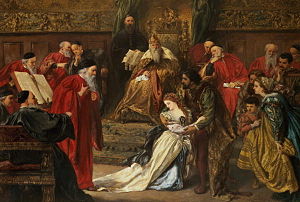
If you read my blog for an extended period of time, or if you listen to my podcasts, or if you’ve taken any of my classes online, then I probably told you the notion that I believe that you could find Shakespearean roots in just about every single work of Western and quite a few of Eastern literature. Shakespeare is ingrained in our culture and therefore a lot of his influence can be felt in almost every bit of media we take in. One of my favorite ways to illustrate this, is by looking at Disney movies, trying to prove that every Disney story is at least a little bit inspired by a Shakespeare play as you’ve seen from my comedy series if Shakespeare wrote for Disney:
I had an enormous challenge on my hands when Disney came out with the new film Encanto. Previously I’ve found it very easy to deconstruct Disney film plots and spot their Shakespearean roots: Pocahontas is Romeo and Juliet by Disney’s own admission, Aladdin is basically the Tempest, Mulan is Twelfth Night, and the Lion King is Hamlet, (as many people have pointed out).
Encanto was really really hard because it is such a fresh and original story. It is deeply rooted in Columbian culture, so trying to defend the notion that it has anything in common with the works of a 400-year-old English male playwright is a tough claim. I don’t mean to suggest that this movie is a deliberate reinterpretation of Shakespeare. That would be insulting and limiting to the breadth of the story. My main purpose with this post is to show how universal and powerful these two stories are- to pay Encanto the compliment that, like Shakespeare, the story transcends cultural and historical boundaries and tells a story we can all relate to, and this is why I am making this bold claim, that Encanto resembles King Lear, albeit with a happy ending.
Mirabelle- the Cordelia of “Encanto”
It was hard for me to realize that Encanto resembles Lear because the Lear character is not the focus of the movie; the focus of the movie is the Cordelia character, Mirabelle. If you’ve read King Lear , then you know that Cordelia is vital to the first 2 scenes of the play, and then goes offstage until Act 4 when where she is reunited with her father in prison, then cures his madness just long enough for her to be hanged. Her death is the darkest, grimmest, bleakest moment that Shakespeare ever wrote. She is the heart of the play and Lear’s failure to listen to her forms the heart of the play’s message; when an older generation clings to power and power or money or status or anything else besides their family, ultimately they suffer tremendously.

In his first line, King Lear says that he wants to give up his kingdom, conferring it to his daughters and their husbands, but what he is really trying to do is to get his daughters to say they love him and to give them the kingdom as a reward.
This deal also has more strings attached; Lear basically says: “Now that I’ve given you my kingdom, you have to house me in your castle with a retinue of 100 knights.” And the only child who really loves Lear and has his best interest in heart is Cordelia, and Lear violently renounces his parental claims on her and banishes her from the kingdom along with her husband the king of France.
The Lear of “Encanto”

So who is the King Lear figure in Encanto? Abuela Alma! Think about it, she is an older person who is spending the whole play clinging and holding on to the power that the Magic Candle gives to her. She spends the whole movie trying to protect the Encanto, and when she mistakenly believes that Mirabelle is a threat, she pushes her away. She rules her other children Papa, Julietta, and Brunowith an iron fist, and she flies into panics and rages whenever anything seems to threaten the safety of the candle. For example, when Bruno gets the magic prophecy that Mirabelle might destroy the house and destroy the Encanto, Abuela refuses to let Mirabelle talk to anybody ever and generally acts in a cruel controlling way.
Look at this passage when Lear rejects his loving daughter Cordelia. Given what I’ve mentioned- the fists of rage, the clinging to supernatural powers, and the controlling demands for loyalty and obedience from his children, whom does King Lear sound like?
Lear:
For, by the sacred radiance of the sun,
The mysteries of Hecate and the night;
By all the operation of the orbs115
From whom we do exist and cease to be;
Here I disclaim all my paternal care,
Propinquity and property of blood,
And as a stranger to my heart and me
Hold thee from this for ever. The barbarous Scythian,120
Or he that makes his generation messes
To gorge his appetite, shall to my bosom
Be as well neighbour'd, pitied, and reliev'd,
As thou my sometime daughter. King Lear, Act I, Scene i.
As Ian McKellen explains in this interview, like Abuella, Lear clings to power, which he derives from supernatural forces, ignores people who care about him, and believes that his authority is absolute:
Trauma and Violence in Encanto and King Lear

Marxist critics believe that Lear’s power is based on violence, (like most medieval kings), and violence is actually connected to Abuela as well. Let’s not forget that the candle was forged after the faceless men with machetes attempted to murder Abuela and her whole village. The candle is Abuela’s power, but it is also a constant reminder of the violence that she escaped. It is also therefore a symbol of her trauma. Perhaps these characters became so controlling, distant, and cold because of the trauma they endured. Lear is supposed to be a king of Britain back in the pre-Christian era of the Anglo-Saxons so he must have seen countless invasions:
The former king says himself that he’s fought in wars with his “Good biting falchion” (a kind of sword). Whether they’ve seen falchions or machetes, these characters have seen violence and want to protect themselves against seeing the pain of it again, and ultimately it is their children that suffer because of it.
In King Lear, the kingdom is ripped apart between the three daughters, and in Encanto, the house is literally ripped apart by the rift between the family and Abuela. Lear foolishly tries to bribe his daughters into flattering him; promising them the kingdom if they demonstrate how much they love him. Therefore Lear demands obedience and love and expects his family to fawn on him as if they were his subjects, not his family.
Lear’s favorite daughter Cordelia refuses to take the bribe, so she says nothing. Lear is enraged and treats this small disobedience like an act of treason:
Arguably Abuella makes the same mistake. She treats her children like her subjects too and exploits their gifts in order to keep the community happy. Her fear of losing her home is the reason she pushes the Madrigals to be indispensable to the community. Think of the psychological and physical pressure Louisa mentions in her song:
As you can see in this video, Lin Manuel Miranda, who wrote the music for Encanto, was actually inspired by Shakespearean verse for the lyrics and rhythms in her song “Surface Pressure.” Whether or not he or the screenwriters were inspired by “Lear,” the fact remains that Mirabelle suffers much like Cordellia. She also can’t stand to see her sister Louisa in pain like this, so she sets out to save her family, which forces her to confront Alma. Much like Lear and Cordelia, Mirabelle and Abuela argue about how her clinging to the past is hurting her family and how the pressure she puts on them is literally ripping their home and family apart:
Sight and Sightlessness in “Encanto” and “King Lear”
Perhaps the biggest connective motif between Encanto and King Lear is the motif of sight and sightlessness. Both Lear and Lord Gloucester are blind to the danger that they’re in and blind to who their real friends and enemies are. Lear trusts his two elder daughters because they flatter him, he trusts his drunken knights who only succeed in getting him forced out of the cold. Conversely, Lear ignores Cordelia. who really loves him, as well as Kent, who is a loyal nobleman to the very end, and he ignores the Fool because he’s a fool. If he had heeded any of their advice he would not have died alone and powerless. Therefore his sightlessness is a deadly weakness.
Gloucester, the other old man character in Lear has another problem with sightlessness and is punished for it figuratively and literally. Gloucester’s bastard son Edmond deceives him into thinking that his legitimate son Edgar is plotting to kill him. The old man sends Edgar away, makes Edmund his heir, and then Edmond betrays him and gets him arrested for treason.
In the play’s most savage scene, Gloucester is tortured and his eyes are literally pulled out of his head. From this moment Gloucester finally sees Edmond’s treachery, and he laments that he “Stumbled when he saw”. Gloucester feels like he is finally able to see clearly now that he is blind, not unlike the ancient Greek tragedy Oedipus Rex. Of course, nothing this gruesome can be shown in a Disney movie but the image of sight is constantly referenced in Encanto visually, and also through the lyrics of the songs. Even the name of the character; Mirabelle comes from the Spanish word ‘mira’ which means “to look”, and the first thing one might notice about her is her brightly painted green glasses, which constantly draw attention to her ability to see.

Mirabelle, like Cordelia, is able to see that her family is in pain, she sees that her family, the Encanto, and the house is in danger, while Abuela is constantly deluding herself and everybody else in thinking that nothing is wrong.
Through the course of the movie, Mirabelle is able to fix the various problems she sees. For instance, she sees that her sister Louisa is taking on too many responsibilities and refusing to admit that she is tired and feels weak. She realizes that her sister Isabella is tired of being the perfect golden child, that her Uncle Bruno is not the monster that the family declares him to be, (however catchy their song about him is).
Through her sight and her perceptiveness, Mirabelle is able to heal the wounds in her family, The last wounds that she heals are the cracks on her house, and her own Abuella’s wounds, the wounds that went deep through her and even deep through her house; she mends the problems that happened the instant that the candle came into being:
Once Mirabelle and Alma reconcile, they set about rebuilding the house in this song. Notice how many times the words “look,” and “see” are mentioned in the lyrics. Mirabelle re-iterates how each person in her family is more than their gifts, more than just the roles Abuella put them in, and they respond by telling her to look at her own gifts and be proud of who she is. She heals them by seeing them as they are, and they heal her by seeing her too.
It was when I realized this that I understood that this movie is what would have happened if King Lear had only listened to the people who really cared about him, and did not succumb to idle flattery. If only he did not let his pain and his trauma dictate the rest of his life. There’s a wonderful hopeful message here that family wounds can be healed if we take the time to see and address them. If you read King Lear and then see Encanto you can see both how these family wounds can be healed, and the tragic consequences if they are not.
I hope that this little post has helped you appreciate both works because they are both magnificent and they are both carefully constructed and they both tell a very simple lesson for all families. As families, we need to recognize our faults, forgive faults in others, and work together to mend the pain and suffering that we experience in our lives. Mirabelle and Cordelia show that we can all be heroes if we see the truth, and speak what they feel not what they ought to say.
FMI
https://www.rsc.org.uk/shakespeare-learning-zone/king-lear/character/analysis#king-lear
Gloucester and His Sons, PBS Learning Media: Shakespeare Uncovered: witf.pbslearningmedia.org/resource/shak15.ela.lit.gloucester/gloucester-and-his-sons-king-lears-subplot-shakespeare-uncovered/?student=true
New Podcast: Disney’s “Encanto” and “King Lear.”

How did Shakespeare Celebrate Halloween?


Let me begin by admitting that this post was harder to write than my Christmas post because pre Christian traditions are harder to pin down. In addition, to give you my standard disclaimer, I don’t believe it’s really possible to definitively know how or if Shakespeare celebrated Halloween, but since the history of Halloween is long and fascinating, and since Shakespeare’s plays influenced that history, I feel it’s worth exploring.
Part I: Origins of Halloween
Almost every culture on Earth has a middle fall celebration that calls to mind the bounty of the harvest, and the inevitable approach of winter. Most of our Halloween traditions are based on the ancient European festival of Samhuin.
What is Samhuin?
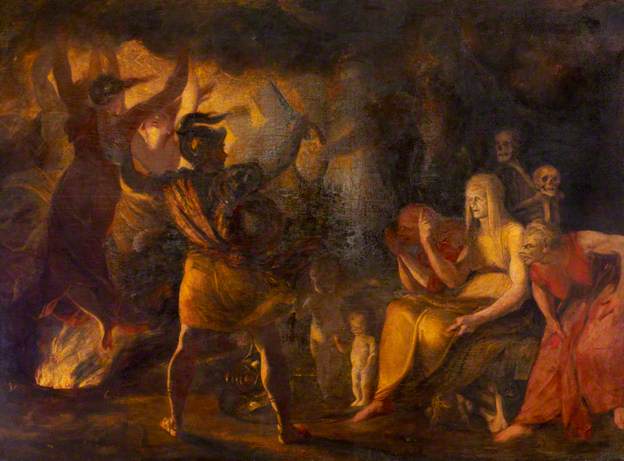
Over 2,000 years ago, the Celts inhabited much of the British Isles. They believed in many gods and spirits that controlled nature and the seasons. To thank the gods for the harvest the Celts gave them offerings like apples, and threw parties to celebrate the gods’ bounty.
When the Romans conquered the Celts, they co-opted some of their religious practices. For instance the tradition of giving apples as offerings to the Roman goddess Pomona. This tradition of course, evolved into our modern Halloween tradition of bobbing for apples. Honoring the harvest also went hand in hand with darker traditions; ones inspired by fear of death, decay, and evil spirits.
With the Sun dying and the Earth growing cold in late October, cultures like the Celts and the Romans feared that evil fairies and ghosts could cross over into our world. In particular the Celts believed that around the night of October 31st, the veil between the living and the dead was the thinnest.
Samhuinn was a liminal time between our world and the Otherworld. It’s a night when the souls of dead loved ones as well as spirits and fairies – the aos sí in Irish mythology and aes sídhe or sìth in Scottish mythology – could come through to visit. Deceased family members were honoured with seats at the evening feast, and offerings of milk and baked goods were left at the front door for the Fairies.
At some point people decided to dress up as the spirits to ward them off, and this evolved into our modern day trick or treating.
These traditions did not die once England became Christian, (after it was conquered by the Romans), they simply translated into a different form. Halloween actually translates as “All Hallows Eve,” a Catholic celebration of of dressing up as pagan spirits and giving offerings of the harvest to honor Catholic saints as well as departed love ones.
Part II: What might Shakespeare have Done on Halloween?
Although Shakespeare never directly mentions Halloween, he lived in a world that kept many of these folk traditions alive. Shakespeare was the grandson of a farmer and his father was a devout Catholic, so he probably was brought up in these ancient Halloween traditions. He probably would have attended some kind of harvest festival to celebrate the bounty of the summer, and might have put food out for his departed family members.
Samhain is still heralded by the baking of kornigou, cakes baked in the shape of antlers to commemorate the god of winter shedding his ‘cuckold’ horns as he returns to his kingdom in the otherworld. On the Isle of Man in the Irish sea, the Manx celebrate Hop-tu-Naa, which is a celebration of the original New Year’s Eve and children dress as scary beings, carry turnips and go from home to home asking for sweets or money.
Source: https://theancientweb.com/2010/10/the-origins-of-halloween-part-1/
Call me a softie but I really like the idea of Shakespeare baking treats like soul cakes for neighborhood kids or telling scary stories about a bonfire. The kornigou is more commonly known as the Soul Cake, and it’s still popular today. It’s even been immortalized in song:
You can even make it yourself: www.cardamomdaysfood.com/recipe/soul-cakes/
Another tradition was dancing around ancient Celtic burial mounds. According to tradition, these mounds were home to spirits and Fairies, and could be portals to the land of the dead. In Irish folklore, poets and storytellers had the power to pass between these two realms. Maybe Shakespeare himself visited such a mound in his youth and was inspired to write about the fairy queen Titania and the hobgoblin Robin Goodfellow. Archeologists are still learning about these ancient ruins today (source: Smithson.com)
• Theater
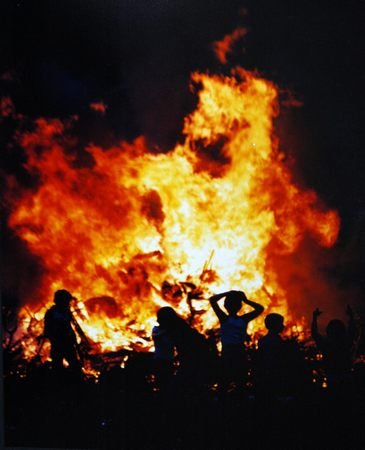
The most tantalizing ancient Halloween tradition is mumming, a kind of amateur theater practiced by the ancient Celts. Like modern Sunday school plays the plays were a religious ritual designed goal to honor the gods and the harvest.
Mumming, a type of folk play, was used to tell traditional Samhuinn stories about battles or the winter goddess Cailleach (meaning “old hag”), who began winter by washing her hair in the whirlpool of Corryvreck.
For a modern example of this of these traditions you can look at the Edinburgh fire festival which preserves the kind of mumming that the Celts might have done on Samhuin and Shakespeare might have seen. It’s highly ritualistic, immersive, and the characters have spooky similarities to some of Shakespeare’s plays.
To give you an idea of how mumming might have influenced Shakespeare, watch this trailer for the 2017 Edinburgh Fire Festival:
• What you can see in the trailer:
1. Keening- the wild women screaming as a way to lament, honor, and guide the dead. Characters like Constance in King John have many similar qualities.
2. The fight between the Summer King and the Winter Lord. Many Celtic stories dramatize the change of seasons from summer to winter as a battle. Even the duel between King Arthur and his young son Mordred could be seen in this context. In another interesting interpretation, Jennifer Lee Carroll in her book Haunt Me Still, interprets this mummers play as a pagan retelling of the story of Macbeth.
3. You can see brightly colored figures some designed to honor the changing of the seasons, and wild, animalistic people, presumably playing the roles of the Fairies, goblins, or other creatures that appear on Samhuin. It’s not much of a stretch to see these figures as the Fairies of Midsummer Night’s Dream, or the witches of Macbeth.
Part III: What did Shakespeare mention about Halloween?

Ghosts appear in five of Shakespeare’s plays. We see reference to all kinds of Fairies, goblins, and spirits and even a couple times people dressing up to ward off evil. In Titus Andronicus, the queen of the Goths disguises herself and her sons as spirits of revenge and go to Titus’ house to torment him, and then the old man Titus tricking them into coming to his house, where he takes his revenge.

One Shakespeare play that I think perfectly encapsulates the Halloween traditions of the English countryside is Merry Wives Of Windsor, specifically the scene in which Falstaff is tormented by a ghost story.
In the play, the fat, drunk knight Sir John Falstaff has been trying to seduce two married women, Mistress Page and Mistress Ford. Page devises a plan to scare and humiliate Falstaff, by dressing up her husband as the terrifying ghost of Herne the Hunter:
• 4.4 MISTRESS PAGE
• There is an old tale goes that Herne the hunter,
Sometime a keeper here in Windsor forest,
Doth all the winter-time, at still midnight,
Walk round about an oak, with great ragg’d horns;
And there he blasts the tree and takes the cattle
And makes milch-kine yield blood and shakes a chain
In a most hideous and dreadful manner:
You have heard of such a spirit, and well you know
The superstitious idle-headed eld
Received and did deliver to our age
This tale of Herne the hunter for a truth.
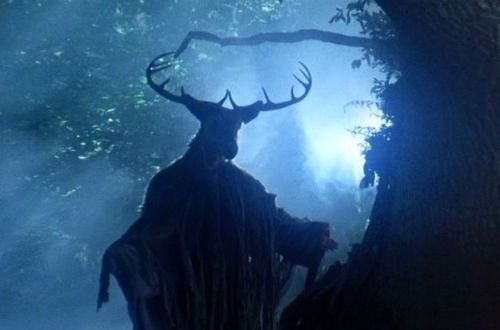
Herne the Hunter is a real medieval legend about a man who was hanged for poaching deer in Windsor park and now haunts the forest with horns on his head. Not only does Master Ford dress as Herne, The witty housewives dress the neighborhood children like Fairies and instruct them to pinch the fat knight and burn him with lit candles. Essentially this scene is a Shakespearean trick or treating moment with a ghost story to boot. Plus as Mistress Page mentioned, the ghost haunts Windsor towards the the oncoming of Winter, so it’s not entirely unlikely that it would be that this scene was originally played around the time of Halloween.

How did Shakespeare contribute?

Scholars describe Shakespeare’s mind like a magpie, taking myths, legends, history, and books to come up with his own plays. As you have seen, the ancient traditions of Halloween had a powerful effect on Shakespeare’s plays. But, did he contribute to those traditions himself? I would say yes in a big way. First of all the image of Hamlet holding a skull has inspired many other Halloween images:

David Tennant in Hamlet, RSC 2008
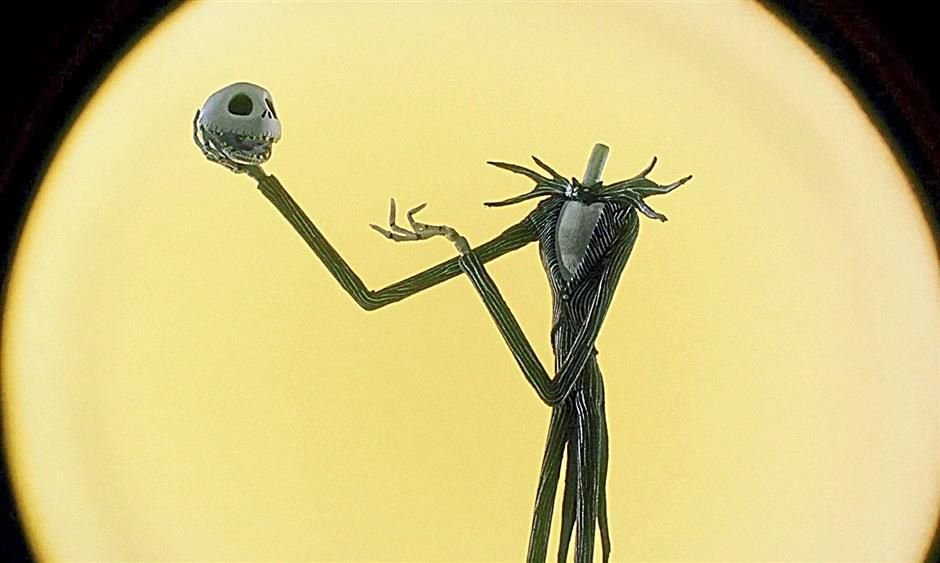
Jack Skellington in The Nightmare Before Christmas, 1993.
But I think Shakespeare’s greatest contribution to how we celebrate Halloween are centered within the witches of Macbeth.

Though Shakespeare by no means invented the concept of witchcraft, he did popularize the idea of the wicked witch, and helped form our modern view of what a witch is. The image he created in Macbeth

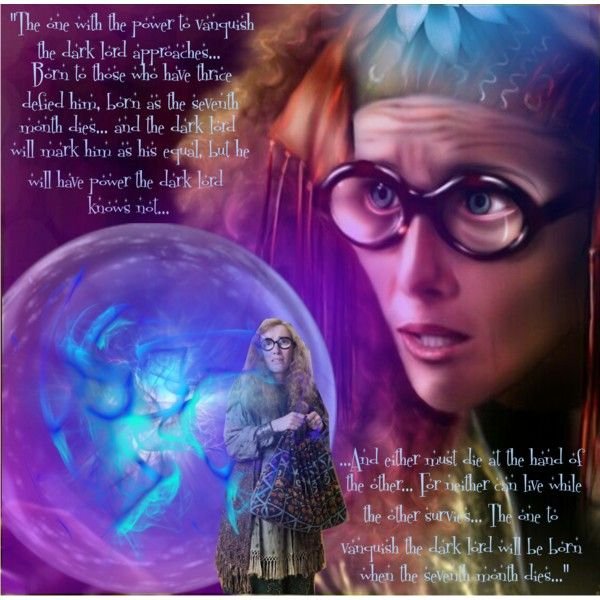
More than that, I would argue that the modern wicked witch would be all but silent without Shakespeare. When you think of what a witch might say, besides a series of high pitched cackling, what do you think of? Probably you think of this:

Or this:

Shakespeare’s bizarre and cryptic language helped inspire countless other interpretations of witches, and thus, a way for audiences to deal with the temptations that lurk in our hearts.



In conclusion, we don’t know how Shakespeare celebrated Halloween or even if he did to begin with; Halloween and Shakespeare’s life are both frought with mystery and legend, but one thing is dead certain; Halloween would not be the same without him. He absorbed the ancient rituals of the Celts and Romans and crafted some modern Halloween ideas and images that endure to this day.
Sources
https://www.historic-uk.com/CultureUK/Halloween/
https://www.bbc.co.uk/newsround/15169373
Thanks very much for reading! If you liked this post, please consider signing up for my new “Macbeth” online class via Outschool.com. One really fun part of the class will be an escape room where you use your knowledge of Macbeth to escape a cursed castle:

How Game Of Thrones is like a Shakespearean Play
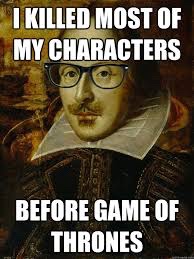
I love Game Of Thrones! If you’ve ever read the books or seen the series on HBO, like me you might be amazed by the scale and complexity of the world author George RR Martin created. He wove together a rich tapestry of medieval history, legends, and yes, Shakespeare. He used some of Shakespeare’s plots, commented and expanded on his themes, and adapted some of his iconic characters into a very rich and in a way, very modern story. Today I’m going to examine the components of Martin’s narrative that he embroidered off of Shakespeare’s plots, themes, and characters. If you like my take on this, or if you disagree, please leave a comment below! If you have any suggestions for other popular works adapted from Shakespeare, let me know and I’ll review them on the blog!
Part I: Story
Shakespeare wrote four plays that chronicle a series of civil wars where powerful families battled each other for the crown of England. Like Game of Thrones, the conflict was mainly between the kingdoms in the North and South:
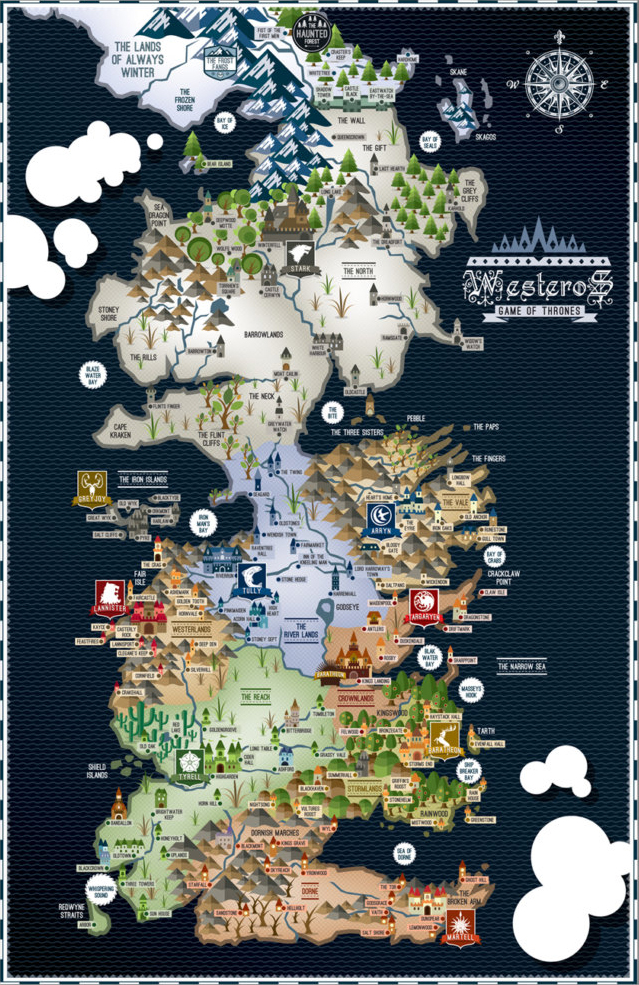
Shakespeare’s three parts of King Henry VI and Richard III chronicle the real struggle between the Yorkists in the north to take the crown from the Lancastrians in London in the South.

Part II: Themes
Power corrupts, especially those who go seeking it.
The death of chivalry and honor in favor of political backstabbing.
King Henry VI has a speech where he watches a great battle while sitting on a molehill, watching the tide turn back and forth between his soldiers and the Yorkists. As with Game Of Thrones, the more blood each side has on its hands, the harder it becomes to decide whom to truly root for. In the end, it doesn’t seem to matter- kingdoms are won and lost as arbitrarily as a game. All it takes is time, and a good player to win.
The silence of the Gods. Shakespeare’s King Lear is constantly making oaths to his gods and asking them to punish his enemies. Likewise, Lear’s friend the Duke Of Gloucester, places his faith in the gods to protect Lear and punish the usurpers Goneril and Regan. Nevertheless, the action of King Lear doesn’t show any kind of divine judgement- Lear is exiled, goes mad, is sent to prison, and finally dies. Gloucester loses his sight, his lands, and dies randomly right after he is re-united with his son Edgar. In both King Lear and Game Of Thrones, there is a persistent question as to the nature of the gods, or even the surety of their existence.

James Barry, c. 1786.
No where is this more apparent than at the end of the play King Lear, when, just as it seems that the Duke of Albany is about to reward the good people and punish the wicked, King Lear arrives howling, with the dead Cordelia in his arms. “Is this the promised end?” in horror at the gods’ apparent cruelty. https://youtu.be/7acLWsal1FU
In Game Of Thrones, the good characters pray to their old gods and new, but never seem to hear from them or sense their influence. Osha, the Wildling even suggests that the gods have no power in King’s Landing, where the special God’s Wood trees have been cut down.
Part III: Characters
Below is a list of my favorite GOT characters, with my interpretation of their Shakespearean roots.

Ned Stark- Humphrey Duke of Gloucester from Henry VI, Part II
Duke Humphrey is a Yorkist from the north of England, just as Ned is Lord of Winterfell, a powerful kingdom in the north of Westeros. King Robert makes Ned Protector Of the Realm when he dies, which makes him king in all but name, and tasked with taking care of Robert’s young son Joffrey until he comes of age.
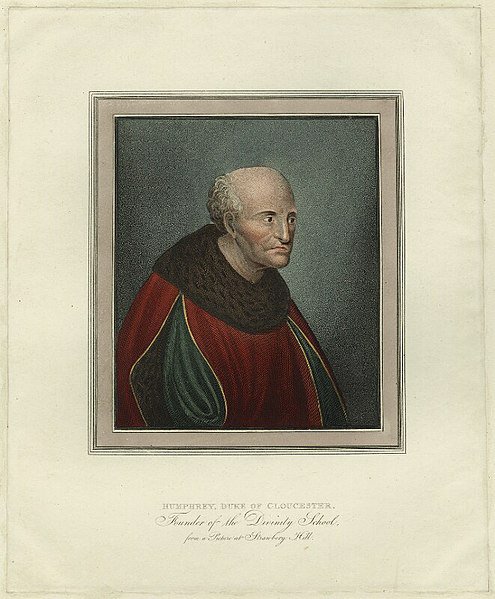
In Shakespeare’s Henry VI trilogy, King Henry the Fifth makes his brother Humphrey Lord Protector before he dies, to take care of England until his infant son Henry VI comes of age to rule. Like Ned, Humphrey is loyal, blunt, and only interested in keeping the realm at peace. In both Westminster and the Red Keep, all the lords are conniving and ambitious, and only interested in advancing themselves politically. These two lord protectors are the only ones with the good of the kingdom in mind.
Both Ned and Humphrey are betrayed and executed by those ambitious lords around them for the same reason; they stand in the way of the lords in their quest for power. In Henry VI, Part II, Henry’s ambitious queen Margaret starts a smear campaign against Humphrey’s wife, then pressures the King to force Gloucester to resign. As if that weren’t enough, Margaret also secretly conspires to murder the noble duke. Similarly, In Game of Thrones (Spoiler Alert), queen Circe puts her son on the throne and proclaims Ned a traitor. In both cases though, once the Lord Protector dies, the whole kingdom erupts in fights and arguments for the crown on all sides.
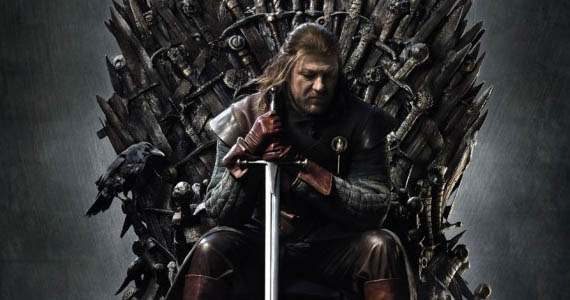
Ned Stark also resembles the heroes of Shakespeare’s Roman plays. He is cold and stoic as Brutus, and a devoted soldier like Titus Andronicus. Ned’s dire wolf is another connection with Shakespeare’s Roman plays; the wolf 🐺 is the symbol of the Roman Empire; packs of cold hunters who depend on each other for the survival of the family.
King Joffrey- Saturnine from Titus Andronicus– Joffrey is like the worst kind of tyrant- rash, proud, violent, and cruel. He lacks the maturity to make wise decisions and because of his privileged upbringing, he takes even the tiniest slight against him as an act of treason, and leaves a trail of heads in his wake. Worse still, he is easily manipulated by his mother Circe, who teaches him to act and feel superior to everyone else, and never care for the good of anyone but himself. In that way, he is very much like a Roman Emperor like Nero or Caligula, the real people whom Shakespeare adapted into the character of Emperor Saturnine in his play Titus Andronicus.
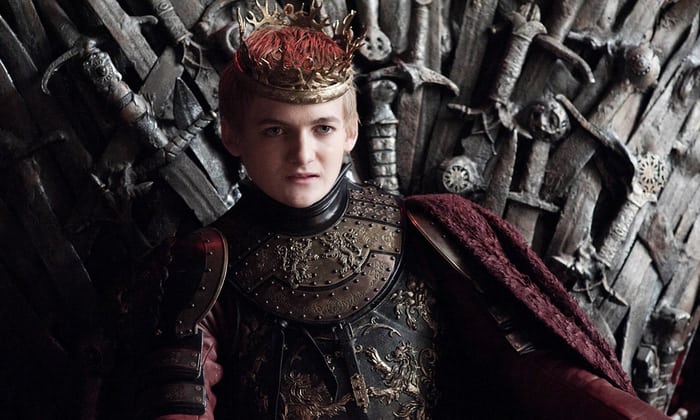
When we first meet Saturnine, he leads an angry mob into the streets of Rome, demanding to be made emperor, and threatening all out war if he doesn’t get his way. He also turns on the loyal soldier Titus, (who helped him win a war and win his crown), just because Titus wouldn’t give Saturnine his daughter in marriage. In the clip below from the 1999 movie Titus, Emperor Saturnine (Alan Cummings) is furious just because Titus wrote some mean scrolls about him, after Saturnine killed two of Titus’ sons, and banished a third.
King Robert Baratheon- Edward IV from Richard III.

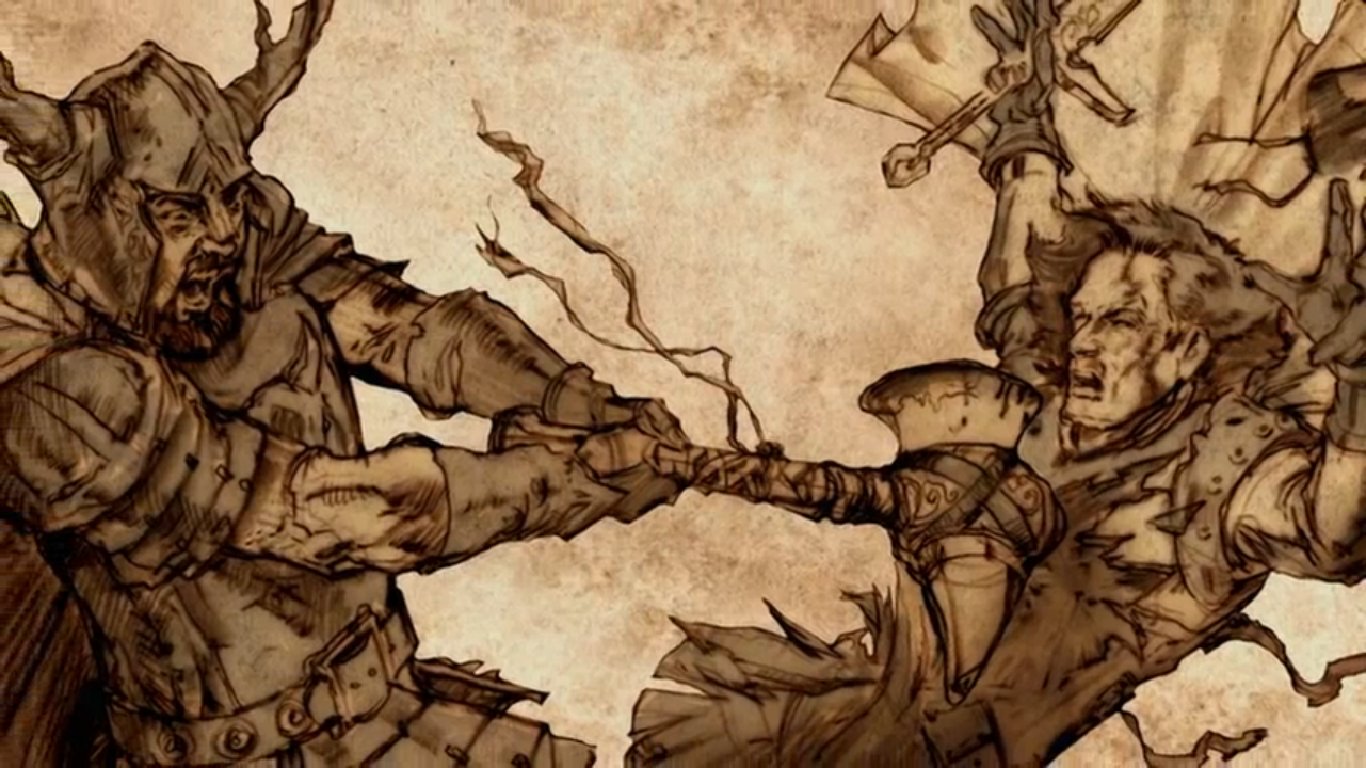
◦ In the first book of the Game of Thrones series, Robert is the King of the Seven Kingdoms, having won a civil war to take it away from the Mad King Araes Targaryen. Edward in the play Richard III has just won the crown of England after a civil war against the mad King Henry VI. Both men were powerful warriors and used to be strong and handsome. People loved and feared him, but now the pressures of keeping the throne has literally consumed them.
P. 53
Next had come King Robert himself, with Lady Stark on his arm. The King was a great disappointment to Jon. His father had talked of him often: the peerless Robert Baratheon, demon of the Trident, the fiercest warrior of the realm, a giant among princes. Jon only saw a fat man, red-faced under his beard, sweating through his silks.
Jon had noticed that too. A bastard had to learn o notice things, to read the truth that people hid behind their eyes. Two seats away, the king had been drinking heavily all night. His broad face was flushed behind his black beard.
In this passage from Thomas More’s History Of Richard III, (Shakespeare’s primary source for the play), More chronicles how Edward went from a handsome young king, loved and feared by all, into a gluttonous, lecherous, sick old man, who was consumed by care.
He was a goodly personage, and very princely to behold: of heart, courageous; politic in counsel; in adversity nothing abashed; in prosperity, rather joyful than proud; in peace, just and merciful; in war, sharp and fierce; in the field, bold and hardy, and nevertheless, no further than wisdom would, adventurous. Whose wars whosoever would well consider, he shall no less commend his wisdom when he withdrew than his manhood when he vanquished. He was of visage lovely, of body mighty, strong, and clean made; however, in his latter days with over-liberal diet [1], he became somewhat corpulent and burly, and nonetheless not uncomely; he was of youth greatly given to fleshly wantonness, from which health of body in great prosperity and fortune, without a special grace, hardly refrains. This fault not greatly grieved the people, for one man’s pleasure could not stretch and extend to the displeasure of very many, and the fault was without violence, and besides that, in his latter days, it lessened and well left.
-Thomas More, History Of Richard III, c. 1513
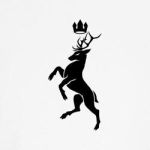
There are also similarities in how the characters died. King Robert was killed by a wild boar, while King Edward was killed by his brother Richard, whose sign was a white boar. As a bonus, the stag that is the sigil of House Baratheon, is also the seal of King Richard II, the king who, in the Shakespearean tragedy that bears his name, started the civil war when he was murdered in the Tower Of London. Below is a picture of the famous Wilton Diptych, (Richard the Second’s private alter piece), which depicts the king and all the angels in heaven wearing a badge with a white stag on it.

I’m not actually the first person to mention this connection between Robert Baratheon and Edward IV. In the British newspaper, The Guardian, the author compares several characters from Game Of Thrones, to historical English events: https://www.telegraph.co.uk/tv/0/game-of-thrones-vs-history-which-real-characters-and-events-insp/robert-baratheon-and-edward-iv/
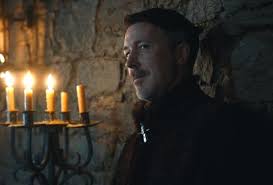
Little Finger -Lucio from Measure For Measure, Iachimo from Cymbeline, Bawd from Pericles, etc. Shakespeare has a host of character like this lord of Westeros, the Master of Coin. He is cowardly and cynical, but he is also very clever and understands people’s weaknesses, especially sex. Like Bawd from Pericles, Little Finger has grown rich off brothels, and like many real life governments, he turns his prostitutes into spies. This gives him not only cash, but dirt on every lord in the 7 kingdoms. He only worries about Ned Stark, (who can’t be bought), and Vares the eunuch, who can’t be seduced. Little Finger is basically an oily politician and exploits the power of lust in the men of King’s Landing.
Jon Snow– Edgar and Edmund in King Lear Philip the Bastard in King John.
◦ Snow is the illegitimate son of Ned Stark. He’s aware of what he is, so he joins thieves and rapers as a knight of the Night Watch to make a life for himself, just as Edgar becomes a mad beggar in King Lear once he is accused of attempted murder. He has few illusions and like all the base-born children in Shakespeare:
775
He was who he was, Jon Snow, bastard oath breaker motherless, friendless, and damned. For the rest of his life, however long that might be- he would be condemned to be an outsider, the silent man standing in the shadows who dares not speak his true name.”
◦ Shakespeare wrote several characters born out of wedlock such as Phillip Falconbridge in King John, and Edmund from King Lear.

Unlike Jon Snow, Edmund in King Lear uses deceitful and cruel cunning in order to advance his position in life. Snow doesn’t try to change the rules, but both of them know that no one is going to give them anything. Early in book one, Jon learns to accept the cruelty of the world, and to accept what he is:
Let me give you some council, bastard, never forget what you are, for surely the world will not. Make it your strength. Then it can never be your weakness. Armor yourself in it, and it will never be used to hurt you.
Song Of Ice And Fire, p. 57.
🦁 Tyrian Lannister –
Obviously he shares some parallels with Richard III, with his small size and the fact that he is the most hated member of a powerful family. In fact, Peter Dinklage who plays Tyrion played Richard the Third back in 2004.
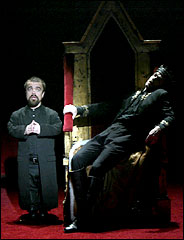
In terms of his personality however, Tyrion has neither the cruelty, nor the bitterness of Richard. For this reason, I would argue that Tyrion more closely resembles Sir John Falstaff.

◦ Like Falstaff, Tyrion laughs at his physical form as a way of disarming his enemies.
◦ Both Characters are famous for talking their way out of anything.
◦ Both characters are down on their luck for most of the books
Both characters are, ahem, fond of drink. Falstaff even has a beer named after him:
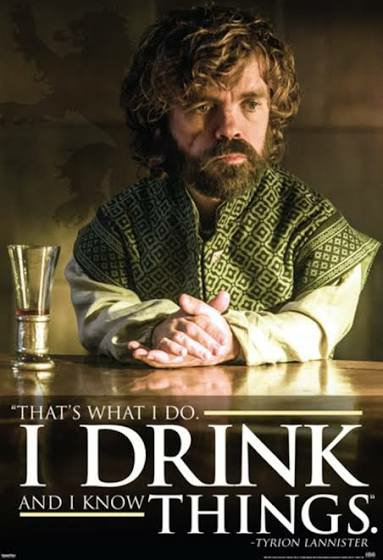

◦ Most Of all, Tyrion and Falstaff are survivors – they will do anything to stay alive, good or bad. They are also unapologetic about acting cowardly and deceitfully to avoid death. In Falstaff’s famous ‘Catechism speech,’ he mocks the concept of honor and how it frequently gets men killed.
FALSTAFF
‘Tis not due yet; I would be loath to pay him before
his day. What need I be so forward with him that
calls not on me? Well, ’tis no matter; honour pricks
me on. Yea, but how if honour prick me off when I
come on? how then? Can honour set to a leg? no: or
an arm? no: or take away the grief of a wound? no.
Honour hath no skill in surgery, then? no. What is
honour? a word. What is in that word honour? what
is that honour? air. A trim reckoning! Who hath it?
he that died o’ Wednesday. Doth he feel it? no.
Doth he hear it? no. ‘Tis insensible, then. Yea,
to the dead. But will it not live with the living?
no. Why? detraction will not suffer it. Therefore
I’ll none of it. Honour is a mere scutcheon: and so
ends my catechism.
Now observe this passage where Tyrion reacts to the death of a noble knight who was foolish enough to wear armor while crossing a river on a raft.
“Good my lord,” the messenger said. “Lord Brax was clad in plate-and-mail when his raft overturned. He was so gallant.” “He was a fool,” Tyrion thought, willing his cup and staring down into the wind depths. Crossing a river at night on a crude raft, wearing armor, with an enemy waiting on the other side–if that was gallantry, he would take cowardice every time. Song of Ice and Fire, 765.
My favorite part of the books is the way Martin writes the female characters. All the female characters are dealing with the fact that women have very little power or say in their society and they all use Shakespearean means or methods to get what they want.
🦁 Circe- Tamara and Lady Macbeth
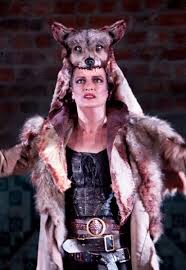
◦ Circe
Just as her son Joffrey has the arrogance and sadistic cruelty of a Roman emperor, Circe is a mirror image of the cruel empress Tamara, Queen Of Goths in Titus Andronicus. Both women are attracted to power and motivated by revenge. Tamara wants revenge against General Titus, who executed her son in the war. After seducing and marrying the emperor, she uses her influence to execute two of Titus’ sons. She then uses her lover Aaron the Moor (with Whom she secretly has a child), to concoct a plot to rape and mutilate Titus’ daughter. And if that weren’t enough, she tries to drive him mad by appearing at his home dressed as the Roman goddess Revenge. In short, Tamara is a classic femme fatale, who raises above the social oppression of her sex by seducing powerful men, and stabbing them in the back.
Circe is also a femme fatale, though Martin gives her more time to explain her motivations than Shakespeare gives Tamara. Like the Queen Of Goths, Circe marries King Robert Baratheon, while secretly having a taboo affair, this time with her brother Jamie. The difference is that Circe kills not strictly for vengeance, but mainly to conceal the fact that her son Joffrey is actually the product of her incest in order to protect him and eventually make him king. This is why Circe kills Ned Stark, Jon Aron, and consents to the murder of all or Robert Baratheon’s true born sons.
Circe does desire revenge, but not against anyone in particular. Instead, she wants to repay the patriarchy that keeps her down simply because she is a woman. Quote about Circe when she talks about how jealous she is of Jamie. In that chapter we get a great sense of who Circe really is. Because she’s a twin, she compares herself to her brother, observing how Jamie was given on her glory and respect when he became a knight and a member of the King’s Guard, while she was sold off to king Robert at the age of twelve like a slave or a common whore. Why, Circe asks, if she looks so much like him and acts so much like him, is she treated so differently just because she’s a woman? In a perverse sort of way, her incest might be a misguided attempt to claim part of Jamie’s honor and power through sexual conquest. Both Tamara and Circe show how an oppressive patriarchy can plant truly destructive thorns in the hearts of women, and these two queens reap that bitter harvest by cutting down the men in power one by one.
like camera Circe is driven by her love for her children and her desire and her pride and desire for vengeance. She spends the first half of the place seducing the emperor to gain his favor and then when she is made empress she uses her power to systematically destroy Titus and his family. Similarly, Circe marries king Robert and then when he dies she makes her son she then kills Ned Stark guy in prisons his daughter tries to kill the second of and
Catelyn-

Hermione From The Winters Tale ❄️ 🐺
◦ Pious
◦ Kindness and mercy are her weapons as well as her will and devotion to her friends and family. Even Tyrion is impressed by her integrity.
🐺 Aria- Imogen from Cymbeline
◦ If it’s a mans world, pretend you are one! She learns to use a sword ⚔️ and uses her small size and gender to sneak away from her enemies.
🐉 Daenerys Targaryen- Cleopatra!
◦ Crafty and beautiful
◦ Uses her sexuality to gain a powerful man’s protection
◦ Her dragons 🐉 make her a goddess, elevating her beyond a woman and even a queen. In a society that opposed and ignored women, female monarchs needed to practically deify themselves in order to get the same respect as their male counterparts.
Just as the real Cleopatra claimed to be a descendant of the goddess Isis and Elizabeth I was part of the cult of the virgin queen, The Mother Of Dragons has a mythic power that commands fear and adoration.
Spoiler Alert
In the final chapter of book one, Daenerys tries to simultaneously say goodbye to her warrior husband Khal Drogo, and to get her few remaining soldiers to swear loyalty to her. She dresses him, she braids his hair, she puts him atop a pyre, and waits for a star to pass overhead to give his funeral a cosmic significance:
“This is a wedding too.”
The pyre shifted and the logs exploded as the fire touched their secret hearts. She could hear the screams of frighten horses and the voices of the Dothraki. “No,” she wanted to shout to him, “No my good knight, do not fear for me. The fire is mine. I am Daenerys Stormborn, daughter of dragons, bride of Dragons, Mother Of Dragons.”
This mirrors how, once Cleopatra loses Antony and knows that the Romans are coming to capture her, she says goodbye to Antony, and asserts herself as queen.
CLEOPATRA
Give me my robe, put on my crown; I have
Immortal longings in me: now no more
The juice of Egypt’s grape shall moist this lip:
Yare, yare, good Iras; quick. Methinks I hear
Antony call; I see him rouse himself
To praise my noble act; I hear him mock
The luck of Caesar, which the gods give men
To excuse their after wrath: husband, I come:
Now to that name my courage prove my title!
I am fire and air; my other elements
I give to baser life.
Have I the aspic in my lips? Dost fall?
If thou and nature can so gently part,
The stroke of death is as a lover’s pinch,
Which hurts, and is desired. Dost thou lie still?
If thus thou vanishest, thou tell’st the world
It is not worth leave-taking. Antony and Cleopatra, Act V, Scene ii.
Dany does the same thing. She lights the pyre to help her husband ascend to the heavens, taking his place among the stars. Then, she sits on top of the pyre along with her three dragon eggs. Miraculously, she survives the fire and the dragons hatch, thus establishing her as the true heir of House Targarean and the Mother Of Dragons.
After witnessing the queen embracing her serpentine children, the blood riders that swore oaths to defend her husband swear again to defend her, promising to help her win the Iron Throne. Her power to command loyalty can win her the throne, and unlike Robert, keep it!
There are enough comparisons between Shakespeare and GOt that one playwright even adapted Shakespeare to resemble a Game Of Thrones story. Below is a poster of
Play Of Thrones, an adaption Of The Henry VI plays that, as I’ve mentioned, are full of characters and scenes similar to Game Of Thrones:
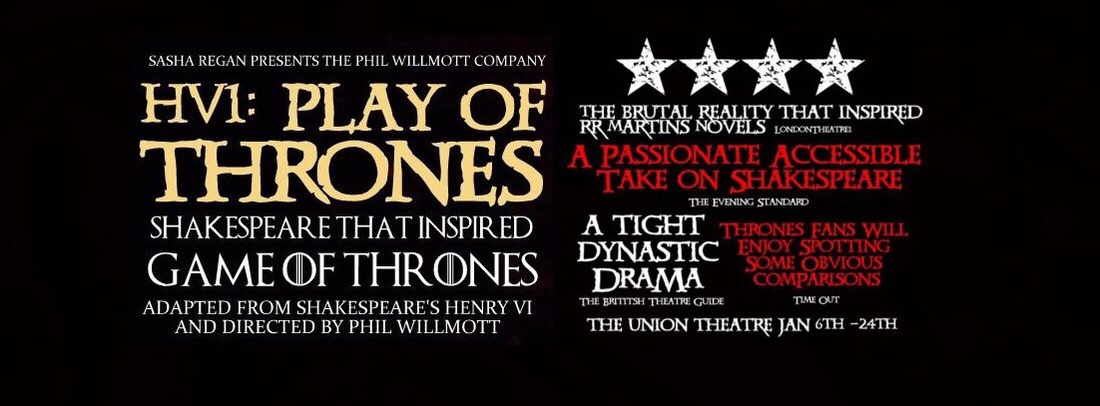
http://philwillmott.org/play-of-thrones-shakespeare-that-inspired-game-of-thrones.html
In conclusion, these two works prove that Shakespeare has a timeless appeal that has inspired countless writers to adapt his stories and characters.

Ira Glass Backtracks From “Shakespeare Sucks” Tweet.
I just saw on the “Tonight Show” a clip where Ira Glass from NPR retracts his statement on Twitter a week ago that “Shakespeare sucks,” after seeing a production of Shakespeare In the Park. Glass said to Jimmy Fallon that he immediately caught heat on the internet “Apparently Shakespeare has a huge internet presence.” To that i say, “Good job Shakespeare nerds!” As Fallon pointed out, Shakespeare is a rallying symbol to all smart people, and that’s why we need to defend him.
Enjoy this video, and enjoy watching Ira squirm.
By the way, if you’re interested in seeing John Lithgow in King Lear, here’s the official website: http://www.publictheater.org/en/Tickets/Calendar/PlayDetailsCollection/SITP/King-Lear/
Announcing The Best Fathers In the Shakespearean Cannon

Announcing The Best and Worst Fathers In the Shakespearean Cannon
Podcast Link: https://www.buzzsprout.com/45002/282555-the-shakespearean-student-episode-5-the-best-dads-in-the-shakespearean-cannon
Shakespeare himself was a father, and he frequently wrote about the dynamic between fathers and their children. There are many different types of fathers in Shakespeare’s 40 plus plays, and this week I’m ranking them in terms of three categories: Good Dads, Bad Dads, and “Dad Dads.” You’ve probably already read the “Worst Dad” post, so now we’re looking at the good, and the not so good. I used the following criteria when choosing the top 5 dads in each categories:
The Good Dads
- Are supportive for their kids
- Try to keep their children happy
- Offer help and advice, especially on their children’s future.
- Are willing to sacrifice themselves
- They let their children become their own people.
The Bad Dads
- Treat their children as property
- Have little to no interest in their children
- Put their children in danger
- Subject their children to abuse
- In some cases, they murder them!
The “Dad” Dads
- Are basically good hearted, but they have some kind of flaw that prevents them from becoming really good parents.
- In my view, are the most human, modern dads on the list.
- I’ve chosen to award these dads a necktie, something every ok dad needs.
Now, onto the Dad Dads:

5. Aegean from The Comedy Of Errors. Aegean wonders around for 20 years looking for his lost children, which I call devoted parenting, but a little aimless and undisciplined. I therefore award Aegean two ties with little anchors on them, to remind him to stay in one place and wait for his sons to find him!

4. Lord Talbott from Henry the Sixth Part I. Talbott is the hero of the English fight against the French at the close of the Hundred Years War. He goes toe to toe with Joan of Arc on numerous occasions. He also raises a fine and valliant son, John Talbott who is also a warrior. The two die bravely in a siege against the French, rather than surrendering, or leaving the other to die. Talbott is clearly also devoted to his child, but his career choice doesn’t allow his son to grow up in a safe environment! I therefore award Talbott two ties with little English and French flags on them.

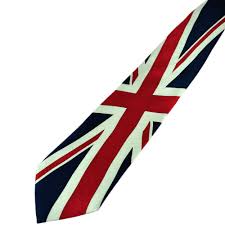

3. The Ghost Of Hamlet’s Father from Hamlet/ Portia’s Dad from Merchant Of Venice. Both these parents die before their plays begin, yet they still try to improve their children’s lives from beyond the grave! The Ghost helps Hamlet become king of Denmark, and Portia’s dad tries to help her find a good husband, (one who will love her for something besides her beauty or riches). Although these parents achieve their goals, waiting this long to help their kids seems a bit like absentee parenting! I therefore award these posthumous parents ties with little skulls on them.


2

. King Henry IV, from King Henry IV King Henry is the classic career dad, one who wants his son Hal (the future King Henry V), to follow in his footsteps. The two have a terrible fight when Henry thinks Hal is trying to steal his crown on his deathbed! Eventually though, father and son reconcile, and dad even gives the future king some last minute advice; if you fight a war with France it’ll help secure your crown, which Hal does and succeeds! I therefore award King Henry a tie with little crowns on it, hoping that nobody with a dagger ties tries to steal it when he’s sleeping!

1. Prince Pericles from Pericles Pericles is another busy dad- King Antiocus tries to murder him, and he has to leave his own kingdom. Then he gets shipwrecked 3 times! In fact, his only daughter is born onboard a ship in the middle of a storm! Pericles raises the girl for a number of years, but then has to leave again, and guess what, he gets shipwrecked AGAIN! He eventually finds his daughter and they live happily ever after, but you kind of get the idea that Pericles is a little accident-prone, which keeps him from being on the Best Dads list. Sorry Pericles, but at least you get a tie with, what else, Boats on it! Maybe next Fathers Day, someone will get you a life preserver.

And now at Long LAST, the BEST Dads in Shakespeare!

5. Aaron the Moor from Titus Andronicus. Ironically, one of the worst villains in Shakespeare is also one of the best fathers. Aaron is fiercely protective of his child, even threatening people at sword point if they dare come near his baby. He also plans out the child’s future and is willing to give his own life for a promise that Lucius will protect and nourish his son. He may be a monster to everyone else, but to his baby, Aaron is simply, a good dad!
4. The Old Shepherd from The Winter’s Tale. This character is a very mirror of generosity and kindness; not only does he take care of his son The Clown, he adopts a poor discarded child, the princess Perdita, with no obligation to do so. He raises her for 16 years and constantly brags about her to the entire town. She becomes a beautiful, wise, and modest girl who fills her adopted father with pride because of his good parenting. Even when Perdita meets her real father, she speaks of The Old Shepherd with real filial affection “Oh my poor father.”
3.
Lord Capulet, from Romeo and Juliet. I know this was a controversial choice, and I discuss my choice in detail on my podcast, but I’ll sum up my major arguments here:
- Even though a lot of actors choose to have him smack Juliet around, there’s no mention of it in Shakespeare’s text. The most he ever does is threaten to strike her, but the stage directions never indicate he does it. Capulet is clearly more bark than bite.
- From the very beginning of the play, Capulet has shown that he cares about Juliet, and wants her to marry for love, not money.
- Lord Capulet hovers and frets constantly when Juliet tells him she will marry Paris, staying up late to plan the wedding! I ask you, does that sound like a tyrannical father? I wonder sometimes if Lord Capulet would’ve forgiven Juliet for marrying Romeo if she had just told him. In any case, based on my criteria above, Capulet is a good dad, bad tempered, yes, but fundamentally concerned for the welfare of his children.

3. Prospero from The Tempest I chose this high spot for Prospero mainly because he seems to have the most success of any other dad in the cannon. Like Pericles, he too is shipwrecked with his daughter, but Prospero stays with Miranda, raises her alone, teaches her everything she knows, and calls her an angel that helped preserve his life. Prospero cares so much for his daughter that he refuses to give into despair, even though he’s lost his wife, his dukedom, and his home.
Prospero also hatches a plan to get him and Miranda off the island, to get his dukedom back, and to get her married to a handsome prince name Ferdinand, and he succeeds with every one of these endeavors, even though it takes 12 years. Prospero gets extra points for his patience and his wisdom, but I have to admit he’s a bit of a control freak; he demands that Miranda listen to him and obey him no matter what, and he warns Ferdinand that there will be dire consequences if he dare try to do anything illicit with his daughter before the wedding. In addition, there’s no denying that Prospero is also acting out of self interest- he wants to become duke again, and he wants revenge against his enemies and that’s partially why he raises a tempest, (or a huge storm), instead of just sending a message back to Milan.
1.
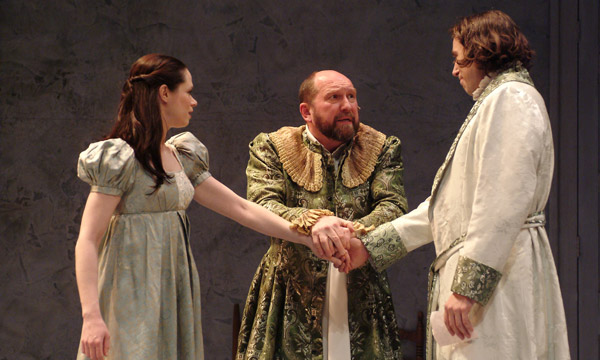
King Simonedes from Pericles, Prince Of Tyre You might forget this character because he only has a short time onstage, but I defy anyone to come up with a better father. He’s kind, supportive, stable, funny, and has a wonderful relationship with his daughter Thaisa. Above all, Simonedes actually listens to his child and does everything in his power to help her when she decides she wants to marry Pericles. Also, like Prospero, Simonedes pretends to object to the marriage, but you kind of get the sense that, rather than testing the affection of the couple, he’s actually just playing a joke on them. You can hear a “gotcha” and a fatherly wink in the final line of the speech in Act II, where he pretends to object to their marriage:
Congratulations to all our fabulous fictional fathers! Thank you for reading, and see you soon!
 The Shakespearean Student