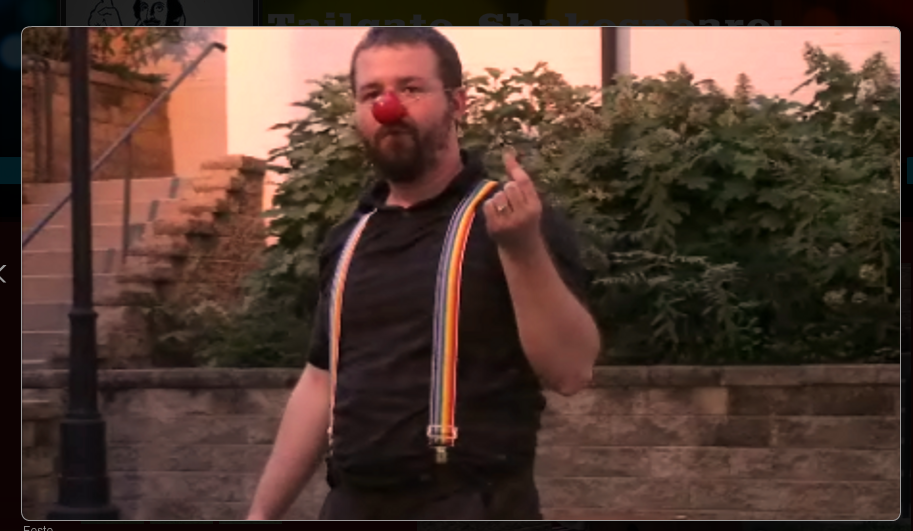
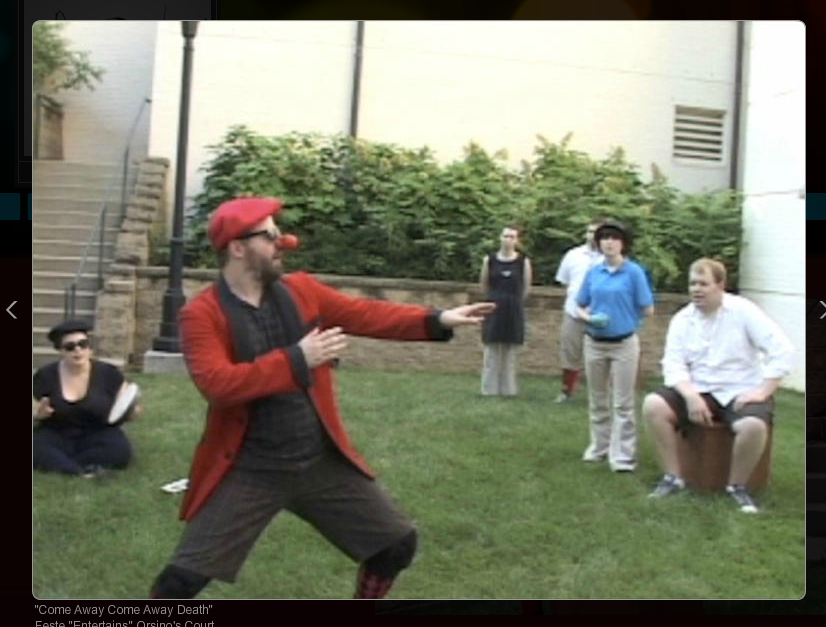
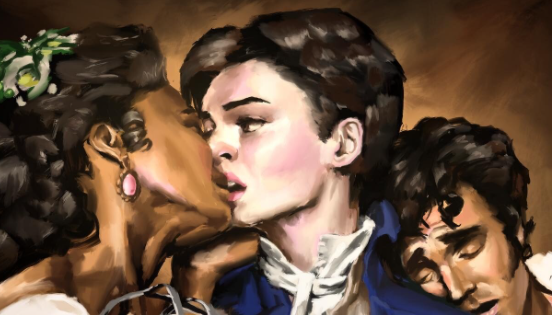
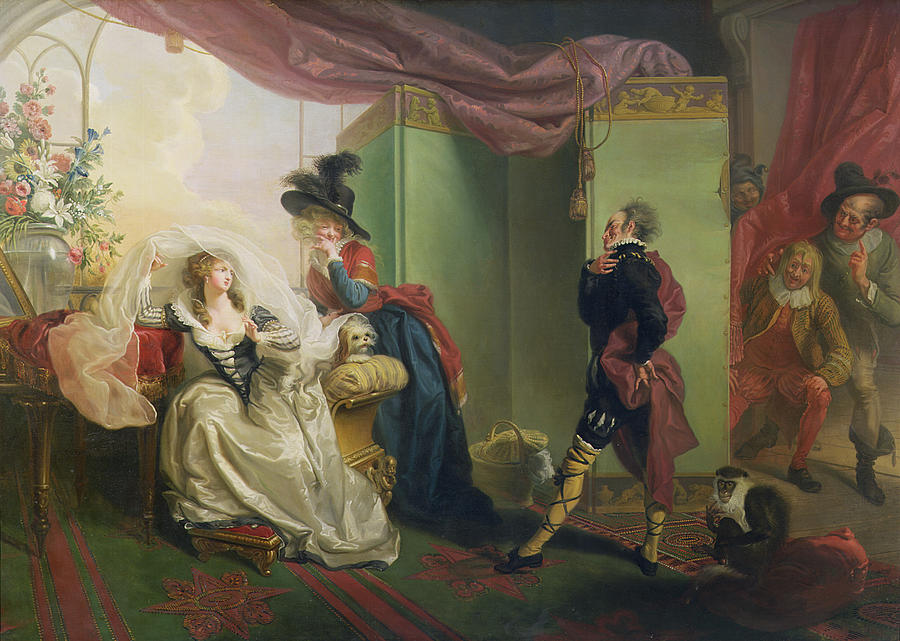
Happy Twelfth Day of Christmas Everyone!

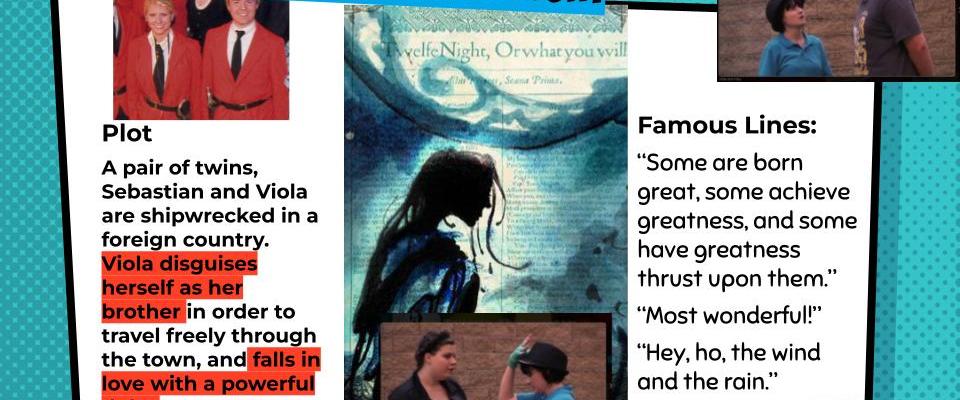
Hello everyone! I’m back from break and happy to celebrate one of my favorite holidays with you- the one that gave its name to one of Shakespeare’s greatest comedies- Twelfth Night

How to throw a Twelfth Night Party

How To Throw A Twelfth Night Party

How to Make a Twelfth Night Cake

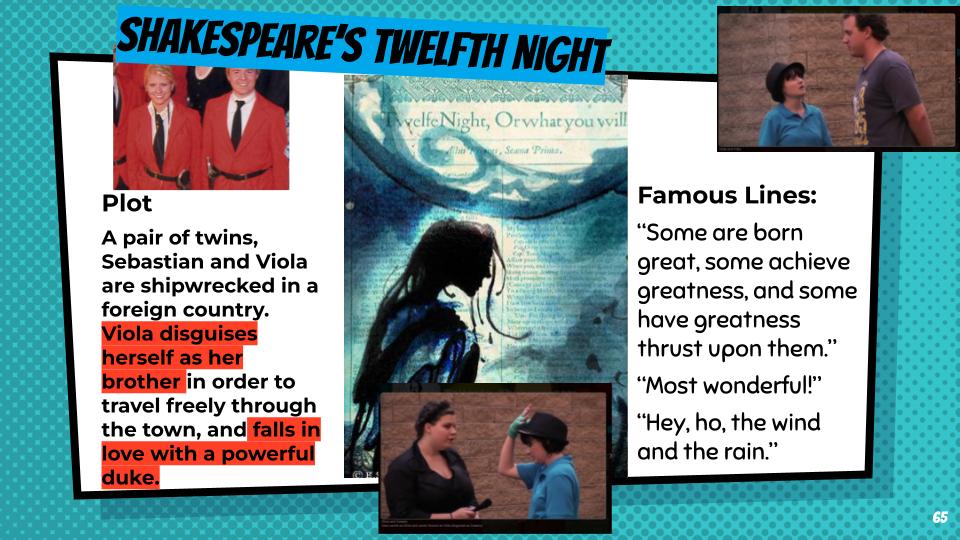
Intro to Twelfth Night (THe play)

I’ve been in this play three times and I’m continually struck by how fun, romantic, and progressive it is. It raises questions about gender roles, social norms, bullying, and even catfishing and heteronormativity! It’s a fascinating and thought-provoking play and it’s my favorite of Shakespeare’s comedies!

Shakespeare’s early comedies are about young love, infatuation, and being ‘madly in love’ (sometimes literally). His middle plays are about mature relationships between men and women and the need for commitment. I would argue that Twelfth Night, (and possibly Much Ado About Nothing), are the best examples of Shakespeare telling meaningful stories about romantic relationships.

Past Posts on “Twelfth Night”

  1. Play of the Month: Twelfth Night
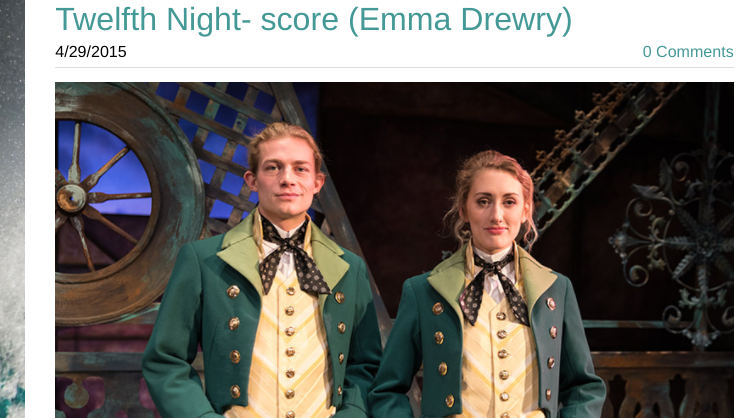
  2. The Fashion Is the Fashion: Twelfth Night
  3. Crafting a Character: Malvolio
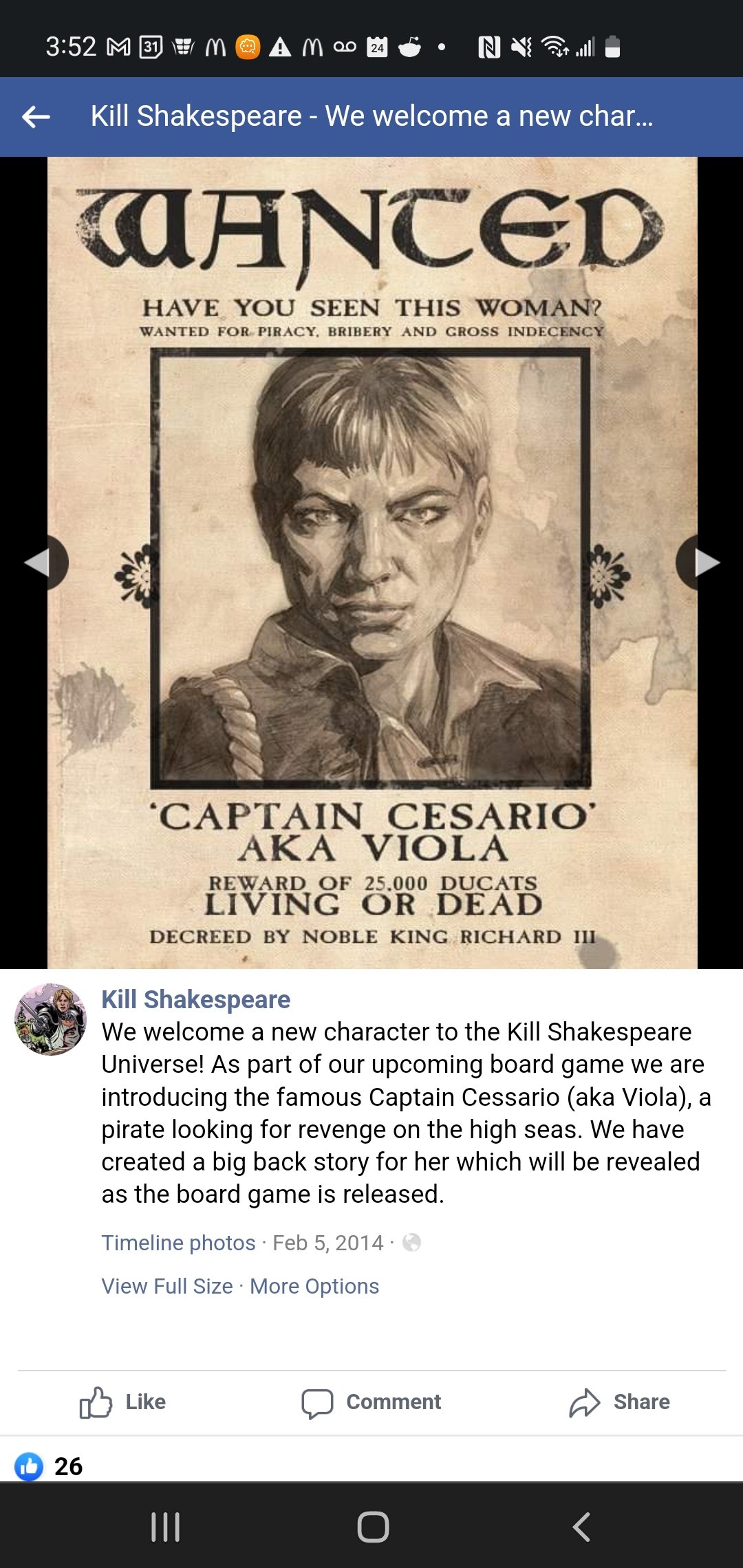
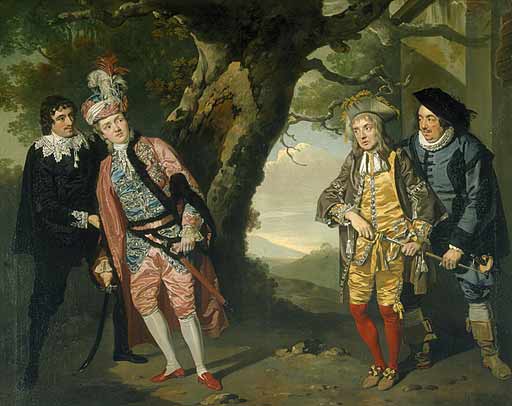
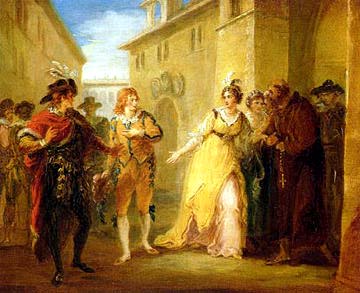
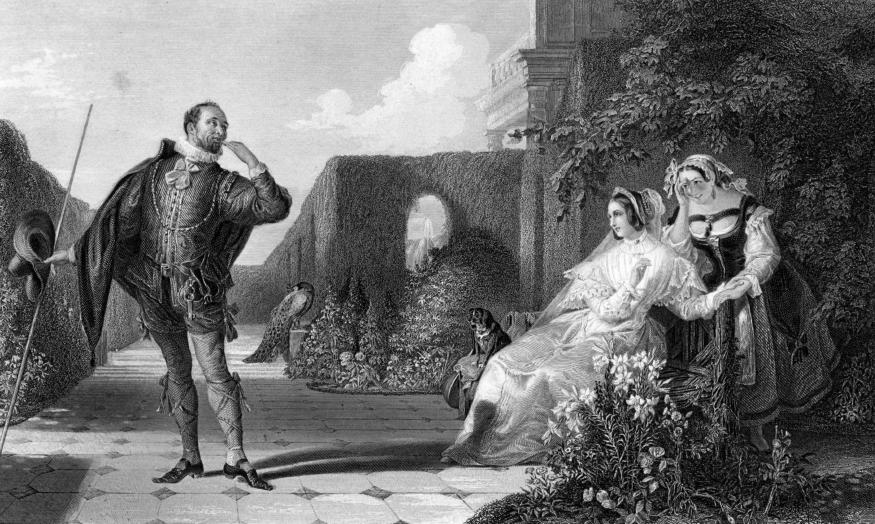
  4. Exquisite Artwork from Twelfth Night

Would you like to know more? Take a class!

In honor of “Twelfth Night,” I’ve created a coupon for my course on Shakespeare’s comedies from now till January 31st: Get $10 off my class “Shakespeare’s Comic Plays” with coupon code HTHESYTIT110 until Jan 31, 2023. Get started at https://outschool.com/classes/shakespeares-comic-plays-868BR5hg and enter the coupon code at checkout.

To finish I wanted to give you a complete production of Twelfth Night for your viewing pleasure, but I can’t decide which one, so I will post a bunch today! 

1. 1996 TV movie starring Geoffrey Rush (Pirates of the Caribbean)

2.1996 Thames TV directed by Kenneth Branaugh 

The Awesome world of “Six”

One really fun thing I like to see each Thanksgiving is the live previews of some of Broadway’s hottest shows. You may remember that I first became acquainted with the musical “Something Rotten,” after seeing a live performance at the Macy’s Day Parade. I am just ecstatic to see and talk about this year’s hit Broadway Musical Six. It swept the Tonys, and has opened up touring productions across the country.

The Cast of “Six” perform live at the 2021 Tony Awards.

This vibrant, clever retelling of Tudor her-story was created by TOBY MARLOW & LUCY MOSS in association with the Chicago Shakespeare Festival.

The show is incredibly smart, and creative, and delves into the lives of some fascinating women, re-told as a singing contest with the characters singing their lives for you to judge what it was like being the queen of England, and living with the turbulent and fickle Henry VIII. What really appeals to me in this show is that like Hamilton, the musical takes these six semi-mythical women and tells their story in a way that is fresh and exciting.

Part I: Shakespeare’s “Henry VIII:” How NOT to tell a queen’s story

Around 1613, Shakespeare wrote his final play- his 10th history play which loosely told the life of English king Henry the Eighth.

I happen to know a lot about this play since I was in it back in 2008, as you can see in the slideshow above. As you might notice, this play doesn’t tell the story of all of Henry’s wives. We only see the last few years of Catherine of Aragon’s life, and the beginning of Henry’s marriage to Anne Boleyn. Most of the drama actually centers around Henry and his scheming advisor, Cardinal Wolsey. Maybe I’m biased because I played this role, but frankly, Woolsey is treated in the play as a stereotypical Machiavellian villain, who conveniently leads the king astray so he can be the hero of the play. Woolsey does all of Henry’s dirty work; taking over his government, spearheading his divorce to Catherine, and trying to dissuade the king from listening to Anne Boleyn’s Protestant ideas, dismissing her as a “spleeny Lutheran.” Shakespeare leaves it ambiguous as to whether Henry actually told Woolsey to do any of these things so the audience will blame Woosey, instead of the king.

I’ll be blunt, aside from the courtroom scene at Blackfriars, where Katherine pleads for Henry not to dissolve their marriage, and the fun dances and costumes in the scene where Anne flirts with Henry, the play is really quite boring. though I blame Jacobean censors more than Shakespeare for this. Even after the entire Tudor dynasty was dead and buried, powerful people in the English government controlled what Shakespeare could say about them.

Part II: The women take wing

During Shakespeare’s life time, the wives of Henry VIII were bit players at best. With the exception of Katherine of Aragon and Anne Boleyn (who in most narratives have often been cast as either virgins or whores), the lives of Jane Seymore, Anne of Cleaves, Catherine Howard and Catherine Parr were barely told until the 20th century, where new feminist scholarship sparked renewed interest in these women and how they lived.

TV series like The Tudors, movies like The Other Boleyn Girl, and of course books and documentaries by

III. Why “Six” Slaps

Let husbands know
Their wives have sense like them: they see and smell
And have their palates both for sweet and sour,
As husbands have.
Emilia, “Othello,” Act IV, Scene iii.

Well, I can’t yet give an objective view of the plot and characters of “Six,” because I haven’t seen it…(yet). But until then, let’s just say that like “Hamilton,” it is great to see history be recontextualized and shared in such an accessible way. We all know that European history is dominated by the names of white guys- king whoever, duke what’s-his name. To see important women in history be given a voice by a multi-ethnic cast is a great way to make it acessible.

Bravo.

Educational links related to the six wives of Henry VIII:

Books

TV:

Web:
https://www.history.com/news/henry-viii-wives

https://sixonbroadway.com/about.php

Resources on Shakespeare’s History Plays:

Books

  1. Shakespeare English Kings by Peter Saccio. Published Apr. 2000. Preview available: https://books.google.com/books?id=ATHBz3aaGn4C
  2. Shakespeare, Our Contemporary by Jan Kott. Available online at https://books.google.com/books/about/Shakespeare_Our_Contemporary.html?id=QIrdQfCMnfQC
  3. The Essential Shakespeare Handbook
  4. The Essential Shakespeare Handbook by Leslie Dunton-Downer and Alan Riding Published: 16 Jan 2013.
    77ace26dfdee4259bf48d6eed1a59d57
  5. Will In the World by Prof. Steven Greenblatt, Harvard University. September 17, 2004. Preview available https://www.amazon.com/Will-World-How-Shakespeare-Became/dp/1847922961

TV:

The Tudors (TV Show- HBO 2007)

“The Six Wives of Henry VIII” (BBC, 1970)

Websites

Watch “Shakespeare Made You Die (Dumb Ways to Die Parody)” on YouTube

Tomorrow is the first session of my course on Shakespeaere’s tragedies! I’m so excited to teach this great group whom I’ve worked with before. To mark this occasion, I present this silly, catchy, and informative song about the tragic fates of Cleopatra, Juliet, Hamlet, and others.

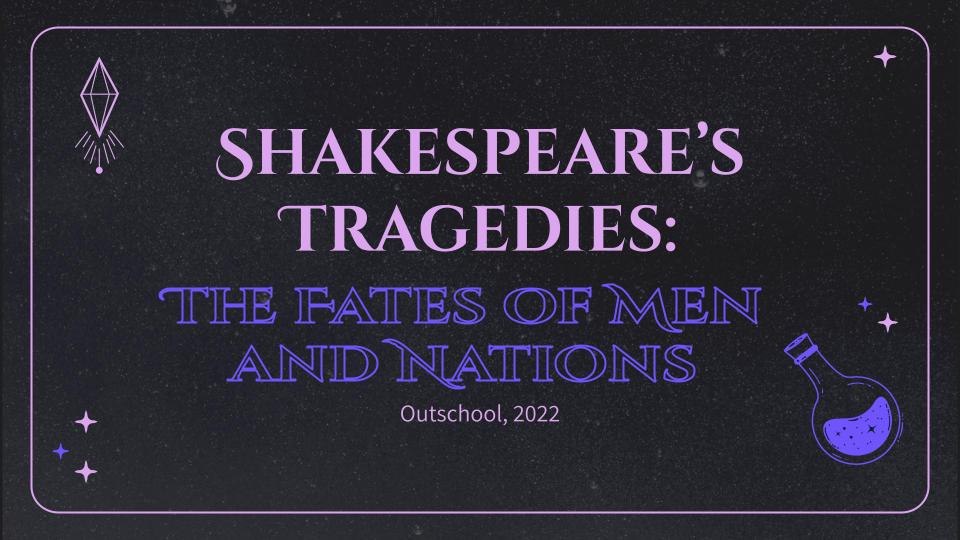
Title page for my course on Shakespeare’s Tragedies

If you want to sign up for this course or request a private session, you can do so at http://www.outschool.com, or by scanning the QR code below:

The trailer for my course.

Thanks for reading and have a good weekend!

Article Review:

“Upon Such Sacrifices: King Lear and the Binding of Isaac”

I’ve compared King Lear to a fairy tale in the past, but i haven’t compared it to a story from the King James Bible, even though Shakespeare, in all likelihood wrote and performed it for James himself. This article form the Jewish Review of Books is a comparison between Lear and the Old Testament Bible. First, the author has a tantalizing historical tidbit that might explain why Shakespeare chose to write Lear for King James:

Before ascending to the English throne, James VI of Scotland wrote a political guide, Basilikon Doron, for his eldest son advising him never to divide his kingdom (as Lear does) but “make your eldest son Isaac, leaving him all your kingdoms.”

Noah Millman.

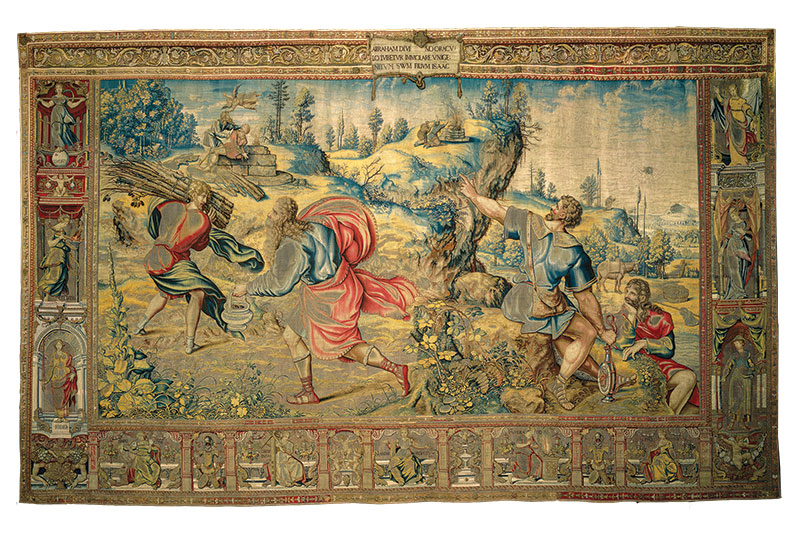
The article also draws some fascinating parallels between Lear and other Biblical patriarchs especially the sacrifice of Isaac, which takes place in Genesis 22, or as it’s known in Jewish tradition, the akeda.

Tapestry depicting the sacrifice of Isaac, the King’s Great Bedchamber, Hampton Court Palace. (Courtesy of the Royal Collection Trust/© Her Majesty Queen Elizabeth II 2017.)

The akedah prompts different questions than King Lear does, not of how so much tragedy could have sprung from a foolish love test, but how the God of all creation could have put his faithful servant to such an unconscionable test in the first place. And so there is a long interpretive tradition that labors to elide that fact in increasingly creative ways. Surely God never intended Isaac to be a sacrifice—the boy was merely to be present at the sacrifice! How could Abraham have thought otherwise, when God had already sworn that it was through Isaac that his promise to Abraham would be fulfilled? Or, alternatively, surely Abraham never doubted that God was merely testing him—after all, Abraham tells Isaac himself that God would provide a lamb to substitute!

Millman. Reprinted from:
https://jewishreviewofbooks.com/articles/2789/upon-sacrifices-king-lear-binding-isaac/?#gf_25

It’s interesting to see the parallels between Lear and an Old Testament patriarch. He constantly asks his gods for help and swears by them when he pronounces his doom, yet arguably he has no real faith in his gods or his daughters, which is why his foolish love test in Act I, serves as the catalyst that corrodes and destroys his kingdom and his life. However, maybe Lear sees himself this way, as a king appointed by God, with the authority to test his daughters’ love as God tested Abraham. Ian McKellen seems to share this view and sees Lear as a priest who is unwilling to give up his “special relationship with his gods.”

The actor playing Lear can benefit from studying the sort of old-fashioned patriarchs presented in the Bible because they help shape his worldview. In addition, the concept of faith and how it is tested is another big theme in Lear and contrasting how men in the Bible keep their faith while Lear loses it is an illuminating way to contextualize both works. Was Shakespeare trying to write a parable for kings? Perhaps, but he certainly encapsulates very well the struggles and anxieties of keeping power, and the desire for divine intervention when a kingdom bleeds.

https://jewishreviewofbooks.com/articles/2789/upon-sacrifices-king-lear-binding-isaac/?#gf_25

The Origins of King Lear

Shakespeare’s King Lear is an age old tale. Like Cinderella it has been reinterpreted throughout time and in many different cultures. Here are a few interesting highlights in the old legend and how it got to Shakespeare in the 1600s.

The Princess Who Loved Her Father More Than Salt

This is an old folktale from my favorite podcast, Journey With Story, which starts with the Cordelia/ Lear plot of a foolish king who banishes his honest daughter. Then through extraordinary circumstances it becomes a Cinderella story. I think at some point these two stories were one and the same until they diverged and one became a story about an absent father and a wicked stepmother, while the other became about a wicked father and a dead mother.

https://www.sacred-texts.com/neu/eng/boeb/boeb05.htm

The ancient ballad of King Leir

The ancient ballad of King Leir, which helped inspire Shakespeare. It serves as a cautionary tale against flattery, and it places equal blame on Lear and his daughters:

And calling to remembrance then
His youngest daughters words,
That said the duty of a child
Was all that love affords:
But doubting to repair to her,
Whom he had banish'd so,
Grew frantick mad; for in his mind
He bore the wounds of woe:

Which made him rend his milk-white locks,
And tresses from his head,
And all with blood bestain his cheeks,
With age and honour spread.
To hills and woods and watry founts
He made his hourly moan,
Till hills and woods and sensless things,
Did seem to sigh and groan.

Even thus possest with discontents,
He passed o're to France,
In hopes from fair Cordelia there,
To find some gentler chance;
Most virtuous dame! which when she heard,
Of this her father's grief,
As duty bound, she quickly sent
Him comfort and relief

The characters of Gloucester and his children, Kent, and the Fool are absent in this ballad, but unlike the fairy tale above, both Lear and Cordelia die in each other’s arms.

The Annonymous History of King Leir, (first published c. 1594)

The anonymous history of King Lear, written shortly before Shakespeare

This play was written for Shakespeare’s rival acting company The Queen’s Men around 1590). Since the Queen was patronizing the company, most of their plays were government-funded propeganda. For instance, it was the Queen’s men who first did a tragedy of the wicked King Richard III.

Michael Wood. In Search Of Shakespeare, 2002.

If you watch the first 20 minutes of the documentary above, you will see that Wood and many other scholars believe Shakespeare must have worked for the Queen’s men, or at least performed their scripts, since they did their own versions of King Lear, Richard III, King John, and Henry V.

Screenshot from Internet Shakespeare Editions’ reprint of King Lear https://internetshakespeare.uvic.ca/doc/Leir_M/index.html

However Shakespeare got a hold of The Queen’s Men’s scripts, he didn’t adhere to them rigidly. Their King Lear follows the fairy-tale / history format of having Cordelia be banished, disguise herself as a peasant (like Cap ‘O Rushes in the earlier version), and eventually she is restored to her rightful place. Shakespeare’s version must have been a MASSIVE shock to anyone who read these old tales and ballads. In Shakespeare’s version, everyone dies and there is no guarantee that the kingdom will survive. Every other tragedy ends with a new king or emperor to take over the kingdom but Lear leaves the audience with a sense of apocolypse; that Lear’s madness and Edmund’s machinations have doomed England and all these characters’ lives will be erased by Time.

As pessimistic as Shakespeare’s Lear is, it does seem more true to life than the previous versions. Perhaps this is because of a legal case from 1603 that might have inspired Shakespear to adapt the story: In 1603, two daughters tried to have their father declared insane. By an astonishing coincidence, the third daughter, who protested, happened to be named Cordelia! Perhaps Shakespeare, (who had three children and was preparing to retire), might have been inspired by this case and worried he might suffer the same fate.

Intro to King Lear

Lear at its core is a play about growing older, and not just for its title character. Goneril and Regan learn their father is a lousy dad and learn to stand up to him. Edgar learns about the cruelty of the world and how to deceive his enemies.


Plot Summary

Lear, a king in pre-Christian England, is too old to rule, so he decides to divide his kingdom among his three daughters. He then tells them he will give the the kingdom to the one who loves him most.

Lear’ youngest daughter Cordelia, refuses to flatter her father, so she banishes her. He also banishes the Earl of Kent, who warns the king that his actions are foolish and rash. Finally, Lear demands that, although he resigns his kingdom, his daughters call him king and agree to house him and his knights in their castle.

Lear is not the only rash old man who is blind to his true danger. His friend the Duke of Gloucester has a bastard son named Edmund, who schemes to usurp his father’s lands and marry into Lear’s family. Edmund frames his legitamite brother Edgar which forces him to disguise himself as the mad beggar Poor Tom

After his daughters refuse to house him and his knights, Lear goes stark-raving mad. He runs out into a storm on the heath, wishing the Earth were struck flat and all mankind was destroyed. He is soon cared for by his Fool, and Kent, disguised as a commoner named Caius.

Duels, wars, tears, and oblivion follow.

Dramaturgy Website: American Shakespeare Center

Contemporary Parallels:

“Empire” (TV Series 2015-2020)

Empire Cast - Original Soundtrack from Season 1 of Empire - Amazon.com Music
Poster for Empire with Lucius and Cookie, and their three sons Jamal

Succession (HBO- 2018- present)

https://www.telegraph.co.uk/tv/2018/08/02/succession-hbos-new-dramais-king-lear-modern-media-age/

This scene from “Brave”

“Slings and Arrows,” Season three

Slings and Arrows, Season 3

“Ran” by Akira Kurasawa-

Encanto (2021): Click here to read my post about Encanto and Lear

Videos

More Posts

Shameless Plug

I’ll be playing Kent in King Lear October 22nd, 1PM EST. It’ll be streamed on Discord and live on YouTube here:

Watch “D E M O N O L O G Y” on YouTube

This book Demonology influenced Shakespeare’s Macbeth and Hamlet in ways I’ll get into later. It was written by King James himself, and it takes the form of a dialogue, that is, an intellectual conversation where the concept of witchcraft, sorcery, necromancy, etc is explained, debated, and questioned between two imaginary people.

In the video, Youtuber Andrew Rakich, known for his history series, Checkmate Linconites, (where he plays two characters who argue about the Civil War from a Union and Confederate perspective) has done a dramatic reading of the whole book in the accent of 1600s England. It’s part audio book, part history lesson, part linguistics lesson, and all great!

Here are some of my favorite quotes from the book:

Just like in Dr. Faustus, James theorizes that the Devil lets all so-called sorcerers and necromancers believe they have power over him, to deceive them later.

For as the humor of Melancholie in the selfe is blacke, heauie and terrene, so are the symptomes thereof, in any persones that are subject therevnto, leannes, palenes, desire of solitude: and if they come to the highest degree therof, mere folie and Manie:

Demonology, Chapter 1, p. 30,. Reprinted from Project Gutenberg

This passage echoes Hamlet’s description of his own meloncholy, and his fear that The Devil might be trying to use his melocholy to conjure up his father in order to damn him:

The spirit that I have seen
600   May be the devil, and the devil hath power
601   To assume a pleasing shape; yea, and perhaps
602   Out of my weakness and my melancholy,
603   As he is very potent with such spirits,

603. As . . . spirits: i.e., because he has great influence on those who have a temperament such as mine.
604   Abuses me to damn me. I’ll have grounds

604. Abuses: deludes.  If the Ghost is deceiving Hamlet about King Claudius’ guilt, and Hamlet kills him, Hamlet would be a murderer, and therefore damned.
605   More relative than this: the play’s the thing
606   Wherein I’ll catch the conscience of the king.

Hamlet, Act II, Scene ii, reprinted from Shakespeare Navigators.com.

For that is the difference betuixt Gods myracles and the Deuils, God is a creator, what he makes appeare in miracle, it is so in effect. As Moyses rod being casten downe, was no doubt turned in a natural Serpent: [pg 023]where as the Deuill (as Gods Ape) counterfetting that by his Magicians, maid their wandes to appeare so, onelie to mennes outward senses: as kythed in effect by their being deuoured by the other. For it is no wonder, that the Deuill may delude our senses, since we see by common proofe, that simple juglars will make an hundreth thinges seeme both to our eies and eares otherwaies then they are. Now as to the Magicians parte of the contract, it is in a word that thing, which I said before, the Deuill hunts for in all men.

Demonology, Chapter 6, p. 23

It’s very useful to conceptualize what the early Jacobeans thought the difference was between God and the Devil, and thus the difference between divine miracles and hellish charms. In James’ eyes, all magic and demonic arts were mere illusions, designed to play upon men’s senses and draw the intended victim into the Devil’s power. Obviously, since all of theater rests upon such illusion, it’s no wonder Shakespeare portrays magic onstage in his most popular works. In particular, this passage calls to mind the magic of Prospero, who is able to conjure spirits fo a while, but they all eventually dissolve:

PROSPERO
146   You do look, my son, in a mov’d sort,

146. mov’d sort: troubled state.
147   As if you were dismay’d: be cheerful, sir.
148   Our revels now are ended. These our actors,

148. revels: festivity, entertainment.
149   As I foretold you, were all spirits and
150   Are melted into air, into thin air:
151   And, like the baseless fabric of this vision,

151. baseless fabric: structure without a physical foundation.
152   The cloud-capp’d towers, the gorgeous palaces,
153   The solemn temples, the great globe itself,

153. the great globe itself: all the world, [and the theater] >>>
154   Yea, all which it inherit, shall dissolve

154. all which it inherit: all who live on it.
155   And, like this insubstantial pageant faded,

155. insubstantial: without material substance.
156   Leave not a rack behind. We are such stuff

156. rack: wisp of cloud driven before the wind.
157   As dreams are made on, and our little life
158   Is rounded with a sleep.

The Tempest, Act IV, Scene i.
A close reading into the most infamous 17th century manual for finding and persecuting witches and sorcerers.

 For although, as none can be schollers in a schole, & not be subject to the master thereof: so none can studie and put in practize (for studie the alone, and knowledge, is more perilous nor offensiue; and it is the practise only that makes the greatnes of the offence.) the cirkles and art of Magie, without committing an horrible defection from God: And yet as they that reades and learnes their rudiments, are not the more subject to anie schoole-master, if it please not their parentes to put them to the schoole thereafter; So they who ignorantly proues these practicques, which I cal the deuilles rudiments, vnknowing them to be baites, casten out by him, for trapping such as God will permit to fall in his hands: This kinde of folkes I saie, no doubt, ar to be judged the best of, in respect they vse no invocation nor help of him (by their knowledge at least) in these turnes, and so haue neuer entred themselues in Sathans seruice; Yet to speake truely for my owne part (I speake but for my selfe) I desire not to make so neere riding: For in my opinion our enemie is ouer craftie, and we ouer weake (except the greater grace of God) to assay such hazards, wherein he preases to trap vs.

Demonology Chapter 5, page 15.

It almost seems in this passage that James is covering his tracks against any detractors who might be wondering if he himself might be damned for knowing so much about witchcraft. Accordingly, he asserts that the knowledge of witchcraft is perfectly lawful, it’s the practice that damns the scholar.