I designed this on an app called “GooseChase”, appropriate since Shakespeare invented the term!
If you click on the link, you can do a great scavenger hunt where you upload pictures or answer trivia questions for points, and of course they are all related to Shakespeare. If you have the app on your phone, search for Shakespeare Birthday Scavenger Hunt and enter the code: 2BON2B (Get it, to be or not to be)! You can also use the code NLEGVM. Let me know if you like it or if you cannot access the link.
War and soldiers come up a lot in Shakespearean plays. After all, he wrote six plays about the Wars Of The Roses. Though most of his work is about the decisions about war made by powerful monarchs, occasionally he gives us some insight into the lives of common soldiers.
We don’t know if he ever fought, but warfare was very much on his mind at the beginning of his career, with good reason. In 1586 The Spanish armada attacked. Was Shakespeare enlisted? We don’t know.
His early plays are generally positive toward soldiers and it’s easy to see why. The growing nationalism in England resulting from the Tudor control over religion and language —was a direct and defensive reaction to the ex-communication of the Tudor monarchs (particularly Henry VIII and Queen Elizabeth. Shakespeare probably saw himself —
. He no doubt saw his role as building the epic sagas of England to remind his countrymen of England’s past victories, especially during the Spanish Armada and the later Irish Rebellion of 1599.
Shakespeare cashed in with 9 plays on English history that mainly take place on the battlefield. His plays were met with praise by audiences and critics:
“How would it have joyed brave Talbot (the terror of the French),” he wrote, “to think that after he had lain two hundred years in his tomb, he should triumph again on the stage and have his bones new embalmed with the tears of ten thousand spectators at least (at several times).” -Thomas Nashe, c. 1590.
In the first tetralogy, common soldiers don’t have any voice. Probably they were played by apprentices, and fencing masters. They were mainly set dressing. Shakespeare mainly focuses on the pivotal importance of leadership and his portrayal f leadership; he understood the consequences of the choices kings make during the war and its effect on millions of common people: like Talbott and King Henry the Fifth.
I want to analyze a short selection from Henry the Fifth, Act IV, Scene I. In this scene, the king is disguised as a commoner the night before a battle to see what his soldiers really think about him, and the impending fight with the French. An outspoken soldier named Williams tells him that if the fighting is wrong, the king is responsible for his soldiers’ deaths, and has to answer for the atrocities that happen during the war:
KING HENRY V
methinks I could not die any where so contented as in the king’s company; his cause being just and his quarrel honourable.
WILLIAMS
That’s more than we know.
BATES
Ay, or more than we should seek after; for we know enough, if we know we are the kings subjects: if his cause be wrong, our obedience to the king wipes the crime of it out of us.
WILLIAMS
But if the cause be not good, the king himself hath a heavy reckoning to make, when all those legs and arms and heads, chopped off in battle, shall join together at the latter day and cry all ‘We died at such a place;’ some swearing, some crying for a surgeon, some upon their wives left poor behind them, some upon the debts they owe, some upon their children rawly left. I am afeard there are few die well that die in a battle; for how can they charitably dispose of any thing, when blood is their argument? Now, if these men do not die well, it will be a black matter for the king that led them to it. King Henry V, Act IV Scene I.
Many productions of Henry the Fifth interpret this speech as Shakespeare’s attitude towards war, (a tempting prospect, since the soldiers’ name is William), but in the very next speech King Henry completely changes Williams’ mind! Here’s the full scene from Kenneth Branaugh’s 1989 movie version of the play, which he directed and starred as King Henry:
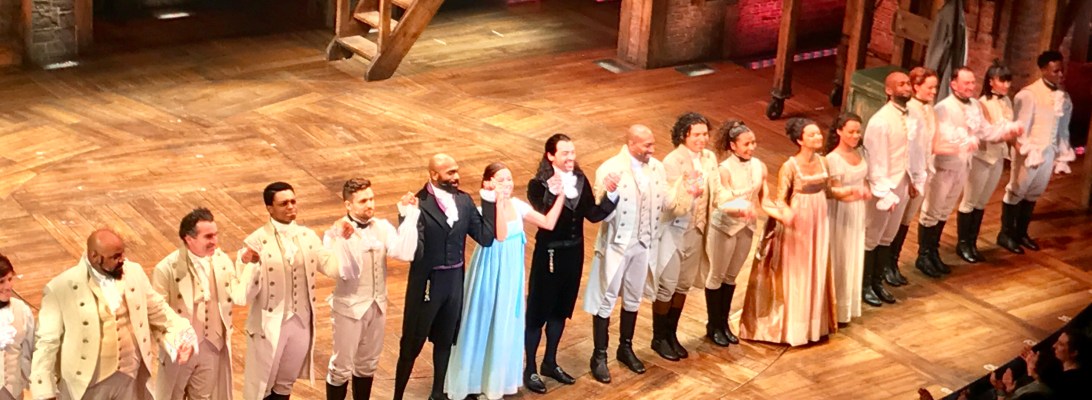
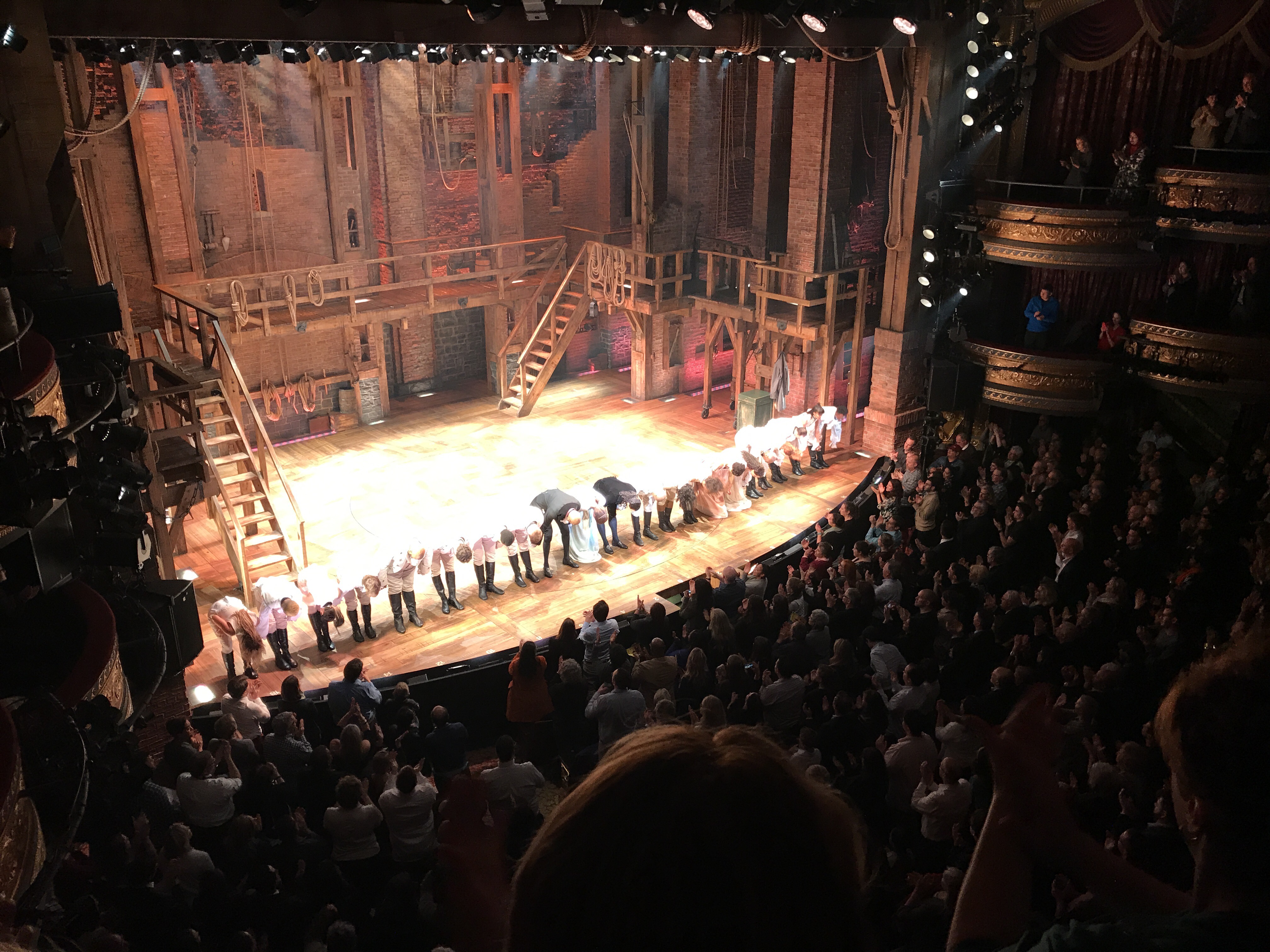
If you have two ears, you’re probably familiar with the Broadway Musical Hamilton. It swept the Tonys, has opened up touring productions across the country, and there’s already talk of a movie.
This historic American musical was the brainchild of writer Lin Manuel Miranda, who also originated the role of Alexander Hamilton.
The show is incredibly smart, creative, and delves into the seminal moments of American history.
What’s really exciting to me is that Hamilton also has a depth and complexity that mirrors some of Shakespeare’s greatest plays, specifically the history plays.
Between about 1590 and 1613, Shakespeare wrote 10 plays about the lives of English kings, from the vain Richard the Second to the heroic Henry the Fifth, to the diabolical Richard the Third. Here is a list of Shakespearean history plays, with links to online study guides, listed in chronological order by reign, not publication date.
Are these Shakespearean history plays historically accurate by our standards? No, not by a long shot, though Shakespeare is only partially to blame for that. While Lin Manuel-Miranda had Hamilton’s own essays, his letters from friends and loved ones, and of course, every American history book at his disposal, Shakespeare’s sources were few, and mostly propaganda. They were, (to paraphrase Napoleon and Benjamin Franklin), “A series of lies, composed by winners, to excuse their hanging of the losers.”
Shakespeare’s genius however, was to turn these two-dimensional propaganda stories into three dimensional characters with which we can all identify. Miranda did the same thing in reverse- distilling his wealth of historical information into a universal story of a man’s quest for the American Dream. Hamilton went from being an immigrant, to a soldier, to a pioneer in American law, government, and finance and the musical reflects his struggle to achieve his dreams through each stage of his life. It is also a love song from America to a man who dreamed of a future for America, one not dissimilar to the ode Shakespeare wrote to his “Star of England,” Henry the Fifth. The greatest compliment I can give Miranda is to say that he created an American musical, with the scale and breadth of Shakespeare.
Part I: War and Peace
In Shakespeare’s histories, particularly the first tetracycle of plays that include Richard the Second, the three parts of Henry VI, and Richard, III, there is a constant shift between war and peace, as scholar Robert Hunter observes. These plays cover the 200 year period of Wars of the Roses, and the end of the Hundred Years War. In all of these plays there are some very violent and very opportunistic young men who see war as an opportunity to rise above their stations. In war, they win glory in death, honor, respect, and status in life. However, in peacetime, they have “no delight to pass away the time,” as Richard III observes, and they struggle to survive in the political landscape of peace.
Hamilton is a man of this same mold: When we first meet him, he is a poor immigrant from the West Indies with no title or money to improve his status. He spends the first third of the musical wishing he could become a commander in the Revolutionary War, especially in the song: “My Shot”
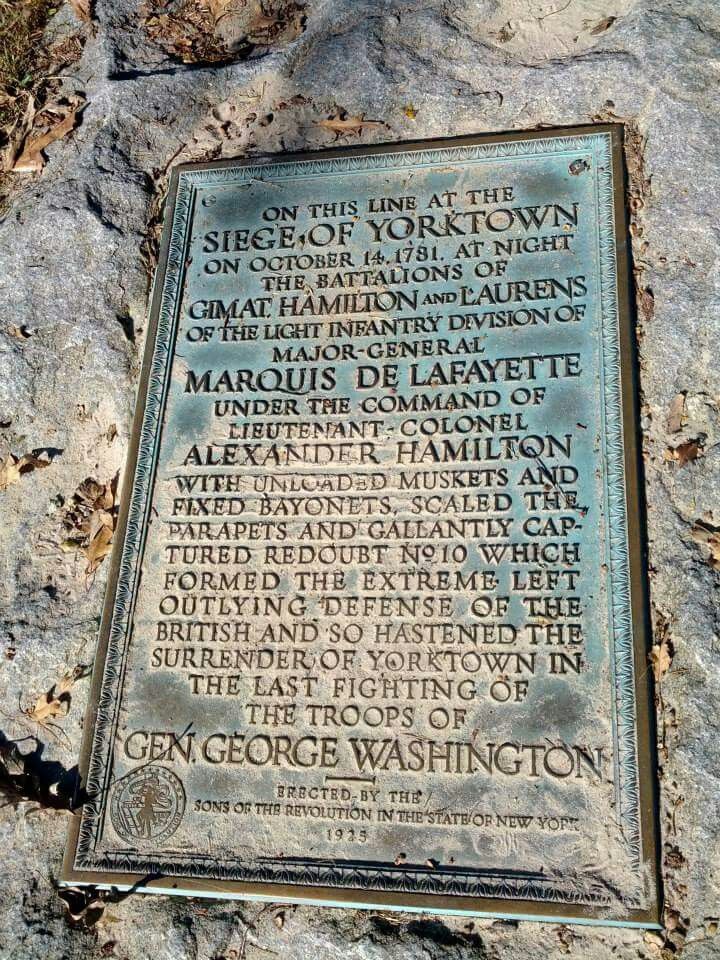
Once Hamilton joins the revolution, his fortunes start to improve; he becomes George Washington’s aide-de-camp, then becomes a war hero in the Battle of Yorktown, and marries Eliza Schyler, daughter of one of the wealthiest men in America.
Hamilton in war bears similarities to Shakespearean characters like Hotspur, Richard Duke of York, and even Richard III; people who see war as a chance to either die in glory, or become honored, wealthy, and powerful.
Unfortunately for Hamilton, he fares less well once the war ends. Even though he becomes Washington’s first Secretary Of the Treasury, his success and closeness to now-President Washington makes him a walking target to his political adversaries. Even worse, his ambition and inability to compromise makes Hamilton equally vulnerable to people who see him as a loudmouth, an elitist, and a would-be demagogue who wants to control America’s finances and live like a king, similar to the way the British Prime Minister controls England’s finances.
The character Hamilton resembles most in peacetime is Cardinal Wolsey in Shakespeare’s Henry VIII.
I happen to know a lot about this character since I played him back in 2008. Wolsey controlled Henry VIII’s finances and was hated by most of Henry’s court because he was the son of a poor butcher in Essex, and became the king’s right-hand man. Throughout Shakespeare’s play, the lords of court are whispering about how Wolsey really controls the government; they even call him the ‘king cardinal’!
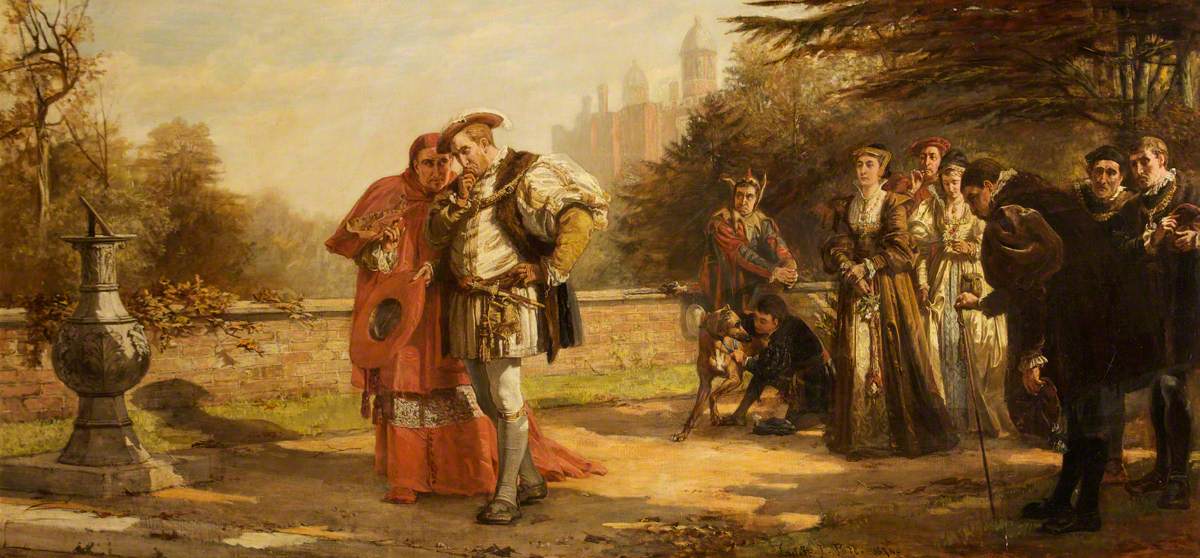
The real life Wolsey appears to have been hated just as much by Henry’s lords. Just look at the faces of the people of the court in this painting of the king and Wolsey by Laslett John Pott; the lords on the right are clearly jealous of Wolsey’s closeness to the king.
Laslett John Pott, The Dismissal of Cardinal Wolsey, 1874
In both plays, Washington and King Henry are treated like gods- invulnerable, aloof, and completely above reproach.
Whenever anything bad happens in the play or musical, the legislature blames Wolsey and Hamilton, not the King or the President. Also, in both plays each one falls from grace and is destroyed by his enemies when the king and president no longer supports their right-hand-men.
Wolsey and Hamilton both fall because of their position as the financial advisor, which makes them a target to their enemies. Both are accused of using their country’s finances to enhance their personal wealth, which leads him to scandal and disgrace.
In Henry the Eighth , Wolsey is certainly guilty of conspiring to use his country’s wealth to line his own pockets- he pays the cardinals in Rome to influence their vote in the hopes that he will become the next Pope!
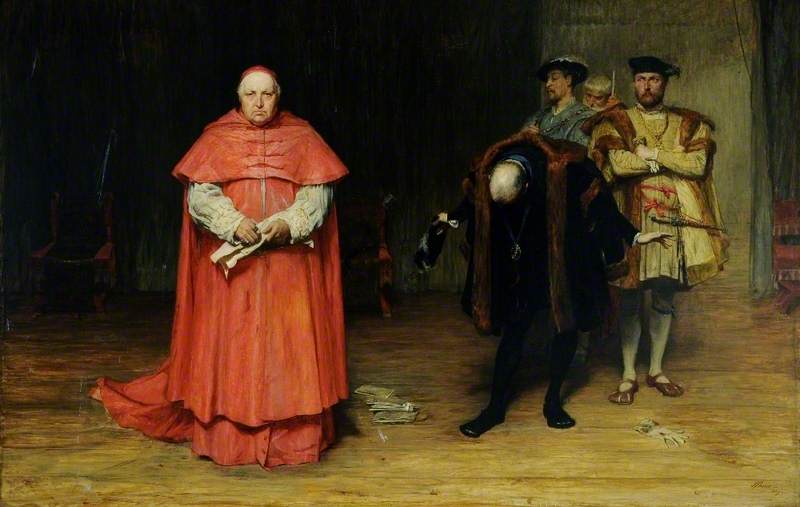
John Pettie: The Disgrace of Cardinal Wolsey, 1869
CARDINAL WOLSEY
What should this mean?
What sudden anger’s this? how have I reap’d it?
He parted frowning from me, as if ruin
Leap’d from his eyes: so looks the chafed lion
Upon the daring huntsman that has gall’d him
Then makes him nothing. I must read this paper;
I fear, the story of his anger. ‘Tis so;
This paper has undone me: ’tis the account
Of all that world of wealth I have drawn together
For mine own ends; indeed, to gain the popedom,
And fee my friends in Rome. O negligence!
Fit for a fool to fall by: what cross devil
Made me put this main secret in the packet
I sent the king? Is there no way to cure this?
No new device to beat this from his brains?
I know ’twill stir him strongly; yet I know
A way, if it take right, in spite of fortune
Will bring me off again. What’s this? ‘To the Pope!’
The letter, as I live, with all the business
I writ to’s holiness. Nay then, farewell!
I have touch’d the highest point of all my greatness;
And, from that full meridian of my glory,
I haste now to my setting: I shall fall
Like a bright exhalation in the evening,
And no man see me more. Henry the Eighth Act III, Scene ii.
Again, though Wolsey is guilty, like Hamilton he also used his financial genius to bring England into a new age of prosperity after centuries of war. The Tudors were some of the richest and most powerful monarchs in British history, and Wolsey helped establish their dynasty, but thanks to his enemies, he is turned out of court in disgrace:
O Cromwell, Cromwell!
Had I but served my God with half the zeal
I served my king, he would not in mine age
Have left me naked to mine enemies. Henry VIII, Act III, Scene ii.
Hamilton is also accused of embezzling his wealth by his enemies, including James Madison, and Thomas Jefferson
Hamilton’s enemies argue that his banking system benefits New York, where Hamilton was part of the House Of Representatives, as well as the Constitutional Convention. The main difference between Wolsey and Hamilton is that he didn’t embezzle America’s money, he is actually guilty of a far worse sin- adultery. Hamilton is accused of having an affair, and embezzling funds to keep it quiet, which he denies in a spectacular fashion:
In both plays, the moment where the main character begins to fall is dramatized in a stirring, metaphor-rich soliloquy. Wolsey compares himself to the Sun, who, once he reaches the zenith of the sky, has nowhere to go but down to the west, and set into night.
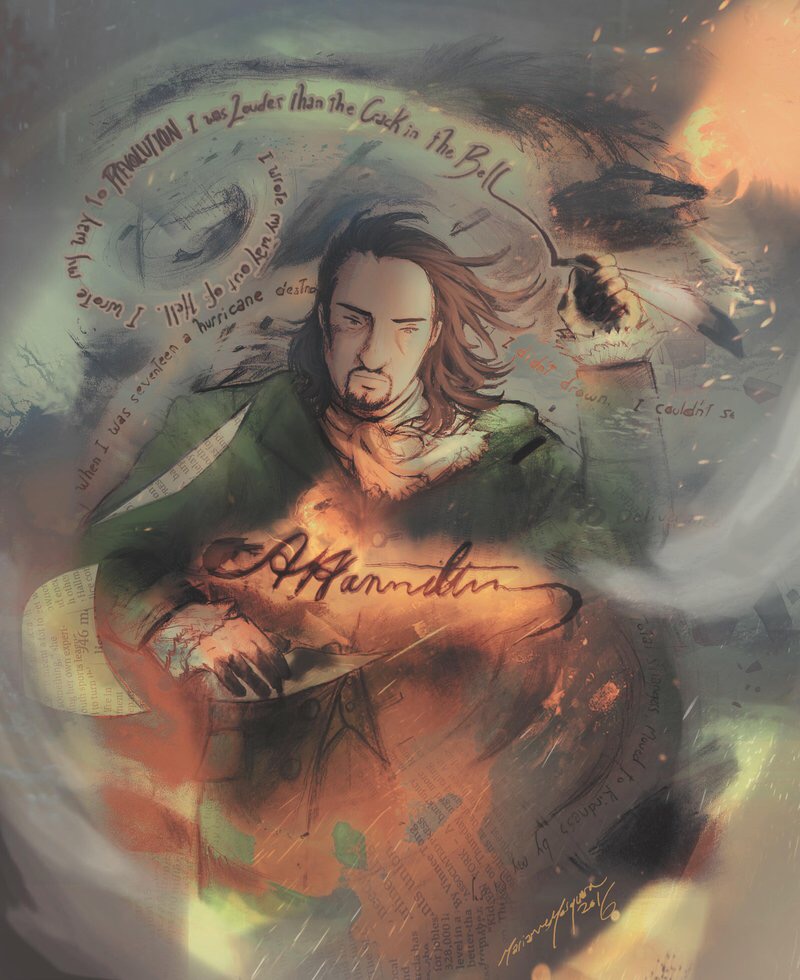
Hurricane From “Hamilton: An American Musical. Reposted from Deviant Art.com
Hamilton compares his situation to being in the eye of a hurricane, a particularly apt metaphor, since the real Alexander Hamilton’s house was destroyed by a hurricane in 1772. In addition, Lin Manuel Miranda‘s parents come from Puerto Rico an island that has, (and continues to be,) ravaged by hurricanes.
In the song, “Hurricane,” Hamilton remembers that when he lost everything as a boy in 1772, he beat the hurricane by writing a letter which was published in the newspaper, and inspired so much pity that the residents of the island raised enough money to send Alexander to America.
Later in the song, Hamilton decides to try to soothe the political hurricane that has engulfed him by writing a pamphlet, admitting the affair, but denying any embezzlement. Eventually the scandal destroys Hamilton’s career, but it doesn’t destroy his life; for that we have to look at the Shakespearean rivalry between Hamilton and Aaron Burr.
Part II- The Duel: Hamilton and Burr V Henry and Hotspur.
Aaron Burr and Hamilton keep meeting at important moments in the show, as if their fates are intertwined like gods in some kind of Greek tragedy.
Hamilton and Burr appear as polar opposites in the musical. Hamilton is fiery, opinionated, uncompromising, and highly principled. He ruffles feathers, but his supporters know where he stands. Burr is the opposite. He keeps his views to himself, and waits for the most opportune time to act on anything. Throughout the play, Hamilton and Burr hate and admire different things about each other. Hamilton admits that Burr’s cool practicality helps him to practice the law and succeed in politics, while Burr admires Hamilton’s energy and his ability to work and write as if his life depends on it, especially in the song “The Room Where It Happens.”
After Hamilton endorses Jefferson in the election of 1800, Burr loses the race, and the job of Vice President. In the musical, he blames Hamilton, and their grievance grows into a deadly conflict.
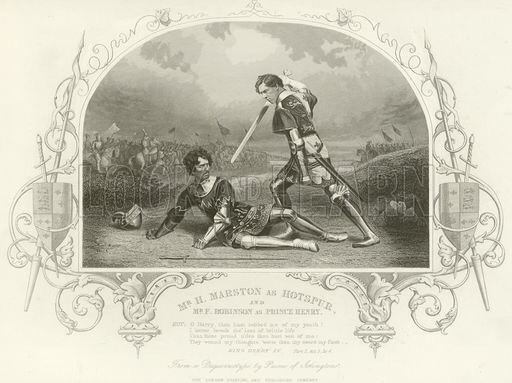
The rivalry between Hamilton and Aaron Burr mirrors many characters in Shakespeare, but the two I want to focus on here are Hotspur and Prince Hal from Henry the Fourth Part One
As this video from the Royal Shakespeare Company shows, these two combatants meet only once in the play, but they are constantly compared to each other by the other characters, who talk about them as if they were twins, (they even have the same first name)! Even the king remarks that his son could have been switched at birth with Hotspur.
Prince Henry (known as Hal in the play), is the heir to the throne. Like Burr in Hamilton, Hal is methodical, cool, keeps his feelings to himself, and is known by some as a Machiavellian politician. Hotspur, (or Henry Percy), is his opposite. Like Hamilton he is fiery, eloquent, and not afraid to die for his cause, which in Hotspur’s case is to supplant the royal family and correct what he believes is an unjust usurpation by Hal’s father, King Henry the Fourth.
In the scene below, the two men seem hungry to not only kill one another, but to win honor and fame as the man who killed the valiant Henry. Whether it’s Henry Percy, or Prince Henry who will die, is something they can only find out by dueling to the death.
HOTSPUR
If I mistake not, thou art Harry Monmouth.
PRINCE HENRY
Thou speak’st as if I would deny my name.
HOTSPUR
My name is Harry Percy.
PRINCE HENRY
Why, then I see
A very valiant rebel of the name.
I am the Prince of Wales; and think not, Percy,
To share with me in glory any more:
Two stars keep not their motion in one sphere;
Nor can one England brook a double reign,
Of Harry Percy and the Prince of Wales.
HOTSPUR
Nor shall it, Harry; for the hour is come
To end the one of us; and would to God
Thy name in arms were now as great as mine!
PRINCE HENRY
I’ll make it greater ere I part from thee;
And all the budding honours on thy crest
I’ll crop, to make a garland for my head.
HOTSPUR
I can no longer brook thy vanities.
They fight, HOTSPUR is wounded, and falls
HOTSPUR
O, Harry, thou hast robb’d me of my youth!
I better brook the loss of brittle life
Than those proud titles thou hast won of me;
They wound my thoughts worse than sword my flesh:
But thought’s the slave of life, and life time’s fool;
And time, that takes survey of all the world,
Must have a stop. O, I could prophesy,
But that the earthy and cold hand of death
Lies on my tongue: no, Percy, thou art dust
And food for– Dies.
Hamilton’s duel is also a matter of honor; Alexander wants to defend his statements against Burr, while Burr wants to stop Hamilton from frustrating his political career. Here is how their duel plays out in the musical Hamilton:
Just like Burr, Prince Hal feels remorse after killing his worthy adversary.
PRINCE HENRY
For worms, brave Percy: fare thee well, great heart!
Ill-weaved ambition, how much art thou shrunk!
When that this body did contain a spirit,
A kingdom for it was too small a bound;
But now two paces of the vilest earth
Is room enough: this earth that bears thee dead
Bears not alive so stout a gentleman.
If thou wert sensible of courtesy,
I should not make so dear a show of zeal:
But let my favours hide thy mangled face;
And, even in thy behalf, I’ll thank myself
For doing these fair rites of tenderness.
Adieu, and take thy praise with thee to heaven!
Thy ignominy sleep with thee in the grave. Henry IV, Part I, Act V, Scene iv.
III. The Times
In both Hamilton and all of Shakespeare’s history plays, the characters know that they are living during important events and their actions will become part of the history of their country, and none more than Washington. In the song, “History has its eyes on you,” he warns Hamilton that, try as one might, a man’s history and destiny is to some extent, out of his control, which echoes one of King Henry the Fourth’s most bleak realizations:
Henry IV. O God! that one might read the book of fate,
And see the revolution of the times
And changes fill the cup of alteration
With divers liquors! O, if this were seen,
The happiest youth, viewing his progress through,
What perils past, what crosses to ensue,
Would shut the book and sit him down and die. Henry IV, Part II, Act III, Scene i.
Washington is keenly aware of his legacy and does his best to protect it. In Shakespeare’s Henry IV,the king also lies awake trying to figure out how to deal with the problems of his kingdom, which is why Shakespeare gives him the famous line “Uneasy lies the head that wears the crown.” Likewise, Richard II, makes a famous speech where he mentions how many kings have a gruesome legacy of dying violently:
As we see the whole story of Hamilton’s life, his fate changes constantly and his legacy shifts in every scene of the show: immigrant, war-hero, celebrated writer, Secretary of the Treasury, but then, once he published The Reynolds Pamphlet, Hamilton went from famous to infamous. After After Burr murdered him in the duel, Hamilton might have been utterly forgotten, in spite of all his great accomplishments. This is a key theme in all history and tragedies; the desire of every man to create a lasting legacy for himself, and thus transcend mortality.
The women who tell the story
Fortunately for Hamilton, the women of his story also help to preserve it. Historically, most of Hamilton’s archives were preserved by his wife Eliza Schyler, and she and her sisters help shape the story from the beginning to the end of the show. Hamilton’s sister in law Angelica sets up this theme by literally rewinding the scene of her first meeting with Alexander, and then retelling how she and Hamilton met from her own point of view.
Once her sister marries Hamilton, Eliza Schuyler asks to “be part of the narrative.” She knows she married a important man and that his life will someday become part of American history. Eliza wants to be a part of that historic narrative.
When Hamilton commits adultery and writes the Reynolds pamphlet though, Eliza is so hurt and scandalized that she rescinds her requests. In the song “Burn,” she destroys her love letters from before the affair, and all correspondence she had with Alexander when he revealed it. Lin Manuel Miranda explained that he wrote the song this way because no records during this period survived, so he invents the notion of Eliza destroying them as a dramatic device, to heighten her estrangement from her husband. Though this is a contrivance, it does re-enforce how, when part of the story is lost, it twists and destroys part of our impression of a person. Shakespeare knew this too; Henry Tudor went to great lengths to destroy the legacy of his predecessor Richard the Third, and literally repainted him as a deformed tyrant. Shakespeare couldn’t escape the narrative of Richard as a monster when he wrote his history play and sadly helped to perpetuate it to this day.
At the end of the play though, Eliza changes her mind yet again, as the final song I placed earlier shows, Eliza spends the last 50 years of her life to preserving and protecting her husband’s name, as well as Washington, all the founding fathers, and children who can grow up knowing that story at her orphanage. This song illustrates clearly that in the end, a man’s story is defined by the people who tell it, and Hamilton is fortunate to have such a creative, energetic and talented writer/ actor in Lin Manuel Miranda, and the cast of Hamilton, to preserve the story in such a Shakespearean way.
Bravo.
Educational links related to Hamilton:
Books
Hamilton: The Revolution by Lin-Manuel Miranda, Jeremy McCarter. A complete libretto of the show, with notes on its creative conception.
Alexander Hamilton by Ron Chernow. This is the book that inspired Lin Manuel Miranda to create the show. It is a stirring, well-researched historical biography.
Well, it happened. A man whom I have described as a villain of Shakespearean proportions is now the president. You might have read in my Richard III post that I had hoped that the election would play out like the history play about a deformed tyrannical king with bad hair. What I forgot when I made that prediction was that the king in question, Richard III, does become king for a little while.
Here’s another way of putting it. I found it on the Facebook page of a friend of mine, Austin Tichnor of The Reduced Shakespeare Company:
I don’t want to talk too much about devisive politics because I feel that the country and the world is hurting too much because of people who want to reduce the world into “my party,” “my country,” and turn everything and everyone else into “the other.”
What I want to talk about in this post, is what I hope for our new president, some words of wisdom from The Bard, and maybe some words of healing for those people who feel like “the other,” starting with some of the people I might have offended with my earlier posts.
Why Donald Trump is like Henry V, (we hope).
A lot of people are full of anxiety right now because nobody is really sure what kind of president Trump will be; will he follow through with his campaign promises? Will he take power from those in Washington and give it to the people, as he said in his inaugural address? How much will his past life as a real-estate tycoon influence his work as president? This uncertain climate reminds me very much of the end of Shakespeare’s Henry IV, Part II, where the old king dies leaving the kingdom to his son. Thus far, the prince, (known as Hal to his friends), has been wasting his time drinking in a bar in Eastcheap with his disreputable friend, Sir John Falstaff. Watch this scene where he and Falstaff mock the king and trade insults with each other:
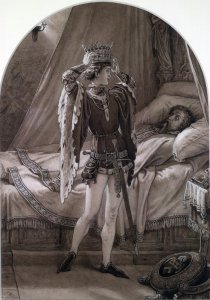
But, on his deathbed the real king summons his son and knocks some sense into him, demanding that he take the job of running the country seriously. In Act IV, Scene v, the prince, (thinking his father is dead) tries on his father’s crown right before King Henry wakes up and curses his son with a long and terrible speech. Below is King Henry’s deep rebuke of his son Hal, detailing his fears of what will happen when the prince becomes king.
Prince Hal tries on his father’s crown. Henry IV, Part II. Act IV, Scene v.
KING HENRY:
What! canst thou not forbear me half an hour?
Then get thee gone and dig my grave thyself,
And bid the merry bells ring to thine ear
That thou art crowned, not that I am dead.
Pluck down my officers, break my decrees;
For now a time is come to mock at form:
Harry the Fifth is crown’d: up, vanity!
Down, royal state! all you sage counsellors, hence!
And to the English court assemble now,
From every region, apes of idleness!
Now, neighbour confines, purge you of your scum:
Have you a ruffian that will swear, drink, dance,
Revel the night, rob, murder, and commit
The oldest sins the newest kind of ways?
Be happy, he will trouble you no more;
England shall double gild his treble guilt,
England shall give him office, honour, might;
For the fifth Harry from curb’d licence plucks
The muzzle of restraint, and the wild dog
Shall flesh his tooth on every innocent.
O my poor kingdom, sick with civil blows!
When that my care could not withhold thy riots,
What wilt thou do when riot is thy care?
O, thou wilt be a wilderness again,
Peopled with wolves, thy old inhabitants! King Henry IV, Part II, Act IV Scene v.
I have to wonder if Obama feels a little like King Henry, since Trump has promised to repeal Obamacare, reverse many of his executive orders, and put his own “Mad Dog” ruffians in charge of the country. I also find it ironic that King Henry is worried about foreign ruffians becoming part of English society, while Trump is worried about keeping them out of America.
The good news is that Prince Hal eventually became a wise and effective ruler. In the play that bears his name, King Henry V united his country, and achieved a famous victory over the French. Everyone in the play was shocked and amazed by how he transformed himself from a drunk into an effective king. Trump has that same opportunity; although his poll numbers are low right now, he can prove his commitment to the job and amaze the country.
This is what I’m sure all of America hopes Trump will do for the country, although I have trouble believing that it will actually happen. It seems more likely to me that he will exploit his position to help his businesses, just as he has done his entire career, and he already shows signs of doing now. It seems unlikely that he will achieve anything that will protect the dignity of Americans, or achieve prosperity for anyone but himself.
I believe that the best we can hope for with Trump is a presidency that mirrors one of Shakespeare’s most mediocre kings. Richard II, who stole land away from his nobles because he believed being king gave him God’s permission to do whatever he wants. Trump was practically quoting Richard, when people wondered about his many potential conflicts of interests between the presidency and his business empire. Moments like this make me and many others like me curse the way businessmen-turned-politicians can give away America’s dignity dollar by dollar, as John of Gaunt famously cursed in Richard II:
JOHN OF GAUNT
Methinks I am a prophet new inspired
And thus expiring do foretell of him:
His rash fierce blaze of riot cannot last,
For violent fires soon burn out themselves;
Small showers last long, but sudden storms are short;
He tires betimes that spurs too fast betimes;
With eager feeding food doth choke the feeder:
Light vanity, insatiate cormorant,
Consuming means, soon preys upon itself.
This royal throne of kings, this scepter’d isle,
This earth of majesty, this seat of Mars,
This other Eden, demi-paradise,
This fortress built by Nature for herself
Against infection and the hand of war,
This happy breed of men, this little world,
This precious stone set in the silver sea,
Which serves it in the office of a wall,
Or as a moat defensive to a house,
Against the envy of less happier lands,
This blessed plot, this earth, this realm, this England,
This nurse, this teeming womb of royal kings,
This land of such dear souls, this dear dear land,
Dear for her reputation through the world,
Is now leased out, I die pronouncing it,
Like to a tenement or pelting farm:
England, bound in with the triumphant sea
Whose rocky shore beats back the envious siege
Of watery Neptune, is now bound in with shame,
With inky blots and rotten parchment bonds:
That England, that was wont to conquer others,
Hath made a shameful conquest of itself.
Ah, would the scandal vanish with my life,
How happy then were my ensuing death! Richard II, Act II, Scene i.
If you’re like me and millions of other people around the country who don’t have a lot of faith in this new government, the question becomes, “What do we do now?”
I believe that once again, Shakespeare can offer words of wisdom and comfort in this moment of doubt and uncertainty. One quote I keep coming back to is from a play you’ve likely never heard of- The History Of Sir Thomas More. You won’t see this text in any collected edition of Shakespeare, because the play is actually unfinished. Only a tiny portion of it survives, and it was never published. It has the incredible distinction to be one of the only surviving play manuscripts from Shakespeare’s day, and if he did write it (which no one can definitively prove), it is the only play written in his own handwriting. Even if Shakespeare did not have a hand in writing it, it is one of the most poignant speeches I’ve ever read, and it has an incredible message for our nation and for the entire world.
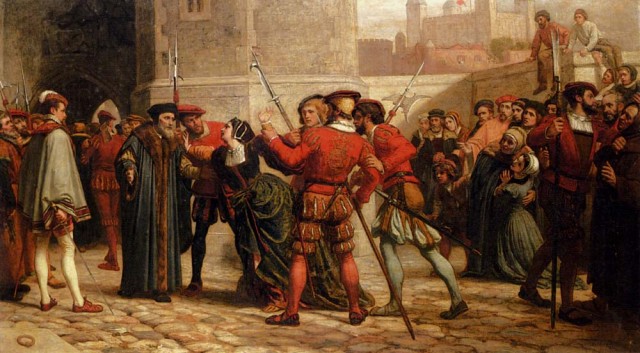
Sir Thomas More (left in the gown), attempting to control a riot.
First, a little background. Sir Thomas More was a real man who worked as Chancellor of England under Henry VIII. He was famously executed for refusing to support the king’s divorce of Queen Katherine Of Aragon because of his devout Catholic beliefs, and for that reason he is still considered a man of great principle and honor. The scene which Shakespeare allegedly helped write however, takes place earlier, when More was just a sheriff of London.
In the speech below, More is trying to break up a riot where a mob of people are trying to murder a group of immigrants from the country, accusing them of stealing jobs from Englishmen, (sound familiar)? More pleads with them to show compassion and to be open to other points of view. Here is More’s speech, performed by Sir Ian McKellen.
Here’s the text of the speech:
Imagine that you see the wretched strangers,
Their babies at their backs and their poor luggage,
Plodding to the ports and coasts for transportation,
And that you sit as kings in your desires,
Authority quite silent by your brawl,
And you in ruff of your opinions clothed;
What had you got? I’ll tell you: you had taught
How insolence and strong hand should prevail,
How order should be quelled; and by this pattern
Not one of you should live an aged man,
For other ruffians, as their fancies wrought,
With self same hand, self reasons, and self right,
Would shark on you, and men like ravenous fishes
Would feed on one another….
Say now the king
Should so much come too short of your great trespass
As but to banish you, whether would you go?
What country, by the nature of your error,
Should give you harbour? go you to France or Flanders,
To any German province, to Spain or Portugal,
Nay, any where that not adheres to England,
Why, you must needs be strangers: would you be pleased
To find a nation of such barbarous temper,
That, breaking out in hideous violence,
Would not afford you an abode on earth,
Whet their detested knives against your throats,
Spurn you like dogs, and like as if that God
Owed not nor made not you, nor that the claimants
Were not all appropriate to your comforts,
But chartered unto them, what would you think
To be thus used? this is the strangers case;
And this your mountainish inhumanity.
Sir Thomas More, Act II, Scene 4.
Finally, here’s a link to view the original manuscript, which is on display in the British Library in London.
The obvious condemnation of xenophobia and hatred of immigrants in More’s speech is obvious, so I won’t belabor it, but it’s worth noting that this problem has been going on for over 400 years. What I’d like to focus on is what More says at the end: when a nation erupts into violence against immigrants it cheapens itself and the world takes notice. Also, it is the job of those in authority to protect, not stay silent when such attacks take place. This is why we need to think carefully about Trump’s proposals regarding immigrants, Muslims , and other such “strangers.”
In a more general sense, I feel that in our divided nation, we all are feeling like strangers. Whether you’re a man or a woman, Democrat or Republican, Caucasian or Non-Caucasian, many thousands of people in this nation all seem to feel that someone is treating them like “strangers,” and our task, all of us, as Americans and human beings, is to “take the stranger’s case,” by looking at other people’s points of view with compassion and an open mind. That, by the way was made Shakespeare a great writer; his own ability to see into the minds of kings and peasants, women and warriors, ghosts and gods.
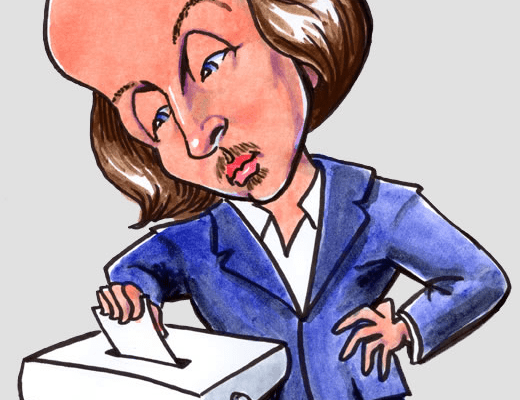
So here’s the big question: whom would Shakespeare vote for? I believe he would vote for whomever would try to learn from the lives of these strangers, and use his or her authority to protect their right to speak their minds. Deciding who that person is, is a task I leave to you.
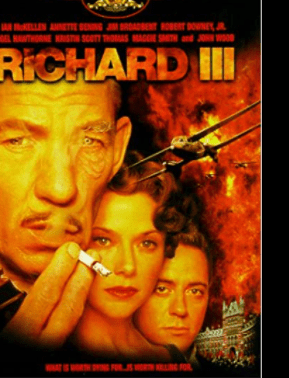
Introducing our new Play of the Month: Shakespeare’s dark history play about murder and corruption, Richard III. First, a short presentation I made that introduces the characters and themes of the play.
Second, a quick, funny summary of the play from the Reduced Shakespeare Company
And finally, this incredible animated version of the play, which looks like a stained-glass window come to life!
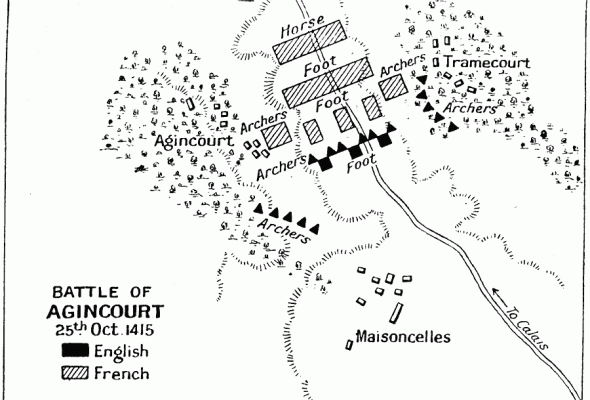
Today is the 600th anniversary of the Battle of Agincourt, one of the greatest victories in English history, where King Henry the Fifth and his 5,000 troops, fought and won against the French, who outnumbered them 5 to 1! Why is this important? Well, in Shakespeare’s history play Henry the Fifth, he gives the king the greatest pep-talk speech of ALL TIME!
This speech is so awesome, it’s cool even when a 5-year old does it!
So you may be wondering, what is Agincourt, and what is St. Crsipin’s Day?
Well Agincourt is a castle in France where on October 25th, 1415, King Henry fought a decisive battle that helped him conquer all of France. For more info on the battle, click here to read this article from the Telegraph.
Contemporary drawing of the Battle of Agincourt.
As for St. Crispin, I wrote about him before when I was working on a high-school production of “Henry the Fifth,” which you can read about here. Long story short- he was the patron saint of SHOEMAKERS!
And finally, a funny take on the battle from my favorite kid’s show, “Horrible Histories.”
Shakespeare himself was a father, and he frequently wrote about the dynamic between fathers and their children. There are many different types of fathers in Shakespeare’s 40 plus plays, and this week I’m ranking them in terms of three categories: Good Dads, Bad Dads, and “Dad Dads.” You’ve probably already read the “Worst Dad” post, so now we’re looking at the good, and the not so good. I used the following criteria when choosing the top 5 dads in each categories:
The Good Dads
Are supportive for their kids
Try to keep their children happy
Offer help and advice, especially on their children’s future.
Are willing to sacrifice themselves
They let their children become their own people.
The Bad Dads
Treat their children as property
Have little to no interest in their children
Put their children in danger
Subject their children to abuse
In some cases, they murder them!
The “Dad” Dads
Are basically good hearted, but they have some kind of flaw that prevents them from becoming really good parents.
In my view, are the most human, modern dads on the list.
I’ve chosen to award these dads a necktie, something every ok dad needs.
Now, onto the Dad Dads:
5. Aegean from The Comedy Of Errors. Aegean wonders around for 20 years looking for his lost children, which I call devoted parenting, but a little aimless and undisciplined. I therefore award Aegean two ties with little anchors on them, to remind him to stay in one place and wait for his sons to find him!
Alexandre Bida, “The death of Lord and John Talbott,” 1895
4. Lord Talbott from Henry the Sixth Part I. Talbott is the hero of the English fight against the French at the close of the Hundred Years War. He goes toe to toe with Joan of Arc on numerous occasions. He also raises a fine and valliant son, John Talbott who is also a warrior. The two die bravely in a siege against the French, rather than surrendering, or leaving the other to die. Talbott is clearly also devoted to his child, but his career choice doesn’t allow his son to grow up in a safe environment! I therefore award Talbott two ties with little English and French flags on them.
The Ghost of Hamlet’s Father by William Blake, 1806.
3. The Ghost Of Hamlet’s Father from Hamlet/ Portia’s Dad from Merchant Of Venice. Both these parents die before their plays begin, yet they still try to improve their children’s lives from beyond the grave! The Ghost helps Hamlet become king of Denmark, and Portia’s dad tries to help her find a good husband, (one who will love her for something besides her beauty or riches). Although these parents achieve their goals, waiting this long to help their kids seems a bit like absentee parenting! I therefore award these posthumous parents ties with little skulls on them.
2
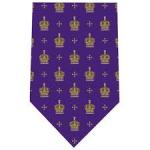
. King Henry IV, from King Henry IV King Henry is the classic career dad, one who wants his son Hal (the future King Henry V), to follow in his footsteps. The two have a terrible fight when Henry thinks Hal is trying to steal his crown on his deathbed! Eventually though, father and son reconcile, and dad even gives the future king some last minute advice; if you fight a war with France it’ll help secure your crown, which Hal does and succeeds! I therefore award King Henry a tie with little crowns on it, hoping that nobody with a dagger ties tries to steal it when he’s sleeping!
1. Prince Pericles from Pericles Pericles is another busy dad- King Antiocus tries to murder him, and he has to leave his own kingdom. Then he gets shipwrecked 3 times! In fact, his only daughter is born onboard a ship in the middle of a storm! Pericles raises the girl for a number of years, but then has to leave again, and guess what, he gets shipwrecked AGAIN! He eventually finds his daughter and they live happily ever after, but you kind of get the idea that Pericles is a little accident-prone, which keeps him from being on the Best Dads list. Sorry Pericles, but at least you get a tie with, what else, Boats on it! Maybe next Fathers Day, someone will get you a life preserver.
And now at Long LAST, the BEST Dads in Shakespeare!
Aaron fights to protect his baby child.
5. Aaron the Moor from Titus Andronicus. Ironically, one of the worst villains in Shakespeare is also one of the best fathers. Aaron is fiercely protective of his child, even threatening people at sword point if they dare come near his baby. He also plans out the child’s future and is willing to give his own life for a promise that Lucius will protect and nourish his son. He may be a monster to everyone else, but to his baby, Aaron is simply, a good dad!
4. The Old Shepherd from The Winter’s Tale. This character is a very mirror of generosity and kindness; not only does he take care of his son The Clown, he adopts a poor discarded child, the princess Perdita, with no obligation to do so. He raises her for 16 years and constantly brags about her to the entire town. She becomes a beautiful, wise, and modest girl who fills her adopted father with pride because of his good parenting. Even when Perdita meets her real father, she speaks of The Old Shepherd with real filial affection “Oh my poor father.”
3.
Lord Capulet, from Romeo and Juliet. I know this was a controversial choice, and I discuss my choice in detail on my podcast, but I’ll sum up my major arguments here:
Even though a lot of actors choose to have him smack Juliet around, there’s no mention of it in Shakespeare’s text. The most he ever does is threaten to strike her, but the stage directions never indicate he does it. Capulet is clearly more bark than bite.
From the very beginning of the play, Capulet has shown that he cares about Juliet, and wants her to marry for love, not money.
Lord Capulet hovers and frets constantly when Juliet tells him she will marry Paris, staying up late to plan the wedding! I ask you, does that sound like a tyrannical father? I wonder sometimes if Lord Capulet would’ve forgiven Juliet for marrying Romeo if she had just told him. In any case, based on my criteria above, Capulet is a good dad, bad tempered, yes, but fundamentally concerned for the welfare of his children.
3. Prospero fromThe Tempest I chose this high spot for Prospero mainly because he seems to have the most success of any other dad in the cannon. Like Pericles, he too is shipwrecked with his daughter, but Prospero stays with Miranda, raises her alone, teaches her everything she knows, and calls her an angel that helped preserve his life. Prospero cares so much for his daughter that he refuses to give into despair, even though he’s lost his wife, his dukedom, and his home.
Prospero also hatches a plan to get him and Miranda off the island, to get his dukedom back, and to get her married to a handsome prince name Ferdinand, and he succeeds with every one of these endeavors, even though it takes 12 years. Prospero gets extra points for his patience and his wisdom, but I have to admit he’s a bit of a control freak; he demands that Miranda listen to him and obey him no matter what, and he warns Ferdinand that there will be dire consequences if he dare try to do anything illicit with his daughter before the wedding. In addition, there’s no denying that Prospero is also acting out of self interest- he wants to become duke again, and he wants revenge against his enemies and that’s partially why he raises a tempest, (or a huge storm), instead of just sending a message back to Milan.
1.
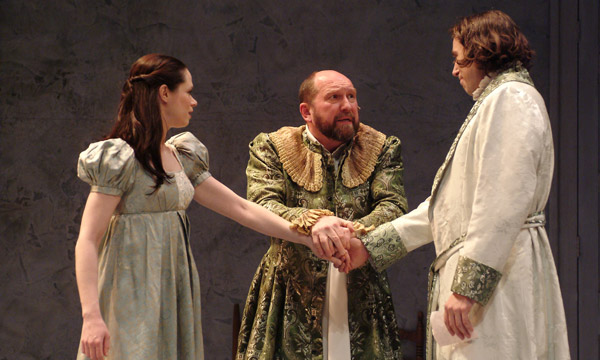
Simonides grants permission for Pericles to wed his daughter. Production shot from Mary Zimmerman’s 2006 production of “Pericles.”
King Simonedes from Pericles, Prince Of Tyre You might forget this character because he only has a short time onstage, but I defy anyone to come up with a better father. He’s kind, supportive, stable, funny, and has a wonderful relationship with his daughter Thaisa. Above all, Simonedes actually listens to his child and does everything in his power to help her when she decides she wants to marry Pericles. Also, like Prospero, Simonedes pretends to object to the marriage, but you kind of get the sense that, rather than testing the affection of the couple, he’s actually just playing a joke on them. You can hear a “gotcha” and a fatherly wink in the final line of the speech in Act II, where he pretends to object to their marriage:
Congratulations to all our fabulous fictional fathers! Thank you for reading, and see you soon!



 If you click on the link, you can do a great scavenger hunt where you upload pictures or answer trivia questions for points, and of course they are all related to Shakespeare. If you have the app on your phone, search for Shakespeare Birthday Scavenger Hunt and enter the code: 2BON2B (Get it, to be or not to be)! You can also use the code NLEGVM. Let me know if you like it or if you cannot access the link.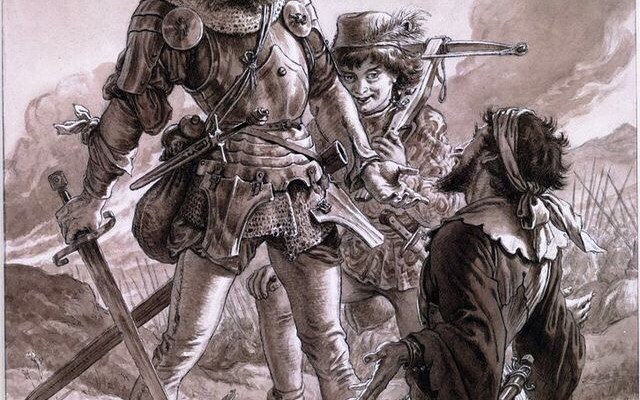
















 The Shakespearean Student