As I said before, my criteria for these apps was “Free, functional (educational or useful in life,) and fun.”
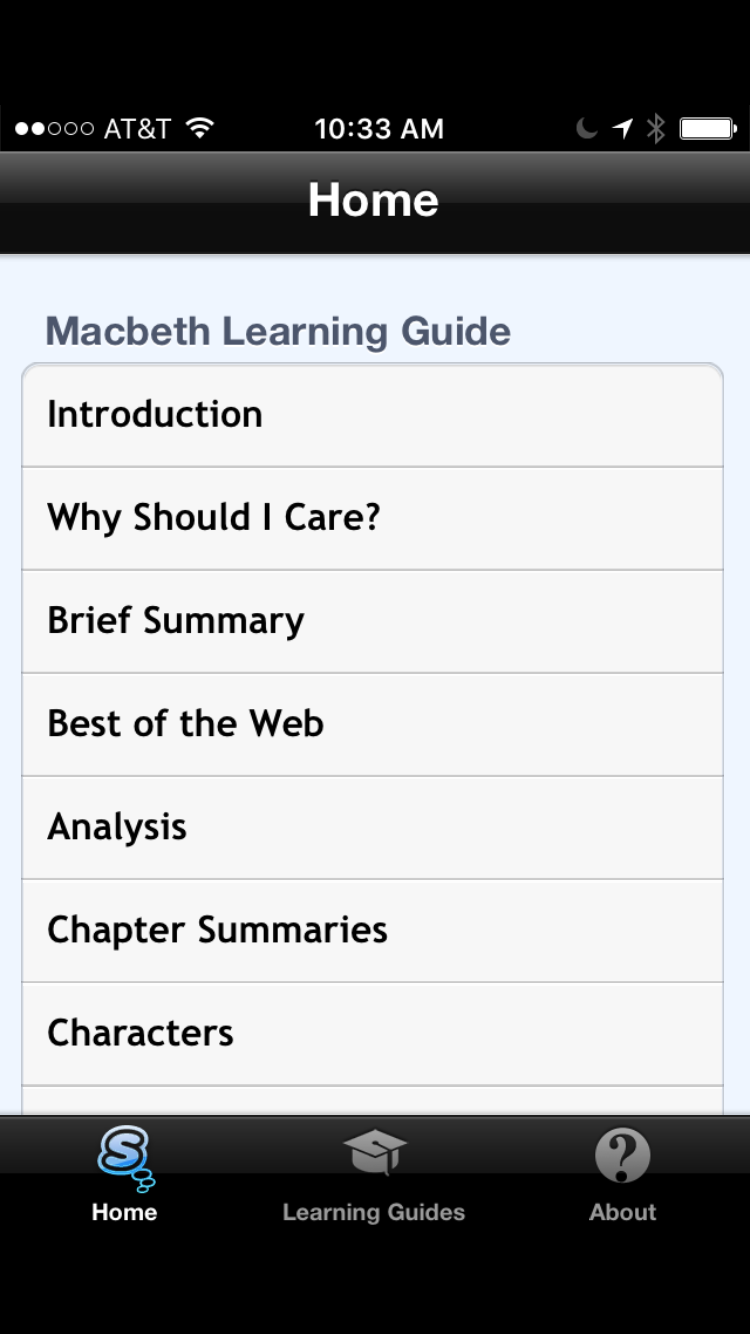
6. Shakespeare by Shmop: incredible! This is a study guide for your phone of tablet. There are separate apps Hamlet, Macbeth, and R&J. Each one features a glossary, analysis, quotes, study questions, you get the idea. You can cover a lot of the play with this app. My favorite feature is “Why Should I Care?” This is a short essay that compares the themes and ideas of the play to modern life. Excellent app, and the website is great too for students and teachers: http://www.shmoop.com
7. Shakespeare for kids–
I believe nobody is too old or too young to enjoy Shakespeare, so I tried to find a Shkespeare app for young children and came up with this. To be honest, I was disappointed in this one; it’s basically an app version of Irene Lamb’s book “Tales From Shakespeare”. It consists of short summaries of the plays intended for children. There are no study guides, no quotes, and the games have nothing to do with Shakespeare. My advice, get the book, or go to these sites:
8. Poems By Heart Made by the Penguin Publishing Co, it’s designed to help you learn a poem by quizzing yourself, one line at a time, (or one word if necessary). Friendly and enjoyable.
9. Soliloquy by playshakespeare.com.
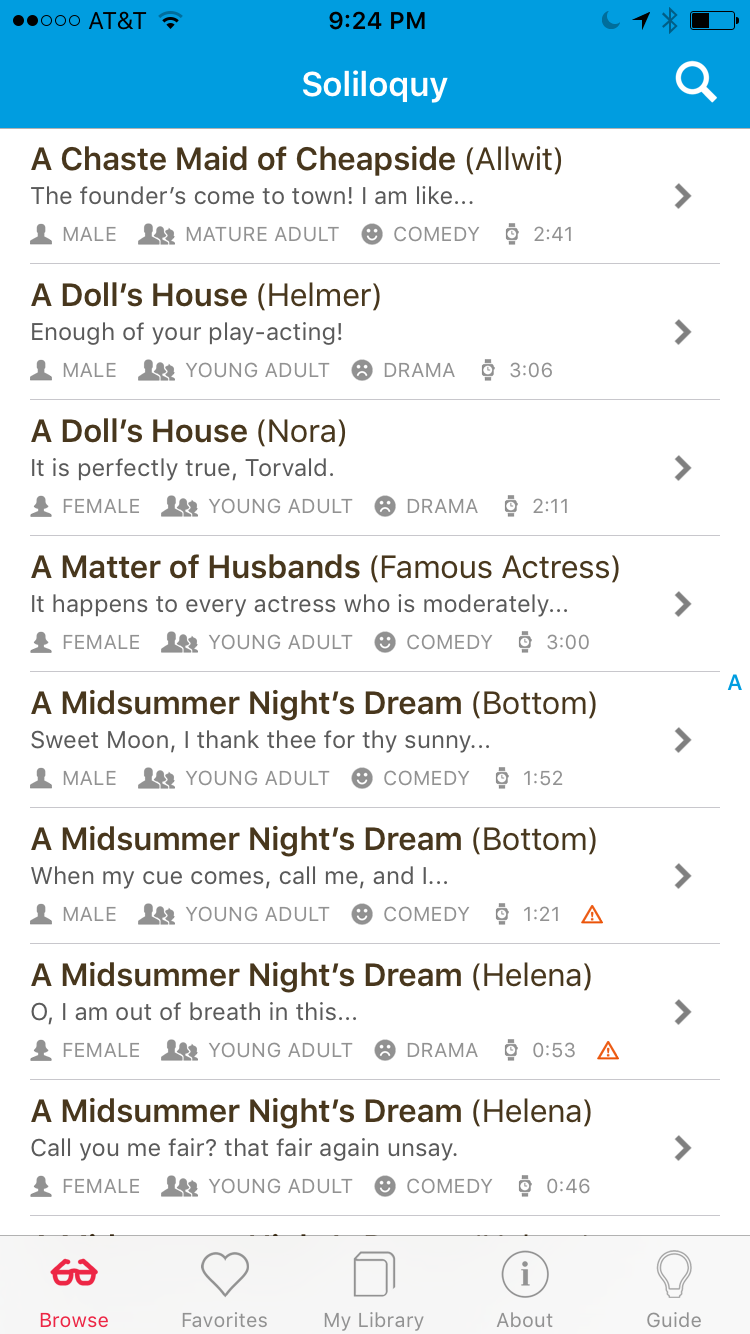
As you might expect, this app is a database of Shakespearean speeches. I normally don’t advocate actors learning speeches out of context without reading the whole play, but this app is useful for the professional actor on the go, who needs to pull out a speech in a hurry. It’s sort of a digital monologue portfolio. You can find a good speech, save it, then pull it out when you need to study it. There’s also a pro feature that allows you to edit the speech if it’s running long. What I really like is the fact that each speech is conveniently classified by gender/ genre/ length, and the helpful tips for young actors picking a good speech.
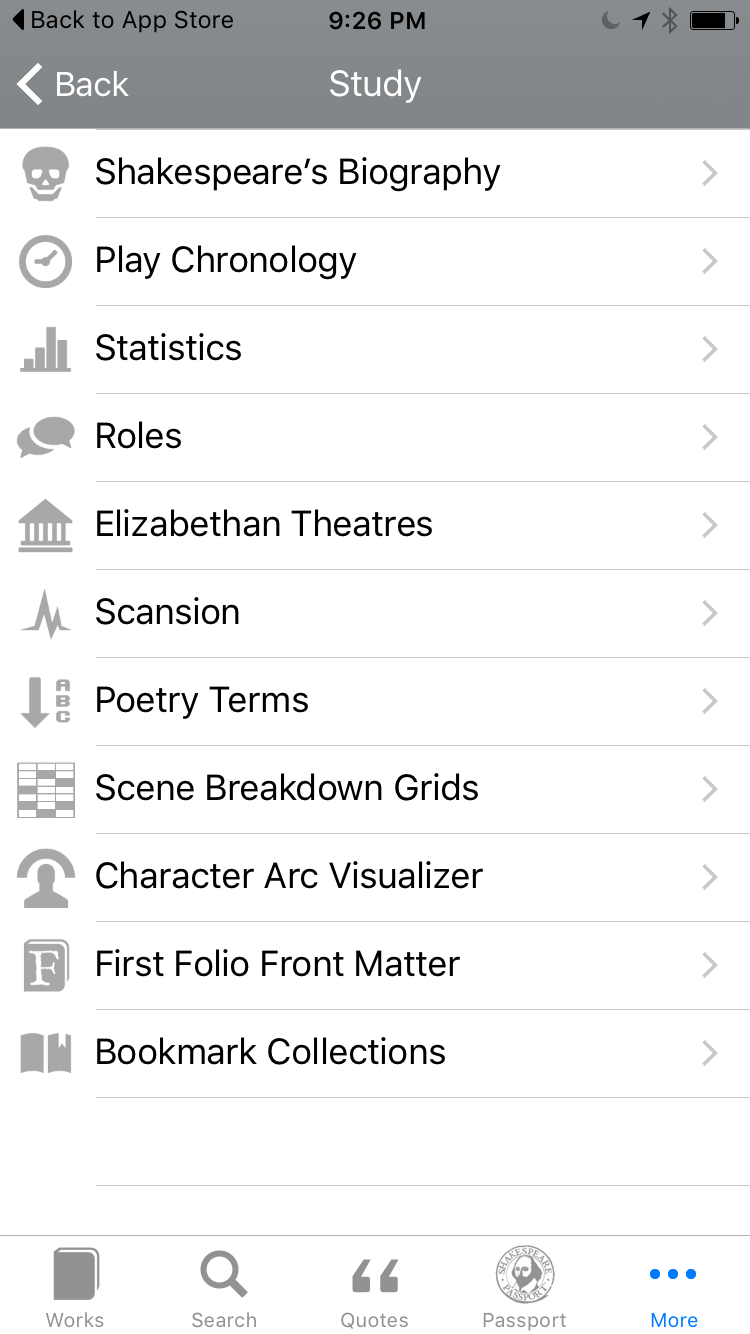
Well now we come to the end of the free Shakespeare app list I’ve compiled. Now what? I would recommend downloading Shakespeare by Playshakespeare.com, then BURN THE LIST! This is the most incredible Shakespeare app I’ve ever seen! It has tons of free and pay- only features and I’ve listed a few below:
Full text of the plays
A GPS feature where you can locate any Shakespearean theater near you.
A free passport to 57 theaters that offer discounts to members.
Study guides which include scene breakdown, poetry glossary, and notes on verse scansion
Shakeapeare quotes generator.
A glossary of over 40,000 Shakespearean words
Much like this blog, I recommend this app to Shakespeare lovers of any age!
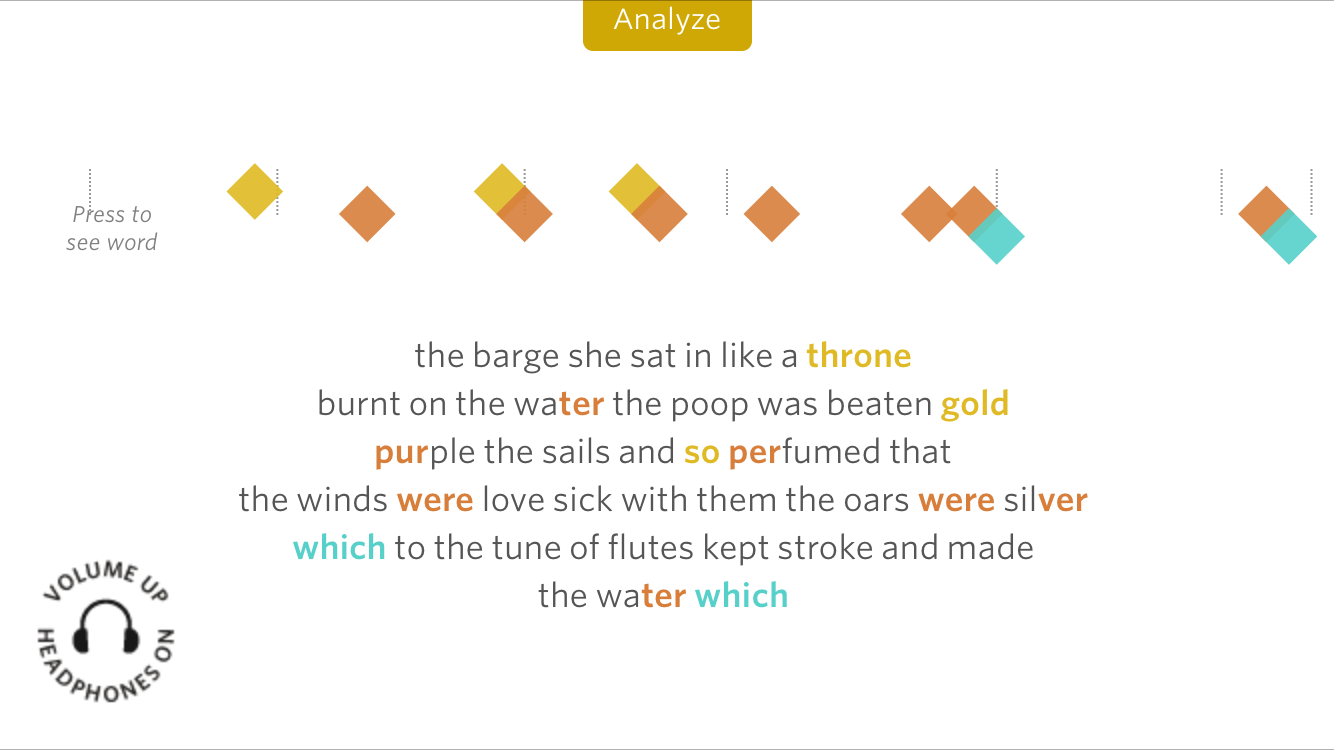
One more bonus review: this isn’t an app, but it’s a website created by Joel Eastman and Erik Hinton of the Wall Street Journal. Its purpose is to analyze the awesome lyric complexity of the Broadway musical “Hamilton.” http://graphics.wsj.com/hamilton/
The website uncovers the use of assonance, alliteration, near-rhymes, mid-line rhymes, and other strokes of Lin-Manuel Maranda’s lyrical brush. The best part is that you can feed any text you want into the website, and it will use the same algorithm to show you its lyrical elements, so I’d recommend using it as a tool to study Shakespeare. You’ll find that the Bard of Avon and Snoop Lion aren’t as different as they might seem.
So there you are, a few fun, friendly, and free tools for exploring the work and life of a timeless English playwright. As The Bard might say: “Sirs, betake you to your tools,” for such apps as these are only as good as the person who uses them.
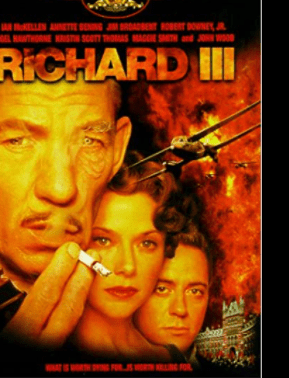
Introducing our new Play of the Month: Shakespeare’s dark history play about murder and corruption, Richard III. First, a short presentation I made that introduces the characters and themes of the play.
Second, a quick, funny summary of the play from the Reduced Shakespeare Company
And finally, this incredible animated version of the play, which looks like a stained-glass window come to life!
The venerated Shakespearean actor, Sir Antony Sher, once said with frustration while he was acting at the RSC that, “even the best Feste is less funny than the worst Malvolio.” I actually have a rare insight into these two roles since I’ve played them both! So allow me if you will to present you with some insights I’ve gained into these two characters that are very much polar opposites. Although they are as different as night and day, they form the central comic premise of the whole play, and have some truly hilarious moments!
Me. as Malvolio, Wooster. High School 2002
I played Malvolio when I was a senior in high school; he was my first principal Shakespearean role. My director chose to set the play in the 1940s and he re-purposed the kingdom of Illyria as the Hotel Illyria, with Malvolio as the concierge or lead butler in charge of all the hotel maids and other housekeepers. This not only made the play more accessible to a 2002 audience, it also really helped me understand Malvolio’s role: he is first and foremost a snob who is obsessed with efficiency and pleasing his mistress Olivia (in this version the owner of the hotel). I would soon also discover that, although Malvolio is certainly snobby and can be a bit of a killjoy, he also has qualities that make him appealing to everyone who has ever felt put down or bullied, and that’s what makes him a complex and endearing character today.
Richard Briars as Malvolio
Some notes on the character: Malvolio’s name means “unsatisfied desire”- somebody who aspires to be what he is not. I find the relationship between Feste and Malvolio interesting because the two are partially defined by how each one is unlike the other. Feste is a clown, hired by the nobles to help them have a good time. He is described as “a merry fellow who cares for nothing.” In other words, Feste never takes anything seriously, except making a living with his jokes and songs. Malvolio is the exact opposite- he is also a servant, but he is a steward, in charge of running the Countess Olivia’s household. As such, he is obsessed with efficiency, commanding respect, and pleasing his mistress through his obsequious manner.
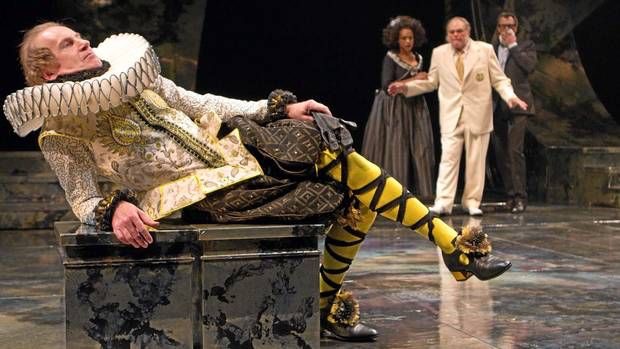
Like the Joker and Batman, both characters live according to an opposing viewpoint; Feste is a chaotic, happy-go-lucky sort, while Malvolio has a strict code of behavior which he expects everyone to follow. Their opposing world views bring them into conflict every time they meet. Plus, in most productions Feste is wearing brightly colored clown apparel or “motley wear,” while Malvolio is dressed in black. I’m not saying Malvolio is anywhere near as cool as Batman, but Malvolio can be just as sanctimonious. His journey is how he goes from being the trusted household servant, to a raving madman, to at last the Spectre at the feast at Olivia’s wedding.
I think the appeal of the character, which balances out the aforementioned snobbery, is that Malvolio is also a nerd: he dreams of becoming a count, he tries to make friends, but he does so by working far too hard at his job and not knowing how to fit in. This is why we inevitably feel sorry for him at the end of the play when he begs to know why his tormentors have locked him in a dark room, treated him like a lunatic, and made him think his lady was in love with him only to utterly destroy his hopes. The balance between the Nerd and the Snob that makes Malvolio a universal and complex part, and that’s why some of history’s greatest actors have played it!
Prepping for the Role: Alec Guinness, Laurence Olivier, Patrick Stewart, Donald Sinden, Nigel Hawthorne, Richard Briars, Steven Fry- these are just some of the names of actors who have played this part over the years. The first actor to play the role was Shakespeare’s leading actor, Richard Burbage, who also played Richard III, Hamlet, and Macbeth. Here’s a sample from Burbage’s famous eulogy, which mentions some of his most famous parts:
A Funeral Elegy On the Death of the Famous Actor, Richard Burbage,
He’s gone, and with him what a world are dead,
Friends, every one, and what a blank instead!
Tyrant Macbeth, with unwash’d, bloody hand,
We vainly now may hope to understand.
Brutus and Marcius henceforth must be dumb,
For ne’er thy like upon the stage shall come,
Vindex is gone, and what a loss was he!
Frankford, Brachiano, and Malevole.
One big decision that every Shakespearean actor needs to make is how to approach their role in a different way. To be honest, I was kind of a thief with my Malvolio- one of the first things I did was read a book by actor Sir Donald Sinden where he talks about how he delivered Malvolio’s first line, which occurs in Act I, Scene iii:
Olivia. What think you of this fool, Malvolio? doth he not mend?
Malvolio. Yes, and shall do till the pangs of death shake him:
infirmity, that decays the wise, doth ever make the 365
better fool (Act I, Scene v).
Sinden described his first line as a snobby “nyess,” as if he were simultaneously bored and embarrassed by Feste’s jokes. The director told me to act around Feste as if I were the villain in a Charlie Chaplin movie- basically to bully Feste and make him feel very small with my lines, in order to justify the revenge Feste innevitably takes on him. Like any character in Shakespeare, this is only one way to play the role, so you don’t have to agree with me.
The Gulling Scene
Malvolio’s most famous scene is called “The Gulling Scene,” the scene in which he’s tricked into thinking Olivia is in love with him. This is the moment where Malvolio goes from being a respectable prudish servant, into a raving madman. He enters full of dreams and plans to become “Count Malvolio” and creates an elaborate fantasy of what his life would be like if he married the Countess.
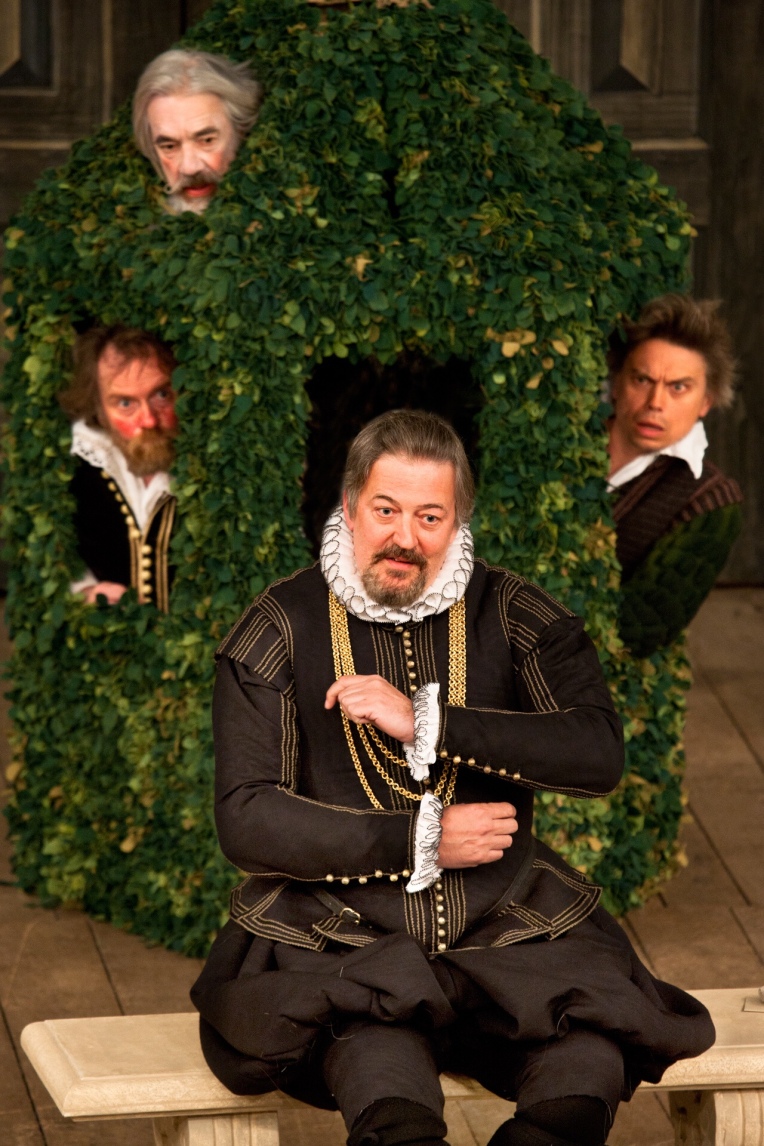
No sooner does Malvolio compete his fantasy of marrying Olivia, when lo and behold, a letter from her suddenly appears! Of course, the audience knows it’s all a trap and even worse, Sir Toby, Sir Andrew, and a boy named Fabian are watching him! It’s a moment of exquisite comedy that’s nearly impossible to get wrong.
One question I had when I did the scene was whether Malvolio really loves Olivia, or just loves her riches and her title. As a high schooler, I chose to believe that he really does have a crush on Olivia, but is too socially awkward to tell her. Having the letter is a chance to make his feelings known, which Malvolio can get very genuinely excited about! On the other hand, as you can see above, Malvolio might just be greedy to make himself even more respected and admired, and to have the power to throw out the likes of Sir Toby, Sir Andrew, and Maria. Malvolio’s revenge fantasy is also fun to watch, since we know he’ll be punished for it later.
Part of the fun involved in the scene is that it’s basically a “play within a play,” a device that Shakespeare used to great effect in Hamlet, A Midsummer Night’s Dream, Love’s Labor’s Lost, and both parts of Henry the Fourth. I think it’s the charm of seeing a character as he really is, Malvolio shows you his fantasies and creates a whole world in the middle of the orchard. Meanwhile, you feel complicit as you watch the people watching him, who could just as easily be part of your audience.Workshop on Twelfth Night and Bullying
On the other hand, the scene has also been called an example of bullying, since Sir Toby and Maria are using the letter to manipulate then humiliate Malvolio. Remember, Malvolio dresses like a fool and act like a fool in front of Olivia in Act III because he believes it will please the Coubtess. Basically Toby and Maria are Catfishing Malvolio, which can seriously hurt psychologically, as anyone who has been deceived over the internet knows. Plus, it ruins Malvolio’s reputation as you can see in this clip:
Again, as a teenager, I could certainly relate to a man making a fool of himself in a vain attempt to impress a girl. Seeing a man lose his head over a girl and then have her break his heart over a prank, is in some ways truly terrible to watch; even Olivia agrees by the end of the play that the joke has gone too far.
Malvolio. Madam, you have done me wrong,
Notorious wrong.
Malvolio. Lady, you have. Pray you, peruse that letter.
You must not now deny it is your hand:
Write from it, if you can, in hand or phrase;
Or say ’tis not your seal, nor your invention:
You can say none of this: well, grant it then
And tell me, in the modesty of honour,
Why you have given me such clear lights of favour,
Bade me come smiling and cross-garter’d to you,
To put on yellow stockings and to frown 2550
Upon Sir Toby and the lighter people;
And, acting this in an obedient hope,
Why have you suffer’d me to be imprison’d,
Kept in a dark house, visited by the priest,
And made the most notorious geck and gull
That e’er invention play’d on? tell me why!
Olivia. Alas, Malvolio, this is not my writing,
Though, I confess, much like the character
But out of question ’tis Maria’s hand.
And now I do bethink me, it was she 2560
First told me thou wast mad; then camest in smiling,
And in such forms which here were presupposed
Upon thee in the letter. Prithee, be content:
This practise hath most shrewdly pass’d upon thee;
But when we know the grounds and authors of it, 2565
Thou shalt be both the plaintiff and the judge
Of thine own cause.
That’s the tragic part of Malvolio’s journey. We’ve all known a Malvolio, and we’ve all been him from time to time. That’s what makes him such an enduring character.
Here’s an article I origionally wrote for the Shakespeare Birthplace Trust about the famous and famously funny scene in Twelfth Night, where Toby tricks Viola in disguise to fight a duel with the cowardly Sir Andrew Aguecheek.
Hello! To celebrate Shakespeare’s 449th birthday, I’d like to discuss the concept of judicial combat or licensed dueling. Most of Shakespeare’s aristocratic patrons would be intimately familiar with the arts of swordplay. Furthermore, Shakespeare as a trained actor would have studied fighting to accurately replicate it onstage. This is why Shakespeare takes many opportunities to mention dueling culture in his plays, especially within the comedies.
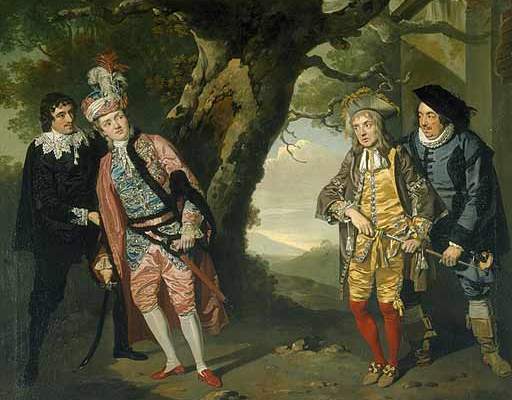
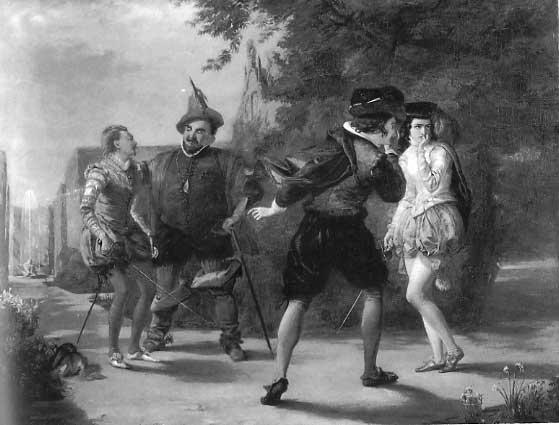
Picture Caption: William Powell Frith, The Duel Scene from “Twelfth Night” (1843)
Shakespeare uses duel references to comic effect in plays such as Twelfth Night, in which Sir Toby Belch convinces the cowardly Sir Andrew to fight Viola, a woman disguised as a man. Both combatants are cowards, but according to the law of arms, both of them have to fight, though neither one wants to or knows how: “He cannot by the duello avoid it” Twelfth Night Act III, Scene iv.
A more serious example of duel culture occurs in “Much Ado About Nothing. In Act IV, Scene I, Claudio has accused his fiancée Hero of adultery in front of the whole town, thus dishonoring her. Her cousin Beatrice is so furious with Claudio, she claims that, were she a man “I would eat his heart in the marketplace!” Eventually, Beatrice convinces Claudio’s friend Benedick to challenge Claudio to a duel. This seems harsh at first, but when one considers the context of judicial combat, it becomes clear that Beatrice is actually being totally rational, and wishes Claudio’s death for an important purpose- to vindicate Hero.
In Elizabethan society, when a woman was accused of adultery, a champion could fight to the death on her behalf in a judicial combat. This is why Beatrice famously asks Benedick to kill Claudio in Act IV; if Benedick kills Claudio in a duel, Claudio’s death would prove by divine influence that he accused her falsely, and Hero would at last be free from shame. However, when she is left alone with Benedick, she is full of conflicting feelings of love for him, which is why at first she hesitates to ask for his help:
Benedick. Surely I do believe your fair cousin is wronged.
Beatrice. Ah, how much might the man deserve of me that would right her!
Benedick Is there no way to show such friendship?
Beatrice. A very even way, but no such friend.
Benedick. May a man do it?
Beatrice. It is a man’s office, but not yours, Much Ado About Nothing, IV.i
In the last line, Beatrice hints at the office of a champion to fight for a dishonored woman. As a nobleman, Benedick may legally challenge Claudio to a duel and vindicate Hero, but Beatrice also knows that she cannot ask him to fight his best friend. Nevertheless, Beatrice wishes someone would fight to repair Hero’s honor, and her pleas eventually convince Benedick to challenge Claudio.
In our century, the idea of dueling to vindicate a woman from adultery is somewhat lost in translation, but the idea of men standing up for what is right on behalf of a lady is at the heart of chivalry, and certainly speaks to us as strongly now as it did in 1599. Therefore an understanding of the concept behind this duel helps the actors and audience to appreciate the richness of Shakespeare’s characters and their attempts to do the right thing, even through questionable means.
This entry is part of series on duels and judicial combat, which I’m working on for the Blackfriars conference in Staunton Virginia. I look forward to bringing you more posts about the culture of duels and judicial combat, which so pervades the works of Shakespeare.
Part One: The Invitation:Tradition says the 12th night does not actually start until nightfall on January 5th; it’s the celebration of the night when the wise men finally got to Bethlehem, so make sure you you’re clear on that in the invitation. If you need help on designing clever 12th night invitations, view my previous post on creating Valentine’s Day cards!Part Two: The FeastTraditionally celebrated with, (as Sir Toby puts it), “cakes and ale,” there’s a lovely recipe for a 12 night cake below.Picture/ recipe is available here: Jane Austin.com: Twelfth Night cakeA Twelfth Night cake is basically a fruitcake stuffed with spices and dried fruit, that symbolizes of the three kings that came from the orient to Bethlehem all those years ago. One game you can play with your guests is putting a bean in the center of the cake. Tradition holds that whoever finds the bean has good luck for the coming year.The alternative version favored in France and Switzerland, is made of puff pastry, egg, and rum. Here’s a recipe I found on food.com: Swiss Twelfth night cakeMusicSinging is a big part of 12th night as evidenced in this scene where sir Toby, Mariah and Sir Andrew start singing songs: Act II Scene III I have taken the liberty of putting down all the songs from 12th night and some YouTube clips of my favorite renditions.Hold Thy Peace, Thou Knave (Shakespeare Songbook)O Mistress Mine (2011)Come Away Death(2014 Shakepeare in the Park SoundtrackHey Robin, Jolly Robin ( Shakespeare Birthplace)I Am Gone Sir (Stratford Shakespeare Festival 2011)The Wind and Rain (Alabama Shakespeare Festival)Games
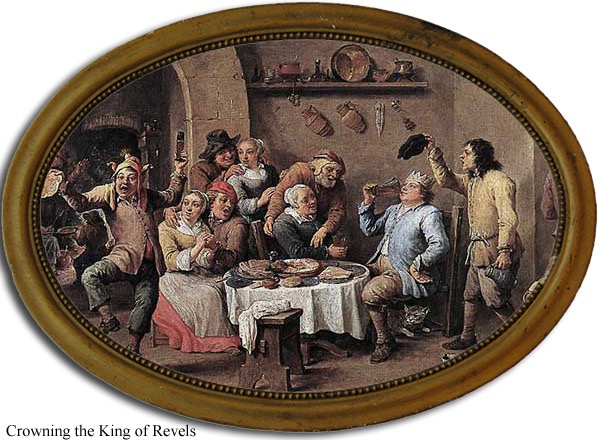
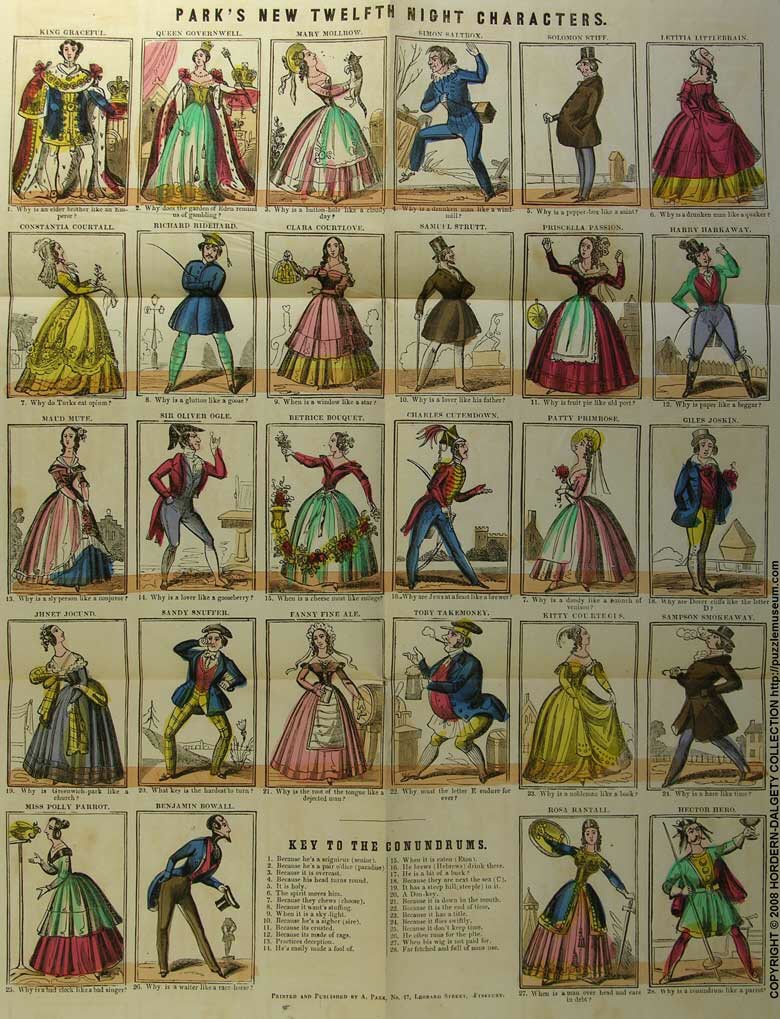
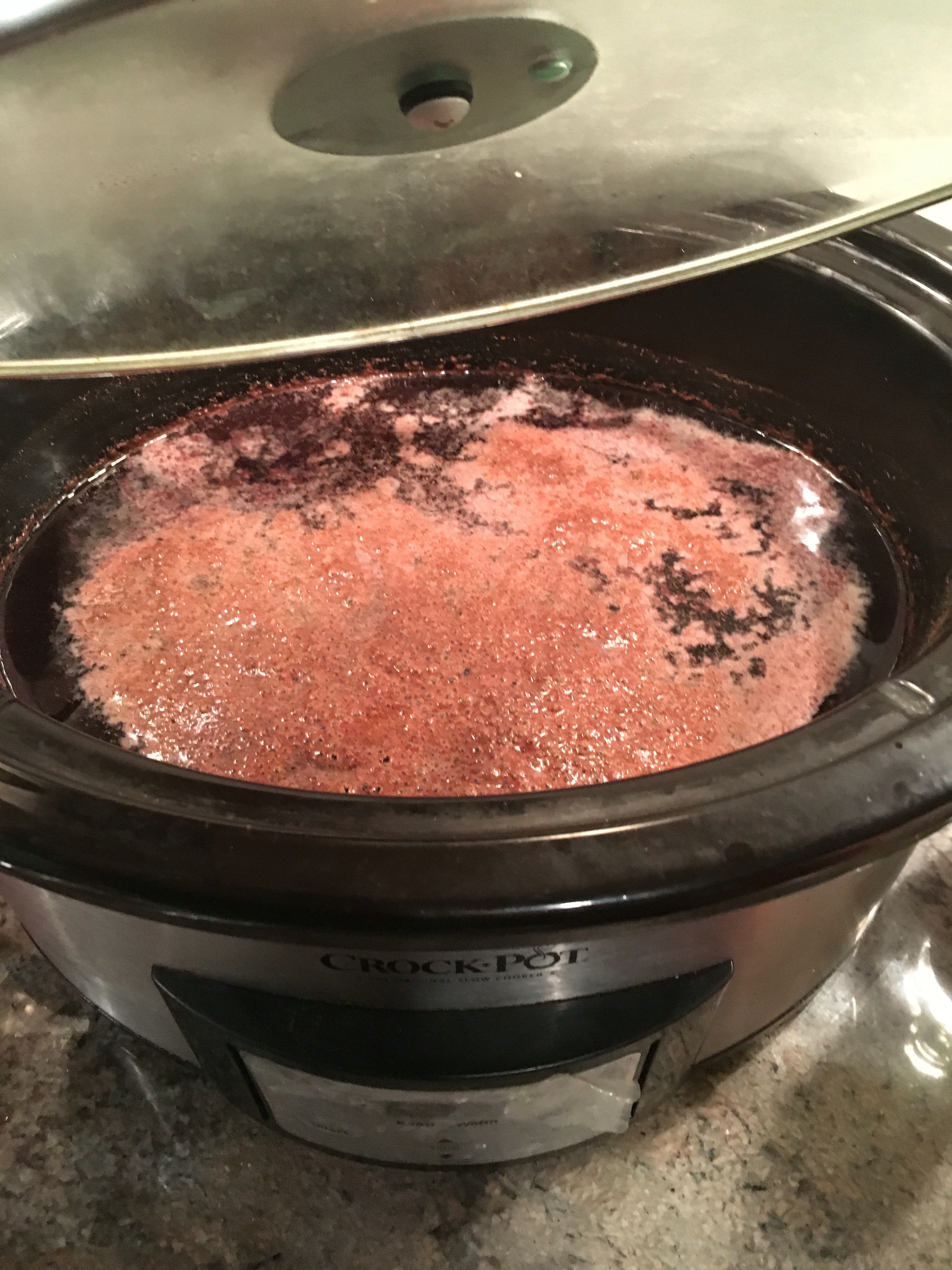
As I’ve mentioned in my previous posts one big part of the Christmas season was appointing a lord of misrule, and ancient tradition that goes back even before Christian times. In the play 12th night Feste basically serves as Lord Of Misrule; he presides over all the games and songs in the house, and he helps Sir Toby baffle Malvolio. In real life a Lord of Misrule presided over each Twelfth Night celebration, choosing which games and dances everyone would engage in.Most early Twelfth Night celebrations included a masked ball. In the 18th century, merrymakers engaged in a sort of role playing game, where they drew a character based on a popular archetype like the soldier Charles Cuttemdown or Beatrice Bouquet, and had to act like that character the rest of the night. Finally, a holiday that encourages you to LARP!Wassail.As I mentioned in my previous post wassail was the quintessential winter beverage and 12 night was not an exception. In this post you can see some photos of me actually making wassail myself in accordance with a trip up recipe I found on the food from the food network’s Alton Brown.Alton Brown Wassail recipe I didn’t have Madeira wine so I substituted port, but otherwise I used all the ingredients he mentioned in the recipe.Like I said in the previous post, Wassail is derived from an old word meaning “lamb’s wool,” and you can see why when you see the frothy mixture on top.I served this wassail to my in laws on Christmas night, and the only complaint I got was that the weather was a little too hot to enjoy it. I can personally attest that wassail warms you right down to your toes, which is great if you’ve been out caroling in 17th century England, but indoors during the hottest Christmas on record, it was a little uncomfortable- I was already wearing shorts and I was still too hot. My advice is- if you get a white Christmas, enjoy your wassail, but if it’s 60 degrees outside, stick to ale or Madeira, or some other kind of spicy spirit that you can serve
Well, that’s my advice, happy Twelfth Night everyone!Update: I’ve adapted the material from this post into an interactive, multimedia online class for kids aged 13-18! It will cover Elizabethan Christmas traditions and the plot and themed of Twelfth Night. You can register now at Outschool.com!Sources:Brownie Locks.com- History of Twelfth Night Catholic Encyclopedia: Feast of Fools Jane Austin.com: Twelfth Night Celebrations Lost Past Remembered: Twelfth night Why Christmas.com: the Twelve Days of Christmastime Project Britain: Twelfth Night http://projectbritain.com/Xmas/twelfth.htm
Below is a link to the excellent documentary, Shakepeare Uncovered. In this episode, actress Joelly Richardson examines the character Viola from Twelfth Night, with the help of her mother, legendary actress Vanessa Redgrave:
Merry Christmas Eve everyone! Today I will be talking about how Shakepeare’s two royal patrons, Queen Elizabeth I and James I celebrated this holiday!
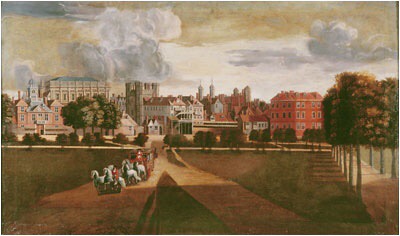
We have surviving records that prove Shakespeare and his troupe performed at Christmas during the reigns of Queen Elizabeth and King James I. The buildings still exist so we can imagine what Shakespeare’s performancesal at court might have looked like. What follows is a bit of historical detective work, with a nice holiday flavor to boot.
How did Good Queen Bess celebrate Christmas?
Like her predecessor Henry VIII, Her Majesty Elizabeth accepted presents from the nobles on New Year’s Day instead of Christmas morning. From all over the kingdom, people would bring the best and most extravagant presents to the queen, hoping to gain her favor at court. Take a look at this true case of what her favorite courtier, Robert Dudley gave the queen for Christmas in 1588:
Dudley gives Queen Elizabeth a wristwatch
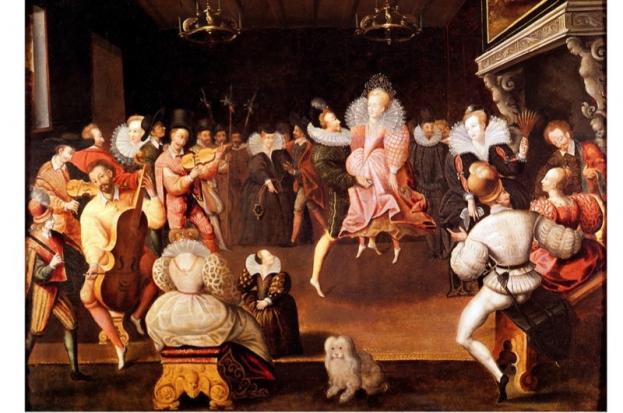
Unlike her dad however, Elizabethan Christmas was a more elaborate affair than a week of sitting and feasting. Yes, Gloriana had elaborate feasts, but she preferred to impress her nobles and visiting dignitaries with dances, jousts, and plays. She was an accomplished dancer and poet, and she loved court masques.
A masque is sort of like a combination masked ball and performance art piece. The nobles would put on costumes and masks and enact a historical or mythological event, like “the Golden Age Restored,” a masque Ben Johnson wrote for Twelfth Night in 1616. The intent was to flatter the queen and her court, as well as having a good time. Of course, Liz still made time on the dance floor for Shakepeare’s company!
.
How the plays were performed:
The plays would be in a large empty hall like the banquet hall or dance hall. Probably the tables would be removed from the feasting, then the dancing would begin. At around 10PM, the actors would take their places. There might be a makeshift tiring house, which was mainly just a curtain that the actors could hide behind to wait for their entrances.
The queen or King would be sitting on a throne on a raised platform so that she or he could be clearly seen by the actors and the audience. Which plays did They Perform?
In 1594 The Lord Chamberlain’s Men played before the Queen at Greenwich Palace. Alas, we don’t know which plays they performed this time. What follows is a list of the plays we do know Shakepeare’s company played at Christmas.
Whitehall Palace by Dankerts, 1675.
Love’s Labors Lost– 1597 at Whitehall palace. This time we know which play they performed before the Queen, because it’s listed right on the title page. I suspect that printing where the play was performed was designed to fire the imagination of the people who bought it. If you couldn’t be at court to see Shakespeare’s play, you could at least read his words and imagine you were there.
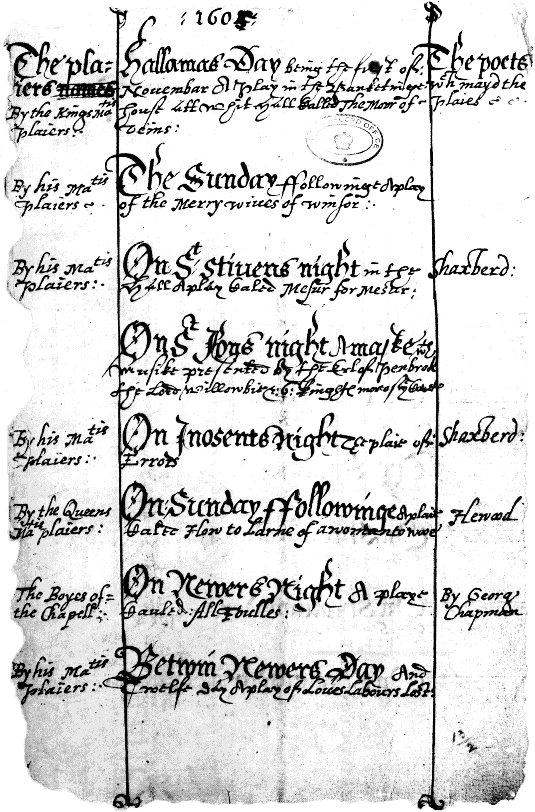
James I invited Shakepeare’s company to perform at Hampton Court many times. Below is an account of the plays for the Christmas holiday in 1603. Notice that Shakepeare’s name is spelled “Shaxberd.”
Here’s a list of some more plays we know Shakepeare’ performed at Christmas:
Midsummer Nights Dream- 1603 on New Years Day, Hampton Court.
Measure for Measure on Boxing Day 1603, Hampton Court.
King Lear on Boxing Day 1606.
Twelfth Night- Candlemas (Feb 2nd 1602).
Twelfth Night 1618 and 1619 (location unknown).
Below is an episode of the incredible documentary “In Search of Shakepeare.” The first twelve minutes show what Christmas might have been like at Hampton Court in 1603, the first year of King James’ reign.
James loved plays and masques even more than Liz, which is why he employed one of the greatest scenic artists of all time, Inigo Jones, to come up with extravagant stage designs and costumes for plays and masques. James’ Queen Anne Of Denmark performed in quite a few masques herself. James also treated the Christmas season as a time of charity, which might have inspired some of the lines in King Lear, which was performed ‘on the feast of Steven’ 1606:
“Poor naked wretches… who soer you are. I have taken too little care of this.” -King Lear, Act III, scene I (The Storm Scene).
We can recall the contrast between King Lear and Good King Wenceslas. In the scene I quoted earlier, Lear laments that he hasn’t been more charitable to the poor, now that he himself feels cold and homeless.
The Christmas season would carry on until oh January 6, aka Twelfth Night. This was the day when, according to Christian tradition, the Three Wise Men finally got to Bethlehem and delivered their presents. Shakespeare’s play Twelfth Night is all about celebrations of feasting, fools and clowns, and of course, epiphanies.
If you liked this post, please consider signing up for my new online class, “What Was Christmas Like For William Shakespeare?” I’ll go further into the traditions of Elizabethan Christmas and add some insight into Shakespeare’s play “Twelfth Night.” Register now at Outschool.com!
One of the greatest icons of female villainy, Lady Macbeth has been portrayed onstage by our greatest actresses, and immortalized in many alluring and terrifying works of art. Here are some of my favorites:
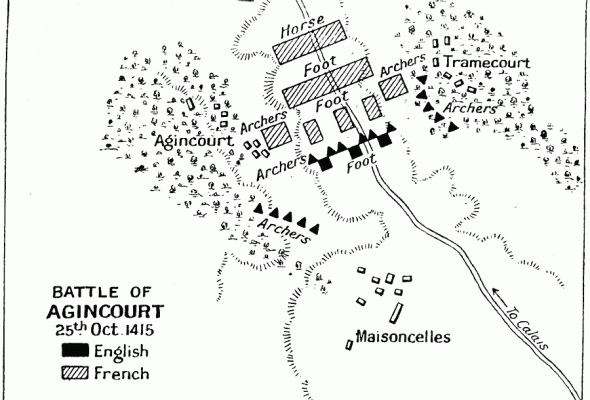
Today is the 600th anniversary of the Battle of Agincourt, one of the greatest victories in English history, where King Henry the Fifth and his 5,000 troops, fought and won against the French, who outnumbered them 5 to 1! Why is this important? Well, in Shakespeare’s history play Henry the Fifth, he gives the king the greatest pep-talk speech of ALL TIME!
This speech is so awesome, it’s cool even when a 5-year old does it!
So you may be wondering, what is Agincourt, and what is St. Crsipin’s Day?
Well Agincourt is a castle in France where on October 25th, 1415, King Henry fought a decisive battle that helped him conquer all of France. For more info on the battle, click here to read this article from the Telegraph.
Contemporary drawing of the Battle of Agincourt.
As for St. Crispin, I wrote about him before when I was working on a high-school production of “Henry the Fifth,” which you can read about here. Long story short- he was the patron saint of SHOEMAKERS!
And finally, a funny take on the battle from my favorite kid’s show, “Horrible Histories.”













 Sources:





 The Shakespearean Student