With Shakespeare’s birthday coming up, I got to wondering if Shakespeare and other Elizabethans celebrated birthdays, and if so, did they use birthday cakes covered with lit candles?
Shakespeare’s plays make it clear that they did at least mark birthdays- Cassius in Julius Caesar and Cleopatra in Antony and Cleopatra do mention birthdays and several other plays mention cake.
One passage from Troilus and Cressida, (a comedy set in Ancient Greece) is practically a recipe for an Elizabethan cake:
Pandarus. Well, I have told you enough of this: for my part,
I'll not meddle nor make no further. He that will
have a cake out of the wheat must needs tarry the grinding.
Troilus: Have I not tarried?
Pandarus. Ay, the grinding; but you must tarry
the bolting.
Troilus. Have I not tarried?
Pandarus. Ay, the bolting, but you must tarry the leavening.
Troilus. Still have I tarried.
Pandarus. Ay, to the leavening; but here's yet in the word
'hereafter' the kneading, the making of the cake, the
heating of the oven and the baking; nay, you must
stay the cooling too, or you may chance to burn your lips.
You might think Shakespeare is being anachronistic, but according to Food and Wine Magazine, the Ancient Greeks invented the practice of putting candles oncake, because Greek cakes were offerings to the Moon goddess Artemis, and the pious worshippers wanted their cakes to shine like the Moon!
There are also stories from Greco-Roman myths about a special honey cake that was so good, it even appeased Cerberus, the three-headed dog of the underworld!
It was the Romans who had the first birthday parties with cake, though their parties were strictly for the aristocracy, not common people. The first children’s birthday cakes with candles came to be in Germany in the 18th century.
So we know birthday cakes were a thing in Shakespeare’s Day, and that he was aware of them. The question is whether Christian Elizabethans chose to continue the practice of birthday cakes, and if common men like Shakespeare partook in them.
Sadly, the research I’ve gathered suggests that common men like Shakespeare probably didn’t eat cakes to celebrate their birthdays, (though, as I have discussed in other posts, Shakespeare might have eaten cakes at Halloween, Christmas, and Twelfth Night).
Twelfth Night Cake recipe from 1604, when Shakespeare was still alive.
Although the concept of a birthday cake with frosting and candles wasn’t really a thing in Shakespeare’s Day and not available to people of his social class, we can still celebrate his birthday in plenty of fun and delicious ways! Below is a video from the Utah Shakespeare festival that features a young girl making an Elizabethan cake from The Complete Cook in Shakespeare’s honor, in front of a special guest!
An Elizabethan cake recipe, Utah Shakespeare Festival.
You’ll notice that the recipe doesn’t have leavening agents like baking powder except for yeast, so like Pandarus warns Troilus, an Elizabethan cake requires kneading, more time, and will produce a smaller and less fluffy result, (much like Troilus’ relationship with Cressida, but I will get into that later). I encourage you to try this and other Shakespearean recipes and stay tuned to my blog, YouTube page, etc, for lots of fun posts in honor of Shakespeare’s Birthday!
I’m beyond excited that I am able to offer three multiple week courses through Outschool for kids aged 6-12. If you scan the QR code below, you can see class descriptions and individual trailers. You can also check out the “My classes,” Page on this blog. I hope you and your family will join me this summer!
It’s April, so it’s about to be spring break. Also, Shakespeare’s birthday 🎂 is coming up, so I thought I’d honor him this year by highlighting some hidden gems of Shakespeare’s plays.
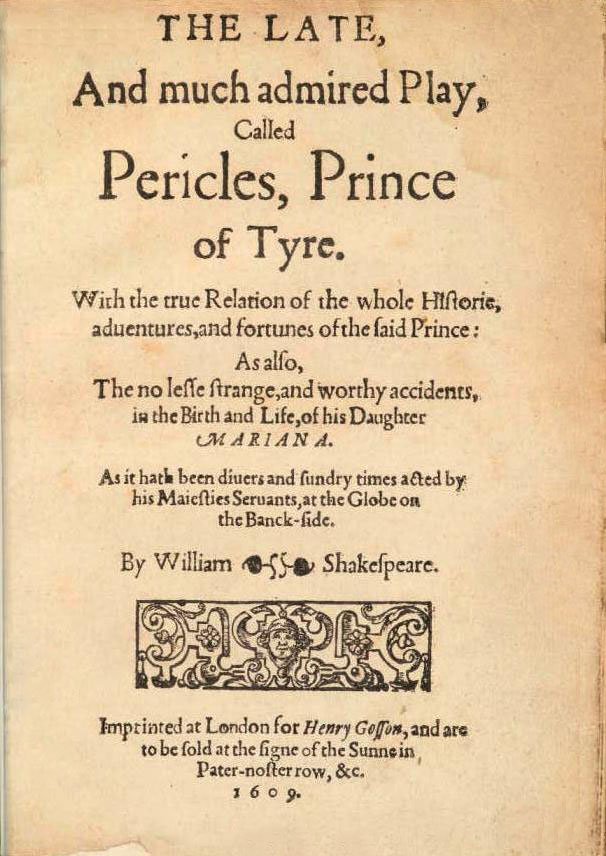
Title Page for Pericles, Prince of Tyre
Shakespeare’s Pericles is an incredible odyssey where the hero goes to many exotic locations and has many adventures, so I thought I’d summarize the action of the play using the device of… vacation photos!
Part 1: Pericles’ Vacation In Antioch
Travel brochure for Antioch, where Pericles finds himself in Act I.
Part II, Scaped beheaded, now he’s wedded!
Pericles’ vacation video where he gets shipwrecked, finds a suit of armor, wins a joust, falls in love, and gets married all in a few days!
Part III: The worst Cruise ever
Pericles reviews the ship 🚢 that took him to Tarsus.
I’m teaching a number of clases on poetry this National Poetry Month, and I wanted to make suggestion if you want to woo a sweetheart this poetry month but don’t know where to start. So here are some resources for you you use, and some links to some of my own work on the subject:
1. Mindup.com
This website is very good at helping you organize your writing into small blocks, webs, charts, etc. This is really useful when you’re creating sonnets because it helps you set up your argument. You can even add pictures to think about the images you’re going to use in your poem!.
This website is very fun and useful for teachers and students. You plug in various adjectives, verbs, and nouns and it does the rest. The sonnets aren’t great, but you do get a clear idea of how sonnets work, and that makes it very useful for students.
A sample sonnet I made about money.
3. Folger.edu- How to Write a sonnet
One of the best pieces of advice I can give to an aspiring poet is to read other poets and learn what you like. The Folger has a yearly competition of student sonnets which you can read on their website, and lots of handouts and info that teaches you about sonnet form, so check it out!
6. My OUtschool Classes on Sonnets and Shakespeare’s writing:
If you want some one-on-one help with writing Elizabethan poetry, consider signing up for my online classes! I teach 2 classes on writing poetry and literary devices:
Love Poetry: Shakespeare Style
This class is a live brainstorming session where I’ll teach you to use the resources I’ve listed above to craft an Elizabethan sonnet of your very own! We’ll also discuss some of Shakespeare’s own sonnets, and the enduring mystery of the Dark Lady and the Fair Young Man.
Trailer video fo “Love Poetry: Shakespeare Style”Page Icon for my Outschool class on Shakespearean writing.
This class is a general intro to Shakespeare’s writing. I discuss the structure of his plays and poems, and I play a fun game where I rewrite some very famous lines in iambic pentameter:
So thanks for reading this list! I hope this helps you out, and if you do consider signing up for my class, I’m offering a special discount for the Love Poetry course: Get $5 off my class “Love Poetry- Shakespeare Style!” with coupon code HTHESVFDPO5 until May 5, 2022. Get started at https://outschool.com/classes/love-poetry-shakespeare-style-k8lL9yLK and enter the coupon code at checkout.
Let thy verse flow like a river, ye merry balladiers!
Ave and Happy Pie Day ! Since it’s Roman month, I thought I’d talk about the most infamous pie in Shakespeare’s Roman plays, and give you an ancient Roman recipe that tastes a lot better!
In Act V of Titus Andronicus, the titular general and his household cook and serve the Empress’ sons to their mother in a pie! Here’s how the scene plays out in the 1999 film Titus:
The infamous pie scene from Titus Andronicus
Before he cooks the Empress’ sons, Titus actually tells them what he is going to do to them, like some kind of psychotic chef giving a cooking program:
This one hand yet is left to cut your throats,
Whilst that Lavinia 'tween her stumps doth hold
The basin that receives your guilty blood.
You know your mother means to feast with me,
And calls herself Revenge, and thinks me mad:
Hark, villains! I will grind your bones to dust
And with your blood and it I'll make a paste,
And of the paste a coffin I will rear
And make two pasties of your shameful heads,
And bid that strumpet, your unhallow'd dam,
Like to the earth swallow her own increase.
This is the feast that I have bid her to,
And this the banquet she shall surfeit on;
I’ve adapted Titus’ recipe into this creepy recipe card below:
Now when Titus says coffin he’s actually referring to a pie crust, (though ironically this coffin will also be a tomb for two human bodies). Ancient Romans did in fact make meat pies, so Tamara wouldn’t have immediately been suspicious It also was not unheard of for the ancient Romans to actually eat brains! According to DE RE COQUINARIA, one of the oldest surviving Roman cookbooks, there was a recipe called Patina frisilis, a pudding made of fresh vegetables, wine, and calf brains:
Take vegetables, clean and wash, shred and cook them cool them off and drain them. Take 4 calf’s brains, remove the skin and strings and cook them4 in the mortar put 6 scruples of pepper, moisten with broth and crush fine; then add the brains, rub again and meanwhile add the vegetables, rubbing all the while, and make a fine paste of it. Thereupon break and add 8 eggs. Now add a glassful of broth, a glassful of wine, a glassful of raisin wine, taste this preparation. Oil the baking dish thoroughly put the mixture in the dish and place it in the hot plate, (that is above the hot ashes) and when it is done unmould it sprinkle with pepper and serve.
APICIUS- DE RE COQUINARIA (c. 1st century CE).
Medieval edition of De Re Coquinaria
My research suggests that the coffin was mainly just flour and oil and was not actually intended to be eaten. It would be similar to a modern salt crust pie that seals in juices and helps preserve the pie in the absence of refrigerators.
Thankfully Apicius has another recipe for a Roman pie that I find much more appetizing
Elderberry Custard or Pie– Patina de sambuco
A dish of elderberries, either hot or cold, is made in this manner: take elderberries, wash them; cook in water, skim and strain. Prepare a dish in which to cook the custard; crush 6 scruples of pepper with a little broth; add this to the elderberry pulp with another glass of broth, a glass of wine, a glass of raisin wine and as much as 4 ounces of oil. Put the dish in the hot bath and stir the contents. As soon as it is getting warm, quickly break 6 eggs and whipping them, incorporate them, in order to thicken the fluid. When thick enough sprinkle with pepper and serve up.
A modern recipe for Elderberry pie 🥧
While I’m at it, here’s another historical pie recipe that was a favorite of Shakespeare’s Richard II:
If you read my blog for an extended period of time, or if you listen to my podcasts, or if you’ve taken any of my classes online, then I probably told you the notion that I believe that you could find Shakespearean roots in just about every single work of Western and quite a few of Eastern literature. Shakespeare is ingrained in our culture and therefore a lot of his influence can be felt in almost every bit of media we take in. One of my favorite ways to illustrate this, is by looking at Disney movies, trying to prove that every Disney story is at least a little bit inspired by a Shakespeare play as you’ve seen from my comedy series if Shakespeare wrote for Disney:
I had an enormous challenge on my hands when Disney came out with the new film Encanto. Previously I’ve found it very easy to deconstruct Disney film plots and spot their Shakespearean roots: Pocahontas is Romeo and Juliet by Disney’s own admission, Aladdin is basically the Tempest, Mulan is Twelfth Night, and the Lion King is Hamlet, (as many people have pointed out).
Encanto was really really hard because it is such a fresh and original story. It is deeply rooted in Columbian culture, so trying to defend the notion that it has anything in common with the works of a 400-year-old English male playwright is a tough claim. I don’t mean to suggest that this movie is a deliberate reinterpretation of Shakespeare. That would be insulting and limiting to the breadth of the story. My main purpose with this post is to show how universal and powerful these two stories are- to pay Encanto the compliment that, like Shakespeare, the story transcends cultural and historical boundaries and tells a story we can all relate to, and this is why I am making this bold claim, that Encanto resembles King Lear, albeit with a happy ending.
Mirabelle- the Cordelia of “Encanto”
It was hard for me to realize that Encanto resembles Lear because the Lear character is not the focus of the movie; the focus of the movie is the Cordelia character, Mirabelle. If you’ve read King Lear , then you know that Cordelia is vital to the first 2 scenes of the play, and then goes offstage until Act 4 when where she is reunited with her father in prison, then cures his madness just long enough for her to be hanged. Her death is the darkest, grimmest, bleakest moment that Shakespeare ever wrote. She is the heart of the play and Lear’s failure to listen to her forms the heart of the play’s message; when an older generation clings to power and power or money or status or anything else besides their family, ultimately they suffer tremendously.
In his first line, King Lear says that he wants to give up his kingdom, conferring it to his daughters and their husbands, but what he is really trying to do is to get his daughters to say they love him and to give them the kingdom as a reward.
This deal also has more strings attached; Lear basically says: “Now that I’ve given you my kingdom, you have to house me in your castle with a retinue of 100 knights.” And the only child who really loves Lear and has his best interest in heart is Cordelia, and Lear violently renounces his parental claims on her and banishes her from the kingdom along with her husband the king of France.
The Lear of “Encanto”
Abuela Alma Madrigal, from Disney’s Encanto.
So who is the King Lear figure in Encanto? Abuela Alma! Think about it, she is an older person who is spending the whole play clinging and holding on to the power that the Magic Candle gives to her. She spends the whole movie trying to protect the Encanto, and when she mistakenly believes that Mirabelle is a threat, she pushes her away. She rules her other children Papa, Julietta, and Brunowith an iron fist, and she flies into panics and rages whenever anything seems to threaten the safety of the candle. For example, when Bruno gets the magic prophecy that Mirabelle might destroy the house and destroy the Encanto, Abuela refuses to let Mirabelle talk to anybody ever and generally acts in a cruel controlling way.
Look at this passage when Lear rejects his loving daughter Cordelia. Given what I’ve mentioned- the fists of rage, the clinging to supernatural powers, and the controlling demands for loyalty and obedience from his children, whom does King Lear sound like?
Lear:
For, by the sacred radiance of the sun,
The mysteries of Hecate and the night;
By all the operation of the orbs115
From whom we do exist and cease to be;
Here I disclaim all my paternal care,
Propinquity and property of blood,
And as a stranger to my heart and me
Hold thee from this for ever. The barbarous Scythian,120
Or he that makes his generation messes
To gorge his appetite, shall to my bosom
Be as well neighbour'd, pitied, and reliev'd,
As thou my sometime daughter. King Lear, Act I, Scene i.
As Ian McKellen explains in this interview, like Abuella, Lear clings to power, which he derives from supernatural forces, ignores people who care about him, and believes that his authority is absolute:
Trauma and Violence in Encanto and King Lear
Marxist critics believe that Lear’s power is based on violence, (like most medieval kings), and violence is actually connected to Abuela as well. Let’s not forget that the candle was forged after the faceless men with machetes attempted to murder Abuela and her whole village. The candle is Abuela’s power, but it is also a constant reminder of the violence that she escaped. It is also therefore a symbol of her trauma. Perhaps these characters became so controlling, distant, and cold because of the trauma they endured. Lear is supposed to be a king of Britain back in the pre-Christian era of the Anglo-Saxons so he must have seen countless invasions:
The former king says himself that he’s fought in wars with his “Good biting falchion” (a kind of sword). Whether they’ve seen falchions or machetes, these characters have seen violence and want to protect themselves against seeing the pain of it again, and ultimately it is their children that suffer because of it.
In King Lear, the kingdom is ripped apart between the three daughters, and in Encanto, the house is literally ripped apart by the rift between the family and Abuela. Lear foolishly tries to bribe his daughters into flattering him; promising them the kingdom if they demonstrate how much they love him. Therefore Lear demands obedience and love and expects his family to fawn on him as if they were his subjects, not his family.
Lear’s favorite daughter Cordelia refuses to take the bribe, so she says nothing. Lear is enraged and treats this small disobedience like an act of treason:
Act 1 Scene ii: Lear disowns Cordelia
Arguably Abuella makes the same mistake. She treats her children like her subjects too and exploits their gifts in order to keep the community happy. Her fear of losing her home is the reason she pushes the Madrigals to be indispensable to the community. Think of the psychological and physical pressure Louisa mentions in her song:
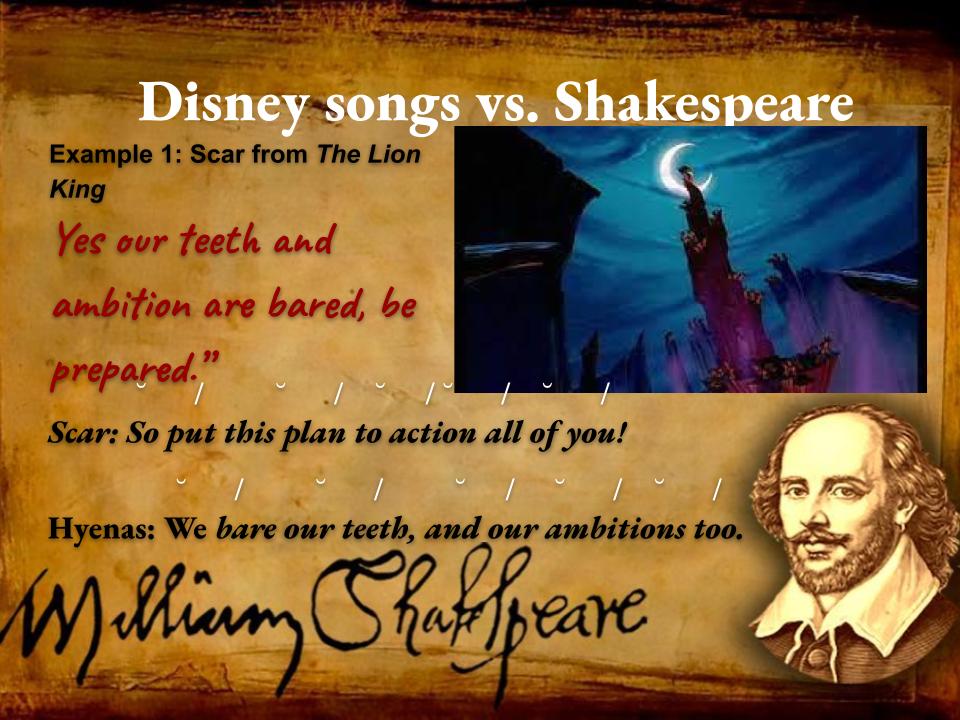
As you can see in this video, Lin Manuel Miranda, who wrote the music for Encanto, was actually inspired by Shakespearean verse for the lyrics and rhythms in her song “Surface Pressure.” Whether or not he or the screenwriters were inspired by “Lear,” the fact remains that Mirabelle suffers much like Cordellia. She also can’t stand to see her sister Louisa in pain like this, so she sets out to save her family, which forces her to confront Alma. Much like Lear and Cordelia, Mirabelle and Abuela argue about how her clinging to the past is hurting her family and how the pressure she puts on them is literally ripping their home and family apart:
Sight and Sightlessness in “Encanto” and “King Lear”
Perhaps the biggest connective motif between Encanto and King Lear is the motif of sight and sightlessness. Both Lear and Lord Gloucester are blind to the danger that they’re in and blind to who their real friends and enemies are. Lear trusts his two elder daughters because they flatter him, he trusts his drunken knights who only succeed in getting him forced out of the cold. Conversely, Lear ignores Cordelia. who really loves him, as well as Kent, who is a loyal nobleman to the very end, and he ignores the Fool because he’s a fool. If he had heeded any of their advice he would not have died alone and powerless. Therefore his sightlessness is a deadly weakness.
Gloucester, the other old man character in Lear has another problem with sightlessness and is punished for it figuratively and literally. Gloucester’s bastard son Edmond deceives him into thinking that his legitimate son Edgar is plotting to kill him. The old man sends Edgar away, makes Edmund his heir, and then Edmond betrays him and gets him arrested for treason.
In the play’s most savage scene, Gloucester is tortured and his eyes are literally pulled out of his head. From this moment Gloucester finally sees Edmond’s treachery, and he laments that he “Stumbled when he saw”. Gloucester feels like he is finally able to see clearly now that he is blind, not unlike the ancient Greek tragedy Oedipus Rex. Of course, nothing this gruesome can be shown in a Disney movie but the image of sight is constantly referenced in Encanto visually, and also through the lyrics of the songs. Even the name of the character; Mirabelle comes from the Spanish word ‘mira’ which means “to look”, and the first thing one might notice about her is her brightly painted green glasses, which constantly draw attention to her ability to see.
Mirabelle, like Cordelia, is able to see that her family is in pain, she sees that her family, the Encanto, and the house is in danger, while Abuela is constantly deluding herself and everybody else in thinking that nothing is wrong.
Through the course of the movie, Mirabelle is able to fix the various problems she sees. For instance, she sees that her sister Louisa is taking on too many responsibilities and refusing to admit that she is tired and feels weak. She realizes that her sister Isabella is tired of being the perfect golden child, that her Uncle Bruno is not the monster that the family declares him to be, (however catchy their song about him is).
Through her sight and her perceptiveness, Mirabelle is able to heal the wounds in her family, The last wounds that she heals are the cracks on her house, and her own Abuella’s wounds, the wounds that went deep through her and even deep through her house; she mends the problems that happened the instant that the candle came into being:
Once Mirabelle and Alma reconcile, they set about rebuilding the house in this song. Notice how many times the words “look,” and “see” are mentioned in the lyrics. Mirabelle re-iterates how each person in her family is more than their gifts, more than just the roles Abuella put them in, and they respond by telling her to look at her own gifts and be proud of who she is. She heals them by seeing them as they are, and they heal her by seeing her too.
It was when I realized this that I understood that this movie is what would have happened if King Lear had only listened to the people who really cared about him, and did not succumb to idle flattery. If only he did not let his pain and his trauma dictate the rest of his life. There’s a wonderful hopeful message here that family wounds can be healed if we take the time to see and address them. If you read King Lear and then see Encanto you can see both how these family wounds can be healed, and the tragic consequences if they are not.
I hope that this little post has helped you appreciate both works because they are both magnificent and they are both carefully constructed and they both tell a very simple lesson for all families. As families, we need to recognize our faults, forgive faults in others, and work together to mend the pain and suffering that we experience in our lives. Mirabelle and Cordelia show that we can all be heroes if we see the truth, and speak what they feel not what they ought to say.
Gloucester and His Sons, PBS Learning Media: Shakespeare Uncovered: witf.pbslearningmedia.org/resource/shak15.ela.lit.gloucester/gloucester-and-his-sons-king-lears-subplot-shakespeare-uncovered/?student=true
James Earl Jones in King LEar at Shakespeare In the Park, 1974. In my opinion, this is the BEST version of “King Lear” on film.





















 The Shakespearean Student