I’m beyond excited that The Deleclrte Theater is continuing their tradition of producing high-quality, free Shakespeare in the Park, and then giving everyone the chance to see it via streaming over PBS.
This summer’s show is Twelfth Night, my favorite Shakespearean comedy, with an all-star cast
I’m so excited to see Peter Dinklage as Malvolio, one of my favorite characters in Shakespeare, and one that I have played myself. I’m also very interested in Sandra Oh’s interpretation of Olivia. She has proven herself in both dramatic and comic roles, which works well for Olivia, a character who starts out in mourning and ends up madly in love.
The performance I am the most excited about, though, is Lupita N’ongo as Viola. I’ve said before that Viola is one of the greatest characters in all of Shakespeare, so I can’t wait to see her portrayed by Lupita N’ongo, an actress I greatly admire. I loved her performances in Avengers Endgame, Us, and my whole family adored her excellent voice work in The Wild Robot. She has simultaneously a childlike enthusiasm, and a calm and stoicism that I’m sure will translate excellently for Viola, who survives a shipwreck and losing her brother (she thinks) through courage and humor.
Hopefully, I can stream this program soon, and give you a full review. In the meantime, enjoy my past posts and videos about Twelfth Night
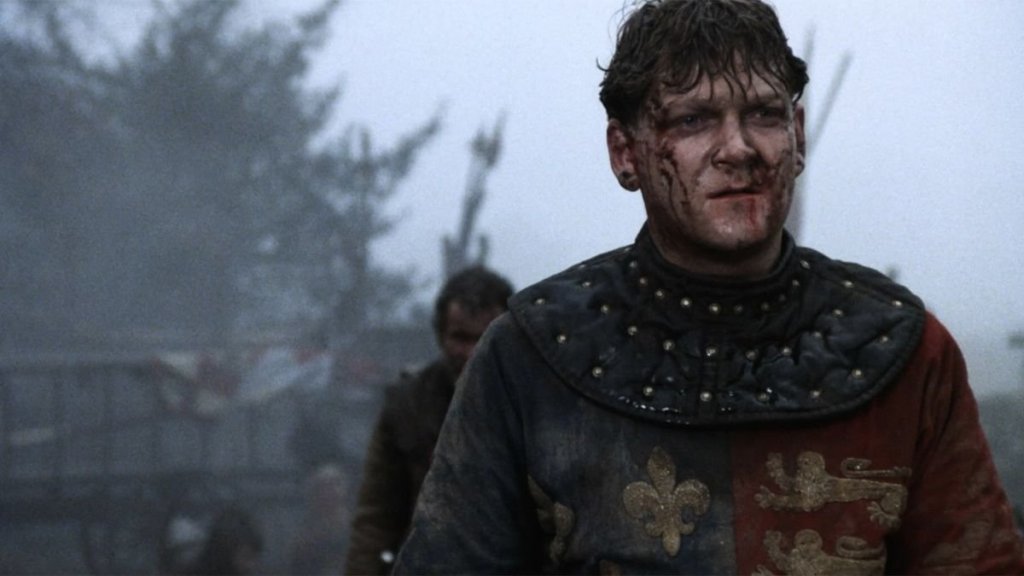
Kenneth Branaugh as Henry V Laurence Oliver as Henry V
The Characters
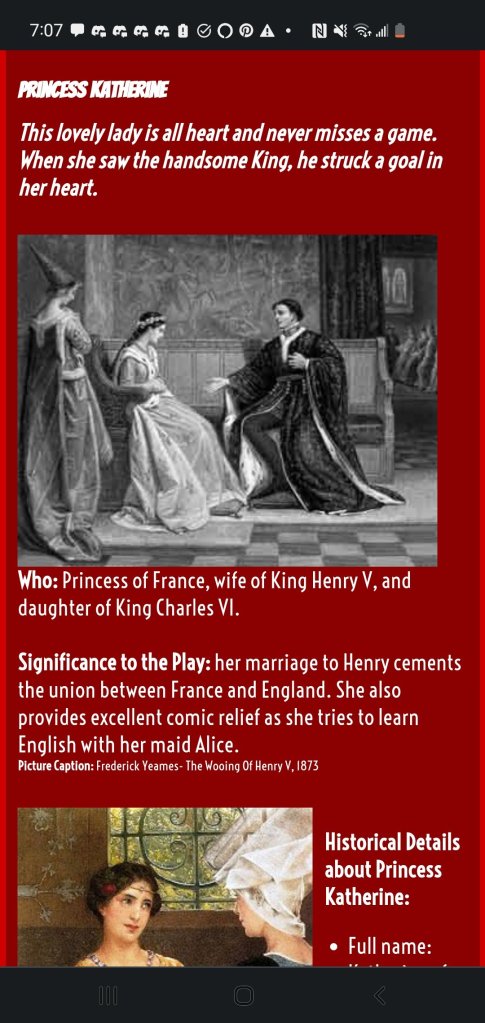
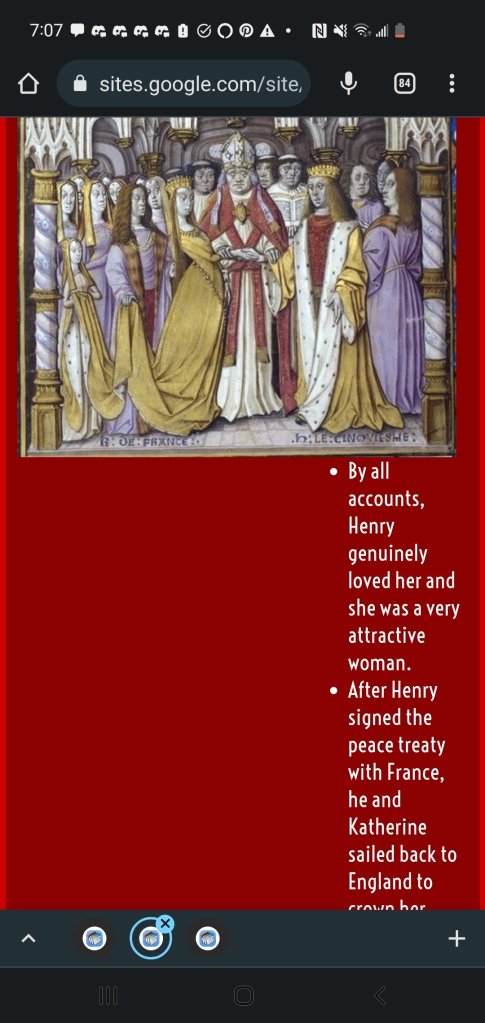
Katharine of Valois
King Henry V
King Henry has just won a decisive victory at the Battle of Agincourt. He is now claiming the crown of France, and Katherine’s hand in marriage. Though he’s proven himself an able soldier and a wise king, he repeatedly stumbles when trying to win Katherine’s heart.
The Text:
Henry V: Fair Katharine, and most fair, Will you agree to teach a soldier terms Such as will enter at a lady’s ear And plead his love-suit to her gentle heart?
Katharine: Your majesty shall mock at me; I cannot speak your England.
Henry V: O fair Katharine, if you will love me soundly with your French heart, I will be glad to hear you confess it brokenly with your English tongue. Do you like me, Kate?
Katharine: Pardonnez-moi, I cannot tell vat is ‘like me.’
Henry V: An angel is like you, Kate, and you are like an angel.
Katharine: O bon Dieu! les langues des hommes sont pleines de tromperies.
Henry V: What say you, fair one? that the tongues of men are full of deceits?
Katherine: Oui, dat de tongues of de mans is be full of deceits:
Henry V: Kate, my wooing is fit for thy understanding: I am glad thou canst speak no better English; for, if thou couldst, thou wouldst find me such a plain king that thou wouldst think I had sold my farm to buy my crown. I know no ways to mince it in love, but directly to say ‘I love you:’ I have no strength in measure, yet a reasonable measure in strength. If I could win a lady at leap-frog, or by vaulting into my saddle with my armour on my back, I should quickly leap into a wife. I speak to thee plain soldier: If thou canst love me for this, take me: take me; and take me, take a soldier; take a soldier, take a king. And what sayest thou then to my love? speak, my fair, and fairly, I pray thee.
Katharine: Is it possible dat I sould love de enemy of France?
Henry V: No; it is not possible you should love the enemy of France, Kate: but, in loving me, you should love the friend of France; for I love France so well that I will not part with a village of it; I will have it all mine: and, Kate, when France is mine and I am yours, then yours is France and you are mine.
Katharine: I cannot tell vat is dat.
Henry V: No, Kate? I will tell thee in French; Je quand sur le possession de France, et quand vous avez le possession de moi,—let me see, what then? Saint Denis be my speed!—donc votre est France et vous etes mienne. It is as easy for me, Kate, to conquer the kingdom as to speak so much more French: I shall never move thee in French, unless it be to laugh at me!
Katharine: Sauf votre honneur, le Francois que vous parlez, il est meilleur que l’Anglois lequel je parle.
Henry V: No, faith, is’t not, Kate: But, Kate, dost thou understand thus much English: canst thou love me?
Katharine: I cannot tell.
Henry V: How answer you, la plus belle Katharine du monde, mon tres cher et devin deesse?
Katharine: Your majestee ave fausse French enough to deceive de most sage demoiselle dat is en France.
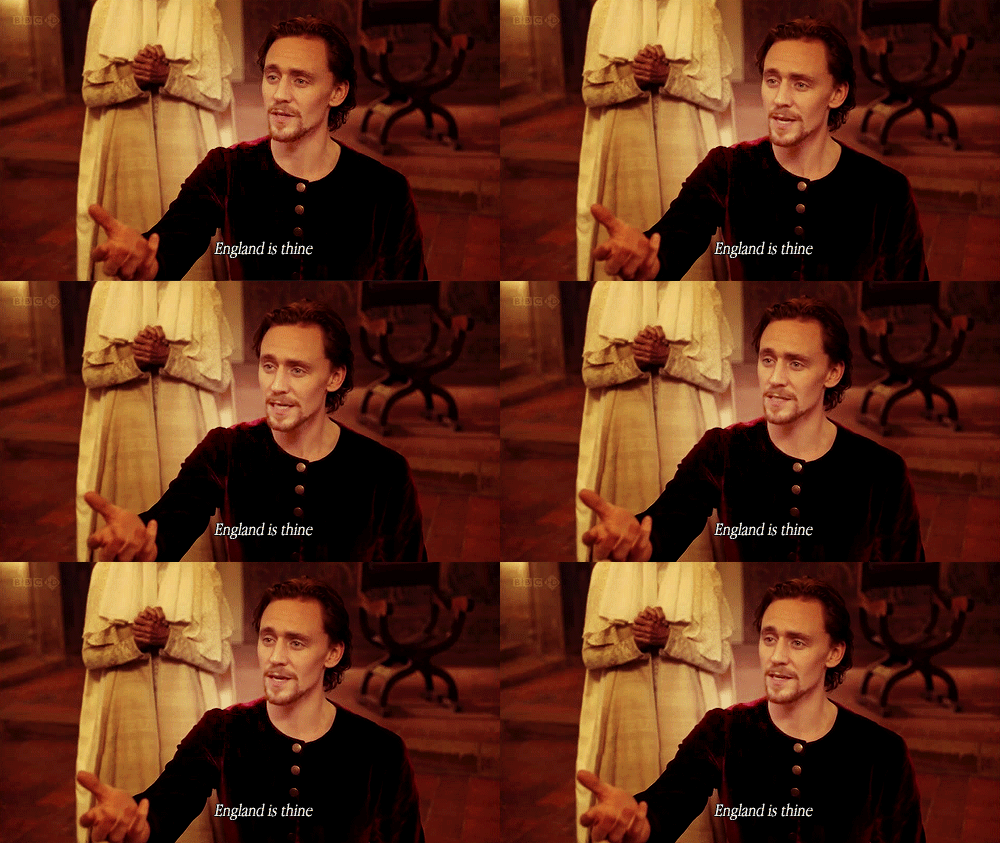
Henry V: Now, fie upon my false French! By mine honour, in true English, I love thee, Kate: by which honour I dare not swear thou lovest me; yet my blood begins to flatter me that thou dost, Put off your maiden blushes; avouch the thoughts of your heart with the looks of an empress; take me by the hand, and say ‘Harry of England I am thine:’ I will tell thee ‘England is thine, Ireland is thine, France is thine, and Harry Plantagenet is thine;’ Come, your answer in broken music; for thy voice is music and thy English broken; therefore, queen of all, Katharine, break thy mind to me in broken English; wilt thou have me?
Katharine: Dat is as it sall please de roi mon pere.
Henry V: Nay, it will please him well, Kate it shall please him, Kate.
Katharine: Den it sall also content me.
Henry V: Upon that I kiss your hand, and I call you my queen. [she shakes her head ‘no’ and kisses him on the lips] You have witchcraft in your lips, Kate: there is more eloquence in a sugar touch of them than in the tongues of the French council; Here comes your father.
Context
The initial awkwardness between Henry and Katherine is what makes the scene endearing; the notion that to Henry, conquering France is easier than wooing Kate. He’s repeatedly at a loss for words, and refuses to flatter or flirt with Katherine. He either is incapable of wooing in “festival terms,” or he wants Katherine to love him for who he is.
For Katherine’s part, at first, she seems indifferent to Henry, if not outright resistant to his love suit. As she says, “Is it possible that I should love the enemy of France?” Henry’s awkward wooing is not the only barrier to Katherine’s heart – he also killed hundreds of her countrymen and aims to take her father’s crown. It’s entirely possible that Katherine sees Henry as her enemy. The biggest question is- does she actually fall in love with him? Henry is charming, so it’s not impossible that Katherine’s feelings are genuine. It’s also possible that Katherine is actually interested in becoming queen to keep her father’s lands and titles in the family through marriage.
Interpretations
Questions To Ask:
Is Henry really being awkward, or is this a front?
Does Henry love Kate, or is he being political?
Is Kate in love with him? If so, when and why does she fall for him?
If Kate never falls for Henry, why does she agree to marry him?
I’m coaching a young actress who is performing a monologue from one of Shakespeare’s histories, his play Henry VI, Part I. It’s likely you know the character, even if you don’t know the play- Joan LaPucelle, aka Joan of Arc. In this post, I will compare and contrast the historical Joan from Shakespeare’s version, and further attempt to separate the real woman from her legendary status as the patron Saint of France.
Shakespeare’s Joan
Shakespeare’s younger sister was also named Joan, and it’s possible she might have inspired Shakespeare’s decision to write about Joan the Maid. Recently, a document called A Spiritual Testimony, (long attributed to Shakespeare’s father), is now believed to be proof that Shakespeare’s little sister was a devout Catholic, at a time when doing so could incur ruinous fines and the risk of arrest for sedition and heresy. Given the courage of Joan’s convictions, perhaps her elder brother infused some of her zeal when writing the character of Joan in Henry VI, part I.
The Life of Joan
One life is all we have, and we live it as we believe in living it. But to sacrifice what you are and to live without belief, that is a fate more terrible than dying. -Joan of Arc
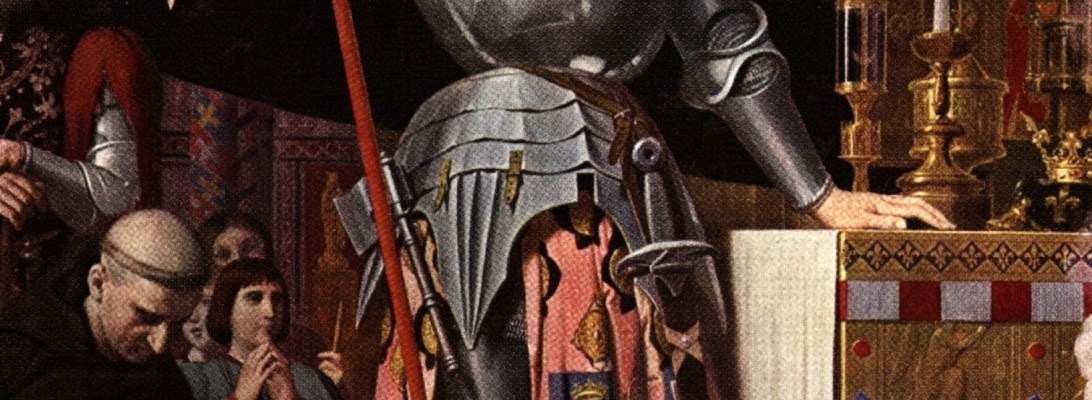
Joan LaPucelle, (Joan the Maid) was a controversial figure even in the 15th century. To the English, (and even some of the French), she was a witch, and a cruel warrior who took away rightful English territory. To others, she was a hero and a saint.
What I hope to do in this post is provide you with details about the life of Joan of Arc. Next I will compare and contrast the most iconic portrayals. I would argue that the success of each interpretation depends on how the writer, director, and of course, the actress playing Joan, answer these questions.
Shakespeare’s Version of Joan La Pucelle
Charles, King of France. Go, call her in.
[Exit BASTARD OF ORLEANS]255
But first, to try her skill,
Reignier, stand thou as Dauphin in my place:
Question her proudly; let thy looks be stern:
By this means shall we sound what skill she hath.
[Re-enter the BASTARD OF ORLEANS, with JOAN LA PUCELLE]

Reignier. Fair maid, is't thou wilt do these wondrous feats?
Joan la Pucelle. Reignier, is't thou that thinkest to beguile me?
Where is the Dauphin? Come, come from behind;
I know thee well, though never seen before.
Be not amazed, there's nothing hid from me:265
In private will I talk with thee apart.
Stand back, you lords, and give us leave awhile.
Reignier. She takes upon her bravely at first dash.
Joan appears in the first part of Shakespeare’s epic saga of four plays about the Wars of the Roses. It is King Henry’s inability to defend his lands in France against Joan’s valiant attacks that helped trigger the Civil War, where the House of York fight to take the crown away from the incompetent King Henry VI.
Joan la Pucelle. Dauphin, I am by birth a shepherd's daughter,
My wit untrain'd in any kind of art.270
Heaven and our Lady gracious hath it pleased
To shine on my contemptible estate:
Lo, whilst I waited on my tender lambs,
And to sun's parching heat display'd my cheeks,
God's mother deigned to appear to me275
And in a vision full of majesty
Will'd me to leave my base vocation
And free my country from calamity:
Her aid she promised and assured success:
In complete glory she reveal'd herself;280
And, whereas I was black and swart before,
With those clear rays which she infused on me
That beauty am I bless'd with which you see.
Ask me what question thou canst possible,
And I will answer unpremeditated:285
My courage try by combat, if thou darest,
And thou shalt find that I exceed my sex.
Resolve on this, thou shalt be fortunate,
If thou receive me for thy warlike mate. Act 1, Scene ii
In the play, Joan is a strong warrior, a clever tactician, and a gifted orator, yet her main function in the play is as the antagonist who goes toe to toe against the English warrior, Lord Talbott.
Naturally, since Shakespeare was trying to write for an English audience, Joan is portrayed as the antagonist, not the hero. The English make many snide comments that suggest Joan might not be as virtuous or as righteous as she appears. However, Shakespeare never outright calls Joan a witch or portrays her doing anything other than trying to fight for her country, by any means necessary.
Once Charles is crowned and Joan gets back Orléans for the French, the tide of battle turns against her. In Shakespeare’s version, this is because the English are united around John of Bedford, (King Henry’s uncle and Regent of France), as well as Lord Talbot, the great knight and “Terror of the French”. In Act V, scene iii, Joan calls upon spirits to fight the English:
The regent conquers, and the Frenchmen fly.
Now help, ye charming spells and periapts;
And ye choice spirits that admonish me
And give me signs of future accidents.
[Thunder]
You speedy helpers, that are substitutes
Under the lordly monarch of the north,
Appear and aid me in this enterprise.
[Enter Fiends]
This speedy and quick appearance argues proof
Of your accustom'd diligence to me.
Now, ye familiar spirits, that are cull'd
Out of the powerful regions under earth,
Help me this once, that France may get the field.
[They walk, and speak not]
O, hold me not with silence over-long!
Where I was wont to feed you with my blood,
I'll lop a member off and give it you
In earnest of further benefit,
So you do condescend to help me now.
[They hang their heads]
No hope to have redress? My body shall
Pay recompense, if you will grant my suit.
[They shake their heads]
Cannot my body nor blood-sacrifice
Entreat you to your wonted furtherance?
Then take my soul, my body, soul and all,
Before that England give the French the foil.
[They depart]
See, they forsake me! Now the time is come
That France must vail her lofty-plumed crest
And let her head fall into England's lap.
My ancient incantations are too weak,
And hell too strong for me to buckle with:
Now, France, thy glory droopeth to the dust.
[Exit]
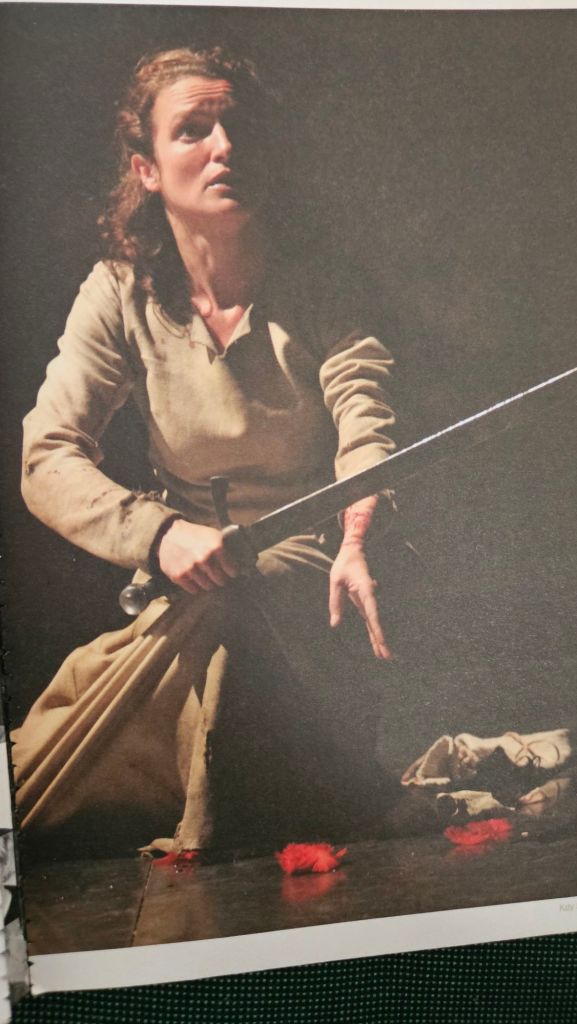
Joan LaPucelle in the 2010 RSC production of “Henry VI, Part 1
At first glance this passage seems shocking- Shakespeare appears to be accusing the patron saint of France of witchcraft. Even more bizarre, later when Joan is arrested by the English lords, she claims to be pregnant with King Charles’ child! And to confound the audience even further, Joan contradicts her own confession by denying any witchcraft or any relationship with any man:
Joan la Pucelle: First, let me tell you whom you have condemn'd:
Not me begotten of a shepherd swain,
But issued from the progeny of kings;
Virtuous and holy; chosen from above,
By inspiration of celestial grace,
To work exceeding miracles on earth.
I never had to do with wicked spirits:
But you, that are polluted with your lusts,
Stain'd with the guiltless blood of innocents,
Corrupt and tainted with a thousand vices,
Because you want the grace that others have,
You judge it straight a thing impossible
To compass wonders but by help of devils.
No, misconceived! Joan of Arc hath been
A virgin from her tender infancy,
Chaste and immaculate in very thought;
Whose maiden blood, thus rigorously effused, Will cry for vengeance at the gates of heaven.
Henry VI, Part I, Act V, Scene iv
I get the sense that Shakespeare is trying to make Joan’s character ambiguous- if you are an English patriot, you can see her as a witch, a liar, and a manipulative harlot. If you are French, you see these accusations as filthy lies, and Joan’s “confession,” as merely a desperate attempt to spare her own life, one that tragically backfires.
The Real Joan of Arc
Born: circa 1412 in Domrémy, France
Died: May 30 1431 (executed by burning)
Birth/ Childhood
Joan was born January 6th, 1412 to Isabelle and Jacques D’Arc, the mayor of the town of Domr’emy France. At the time, Domremy was right on the border between the Armeniacs (who supported Charles the Dauphin) and the Burgundians, who supported King Henry V of England as rightful king of all Frence. Because of this, Joan’s home was subject to English raids and she might have been raised to support Charles as her lawful king. In any case, the accounts we have describe her as very pious, intelligent, generous, and a lover of justice.She had no formal education nor any experience on the Battlefield. Yet, by all accounts, Joan was an extremely devout youth, devoted to God, and her lawful king.
Call to Arms
When she was 13, Joan went to pray in her father’s garden and believed that she saw the Archangel Michael, who prophesied that she would be the one to save France. In 1428, Joan approached Robert Baudricourt, Lord of Vaucouleurs. She demanded to join the French army and to bring Charles to Reims to be officially crowned king. Though she was turned away three times, Joan’s faith and courage attracted followers from the surrounding countryside, and Baudricourt eventually agreed to train Joan to fight, and allowed her and her enterage to talk to Charles the Dauphin about joining the troops defending the city of Orléans.
Once he met Joan at his palace in Chinon, the Dauphin agreed to let her take weapons and supplies to the troops who were already laying siege to the French town of Orléans. However, Joan insisted on leading the troops into battle, and quickly became a symbol of French resistance.
The Siege of Orléans
The city of Orléans was a vital town that the English had garrison. For six months, the French had attempted to starve out the English, destroy their defenses, and retake the city.
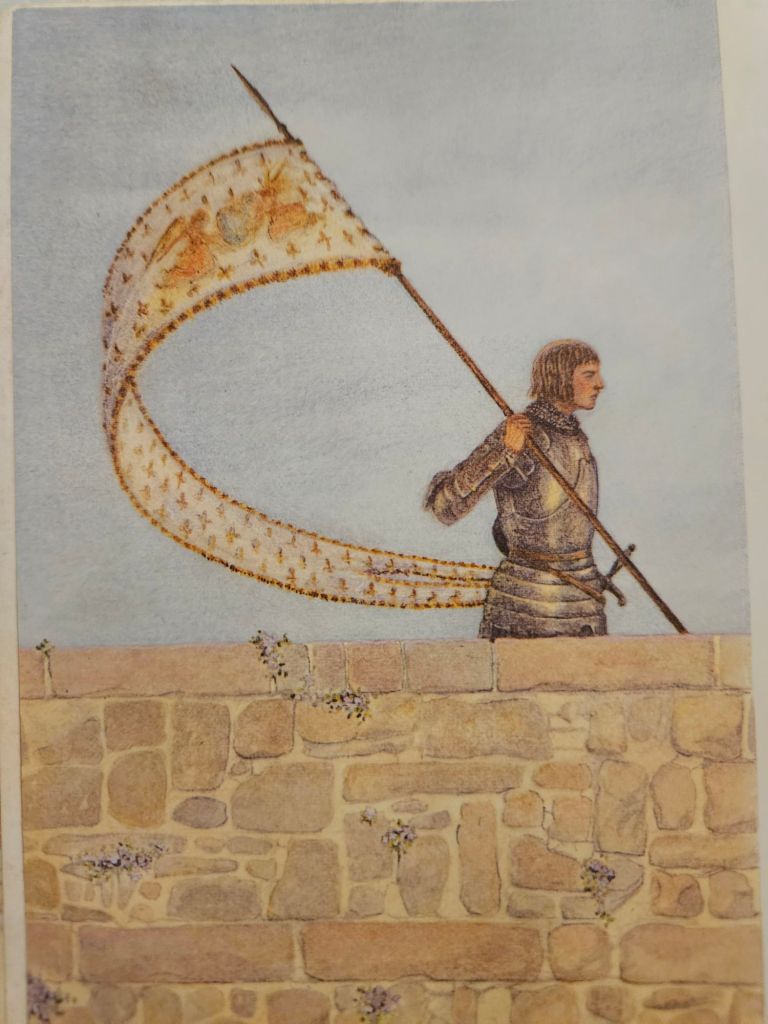
Joan la Pucelle. Advance our waving colours on the walls; Rescued is Orleans from the English Thus Joan la Pucelle hath perform’d her word.- Henry the Sixth, Part I
Diagram of a castle Diagram of siege equipment
Joan’s Fall From Grace
Henry, by the grace of God, king of France and England, greeting. It is well known how for some time a woman calling herself Jeanne the Maid, putting off the habit and dress of the female sex (which is contrary to divine law, abominable to God, condemned and prohibited by every law), has dressed and armed herself in the state and habit of man, has wrought and occasioned cruel murders, and it is said, to seduce and deceive the simple people, has given them to understand that she was sent from God and that she had knowledge of His divine secrets, with many other dangerous dogmatizations most prejudicial and scandalous to our holy faith. Whilst pursuing these abuses and exercising hostilities against us and our people, she was captured in arms before Compiègne by certain of our loyal subjects and has subsequently been led prisoner towards us. And because she has been reputed, charged and defamed by many people on the subject of superstitions, false dogmas and other crimes of divine treason, we have been most urgently required by our well beloved and loyal counselor the bishop of Beauvais, the ecclesiastical and ordinary judge of the said Jeanne, who was taken and apprehended in the boundaries and limits of his diocese
Letter from King Henry VI to the Bishop of Beauvais (Joan’s captor), January 3rd, 1431
Joan was captured in 1430, when King Henry of England was only 10 years old. Even though now France is united with pride for Joan and her defense of her country, back then there were plenty of factions that actually supported the English, and those French factions captured, and arrested her for heresy during the siege of Compiègne.
The Trial- January 9th, 1431
It has pleased divine Providence that a woman of the name of Jeanne, commonly called The Maid, should be taken and apprehended by famous warriors within the boundaries and limits of our diocese and jurisdiction. The reputation of this woman had already gone forth into many parts: how, wholly forgetful of womanly honesty, and having thrown off the bonds of shame, careless of all the modesty of womankind, she wore with an astonishing and monstrous brazenness, immodest garments belonging to the male sex.
As this excerpt from the trial transcripts demonstrates, Joan’s trial focused much more on her alleged heresy and witchcraft, rather than her defying British rule. In reality, Joan’s arrest and martyrdom was a political sacrifice for the French- they wanted to show political support for their English overlords, without alienating Joan’s supporters. Discrediting Joan by calling her a heretic was a calculated political move, and Joan probably knew it.
Execution
Joan is burned at the stake
Joan was executed by burning on May 30th, 1431, six months before King Henry was formally crowned King of England. After her death, Henry was unable to maintain control of France and his incomplete, combined with a congenital mental illness, is why he later lost
Iconic portrayals:
Trailer for Carl Dryer’s Passion of Joan of Arc (1928)
Mila Jovavich in Luc Besson’s “The Messanger”, 1999
Sources:
Books
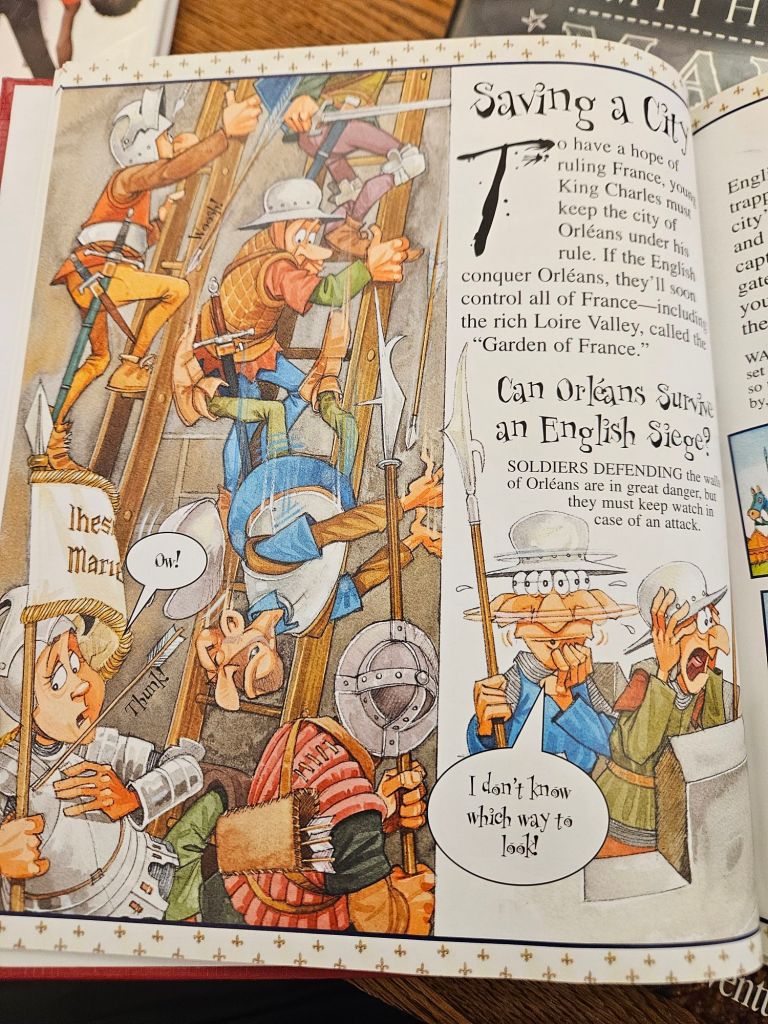
You Wouldn’t Want To Be Joan of Arc
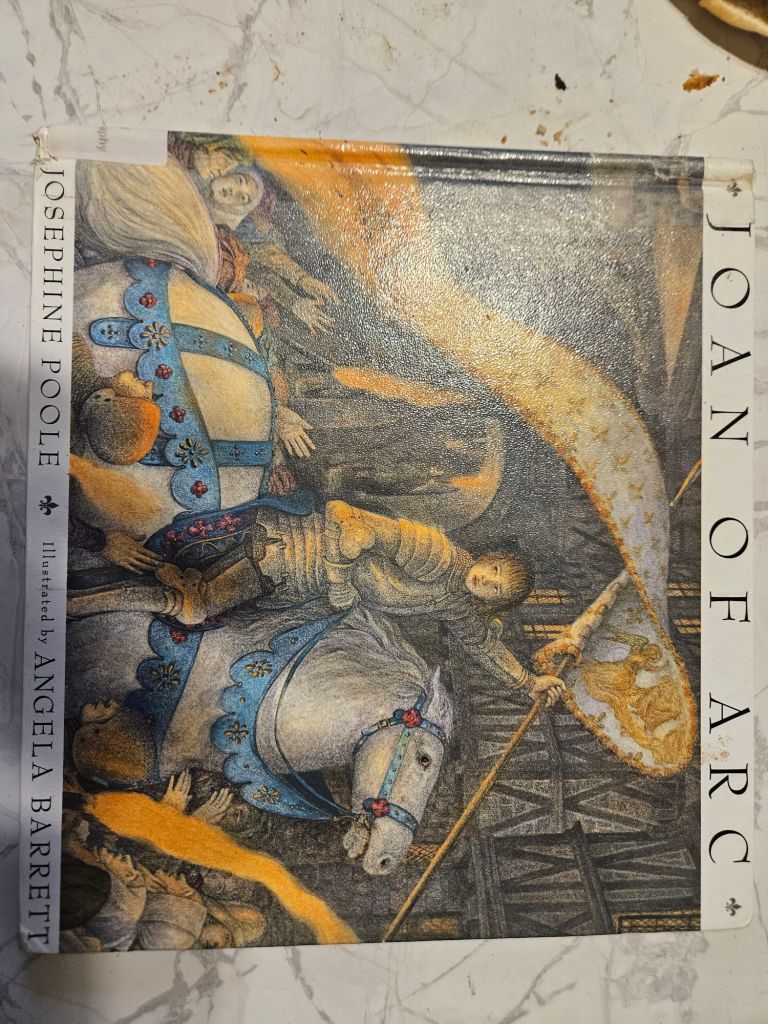
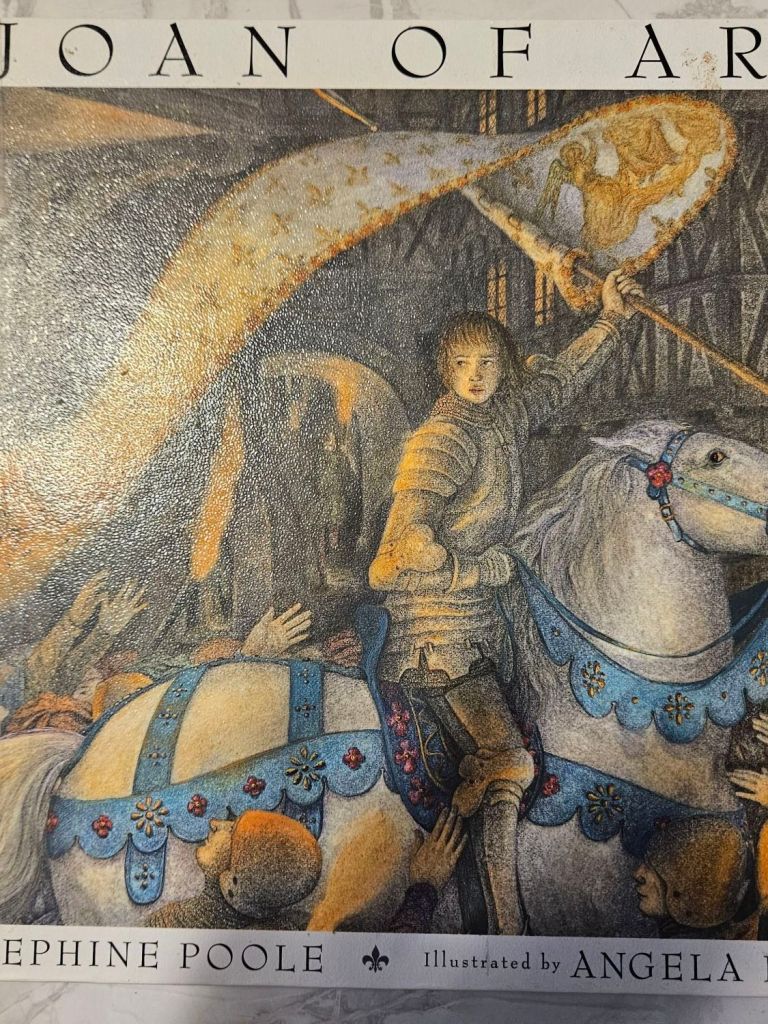
Joan of Arc by Josephine Poole
Title Page of Joan of Arc by Josephine Poole, illustrated by Angela Barrett
I’m pleased to announce that I’ve created a fully online, interactive Shakespeare class for kids ages 6-11 to start them on a lifelong journey of Shakespeare! The course will include games, videos, webquest activities, and puppet shows!
Title: Shakespeare for Kids!
Purpose:
Video trailer
The goal of this class is to introduce Shakespeare to young children in a fun and interactive way. For example, each lesson starts with a fun and funny introduction to a Shakespearean topic by our friend Puppet Shakespeare. Each class will also feature interactive games and quizzes that break down the poetry, language, characters, and plots of Shakespeare to help kids lose their “Shakes-fear” and begin engaging with classic literature
Each class builds from learning about Shakespeare to learning about the language and poetry of his plays, to finally an in-depth analysis of one play: “A Midsummer Night’s Dream.” After watching videos, playing games, and filling out handouts about these topics, the student will go on a “webquest,” that is, a series of webpages that feature activities, outside websites, and a short- puppet show retelling of “Midsummer” for the student. The goal is that by the end of the course, the student will be able to understand the dialogue of the play, summarize the story, know the characters, and enjoy the poetry.
Format: Nearpod with video and web links.
Ages 6-10
Description: 2 week course, $10 per week.
Part I: Who Is Shakespeare?
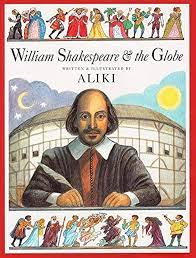
Learn about Shakespeare’s life and career with an interactive timeline, handouts, and an engaging puppet show! This section will include me reading from the excellent children’s book: William Shakespeare and the Globe by Aliki.
Part II: Words, Words, Words
WIlliam Shakespeare (Or Bill as I like to call him), wrote in a very special way. Back then playwrights were called poets, so not only did he have to make plays, he had to write them so they would sound like lines of poetry.
Part III: Shakespeak
Figure out how to translate all the “thees” and “thous” that make reading Shakespeare a challenge nowadays
Part IV The Play’s the Thing!
What kinds of plays did Shakespeare write? This handy lesson will teach you about the basic types of plays Shakespeare wrote, and give you a quick summary of each!
Part V: Disney vs. Shakespeare
Poster for Disney’s Elemental, which bears many similarities to Shakespeare’s Romeo and JulietContinue reading →
It’s around 1597 and Shakespeare is putting the finishing touches on his new play, Romeo and Juliet, when his wife Anne Hathaway arrives. Anne frankly, hates the double-suicide ending and takes Will’s quill. She then proceeds to write a new story where, after Romeo dies, Juliet packs up and flees with her Nurse and her two best friends to have a holiday in Paris (the city, not her ex-fiance).
To find a jukebox musical that is so self-aware in its writing, so humorous in the way it includes its songs through the narrative, and so blatantly charming, is a pure joy…and really, if you asked me to summarise this review into just a sentence it would be that: & Juliet is pure joy. –Carly Fisher
Stuff you Might have Missed
1609 collection of Shakespeare’s Sonnets, which were published without his permission.
Anne Hathaway Shakespeare- the sonnet Anne complains that Shakespeare never mentions her in his work, except once in sonnet 145, where he writes: “I hate, from hate away she threw, and saved my life saying, ‘not you’.”
Anne and the Second Best Bed– After breaking the fourth wall, Anne also complains that her husband left nothing to her in his will but “My second best bed with the furniture.” This is true, and some scholars have attempted to defend this choice, but it certainly doesn’t look good. In the myth of Shakespeare, this story has helped to construct the Shakespeare who cares more about his work than his wife. What’s interesting is that “&Juliet” helps address this myth and examines it. For more information about the myth of Anne and Will, click here to see my review of “Hamnet”
Yes, Juliet might be based on a historical character. One reason Will objects to his wife changing the play is that it violates the historical accuracy of the story. Like I said in my “Genesis of Romeo and Juliet,” the Capulets and Montegues might have been based on real political factions in Verona.
The Characters
The Music
All the songs in “& Juliet” came from one man- Max Martin, a Sweedish songwriter who has composed songs for Brittney Spears, Celene Dion, and The Backstreet Boys. These mega pop-hits were a huge part of my childhood, so seeing them combined with my favorite writer definitely tickled me and set off my nostalgia goggles. More importantly, it’s very interesting to see how the playwright David West Read turned these songs into a musical.
Setting “Romeo and Juliet” to pop music is by no means a new idea- “Gnomio and Juliet” underscored the whole movie with music by Elton John (who also produced the film). Making Shakespeare into a kind of rock or pop star is also not a new idea- Something Rotten and the musical version of “Shakespeare In Love” also did that. What is new is the concept of turning the story of Romeo and Juliet into a jukebox musical- a story where all the songs are pre-existing pop songs.
Normally I hate jukebox musicals- I find it irritating when producers take an artists’ songs and try to stitch them together into a coherent musical play. In normal musicals, the songs are designed to further the plot and help explain the characters’ internal and external conflicts. In my experience with most jukebox musicals, the songs feel like a waste of time, because the songs were never designed to tell an overarching story, so when they are integrated into a play, the story grinds to a halt. When it’s done badly, either you’re bored with the songs, or bored with the play.
With this in mind, I was prepared to dislike “&Juliet”. I was expecting either to hate the songs for slowing down the plot, or to hate the plot because I wanted to get back to the songs. But… miraculously, both the songs and the story WORKS! David West Read did a great job seeing the overarching themes of loss, love, and conflict within relationships within the music of Max Martin, and translate them into Romeo and Juliet- the iconic lovesick teenagers.
I’d like to highlight the incredible effect of one of these songs in the context of the play- “Hit Me Baby One More Time,” by Miller, made popular by Brittney Spears:
Oh, baby, baby The reason I breathe is you Boy, you got me blinded Oh, pretty baby There’s nothing that I wouldn’t do It’s not the way I planned it
It’s very clever that the writer gave this song to Juliet when she us at her most down and most self-destructive. She feels like her life is over without Romeo (her loneliness is killing her). What’s nice about this musical is that this moment is the beginning of Juliet’s arch, not the end.
Costumes
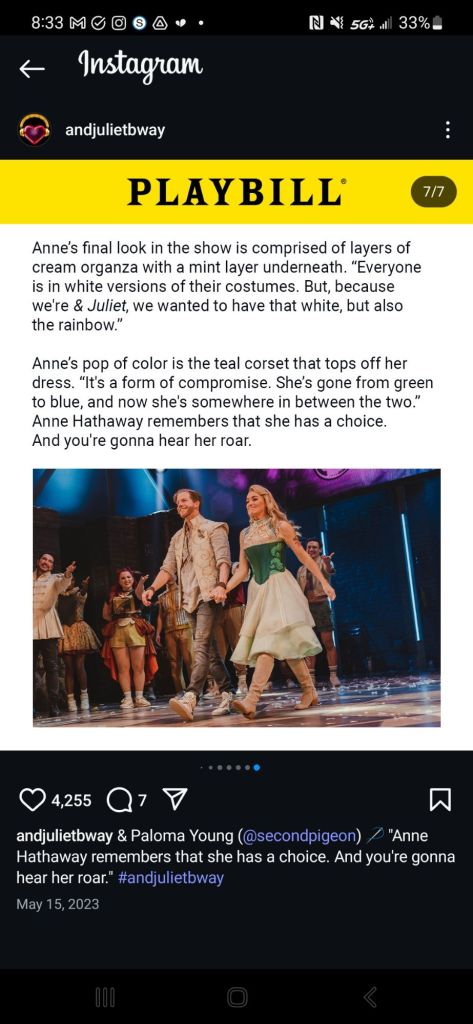
I could write a whole post about how clever the costumes are, and I will at a later date. Suffice it to say that they compliment the story and music by blending Elizabethan costumes with the sort of late 90s-early 2000s pop-star fashion favored by The Backstreet Boys, Katy Perry, and of course, Brittney Spears.
My Final Word
This show might not please everyone- hardcore Shakespeare nerds might find the concept hard to swallow, and honestly since the songs are mostly from the 90s and early 2000s, the music might be a little dated for a modern audience. Also, with the positive portrayal of homosexual relationships this show is DEFINATELY NOT FOR CONSERVATIVES. That said, it might do exactly what I’d hoped it would do- make fun of Shakespeare with care and in the process, get audiences to enjoy it anew.
In a world and in an age where everything is taken so seriously, it’s a complete delight to return to the idea of going to the theatre simply for fun and entertainment. Yes, the storyline is light and the line up of songs is a laundry list of bops, but in my opinion, there’s no problem in any of that! Quite the opposite! Packed to the brim with exceptional talent and some of Australia’s top dancers filling the ensemble…this is entertainment for entertainment’s sake and that is a lost art form in and of itself. – Carly Fisher
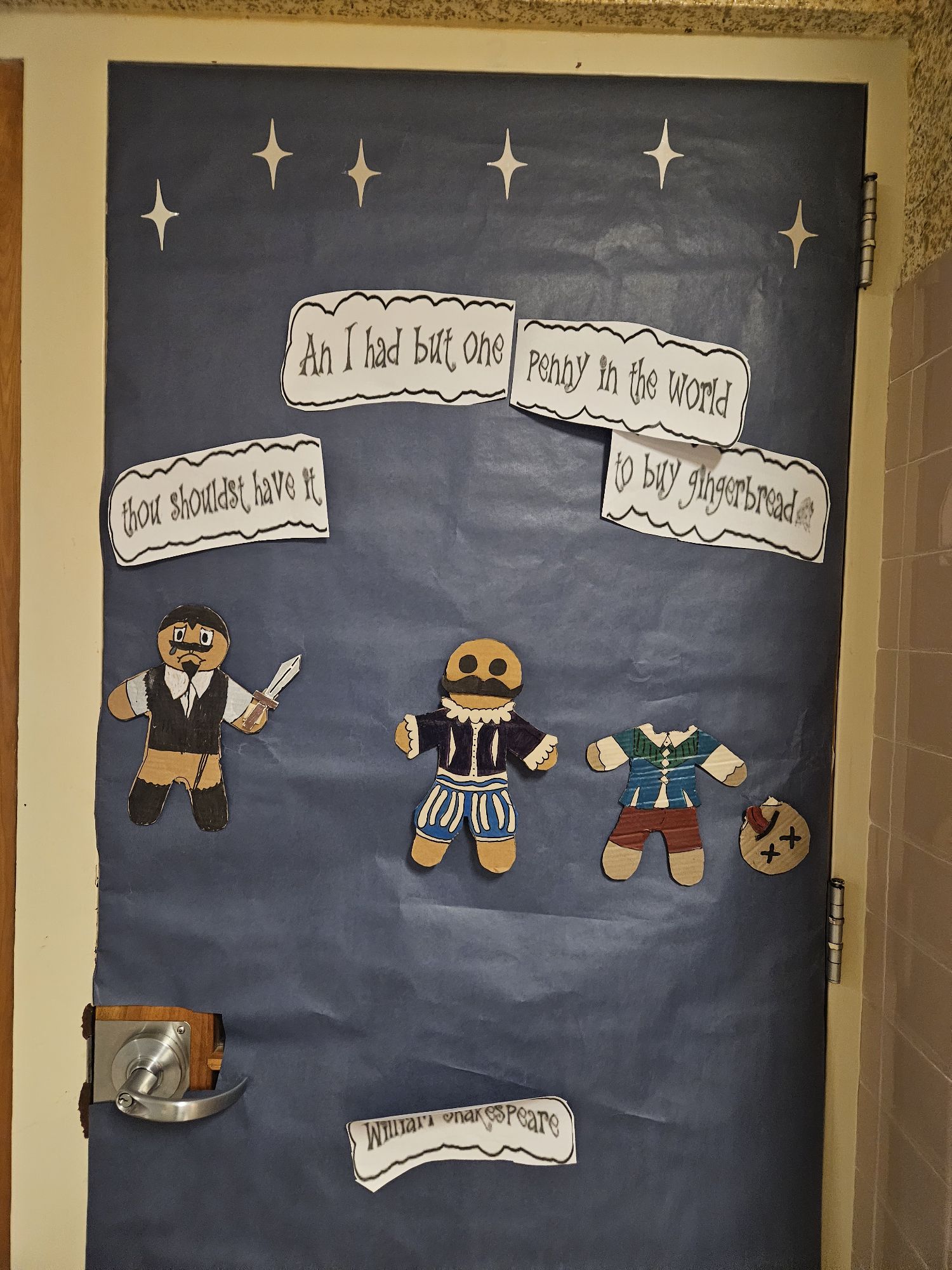
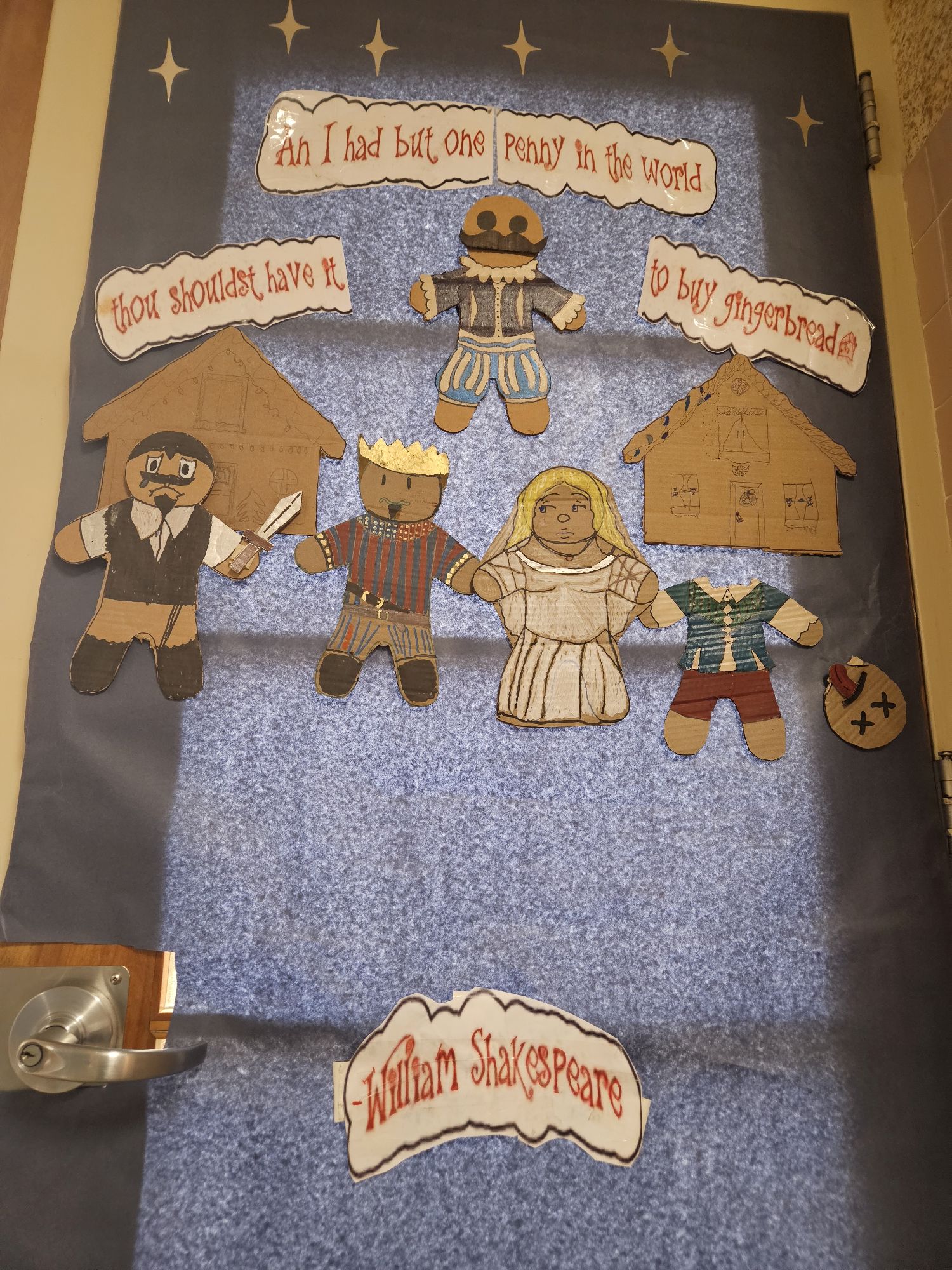
Every holiday season, my school likes to decorate the classroom doors in a festive way. I wanted to celebrate my Shakespeare Club and also teach the club members about Shakespearean fashion, Shakespearean characters, and maybe a little bit about engineering too. I’m very proud of the results, and I wanted to share this idea with you to maybe inspire you next holiday season!
Gingerbread Hamlet Close up of Hamlet’s sword Gingerbread Shakespeare Off with his head!Gallery of my Gingerbread Madness
The Concept
Hath I but one penny in the world, thou should’st have it to buy gingerbread. – Love’s Labors Lost
Since the theme had to be holiday-related, I looked at the above quote and decided to make Shakespearean gingerbread men! I knew I wanted to make the kids design a bunch of gingerbread men that would look like Shakespearean characters. While we were at it, I wanted gingerbread houses and maybe even a 3D element to go along with it. I knew it wouldn’t be easy, but I also knew my group was up to the task!
The plan
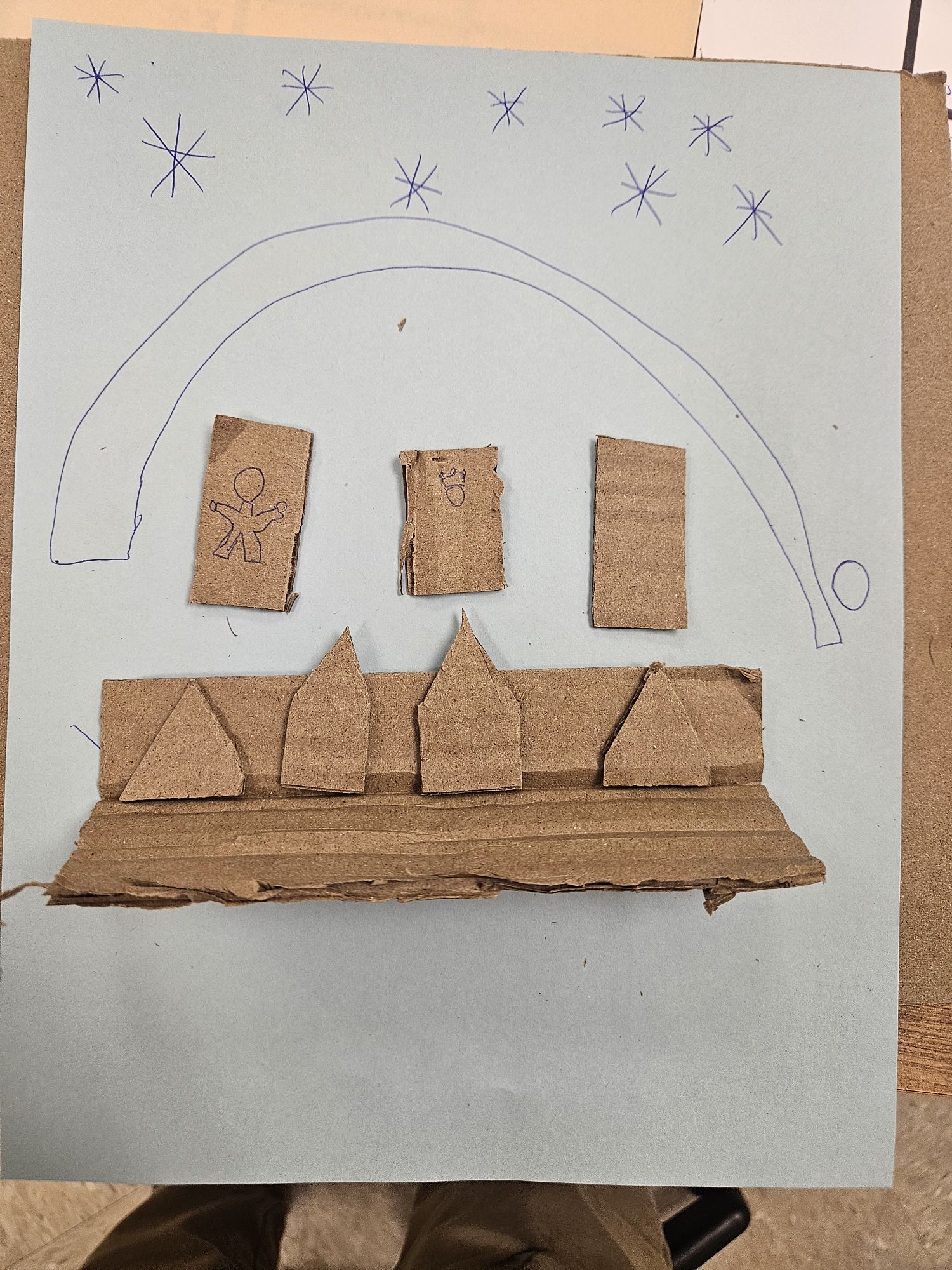
My concept drawing of how the door should look
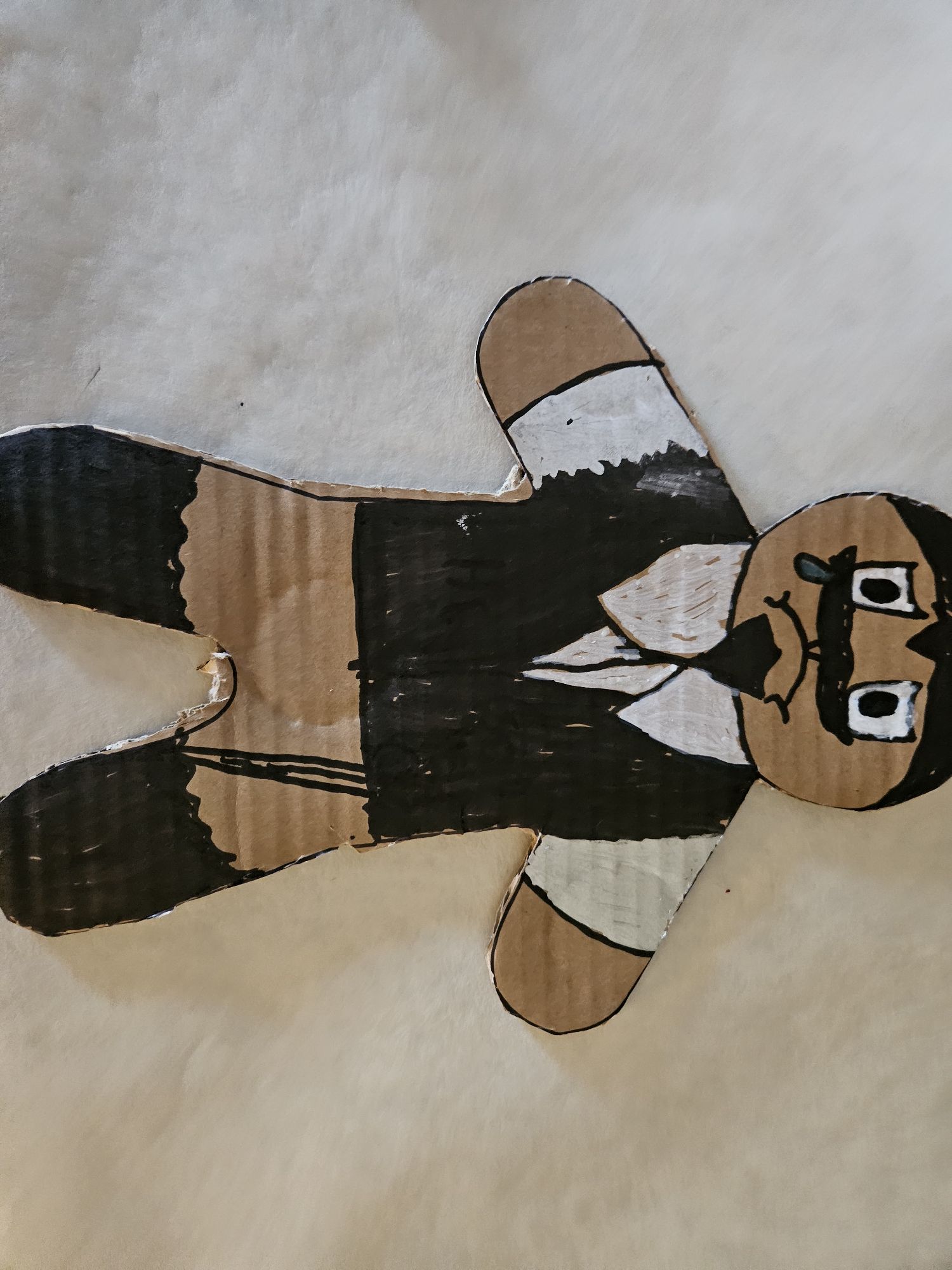
I knew I couldn’t use real gingerbread, so I chose the next best thing- cardboard! I made a cardboard plan of the door to show to my group. I then found a wooden gingerbread man at the local dollar store and used that as a template for the cardboard characters. Finally, I explained the concept to the group, and divided my group up into teams- one group would draw and color the gingerbread houses, one group would color the gingerbread men based on pictures of Shakespearean characters:
Gingerbread HamletGingerbread Henry V Gingerbread Juliet
My final group created a 3D gingerbread house with a light in it to make the gingerbread village come to life. They even put my little puppet Shakespeare pal in there (I guess it’s his winter home).
I’m sure I don’t need to tell you that one of the most iconic voices of our generation, James Earl Jones has passed away at the age of 93. I’m sure I also don’t need to mention his iconic film roles in such films as Field of Dreams, Coming To America, The LIon King, and of course, his (initially uncredited) role as the voice of Darth Vader in the Star Wars Trilogy. As I’ve written before, Jones had a powerful, authoritative voice that played kings, generals, knights, and even gods, which came directly from his training as a Shakespearean actor. So, instead of taking a look at his illustrious film career, I’d like to celebrate Jones’ contributions to Shakespeare, and how Shakespeare changed his life, and through him, changed mine.
Jones and Poetry
“I don’t mind talking about my stuttering because it’s just another example of you finding yourself with a weak muscle and you exercise it, and sometimes that becomes your strong muscle,” Jones told KCRA in 1986. “I was mute from grade one through freshman year in high school — mute because I just gave up on talking.”
-James Earl Jones in a TODAY Show interview, 1986
James Earl Jones was born in 1931 in Arkabutla, Mississippi. Not only did he struggle with racial discrimination at home and in his career, he also dealt with a debilitating stutter which, as you can see in the quote above, left him all but mute for years of his life. It was one of his teachers who helped Jones find his voice by giving him poetry to read, inspiring him to become an actor. As a Shakespearean actor who also struggles with a stutter, reading this about Jones helped me become an actor as well.
The New York Shakespeare Festival
Your voice has the power to inspire, motivate, and change lives. Don’t be afraid to use it.
James Earl Jones
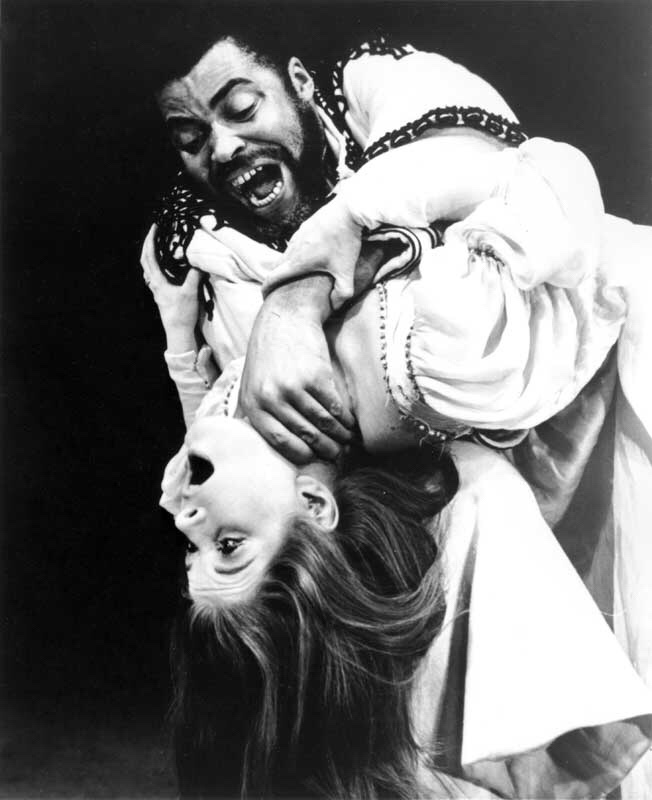
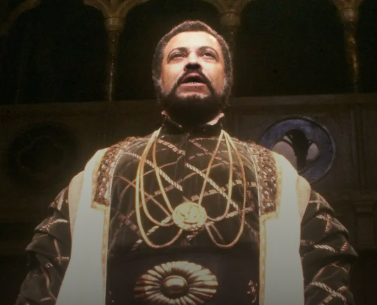
Before he became a star in the Hollywood firmament, Jones was a classically trained actor who starred in many contemporary and classic plays like The Iceman Cometh, The Great White Hope, and a title role in a drama about the great Shakespearean actor, Paul Robeson. In addition, Jones was a regular performer at the New York Shakespeare Festival, starring as King Claudius in Hamlet, Oedipus Rex, The Prince of Morocco in The Merchant of Venice, and like Paul Robeson, Jones was celebrated for his dignified and powerful portrayal of Othello.
James Earl Jones as Othello and Cecilia Hart as Desdemona in a scene from the Broadway revival of the play “Othello.”
James Earl Jones as Othello and Christopher Plummer as Iago in a scene from the Broadway revival of the play “Othello” (New York 1982)
“Mr. Jones commands a full, resonant voice and a supple body, and his jealous rages and frothing frenzy have not only size but also emotional credibility,” .”
The Times wrote in a review in 1964
From Shakespeare to Strangelove
James Earl Jones made the leap from stage and TV (he was one of the first celebrity guests on Sesame Street among others), after a surprising performance. In 1964, he was playing the relatively minor role of the Prince of Morocco in Merchant of Venice at the New York Shakespeare Festival, while George C. Scott played the more iconic role of Shylock. Surprisingly, Director Stanley Kubrick saw both of them and cast them both in Dr. Strangelove, Or: How I Learned to Stop Worrying And Love the Bomb, Jones’ first film role.
This goes to show that success is often not a straight line, that sometimes it’s the people you know and the reputation you garner that gives you success in your field.
Success should not be measured by material possessions, but by the contentment and fulfillment we find within ourselves.
James Earl Jones
My Favorite Performance of Jones
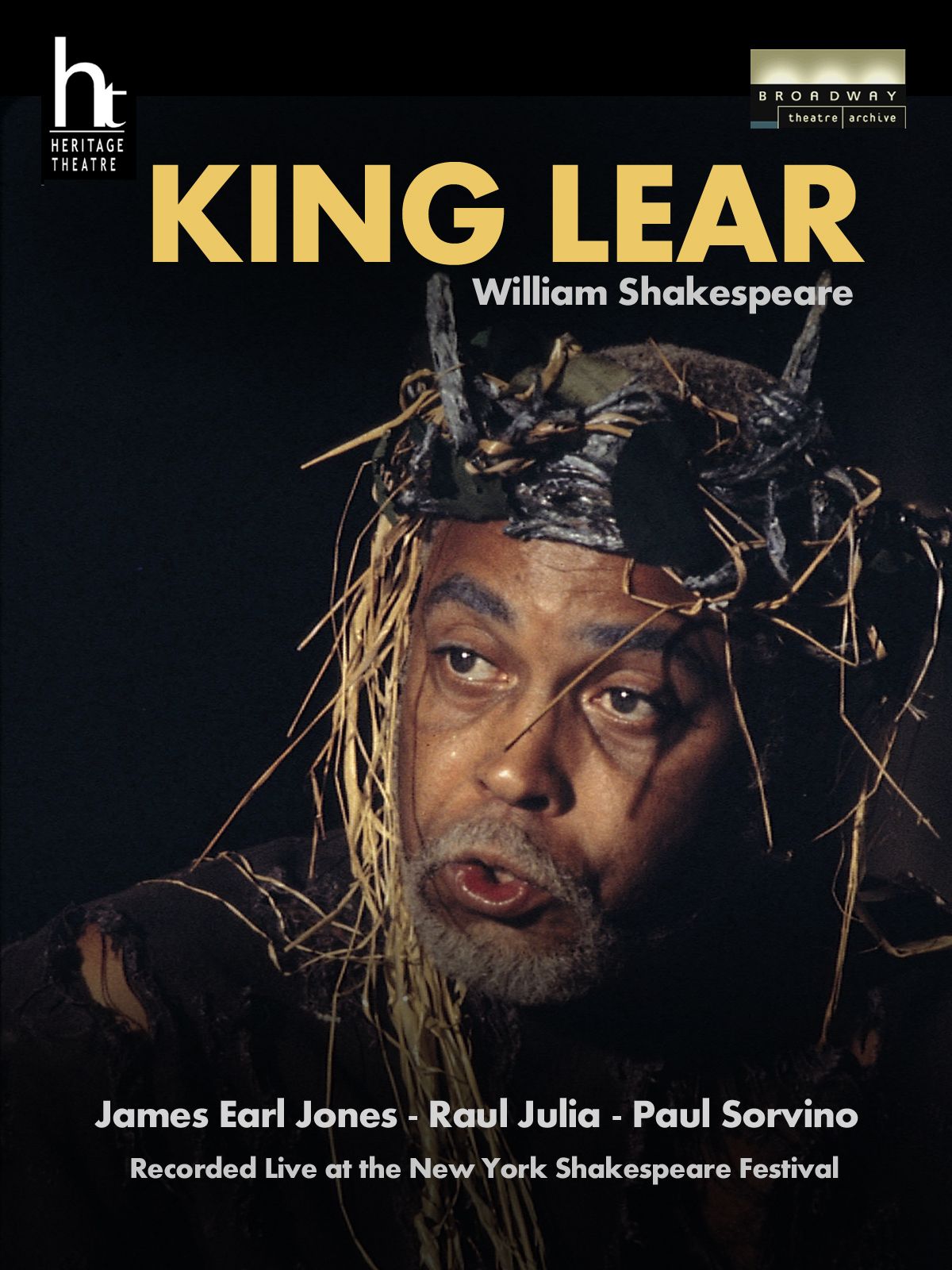
Though his film roles brought him international acclaim, James Earl Jones still performed onstage well into his 80s, including many more memorable performances at the New York Shakespeare Festival, including my favorite performance of all Jones’ stage roles- his role as King Lear. I’ve written before that Jones is still my favorite Lear- he plays the characters’ rage and commanding presence extremely well, but tempers it with the frailty and foolishness of age. You get the sense that this man was a force to be reckoned with, but is now unable to command himself, much less others. Jones’ interpretation apparently changed drastically in rehearsal, as he delved into Lear’s all-too-human flaws, playing him more like a king with dementia than like Mufasa.
Final thoughts
James Earl Jones would be the first to admit that Shakespeare and poetry changed his life. I would argue that the poetic qualities of his voice was what made him such a great actor. He could rumble and smash but also soothe and charm with a single sentence, and that is why I am glad that his voice is now preserved in the halls of Hollywood. Though he was a movie star, his voice was a Shakespearean through and through.
True strength is not in showing power over others, but in conquering your own fears and insecurities.













































 The Shakespearean Student