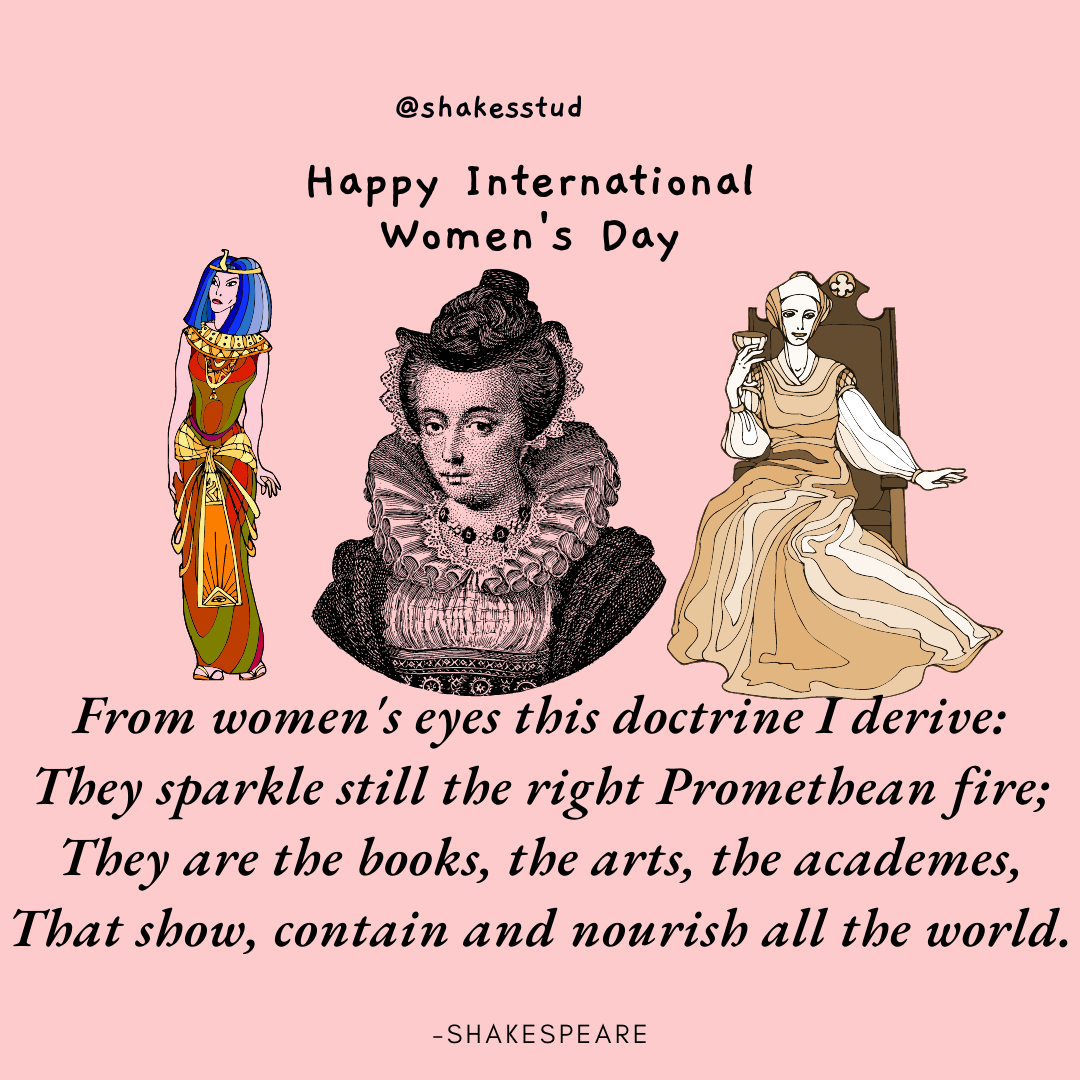
Happy International Women’s Day! I would like to dedicate my posts today to my daughter, a wonderful strong girl, a Shakespeare fan, and a lifelong lover of the musical “Six”.
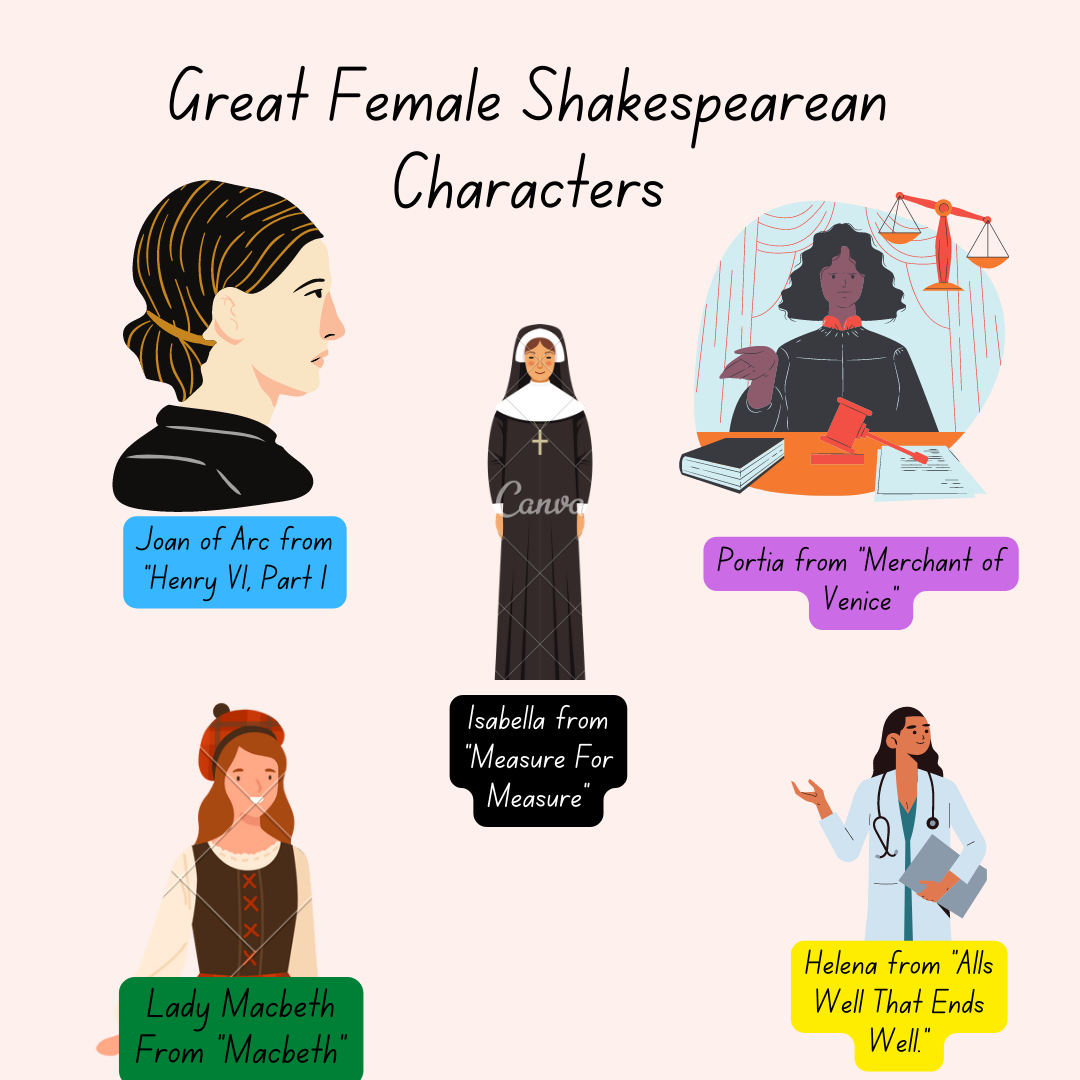
Some of Shakespeare’s Best Female Characters
I’ve discussed Shakespeare’s best Mother characters before, and his Roman characters as well, but I thought I should include some of the ones who are not mothers and/or unmarried (at least for most of the play). I don’t want to rank these characters since I detest ranking women in general, so here are some of Shakespeare’s best characters, and some of their immortal speeches:
CleoPatra
Katherine Of Aragon
Even though “Henry the Eighth” is my least favorite Shakespeare play, I love how strong Katherine is and how well she fights against the machinations of Cardinal Woosey and her husband. She is a courageous, virtuous, and strong-minded woman, who when Henry demands that she consent to a divorce, Katherine simply says: “No Way!”
A fascinating and electrifying character. She seduces her husband and makes him fully commit to murdering the king. If you look at the post above, you can see the multiple potential readings for why she courts evil spirits to convince her husband to murder the king. Her strength and energy is highly attractive and it was easy for me to see how a man might do anything to make her happy.
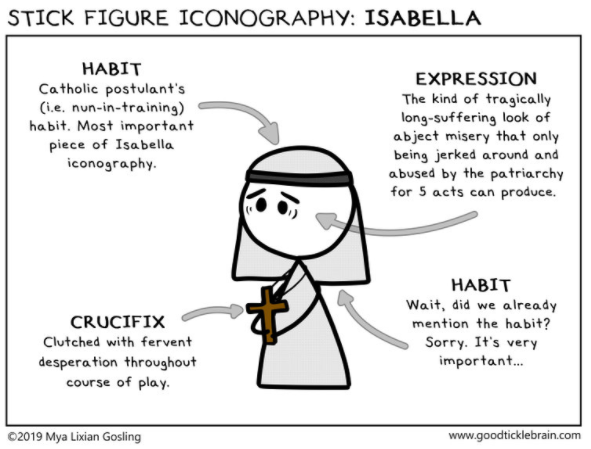
Isabella From “Measure For Measure”
I think Elizabethans would have seen the connection between the Virgin Queen who fought off assassination from the Pope, and Isabella, a virgin who fights off the advances of Angello, who seems pious, but who secretly is degenerate and cruel. Isabella even becomes a princess at the end of the play, (assuming she marries the Duke), which means she could literally become a Queen Elizabeth to English eyes.
Stick figure version of Isabella from “Peace Good Tickle Brain.”
Portia Catonis (Wife of Brutus)
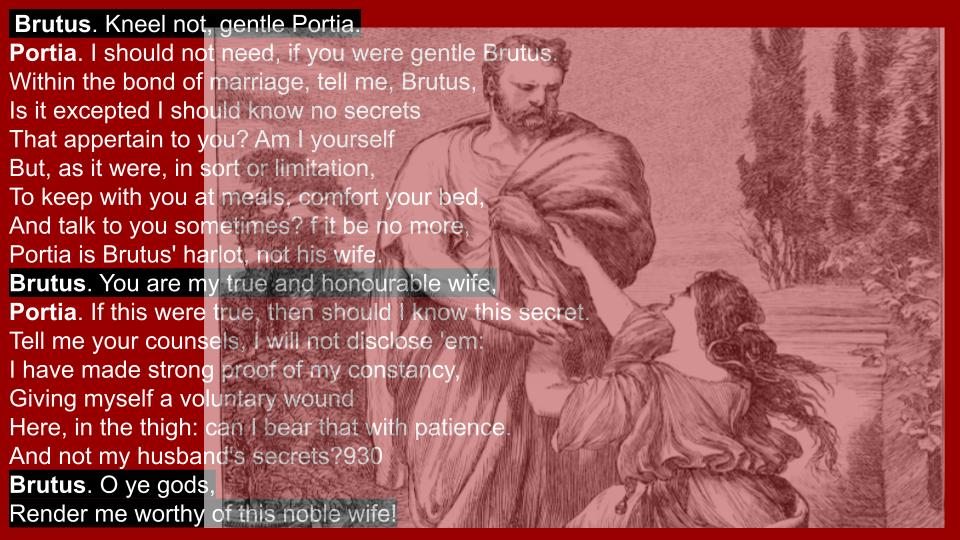
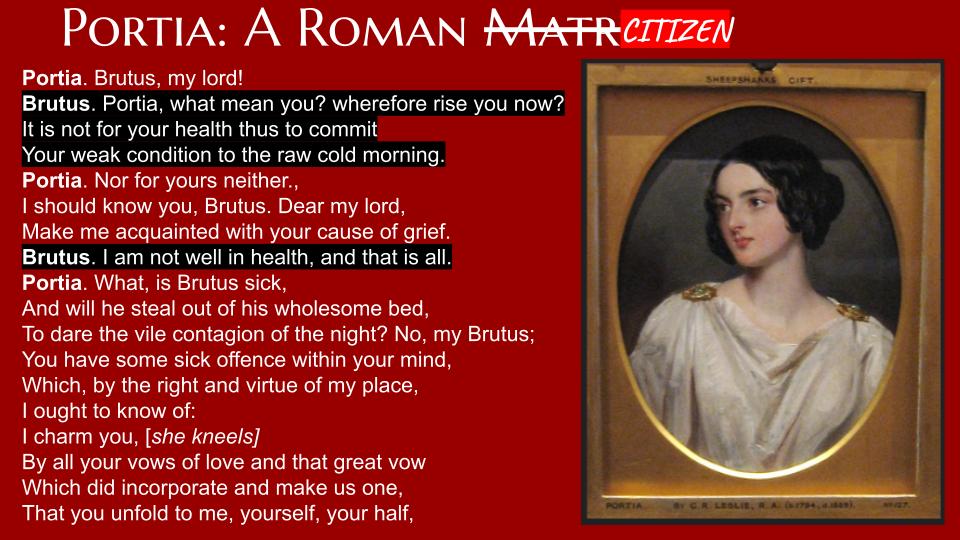
One of the best female characters in the Roman plays, Portia demands to be taken seriously as a wife and as a Roman citizen. In her one great scene we see her demand that Brutus tell her why he has been so distant and cold:
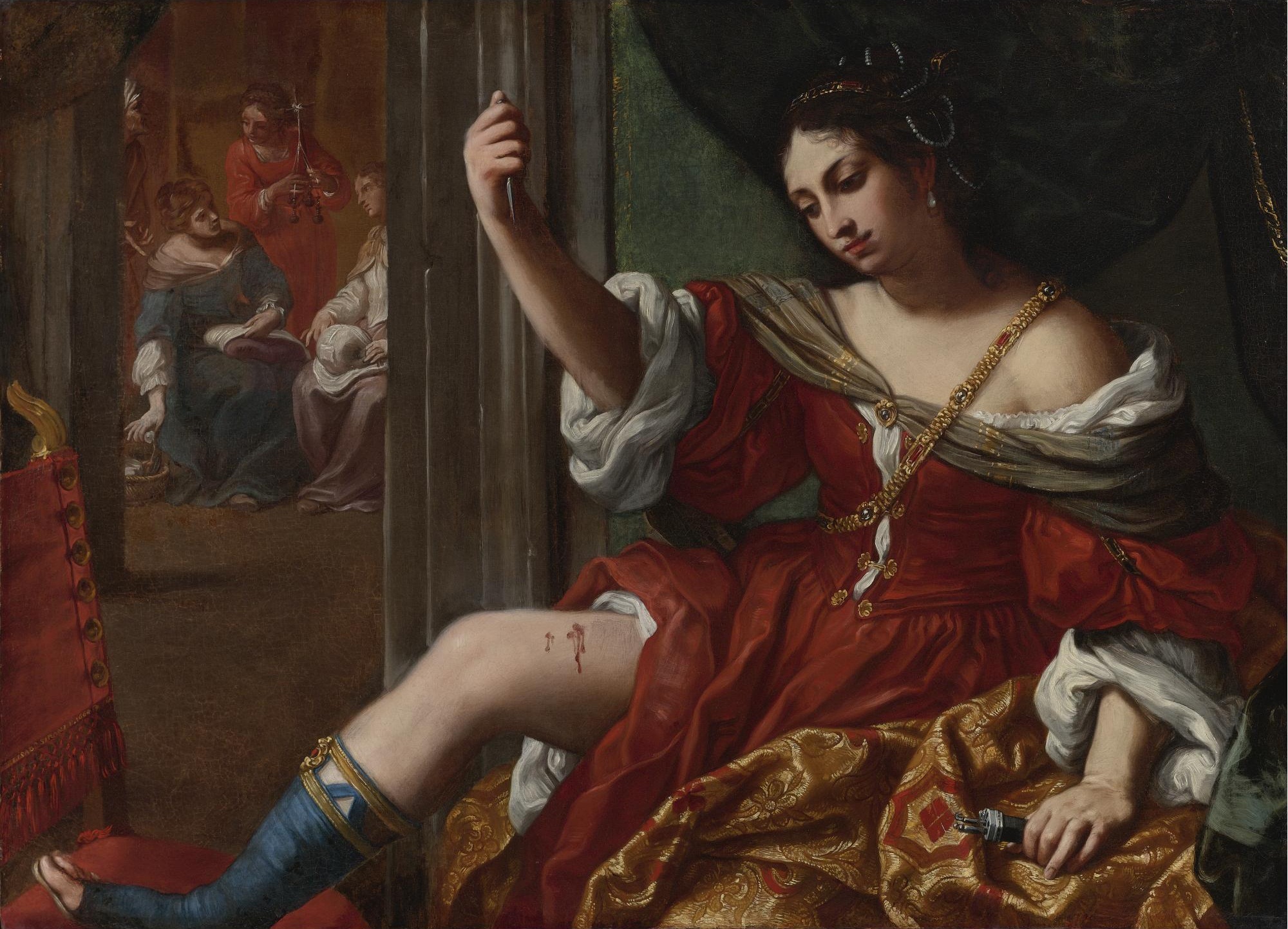
Some have speculated that in real life Portia helped Brutus with the conspiracy to assassinate Caesar, after all, she was the daughter of Caesar's great rival senator Cato, who was willing to die when he realized the Roman republic was finished. Not only was the real Portia a great woman, she also inspired some great art. Below is the great masterpiece: Portia Wounding her Thigh, by Elisabetta Sirani (1664). According to Dr. DR. MAURA GLEESON, the painting was commissioned by a fabric merchant, which explains Portia's sumptuous outfit. Portia remains totally calm, yet focused and determined as the other women in the background idly spin clothes in the background. For more information on this masterpiece, click the link below:
Since International Women’s Day is Friday, I’m devoting the following week to talking about the awesome female characters in Shakespeare’s Roman plays: Titus, Andronicus, Julius Caesar, Antony and Cleopatra, and Coriolanus
First, here’s my post and an accompanying podcast on Roman women, which includes an analysis of Lavinia, Portia, Valumnia, and Cleopatra:
Here’s a fascinating video about the lives of Roman girls:
And here’s a special section about Cleopatra:
Comedy sketches about Cleopatra from “Horrible Histories” BBC, 2015.
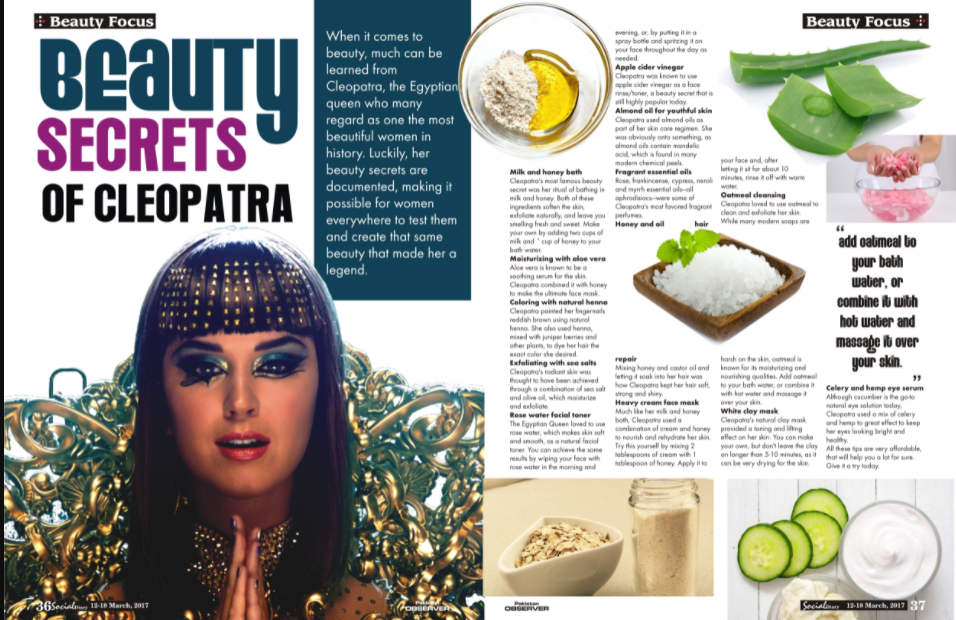
A Lady-Gaga-esque song about Cleopatra from “Horrible Histories,” 2014Infographic from an article about Cleopatra’s beauty regimen. Source: http://socialdiary.pk/
For my Shakespeare club, I’m coaching two young actors on Viola’s celebrated soliloquy in Act II, Scene ii.I thought I’d share some of that work with you. In this speech, Viola has an epiphany; the lady she was sent to woo on her master Orsino’s behalf LOVES HER!
Viola has spent an unspecified amount of time disguised as a man. She has just tried (unsuccessfully) to woo Countess Olivia on behalf of her employer, Duke Orsino. Olivia seemed intrigued by her in her disguise as “Cesario,” and refused to hear any more words about Orsino, but asked Viola to come see her again. The Countess then sent her messenger Malvolio to give Viola a ring, which he claims she tried to give to Olivia as a gift. At first, Viola is confused and upset by the accusation, but slowly realizes that the ring is actually a gift for her; in fact, it’s a love token.
Traditional Interpretations
I think the comedy depends on how Viola reacts to the realization that Olivia loves her. I’ve seen some Violas that are embarrassed, some that are a little frightened (after all, hell hath no fury like a woman scorned), and others with sad sympathy. Viola is a good person, so she can’t laugh at the lovesick countess, but she can have a wry laugh at herself and how her disguise has caused all this trouble; making her unable to confess her love to him, while at the same time making Olivia think she is a handsome young man.
Michelle Terry In the Globe Theater (2021)
Michelle Terry as Viola in the 2021 production of “Twelfth Night”
Michelle Terry is very matter-of-fact in her portrayal. She doesn’t pause, she doesn’t drag out the lines. In fact, she seems more annoyed and scandalized than anything else. The comedy comes mainly from her gestures and movements as she talks to the audience as if they were one of her gal-pals- venting her frustration with this ridiculous situation.
Michelle Terry excels as Viola, straight-faced, tormented, only occasionally raising a conspiratorial eyebrow at the audience.
Judy Dench in the RSC TV show “Playing Shakespeare” is very sympathetic to “Poor Olivia, ” and plays the speech with a romantic sentimentality. She’s focused on Olivia, and feels awful for the false hope she’s given her.
Both these interpretations are valid, and they’re a good baseline for two sides of Viola’s personality- the sensitive genteel duke’s daughter who is sympathetic to Olivia, and the down-to-earth funny one who is willing to disguise herself as a boy to survive.
Literary Devices
Imagery
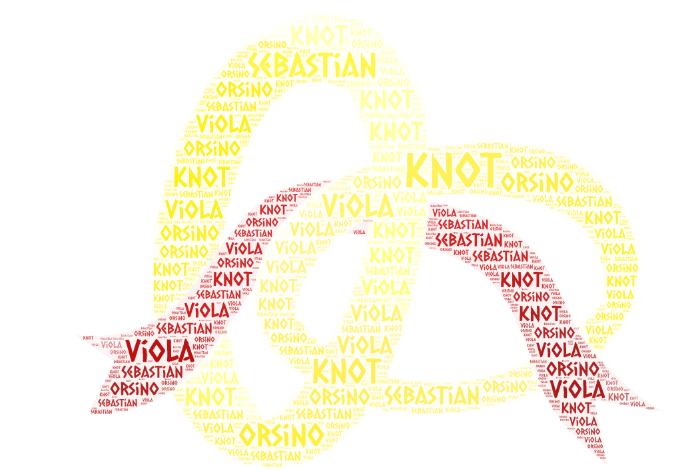
The main image here is the image of the knot- a central image of how convoluted this love triangle is.
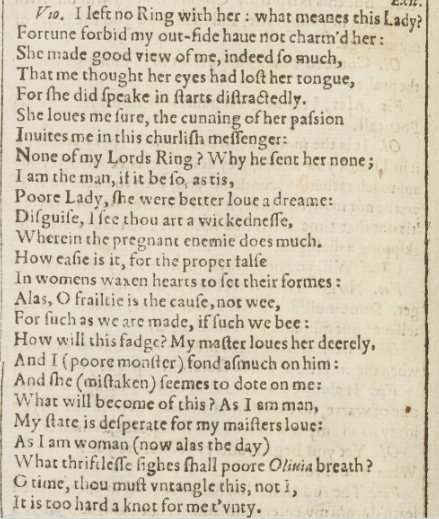
I left no Ring with her: what meanes this Lady? Fortune forbid my out‑side haue not charm'd her: [650] She made good view of me, indeed so much, That me thought her eyes had lost her tongue, For she did speake in starts distractedly. She loues me sure, the cunning of her passion Inuites me in this churlish messenger: [655] None of my Lords Ring? Why he sent her none; I am the man, if it be so, as tis, Poore Lady, she were better loue a dreame: Disguise, I see thou art a wickednesse, Wherein the pregnant enemie does much. [660] How easie is it, for the proper false In womens waxen hearts to set their formes: Alas, O frailtie is the cause, not wee, For such as we are made, if such we bee: How will this fadge? My master loues her deerely, [665] And I (poore monster) fond asmuch on him: And she (mistaken) seemes to dote on me: What will become of this? As I am man, My state is desperate for my maisters loue: As I am woman (now alas the day) [670] What thriftlesse sighes shall poore Oliuia breath? O time, thou must vntangle this, not I, It is too hard a knot for me t'vnty.
It’s interesting to note that (in the First Folio text), the verse alternates between being regular, and using a run-on technique called enjabment, where the thoughts continue after the end of the lines, starting with lines three and four. Ironically, when Viola says that Olivia was distracted and confused when she visited her, her own thoughts are disjointed and fragmentary as she reaches the inevitable conclusion that Olivia is infatuated with Viola in her disguise.
Viola’s Emotional Journey
In the book “Shakespeare’s First Texts” by Neil Freeman he describes how the Folio prints the speech in four distinct sections. Freeman hypothesizes that Shakespeare organized this speech into four phrases that chart the stages of emotions Viola goes through:
Each stage has its own easily identifiable quality, reflecting the growing steps of Viola’s journey in what for her is a huge struggle not only to comprehend, but also to deal with the enormous complications of the dreadful love triangle- the potential results of which are now becomming only too clear.
Freeman, 175.
Stage 1: Introduction
In the first three and a half sentences, Viola goes through the facts- she gave no ring to Olivia, Olivia was eying her, and half paying attention to what Viola was saying. The phrase ends with Viola’s conclusion that Olivia must be in love with her.
Stage 2: Complications
The sentences are of very irregular length- sometimes six words per line, sometimes a few as four. According to Freeman, the irregularity of the verse shows how Viola’s emotions are getting the better of her. Viola could be gasping with remorse over the pain she’s caused Olivia, or shocked at how easily she was taken in by Viola’s disguise.
Stage 3: Crisis/ Catharsis
Each line of this section mentions the people in this love triagle: “My master,” “And I,” “And She,” etc. Viola might be thinking about the possible outcomes to this situation- getting fired, getting discovered, getting married, etc.
Stage 4: Summary: “O Time, Thou Must Untangle This, Not I.”
Like Hamlet before her and Macbeth after her, Viola ends her soliloquy by saying she has no conclusion. She has no idea how to solve this problem, but can only hope that Time will provide a solution.
Audience Interaction
As I said, this is a soliloquy, which is to say, a speech where the character is solo or alone onstage. Some people think this means that the characters are talking to themselves, but I firmly disagree with this notion. One reason why Shakespeare writes soliloquies is because they allow a character to share their thoughts and feelings with the audience. They are the ancestors of every aria or solo in opera and musical theater, and every Disney Princess/ Villain song. I’ve even said before that there are some similarities between Viola and a famous Disney Princess:
This is a story of two boys, centuries apart, but united by their love of theater in general, and the Globe Theater in particular. The first is William Shakespeare, whose story Aliki tells from his birth, to his boyhood days, to his rise to prominence in the theater. The second is Sam Wannamaker, the man who spearheaded the project of re-building the Globe Theater from 1949 to the first performance of the Globe in June of 1997.
Aliki tells this story in the format of an Elizabethan play, dividing it into five acts. Acts I-4 tell the story of Shakespeare’s life while Act V focuses on Sam Wannamaker pursuing his dream. The book concludes with a chronology of Shakespeare’s plays, and a table of his most famous words and expressions, illustrated with adorable characters.
Illustrations: Medium and Style of Illustration
Like many of her books, Aliki’s illustrations are layered and detailed. She uses ink pen outlines to draw her characters, but then fills them in with bright, vibrant colors. She then painstakingly shades them using the crosshatching technique, to create textures that are complex but have a hand-drawn almost impressionistic feel. The characters aren’t ultra-realistic, and the color palette is limited mainly to bright primaries and warm browns, making it look like a child’s box of crayons or colored pencils. This book is designed to appeal to children with its hand-drawn quality.
Format:
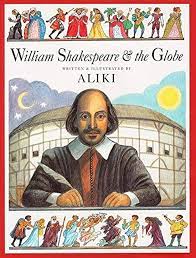
Cover- The cover makes the subject of the book clear to the audience. We see Shakespeare and Globe Theater, but also illustrated moments from his plays. This helps establish that this is not only a biography, it is an introduction to Shakespeare’s plays and poems as well.
Front Matter: The book opens with four pages of quotes from Shakespeare’s plays illustrated with fairies, pipers, and Elizabethan men and women. There is no half-title, no frontispiece and no Half title verso.
Title page verso (copyright page) In the center of the copyright page is an Illustration of Shakespeare standing atop a globe, over the famous lines: “All the world’s a stage, and all the men and women merely players.” Below the quote in very small letters is the copyright date, a short summary, the ISBN data, card catalog information, and the typography information.
Title Page The title is laid out on a white background with a thin black border. Below the title is an image of a boy (presumably Sam Wanamaker), assembling a paper model of Shakespeare’s globe, with a portrait of Shakespeare in the background. This helps establish that this biography focuses on both Shakespeare and Wanamaker, and makes the reader excited to see the real Globe brought to life in full illustration.
Table of Contents As stated before, the book is organized like an Elizabethan play, so rather than Chapter 1, etc. the book has five Acts with 1-4 scenes in them. Each chapter in the table of contents is labeled with a description that sets the scene; either a location (like London, Stratford, The Globe), or what will happen in the scene (such as “Building” or “Uncovering”). The table then details four appendices that are part of the back matter.
Preface: The Preface is referred in the book as an aside, (an Elizabethan theater term meaning something spoken between a character and the audience). This preface acknowledges that, because of the lack of surviving historical information on William Shakespeare, Aliki, like many Shakespearean biographers, has to use some guesswork to fill out the narrative of his life. A second preface (referred to as a Prologue), introduces the story of the book, (namely the lives of Will Shakespeare and Sam Wanamaker). This preface mimics how in Shakespeare’s plays, a prologue would tell the audience what would happen before the narrative started.
Back Matter/ Appendices: There are four appendices in the back matter- A table of Shakespeare’s collected works, a timeline of the book’s events from 1564-1999, an illustrated list of Shakespearean words and expressions, and finally a list of Shakespearean sites to visit in London and Shakespeare’s home town of Stratford Upon Avon. These appendices show the reader that Shakespeare has an important role in history and in the English language, and encourage the reader to learn more about him.
Value As an Educational Tool
This story not only tells Shakespeare’s life, it also introduces the reader to his plays and his influence on the English language through the illustrations and frequent Shakespearean quotations. The reader also gains an insight into Elizabethan life and culture by following Will’s journey from Stratford to London. Finally, by juxtaposing Shakespeare’s life with Sam Wannamaker’s, the reader sees Shakespeare through Sam’s eyes as he works his whole life to restore Shakespeare’s Globe to its former glory. The reader develops a love of Shakespeare, (or at least an empathetic respect), and may feel empowered to read more about Shakespeare, see his plays or maybe even become a Shakespearean artist in the future. In short, Aliki’s book brings the world of Shakespeare to young readers in a way that is beautiful to look at, full of insight, and with enough supplemental materials to encourage them to learn more.
Overall Impression:
Like Prospero’s magic in The Tempest, this story is magically told- it is not intended to create a totally realistic representation of Elizabethan life, but to give an exciting, colorful impression of Will’s life and work to the reader. Due to the scant historical details of Will’s life, Aliki chose not to do a standard biography, but, like Shakespeare’s own history plays, to tell a historically authentic story, rooted in truth that brings a time and a place to life, while portraying it an exciting and visually appealing way.
Citation:
Aliki. (2000). William Shakespeare & the Globe. HarperCollins Publishers.
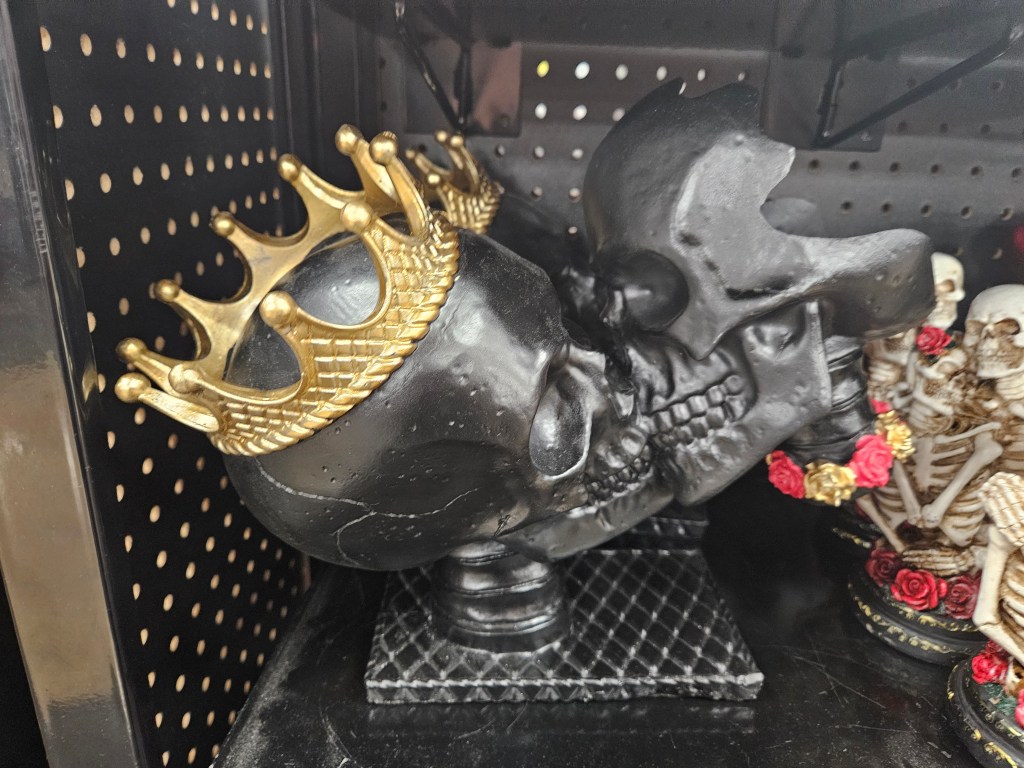
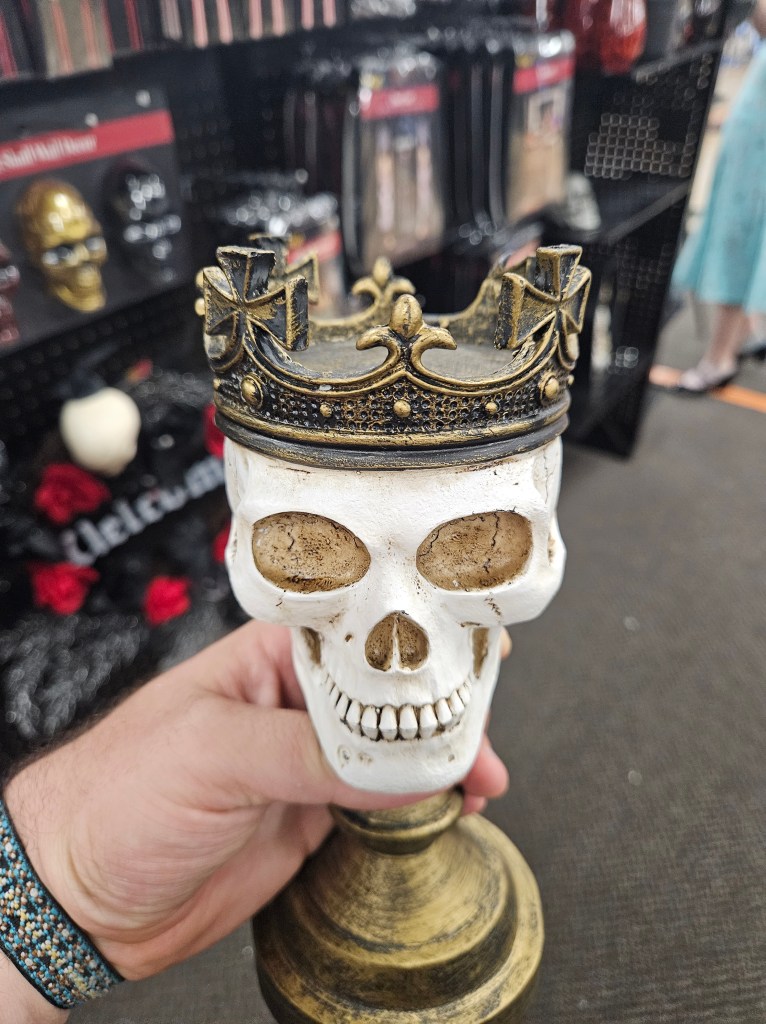
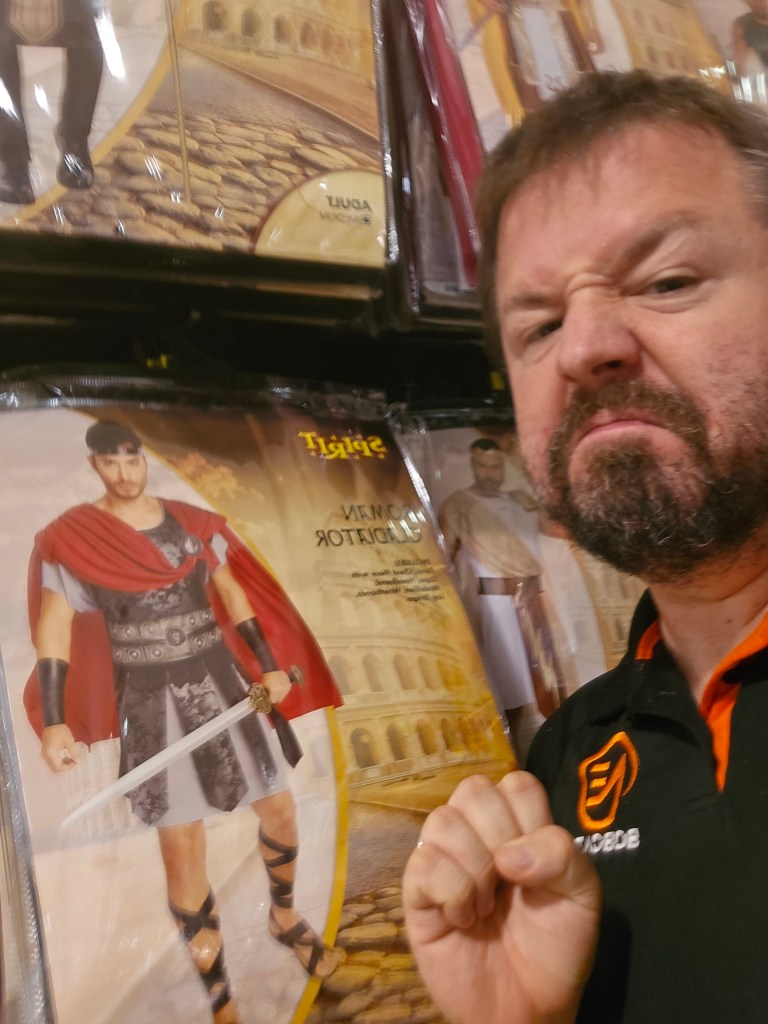
I’ve written before that Shakespeare helped influence Halloween as we know it- the images of holding skulls, witches chanting over a cauldron, and even ghosts coming back to plague their murderers all have Shakespearean roots. Exhibit A is how these images and tropes can even be found in beloved Halloween costume stores like Spirit Halloween!
If you like creepy Halloween activities and Shakespeare, please sign up for my fully online, fully asynchronous class: “An Immersive Guide To Shakespeare’s Macbeth!” The class features a digital escape room, an interactive quiz, and a special, undead guest!
As you probably know, I love to review children’s adaptations of Shakespeare (whether direct or indirect). “The Lion King,” (Hamlet), “Encanto” (King Lear), and of course, the many adaptations of “Romeo and Juliet,” are mainstays on this website: Gnomio and Juliet, Romeo and Juliet: Sealed With A Kiss, even Disney’s Pocahontas have their basic plot and characters firmly rooted in Verona Italy.
Then one day by chance, I found this book in a local park, and I knew I had to review it!
The Premise
This is a simple re-telling of the story of Shakespeare’s play that focuses on just the young lovers. You feel for these cute little animals and in a way, making them a kitty and a dog smitten with puppy love, makes them more understandable and sympathetic than Shakespeare’s youthful teenagers, who indulge in violent delights without using their human reason.
What It Keeps
The Story
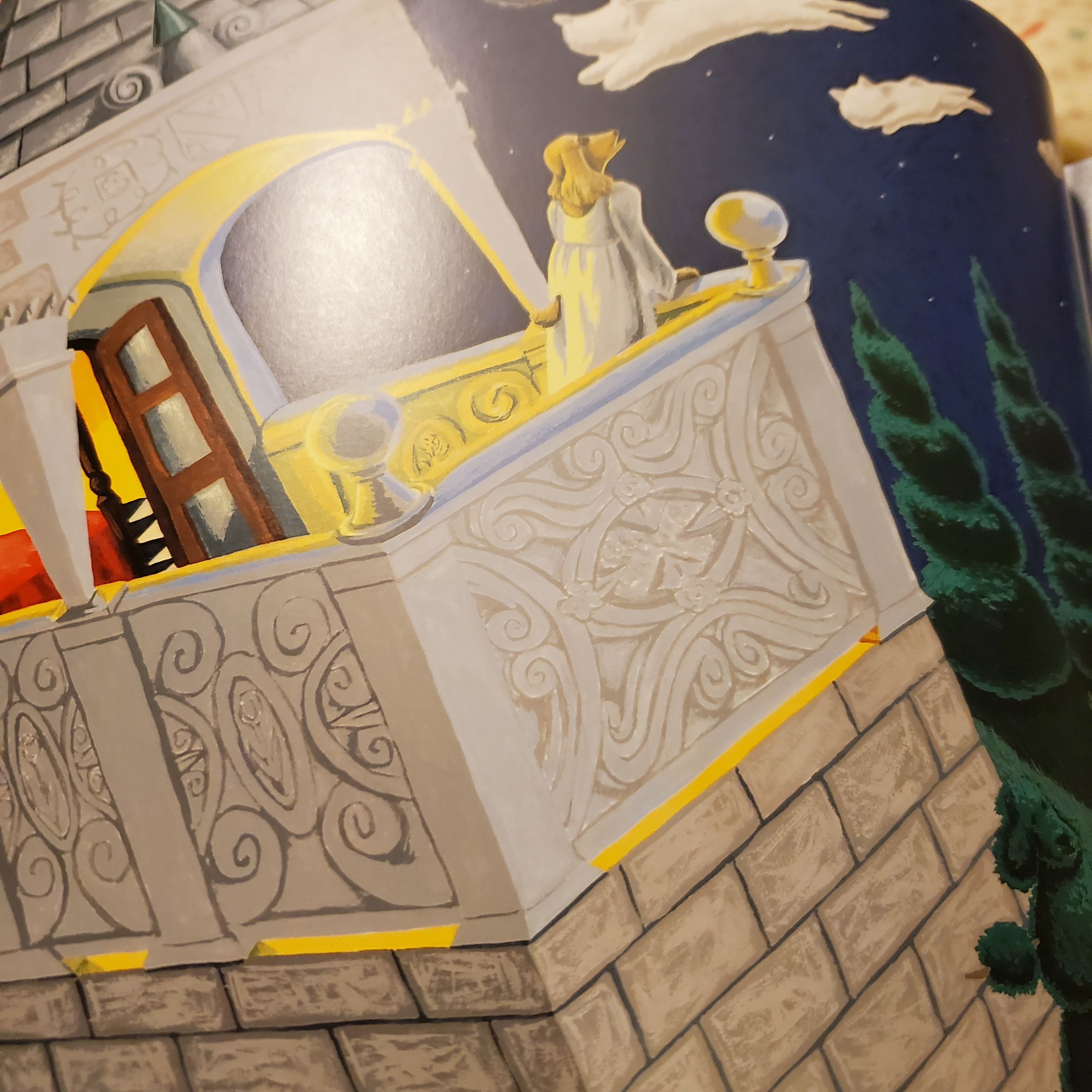
The book keeps the feud between the two families, has the young lovers meet in disguise at a ball, fall in love on a balcony, get married, and amazingly, DIE! Laden still manages to tell the story in a kid-friendly way, though giving it tragic weight.
The Language
The book opens with a rhyming prologue, which, although it isn’t in sonnet form, has the same function as Shakespeare’s prologue- to explain the plot before we see it played out in the book, thus giving the whole story a sense of dramatic irony. Plus, as you can see, Laden also imitates Shakespeare’s love of wordplay with metaphors and puns, (a tale of tails), and alliteration to give the dialogue some wit and effervescence. Reading it gave me giggles like I’d just popped open some champagne.
What it changes: Spoiler alert
All throughout, Laden makes small changes to simplify the plot and remove characters that don’t directly impact the main plot. The characters of Lord/Lady Capulet and Lord/Lady Montegue, The Nurse, Paris, Peter, the servants, and the friars are completely absent, turning an already brief play into an even more compressed story.
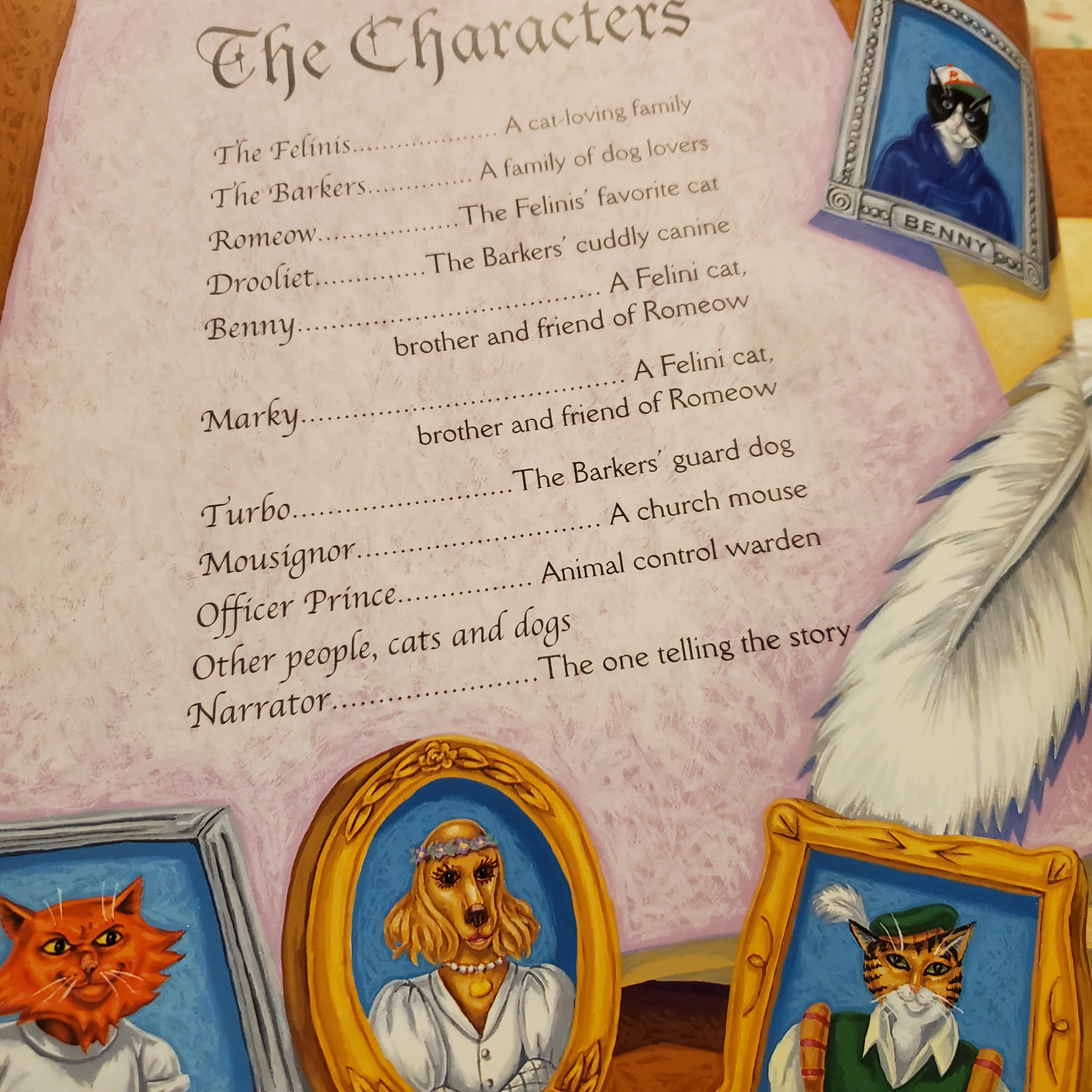
Like a lot of animal retellings I’ve seen of this story, the author recasts the human leads as animals that are natural enemies- in this case, cats and dogs. This makes the story easier for kids to understand. As I’ve said before, it’s often difficult to keep track of who belongs to which house in Shakespeare’s version. All you need to know is that Romeo and his brothers are cats and Juliet’s family are dogs.
Funnily enough, my daughter actually complained that the story would’ve been better if Juliet were a cat instead of Romeo, which I agree with for very specific reasons. The character of Tybalt is named after a character from a prose story called “Reynard the Fox,” who had the epithet, Prince of CATS. Mercutio annoys Tybalt by taunting him with this title before challenging him to a duel:
Tybalt: What would you with me? Mercutio: Good Prince of Cats, nothing but one of your nine lives! Romeo and Juliet, Act III, Scene i.
It would’ve been a funny Shakespeare easter egg to have Juliet and Tybalt be portrayed as cats, but I understand why they went with dogs- Drooliet is a hilarious pun, and having Tybalt be a vicious, rabid dog helps set him up as a fearsome antagonist.
I suppose you’re wondering, how the author keeps Shakespeare’s tragic ending in a children’s book? Well, like Shroedinger’s cat, she manages to make Romeow die and not die at the same time. He gives Drooliet one of his 9 lives, allowing them both to ‘die’ and then come back for a happy ending. It’s a brilliant way to nod at the original, while also keeping the kid-friendly tone.
My Reaction
This book is really fun and very enjoyable for kids, parents, and teachers who want to introduce kids to Shakespeare at an early age!
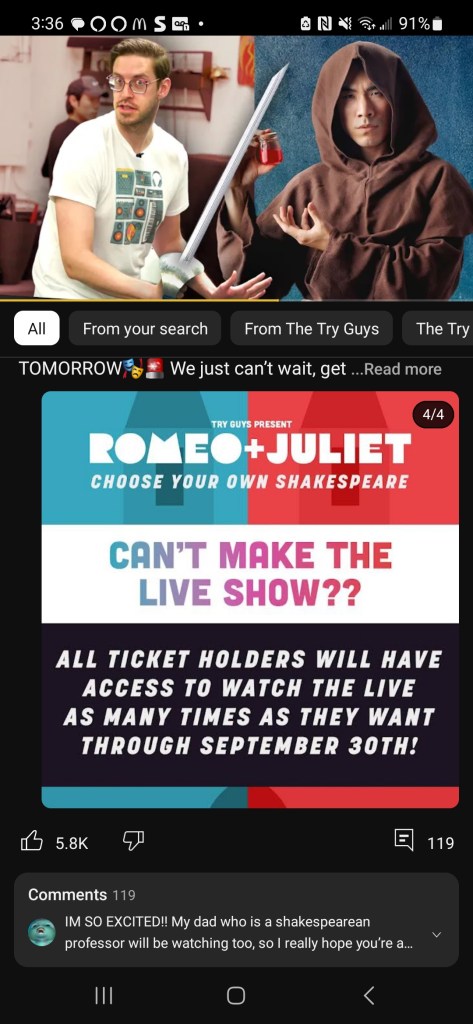
I was excited from the beginning to hear that the Try guys were going to bring Shakespeare to YouTube in a way that was fun and accessible. My expectations were that they would make fun of the play with care; I was hoping that they wouldn’t mock Shakespeare, (or mock people who like Shakespeare). I was also hoping that they would critique the characters without outright mocking them and find ways to make the play connect to modern audiences. I think they achieved all those things and more!
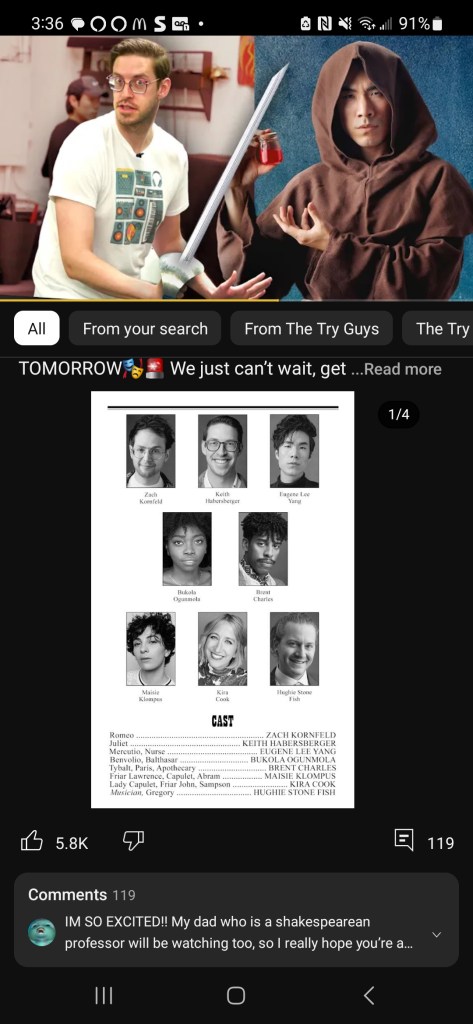
Zach Kornfield, Eugene Yang, and Keith Habersberger known collectively as “The Try Guys” are a group of friends who seek out new experiences and share them with the world. They thrive on taking themselves out of their comfort zone and learning about the world through experiencing it firsthand in a funny, lighthearted way. As I said before, what could be more adventurous, daring, informative, and out of YouTube’s comfort zone than doing Shakespeare?
In a series of videos they explored Elizabethan clothing, stage combat, learning how to speak Shakespearean verse, and finally on August 10th, 2023, they performed “Romeo and Juliet” live on Youtube, with suggestions from the audience! With this post, I will discuss the evolution from these three videos, to the final show, which I got to see live on YouTube. I will discuss what I think worked, what didn’t, and how this production might influence future Shakespeare productions going forward!
Podcast About the SHow:
My Top Ten Moments:
Background on the Show
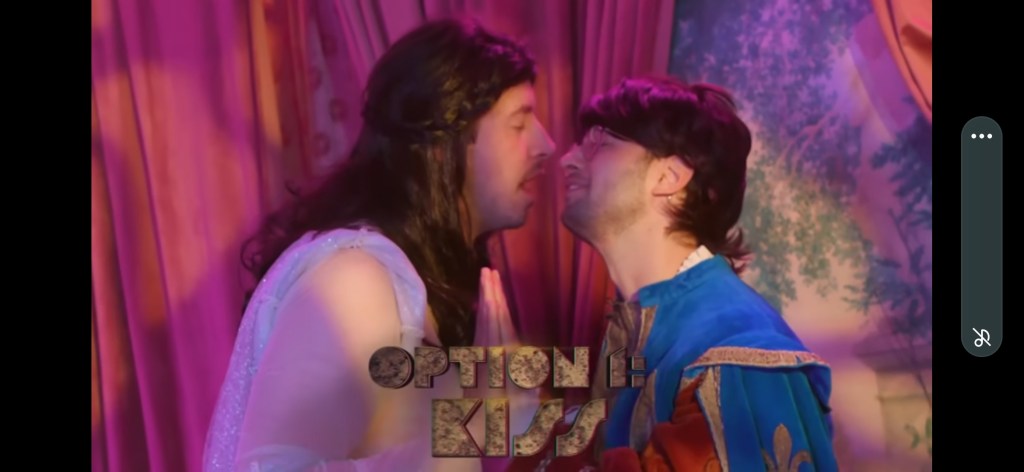
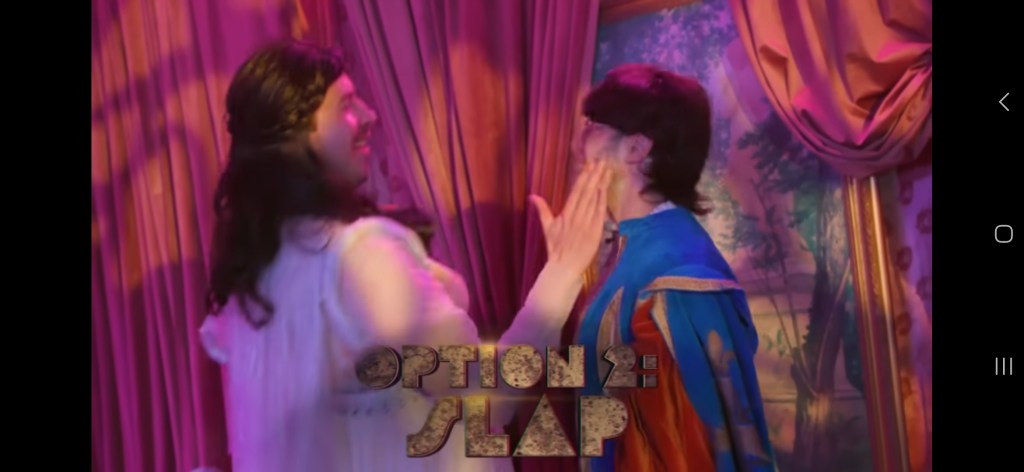
The original pitch for the play made it sound like a live YouTube event, but they made it even better by including a voting option where viewers could change some of the action and chose for instance, if they fought with swords or some other object, thus engaging the audience the whole time. This is what made this experience unique, (perhaps more than any other production), and I think in many ways this production could be an inspiration to educators and theater practitioners! My main critcism of the show is that, though it can be enjoyed by almost anybody, it is definitely not suitable for children, and nobody could get away with showing it in a classroom environment.
Costumes and Sets
The set for “Romeo and Juliet,” seems like an ordinary YouTube TV studio, in that it’s fairly small and it does not suggest any particular period. It kind of suggests somewhat of a dream-like environment; there are cardboard cut outs with some clouds, the lighting is warm with a few pink colors . Most of all it reminds me of a fractured fairytale more than classic tragedy, (which I suppose is clever in itself because it sets up that the Try Guys are going to fracture Shakespeare the same way people like the Muppets fractured fairy tales.
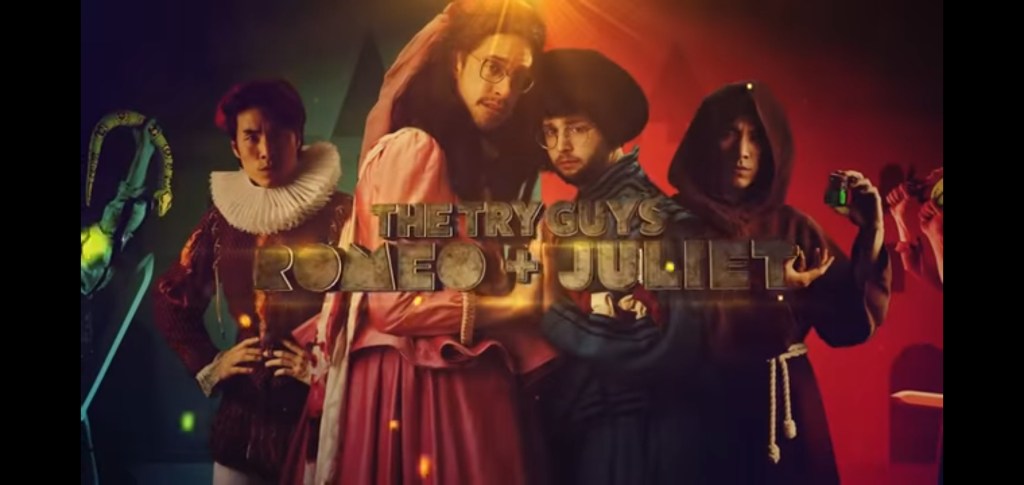
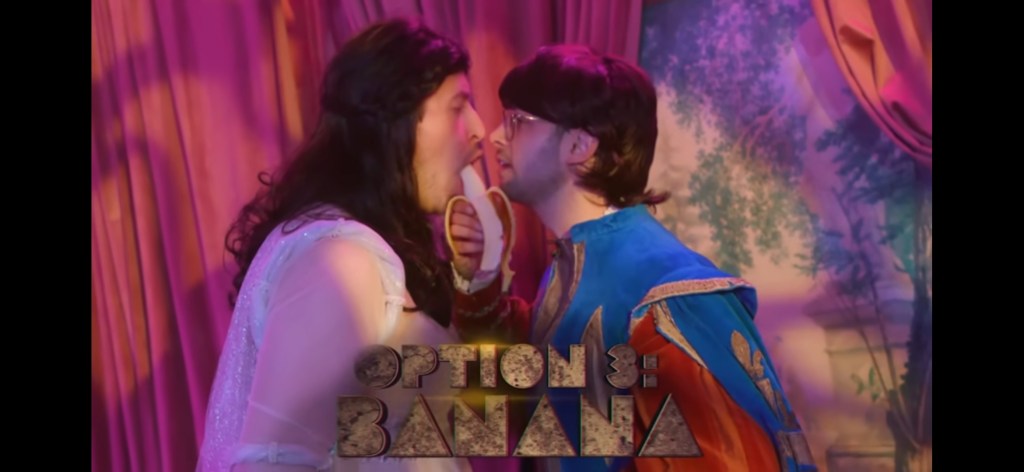
The costumes don’t seem as elaborate or historically accurate as the ones in the previous video, which is a shame because it would’ve been really nice to see the Try Guys walk, fight, and dance in the same costumes that they experimented with in the previous video. That said, the costumes certainly are functional within the story. Eugene as Mercutio has a stylish striking black outfit that certainly suggests somebody you don’t want to mess with. Zach as Romeo has an amusing long wig (romantically disheveled of course) and a blue doublet (though I miss the pumpkin pants in the previous video). As in other productions, the Montegues wear blue and the Capulets mostly wear red. I would be surprised if the director had seen the famous Franco Zephirelli film (or at least Gnomio and Juliet).
The director Keith Habersberger also keeps the best costumes for himself both as the Prince and Juliet; he’s wearing a beautiful ordinate gold costume as the Prince and Juliet herself has lovely rose-colored gowns. Even her shift in Act Four is it’s tasteful. I’ll talk more about Keith’s portrayal of Juliet later, but let’s just say that the clothes do not make him look like a man in women’s garb, they make him look like Juliet.
Stage Combat
The stage combat episode is great, and as a Stage Combat junkie myself, I watch a lot of channels like Skalgrim, Forged In Fire, HEMA videos, and of course my own stage combat videos. Consuming this combat content, I know that there are lots of avenues for education and for entertainment watching these 3 guys who have never done sage combat before, try out swords. I was very delighted to see them putter around with swords and then learn a short stage combat scene in which they then put on put their own spin on by improvising a scene where Romeo & Juliet sword fight with a guy who cut the cut in front of them while they were trying to get ice Cream. The video is fun, ludicrous, but also it’s just as informative as videos from the Folger Shakespeare Library.
Unfortunately, The Try Guys didn’t make much use of the swordplay they learned in this video during the final performance. Imagine my disappointment when, during the climactic duel between Tybalt and Mercutio, the audience voted to replace the swords with…something that was definitely NSFW. I’ll discuss this choice in depth later on my podcast but let’s just say it made the training they did in the previous episode seem like a waste of time.
The Cameos
Did you hear about this guy Romeo? He’s the talk of the town
Link Neal from Good Mythical Morning
One aspect of the production that I deeply loved was that instead of doing the whole play, The Try Guys did a 90-minute abridged version using multiple narrators to fill in with bits of exposition and commentary. The Reduced Shakespeare Company did this before in their show, but since The Try Guys are very popular in the YouTube Community, they got a bunch of their fellow Youtubers to be their narrators like Rhett and Link, Smosh Games, Rosario Pansino from Nerdy Nummies, and Mat Pat from Game Theory. It was absolutely delightful to hear more of my favorite YouTubers talk about my favorite writer, each one telling the story with their own brand of humor!
Romeo runs to Friar Laurence, mascara all smeared!
Manny Mua
The Performances:
Finally, let’s talk about the acting in the final performance and how the Try Guys succeded in bringing Shakespeare to You Tube.
Keith Habensburger as Juliet
Keith carries the show as Juliet. As he mentions in the video above, he has performed in Shakespeare before, and his passion for performing shines. It’s actually a bit shocking to see him drop his usual persona as an easy-going funny guy and become a tragic heroine! In addition, he has a clear vision for the character- I suspected that he would probably exploit the comedy of him being a man playing a woman and being taller than Zach and he does in the earlier scenes, but once Tybalt dies, Keith plays Juliet absolutely straight- he is absolutely committed to playing Juliet’s anguish and desperation and it’s really moving to watch!
Eugene As The Nurse/ Mercutio
Eugene was a natural choice for Mercutio- his Try Guys persona is very much the wild card, sometimes friendly and sometimes fierce and he clearly loves Shakespearean language as you can see in the earlier video where he plays Edmund from “King Lear.” Honestly, though, I think his performances in the final play are a bit under-dramatized- I don’t quite know what he was going for as either The Nurse or Mercutio, which might be a result of limited time or lack of direction. That said, he does a good job for having never done Shakespeare professionally before.
Zach as Romeo or “A Bro wearing Hose”
Zach admits in the Shakespeare Acadamy video that he doesn’t “get Shakespeare,” and I get the sense that he doesn’t really like Romeo, so his performance seems like an intentional parody of romantic leading men. Honestly, this is fine. Romeo isn’t my favorite Shakespearean character either, and yes, The Try Guys are treating this as a real show, but at the same time it is still an experiment; they are trying something they wouldn’t normally do, so Zach is dealing with the awkwardness of playing Romeo with the same self-deprecating sense of humor that he uses when baking without a recipe or trying ballet. He knows that he would never get cast as Romeo in real life, so he’s having a laugh while he does it onstage, all the while being the best Romeo he can be.
The Format
One of the biggest challenges any Shakespeare practitioner has to face with a modern audience is the problem of engagement. The age of social media has changed how we consume content- we don’t passively watch anymore, we engage with it, comment on it, share it, and sometimes even manipulate it for ourselves. In Shakespeare’s day, there was no division between actors and audiences so in a way, his plays work well for this kind of live choose-the-outcome YouTube Event and I’m interested to see if it influences future performances going forward. In any case, I’m grateful that I was able to see this fun-frenetic, once-in-a-lifetime evening of live theater!
If you would like to learn Shakespeare like the Try Guys, I have a series of online clases in acting, stage combat, Shakespearean comedies, tragedies, and of course, “Romeo and Juliet.” You can enroll in one of these classes now or schedule one with me by visiting my Outschool.com page:
“Welcome Spirit, How Camest Thou hither?” The sources for Puck
Puck, in medieval English folklore, a malicious fairy or demon. In Old and Middle English the word meant simply “demon.” In Elizabethan lore he was a mischievous, brownielike fairy also called Robin Goodfellow, or Hobgoblin. As one of the leading characters in William Shakespeare’s Midsummer Night’s Dream, Puck boasts of his pranks of changing shapes, misleading travelers at night, spoiling milk, frightening young girls, and tripping venerable old dames. The Irish pooka, or púca, and the Welsh pwcca are similar household spirits.
Shakespeare also took inspiration from English poet Edmund Spencer, who visited Ireland in the 1590s and adapted the folklore he picked up into his opera The Fairy Queen, which Shakespeare adapted into A Midsummer Night’s Dream
Types of fairies you can “spot” at the Lullymore Park in Ireland:
Puck/Robin’s Dual Nature
The old stories tell that Fairies are magical creatures who live in hollow places in the earth. Some are benevolent and help give rain and pleasant weather to the Earth, Like the king and Queen of the fairies, Oberon and Titania:
And the mazed world, By their [the tides] increase, now knows not which is which: And this same progeny of evils comes From our debate, from our dissension; We are their parents and original.
— Titania, (Queen of the Faries), A Midsummer Night’s Dream Act II, Scene i.
Titania in this speech shows great concern for nature, humanity, and the planet. She believes it is the responsibility of fairies, particularly herself and her husband Oberon, to control the elements and keep humans and fairies safe. Some fairies, however, are cruel and enjoy playing tricks on mortals, just like Puck in A Midsummer Night’s Dream, or Queen Mab in Romeo and Juliet.
Close reading of Puck’s speech (MND II, i)
.
This is a short analysis I created of the tricks Puck plays on people in A Midsummer Night’s Dream, as part of my acting course on Ouschool.com. Note the different ways Puck is portrayed in photos as a satyr, a rotund elf, and sometimes as an almost- demon like figure.
Punishments or contracts with fairies formed a significant part of Goodfellow’s purpose on earth. While he could issue good fortune and support, this was always at the cost of those involved. As Reginald Scot commented, Goodfellow had a ‘standing fee’ of a ‘mess of white bread and milk’, which he expected after supporting housewives with their chores. If his payment was forgotten, Goodfellow was believed to steal from the home that owed him, often stealing grain and milk from the dairy.
Abigail Sparkes, Historic UK.com
Performing Puck
Because Puck is not human, and somewhat ambiguous in the text, an actor can play Puck in many different ways. Generally speaking, actors tend to explore Puck’s attitude toward humans, their love of mischief, and how to translate that physically and vocally
Puck. My mistress with a monster is in love. Near to her close and consecrated bower, While she was in her dull and sleeping hour, A crew of patches, rude mechanicals, Were met together to rehearse a play The shallowest thick-skin of that barren sort, Who Pyramus presented, in their sport Forsook his scene and enter’d in a brake When I did him at this advantage take, An ass’s nole I fixed on his head:
Anon his Thisbe must be answered, And forth my mimic comes. So, at his sight, away his fellows fly; And, at our stamp, here o’er and o’er one falls; He murder cries and help from Athens calls. I led them on in this distracted fear, And left sweet Pyramus translated there: When in that moment, so it came to pass, Titania waked and straightway loved an ass!
I know I haven’t posted in a while. I’ve been working on my education certification so I’ve been pretty busy. My last project was about using theater as an educational tool, so I thought I’d reprint it here. I’ll add some notes later on to show how this can be adapted to Shakespeare, but for now, hopefully, this can be an interesting look at theater as a way for children to cope with trauma, etc.
INTRODUCTION
Numerous studies from educators, neuroscientists, and nonprofit organizations have demonstrated that children’s brains benefit from the arts. According to David A. Sousa in his book How the Brain Learns, human beings have used art forms as teaching from the very beginning of civilization, and every child’s early development can benefit from the kind of imaginative play that children naturally engage in:
Much of what young children do as play- singing, drawing, dancing…engages all the senses and helps wire the brain for successful learning. When children enter school, these art activities need to be continued and enhanced. The cognitive areas are developed as the child learns songs and rhymes. The dancing and movements during play develop gross motor skills, and the sum of these activities enhances emotional well-being.
(Sousa 215)
One method to continue this kind of artistic learning in a classroom is dramatic play or drama therapy: using theatrical games and techniques as a teaching tool. This paper will demonstrate how educators have used dramatic play to improve socio/emotional learning, as well as cognitive development. In particular, the studies and books cited in this paper will argue that a dramatic play intervention in schools would be beneficial to students who are facing challenges due to emotional disorders.
After reviewing case studies in drama therapy and reading literature on dramatic play, the author of this paper is convinced that a dramatic therapy intervention could and should be available to children with emotional disorders. The goal of the intervention is to help students with emotional disorders through creative play, dramatic exploration, textual analysis, and roleplay-based problem-solving. The suggested intervention would help students confront their problems in a safe way and help them develop problem-solving strategies over the course of a few weeks.
WHAT IS DRAMATIC PLAY?
According to West Governor’s University, dramatic play involves students taking on roles and acting them out to explore themselves and their surroundings. WGU’s website identifies two basic types of dramatic play- structured and unstructured. In the case of structured play, it may take the form of roleplaying scenarios, or performing a specific group activity or task. Finally, the play may center around interpreting a text such as a book, play, or some other artform. The roles the students play need not be a pre-written story. When students take on these roles to play, they may better understand their real-life roles and how to perform them in real life.
In her 2015 article, Analysis of Three Approaches in Dramatherapy, Ivana Lessner Listiakova compares and contrasts three approaches of drama therapy: Role Theory, Psychodrama, and Developmental Transformation. In all three approaches, participants may gain a new understanding of themselves and a healthy way of processing their emotions. Within Role Theory, participants examine Jungian archetypal roles and counter roles within themselves by embodying them. In Psychodrama, participants enact moments from their own lives and have emotional and mental epiphanies by looking at those moments with a critical eye. Finally, in Developmental Transformation, participants arrive at roles and stories organically through a sort of “improvised series of encounters,” rather than a set story that is agreed upon beforehand. Listiakova emphasizes that these approaches work within psychotherapy because rather than the direct uncomfortable confrontations found in traditional therapy, dramatherapy uses the theater’s distance from the client and the metaphorical nature of storytelling to allow clients to see the issues and emotions that they face in their lives in a new light.
HOW DRAMATIC PLAY BENEFITS CHILDREN WITH EMOTIONAL DISORDERS.
A study by Roundabout Dramatherapy in 2013 in the journal Dramatherapy (Godfrey 20-28), demonstrates how drama therapy can specifically benefit developmental disorders like Autistic Spectrum Disorders (ASD). Roundabout is a London-based charity aimed at improving the lives of children on the Autism Spectrum. Through a collaboration with Emma Godfrey, (a psychotherapist and drama therapist), this article chronicled the success of its drama therapy sessions over three primary schools and five secondary schools. Before and after each program of drama therapy, teachers, parents, and students submitted evaluations and questionnaires to Roundabout.
The students showed marked improvement in the following specific areas: [processing}f, working with peers, social skills, structure, and anxiety. Most children on the Autism spectrum struggle with these very skills, therefore this kind of play was incredibly useful for these students. The activities encouraged at Roundabout developed specific life skills such as saying hello and goodbye and relaxation techniques to quell anxiety:
Dramatherapy is particularly appropriate for this client group as it develops social skills and supports the expression of feelings through structured work that helps reduce anxiety. The dramatherapist can model clear, expressive communication, as well as facilitate the development of relationships with others, which gives participants numerous opportunitiesto rehearse and replay social skills until they are learned and integrated into behavior. (Godfrey 21)
Godfrey’s study showed that students with ASD benefited from modeled play, in which the teachers rehearsed and practiced important life skills in class that taught the students how to compensate for their inability to intuit social cues. As this quote from a parent whose child was part of the study illustrates, dramatherapy can help ASD students gain a better understanding of themselves, how to interact with people, and help them develop tools to engage with others and control their anxiety and other forms of emotional stress:
It has really helped him to understand his emotions and friendships more. At times he has found it challenging but it’s been great for him to do that in a safe and caring environment where the people running it understand his issues (Godfrey 25).
The sources cited above confirm that students with emotional disorders can benefit from different forms of dramatic play and develop coping mechanisms and skills to help enrich and improve their lives.
DISCUSSION AND RECOMMENDATION
As the literature previously demonstrates, dramatic play is an excellent educational tool to help students process their emotions and prevent anxiety through role-playing while promoting social, emotional, and physical health. The author’s suggested interventions, like the study by Roundabout, would carefully monitor child development as students engaged in formal and informal activities to help develop social skills, reduce anxiety, and develop emotional coping skills.
A potential format for the intervention would be to start with unstructured drama games designed to engage the children’s imagination, and promote positive emotion. The teacher would then move into a check-in-check-out therapy to guide the students into thinking about their feelings and social situations that the therapy would address. The class could then turn to role-play and role theory, where students would explore sources of stress, anxiety, or difficulty in a safe roleplay-based setting. The session might then conclude with a creative group project such as superhero play, or reading and acting out a storybook or text, (with emphasis on books that promote healthy social and emotional behavior).
The work of Sousa, Godfrey, Hereford, and others indicates that dramatic play can be a powerful method to improve the lives of children with emotional disorders, and their techniques would translate well to children with anxiety, Autism Spectrum Disorders, or depression. The potential intervention described in this paper would use these techniques effectively to benefit children with these and other emotional disorders. Since the onset of COVID-19 in 2020, mental health has been a big concern in schools, and cases of ASD have been increasing over the last few decades (Godfrey 21). There has never been a greater need for mental health interventions in classrooms, and dramatic play is a particularly effective method to help the growing number of children who require intervention.
Godfrey, E., & Haythorne, D. (2013). Benefits of Dramatherapy for Autism Spectrum Disorder: A Qualitative Analysis of Feedback from Parents and Teachers of Clients Attending Roundabout Dramatherapy Sessions in Schools. Dramatherapy, 35(1), 20–28. https://doi.org/10.1080/02630672.2013.773131
Kissinger, K. (2017). Anti-bias education in the early childhood classroom : hand in hand, step by step. Routledge.