I’m beyond excited that The Deleclrte Theater is continuing their tradition of producing high-quality, free Shakespeare in the Park, and then giving everyone the chance to see it via streaming over PBS.
This summer’s show is Twelfth Night, my favorite Shakespearean comedy, with an all-star cast
I’m so excited to see Peter Dinklage as Malvolio, one of my favorite characters in Shakespeare, and one that I have played myself. I’m also very interested in Sandra Oh’s interpretation of Olivia. She has proven herself in both dramatic and comic roles, which works well for Olivia, a character who starts out in mourning and ends up madly in love.
The performance I am the most excited about, though, is Lupita N’ongo as Viola. I’ve said before that Viola is one of the greatest characters in all of Shakespeare, so I can’t wait to see her portrayed by Lupita N’ongo, an actress I greatly admire. I loved her performances in Avengers Endgame, Us, and my whole family adored her excellent voice work in The Wild Robot. She has simultaneously a childlike enthusiasm, and a calm and stoicism that I’m sure will translate excellently for Viola, who survives a shipwreck and losing her brother (she thinks) through courage and humor.
Hopefully, I can stream this program soon, and give you a full review. In the meantime, enjoy my past posts and videos about Twelfth Night
I’m coaching a young actress who is performing a monologue from one of Shakespeare’s histories, his play Henry VI, Part I. It’s likely you know the character, even if you don’t know the play- Joan LaPucelle, aka Joan of Arc. In this post, I will compare and contrast the historical Joan from Shakespeare’s version, and further attempt to separate the real woman from her legendary status as the patron Saint of France.
Shakespeare’s Joan
Shakespeare’s younger sister was also named Joan, and it’s possible she might have inspired Shakespeare’s decision to write about Joan the Maid. Recently, a document called A Spiritual Testimony, (long attributed to Shakespeare’s father), is now believed to be proof that Shakespeare’s little sister was a devout Catholic, at a time when doing so could incur ruinous fines and the risk of arrest for sedition and heresy. Given the courage of Joan’s convictions, perhaps her elder brother infused some of her zeal when writing the character of Joan in Henry VI, part I.
The Life of Joan
One life is all we have, and we live it as we believe in living it. But to sacrifice what you are and to live without belief, that is a fate more terrible than dying. -Joan of Arc
Joan LaPucelle, (Joan the Maid) was a controversial figure even in the 15th century. To the English, (and even some of the French), she was a witch, and a cruel warrior who took away rightful English territory. To others, she was a hero and a saint.
What I hope to do in this post is provide you with details about the life of Joan of Arc. Next I will compare and contrast the most iconic portrayals. I would argue that the success of each interpretation depends on how the writer, director, and of course, the actress playing Joan, answer these questions.
Shakespeare’s Version of Joan La Pucelle
Charles, King of France. Go, call her in.
[Exit BASTARD OF ORLEANS]255
But first, to try her skill,
Reignier, stand thou as Dauphin in my place:
Question her proudly; let thy looks be stern:
By this means shall we sound what skill she hath.
[Re-enter the BASTARD OF ORLEANS, with JOAN LA PUCELLE]

Reignier. Fair maid, is't thou wilt do these wondrous feats?
Joan la Pucelle. Reignier, is't thou that thinkest to beguile me?
Where is the Dauphin? Come, come from behind;
I know thee well, though never seen before.
Be not amazed, there's nothing hid from me:265
In private will I talk with thee apart.
Stand back, you lords, and give us leave awhile.
Reignier. She takes upon her bravely at first dash.
Joan appears in the first part of Shakespeare’s epic saga of four plays about the Wars of the Roses. It is King Henry’s inability to defend his lands in France against Joan’s valiant attacks that helped trigger the Civil War, where the House of York fight to take the crown away from the incompetent King Henry VI.
Joan la Pucelle. Dauphin, I am by birth a shepherd's daughter,
My wit untrain'd in any kind of art.270
Heaven and our Lady gracious hath it pleased
To shine on my contemptible estate:
Lo, whilst I waited on my tender lambs,
And to sun's parching heat display'd my cheeks,
God's mother deigned to appear to me275
And in a vision full of majesty
Will'd me to leave my base vocation
And free my country from calamity:
Her aid she promised and assured success:
In complete glory she reveal'd herself;280
And, whereas I was black and swart before,
With those clear rays which she infused on me
That beauty am I bless'd with which you see.
Ask me what question thou canst possible,
And I will answer unpremeditated:285
My courage try by combat, if thou darest,
And thou shalt find that I exceed my sex.
Resolve on this, thou shalt be fortunate,
If thou receive me for thy warlike mate. Act 1, Scene ii
In the play, Joan is a strong warrior, a clever tactician, and a gifted orator, yet her main function in the play is as the antagonist who goes toe to toe against the English warrior, Lord Talbott.
Naturally, since Shakespeare was trying to write for an English audience, Joan is portrayed as the antagonist, not the hero. The English make many snide comments that suggest Joan might not be as virtuous or as righteous as she appears. However, Shakespeare never outright calls Joan a witch or portrays her doing anything other than trying to fight for her country, by any means necessary.
Once Charles is crowned and Joan gets back Orléans for the French, the tide of battle turns against her. In Shakespeare’s version, this is because the English are united around John of Bedford, (King Henry’s uncle and Regent of France), as well as Lord Talbot, the great knight and “Terror of the French”. In Act V, scene iii, Joan calls upon spirits to fight the English:
The regent conquers, and the Frenchmen fly.
Now help, ye charming spells and periapts;
And ye choice spirits that admonish me
And give me signs of future accidents.
[Thunder]
You speedy helpers, that are substitutes
Under the lordly monarch of the north,
Appear and aid me in this enterprise.
[Enter Fiends]
This speedy and quick appearance argues proof
Of your accustom'd diligence to me.
Now, ye familiar spirits, that are cull'd
Out of the powerful regions under earth,
Help me this once, that France may get the field.
[They walk, and speak not]
O, hold me not with silence over-long!
Where I was wont to feed you with my blood,
I'll lop a member off and give it you
In earnest of further benefit,
So you do condescend to help me now.
[They hang their heads]
No hope to have redress? My body shall
Pay recompense, if you will grant my suit.
[They shake their heads]
Cannot my body nor blood-sacrifice
Entreat you to your wonted furtherance?
Then take my soul, my body, soul and all,
Before that England give the French the foil.
[They depart]
See, they forsake me! Now the time is come
That France must vail her lofty-plumed crest
And let her head fall into England's lap.
My ancient incantations are too weak,
And hell too strong for me to buckle with:
Now, France, thy glory droopeth to the dust.
[Exit]
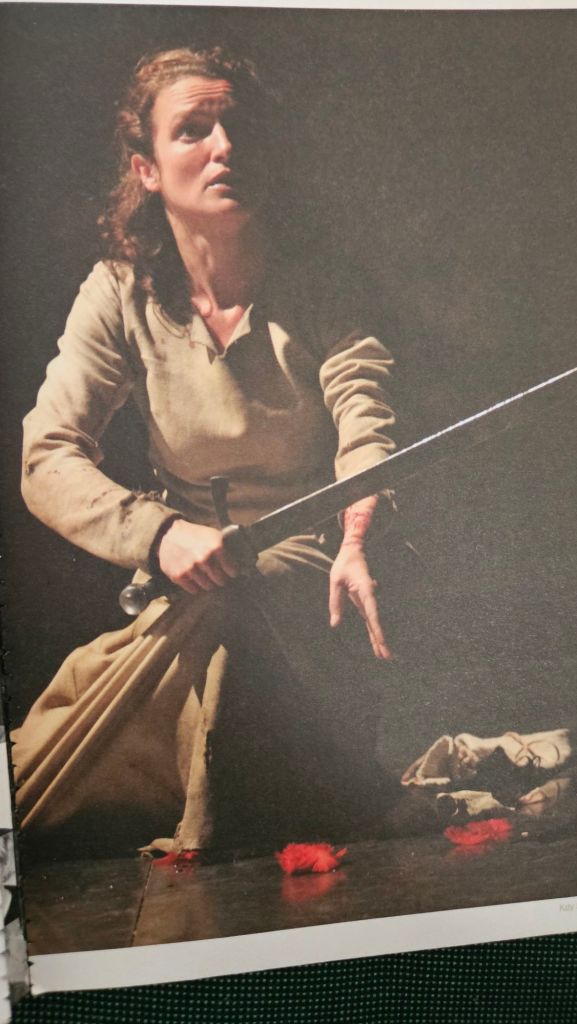
Joan LaPucelle in the 2010 RSC production of “Henry VI, Part 1
At first glance this passage seems shocking- Shakespeare appears to be accusing the patron saint of France of witchcraft. Even more bizarre, later when Joan is arrested by the English lords, she claims to be pregnant with King Charles’ child! And to confound the audience even further, Joan contradicts her own confession by denying any witchcraft or any relationship with any man:
Joan la Pucelle: First, let me tell you whom you have condemn'd:
Not me begotten of a shepherd swain,
But issued from the progeny of kings;
Virtuous and holy; chosen from above,
By inspiration of celestial grace,
To work exceeding miracles on earth.
I never had to do with wicked spirits:
But you, that are polluted with your lusts,
Stain'd with the guiltless blood of innocents,
Corrupt and tainted with a thousand vices,
Because you want the grace that others have,
You judge it straight a thing impossible
To compass wonders but by help of devils.
No, misconceived! Joan of Arc hath been
A virgin from her tender infancy,
Chaste and immaculate in very thought;
Whose maiden blood, thus rigorously effused, Will cry for vengeance at the gates of heaven.
Henry VI, Part I, Act V, Scene iv
I get the sense that Shakespeare is trying to make Joan’s character ambiguous- if you are an English patriot, you can see her as a witch, a liar, and a manipulative harlot. If you are French, you see these accusations as filthy lies, and Joan’s “confession,” as merely a desperate attempt to spare her own life, one that tragically backfires.
The Real Joan of Arc
Born: circa 1412 in Domrémy, France
Died: May 30 1431 (executed by burning)
Birth/ Childhood
Joan was born January 6th, 1412 to Isabelle and Jacques D’Arc, the mayor of the town of Domr’emy France. At the time, Domremy was right on the border between the Armeniacs (who supported Charles the Dauphin) and the Burgundians, who supported King Henry V of England as rightful king of all Frence. Because of this, Joan’s home was subject to English raids and she might have been raised to support Charles as her lawful king. In any case, the accounts we have describe her as very pious, intelligent, generous, and a lover of justice.She had no formal education nor any experience on the Battlefield. Yet, by all accounts, Joan was an extremely devout youth, devoted to God, and her lawful king.
Call to Arms
When she was 13, Joan went to pray in her father’s garden and believed that she saw the Archangel Michael, who prophesied that she would be the one to save France. In 1428, Joan approached Robert Baudricourt, Lord of Vaucouleurs. She demanded to join the French army and to bring Charles to Reims to be officially crowned king. Though she was turned away three times, Joan’s faith and courage attracted followers from the surrounding countryside, and Baudricourt eventually agreed to train Joan to fight, and allowed her and her enterage to talk to Charles the Dauphin about joining the troops defending the city of Orléans.
Once he met Joan at his palace in Chinon, the Dauphin agreed to let her take weapons and supplies to the troops who were already laying siege to the French town of Orléans. However, Joan insisted on leading the troops into battle, and quickly became a symbol of French resistance.
The Siege of Orléans
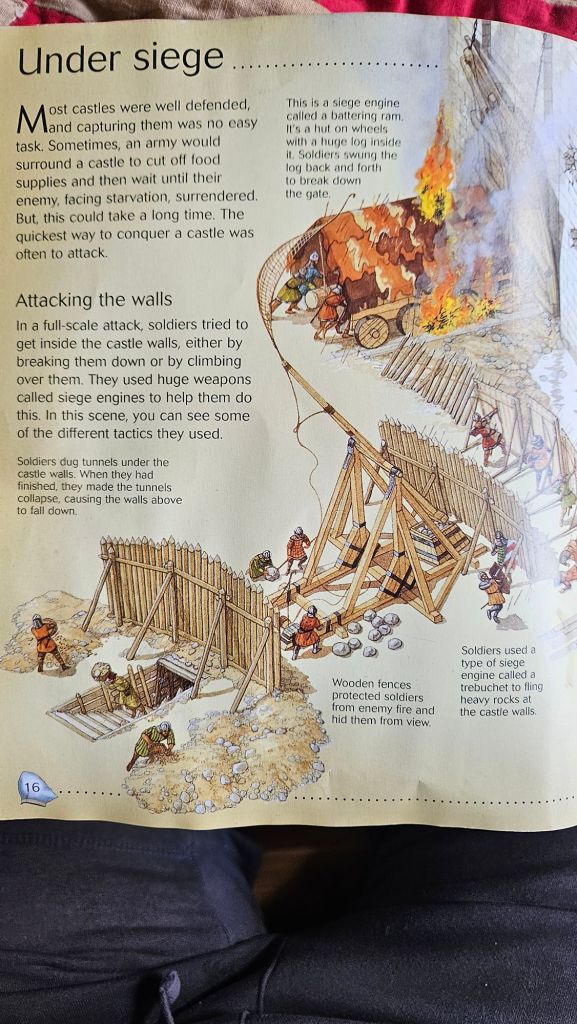
The city of Orléans was a vital town that the English had garrison. For six months, the French had attempted to starve out the English, destroy their defenses, and retake the city.
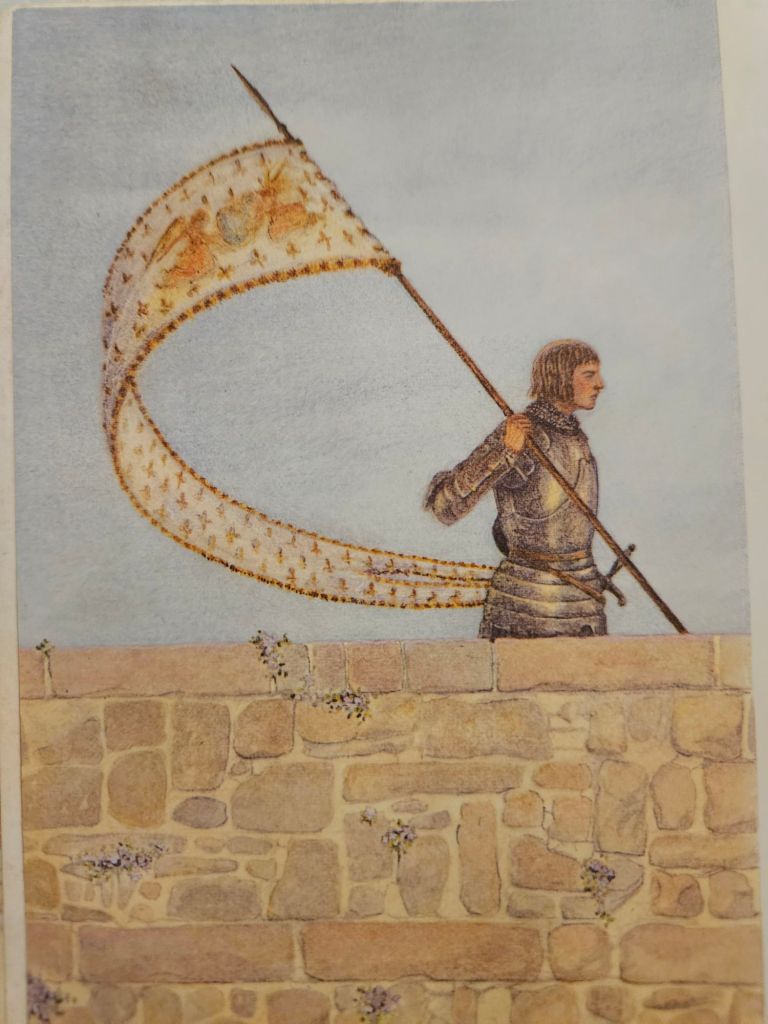
Joan la Pucelle. Advance our waving colours on the walls; Rescued is Orleans from the English Thus Joan la Pucelle hath perform’d her word.- Henry the Sixth, Part I
Diagram of a castle Diagram of siege equipment
Joan’s Fall From Grace
Henry, by the grace of God, king of France and England, greeting. It is well known how for some time a woman calling herself Jeanne the Maid, putting off the habit and dress of the female sex (which is contrary to divine law, abominable to God, condemned and prohibited by every law), has dressed and armed herself in the state and habit of man, has wrought and occasioned cruel murders, and it is said, to seduce and deceive the simple people, has given them to understand that she was sent from God and that she had knowledge of His divine secrets, with many other dangerous dogmatizations most prejudicial and scandalous to our holy faith. Whilst pursuing these abuses and exercising hostilities against us and our people, she was captured in arms before Compiègne by certain of our loyal subjects and has subsequently been led prisoner towards us. And because she has been reputed, charged and defamed by many people on the subject of superstitions, false dogmas and other crimes of divine treason, we have been most urgently required by our well beloved and loyal counselor the bishop of Beauvais, the ecclesiastical and ordinary judge of the said Jeanne, who was taken and apprehended in the boundaries and limits of his diocese
Letter from King Henry VI to the Bishop of Beauvais (Joan’s captor), January 3rd, 1431
Joan was captured in 1430, when King Henry of England was only 10 years old. Even though now France is united with pride for Joan and her defense of her country, back then there were plenty of factions that actually supported the English, and those French factions captured, and arrested her for heresy during the siege of Compiègne.
The Trial- January 9th, 1431
It has pleased divine Providence that a woman of the name of Jeanne, commonly called The Maid, should be taken and apprehended by famous warriors within the boundaries and limits of our diocese and jurisdiction. The reputation of this woman had already gone forth into many parts: how, wholly forgetful of womanly honesty, and having thrown off the bonds of shame, careless of all the modesty of womankind, she wore with an astonishing and monstrous brazenness, immodest garments belonging to the male sex.
As this excerpt from the trial transcripts demonstrates, Joan’s trial focused much more on her alleged heresy and witchcraft, rather than her defying British rule. In reality, Joan’s arrest and martyrdom was a political sacrifice for the French- they wanted to show political support for their English overlords, without alienating Joan’s supporters. Discrediting Joan by calling her a heretic was a calculated political move, and Joan probably knew it.
Execution
Joan is burned at the stake
Joan was executed by burning on May 30th, 1431, six months before King Henry was formally crowned King of England. After her death, Henry was unable to maintain control of France and his incomplete, combined with a congenital mental illness, is why he later lost
Iconic portrayals:
Trailer for Carl Dryer’s Passion of Joan of Arc (1928)
Mila Jovavich in Luc Besson’s “The Messanger”, 1999
Sources:
Books
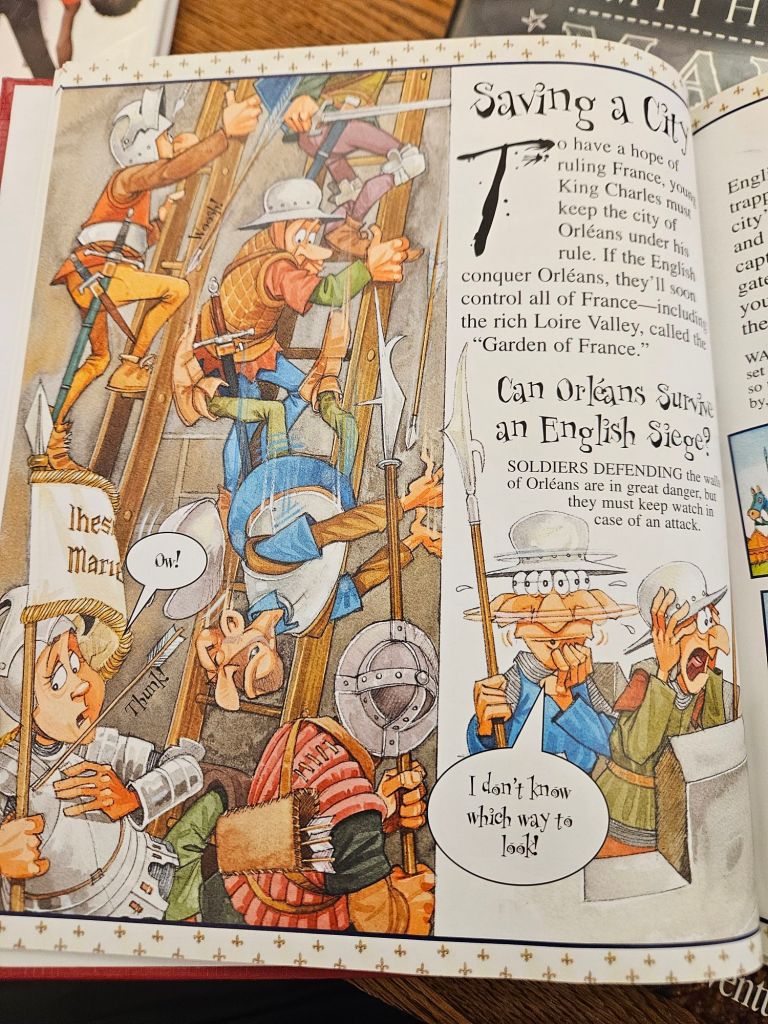
You Wouldn’t Want To Be Joan of Arc
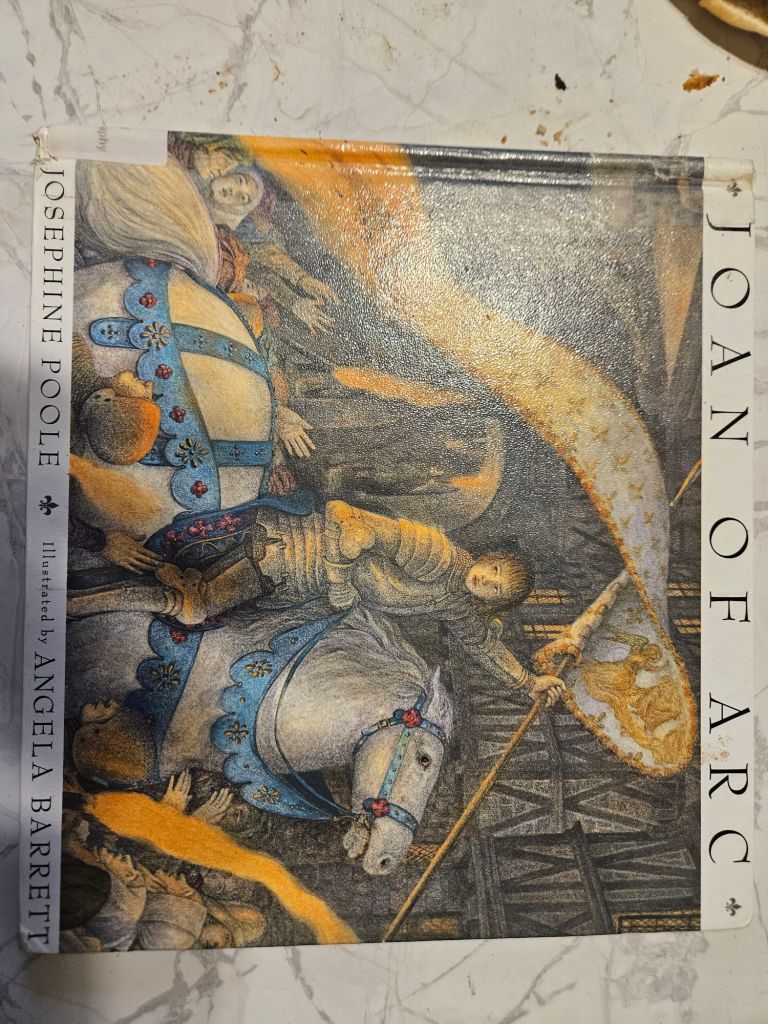
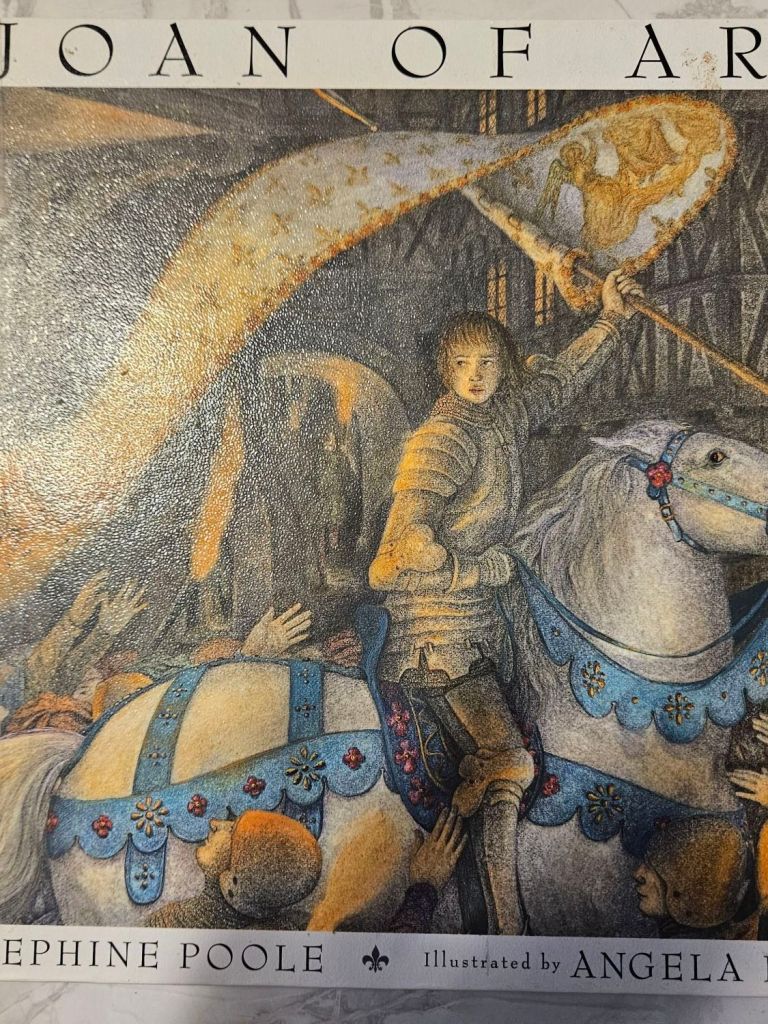
Joan of Arc by Josephine Poole
Title Page of Joan of Arc by Josephine Poole, illustrated by Angela Barrett
I’m pleased to announce that I’ve created a fully online, interactive Shakespeare class for kids ages 6-11 to start them on a lifelong journey of Shakespeare! The course will include games, videos, webquest activities, and puppet shows!
Title: Shakespeare for Kids!
Purpose:
Video trailer
The goal of this class is to introduce Shakespeare to young children in a fun and interactive way. For example, each lesson starts with a fun and funny introduction to a Shakespearean topic by our friend Puppet Shakespeare. Each class will also feature interactive games and quizzes that break down the poetry, language, characters, and plots of Shakespeare to help kids lose their “Shakes-fear” and begin engaging with classic literature
Each class builds from learning about Shakespeare to learning about the language and poetry of his plays, to finally an in-depth analysis of one play: “A Midsummer Night’s Dream.” After watching videos, playing games, and filling out handouts about these topics, the student will go on a “webquest,” that is, a series of webpages that feature activities, outside websites, and a short- puppet show retelling of “Midsummer” for the student. The goal is that by the end of the course, the student will be able to understand the dialogue of the play, summarize the story, know the characters, and enjoy the poetry.
Format: Nearpod with video and web links.
Ages 6-10
Description: 2 week course, $10 per week.
Part I: Who Is Shakespeare?
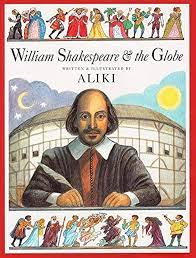
Learn about Shakespeare’s life and career with an interactive timeline, handouts, and an engaging puppet show! This section will include me reading from the excellent children’s book: William Shakespeare and the Globe by Aliki.
Part II: Words, Words, Words
WIlliam Shakespeare (Or Bill as I like to call him), wrote in a very special way. Back then playwrights were called poets, so not only did he have to make plays, he had to write them so they would sound like lines of poetry.
Part III: Shakespeak
Figure out how to translate all the “thees” and “thous” that make reading Shakespeare a challenge nowadays
Part IV The Play’s the Thing!
What kinds of plays did Shakespeare write? This handy lesson will teach you about the basic types of plays Shakespeare wrote, and give you a quick summary of each!
Part V: Disney vs. Shakespeare
Poster for Disney’s Elemental, which bears many similarities to Shakespeare’s Romeo and JulietContinue reading →
It’s around 1597 and Shakespeare is putting the finishing touches on his new play, Romeo and Juliet, when his wife Anne Hathaway arrives. Anne frankly, hates the double-suicide ending and takes Will’s quill. She then proceeds to write a new story where, after Romeo dies, Juliet packs up and flees with her Nurse and her two best friends to have a holiday in Paris (the city, not her ex-fiance).
To find a jukebox musical that is so self-aware in its writing, so humorous in the way it includes its songs through the narrative, and so blatantly charming, is a pure joy…and really, if you asked me to summarise this review into just a sentence it would be that: & Juliet is pure joy. –Carly Fisher
Stuff you Might have Missed
1609 collection of Shakespeare’s Sonnets, which were published without his permission.
Anne Hathaway Shakespeare- the sonnet Anne complains that Shakespeare never mentions her in his work, except once in sonnet 145, where he writes: “I hate, from hate away she threw, and saved my life saying, ‘not you’.”
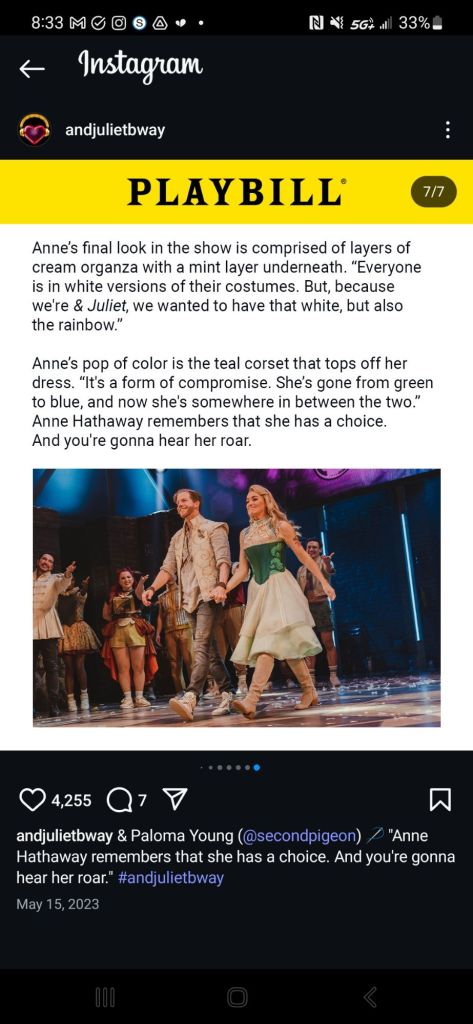
Anne and the Second Best Bed– After breaking the fourth wall, Anne also complains that her husband left nothing to her in his will but “My second best bed with the furniture.” This is true, and some scholars have attempted to defend this choice, but it certainly doesn’t look good. In the myth of Shakespeare, this story has helped to construct the Shakespeare who cares more about his work than his wife. What’s interesting is that “&Juliet” helps address this myth and examines it. For more information about the myth of Anne and Will, click here to see my review of “Hamnet”
Yes, Juliet might be based on a historical character. One reason Will objects to his wife changing the play is that it violates the historical accuracy of the story. Like I said in my “Genesis of Romeo and Juliet,” the Capulets and Montegues might have been based on real political factions in Verona.
The Characters
The Music
All the songs in “& Juliet” came from one man- Max Martin, a Sweedish songwriter who has composed songs for Brittney Spears, Celene Dion, and The Backstreet Boys. These mega pop-hits were a huge part of my childhood, so seeing them combined with my favorite writer definitely tickled me and set off my nostalgia goggles. More importantly, it’s very interesting to see how the playwright David West Read turned these songs into a musical.
Setting “Romeo and Juliet” to pop music is by no means a new idea- “Gnomio and Juliet” underscored the whole movie with music by Elton John (who also produced the film). Making Shakespeare into a kind of rock or pop star is also not a new idea- Something Rotten and the musical version of “Shakespeare In Love” also did that. What is new is the concept of turning the story of Romeo and Juliet into a jukebox musical- a story where all the songs are pre-existing pop songs.
Normally I hate jukebox musicals- I find it irritating when producers take an artists’ songs and try to stitch them together into a coherent musical play. In normal musicals, the songs are designed to further the plot and help explain the characters’ internal and external conflicts. In my experience with most jukebox musicals, the songs feel like a waste of time, because the songs were never designed to tell an overarching story, so when they are integrated into a play, the story grinds to a halt. When it’s done badly, either you’re bored with the songs, or bored with the play.
With this in mind, I was prepared to dislike “&Juliet”. I was expecting either to hate the songs for slowing down the plot, or to hate the plot because I wanted to get back to the songs. But… miraculously, both the songs and the story WORKS! David West Read did a great job seeing the overarching themes of loss, love, and conflict within relationships within the music of Max Martin, and translate them into Romeo and Juliet- the iconic lovesick teenagers.
I’d like to highlight the incredible effect of one of these songs in the context of the play- “Hit Me Baby One More Time,” by Miller, made popular by Brittney Spears:
Oh, baby, baby The reason I breathe is you Boy, you got me blinded Oh, pretty baby There’s nothing that I wouldn’t do It’s not the way I planned it
It’s very clever that the writer gave this song to Juliet when she us at her most down and most self-destructive. She feels like her life is over without Romeo (her loneliness is killing her). What’s nice about this musical is that this moment is the beginning of Juliet’s arch, not the end.
Costumes
I could write a whole post about how clever the costumes are, and I will at a later date. Suffice it to say that they compliment the story and music by blending Elizabethan costumes with the sort of late 90s-early 2000s pop-star fashion favored by The Backstreet Boys, Katy Perry, and of course, Brittney Spears.
My Final Word
This show might not please everyone- hardcore Shakespeare nerds might find the concept hard to swallow, and honestly since the songs are mostly from the 90s and early 2000s, the music might be a little dated for a modern audience. Also, with the positive portrayal of homosexual relationships this show is DEFINATELY NOT FOR CONSERVATIVES. That said, it might do exactly what I’d hoped it would do- make fun of Shakespeare with care and in the process, get audiences to enjoy it anew.
In a world and in an age where everything is taken so seriously, it’s a complete delight to return to the idea of going to the theatre simply for fun and entertainment. Yes, the storyline is light and the line up of songs is a laundry list of bops, but in my opinion, there’s no problem in any of that! Quite the opposite! Packed to the brim with exceptional talent and some of Australia’s top dancers filling the ensemble…this is entertainment for entertainment’s sake and that is a lost art form in and of itself. – Carly Fisher
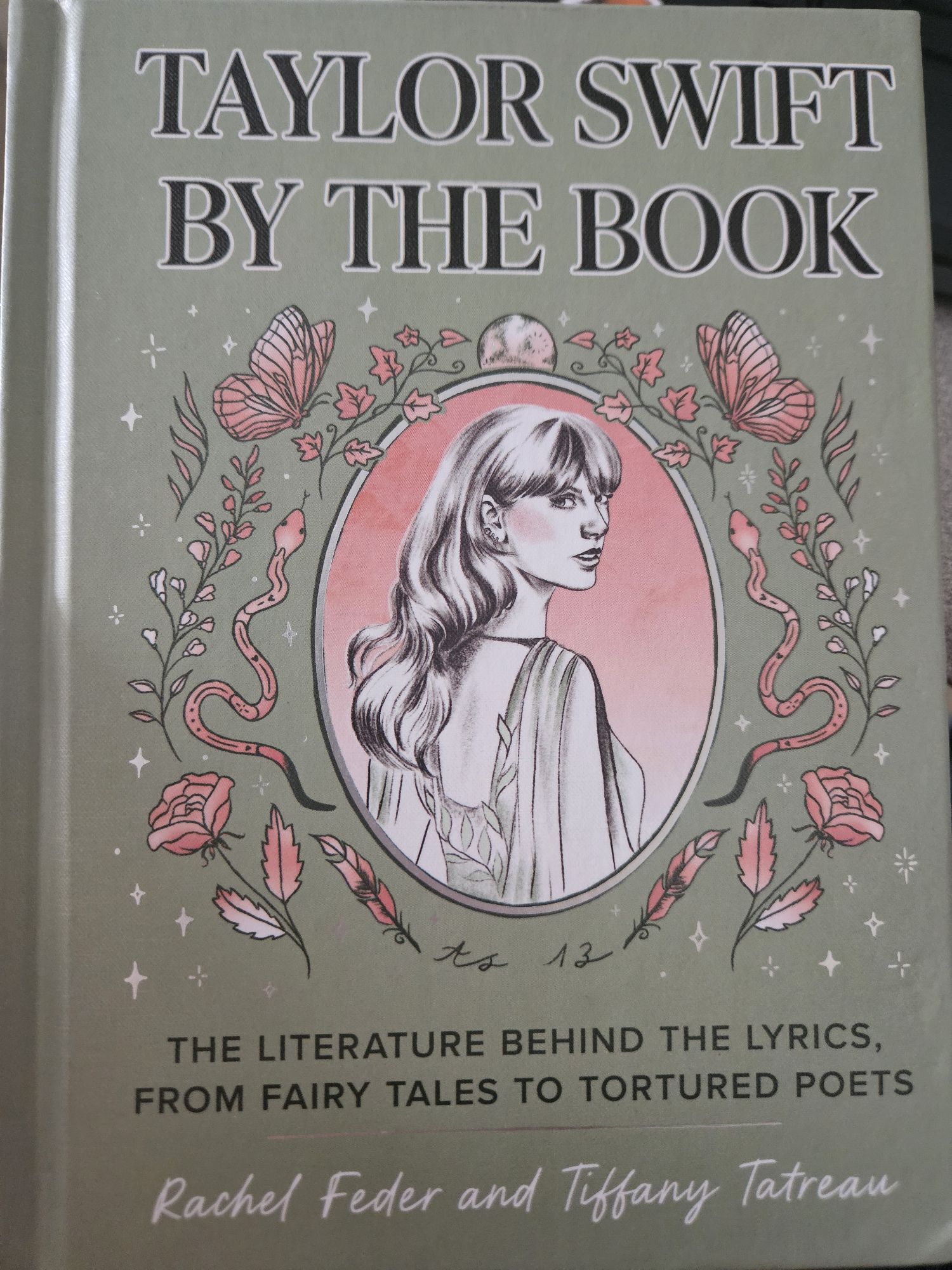
One of my colleagues at work showed me this book, and it really fired my imagination. Taylor Swift is one of the most if not THE MOST successful singer/songwriter of our era. Her songs go across multiple genres and tones and, like many writers, they often contain allusions to classical poetry, nursery rhymes, and occassionally even Shakespeare.
My own Reservations with Taylor
I’m not exactly a Swifite, and I know I’m running the risk of offending MILLIONS of people here by offering criticisms of Taylor Swift, but I honestly think it’s a good idea to be able to critique the things you love. In the past I’ve criticized Shakespeare’s plays, his characters, and even suggested that he might be racist. I would like to offer that, in the case of Love Story, Ms. Swift simplifies the plot of Romeo and Juliet, and leaves out its tragic elements, which kind of misses the point. As an allusion, it seems a little watered down. That said, I feel other TS songs are better, use their allusions more skillfully, and create a more coherent picture in the listeners’ mind. Dispite my issues with this one song, I heartily admit that Ms. Swift is prolific, talented, and has created songs that are classic works of art!
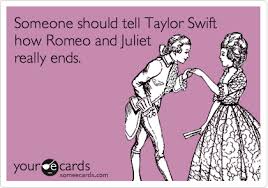
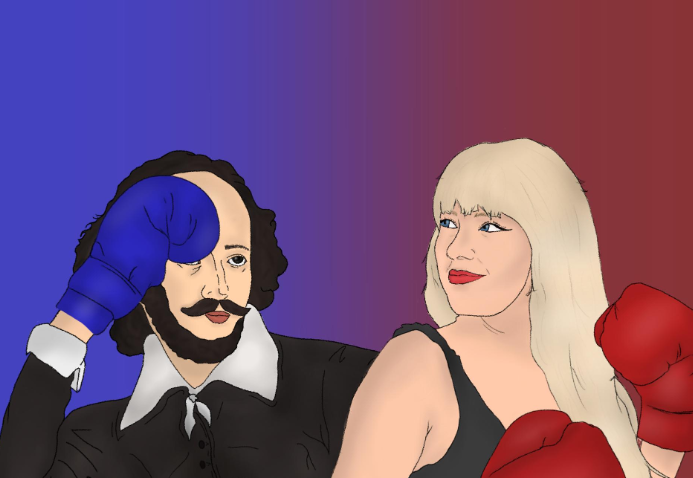
What I’m not interested in doing is getting into a “battle” where I try to justify Shakespeare as being better than Taylor Swift. When I see memes like the one above, it makes me immediately disengage with whoever posted it. I don’t want a Swiftie to talk in the comments about how Shakespeare was a talentless hack. Alternatively, I don’t want a Shakespeare nerd to dismiss Taylor as being infantile or any other critique. Both these writers had different goals, went about them differently, and achieved success in their own special ways. So now, let’s look at how Taylor Swift borrowed from different literary traditions to make her songs more dramatic, more visceral, more insightful, and more poetic.
Her Literary Allusions
Obviously, Love Story mentions Romeo and Juliet, as well as The Scarlet Letter and various princess stories. TS rarely makes direct references to Shakespeare in her work, but some scholars have suggested that there might be more oblique references in some of her songs. For instance, when I look at the lyrics of Willow, I can’t help wonder if she wasn’t at least partially inspired by Shakespeare’s song of the same name in Othello:
Wait for the signal and I’ll meet you after dark Show me the places where the others gave you scars Now this is an open-shut case Guess I should’ve known from the look on your face Every bait and switch was a work of art
The more that you say The less I know Wherever you stray I follow I’m begging for you to take my hand Wreck my plans That’s my man
I can’t hear this song and not hear the parallels with the Othello story- the speaker alludes to eloping with her beloved (which Desdemona nearly does in the first act), that he has scars (which Othello clearly does mentally and physically). In addition, I imagine the refrain as like a duet between Othello (who is reluctant to kill Desdemona), and Desdemona (who wants to leave Cyprus and have a normal married life with Othello:
Desdemona: The more that you say
The less I know
Othello: Wherever you stray
I follow
I'm begging for you to take my hand
Wreck my plans
Desdemona: That's my man

Even if Shakespeare isn't mentioned directly in many of Taylor's songs, like Shakespeare she often uses Greek myths, the Bible, and other popular works as allusions. Some scholars have suggested that both Shakespeare and TS write using their own experiences through the lenses of classical poetry and literature. Simmilar to how Shakespeare probably wrote Hamlet to deal with his grief over his son's death, Taylor writes songs about past relationships, feuds with pop stars, and her own evolution as an artist through the lens of Shakespeare, novels, poetry, and other works.
TS’s Poetry
Ms. Swift’s songs are more than just catchy beats with a few allusions stuffed in. Like Shakespeare, she makes use of alliterations, internal rhymes, clever metaphors, and strong rhythms that help her songs tell their stories clearly and effectively. As an exercise, I fed the lyrics to “Bad Blood” into a poetry analyzer and found a very interesting analysis:
The poem features a rhythmic and catchy structure, typical of song lyrics. The syllabic patterns vary but often maintain a consistent beat, enhancing its musical quality. The use of internal rhymes and alliteration (e.g., “mad love,” “bad blood”) adds to the flow and memorability. The stresses often fall on the first word of each line, creating a strong start and a compelling rhythm that engages the listener. The word choice in the poem is evocative and charged with emotion. Phrases like “bad blood,” “deep cut,” and “salt in the wound” create vivid imagery and convey the depth of the narrator’s pain. The use of questions, such as “Did you have to do this?” and “Did you think we’d be fine?” emphasizes feelings of confusion and hurt. –Studycorgi.com
I highly encourage students and teachers to do an analysis of both Shakespeare and Taylor Swift because studying one can help us appreciate the other. Similarly, learning the way each writer conveys ideas can help the reader become more creative!
Who Said It? Shakespeare or T.Swift?
Lots of teachers play this game and there are many Youtube videos of people playing it. Occassionally, even Shakespearean actors have played it:
There are also online quiz forms available on Quizlet and Gimkit. You can also show your students this video below:
What iF SHakespeare’s Characters were Swifties?
I posted on Reddit a while back to ask the internet which Swift songs would be great soundtracks for the lives of Shakespearean characters. This is sort of an outgrowth of my: Infinite (Variety) Playlist activity. Here are some of the results I got:
Mercutio from “Romeo and Juliet”- 22 and “Shake it Off”
Goneril from “King Lear”- Blank Space
Do you agree with my list?
I hope this post can help teachers see the value in analyzing Taylor Swift with their students, and help students in analyzing Shakespeare. I think the term “classic” applies to anything good enough to stand the test of time. Shakespeare has already passed that test, and based on her clever allusions, evocative wordplay, and emotionally-charged subjects, I believe Taylor Swift to be classic too!
LADY CAPULET  Good night.
Get thee to bed and rest, for thou hast need.
Lady Capulet and the Nurse exit.
JULIET
Farewell.—God knows when we shall meet again.
I have a faint cold fear thrills through my veins
That almost freezes up the heat of life.
I’ll call them back again to comfort me.—
Nurse!—What should she do here?
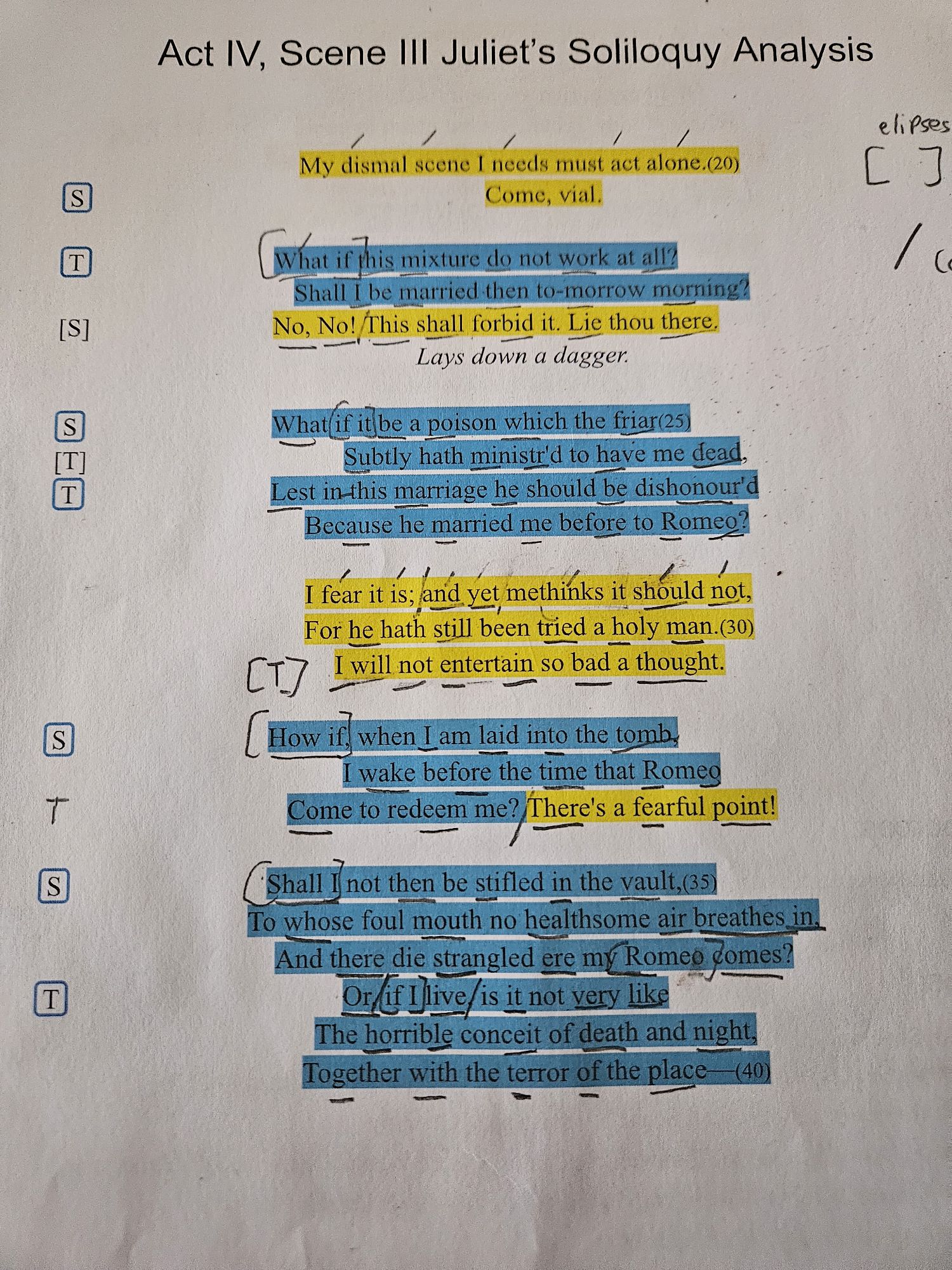
My dismal scene I needs must act alone.
Come, vial. She takes out the vial.
What if this mixture do not work at all?
Shall I be married then tomorrow morning?
She takes out her knife
and puts it down beside her.
No, no, this shall forbid it. Lie thou there.
What if it be a poison which the Friar
Subtly hath ministered to have me dead,
Lest in this marriage he should be dishonored
Because he married me before to Romeo?
I fear it is. And yet methinks it should not,
For he hath still been tried a holy man.
How if, when I am laid into the tomb,
I wake before the time that Romeo
Come to redeem me? There’s a fearful point.
Shall I not then be stifled in the vault,
To whose foul mouth no healthsome air breathes in,
And there die strangled ere my Romeo comes?
Or, if I live, is it not very like
The horrible conceit of death and night,
Together with the terror of the place—
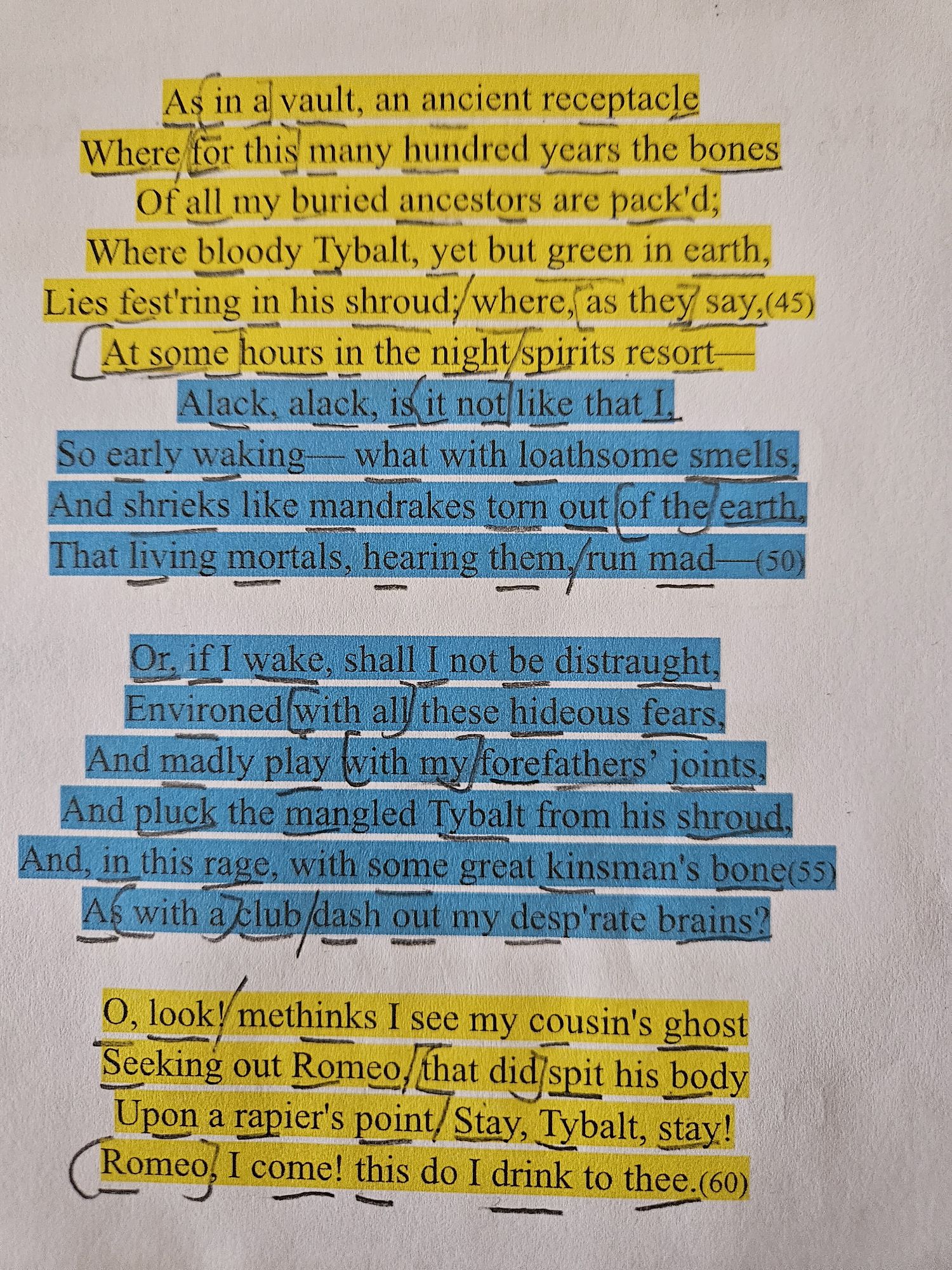
As in a vault, an ancient receptacle
Where for this many hundred years the bones
Of all my buried ancestors are packed;
Where bloody Tybalt, yet but green in earth,
Lies fest’ring in his shroud; where, as they say,
At some hours in the night spirits resort—
Alack, alack, is it not like that I,
So early waking, what with loathsome smells,
And shrieks like mandrakes torn out of the earth,
That living mortals, hearing them, run mad—
O, if I wake, shall I not be distraught,
Environèd with all these hideous fears,
And madly play with my forefathers’ joints,
And pluck the mangled Tybalt from his shroud,
And, in this rage, with some great kinsman’s bone,
As with a club, dash out my desp’rate brains?
O look, methinks I see my cousin’s ghost
Seeking out Romeo that did spit his body
Upon a rapier’s point! Stay, Tybalt, stay!
Romeo, Romeo, Romeo! Here’s drink. I drink to
thee.
She drinks and falls upon her bed
within the curtains.
The Given Circumstances
This famous soliloquy comes from Act IV, Scene iii. In this speech, Juliet grapples with her fears and anxieties about taking the Friar’s sleeping potion.
Traditional Interpretations
Ellen Terry (Vinal Record Recording, C. 1911)
Ms. Terry, like her famous grandson John Gielgud, is more interested in delivering the text clearly, beautifully, and strongly than getting Juliet’s character across. Consequently, by our standards, her reading of the speech is slow, declamatory, and maybe a bit over-the-top. However, this kind of delivery really brings out the rhythm of the verse, the beauty of the individual words, and the structure of the speech itself, so I recommend actors listen to it as a jumping off point. In my opinion, having a good technical grasp of the speech will keep an actor from going too far with the emotion, (making it hard for the audience to hear and understand them). This is why there’s still value in these dusty old recordings.
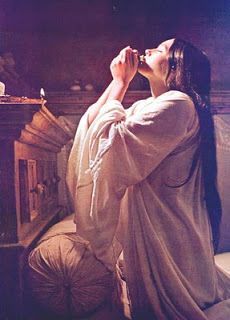
Olivia Hussey (Romeo and Juliet directed by Franco Zephirelli, 1966)
Zephirelli was very sparing with the dialogue- choosing to condense this entire speech to one line “Love, give me strength.” Hussey has a great deal of passion in the speech, as if she is absolutely certain that taking the potion will re-unite her with Romeo.
Claire Danes (Romeo +Juliet, 1996)
Claire Danes contemplating the vial in Romeo + Juliet
Danes has a sense of almost macabe trance-like energy when she delivers the speech. Like all the edged weapons in the movie, the dagger is replaced by a gun. Most of the speech is cut because Luhrman wanted to emphasize the character’s obsession with violence, rather than fears about ghosts and arranged marriages. Consequently, Danes does little other than put the gun under her pillow, take out the vial, and drink it.
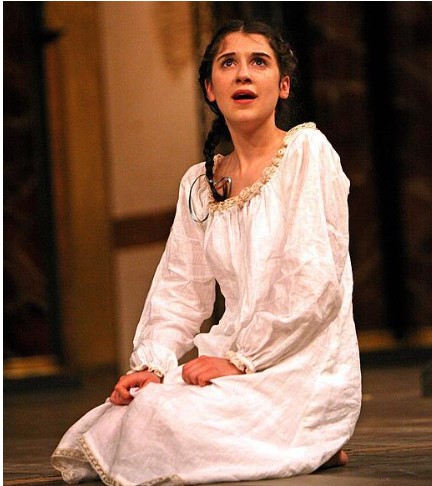
Ellie Kendrick (Globe Theater, 2009)
Ms. Kendrick is one of my favorite Juliets ever! She is a wonderful blend of sweetness and naivety, tempered with anxiety and practical thinking. She delivers the whole speech to different parts of the audience and makes sure every idea and every horrible thought of Juliet lands. Furthermore, her fast pacing around the stage helps her not only connect with the audience, but to use the Globe theater to make them imagine the Capulet vault.
Verse
As I always say, verse is the heartbeat of a character, and based on this, Juliet’s heart is beating a mile a minute. You’ll notice that five of these lines start with a trochee (T), and five of them have trochees. This means Juliet is unsettled, she’s literally off-beat. In addition, there are frequently pauses in the middle of the lines called cesuras, which might indicate that either Juliet is trying to answer her own questions, or that she is so worried, that she’s gasping for breath.
In this second part of the speech, the lines start running together. Juliet’s pace is quickening and she breathes every 2-3 lines instead of at the end of each line.
Structure
The speech is organized as a series of questions:
“What if…”
“What if…”
“How if…”
“Or if I live…”
“O, if I wake, shall I not…”
and then the terrifying statement: “O look…”
So, with this in mind, the actress needs to convey Juliet’s overactive imagination, her fears, and her ability to answer these fears with inner calm and inner strength.
Imagery
It’s a horrific idea being shut up alive with the dead. Shakespeare gives us the sights and smells and the grim reality of feeling “stifled” in a vault. I created this image to demonstrate the smells, the fear, and the claustrophobic nature of the vault.
I chose to have the vault lit with candles, and to use green smoke to represent decay and possibly noxious gas, like the nitre that sometimes dips from walls of tombs. I also added some stone faces of ancestors to stare down at Juliet.
Historical Research
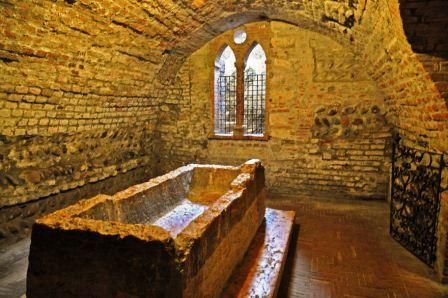
Sarcophagus in church of San Francesco al Corso, an old Franciscan monastery in Verona.
The plain stone sarcophagus above has become a tourist attraction as the traditional ‘resting place’ of Juliet. As I mentioned in my Friar Lawrence post, the Friar who marries Juliet is a Franciscan, which is probably why they chose this church in Verona as the ‘site’ for Juliet’s grave.
It is a plain, open, and partly decayed sarcophagus, in a wild and desolate conventual garden once a cemetery now ruined to the very graves. The situation struck me as very appropriate to the legend, being blighted as their love.
– Lord Byron, Letters and Journals Vol. III
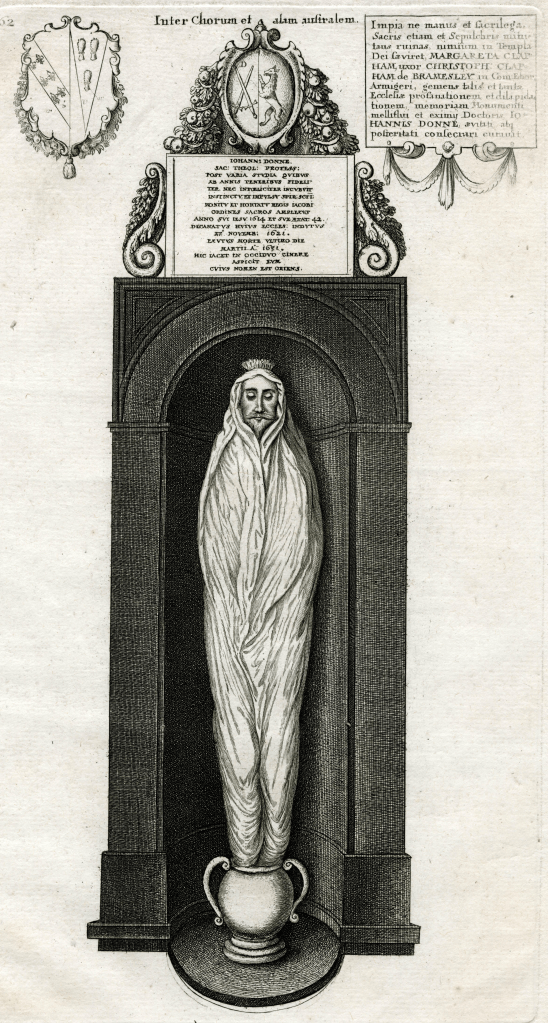
Since Italy is a small, hot country, bodies in the 16th century were buried almost immediately. First, the body would be wrapped up in a shroud or winding sheet, as Juliet mentions at the end. The corpses might be decorated with Rosemary or other sweet-smelling herbs.
A winding sheet for a corpse
Wealthy families like the Capulets or the church, would store all the bodies of their ancestors in burial vaults or crypts. Some bodies would be anointed with oil or preserved with vinegar.
Literary Inspiration: The Cask of Amontillado
Montressor and Fortunato move through the burial crypt in “The Cask of Amontillado”
When I think of the dark, macabre atmosphere of a family tomb, I think of The Cask of Amontillado, a short story by Edgar Allen Poe where the anti-hero Montressor, tricks his enemy Fortunato into going into his family crypt and buries him alive! There are some interesting parallels between Montressor and Tybalt from Romeo and Juliet- both men belong to ancient families, both men are violent, and both refuse to let any kind of insult stand. I think Juliet sees the vault as a hostile place, where her ancestors are angry at her for “betraying the Capulet name,” after marrying a Montague.
Image Research 4: Tybalt’s Angry Ghost
AI image of Tybalt’s Ghost
Like Montressor in The Cask of Amontillado, Tybalt embodies the Capulet feud, and it makes sense that Juliet would see him when she thinks of being shut up in the vault. The real question is, what does seeing him do to her? Is she terrified? Is she remorseful? Is she moved to protect Romeo? How does seeing Tybalt’s ghost motivate her to take the potion?
Other Questions to consider
Why is Juliet so nervous?
How does Juliet feel about running away from home?
Do the ghosts represent something? Guilt? Judgement? Some kind of ticking clock?
What does she see Tybalt’s ghost doing?
How does Juliet pull it together at the end?
Emotional
Not only is Juiet worried about her health, (mental and physical), I get a sense that she might also be experiencing guilt. The notion of her being tormented by spirits that shriek like mandrakes, suggests that maybe the ancient Capulets aren’t very pleased with Juliet. This makes sense because she married a Montegue. I get the sense that maybe, for the first time, Juliet actually feels guilty, as if she’s failed her ancestors. However, for whatever reason, she definitely re-focuses and thinks about Romeo. Either she rejects her ancestors and Tybalt, or maybe she sees the potion as a way of protecting Romeo, or possibly Juliet just wants these fears and anxieties to end, and takes the potion as a release. My actor and I will no doubt try these ideas out and figure out what works within the structure and within her interpretation of the character.
Our Interpretation
Again, it’s a little too early for me to tell you our interpretation yet, but I’ll post it later.
Resources:
Myshakespeare.com. This website will allow you to look up unfamilliar words, download pictures and videos of the scene, and even watch an ‘interview’ with Juliet, where, just as in this speech, she becomes more and more anxious and fearful until the very end.
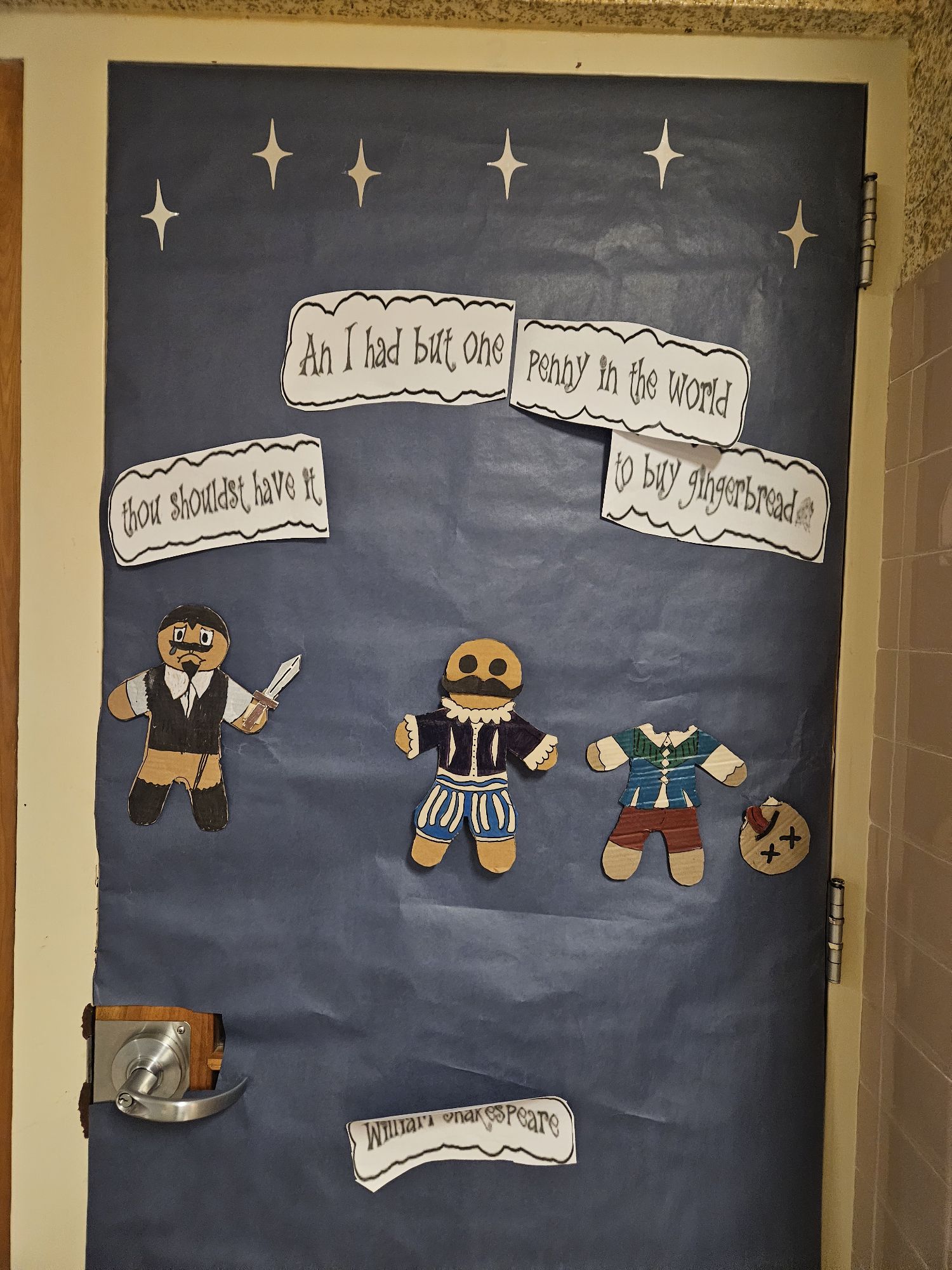
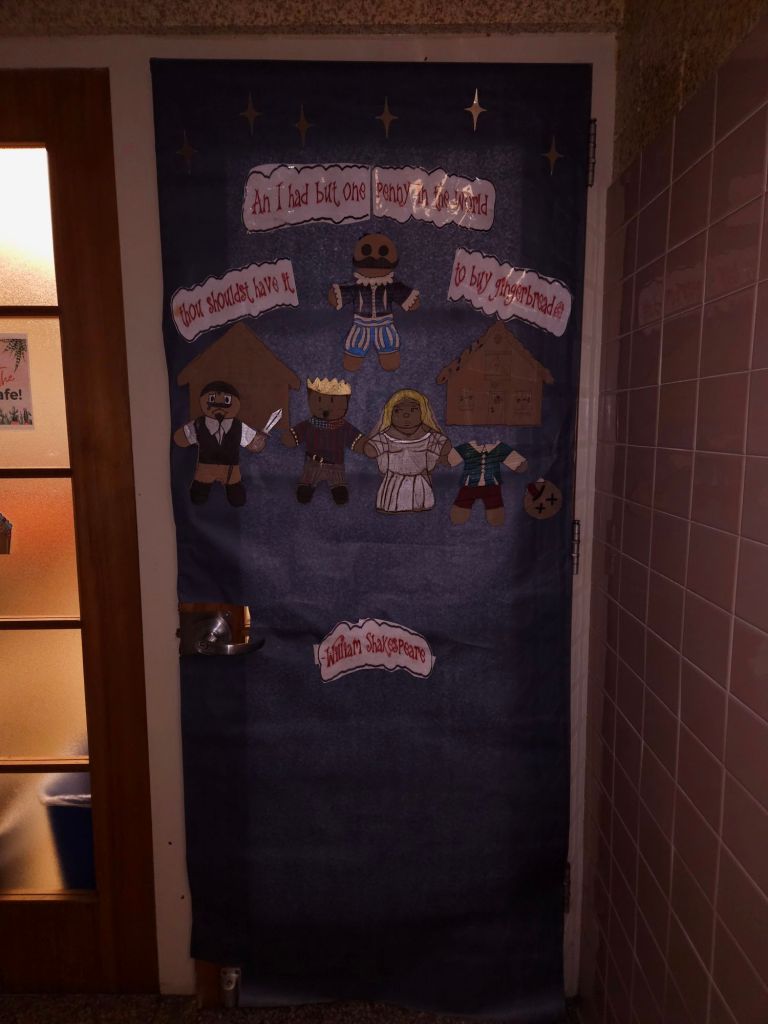
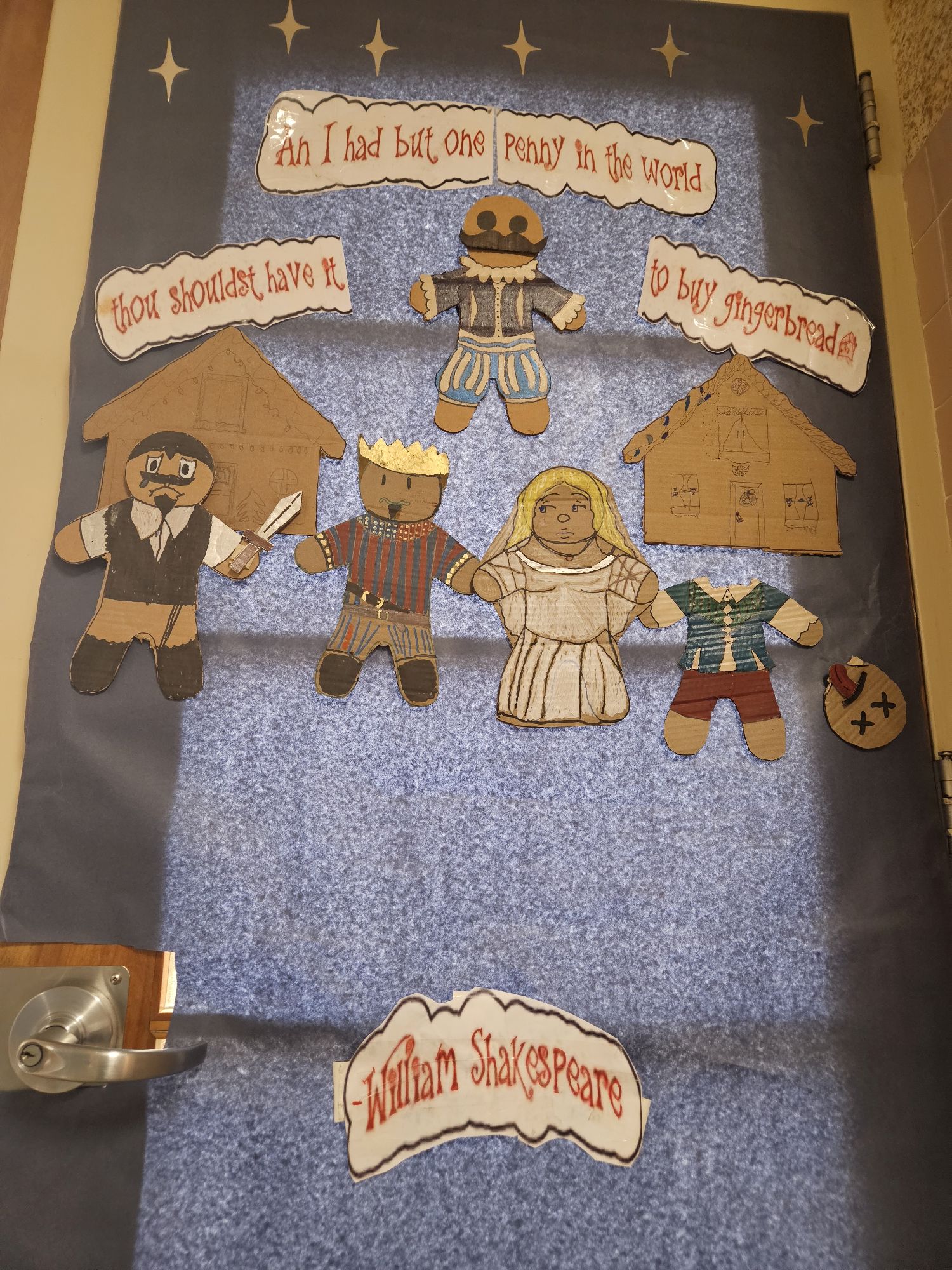
Every holiday season, my school likes to decorate the classroom doors in a festive way. I wanted to celebrate my Shakespeare Club and also teach the club members about Shakespearean fashion, Shakespearean characters, and maybe a little bit about engineering too. I’m very proud of the results, and I wanted to share this idea with you to maybe inspire you next holiday season!
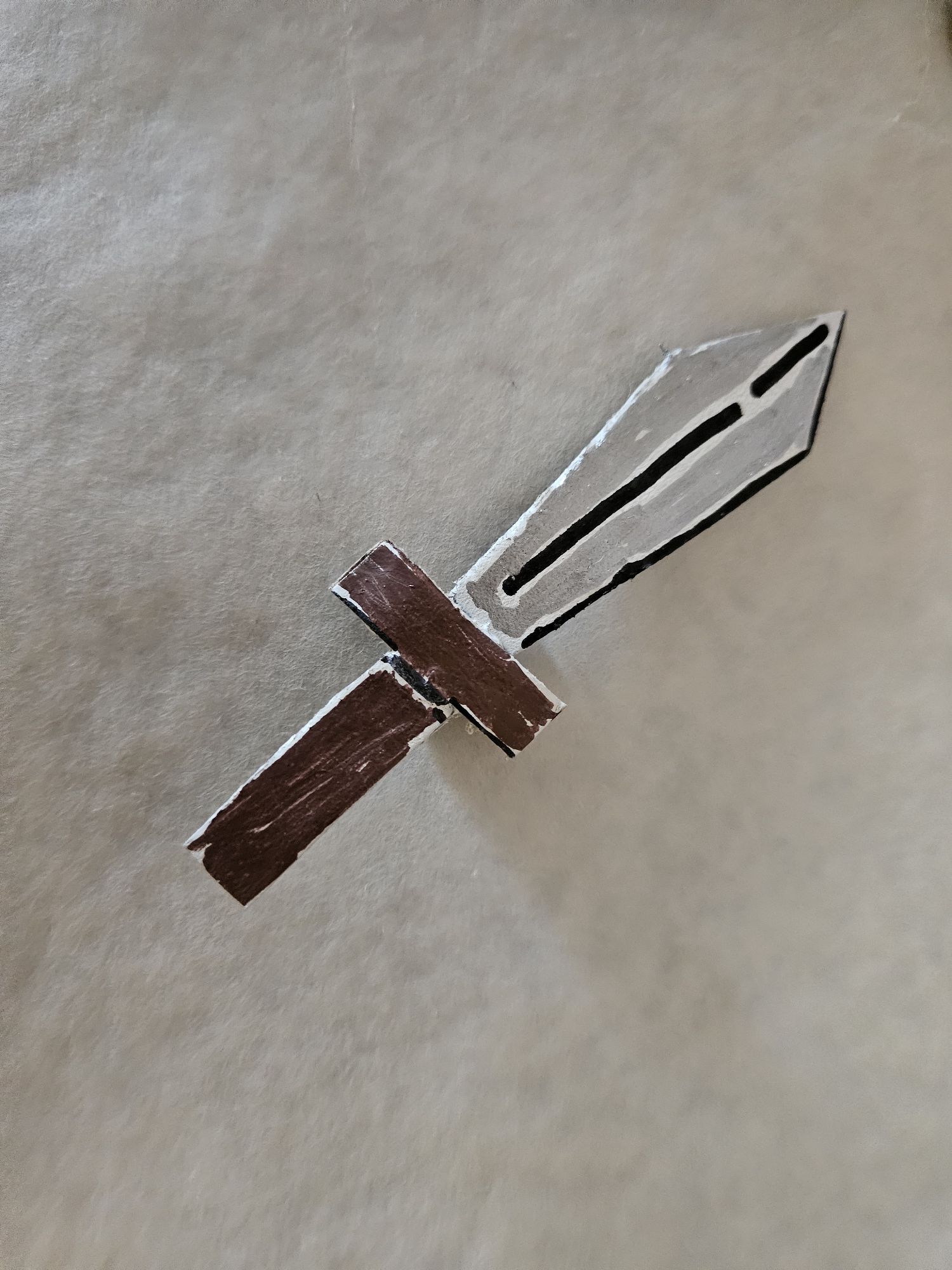
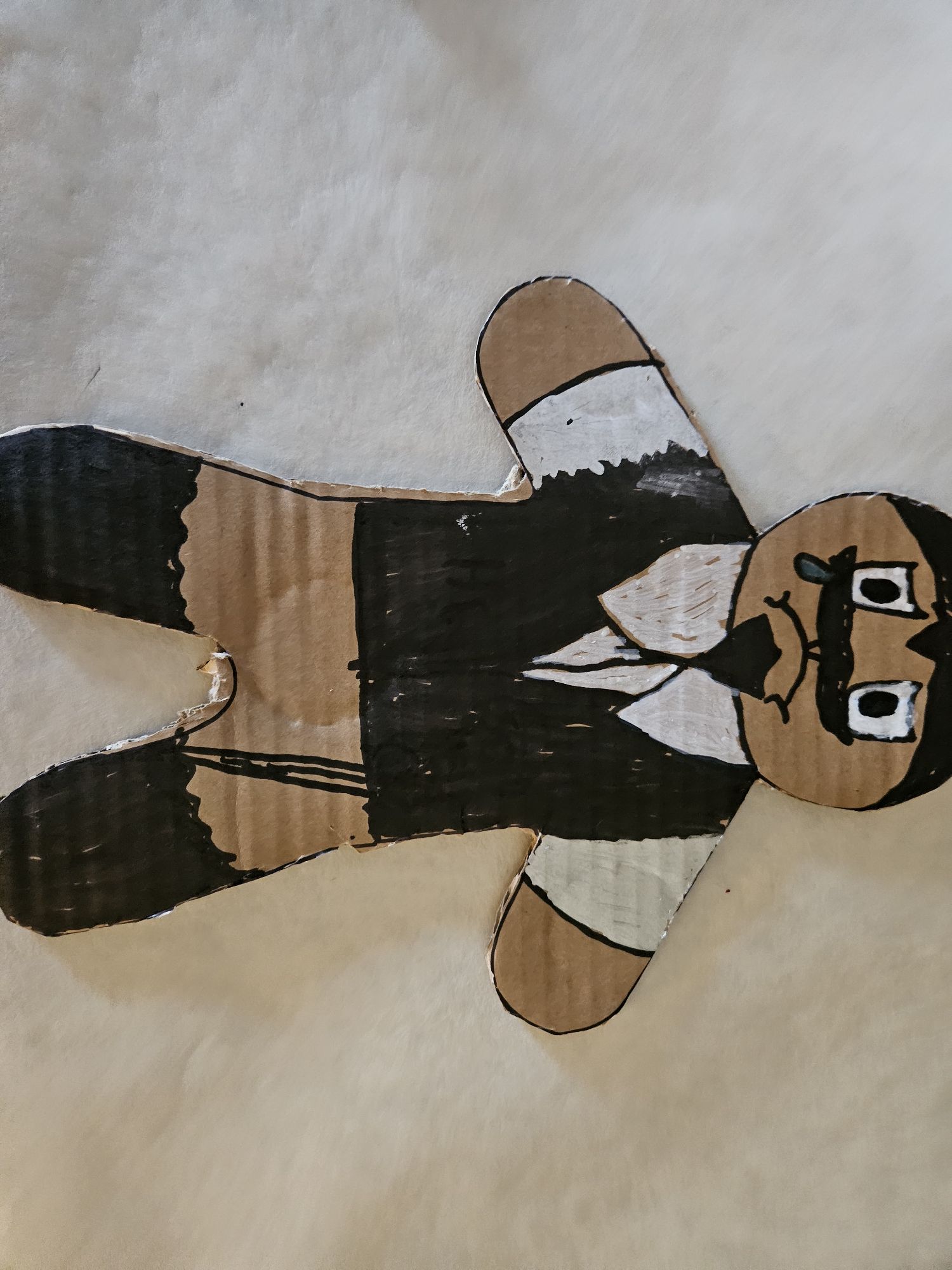
Gingerbread Hamlet Close up of Hamlet’s sword Gingerbread Shakespeare Off with his head!Gallery of my Gingerbread Madness
The Concept
Hath I but one penny in the world, thou should’st have it to buy gingerbread. – Love’s Labors Lost
Since the theme had to be holiday-related, I looked at the above quote and decided to make Shakespearean gingerbread men! I knew I wanted to make the kids design a bunch of gingerbread men that would look like Shakespearean characters. While we were at it, I wanted gingerbread houses and maybe even a 3D element to go along with it. I knew it wouldn’t be easy, but I also knew my group was up to the task!
The plan
My concept drawing of how the door should look
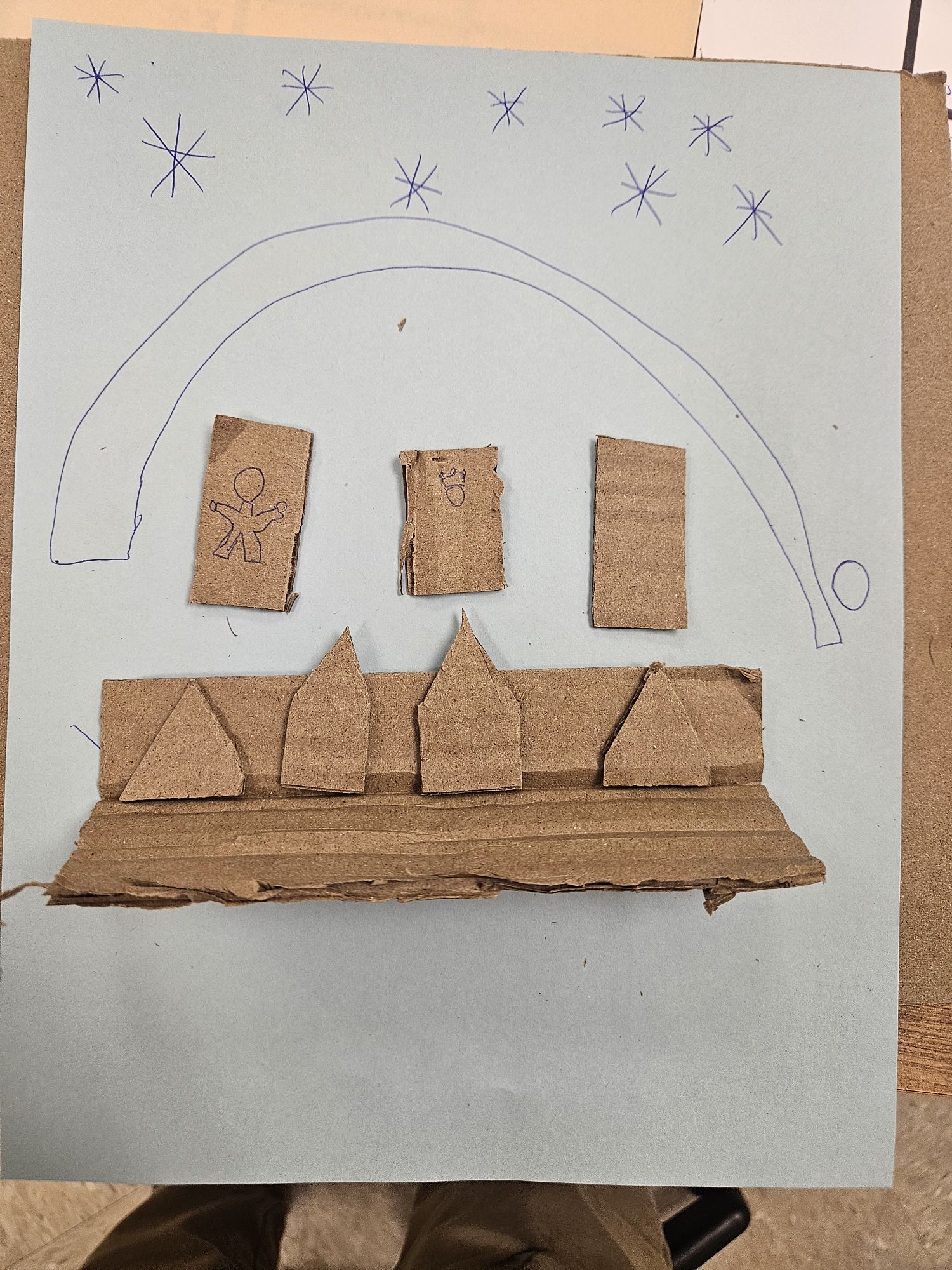
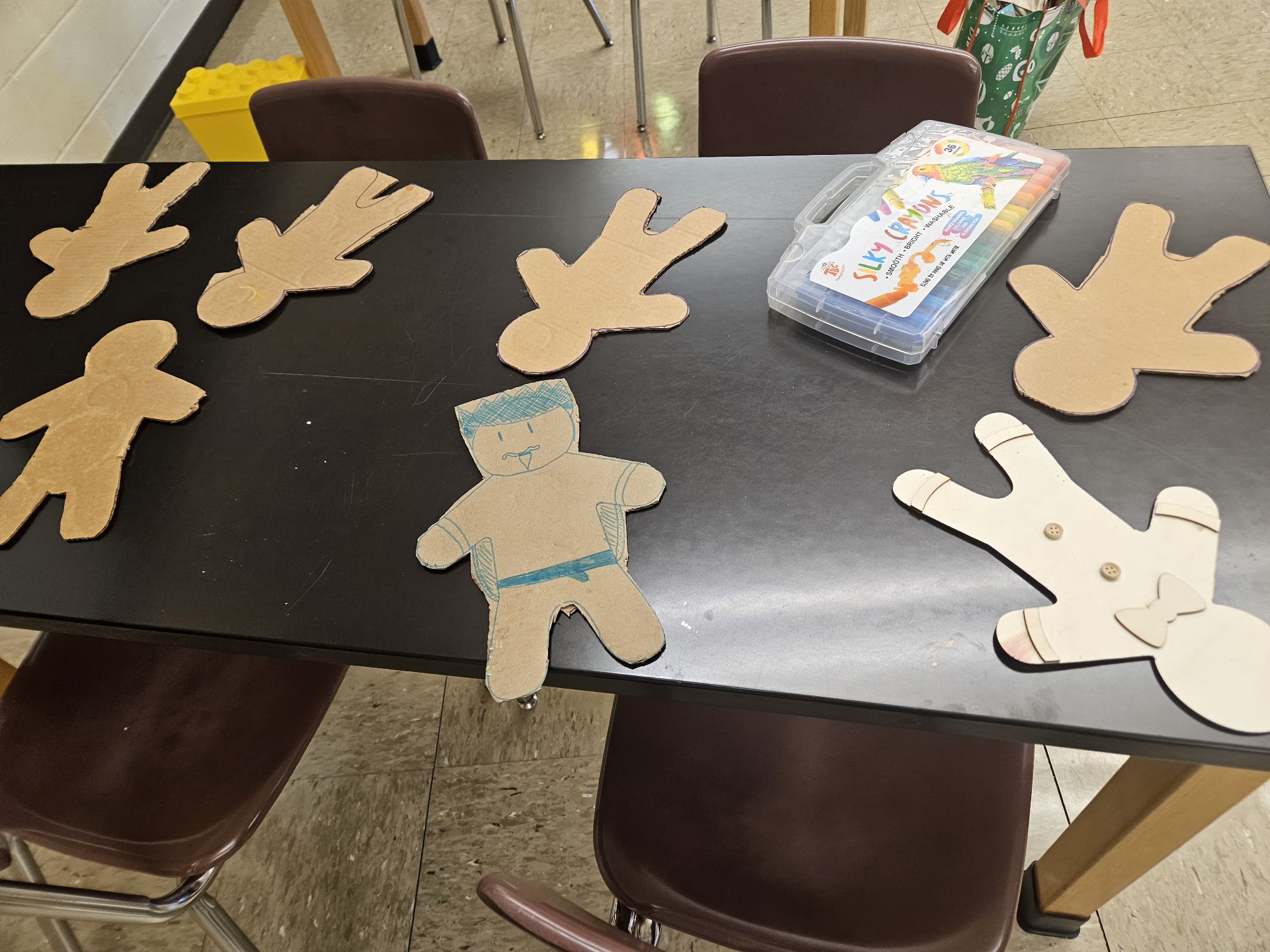
I knew I couldn’t use real gingerbread, so I chose the next best thing- cardboard! I made a cardboard plan of the door to show to my group. I then found a wooden gingerbread man at the local dollar store and used that as a template for the cardboard characters. Finally, I explained the concept to the group, and divided my group up into teams- one group would draw and color the gingerbread houses, one group would color the gingerbread men based on pictures of Shakespearean characters:
Gingerbread HamletGingerbread Henry V Gingerbread Juliet
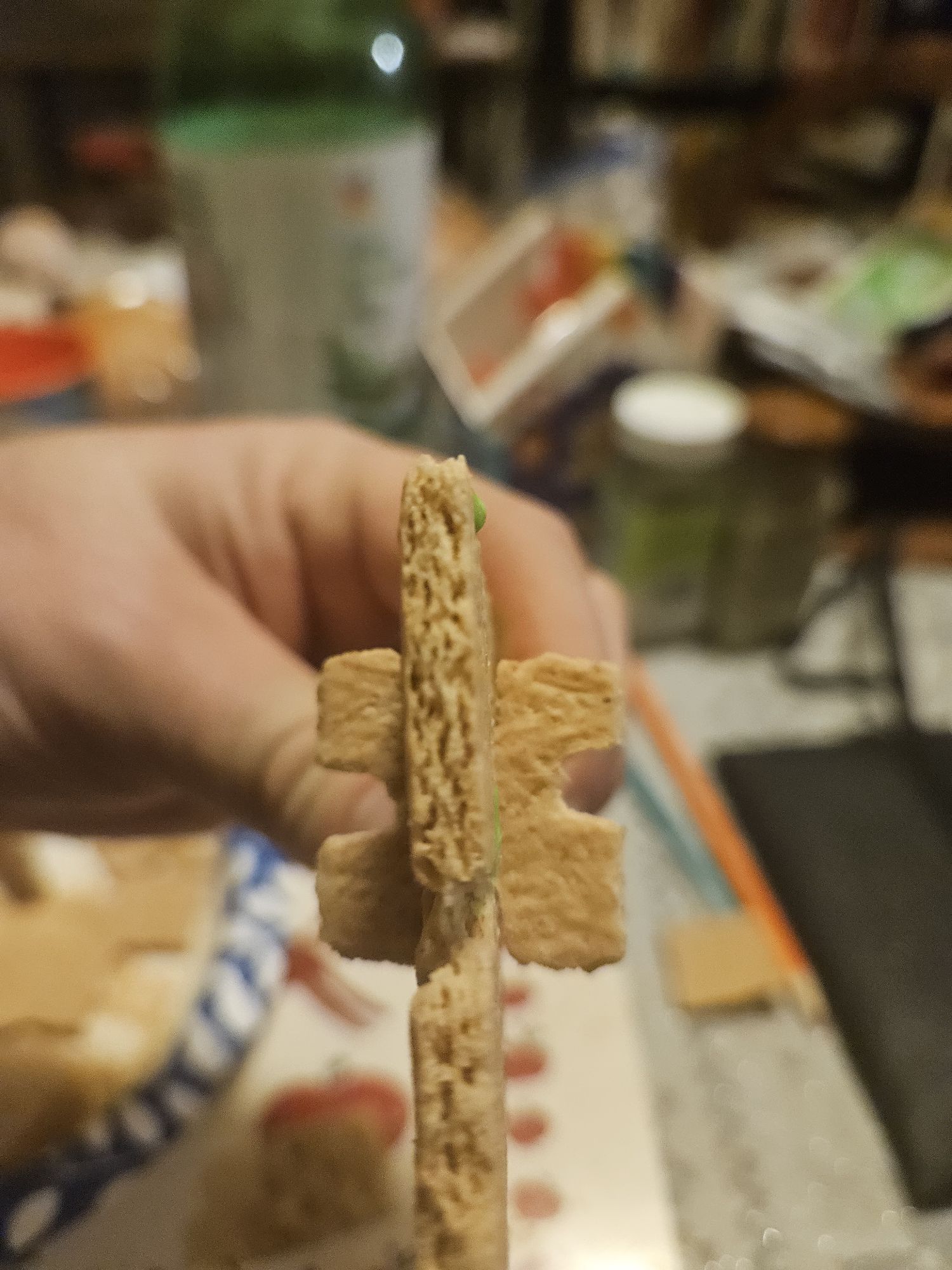
My final group created a 3D gingerbread house with a light in it to make the gingerbread village come to life. They even put my little puppet Shakespeare pal in there (I guess it’s his winter home).














































 The Shakespearean Student