For THIS WEEK ONLY, I’m offering a $5 discount for my “Macbeth” course: Get $5 off my class “Macbeth: An Immersive Learning Experience” with coupon code HTHESUEQUG5 until Nov 5, 2021. Get started at https://outschool.com/classes/macbeth-an-immersive-learning-experience-xGKHeHgH and enter the coupon code at checkout.
Trailer for my 2021 Acting course via Outschool.com
I’ve been working on a remote learning class for Outschool.com where I take some of the audition advice I wrote in Creating A Character: Macbeth, and some of the other acting posts I’ve published over the years. This will be a weekly virtual acting course for kids ages 13-18, starting September 12th at 10AM EST.
This class will outline the tools and techniques of Shakespearean acting such as projection, articulation, and imagination. Each We’ll also go over Shakespeare’s own advice on acting in his play “Hamlet: Prince of Denmark.” The course will culminate with the students choosing their own Shakespearean monologues and scenes, which they can use going forward in auditions, school plays, and classes.
The best thing about the course is that each week builds on the previous week’s experience, but you don’t need to go to all of them. I’ll be flexible and work with the student’s schedule so everyone gets as much out of the class as possible.
If you’re interested in signing up, go to Outschool.com. If you have any questions, email me by clicking here:
I’m working this summer with the good people at Outschool, an online learning platform for kids ages 3-18. I’m designing a series of Shakespeare classes that you can sign up for. We’ll be doing acting exercises, reading Shakespeare’s text, and making Shakespeare props Cost is $3 per child.
The course is ala carte, that is, you can sign up for as many courses as you like. Each course builds on the last one, but you don’t have to have taken the previous ones to enjoy any one particular course Let me know in the comments which class(es) you are interested in, and/or what suggestions you might have. I can’t wait to hear what you think about these summer Shakespeare courses, and I hope to see you online soon!
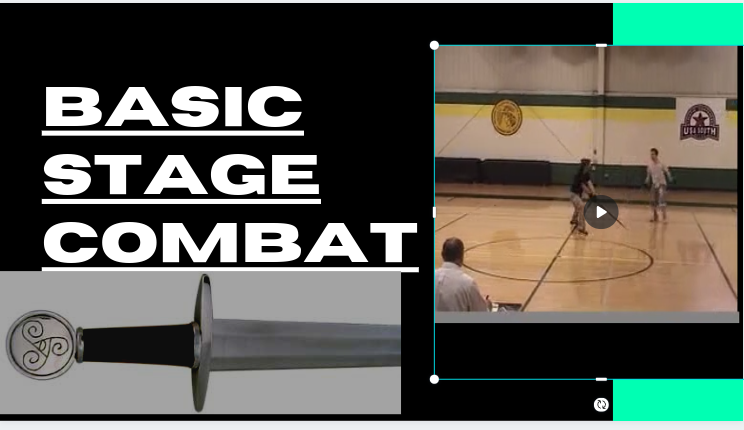
1. Introduction to Shakespeare- (enrollment here: https://outschool.com/classes/introduction-to-shakespeare-or-how-i-learned-to-love-the-bard-UoHH5fes?sectionUid=973060db-f857-461a-a23a-f1476203a544&showDetails=true) We’ll talk about why Shakespeare is so famous and learn about his life and career. Then we’ll do some fun quizzes that you can earn prizes based on how well you pay attention! 2. How to write ✍ like Shakespeare (Enrollment here: https://outschool.com/classes/how-to-write-like-shakespeare-0HuPq1Cg?sectionUid=4243af25-ba41-4724-82a2-61bd7c7d862e&showDetails=true) – Have you ever wanted to woo your sweetheart or write the next bestselling play? Well, this course will cover the secrets of Shakespeare’s writing. We’ll cover how to write romantic poems, the structure of Shakespeare’s plays, and you’ll get to write your own Shakespearean speeches! 3. Intro to Shakespearean acting Practical tips and tricks for your next Shakespeare audition. 4. Shakespeare’s villains We’ll look at the darkest and creepiest Shakespearean characters and see why they still fascinate us today! 5. The Violent Rhetoric Of Shakespeare’s Julius Caesar (Registration Here: https://outschool.com/classes/the-violent-rhetoric-of-julius-caesar-fkMLbAtA?sectionUid=1f9220cd-8c28-438d-9799-8479494353a4&showDetails=true#usMaRDyJ13) In this one-time course, students will analyze the rhetoric and persuasive power in two speeches from Shakespeare’s “Julius Caesar” 6. Intro to Romeo and Juliet – Get a leg up on your next English class with this fun, frenetic look through the characters, themes, and story of Shakespeare’s most popular, and most-taught play. 7. Basics Of Stage Combat (Registration here: https://outschool.com/classes/1120ada2-047d-4b0f-84f6-5eb4b0f7dc66/schedule#usMaRDyJ13– I’ll teach the kids about Elizabethan street fighting, and the basics of stage combat. 8. The Balcony Scene of Romeo and Juliet– It’s been called the greatest love scene of all time, but why? I’ll explain the imagery, the poetic language, and give you a chance to make your own love poetry! 9. Insults and Shakespeare You’ll craft your own Shakespeare insults and engage in a (respectful), beat down with your classmates! Along the way, we’ll talk about how insults escalate to violence in Shakespeare’s Romeo and Juliet. 10. The Iconic imagery of Romeo and Juliet We’ll look at some beautiful paintings, songs, and other works of art that build on Shakespeare’s poetic imagery. 11. Romeo and Juliet and pedagogy Shakespeare is uniquely challenging to get kids to engage with. I’ll give you some of my resources, games, and activities to help you delve into the play in your next class.
If you like these courses, let me know by leaving a comment below. If you’re interested in signing up, visit my teacher profile page: https://outschool.com/teachers/The-Shakespearean-Student. New classes will be added every week, and I’ll work around your schedule when planning the dates and times. Hopefully this will be a great chance for me to share my expertise with a young group of future Shakespearean students!
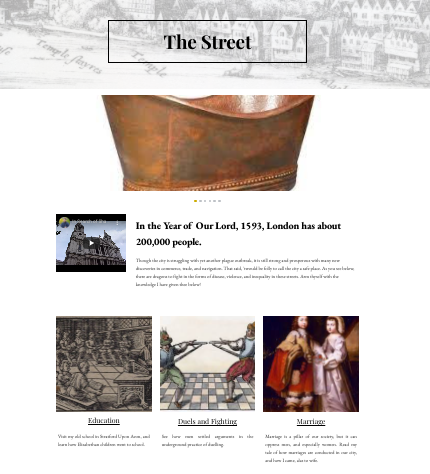
I’m working on several educational projects at the moment and I’m proud to share this one with you. It’s what I call a virtual tour of Shakespeare’s London. The teacher I’m working with said she wanted to teach the kids about the culture of Elizabethan London as he was writing Romeo and Juliet. Naturally with the pandemic a field trip was out of the question, (for multiple reasons), but I wanted to create a visually interesting tour of the places Shakespeare knew and worked and try to imagine his perspective and how that might have informed the characters and themes of Romeo and Juliet.
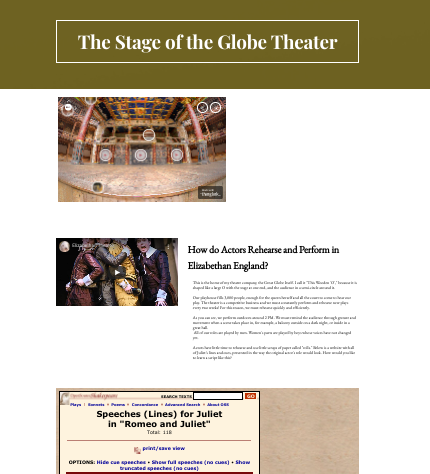
So I created this: a website written as if Shakespeare himself is taking you on a tour of his London in the year 1593, the year where, as far as we know, he had just completed writing Romeo and Juliet. 1593 was also the middle of another outbreak of Bubonic Plague. It has virtual tours of Shakespeare’s Globe Theater, Hampton Court Palace, Shakespeare’s Grammar School, and a quiz where you can pretend you’re in the Elizabethan doctor’s office.
For the class I’m helping, the students will fill out a worksheet as they navigate the website so they learn from the material at their own pace. If you’re interested, leave a comment and I’ll post the worksheet so you can use it in your classroom.
My hope is that this website can be a resource for anyone trying to connect with Romeo and Juliet and trying to learn from the culture of Elizabethan London. Shakespeare was a product of his time and his experiences must have had an influence on what he wrote. Even if they didn’t, they certainly influenced the people who saw the play and he knew that it would. So I hope it can help you understand a little bit more about the world of this famous play, and the context of the world that created it.
I’m stuck at home with the kids for Shakespeare’s Birthday, so I thought I’d come up with some fun activities for my kids to do today:
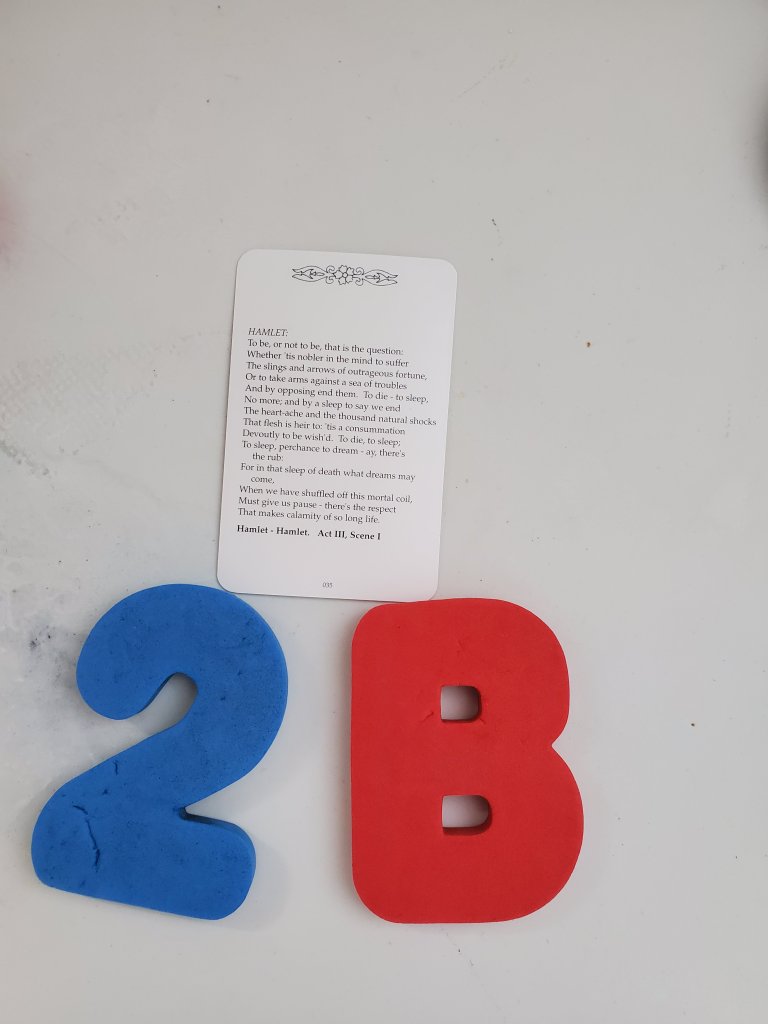
I hid the quote from “Hamlet” in the bathtub 🛁 and had my kids find the bath letters “2” and “B.”
At home I have a card game called “The Bard Game, which has several famous Shakespeare quotes printed on little cards. I hid the cards around the house and when they found them, I had them recite a short quote. Sometimes I hid them in funny locations like the bath tub or the fridge.
2. Romeo and Juliet For Kids. There’s a bunch of animated Shakespeare videos on YouTube and my daughter really likes this one: https://youtu.be/mMFE0IIHR6I
3. William Shakespeare and the Globe by Aliki. A fantastic book that introduces Shakespeare’s life and plays.
Romeo and juliet cookies
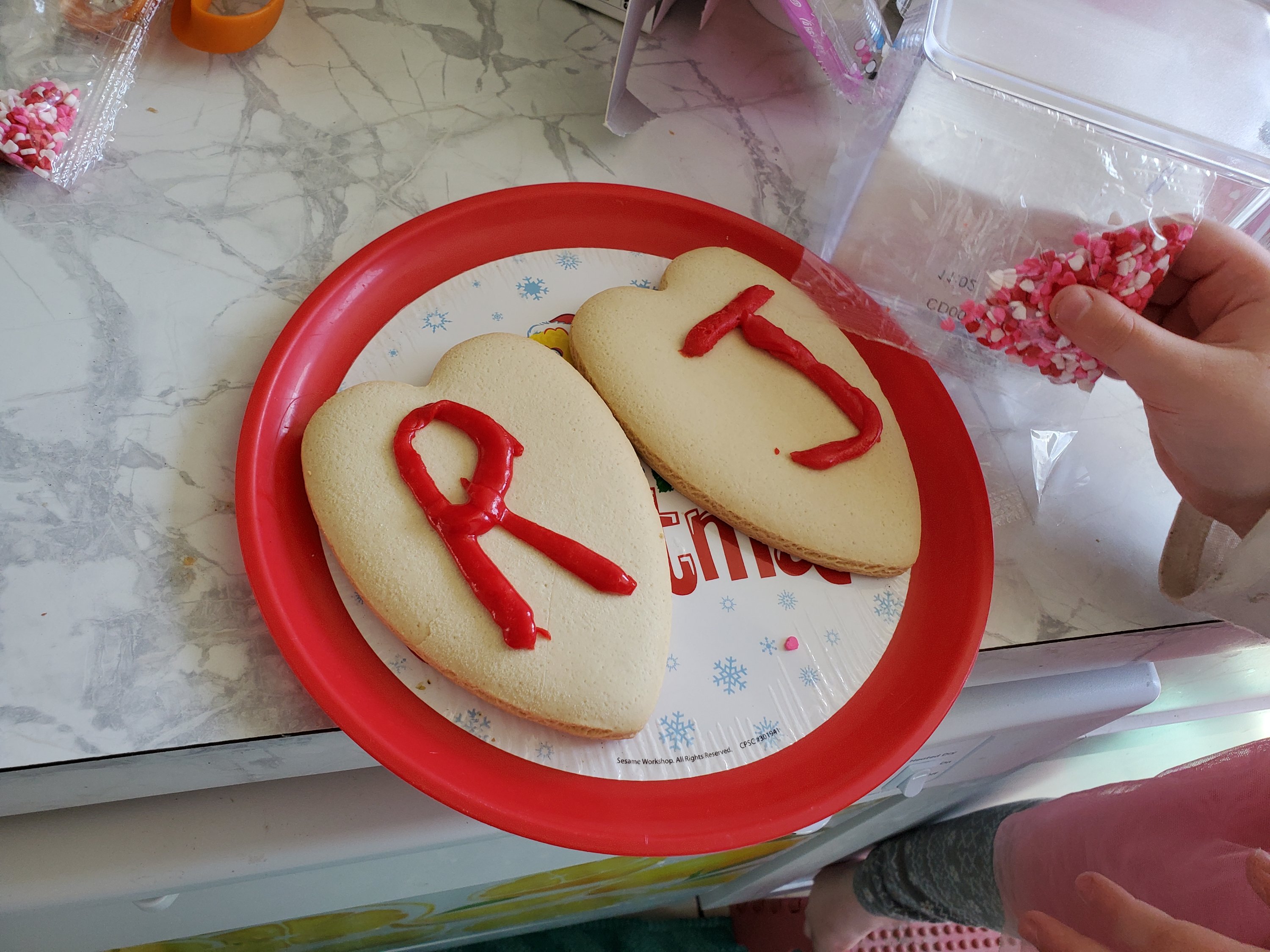
What’s a birthday party without treats? I had my kids decorate these Romeo and Juliet cookies. My daughter is only 5, so it was good practice writing ✍ the letters R and J.
If you like my ideas or want to suggest something, please leave a comment below!
Back in 2009, I had the opportunity to play the lead in a touring production of “Macbeth.” It was the first time I’d ever played a titular Shakespearean character and I was really excited to play this part. I feel that playing one of these parts gives you an insight into the character that no other research can, so I’d like to share the steps of my process, with some pictures and videos from other famous Macbeths to give you an idea of what I learned.
The Auditions-
As I said in one of my earliest posts, if you’re auditioning for a Shakespeare play, Read the whole play, not just a monologue book. Monologue books won’t give you a sense of the whole story and you’ll miss a lot of details about who your character is by not hearing what he/she says, and what other people say about him/her. Fortunately for me, I first read the play when I was 17 and remembered the story pretty well. Unfortunately, my first reading of the part was a disaster. Unlike Hamlet, Macbeth didn’t feel like a part I could play; he seemed like this huge Scottish warrior who everyone loved until he turned into a psycho killer. I’m not a warrior, not a psycho, and (like most actors), often feel a lot of doubt and loneliness about my self. Ironically, that was what helped me get into the heart of the character!
Figure out what’s the hard part. When directors cast, they need to make sure you can handle the part. If your character has to sing, you better be able to carry a tune. If your character needs to be able to contort into a pretzel and talk to dolphins, he or she will probably make that part of the audition. My advice to anyone auditioning for a specific part in a play (Shakespeare or not), is to think like a director and try and figure out what the hardest thing that your character will have to do, and try to prepare for that. For me, the hardest part of playing Macbeth, was the famous Dagger Speech.
Perform your monologue for someone first. I was fortunate that while I was prepping for the audition, the great Shakespearean director Rob Claire was doing a workshop and he helped me work on Macbeth’s soliloquy in Act I, where he decides whether or not to murder Duncan.
Table work
Table work is the point in the process where the actors sit around and read the play, trying to get an idea of the character’s journey from beginning to end. To me is the most exciting time in rehearsals because it’s just the actor and Shakespeare’s words- you can imagine how the play will go, discover how the lines make you feel, and form a bond with your character and fellow actors.
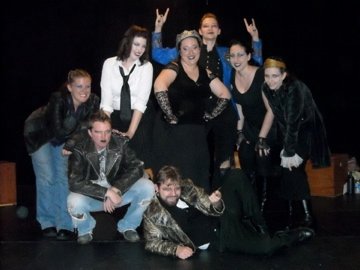
Me and my Lady Macbeth, Katie Crandol.
Macbeth’s Motive- During the table read, I decided on Macbeth’s motivation: to prove himself to his wife. In the play, Lady Macbeth frequently criticizes him and seems to define true manhood as taking what you want, regardless of fear or ethics. Take a look at this horrific passage where she first critiques Macbeth’s manhood, then says she would rather bash her baby’s head in rather than give up on murdering the king!
MACBETH
Prithee, peace:
I dare do all that may become a man;
Who dares do more is none.
LADY MACBETH
What beast was’t, then,
That made you break this enterprise to me?
When you durst do it, then you were a man;
I have given suck, and know
How tender ’tis to love the babe that milks me:
I would, while it was smiling in my face,
Have pluck’d my nipple from his boneless gums,
And dash’d the brains out, had I so sworn as you
Have done to this.
MACBETH
If we should fail?
LADY MACBETH
We fail!
But screw your courage to the sticking-place,
And we’ll not fail. (Macbeth, Act I, Scene vii).
One interesting contradiction in the play, although Lady M mentions that she’s nursed a baby, later on in the play Macduff says that Macbeth has no children. I therefore decided that Lady Macbeth has lost a child, and this has caused unimaginable pain for the couple. Therefore, Macbeth is willing to do anything to win his wife’s affection again, even murder.
Study the verse– Another point I’d advise when you’re doing table work is pay attention to Shakespeare’s verse because it provides clues to help you keep your hand on the pulse of your character. Just like a heartbeat, when a line of verse changes or fragments it usually signals an emotional or mental change in the character. Here is a quick analysis of the verse in Shakespeare’s Macbeth. Click here to find some great books about how to study Shakespeare’s verse.
Voice and Body
When creating any character, you have to decide how (s)he walks and talks. Most Macbeth’s I’ve seen are big, heroic guys, and I’m not big and imposing. I talked to one of my mentors at American Shakespeare Center and he suggested that maybe Macbeth has a bit of a Napoleonic Complex. This made a lot of sense to me. I thought about how Macbeth gets honored at the beginning of the play; what if he just got lucky killing the Norwegians? What if deep down, he doesn’t feel he deserves to be honored just for killing in war? That kind of self hatred and desire for approval could easily lead to violent behavior. I therefore based my physical choices on alternately shrinking and sulking when Macbeth feels low, and trying very hard to look big and imposing for the rest of the play.
I worked on my arms for the sword work and my back because I believe that’s where Macbeth caries himself. When I wanted to appear like a king I would stand straight and puff out my chest, however in moments like the appearance of Banquo’s ghost, I shrank and turned my head away.
I didn’t try to do a voice for Macbeth, I just tried to let my voice go through the changes. When Macbeth is paranoid or afraid, my voice went up, when he feels in control, I kept it at a low, strong register.
The one time I shouted was at the end, when Macduff demands that
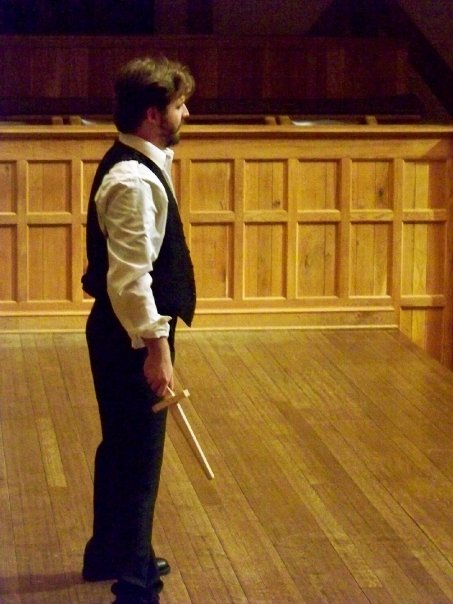
I prepare to fight Macduff.
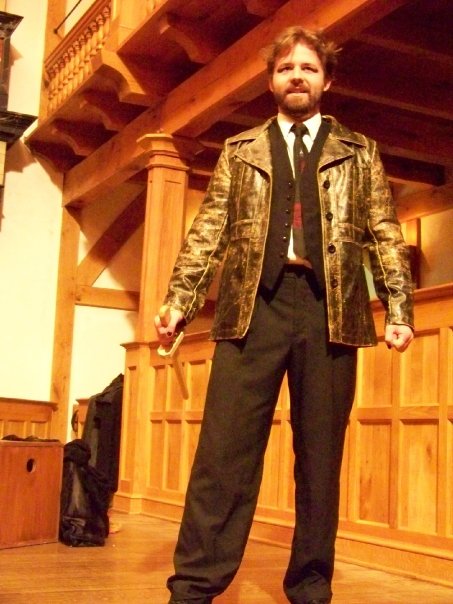
Macbeth surrender. I snarled and barked the line: “I WILL NOT YIELD!” At the end of the play, when Macbeth gets to fight Macduff, I feel he finally feels brave and strong, challenging Macduff even though he knows he will lose. At last he can feel like a valliant hero, even though everyone else sees him as a villain. I gleefully assumed a fighting stance and put all the power in my body into my limbs, ready to attack!
The Speeches. All of Shakespeare’s great characters have fabulous speeches that allow the audience to peer into their hearts. With Macbeth, we see a good man’s journey into becoming a demented, paranoid tyrant through the following speeches.
I contemplate murder in Act I, scene vii.
“If It Were Done,” Act I, Scene vii. This speech was my favorite. It’s basically Macbeth’s version of “To Be Or Not To Be.” In both speeches, the character is contemplating murder, without saying the word “murder.” This is the “IT” Macbeth refers to; killing the king to get his crown. Macbeth is tortured by his ambition and his desire, and you get to see him wrack his brain and body over what to do. Below is Sir Ian McKellen’s interpretation of the speech in a 1979 RSC production.
The Dagger Speech Act II, Scene i. The night of the murder,
Macbeth stands alone during the Dagger Speech, Act II, scene i
Macbeth sees a bloody dagger that points his way to the king. It’s up to the actor to determine where and what the dagger is: if it is the Witches’ magic, his own psychosis, or a hellish prophesy. Does Macbeth love or fear the dagger? Does it stay in one place or move? Answering these questions and keeping track of the answers makes the speech very hard to do. Here is Sir Antony Sher’s kinetic and frantic version of the Dagger Speech:
“Tomorrow and Tomorrow” Act V, Scene v. This speech is often quoted out of context, given that it has a nearly perfect metaphor for the futility of life: “Life’s but a walking shadow, a poor player who struts and frets his hour upon the stage… it is a tale, told by an idiot, full of sound and fury, signifying nothing.” Since this is the most famous speech in the play, I had to do something different than other Macbeths. What many people forget is that Macbeth says all this when he’s trying to command his army, and gets word that his wife is dead.
I chose to play the speech as a fight within Macbeth to not give into despair. At first he’s furious when he hears the news; he didn’t need this news, especially not today! He tries to suppress his grief, delaying it until tomorrow, but he can’t; now that he knows his wife is dead, his life seems completely pointless, including the battle he was trying to fight. I then gave Macbeth an epithany near the end of the speech: If life is pointless, fighting a battle and dying would be a glorious way to end it! Why not die, after all, life is just “a tale told by an idiot?” At last, Macbeth has a reason to fight again, and he concludes the speech as a call to his soldiers to fight without fear of death. Now, you may disagree with my interpretation, but the point is that it’s mine. I wasn’t trying to imitate Antony Sher, or Laurence Olivier, or Patrick Stewart when they played the part. I was doing my Macbeth, and that’s what made it worth watching.
I hope you enjoyed this look into the process of creating this complex and fascinating character. If you’ve played this character before, leave me a comment about your interpretation, or tell me which Macbeth you liked best and why. Finally, below are links to two full-length productions of Macbeth for your viewing pleasure.















 The Shakespearean Student