Since International Women’s Day is Friday, I’m devoting the following week to talking about the awesome female characters in Shakespeare’s Roman plays: Titus, Andronicus, Julius Caesar, Antony and Cleopatra, and Coriolanus
First, here’s my post and an accompanying podcast on Roman women, which includes an analysis of Lavinia, Portia, Valumnia, and Cleopatra:
Here’s a fascinating video about the lives of Roman girls:
And here’s a special section about Cleopatra:
Comedy sketches about Cleopatra from “Horrible Histories” BBC, 2015.
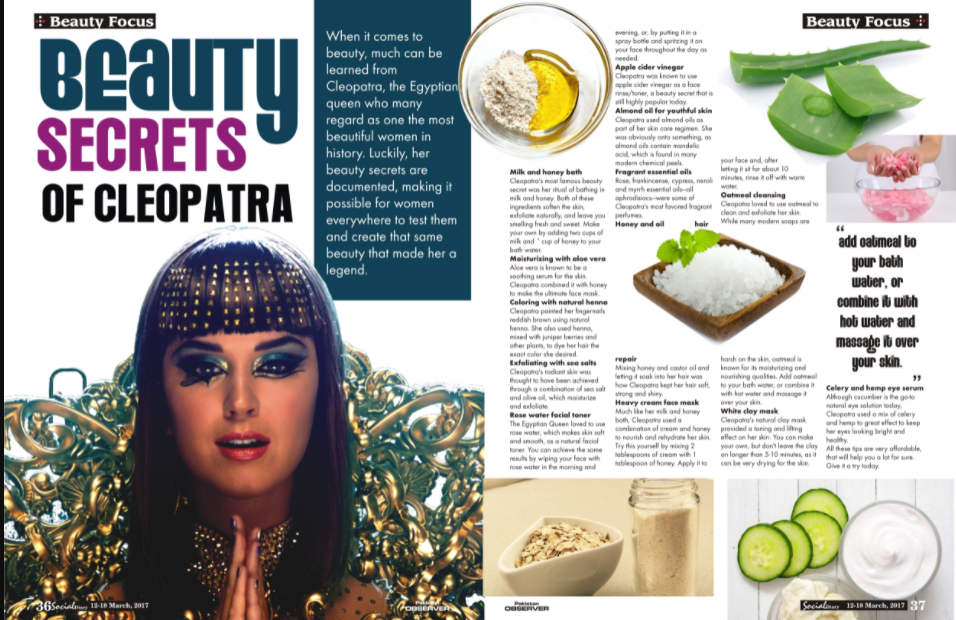
A Lady-Gaga-esque song about Cleopatra from “Horrible Histories,” 2014Infographic from an article about Cleopatra’s beauty regimen. Source: http://socialdiary.pk/
Ave and Happy Pie Day ! Since it’s Roman month, I thought I’d talk about the most infamous pie in Shakespeare’s Roman plays, and give you an ancient Roman recipe that tastes a lot better!
In Act V of Titus Andronicus, the titular general and his household cook and serve the Empress’ sons to their mother in a pie! Here’s how the scene plays out in the 1999 film Titus:
The infamous pie scene from Titus Andronicus
Before he cooks the Empress’ sons, Titus actually tells them what he is going to do to them, like some kind of psychotic chef giving a cooking program:
This one hand yet is left to cut your throats,
Whilst that Lavinia 'tween her stumps doth hold
The basin that receives your guilty blood.
You know your mother means to feast with me,
And calls herself Revenge, and thinks me mad:
Hark, villains! I will grind your bones to dust
And with your blood and it I'll make a paste,
And of the paste a coffin I will rear
And make two pasties of your shameful heads,
And bid that strumpet, your unhallow'd dam,
Like to the earth swallow her own increase.
This is the feast that I have bid her to,
And this the banquet she shall surfeit on;
I’ve adapted Titus’ recipe into this creepy recipe card below:
Now when Titus says coffin he’s actually referring to a pie crust, (though ironically this coffin will also be a tomb for two human bodies). Ancient Romans did in fact make meat pies, so Tamara wouldn’t have immediately been suspicious It also was not unheard of for the ancient Romans to actually eat brains! According to DE RE COQUINARIA, one of the oldest surviving Roman cookbooks, there was a recipe called Patina frisilis, a pudding made of fresh vegetables, wine, and calf brains:
Take vegetables, clean and wash, shred and cook them cool them off and drain them. Take 4 calf’s brains, remove the skin and strings and cook them4 in the mortar put 6 scruples of pepper, moisten with broth and crush fine; then add the brains, rub again and meanwhile add the vegetables, rubbing all the while, and make a fine paste of it. Thereupon break and add 8 eggs. Now add a glassful of broth, a glassful of wine, a glassful of raisin wine, taste this preparation. Oil the baking dish thoroughly put the mixture in the dish and place it in the hot plate, (that is above the hot ashes) and when it is done unmould it sprinkle with pepper and serve.
APICIUS- DE RE COQUINARIA (c. 1st century CE).
Medieval edition of De Re Coquinaria
My research suggests that the coffin was mainly just flour and oil and was not actually intended to be eaten. It would be similar to a modern salt crust pie that seals in juices and helps preserve the pie in the absence of refrigerators.
Thankfully Apicius has another recipe for a Roman pie that I find much more appetizing
Elderberry Custard or Pie– Patina de sambuco
A dish of elderberries, either hot or cold, is made in this manner: take elderberries, wash them; cook in water, skim and strain. Prepare a dish in which to cook the custard; crush 6 scruples of pepper with a little broth; add this to the elderberry pulp with another glass of broth, a glass of wine, a glass of raisin wine and as much as 4 ounces of oil. Put the dish in the hot bath and stir the contents. As soon as it is getting warm, quickly break 6 eggs and whipping them, incorporate them, in order to thicken the fluid. When thick enough sprinkle with pepper and serve up.
A modern recipe for Elderberry pie 🥧
While I’m at it, here’s another historical pie recipe that was a favorite of Shakespeare’s Richard II:
Today is March 15th, a day that history still bewares, because of the infamous day when armed, violent conspirators went to the Senate and attempted to overthrow elected rulers. For obvious reasons, this put me in mind of the heinous actions of another group of conspirators stormed another Senate and tried, unsuccessfully, to overthrow democracy.
January 6th, 2021 (which, coincidently, was Twelfth Night, one of my favorite Shakespeare-themed holidays), was a tragedy for multiple reasons. The protestors broke windows, destroyed furniture, defaced statues, broke into both chambers of Congress, and probably would have harmed lawmakers, in a violent protest of both the US presidential election and the Senate vote in Georgia that week.
Let me be clear, this was sedition and treason and everyone involved should be prosecuted to the full extent of the law. Anyone who says otherwise is blatantly attacking our cherished democracy, and spitting in the face of the rule of law. Unfortunately, Republicans in both chambers have been unwilling to condemn their actions for fear of alienating their base. If this is what the Republican party has come to, the party doesn’t deserve the name. A republic protects the right of the people to elect its representatives and dedicates itself to the peaceful transition of power. Left unchallenged, groups like this will bring anarchy and tyranny to our country.
How do I know this? Because it happened before. Shakespeare has long dramatized real historic events where people rise up against their governments (for better or worse). In all cases, whether protesting a famine, a war, or a cruel tyrannical usurper, the riots never accomplish anything except bringing chaos and bloodshed. Sometimes these ignorant rioters are goaded by charismatic powerful figures, but these upper-class characters are only exploiting the rioters, using their violence as a way to get power for themselves. So, let’s examine the language, tactics, and effects of rioters in three of Shakespeare’s plays: Julius Caesar, Henry VI Part III, and Sir Thomas More:
Example 1: Julius Caesar
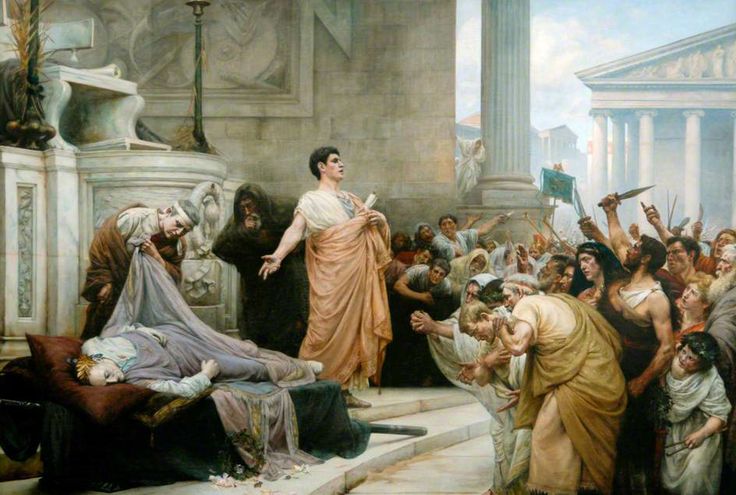
(c) Hartlepool Museums and Heritage Service; Supplied by The Public Catalogue Foundation
As I covered before in my “Friends, Romans, Countrymen,” post, during Antony’s famous funeral speech, he galvanizes the Roman crowd, first to mourn Caesar, then to revenge his death. How do they do this? By burning the houses of the conspirators and rioting in the street. They even kill a man just because he has the same name as one of the conspirators:
What does this violence accomplish? Nothing. Caesar is still dead. Brutus is still alive (though on the run). Antony merely wished to punish Brutus, and get the mob to hate him while he secretly cheats them out of their money. In Act Four, Antony becomes the de facto ruler of Rome because he leveraged his performance at the funeral, and uses his newfound powers to take money away from the citizens that Caesar promised to give them in his will. He manipulated them for his own purposes and duped them for political power.
Example 2: Jack Cade in Henry VI, Part ii.
Henry VI is the only king in English history to be crowned twice, deposed twice, and buried twice (Saccio 91). As the play begins, King Henry has already lost France, lost his mind, and lost the respect of his people. Around 1455, John Hardyng wrote a contrast between Henry’s father and himself. He laments that Henry the Fifth died so soon and then exhorts Henry to keep the quarrelsome lords in his government from warring among themselves.
Withstand, good lord, the outbreak of debates. And chastise well also the rioters Who in each shire are now confederates Against your peace, and all their maintainers For truly else will fall the fairest flowers Of your great crown and noble monarchy Which God defend and keep through his mercy.
(Excerpt from Harding’s Chronicle, English Historical Documents, 274).
Henry’s political ineptness was why Richard of York challenged his claim to the throne. Though Richard had little legal claim as king, he believed himself to be better than Henry.
In Shakespeare’s play Henry VI, Part ii, York tries to get the people’s support by engineering a crisis that he can easily solve. York dupes a man named Jack Cade to start a riot in London and demand that the magistrates crown Cade as the true king.
Biography of Richard, Duke of York, who challenged King Henry VI for his right to be king.
York and Cade start a conspiracy theory that Cade is the true heir to the throne and the royal family suppressed his claim and lied about his identity. Cade starts calling himself John Mortimer, a distant uncle of the king whom York himself admits is long dead:
The Royal National Theater’s production of Henry VI, Parts II, and 7. Jack Cade appears at about the 7-minute mark.
And this fell tempest shall not cease to rage
 Until the golden circuit on my head,
 Like to the glorious sun's transparent beams,
 Do calm the fury of this mad-bred flaw.
 And, for a minister of my intent,
 I have seduced a headstrong Kentishman,
 John Cade of Ashford,
 To make commotion, as full well he can,
 Under the title of John Mortimer.
Just like Cade and his rebels, the January 6th rioters were motivated by lies and conspiracies designed to crush their faith in their legitimate ruler. Even more disturbing, these rioters are pawns in the master plan of a corrupt political group. York doesn’t care that Cade isn’t the real king; he just wants to use Cade’s violence as an excuse to raise an army, one that he can eventually use against King Henry himself.
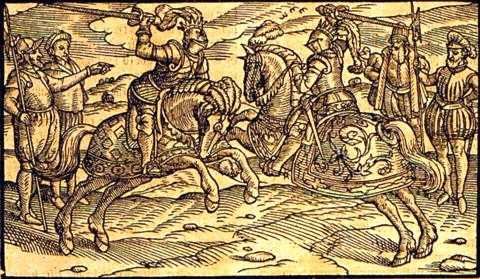
15th century woodcut from the War Of the Roses.
Similar to York’s lies and conspiracy-mongering, many Republicans have refused to accept the legitimacy of Joe Biden’s election, and some are actual proponents of Q Anon conspiracies!
A lot of Republicans deserve blame for fanning the flames of rebellion on January 6th, but arguably former President Trump deserves most of the blame. Even Rush Limbaugh admitted that Trump spread a huge amount of conspiracy theories without believing in any of them. He does this because he wants Americans to be afraid of imaginary threats that he claims he can solve. What’s easier to solve than a problem that doesn’t exist? Much like York, Trump tried to hold onto power by pressuring his supporters to pressure the Capital, feeding them lies about election fraud, and a secret democratic Satanic cult. Thus radicalized, they resolved to do what Cade’s mob did: “Kill all the lawyers.” Unfortunately, there are a lot of lawyers in the Senate.
As Dick the Butcher points out, most people don’t actually believe Cade is truly John Mortimer, they are just so angry at the king and the oppressive English government, that they are willing to follow him in a violent mob to take their vengeance upon the monarchy. This is why they try Lord Saye and execute him just for the crime of reading and writing! Similarly, the mob attacking the capital was made up of die-hard conspiracy adherents, and people just angry at the Democratic Party.
Like I said before, Cade and his mob is just a pawn in the machinations of York. Eventually the king’s enforcer, Lord Clifford convinces most of them to abandon Cade, and Cade himself dies a humiliating death- on the run from the law and starving, Cade is murdered by a farmer after trying to steal some food. After Joe Biden became the 46th President, many of the conspiracy group Q-Anon, who had many prominent members in the January 6th riot, began to disbelieve and abandon the conspiracies of the group. However, as this news story shows, some Q-Anon supporters are die-hard adherents and will never abandon their conspiracy theories, and some, like York’s supporters, are being recruited by other extreme groups. Sadly, as York shows, sometimes a riot is a rehearsal for another riot. In Shakespeare’s Henry VI, Part III, York finally amasses an army and challenges the Lancastrians in all-out war. Hopefully, the US government will hunt down and arrest these violent insurrectionists before they have the chance to do the same.
Example 3: Sir Thomas More
In the unfinished play “Sir Thomas More, a racist mob again attempts to attack London. This time they have no political pretenses; they want to lynch immigrants who they believe are taking English jobs. As I said in my “Who Would Shakespeare Vote For?” post, More’s speech is a perfect explanation of why this behavior cheapens and denigrated a country’s image, and weakens its ability to command respect from the rest of the world. Last time I posted a video of Sir Ian McKellen speaking this speech, but this time.. well just watch:
Titus Andronicus is one of the most bloody, disgusting plays in Shakespeare. As this infographic from the Royal Shakespeare Company shows, there are tons of deaths and some of them are even the result of cannibalism!
One way to capture the macabre nature of this play in the classroom, (which some scholars see as a horror comedy), is to characterize it through cooking, after all, revenge is a dish best served cold.
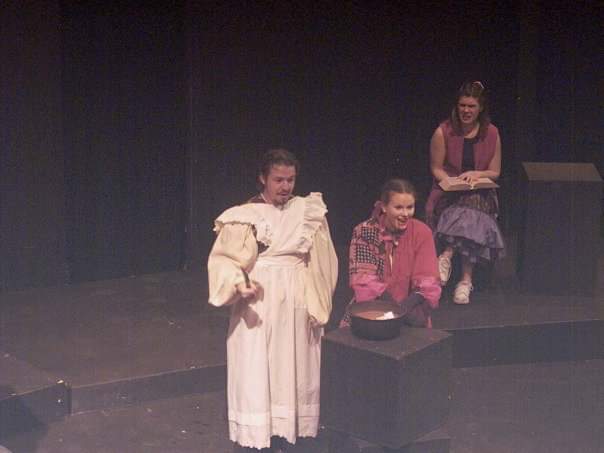
Me in costume as Titus Androgynous, a crazy cooking show host who butchers two people in the same manner as Titus
So here are some ghoulish gourmet dishes and revolting recipes that you can share with your students to help them get into this tragic tale of violence, revenge, and cooking:
Idea 1: recipe cards
Design a recipe card like the ones in cooking magazines based on Titus speech where he murders Chiron and Demetrius
Idea 2: Create a menu that summarizes the play:
Act I:
Starter: Caesar Salad, toad in the hole
As the play begins, Caesar has died and Saturnine wants to devour his father’s empire. Enjoy this light salad in anticipation of far more bloody feasts to come.https://youtu.be/UxZ5NOkRwj0
Act II Scene 3: Breakfast:
Lamb Benedict
Lamb Benedict recipe I found on Reddit
While on an early morning hunting trip, Bassianus is slaughtered like a lamb by his own nephews. Enjoy this sweet treachery with a golden egg in the hole.
Act II, Scene 4: Main course:
Roast venison with all the trimmings
“As the deer that hath some unrecuring wound.”
“She was washed and cut and trimmed.”
Titus compares his daughter to a deer or welkin, and in the play’s most barbaric scene, the emperor’s sons ravish her and cut out her tongue. They enjoy the cruel rape and mutilation just like two starving lions enjoying their prey.
Act V:
Just desserts: people pot pie.
“More stern and bloody than the centaur’s feast,” A truly unforgettable dessert for this feast of carnage. The cook, Titus, reinvents the term rich food by cooking two emperor’s sons into pies.
Served cold, like revenge!
“Set him breast deep in Earth and famish him.”
Idea 3: Real Titus foods inspired by my favorite Halloween diy recipes
Or this grisly appetizer: cheese hand in prosciutto
3.
People Pies:
There are many horrific pie recipes on the internet, but for a busy teacher on a budget, I’m adapting this one from the YouTube channel Threadbanger: https://youtu.be/E6U6xUl3A5M. Don’t show this video to your students because there’s far too much cursing. That said this recipe is very cheap and it’s easy. He used only store bought items and no fancy cooking techniques, which means if you choose to bake it as a classroom activity, even your students can help make it. Here are some tips from the video to get the most horrible ppeople pie you can make:
• Use red filling like cherry or strawberry for filling.
With just a few days left until Halloween, many of us will be anxious to put the candy bowl away, dim the lights, and watch a scary movie. I’d like to recommend my pic for the single best Shakespeare play for Halloween, and you might be surprised to learn which one it is:
It’s not Macbeth, despite its ghosts and witches, it’s not Hamlet, though it has a famous scene in a graveyard. In my opinion, the scariest, most horrific, most disturbing Shakespearean play is the ancient Roman revenge tragedy Titus Andronicus!
Titus is the most violent, most outrageous play in the Shakespearean cannon and features murder, mutilation, cannibalism, (and even featured the first recorded trick or treating). It was also his first tragedy ever, written around 1590. Back in this period, Shakespeare’s theater was also the site of public executions and blood sports like Bear-baiting, so Shakespeare knew that gore sells. He also knew that people were reading the bloody tragedies of the Roman poet Seneca, so he created a play that out-does the Roman master of bloody violence!
So why have you not heard of it?
Too violent for school For most people, their first encounters with Shakespeare is in the classroom, and because of the violence in this play it’s definitely not appropriate for high school. The most famous atrocity in the play happens to Titus’ daughter, who is raped offstage. Then, to keep her from incriminating the men who raped her, the rapists cut off her hands and cut out her tongue. Quite a departure from the “Honey tongued” Shakespeare we see in the comedies and sonnets.
It’s vulgar: T.S. Eliot declared that Titus Andronicus is “one of the stupidest and most uninspired plays ever written.” For people who expect Shakespeare to be poetic and romantic, this play is a sad dissapointment.
It’s Over the top- People don’t just die in this play, they get butchered horror movie style! Some get stabbed and thrown in a pit, some get their limbs chopped off, one character is buried alive! Many scholars say that after one atrocity after another, the only way you can react to the horror onstage is to laugh. Look at this scene where the villain of the play, Aaron the Moor, confesses to a laundry list of hideous atrocities which he did just for the pleasure of being evil:
Scholars often compare the dark comedy of Titus to the films of Quentin Tarantino, who will murder his characters in grotesque, but funny ways. I won’t even give away the surprise ending where Titus and his daughter gets their revenge, but let’s just say that they would certainly agree with Tarantino that revenge is a dish, best served cold!
It might be racist As I mentioned in the clip above, the main villain of the play is a black man. Aaron, like Richard III is completely evil and unapologetic about it. When I was studying Shakespeare in college, James Earl Jones, (Darth Vader himself) came to my school to talk about Shakespeare’s racially diverse characters. He argued though that nobody treats Aaron any differently until they learn about his heinous crimes and that the person who seems to hate Aaron’s blackness the most is himself. Look at this passage and see if you agree:
AARON
I go, Andronicus: and for thy hand
Look by and by to have thy sons with thee. Aside Their heads, I mean.
O, how this villany Doth fat me with the very thoughts of it! Let fools do good, and fair men call for grace. Aaron will have his soul black like his face (Titus, Act III, Scene 1).
Now the question to ask about Aaron and most of Shakespeare’s villains, is are they bad because they’re different (different race, differently abled, illegitimate birth), or did they become bad from people treating them badly?
Serious note– Even though productions often dramatize the violence and rape in Titus as over-the-top black comedy, this kind of rape and violence happens in real life, every day, particularly violence against women like Lavinia. One reason why this play is gaining popularity is sadly, that this kind of violence is more common in our current society with the shocking number of rapes committed in this country (1 in 5 women, according to the National Sexual Violence Resource Center), and the brutal murders in this play suggest many real-life atrocities such as Abu ghraib,
If you can’t get to the theater this Halloween and want to watch a production of Titus, you’re in luck: In 1999, Julie Taymor, famed director of the Broadway production of The Lion King, directed a film adaptation of Titus which I consider the single greatest Shakespearean film of all time. The movie captures the grotesque comedy of the play, while also visually showing the beauty of Shakespeare’s poetry. It also doesn’t get hung up on historical accuracy just because the play is set in Rome. Best of all, the cast in incredible: Anthony Hopkins, Jessica Langue, Alan Cumming, Harry Lennox and more. This cast knows how to do Shakespeare for the movies and their work shows in every scene. Interesting side note: Hopkins actually considered making this movie the last movie of his career, which explains his amazing glee and energy in the role of Titus. Below is a nice in-depth analysis of the film












 The Shakespearean Student