In 2008, I was in grad school studying Shakespeare. My roommate Robbie invited me to watch this show on DVD. I loved the show at the first watch and bought my own copy soon after. I also shared watching them with the woman who would later become my wife. Watching this show was our unofficial first date!
So as you can see, I clearly have a bias and a nostalgic connection to this show, but I think it has garnered enough praise that I can justify my admiration of it. The creators are Tony award-winning writers. The actors are acclaimed stars on stage and screen, all of whom have experience with Shakespeare, musicals, improv-comedy, or all three! So we have a comedy written by talented theater practitioners, acted by professional Shakespearean actors, and half the dialogue is Shakespeare? Was this show made specifically for me?
The premise of the Series
Something is rotten at the New Burbage Shakespeare Festival- a fictional Canadian Shakespeare company that is loosely based on the Stratford Shakespeare festival. The Artistic Director, Oliver Wells has died in suspicious circumstances, right before he was to start rehearsing “Hamlet.” Wells’ successor is a volatile actor-manager named Geoffry Tennet, who, in addition to dealing with the work-a-day demands of running a theater, the backstage drama of directing a play, his own romantic feelings for lead actress Ellen, is also having ghostly visits from his old mentor, Olliver! What follows is a funny, tragic, bittersweet comedy about drama. It’s The Office for Shakespeare Nerds!
The Cast
The drama centers around the actors and actresses in the New Burbage Festival as they rehearse a Shakespeare play; Hamlet in Season 1, Macbeth in Season 2, and King Lear in Season 3. The subplots are more often than not workplace drama. Ironically, though the main cast parallels hamlet, the management team of Richard St-John (with a hyphen, played by Mark McKinney) and Holly Day (Jennifer Irwin), are unknowingly playing Lord and Lady Macbeth. The two of them plan to sabotage the production and eventually replace all Shakespeare shows with a more profitable musical-theatre-centered festival. It’s deliciously ironic that McKinney plays the scheming musical-loving Richard, since he himself is one of the Tony-award-winning writers of the Drowsy Chaperone.
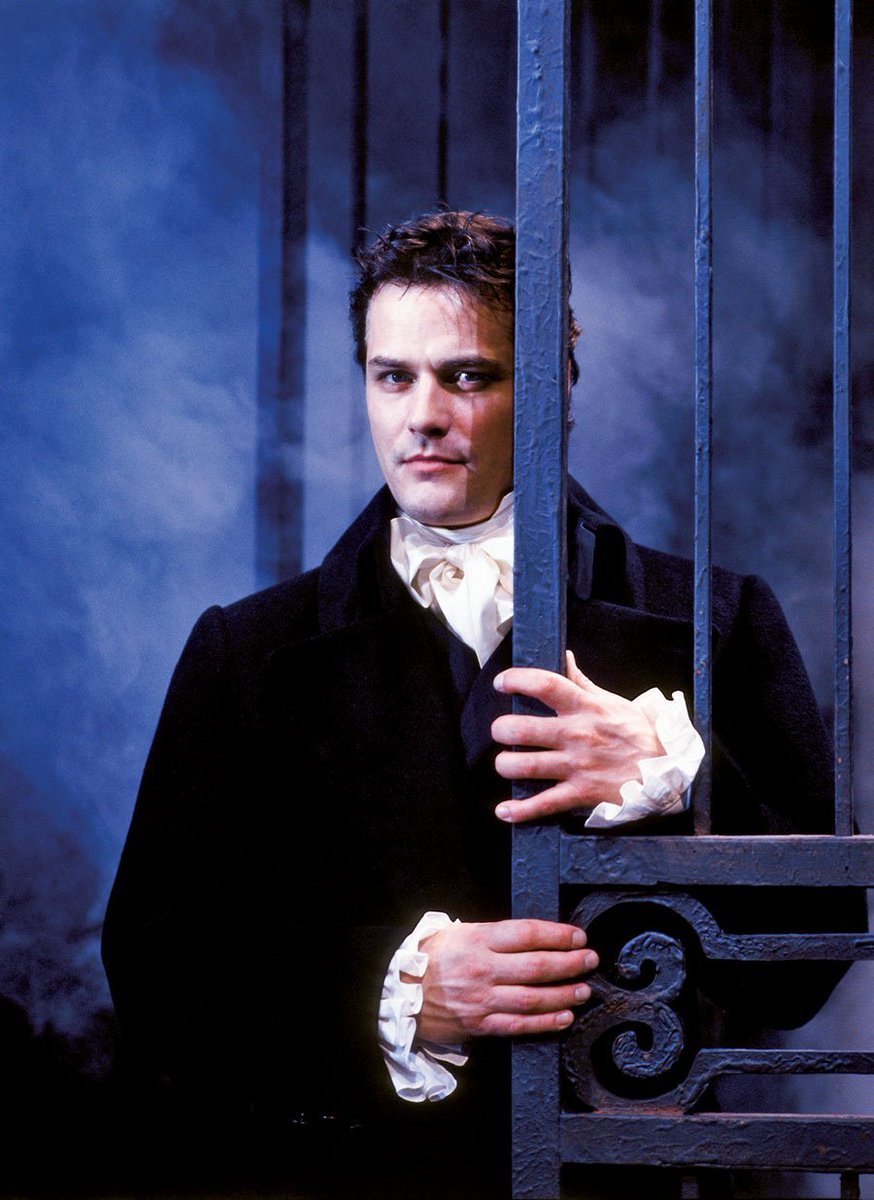
Paul Gross as Geoffrey Tennet
I’ve said before that Gorss gives a kind of animal intensity as Hamlet and Geoffrey, and this is especially true in Season 1. When we first meet him, Geoffrey lost his girlfriend, his sanity, and his career as a respected actor. Then he has to return to the theatre where the man who betrayed him works, and is forced to take over this same theater as Artistic Director.
Geoffrey’s Journey
If you’ve never seen the show before, I should warn you, GEOFFREY IS AN ABSOLUTE JERK in the first few episodes. Like I said, he starts out hating his job and pushing away everyone who comes in contact with him. However, little by little, he re-discovers why he loves theater, Shakespeare, and his friends and colleagues. Look at how he goes from a sarcastic pedant to a real director as he teaches these businesspeople how to act!
Rachel McAdams As Kate
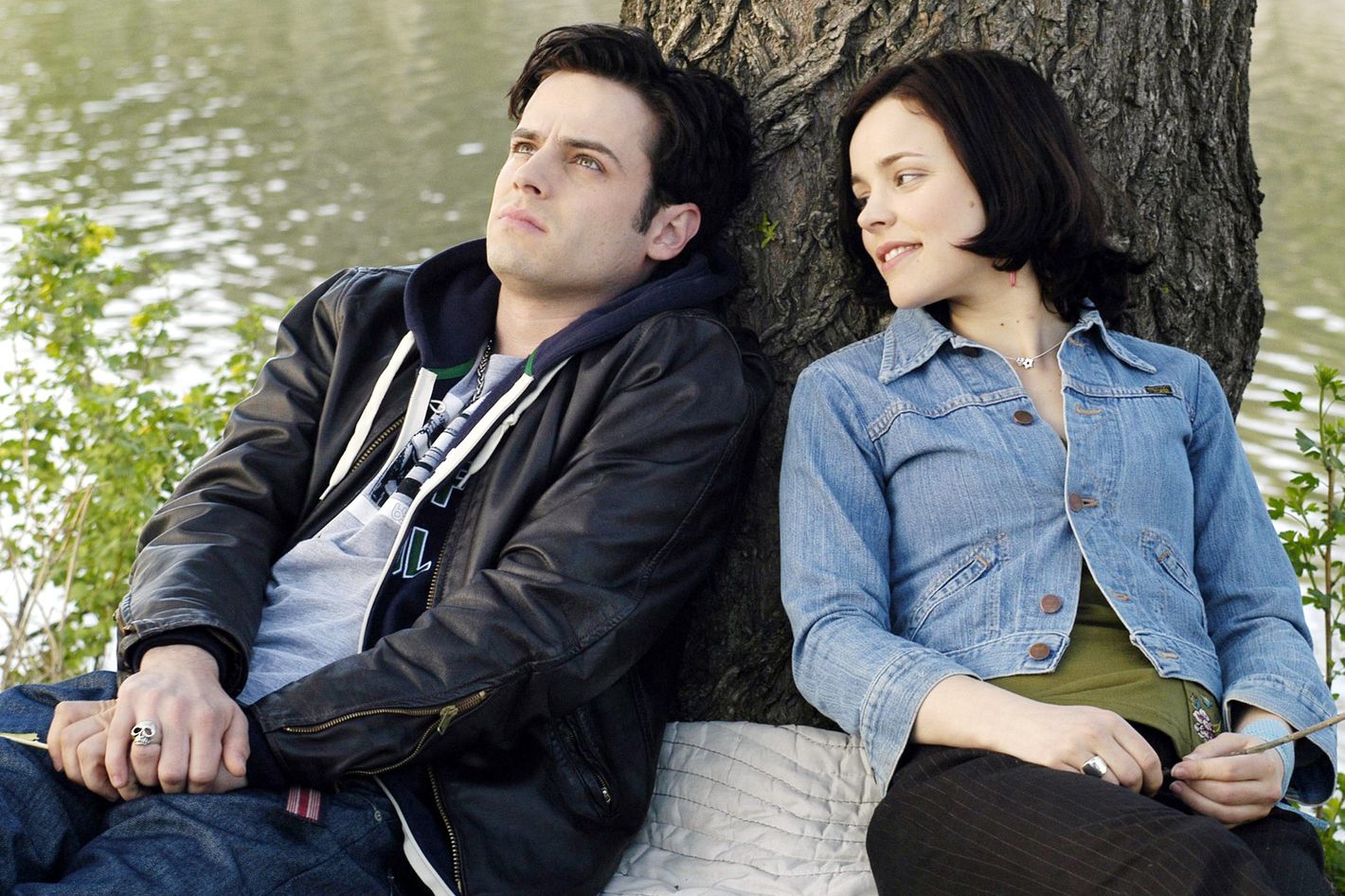
Rachel McAdams and Luke Kirby in “Slings and Arrows”
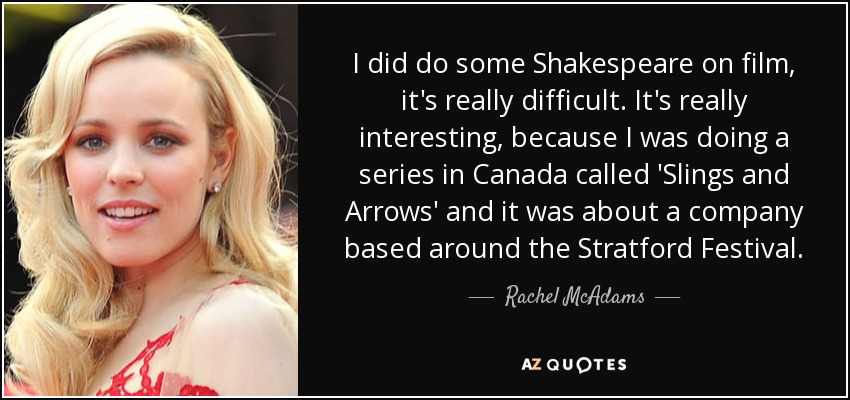
The most truly lovely thing about season 1 in particular, is watching Rachel McAdams’ charming and heartfelt performance as Kate. She plays a struggling actor who deeply loves the theater and dreams of becoming a respected actress. Her dreams are tested however when she falls in love with one of her co-stars and is accused of sleeping her way into a better role.
McAdams is the perfect ingenue in this show: She is naive, charming, Ernest, and kind. You watch Kate struggle and desperately want her luck to turn around and then rejoice when she gets to fulfill her dreams.
As Kate on Slings, she’s the understudy who knows better — happy to be cast, sad that she’s not really cast, and trying not to be bitter that the actual Ophelia is such a wreck. Her smarts and capability of course find her pairing off with Jake (Kirby), who’s more famous but less theatrical.
Slings and Arrows Is the Show Rachel McAdams (and All of Us) Deserved By Margaret Lyons. Vulture Magazine, Aug, 2015.
Then you remember… she was Regina George! It’s easy to overlook how good an actor Ms. McAdams is since she frequently is overshadowed by her co-stars. Much like Ophelia herself, people heap all the praise on Hamlet and forget Ophelia. When I keep in mind the breadth of emotions Ms. McAdams has to portray, and how incredibly different this role is from her role in Mean Girls, I feel compelled to say her acting rivals Paul Gross as Geoffrey Tennet
Season 1 Retrospective
Geoffrey: “Are you dead, or am I insane?
Oliver’s ghost: “I don’t see how those things are mutually exclusive.”
S&A Episode 3
My favorite episodes
I recommend watching all six episodes of Season 1 consecutively, but I can’t deny, some episodes are better than others, especially in Season 1. The first three episodes mainly focus on Oliver’s death and the tragedy of the falling out between Geoffrey, Oliver, and Ellen. This is important for backstory purposes, but it’s a little uncomfortable and sad to watch. My favorite episodes are episodes 4,5 and 6. Here’s why:
Episode 4: Outrageous fortune
After a drunken sword fight at his ex-girlfriend’s house, Geoffrey winds up in jail. This is his rock bottom. He even paraphrases Hamlet’s most famous speech as he contemplates ending it all in his cell. Thankfully, Oliver’s Ghost talks him out of it. Once he’s released, Geoffrey is re-energized and has a new purpose in life- directing Hamlet. Again, after three episodes of Geoffrey hurting, irritating, and sometimes even stabbing people, it’s nice to see our hero do what he was put here to do.
Episode 5:A Mirror Up to Nature
Geoffrey is finally fully committed to making the best Hamlet he can be, but he’s having problems with his Ophelia.
Geoffrey’s star is missing! With the production stalled, Geoffrey and Ellen finally have it out, and finally, share their tragic past with each other. Now the race is on to, “Repent what’s past, avoid what is to come, and fulfill their promise to Oliver.
So I hope I’ve articulated why I love this show and its characters. Just like anyone who’s ever had a boring office job loves and recognizes the characters from “The Office,” those of us in the theater recognize the crazy directors, the hopeful understudies, the divas, and the money-grubbing management. These characters feel like our friends and colleagues and they care so much about the universal dogma of “The show must go on,” no matter what kind of agonizing problems slow it down. Whether it be death, dementia, or a dislocated knee caused by a chameleon. the show within-this incredibly clever comedy about drama will catch your conscience… and your heart.
I’m delighted to share with you my recommendations for the best Hamlets committed to film! I was pretty strict with my criteria which left a few Hamlets out, so if I missed yours, let me know in the comments.
In order to make this list:
I have to have seen the whole thing. Sadly that excludes a lot of unfilmed productions or films I haven’t got around to seeing.
The interpretation has to take a unique stance on the play.
The actor has to have a clear grasp of the part.
I personally have to like it. This is subjective, and I will make it clear if something is my opinion, or if I think this interpretation works for classes or private viewing.
By the way, if you’re a teacher, I’ll be sure to mention which productions work for classes, and which, for whatever reason, do not. I also can recommend Common Sense Media to give you a good idea what age group this film works best for:
So, without any further adieu (get it?):
The Good Hamlets
#10: Arnold SChwarzenegger in “Last Action Hero”
I would love to do a full review of this movie. When it works, it is actually a thoughtful deconstruction of the action movie genre, and as this clip shows, the movie concedes that Hamlet was actually the first great action hero. Schwarzenegger is really funny as an action movie parody of “Hamlet,” and everything he does is pretty cathartic for bored school boys who have to read the play in class. Plus, as a funny easter egg, the teacher in the scene who is showing Olivier’s Hamlet on the screen is played by Joan Plowright, who played Gertrude IN THAT FILM, and was married to Olivier in real life!
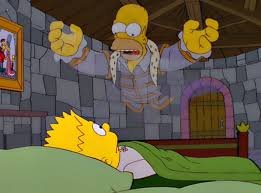
#9: Bart Simpson in “Tales from the Public Domain”
It’s absolutely astonishing how many Shakespeare easter eggs are in this little episode! How they make fun of medieval history, (the Danes were in fact Vikings in the early middle ages), Elizabethan theater, (when Bart does a soliloquy and is surprised that Claudius can hear him), and the way they compress Shakespeare’s longest play into a five minute episode is masterful satire.
In addition, the cast is perfectly chosen among the Simpsons’ core cast. Long-time viewers know that Moe has wanted to sleep with Homer’s wife for years, so making him Claudius is a brilliant choice. Plus, Dan Castellaneta steals the show with his over-the-top performance as the ghost, which actually reminds me of a 1589 review of Hamlet by Thomas Lodge:
“[He] walks for the most part in black under cover of gravity, and looks as pale as the vizard [mask] of the ghost who cried so miserably at the Theatre like an oyster-wife, Hamlet, revenge!”
THOMAS NASHE, “PREFACE” TO ROBERT GREENE, MENAPHON, (1589)
In any case, this clip is a great way to introduce anyone to Hamlet and I highly recommend it.
#8: Austin Tichenor in “The Complete Works of Shakespeare- Abridged”
Part 1 of a 4 part series of clips from “The Complete Works Of Shakespeare (Abridged)” Starring Austin Tichenor, Reed Martin, and Adam Long.
This show is very special to me- in around 1997 my parents went to England and brought home a copy of The Complete Works of Shakespeare (Abridged). I’d only read “Romeo and Juliet” previously and through this show, I gained an appreciation for all of Shakespeare’s plays. Seeing the plays through parody made them seem less lofty and stuffy, and made me want to see and read the original works. This is especially true for “Hamlet,” which occupies the second half of the show, where Hamlet is portrayed by Austin Tichenor.
Tichenor wins my award for “Hammiest Hamlet,” which is just delightful to watch. He clearly takes the part WAAAY too seriously, as evidenced by how emphatically he demands solemn silence from the audience while he attempts to do “To Be Or Not To Be.” Tichenor also serves as the pedantic straight man who tries to keep the show moving and academic, while mediating between his bickering co-stars Adam and Reed. This wonderful Three-stooges dynamic makes every minute of the show fun and frenetic. However, the cast makes it very clear that they are making fun of Shakespeare with love; they never mock the play, they inform as well as entertain, and occasionally they even move the audience as Adam does at the end. In short, this show helped me form my approach to Shakespeare, and it’s largely through Tichenor that I read Hamlet at all, so he’s to blame for this website.
#7: Richard Burton, 1964 (stage production directed by John Gielgud).
With the advent of TV and film making theater seem obsolete, directors knew they had to do something drastic in order to get people to come to the playhouses. Enter John Gielgud, one of the greatest Hamlets of the early 20th century, who directed Richard Burton in a highly-acclaimed production with minimum sets and with actors wearing rehearsal clothes. The idea was to let Shakespeare’s words and the actors’ performances be the focus, and save spectacle for film and TV. This approach has been adopted by many theater companies since, including a few I’ve been a pat of.
Burton has a lot of energy and manic physicality in his portrayal and it makes his Hamlet engaging to watch. Plus Gielgud himself as the ghost is almost operatic to hear. I highly recommend any theater fan to watch it, though it might not translate in a classroom much.
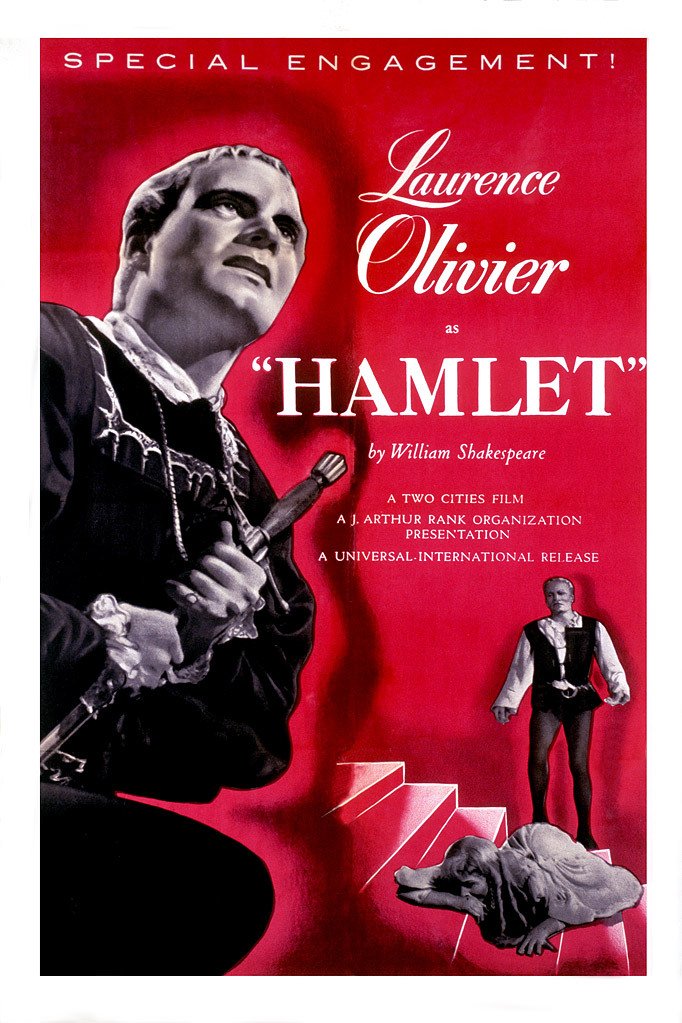
# 6: Laurence Olivier, (Film 1948)
I have my issues with Olivier as an actor and apparently I’m not alone:
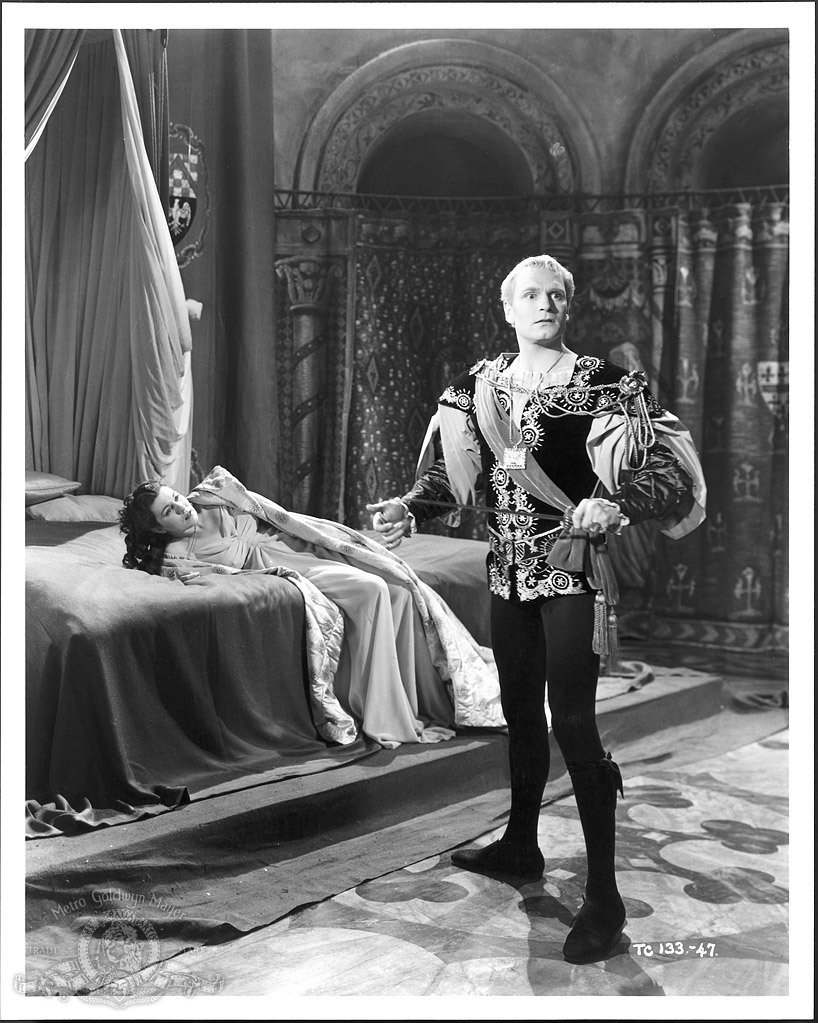
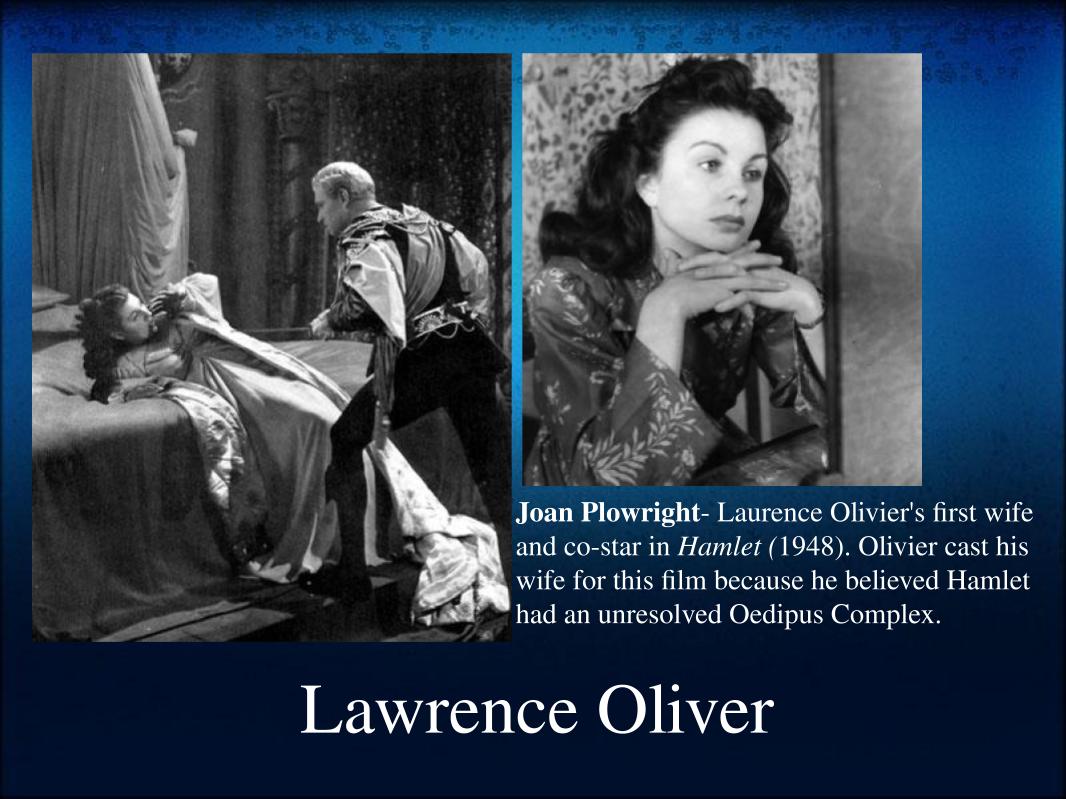
I find Olivier’s acting over-the-top, lacking in emotion and subtlety, and I think his directing is generally self-centered. He rarely deigns to give close-ups to anyone but himself and a lot of the scenes he directs are filmed like stage plays. That said, Olivier’s Hamlet is really good. SIr Laurence talked to Ernest Jones about the theory that Hamlet might have had an Oedipus Complex and created a unique and well-thought-out interpretation for his Hamlet. First off, casting his real-life wife Joan Plowright as Gertrude, fills the Closet scene with uncomfortable tension. He also did a great job making the ghost seem as imposing and accusatory as possible, as well as making Claudius as disgusting as possible.
You get the idea that this film is how Hamlet sees the world with its dark and shadowy towers, representing Hamlet’s melancholic mind, his imprisoned spirit, and his dark desires. Also as many people have pointed out, Gertrude’s bed chamber looks like a female organ, making the Oedipus theory even more explicit.
Even I have to admit that Olivier nailed the “To Be Or Not To Be,” Speech. He squirms at his own Oedipal fantasies, and contemplates jumping off the battlements in a captivating and subtle way. The performance and cinematography is iconic, and it makes me grudgingly admit Olivier, for all his faults, is still one of the best Hamlets of all time.
I would recommend this film to every Shakespeare film fan and any hardcore Shakespeare scholars. I would caution against showing the whole thing in a class however, since it’s black and white, and again, I find Oliver’s delivery very old-fashioned.
#5: Paul Gross, (StratforD Festival, 2000)
Thus far, I’ve mainly reviewed British and American Hamlets. Paul Gross is one of Canada’s most celebrated actors who gained fame as one of the best Hamlets at Toronto’s Stratford Festival. Unlike most Hamlets who go for the humanistic prince version of Hamlet, Gross plays him with sort of an animal intensity, like a wounded bear who will growl at you if you get in his way.
I have to admit I broke my own rule with this one- I haven’t really seen Gross’ portrayal, but I believe I saw it well-represented in his role as Geoffery Tennent, the Shakespearean Actor-turned madman-turned director in the Canadian TV show “Slings and Arrows.” This amazing dark comedy portrays the ins and outs of a Shakespeare Company from the normal problems of mounting a play to backstage drama, even the funding and marketing gets focus! Basically, the show is The Office for Shakespeare nerds, except for one ghostly cast member (no spoilers).
4. Benedick Cumberbatch / John Harrell
I couldn’t make up my mind between these two Hamlets, so I’m listing them together (guess that makes me Hamlet too). One is one of the most accomplished Shakespearean actor in recent memory, an RSC alumn, and a Hollywood star to boot, Benedick Cumberbatch.
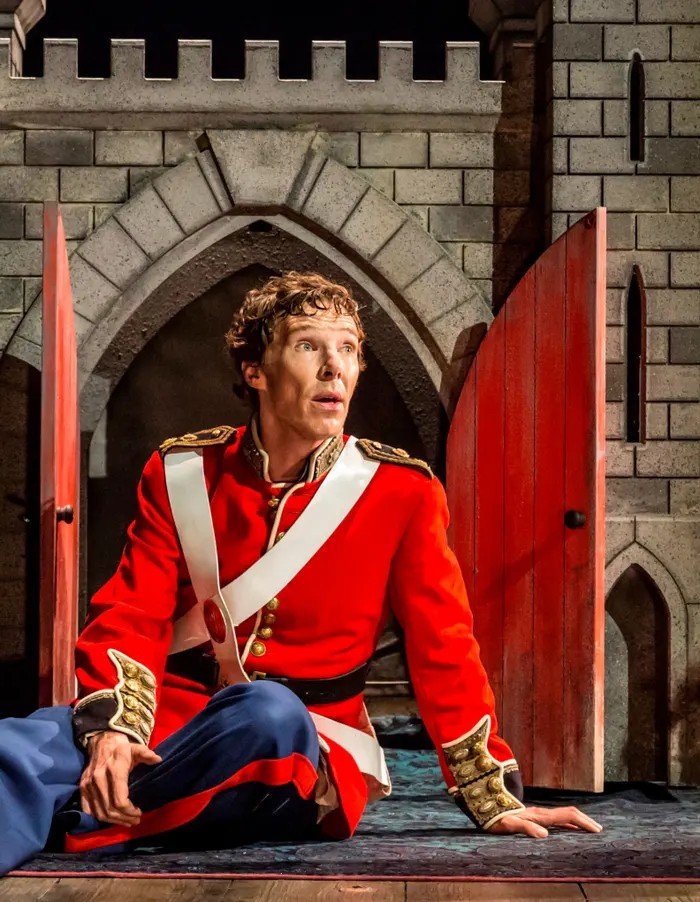
Left- Benedick Cumberbatch as Hamlet, National Theater. Right- John Harrell at the Blackfriars Playhouse, Staunton VA.
Both these actors have similar strengths- they’re both tall and imposing with aquiline features. They are also highly physical performers. I talked in my lecture on Richard III about how Harrell performed the role of Gloucester with his legs tied together and a bowling ball strapped to his hand. Appearance-wise- Harrell and Cumberbatch are so similar, that it’s actually a joke at the ASC that they must be long-lost twins.
That said, when it comes to their approach to Hamlet, these two actors couldn’t be more different. Cumberbatch focused on Hamlet’s emotional turmoil- he was tortured and angry, full of youthful angst and volatility. This particular production is sort of an anachronistic mash-up of modern and period, which gives it a sort of dream-like quality that I really enjoy. Like Richard Burton, the director knows how to stage a play differently from a movie or TV show, which is especially important with this actor, since we can see him on all those platforms.
Nor should they have. Full of scenic spectacle and conceptual tweaks and quirks, this “Hamlet” is never boring. It is also never emotionally moving — except on those occasions when Mr. Cumberbatch’s Hamlet is alone with his thoughts, trying to make sense of a loud, importunate world that demands so much of him.
John Harrell on the other hand is a more mature and subtle Hamlet, more interested in saving his hide than contemplating his navel. This Hamlet masks pain with humor and sardonic wit and it translates to all his relationships with the King, Queen, and courtiers.
John Harrell as Hamlet, American Shakespeare Center, 2011
Rather than a sour, dour, morose, obtuse, naval-gazing Hamlet, this prince was cunning, cynical, devious, sarcastic, and very much enjoying his feigned madness, his chess game with the king, and his fencing bout with Laertes.
OK, I have to admit that I didn’t see this whole production either, but it’s so cool and the acting is so good I wish I had! Papaa Essiedu is an electrifying blend of wit, sadness, manic excitement, and rage. His fresh take on a role that can be rather dour is why even the little I’ve seen of his performance makes it one of my favorites!
#2: David Tennet, RSC 2009
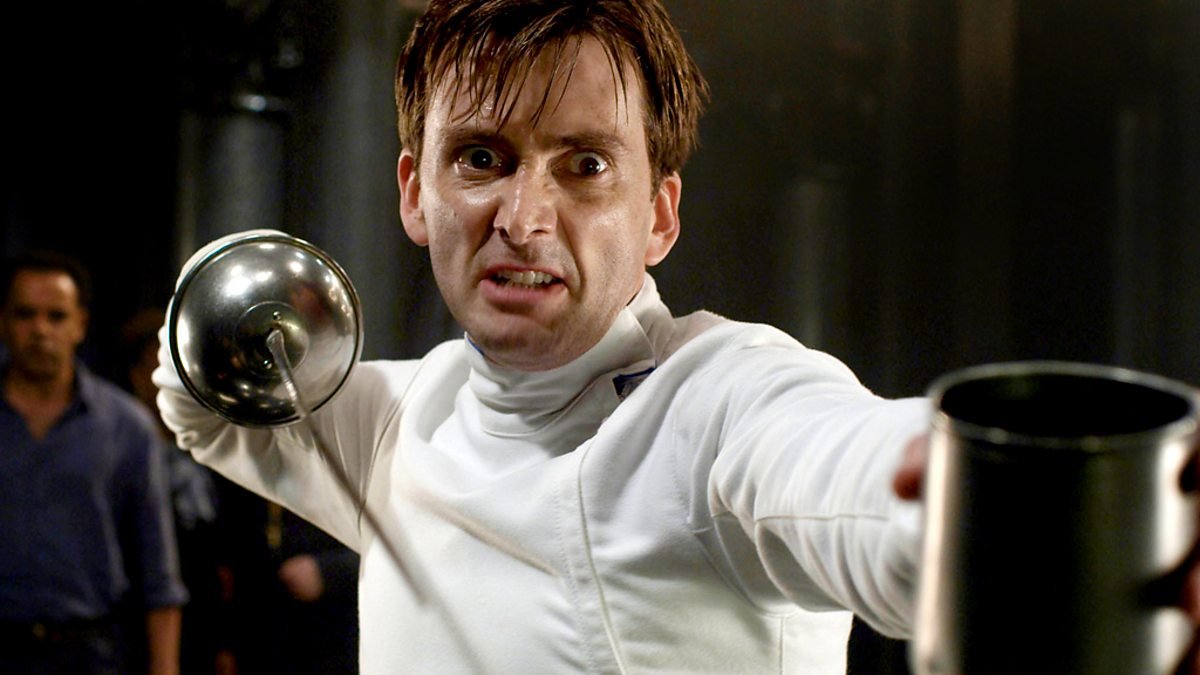
Tennet does an incredible job of encapsulating Hamlet’s quick wit, giddy excitement, frailty, fury, and frustration, especially with himself. I love the fact that he does “To Be Or Not To Be” in a superhero T-Shirt. In a way, this Hamlet is constantly wishing he was more of the action-movie type that Schwartzenegger parodies at the top of this list. Like Harrell, Tennent’s Hamlet masks his pain with humor, but you can see him struggle with it and try to pull himself out of despair. All these Hamlets find a way to nail at least one aspect of the character, but Tennet in his short 3 hours on the stage, manages to highlight all of them.
I recommend this version for any viewer in any classroom. It’s beautifully shot, extremely well acted, fast-paced, funny, and exciting. I cannot recommend it highly enough.
Honorable mentions: Anton Lester, Ian McKellen, MiChelle Terry, and Sir John Gielgud
I haven’t seen any of these Hamlets and have been unable to locate any clips, but I have the deepest respect for all of these actors, so I thought I’d highlight them here.
I’d also like to give special mention to Michelle Terry. Gender-blind productions of Shakespeare get a lot of flack that is undeserved, and there’s nothing wrong with a female Hamlet. To quote Geoffrey Tennet in Slings and Arrows: “Shakespeare didn’t care about anachronism, and neither should we.”
I didn’t include Ms. Terry in this list, simply because I wasn’t able to get to the Globe, and I wanted to focus on productions that people can watch for free. If you wish, you can watch her 2018 performance on the Globe Theater’s steaming website:
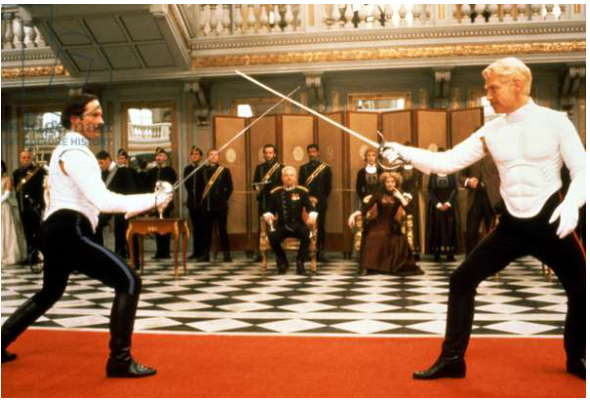
Hamlet (Kenneth Branaugh) duels with Laertes (Michael Maloney) in Branaugh’s 1996 film.Stills from Kenneth Branaugh’s Hamlet (1996).
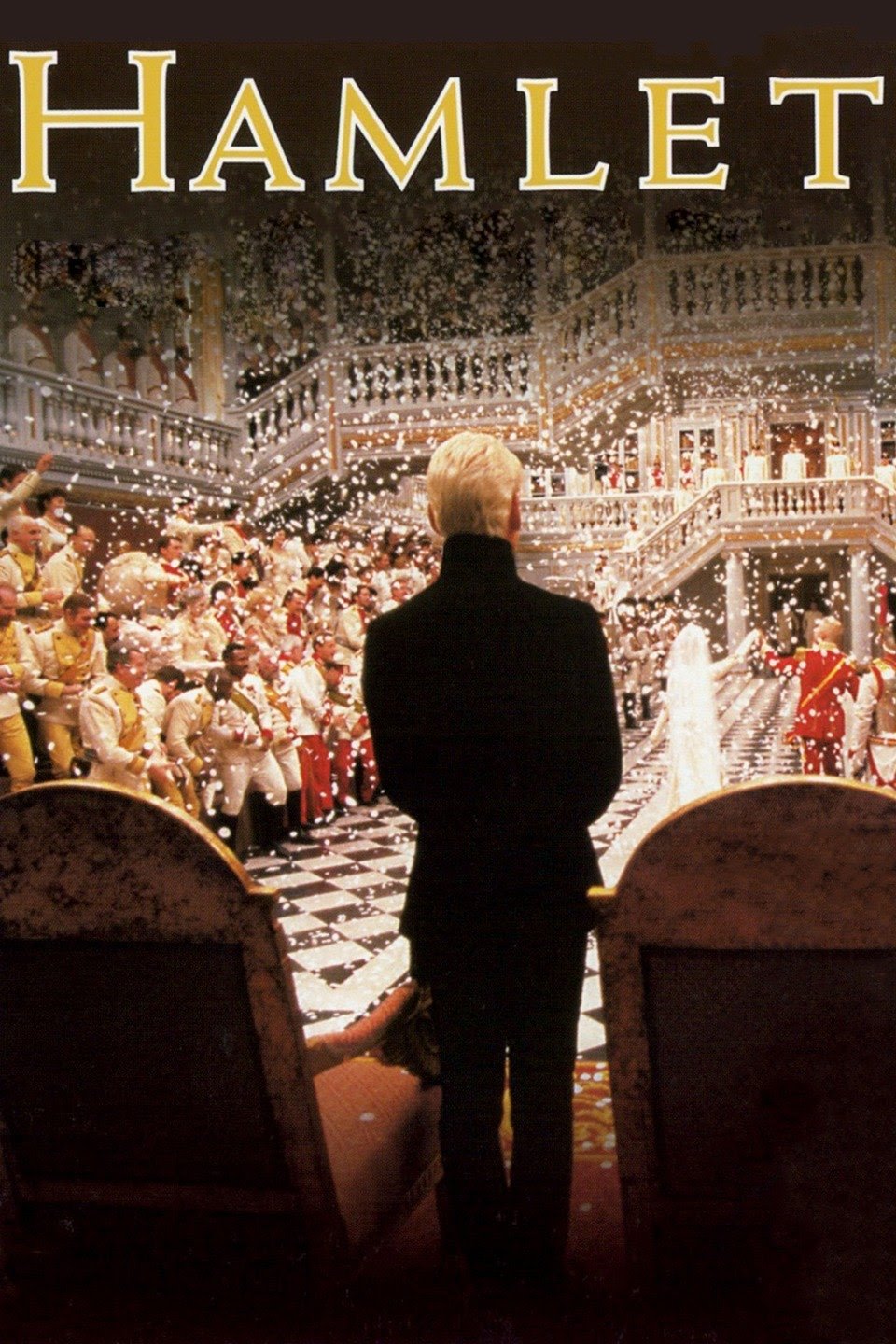
You probably saw this coming. I’ve made it clear in other posts that I absolutely love Branaugh’s Hamlet, after all his film was one of the first Shakespeare movies I ever saw and the first one I really enjoyed. I discuss in detail why I love this movie the best in my review of the film, but to summarize, I think the direction is incredible, the music is excellent, the cast is nearly perfect, and Branaugh himself puts a huge amount of love, craft, skill, experience, and maybe a little madness into his portrayal of the character. I know Branaugh isn’t everyone’s cup of tea; other Hamlets on this list might be more enjoyable, fun, or subtle, for you. But for me, Branaugh’s will always be my favorite.
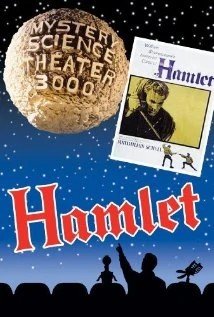
Mystery Science Theater 3000 has been on the air for over 20 years. The show originally aired in 1988 on KTMA TV in Eden Prairie MN. Since then it’s spawned over 13 seasons, (still going strong on Netflix), a huge cult following, and countless parodies in many versions of pop culture.The premise is that three guys watch bad movies and make sarcastic comments about the acting, sets, costumes, etc. The show thrives on meta-commentary, obscure references, and satirizing anything and anyone.
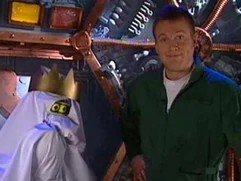
Crow T. Robot (Bill Corbit) trying to play the ghost of Mike’s father (Michael J. Nelson)
Full circle for the show
Kevin Murphy (right), as Fortinbras, who makes a brief appearance at the end of the episode, along with Bill Corbit and Mary Jo Pehl.
Kevin Murphy, one of the show’s creators actually had reservations of even doing the episode, as he is a big Shakespeare fan. This makes sense as I would argue that the very premise of the show lies in Shakespeare, and in particular, Hamlet. As I said in the last paragraph, the show thrives on reference humor, meta-commentary, and satire, and one person who loves that kind of humor is in fact, Shakespeare’s own drama critic- Hamlet, Prince of Denmark.
In Act III, Scene ii of Hamlet, there is a play within a play, where Hamlet sits back and makes sarcastic comments about how bad the production is:
Enter Prologue.
Hamlet. We shall know by this fellow. The players cannot keep counsel; they’ll tell all. Ophelia. Will he tell us what this show meant?2035 Hamlet. Ay, or any show that you’ll show him. Be not you asham’d to show, he’ll not shame to tell you what it means. Ophelia. You are naught, you are naught! I’ll mark the play. Pro. For us, and for our tragedy, Here stooping to your clemency, We beg your hearing patiently. [Exit.] Hamlet. Is this a prologue, or the posy of a ring? Ophelia. ‘Tis brief, my lord. Hamlet. As woman’s love.
Hamlet, Act III, Scene ii
If Hamlet had two robot companions, he’d essentially be doing an episode of the show!
Begin Murderer! Pox! Leave thy damnable faces and begin!
Hamlet, Act III, Scene ii.
So it’s an interesting kind of irony that after 13 years, MST3K finally got around to review the very source of their humor. Not only is Hamlet highly meta and satirical, Many educators, myself included, say that teaching Shakespeare with a healthy dose of irreverence is a good way to draw in new students and get them interested in the play:
Mystery Science Theater 3000’s “Hamlet ” episode reveals a common reaction to Hamlet that often goes unspoken by high school and college students too afraid to sound anti-intellectual. Despite this irreverent tone, however, this unique appropriation of Shakespeare adds to our understanding of a play that today very few read and even fewer see performed. As an author who reveled in making serious, yet sometimes playful, fun at human weakness, I think this respectful irreverence would have delighted the Bard were able to see it.
Dan Mills. “Mystery Science Theater 3000, Shakespeare, and Postmodern Canonization,” Interdisciplinary Literary Studies, 17.2 (2015): 206-227.
3. Divisive episode
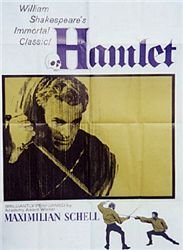
Original film artwork for “Hamlet”, 1961
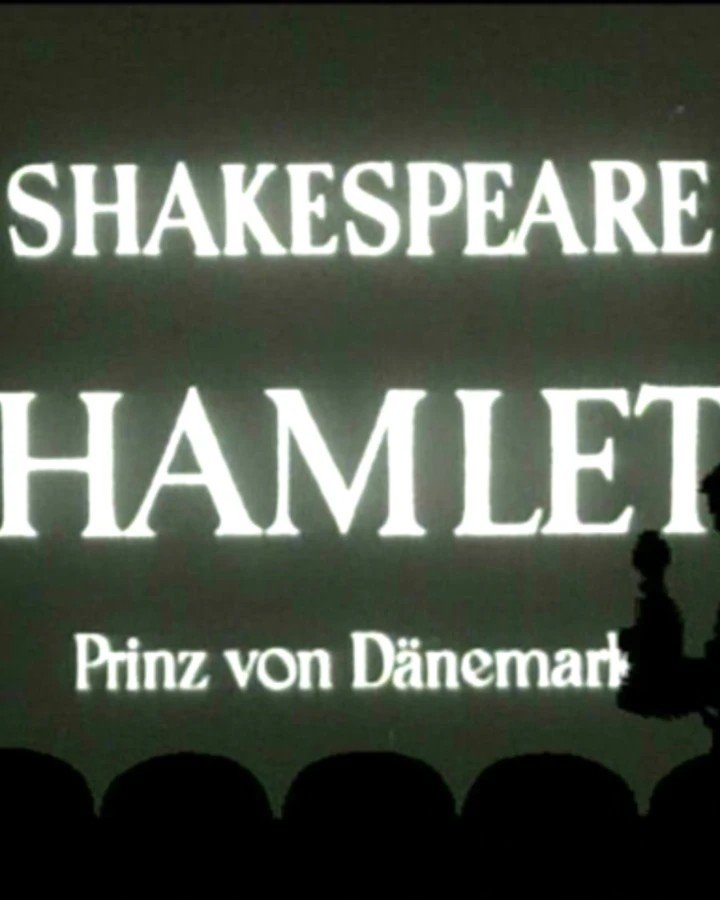
This episode is somewhat controversial among the MST3K fandom. While almost everyone agrees it was a good idea for Mike and the bots to do Shakespeare, many fans question the choice to do this Shakespeare. The 1961 film was produced for German TV, and starred Maximillian Schell, (who would later win an Oscar for his performance in “Judgement at Nuremberg).”
First of all, the film is very slow and badly paced with no distinctive production choices. The sets and costumes are generic, (except for the Liberace-looking ghost), and the cinematography is competent but dull. Finally it’s Hamlet; the play that even Mike Nelson called “The greatest work of fiction ever written.” Even with the dreary set, the bad dubbing, and nonexistent pacing, it’s still a good story with magnificent dialogue, and the cast is still pretty good. Perhaps the ultimate backhanded compliment Mike Nelson and company could have handled is that even the worst production of Hamlet is very difficult to riff. Still, when the jokes land, they hit extremely well. Here are some of my favorites:
C’mon, man. We’ve seen like eight ghosts, none of ’em have been even close to my dad. MIKE NELSON
Rap artist, The Notorious K.I.N.G.”
Hamlet: To die: to sleep. Crow: Yeah, that’s what we’re doing right now, Bub.
Hamlet: TO BE OR NOT TO BE…. and lose the name of action.
Mike: So I’m a chicken for not stabbing myself—that’s all you needed to say!
[Having stabbed an intruder behind Gertrude’s tapestry, Hamlet discovers it is not the King, but Polonius.] Hamlet: Thou wretched, rash, intruding fool! Crow [as Polonius]: Oh, right, it’s my fault you killed me.
My reaction
On the one hand, it’s great to watch the MST3K guys look at a piece of classic theater, especially since the show owes a lot to Shakespeare. That said, they never acknowledge this, not even during the play within a play scene. In addition, the critics are right that the film is so dreary it’s hard to make fun of. I would love to see how the bots and Mike riff on Branaugh or Gibson! Finally, maybe part of the problem was that Hamlet has already been riffed and mocked before. As the clip above from The Reduced Shakespeare Company shows, gently ribbing on the plot and characters of Hamlet has been done before. Once something becomes famous as the best or the worst, it becomes a target for mockery. I was hoping that my favorite riffers would have more fun riffing on the play that helped create their art form. That said, this show is a classic comedy series, and this episode always makes me smile.
Giant Skull art as part of Area 15. Hamlet would be dazzled.
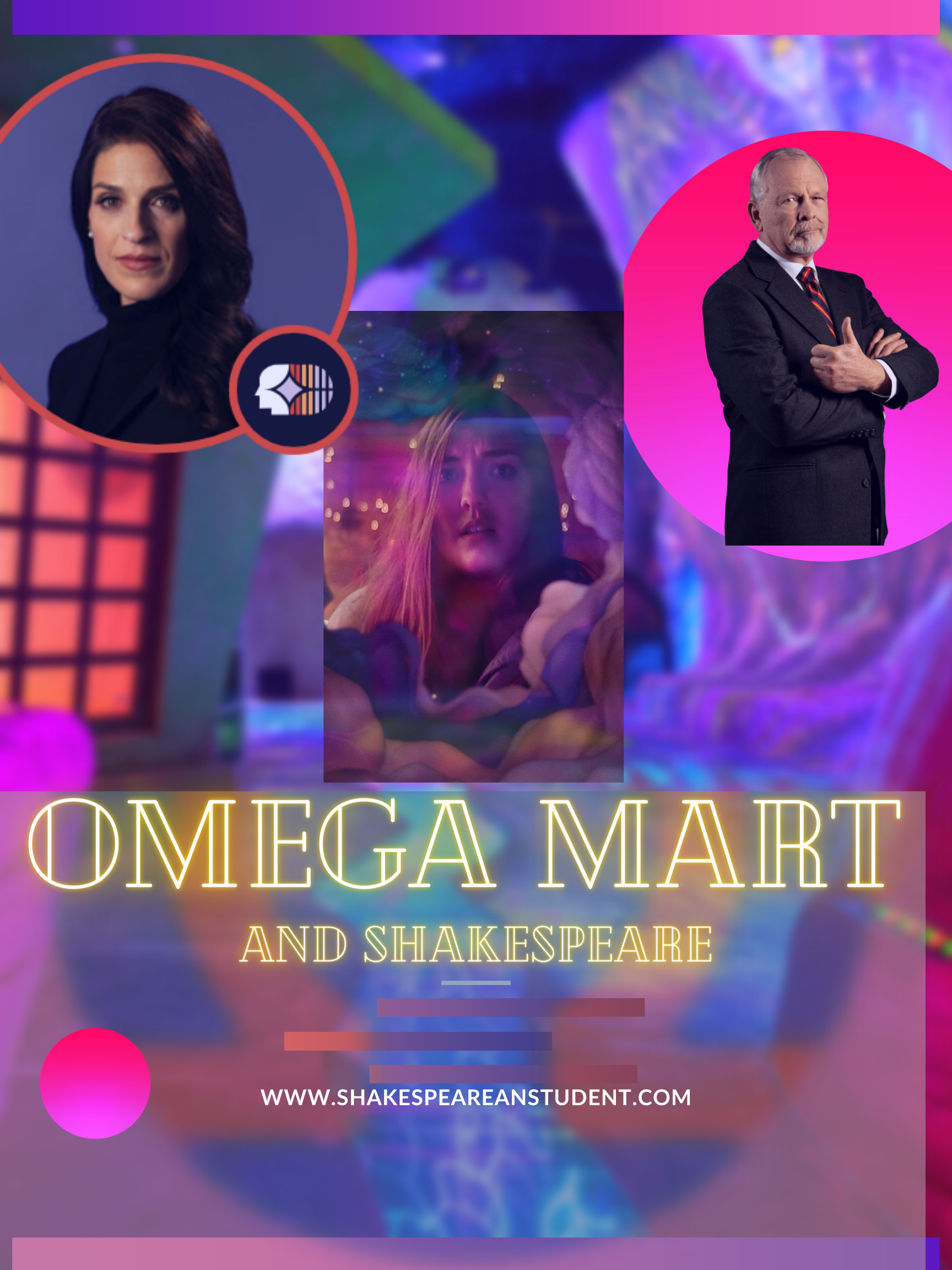
I just got back from Las Vegas where I had a simulating, terrifying, and extremely engaging trip to the Meow Wolf Area 15! If you haven’t heard of them, Meow Wolf is an arts and entertainment group which specializes in creating multimedia experiences, and their most popular and mysterious installation is their apocalyptic grocery store, Omega Mart.
Even if you’ve never been to Omega Mart, you might have seen their website, their ’employee training videos’, or the music videos that have been floating around the Internet. My journey began when I saw this video by the YouTube channel Food Theory. After seeing this video, I, like Matt Pat was compelled to go there myself and discover what Omega Mart was like.
My handwritten notes about the mysteries of Omega Mart that I wanted to explore once I got there.
“We take a lot from open world games [where] you can play the story lines or you can just mess around. We like giving people that optionality (sic). If you’re a 5 year old kid and you aren’t into reading a bunch of material, you just want to run around and treat it like a playground, and that’s totally fine.”
Vince Cadleback, CEO of Meow Wolf
Video artwork that was projected on the wall of the Forked Earth room
A Note about the experience
Meow Wolf’s CEO has stated that the experience of Omega Mart is ultimately up to you. Similar to Sleep No More, this art installation (and it is an art installation) is much like an experiential theater experience in that there is no proscenium, and you do not sit down; it is not a passive watching experience but an active mystery. In Sleep No More, you followed various actors and watched them act out scenes in front of you. In Omega Mart, the story is more epistulary, meaning that there are no live performances, but you can unlock the story at your own pace through reading journal entries, corporate memos and websites, mini-games, and of course, actors performing in corporate videos, commercials, and even security footage. Like a modern video game, you can just walk around the open world and enjoy it, or you can unlock all the lore and piece together the mystery of Omega Mart yourself. This is story a story that is rife with greed, personal tragedy, family drama and maybe even murder. So of course my Shakespeare brain activated, and I wanted to see if I could find some Shakespearian tropes in the story of Omega Mart. I should mention that this kind of experience is often best when you let it become a surprise, so if you truly want to experience Omega Mart without spoilers, stop reading….
STOP RIGHT NOWSTOP RIGHT NOWSTOP RIGHT NOWSTOP RIGHT NOWSTOP RIGHT NOWSTOP RIGHT NOWSTOP RIGHT NOW RIGHT RiGHT St0p R$GHT N00000W!
OK well if you’ve continued reading grab your tattoo chicken, apply your whale song deodorant and let’s get going!
The Characters
The drama of Omega Mart focuses on a single family, the Dram family: Walter, Charlie, Cecilia and Marin Dram. As you go through the various exibits in the Meow Wolf installation (not just the OmegaMart store), you begin to piece together what happened to them, how this family broke apart, and what Shakespearian tropes can we see within this story.
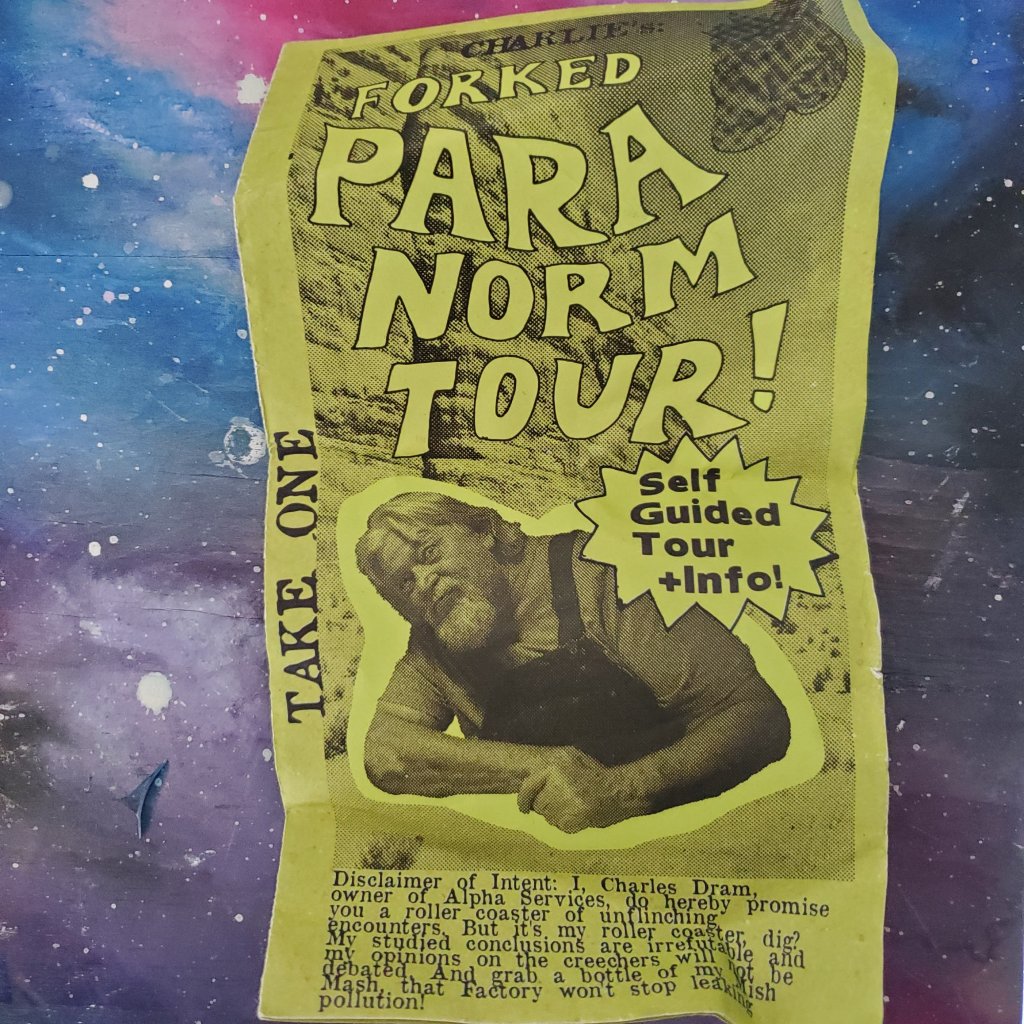
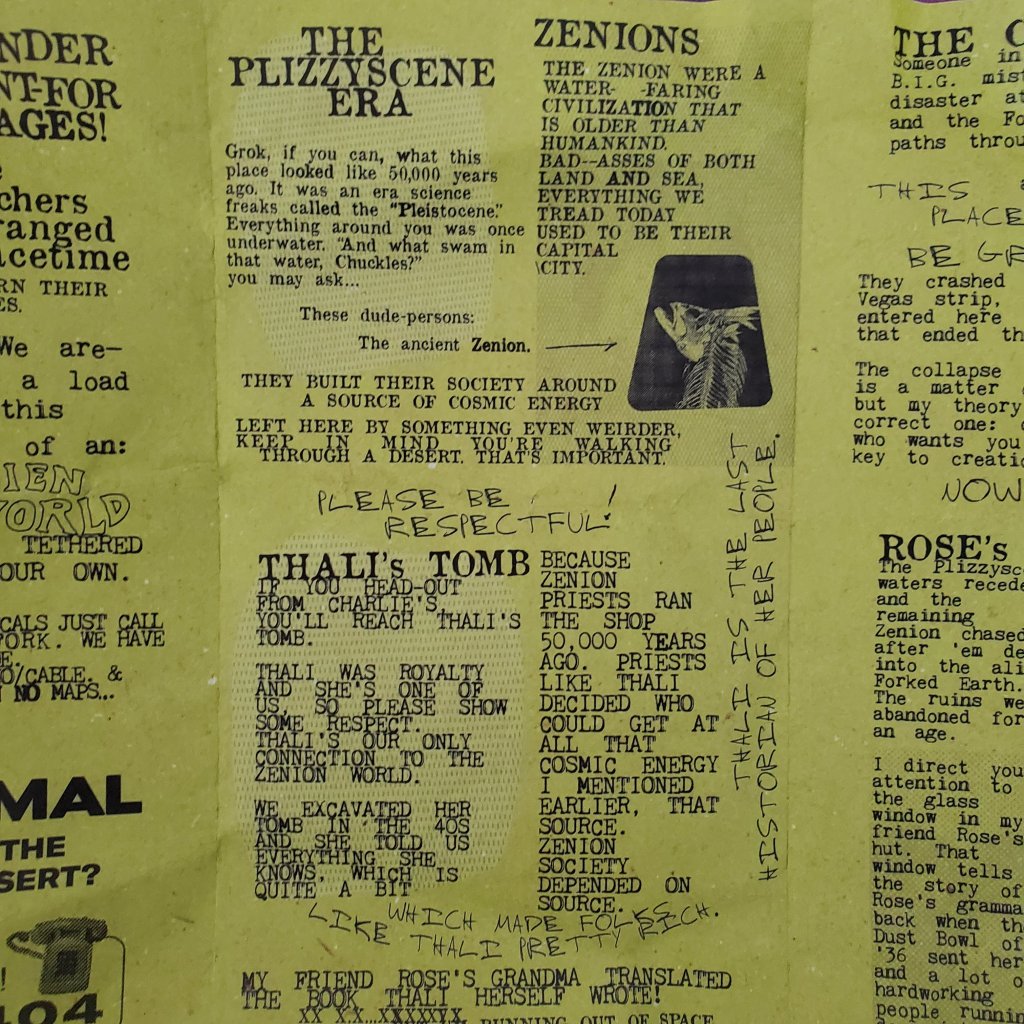
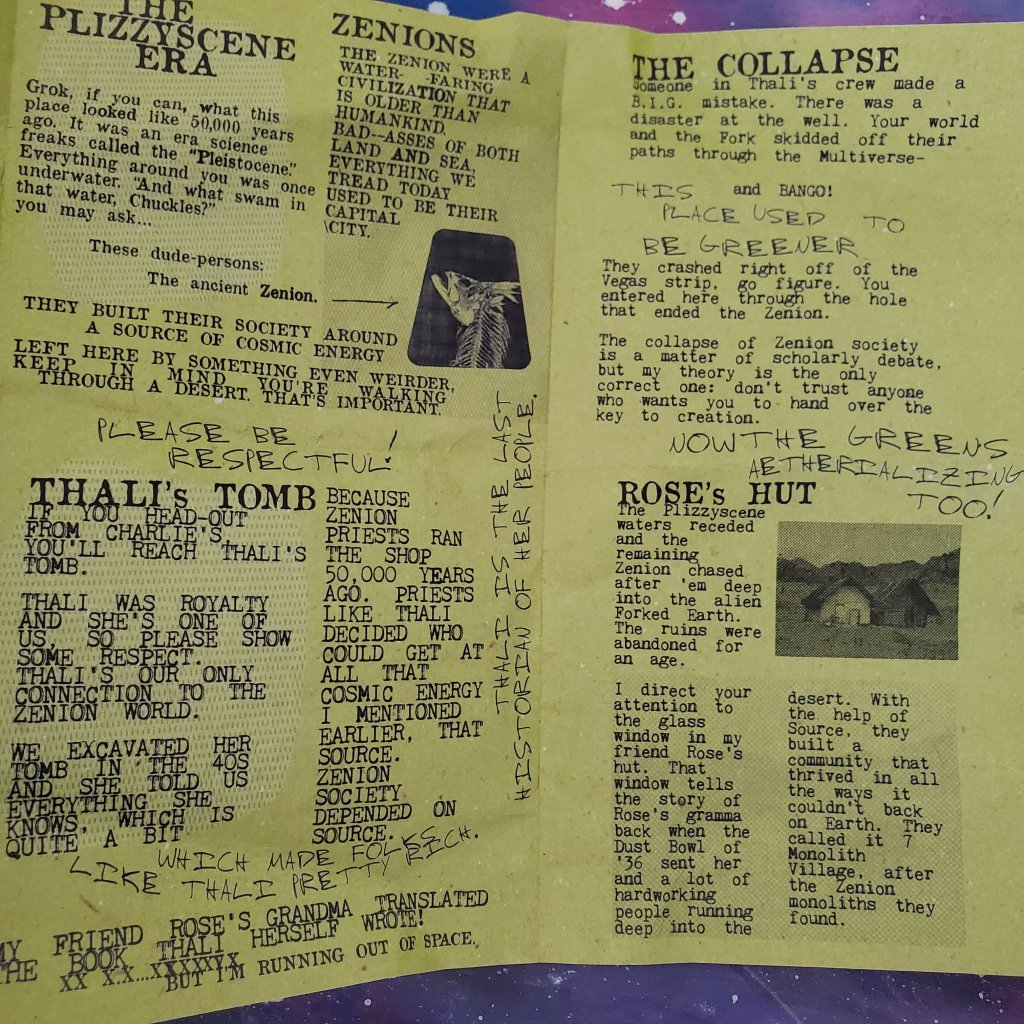
Charlie Dram: Sir John Falstaff The whole story begins with Charlie Dram; an old garage attendant who lives in the fictional town of Seven Monolith Villiage in Nevada. As you can see in the brochure I photographed above, Charlie runs a small tourist attraction where he guides tours allowing people to see The Forked Earth- a dimensional rift between our world and an alien planet, that is also the fount of a powerful and dangerous place called The Source Well. At some point, Charlie goes into business with his family, who eventually cut him out of their lives.
Henry V. I know thee not, old man. Fall to thy prayers. How ill white hairs become a fool and jester! For God doth know, so shall the world perceive, That I have turn’d away my former self; So will I those that kept me company.
King Henry IV, Part II, Act V, Scene 5.
Walter Dram, CEO of Dramcorp
2. Walter Dram: King Lear. This being America of course it was inevitable that somebody would try to capitalize on the Source Well, specifically Walter dram Charlie's brother Walter. Mr. Dram, the CEO of Dramcorp found a way to harness the source and use it. It's not explicitly stated but it's highly implied that he took the Source to a place called Plenty Valley and started using it to revitalize crops out in the Las Vegas desert.
After harnessing The Source, Walter found that he was able to create produce that had unusual properties and from there he opened his grocery store, Omega Mart. If you go to the store, the products seem just a little off- they all have peculiar names, seem to have peculiar properties and in some extreme cases they seem to have inhuman properties like like lemons that are alive!

Charlie calls these creatures  "mascots;" creatures that have that seem to be living cereal boxes. The source seems to have unpredictable and uncontrollable effects on natural products but because every Omegamart produce is doused with Additive S (which is Walter's addictive additive made from The Source), customers don't seem to care if they become addicted to any products that are laced with The Source.

Walter finds himself extremely rich and successful and opens up his corporation Dram Corp in 1977. Decades later in 2020, Walter promises to make his daughter Cecilia Dram his sucessor when he retires, but at some point, he must have reneged on that promise, proclaiming Kaz Matzumora the future CEO. What happened to accelerate the fallout between Walter and Cecilia, we're not sure, but it's quite possible that it has something to do with Cecilia's daughter Marin.
Better that thou hast not been born, then not to have pleased me better.
King Lear
So we have a rich and successful man, who, now that he’s getting old, desires to pass his empire on to younger people, including his daughter. At the same time, he refuses to let go of power, and is willing to throw family under the bus to get his way, as he did with Charlie, and would have done with Marin, (more on that later). Let’s just say, it is very easy to spot the parallels between Walter Dram, and King Lear. Look at this video below where Walter seems to repent for his greed and abandoning his family, though it takes place in an ethereal prison.
Lear. Pray, do not mock me. I am a very foolish fond old man, Fourscore and upward, not an hour more nor less; And, to deal plainly, I fear I am not in my perfect mind. Methinks I should know you, and know this man; Yet I am doubtful; for I am mainly ignorant What place this is; and all the skill I have Remembers not these garments; nor I know not Where I did lodge last night. Do not laugh at me; For (as I am a man) I think this lady To be my child Cordelia.
King Lear Act IV, Scene vii.
When I watched the Film Theory about Omega Mart, I thought Walter was like King Duncan in Macbeth, and his daughter Cecelia was Lady Macbeth, killing Walter to gain his power. The truth though, is much more complicated, and it centers around Walter’s granddaughter, Marin.
2. Marin Dram: Cordelia from King Lear, Miranda from The Tempest
if you look at the videos in Charlie’s office you can see Cecilia Dram (Walter’s daughter), drinking the Source. Within a minute she starts having cramps, and convulsions; she has been literally impregnated by the Source! Her daughter Marin was conceived by Cecilia Dram and the Source. But, there’s a catch; Marin, because she was created from the Source, cannot be too far from the Source Well. So, rather than living with her her mother and grandfather at Dramcorp, she’s forced to live in a yurt in Seven Monolith Village, very close to the Source Well.
Tarot cards found in Marin’s desk.
Marin’s diary expresses a deep sense of loneliness and a desire to explore the world, not unlike Prospero’s daughter Miranda in The Tempest. She also expresses romantic feelings for Rose, a girl who lives in Seven Monolith, (who according to Charlie, is the granddaughter of a woman who successfully translated the language of the aliens who created the Source Well). The wonderful music video “Marin’s dream” playing below, shows cogent references to Marin having bisexual feelings for Rose and fear towards her mother. This is partly because, since Marin is connected to the Source and her family has been exploiting The Source for profit, she is fearful that her mother will exploit her for her Source-given powers .
We are such suff as dreams are made on, and our little life is rounded with a sleep
Prospero- The Tempest
It is further revealed that Marin is capable of creating living creatures with her own mind because of her connection to the Source. Below is a drawing by Marin of a hamster which then came to life in 7 Monolith! These powers make Marin highly desirable to both Celia and Walter. As Charlie mentions in the brochure, there are living product creatures called mascots and it seems likely that Marin is literally creating these creatures in her sleep!
At the end of the music video you can see Marin going through a portal in the wall. In Seven Monolith you can access numerous posters, emails, and phone calls that discuss and speculate about Marin’s disappearance. Some say she ran away from home, some say she was violently sucked into the portal, but the music video makes it very clear that Marin Dram chose to leave Seven Monolith Villiage, and to leave our universe as we know it. Why? It probably has to do with her mother, Cecilia Dram.
Cecilia’s letter to Charlie, May 2017
Cecelia Dram: Goneril and prosperO
Like I said before, I was expecting Cecelia to be the villain in the story- a power-hungry “thankless child,” (as King Lear puts it), who murdered her own father to take control of his empire. Now it’s possible that she did want to take the company at some point, but what also seems clear is that Cecelia is also seeking redemption for herself, and a reunion for her family.
Cecelia and Walter’s Disappearance
In a highly classified video that you can only access in the Dram Corp offices, Walter and Cecilia confront each other about Marin, and Walter seems to be intent on exploiting her gifts for profit. At this point, the video cuts out, but the audio tells us that Walter has fallen into the Source Well. It’s unclear whether he fell or if Cecilia or Marin pushed him, but what we do know is that Walter in every subsequent and email and communication with the board is referred to as “traveling.” When I first saw this, I thought that it meant that Cecilia had murdered Walter simply to gain control of the company, but it seems to be wilder than that; it seems that Cecilia might have thrown Walter into the source well to protect her daughter, but now wishes to get him back.
Once Walter falls into the Source Well, he actually absorbed so much Source that he no longer has a physical form; he seems to have ascended to a higher plane of existence and as you can see in this whiteboard, there’s a rumor that he is actually hiding somewhere in the Omega Mart facility. I won’t give away where he actually is though; you’ll have to discover it yourself.
Cecilia’s motives are the most interesting and ambiguous in the course of the Omegamart storyline. Her demeanor changes drastically after the disappearance of her father and daughter; it seems that she is trying to harness the power of the source not for profit but for but to cause her employees to “Ascend to a higher plan of existence.” Other members of the board in teleconferences seem frustrated with her, accusing her of no longer taking an interest in selling products anymore and that she seems to be coming down with strange cult-like behavior. Look at this highly confusing LED talk she gave one month after Walter’s disappearance:
So it’s ambiguous what Cecilia’s motives are- it could be that she’s attempting to create an army of Source-addicted zombies to do her bidding. It’s also possible that she is trying to figure out how to replicate the same experience as Walter and Marin. Maybe she wants to try and replicate what happened to them, so she can see them again.
Further evidence also supports that Cecelia is desperate to contact Marin and Walter by the fact that in addition to working on LAT, (her employee advancement program), Cecilia is also pushing her research team to create inter-dimensional portals. The clip above in which Cecilia talks to her DART scientists strongly implies what Cecilia really wants to do is to find her daughter in whatever dimension that she’s actually in. Notice that when the test subject mentions a teenage girl he sees in his dreams, Cecelia immediately drops everything to talk to him. Soon after that, DART starts working on DRAMNILATE, a technology that allows researchers to look inside people’s dreams, and test them on the exact same employee as before. Clearly Cecelia is hellbent on finding Marin anywhere, even in dreams!
Through the entire Omegamart storyline, it is ambiguous as to whether Cecilia is the hero or the villain. Her quest to find her family is noble, but she is hiding behind a mask of unbridled capitalism and exploiting a company that creates an addictive substance to do it. It seems almost Faustian that Cecelia has made a deal with the Devil to try and get her family back.
Tell your piteous heart there’s no harm done. No harm.
I have done nothing but in care of thee,
Of thee, my dear one, thee, my daughter, who
Art ignorant of what thou art…
The Tempest , Act I, Scene ii.
So what does this have to do with Shakespeare? When I saw how Cecelia was protecting Marin I saw a king Lear trope; a greedy cruel old man who places his kingdom ahead of even his own family. Lear’s daughter Goneril lies to him and rejects him, but she does so to protect herself. Cecelia is alike a Goneril who protects Cordelia, the youngest and most innocent of Lear’s daughters, while Marin is like Cordelia herself.
Zenion creature (left), and illustration of Caliban (right).
This island’s mine, by Sycorax my mother, Which thou takest from me! When thou camest first, I loved thee And show’d thee all the qualities o’ the isle, Cursed be I that did so! All the charms Of Sycorax, toads, beetles, bats, light on you! For I am all the subjects that you have, Which first was mine own king!
Caliban, Act I Scene ii.
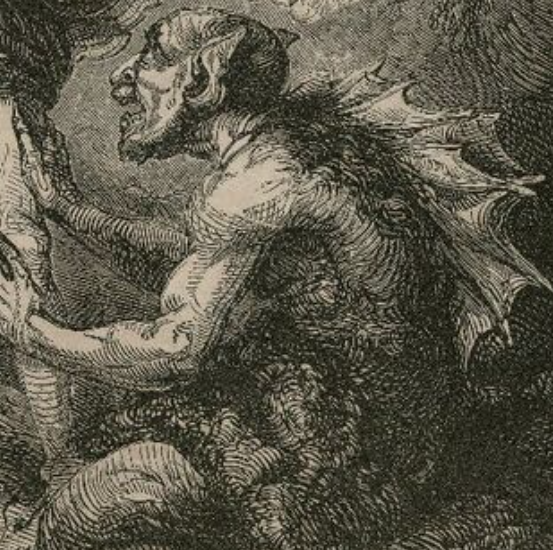
Looking at the totality of the Omegamart story, there are several connections to the Tempest Calliban the creature that lives on Prospero’s island bears striking similarities to the Zenions. He is described as being man and fish, much like the Zenions. Further, Caliban is not a native inhabitant of the island; he was brought over by the witch Sycorax and Prospero exploited him after Sycorax died, much like how the Dram family, especially Walter, exploited The Zenion’s magical Source.
In both cases, the Prospero character has both noble and ingnoble goals- Prospero wants to get himself and his daughter home, but also to revenge his exile to the island. Walter and Cecilia seem like Prospero split in two: there is a light side that wishes to defend Marin and see her safely home,and the dark side that wishes to exploit The Source and addict unwitting consumers.
I won’t give away how the story of omegamart ends but let’s just say that Walter gets across the notion that he has repented for his greed, and wishes to free the Source from the factory, much like how Prospero frees Ariel at the end of The Tempest. In both cases, YOU are the necessary person to help free Walter. Both Walter and the Meow Wolf team have hinted that there are new areas of Omega Mart that guests haven’t unlocked yet. Perhaps you will be the one to unlock the secret to free Walter, and the Source!
Prospero. Now my charms are all o’erthrown, And what strength I have’s mine own, Which is most faint: Let me not, Since I have my dukedom got And pardon’d the deceiver, dwell In this bare island by your spell; But release me from my bands With the help of your good hands: And my ending is despair, Unless I be relieved by prayer, Which pierces so that it assaults Mercy itself and frees all faults. As you from crimes would pardon’d be, Let your indulgence set me free.
Prospero. Act V, Scene i
Thanks for reading this post. If you enjoyed reading it, leave a comment below. Please also relate any Omega Mart stories you had at Area 15!
I’m very proud to announce that just in time for Valentines’ Day, I’m offering a course of classes about Shakespeare’s most popular play about love. The play will include fight choreography, dramatic readings, games, escape rooms, and an activity where the students create their own Shakespearean insults!
Course Description:
We’ll engage with the play with thoughtful discussion.
You’ll go on a virtual tour to the Globe Theater!
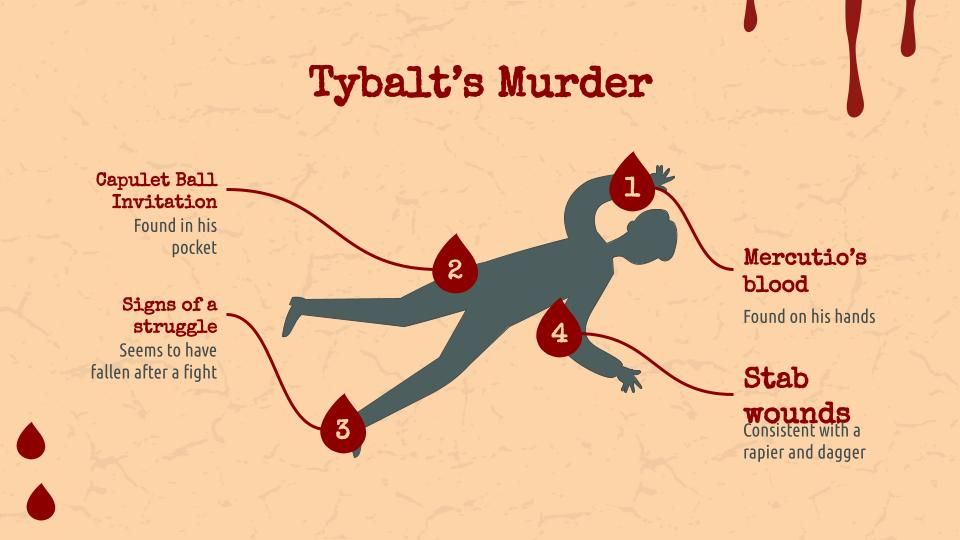
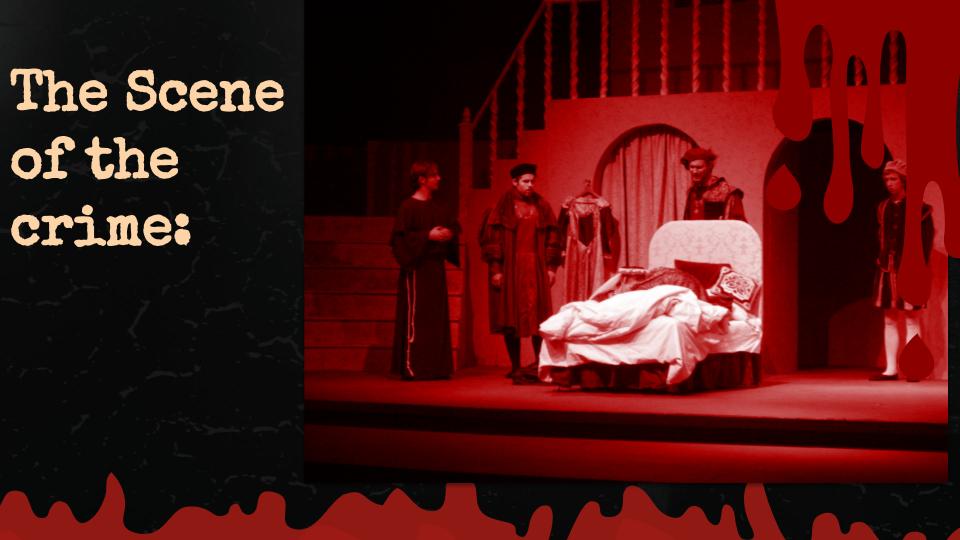
You’ll play detective and solve a Shakespearean murder!
Instead of just reading the play "Romeo and Juliet," this class will actively delve into the world of the play through a combination of lectures, dramatic readings, virtual field trips, online quizzes and activities, and finally, a digital escape room to test the student's knowledge of the play and its ideas. Each class is ala carte, meaning that once you take one class, you choose whether to stop at one class or continue onwards. Each class will delve into a different theme, literary device, and historical concept in the play:
Class Structure:
Class 1: Why Read Romeo and Juliet?
- The teacher will decode the Prologue of Romeo and Juliet and tell the basic story of the play
- We will explain dramatic irony through looking at the prologue,
- The teacher will explain why Shakespeare used poetry in the play, instead of just writing in common prose
- We will discuss why we still read Shakespeare and Romeo and Juliet in particular.

Class 2: Foils and Fights
- The learner will learn about the culture of dueling and sword fighting that was rampant in the 17th century.
- The teacher will explain and the learner will learn to recognize character foils in the play like Romeo and Friar Laurence
- We will cover the topic of antithesis- how opposite imagery permeates the play.
- We will discuss figurative language through insults and the students will have a contest to see who can craft the best Elizabethan insults!

Class 3: Acts 1& 2- The Language of Love and Hate
- We will recap how insults work- hyperbole and metaphor used to make someone seem the worst, the smallest, the ugliest, the dumbest, etc.
- We'll examine passages from Act II that show how these techniques apply to wooing and expressing love through metaphor, hyperbole, and allusions.
- The teacher will explain what a sonnet is and how Shakespeare uses them repeatedly in "Romeo and Juliet"
- We will discuss staging the famous Balcony Scene of Romeo and Juliet and ask if it's possible to do so in a virtual environment.

Class 3:  Act 3 fighting 💪 swordplay and plague imagery
The teacher will explain the plot structure of Elizabethan tragedies and explain that Act III is the climax of the play.
We will recap  the events that led to the deaths of Mercutio and Tybalt
The teacher will unpack Mercutio’s famous curse "A plague on both your houses," which is a foreshadowing, and the climax of the action.
The class will end with a short, safe demonstration of stage fighting where the students may choose to enact Mercutio's fight with Tybalt and/ or Romeo's fight with Tybalt.

Class 4: Act 4 antithesis and dramatic irony
We will talk about the imagery in Act IV, scene 1, which foreshadows the end of the play. I will also do a dramatic re-enactment of Juliet's soliloquy in Act IV,
We'll go on a virtual field trip to an Elizabethan wedding.
The teacher will historical context of the black death and its relevance to the play and Shakespeare's life.

Class 5: The final curtain
We will discuss Act V of the play and how so many forces seemed to be out of Romeo and Juliet's control, pushing them apart. We will also discuss whether or not Friar Laurence should be punished for encouraging Romeo and Juliet to disobey their parents.

Class 6: Performance then and Now
The teacher will perform in character as William Shakespeare, and teach the students how to act like real Elizabethan actors. This will include a virtual tour of the Globe Theater, a virtual costume fitting, stage fighting lessons, and DIY Elizabethan crafts. The teacher will then engage the class by discussing different adaptations, sequels, and spin-offs of Romeo and Juliet, in order to illustrate how popular and long-lasting this story is. The students will watch and discuss clips from various movies, plays, and ballets based on Romeo and Juliet. The instructor will conclude by sharing his own experience acting in Romeo and Juliet three times as The Prince, Friar Laurence, and Peter.

Class 7:
Final project- CSI ROMEO AND JULIET STYLE
The class will play the role of a detective trying to solve the mystery of Juliet's death in Act IV, (when she actually takes the sleeping potion). (S)he doesn't know what happened but must piece together clues hidden in a digital escape room, such as handwritten notes, blog posts, receipts from "The Apothecary," etc. The clues will not only test the student's knowledge of the play, but their understanding of metaphor, verse, Elizabethan history, and more! In the end, the Detective will be the one who tells Lord and Lady Capulet the true story of what happened to Juliet. To unlock the digital escape room, the students will decode messages hidden in the clues and enter them into a Google Form.
First course runs from February 2nd to March 19th, 7PM EST. If you can’t make it to this section, I can schedule one for you.
For THIS WEEK ONLY, I’m offering a $5 discount for my “Macbeth” course: Get $5 off my class “Macbeth: An Immersive Learning Experience” with coupon code HTHESUEQUG5 until Nov 5, 2021. Get started at https://outschool.com/classes/macbeth-an-immersive-learning-experience-xGKHeHgH and enter the coupon code at checkout.





































 The Shakespearean Student