Ages: Pre Teen- teen. The story is highly condensed so older readers might want a more in-depth adaptation to understand the themes and ideas of the plot.
Premise: This graphic novel is a good introduction to “A Midsummer Night’s Dream.” It tells the bare minimum of the story with very little dialogue and almost none of the original text. Most of the story is conveyed through the visual medium.
ABOUT THE ILLUSTRATORS (Reprinted from the graphic novel)
https://www.behance.net/berelince?locale=en_US Berenice Muniz is a graphic designer and illustrator from Monterrey, Mexico. In the past, she has done work for publicity agencies, art exhibitions, and she’s even created her own webcomic. These days, Berenice is devoted to illustrating comics as part of the CGraphikslava crew. In her spare time, “Bere” loves to draw, read manga, watch animated movies, play videogames, and kill zombies Fares Maese is a graphic designer and illustrator. He has worked as a colorist for Marvel Comics and as a concept artist for the card and role-playing games Pathfinder and Warhammer. Fares loves spending time playing video games with his Graphikslava comrades, and he’s an awesome drum player: https://faresmaese.artstation.com/
About the Retelling Author
The career path of Nel Yomtov has taken him from the halls of Marvel Comics, as an editor, writer, and colorist, to the world of toy development. He then became editorial and art director at a children’s nonfiction book publisher, and now Nel is a writer and editor of books, websites, and comics for children. A harmonica-honking blues enthusiast, Nel lives in New York with his wife, Nancy. They have a son. Jess.
mY rEACTION
I read this version to my five year old son and he enjoyed the colors and characters, which is why I feel confident recommending this version to younger children. It won’t help you pass a test on Midsummer and you won’t get the whole story. But you might get a tantalizing glimpse of Shakespeare’s world of fairies, lovers, and funny fools and honestly, that’s fine with me. As I’ve stated before, parody and short pop-culture adaptations of Shakespeare are great ways to connect with young people, and I see this book as a tool to do just that.
tECHNICAL eXECUTION
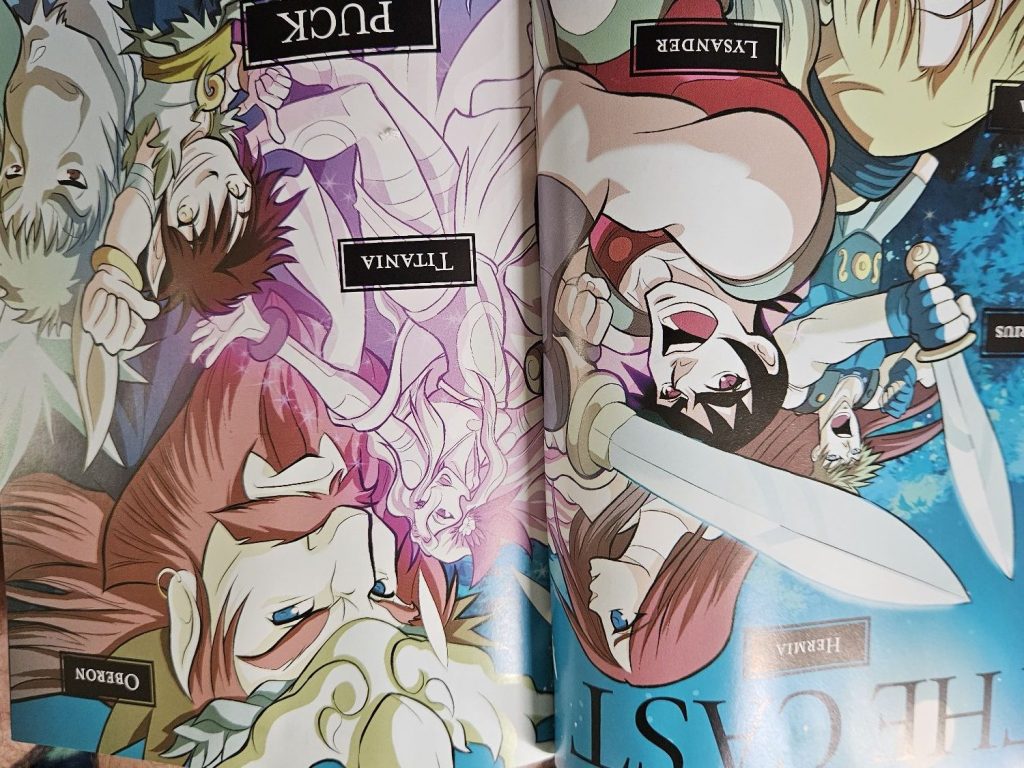
Character Design. It’s interesting to see the difference in style between this version, and the Manga Shakespeare version I previously read. That one was very much inspired by the Shoujo manga style, which emphasizes drama and relationships. This version’s drawings are softer, more cartoonish, and the expressions are less stiff, (except for Oberon, who is drawn very austerely). I particularly like the design for Puck with his big mischievous eyes and squat, childlike shape. I would argue however that the lovers and Mechanicals aren’t distinct enough, which is a problem since they are the most important characters.
The Adaptation
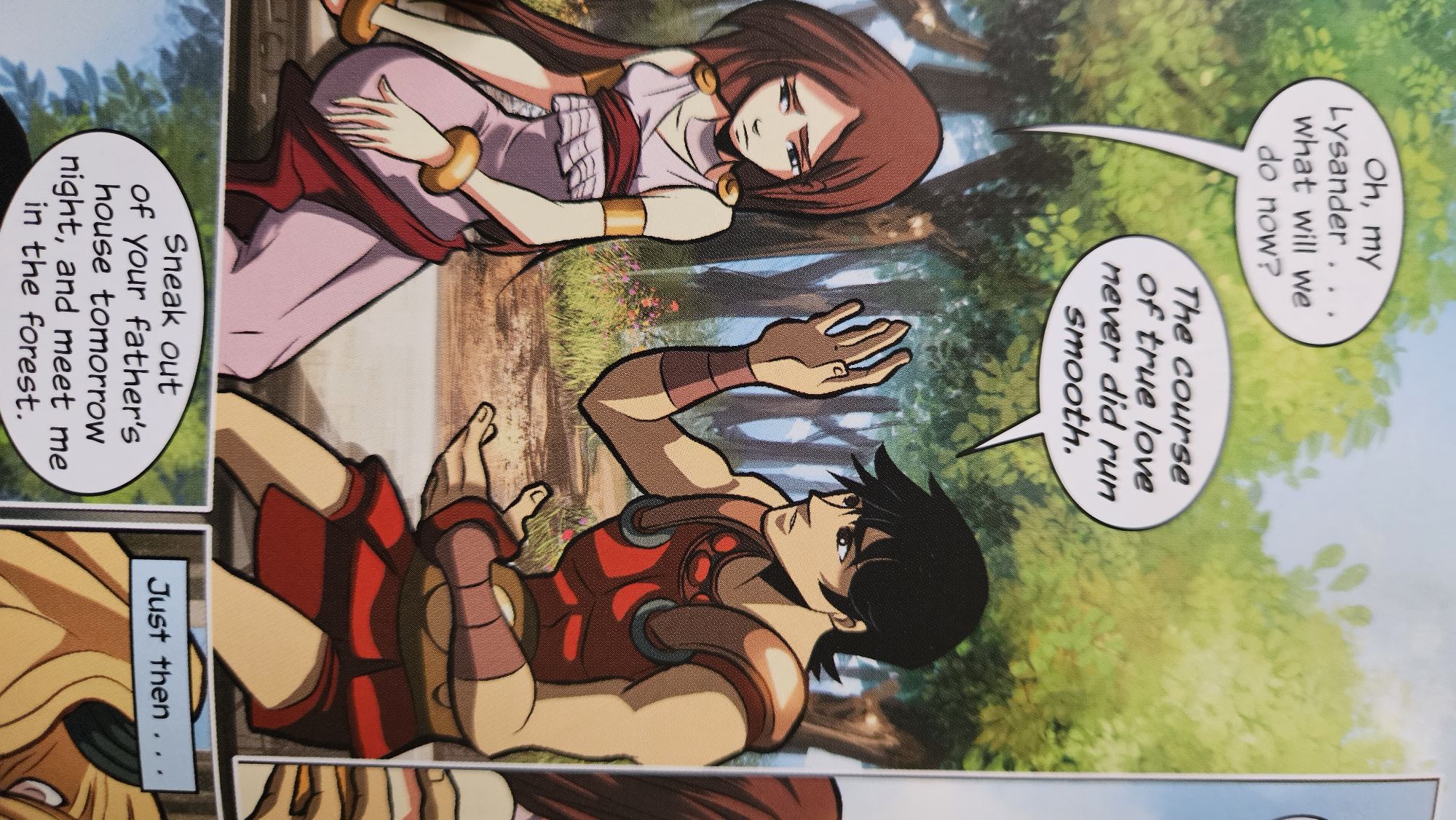
Like I said, this is a bare minimum adaptation of the play. None of Shakespeare’s text is used and the lines and speeches are cut liberally. The entire book is only 77 pages which of course means, that there are a lot of cuts. There’s no mention of the Indian boy, Titania’s tiff with Oberon, Philostrate, the other fairies, and all the great speeches are cut. This version is focused entirely on the plot, and it cuts it quite efficiently. To demonstrate this, below on the left is a panel that shows how Lysander and Hermia express their frustration with not being allowed to marry. On the right is the original text of the scene.
Ay me! for aught that I could ever read, Could ever hear by tale or history, The course of true love never did run smooth; But, either it was different in blood, Lysander. Or else misgraffed in respect of years, Lysander. Or else it stood upon the choice of friends, Or, if there were a sympathy in choice, War, death, or sickness did lay siege to it, Making it momentany as a sound, Swift as a shadow, short as any dream; Brief as the lightning in the collied night, That, in a spleen, unfolds both heaven and earth, And ere a man hath power to say ‘Behold!’ The jaws of darkness do devour it up: So quick bright things come to confusion.
The Colors
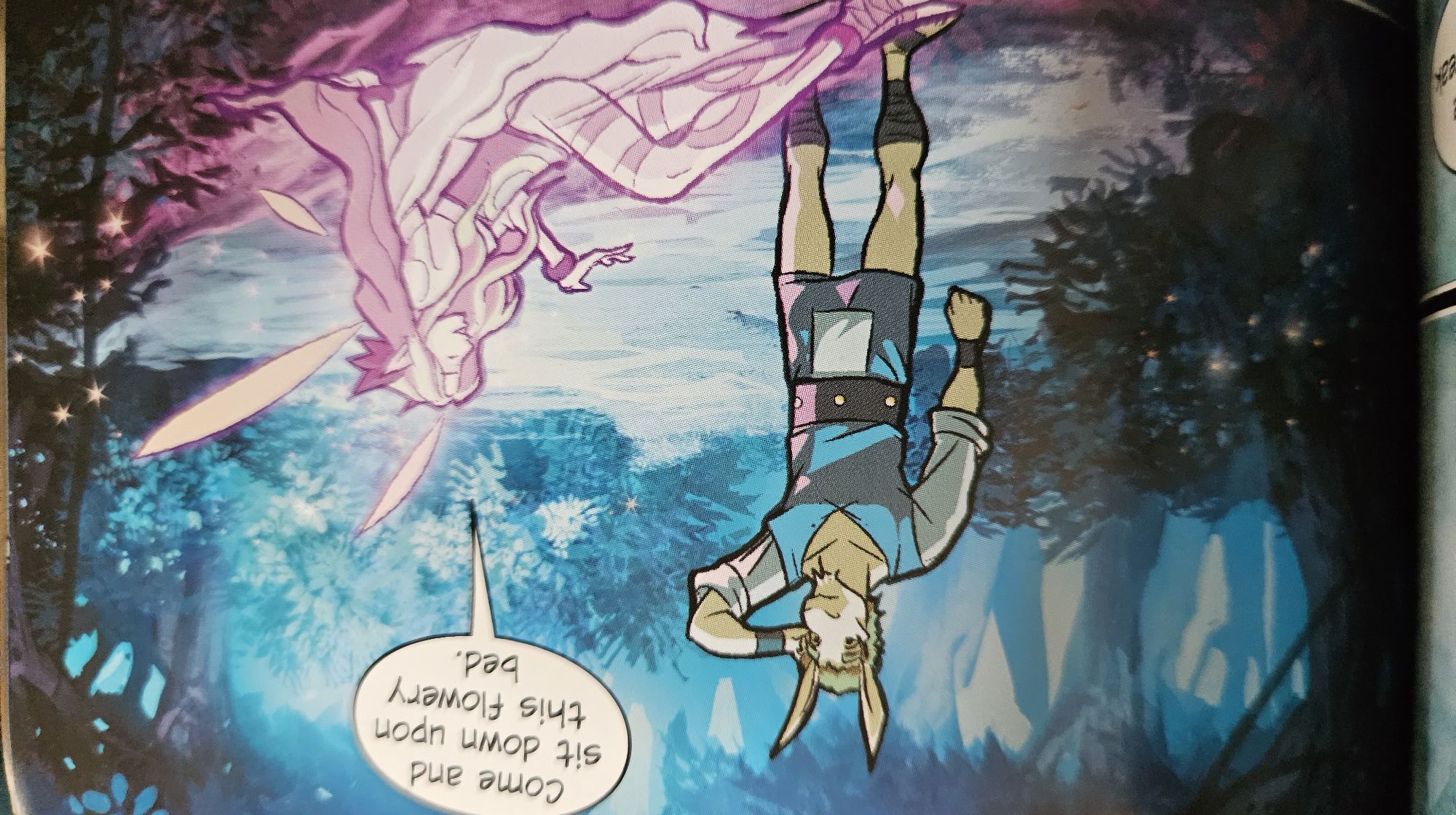
The colors are very beautiful. Other manga stories have colorful title pages but no color in the panels. This comic is alive with color and the colors help tell the story. Athens represents the world of the daytime, so the colors are very warm and vibrant. In the nighttime, the colors are cool and the characters are drawn with very sharp lines to make sure they don’t fade into the background.
IN Conclusion
This version tells l the story quickly and entertainingly with a vibrant and colorful style that was lacking in the Manga version. Granted, the Manga Shakespeare did allow me to focus on the text more, but I think I actually prefer this version, simply because of its beautiful artwork. Check it out if you get a chance!.
Last weekend I saw a wonderful production of “Six” The Musical at the Cab Calloway School Of the Arts in Wilmington DE. After seeing the professional production, I was worried that I wouldn’t enjoy these student performers but it was incredible! The young performers were all terrific and the director managed to use inventive, creative, and entertaining setpieces to both capture the essence of the Broadway show, and also make a version that is distinct and its own with student performers!
The Direction
DIRECTOR’S NOTE I thought original I’d never Broadway get a show chance only to has direct six it at actors Cab. in AS the luck cast, would so/ have it, the teen edition came out this past summer, which allows the addition of a singing and dancing ensemble. I immediately applied for the rights and we were one of the lucky schools to get them. This new teen edition is the perfect fit for our school community and it highlights the talents of studentsfrom every arts area. I wanted to create a Beyoncé or Taylor Swift concert-type at- mosphere, and I think we have achieved that with our show. The fabulous lighting, the beautiful costumes and make-up, the rocking pit band, the fabulous cast and crew and especially the epic choreography have culminated into quite a spectacle! It has always been a joy to work with my colleagues on these projects. and I want to give a particular shout-out to my team of choreog- raphers. They have taken my vision and turned it into something amazing. The creativity in this team is fierce, and if ever there was a group that fed off of each other’s ideas, it’s this one. We’ve had a blast collaborating on this production Also, I would like to acknowledge Brian Touchette, Peter Kuo and Jared DeStafney for their tireless work on this production. With- out them, this show would not be possible.
Marjorie Eldreth
As the director notes in the program, the challenge with doing a musical like “Six” at a high school or community setting is that there are only six major roles, which means it would be hard to find ways for the whole student body to participate. What I loved about this version is that, by utilizing dance, pantomime, and choruses, the director has found ways to not only involve more people, but help use the additional cast to tell the story in ways that the professional touring production I saw earlier didn’t!
My Favorite Moments
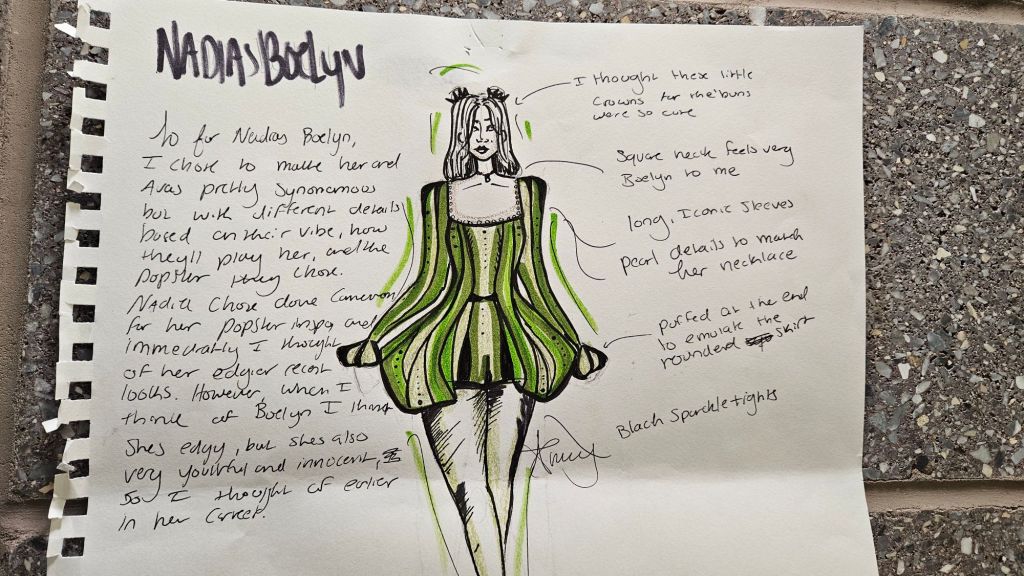
Normally I hate dance numbers in musicals. Don’t get me wrong, I admire the skill and athleticism that dancers have, but when I see a play or musical, I come for the story and the songs. Dance always seems like the black sheep in the musical theater trifecta to me. Not so with this production of “Six.” The dance numbers help tell the story in clever and moving ways! For instance, during Anne Boleyn’s “Don’t Lose Your Head,” a team of dancers with green sticks accompanied her. Their movements were cheeky and brash, which helps encapsulate her bubbly yet tart personality. During the choruses, the dancers and Anne rested their hands on the sticks, drawing attention to their heads moving back and forth, which reinforced both the title, and Anne’s air-headedness. Then, at the end of the number, the dancers got into a circle and pointed their sticks at Anne’s neck- pantomiming how she would eventually be beheaded! Thus, the dancers complimented Anne’s song perfectly, in a way that was not originally part of the show!
“My Heart Of Stone”
The most moving moment of dance was during Jane Seymore’s song “My Heart Of Stone.” When I saw this number in Hershey, it was by far my least favorite. I thought the lyrics were generic, that the song itself was bland, and that gave little depth to Jane character. All that changed this time around. While Jane belted her heart out about the son she never got to raise and the husband who mistreated her, we got to see elegant ballet dancers perform those moments for us. I particularly liked that the male dancers had red hair, (much like the real Henry VIII and his son). The dance actually helped me see Jane’s conflicting feelings for Henry- how she feels genuine love and affection one minute, and terror the next. How she and her son are both ghosts, now that they were denied the chance to live together on Earth. I don’t wish to diminish the wonderful singing and acting of the Hershey production, but Six: Teen Edition did a masterful job of showing, in addition to telling Jane’s story.
THe Cast
The Cab Calloway School of the Arts boasts some of the top young actors in the country, and all of them have tremendous chops as actors, dancers, and singers. Some of them already have professional acting credits. So it should come as no surprise that all the performances were incredible. It was very exciting, however to see a real 19-year-old play Catherine Howard, (since that was the real age she was when she died).
This production also took the bold leap of casting two men in the show. In one cast Anne of Cleaves was played by a man, and in the other (the one I watched), Katherine of Aragon was played by a man. I have no problem with this choice, (after all boys have been playing Katherine ever since Shakespeare’s Day), but I was a little disappointed that the actor had to modify the song to fit his range- I was looking forward to the extravagantly high Shakira and Beyonce inspired vocals that I’ve come to expect from the part. Nevertheless, the actor I saw was incredibly talented and his acting and dancing were completely appropriate for the part.
THe Dramaturg
For those of you who don’t know, a dramaturg’s responsibility is to help the actors, director, and production designer by doing research into the play’s historical or political context. It’s a role that is very important in period plays like Shakespeare. I’ve worked as a dramaturg myself and, though the work one does as a dramaturg is mostly unnoticed by the audience, the dramaturg can greatly contribute to the way the actors understand the text and give the director tools and ideas with which to explore themes and ideas present in it. I don’t know what the dramaturg did for this production, but I could tell based on the performances that every cast member was fully committed to their character. Each actor was able to clearly articulate their character’s emotional journey and that meant they must have learned the history and context of the Tudor period. Again, I don’t know if the dramaturg had any effect on this, but I’m going to assume they did a terrific job, because their end goal was accomplished- the actors and director gave a coherent and well thought out performance that captures the spirit of the Tudor period, so great job!
Shakespeare’s King Lear is an age old tale. Like Cinderella it has been reinterpreted throughout time and in many different cultures. Here are a few interesting highlights in the old legend and how it got to Shakespeare in the 1600s.
The Princess Who Loved Her Father More Than Salt
This is an old folktale from my favorite podcast, Journey With Story, which starts with the Cordelia/ Lear plot of a foolish king who banishes his honest daughter. Then through extraordinary circumstances it becomes a Cinderella story. I think at some point these two stories were one and the same until they diverged and one became a story about an absent father and a wicked stepmother, while the other became about a wicked father and a dead mother.
The ancient ballad of King Leir, which helped inspire Shakespeare. It serves as a cautionary tale against flattery, and it places equal blame on Lear and his daughters:
And calling to remembrance then
His youngest daughters words,
That said the duty of a child
Was all that love affords:
But doubting to repair to her,
Whom he had banish'd so,
Grew frantick mad; for in his mind
He bore the wounds of woe:

Which made him rend his milk-white locks,
And tresses from his head,
And all with blood bestain his cheeks,
With age and honour spread.
To hills and woods and watry founts
He made his hourly moan,
Till hills and woods and sensless things,
Did seem to sigh and groan.

Even thus possest with discontents,
He passed o're to France,
In hopes from fair Cordelia there,
To find some gentler chance;
Most virtuous dame! which when she heard,
Of this her father's grief,
As duty bound, she quickly sent
Him comfort and relief
The characters of Gloucester and his children, Kent, and the Fool are absent in this ballad, but unlike the fairy tale above, both Lear and Cordelia die in each other’s arms.
The Annonymous History of King Leir, (first published c. 1594)
The anonymous history of King Lear, written shortly before Shakespeare
This play was written for Shakespeare’s rival acting company The Queen’s Men around 1590). Since the Queen was patronizing the company, most of their plays were government-funded propeganda. For instance, it was the Queen’s men who first did a tragedy of the wicked King Richard III.
Michael Wood. In Search Of Shakespeare, 2002.
If you watch the first 20 minutes of the documentary above, you will see that Wood and many other scholars believe Shakespeare must have worked for the Queen’s men, or at least performed their scripts, since they did their own versions of King Lear, Richard III, King John, and Henry V.
However Shakespeare got a hold of The Queen’s Men’s scripts, he didn’t adhere to them rigidly. Their King Lear follows the fairy-tale / history format of having Cordelia be banished, disguise herself as a peasant (like Cap ‘O Rushes in the earlier version), and eventually she is restored to her rightful place. Shakespeare’s version must have been a MASSIVE shock to anyone who read these old tales and ballads. In Shakespeare’s version, everyone dies and there is no guarantee that the kingdom will survive. Every other tragedy ends with a new king or emperor to take over the kingdom but Lear leaves the audience with a sense of apocolypse; that Lear’s madness and Edmund’s machinations have doomed England and all these characters’ lives will be erased by Time.
As pessimistic as Shakespeare’s Lear is, it does seem more true to life than the previous versions. Perhaps this is because of a legal case from 1603 that might have inspired Shakespear to adapt the story: In 1603, two daughters tried to have their father declared insane. By an astonishing coincidence, the third daughter, who protested, happened to be named Cordelia! Perhaps Shakespeare, (who had three children and was preparing to retire), might have been inspired by this case and worried he might suffer the same fate.
Stagecraft has a fascinating and interesting history. The way we portray spectacle on stage has changed a lot since the advent of television and movies, which utilize computers and animatronics, etc. to create impossible things that could never be is shown live. In a way, the pre-recorded nature of film and TV gives theater practitioners an advantage because the more clever they are with their stagecraft, the more impressive it is for the simple fact that it is live- happening right now in front of an audience.
What I want to do with this post is to speculate whether, with the technology of the time, if Shakespeare could have used some kind of visual spectacle to portray otherworldly creatures, such as the ghosts in Hamlet and Macbeth
The conventional wisdom
Contemporary accounts of the Globe theater mention two trap doors, one in the ceiling for angels and gods, and one in the floor for ghosts or devils.
Most books I’ve read on Elizabethan stagecraft say that the theaters of this era were very minimalistic in design. They had trap doors, they had galleries, they had a primitive flying rig, and they had music and some simple sound effects, but most of the experience was watching the actors, their costumes, their bodies, and hearing their voices hence ‘audience’- audio, “To hear.”
Professor Stephen Greenblatt of Harvard University explains the way the ghost probably haunted the Globe Theater in 1600.
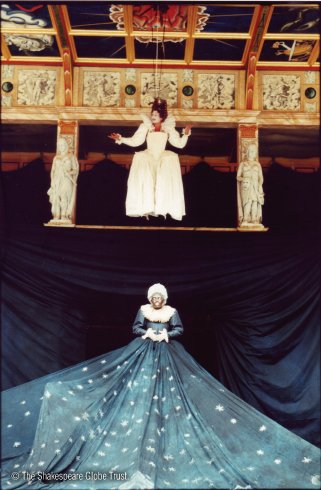
We are told there wasn’t much visual representation of spectacle and fantasy on Shakespeare’s stage, which which is is odd because there are some pretty fantastical elements in his plays, especially Hamlet and Macbeth, where the former calls for a ghost and the latter calls for a ghost, witches, and a literal goddess to appear on stage. How may one ask, was this achieved back in Shakespeare’s day, the late 1590s and the early 1600s? The conventional wisdom is that the ghosts in Hamlet and the ghost in Macbeth came through a trap door in the stage known as Hell.
If you’re you go to the Globe now you can see this actual trap door being used. It used a primitive pully system to open up in the middle of the floor. The ghost would ascend to the stage through a small step ladder. Hamlet’s father’s ghost is described as wearing a suit of armor and being very pale. Banquo’s ghost is described as having long hair dappled with blood.
Banquo’s ghost appears during a banquet in Macbeth’s honor. Based on this hypothesis it’s likely that a banqueting table was brought out into the middle of a stage to conceal the ghost, to make it more of a surprise when it ascends onstage through the trap door, but the effect to modern taste would be rather dull. However impressive the performance, this cannot stand up to the stunning nature of visual effects using computer technology, motion capture, et cetera. I wanted to see if there are any Elizabethan theatrical illusions that would still have been accessible to Shakespeare back in the 1590s.
Idea #1: A Smoke-monster ghost?
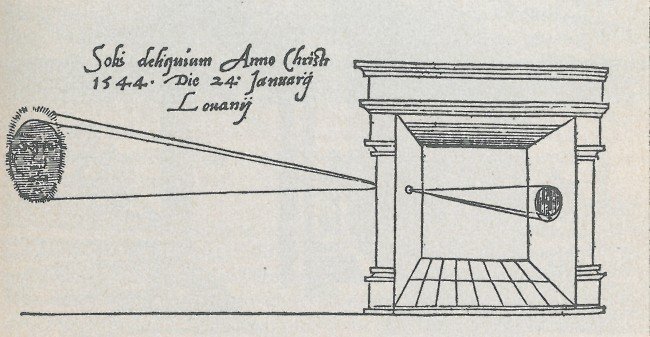
My research began with this video from the YouTube History Channel Atun-Shei Films, where the author traces the history of film, (both as photography and film as a projection). He cites at the start, an incident in 1536 where a supposed necromancer appeared to conjure a ghost for an unsuspecting rube. According to The Lives Of the Necromancers, the solution was achieved by creating huge clouds of smoke within the theater space, (which was the Colosseum) and then using a primitive camera obscure to project a frightening image Into this space.
Sketch for an early camera obscura, dated 1544 by Leonardo Da Vinci.
Camera Obscura is a term is it Latin for dark chamber the principal had been discovered for century had existed for centuries bit is for centuries but only in the 1530s this was the 1st recorded example of it being used to create a theatrical illusion.
The question is, could Shakespeare’s company have performed the same illusion with the technology of the day? Honestly, I find it rather unlikely that Shakespeare’s audience would’ve put up with huge clouds of smoke in a wooden amphitheater. Still, the fact remains that primitive projection technology existed back in Shakespeare’s day, which means a director could reasonably implement it in a production of Hamlet or Macbeth, even under the constraints of Original Practices.
Theoretically, Shakespeare’s company could have crushed this rock into a powder and made it into a paint that glowed onstage. There is precedent for this- in The Hound Of the Baskervilles, Sherlock Holmes discovers that the terrifying ghost-hound is merely a large dog painted with phosphorescent paint:
In mere size and strength it was a terrible creature which was lying stretched before us. It was not a pure bloodhound and it was not a pure mastiff; but it appeared to be a combination of the two–gaunt, savage, and as large as a small lioness. Even now in the stillness of death, the huge jaws seemed to be dripping with a bluish flame and the small, deep-set, cruel eyes were ringed with fire. I placed my hand upon the glowing muzzle, and as I held them up my own fingers smouldered and gleamed in the darkness.
“Phosphorus,” I said.
“A cunning preparation of it,” said Holmes, sniffing at the dead animal.
Doyle, Part IV.
Though this paint would potentially make a terrifying effect, this would be impossible at an outdoor theater during the day. This makes it unlikely that Shakespeare used glow-in-the-dark paint at the Globe, as most of the performances took place in the afternoon. That said, both Hamlet and were written just at the point in which Shakespeare’s company was in the process of acquiring an indoor theater, the Blackfriars.
The Blackfriars and Shakespeare’s stagecraft
Almost all of these ideas would depend on Shakespeare having access to a theatre in which he could control the lighting. As you can see, the Blackfriars was lit with candles and its indoor nature meant that performances weren’t dependent on sunlight. Greg Doran, former director of the Royal Shakespeare Company has theorized in the past that maybe while his company was preparing to move into the Blackfriars, Shakespeare was changing his material to make it both literally and figuratively darker.
In the reconstructed Blackfriars, (where I studied and interned for three years), there is a trap-door and flying rig like the Globe, so the conventional trap-door ghost can and has been utilized there. I would also argue that in the Blackfriars unlike the Globe, there was a chance for more variety of theatrical illusions- perhaps a smoke projection, magic lantern, or even…
Idea 3: A Pepper’s ghost
A Peppers Ghost is a stage illusion that dates back to the 19th century. It uses the principle of refracted light to project the image of a ghost on top of a piece of glass. This image will appear translucent and could be very impressive to an audience at the Blackfriars! As you can see in the diagram below, the actor could be under the stage in the trap door standing in front of a mirror, and the glass sheet could be used to project his image to the audience. The only concern would be that this could limit the blocking of the other actors, and it might not make the ghost visible to the audience members in the upper galleries, but it would still be an impressive visual effect that uses scientific principles known in the 17th century.
Pepper’s ghost diagram.
Pepper’s Ghost illusions are still used frequently in theme parks, trade shows, and concerts where singers interact with “holograms.” As a special Halloween treat, (or trick as the case may be), I’ve included a video that will allow you to make your own Pepper’s ghost at home. If you choose to make one, leave me a comment!
So, in conclusion, though we are taught that Shakespeare’s theater often reveled in simplistic theatrical designs, I personally think that there is more room to explore low-tech theatrical illusions like these, especially at companies like the Globe Theater and the American Shakespeare Company, which pride themselves on using Shakespeare’s original staging practices. Live theater has dodged giving up its ghost for 2,000 years by exploring the limits of live theater through movement, voice, story, music, and yes spectacle. I think theater practitioners, even Original Practitioners should keep innovating new kinds of spectacular means to keep creating fresh interpretations of Shakespeare, that still keep within the spirit of the play’s original time and place.
Bonus: If you want to learn more about the stage illusions of Shakespeare’s company, click here to listen to That Shakespeare Life Podcast with Cassidy Cash. In this episode, she interviews theater professor Frank Mohler, who describes how thunder and flying effects were done in the 17th century, using records of the period, and his own experimentation.
Basics Of Stage Combat: Students will learn the basics of safely enacting a fight onstage, in preparation for a Shakespeare play. We will also learn about the history of sword fighting in the military and the duel.
Trailer for Basics of Stage Combat.
My daughter really enjoyed taking this class. She was actually able to use her sabre and try out her routine on her father. Paul is quite knowledgeable about Shakespeare and made the class really fun by teaching a fight scene from Romeo and Juliet. It is amazing watching her practice with Paul over Zoom. I hope Paul will have. more combat classes, it is a different way to learn Shakespeare.
IB, Parent
An Interactive Guide To Shakespeare’s London (New Class)
A virtual tour of Shakespeare’s London will get kids to interact with the culture of Elizabethan England.
Class Experience
To teach kids about the Elizabethan era and the background of Romeo and Juliet, The Instructor will interact with the class (via pre-recorded videos), pretending to be Shakespeare. The class, pretending to be actors in Romeo and Juliet, will get a virtual tour of The Globe Theater, Hampton Court Palace, and a virtual visit to an Elizabethan doctor's office. This activity is an immersive way for them to learn about the period, how it relates to the world of the play, and how Shakespeare changed theater.

The class will take the form of a guided WebQuest activity.  First, the students will get a worksheet that has a series of fill-in-the-blanks about Elizabethan society (below). The students will fill out this worksheet based on a Nearpod and in conjunction with a website I’ve made, https://sites.google.com/nebobcats.org/visit-to-elizabethan-london/home?authuser=0
Both the Nearpod and each webpage will have a virtual tour, a video, and text explaining some aspects of Elizabethan life. Before they go to each location, I will give a short introduction via prerecorded video:
Wizard Science
In this one-hour course, your child will discover the enchanting world of science through a series of magical experiments. Learn about such topics as Astronomy, Static Electricity, chemistry, and optical illusions.
In this one-hour course, students will learn and play games that will explore the history behind Christmas traditions. We will also discuss the themes, characters, and famous quotes from Shakespeare’s play “Twelfth Night.”
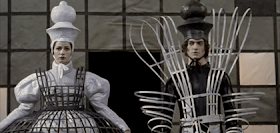
Geraint Wyn Davies as “Macbeth”Darren’s “Chess PawnOliver plays Banquo’s Ghost
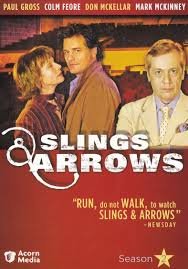
Slings And Arrows is a Canadian sitcom about a theater festival loosely based on the Stratford Shakespeare Festival in Ontario. Its hero, Geoffrey Tennant (Paul Gross), in addition to dealing with the seemingly endless problems (or should I say, “Slings and Arrows?”) mounting a Shakespeare play, is also worried he’s going mad, since he keeps seeing the ghost of his old mentor/ director Oliver Wells (Stephen Ouimette). For a recap of Season One, click here to read my review.
The premise of the Series
I describe this show as a funny, tragic, bittersweet comedy about drama. It’s The Office for Shakespeare Nerds!
Season 2 Retrospective
Whereas Season One was sometimes extremely dramatic and raw, Season Two is much more relaxed; it feels a little bit more like The Office for Shakespeare nerds. Each episode focuses much more on the work-a-day frustrations of running a theater. We see it through multiple perspectives and even multiple shows- we see one director not being able to complete Romeo and Juliet, we see another trying to cast for Pirates of Penzance, and finally we see Geoffrey trying to fulfill Oliver’s posthumous concept for Macbeth.
“You just need to sell more tickets.”
“It’s not that simple, we’re talking about THEATER!”
Season Two doesn’t just focus on the artistic side. The theater is going broke, and Richard is begging for money from sponsors and the government. Susan Coyne as the overworked Executive Assitant Anna also has her hands full taking calls, organizing the schedule, and of course her new additional frustration with the internship program.
Grace Lynn Kuhn as Emily sobs contritely in front of Geoffrey (Paul Gross)
This particularly made me laugh the first time I saw the show because at the time, I was interning for the American Shakespeare Center. I know what it’s like to feel like if you’re out of your depth but excited, thinking that this is going to be your big break, (while also being keenly aware that your job is mostly obviously getting coffee and writing notes in the prompt book). I have to give a shout-out to Grace Lynn Kung who plays intern Emily Wu; she does a great job of portraying this mixture of anxiety and youthful desire to please.
To be brief, this season has a much greater level of authenticity and realism that shows the series graduating from a soap opera into a real workplace comedy.
The Cast
Paul Gross as Geoffrey Tennet
In the first three episodes, Geoffrey is afraid to put on Macbeth because he thinks that Oliver will come back. Just like Season one, Geoffrey is still not sure whether Oliver is actually a ghost or is actually a manifestation of Geoffrey’s madness. As he continues to work on the production, he and Oliver quarrel as conflicting directors, and their private struggles as friends and colleagues even spill over into rehearsals, which threatens the production itself.
Gerand Wynt Davies as Henry Breedlove
Geraint Wyn Davies as Henry Breedlove, onstage as Macbeth
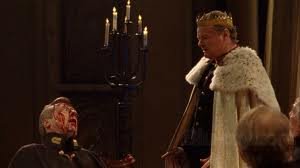
The main curse in this production is the old guard of actors who are threatened by Jeffrey’s leadership; they got used to Oliver’s more relaxed style and they do not want Geoffrey shaking things up. Chiefly among them is Brian Cabbott and Henry Breedlove played by Geraint Wyn Davies, (who is really a classically trained actor from the Royal Shakespeare Company). Brian starts out by playing Claudius in Hamlet in the tail end to Season One. He’s disrespectful to Geoffrey and criticizes him to his face. Like Prince Hal dismissing Falstaff, Geoffrey dismisses Brian from the company.
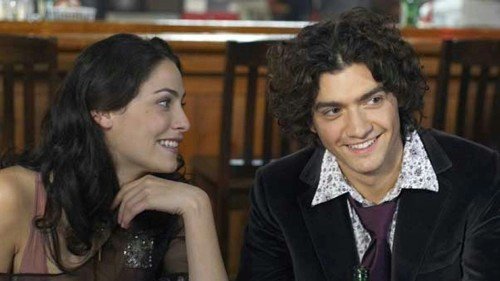
One theme of Macbeth that is echoed again and again in Season two is middle-aged people feeling threatened by the young. It’s shown in Geoffrey’s clashes with Henry and Brian, with Richard being seduced by the hotshot young marketers at Froghammer, and especially with Darren Nichols, who is forced to direct Romeo and Juliet, and clashes with the young and idealistic Sarah (Joanne Kelly). She gives a passionate performance both as Juliet and as a young actress who desperately wants to do her best, and actually asks Geoffrey to direct her behind Darren’s back, as this adorable scene illustrates:
What’s great about this scene is it doesn’t just set up the star-crossed romance between Sarah and her costar; it also cleverly points out the similarities between Macbeth, and Romeo and Juliet. As you see at the end, Geoffrey is inspired by Sarah’s performance and it carries over to how he directs Henry and Ellen in Macbeth. Both couples are impulsive and reactive- they love pitting themselves against the world, and that is one reason why their affairs end in tragedy. Many scholars echo this interpretation, that if Romeo and Juliet had lived, they might have become the Macbeths. Seeing the balance between backstage drama, clever Shakespearean commentary, brilliant Shakespearean acting, and workplace comedy is at the heart of why this show works, and it’s handled masterfully in each and every episode of Season 2.
My favorite episodes
Episode 1: Season’s End
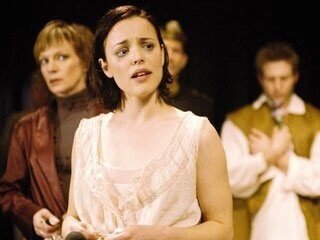
The Departure of Rachel McAdams As Kate
Rachel McAdams as Kate playing Ophelia in Season 1.
In the first episode, there is the tearful goodbye of Luke Kirby and Rachel McAdams, mirroring the fact that, as big Hollywood stars the two of them were unable to continue for a second season, even though everyone involved from the cast to the creators wishes they could. The life imitates art aspect of this episode makes it particularly tearful and sad to watch and yet it is a thoughtful and deeply well-earned sendoff.
Episode 2: Fallow Time
One of my favorite episodes is technically the Christmas episode of the show, and as such, Oliver gives Geoffrey a gift- he leaves him costume sketches, set designs, and notes on the play’s concept, which the ghost of Oliver explains in detail to Geoffrey and the audience. Maybe this kind of glimpse into the nitty gritty of theatrical concepts will only appeal to theater nerds, but I truly love it.
Episode 4: Fair Is Foul and Foul is Fair
While all the drama onstage is going on, Anna is getting some romantic attention from a playwright, unaware that (SPOILER ALERT), he’s using her for ideas for his script. In a way, this subplot shows us another aspect of Macbeth and Romeo and Juliet; in both these stories, the men use women for their own gain. Romeo arguably is using Juliet to play out his romantic fantasies, and Macbeth certainly depends on Lady Macbeth’s courage and cunning in order to go through with their plan to kill the king. Not surprisingly, all three romances end in tragedy.
Meanwhile on the stage during Macbeth rehearsals, Geoffrey is trying to get an organic, serious performance out of Henry, but he thinks he knows more than his director so Geoffrey has no choice but to fire him as he did Brian.
Episode 5: Steeped In Blood
S
In this episode Geoffrey puts the lovable understudy Jerry onstage as Macbeth. What’s interesting in this episode is, while Henry plays Macbeth as a larger-than-life soldier, Jerry plays him as sort of an everyman, letting himself be seduced by power and delusions of grandeur. Looking back, I actually owe a lot to this episode, since it helped inspire my own interpretation of Macbeth.
Episode Six: Birnam Wood
If I were going to pick one episode of Slings And Arrows for the time capsule, one episode of the show to stick up against every other show ever made, it would be “Birnam Wood.” I don’t honestly know if this is the best episode of the show—the series finale proper is probably that—but it’s my favorite episode of the show. It makes me cackle with delight, thrill with excitement, and smile with sympathy every time I watch it.
The season finale gives us a fully formed version of Macbeth and Romeo and Juliet: we get to see the designs, the technical rehearsals, the marketing, everything that the whole season was building up to into, not one but two complete theatrical performances!
First, Geoffrey cooks up an elaborate scheme to touch Darren’s heart and get him to scrap his cynical concept for Romeo and Juliet.
Geoffrey tricks Darren into re-directing “Romeo and Juliet”
As you can see, the scheme works, and Darren has an epiphany during tech rehearsals.
Darren has an epithany during tech for “Romeo and Juliet.”
In the show’s climax, for 20 minutes we get to see Henry perform as Macbeth and Ellen as Lady M. Geoffrey reluctantly re-hires Henry, but he refuses to let him walk all over him or his production. I won’t go into spoilers, but let’s just say Henry finally learns his lesson, with a little help from Oliver:
As I said last time, anyone who’s ever had a boring office job loves and recognizes the characters from “The Office,” while those of us in the theater recognize the crazy directors, the hopeful understudies, the divas, and the money-grubbing management. What’s great about this season is that, while Season one focused on them all broken apart, this season has them all coming together, using their talents to put on two excellent shows. After seeing the characters grow and change professionally and personally, we feel like proud parents and this fictional theater company feels more like a family, but any family can be broken… stay tuned.






















 The Shakespearean Student