Introducing our new Play of the Month: Shakespeare’s dark history play about murder and corruption, Richard III. First, a short presentation I made that introduces the characters and themes of the play.
Second, a quick, funny summary of the play from the Reduced Shakespeare Company
And finally, this incredible animated version of the play, which looks like a stained-glass window come to life!
Hi everyone! Well, it’s nearly August, which means back to school. Everyone is looking in the stores for the latest educational gear to help young minds on the journey to knowledge. To hopefully aid your journey teachers and students, I’ve compiled some of my favorite Shakespeare apps. There are a lot of apps out there of course, and I couldn’t hope to review them all, but I had a few criteria to limit the results:
The app had to be free,
It has to be functional (educational or useful in life,)
Fun!
I also discovered that most Shakespeare apps out there seem to follow three basic categories: Shakespeare quotes, Shakespeare guides, and Shakespearean insults. Generally speaking, every app on this list is designed to either help you learn Shakespeare by showing and testing you on famous quotations, to help you engage with the text of the plays, or to just have fun making vintage Tudor insults such as: “I was looking for a fool when I found you. I desire we may be better strangers!” So here are the first five apps I am ready to recommend to students and teachers that bring the Bard into the mobile electronic age!
I. 3x The Bard–
This app is a series of quizzes on Shakespearean quotes. It gets is title because the quiz goes on and on until you make three mistakes. Just like in baseball, three strikes and you’re out! I found it fun but not functional. You don’t learn what the quotes mean, and you’re not tested on how well you can recite it, it just quizzes you on which play the quote comes from. Still, worth a look.
II. Shx at Play Two word review: very useful.
Combines the interactivity of an app, with the format of the Sourcebook Shakespeare books I mentioned in my “Which Shakespeare Edition Is Right For You” post. It features annotated texts of Shakespearean plays, videos, and a glossary. It’s really good stuff. I encourage teachers and students to use it. The only problem is that, while the plays are free, some features don’t become available until you pay to download them, but you might want to if you’re serious about studying the play.
III. Globe Theater 360
This is one of my favorite apps ever. I would call it the Pokemon Go of Shakespeare apps. As you move your phone, you get a 360 degree of Shakespeare’s Globe Theater, as if you were actually there! Even cooler, if you put your phone or tablet over the Globe Theater logo, it will make a computerized theater appear on your phone’s camera in real time, just like the creatures of Pokemon Go! Furthermore, you can click on various part of the Globe to learn about the theater, how the plays were performed, and the colorful history of Shakespeare’s Company. I think this is a must-have app for anyone interested in Shakespeare.
IV. Globe Player
Ok, I’ll be honest, this one isn’t free either, but it’s still incredible. I love that The Globe is well aware that not everyone can get out to London and see a play in Shakespeare’s re-constructed Globe theater, so they have a pay-per-view style app that allows you to watch videos of Globe Theater performances in your own home. You can also watch or stream international Shakespearean performances and documentaries right to your phone, tablet, or online at https://globeplayer.tv/
V. Genius
The best thing about this app is that you probably own it already! This is an extremely popular app for deciphering the meaning of song lyrics. Well guess what? People have also contributed commentary of some of Shakespeare’s famous speeches too! If you’re a teacher, you might consider having your class upload a Shakespearean text, and have them write line-by-line commentary to show just how well they understand it.
So that’s Part I of my look into my favorite apps Shakespearean apps, and I hope you enjoyed it. If you find any other apps you’d like me to review, leave a comment below!
The venerated Shakespearean actor, Sir Antony Sher, once said with frustration while he was acting at the RSC that, “even the best Feste is less funny than the worst Malvolio.” I actually have a rare insight into these two roles since I’ve played them both! So allow me if you will to present you with some insights I’ve gained into these two characters that are very much polar opposites. Although they are as different as night and day, they form the central comic premise of the whole play, and have some truly hilarious moments!
Me. as Malvolio, Wooster. High School 2002
I played Malvolio when I was a senior in high school; he was my first principal Shakespearean role. My director chose to set the play in the 1940s and he re-purposed the kingdom of Illyria as the Hotel Illyria, with Malvolio as the concierge or lead butler in charge of all the hotel maids and other housekeepers. This not only made the play more accessible to a 2002 audience, it also really helped me understand Malvolio’s role: he is first and foremost a snob who is obsessed with efficiency and pleasing his mistress Olivia (in this version the owner of the hotel). I would soon also discover that, although Malvolio is certainly snobby and can be a bit of a killjoy, he also has qualities that make him appealing to everyone who has ever felt put down or bullied, and that’s what makes him a complex and endearing character today.
Richard Briars as Malvolio
Some notes on the character: Malvolio’s name means “unsatisfied desire”- somebody who aspires to be what he is not. I find the relationship between Feste and Malvolio interesting because the two are partially defined by how each one is unlike the other. Feste is a clown, hired by the nobles to help them have a good time. He is described as “a merry fellow who cares for nothing.” In other words, Feste never takes anything seriously, except making a living with his jokes and songs. Malvolio is the exact opposite- he is also a servant, but he is a steward, in charge of running the Countess Olivia’s household. As such, he is obsessed with efficiency, commanding respect, and pleasing his mistress through his obsequious manner.
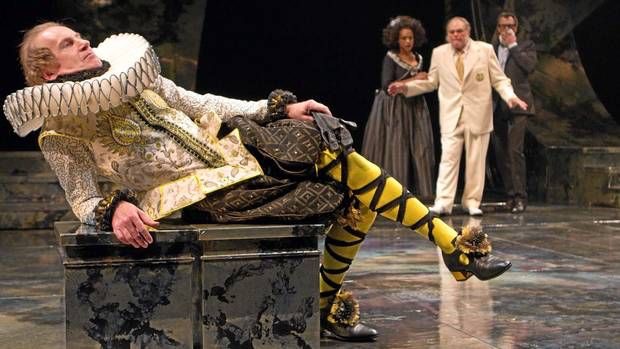
Like the Joker and Batman, both characters live according to an opposing viewpoint; Feste is a chaotic, happy-go-lucky sort, while Malvolio has a strict code of behavior which he expects everyone to follow. Their opposing world views bring them into conflict every time they meet. Plus, in most productions Feste is wearing brightly colored clown apparel or “motley wear,” while Malvolio is dressed in black. I’m not saying Malvolio is anywhere near as cool as Batman, but Malvolio can be just as sanctimonious. His journey is how he goes from being the trusted household servant, to a raving madman, to at last the Spectre at the feast at Olivia’s wedding.
I think the appeal of the character, which balances out the aforementioned snobbery, is that Malvolio is also a nerd: he dreams of becoming a count, he tries to make friends, but he does so by working far too hard at his job and not knowing how to fit in. This is why we inevitably feel sorry for him at the end of the play when he begs to know why his tormentors have locked him in a dark room, treated him like a lunatic, and made him think his lady was in love with him only to utterly destroy his hopes. The balance between the Nerd and the Snob that makes Malvolio a universal and complex part, and that’s why some of history’s greatest actors have played it!
Prepping for the Role: Alec Guinness, Laurence Olivier, Patrick Stewart, Donald Sinden, Nigel Hawthorne, Richard Briars, Steven Fry- these are just some of the names of actors who have played this part over the years. The first actor to play the role was Shakespeare’s leading actor, Richard Burbage, who also played Richard III, Hamlet, and Macbeth. Here’s a sample from Burbage’s famous eulogy, which mentions some of his most famous parts:
A Funeral Elegy On the Death of the Famous Actor, Richard Burbage,
He’s gone, and with him what a world are dead,
Friends, every one, and what a blank instead!
Tyrant Macbeth, with unwash’d, bloody hand,
We vainly now may hope to understand.
Brutus and Marcius henceforth must be dumb,
For ne’er thy like upon the stage shall come,
Vindex is gone, and what a loss was he!
Frankford, Brachiano, and Malevole.
One big decision that every Shakespearean actor needs to make is how to approach their role in a different way. To be honest, I was kind of a thief with my Malvolio- one of the first things I did was read a book by actor Sir Donald Sinden where he talks about how he delivered Malvolio’s first line, which occurs in Act I, Scene iii:
Olivia. What think you of this fool, Malvolio? doth he not mend?
Malvolio. Yes, and shall do till the pangs of death shake him:
infirmity, that decays the wise, doth ever make the 365
better fool (Act I, Scene v).
Sinden described his first line as a snobby “nyess,” as if he were simultaneously bored and embarrassed by Feste’s jokes. The director told me to act around Feste as if I were the villain in a Charlie Chaplin movie- basically to bully Feste and make him feel very small with my lines, in order to justify the revenge Feste innevitably takes on him. Like any character in Shakespeare, this is only one way to play the role, so you don’t have to agree with me.
The Gulling Scene
Malvolio’s most famous scene is called “The Gulling Scene,” the scene in which he’s tricked into thinking Olivia is in love with him. This is the moment where Malvolio goes from being a respectable prudish servant, into a raving madman. He enters full of dreams and plans to become “Count Malvolio” and creates an elaborate fantasy of what his life would be like if he married the Countess.
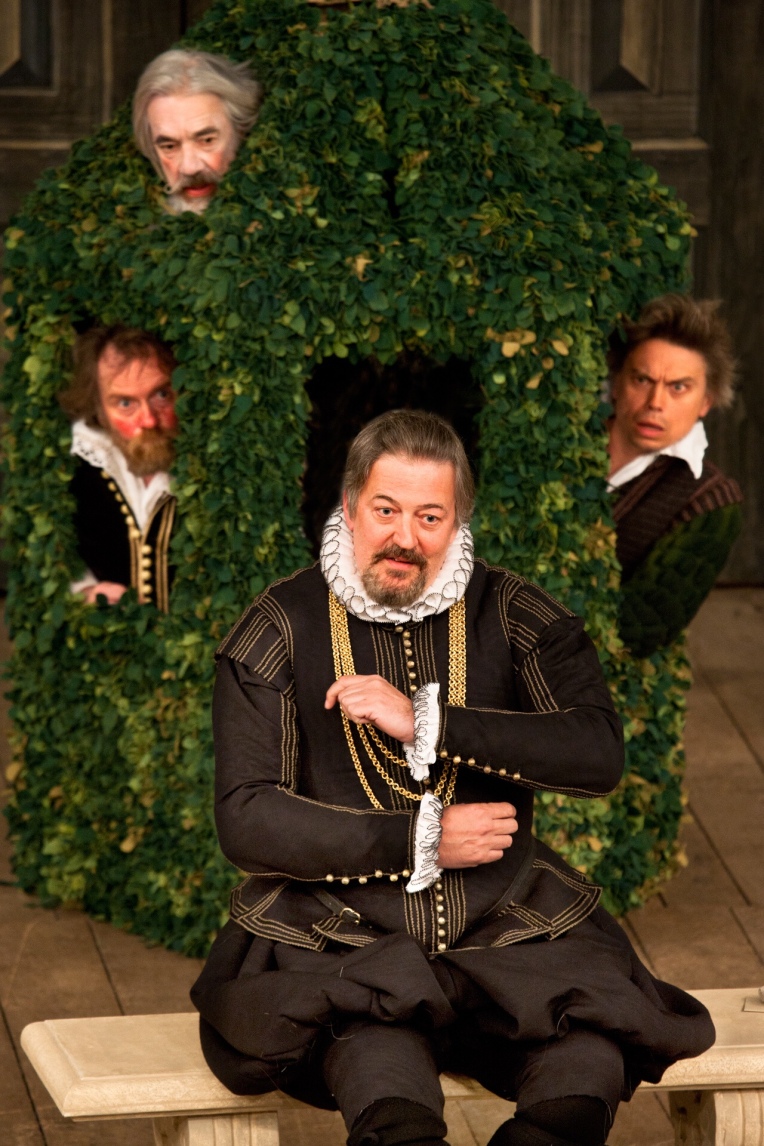
No sooner does Malvolio compete his fantasy of marrying Olivia, when lo and behold, a letter from her suddenly appears! Of course, the audience knows it’s all a trap and even worse, Sir Toby, Sir Andrew, and a boy named Fabian are watching him! It’s a moment of exquisite comedy that’s nearly impossible to get wrong.
One question I had when I did the scene was whether Malvolio really loves Olivia, or just loves her riches and her title. As a high schooler, I chose to believe that he really does have a crush on Olivia, but is too socially awkward to tell her. Having the letter is a chance to make his feelings known, which Malvolio can get very genuinely excited about! On the other hand, as you can see above, Malvolio might just be greedy to make himself even more respected and admired, and to have the power to throw out the likes of Sir Toby, Sir Andrew, and Maria. Malvolio’s revenge fantasy is also fun to watch, since we know he’ll be punished for it later.
Part of the fun involved in the scene is that it’s basically a “play within a play,” a device that Shakespeare used to great effect in Hamlet, A Midsummer Night’s Dream, Love’s Labor’s Lost, and both parts of Henry the Fourth. I think it’s the charm of seeing a character as he really is, Malvolio shows you his fantasies and creates a whole world in the middle of the orchard. Meanwhile, you feel complicit as you watch the people watching him, who could just as easily be part of your audience.Workshop on Twelfth Night and Bullying
On the other hand, the scene has also been called an example of bullying, since Sir Toby and Maria are using the letter to manipulate then humiliate Malvolio. Remember, Malvolio dresses like a fool and act like a fool in front of Olivia in Act III because he believes it will please the Coubtess. Basically Toby and Maria are Catfishing Malvolio, which can seriously hurt psychologically, as anyone who has been deceived over the internet knows. Plus, it ruins Malvolio’s reputation as you can see in this clip:
Again, as a teenager, I could certainly relate to a man making a fool of himself in a vain attempt to impress a girl. Seeing a man lose his head over a girl and then have her break his heart over a prank, is in some ways truly terrible to watch; even Olivia agrees by the end of the play that the joke has gone too far.
Malvolio. Madam, you have done me wrong,
Notorious wrong.
Malvolio. Lady, you have. Pray you, peruse that letter.
You must not now deny it is your hand:
Write from it, if you can, in hand or phrase;
Or say ’tis not your seal, nor your invention:
You can say none of this: well, grant it then
And tell me, in the modesty of honour,
Why you have given me such clear lights of favour,
Bade me come smiling and cross-garter’d to you,
To put on yellow stockings and to frown 2550
Upon Sir Toby and the lighter people;
And, acting this in an obedient hope,
Why have you suffer’d me to be imprison’d,
Kept in a dark house, visited by the priest,
And made the most notorious geck and gull
That e’er invention play’d on? tell me why!
Olivia. Alas, Malvolio, this is not my writing,
Though, I confess, much like the character
But out of question ’tis Maria’s hand.
And now I do bethink me, it was she 2560
First told me thou wast mad; then camest in smiling,
And in such forms which here were presupposed
Upon thee in the letter. Prithee, be content:
This practise hath most shrewdly pass’d upon thee;
But when we know the grounds and authors of it, 2565
Thou shalt be both the plaintiff and the judge
Of thine own cause.
That’s the tragic part of Malvolio’s journey. We’ve all known a Malvolio, and we’ve all been him from time to time. That’s what makes him such an enduring character.
Merry Christmas Eve everyone! Today I will be talking about how Shakepeare’s two royal patrons, Queen Elizabeth I and James I celebrated this holiday!
We have surviving records that prove Shakespeare and his troupe performed at Christmas during the reigns of Queen Elizabeth and King James I. The buildings still exist so we can imagine what Shakespeare’s performancesal at court might have looked like. What follows is a bit of historical detective work, with a nice holiday flavor to boot.
How did Good Queen Bess celebrate Christmas?
Like her predecessor Henry VIII, Her Majesty Elizabeth accepted presents from the nobles on New Year’s Day instead of Christmas morning. From all over the kingdom, people would bring the best and most extravagant presents to the queen, hoping to gain her favor at court. Take a look at this true case of what her favorite courtier, Robert Dudley gave the queen for Christmas in 1588:
Dudley gives Queen Elizabeth a wristwatch
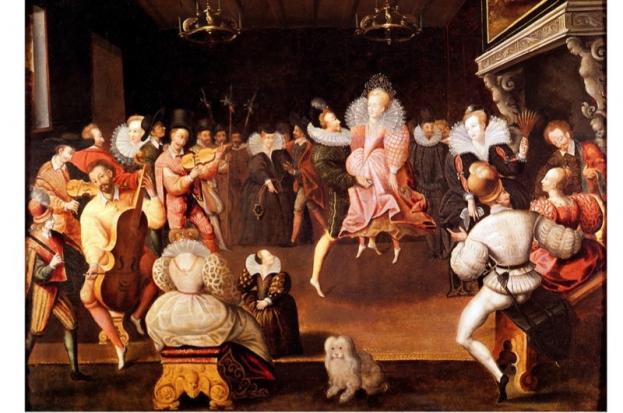
Unlike her dad however, Elizabethan Christmas was a more elaborate affair than a week of sitting and feasting. Yes, Gloriana had elaborate feasts, but she preferred to impress her nobles and visiting dignitaries with dances, jousts, and plays. She was an accomplished dancer and poet, and she loved court masques.
A masque is sort of like a combination masked ball and performance art piece. The nobles would put on costumes and masks and enact a historical or mythological event, like “the Golden Age Restored,” a masque Ben Johnson wrote for Twelfth Night in 1616. The intent was to flatter the queen and her court, as well as having a good time. Of course, Liz still made time on the dance floor for Shakepeare’s company!
.
How the plays were performed:
The plays would be in a large empty hall like the banquet hall or dance hall. Probably the tables would be removed from the feasting, then the dancing would begin. At around 10PM, the actors would take their places. There might be a makeshift tiring house, which was mainly just a curtain that the actors could hide behind to wait for their entrances.
The queen or King would be sitting on a throne on a raised platform so that she or he could be clearly seen by the actors and the audience. Which plays did They Perform?
In 1594 The Lord Chamberlain’s Men played before the Queen at Greenwich Palace. Alas, we don’t know which plays they performed this time. What follows is a list of the plays we do know Shakepeare’s company played at Christmas.
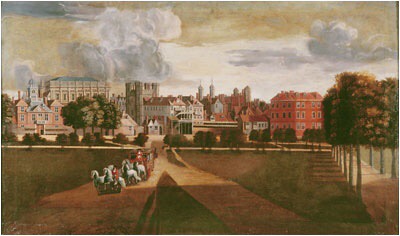
Whitehall Palace by Dankerts, 1675.
Love’s Labors Lost– 1597 at Whitehall palace. This time we know which play they performed before the Queen, because it’s listed right on the title page. I suspect that printing where the play was performed was designed to fire the imagination of the people who bought it. If you couldn’t be at court to see Shakespeare’s play, you could at least read his words and imagine you were there.
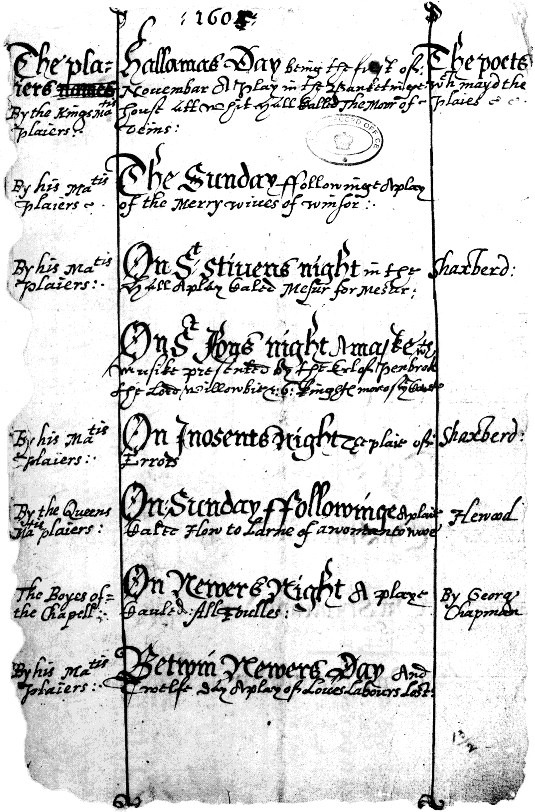
James I invited Shakepeare’s company to perform at Hampton Court many times. Below is an account of the plays for the Christmas holiday in 1603. Notice that Shakepeare’s name is spelled “Shaxberd.”
Here’s a list of some more plays we know Shakepeare’ performed at Christmas:
Midsummer Nights Dream- 1603 on New Years Day, Hampton Court.
Measure for Measure on Boxing Day 1603, Hampton Court.
King Lear on Boxing Day 1606.
Twelfth Night- Candlemas (Feb 2nd 1602).
Twelfth Night 1618 and 1619 (location unknown).
Below is an episode of the incredible documentary “In Search of Shakepeare.” The first twelve minutes show what Christmas might have been like at Hampton Court in 1603, the first year of King James’ reign.
James loved plays and masques even more than Liz, which is why he employed one of the greatest scenic artists of all time, Inigo Jones, to come up with extravagant stage designs and costumes for plays and masques. James’ Queen Anne Of Denmark performed in quite a few masques herself. James also treated the Christmas season as a time of charity, which might have inspired some of the lines in King Lear, which was performed ‘on the feast of Steven’ 1606:
“Poor naked wretches… who soer you are. I have taken too little care of this.” -King Lear, Act III, scene I (The Storm Scene).
We can recall the contrast between King Lear and Good King Wenceslas. In the scene I quoted earlier, Lear laments that he hasn’t been more charitable to the poor, now that he himself feels cold and homeless.
The Christmas season would carry on until oh January 6, aka Twelfth Night. This was the day when, according to Christian tradition, the Three Wise Men finally got to Bethlehem and delivered their presents. Shakespeare’s play Twelfth Night is all about celebrations of feasting, fools and clowns, and of course, epiphanies.
If you liked this post, please consider signing up for my new online class, “What Was Christmas Like For William Shakespeare?” I’ll go further into the traditions of Elizabethan Christmas and add some insight into Shakespeare’s play “Twelfth Night.” Register now at Outschool.com!
Once Shakespeare became a member of the Lord Chamberlain’s Men and later The King’s Men, the royals often requested that he and his company perform as the official royal entertainment at Christmas. Christmas for Shakespeare from 1592 to 1613 meant work. Nevertheless, it must’ve been a thrill for this country boy from Warwickshire England to see how the king and courtiers of his country would celebrate Christmas with elaborate feasts, parties, dances, and of course drama.
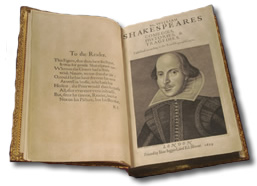
We know for a fact that Shakespeare was asked to perform at Christmas. As you can see on this title page for Shakespeare’s Loves Labors Lost, we have records of his plays being performed by name for the Christmas feast. In Tudor and Jacobean times, The Master of the Revels kept records of which plays he permitted to perform during the Christmas season and those records reveal what kind of entertainment each monarch enjoyed at Christmas. Christmas at King Henry VIII’s palace
Although King Henry the Eighth died before Shakespeare was born, his Christmas feasts were so lavish I simply had to devote some space in this post to talk about him. Henry outlawed all sports and games at Christmastime during his reign, focusing instead on drama and feasts. Part of the reason that the king outlawed any kind of sports (except archery), was because of the huge caloric quantity ingested from his feasts. To be blunt, as Henry aged, his diet only got worse. Near the end of his life, he was so overweight, his attendants needed a crane to get him out of bed!
Henry’s Christmas feasts were the stuff of legend. One-third of his palace at Hampton Court was devoted to the kitchens! The feast would include as many exotic and expensive dishes as the king’s court could imagine!
Christmas turkey became popular in Henry the Eighth’s day, but it would certainly share a dish with peacock, hare, goose, and wild boar; the most vicious animal to kill in the wild forest. There’s even a Christmas carol called the Boar’s Head Carol, which celebrates how hard it was to procure and prepare such an animal. For Henry, exotic food was a symbol of his power and so he stocked his Christmas feast with the most elaborate food a king could buy to impress his nobles and visiting dignitaries.
After the feast, the court would sing together, often to unaccompanied music called madrigals. These were short, secular songs in multiple voice parts and they were the pop songs of Henry’s day; he even composed a few himself!
If you watch this video you can see an incredible documentary, where a group of historic food historians re-creating an elaborate Tudor feast: A Tudor Feast
If you liked this post, please consider signing up for my new online class, “What Was Christmas Like For William Shakespeare?” I’ll go further into the traditions of Elizabethan Christmas and add some insight into Shakespeare’s play “Twelfth Night.” Register now at Outschool.com! – Shakespearean Student
This story is my own invention, but it is based on historical fact and some ideas that could be inferred from Shakespeare’s life and career, composed for Friday the 13th, 2015. I hope you enjoy it.
November, 1603.
The bell tolled in St. Paul’s Churchyard, stopping the bustling crowd in their tracks. A solemn wind blew through the crowd, like there was some dark magic in the air. Though the old queen had died months ago, all god-fearing Englishmen were still in mourning for her death, and spared a thought for the virgin queen as they passed out the long nave of the church into the yard. William Shakespeare was in mourning as well, but not for the queen; he was worried about the future of his company; without the queen’s sanction and protection, the theaters might be closed for good this time, (not one of these Newsmongers who gossiped at Paul’s Walk seemed to know how the young King James would take to plays and theater. The young man had had a life more dramatic than anything Will hat put to parchment- mother executed, father murdered, fighting off plots and murder attempts his whole life. “They say his mother’s head whispered a prayer when it was cut off” one of the gossips had told Will. “I heard talk his father was killed by cannon,” another whispered.” Shakespeare began to think of his old play Henry the Fourth, where he himself played the character of Rumor, who spoke with a million tongues, and not one of them true. Suddenly, from over the Bard’s left shoulder, came a slow deep voice that overpowered all the rest: “I heard t’other day the king fears being killed by witchcraft.” The voice came from one of the booksellers in the square.
Woodcut from the witch trial of 1597, in which witches supposedly tried to drown King James I.
As a writer, Shakespeare often came to St. Paul’s to buy books from the stalls at Paul’s Churchyard. He knew many of the booksellers by name, but he’d never seen this one before. His chest and arms were big as an ale barrow and his beard was grizzled and split into two forks, but what the poet marked in the man most was his piercing eyes- ones that stared at him like fire from an oily taper- quick and dancing, with an excitement as fiery as his own. “Tis true, the king were nearly shipwrecked as a boy by a coven of witches. 13 there were, always 13. They gathered on Fridays for their cursed Witches’ Sabbaths, and summoned up storms to sink the royal barge. The elder witch spoke to the King at Holy Rood house and told his majesty prophesies. She knew all the privy conversations he had with his wife, though she’d never seen him before! His majesty gasped in wonder and had her hanged and burned.” “Fine tale, said the playwright.” “Aye,” said the fire-eyed seller, but the king fears most of all the Wyrd Sisters, who foretold the deaths of his ancestors at the hands of King Macbeth.”
Shakespeare began to smell a devise- to appease the king, he would write a play honoring James’ noble ancestors and condemning this Macbeth as a villain. Shakespeare knew this kind of historical flattery would work; his tragedy of King Richard III had been a great success and the old queen had made him a courtier soon afterwards. Now he just needed to get his hands on some Scottish history to concoct a new play for the King. “Have you a copy of the Chronicles of England and Scotland?” “Nay, me press be not ready yet for the latest edition. But the best story of King Macbeth is an ancient tome written by the Elder Witch herself. Few have seen it, and fewer live to tell its secrets. If ye travel to Scotland, look for the book in the hands of a woman with hair red as flame, and eyes sea-storm blue.” Shakespeare thanked the man, wrapped himself in his cloak, and left the shop in a huff. The bookseller pondered the poet and smiled: “Wicked flame from wicked smoke. Envy burns black beneath thy cloak.”
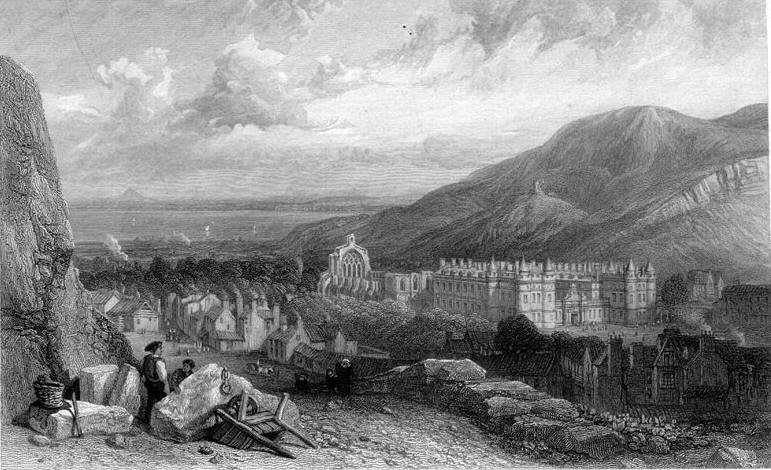
Holyrood House or “Holy Cross Palace” as it looked in Shakespeare’s day from Calton Hill in Edinburgh.
Over the Christmas holiday, Shakespeare’s company received a summons to court to perform some entertainments before the new King! The Chamberlain’s Men were delighted and Will was quite relieved. The King ordered the players to perform at Holy Rood house in Edinburgh, as his court was still in procession from Scotland to England. “Masters,” Will shouted, “Let us give the new king a taste of our quality, and may he pay handsomely for it!” Will and the other shareholders in the company decided on a series of plays to perform for the king, and began the journey to the wilds of Scotland. On Christmas morning they set up their temporary Tiring house within the great banquet hall for the performance, placing props and costumes behind a series of tapestries.
At suppertime the chamberlain gave word to light the candles within the hall, and signal the actors to perform the play, which Will had selected as King Henry the Fourth; a clever choice by Will since it depicted an old king passing the crown to a young and energetic monarch. As the king and courtiers processed, Will spied through the tapestry a haunted looking young woman at King James’ elbow, dressed in courtly gowns with a green veil on her head. The chamberlain directed everyone to their seats and announced the start of the play. To Will’s annoyance, he addressed the company “Mr. Shaxberd and company,” but there was no time to be annoyed or intrigued. “The play’s the thing,” Will muttered, and took his place backstage.
End of Part I.
Part II
The performance was a terrific success! The king himself applauded and promised to patronize the entire company. All of Will’s dreams seemed to be coming true! That night, as he and the other players were packing their belongings into a wagon and preparing to leave the castle in search of a nice, cheap inn for the night, a pale breathless messenger arrived and informed Will that the King wished to meet with him to commission work for their next court performance. Will dutifully walked back up the battlements and entered the castle.
“The Murder of David Rizzio” by William Allen, 1883.
The servant directed him, not back into the ante-chamber of the Great Hall, but up one of the staircases on the North East tower. This tower housed the royal bed chambers! What on Earth was a mere poet from Stratford doing up here? The servant’s candle cast strange shapes upon the walls and the flame blazed upward like some bronze blade. Shakespeare knew from the gossips that the King’s mother had watched her lover David Rizzio be murdered in this very tower- he was stabbed 56 times by jealous Scottish nobles who wished to marry the queen and take the throne. Gruesome images flickered in the poet’s mind. At last, they came to an archway with four adjacent chambers. Three were heavily guarded by English soldiers with halberds but the fourth was unprotected. Slowly, ever so slowly Shakespeare nodded to the servant, and stalked along the pathway. Before he could nock, the door swung open. Pausing a little, The Bard stepped inside.
The room looked like a mix between a library and a crypt with a cold stone wall, a small altarpiece that looked barely used, and several oak bookcases piled high to the ceiling. Once the playwright entered the room, the door shut without warning. He couldn’t see who shut it and the shock put something cold in his blood. Shakespeare’s eyes adjusted to the darkness of the room.Moonlight gave the place a silvery glow, until a shadow came out of the darkness and revealed itself as a woman’s face. Shakespeare could barely make out her features but it was clearly the woman he’d seen in the procession. The Moon made her red tresses shimmer and gleam, as if she were a fairy from one of the dark pools of legend. “I am Princess Elizabeth,” she replied in a voice that seemed more solemn than proud of her royal title. Recovering from his initial shock, the poet bowed low and counterfited his best courtier’s smile. “I am Master Will Shakespeare, at your service.”
“I know who you are. They call you the Bard of Avon. You’ve written sad stories of the deaths of kings, and woven yarns of the fairy queen,” the princess said in a hollow voice that chilled the poet to the core. “When I was little,” said the princess warming slightly, “My mother spoke of how Irish Bards could change their forms, and speak with the spirits of the dead. Sometimes they even outmatched witches who danced with the devil on Friday nights. You seek my family’s patronage?” “Yes”, said Shakespeare tentatively, “And may I prove worthy of such an honor.” “Beware your ambitions,” Elizabeth went on.
“My family has been torn apart by ambitious men. You know I take it that the chamber we stand in was where my grandmother watched her servant die. She lost the crown, and never saw her son again. Death stalks ambition in Scotland. Some say the Devil tempts men to dance with him on nights like this, and signs their name in his book. My ancestor Malcolm fought armies from Hell to keep his crown.” “From King Macbeth,” replied Shakespeare, (his breath finally returned). “I am the keeper of a history of that damned king, but I will not share it with anyone. He sold his soul to a witch to get the crown, and his book is full of spells that curse the reader. I brought you here so that you can lift our family’s curse with your writing. When you get my father’s patronage, do not feed his fears with stories of witches and prophesies or the curse will envelop the throne. Heed my warning, and do not look for the story of King Macbeth.”
As mysteriously as it had closed, the door opened again. The Bard bowed politely and left the chamber. As he left, he saw the Princess kneeling at the shrine at the corner of the room, eyes closed and meloncholy.
Tonight I’d like to discuss some of the spookiest, most enigmatic, and above all WEIRDEST characters in Shakespeare: the Three Weird Sisters in Macbeth.
1. Who are they?
Every production has to answer who the witches are, and many have very different answers. Are they temptress? Are they evil agents controlling Macbeth?Furies trying to destroy Macbeth?
I would argue in their basic form the witches are harbingers of change. Their very name “Wyrd Sisters” refers to an old Anglo Saxon concept of fate or destiny. Whether or not they have any effect on Macbeth mind or soul, they point the finger at him and say “things are going to change for you.” Then, he either makes the choices that determine his fate, or they change his fate for him.
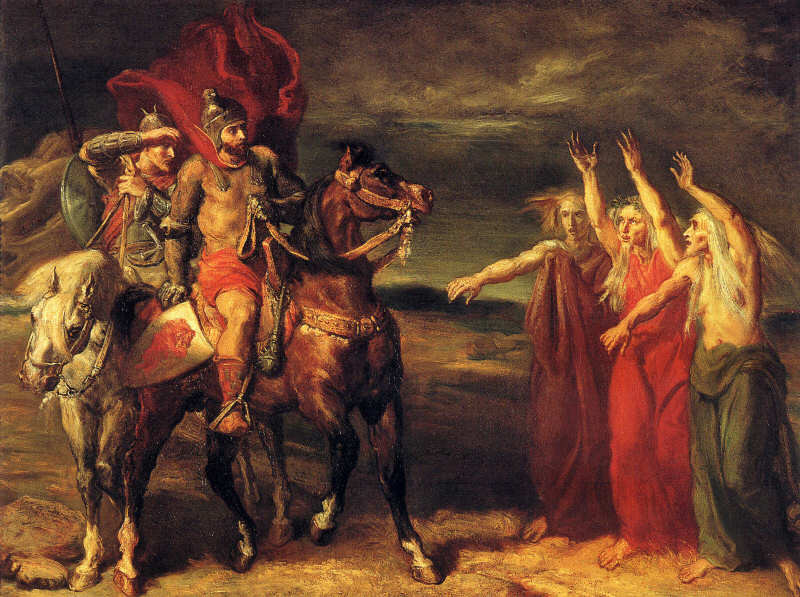
“Macbeth and Banquo First Encounter the Witches,” Théodore Chassériau, 1854.
Macbeth meets the witches on a heath, which means land that is literally out of bounds– the wild, untamed wilderness, which the old Anglo Saxons believed was the lair of many cursed spirits and monsters. This could symbolize Macbeth’ sin or transgressions, slowly turning into a murderer, usurper, and a tyrant. It could also symbolize the chaos in Macbeth’s life.
What Do They Look Like?
Shakespeare’s descriptions of the witches are highly contradictory- they seem to be floating, yet on the ground, they seem to be women, but they have beards! They don’t look Earthly, but here they are on the Earth. This gives them an other worldly quality that keeps us guessing as to who they are, and helps them tempt Macbeth more easily.
BANQUO What are these So wither’d and so wild in their attire, That look not like the inhabitants o’ the earth, And yet are on’t? Live you? or are you aught That man may question? You seem to understand me, By each at once her chappy finger laying Upon her skinny lips: you should be women, And yet your beards forbid me to interpret That you are so.
MACBETH Speak, if you can: what are you? (Act I, Scene iii).
The Witches’ Language:
You know from my earlier posts that the norm for Shakespearean characters is to speak in iambic pentameter- 10 syllable lines of unrhymed poetry that sounds like a normal heartbeat. The witches break these norms- they generally speak in Trochaic Tetrameter- 8 syllable lines with the off beat emphasized. The witches are literally offbeat, and that’s why their speeches are unsettling. Look at the contrast between a normal iambic line like:
“In sooth I know not why I am so sad.” (Merchant Of Venice I,i).
and
“Dou-ble Dou-ble, Toil and Tro-ble.
Fire burn and Caul-dren Bu-ble. (Macbeth, Act IV, Scene i).
For more info on the verse forms of the Witches, click here:
The witches also speak their prophesies in a vague, ambiguous manner They like to play with obscuring their prophesies with lines that make Macbeth think one thing, but the opposite is true. The famous example here is when they claim Macbeth will never be vanquished “until Birnam Wood comes to Dunsinane Hill.” Macbeth assumes this means he’s invincible, but it actually means that the enemy carry wood from the forrest. This is called Equivocation.
Witches and mythology
Illustration from William Blake’s “Europe a Prophecy,” 1794.
1. During the reign of King James, the modern witch hunt began; the king was fascinated with witches and even wrote a book called Daemonology on how to identify and destroy them. This was the era where people believed that witchcraft, rather than a pagan religious practice, was a forbidden craft that could only come from a pact with the devil. However, Shakespeare borrows from both Satanic and early pagan ritual in the characters of his witches.
2. Shakespeare took a couple of details about witchcraft from ancient Celtic and Greek mythology. First of all, the use of a cauldron. In Celtic myth, a cauldron is a symbol of rebirth and was sometimes used to resurrect the dead, just as the witches do in IV i. Of course, the ideal time for raising the spirits was on the feast of the pagan god Samhain, at the point where the veil between the living and dead was the thinnest. The feast took place on October 31st, our modern day Halloween!
Illustration of witches and their familiar spirits, 1647.
3. Familiar spirits In Act I, the witches speak to animal spirits called familiar spirits, which call to them and tell them where to go. King James himself wrote about how the witches found and communicated with these spirits.
Hecate.
In Act IV, Hecate, Ancient Greek goddess of magic appears. She is clearly the lord of all the witches, and is very displeased that they are riddling with Macbeth. Maybe not all witches believe in giving out prophesies that can destroy the Scottish monarchy. Hecate was always enigmatic in myths- she was born one of the Titans who opposed the gods, but frequently changed sides. More then being two faced, she was often portrayed as having three faces! Shakespeare refers to her frequently as “Triple Hecate.”
“The Triple Hecate,” by William Blake, 1794.
For more information on this mysterious goddess, consult the video below, (WARNING, ADULT-ONLY CONTENT).
In conclusion, the witches are meant to be ambiguous because the play examines the source of evil- whether it is inspired by other people, or if it comes from one’s own heart. The witches can be either or both, depending on how you want to tell the story, which is why they act and speak in contradictory ways.
Thanks for reading! If you enjoyed this posting, please consider signing up for my online class, “Macbeth: An Immersive Horror Experience.” I tell you the story of Macbeth and you get to play through an escape room, where you must solve the witches’ puzzles or be added to their Cauldron!
One of the greatest icons of female villainy, Lady Macbeth has been portrayed onstage by our greatest actresses, and immortalized in many alluring and terrifying works of art. Here are some of my favorites:
















 The Shakespearean Student