“Upon Such Sacrifices: King Lear and the Binding of Isaac”
I’ve compared King Learto a fairy tale in the past, but i haven’t compared it to a story from the King James Bible, even though Shakespeare, in all likelihood wrote and performed it for James himself. This article form the Jewish Review of Books is a comparison between Lear and the Old Testament Bible. First, the author has a tantalizing historical tidbit that might explain why Shakespeare chose to write Lear for King James:
Before ascending to the English throne, James VI of Scotland wrote a political guide, Basilikon Doron, for his eldest son advising him never to divide his kingdom (as Lear does) but “make your eldest son Isaac, leaving him all your kingdoms.”
Noah Millman.
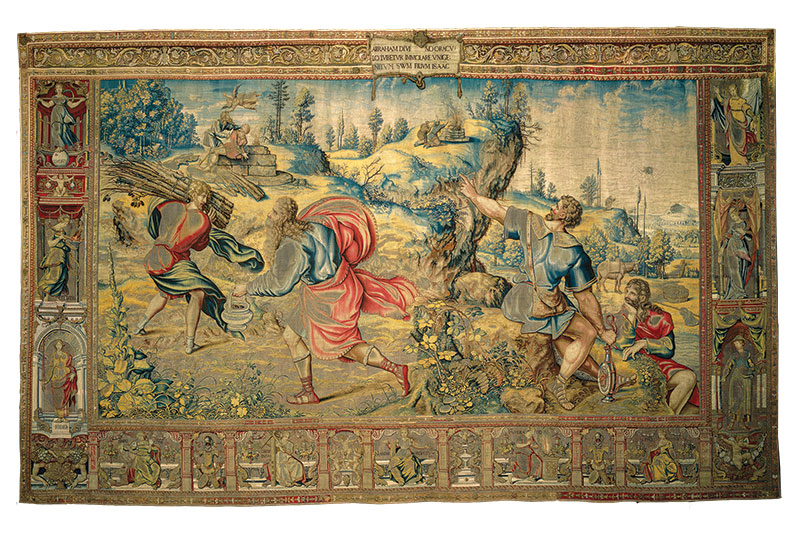
The article also draws some fascinating parallels between Lear and other Biblical patriarchs especially the sacrifice of Isaac, which takes place in Genesis 22, or as it’s known in Jewish tradition, the akeda.
The akedah prompts different questions than King Lear does, not of how so much tragedy could have sprung from a foolish love test, but how the God of all creation could have put his faithful servant to such an unconscionable test in the first place. And so there is a long interpretive tradition that labors to elide that fact in increasingly creative ways. Surely God never intended Isaac to be a sacrifice—the boy was merely to be present at the sacrifice! How could Abraham have thought otherwise, when God had already sworn that it was through Isaac that his promise to Abraham would be fulfilled? Or, alternatively, surely Abraham never doubted that God was merely testing him—after all, Abraham tells Isaac himself that God would provide a lamb to substitute!
It’s interesting to see the parallels between Lear and an Old Testament patriarch. He constantly asks his gods for help and swears by them when he pronounces his doom, yet arguably he has no real faith in his gods or his daughters, which is why his foolish love test in Act I, serves as the catalyst that corrodes and destroys his kingdom and his life. However, maybe Lear sees himself this way, as a king appointed by God, with the authority to test his daughters’ love as God tested Abraham. Ian McKellen seems to share this view and sees Lear as a priest who is unwilling to give up his “special relationship with his gods.”
The actor playing Lear can benefit from studying the sort of old-fashioned patriarchs presented in the Bible because they help shape his worldview. In addition, the concept of faith and how it is tested is another big theme in Lear and contrasting how men in the Bible keep their faith while Lear loses it is an illuminating way to contextualize both works. Was Shakespeare trying to write a parable for kings? Perhaps, but he certainly encapsulates very well the struggles and anxieties of keeping power, and the desire for divine intervention when a kingdom bleeds.
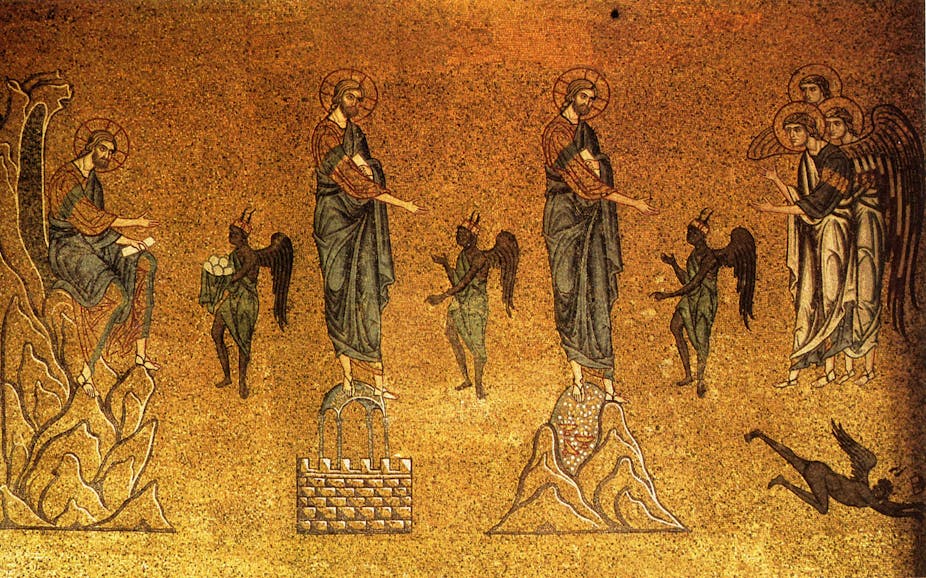
Forty days in the wilderness: Temptations of Christ, St Mark’s Basilica.
According to the Christian calendar, today (Tuesday) is Shrove Tuesday AKA fat Tuesday, AKA pancake day, AKA Fasnacht Day, (if you live in Pennsylvania ) It is the season that commemorates the time when Jesus Christ fasted in the desert for 40 days, before the holy week of Maudlin Thursday, Good Friday, and Easter Sunday. It is a time when believers give up a material comfort like sweets or fat, and meditate on Christ’s journey from Heaven to Earth and back.
Every aspect of the Easter story from Christ’s entry to Jerusalem to the Holy Thursday celebration of the Last Supper, to his death on the cross on Good Friday has been ritualized by the Catholic and many Protestant churches. Incidentally, Holy Thursday is determined by the Jewish calendar, which is in itself coordinated by the Paschal moon, the last full moon before the Vernal Equinox.
Growth and fertility; pain and pleasure, privation, and excess, things dying and things born. These extreme states of being and the dramatic stories of Christ’s passion are, of course, very good theater, so it’s no wonder that Shakespeare would choose to incorporate the themes and motifs of Shrove Tuesday into his plays.
Shakespeare and Shrove Tuesday
Peter Bruegel the Elder- The Fight Between Shrove Tuesday and Lent, 1559. Notice on the left there is a pancake supper and a rotund man playing a song on a stringed instrument, while on the right there is an emaciated woman wearing an austere head covering.
Shakespeare Loved Pancakes!
Shakespeare uses a lot of Christian imagery and theology in all of his plays but he also specifically refers to Shrove Tuesday, with its pancake suppers, use of theatrical disguise, and carefree attitude. He also refers to Lent, and the threadbare and lean times it represents.
In a general sense, a lot of Shakespeare’s plays deal with the swinging back-and-forth of Time, where society is simultaneously getting ready to purge itself of sin and deny itself pleasure. I thought I’d explore that by taking a look at some examples of text Shakespeare that deal with these themes.
First, let’s talk about Shrove Tuesday; in As You Like It, Touchstone makes reference to eating pancakes, traditional food for Shrove Tuesday in a lot of Christian communities. There are variations like donuts and fasnachts, but the idea is to eat up the fat and oil in your house. This is because to begin the start of length a time when Christians are supposed to abstain from fat, people would use the remaining oil and butter in their houses to have pancake suppers.
This modest pancake supper is one tradition of Shrove Tuesday, but there are many more elaborate ones. Shrove Tuesday goes by many names, but the most extreme and extravagant pre-Lent celebration is, of course, Mardi Gras. The celebration of Mardi gras in New Orleans is an offshoot of the Shrove Tuesday tradition, which is why it is often celebrated as an extravagant party with food, drink, and sometimes lewd behavior. Sometimes, Mardi Gras celebrations even incorporate Shakespeare plays as a theme:
Masks and Mardi Gras
As you can imagine getting the chance to purge yourself from sin and do things that you wish you wanted to do might make you a bit self-conscious, which is why traditionally in a lot of cultures mardi gras is celebrated by the wearing of masks. With a mask, revlers can hide their faces, and adopt an extreme personality, and indulge in dancing and drinking. Venice is another city famous for its Mardi Gras celebrations, and Shakespeare uses this tradition heavily in his play The Merchant Of Venice.
Shakespeare’s debt to Italy
Many of Shakespeare’s comic characters are directly inspired from character types created in a form of Italian comedy called “Commedia Del’Arte-” The Comedy of Art. These were short improvised vignettes where performers donned masks and acted improvised skits. Each actor spent years learning the voices and mannerisms of these stock characters like the scheming maid, (Columbina) the crafty servant (Arlequinno or Harlequin), or the greedy, dishonest innkeeper Brighella, who might have influenced Shylock himself. If you click on this website, there are some great scholarly articles about Commedia’s influence on Shakespeare, and how these characters helped forge all of his comedies, not just Merchant Of Venice.
Masks and Venetian culture
As this video from the Youtube historian Metatron explains, Commedia masks were just one of the masks that were front and center in Merchant Of Venice. Masks were part of Venetian society, not just during Carnival, which allowed Shakespeare to make masks part of the plot of Merchant Of Venice.
It’s not explicitly said, but I believe Shakespeare sets Act II of The Merchant Of Venice during a Carnival masquerade revel, where young men danced through the streets wearing masks. This might very well be during a carnival celebration, which means the play might very well be taking place during the twin seasons of Easter for Christians and Passover for Jews. This might very well be what Shakespeare was intending, as this clashing of religious dogma is at the heart of the play.
Shylock isn’t the only Commedia inspired character in Merchant. There’s also Graziano, Bassanio’s wild and raunchy friend. In this speech, he deftly parodies the duelling concepts of Shrove Tuesday and Lent, by promising to be austere, wise, and virtuous tomorrow, but not tonight, when he and his friend Lorenzo will be walking through the streets in their masks.
Bassanio. Why then you must. But hear thee, Gratiano;745
Thou art too wild, too rude and bold of voice;
Parts that become thee happily enough
And in such eyes as ours appear not faults;
But where thou art not known, why, there they show
Something too liberal. Pray thee, take pain750
To allay with some cold drops of modesty
Thy skipping spirit, lest through thy wild behavior
I be misconstrued in the place I go to,
And lose my hopes.
Gratiano. Signior Bassanio, hear me:755
If I do not put on a sober habit,
Talk with respect and swear but now and then,
Wear prayer-books in my pocket, look demurely,
Nay more, while grace is saying, hood mine eyes
Thus with my hat, and sigh and say 'amen,'760
Use all the observance of civility,
Like one well studied in a sad ostent
To please his grandam, never trust me more.
Bassanio. Well, we shall see your bearing.
Gratiano. Nay, but I bar to-night: you shall not gauge me765
By what we do to-night.
Bassanio. No, that were pity:
I would entreat you rather to put on
Your boldest suit of mirth, for we have friends
That purpose merriment. But fare you well:770
I have some business.
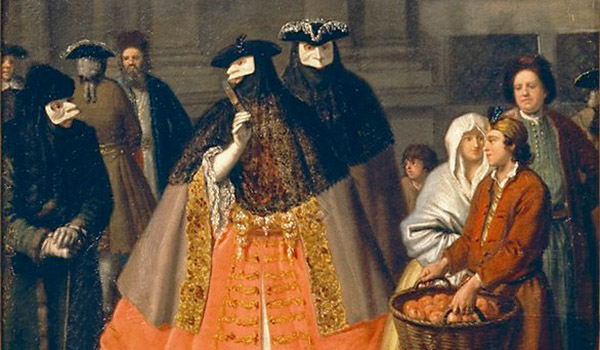
Detail, Conversation between Baute Masks, by Pietro Longhi (1701-1785); Museo Del Settecento Veneziano
While Gratziano and his friends are playing masquerade outside, Shylock instructs his daughter Jessica to shut up his doors and do not let the maskers in, or even look at them.
Merchant of Venice, Act II, Scene v.
It’s entirely possible that the play itself might very well conclude around the time of Easter which is especially significant considering that it ends with a scene that inverts, subverts, and questions the Passion story of Jesus.
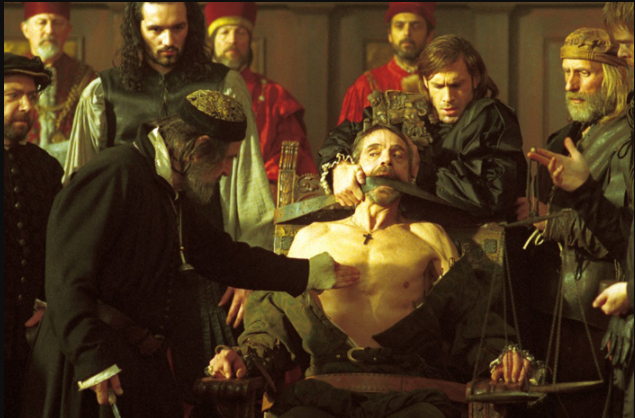
The courtroom scene from Merchant of Venice is almost a Passion Play in itself, where Shylock attempts to take a pound of flesh from the Christian Antonio, (who gives it as willingly as if he were Christ himself). Even though Jesus was crucified by Romans, for millennia the Jews were blamed for his death, and Shakespeare uses this anti-semetic imagery where Shylock stands in for the austerity of Mosaic law, rejecting the concept of divine Grace. Meanwhile, Portia is playing the judge, and she utters a poignant speech about mercy with almost God-like eloquence. This scene illustrates the established theological basis of Lent and Easter. According to Christian theology, the whole point of Lent is to remember and celebrate Christ’s sacrifice where we are redeemed from our sins. As she says, “We do pray for mercy, and that same prayer teaches us to render the deeds of mercy.” In a way, the sinful nature of mardi gras is not just a purging of human sin, it is also a way of acknowledging how far we fall short of God’s perfect ideals.
In that sense, Mardi Gras and Carnival are not a flouting or a rejection of Christian theology; it’s a reinforcement of it. Christians indulge in sin and acknowledge their sins the next day on Ash Wednesday, where they don black clothes and become contrite and this is our way of remembering Christ’s sacrifice and how necessary it was.
However, Shakespeare doesn’t have Antonio die like Christ, instead, it is Shylock the Jew who will metaphorically die and be reborn; he will convert to Christianity (and thus be dead to his former community), and his riches will give stability to Jessica and Lorenzo when Shylock dies. Shylock’s punishment at the end of the play is intentionally harsh and cruel, and many scholars have shown it as a demonstration of the limits of Christian mercy. Like the masks they put on every day, Venetian Christians seem pure and pious, but are inwardly corrupt and degenerate.
Shakespeare and Lent
You might have noticed that I used the word “purge” repeatedly in reference to what people do on carnival and mardi gras as a way of releasing their sins. The Purge movies do in fact have a basis in this concept. Traditionally the flowers that are part of purge days are actually given at Shrove tide. The Purge is also traditionally celebrated in mid March around the time of the vernal equinox, so the purge movies are a more extreme version of mardi gras, with the belief that the one illegal tendency people would indulge in alloed, would be murder, (which is a very bleak comment on human society).
What’s interesting is that Shakespeare creates his own sort of purging of society in his play Measure For Measure, and he creates a villain who is very much like an embodiment of um of lentin But
no man can is without sin and no and it is incredibly dangerous to assume that 1 Possibly making fun of her clothing and possibly also calling her a whore or a prostitute that that um you see it was traditional to eat Is the food a drink length until It’s a sexual It’s not as enjoyable and probably lower quality than the norm normal because of course the tradition of lent is a tradition of self denial and and in measure for measure he creates a character who is obsessed with his own piety and self denial the character of the judge Angelo in measure for measure he is a judge who is known for his piety and a society that is that it’s become too loose too loose to carnival ish and he is charged by the Duke who has chosen to Leave Vienna to with to become more dracodian to become more our strict and and legalistic and punish people use the fear of the law in order to command good behavior he sets the same standards for everybody else that he does for himself and that’s why the central conflict of the play is between him and Isabella whose brother who hasn’t committed any sins on stage but her brother Claudio is guilty of adultery well not no not guilty of adultery hes technically guilty of fornication in that he has consummated his marriage with the Woman before proceeding with the marriage rituals that I mentioned in my most recent Romeo Juliette portpost so hes being punished by 4 and a Kate for fornication fornication in in the the strictest and most technical definition of fornication he loves this woman he has made a pledge for her to be his wife legally they are married but it’s not good enough unless they make a formal request they get the consent of the parents and they and they are and they have a marriage ceremony performed in a church unless he does all of those things in Angelo’s mind he is guilty of fornication So you can see that Angelo has a stricter nature than most people would permit themselves and he is utterly and the concept of mercy is just as alien to hit him as it was to Shylock the main difference between the 2 characters that’s Angelo heights behind Christian piety not Jewish piety Ione and he turns out to be even more morally degenerate than Shylock because he is it is he is trying to manipulate uh manipulate Isabella in order to get her to sleep with him he wants to sleep with a nun because he thinks he deserves her he thinks that she is a reward for his piety
Angelo forgot what any person who celebrates mardi gras and ash Wednesday does that the purpose of lent is to remind ourselves that we are human know that we need mercy and to celebrate the sacrifice the Christ made so that we can continue to be human and not try to utter utterly lady destroy our imperfections that make us human so measure for meta The diconomy between Lynton and and a boccanelli or carnum Leonora carnival’s morals morals and in the end Isabella emerges from that crucible Victorious she defeats Angelo she exposes him as a failure as a failure she failure she ransoms her brother almost as definitely as Christ renziming humanity humanity and in the end she is offered the chance to either become a nun as she wanted or to become the Duke’s wife and therefore Queen of the whole country Taking a face value it looks like it seems like a fairy tale ending where this is the sort of person who should be governing somebody whose morality is tempered with mercy but but Shakespeare’s play is much Messier than that if you actually read it or see it performed formed it has Siri it’s a racist serious questions about how helpful oh helpful this this particular concept the concept is to women especially since Particularly when it comes to failings of the Flash in most productions I’ve seen you’ve Jew seen Juliet in measure for measure to for measure is as mocked and as disdained and is the and abused it’s viewed as Claudio is and Is life a reputation which is really all a woman had back in this period so Shakespeare does a good job of of showing the virtues of letting and carnival in Is illings of such rules it’s all very well and good to say we are allowed to be human man but very often women are set to higher standards than the men when it comes to if comes to standards of purity and piety
No hare, sir; unless a hare, sir, in a lenten pie, that is something stale and hoar ere it be spent. [Sings] An old hare hoar, And an old hare hoar, Is very good meat in lent But a hare that is hoar Is too much for a score, When it hoars ere it be spent. Romeo, will you come to your father’s? we’ll to dinner, thither.
–Mercutio, Romeo and Juliet
Lent and Measure FOr Measure
Conclusion
the Lenten season probably appealed to Shakespeare because much like “Twelfth Night” it is a season that momentarily subverts and then enforces the status quo. People indulge themselves in debauchery briefly, then commit themselves whole-heartedly to sobriety and piety. It shows the tendency towards the extreme in human nature, whether it be the grotesque, the sinful, the lusty, or even the austere. Like the masks at Carnival, we find these extremes of nature fascinating to watch as they dance before us and therefore, they also make for very good drama.
I know Halloween is over, but since I am doing a research project on the Salem Witch Trials, I thought I would trace the history of Witch Hunts from Shakespeare’s day to Salem:
I played this character back in 2010 as a college production and not to brag, but I want award both for my performance and also my role as dramaturg for that particular production, so I did a lot of research in into the character and I tried to bring my own spin on the part. So unlike my other Crafting a Character posts, I am going approach explaining the character as a series of questions instead of talking about it https://youtu.be/-ocOfP16tdw
Who Is Friar Lawrence?
Concept art for Friar Lawrence, including a photo of Pete Postelwhite in the 1996 movie
A friar is a monk who belongs to a local monestary. Francis belongs to the Franciscan orders created by Saint Francis of Assisi. It was known for its naturalist philosophy, and St Francis himself is often depicted in paintings as being friends with birds and rabbits and things like that. He was also a strict vegetarian and believed the spirit of God is in all creatures.
Francis’ work was a reaction to the other orders of Catholic monks who, the Franciscans believed, had gotten corrupt and lustful. So the Franciscans in reaction to that corruption, tried to embrace poverty, plain living, and duty to the poor.
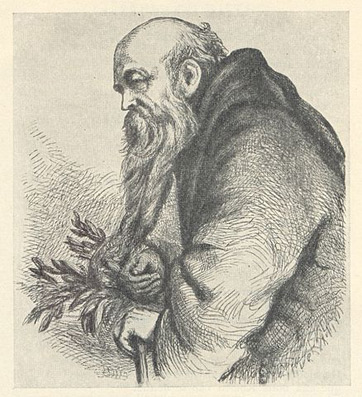
The Franciscans were also famous for not wearing shoes; Shakespeare calls one of them “[our] barefoot brother.” Again, the Franciscans value humility before God, and because of that, they shaved off part of their heads, (known as a tonsure hairstyle); it was way of stating that they were not concerned with their appearance, (so yes, it’s supposed to look stupid).
Why does Romeo hang around him? Friar Lawrence is supposed to be Romeo’s tutor, but really he is in the play because Shakespeare needed a convenient way to get Romeo married to Juliet without his parents finding out. He is also a neutral party who can be sympathetic to both Romeo and Juliet, without being tangled in the politics of the Capulet/ Montegue fued.
Romeo persuades Friar Lawrence to help him marry Juliet in Act II, Scene iii.
Friar Lawrence also acts as a character foil to Romeo. While Romeo is rash, passionate, and impulsive, Friar Lawrence is calm, slow, and contemplative, (appropriate qualities for a monk). During my production of Romeo and Juliet, the director beautifully explained their relationship by having Romeo trip and fall when he is excited about his impending marriage. I as Friar Laurence turned around and said calmly: “Wisely and slow, they stumble that run fast.”
My Interpretation Shakespeare makes references again and again to the character being old, yet the director and I made a conscious choice not to portray him as such. I portrayed him as just a few years older than Romeo, who is supposed to be a teenager. I played him as sort of about 25-26, the same age that I was when I played the part.
We did this because even though Friar Laurence acts as the voice of age and experience, he also seems very naive. He seriously believes that he can singlehandedly stop the feud between the Montegues and Capulets with one marriage. he never consults anybody else, and he leaves Friar John in charge of sending the all important letter to Romeo that Juliet is not dead, and never checks up with him on that.
Rather than being an old priest who is aged and experienced, I portrayed him as a young idealistic priest who doesn’t know better. In some ways, his love of God has blinded him as much as Romeo’s love for Juliet. The Friar thinks that being a peacemaker is something that God wants him to do. He thinks that bringing together souls is part of his heavenly mandate and he doesn’t think about the practical consequences of his religious fervour.
What is his role in the play?
Friar Laurence engineers the plots to get Romeo married to Juliet and hopefully settle the feud. When we first meet him, Romeo convinces Friar Lawrence to perform a secret wedding between Romeo and Juliet (Act II, Scene iii).
“Romeo shall thank thee daughter, for us both,” Romeo and Juliet, Act II, Scene v.
In Act II, Scene vi, Friar Lawrence secretly marries Romeo and Juliet, but first warns them to “Love moderately,” because he believes that an over abundance of passion can have disastrous consequences. He even compares Romeo and Juliet’s love to gunpowder.
In Act IV, Friar Lawrence has two scenes where he stops Romeo and then Juliet from killing themselves. First he stops Romeo, filled, with grief and remorse after murdering Tybalt, and being banished.
“What, rouse thee man, thy Juliet is alive!” “Juliet, I already know thy grief…”“Come you to make confession to this father?” Paris (Matt Bugay) meets Juliet (Alesia Lawson) outside of Friar Lawrence’s cell, Act IV, Scene 1.
In Act IV, Scene iii, Friar Lawrence concocts his plan to give Juliet a secret potion with which to fake her death. Juliet demands that he find a way to prevent her marriage to Paris or she will kill herself.
“The heavens do lour upon you for some ill.”In Act V, Scene ii, Friar Lawrence learns from Friar John that his message that Juliet is alive, never reached Romeo. “A greater power than we can prevent…” Friar Lawrence delivers the bad news that Romeo is dead, Act V, Scene iii.
Is Friar Lawrence To Blame For Romeo and Juliet’s Death?
A lot of scholars, teachers, and classrooms have pondered this question. In addition, even the Supreme Court of the United States put Friar Lawrence on trial in 2016 as part of a mock trial sponsored by the Shakespeare Theater in Washington DC. https://www.c-span.org/video/?419930-1/federal-judges-discuss-romeo-juliet
I am actually working on my own mock trial activity which I will share by the end of this month, but for right now I will summarize the major arguments:
The Defendant (Friar Lawrence) tried repeatedly to prevent Juliet and Romeo from committing suicide. In Act III, when Romeo tries to stab himself, Friar Lawrence stops him and convinces him to go to Mantua:
Romeo. O, tell me, friar, tell me,
In what vile part of this anatomy1985
Doth my name lodge? tell me, that I may sack
The hateful mansion.
[Drawing his sword]

Friar Laurence. Hold thy desperate hand:
Art thou a man? thy form cries out thou art:1990
Thy tears are womanish; thy wild acts denote
The unreasonable fury of a beast:
Thou hast amazed me: by my holy order,1995
I thought thy disposition better temper'd.
Hast thou slain Tybalt? wilt thou slay thyself?
And stay thy lady too that lives in thee,
By doing damned hate upon thyself?
Likewise in Act IV, Friar Lawrence stops Juliet from killing herself and gives her the vial of sleeping potion.
“Be not so long to speak, I long to die!” Juliet (Claire Danes), begs Friar Lawrence to divise a plan to prevent her marriage to Paris in the 1996 movie.
Throughout the play, Friar Lawrence attempted to keep Romeo and Juliet alive and together, but was thwarted by what could legally be interpreted as and ‘Act of God’:
Passage from Act V, Scene ii.As this slide shows, the reason Friar John was unable to deliver the message to Romeo is that he was in quarantine. A literal “Plague on both your houses,” has indirectly killed Romeo and Juliet
What the prosecutor might say-
Friar Lawrence performed a marriage illegally, without consulting the parents of two minors. He also harbored a fugitive (Romeo), right after he was found guilty of murder. Finally, he tried to deceive Juliet’s parents by giving her a dangerous drug. On paper, though Friar Lawrence was certainly acting out of compassion for Romeo and Juliet, his actions were highly suspicious and could be considered criminal.
An English class can learn a lot putting Friar Lawrence on trial for his role in Romeo and Juliet’s deaths, as long as they are responsible in the way they portray teenage suicide.
Who Originally Played Friar Laurence?
I don’t have any substantial evidence to prove this but I do of have a theory: some of Shakespeare’s parts require a great amount of stage business; singing, dancing, swordfighting, improvising that kind of thing. Hamlet for example has to sing, dance, sword fight, and remember copious amounts of speeches and dialogue. Will Kempe had to dance and dance and sing. Robert Armin had to improvise and dance with the audience.
My theory is Shakespeare didn’t have time to learn extravagant stage business, since he was also writing the plays and helping with the company’s business dealings. With this in mind, he probably gave himself the parts that had long speeches. That’s why I think that Shakespeare himself might have played friar Laurence.
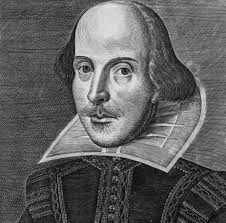
Plus Shakespeare had an edge playing the role over other actors. Since friars are supposed to shave their heads, and since we know that Shakespeare had thinning hair, he could have easily played the part himself.
So those of you who get cast as Friar Laurence and wish that you were cast is somebody young like Romeo or Tybalt, at least your consolation prize is that you might be playing the part that Shakespeare himself once played.
I hope you found this insightful and maybe helpful if you find yourself cast in Romeo and Juliet. I’ll be sure to post about the Friar Lawrence mock trial I’m currently working on. At the very least, I hope this information helps you see Friar Lawrence as more than an old guy who hangs around teenagers.
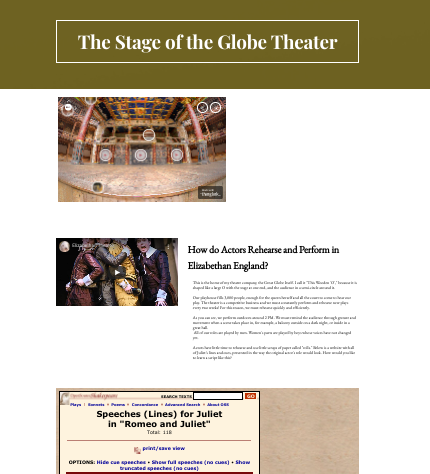
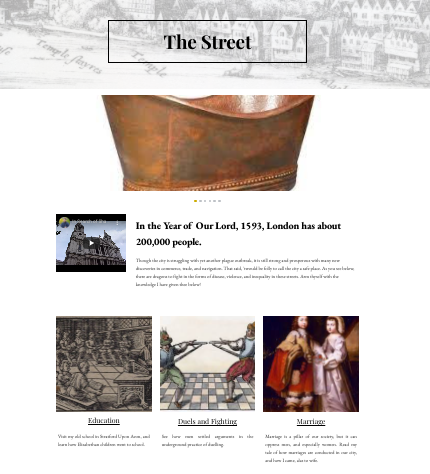
I’m working on several educational projects at the moment and I’m proud to share this one with you. It’s what I call a virtual tour of Shakespeare’s London. The teacher I’m working with said she wanted to teach the kids about the culture of Elizabethan London as he was writing Romeo and Juliet. Naturally with the pandemic a field trip was out of the question, (for multiple reasons), but I wanted to create a visually interesting tour of the places Shakespeare knew and worked and try to imagine his perspective and how that might have informed the characters and themes of Romeo and Juliet.
So I created this: a website written as if Shakespeare himself is taking you on a tour of his London in the year 1593, the year where, as far as we know, he had just completed writing Romeo and Juliet. 1593 was also the middle of another outbreak of Bubonic Plague. It has virtual tours of Shakespeare’s Globe Theater, Hampton Court Palace, Shakespeare’s Grammar School, and a quiz where you can pretend you’re in the Elizabethan doctor’s office.
For the class I’m helping, the students will fill out a worksheet as they navigate the website so they learn from the material at their own pace. If you’re interested, leave a comment and I’ll post the worksheet so you can use it in your classroom.
My hope is that this website can be a resource for anyone trying to connect with Romeo and Juliet and trying to learn from the culture of Elizabethan London. Shakespeare was a product of his time and his experiences must have had an influence on what he wrote. Even if they didn’t, they certainly influenced the people who saw the play and he knew that it would. So I hope it can help you understand a little bit more about the world of this famous play, and the context of the world that created it.
My purpose with this post is to provide some hope and comfort by showing how Shakespeare and other Elizabethans dealt with epidemics and survived. The thing to remember is, although we are dealing with a pandemic, we are still far better prepared for it than any time in history. Furthermore, I want to draw on lessons from the past to offer hope and wisdom for people going through an epidemic.
Side note: Shakespeare refers to several diseases in his plays including “The plague,” (Bubonic Plague), “The Pox,” (syphilis), “Dropsy,” (edema), and “Falling sickness,” (epilepsy). I will mainly focus on the plague because of its strong connection to both Shakespeare’s life and career, as well as the continuing anxiety it causes to this day. I am also focusing on the plague to try and make parallels with Covid 19, a disease that, while less lethal and harder to detect, is still a pandemic that like the plague has transformed much of daily life since its inception, and could continue to grow, abate, and revive if we as a society aren’t careful.
Shakespeare’s plays also frequently allude to plagues and plague imagery, especially his most famous play, Romeo and Juliet.
First of all plague is an important plot element; an outbreak of plague prevents Romeo from getting the message that Juliet is alive, so plague inadvertently kills them both.
Plague also serves as a motif for the destructive forces that lead to the play’s tragic conclusion. After Mercutio curses “A plague on both your houses,” his death sets the events in motion that kills most of the principal the characters, as if his curse somehow infected all of them with a deadly virus.
Immortal Longings Artwork for “Romeo and Juliet” by Elizabeth Schuh, used with permission.
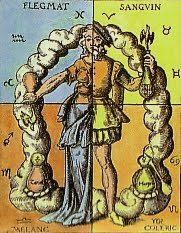
Shakespeare exploited a unique cultural knowledge of plagues to help his audience engage with Romeo and Juliet. If you click on the link to my presentation above, you’ll see that Elizabethans believed that four liquids called humors controlled health and behavior. A humorous man was someone who was out of ballance with the humours and thus was ridiculous for failing to control his emotions. The humor choler was associated with anger and in dangerous imbalances was thought to cause terrible fevers and even plague. Hence, when characters like Romeo and Tybalt get angry, his audience knew that one way or another, that anger will kill them.
Medieval illustration of the four humours. Top left to bottom right; Phlegm, Blood (Sanguine), Melancholy, (black bile), and choler (yellow bile).
Shakespeare also uses plague as a metaphor for the hate of the two families that infects and kills the young lovers, as well as Tybalt, Paris, and Mercutio.
The play was first published in 1595, two years after a plague outbreak so bad that the theaters were all closed, so Shakespeare’s audience had a visceral reaction to this plague imagery when they saw it in the theater, especially after a year of being quarantined away from the theaters because of that exact same disease!
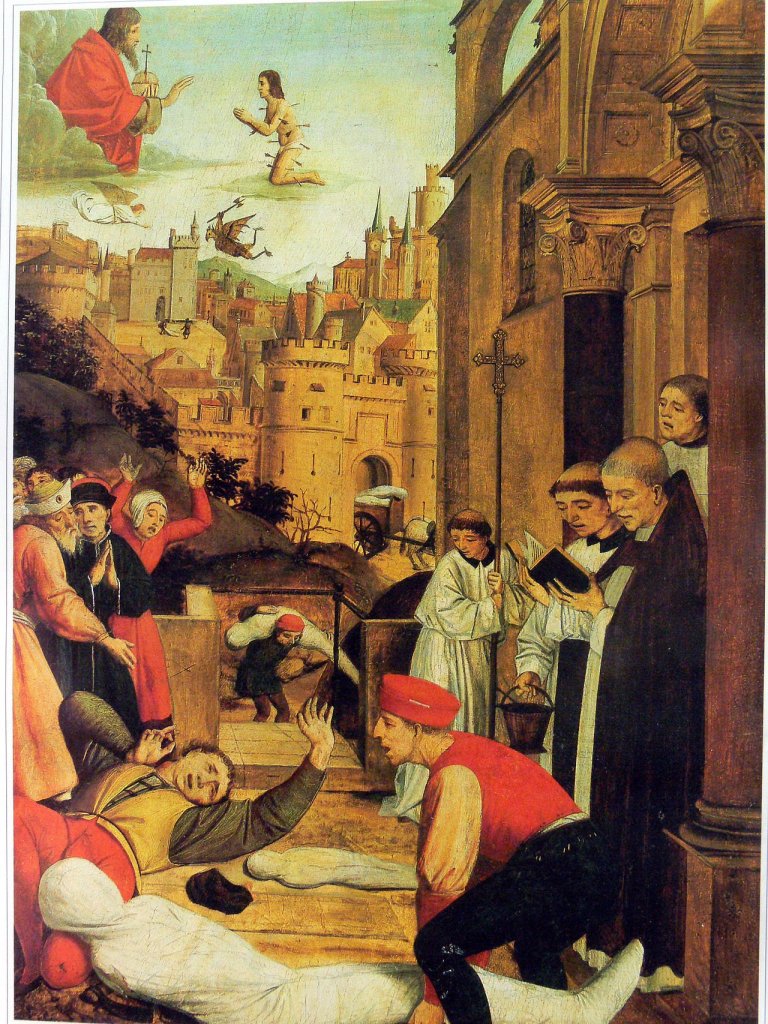
Saint Sebastian pleads with Jesus for the life of a gravedigger afflicted by plague during the Plague of Justinian. (Josse Lieferinxe, c. 1497–1499)
“Scourge and Minister”
Some of Shakespeare’s plays mention plague indirectly in relation to its perceived nature as a divine punishment. Since the very beginning of the plague,, writers, clergy, and many others perceived the plague as a divine punishment, designed to destroy the wicked, like the 10th plague in the Bible that decimated the enslaving Egyptians.
To “scourge oneself” is also a verb for whipping. In the 14th century, a group a people called the flaggelants, who voluntarily scourged themselves in the hope that God would end the disease as a result of their suffering.
Shakespeare uses both meanings of scourge in many of his plays. In Henry IV, the king is filled with remorse for usurping the throne from King Richard, and worries that his future progeny will become a scourge upon him:
I know not whether God will have it so,
For some displeasing service I have done,
That, in his secret doom, out of my blood
He’ll breed revengement and a scourge for me;
King Henry IV, Part I, Act III, Scene ii.
Sometimes a scourge is a person sent to destroy a sinful person or group of people. Shakespeare refers to the character of Richard III several times as a scourge upon the families who fought in the Wars Of The Roses.
In Shakespeare’s first cycle of four history plays, we see the families of York and Lancaster take turns usurping the throne, and committing numerous acts of murder, treason, and blasphemy. In the play that bears his name, Richard III kills the Yorkist royal family and then is murdered himself by Henry Tudor, systematically destroying the families of York and Lancaster. Thus, in Shakespeare’s propaganda version of history, he depicts Richard as a scourge who purges the throne of usurper and traitors, paving the way for the “virtuous,” Henry Tudor and his dynasty.
The ending shot of the BBC’s 1978 TV version of “Richard III.”
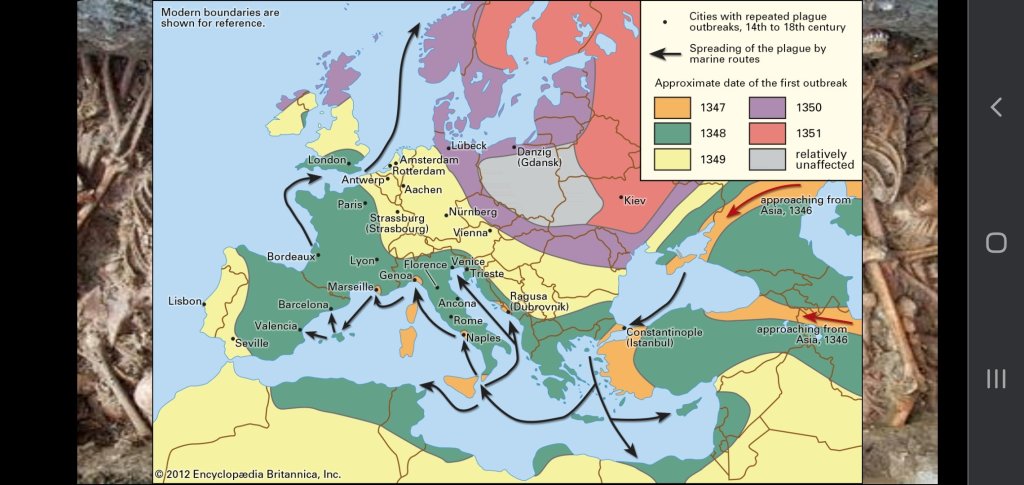
The Real Plague The black death, also known as Bubonic Plague, was first documented in 1347. Like Covid 19 it was first discovered in China, though it might not have originated there. Some historians argue that the Huns might have carried the plague into China and trade routes from the East carried it into Europe. By 1349 it reached England.
Everyone knew what to look for from those infected with the plague: first came fevers and chills. The next stage was the appearance of small red boils on the neck, in the armpit or groin. These lumps, were called buboes, (hence the term Bubonic Plague)
The buboes grew larger and darker in colour as the disease grew worse. From there the victim would begin to spit blood, which also contaminated with plague germs, making anyone able to spread the disease by coughing. The final stage of the illness was small, red spots on the stomach and other parts of the body caused by internal bleeding, and finally death.
We see death coming into our midst like black smoke, a plague which cuts off the young, a rootless phantom which has no mercy or fair countenance. Woe is me for the shilling in the armpit. . . It is an ugly eruption that comes with unseemly haste. It is a grievous ornament that breaks out in a rash. The early ornaments of black death.-Jevan Gethin, poet who died from plague in 1349.
Detail from The Temptation of St Anthony, 1512. Note the swollen buboes on the stomach, arms, and legs.
John Flynn, an Irish Friar described the plague in apocalyptic terms, writing a journal for posterity, but expressed doubt that ” Any of the race of Adam would even survive.” With the horrifying spread of the epidemic, it is not hard to understand why Flynn felt that way: In 1348, there were 100,000 people living in London, but after the plague spread, the city lost 300 people every day!
Quarentines: The word quarantine is Italian for 40 days. It refers to the Venetian practice of taking suspected plague victims to an island for 40 days before allowing them to enter Venice or other populated areas. The rationale was that in the Bible, the number 40 occurs many times when a person or group of people require some form of purification; the 40 days of flooding in Genesis, the 40 years that the Jews journey to the promised land, and the 40 days of fasting Christ endured before he began his ministry to name a few examples. Bubonic plague has an incubation period of less than 40 days so the quarantine actually worked- people would go to the island, then the disease would run its course and not spread out as long as it was contained. The problem was that these quarantines were also essentially leper colonies and without treatment, the infected were basically sent to die.
Social distancing in Elizabethan England–
By 1564, the year Shakespeare was born, there had been several outbreaks, but also a system designated to contain the disease. The rich went to the country. Plague bodies were burned. Theaters were closed to keep the disease from spreading. There were also body inspectors, (similar to coroner’s or death investigators today,) who inspected the bodies to look for the cause, then burned them and the clothes. Funerals for plague victims were held at night, to discourage crowds from attending, similar to our own practice of encouraging people to shop and go outside during non-peak hours.
“Treating” it: The biggest comfort I can give here is to remind people that although like the plague, we are dealing with a disease with no known cure, we still have a much better understanding of how to treat viruses than our Elizabethan forebears. Some of the “cures,” from Shakespeare’s day are downright silly, when they aren’t expensive, dangerous, and above all, ineffective.
Real plague “cures” • Kill cats and dogs • A poultice made of Marigold flowers and eggs • Arsenic powder (which is highly toxic) • Crushed emerald powder. • Pluck a chicken and place its rear end on the patient’s buboes, known as the Vicary Method.
To bring the aftermath of the plague into a modern context, I’d like to allude to some comments from the news. Recently a few Republicans have alluded that the cost of people staying home from work would cause irreparable harm to the American economy, and alluded to the notion that a few deaths might actually benefit the economy as a whole, including Texas Lieutenant Governor Dan Patrick and Republican pundit Glenn Beck. Now at first glance these comments are gruesome and heartless, but they have a veneer of historical precedent: some people did prosper because of the black death. Laborers could charge more from their landlords simply because most of them had died, and some younger men managed to skirt the laws of primogeniture and inherit their families’ wealth because of the death of their oldest siblings. Shakespeare himself was the third child of Mary and John Shakespeare, but his elder siblings both perished due to plague. Again, to be fair to these Republicans, there is a historical facet to their arguments, however this is a very narrow and very incomplete version of history.
https://youtu.be/QNo-r20wqqg Looking forward from the first century after the Black Death, the loss of life and resources was devastating for the workforce and caused a series of catastrophes for centuries to come. Though some peasants benefited from the lack of serfs, the depleted workforce meant work became harder and more expensive, and the coming centuries were plagued again by revolts, wars, and famine.
Wat Tyler, leader of the Peasants Revolt, rides out to negotiate with King Richard’s army.
Just 30 years after the first outbreak of plague in England, the peasants rose in revolt against their lords for the first time in 300 years, in no small part, due to the hardships caused by the plague.
Portrait of King Richard the Second
The king who punished the peasants was Richard Richard the Second, whom Shakespeare famously dramatized as an arrogant, egomaniacal, incompetent man-child who was eventually deposed and executed in the Tower of London. I think certain people who are tempted to “make sacrifices,” to protect the American economy would do well to look at this historical tragedy and avoid the political consequences of this kind of thinking.
In conclusion, though we are dealing with a frightening pandemic that we currently don’t know how to treat, we can take comfort from the fact that our forebears faced far worse diseases and survived. History has shown that social distancing works and that basic sanitation and the tireless work of healers and scientists can slow a disease, cause it to ebb, and eventually irradicate it. But until science discovers a treatment for Covid-19, it is up to all of us to flatten the curve for the sake of our country, world, and our future.
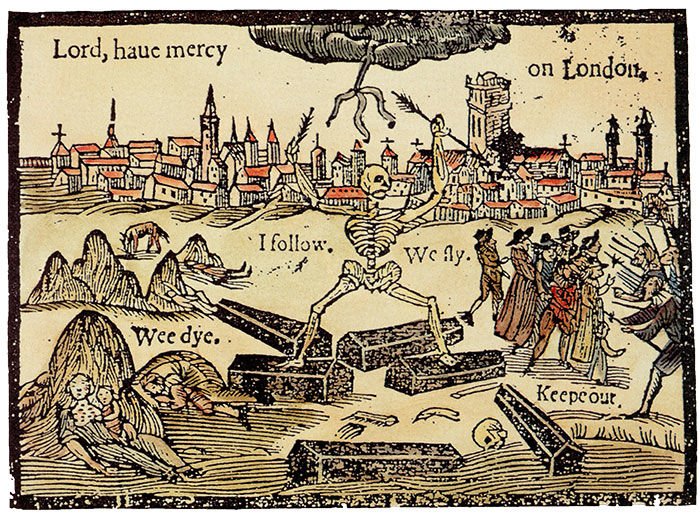
Plague woodcut. Note the wealthy people on the right who fled the plague, and the poor families dying on the left.
Like I have said, the working poor as a whole, suffered greatly because of the plague, especially since they were denied the means to avoid it. They lived in tightly packed, unsanitary environments and were unable to leave them without their lord’s permission, whereas we have a choice. This why it is crucial that we all do our part by staying away from crowds, observing proper hygiene, and offering support to our healthcare workers who are on the front lines of this war against coronavirus, and for whom we all pray for to stay healthy in turn.
I am disgusted by the recent violence in Charlottesville VA. The fact that in 2017, White supremacists threatened, hurt, and killed innocent Americans is despicable and truly disheartening. I won’t go into my political views here since this tragedy transcends politics and forces everyone in this country to re-examine who we are and what we stand for as a people, and do our part to help prevent this kind of mindless hatred.
I’m not a politician, I’m not a policeman. My area of expertise is Shakespeare, so I am going to try to make a case for why the study of Shakespeare can help people, (especially young people), learn about the world, examine new points of view, and try to improve the world. I will then add a list of resources for teachers and students to deepen your understanding of the play.
My first argument for the play is that Merchant has two of the best speeches about intolerance ever written.
You’ve probably heard of this speech, (spoken by the Jewish moneylender Shylock), and I’m also well aware of the fact that, in context, it is not entirely about peaceful coexistence and tolerance, but it nevertheless establishes Shakespeare’s argument that condemns bigotry and violence, particularly against Jews:
Hath not a Jew eyes? hath not a Jew hands, organs,
dimensions, senses, affections, passions? fed with
the same food, hurt with the same weapons, subject
to the same diseases, healed by the same means,
warmed and cooled by the same winter and summer, as
a Christian is? If you prick us, do we not bleed?
if you tickle us, do we not laugh? if you poison
us, do we not die? and if you wrong us, shall we not
revenge? If we are like you in the rest, we will
resemble you in that. If a Jew wrong a Christian,
what is his humility? Revenge. If a Christian
wrong a Jew, what should his sufferance be by
Christian example? Why, revenge. The villany you
teach me, I will execute, and it shall go hard but I
will better the instruction. Merchant, Act III, Scene i.
Al Pacino when he did this speech said that it has the eloquence and power of Dr. Martin Luther King. Patrick Stewart initially had the same reaction, but later realized that Shylock turns midway through and the speech becomes a justification for revenge. What’s clever here is that Shakespeare manages to give Shylock two good arguments against bigotry; by emphasizing how Jews are no different than any other racial or religious group, and also warning that oppressing a people will only result in more retribution and pain on both sides. This is what he means when he says: “The villainy you teach me, I will execute.” We’re seeing this sort of reaction right now with the recent surge of violence by both white supremacists and the Antifa; without tolerance and common decency, chaos and bloodshed reins.
Another speech, much less well-known, is this speech of the Prince Of Morocco, one of Shakespeare’s only black characters. The speech below is the first time he speaks while attempting to woo the heroine Portia:
Prince of Morocco. Mislike me not for my complexion,
The shadow’d livery of the burnish’d sun,
To whom I am a neighbour and near bred.
Bring me the fairest creature northward born,
Where Phoebus’ fire scarce thaws the icicles,
And let us make incision for your love,
To prove whose blood is reddest, his or mine.
I tell thee, lady, this aspect of mine
Hath fear’d the valiant: by my love I swear
The best-regarded virgins of our clime
Have loved it too: I would not change this hue,
Except to steal your thoughts, my gentle queen. Merchant Of Venice, Act II, Scene i.
People often forget that this speech condemns pre-judging a person based on the color of their skin. Morocco tells Portia, (who in all probability has never seen a black man before), to not judge him by his appearance. His tone is gentle, but it is not apologetic. He says he won’t change his skin color for anything, (except maybe if it would win her heart). The Prince is a dignified and proud representative of his country and his race.
My second argument for reading or teaching this play is that it reveals how bigotry and racism is usually tied to money and profit. In Act IV, Scene i, Shylock points out the hypocrisy of his Christian brethren in keeping slaves, which they justify by saying that they are not people, but property:
Shylock. You have among you many a purchased slave, Which, like your asses and your dogs and mules, You use in abject and in slavish parts, Because you bought them: shall I say to you, Let them be free, marry them to your heirs? Why sweat they under burthens? let their beds Be made as soft as yours and let their palates Be season’d with such viands? You will answer ‘The slaves are ours:’ so do I answer you: The pound of flesh, which I demand of him, Is dearly bought; ’tis mine and I will have it. If you deny me, fie upon your law! There is no force in the decrees of Venice. I stand for judgment: answer; shall I have it? Merchant, Act IV, Scene i.
Shylock turns this hypocrisy back on the Christians by saying basically, “How can you call me inhuman when you debase and subjugate your fellow creatures?” The answer to both questions of course, is that it is economically convenient. Shylock earns his money by lending money at interest, and threatens dear penalties if not repaid on time. Similarly, the Christians need Shylock because their religious practices forbid them from lending money, so they have to go to him instead of other Christians. We see echoes of this unfortunate tendency today: the white supremacists in Charlottesville were chanting: “Jews will not replace us,” which clearly exposes their fear of losing political and economic influence to minorities. In addition, our country has refused countless immigrants from poor, war-torn countries which we justify to ourselves by saying the cost of letting them in is too great.
The play’s comic sub-plot also has many lessons for today’s world. The hero Bassanio undergoes dramatic transformation from a spoiled prodigal son to enlightened married man. At the play’s beginning, he has a close friendship with the merchant Antonio, that might be played as a one sided homosexual relationship. Antonio is very affectionate to Bassanio, and lends him a large amount of money without any expectation of repayment, which has sometimes been interpreted as a hinting of Antonio’s unrequited love for Bassanio. Though Basanio doesn’t reciprocate any romantic feelings, he eventually saves Antonio’s life, and at least tries to repay him for his kindness.
Robert Alexander-Hillingford: The Three Caskets, The Merchant Of Venice, Act III, Sceneii
Bassanio also takes a very feminist attitude towards the play’s heroine Portia- he understands that being married means making your spouse a partner, and giving her an equal say. At the beginning of the play, he sails to an island called Belmont, to try to win Portia’s hand, by correctly solving a riddle. You may have heard of the three caskets, gold, silver, and lead. If Bassanio guesses right, he wins Portia and her fortune. Bassanio chooses the correct casket, but halts afterwards, and does something unexpected; he asks Portia herself if she wants to marry him. He doesn’t treat her as his prize, and throughout the play asks her opinion, and her permission before he acts, just as a good husband should.
Fair lady, by your leave;
I come by note, to give and to receive.
Like one of two contending in a prize,
That thinks he hath done well in people’s eyes,
Hearing applause and universal shout,
Giddy in spirit, still gazing in a doubt
Whether these pearls of praise be his or no;
So, thrice fair lady, stand I, even so;
As doubtful whether what I see be true,
Until confirm’d, sign’d, ratified by you. Merchant Of Venice, Act III, Scene ii
I would argue that, although Portia is a far more important character, Bassanio is the moral center of the play. He is the only person who treats Shylock like a human being, by trying to reason with him and pay Antonio’s debt, instead of spitting in Shylock’s face like Antonio, or forcing him to convert like the characters at the end of the play. Bassanio also is one of the only characters who call Shylock by name, everyone else just calls him “Jew.” Thus, audiences and students can learn from this kind of person; the kind of person Christ said could be saved and become a true Christian, because he acknowledges his sins and tries to correct them. Bassanio is the prodigal son in this play, and we benefit from the parable of his life.
By contrast, some of the other characters, Christian and Jewish, are examples of the kind of morality that we all wish to discourage in our children, and society in general. Though they are outwardly pious, the Christians like Antonio and Portia, are capable of vindictive, cruel, and definitely impious behavior. Portia, (probably due to her sheltered life on Belmont), can be deeply racist and prejudicial. She is prejudiced against the Prince of Morocco because of his race, hoping that “All of his complexion,” will fail to win her love. In addition, when she poses as a judge presiding over the court case between Antonio and Shylock, she throws vengeance at Shylock, even though she barely knows either of them. She strips Shylock of his property and nearly gets him sentenced to death, even though she preaches mercy to him in her most famous speech. If you look at the contrast between her words and actions, she is a deeply hypocritical person. Shakespeare shows how toxic it can be to raise a child in an isolated environment. Portia’s isolation makes it harder for Portia to relate to and understand different types of people, and it planted her predjudices within her heart.
Antonio for his part, seems to define himself by how “un-Jewish” he is, believing that generosity and mercy are anathema to all Jews, particularly when Shylock confronts Antonio in the courtroom:
I pray you, think you question with the Jew:
You may as well go stand upon the beach
And bid the main flood bate his usual height;
You may as well use question with the wolf
Why he hath made the ewe bleat for the lamb;
You may as well forbid the mountain pines
To wag their high tops and to make no noise,
When they are fretten with the gusts of heaven;
You may as well do anything most hard,
As seek to soften that—than which what’s harder?—
His Jewish heart: therefore, I do beseech you,
Make no more offers, use no farther means, Merchant, Act IV, Scene i.
Although Jesus preached loving ones neighbor, and being the Good Samaritan to other religions, Antonio seems to think that being a true Christian, means being Anti-Jew. He is a counter example of piety that audiences and students can learn to mollify and avoid within themselves.
My final example of religious counter examples, Shylock himself, shows how prejudice can destroy a man if he lets it. At the beginning of the play, Shylock has had to endure losing his wife, having Antonio spit on him, mock him, encourage his enemies, and call him a host of dehuminizing names. That’s not even taking into account the horrible Venetian ghettos of the 1590s, in which Shylock would have been forced to live were he a real Venetian Jew. One quote that helps explain his behavior comes from Henry Norman Hudson in 1882:
[In Shylock] “we see the remains of a great and noble nature, out of which all the genial sap of humanity has been pressed by accumulated injuries.” – Shakespeare: His Life, Art, and Characters, H. N. Hudson, Ginn and Company, Boston, p. 291. “
Scholars and actors have emphasized ever since the end of the Second World War, that, although Shylock is still guilty of reprehensible acts, his cruelty is a reaction to the cruelty he has had to endure, or as he puts it: “The villainy you teach me, I will execute.
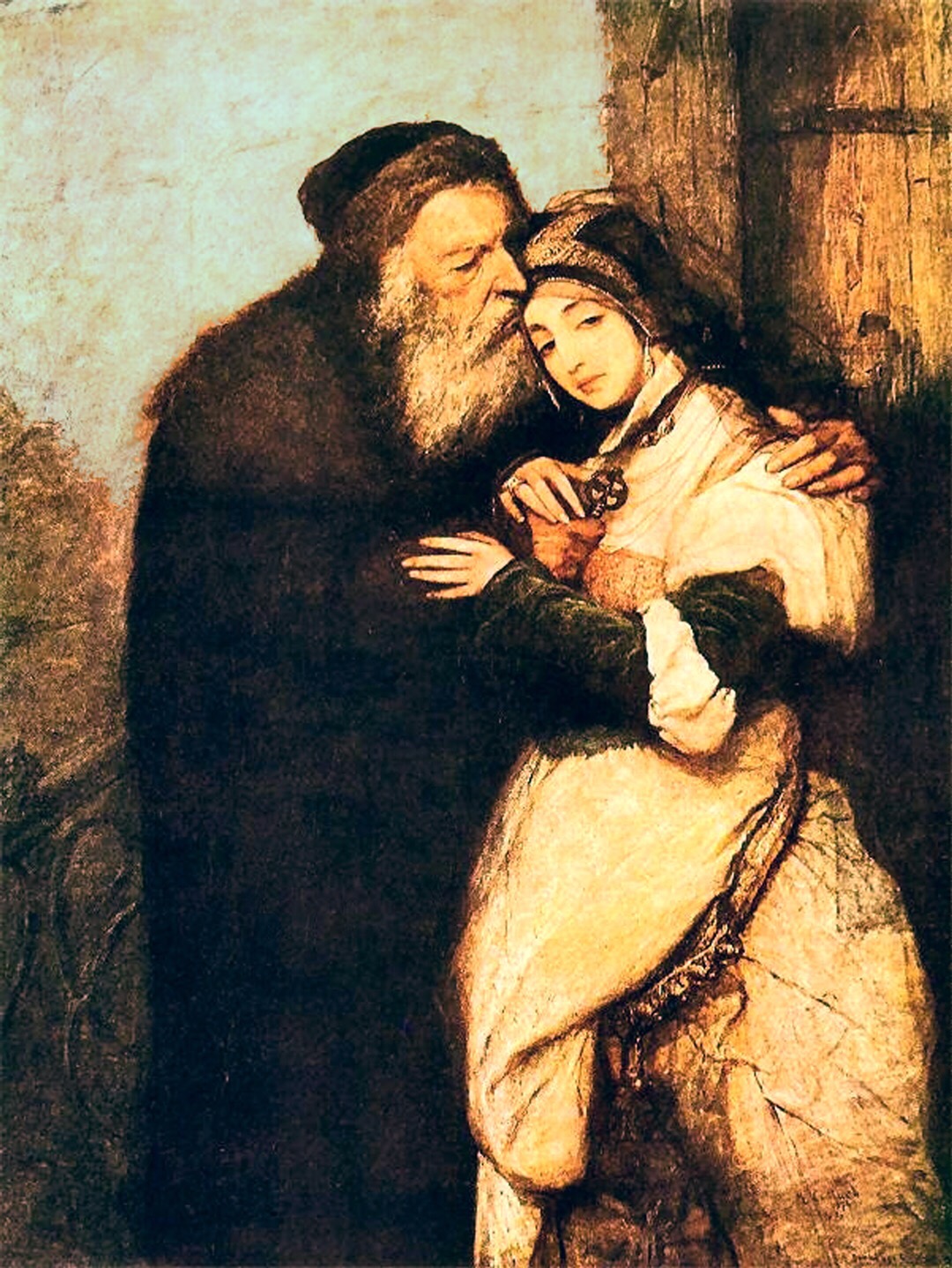
Maurycy Gottlieb: “Shylock and Jessica,” 1876
Shylock’s lack of joy and love manifests itself by the way he treats everyone in the play. He keeps his daughter locked away from anyone, which later compels her to run away with the Christian Lorenzo, (while stealing a huge amount of Shylock’s money). Shylock then rages against the citizens of Venice, especially Antonio, whom he blames for his losses, and concocts a plan to kill him by taking a pound of flesh away from his heart.
Shylock’s pain and hardships have turned him into the kind of bloodthirsty Jewish stereotype his enemies have always assumed to be. At the same time, he constantly points out the cruelty and hypocrisy of Christians, calling them no better than himself. In the end though, through Portia and the Duke sentencing Shylock to will his money to Lorenzo, and convert to Christianity, Shylock has to become what he hates, and surround himself with people who will never accept him; an ending that fills the audience with pity and maybe even remorse.
Now, there are compelling arguments that teaching this play can actually encourage stereotypes, which it can, and has in ages past. I read several articles that debate this issue in various ways. I’d like to discuss two articles written within one year of each other that are particularly fascinating. The first one was an article from The New Yorker by Professor Steven Greenblatt, who claimed that Merchant is “Shakespeare’s Cure For Xenophobia.” The other was a Washington Post article that argues that in the interest of keeping negative Jewish stereotypes from perpetuating themselves, this play should be ignored altogether.
On the other hand, as Professor Greenblatt says, the genius of the play is that it shows stereotypes, but it also shows the people under them. If you compare Shylock in The Merchant Of Venice, to other contemporary Jewish characters like Barrabas in Marlowe’s Jew Of Malta, he is a much more compelling, complete, interesting, and at times moving character. Love him or hate him, Shylock inevitably gets under your skin. He’s a man who strips the varnish off our culture and exposes the hypocrisy, greed, and prejudice that lurk just beneath the waters of the Rialto, (as well as the modern Potomac and the Hudson). The saving grace of this play is that it forces us to examine ourselves- how do we treat people, how do we see people who are different than us? What makes our points of view good and bad, and what can we do to heal our misunderstandings? Though this play cannot answer these questions, it encourages us to confront them, to open a dialogue, and hopefully, open avenues for change.
Tonight I’d like to discuss some of the spookiest, most enigmatic, and above all WEIRDEST characters in Shakespeare: the Three Weird Sisters in Macbeth.
1. Who are they?
Every production has to answer who the witches are, and many have very different answers. Are they temptress? Are they evil agents controlling Macbeth?Furies trying to destroy Macbeth?
I would argue in their basic form the witches are harbingers of change. Their very name “Wyrd Sisters” refers to an old Anglo Saxon concept of fate or destiny. Whether or not they have any effect on Macbeth mind or soul, they point the finger at him and say “things are going to change for you.” Then, he either makes the choices that determine his fate, or they change his fate for him.
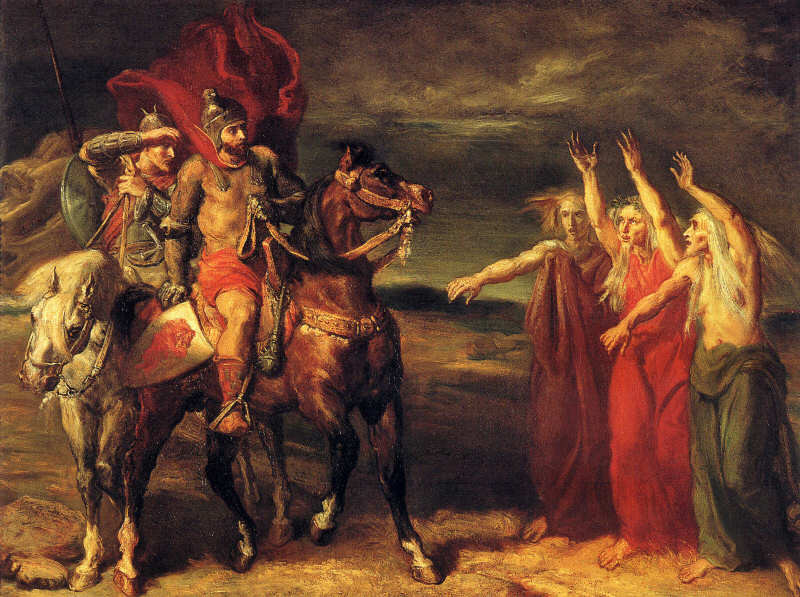
“Macbeth and Banquo First Encounter the Witches,” Théodore Chassériau, 1854.
Macbeth meets the witches on a heath, which means land that is literally out of bounds– the wild, untamed wilderness, which the old Anglo Saxons believed was the lair of many cursed spirits and monsters. This could symbolize Macbeth’ sin or transgressions, slowly turning into a murderer, usurper, and a tyrant. It could also symbolize the chaos in Macbeth’s life.
What Do They Look Like?
Shakespeare’s descriptions of the witches are highly contradictory- they seem to be floating, yet on the ground, they seem to be women, but they have beards! They don’t look Earthly, but here they are on the Earth. This gives them an other worldly quality that keeps us guessing as to who they are, and helps them tempt Macbeth more easily.
BANQUO What are these So wither’d and so wild in their attire, That look not like the inhabitants o’ the earth, And yet are on’t? Live you? or are you aught That man may question? You seem to understand me, By each at once her chappy finger laying Upon her skinny lips: you should be women, And yet your beards forbid me to interpret That you are so.
MACBETH Speak, if you can: what are you? (Act I, Scene iii).
The Witches’ Language:
You know from my earlier posts that the norm for Shakespearean characters is to speak in iambic pentameter- 10 syllable lines of unrhymed poetry that sounds like a normal heartbeat. The witches break these norms- they generally speak in Trochaic Tetrameter- 8 syllable lines with the off beat emphasized. The witches are literally offbeat, and that’s why their speeches are unsettling. Look at the contrast between a normal iambic line like:
“In sooth I know not why I am so sad.” (Merchant Of Venice I,i).
and
“Dou-ble Dou-ble, Toil and Tro-ble.
Fire burn and Caul-dren Bu-ble. (Macbeth, Act IV, Scene i).
For more info on the verse forms of the Witches, click here:
The witches also speak their prophesies in a vague, ambiguous manner They like to play with obscuring their prophesies with lines that make Macbeth think one thing, but the opposite is true. The famous example here is when they claim Macbeth will never be vanquished “until Birnam Wood comes to Dunsinane Hill.” Macbeth assumes this means he’s invincible, but it actually means that the enemy carry wood from the forrest. This is called Equivocation.
Witches and mythology
Illustration from William Blake’s “Europe a Prophecy,” 1794.
1. During the reign of King James, the modern witch hunt began; the king was fascinated with witches and even wrote a book called Daemonology on how to identify and destroy them. This was the era where people believed that witchcraft, rather than a pagan religious practice, was a forbidden craft that could only come from a pact with the devil. However, Shakespeare borrows from both Satanic and early pagan ritual in the characters of his witches.
2. Shakespeare took a couple of details about witchcraft from ancient Celtic and Greek mythology. First of all, the use of a cauldron. In Celtic myth, a cauldron is a symbol of rebirth and was sometimes used to resurrect the dead, just as the witches do in IV i. Of course, the ideal time for raising the spirits was on the feast of the pagan god Samhain, at the point where the veil between the living and dead was the thinnest. The feast took place on October 31st, our modern day Halloween!
Illustration of witches and their familiar spirits, 1647.
3. Familiar spirits In Act I, the witches speak to animal spirits called familiar spirits, which call to them and tell them where to go. King James himself wrote about how the witches found and communicated with these spirits.
Hecate.
In Act IV, Hecate, Ancient Greek goddess of magic appears. She is clearly the lord of all the witches, and is very displeased that they are riddling with Macbeth. Maybe not all witches believe in giving out prophesies that can destroy the Scottish monarchy. Hecate was always enigmatic in myths- she was born one of the Titans who opposed the gods, but frequently changed sides. More then being two faced, she was often portrayed as having three faces! Shakespeare refers to her frequently as “Triple Hecate.”
“The Triple Hecate,” by William Blake, 1794.
For more information on this mysterious goddess, consult the video below, (WARNING, ADULT-ONLY CONTENT).
In conclusion, the witches are meant to be ambiguous because the play examines the source of evil- whether it is inspired by other people, or if it comes from one’s own heart. The witches can be either or both, depending on how you want to tell the story, which is why they act and speak in contradictory ways.
Thanks for reading! If you enjoyed this posting, please consider signing up for my online class, “Macbeth: An Immersive Horror Experience.” I tell you the story of Macbeth and you get to play through an escape room, where you must solve the witches’ puzzles or be added to their Cauldron!

















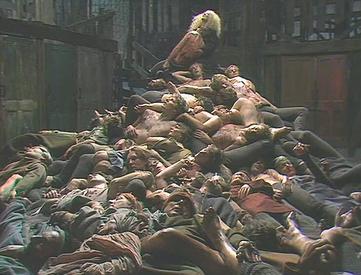



 • Plague carts like in Monty Python (Dreary) carried plague bodies out of the city and burned them.








 The Shakespearean Student