Comparing Coronations, or “Who Wore It Best” (Royals Edition)?

O ceremony, show me but thy worth!
What is thy soul of adoration?
Art thou aught else but place, degree and form,
Creating awe and fear in other men?
Wherein thou art less happy being fear'd
Than they in fearing.
What drink'st thou oft, instead of homage sweet,
But poison'd flattery? O, be sick, great greatness,
And bid thy ceremony give thee cure!
Think'st thou the fiery fever will go out
With titles blown from adulation?
Will it give place to flexure and low bending?
Canst thou, when thou command'st the beggar's knee,
Command the health of it? No, thou proud dream,
That play'st so subtly with a king's repose;
I am a king that find thee, and I know
'Tis not the balm, the sceptre and the ball,
The sword, the mace, the crown imperial,
The intertissued robe of gold and pearl,
The farced title running 'fore the king,
The throne he sits on, nor the tide of pomp
That beats upon the high shore of this world,
No, not all these, thrice-gorgeous ceremony Henry V, Act IV, Scene i.

As this quote from Shakespeare's Henry V, there are many different cermonial customs and adornments that the British monarchs have used to adorn and elevate their kings and queens. Today I'm going to compare and contrast King Charles III and his mother Queen Elizabeth II, then I'll compare these coronations with the monarch who lived during most of Shakespeare's life: Queen Elizabeth I.

Part I: Queen Elizabeth II vs. Charles I

All my information for this section comes from this fascinating article from the Washington Post, which compares and contrasts King Charles’ coronation on May 6th, 2022, with his mother’s, which occurred on June 2, 1953:

https://www.washingtonpost.com/photography/interactive/2023/visual-comparison-coronations-queen-elizabeth-king-charles/

THe Balm

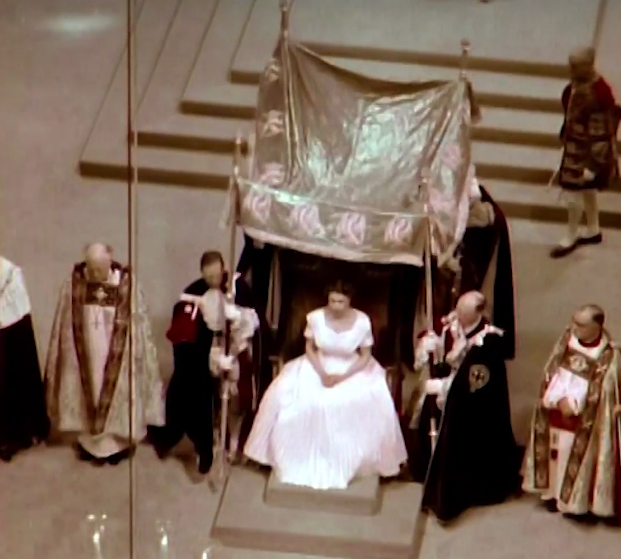
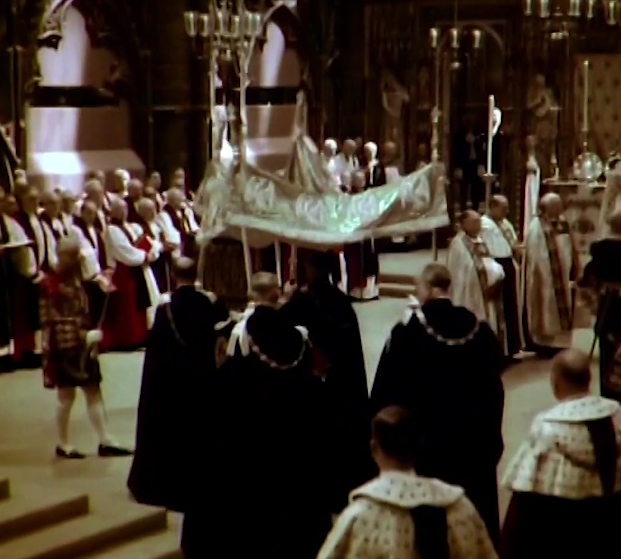
Close up of the canopy raised while the king was annointed

Both Charles and Elizabeth were anointed with holy oil- an ancient tradition signifying God’s favor. The tradition goes all the way back to the Bible, where the book of First Kings details the procedure of anointing King Solomon:

And the king said to them, “Take with you the servants of your lord and have Solomon my son ride on my own mule, and bring him down to Gihon.  

And let Zadok the priest and Nathan the prophet there anoint him king over Israel. Then blow the trumpet and say, ‘Long live King Solomon!’  You shall then come up after him, and he shall come and sit on my throne, 

1 Kings Chapter 1, Verses 33-35

King George the Third commissioned composer Georg Friedrich Handel (famous for “The Messiah”) to write an anthem for his coronation based on this Biblical passage in 1761 This song has been a tradition during English coronations for the past 300 years, and as you can see in the video below, it was played when King Charles and Queen Elizabeth were privately anointed behind the canopy you see below.

The Scepter

The scepter is called the Sovereign’s Scepter and it is on display in the Tower of London as part of the Crown Jewels. For more information, go to Royal Collection.org:

https://www.rct.uk/collection/themes/Trails/the-crown-jewels-coronation-regalia

The Ball

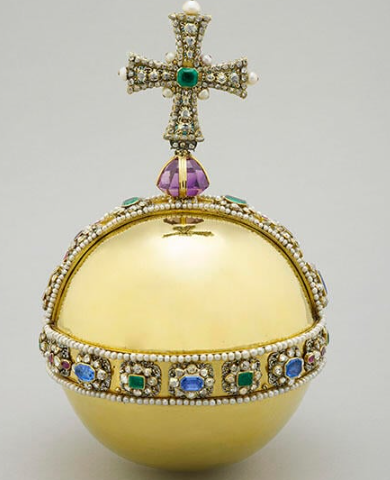
The ball in this passage refers to the globus cruciger or ‘the orb and the cross.’ This is a symbol of the king’s status as the head of the Church Of England, which began with Elizabeth I’s father, Henry VIII. The orb telegraphs Christ as the true ruler of the world, and the English monarch as his representative on Earth.

The Sword (and) the Mace

A mace used to be a concussive weapon used in battle against knights in shining armor. Since armor is hard to penetrate, medieval warriors tried to cause blunt force trauma and concussion in their enemies using maces. Since those more violent beginnings, the mace has evolved into a symbol of the King’s power and is used at the opening of Parliament. There are three swords that lords used to herald the King during the coronation- the two swords of Justice, and the Curtana or ‘Sword of Mercy,’ so called, because its blade is broken, making it a ceremonial object of peace, rather than a practical weapon.

King Charles’ own sword is called the Sword of State- it is a steel sword gilded with silver, and the handle is wooden, gilded with gold. It symbolizes the monarch’s commitment to knightly virtues, and it is used to create people as knights.

The Crown

St. Edward’s crown is adorned with diamonds, furs, and over 2,000 diamonds! This crown, along with the sword of state, dates back to the 1660s, after the monarchy was briefly abolished, though the crown still has had its share of problems over the centuries, including being stolen!

The Robe(s)
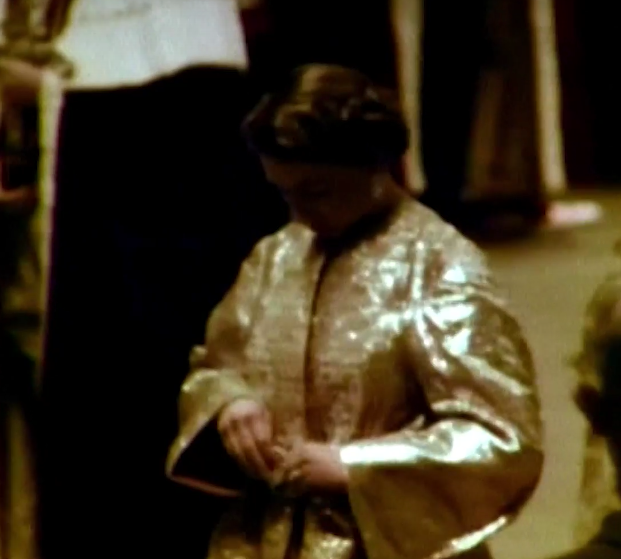
Much like how during graduation ceremonies people wear special robes to signify the transition from one state of being to another, British monarchs have worn multiple robes to show their apotheosis from a prince to the sovereign head of the country.

The Robe of Estate

The robe of Estate is the long, sumptuous robe of the sovereign; a symbol of his or her wealth. Charles wore his at the end of the ceremony after the crown was placed on his head.

Traditionally, the Robe of Estate is a very specific shade of purple called Tyrian Purple. It is again, a symbol of wealth because it was very labor-intensive and expensive to produce. This is one of the reasons why purple is a color associated with wealth and status:

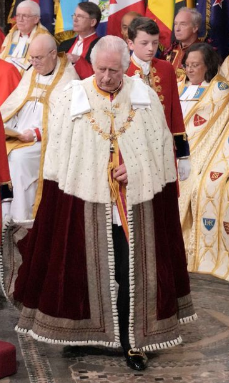
Charles in his red surcoat
Left- Royal portrait of Queen Elizabeth in her purple Robe of Estate by Sir Herbert James Gunn. Right- King Charles in his crimson Robe of Estate

Elizabeth’s purple Robe of Estate will now be worn by Queen Camilla, Charles’ wife. It is 6 1/2 meters long, weighs 15 pounds, and took 12 seamstresses 3,500 hours to complete, (source: Historic UK).

Queen Camilla in her Robe of State

THe THrone

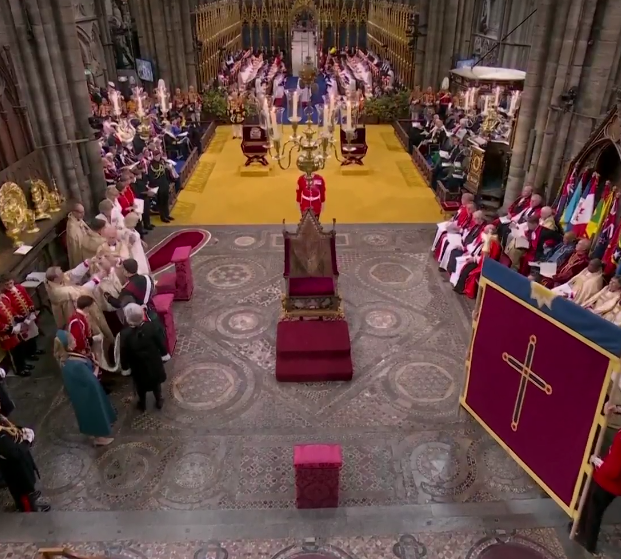
The oldest part of the ceremony will without question be the throne- a plain-looking piece of oak that is over 700 years old! St. Edward’s Throne has been part of coronation ceremonies since King Edward I, (aka Edward Longshanks from Braveheart) in around 1200 AD. Surely there is no greater symbol of royal continuity- the monarchs in Shakespeare’s history plays actually sat on this throne. Any king or queen who touches this piece of furniture must get a sense of the ancient traditions of the monarchy.

King Charles III sits on St. Edmund’s throne, holding the scepters.

The Tide of Pomp (Royal Processions)

The royal coach parked in front of Westminster Abbey

It’s been a tradition ever since the Middle ages for the new king or queen to travel from their home palace through the county so people can see them on their way to be crowned at Westminster Abbey. Long ago, this was a multi-day journey full of public festivals and entertainment that allowed the whole country to get a rare glimpse of the new monarch. By contrast, King Charles and Queen Camila only traveled 1.3 miles from Buckingham Palace to Westminster.

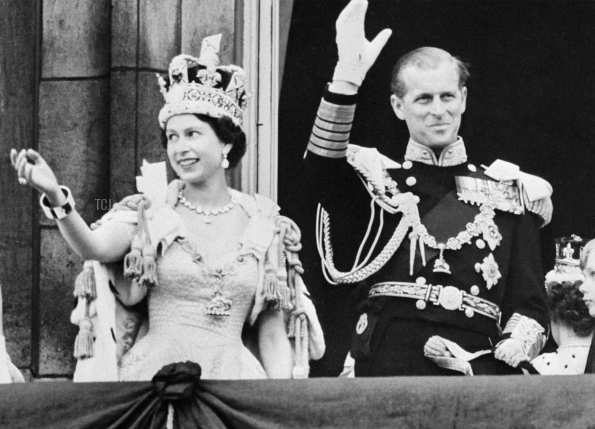
Image compare of King Charles III and his queen Camilla with his mother and father during Queen Elizabeth’s coronation in 1953.

Part II: Queen Elizabeth the First’s Coronation, January 14th, 1558.

The Procession

After the death of Mary the First, Elizabeth’s sister,

Royal portrait of the coronation of Queen Elizabeth I.

An Account of the Coronation

Like her namesake and the new king, Queen Elizabeth I was crowned at Westminster on January 15, 1558. Unlike them, however, the ceremony was performed in Latin and English by a Catholic bishop. Obviously, since Elizabeth was crowned during the Protestant Reformation, there was a lot of controversy about the liturgy. Some accounts aren’t sure what parts of the Catholic were read, but we do know Elizabeth took the oath, wore a similar golden robe to Charles and Elizabeth II, and was given the balm and scepter just like them. Here is a primary source account from an ambassador from the town of Mantua, Italy:

“The Queen was received under the canopy by the Archbishop and another Bishop, they having previously perfumed her with incense, giving her the holy water and the pax, the choristers singing; then the Earl of Rutland followed her Majesty with a plain naked sword without any point, signifying Ireland, which has never been conquered; then came the Earl of Exeter with the second sword; the third was borne by Viscount Montagu; the Earl of Arundel, having been made Lord Steward and High Constable for that day, carried the fourth (sword) of royal justice, with its gilt scabbard loaded with pearls. The orb was carried by the Duke of Norfolk, Lord Marshal, and in advance were knights clad in the ducal fashion, carrying the three crowns, they being the three Kings-at-arms; they bore the three sceptres, with their three crowns of iron, of silver, and of gold on their heads, and in their hands three naked iron swords, signifying the three titles of England, France, and Ireland..”

— Il Schifanoya, royal ambassador from Mantua

‘And whereas your request is that I should continue your good lady and be Queen, be ye ensured that I will be as good unto you as ever Queen was unto her people. No will in me can lack, neither do I trust shall there lack any power. And persuade yourselves that for the safety and quietness of you all I will not spare if need be to spend my blood. God thank you all.’ _Queen Elizabeth I
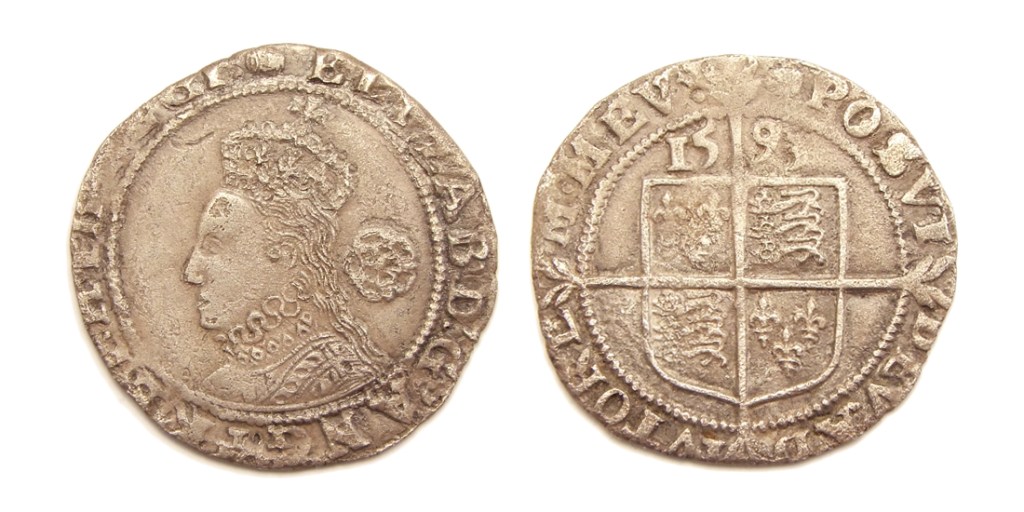
Elizabeth’s ring

References:

https://www.rct.uk/collection/404386/queen-elizabeth-ii-1926-2022-in-coronation-robes

The Weirdest History Show on YouTube

No, you aren’t hallucinating. This is a clip from the short-lived Warner Brothers kids cartoon show “Histeria,” an educational variety show, sort of like Horrible Histories or “Who Was.” This clip is a song about the life of Henry VIII.
The show was produced by Worner Brothers for the WB back in 1996. It starred many successful voice actors from other WB projects like Billy West (Renn and Stimpy), Tess McNeill (Tiny Toon Adventures), and Frank Welker (The current voice of Curious George). In addition, the show was created by Tom Ruegger, Executive Producer of Warner Animation, who also created Tiny Toons, Animaniacs, and Pinky and the Brain. Those of you who grew up in the 90s know that the WB occasionally sprinkled their shows with educational sketches especially with Animaniacs:

So the idea of using these creative people to create a show about history was not a bad one in and of itself. It could have been a modern-day Schoolhouse Rock. The problem is that the characters are TERRIBLE.While Tiny Toons had likeable characters who were the modern-day successors to classic Warner characters like Buster Bunny, Plucky Duck, and Hampton pig, Histeria has lame characters nobody knows or has any interest in like Froggo, World’s Oldest Woman, and Big Fat Baby. In addition, there is no through line to any of these sketches so it seems like a bunch of random skits. While the Animaniacs was about crazy weird characters trying to escape from the Warner Bros. lot, it seems unclear as to why these characters are talking to me about history.

In short, Histeria feels like a bunch of talented people were forced to make it, and they gave little thought to how to make it a popular series. Still, the animation is good, the voice acting is top-notch, and occasionally, the jokes land very well, and the songs are very catchy. Not surprisingly, my favorite song is this one, where the cast summarizes in song, all 37 plays of William Shakespeare:

https://tvtropes.org/pmwiki/pmwiki.php/WesternAnimation/Histeria

This video, of course, is about the life of Henry VIII.

The Shakespeare Authorship Controversy and Conspiracy Theories

“There is a tendency for us to view Shakespeare as this unquestionable monolithic genius. But there is also in us all that iconoclast that wants to tear him off his pillar or plinth.”

Dr. Katrina Marchant

There are few things that will drive a Shaespeaeran scholar more skull-shatteringly livid than when someone asks them if Shakespeare wrote the plays attributed to him. There are dozens of YouTube rants, bile-dripping academic papers, tinfoil-hat Tweets, and of course, centuries of anti-academic book bashing and counter-bashing research on the subject. So I won’t try to settle this debate, but I think the debate itself is worth looking at.

The authorship controversy is essentially a conspiracy theory- Was some unknown writer sending scripts to Shakespeare’s company and using the actor from Stratford as a patsy, or a pen name? Is there a massive cover-up to disguise the author of the most celebrated works in the English language? If so, why? How? and what else are they hiding?

The Malleus Malefecarum, “The Witch’s Hammer,” a 15th century book that posits that there is a vast conspiracy of witches living among us.

Now if there’s one thing I’ve learned over the past four years is that it’s extremely rare to change anyone’s mind about any kind of conspiracy theory, and there are hundreds! Ancient Aliens, Bill Gates, Covid vaccine microchips, Elvis isn’t dead, The Illuminati, Kennedy Assassination, Pizzagate, Q-Anon, Trump’s Russia connections, the list goes on. Several recent studies show that the majority of Americans have heard at least one conspiracy theory, and many of us believe these theories to varying degrees. Sadly, the internet, which was designed to share information, is extremely good at sending misinformation as well.

So as an en educator and a father, I want to focus on the Shakespeare conspiracy not just because it gets my dander up, but also because, compared to these other theories, it is actually one of the least harmful. Conspiracies like the Plandemic hoax are extremely dangerous because they dissuade people from getting a life-saving treatment, and allow this pandemic to continue. By contrast, ultimately it doesn’t really matter who wrote Shakespeare’s plays, so I think this kind of exercise is useful for educators to challenge students to think critically about this low-stakes theory, and then applying the same skill to others to become better-informed thinkers.

How to break down the Shakespeare conspiracy theory

First, let’s summarize the most compelling points of the theory that Shakespeare didn’t write his plays. This is a video by director Roland Emmerich, which he made to help promote his film “Anonymous.” Emmerich dramatizes the controversy by portraying the Earl of Oxford writing the plays of Shakespeare anonymously, and sending them to Shakespeare’s company, giving the man from Stratford credit for writing them.

There’s an old saying in science that “Extraordinary claims require extraordinary proof,” and, aside from the fact that the Earl of Oxford wrote poems, there is no evidence that Oxford ever even spoke to Shakespeare’s company. In fact, almost none of this video is supported by any historical evidence. Now it would be a lot of work to refute each argument of this video point by point right? And surely I have better things to do than do a point-by-point refutation, but…

A Point-by Point refutation of the Roland Emmerich video:

– Shakespeare did leave evidence of his handwriting, just not evidence of his dramatic writing. The fact that his correspondence didn’t survive doesn’t mean there wasn’t any. The kind of cheap parchment that writers of the period used dissolved very easily, especially when they used ink with high iron content. The examples we have of Shakespeare’s writing are mainly legal records and books that were designed to last. In short, there’s no conspiracy to hide Shakespeare’s manuscripts, they simply didn’t survive.

The dedication page of the 1623 First Folio.

We don’t know for sure that his parents were illiterate, or that his daughters were. That is based on an urban legend, not actual proof. Also, plays were not written to be read, that’s why TV viewers are viewers and the grounding are called an audience.

A. Shakespeare wrote about aristocratic people because they were paying his rent. His company was literally named “The Lord Chamberlain’s Men.” One reason why Shakespeare was more successful than Ben Johnson was that he was deferential and obsequious to the English aristocracy; he had to sing their praises to stay in business.

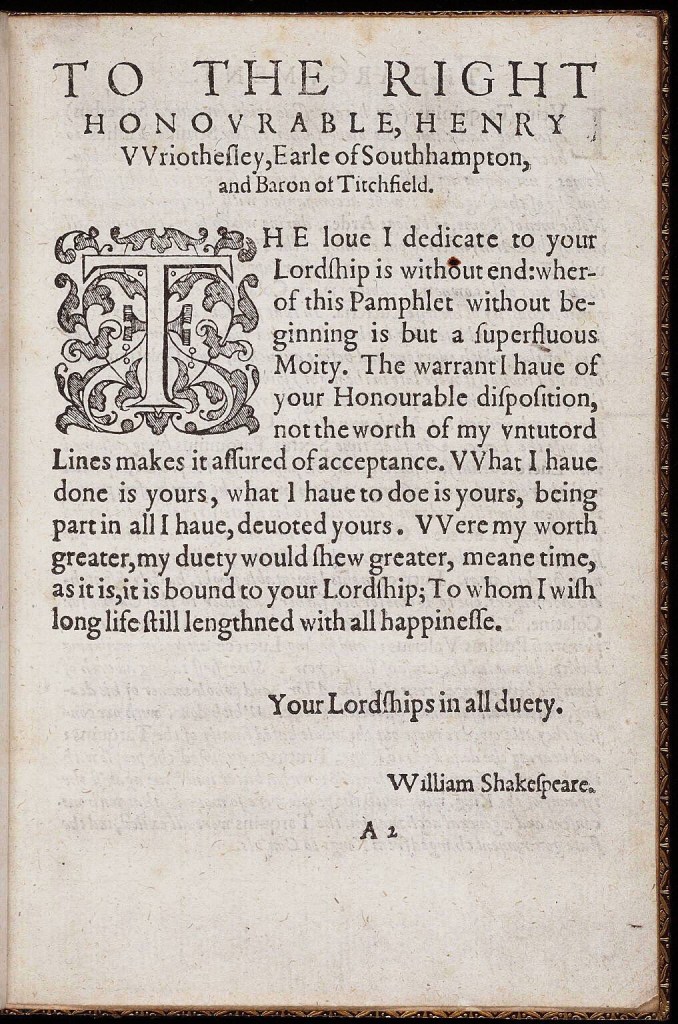
Dedication page of Venus and Adonis, which Shakespeare wrote to the Earl Of Southampton.

B. Every character that Emmerich mentions is not an aristocrat- Bottom is a lower-class weaver, Mistress Overdon is an inn-keeper. The only aristocrats Shakespeare ever insults are Polonius (who isn’t real), and Sir John Oldcastle in the early draft of King Henry IV, which he immediately changed to Sir John Falstaff once Oldcastle’s family members complained about it to Shakespeare’s company. Emmerich is flat-out lying when he says Shakespeare mocks the English upper class like an equal.

C. There’s a very simple explanation of how Shakespeare was able to write about the manners and lives of the English aristocratic class: he didn’t. All of Shakespeare’s comedies (except for Merry Wives which has the aforementioned Falstaff as a character), and tragedies take place in other countries like Italy, France, Sicily, or Greece. His History plays are set in England, but they dramatize events that happened 100-200 years before Shakespeare was born, meaning that he didn’t need to know too much about contemporary court politics. Furthermore, the majority of the plots he used were recycled from history books, poems, and prose romances.

It’s useful to think of Shakespeare not as a novelist like Dickens or Tolstoy and more like a TV or film screenwriter like George Lucas or Aaron Sorkin. He didn’t write based on real-life experiences or conjure new ideas out of thin air. He was a popular dramatist who adapted existing works of literature to be dramatized onstage. This is why I created my YouTube comedy series “If Shakespeare worked for Disney.” Emmerich, like many Anti-Stratfordians, is assuming that Shakespeare couldn’t have written plays about the nobility without being one himself, but that’s not what Elizabethan dramatists did- they adapted pre-existing work to fit on the public stage, which means anyone with a good education and knowledge of the theater could have written them, regardless of his or her upbringing.

If you are wondering how I could possibly know Shakespeare’s writing process,, the answer is simple: All of Shakespeare’s sources have survived, which means that I can prove that his plays are adaptations. This is a common problem with most conspiracy theories- they never take the straightforward way to explain something. Instead, they take a theory and twist facts to suit that theory. In this case, they twisted the facts about the Earl of Oxford’s life to make him look like Hamlet and based on that, they made him look like the true author of Shakespeare.

D. Honestly the handwriting is the weakest point- yes Shakespeare spelled his name differently in documents but this was before standard English spelling. The first English dictionary was at least 100 years after Shakespeare’s death. This point is clearly designed to discredit Shakespeare and make him seem uneducated. But again, this point is irrelevant when you consider that Shakespeare wrote for theater, where standard spelling is completely unnecessary.

By the way, Ben Johnson spelled his name differently in his manuscripts.

The Debate- Feelings vs. Facts. Modern vs. early modern

When I was in high school, taking my first class on Shakespeare, I watched this documentary which almost convinced me that Oxford was the true author of Shakespeare. The researcher they interviewed seemed so passionate and I wanted to believe what he said was true. But that was before I started reading about Shakespeare’s life for myself, and looked at the evidence myself.

How to Spot a Conspiracy Theory

https://allianceforscience.cornell.edu/conspiracy-theory-handbook/

The common traits of Conspiracy Theories from the Conspiracy Theory Handbook

If you look at many different conspiracy theories, they often exist in a form outside of normal reality, to the point where the believers have no interest in any kind of contrary evidence, logic, or any person who even questions it. Essentially the conspiracy becomes their identity, and they will virulently defend this conspiracy from anyone and anything that opposes it. Below is an explanation of the basic parts of a Conspiracy theory, with some points on how they all apply to the Shakespeare Authorship Controversy

Contradictory Beliefs:

Believers in conspiracies are motivated by feelings, not facts, and they don’t care how inconsistent those theories are. For example, the same people who believe Joe Biden lost the presidential election, also believe that the president (Joe Biden) is also being played by an actor. This might explain why many people believe that people like Christopher Marlowe wrote the works of Shakespeare, despite the fact that he died 9 years before Shakespeare started writing.

Overriding suspicion:

Again, since the believer is motivated by feelings, they are naturally suspicious of any contrary evidence and just assume anyone who contradicts them is in on the conspiracy. This is called self-sealing the conspiracy.

Nefarious intent:

One question that inevitably comes up with the Shakespeare Authorship debate is: “Who cares?” Usually, this means “Does it really matter who wrote the plays?” However, I want to use this question in this context: “Why go through the trouble to conceal who wrote these plays?” As I mentioned earlier, though Shakespeare is very famous and culturally important now, he certainly wasn’t back in his lifetime. Playwriting was not a venerated profession, and socioeconomically, Shakespeare was little better than a tailor. Why would it be worth it to conceal who wrote a few, fairly popular plays in 1616?

It would take an enormous amount of effort to conceal who wrote these plays for 400 years- you’d have to pay off publishers, fake court records (like the one I showed you above), keep an entire court quiet, and make sure nobody ever wrote down the truth for 400 years. Why would it be worth it? This kind of logic is why the Moon Landing and the Flat Earth conspiracies don’t hold up to rational thought- there’s simply no reason to go through the effort of concealing the alleged truth. The truth itself is just easier to defend.

Something Must be wrong:

As the name implies, Anti-Stratfordians don’t so much believe in Bacon, Pembroke, Oxford, etc, so much as they actively choose not to believe in William Shakespeare of Stratford. This means they will use every bit of their energy trying to prove that theory, and won’t stop until they find something, no matter how nonsensical, to prove their Shakespeare is the real Shakespeare.

Persecuted victim:

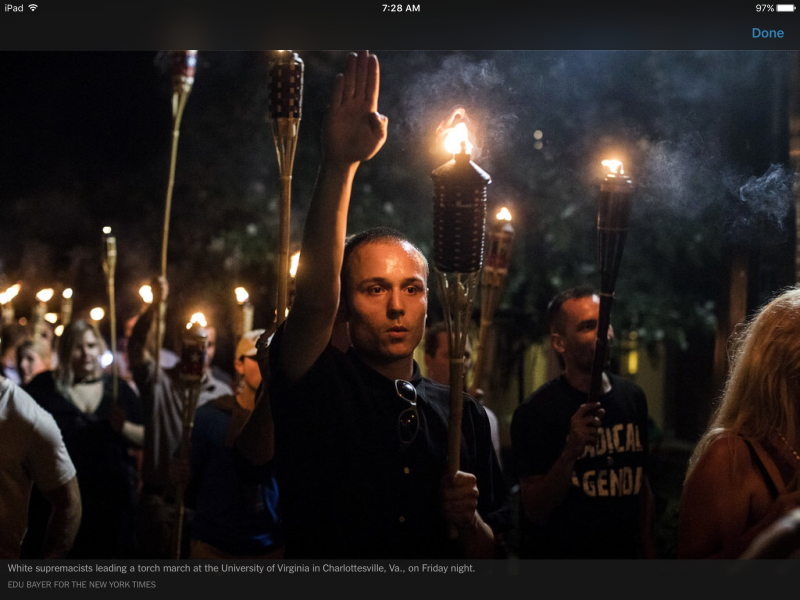
Let me be blunt- a conspiracy is very simmilar to a delusion, and any attempt to shatter that delusion is a form of persecution for the conspiracist. The most infamous example of how conspiracy theorists can feel persecuted and empowered at the same time is the way it permeated Nazi Germany and neo-Nazi units. Hitler came to power by spreading the theory that the Jews were secretly controlling the world and Germany was persecuted, while at the same time, Germany was destined to control the world in the eyes of the Nazis. I mention this not because I think Anti-Stratfordians are Nazis (how could I watch I Claudius otherwise?), but that conspiracy theories are potentially very dangerous because they foster a self-serving victim mentality where people are constantly looking for someone to blame for their problems and they will sometimes become violent against anyone who challenges them.

Immune to Evidence

One of the most important concepts in law is the notion that someone is ixznnocent until proven guilty. Along those lines, the prima facie, the accepted truth is accepted as truth, until new evidence contradicts it. If you look at the Supreme Court mock trial for the Authorship question back in 1987, that was the conclusion they came to in the end. Though little historical evidence for Shakespeare has survived, there is NO PHYSICAL evidence that contradicts it, so in the interest of prima facie evidence, they ruled for Shakespeare.

Now real conspiracy believers never believe in the merits of contrary evidence. They will just assume it is manufactured or faulty; part of the attempts of those nefarious truth concealers to pull the wool over their eyes.

Re-Interpreting Randomness

I’ve seen many people claim that the evidence for conspiracies is not found in documents or in scientific explanation, it’s in some kind of code or cipher or series of clues that only the believers understand. As you’ll see below, some of the most famous Anti-Stratfordians claimed to find hidden codes and ciphers in Shakespeare’s plays that prove that he was concealing his true identity. They will also cite coincidental details like the fact that the crest of Edward DeVere was an eagle shaking a spear, and claim this proves his identity as the true author of the plays. When you see a theory like like this, remember, correlation is not causation. Just because a few bad things happened when a few people said “Macbeth,” does not mean Macbeth is cursed. Some things actually are coincidences and not everything has a dramatic or sinister cause. This brings me to my next point:

The real enemy of conspiracies: Disappointing facts (Spoilers ahead for the movie “Coco”)

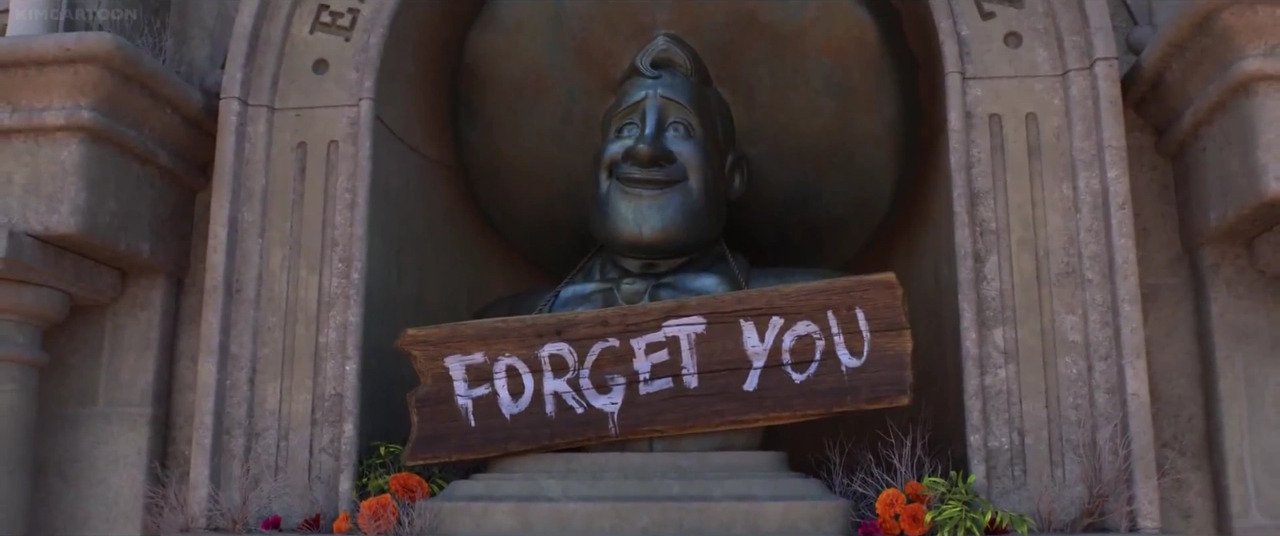
Let’s do a little thought experiment: Let’s imagine that you were Miguel from Disney’s Coco, and you discovered that your hero Ernesto Dela Cruz murdered your grandfather Hector, but (unlike in the movie), he actually DID write the songs he said he did. How would you feel about Hector? Would you hope and pray that Ernesto lied and your virtuous grandfather was the real author? Might you even concoct a conspiracy theory to rewrite Ernesto’s history and get Hector celebrated as the real author of “Remember Me?”

I’m not suggesting that Shakespeare is guilty of murder, or any other crime (apart from usury, hoarding grain, and a few minor tax violations). What I’m trying to do is to draw parallels between two men who are icons that are beloved by their hometowns, who created work that resonates with a lot of people.

We all have a tendency to take people we admire and put them on pedestals, (like the quote at the beginning mentions), and many people try to identify with their heroes. This is really easy with Shakespeare because most of the personal details of his life have vanished, so we can imbue him with our own sensibilities. Case in point- when Mya Angelou read Shakespeare’s sonnets as a little girl, she initially thought that he was a black girl. Likewise, Eugene O’Neill and other Irish and Irish American writers have thought he might be been Irish.

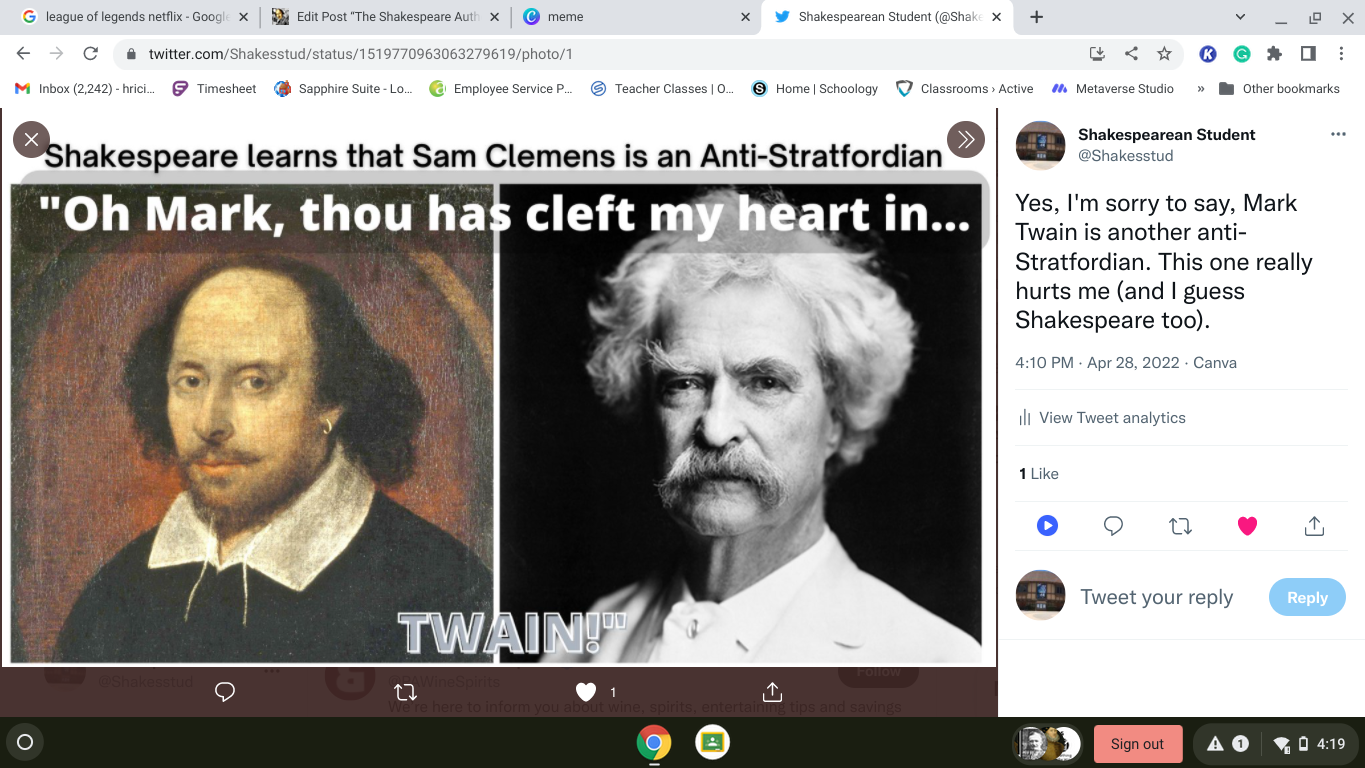
Some of the most outrageous anti-Stratfordians clearly have an axe to grind because they have a family connection (real or imagined) to the man they believe to be Shakespeare. In the 19th century, Delia Bacon wanted to prove that the real author of Shakespeare’s plays was the 17th-century poet, philosopher, and essayist, SIR FRANCIS BACON. Ms. Bacon hated Shakespeare because she thought he was an illiterate sheep-poaching commoner. She, therefore, used her theory to hoist Shakespeare off his literary pedestal, and therefore elevate herself because she believed she was descended from Sir Francis (though in reality, she wasn’t).

Rather than using any kind of historical evidence to prove her theory, Ms. Bacon claimed there was an elaborate code hidden in the iambic pentameter. Subsequent literary pseudo-scholars have attempted to hack the code and prove that they can prove that Sir Francis was the real author of the plays. In the late 1800s, American politician and author Ignatius Donnelly appropriated Ms. Bacon’s theory and claimed he had found the code, which rested on the pagination of the First Folio.

Donnelly had a knack for spreading conspiracy theories; as the title page of his book shows, he also authored a book where he claimed he correctly identified the location of the lost city of Atlantis. He also hated Shakespeare because Donnelly believed he was nothing more than a businessman, exploiting the talent of others, so like Bacon, he cooked up these ‘facts’ to suit his theory in order to take Shakespeare down.

Like many conspiracy theories, Anti-Stratfordians don’t have any factual basis for the ideas they hold, they are responding to an emotional need or desire. Donnelly and Bacon wanted fame, recognition, and revenge against a man they hated. J. Thomas Looney, who proposed that the Earl of Oxford wrote Shakespeare, wanted a ‘fairy prince’ that is, a semi-mythical Bard who would lead England into a golden age. All these people were dissatisfied with the man from Stratford, so they created a Shakespeare of their own, and tried to justify his existence.

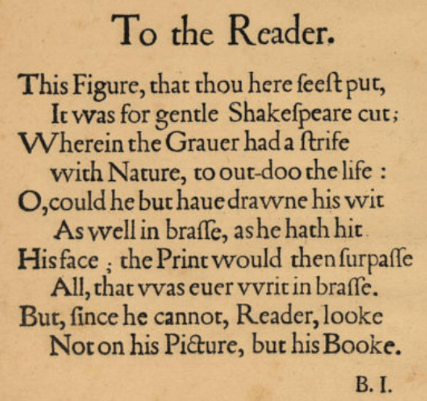
Title page of the 1623 Folio, the first complete edition of Shakespeare's plays.
Title page of the 1623 Folio, the first complete edition of Shakespeare’s plays.

To briefly sum up why the Bacon/ Donnelly theory is false, it hinges on the page numbers of the Folio, but Shakespeare didn’t print the first Folio. If you look at the title page, it was assembled by two actors from Shakespeare’s company- Henry Condell and John Hemmings, and it was printed by Isaac Jaggard, the same man who printed Shakespeare’s Sonnets in 1609. Writers had no say in how their work was printed and in fact Jaggard actually printed the sonnets without Shakespeare’s permission! The notion that Jaggard had any interest in properly printing a secret code in the pages of his posthumous book seems to me, incredibly unlikely at best.

Lesson plan

I’ve adapted a lesson plan about conspiracy theories to include a discussion of the Shakespeare authorship question. I’ll also include a worksheet that you can use in your classroom to distribute among your students if you choose to use it as well. I think it’s a good way to foster critical thinking, scientific reasoning, and historical curiosity, and if it prevents more people from joining Q-Anon, so much the better!

This lesson plan makes use of the Conspiracy Theory Handbook, and it has great, easy to read activities about how to spot a conspiracy theory, how to talk to a conspiracy theorist, and how to avoid being taken in by a conspiracy.

Sources:

https://www.americanprogress.org/press/release/2020/10/13/491521/release-new-survey-shows-conspiracy-theories-thriving-u-s-election-nears/:

https://www.forbes.com/sites/rainerzitelmann/2020/06/29/how-many-americans-believe-in-conspiracy-theories/?sh=62b9725d5e94

https://www.c-span.org/video/?618-1/shakespeare-author-pseudonym#

Shakespeare Week Is Coming at Outschool.com

Outschool.com will be honoring the contributions of Shakespeare during the very first Shakespeare Week on March 21-27th.

I’m honored to take part in this celebration, and I’m offering several aclasses which relate to Shakespeare in an engaging way. Here’s the schedule below:

If you want to sign up for one of my classes, please visit my Outschool page:

https://outschool.com/teachers/The-Shakespearean-Student

https://outschool.com/teachers/The-Shakespearean-Student

Hope to see you during Shakespeare Week!

Summer Shakespeare Academy!

I’m working this summer with the good people at Outschool, an online learning platform for kids ages 3-18. I’m designing a series of Shakespeare classes that you can sign up for. We’ll be doing acting exercises, reading Shakespeare’s text, and making Shakespeare props Cost is $3 per child.

The course is ala carte, that is, you can sign up for as many courses as you like. Each course builds on the last one, but you don’t have to have taken the previous ones to enjoy any one particular course Let me know in the comments which class(es) you are interested in, and/or what suggestions you might have. I can’t wait to hear what you think about these summer Shakespeare courses, and I hope to see you online soon!

1. Introduction to Shakespeare- (enrollment here: https://outschool.com/classes/introduction-to-shakespeare-or-how-i-learned-to-love-the-bard-UoHH5fes?sectionUid=973060db-f857-461a-a23a-f1476203a544&showDetails=true) We’ll talk about why Shakespeare is so famous and learn about his life and career. Then we’ll do some fun quizzes that you can earn prizes based on how well you pay attention!
2. How to write ✍ like Shakespeare (Enrollment here: https://outschool.com/classes/how-to-write-like-shakespeare-0HuPq1Cg?sectionUid=4243af25-ba41-4724-82a2-61bd7c7d862e&showDetails=true) Have you ever wanted to woo your sweetheart or write the next bestselling play? Well, this course will cover the secrets of Shakespeare’s writing. We’ll cover how to write romantic poems, the structure of Shakespeare’s plays, and you’ll get to write your own Shakespearean speeches!
3. Intro to Shakespearean acting Practical tips and tricks for your next Shakespeare audition.
4. Shakespeare’s villains
We’ll look at the darkest and creepiest Shakespearean characters and see why they still fascinate us today!
5. The Violent Rhetoric Of Shakespeare’s Julius Caesar (Registration Here: https://outschool.com/classes/the-violent-rhetoric-of-julius-caesar-fkMLbAtA?sectionUid=1f9220cd-8c28-438d-9799-8479494353a4&showDetails=true#usMaRDyJ13) In this one-time course, students will analyze the rhetoric and persuasive power in two speeches from Shakespeare’s “Julius Caesar”
6. Intro to Romeo and Juliet – Get a leg up on your next English class with this fun, frenetic look through the characters, themes, and story of Shakespeare’s most popular, and most-taught play.
7. Basics Of Stage Combat (Registration here: https://outschool.com/classes/1120ada2-047d-4b0f-84f6-5eb4b0f7dc66/schedule#usMaRDyJ13 I’ll teach the kids about Elizabethan street fighting, and the basics of stage combat.
8. The Balcony Scene of Romeo and Juliet– It’s been called the greatest love scene of all time, but why? I’ll explain the imagery, the poetic language, and give you a chance to make your own love poetry!
9. Insults and Shakespeare You’ll craft your own Shakespeare insults and engage in a (respectful), beat down with your classmates! Along the way, we’ll talk about how insults escalate to violence in Shakespeare’s Romeo and Juliet.
10. The Iconic imagery of Romeo and Juliet We’ll look at some beautiful paintings, songs, and other works of art that build on Shakespeare’s poetic imagery.
11. Romeo and Juliet and pedagogy Shakespeare is uniquely challenging to get kids to engage with. I’ll give you some of my resources, games, and activities to help you delve into the play in your next class.

If you like these courses, let me know by leaving a comment below. If you’re interested in signing up, visit my teacher profile page: https://outschool.com/teachers/The-Shakespearean-Student. New classes will be added every week, and I’ll work around your schedule when planning the dates and times. Hopefully this will be a great chance for me to share my expertise with a young group of future Shakespearean students!

Resources for Teachers and Students: A Visit To Elizabethan London

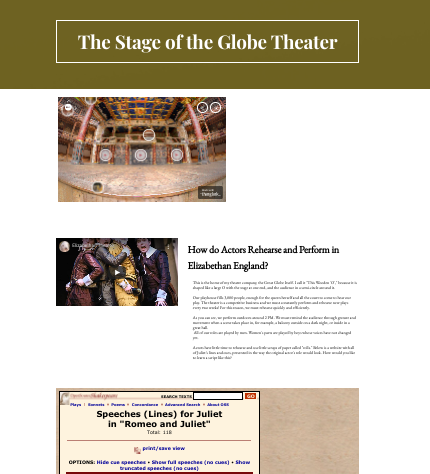
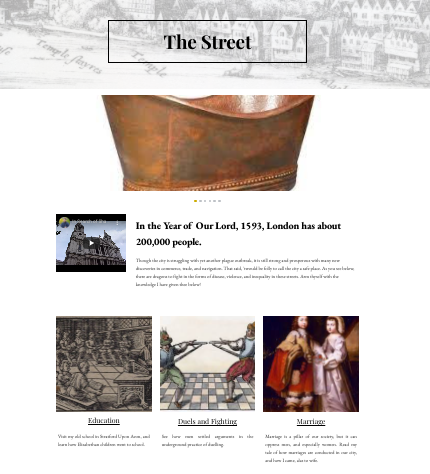
I’m working on several educational projects at the moment and I’m proud to share this one with you. It’s what I call a virtual tour of Shakespeare’s London. The teacher I’m working with said she wanted to teach the kids about the culture of Elizabethan London as he was writing Romeo and Juliet. Naturally with the pandemic a field trip was out of the question, (for multiple reasons), but I wanted to create a visually interesting tour of the places Shakespeare knew and worked and try to imagine his perspective and how that might have informed the characters and themes of Romeo and Juliet.

So I created this: a website written as if Shakespeare himself is taking you on a tour of his London in the year 1593, the year where, as far as we know, he had just completed writing Romeo and Juliet. 1593 was also the middle of another outbreak of Bubonic Plague. It has virtual tours of Shakespeare’s Globe Theater, Hampton Court Palace, Shakespeare’s Grammar School, and a quiz where you can pretend you’re in the Elizabethan doctor’s office.

For the class I’m helping, the students will fill out a worksheet as they navigate the website so they learn from the material at their own pace. If you’re interested, leave a comment and I’ll post the worksheet so you can use it in your classroom.

My hope is that this website can be a resource for anyone trying to connect with Romeo and Juliet and trying to learn from the culture of Elizabethan London. Shakespeare was a product of his time and his experiences must have had an influence on what he wrote. Even if they didn’t, they certainly influenced the people who saw the play and he knew that it would. So I hope it can help you understand a little bit more about the world of this famous play, and the context of the world that created it.

Shakespeare’s Roman Women

Since it’s Women’s History Month, and we just had the Ides of March last week, I thought it might be a good idea to analyze some of Shakespeare’s  female characters in his Roman plays. I’ve talked a lot about the men in Julius Caesar, Titus, Andronicus, and Coriolanus, but haven’t examined the female characters much, so that’s what I’m going do discuss today.

Examining these characters is important because many are based on real Roman women, and Shakespeare’s sources reveal what Roman culture thought about women’s roles. This is particularly relevant to those of you reading this in the west because Roman culture influenced the Elizabethans and they set the foundation for our culture today. Feminist criticism has been much maligned, (and I’m certainly not an expert on feminism), but I do know this: it exists to question the values and conventions of our culture, so we can identify what works and what needs to change to build a more egalitarian society.

When it comes to Shakespeare female characters in general, he challenges the status quo, but also reinforces it: There’s always a character who challenges traditional gender roles like Katherine and Beatrice, but, (with the exception of Twelfth Night), for every one of these there’s also a Bianca or a Hero; characters who embody traditional famine roles and virtues of chastity, meekness, and yes, marriage and childbirth.

Nowhere is this more apparent than in Shakespeare’s Roman plays where there are always two female characters and they usually embody opposite views of women’s roles and a woman’s duty to her country and the men in their lives

1. Tamara from Titus Andronicus

Titus was Shakespeare’s first tragedy and his first Roman play. As we shall see, as Shakespeare went through his career we see a more nuanced view of women’s roles and a greater appreciation for women who disdain or challenge patriarchal society. The characters Lavinia and Tamara are perfect examples and counterexamples respectively of traditional feminine roles.

When we first meet her, Tamara is the queen of the Goths- an enemy tribe that Rome has just conquered. Everything about Tamara from her foreign upbringing, to her personality, is a counter-example of what Romans prize in women. She is portrayed as savage and bloodthirsty, motivated by revenge against Titus, (who in the first scene of the play, kills her eldest son. Tamara responds by masterminding the murder of all of Titus’ children. She is also sexually liberated and uses her sexuality to further her revenge. Tamara seduces the Emperor to get him on her side, and gets the Emperor to condemn Titus’ sons to death. Her adultery with Aaron is another way she uses her sexuality to get revenge; she brings ruin the monarchy by cuckolding the Emperor. Thus Tamara’s sexuality and bold personality is framed in the play as an existential threat to Rome itself.

Tamara’s chief and only virtue is her love for her children, as you can plainly see in this scene from the play. Her love for her son Alarbus is why she begs Titus for his life, and afterwards, when he sacrifices Alarbus, Tamara’s love for her son turns into deadly hate to Titus. It is her motherly devotion that makes Tamara simultaneously human, and inhuman. As the play progresses however, Tamara is referred to in increasingly inhuman and savage terms. She dresses up as the goddess Revenge to torment Titus, and after she dies, Lucius, the new Emperor (and Titus’ only surviving son), calls her a “ravenous tiger,” and calls for her body to be thrown to beasts, since “Her life was beast-like.” Tamara is unquestionably the villain- a femme-fatale and a threat to all the Roman characters, but especially Titus’ daughter Lavinia.

2. Lavinia from Titus Andronicus

For the entire play, Lavinia embodies  traditional Roman female virtues, in that she is defined by the men in her life, and her chastity. The Romans actually invented the term castitas to refer to the female virtues of modesty and chastity, that is, only having sex with the man you are married to. Lavinia fits this mold perfectly. She’s a devoted daughter, wife, and sister. When we first meet her, she is a model of duty- greeting her father and asking for his blessing when he returns to Rome, and shedding tears for her brothers that were slain in the war:

In the cruelest and most barbaric scene in all of Shakespeare, Lavinia is raped by Tamara’s sons. Then, to keep her from identifying her attackers, they cut out her tongue and cut off her hands. The mutilation is grotesque, but for Titus, the Romans, and for the Elizabethans Shakespeare was writing for, the cruelest loss for Lavinia was the loss of her chastity. Now that she isn’t a virgin, Lavinia is marked with the opposite of chastity, incestum, or infamy. Even though the rape was not her fault, Lavinia is marked with shame. The Romans took unchastity extremely seriously; they used to punish it by throwing the adulteress to her death off the Tarpeian Rock. As you can see in this video, when a woman who was supposed to live chaste is even suspected of adultery, her very life is now in jeopardy:


When she loses her virginity, Lavinia becomes a silent creature of sadness. She is no longer a person, but a motivation for Titus’ revenge. Even if she hadn’t lost her tongue, she would still have little agency in the plot. This is why Titus kills her; to remove her incestum, and end her suffering.  Lavinia embodies the the cruel truth that women had to face in ancient Rome- once they lose their virginity, they are already dead in the eyes of most of Roman society.

Lavinia’s death scene from Titus, 1999, directed by Julie Taymor.

3. Portia (Julius Caesar)
If Shakespeare only wrote these two  female characters, you might rightly assume that he was a vile sexist, who defines a women’s usefulness simply by her chastity or lack thereof, and who thinks the proper function of a woman is to be quiet, demure, chaste, and obedient. Thankfully Shakespeare created Portia in Julius Caesar, and she defies many of the stereotypes associated with women in Ancient Rome.

Portia marks a turning point in Shakespeare’s Roman female characters as we we go from more ‘traditional’ female characters, to ones who exemplify masculine virtues. Instead of women being subordinates to men’s affairs and keeping out of religion, politics, and the affairs of Roman society, Portia is a character who demands respect, and to share her husband’s dangers. Some ancient sources suggested possibly Portia might have been the one who inspired Brutus to kill Caesar, (more on that later), but in any case Portia is not a character who is subordinate to men, but who demands to be treated as a Roman citizen.

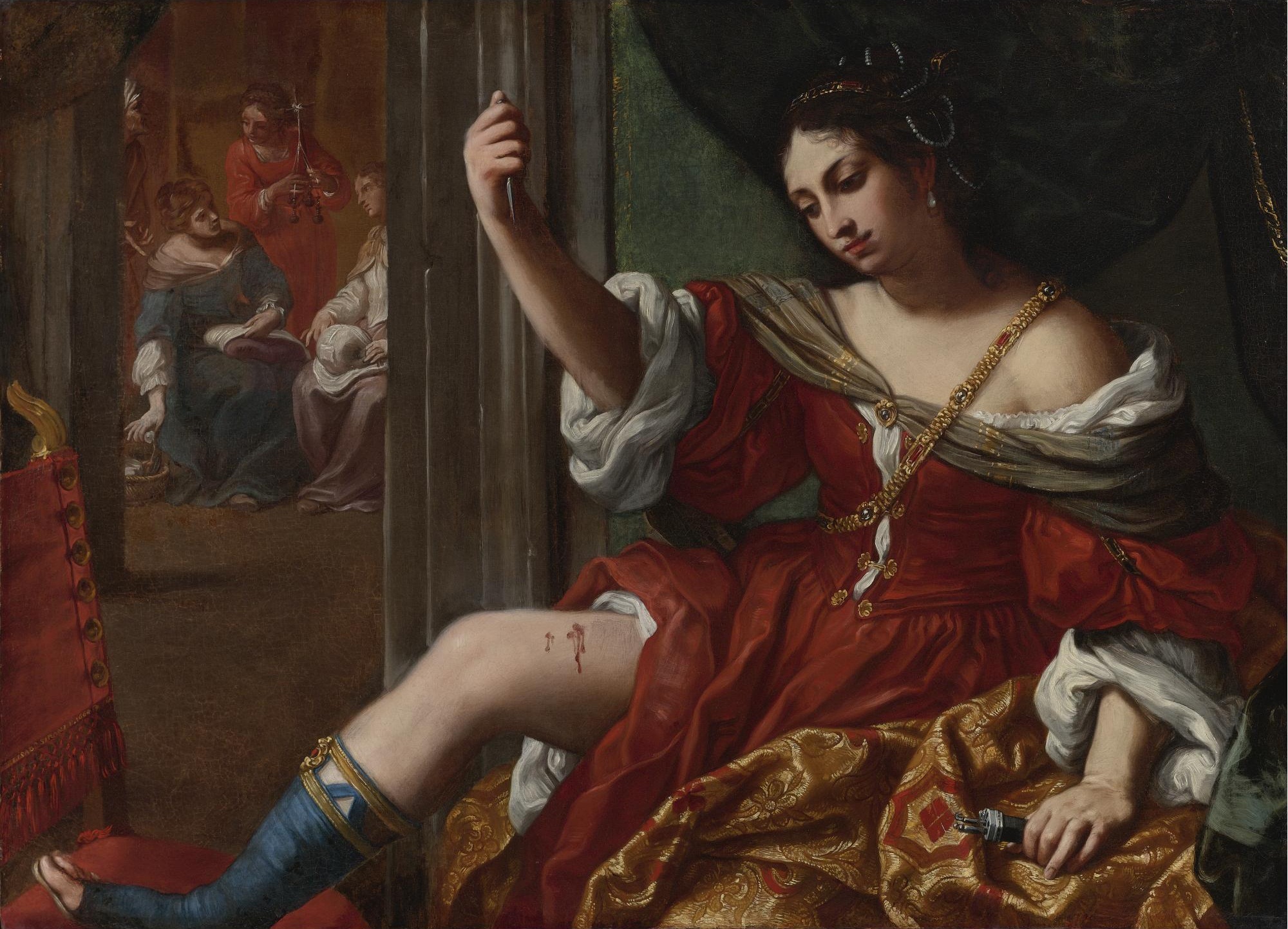
In one of the strangest passages of the play, Portia reveals that she has willingly injured herself by stabbing herself in the thigh. She does this as a way of establishing her tolerance for pain and her desire to be taken seriously by her husband:

Brutus. You are my true and honourable wife,
As dear to me as are the ruddy drops
That visit my sad heart
Portia. If this were true, then should I know this secret.
I grant I am a woman; but withal920
A woman that Lord Brutus took to wife:
I grant I am a woman; but withal
A woman well-reputed, Cato's daughter.
Think you I am no stronger than my sex,
Being so father'd and so husbanded?925
Tell me your counsels, I will not disclose 'em:
I have made strong proof of my constancy,
Giving myself a voluntary wound
Here, in the thigh: can I bear that with patience.
And not my husband's secrets?930
Brutus. O ye gods,
Render me worthy of this noble wife!

Romans have always had a connection with blood. Blood is a connection to duty; we owe our lives and our blood to Rome; the Gladiator whose blood honours the dead, the sacrifice of the enemy soldiers in Titus Andronicus, and the blood of the Roman soldier shed in service of the country. Rome is almost a culture that is built on blood. Portia in this gesture makes it clear that she is willing to shed blood just as much as her husband, who of course, will shed blood, (just not his own). In a way, Portia’s wound makes her more heroic than Brutus, because she is willing to suffer for the good of Rome, while Brutus kills for the good of Rome.

Shakespeare’s Roman characters, (male and female), extol the questionable virtue of the noble death. Historically when a Roman conspiracy failed, the conspirators had a choice; they could be paraded back to Rome humiliated and disgraced, or they could kill themselves and show defiance in the face of their conquerors. In some cases suicide was actually encouraged by the conquerors, as it meant that the threat was neutralized. In response, the conquerors would go easy on the wife and children.

Portia kills herself after Brutus is on the run. There could be two equally important reasons why she does this. First, she might be attempting to gain favor with the triumvirate by killing herself, (since she is complicit in the assassination), in the hopes that Anthony and a and Octavian will take pity on a Brutus’ children. It’s also possible that Portia kills herself because with the tide of battle turning, she might be next. Portia might be showing the same sort of resolve their husband later shows when he commits suicide to appease Caesar’s ghost and to defy his enemies the honor of capturing him.

Since Portia has a lot of her husband’s same virtues, the inevitable question I come to is to wonder what if; what if  Shakespeare’s Brutus had a listened to Portia more,what might he have done?

The Lictors Bring to Brutus the Bodies of His Sons, Jacques Louis David, 1789.

This painting by Jacques Louis David depicts Brutus’ ancestor Junius Brutus. We see that he is utterly removed and stoic him in the face of death. He has ordered the execution of his own sons for trying to bring back the monarchy. In the background, Brutus’s wife and daughters are mourning the death of their son and brothers. Men like Brutus, with their Republican ideals, take little stock in the consequence of their actions.

One can only wonder if Brutus had had confided in Portia, would she have condemned his actions, or could she have led him to a more constructive path, that might have a prevented Brutus’ death, and maybe even stopped the coming days of the Empire?

Valumnia (Coriolanus)
In Shakespeare’s later Roman tragedy Coriolanus, we again see a young, chaste woman and an older mother figure, but unlike in Titus, the older Volumnia is much more heroic than the young maid Virgilia. Both show loyalty to Rome and devotion to Coriolanus, but Volumnia is not only a hero, she is in many ways a complete inversion of the Roman mother trope.


Volumnia is fanatically devoted to Rome and its army and like her son. She finds war more beautiful than symbols of peace, especially those associated with motherhood. In Act I, Scene iii, she says that the breasts of the Trojan Queen Hecuba were not as lovely as her son’s forehead when it spit blood in battle. She is an inversion of the traditional motherly character; because of her devotion to Rome and  her son,
she is more outspoken than other women and not afraid to talk back to anyone who questions Rome. In a way she is more of Coriolanus’ general or his father than a traditional mother. Her love of Rome is inextricably tied to her love of her son. She raises her son to be a warrior for the Senate and the people of Rome, exhorting him to either return in glory, or die. Observe this passage where she tells Coriolanus’ wife that she was never proudest than when she sent her son off to war:

Volumnia: I pray you, daughter, sing; or express yourself in a
more comfortable sort: if my son were my husband, I
should freelier rejoice in that absence wherein he
won honour than in the embracements of his bed where
he would show most love. When yet he was but
tender-bodied and the only son of my womb, when
youth with comeliness plucked all gaze his way, when
for a day of kings' entreaties a mother should not
sell him an hour from her beholding, I, considering
how honour would become such a person. that it was
no better than picture-like to hang by the wall, if
renown made it not stir, was pleased to let him seek
danger where he was like to find fame. To a cruel
war I sent him; from whence he returned, his brows
bound with oak. I tell thee, daughter, I sprang not
more in joy at first hearing he was a man-child
than now in first seeing he had proved himself a
man.

Although Virgilia fits the bill of the modest, chaste, and loyal Roman housewife, Volumnia is framed as much more heroic. She even uses her mighty stoicism to save Rome! After Coriolanus rebels against Rome and joins the Volscis, Volumnia gets him to agree to make peace with Rome. She does this by kneeling before her own son; humiliating herself for the good of Rome. This act of self-humiliation changes Coriolanus’ mind. Observe how shocked Coriolanus (Ralph Fiennes) is when his mother (Vanessa Redgrave) kneels in this scene from the movie Coriolanus (directed by Ralph Fiennes in 2011).

4. Julia (Antony and Cleopatra) and with Cleopatra

With these final two examples, I’ve chosen two character who, (at face value), resemble Lavinia and Tamara. One is a dutiful, chaste Roman wife, related by blood to the Imperial family. Octavia was beloved throughout Rome for her chastity and kindness, and the citizens were outraged when her husband Marc Antony, abandoned her for Cleopatra, who was seen by many as a murderous, barbarous, lustful and an evil sorceress. However, Shakespeare paints a much more complex picture of Cleopatra, and though Octavia retains her chastity and is praised for her virtue, Cleopatra is unquestionably the star of the show, and ultimately commands more respect, awe, and even sympathy from the audience.

In Shakespeare’s play (and in real life), Cleopatra used her beauty as a propaganda tool. As I mentioned the Game of Thrones post, she deified herself in order to be taken seriously. In the 1st century AD, the system was very much rigged against female authority and so women had to resort to terrible measures in order to secure power for themselves.

If you look at the play again especially near the end, Cleopatra doesn’t come across as a femme fatale, she comes across as a woman who is trying to keep her Kingdom and her son Cesarian safe, and she will do anything to protect him. As the name suggests, Cesarean was Cleopatra’s love child of Julius Caesar, so the entire Roman world wanted him dead, because he was a threat to Octavian’s claim to the throne. To keep her son safe, Cleopatra seduces Marc Antony, hoping a powerful Roman alliance will keep her crown safe, and her son alive. Sadly for her, Octavian would stop at nothing to bring down all threats to his power, including Cesarian and Marc Antony. Arguably, the only reason he married Marc Antony to Octavia in the first place, was that he knew if Antony committed adultery, it would give Octavian the perfect excuse to raise an army and destroy Antony. Cleopatra got caught up in the political machinations of the most powerful and cunning man in the ancient world, and held him off as best she could.

Cleopatra struggles through the whole play to keep Antony, her people, and the situation in Rome under control. Antony never respects her as a queen and treats her like a jealous boyfriend, which is why they frequently get into fights.

However, after Antony’s suicide, the audience sees that Cleopatra also genuinely loved him back, and weeps for him as a wife, not an ally. Yet, quickly she regains her royal composure once Octavian threatens to take her back to Rome in chains. She decides to simultaneously deny Octavian the satisfaction, protect her son, and join her husband in the afterlife with her regal suicide:

Cleopatra: Give me my robe, put on my crown; I have
Immortal longings in me: now no more
The juice of Egypt's grape shall moist this lip:
Yare, yare, good Iras; quick. Methinks I hear
Antony call; I see him rouse himself
To praise my noble act; I hear him mock
The luck of Caesar, which the gods give men
To excuse their after wrath: husband, I come:
Now to that name my courage prove my title!
I am fire and air; my other elements
I give to baser life. So; have you done?
Come then, and take the last warmth of my lips.
Farewell, kind Charmian; Iras, long farewell.
[Kisses them. IRAS falls and dies]
Have I the aspic in my lips? Dost fall?
If thou and nature can so gently part,
The stroke of death is as a lover's pinch,
Which hurts, and is desired. Dost thou lie still?
If thus thou vanishest, thou tell'st the world
It is not worth leave-taking.

In conclusion, Shakespeare couldn’t go too far against the grain with challenging traditional patriarchal views of women, but in his Roman plays, we see characters who are simultaneously mothers and murderers, chaste and intelligent, citizens and devoted wives. I’m not trying to say that Shakespeare invented feminism, but I do believe his characters remind us that it is folly to try to box either gender into such stale old Roman categories as masculine or feminine. Perhaps we should all aspire to be like Cleopatra, whose infinite variety allowed her to succeed in a man’s world, while still being a wife, a mother, a lover, and a queen.

Christmas For Shakespeare Part III: Performing for Queen Elizabeth 

Merry Christmas Eve everyone! Today I will be talking about how Shakepeare’s two royal patrons, Queen Elizabeth I and James I celebrated this holiday!

We have surviving records that prove Shakespeare and his troupe performed at Christmas during the reigns of Queen Elizabeth and King James I. The buildings still exist so we can imagine what Shakespeare’s performancesal at court might have looked like. What follows is a bit of historical detective work, with a nice holiday flavor to boot.

How did Good Queen Bess celebrate Christmas?

Like her predecessor Henry VIII, Her Majesty Elizabeth accepted presents from the nobles on New Year’s Day instead of Christmas morning. From all over the kingdom, people would bring the best and most extravagant presents to the queen, hoping to gain her favor at court. Take a look at this true case of what her favorite courtier, Robert Dudley gave the queen for Christmas in 1588:

Dudley gives Queen Elizabeth a wristwatch
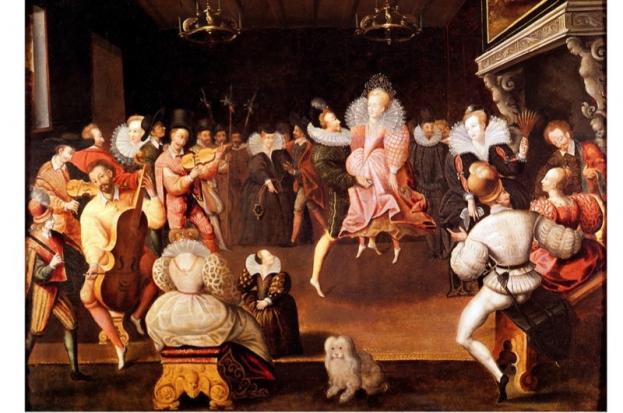
Unlike her dad however, Elizabethan Christmas was a more elaborate affair than a week of sitting and feasting. Yes, Gloriana had elaborate feasts, but she preferred to impress her nobles and visiting dignitaries with dances, jousts, and plays. She was an accomplished dancer and poet, and she loved court masques.

A masque is sort of like a combination masked ball and performance art piece. The nobles would put on costumes and masks and enact a historical or mythological event, like “the Golden Age Restored,” a masque Ben Johnson wrote for Twelfth Night in 1616. The intent was to flatter the queen and her court, as well as having a good time. Of course, Liz still made time on the dance floor for Shakepeare’s company!

.

How the plays were performed:

The plays would be in a large empty hall like the banquet hall or dance hall. Probably the tables would be removed from the feasting, then the dancing would begin. At around 10PM, the actors would take their places. There might be a makeshift tiring house, which was mainly just a curtain that the actors could hide behind to wait for their entrances.
The queen or King would be sitting on a throne on a raised platform so that she or he could be clearly seen by the actors and the audience.
Which plays did They Perform?

In 1594 The Lord Chamberlain’s Men played before the Queen at Greenwich Palace. Alas, we don’t know which plays they performed this time. What follows is a list of the plays we do know Shakepeare’s company played at Christmas.

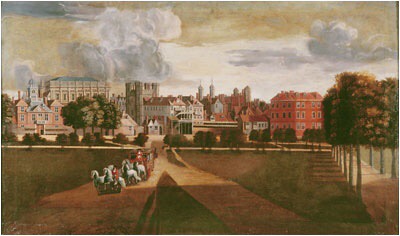
Whitehall Palace by Dankerts, 1675.

Love’s Labors Lost– 1597 at Whitehall palace. This time we know which play they performed before the Queen, because it’s listed right on the title page. I suspect that printing where the play was performed was designed to fire the imagination of the people who bought it. If you couldn’t be at court to see Shakespeare’s play, you could at least read his words and imagine you were there.

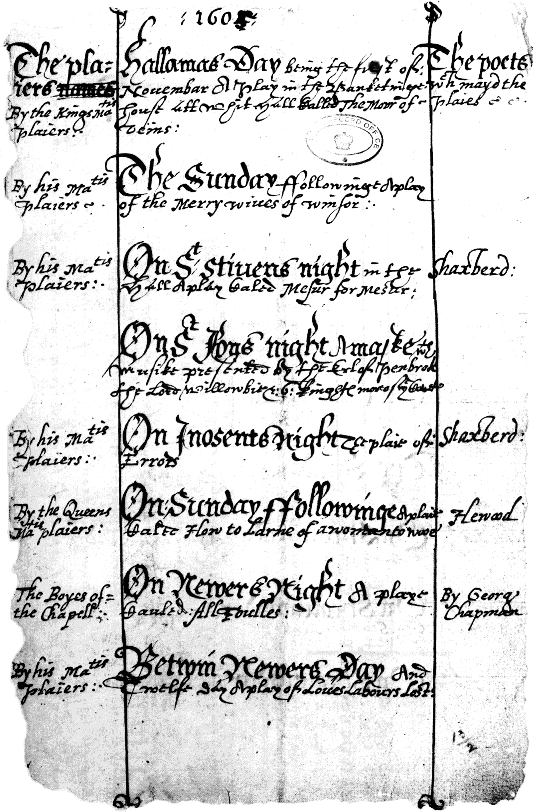
James I invited Shakepeare’s company to perform at Hampton Court many times. Below is an account of the plays for the Christmas holiday in 1603. Notice that Shakepeare’s name is spelled “Shaxberd.”

Here’s a list of some more plays we know Shakepeare’ performed at Christmas:

  1. Midsummer Nights Dream- 1603 on New Years Day, Hampton Court.
  2. Measure for Measure on Boxing Day 1603, Hampton Court.
  3. King Lear on Boxing Day 1606.
  4. Twelfth Night- Candlemas (Feb 2nd 1602).
  5. Twelfth Night 1618 and 1619 (location unknown).

Below is an episode of the incredible documentary “In Search of Shakepeare.” The first twelve minutes show what Christmas might have been like at Hampton Court in 1603, the first year of King James’ reign.

In Search of Shakespeare: For All Time

James loved plays and masques even more than Liz, which is why he employed one of the greatest scenic artists of all time, Inigo Jones, to come up with extravagant stage designs and costumes for plays and masques. James’ Queen Anne Of Denmark performed in quite a few masques herself. James also treated the Christmas season as a time of charity, which might have inspired some of the lines in King Lear, which was performed ‘on the feast of Steven’ 1606:

“Poor naked wretches… who soer you are. I have taken too little care of this.” -King Lear, Act III, scene I (The Storm Scene).

We can recall the contrast between King Lear and Good King Wenceslas. In the scene I quoted earlier, Lear laments that he hasn’t been more charitable to the poor, now that he himself feels cold and homeless.

The Christmas season would carry on until oh January 6, aka Twelfth Night. This was the day when, according to Christian tradition, the Three Wise Men finally got to Bethlehem and delivered their presents. Shakespeare’s play Twelfth Night is all about celebrations of feasting, fools and clowns, and of course, epiphanies.

If you liked this post, please consider signing up for my new online class, “What Was Christmas Like For William Shakespeare?” I’ll go further into the traditions of Elizabethan Christmas and add some insight into Shakespeare’s play “Twelfth Night.” Register now at Outschool.com!

The Shakepearean Student

Sources: http://www.unofficialroyalty.com/columnists/the-laird-othistle/will-shakespeare-at-christmas-court/

http://home.hiwaay.net/~paul/shakespeare/revels/revelsacct1.html

http://www.timetravel-britain.com/articles/christmas/jacobean.shtml

http://www.shakespeare-online.com/theatre/theroyalpalaces.html

http://internetshakespeare.uvic.ca/m/lifetimes/society/court%20life/festivals.html

FMI look at “The Christmas Revels”