Crafting A Character: Portia (Wife of Brutus

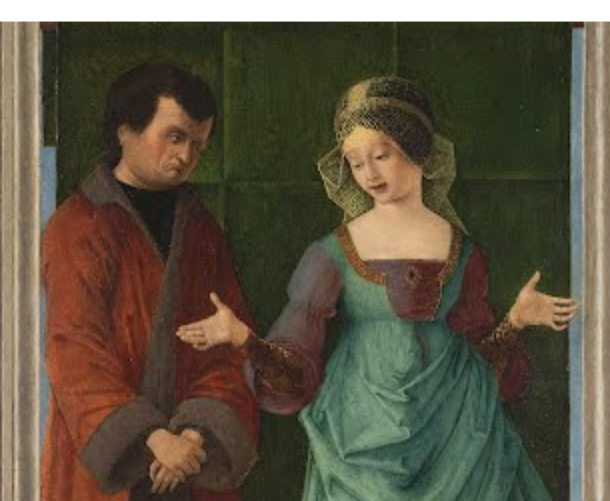
Portia (Or Porcia), was the wife of Marcus Brutus. Many ancient writers emphasize her courage, beauty, and devotion to her husband and Rome. Many painters and illustrators have chosen to depict her as a model of courage and grace.

Porcia, as has been said, was a daughter of Cato, and when Brutus, who was her cousin, took her to wife, she was not a virgin; she was, however, still very young, and had by her deceased husband⁠17 a little son whose name was Bibulus. A small book containing memoirs of Brutus was written by him, and is still extant. 4 Porcia, being of an affectionate nature, fond of her husband, and full of sensible pride, did not try to question her husband about his secrets until she had put herself to the following test. 5 She took a little knife, such as barbers use to cut the finger nails, and after banishing all her attendants from her chamber, made a deep gash in her thigh, so that there was a copious flow of blood, and after a little while violent pains and chills and fever followed from the wound. 6 Seeing that Brutus was disturbed and greatly distressed, in the height of her anguish she spoke to him thus: 7 “Brutus, I am Cato’s daughter, and I was brought into thy house, not, like a mere concubine, to share thy bed and board merely, but to be a partner in thy joys, and a partner in thy troubles. 8 Thou, indeed, art faultless as a husband; but how can I show thee any grateful service if I am to share neither thy secret suffering nor the anxiety which craves a loyal confidant? 9 I know that woman’s nature is thought too weak to  p155 endure a secret; but good rearing and excellent companion­ship go far towards strengthening the character, 10 and it is my happy lot to be both the daughter of Cato and the wife of Brutus. Before this I put less confidence in these advantages, but now I know that I am superior even to pain.” 11 Thus having spoken, she showed him her wound and explained her test; whereupon Brutus, amazed, and lifting his hands to heaven, prayed that he might succeed in his undertaking and thus show himself a worthy husband of Porcia. Then he sought to restore his wife. -Plutarch, Life of Brutus

https://portiacatonis.weebly.com

She tried to conceal her distress, but a certain painting betrayed her, in spite of her noble spirit hitherto. 3 Its subject was Greek, — Andromache bidding farewell to Hector; she was taking from his arms their little son, while her eyes were fixed upon her husband. 4 When Porcia saw this, the image of her own sorrow presented by it caused her to burst into tears, and she would visit it many times a day and weep before it. 5 And when Acilius, one of the friends of Brutus, recited the verses containing Andromache’s words to Hector,

“But, Hector, thou to me art father and honoured mother

And brother; my tender husband, too, art thou,”

Brutus smiled and said: 6 “But I, certainly, have no mind to address Porcia in the words of Hector,

‘Ply loom and distaff and give orders to thy maids,’⁠23

for though her body is not strong enough to perform such heroic tasks as men do, still, in spirit she is valiant in defence of her country, just as we are.” This story is told by Porcia’s son, Bibulus.

https://artsandculture.google.com/asset/portia-and-brutus/qQH7qtdFwf6xeA?hl=en&ms=%7B%22x%22%3A0.5%2C%22y%22%3A0.2668803418803419%2C%22z%22%3A8%2C%22size%22%3A%7B%22width%22%3A2.1891025641025643%2C%22height%22%3A0.6672008547008548%7D%7D

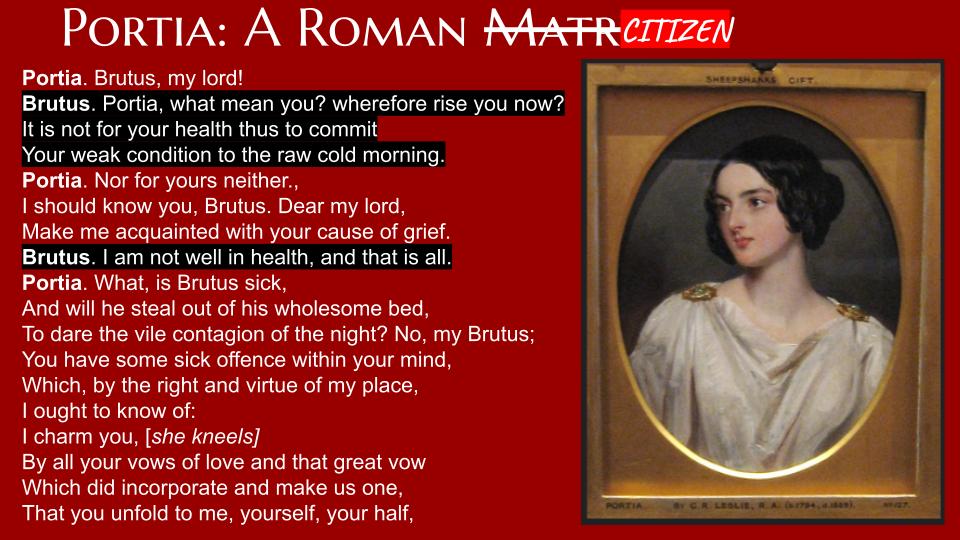
Portia marks a turning point in Shakespeare’s Roman female characters as we we go from more ‘traditional’ female characters, to ones who exemplify masculine virtues. Instead of women being subordinates to men’s affairs and keeping out of religion, politics, and the affairs of Roman society, Portia is a character who demands respect, and to share her husband’s dangers. Some ancient sources suggested possibly Portia might have been the one who inspired Brutus to kill Caesar, (more on that later), but in any case Portia is not a character who is subordinate to men, but who demands to be treated as a Roman citizen.

Playing Portia

Happy International Women’s Day

Happy International Women’s Day! I would like to dedicate my posts today to my daughter, a wonderful strong girl, a Shakespeare fan, and a lifelong lover of the musical “Six”.

Some of Shakespeare’s Best Female Characters

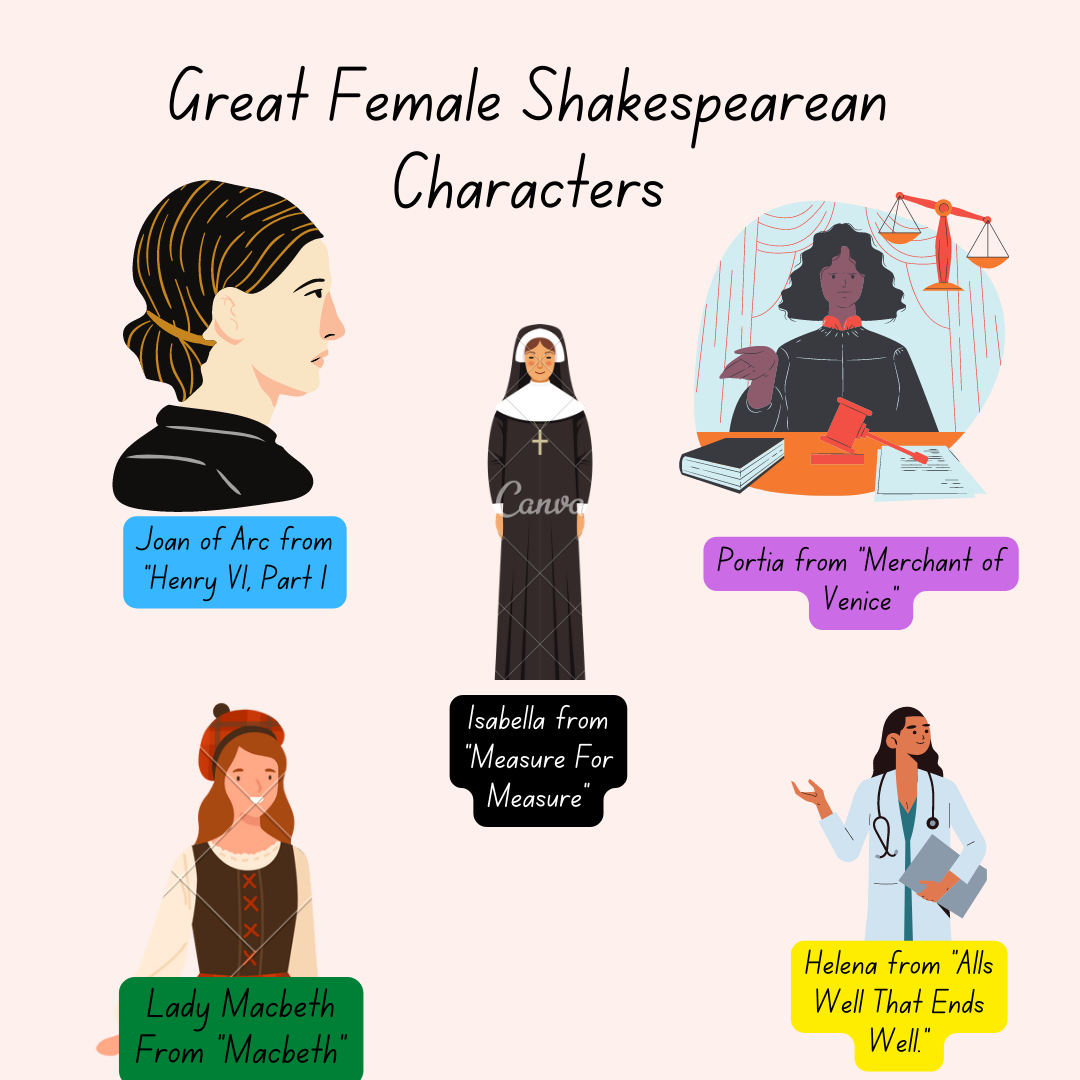
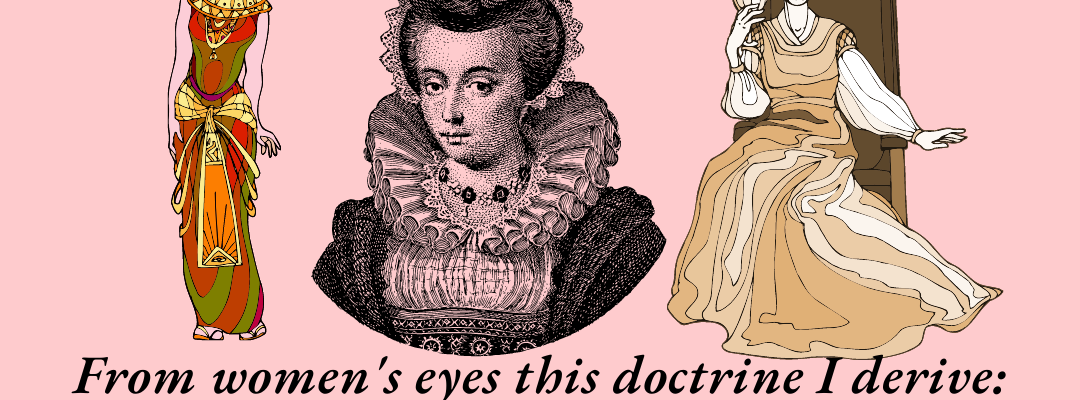
I’ve discussed Shakespeare’s best Mother characters before, and his Roman characters as well, but I thought I should include some of the ones who are not mothers and/or unmarried (at least for most of the play). I don’t want to rank these characters since I detest ranking women in general, so here are some of Shakespeare’s best characters, and some of their immortal speeches:

CleoPatra

Katherine Of Aragon

Even though “Henry the Eighth” is my least favorite Shakespeare play, I love how strong Katherine is and how well she fights against the machinations of Cardinal Woosey and her husband. She is a courageous, virtuous, and strong-minded woman, who when Henry demands that she consent to a divorce, Katherine simply says: “No Way!”

Lady Macbeth

A fascinating and electrifying character. She seduces her husband and makes him fully commit to murdering the king. If you look at the post above, you can see the multiple potential readings for why she courts evil spirits to convince her husband to murder the king. Her strength and energy is highly attractive and it was easy for me to see how a man might do anything to make her happy.

Isabella From “Measure For Measure”

I think Elizabethans would have seen the connection between the Virgin Queen who fought off assassination from the Pope, and Isabella, a virgin who fights off the advances of Angello, who seems pious, but who secretly is degenerate and cruel. Isabella even becomes a princess at the end of the play, (assuming she marries the Duke), which means she could literally become a Queen Elizabeth to English eyes.

https://www.rsc.org.uk/shakespeare-learning-zone/measure-for-measure/character/analysis

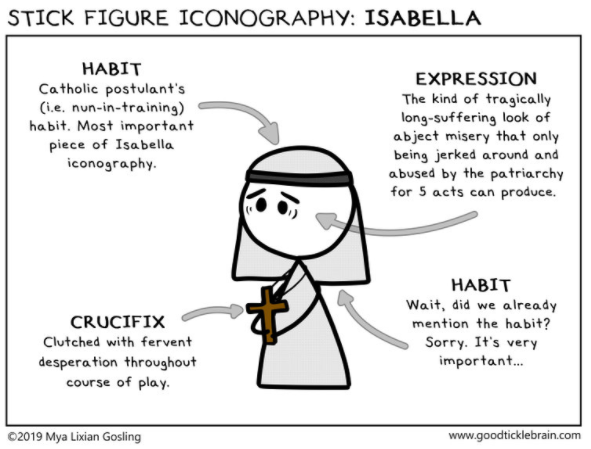
Stick figure version of Isabella from “Peace Good Tickle Brain.”

Portia Catonis (Wife of Brutus)

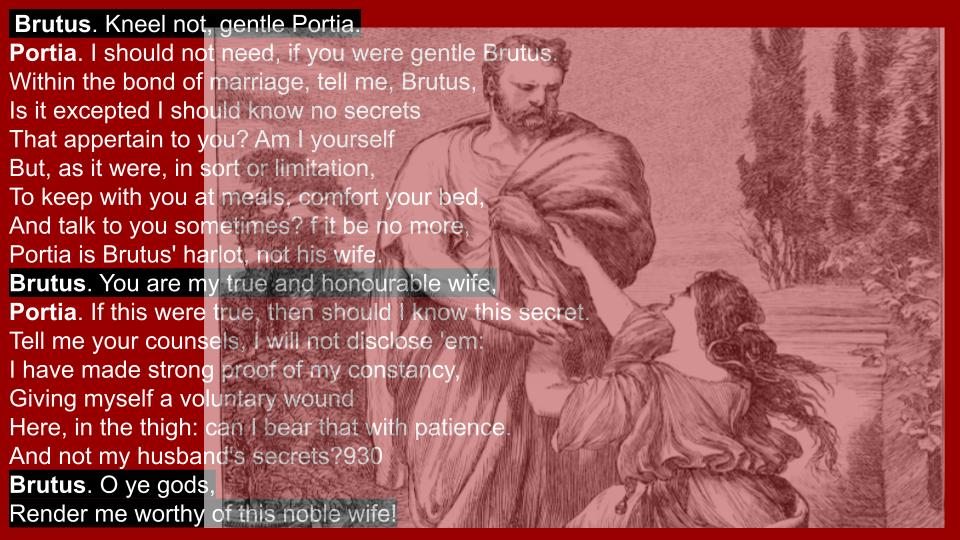
One of the best female characters in the Roman plays, Portia demands to be taken seriously as a wife and as a Roman citizen. In her one great scene we see her demand that Brutus tell her why he has been so distant and cold:

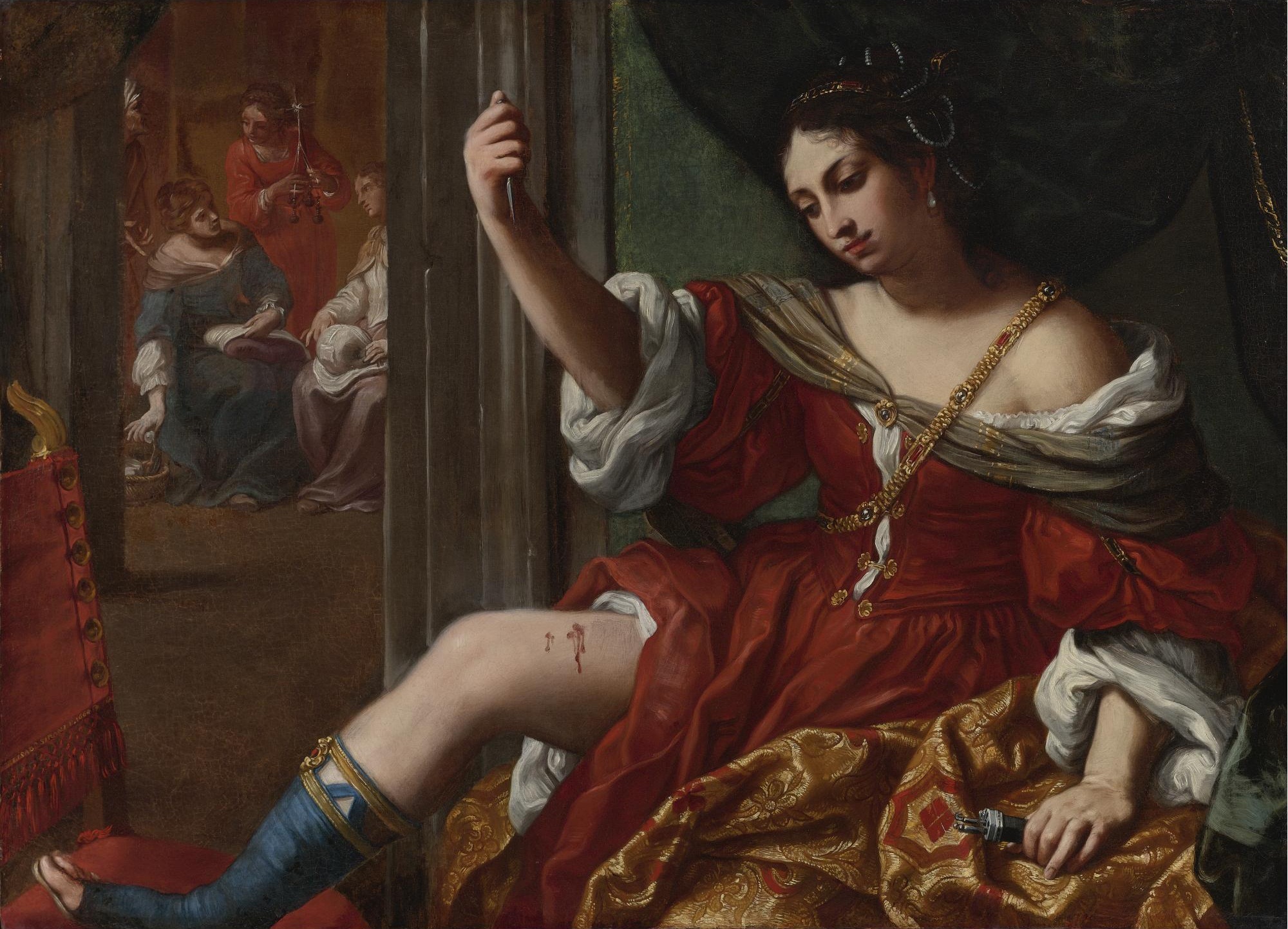
Elisabetta Sirani, Portia Wounding her Thigh, 1664, oil on canvas, 101 x 138 cm (Collezioni d’Arte e di Storia della Fondazione della Cassa di Risparmio, Bologna)
Some have speculated that in real life Portia helped Brutus with the conspiracy to assassinate Caesar, after all, she was the daughter of Caesar's great rival senator Cato, who was willing to die when he realized the Roman republic was finished.
Not only was the real Portia a great woman, she also inspired some great art. Below is the great masterpiece: Portia Wounding her Thigh, by Elisabetta Sirani (1664). According to Dr. DR. MAURA GLEESON, the painting was commissioned by a fabric merchant, which explains Portia's sumptuous outfit. Portia remains totally calm, yet focused and determined as the other women in the background idly spin clothes in the background. For more information on this masterpiece, click the link below:

If you’d like to learn more about Portia and Julius Caesar, sign up for my online class on the play via Outschool.com. Get a $5 discout with coupon code HTHES6Q5XA5 until Apr 2, 2024. Get started at https://outschool.com/classes/the-violent-rhetoric-of-julius-caesar-flex-schedule-edition-fwB3cwQM and enter the coupon code at checkout.


So happy International Women’s Day ladies! Hope you get some of the love and appreciation you deserve today! More posts coming soon!