Is Shakespeare Being Canceled?

Thanks to WordPress’ new interface, it’s easier for me to read what other bloggers have to say about the topics I write about. One trend I’ve noticed is the question that’s been boiling underneath the surface of a lot of people in our culture: “Should Shakespeare be ‘cancelled’?” It’s an interesting question and definitely merits discussion.

It is also a question that has some basis reality: Shakespeare was taken off the list of required reading of of schools in New Zealand. In 2007, The American Council Of Trustees and Allumni published a report called “The Vanishing Shakespeare,” about the number of colleges who no longer require English majors to take Shakespeare courses. If you read my post on Romeo and Juliet, you will recall that one of the main reasons why we have Shakespeare as a requirement in American high schools is that he is required reading in many colleges. So this could be part of a trend that extends to primary as well as secondary schools as well.

Many academics, (myself included), are wondering about Shakespeare’s status in education, and whether or not he will continue to be a staple of all English language curricula. So what I want to do with this essay is to ask the question, “Should Shakespeare be cancelled,” as well as”Should he not be cancelled? and “What even is cancelling and how does apply to somebody who is already long long dead now?”

First off, cards on the table: I am a white man, (with a beard), who has been studying Shakespeare for 20 years. I have a very clear bias; I would never advocate for Shakespeare being taken out of any schools. That said, I see merits to parts of the argument, and I do not believe that these teachers who are reexamining Shakespeare’s place in education are inherently wrong. Nor do I believe if that there is no merit to changing the way educators teach Shakespeare in our schools, (more on that later). My point is to write a thoughtful reflection about the nature of Shakespeare as a writer, his status within our culture, his status within the educational establishment, and how changing that is not necessarily a bad thing.

Part One: the arguments for cancelling Shakespeare

When I read the article “Why I am rethinking Teaching Shakespeare In My English Classroom,” by teacher Christina Torres, I noticed a lot of her arguments centered around diversity quotas and simply not having the class time to devote to Shakespeare. This is entirely understandable. Shakespeare has been dead for 400 years, which means language has changed a lot since his heyday.

Shakespeare poses several unique challenges in education. He wrote in an obscure form of poetry that is no longer fashionable. You have to read footnotes. Although 95% of the words he used are still used today, they are used in a very unique syntax. Furthermore, I come to teaching Shakespeare from the perspective of somebody who studied theater, acting, Elizabethan history, and everything that that is required to teach Shakespeare, but many teachers do not. My point is I can understand why a teacher feels that he or she does not have the time, energy, or the learning required to give Shakespeare the space that he so clearly demands.

The question of Shakespeare’s status in our classrooms also raises subtle questions about diversity. Many curricula these days emphasize diverse writers and try to highlight the cultural contributions of women, people of color, and LGBTQ people, and as far as we know, Shakespeare fit into none of these groups.

This educational initiative is a part of the anti racist initiative and I as an educator I am fully on board with this. I love to be in a classroom where Gabriel Garcia Marquez, Lorraine Hansberry, Mary Shelley, and Truman Capote share the same shelf is William Shakespeare, but ever since the 18th century Shakespeare and cultural nationalism have been inexorably linked.

Almost since the beginning of Shakespearean scholarship, American and British critics have sought to venerate Shakespeare as the peak of British culture, and thus the peak of human culture as well. It’s not a coincidence that we celebrate National Poetry Month the same month as Shakespeare’s birth and death. Also, even though we don’t know for sure when Shakespeare was born, we celebrate it on April 23rd, St. George’s Day, thus forever linking England’s greatest poet, with its patron saint. George Bernard Shaw, (an Irishman), coined the term ‘bardolotry,’ to describe the treatment of Shakespeare by the English as if he were a god and the evidence is quite damning:
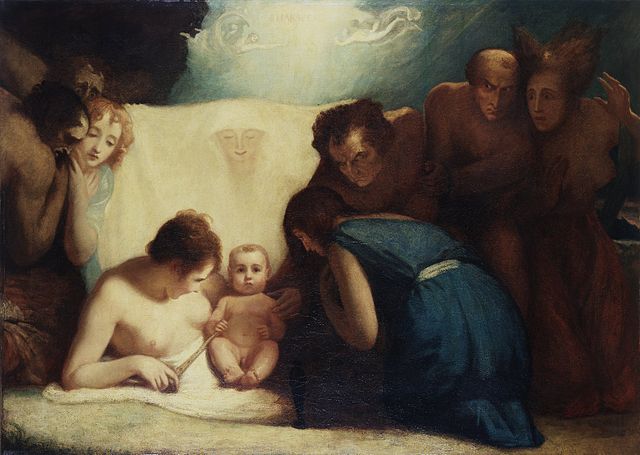
The infant Shakespeare attended by Nature and the Passions (Romney, c. 1791-1792)

Just look at this painting where Shakespeare is portrayed as in the same pose and with the same reverence as the baby Jesus. This reverence carried over to poetry, music, festivals, and of course, to the classroom. As I wrote in My Romeo and Juliet post, since the beginning of American public education, Shakespeare was an indispensable fixture in American schools, and thus, prompting American writers like Mark Twain to grumpily refer to Shakespeare and other classics as “Something everyone wants to have read, but nobody wants to read.”

Countless textbooks refer to Shakespeare as the greatest writer in the English language, and possibly the greatest writer ever. Ralph Waldo Emerson once preached that Shakespeare was: “Inconceivably wise.” The god-like aura around Shakespeare has made him nearly impervious to criticism and English speakers on both sides of the Atlantic have claimed Shakespeare as their gospel. Being an English speaker means having the God-Shakespeare on your side, and if you have God on your side historically speaking, you can justify anything.

“A Discovery Of the Bermudas,” 1610. Thought by many scholars to be Shakespeare’s inspiration for “The Tempest”

The British were keen to elevate Shakespeare to this godlike status partially because it showed that their culture was superior to others. Let’s not forget that Shakespeare’s last play The Tempest is about a man with book learning who goes off and colonizes an island whose inhabitants seem savage and uneducated. If our goal as educators with adding anti racist education is to show that all voices are valid, to highlight the contributions of every ethnic group, and to refute the notion that white culture is in any way superior to any other, then to a certain degree, we must knock Shakespeare off his literary pedestal.

Caliban, Prospero’s slave from “The Tempest”

We also should not a take a blind eye to the anti-POC and mysoginist language in some of Shakespeare’s plays. For instance one line I deeply despise in Romeo and Juliet is the line where Romeo refers to Juliet by saying she “Hangs upon the cheek of night like a rich jewel in Ethiop’s ear” (A black woman wearing an earring).

1583/5 – ANNIBALE CARRACCI, PORTRAIT OF A WOMAN HOLDING A CLOCK

This statement contrast beauty, specifically the beauty of white skin, with the “ugliness” of a black woman’s ear. Shakespeare uses this metaphor several times in several plays, establishing white as beauty and black as the aberration.

I bring this up not to say that Shakespeare should be cancelled and hated because of this racially insensitive language, because he’s not the only one who does it. All you have to do is Google “Who’s the fairest one of all?” to realize that for centuries, fair skin, beautiful skin, and white skin meant the same thing. As Dr. Grady says in the video above, having an honest discussion of Shakespeare’s language and his culture’s attitude towards race is an opportunity to teach critical race theory in the classroom, and to teach students to recognize and deplore dehumanizing language, which though poetic to white Elizabethans, is hurtful and dehumanizing to people of color. In short, banning or condemning Shakespeare is counter productive, but examining his language, culture, and politics with a critical eye is a very useful and important exercise.

Part 2 why Shakespeare doesn’t deserve to be cancelled

I’ve established that Shakespeare has connections with some very dark moments in a European history and he should not be celebrated merely because of he was white or because he was British. I believe that Shakespeare’s contributions to the English language as well as drama and the arts still makes him worthy of study by students. As this video from the New York Times shows, students need at least a basic understanding of Shakespeare to understand western culture:

There’s No Escaping Shakespeare: New York Times, 2016.

I believe that, as long as we educators don’t indulge our bardolotrous tendancies, and keep Shakespeare in the context of the period in which he lived, we can still teach him in a way that will benefit our students.

One small way to put Shakespeare in context is very simple: STOP USING THE TERM “RENAISSANCE.” Most scholars now refer to Shakespeare’s time period as the Early Modern Period, not The Renaissance, which was an honorific term that people used during Shakespeare’s time period. The term RENAISSANCE, meaning the rebirth of classical learning and by extention the rebirth of sophisticated European culture, can give the impression that it was only a period of study and artistic achievement, leaving out colonization and racial and political tension. I find Early Modern Period a very useful descriptor because like it or not, Shakespeare’s culture influenced ours, therefore an understanding of him is very much understanding of where we came from. Learning from Shakespeare is like learning from history- we cannot shy away from the mistakes of the past, nor should we flat out reject its benefits.

it should be noted that a lot of the good scholarship in the last to the last 50 or 60 years has been tasked with putting Shakespeare back into his historical context and trying to reclaim his staus as a man of his time. Dr. Stephen Greenblatt of Harvard University helped coin the term ‘new historicism’ which emphasizes learning about the culture of a writer’s time period. To New Historicists (such as myself), Shakespeare is no longer considered a great man of history, but a man shaped by the culture of his time, which is to say a man who had good parts and bad parts much like history itself. This is the approach that I think should be taught in American schools highlighting how Elizabethan culture shaped Shakespeare, and how he shaped our culture in turn.

Comparing Shakespeare to history, especially American history, is very useful in American schools. Like the founding fathers Shakespeare reached towards an ideal. He wrote plays about ideal kingship, even though kingship is a cruel and autocratic system of government. He wrote romances about young lovers who follow the wonderful idea of love at first sight, even though in reality that concept is somewhat rare, and very often fraught with peril. And like Shakespeare, people often ignore the flaws and human failings of the founding fathers too. Look at this mural painting of The Apotheosis of Washington, which still looks down on mortals from the US capital building in Washington DC.

Deifying the First President in 'The Apotheosis of Washington' – Brewminate
The Apotheosis of Washington  Constantino Brumidi, 1865 .

Much like the founding fathers’ document that declares that all men are created equal, we can appreciate Shakespeare’s plays but also be aware of their flaws. Both documents were written by a flawed human being with a very narrow understanding of the wider culture and world in which he lived, but one who did his best to try and write works that would benefit all of mankind. As educators we can teach students to be inspired by this work, and seek to have a greater understanding of “The Great Globe Itself,” with the benefit of hindsight, so they may become enlightened citizens of the world, true Renaissance Men, Women, themselves.

So if I truly believe, (and I do), that Shakespeare is still relevant and has something to say to people regardless of their culture or cultural and racial backgrounds regardless of what time period they were born in and regardless of gender, how then can we teach him in classrooms in responsible and nuanced way?

What to do?

[  ]Give a cultural context to the play you study. A culture that is the direct ancestor of our own, but one that was frought with Colonialism, Casual racism, (especially in language), Sexism, Patriarchy, and Homosexual oppression. Not to toot my own horn, but this is what I tried to do with my Romeo and Juliet Website: https://sites.google.com/d/1iLSGjbllxU-ZwyrUya_xHtjojSCg9pd6/p/12GhgKdJr63wmTcm6TTvkZ-ROmUnALKQi/edit

-Give students the chance to rewrite or reword the more problematic elements, such as Romeo’s creepy stalking of Juliet,

-Highlight Shakespeare calling attention to patriarchial issues: Capulet in Act III, v, Friar Lawrence comparing love to gunpowder. Juliet raging against arranged marriage, etc.

  • Celebrate Shakespeare’s positive contributions to race relations: Othello was the first black hero on the London stage and the role helped generations of black actors get their start in theatre. There’s your modern bardolotry, Shakespeare not as “Inconceivably wise,” Inconceivably woke! You can also look at the proud tradition of color blind casting in Shakespeare’s performance history, such as Orson Wells’ “Voodoo Macbeth.”
  • Do some research on modern productions that translate the themes into a modern concept.
BOOKS : THE LOVERS, AFGHANISTAN'S ROMEO AND JULIET — Home | Afghan Culture  Unveiled
Book cover for “The Lovers,” the real-life story of Ali and Zakia, teenagers from Afghanastan, who fell in love in spite of their parent’s religious hatreds.

To sum up- cancelling Shakespeare doesn’t mean vilifying him. It means re-examining his role in our culture, and teaching students to appreciate the benefits, and try to correct the damages that his culture has brought to our own. We can’t change the past, but we can learn from it. As for Shakespeare himself, no amount of legitimate criticism will keep people like me from enjoying his plays. If anything, I appreciate even more the breadth and depth of his writing the more I learn about the culture in which he lived. I like to think that, if Shakespeare knew people would be talking about him in school, he’d echo the way Othello said he wanted to be remembered, to “Speak of me as I am, Nothing extenuate.” And that we heed the words of Ben Johnson in the dedication to the First Folio, when we think of treating Shakespeare as an icon.

Dedication by Ben Johnson in Shakespeare’s First Folio, 1623.

Resources for Teachers and Students: A Visit To Elizabethan London

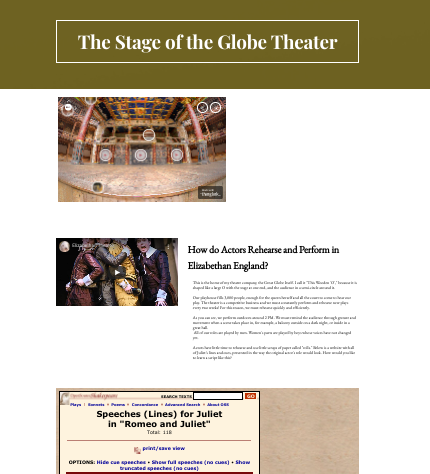
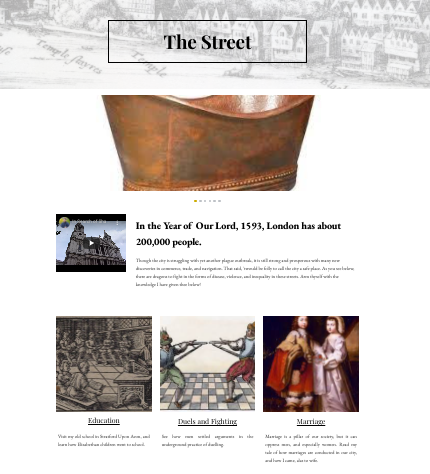
I’m working on several educational projects at the moment and I’m proud to share this one with you. It’s what I call a virtual tour of Shakespeare’s London. The teacher I’m working with said she wanted to teach the kids about the culture of Elizabethan London as he was writing Romeo and Juliet. Naturally with the pandemic a field trip was out of the question, (for multiple reasons), but I wanted to create a visually interesting tour of the places Shakespeare knew and worked and try to imagine his perspective and how that might have informed the characters and themes of Romeo and Juliet.

So I created this: a website written as if Shakespeare himself is taking you on a tour of his London in the year 1593, the year where, as far as we know, he had just completed writing Romeo and Juliet. 1593 was also the middle of another outbreak of Bubonic Plague. It has virtual tours of Shakespeare’s Globe Theater, Hampton Court Palace, Shakespeare’s Grammar School, and a quiz where you can pretend you’re in the Elizabethan doctor’s office.

For the class I’m helping, the students will fill out a worksheet as they navigate the website so they learn from the material at their own pace. If you’re interested, leave a comment and I’ll post the worksheet so you can use it in your classroom.

My hope is that this website can be a resource for anyone trying to connect with Romeo and Juliet and trying to learn from the culture of Elizabethan London. Shakespeare was a product of his time and his experiences must have had an influence on what he wrote. Even if they didn’t, they certainly influenced the people who saw the play and he knew that it would. So I hope it can help you understand a little bit more about the world of this famous play, and the context of the world that created it.

What to Get A Shakespeare Nerd For Christmas

If you’re reading this as I post it, there’s a Shakespearean nerd in your life and your wits are about to turn trying to find a gift. I’ve already written about printed editions of Shakespeare and educational apps, so you can consult those if that’s what you are looking for. Now I’m covering the kinds of stuff that die-hard Shakespeare fans will kill a king and marry with his brother for, basically nerdy swag that no Shakespearean fanatics should be without!

img_0615-1


For anyone: Immortal Longings.com- This company is very special to me. If you’ve seen any of my Play Of the Month posts, you’ve seen the gorgeous artwork for Shakespeare’s plays by the artist Elizabeth Schuch. Not only do I love her work, my wife and I put her prints on the decor for our wedding day, and wrapped some of my presents in wrapping paper with her designs on it. If you go to her website, she sells Shakespearean art printed on and inspired by Shakespeare’s plays on everything from tapestries to clothes to iPhone cases. I highly recommend checking her work out, and patronizing it as much as possible: https://society6.com/immortallongings/s?q=popular+framed-prints

img_1488-1

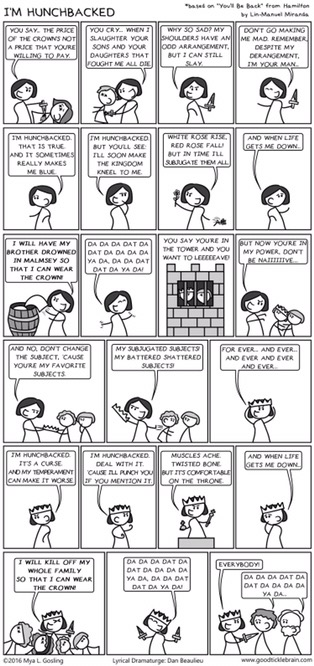
I also want to give a shout-out to the website Good Tickle Brain, a weekly Shakespearean comic that satirizes the Bard’s work with love. I feel the best way to introduce anyone, young or old to Shakespeare is through a healthy dose of satire and parody. Mya Gosling loves Shakespeare and it comes through in her simple, funny retellings of his plays. If you go to their shop (spelled Shoppe to appeal to nerds like me), you can get some of her comic books, funny T-shirts, and a few educational posters for teachers too: https://goodticklebrain.com/shoppe/

Bard Game

Adults

  1. The Bard game This is the Monopoly for Shakespeare Nerds- each player pretends to be a theater manager putting on plays in real locations where Shakespeare’s company toured during his lifetime. You make money by reciting speeches or improvising one in the Shakespearean style, or by answering Shakespearean trivia questions. A must-have for any Twelfth Night Party! Review of the game: https://boardgamegeek.com/boardgame/12372/shakespeare-bard-game https://boardgamegeek.com/boardgame/12372/shakespeare-bard-game
  2. Bards Dispense ProfanityBards against humanityMost people know the raunchy card game where you try to encapsulate a disgusting word or phrase with a description written on your card. Well, there’s a Shakespeare version too! It makes sense that someone made a card game inspired by the king of the Elizabethan put-downs, (and the inventor of one or two modern curse words!)
  3. Wine 🍷 Though I was unable to find actual wine with Shakespeare’s name on it, practically every other part of the wine drinking experience has been branded with Shakespeare- wine bags, glasses, corks and bottle stoppers, and even whole bars! If you spend a few minutes looking online, you can find tons of Shakespearean wine merch. By the way, here’s a convenient list of quotes Shakespeare wrote about alcohol: http://www.shakespeare-online.com/faq/shakespearedrinking.html
  4. T shirts 👕 https://www.redbubble.com/shop/shakespeare+t-shirts

Stocking stuffers

  1. Pen and ink There’s a lot of good versions of pen and ink with Shakespeare’s name on them. Imagine the fun you can have writing sonnets with your own Shakespearean pen and ink!

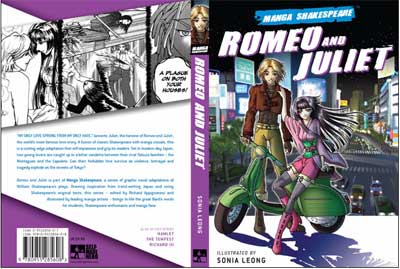
Shakespearean Comic Books. I’ve written reviews about some of these books and I’m very impressed by the artwork and the clever adaptations. Click here to read my review of the Romeo and Juliet Comic.

Kids

  1. Pop-Up Shakespeare by the writers of the Reduced Shakespeare Company. I’m a huge fan of The Reduced Shakespeare Company and they have created an amazing new popup book for kids of the entire Shakespearean cannon!
  1. Barbie and Ken as Romeo and Juliet. Ok, so this is a bit of a stretch, but hey, I’d get it for my daughter. R&J Barbie
  1. MND Board BookBoard books 📖 Yes, even toddlers can get into Shakespeare. I actually read this to my daughter a lot. It’s not the story of the play, but it does introduce some of the characters and famous lines which can help a child to become familiar with Shakespeare.
  1. King Of Shadows
  1. Cover of “King Of Shadows,” an excellent Young adult novel for anyone who loves Shakespeare.
  1. King 👑 Of shadows (Ages 8-12) This is an excellent young adult novel that teaches a lot about Shakespeare’s theater and the time period in which he lived. For a complete review, click here:

This was one of my favorite books growing up. It tells the story of Shakespeare’s life and work, with special attention to the creation of the Globe Theater in 1599. It’s gorgeously illustrated and a great read for kids!

So there are some gift ideas for the Shakespeare nerd in your life. Merry Christmas!

Here’s one more gift that you could give a Shakespeare nerd ages 13-18: A class from ME!

Go to my Outschool profile and Get $5 off the following classes:

  1. Wizard Science for Kids!
  2. What Was Christmas Like for William Shakespeare?
  3. The Violent Rhetoric of Julius Caesar
  4. Stars and Constellations for Kids
  5. Romeo and Juliet: Why Do We Still Read This Play?
  6. Macbeth: An Immersive Learning Experience
  7. Love Poetry- Shakespeare Style!An Interactive Guide to Shakespeare’s London
  8. An Immersive Guide to “Romeo and Juliet”
  9. A Child Astronomer’s Christmas!

Get started at https://outschool.com/classes/a-child-astronomers-christmas-bhmPRpND and enter the coupon code at checkout. My classes are available for as low as $4 apiece! Get started at https://outschool.com/classes/a-child-astronomers-christmas-bhmPRpND and enter the coupon HTHESNIF6B5 code at checkout.

Course image: "The Violent Rhetoric Of Julius Caesar"
Course title image for my Outschool course, 2021

How To Write Romantic Poetry Like Shakespeare 

Since this is national poetry month, I thought I’d talk a little bit about Shakespeare’s poetry.  Shakespeare wrote 154 short love poems called sonnets. What follows is kind of a do-it-yourself poetry manual that would be great if you want to write a poem for a spouse or a loved one for Valentine’s Day, Christmas, Mother’s Day or any other time, to show that you care. Sonnet writing has been a time honored tradition for showing the people we care about just how much they mean to us.
If you’ve never written a sonnet , don’t worry, the kind of sonnet Shakespeare wrote is pretty easy to write, and it follows just a few simple rules. I don’t want to lie; it takes a lot of patience and thought to craft a sonnet, but the rules are easy to follow. So let’s get to it!


analyzing-sonnet-011.jpgWhat Is A Sonnet? A sonnet is a short poem that’s only 14 lines long, written in what is called Iambic Pentameter, Shakespeare’s preferred form of poetry. I’ve written before about Iambic Pentameter, but just to be clear it’s a 10 syllable line that goes da-Dum- daDum-da-Dum-daDum-daDum. So all you need is 14 lines that follow a particular rhyme scheme. You’ll notice that in the sonnet above, every other line rhymes except the end. This is called an ABAB rhyme pattern, and it is the trickiest thing about writing a sonnet. One reason Shakespeare has this rhyme pattern is to draw your attention to the last two lines, then draw the sonnet to a close with the simpler rhyme of the couplet.

Sonnet Form A sonnet’s 14 lines are arranged into three short groups or quatrains which are four lines long. Usually around line 9, there is a kind of “turn” or change in the direction of the argument, like at line 9 in Sonnet 8 above, where Shakespeare stops talking about summer, and starts talking about the person to whom he’s writing. If it helps, you can think of this as the “But…” part of the sonnet, because it’s the part where he changes the argument using the word “but,” (and what a but it is). The sonnet then concludes with two rhymed lines of Iambic called a rhymed couplet. These last two lines are a way of wrapping up the main idea of the poem in a short, catchy way.

Step by step Tips and Tricks:

  1. Start by planning out your sonnet.

It’s often useful to consider your sonnet like a speech or a short argument. The three quatrains give you a chance to come up with an idea, then develop the idea, and then come to a conclusion, much like any other form of persuasive writing that you might’ve had to do for English class. For example, Sonnet 8 pictured above, (one of Shakespeare’s most famous sonnets), begins with the question: “Shall I compare the to a summers day?” He then goes to flatter the person he’s writing about by talking about how much better they are than a summers day, saying that actual summers are too windy and too hot, and the flowers of the summer are all too brief. By contrast, Shakespeare argues that the  subject of the sonnet has beauty that will last forever, particularly if that person goes on to have children. This is the form that Shakespeare sonnets often take and I would advise you to try and make your sonnet into a clear argument.

Example Of Sonnet Writing:  Since Mother’s Day is coming up, if you wanted to write about the mother of your child, and thank her for her for being there for your child, you might want to structure your sonnet by using the three stanzas to express three simple ideas like:

1. Thank you for being the mother of our child(ren) 

2. A specific time she did something awesome for your child (give examples!)

3. Thank you from you, me, and our child(ren).

Tip 2: Plan Out The Rhyming Couplet: As I mentioned before, the last two lines of every sonnet are called a rhyming couplet; two lines of iambic pentameter that rhyme together and help conclude the sonnet. Just like a English paper, a good conclusion is very important, which is why it’s it’s often useful to work on this these two lines first before you get into writing the meat of your sonnet. For example, here’s a couplet I wrote about preparing breakfast in bed and doing chores for one’s wife on Mother’s Day.

All chores this day will I do in thy stead

Commence I shall with breakfast in thy bed!

Tip 3: Writing Poetry  Now that you have the ideas you want to express now comes the hard part: putting them into poetry. I often find it helps to just get a piece of paper, write as much as possible to express the three ideas in your sonnet in prose, then get down to translating your ideas into iambic pentameter.

Quick Tips to help you along:

  1. Make sure the important words are on the right beats. Remember, in a normal Iambic line, every other beat (2, 4, 6, 8, and 10) are emphasized. This means the important words/ sylables need to be on those beats. You might have to invert the order of a word or two to keep those beats clear. like I did in my couplet when I wrote “will I do” instead of “I will do”
  2. You don’t have to use iambic in every line. Shakespeare was never a slave to a particular verse form, and a whole poem in iambic pentameter can sound a little dull sometimes. This is why, if you really want to, you can change a line or two to emphasize different beats
    • Trochees A clever way to wake up your audience is to start off with a few regular iambic pentameter lines, and then change it to a line where the first beat is the one that’s important. Like a dance or song that suddenly changes tempo, this creates a sense of excitement in the reader.
    • Spondees Sometimes you can emphasize two syllables at the same time, as Shakespeare does in lines 1 and 3 of Sonnet 8. You wouldn’t pronounce “Shall I” as “SHALL I or shall I,” and the phrase “rough winds” demands that both words are important, so Shakespeare is clearly changing the verse a little just to make the poetry more interesting.
    • For More information on other types of Meter, read Sam Rame’s Literary Analysis Blog: http://samrames.blogspot.com/2013/03/william-shakespeares-sonnet-60-like-as.html

Tip 4: Use Literary Devices: I find Shakespeare very often tried to express an idea by using metaphor and allusion to create images in the listeners mind. Sonnet 8 which we’ve been discussing, is structured around creating a contrast between the speaker and a pretty day in summer. You can do this kind of flattering comparison yourself, but, as we’ve seen, it’s often useful to put a “but” in the argument around line 9, to make it clear that you love the person more than for example a warm summer day. Imagine getting a sonnet that claims that someone loves you more than ice cream!

Sometimes Shakespeare uses contradictory images in his poetry for dramatic effect. Romeo often and talks about “Oh brawling love, O loving hate”. He uses this to express the wildness of his passion. This is called antithesis, and it’s very useful when you want to add a little spice to your poetry. Try comparing your beloved to both ice and fire!
Alliteration and assonance: Remember, Shakespeare wrote for the theater not for people reading in the book this is why he often plays with words that sound a particular way and worked very hard to come up with sounds that would grab a listeners attention rather than readers. When a word when several words start the same letter it creates a sense of order and gets the readers attention. Assonance is when consonants are repeated within the middle of a line.

Useful Websites when you’re working

  • Rhymezone.com– a convenient online rhyming dictionary
  • Thesaurus.com– useful if you need another word that fits into iambic better.
  • Kotsheet.com- a website for teachers with lots of useful worksheets to help you organize your sonnet. Useful for writing or teaching sonnets!

I hope this post was helpful. If you have any questions, please comment, or email me in the “Ask the Shakespeare Guru” page. If you write any sonnets yourself and wish to share them on this site, let me know and I’ll gladly re-post them!

Till Next Time,

-The Shakespearean Student.

References

  1. The Sonnets Edited by Rex Gibson. Cambridge University Press, 1997.
  2. Shakespeare’s Wordcraft  by Scott Kaiser. Limelight Editions, 2007. Free preview here: https://books.google.com/books/about/Shakespeare_s_Wordcraft.html?id=IdVuj0IY2ekC&printsec=frontcover&source=kp_read_button&hl=en#v=onepage&q&f=false 
  3. Literary Devices.net: https://literarydevices.net/
  4. Cummings Study Guide: https://cummingsstudyguides.net/xSonnets.html

The Witches Of Macbeth

Happy Halloween everybody!

Tonight I’d like to discuss some of the spookiest, most enigmatic, and above all WEIRDEST characters in Shakespeare: the Three Weird Sisters in Macbeth.

1. Who are they?

Every production has to answer who the witches are, and many have very different answers. Are they temptress? Are they evil agents controlling Macbeth?Furies trying to destroy Macbeth?

https://www.youtube.com/watch?v=clG8ha2D26g
I would argue in their basic form the witches are harbingers of change. Their very name “Wyrd Sisters” refers to an old Anglo Saxon concept of fate or destiny. Whether or not they have any effect on Macbeth mind or soul, they point the finger at him and say “things are going to change for you.” Then, he either makes the choices that determine his fate, or they change his fate for him.

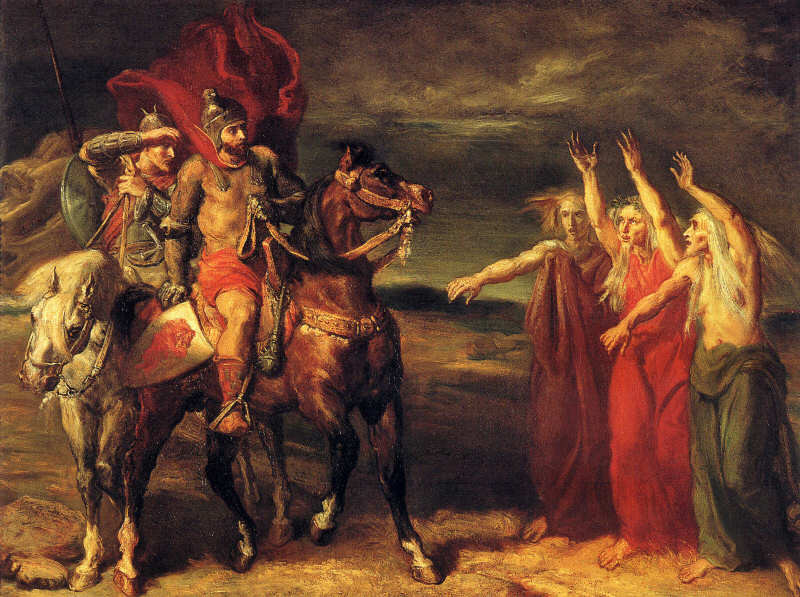
“Macbeth and Banquo First Encounter the Witches,” Théodore Chassériau, 1854.

Macbeth meets the witches on a heath, which means land that is literally out of bounds– the wild, untamed wilderness, which the old Anglo Saxons believed was the lair of many cursed spirits and monsters. This could symbolize Macbeth’ sin or transgressions, slowly turning into a murderer, usurper, and a tyrant. It could also symbolize the chaos in Macbeth’s life.

What Do They Look Like?

Shakespeare’s descriptions of the witches are highly contradictory- they seem to be floating, yet on the ground, they seem to be women, but they have beards! They don’t look Earthly, but here they are on the Earth. This gives them an other worldly quality that keeps us guessing as to who they are, and helps them tempt Macbeth more easily.

BANQUO
What are these
So wither’d and so wild in their attire,
That look not like the inhabitants o’ the earth,
And yet are on’t? Live you? or are you aught
That man may question? You seem to understand me,
By each at once her chappy finger laying
Upon her skinny lips: you should be women,
And yet your beards forbid me to interpret
That you are so.

MACBETH
Speak, if you can: what are you? (Act I, Scene iii).

The Witches’ Language:
You know from my earlier posts that the norm for Shakespearean characters is to speak in iambic pentameter- 10 syllable lines of unrhymed poetry that sounds like a normal heartbeat. The witches break these norms- they generally speak in Trochaic Tetrameter- 8 syllable lines with the off beat emphasized. The witches are literally offbeat, and that’s why their speeches are unsettling. Look at the contrast between a normal iambic line like:

“In sooth I know not why I am so sad.” (Merchant Of Venice I,i).

and

Dou-ble Dou-ble, Toil and Tro-ble.

Fire burn and Caul-dren Bu-ble. (Macbeth, Act IV, Scene i).

For more info on the verse forms of the Witches, click here:

The witches also speak their prophesies in a vague, ambiguous manner They like to play with obscuring their prophesies with lines that make Macbeth think one thing, but the opposite is true. The famous example here is when they claim Macbeth will never be vanquished “until Birnam Wood comes to Dunsinane Hill.” Macbeth assumes this means he’s invincible, but it actually means that the enemy carry wood from the forrest. This is called Equivocation.

Witches and mythology

Illustration from William Blake's
Illustration from William Blake’s “Europe a Prophecy,” 1794.

1. During the reign of King James, the modern witch hunt began; the king was fascinated with witches and even wrote a book called Daemonology on how to identify and destroy them. This was the era where people believed that witchcraft, rather than a pagan religious practice, was a forbidden craft that could only come from a pact with the devil. However, Shakespeare borrows from both Satanic and early pagan ritual in the characters of his witches.

2. Shakespeare took a couple of details about witchcraft from ancient Celtic and Greek mythology. First of all, the use of a cauldron. In Celtic myth, a cauldron is a symbol of rebirth and was sometimes used to resurrect the dead, just as the witches do in IV i. Of course, the ideal time for raising the spirits was on the feast of the pagan god Samhain, at the point where the veil between the living and dead was the thinnest. The feast took place on October 31st, our modern day Halloween!

Illustration of witches and their familiar spirits, 1647.

3. Familiar spirits In Act I, the witches speak to animal spirits called familiar spirits, which call to them and tell them where to go. King James himself wrote about how the witches found and communicated with these spirits.

Hecate.
In Act IV, Hecate, Ancient Greek goddess of magic appears. She is clearly the lord of all the witches, and is very displeased that they are riddling with Macbeth. Maybe not all witches believe in giving out prophesies that can destroy the Scottish monarchy. Hecate was always enigmatic in myths- she was born one of the Titans who opposed the gods, but frequently changed sides. More then being two faced, she was often portrayed as having three faces! Shakespeare refers to her frequently as “Triple Hecate.”

“The Triple Hecate,” by William Blake, 1794.

For more information on this mysterious goddess, consult the video below, (WARNING, ADULT-ONLY CONTENT).

In conclusion, the witches are meant to be ambiguous because the play examines the source of evil- whether it is inspired by other people, or if it comes from one’s own heart. The witches can be either or both, depending on how you want to tell the story, which is why they act and speak in contradictory ways.

Thanks for reading! If you enjoyed this posting, please consider signing up for my online class, “Macbeth: An Immersive Horror Experience.” I tell you the story of Macbeth and you get to play through an escape room, where you must solve the witches’ puzzles or be added to their Cauldron!