In doing my research for Twelfth Night, I came across a fantastic production from Shakespeare’s Globe in 2002. It used what is known as “original practices,” meaning that the actors tried to replicate everything we know about the way Shakespeare’s actors performed.
The play was performed in the great Globe Theater, which is itself a replica of Shakespeare’s original playhouse, which means that it was outdoors, using mostly natural lighting, and minimal sets. https://youtu.be/qtoUeVjP_rs
In addition, all the women’s roles were played by men, and the actors played multiple parts, which were all accurate stage practices from Shakespeare’s era. Most exciting of all, the actors all wore authentic 17th century costumes designed by veteran costume designer, Jenny Tiramani:
Few things determine how an actor moves or looks more than the clothes he or she wears, and watching these actors wear doublet and hose and real Jacobean dresses really fires up my imagine and makes me feel that I’ve truly been transported through time. The production is available on DVD, as well as several clips on YouTube, and I urge you to take a look at it. In the meantime, I’d like to comment a little on how the costumes from this production inform the audience about the characters that wear them.
Some Info On 17th century fashion
* Men
Tight pants or hose, and stockings designed to show off the legs
Tight jackets made of wool or leather called doublets
By the 17th century, starched ruffs were being replaced with lace collars.
Starched collars called ruffs around the neck.
* Women
Longer skirts, often embroidered with elaborate patterns
* Servants- Servants like Cesario (who is actually the Duke’s daughter Viola in disguise), would typically wear matching uniforms called liveries, a sign of who they worked for and their master’s trust in their abilities. People judged the aristocracy by how well they trained and controlled their servants, so wearing your master’s livery meant he trusted you to represent his house.
In her first scene as Cesario, a servant named Curio remarks to her that Orsino has shown favor to “him” from the very beginning. This might explain the rich garments that Viola wears in this production, which resemble a noble gentleman more than a servant.
A higher ranking servant like Malvolio would be able to wear a higher status garment, which is why you see Steven Fry as Malvolio dressed in a handsome doublet.
3. Character notes:
* What are they wearing?
* Why are they wearing it?
* How do the clothes inform the movement?
1. Viola (Eddie Redmane) Viola, the star of the show, begins the show as the daughter of a duke, who has just been shipwrecked in a foreign country, so her clothes must look bedraggled and worn, yet appropriate to her status. As I said before though, for the majority of the play, Viola is disguised as the servant Cesario
2. Malvolio (Steven Fry)
Malvolio wears dark colors since he’s a Puritanical servant.
He mentions that he has a watch. The first ever wristwatches ever came into being around this time.
Most productions give Malvolio a Gold chain and/ or a staff of office to show his status, and his prideful nature.
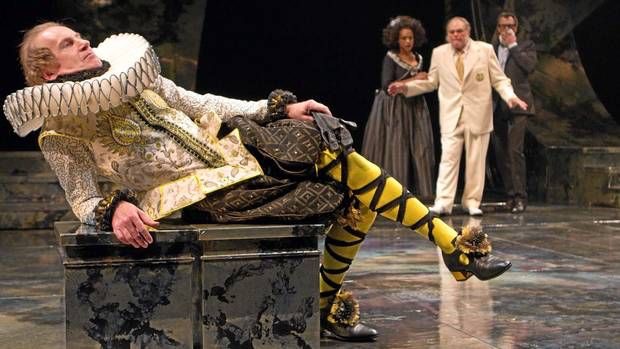
In Act III, Malvolio is tricked into wearing yellow stockings with cross garters.
3. Maria the Countess Olivia’s maid, (who has an appetite for tricks and pranks), Maria’s job is to dress and help Olivia with her daily routine. This might include tying up her corset, putting on her makeup, and helping her with the elaborate gowns that nobles wore during this period. In the video below, you can watch a dresser help get an actress into an elaborate costume for another Globe theatre production. Just think of the amount of time and hard work it would take for a servant like Maria to dress Olivia every day!
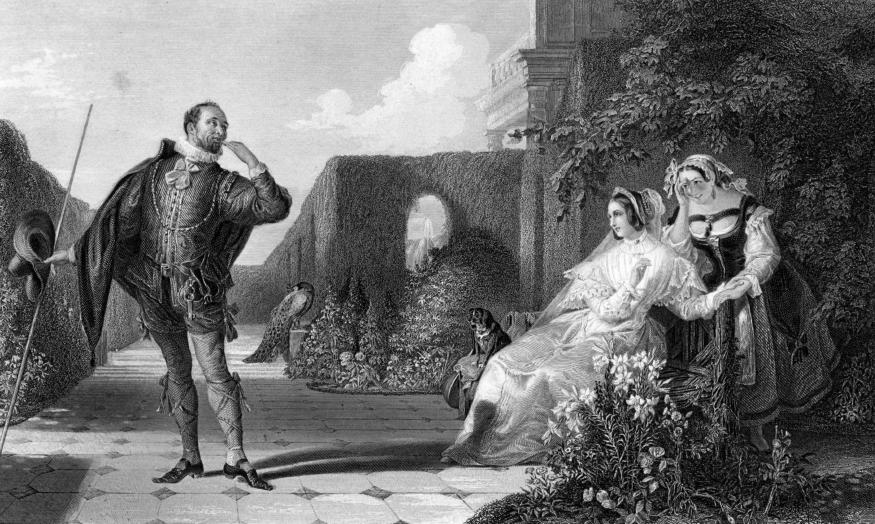
In the play, Viola momentarily mistakes Maria for her mistress because she wears a veil. This also suggests that, rather than wearing a livery like Cesario, maybe Olivia let Maria wear some of her older clothes, which was a common practice for high level servants. A lot of the costumes Shakespeare’s company wore were probably hand me downs from their aristocratic patrons.
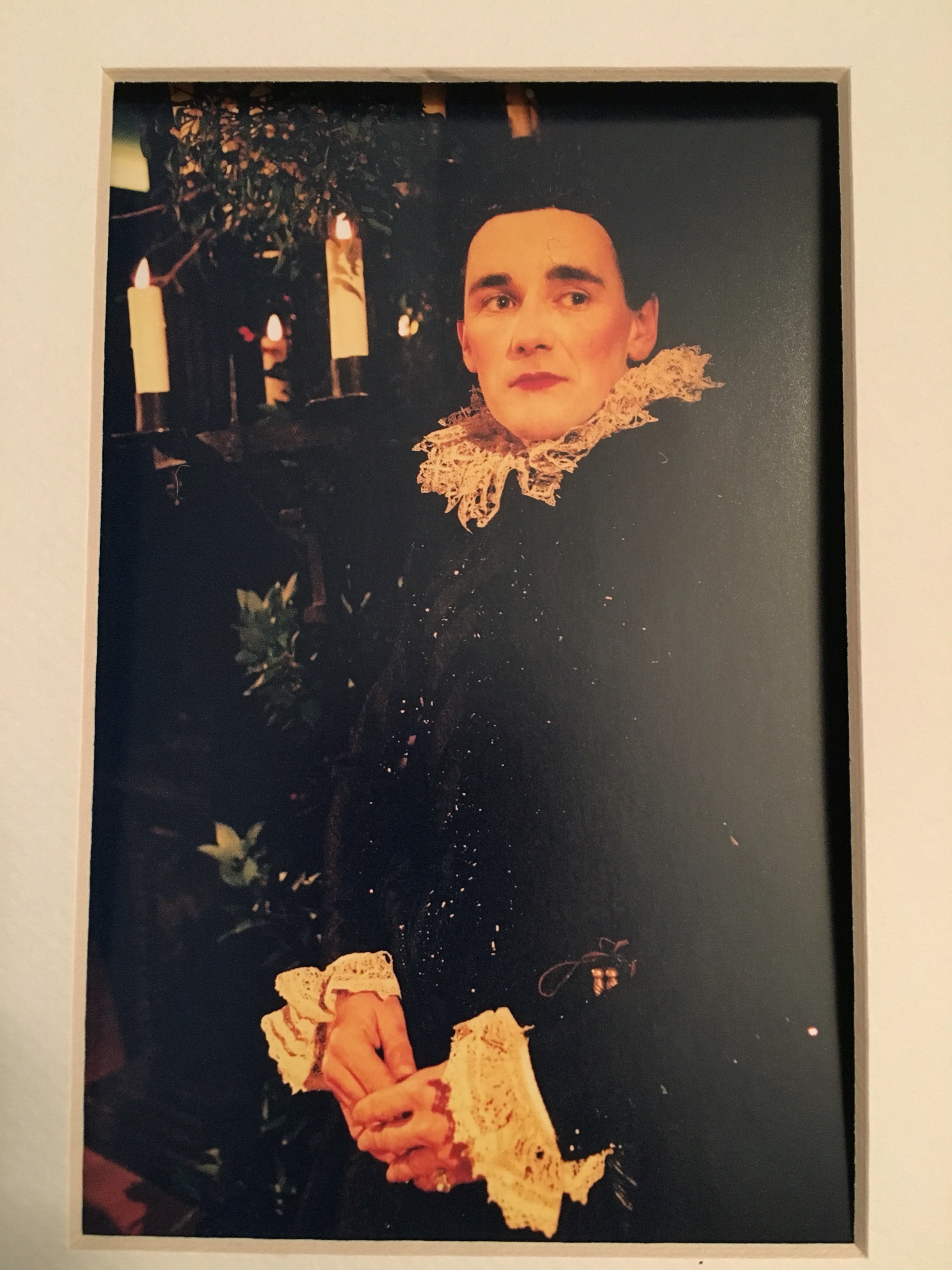
4. Olivia (Mark Rylance)
In this production, the countess and all the female roles were performed by men, just as they were in Shakespeare’s Day. Mark Rylance, who played Olivia, was also the Artistic Director of the Globe Theatre.
Olivia is mourning her lost brother, which is why she’s traditionally dressed in a black dress and veil
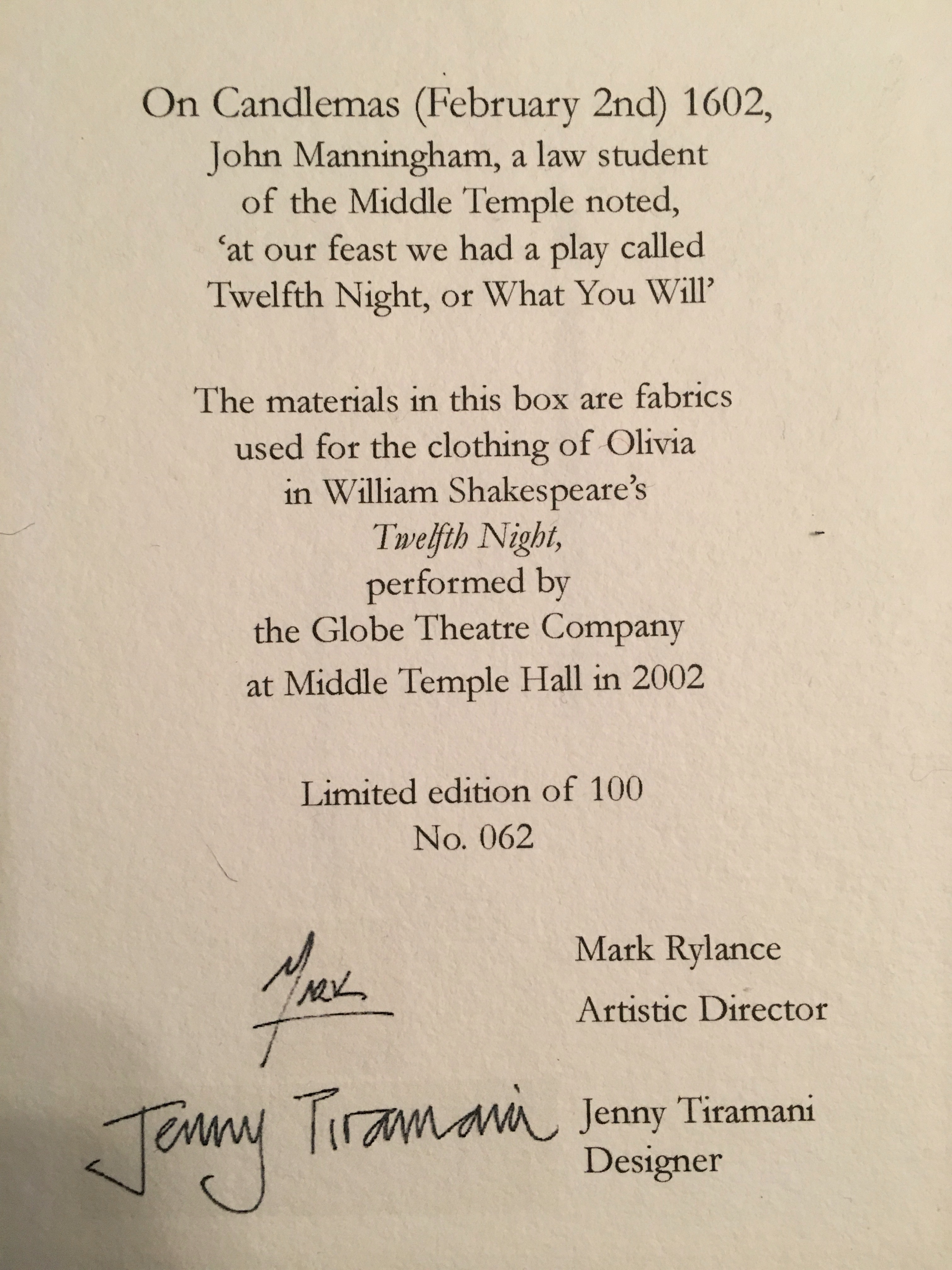
The dress is black silk with elaborate embroidery, as you can see from this actual sampler of the real fabric used in the show. You will also notice the threads holding the fabric together with metal points at the end. Olivia’s gown was hand sewn into many different pieces and tied together with these points. One nickname Shakespeare gave servants like Maria was “One who ties [her] points.”
Costumes like these offer a tantalizing glimpse into history. Just as Shakespeare’s words help an actor bring to life the thoughts and feelings of his age, The type of clothes his company wore helps the actor embody the moiré’s and desires of Shakespeare’s society, whether a mournful countess, a dazzling gentleman, or a reserved Puritan.
References
Feldman, Adam
“Q&A: Mark Rylance on Shakespeare, Twelfth Night and Richard III” Time Out Magazine. Posted: Tuesday November 12 2013
I am disgusted by the recent violence in Charlottesville VA. The fact that in 2017, White supremacists threatened, hurt, and killed innocent Americans is despicable and truly disheartening. I won’t go into my political views here since this tragedy transcends politics and forces everyone in this country to re-examine who we are and what we stand for as a people, and do our part to help prevent this kind of mindless hatred.
I’m not a politician, I’m not a policeman. My area of expertise is Shakespeare, so I am going to try to make a case for why the study of Shakespeare can help people, (especially young people), learn about the world, examine new points of view, and try to improve the world. I will then add a list of resources for teachers and students to deepen your understanding of the play.
My first argument for the play is that Merchant has two of the best speeches about intolerance ever written.
You’ve probably heard of this speech, (spoken by the Jewish moneylender Shylock), and I’m also well aware of the fact that, in context, it is not entirely about peaceful coexistence and tolerance, but it nevertheless establishes Shakespeare’s argument that condemns bigotry and violence, particularly against Jews:
Hath not a Jew eyes? hath not a Jew hands, organs,
dimensions, senses, affections, passions? fed with
the same food, hurt with the same weapons, subject
to the same diseases, healed by the same means,
warmed and cooled by the same winter and summer, as
a Christian is? If you prick us, do we not bleed?
if you tickle us, do we not laugh? if you poison
us, do we not die? and if you wrong us, shall we not
revenge? If we are like you in the rest, we will
resemble you in that. If a Jew wrong a Christian,
what is his humility? Revenge. If a Christian
wrong a Jew, what should his sufferance be by
Christian example? Why, revenge. The villany you
teach me, I will execute, and it shall go hard but I
will better the instruction. Merchant, Act III, Scene i.
Al Pacino when he did this speech said that it has the eloquence and power of Dr. Martin Luther King. Patrick Stewart initially had the same reaction, but later realized that Shylock turns midway through and the speech becomes a justification for revenge. What’s clever here is that Shakespeare manages to give Shylock two good arguments against bigotry; by emphasizing how Jews are no different than any other racial or religious group, and also warning that oppressing a people will only result in more retribution and pain on both sides. This is what he means when he says: “The villainy you teach me, I will execute.” We’re seeing this sort of reaction right now with the recent surge of violence by both white supremacists and the Antifa; without tolerance and common decency, chaos and bloodshed reins.
Another speech, much less well-known, is this speech of the Prince Of Morocco, one of Shakespeare’s only black characters. The speech below is the first time he speaks while attempting to woo the heroine Portia:
Prince of Morocco. Mislike me not for my complexion,
The shadow’d livery of the burnish’d sun,
To whom I am a neighbour and near bred.
Bring me the fairest creature northward born,
Where Phoebus’ fire scarce thaws the icicles,
And let us make incision for your love,
To prove whose blood is reddest, his or mine.
I tell thee, lady, this aspect of mine
Hath fear’d the valiant: by my love I swear
The best-regarded virgins of our clime
Have loved it too: I would not change this hue,
Except to steal your thoughts, my gentle queen. Merchant Of Venice, Act II, Scene i.
People often forget that this speech condemns pre-judging a person based on the color of their skin. Morocco tells Portia, (who in all probability has never seen a black man before), to not judge him by his appearance. His tone is gentle, but it is not apologetic. He says he won’t change his skin color for anything, (except maybe if it would win her heart). The Prince is a dignified and proud representative of his country and his race.
My second argument for reading or teaching this play is that it reveals how bigotry and racism is usually tied to money and profit. In Act IV, Scene i, Shylock points out the hypocrisy of his Christian brethren in keeping slaves, which they justify by saying that they are not people, but property:
Shylock. You have among you many a purchased slave, Which, like your asses and your dogs and mules, You use in abject and in slavish parts, Because you bought them: shall I say to you, Let them be free, marry them to your heirs? Why sweat they under burthens? let their beds Be made as soft as yours and let their palates Be season’d with such viands? You will answer ‘The slaves are ours:’ so do I answer you: The pound of flesh, which I demand of him, Is dearly bought; ’tis mine and I will have it. If you deny me, fie upon your law! There is no force in the decrees of Venice. I stand for judgment: answer; shall I have it? Merchant, Act IV, Scene i.
Shylock turns this hypocrisy back on the Christians by saying basically, “How can you call me inhuman when you debase and subjugate your fellow creatures?” The answer to both questions of course, is that it is economically convenient. Shylock earns his money by lending money at interest, and threatens dear penalties if not repaid on time. Similarly, the Christians need Shylock because their religious practices forbid them from lending money, so they have to go to him instead of other Christians. We see echoes of this unfortunate tendency today: the white supremacists in Charlottesville were chanting: “Jews will not replace us,” which clearly exposes their fear of losing political and economic influence to minorities. In addition, our country has refused countless immigrants from poor, war-torn countries which we justify to ourselves by saying the cost of letting them in is too great.
The play’s comic sub-plot also has many lessons for today’s world. The hero Bassanio undergoes dramatic transformation from a spoiled prodigal son to enlightened married man. At the play’s beginning, he has a close friendship with the merchant Antonio, that might be played as a one sided homosexual relationship. Antonio is very affectionate to Bassanio, and lends him a large amount of money without any expectation of repayment, which has sometimes been interpreted as a hinting of Antonio’s unrequited love for Bassanio. Though Basanio doesn’t reciprocate any romantic feelings, he eventually saves Antonio’s life, and at least tries to repay him for his kindness.
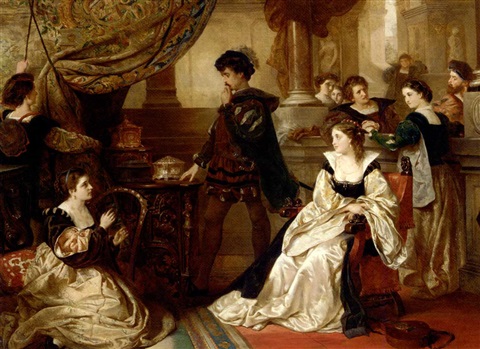
Robert Alexander-Hillingford: The Three Caskets, The Merchant Of Venice, Act III, Sceneii
Bassanio also takes a very feminist attitude towards the play’s heroine Portia- he understands that being married means making your spouse a partner, and giving her an equal say. At the beginning of the play, he sails to an island called Belmont, to try to win Portia’s hand, by correctly solving a riddle. You may have heard of the three caskets, gold, silver, and lead. If Bassanio guesses right, he wins Portia and her fortune. Bassanio chooses the correct casket, but halts afterwards, and does something unexpected; he asks Portia herself if she wants to marry him. He doesn’t treat her as his prize, and throughout the play asks her opinion, and her permission before he acts, just as a good husband should.
Fair lady, by your leave;
I come by note, to give and to receive.
Like one of two contending in a prize,
That thinks he hath done well in people’s eyes,
Hearing applause and universal shout,
Giddy in spirit, still gazing in a doubt
Whether these pearls of praise be his or no;
So, thrice fair lady, stand I, even so;
As doubtful whether what I see be true,
Until confirm’d, sign’d, ratified by you. Merchant Of Venice, Act III, Scene ii
I would argue that, although Portia is a far more important character, Bassanio is the moral center of the play. He is the only person who treats Shylock like a human being, by trying to reason with him and pay Antonio’s debt, instead of spitting in Shylock’s face like Antonio, or forcing him to convert like the characters at the end of the play. Bassanio also is one of the only characters who call Shylock by name, everyone else just calls him “Jew.” Thus, audiences and students can learn from this kind of person; the kind of person Christ said could be saved and become a true Christian, because he acknowledges his sins and tries to correct them. Bassanio is the prodigal son in this play, and we benefit from the parable of his life.
By contrast, some of the other characters, Christian and Jewish, are examples of the kind of morality that we all wish to discourage in our children, and society in general. Though they are outwardly pious, the Christians like Antonio and Portia, are capable of vindictive, cruel, and definitely impious behavior. Portia, (probably due to her sheltered life on Belmont), can be deeply racist and prejudicial. She is prejudiced against the Prince of Morocco because of his race, hoping that “All of his complexion,” will fail to win her love. In addition, when she poses as a judge presiding over the court case between Antonio and Shylock, she throws vengeance at Shylock, even though she barely knows either of them. She strips Shylock of his property and nearly gets him sentenced to death, even though she preaches mercy to him in her most famous speech. If you look at the contrast between her words and actions, she is a deeply hypocritical person. Shakespeare shows how toxic it can be to raise a child in an isolated environment. Portia’s isolation makes it harder for Portia to relate to and understand different types of people, and it planted her predjudices within her heart.
Antonio for his part, seems to define himself by how “un-Jewish” he is, believing that generosity and mercy are anathema to all Jews, particularly when Shylock confronts Antonio in the courtroom:
I pray you, think you question with the Jew:
You may as well go stand upon the beach
And bid the main flood bate his usual height;
You may as well use question with the wolf
Why he hath made the ewe bleat for the lamb;
You may as well forbid the mountain pines
To wag their high tops and to make no noise,
When they are fretten with the gusts of heaven;
You may as well do anything most hard,
As seek to soften that—than which what’s harder?—
His Jewish heart: therefore, I do beseech you,
Make no more offers, use no farther means, Merchant, Act IV, Scene i.
Although Jesus preached loving ones neighbor, and being the Good Samaritan to other religions, Antonio seems to think that being a true Christian, means being Anti-Jew. He is a counter example of piety that audiences and students can learn to mollify and avoid within themselves.
My final example of religious counter examples, Shylock himself, shows how prejudice can destroy a man if he lets it. At the beginning of the play, Shylock has had to endure losing his wife, having Antonio spit on him, mock him, encourage his enemies, and call him a host of dehuminizing names. That’s not even taking into account the horrible Venetian ghettos of the 1590s, in which Shylock would have been forced to live were he a real Venetian Jew. One quote that helps explain his behavior comes from Henry Norman Hudson in 1882:
[In Shylock] “we see the remains of a great and noble nature, out of which all the genial sap of humanity has been pressed by accumulated injuries.” – Shakespeare: His Life, Art, and Characters, H. N. Hudson, Ginn and Company, Boston, p. 291. “
Scholars and actors have emphasized ever since the end of the Second World War, that, although Shylock is still guilty of reprehensible acts, his cruelty is a reaction to the cruelty he has had to endure, or as he puts it: “The villainy you teach me, I will execute.
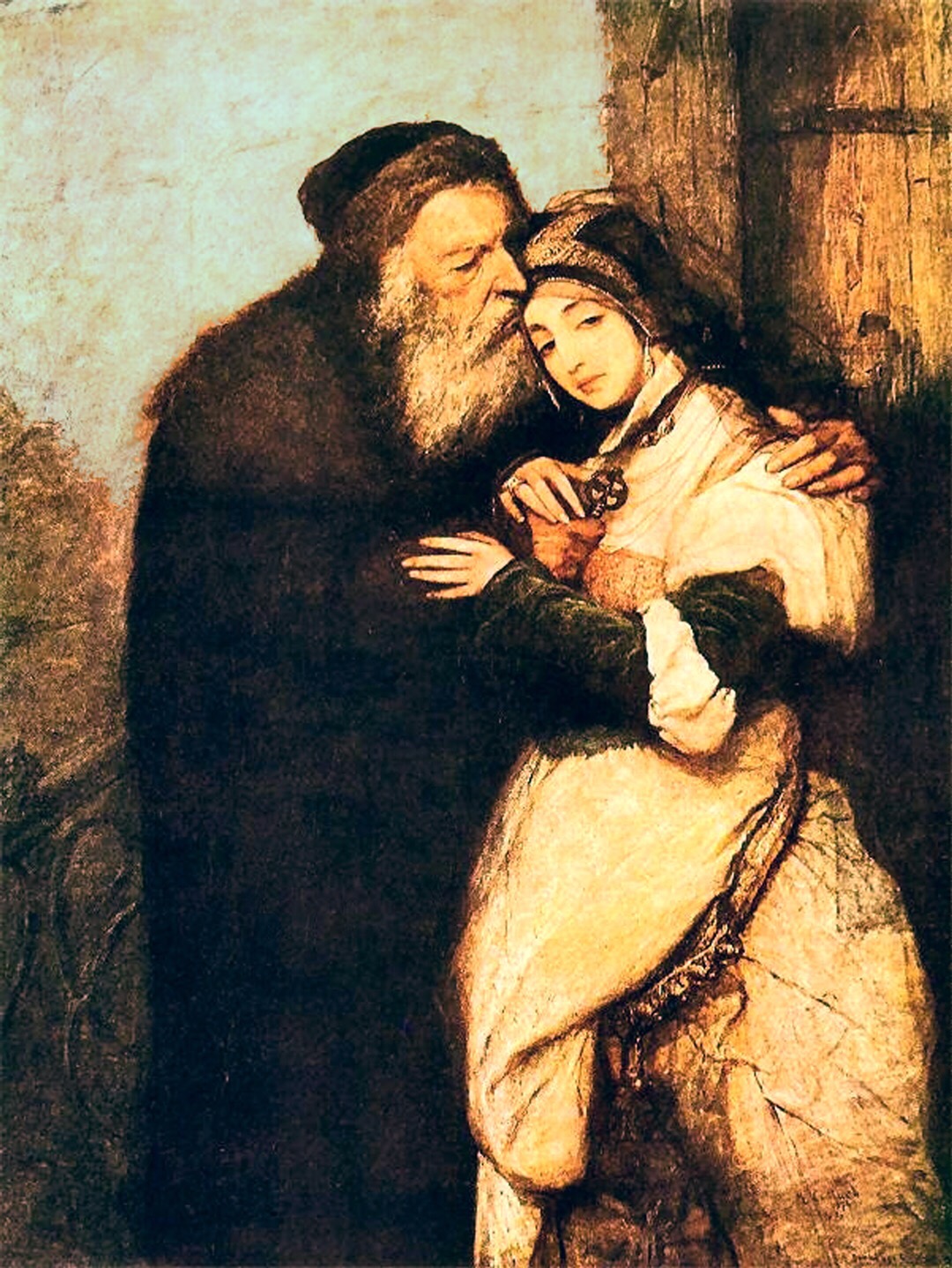
Maurycy Gottlieb: “Shylock and Jessica,” 1876
Shylock’s lack of joy and love manifests itself by the way he treats everyone in the play. He keeps his daughter locked away from anyone, which later compels her to run away with the Christian Lorenzo, (while stealing a huge amount of Shylock’s money). Shylock then rages against the citizens of Venice, especially Antonio, whom he blames for his losses, and concocts a plan to kill him by taking a pound of flesh away from his heart.
Shylock’s pain and hardships have turned him into the kind of bloodthirsty Jewish stereotype his enemies have always assumed to be. At the same time, he constantly points out the cruelty and hypocrisy of Christians, calling them no better than himself. In the end though, through Portia and the Duke sentencing Shylock to will his money to Lorenzo, and convert to Christianity, Shylock has to become what he hates, and surround himself with people who will never accept him; an ending that fills the audience with pity and maybe even remorse.
Now, there are compelling arguments that teaching this play can actually encourage stereotypes, which it can, and has in ages past. I read several articles that debate this issue in various ways. I’d like to discuss two articles written within one year of each other that are particularly fascinating. The first one was an article from The New Yorker by Professor Steven Greenblatt, who claimed that Merchant is “Shakespeare’s Cure For Xenophobia.” The other was a Washington Post article that argues that in the interest of keeping negative Jewish stereotypes from perpetuating themselves, this play should be ignored altogether.
On the other hand, as Professor Greenblatt says, the genius of the play is that it shows stereotypes, but it also shows the people under them. If you compare Shylock in The Merchant Of Venice, to other contemporary Jewish characters like Barrabas in Marlowe’s Jew Of Malta, he is a much more compelling, complete, interesting, and at times moving character. Love him or hate him, Shylock inevitably gets under your skin. He’s a man who strips the varnish off our culture and exposes the hypocrisy, greed, and prejudice that lurk just beneath the waters of the Rialto, (as well as the modern Potomac and the Hudson). The saving grace of this play is that it forces us to examine ourselves- how do we treat people, how do we see people who are different than us? What makes our points of view good and bad, and what can we do to heal our misunderstandings? Though this play cannot answer these questions, it encourages us to confront them, to open a dialogue, and hopefully, open avenues for change.
This app looks incredible, listen to this satisfied customer:
So far, the only play on the app is “The Tempest,” but hopefully if enough people buy it, it’ll expand and encompass all the plays. I hope you’ll check it out!
Hi everyone! Well, it’s nearly August, which means back to school. Everyone is looking in the stores for the latest educational gear to help young minds on the journey to knowledge. To hopefully aid your journey teachers and students, I’ve compiled some of my favorite Shakespeare apps. There are a lot of apps out there of course, and I couldn’t hope to review them all, but I had a few criteria to limit the results:
The app had to be free,
It has to be functional (educational or useful in life,)
Fun!
I also discovered that most Shakespeare apps out there seem to follow three basic categories: Shakespeare quotes, Shakespeare guides, and Shakespearean insults. Generally speaking, every app on this list is designed to either help you learn Shakespeare by showing and testing you on famous quotations, to help you engage with the text of the plays, or to just have fun making vintage Tudor insults such as: “I was looking for a fool when I found you. I desire we may be better strangers!” So here are the first five apps I am ready to recommend to students and teachers that bring the Bard into the mobile electronic age!
I. 3x The Bard–
This app is a series of quizzes on Shakespearean quotes. It gets is title because the quiz goes on and on until you make three mistakes. Just like in baseball, three strikes and you’re out! I found it fun but not functional. You don’t learn what the quotes mean, and you’re not tested on how well you can recite it, it just quizzes you on which play the quote comes from. Still, worth a look.
II. Shx at Play Two word review: very useful.
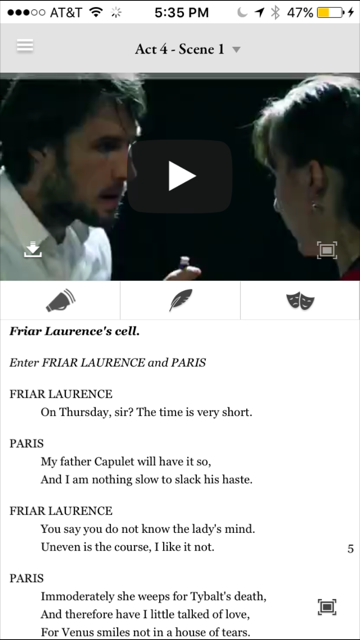
Combines the interactivity of an app, with the format of the Sourcebook Shakespeare books I mentioned in my “Which Shakespeare Edition Is Right For You” post. It features annotated texts of Shakespearean plays, videos, and a glossary. It’s really good stuff. I encourage teachers and students to use it. The only problem is that, while the plays are free, some features don’t become available until you pay to download them, but you might want to if you’re serious about studying the play.
III. Globe Theater 360
This is one of my favorite apps ever. I would call it the Pokemon Go of Shakespeare apps. As you move your phone, you get a 360 degree of Shakespeare’s Globe Theater, as if you were actually there! Even cooler, if you put your phone or tablet over the Globe Theater logo, it will make a computerized theater appear on your phone’s camera in real time, just like the creatures of Pokemon Go! Furthermore, you can click on various part of the Globe to learn about the theater, how the plays were performed, and the colorful history of Shakespeare’s Company. I think this is a must-have app for anyone interested in Shakespeare.
IV. Globe Player
Ok, I’ll be honest, this one isn’t free either, but it’s still incredible. I love that The Globe is well aware that not everyone can get out to London and see a play in Shakespeare’s re-constructed Globe theater, so they have a pay-per-view style app that allows you to watch videos of Globe Theater performances in your own home. You can also watch or stream international Shakespearean performances and documentaries right to your phone, tablet, or online at https://globeplayer.tv/
V. Genius
The best thing about this app is that you probably own it already! This is an extremely popular app for deciphering the meaning of song lyrics. Well guess what? People have also contributed commentary of some of Shakespeare’s famous speeches too! If you’re a teacher, you might consider having your class upload a Shakespearean text, and have them write line-by-line commentary to show just how well they understand it.
So that’s Part I of my look into my favorite apps Shakespearean apps, and I hope you enjoyed it. If you find any other apps you’d like me to review, leave a comment below!
Tonight I’d like to discuss some of the spookiest, most enigmatic, and above all WEIRDEST characters in Shakespeare: the Three Weird Sisters in Macbeth.
1. Who are they?
Every production has to answer who the witches are, and many have very different answers. Are they temptress? Are they evil agents controlling Macbeth?Furies trying to destroy Macbeth?
I would argue in their basic form the witches are harbingers of change. Their very name “Wyrd Sisters” refers to an old Anglo Saxon concept of fate or destiny. Whether or not they have any effect on Macbeth mind or soul, they point the finger at him and say “things are going to change for you.” Then, he either makes the choices that determine his fate, or they change his fate for him.
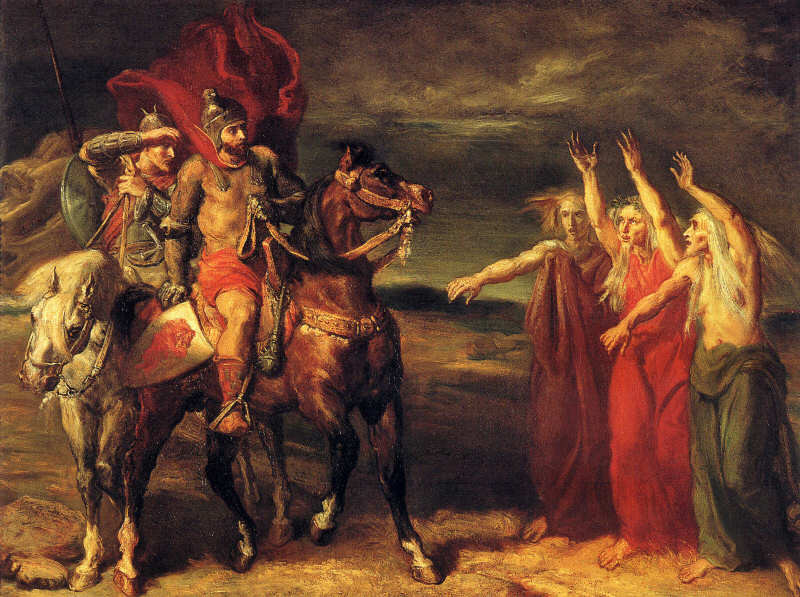
“Macbeth and Banquo First Encounter the Witches,” Théodore Chassériau, 1854.
Macbeth meets the witches on a heath, which means land that is literally out of bounds– the wild, untamed wilderness, which the old Anglo Saxons believed was the lair of many cursed spirits and monsters. This could symbolize Macbeth’ sin or transgressions, slowly turning into a murderer, usurper, and a tyrant. It could also symbolize the chaos in Macbeth’s life.
What Do They Look Like?
Shakespeare’s descriptions of the witches are highly contradictory- they seem to be floating, yet on the ground, they seem to be women, but they have beards! They don’t look Earthly, but here they are on the Earth. This gives them an other worldly quality that keeps us guessing as to who they are, and helps them tempt Macbeth more easily.
BANQUO What are these So wither’d and so wild in their attire, That look not like the inhabitants o’ the earth, And yet are on’t? Live you? or are you aught That man may question? You seem to understand me, By each at once her chappy finger laying Upon her skinny lips: you should be women, And yet your beards forbid me to interpret That you are so.
MACBETH Speak, if you can: what are you? (Act I, Scene iii).
The Witches’ Language:
You know from my earlier posts that the norm for Shakespearean characters is to speak in iambic pentameter- 10 syllable lines of unrhymed poetry that sounds like a normal heartbeat. The witches break these norms- they generally speak in Trochaic Tetrameter- 8 syllable lines with the off beat emphasized. The witches are literally offbeat, and that’s why their speeches are unsettling. Look at the contrast between a normal iambic line like:
“In sooth I know not why I am so sad.” (Merchant Of Venice I,i).
and
“Dou-ble Dou-ble, Toil and Tro-ble.
Fire burn and Caul-dren Bu-ble. (Macbeth, Act IV, Scene i).
For more info on the verse forms of the Witches, click here:
The witches also speak their prophesies in a vague, ambiguous manner They like to play with obscuring their prophesies with lines that make Macbeth think one thing, but the opposite is true. The famous example here is when they claim Macbeth will never be vanquished “until Birnam Wood comes to Dunsinane Hill.” Macbeth assumes this means he’s invincible, but it actually means that the enemy carry wood from the forrest. This is called Equivocation.
Witches and mythology
Illustration from William Blake’s “Europe a Prophecy,” 1794.
1. During the reign of King James, the modern witch hunt began; the king was fascinated with witches and even wrote a book called Daemonology on how to identify and destroy them. This was the era where people believed that witchcraft, rather than a pagan religious practice, was a forbidden craft that could only come from a pact with the devil. However, Shakespeare borrows from both Satanic and early pagan ritual in the characters of his witches.
2. Shakespeare took a couple of details about witchcraft from ancient Celtic and Greek mythology. First of all, the use of a cauldron. In Celtic myth, a cauldron is a symbol of rebirth and was sometimes used to resurrect the dead, just as the witches do in IV i. Of course, the ideal time for raising the spirits was on the feast of the pagan god Samhain, at the point where the veil between the living and dead was the thinnest. The feast took place on October 31st, our modern day Halloween!
Illustration of witches and their familiar spirits, 1647.
3. Familiar spirits In Act I, the witches speak to animal spirits called familiar spirits, which call to them and tell them where to go. King James himself wrote about how the witches found and communicated with these spirits.
Hecate.
In Act IV, Hecate, Ancient Greek goddess of magic appears. She is clearly the lord of all the witches, and is very displeased that they are riddling with Macbeth. Maybe not all witches believe in giving out prophesies that can destroy the Scottish monarchy. Hecate was always enigmatic in myths- she was born one of the Titans who opposed the gods, but frequently changed sides. More then being two faced, she was often portrayed as having three faces! Shakespeare refers to her frequently as “Triple Hecate.”
“The Triple Hecate,” by William Blake, 1794.
For more information on this mysterious goddess, consult the video below, (WARNING, ADULT-ONLY CONTENT).
In conclusion, the witches are meant to be ambiguous because the play examines the source of evil- whether it is inspired by other people, or if it comes from one’s own heart. The witches can be either or both, depending on how you want to tell the story, which is why they act and speak in contradictory ways.
Thanks for reading! If you enjoyed this posting, please consider signing up for my online class, “Macbeth: An Immersive Horror Experience.” I tell you the story of Macbeth and you get to play through an escape room, where you must solve the witches’ puzzles or be added to their Cauldron!
While I work on this week’s posts, enjoy this wonderful documentary from the series Shakespeare Uncovered, about the great Shakespeare play, hosted by Joseph Fiennes, who played Romeo and Shakespeare in the film “Shakespeare In Love.” It talks about where the play comes from, and examines why this 400 year old love story endures. For you teachers, I’ve also included a great series of lesson plans that accompany the video
In this section, I review a Shakespeare book, movie, or TV show that I feel has some kind of value, either as an interpretation of Shakespeare, or a means to learn more about the man and his writing.
Official Wallpaper from “Manga Shakespeare: Romeo and Juliet.”
Basic Details:
Name: The Manga Shakespeare: Romeo and Juliet
Media: Comic book, with accompanying website
Ages: Young adult/ Teen.
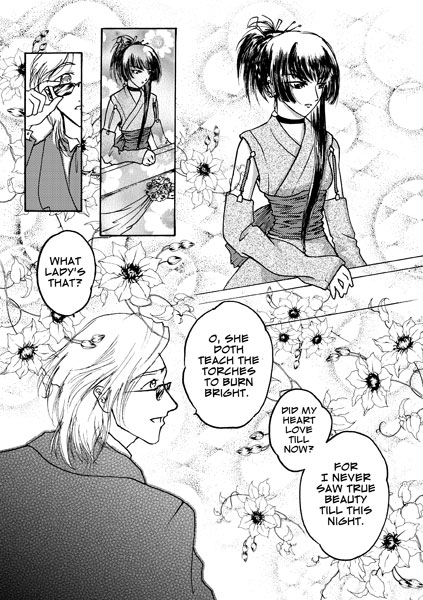
Premise: A slick, clever interpretation of Shakespeare that pares down the story and uses Japanese-inspired Manga comic book design to bring to life the violence and youthful energy of Romeo and Juliet. It transposes the story to a Tokyo suburb with two katana-wielding rival versions of the Capulets and Montegues.
Sample Images
My reaction: I think this is a very clever and very exciting way to get young people interested in Shakespeare. The pictures help bring the emotions out with great clarity and the storytelling is very condensed and clever. In addition, the website has helpful resources for Shakespeare newbie’s.
Recommendation: I’d recommend this book to all teens and high-school students and fans of Shakespeare.



 Here’s a classroom guide that you can use with your students: Othello Classroom Guide

 In her first scene as Cesario, a servant named Curio remarks to her that Orsino has shown favor to “him” from the very beginning. This might explain the rich garments that Viola wears in this production, which resemble a noble gentleman more than a servant.
 Viola, the star of the show, begins the show as the daughter of a duke, who has just been shipwrecked in a foreign country, so her clothes must look bedraggled and worn, yet appropriate to her status. As I said before though, for the majority of the play, Viola is disguised as the servant Cesario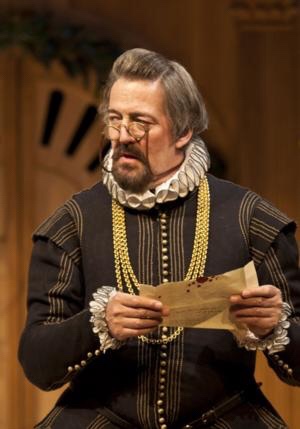














 The Shakespearean Student