
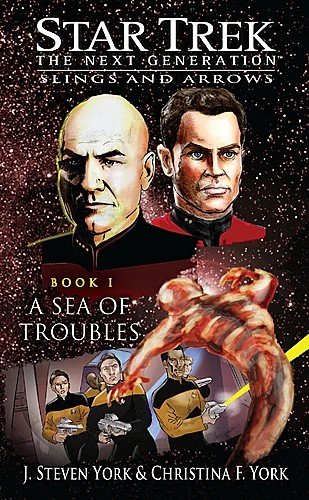
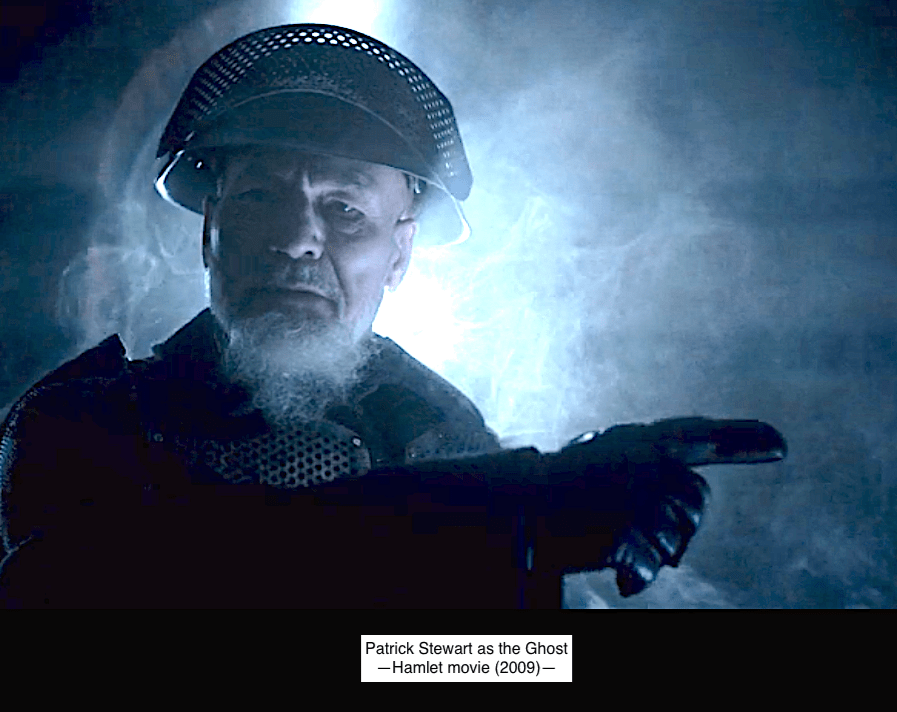
Tribute to Patrick Stewart, Part 1

I. Introduction


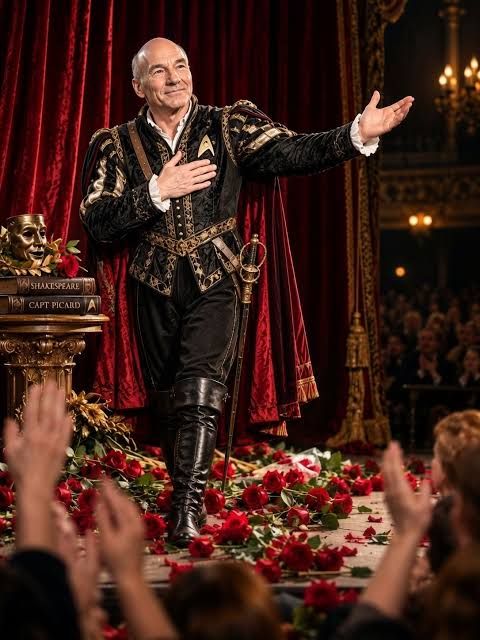
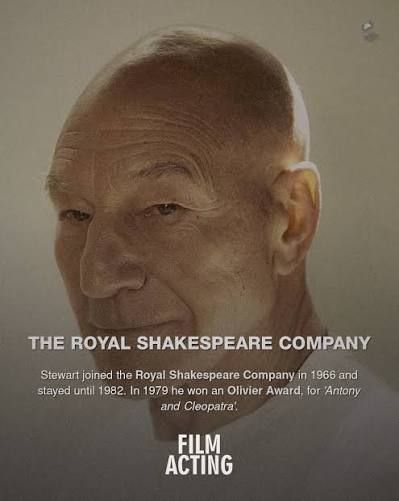
If you’re like me, you are still mourning the loss of beloved actor, Sir Patrick Stewart. Most visitors to my website know that he was more than a movie star, creator of such iconic characters as Professor X in X men and Captain Jean Luc Picard in Star Trek; he was also an accomplished Shakespearean actor. As I’ve written before, Sir Patrick was not only a great Shakespearean actor, he became an icon for Shakespearean acting, and was sort of an avatar for Shakespeare himself.

Since Sir Patrick meant so much to so many people, this tribute is only part of a series. What I want to do is start by showing you my journey of discovery- how I became acquainted with Stewart’s work, and how it helped shape my understanding of acting, Shakespeare, and the world at large.

https://docs.google.com/presentation/d/1hCl8ko_QvEojVIJXzFnUMSspRTLcS_SJ_CBPKsLrPNs/edit?usp=drivesdk

Beginnings

I was born in 1984- the year Orwell told us would be a hideous technocracy with the government observing and controlling our every move.
In 1987, Gene Roddenberry created a much more optimistic vision of the future- a future where all peoples of the Earth live in peace and harmony, united on a misison of scientific discovery across the stars. As a kid, I was too young to see Star Trek once it came out, but soon, it would become an abiding obsession in my childhood.

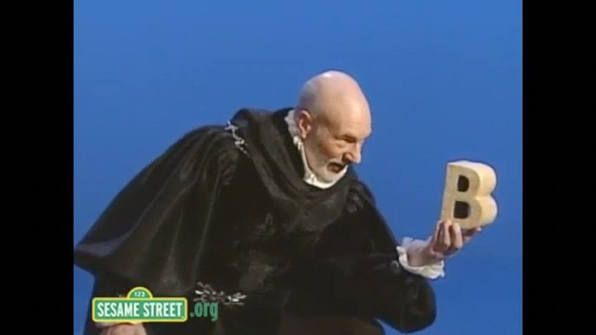
My first introduction to Sir Patrick and Star Trek came from his friend LaVar Burton. At the time, I was an avid fan of the TV show Reading Rainbow, and as a child, I saw this:

Re-Trekking The Stars
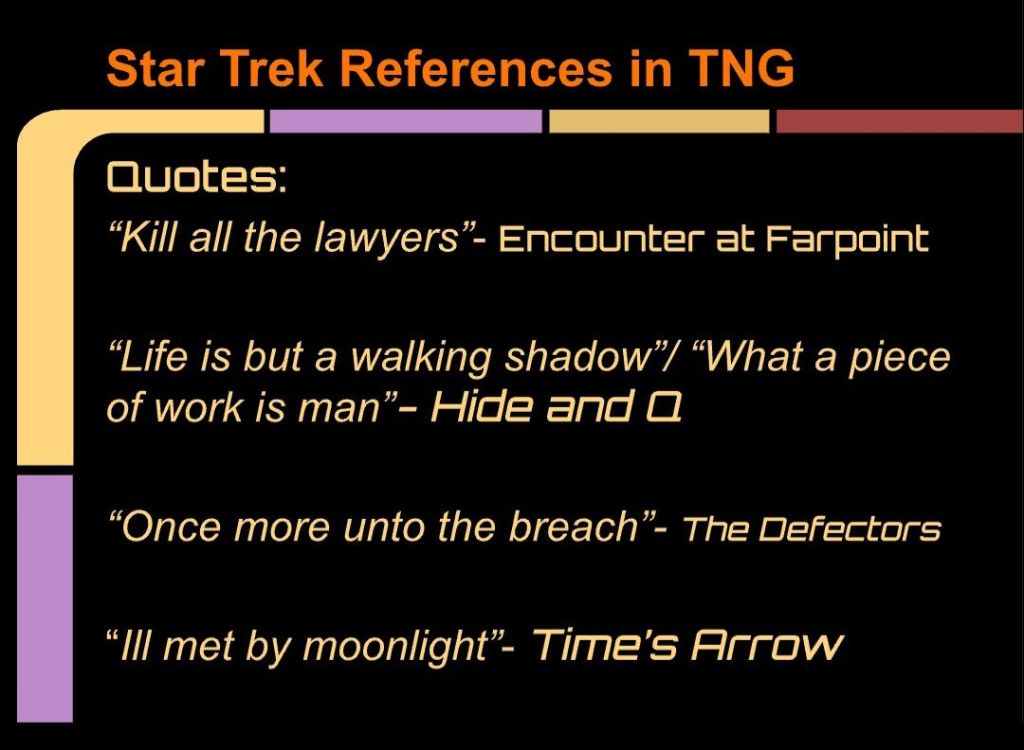
I was too young to watch much Star Trek live, but once it was syndicated, I ate it up- I watched episode after episode, (and amassed an impressive collection of toys and other merchandise). More importantly, I was beginning to understand that Shakespeare was more than a lofty dead author, he was a writer who could inspire people and be used to help them understand the world (or galaxy).

Shakespeare Moments From Star Trek

Austin Tichenor of the Reduced Shakespeare Company pointed out that, although most of us read Shakespeare in school, we don’t engage with it much (no pun intended). In school, Shakespeare is a passive experience- plots, themes, and characters are spouted at us by a teacher, and we rarely learn how to apply Shakespeare to our daily life. In the world of Star https://youtu.be/JWit15tvkBs?is=Dg7Dk0A6PA29kbo3

Q (John DeLancie) and Picard (Patrick Stewart) debate the virtues of the human race (Hide and Q, episode 10).


Commander Data’s struggle to understand humanity extends to reading and performing Shakespeare himself, as this clip shows:

Data even impersonates a Shakespearean actor playing Puck in the episode Time’s Arrow, (a preview of Spiner’s role as Puck in Gargoyles):

Clash of the Shakespearean Titans

in the two-part episode “Chain Of Command,”another veteran Shakespearean actor David Warner, captures and tortures Captain Picard!

The chilling way Warner plays Gul Madred is one of the high points of the series. He and Stewart worked before on a production of Hamlet in 1965, and the way these two play off each other is masterful. Warner is powerful, in command, dangerous, and sly. Picard never knows when he is telling the truth, and as time goes on, Madred revels in how much closer he is to breaking the pitiful human. Still, Picard in his wonderful stoicism never breaks, and briefly manages to turn the tables on Gul Madred, when he makes the mistake of opening up to Picard about how in reality, he is a scared and miserable soul, trying to fill the emptiness of his heart with power and sadistic pleasure. Again, these two actors are so powerful that all you need is them, and a dark room to create compelling drama.

2001-2007- I Wanna Act Like Pat
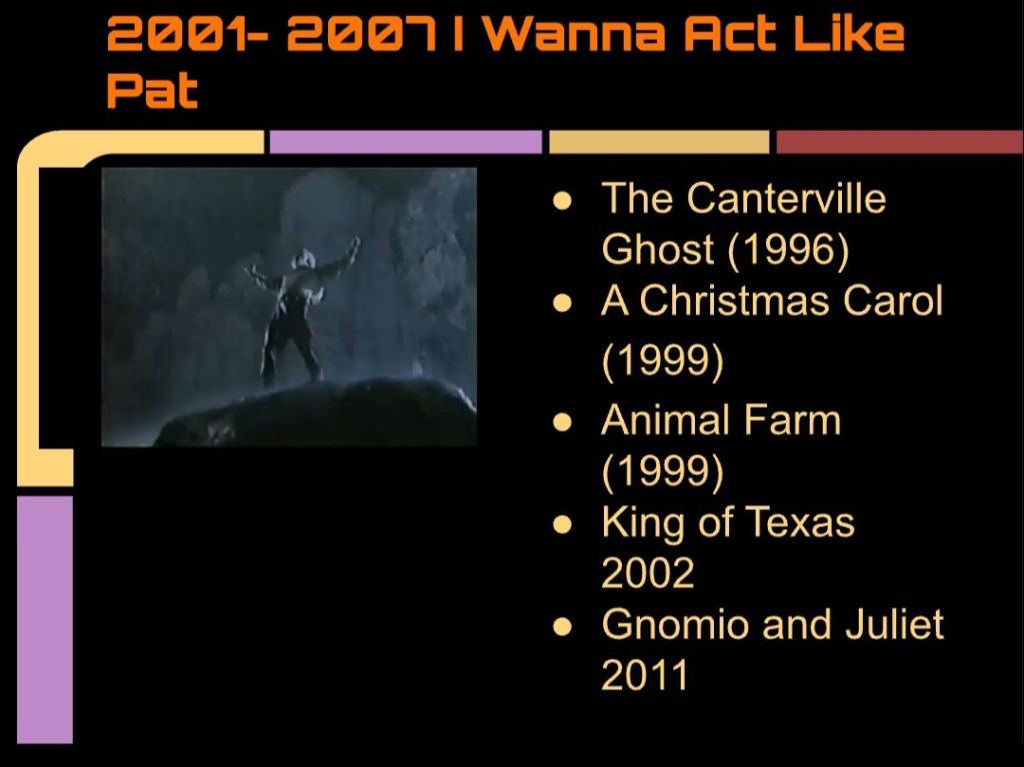
After Star Trek ended, I started seeing Sir Patrick in many Shakespeare-adjacent roles, such as the Shakespeare quoting Canterville Ghost or the King of Texas (which was itself a cowboy re-telling of King Lear). For me, these TV performances piqued my interest, and inspired me to study Shakespeare myself.

Trailer for “King Of Texas”, 2002.

Playing Shakespeare

Montage of Stewart’s most iconic Shakespearean creations

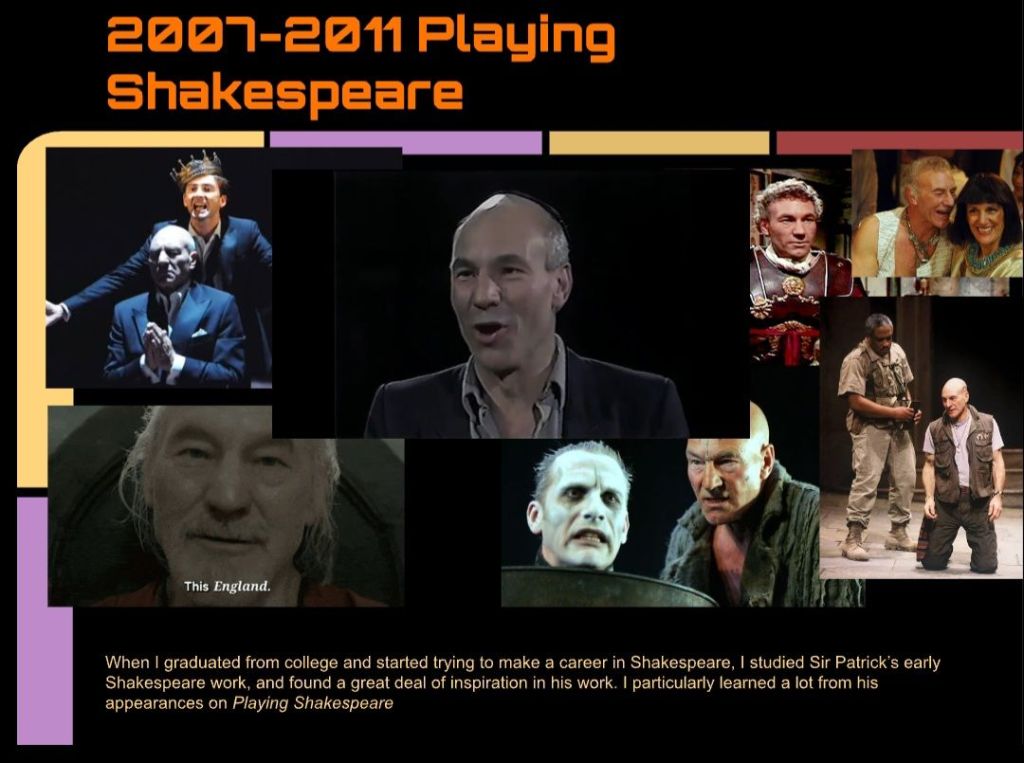
When I graduated from college and started trying to make a career in Shakespeare, I studied Sir Patrick’s early Shakespeare work, and found a great deal of inspiration in his control of the language.

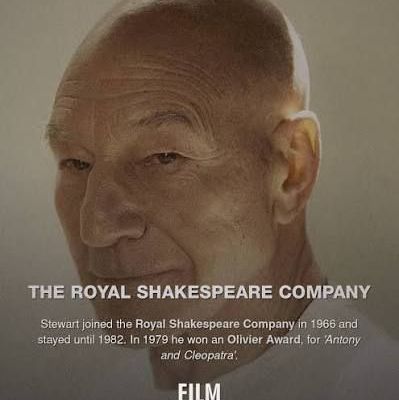
I particularly learned a lot from his appearances on Playing Shakespeare, a 1975 TV show produced by the Royal Shakespeare Company. This show is an invaluable resource for Shakespearean actors because it parts the curtain and allows the actors to get at the way they approach Shakespeare’s language.


Stewart has given so many memorable Shakespearean performances over the years, but one of my favorites was when he played Marc Antony in Antony and Cleopatra. Sir Patrick played Antony as a shadow of his former self- a drunk, foolish old man who is completely blinded to the threat Octavian poses to him. Stewart said that he based his portrayal on his own father, who was himself a soldier and an alcoholic. With this in mind, the portrayal has an uncomfortable truth to it- you see a man who is destroying himself and undoing his golden reputation.
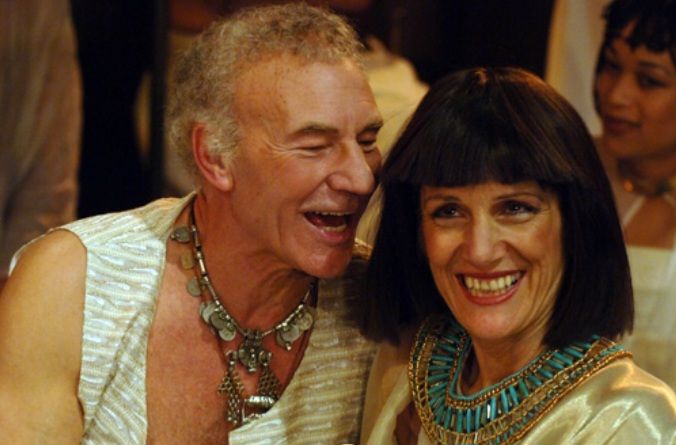
At the same time, Stewart makes us feel for him; since so many people admired Stewart (myself included), seeing him play a man who is bringing himself low, makes us all want to save him from himself. It’s the definition of catharsis.

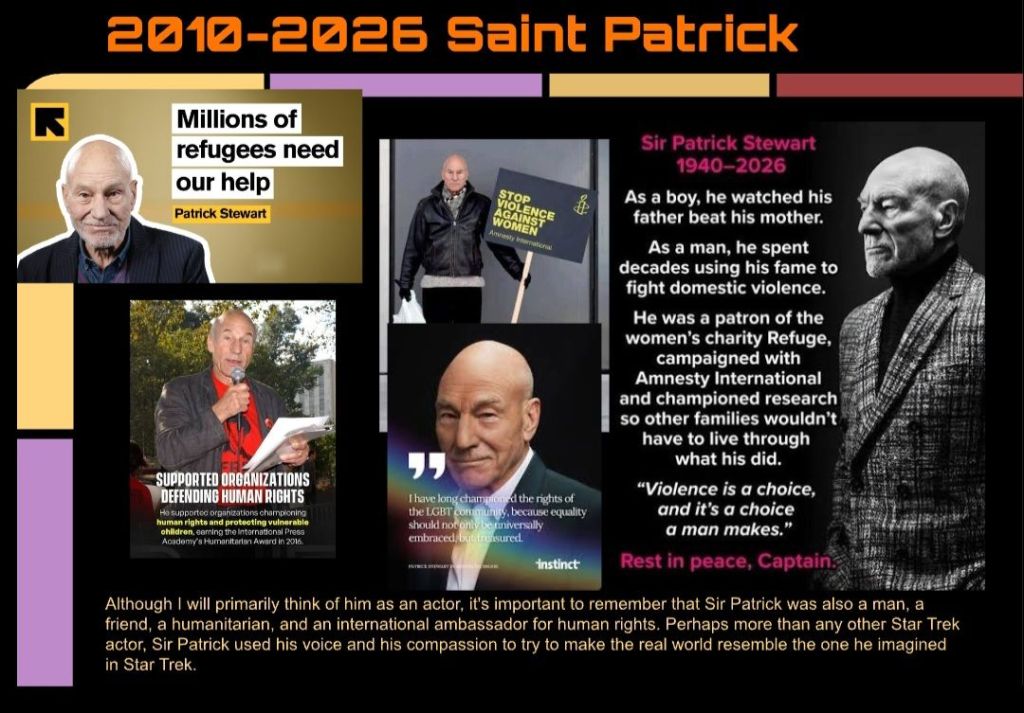
St. Patrick
Sources:

https://geekfrontiers.com/pittsburgh-history/the-1975-star-trektacular-and-twelfth-night/

http://bardfilm.blogspot.com/2008/11/discoveries-in-undiscovered-country.html
https://www.hollywoodreporter.com/movies/movie-news/christopher-plummer-was-a-diehard-trekkie-before-being-cast-in-undiscovered-country-4128612/

Shakespeare and Star Trek

Today I’ll be tracing the recurring themes and motifs that evolved from Shakespeare’s last solo play, “The Tempest,” and chart a course that explains the evolution of this play into the beloved Star Trek franchise.

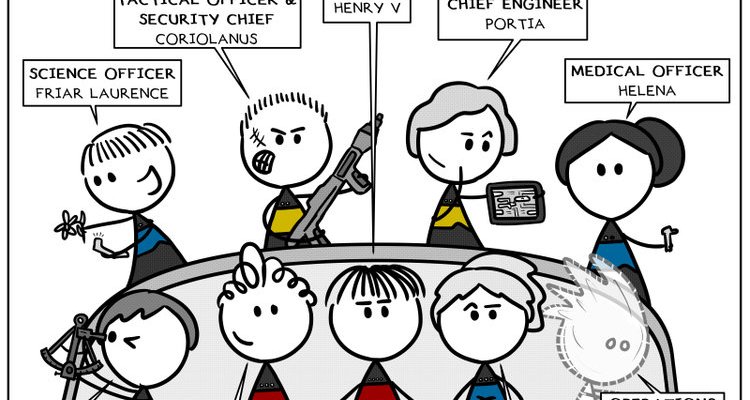
https://goodticklebrain.com/home/2019/7/11/the-crew-of-the-uss-shakespeare

The Roots of Star Trek in Shakespeare

  • Shakespeare’s The Tempest is based on a real story. As I said before, the story might have come from a traveler’s story about visiting the island of Bermuda in the early 1600s. The idea of Europeans going to an uncharted island, meeting the strange inhabitants, and ‘civilizing’ them, might have inspired Shakespeare to write the story of Prospero.
  • In addition to the Bermuda story, the age of English colonization had firmly begun at this time. The first English colony in America, Jamestown was settled in 1607, and The Tempest came out 1611.
  • At the same time, The King was worried about magic and trying to marry his daughter off to a prince.
  • Shakespeare wasn’t allowed to comment on contemporary issues, so instead of setting the play in England or even contemporary Europe, he set it on a fantastical island with spirits Prospero can control. His control becomes a metaphor for colonization. At the same time, we see a fantasy version of James’ daughter’s marriage in the romance between Ferdinand and Miranda. The motifs of discovering strange new worlds and encountering new races of people form the core of Star Trek and space-based science fiction in general, and an adaptation of The Tempest in the 1950s would set the template that the Enterprise and her crew would be built on.

“Forbidden planet”- The Tempest goes Sci-Fi

Forbidden Planet is a story about a dashing, adventurous captain, a curmudgeonly doctor, and a science officer who are from a United group of planets that peacefully searches for “brave new worlds,” and the people in them. Obviously, these characters are very similar to Captain Kirk, Dr. McCoy, and Mr. Spok, so clearly Star Trek owes its initial creation to the success of Forbidden Planet, which was a Sci-fi adaptation of the Tempest. The question then is if there is there more that we can say about the connection between Shakespeare and Star Trek.

Star Trek’s relationship with Shakespeare

The main connective tissue of Star Trek and The Tempest is the use of exotic locations and alien cultures to explore issues that were close to home. When people in 1600 went to see Hamlet Prince of Denmark they didn’t see an ancient legend of a Viking Prince as the original Amleth, written by Saxo Grammaticus; what they saw was a thoroughly modern story of a Renaissance Prince tackling theological issues that had only just been dreamt of by the English protestants; issues of predestination, issues of Calvinism, issues of the questions about the issue the existence of purgatory, etc. That would have been unheard of to the original audience of Prince Hamlet. The appeal was seeing a different place and time to retell an ancient legend that at the same time spoke to the present time of the 17th century. Star Trek does the same thing only looking to the future instead of the past.

Did any of TOS 5 year mission first contacts aliens show up in later Star  Trek episodes as Borg? - Science Fiction & Fantasy Stack Exchange

Like Star Trek, Shakespeare used exotic locations to examine issues that were universal, (no pun intended), issues that were very much for the consumption of his audience. Look at Star Trek; every alien race the Enterprise encounters is an allegory for some culture or idea on Earth, like the two-toned alien Lokai and Bele that represent segregation and racism, or the Klingons who represented the Soviet Union, or the Borg, who represent imperialism and authoritarianism, cults, and to a certain extent fascism,

In Star Trek, space-age technology was always secondary to character; it was always about fragmenting the human condition into different recognizable alien species. Through the characters of Dr. McCoy, Captain Kir, and Mr. Spok, Star Trek examines humanity through 3 distinct points of view; that of Kirk the wide-eyed Explorer, McCoy, the cynical doctor with a heart of gold, and the cold and logical Mr. Spock. As the series went on, the allegories to contemporary affairs grew more nuanced, like how in Star Trek 6, the conflict between the Federation and the Klingons represents the final days of the Soviet Union, and the fear on both sides of what a post-Cold War world would be like.

Star Trek The Next Generation: The Tempest, Reformed.

Why did the creators of Star Trek cast Patrick Stewart, the foremost Shakespearean actor of his time, to play the captain of the Enterprise? I would say it is because Shakespeare is a writer who follows some of the same tropes that Star Trek would later use, so the creators needed a Shakespearean actor to communicate these ideas to the audience.

When Star Trek: The Next Generation first came out in the mid-1980s; the lens through which we saw alien cultures changed significantly: Picard sees humanity and the universe through a sentimental lens; viewing all cultures with no concept of superiority or paternalism. Like Shakespeare, Picard sees these cultures as his own and all worthy of respect. That’s why these cultures are often drawn to him and embrace him as one of their own, such as in the episode where he literally lives the life of a man named Kamin on the now-dead planet of Katan, and becomes the only living man to pass on their stories:

Picard’s greatest antagonist Q is a warped mirror of Picard; somebody who sees humanity as a plaything but nonetheless is intrigued and fascinated by human nature:

Taken together, Picard and Q are like the two sides of Shakespeare’s Prospero in The Tempest. Simmilar to how Dr. Morbius represents Prospero’s ego in Forbidden Planet, Picard represents the superego- the part devoted to improving the lives of his crew and the aliens he helps, and who looks at each “brave new world,” he encounters with awe and respect.

Q however, is Prospero’s Id- a malevolent, cynical, vengeful man, (who like Prospero in the episode Deja Q, is actually banished from his rightful place in the Q Continuum). He torments and enslaves creatures for his own amusement and his curiosity about humanity is more morbid and sadistic than scientific or philosophical. With this in mind, it makes sense that Q has been such an enduring part of the Star Trek series since he is an essential component of the series’ psychological makeup.

Science fiction in general is about possibilities- looking at where we came from and where we are and asking questions about where we are going. Generally speaking, Shakespeare looked more to the past than the future, but his conclusions were pretty much the same- he saw “What a piece of work man is,” but also feared greatly for his survival. Star Trek takes these concepts and projects them out to the far future. Even though in the 24rth century humans have mastered space travel, eliminated poverty, and put aside petty prejudice, people are still people and the conflicts they have don’t change. What’s great about Star Trek is how well both choose to tell the eternal story of the human condition, looking before and after and making some truly profound discourse on what it means to be human. Perhaps the real final frontier is the same as the first- the human heart.