As a parent, I know it’s hard to keep kids occupied during the summer. That’s why I have classes on Shakespeare’s life, Romeo and Juliet, and my celebrated Stage Combat class! Sign up now for all the fun on Outschool.com!
Shakespeare and Star Wars
Class Description: Using self-paced online activities, your child(ren) will compare the plot and characters of Star Wars to Shakespeare’s plays. We will also discuss Shakespeare’s writing by looking at “William Shakespeare’s Star Wars” by Ian Doescher.
Romeo and Juliet Murder Mystery
Course Description: A flexible schedule class that teaches kids the plot and characters of “Romeo and Juliet,” in the context of a detective story where you solve the mystery of the young lovers’ deaths.
Course Descriptions
How to Write Like Shakespeare: Learn the basics of iambic pentameter, sonnet form, and Shakespeare’s dramatic structure, and practice writing Shakespearean speeches.
Exciting News!
Our friend Puppet Shakespeare will finally get to host a series of classes for kids!
I’m working on a Harry-Potter inspired course that teaches science with a magical flavor. I’m also working on a Shakespeare for children course. Stay Tuned!
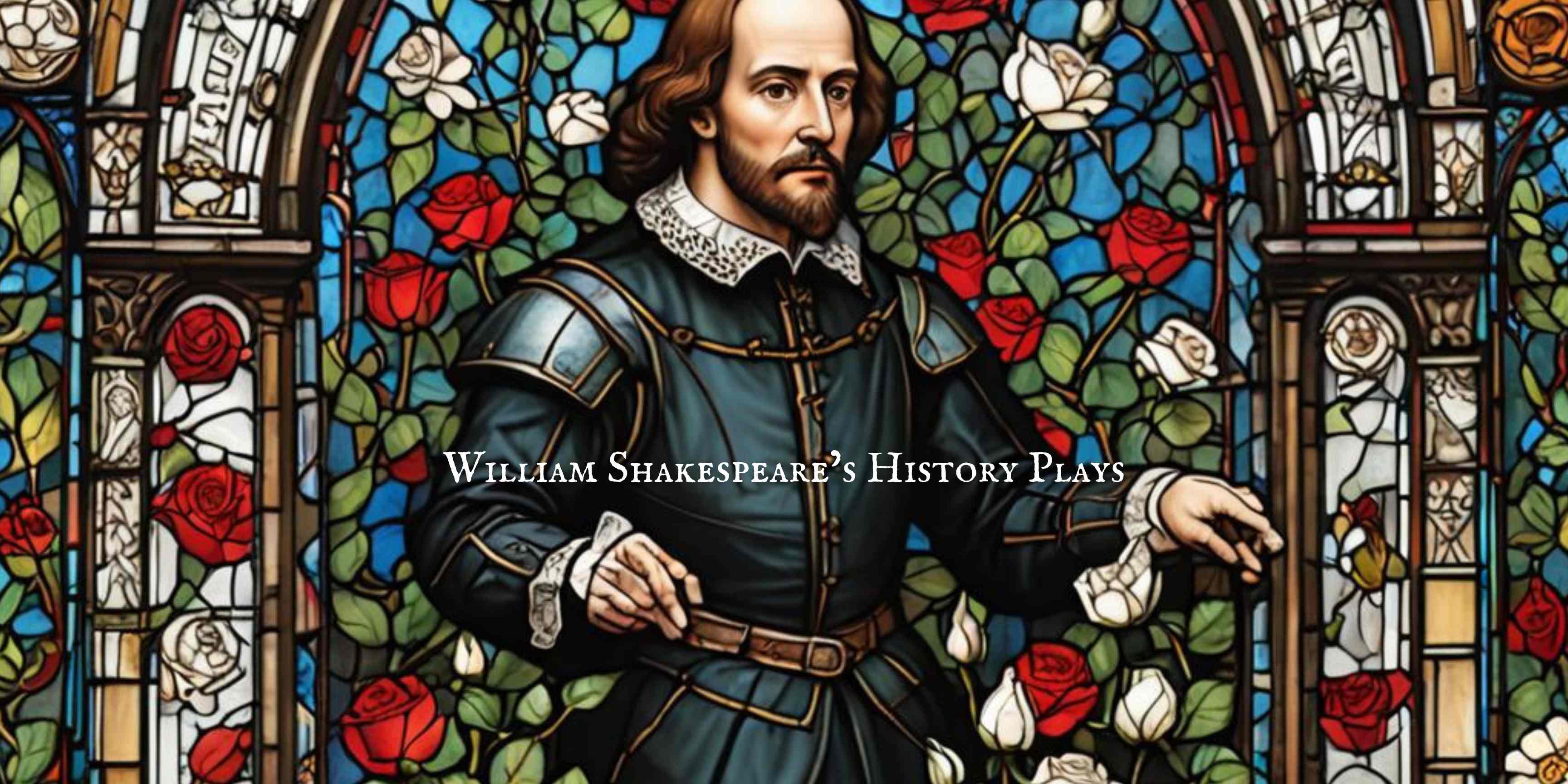
Parent Description- A fully online, fully interactive course into Shakespeare’s histories taught by a professional text coach and actor.
Students- Uncover the scandalous and gory history behind Shakespeare’s most action-packed plays! Shakespeare’s histories have inspired such works as “Empire,” “Game of Thrones,” “Hamilton” and even the “Star Wars” trilogy. This class will unlock for you why these stories of power and betrayal have been so popular for 400 years.
Format:
0. The class will have a Nearpod with slides, activities, and links to my other resources. The class will be a combination of slides, activities, and videos. Each class will have
Weekly Discussion questions via Google Forms such as: “What do you know about Shakespeare the man?” or, “Are Shakespeare plays still relevant today?”
Video Analysis- Every week I’ll discuss a different play with a short video.
I’ll provide some context, explaining what is happening in the play durin the speech, and any relevant historical context.
We’ll watch a recording and the students can write their impressions on what they like and don’t like.
Immersive activities such as:
– Shakespeare arts and crafts and recipes such as making costumes and props.
– My online Shakespeare board game.
Virtual tours of the Tower Of London,
Weekly Web Quests like “find a Shakespeare quote that you use in normal speech,” “find a movie or character that’s based on Shakespeare,” or “Draw a picture of a Shakespearean character (stick figures are acceptable).
6 Week Course
Week 1 – Why Hamilton is Like A Shakespeare History Play Hamilton and Shakespearean History We’ll discuss what makes a history play a history play, why they were so popular in Shakespeare’s day, and draw parallels between Shakespeare and the Broadway Musical “Hamilton.”
What is a history play?
Song quest: Watch the Horrible histories king song
Worksheet- which Shakespearean character reminds you most of Hamilton?
What would you call the tone of this speech? Patriotic? Mournful? Excited? Bitter?
The deposition Scene (video- 3 minutes)
The danger of this scene:
Though Queen Elizabeth I is now almost universally beloved, she wasn’t always in Shakespeare’s time. By 1601, she was 68 years old and had no male heir. Her government had also failed to put down a rebellion in Ireland. Some people in her government were getting restless.
Robert Devereaux, Earl of Essex was one of those restless nobles. He’d been one of the Queen’s favorites, but after failing to crush the rebellion in Ireland, his relationship with her sourered. He then plotted to rebel against the Queen, and take the throne for himself.
To do that though, Essex would need to get people on his side, so he recruited Shakespeare! One of Essex’s servants paid Shakespeare’s companies to perform a scene from Shakespeare’s Richard II; the scene where a handsome and charismatic nobleman convinces the king to willingly give up his power.
This scene was so dangerous that when the play was published, it was taken out by Elizabeth’s censors.
Playing Richard video: Fiona Shaw Questions What does making Richard female emphasize for an audience? What point does Shaw’s performance say about women in power?
Week 3 Henry V week
Tom Hiddleston as Henry V
Basic plot- Young king fights a war and conquers France proving himself to the world.
Olivier vs. Branaugh
-Concept- what if the play was a Hockey movie?
Henry is like the coach or team captain who gives inspirational speeches
The underdogs win
The snooty bad guys lose
How this translates to staging fights/ directing the characters (website/ youtube interviews)
Activity= write a trailer or design a poster for Henry with a cool tag line.
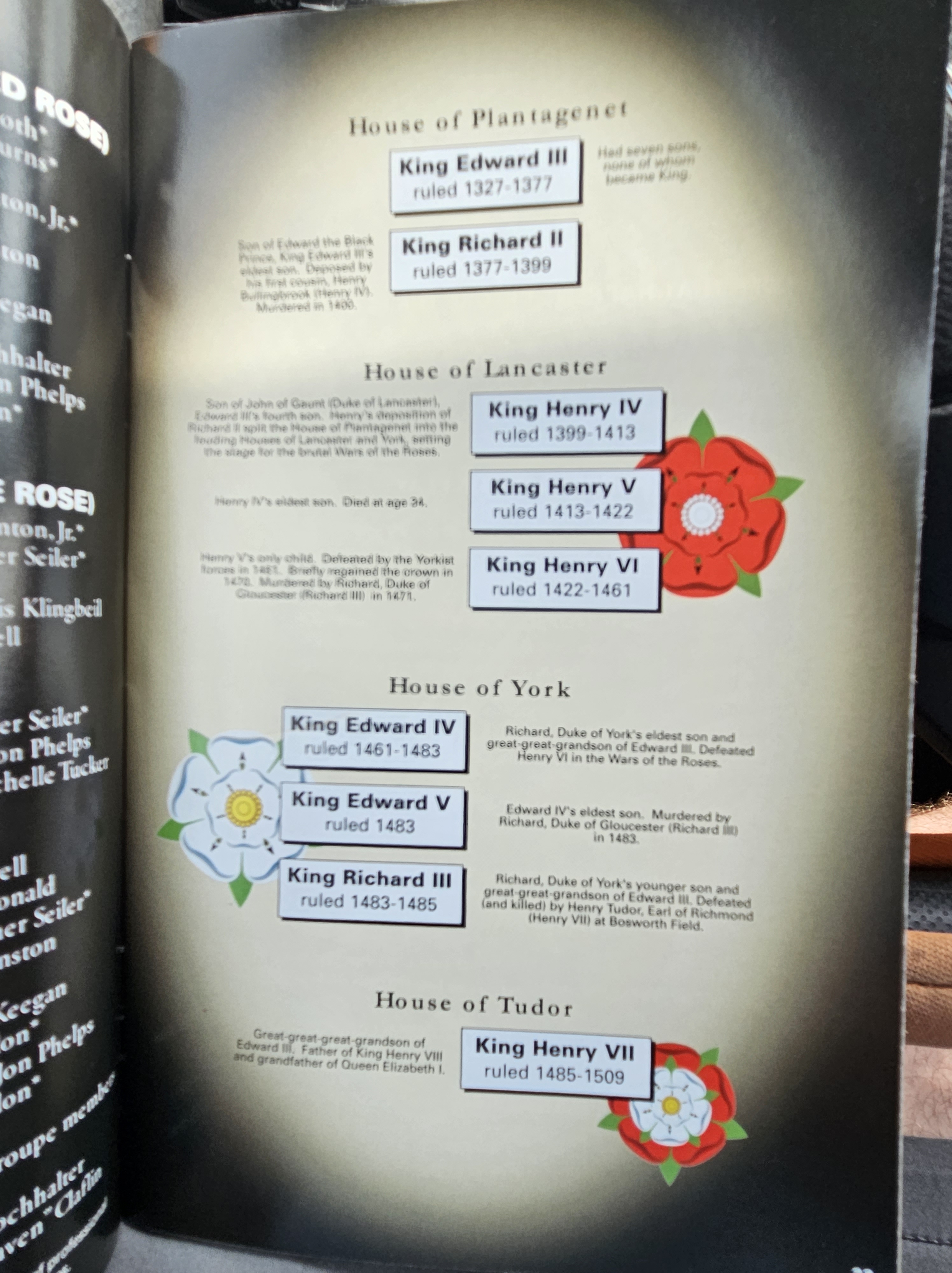
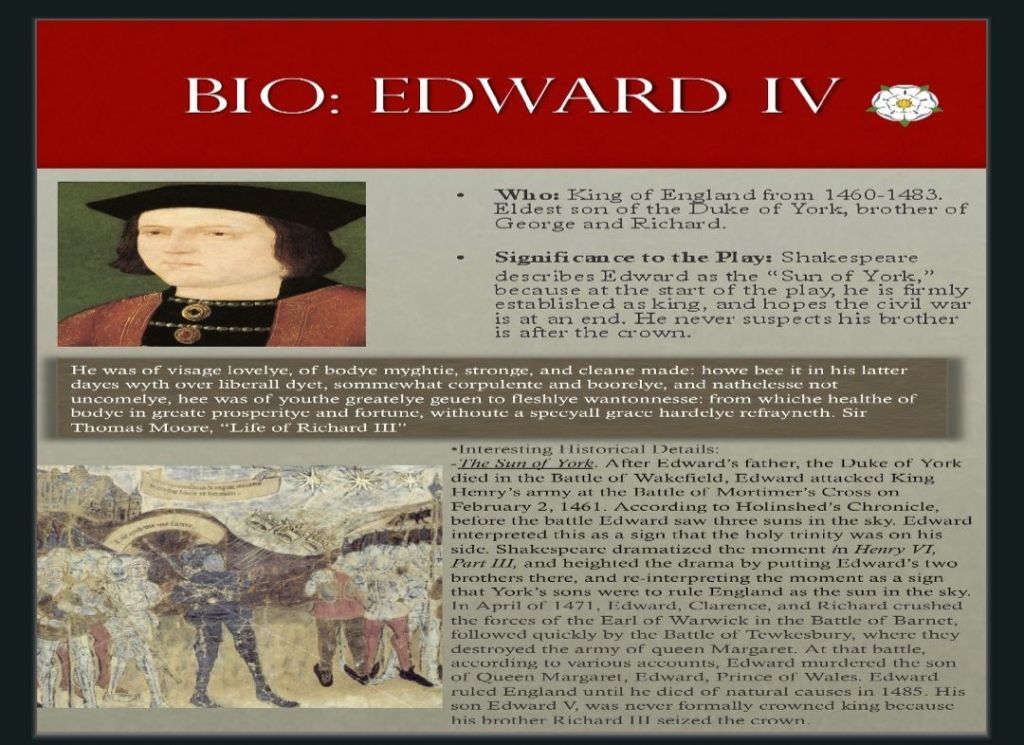
Week 4- The Wars of the Roses-
Summary of the three Henry VI plays
Wars of the Roses Horrible Histories
Web quest- research one major character from the 3H6 ASC website:
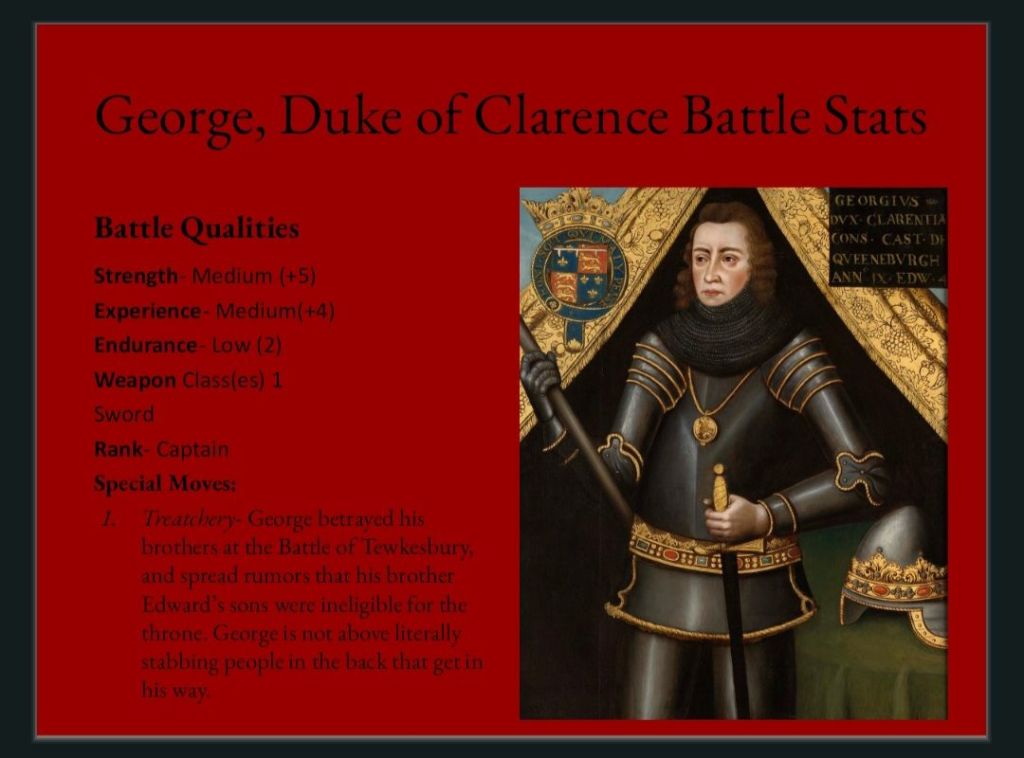
Richard of Gloucester
Henry VI
Margaret of Anjou
Richard of York
Medieval warfare
Watch one of the Weapons that Made Brittain videos and answer 5 questions.
The battles of the Wars of the roses
Costumes
Week 5- Richard III- The rise of the corrupt king
Close reading- “Now Is the Winter of Our Discontent”
Slides on Richard’s plot.
Richard and Machiavelli
Richard and Emperor Palpatine
Richard and Modern Leaders
Richard vs. the Amir of Gloucester
Propaganda activity- make a campaign slogan/ poster for Richard.
Using self-paced online activities, your child(ren) will compare the plot and characters of Star Wars to Shakespeare’s plays. We will also discuss Shakespeare writing by looking at “William Shakespeare’s Star Wars” by Ian Doescher.
Course Description
Concept: To compare and contrast the plot, characters, themes, and language of Shakespeare’s plays with Star Wars
Student Description:
Epic battles, quests for revenge, pirates, funny characters, powerful warriors swinging swords. Star Wars has something for everyone. But did you know that in many ways, Star Wars is based on the ideas and writings of William Shakespeare? In this course we’ll peer beneath the veil of Shakespeare and Star Wars to find the universal stories of love, revenge, power, and growing up, using games, artwork, and dramatic readings by professional actors!
Did you know that Star Wars is based on the ideas and writings of William Shakespeare? This class will teach you about writing and characters though games, interactive activities and dramatic readings of both Star Wars and Shakespeare!
Course organization (the class is divided into 6 parts that students can complete at their own pace over a week-long period.
What parts of the Star Wars story are like Shakespeare’s plays?
Are Shakespeare and the Star Wars movies saying anything similar about war? Families? Growing up?
Lesson Objectives
To teach about the characters and plot of Star Wars by comparing them to Star Wars
To introduce the concept of archetypes, tropes,
Set the Scene
Star Wars is about an evil empire trying to take over the galaxy. They have more ships, more soldiers, and a fearsome weapon that can blow up planets. The rebels on the other hand, though fewer in number, are faster, smarter, and have the advantage of fighting for a good cause.
In addition, the story is about growing up- Luke becomes a Jedi Knight. He takes revenge on the man who destroyed his father.
The Players (slides)
Luke
Obi Wan/ Yoda
Vader
Leia
Han
R2D2 and C3PO
The Emperor
Words Words Words
Epic
Parody
Theme
Plot
Archetype
Character
Trope
Theme
Class 2: The Journey of Han and Leia
Han and Leia vs. Beatrice and Benedick
Show videos of Han before Leia
Plot summary of Much Ado
Clips of the bickering of Benedick and Beatrice
Read blog and look at the writing.
Activity- how would you write a love letter to Han or Leia?
Play the scene from Jedi
Unit 2- The Prequels and Shakespeare’s Histories
A Crash Course in Shakespeare’s Histories
The Rise of Palpatine/ Richard III
Emperor Palpatine in Star Wars rises to power through a combination of manipulation, intimidation, and by killing his opponents.
Bio of Richard III
Slide- Richard’s rise to power
Slide- Palpatine’s rise to power
Quizlet
Unit 3- The Verse of William Shakespeare’s Star Wars by Ian Doescher
What is William Shakespeare’s Star Wars
Introduce the plays
Explain how Shakespeare’s verse works
Look at the common verse elements
Sonnets
Show the chorus of “Verily a New Hope”
It is a period of civil war. The spaceships of the rebels, striking swift From base unseen, have gain’d a vict’ry o’er The cruel Galactic Empire, now adrift. Amidst the battle, rebel spies prevail’d And stole the plans to a space station vast,Whose pow’rful beams will later be unveil’d And crush a planet: ’tis the DEATH STAR blast. Pursu’d by agents sinister and cold,Now Princess Leia to her home doth flee, Deliv’ring plans and a new hope they hold:Of bringing freedom to the galaxy .In time so long ago begins our play,In star-crossed galaxy far, far away
Stychomichia
Half lines
Enjambment
Title Crawl (make a gif via Canva)
Side By Side Comparisons
Read/ watch segments of the play
To Be Or Not To Be
All the World’s a Stage
St. Crispin’s Day Speech
Try to turn a Star Wars line into verse, and then look at the reveal.
Unit 4- Literary Devices of William Shakespeare’s Star Wars
Using the educational guide, we’ll learn about the following literary devices:
Extended Metaphors (Luke’s green lightsaber)
Anaphora (Luke’s call to action in Jedi)
Premonatory Dreams (Calpurnia)
Stichomythia Richard III vs. Han and Leia
Unit5- The Hero’s Journey of Luke Skywalker
Class 1: What is a Hero’s Journey (Slides)
Learn a little about Joseph Campbell’s monomyth. using the Percy Jackson post, Crash course video about monomyth
Chart Luke’s monomyth journey
Activity- Mad libs- write a star wars movie!
Quiz on plot elements from the monomyth (Quizzes or Quizlet)
Class 2 : Hamlet and Luke Skywalker
Plot comparison
(use infographic)
Quote from Doescher:
Hamlet The Tragedy of Hamlet, Prince of Denmark is Shakespeare’s most famous play. It’s also the play I make the most references to in William Shakespeare’s Star Wars.
To Be Or Not to Be
Use my video about the speech to explain the structure
Note how Doescher repurpuses every line in the Star Wars Trilogy:
Sometimes it expresses fear:
Sometimes concern:
Frustration: “The whips and scorns of time”
Hope: “The undiscovered galaxy” “Tis a consummation devoutly to be wished.”
Activity: write your own paraphrase of Hamlet’s speech, using the 6 beats I provided.
For the final class of my course on Shakespeare’s Tragedies, I’m coaching two young actors on a pair of tragic speeches I’ve selected, and I thought I’d share some of that work with you. The first is a speech by Lady Macbeth that comes from Act I, Scene v, which I discussed in another post. But today, I’m going to talk about the second one, Iago’s soliloquy in Act II, Scene iii.
The Text
Iago. And what’s he then that says I play the villain? When this advice is free I give and honest, Probal to thinking and indeed the course1490 To win the Moor again? For ’tis most easy The inclining Desdemona to subdue In any honest suit: she’s framed as fruitful As the free elements. And then for her To win the Moor—were’t to renounce his baptism,1495 All seals and symbols of redeemed sin, His soul is so enfetter’d to her love, That she may make, unmake, do what she list, Even as her appetite shall play the god With his weak function. How am I then a villain1500 To counsel Cassio to this parallel course, Directly to his good? Divinity of hell! When devils will the blackest sins put on, They do suggest at first with heavenly shows, As I do now: for whiles this honest fool1505 Plies Desdemona to repair his fortunes And she for him pleads strongly to the Moor, I’ll pour this pestilence into his ear, That she repeals him for her body’s lust; And by how much she strives to do him good,1510 She shall undo her credit with the Moor. So will I turn her virtue into pitch, And out of her own goodness make the net That shall enmesh them all. Othello, Act II, Scene iii Lines 1488- 1513.
The Given Circumstances
Iago has begun his plan to humiliate Cassio and destroy Othello and Desdemona by getting Cassio drunk and sending Roderigo to fight with him. Alone in soliloquy, Iago explains how his advice to Cassio, to ask Desdemona to plead Othello on his behalf, is in reality the pin that will set off an explosion of distrust and pain for all of them:
Traditional Interpretations
Slide from my course on Shakespeare’s tragedies. Outschool, 2022
Iago poisons Othello’s mind by deceiving him into thinking his wife is unfaithful. He also manipulates the lusts and prejudices of those around him. These actions, coupled with a number of passages where he brings up Satanic or hellish imagery, are why many productions portray Iago as if he were The Devil himself, and explain his hatred for Othello as nothing more than desire to do evil for its own sakee; what the poet Colridge called: “Motiveless malignity.”
It is true that Iago speaks and acts like The Devil through the course of the play, but that doesn’t mean he thinks like a devil. Any actor will tell you that ‘motive-less malignity,’ is impossible to play. An actor has to construct a reason for why his character behaves this way. Below are some interviews and quotes from great Iagos who explain how they justified Iago’s evil and tried their best to find the man within the monster.
Iago is an easy part to bring off and rarely fails to impress. I am not the first to realise that there is no need to act the underlying falsity of the man rather to play “honest Iago” on all occasions. “Do not smile or sneer or glower — try to impress even the audience with your sincerity”: Edwin Booth. As Iago confides the truth to the audience (as always in Shakespeare), they are privy to his deceit and the gulling of Roderigo, Cassio, Desdemona and Othello himself. It is an unfair advantage and early on Willard accused me of trying to get the audience on my side against him. I explained that I didn’t need to try — Shakespeare had organised it that the villain’s part should be the audience’s portal into the action. The history of the play records many more serious misunderstandings between the Moor and his Ancient.
Iago loves to turn holy things on their head, and he revels in it with phrases like: “Divninity of Hell,”
“Do and Undo” and the notion of turning virtue into pitch, a substance that defiles what it touches.
Puns, Assonence, and Alliteration
In this speech especially, Iago likes to play with similar-sounding words “Fool” and “Fortune,” as well as sounds within those words like “Plied/Plead” and “Pour/Moor.” Iago’s soliloquy shows off that his ability to manipulate language as well as his ability to manipulate people.
Iago. And what's he then,
That saies I play the Villaine?
When this aduise is free I giue, and honest,
Proball to thinking, and indeed the course
To win the Moore againe.
For 'tis most easie
Th'inclyning Desdemona to subdue
In any honest Suite. She's fram'd as fruitefull
As the free Elements. And then for her
To win the Moore, were to renownce his Baptisme,
All Seales, and Simbols of redeemed sin:
His Soule is so enfetter'd to her Loue,
That she may make, vnmake, do what she list,
Euen as her Appetite shall play the God,
With his weake Function. How am I then a Villaine,
To Counsell Cassio to this paralell course,
Directly to his good? Diuinitie of hell,
When diuels will the blackest sinnes put on,
They do suggest at first with heauenly shewes,
As I do now. For whiles this honest Foole
Plies Desdemona, to repaire his Fortune,
And she for him, pleades strongly to the Moore,
Ile powre this pestilence into his eare:
That she repeales him, for her bodies Lust'
And by how much she striues to do him good,
She shall vndo her Credite with the Moore.
So will I turne her vertue into pitch,
And out of her owne goodnesse make the Net,
That shall en-mash them all. First Folio Transcription from Internet Shakespeare Editions
For the first 13 lines, Iago’s verse is uneven and has a lot of run on lines. It almost seems like he’s speaking in prose, which is to say, that he is speaking from his mind, but not his heart. Then, right at the line: “Divinity of Hell,” the tone changes, the verse is slower and more deliberate. Now Iago is letting his real feelings out- his narcisism, his sadistic glee, his mysogyny and his utter hatred of everyone in the play.
Questions to consider
Again, what is the real reason Iago hates Othello? Jealousy? Lust? Envy?
How does Iago feel about this plot? Does it give him pleasure? Pain? What will destroying Othello accomplish for him?
Our Interpretation
The Moor, howbeit that I endure him not, Is of a constant, loving, noble nature,1090 And I dare think he’ll prove to Desdemona A most dear husband. Now, I do love her too; Not out of absolute lust, though peradventure I stand accountant for as great a sin,
In this interpretation, I believe Iago really actually loves Desdemona and hates Othello for taking her away from him. His unrequited love also manifests itself as a bitter hatred toward her. In our culture, men who love women but are unable to possess them are demeaned and mocked with terms like ‘simp,’ ‘incel,’ ‘loser,’ or even ‘cuck.’ With this in mind, I think Iago’s devilish imagery is based on being denied love. Like Lucifer, I feel Iago lost paradise when he lost Desdemona, and now hates everyone who takes her away from him, including himself.
I’m beyond excited that I am able to offer three multiple week courses through Outschool for kids aged 6-12. If you scan the QR code below, you can see class descriptions and individual trailers. You can also check out the “My classes,” Page on this blog. I hope you and your family will join me this summer!
Outschool.com will be honoring the contributions of Shakespeare during the very first Shakespeare Week on March 21-27th.
course image: Immersive Guide To Romeo and JulietCourse image: Intro To Stage Combat
Course image: Shakespearean Acting Course image: The Violent Rhetoric Of Julius Caesar Course image: Basics of Shakespearean ActingCourse image: Immersive Guide To Macbeth course image: How to Write Like Shakespeare course image: Intro to Shakespeare
I’m honored to take part in this celebration, and I’m offering several aclasses which relate to Shakespeare in an engaging way. Here’s the schedule below:
If you want to sign up for one of my classes, please visit my Outschool page:
I’m very proud to announce that just in time for Valentines’ Day, I’m offering a course of classes about Shakespeare’s most popular play about love. The play will include fight choreography, dramatic readings, games, escape rooms, and an activity where the students create their own Shakespearean insults!
Course Description:
We’ll engage with the play with thoughtful discussion.
You’ll go on a virtual tour to the Globe Theater!
You’ll play detective and solve a Shakespearean murder!
Instead of just reading the play "Romeo and Juliet," this class will actively delve into the world of the play through a combination of lectures, dramatic readings, virtual field trips, online quizzes and activities, and finally, a digital escape room to test the student's knowledge of the play and its ideas. Each class is ala carte, meaning that once you take one class, you choose whether to stop at one class or continue onwards. Each class will delve into a different theme, literary device, and historical concept in the play:
Class Structure:
Class 1: Why Read Romeo and Juliet?
- The teacher will decode the Prologue of Romeo and Juliet and tell the basic story of the play
- We will explain dramatic irony through looking at the prologue,
- The teacher will explain why Shakespeare used poetry in the play, instead of just writing in common prose
- We will discuss why we still read Shakespeare and Romeo and Juliet in particular.

Class 2: Foils and Fights
- The learner will learn about the culture of dueling and sword fighting that was rampant in the 17th century.
- The teacher will explain and the learner will learn to recognize character foils in the play like Romeo and Friar Laurence
- We will cover the topic of antithesis- how opposite imagery permeates the play.
- We will discuss figurative language through insults and the students will have a contest to see who can craft the best Elizabethan insults!

Class 3: Acts 1& 2- The Language of Love and Hate
- We will recap how insults work- hyperbole and metaphor used to make someone seem the worst, the smallest, the ugliest, the dumbest, etc.
- We'll examine passages from Act II that show how these techniques apply to wooing and expressing love through metaphor, hyperbole, and allusions.
- The teacher will explain what a sonnet is and how Shakespeare uses them repeatedly in "Romeo and Juliet"
- We will discuss staging the famous Balcony Scene of Romeo and Juliet and ask if it's possible to do so in a virtual environment.

Class 3:  Act 3 fighting 💪 swordplay and plague imagery
The teacher will explain the plot structure of Elizabethan tragedies and explain that Act III is the climax of the play.
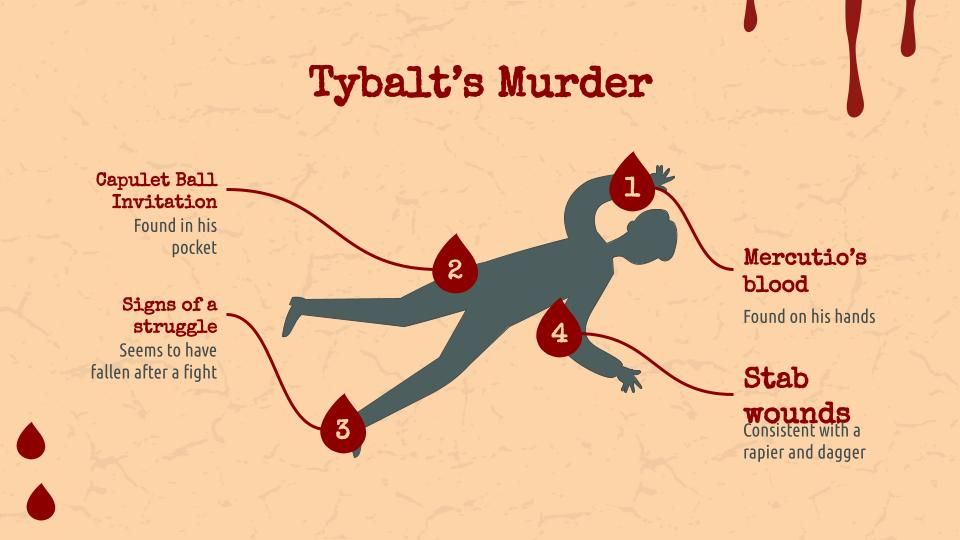
We will recap  the events that led to the deaths of Mercutio and Tybalt
The teacher will unpack Mercutio’s famous curse "A plague on both your houses," which is a foreshadowing, and the climax of the action.
The class will end with a short, safe demonstration of stage fighting where the students may choose to enact Mercutio's fight with Tybalt and/ or Romeo's fight with Tybalt.

Class 4: Act 4 antithesis and dramatic irony
We will talk about the imagery in Act IV, scene 1, which foreshadows the end of the play. I will also do a dramatic re-enactment of Juliet's soliloquy in Act IV,
We'll go on a virtual field trip to an Elizabethan wedding.
The teacher will historical context of the black death and its relevance to the play and Shakespeare's life.

Class 5: The final curtain
We will discuss Act V of the play and how so many forces seemed to be out of Romeo and Juliet's control, pushing them apart. We will also discuss whether or not Friar Laurence should be punished for encouraging Romeo and Juliet to disobey their parents.

Class 6: Performance then and Now
The teacher will perform in character as William Shakespeare, and teach the students how to act like real Elizabethan actors. This will include a virtual tour of the Globe Theater, a virtual costume fitting, stage fighting lessons, and DIY Elizabethan crafts. The teacher will then engage the class by discussing different adaptations, sequels, and spin-offs of Romeo and Juliet, in order to illustrate how popular and long-lasting this story is. The students will watch and discuss clips from various movies, plays, and ballets based on Romeo and Juliet. The instructor will conclude by sharing his own experience acting in Romeo and Juliet three times as The Prince, Friar Laurence, and Peter.

Class 7:
Final project- CSI ROMEO AND JULIET STYLE
The class will play the role of a detective trying to solve the mystery of Juliet's death in Act IV, (when she actually takes the sleeping potion). (S)he doesn't know what happened but must piece together clues hidden in a digital escape room, such as handwritten notes, blog posts, receipts from "The Apothecary," etc. The clues will not only test the student's knowledge of the play, but their understanding of metaphor, verse, Elizabethan history, and more! In the end, the Detective will be the one who tells Lord and Lady Capulet the true story of what happened to Juliet. To unlock the digital escape room, the students will decode messages hidden in the clues and enter them into a Google Form.
First course runs from February 2nd to March 19th, 7PM EST. If you can’t make it to this section, I can schedule one for you.

























 The Shakespearean Student