The Child is locked within that room, alack!
Too high to fly and the doors are far too thick
Perhaps this console I can disarm or hack
O Fate! Thou play'st upon me yet another trick.
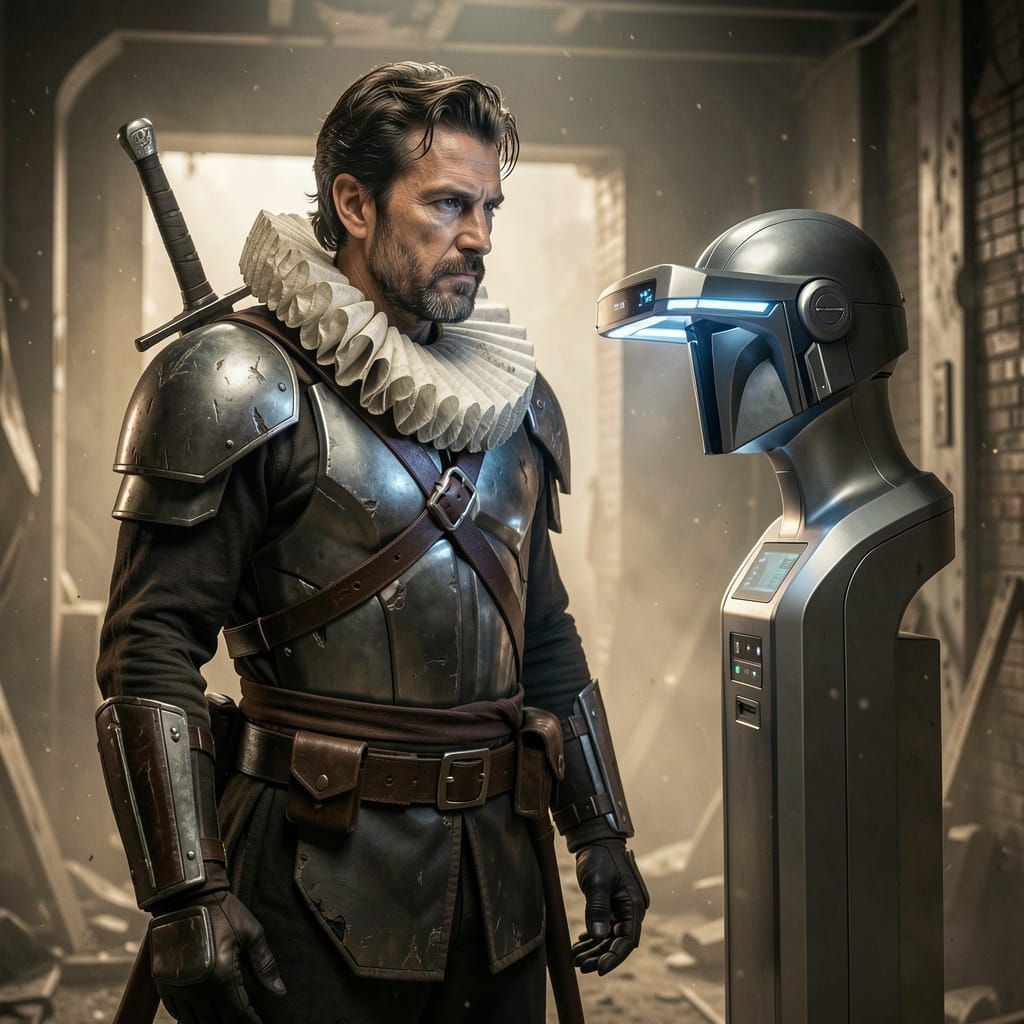
To enter I must show this Droid my face
A thing most vile, against my holy creed.
Methinks I hear The Armorer's voice 'cross space:
"This is the way of Mandalore, take heed."
This is MY WAY, MY QUEST, MY SACRIFICE
Behold my face, thou cold and lifeless sentry.
A few seconds shame should thee suffice
Open the gate! Let me have present entry!

Strange, up to now, my face hath been my mystery
My Grogu's life is far more dear to me.
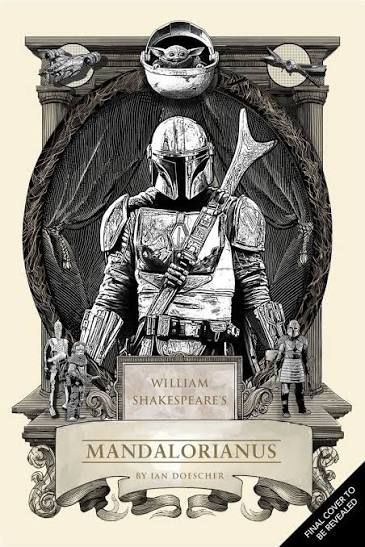
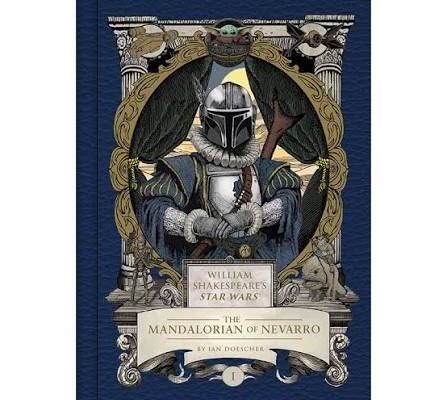
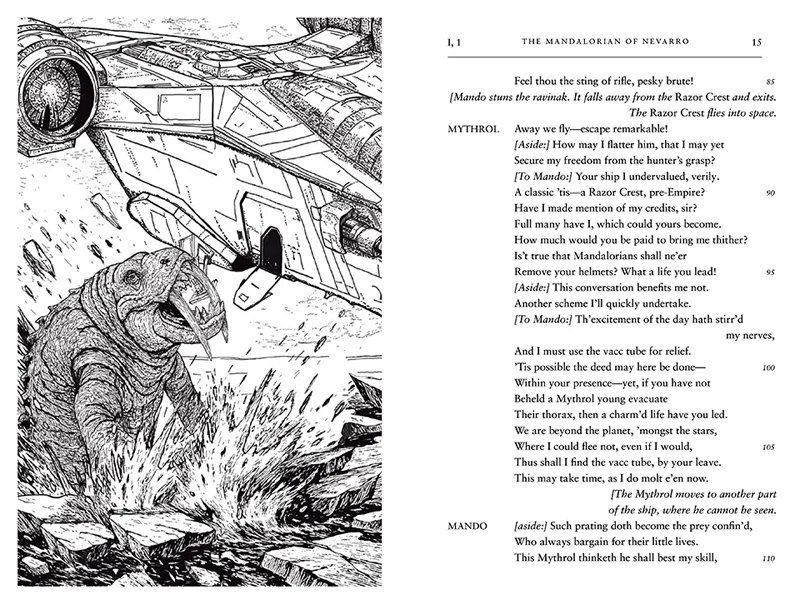
With the upcoming release of The Mandalorian and Grogo, I knew there would be lots of tie-in Star Wars merchandise capitalizing on it. What I didn’t expect, was that, after a six year hiatus, playwright Ian Doescher has once again taken up his quills and lightsabers to dramatize the next installment in the Shakespearean Star Wars cannon, The Mandalorian of Nevarro.
What Is William Shakespeare’s Star Wars?
William Shakespeare’s Star Wars is a series of parody plays written by Ian Doescher that takes the prose screenplays of the Star Wars story and transforms them into Elizabethan verse. Last time, I mentioned how much I loved the cheeky references to Shakespeare and Star Wars, and how Doescher adapts the cinematic quality into Elizabethan drama very well. In my podcast, I also emphasized the way Doescher gives each character verbose Shakespearan language that works very well for radio and theater:
I’ve written reviews about Mr Doescher’s versions of the original trilogy, but I never expected him to cover the Disney Plus shows, bit he proved me wrong, and by all accounts, this edition lives up to its predecessors.
Interview with Ian Doescher about “The Mandalorian of Nevarro”
What We Know
I haven’t gotten a copy yet of the full play, so this will be less of a review and more of a prediction and a fun speculation about how Mr Doescher will handle everyone’s favorite green foster child and Beskar- clad dad.
When your main character is, quite frankly, one of the most non-theatrical Star Wars protagonists in existence, forcing that character to come out of his shell and give him that Shakespearean flair was always going to be a test. – Nate Manning, Star Wars News.net
The Mandalorian of Nevarro is a two part series that, like the other William Shakespeare’s Star Wars books, adapts the prose text of episodes 1-4 into Shakespeare’s verse. According to Wookiepedia, the series was originally titled Mandalorius, which is probably a pun on Shakespeare’s play Coriolanus
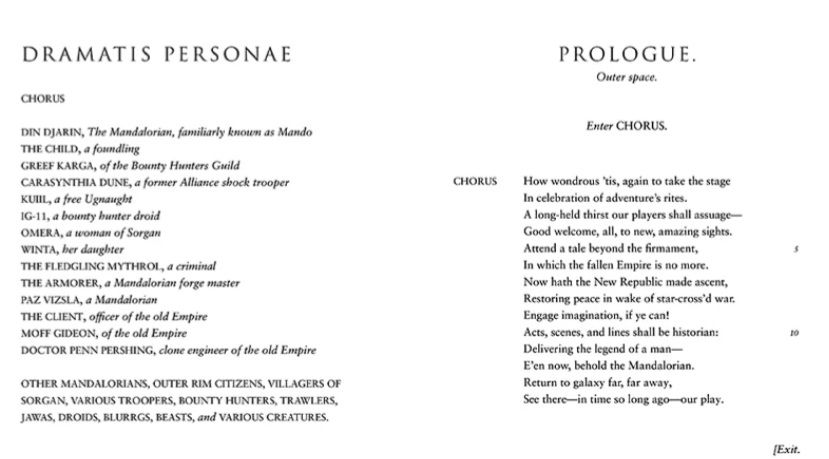
Prologue and Dramatis Personae for “The Mandalorian of Nevarro”
What We Can Guess
One thing I am very curious about is how far Doescher adapted Coriolanus for Mandolorian. As you might have read in my review for Coriolanus, one reason why the play isn’t as popular as some of Shakespeare’s other tragedies is simply that its hero is not very compelling. Coriolanus is not as articulate or wise as Hamlet, nor does his journey form a cohesive arc like Macbeth or Othello. He seems to flit between loving Rome and hating it, between peace and war, with little agency or understanding of what is happening to him, and even less insight. He is mainly a maddeningly inscrutable man, almost as if he was wearing a mask.
With all this in mind, I can honestly understand why Doescher might choose the Roman general Caius Martius Coriolanus as a model for Jinn Jaran, (assuming that the final play does in fact do so). Like Coriolanus, Mando is a lone warrior in a fragile republic, who goes from planet to planet with nothing but his ship, and his rigid code of behavior to guide him. Therefore it makes total sense that Doescher would use Coriolanus as a model to emulate when adapting The Mandalorian.
With all due respect to Shakespeare, what makes Mando a more interesting character from Coriolanus us that he has a compelling Arc. He starts as a solitary bounty hunter to a surrogate father who finds meaning when he adopts a child. It’s like his helmet and armor are metaphors for the uncaring, uncompromising person he was. Over the course of the series, as Mando becomes a better man and a better father, he is forced to remove his armor and form real relationships.
What I Hope
I hope this adaptation uses Shakespeare’s ability to conjure images and feelings when telling Mando’s story, but only time will tell.