

literature
My Top 10 Favorite Shakespeare/ Star Wars Actors

This list is not about skill or the talent of the actor. This is to honor the contributions of Shakespearean actors who also appeared in one of my favorite film series of all time: Star Wars
#10: Daisy Ridley
I should say at the outset, that I am judging these actors for their cumulative contributions to Shakespeare, so unfortunately that means the older actors have an advantage. This is very apparent with Daisy Ridley here. She has a fantastic voice and her acting is top-notch, so I have absolutely no doubt that if she chooses, she could become the next Helena Bonham Carter in a few decades. But for now, her most notable Shakespearean contribution is this film, Ophelia, which is a retelling of Hamlet, from the perspective of his long-suffering girlfriend:
#9: Ewan McGreggor

The Scottish actor, (and in my opinion, best part of the prequels), is a multi-talented star of stage and screen. Ewan actually complained that the script for Episode I was: “Not exactly Shakespeare.” He first came to prominence on stage playing Mark Renton in the dark comedy Trainspotting (whom he also played for the film). Like Daisy Ridley, however, aside from playing Iago to Chiwetel Ejiofor’s Othello, McGreggor hasn’t done much Shakespeare… at least for now.
#8: Andy Serkis
We normally associate the English actor Andy Serkis with physical acting and motion capture, after his roles as Snoke in Last Jedi, Caesar in Planet of the Apes, Kong in King Kong, and of course, Gollum in Lord of the Rings. However, before he became a one-man advocate for the art of motion capture, Mr. Serkis toured in a number of Shakespeare productions including The Winter’s Tale, King Lear (as the Fool), and like Ewan McGregor, Mr. Serkis has played the role of Iago (fitting for a man who played a treacherous hobbit, consumed by unnatural desire). The breadth of his film, theater, and digital work is why I placed him this high on the list.
#7: Peter Cushing
Most fans of Peter Cushing think of him as a horror icon, playing multiple roles for the famous Hammer Studios, with his classic portrayals of Dr. Frankenstein, Dr. Van Helsing in Dracula, and Sherlock Holmes among others. However, Mr. Cushing has a place in Shakespearean history for his performance in Laurence Olivier’s Hamlet, playing OSRIC! I kind of lost my mind when I realized that Cushing isn’t playing the Ghost, or the smiling, damned Claudius, or even the fiery Laertes, but Osric, the foppish sycophant who sucks up so hard to Hamlet, that the prince convinces him that it’s hot, and cold at the same time! Goes to show you how much range Cushing had, (even before he rose from the dead in Rogue One). He truly was, “Charming, to the last.”
#6 Christopher LEe
Like his longtime friend, Peter Cushing, Christopher Lee was also a horror star at the Hammer Studio, and his performances as Dracula are the stuff of legend. With his powerful deep voice, I was not surprised to learn Lee was a trained Shakespearean actor, and he was also in Olivier’s Hamlet, though as an uncredited spear-carrier. By the way, to those people who criticized his swordplay in Attack Of the Clones, I offer this contrary evidence:
#5 Max Von Sydow
The Sweedish-born actor is less known for Star Wars than for his classic roles in The Exorcist, Minority Report, Judge Dredd, and others, but he was in Force Awakens, so he still counts.
I wanted to talk about him here because Von Sydow has given many performances in Shakespeare and Shakespeare adjacent movies. First off, he played the Claudius figure in the atrocious Canadian Hamlet ‘comedy’ Strange Brew, one of the worst movies I’ve ever seen, but Von Sydow’s performance is one of the few watchable parts of the film.
More importantly, Von Sydow has specialized in playing wise, sage-like characters who stare into brave new worlds. First off, in Star Wars, he was the catalyst that helped start the rebellion against the First Order in The Force Awakens.
Von Sydow previously played a powerful sage as Shakespeare’s Prospero at the Old Vic in London in 1988, directed by Jonathan Miller:
‘Miller … used a mixed cast made up of white actors as the humans and black actors playing the spirits and creatures of the island. According to Michael Billington, “von Sydow’s Prospero became a white overlord manipulating a mutinous black Caliban and a collaborative Ariel keenly mimicking the gestures of the island’s invaders. The colonial metaphor was pushed through to its logical conclusion so that finally Ariel gathered up the pieces of Prospero’s abandoned staff and, watched by awe-struck tribesmen, fitted them back together to hold his wand of office aloft before an immobilized Caliban. The Tempest suddenly acquired a new political dimension unforeseen by Shakespeare’. Source: http://bufvc.ac.uk/shakespeare/index.php/title/av70946
In addition to playing Prospero onstage, Von Sydow has influenced many stage and screen productions of Hamlet due to his iconic portrayal of the knight Antonius Block in Ingmar Bergman’s The Seventh Seal:
The whole movie is sort of a Hamlet spin-off, in that the title character has seen the pain and suffering of the world and is pondering the meaning of life, while constantly aware that Death is watching him and waiting to take him. The gothic atmosphere has influenced hundreds of productions from Olivier to Zefirelli. The film has even inspired parodies like Bill and Ted’s Bogus Journey, and Last Action Hero, which of course is a deconstruction of the action movie genre that acknowledges that its roots lie in Hamlet:
Arguably what Bergmen and Von Sydow did with “Seventh Seal” was outline the courses of action that Hamlet considers in “To Be Or Not To Be,” namely whether to sit inactive, or to actively choose murder. Action heroes are basically men who deal with the fear of death, by inflicting death on ‘bad guys,’ yet however they try, Death gets them all in the end. Even Luke Skywalker, who escapes death many times, and begs his father and his master Yoda not to die, cannot change the inevitability of death.
#4: Julian Glover

One of the smaller bit part actors in Star Wars is actually a very distinguished Shakespearean actor. Julian Glover, who played General Maximillian Veers in The Empire Strikes Back, (and later played Walter Donovan in Indiana Jones), spent many years at the Royal Shakespeare Company, and turned out some wonderful performances. If you watch this clip from the documentary In Search Of Shakespeare, you can see him perform as King Lear, and the Ghost of Hamlet’s Father.
#3: Sir Alec Guinness
https://www.theguardian.com/news/2000/aug/07/guardianobituaries.filmnews
To be honest, I don’t care much for Alec Guinness’ acting. He has a great presence and a subtle but clear delivery, (what do you expect for someone whose name is an anagram for “Genuine Class)? That said, I feel he’s never having any fun in his roles. It might also surprise you to learn that he didn’t like playing his most famous role:
ir Alec Guinness regretted playing Obi-Wan Kenobi in the original Star Wars trilogy. He called the dialogue “lamentable.” n fact, in his autobiography, he recounted a story in which a fan asked for an autograph and told Guinness that he had seen Star Wars more than 100 times. Guinness claims he gave the autograph on the condition that the fan never watch the movie again.
Buzzfeed- “6 Actors Who Regretted Taking A Role And 6 More Who Regretted NOT Taking One”


Even though I don’t enjoy Sir Alec Guinness in Star Wars or in Shakespeare, for the purposes of this list, he has done decades of work on stage and he has helped shaped modern Shakespearean acting, (for good or ill). But, don’t take my word for it, judge for yourself:
#2: Ian McDiarmid
Not only is this actor essential to the Star Wars universe, playing the diabolical Emperor Palpatine, Ian McDiarmid has made an indelible impression on the world of Shakespeare. He’s appeared onstage as Shylock, Timon Of Athens, and many others. He also served as Artistic Director for the Almeida Theater in England, helping to stage many other high profile productions of Shakespeare and other plays.
My favorite performance of his though, has got to be as the Porter in Trevor Nunn’s Macbeth. Since McDiarmid is actually Scottish, he was allowed to use his natural accent. He’s funny as the drunken comic relief, but there’s a wicked gleam in his eye. After seeing him as Palpitine, I wondered if he was actually Satan, coming up from Hell to greet King Duncan (since Macbeth is murdering him upstairs). Perhaps this is the real Devilish porter, ready to carry away the king’s soul. What do you think?
#1: James Earl Jones
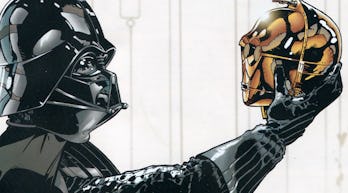
You probably saw this coming. Maybe this is some cultural bias since I’m American, but James Earl Jones is the pinnacle of American Shakespeareans, and we owe a lot to him and he himself owes a lot of his career to Shakespeare. Jones’ first ever film role in Stanley Kubrick’s Dr. Strangelove, came about after he and George C. Scott were both acting in “The Merchant Of Venice.” Kubrick saw the show and hired them both (Source: The Wall Street Journal).
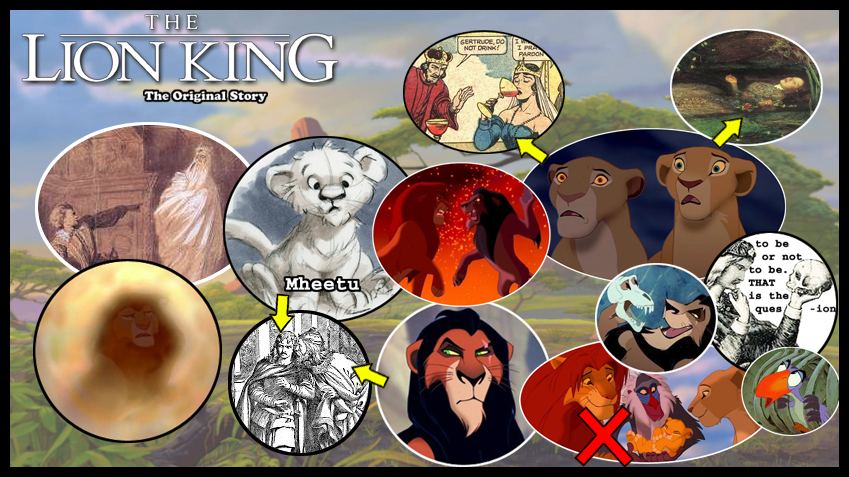
Since then, in addition to playing the voice of one of the most iconic villains of all time, (and the lion equivalent of Hamlet’s father), Jones has become one of the most beloved and acclaimed actors of our day, and his Shakespeare work is truly incredible. If you watch the documentary above, Mr. Jones talks about how he created his performances as King Lear and Othello, which were truly magnificent. In my opinion, James Earl Jones gave the best performance as Lear in the 2nd half of the 20th century, and his Othello was one for the ages.
Not only has his work onstage advanced the craft of acting, Jones has freely shared his knowledge and experience at colleges and universities around the country, including my own. I heard him talk plainly but eloquently about Shakespeare’s characters, his approach to race, and his insight into the plays that could only come from many years inhabiting some of Shakespeare’s most iconic characters. If you ever read this Mr. Jones, Thank you for being an inspiration on film, on stage, and in the classroom!
It’s not hard to see why so many actors have been drawn to Shakespeare and Star Wars. They are both drawn from epic myths that examine what it means to be human, to be part of a family, and to fight for what we believe in. Every actor on this list used their experience with Shakespeare to help bring these iconic Star Wars characters to life, and today I honor their contributions to The Great Globe, and A Galaxy Far Far Away.
Happy Teacher Appreciation Week!

Greetings Teachers!
As an educator, I am in awe of all the hard work teachers do. They do more than just educate, they maintain discipline, nurture young minds, foster curiosity, volunteer, inspire, and give hours of their time, money, and passion.
I’ve tried to make this blog a resource for teachers as well as students and since I know a lot of you have testing to do, you probably could use some quick, simple activities and lesson plans to get your class past the fourth quarter and on to the finish line! So first, here’s a bunch of my resources and lesson plans that you’re welcome to use as you will:
- My top 10 Shakespeare apps: My Top Ten Shakespearean Apps For Teachers and Students, Part 1 and My Top Ten Shakespearean Apps For Teachers and Students, Part 2
- My Macbeth Digital Escape Room: Activities for Students and Teachers: Macbeth Escape Room
- My Shakespeare Website (useful for web quests) Resources for Teachers and Students: A Visit To Elizabethan London
- Activities For Students and Teachers: “The Comedy Of Errors.”
- Activities For Teachers and Students: Mock Trial of Romeo and Juliet
- Activities For Students and Teachers: A Midsummer Night’s Dream
Also, please check out my reviews of Shakespeare movies to decide which ones are good for your class (More on that later).
Finally, here are some words of encouragement from Shakespeare himself:
O, let my books be then the eloquence
And dumb presagers of my speaking breast,
Who plead for love and look for recompense
More than that tongue that more hath more express’d.
O, learn to read what silent love hath writ:
To hear with eyes belongs to love’s fine wit.
— Sonnet 23

The Shakespeare Authorship Controversy and Conspiracy Theories

“There is a tendency for us to view Shakespeare as this unquestionable monolithic genius. But there is also in us all that iconoclast that wants to tear him off his pillar or plinth.”
–Dr. Katrina Marchant

There are few things that will drive a Shaespeaeran scholar more skull-shatteringly livid than when someone asks them if Shakespeare wrote the plays attributed to him. There are dozens of YouTube rants, bile-dripping academic papers, tinfoil-hat Tweets, and of course, centuries of anti-academic book bashing and counter-bashing research on the subject. So I won’t try to settle this debate, but I think the debate itself is worth looking at.

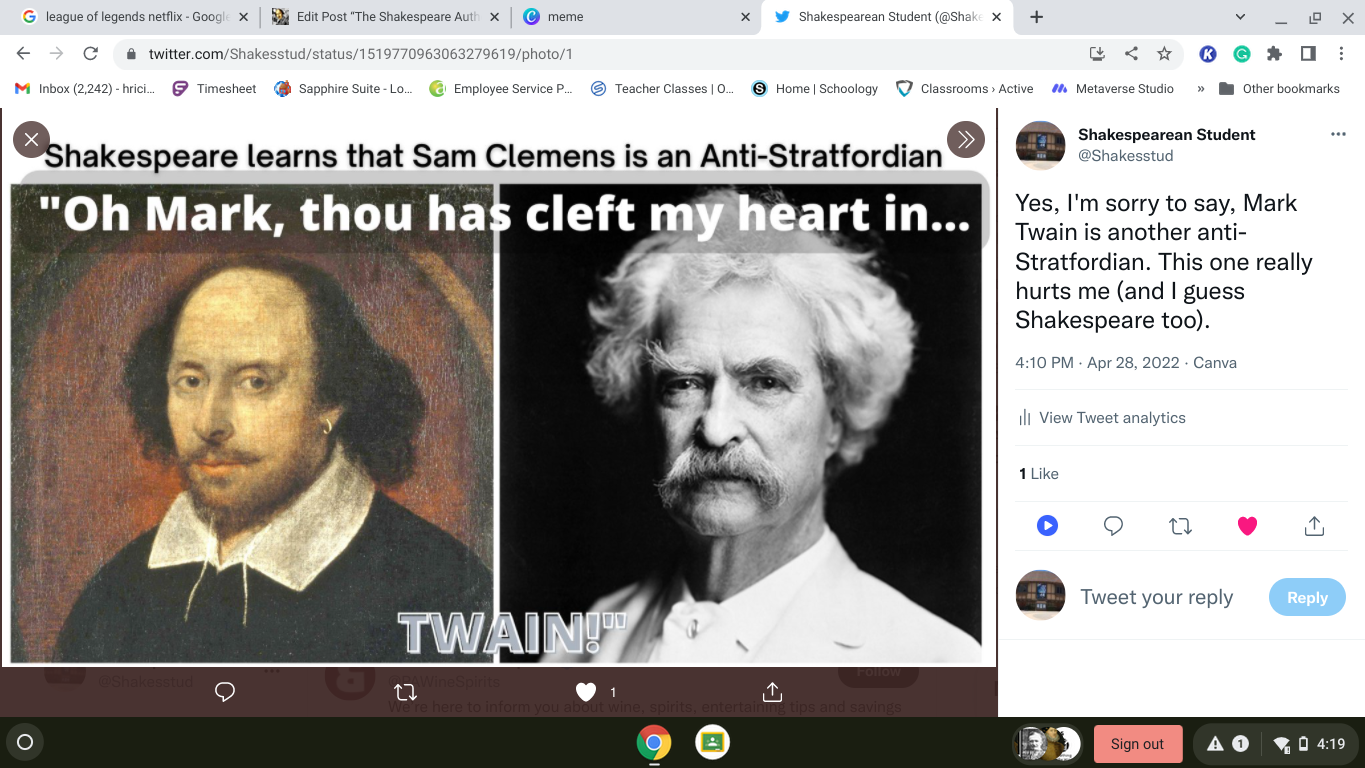

The authorship controversy is essentially a conspiracy theory- Was some unknown writer sending scripts to Shakespeare’s company and using the actor from Stratford as a patsy, or a pen name? Is there a massive cover-up to disguise the author of the most celebrated works in the English language? If so, why? How? and what else are they hiding?

Now if there’s one thing I’ve learned over the past four years is that it’s extremely rare to change anyone’s mind about any kind of conspiracy theory, and there are hundreds! Ancient Aliens, Bill Gates, Covid vaccine microchips, Elvis isn’t dead, The Illuminati, Kennedy Assassination, Pizzagate, Q-Anon, Trump’s Russia connections, the list goes on. Several recent studies show that the majority of Americans have heard at least one conspiracy theory, and many of us believe these theories to varying degrees. Sadly, the internet, which was designed to share information, is extremely good at sending misinformation as well.
So as an en educator and a father, I want to focus on the Shakespeare conspiracy not just because it gets my dander up, but also because, compared to these other theories, it is actually one of the least harmful. Conspiracies like the Plandemic hoax are extremely dangerous because they dissuade people from getting a life-saving treatment, and allow this pandemic to continue. By contrast, ultimately it doesn’t really matter who wrote Shakespeare’s plays, so I think this kind of exercise is useful for educators to challenge students to think critically about this low-stakes theory, and then applying the same skill to others to become better-informed thinkers.
How to break down the Shakespeare conspiracy theory
First, let’s summarize the most compelling points of the theory that Shakespeare didn’t write his plays. This is a video by director Roland Emmerich, which he made to help promote his film “Anonymous.” Emmerich dramatizes the controversy by portraying the Earl of Oxford writing the plays of Shakespeare anonymously, and sending them to Shakespeare’s company, giving the man from Stratford credit for writing them.
There’s an old saying in science that “Extraordinary claims require extraordinary proof,” and, aside from the fact that the Earl of Oxford wrote poems, there is no evidence that Oxford ever even spoke to Shakespeare’s company. In fact, almost none of this video is supported by any historical evidence. Now it would be a lot of work to refute each argument of this video point by point right? And surely I have better things to do than do a point-by-point refutation, but…
A Point-by Point refutation of the Roland Emmerich video:
– Shakespeare did leave evidence of his handwriting, just not evidence of his dramatic writing. The fact that his correspondence didn’t survive doesn’t mean there wasn’t any. The kind of cheap parchment that writers of the period used dissolved very easily, especially when they used ink with high iron content. The examples we have of Shakespeare’s writing are mainly legal records and books that were designed to last. In short, there’s no conspiracy to hide Shakespeare’s manuscripts, they simply didn’t survive.
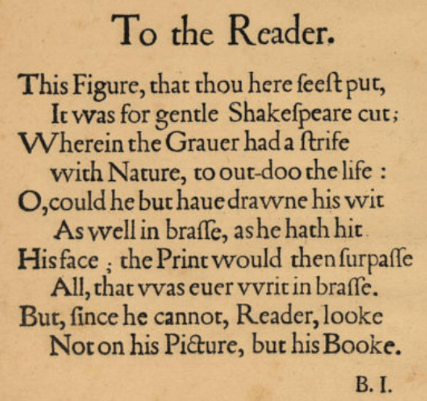
– We don’t know for sure that his parents were illiterate, or that his daughters were. That is based on an urban legend, not actual proof. Also, plays were not written to be read, that’s why TV viewers are viewers and the grounding are called an audience.
A. Shakespeare wrote about aristocratic people because they were paying his rent. His company was literally named “The Lord Chamberlain’s Men.” One reason why Shakespeare was more successful than Ben Johnson was that he was deferential and obsequious to the English aristocracy; he had to sing their praises to stay in business.
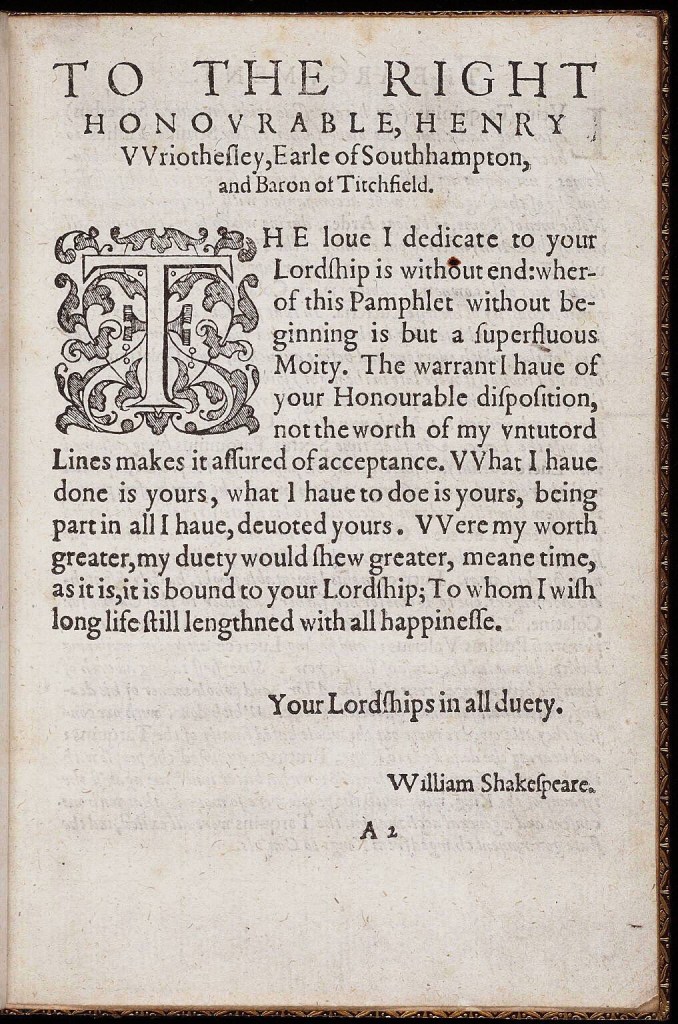
B. Every character that Emmerich mentions is not an aristocrat- Bottom is a lower-class weaver, Mistress Overdon is an inn-keeper. The only aristocrats Shakespeare ever insults are Polonius (who isn’t real), and Sir John Oldcastle in the early draft of King Henry IV, which he immediately changed to Sir John Falstaff once Oldcastle’s family members complained about it to Shakespeare’s company. Emmerich is flat-out lying when he says Shakespeare mocks the English upper class like an equal.
C. There’s a very simple explanation of how Shakespeare was able to write about the manners and lives of the English aristocratic class: he didn’t. All of Shakespeare’s comedies (except for Merry Wives which has the aforementioned Falstaff as a character), and tragedies take place in other countries like Italy, France, Sicily, or Greece. His History plays are set in England, but they dramatize events that happened 100-200 years before Shakespeare was born, meaning that he didn’t need to know too much about contemporary court politics. Furthermore, the majority of the plots he used were recycled from history books, poems, and prose romances.
It’s useful to think of Shakespeare not as a novelist like Dickens or Tolstoy and more like a TV or film screenwriter like George Lucas or Aaron Sorkin. He didn’t write based on real-life experiences or conjure new ideas out of thin air. He was a popular dramatist who adapted existing works of literature to be dramatized onstage. This is why I created my YouTube comedy series “If Shakespeare worked for Disney.” Emmerich, like many Anti-Stratfordians, is assuming that Shakespeare couldn’t have written plays about the nobility without being one himself, but that’s not what Elizabethan dramatists did- they adapted pre-existing work to fit on the public stage, which means anyone with a good education and knowledge of the theater could have written them, regardless of his or her upbringing.

If you are wondering how I could possibly know Shakespeare’s writing process,, the answer is simple: All of Shakespeare’s sources have survived, which means that I can prove that his plays are adaptations. This is a common problem with most conspiracy theories- they never take the straightforward way to explain something. Instead, they take a theory and twist facts to suit that theory. In this case, they twisted the facts about the Earl of Oxford’s life to make him look like Hamlet and based on that, they made him look like the true author of Shakespeare.
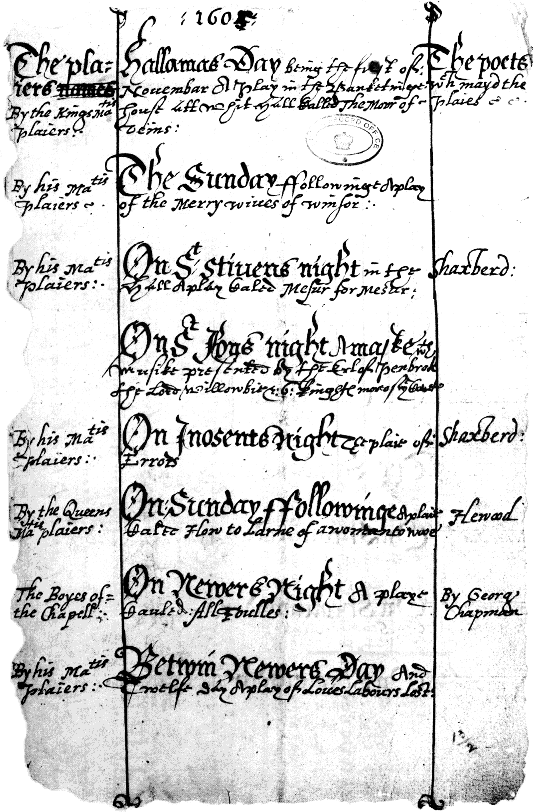
D. Honestly the handwriting is the weakest point- yes Shakespeare spelled his name differently in documents but this was before standard English spelling. The first English dictionary was at least 100 years after Shakespeare’s death. This point is clearly designed to discredit Shakespeare and make him seem uneducated. But again, this point is irrelevant when you consider that Shakespeare wrote for theater, where standard spelling is completely unnecessary.
By the way, Ben Johnson spelled his name differently in his manuscripts.
The Debate- Feelings vs. Facts. Modern vs. early modern
When I was in high school, taking my first class on Shakespeare, I watched this documentary which almost convinced me that Oxford was the true author of Shakespeare. The researcher they interviewed seemed so passionate and I wanted to believe what he said was true. But that was before I started reading about Shakespeare’s life for myself, and looked at the evidence myself.
How to Spot a Conspiracy Theory
https://allianceforscience.cornell.edu/conspiracy-theory-handbook/

If you look at many different conspiracy theories, they often exist in a form outside of normal reality, to the point where the believers have no interest in any kind of contrary evidence, logic, or any person who even questions it. Essentially the conspiracy becomes their identity, and they will virulently defend this conspiracy from anyone and anything that opposes it. Below is an explanation of the basic parts of a Conspiracy theory, with some points on how they all apply to the Shakespeare Authorship Controversy
Contradictory Beliefs:
Believers in conspiracies are motivated by feelings, not facts, and they don’t care how inconsistent those theories are. For example, the same people who believe Joe Biden lost the presidential election, also believe that the president (Joe Biden) is also being played by an actor. This might explain why many people believe that people like Christopher Marlowe wrote the works of Shakespeare, despite the fact that he died 9 years before Shakespeare started writing.
Overriding suspicion:
Again, since the believer is motivated by feelings, they are naturally suspicious of any contrary evidence and just assume anyone who contradicts them is in on the conspiracy. This is called self-sealing the conspiracy.
Nefarious intent:
One question that inevitably comes up with the Shakespeare Authorship debate is: “Who cares?” Usually, this means “Does it really matter who wrote the plays?” However, I want to use this question in this context: “Why go through the trouble to conceal who wrote these plays?” As I mentioned earlier, though Shakespeare is very famous and culturally important now, he certainly wasn’t back in his lifetime. Playwriting was not a venerated profession, and socioeconomically, Shakespeare was little better than a tailor. Why would it be worth it to conceal who wrote a few, fairly popular plays in 1616?
It would take an enormous amount of effort to conceal who wrote these plays for 400 years- you’d have to pay off publishers, fake court records (like the one I showed you above), keep an entire court quiet, and make sure nobody ever wrote down the truth for 400 years. Why would it be worth it? This kind of logic is why the Moon Landing and the Flat Earth conspiracies don’t hold up to rational thought- there’s simply no reason to go through the effort of concealing the alleged truth. The truth itself is just easier to defend.
Something Must be wrong:
As the name implies, Anti-Stratfordians don’t so much believe in Bacon, Pembroke, Oxford, etc, so much as they actively choose not to believe in William Shakespeare of Stratford. This means they will use every bit of their energy trying to prove that theory, and won’t stop until they find something, no matter how nonsensical, to prove their Shakespeare is the real Shakespeare.
Persecuted victim:
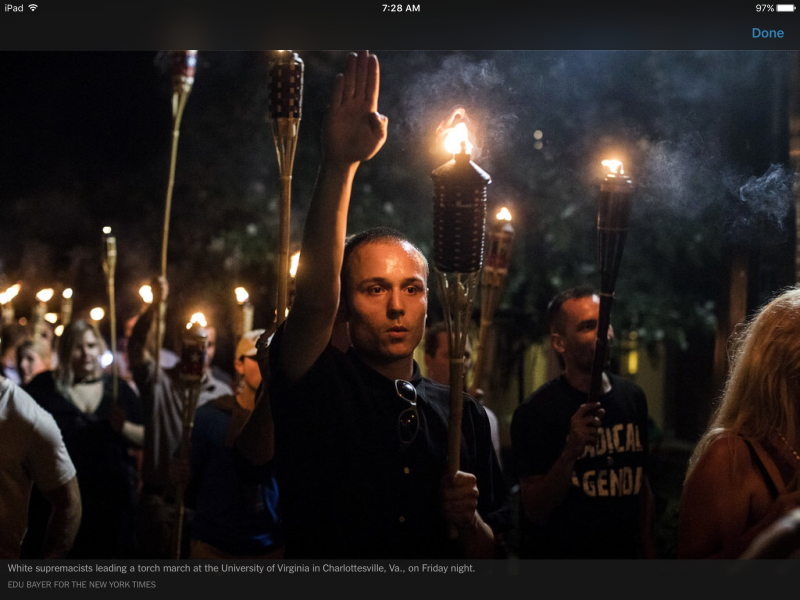
Let me be blunt- a conspiracy is very simmilar to a delusion, and any attempt to shatter that delusion is a form of persecution for the conspiracist. The most infamous example of how conspiracy theorists can feel persecuted and empowered at the same time is the way it permeated Nazi Germany and neo-Nazi units. Hitler came to power by spreading the theory that the Jews were secretly controlling the world and Germany was persecuted, while at the same time, Germany was destined to control the world in the eyes of the Nazis. I mention this not because I think Anti-Stratfordians are Nazis (how could I watch I Claudius otherwise?), but that conspiracy theories are potentially very dangerous because they foster a self-serving victim mentality where people are constantly looking for someone to blame for their problems and they will sometimes become violent against anyone who challenges them.
Immune to Evidence
One of the most important concepts in law is the notion that someone is ixznnocent until proven guilty. Along those lines, the prima facie, the accepted truth is accepted as truth, until new evidence contradicts it. If you look at the Supreme Court mock trial for the Authorship question back in 1987, that was the conclusion they came to in the end. Though little historical evidence for Shakespeare has survived, there is NO PHYSICAL evidence that contradicts it, so in the interest of prima facie evidence, they ruled for Shakespeare.
Now real conspiracy believers never believe in the merits of contrary evidence. They will just assume it is manufactured or faulty; part of the attempts of those nefarious truth concealers to pull the wool over their eyes.
Re-Interpreting Randomness
I’ve seen many people claim that the evidence for conspiracies is not found in documents or in scientific explanation, it’s in some kind of code or cipher or series of clues that only the believers understand. As you’ll see below, some of the most famous Anti-Stratfordians claimed to find hidden codes and ciphers in Shakespeare’s plays that prove that he was concealing his true identity. They will also cite coincidental details like the fact that the crest of Edward DeVere was an eagle shaking a spear, and claim this proves his identity as the true author of the plays. When you see a theory like like this, remember, correlation is not causation. Just because a few bad things happened when a few people said “Macbeth,” does not mean Macbeth is cursed. Some things actually are coincidences and not everything has a dramatic or sinister cause. This brings me to my next point:
The real enemy of conspiracies: Disappointing facts (Spoilers ahead for the movie “Coco”)

Let’s do a little thought experiment: Let’s imagine that you were Miguel from Disney’s Coco, and you discovered that your hero Ernesto Dela Cruz murdered your grandfather Hector, but (unlike in the movie), he actually DID write the songs he said he did. How would you feel about Hector? Would you hope and pray that Ernesto lied and your virtuous grandfather was the real author? Might you even concoct a conspiracy theory to rewrite Ernesto’s history and get Hector celebrated as the real author of “Remember Me?”
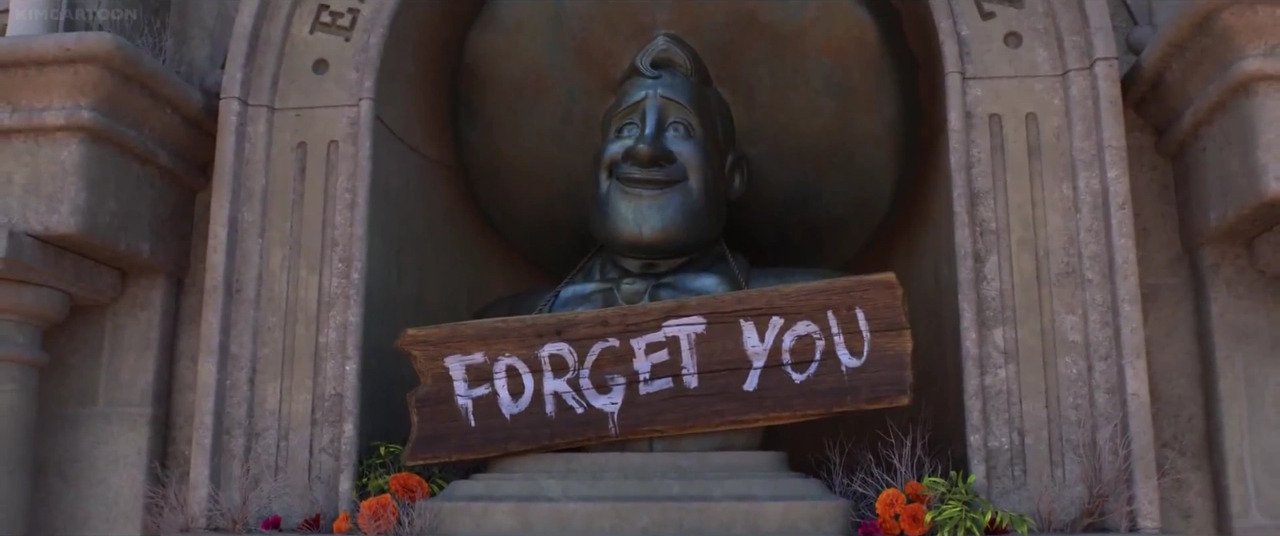
I’m not suggesting that Shakespeare is guilty of murder, or any other crime (apart from usury, hoarding grain, and a few minor tax violations). What I’m trying to do is to draw parallels between two men who are icons that are beloved by their hometowns, who created work that resonates with a lot of people.

We all have a tendency to take people we admire and put them on pedestals, (like the quote at the beginning mentions), and many people try to identify with their heroes. This is really easy with Shakespeare because most of the personal details of his life have vanished, so we can imbue him with our own sensibilities. Case in point- when Mya Angelou read Shakespeare’s sonnets as a little girl, she initially thought that he was a black girl. Likewise, Eugene O’Neill and other Irish and Irish American writers have thought he might be been Irish.
Some of the most outrageous anti-Stratfordians clearly have an axe to grind because they have a family connection (real or imagined) to the man they believe to be Shakespeare. In the 19th century, Delia Bacon wanted to prove that the real author of Shakespeare’s plays was the 17th-century poet, philosopher, and essayist, SIR FRANCIS BACON. Ms. Bacon hated Shakespeare because she thought he was an illiterate sheep-poaching commoner. She, therefore, used her theory to hoist Shakespeare off his literary pedestal, and therefore elevate herself because she believed she was descended from Sir Francis (though in reality, she wasn’t).
Rather than using any kind of historical evidence to prove her theory, Ms. Bacon claimed there was an elaborate code hidden in the iambic pentameter. Subsequent literary pseudo-scholars have attempted to hack the code and prove that they can prove that Sir Francis was the real author of the plays. In the late 1800s, American politician and author Ignatius Donnelly appropriated Ms. Bacon’s theory and claimed he had found the code, which rested on the pagination of the First Folio.
Donnelly had a knack for spreading conspiracy theories; as the title page of his book shows, he also authored a book where he claimed he correctly identified the location of the lost city of Atlantis. He also hated Shakespeare because Donnelly believed he was nothing more than a businessman, exploiting the talent of others, so like Bacon, he cooked up these ‘facts’ to suit his theory in order to take Shakespeare down.
Like many conspiracy theories, Anti-Stratfordians don’t have any factual basis for the ideas they hold, they are responding to an emotional need or desire. Donnelly and Bacon wanted fame, recognition, and revenge against a man they hated. J. Thomas Looney, who proposed that the Earl of Oxford wrote Shakespeare, wanted a ‘fairy prince’ that is, a semi-mythical Bard who would lead England into a golden age. All these people were dissatisfied with the man from Stratford, so they created a Shakespeare of their own, and tried to justify his existence.
To briefly sum up why the Bacon/ Donnelly theory is false, it hinges on the page numbers of the Folio, but Shakespeare didn’t print the first Folio. If you look at the title page, it was assembled by two actors from Shakespeare’s company- Henry Condell and John Hemmings, and it was printed by Isaac Jaggard, the same man who printed Shakespeare’s Sonnets in 1609. Writers had no say in how their work was printed and in fact Jaggard actually printed the sonnets without Shakespeare’s permission! The notion that Jaggard had any interest in properly printing a secret code in the pages of his posthumous book seems to me, incredibly unlikely at best.
Lesson plan
I’ve adapted a lesson plan about conspiracy theories to include a discussion of the Shakespeare authorship question. I’ll also include a worksheet that you can use in your classroom to distribute among your students if you choose to use it as well. I think it’s a good way to foster critical thinking, scientific reasoning, and historical curiosity, and if it prevents more people from joining Q-Anon, so much the better!
This lesson plan makes use of the Conspiracy Theory Handbook, and it has great, easy to read activities about how to spot a conspiracy theory, how to talk to a conspiracy theorist, and how to avoid being taken in by a conspiracy.
Sources:
https://www.c-span.org/video/?618-1/shakespeare-author-pseudonym#
New Podcast: “Crafting A Character: Brutus.”
What Shakespeare play are you?
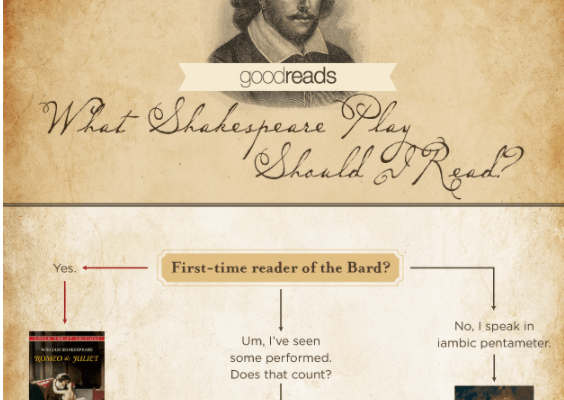
I found this awesome flowchart/ personality quiz on the website goodreads.com that helps you determine what is your perfect Shakespeare play:

https://www.goodreads.com/blog/show/415-what-shakespeare-play-should-i-read-an-infographic
So now I want to hear from you! I want you to take the quiz and tell me what play you get! You can respond to me via the comments on www.shakespeareanstudent.com, or on Twitter at @shakestud. Can’t wait to hear from you!
Shakespeare Week Is Coming at Outschool.com
Outschool.com will be honoring the contributions of Shakespeare during the very first Shakespeare Week on March 21-27th.

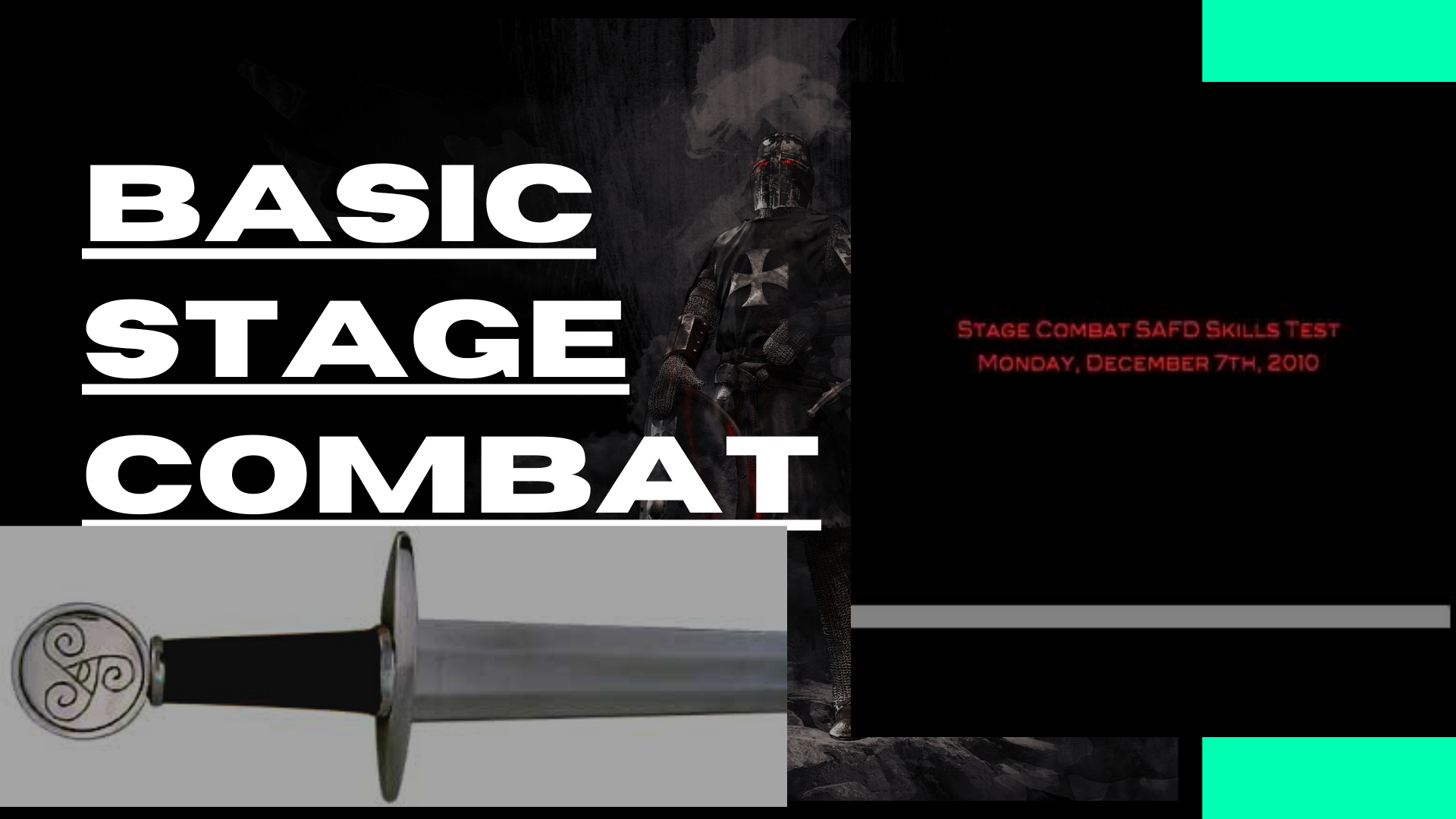


I’m honored to take part in this celebration, and I’m offering several aclasses which relate to Shakespeare in an engaging way. Here’s the schedule below:


If you want to sign up for one of my classes, please visit my Outschool page:
https://outschool.com/teachers/The-Shakespearean-Student
https://outschool.com/teachers/The-Shakespearean-Student
Hope to see you during Shakespeare Week!
THe Fashion Is the Fashion: Ancient Roman Fashion and Beauty
Roman Fashion 101:
Roman clothing Myths!

- Myth 1: Everyone wore togas! The toga was a formal garment that was worn by male citizens, usually on business, therefore women and slaves couldn’t wear them. Basically, think of a toga as like a 3 piece suit, (which is probably how it felt to those men in the hot Mediterranean sun). Togas were very hot because they were made of wool. As the video below shows, many Romans couldn’t wait to get out of their togas and wear a simple tunic.
Myth 2: All Togas were white
In most movies, and pictures set in Rome, we see rooms full of men wearing white togas, especially in the Senate. However, togas gradually evolved into a variety of styles and colors and helped indicate a Roman man’s status and maturity.




Types of Togas and how to wear them:
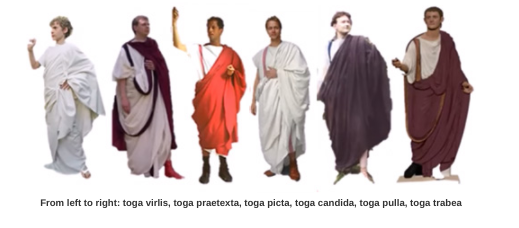
Shakespeare makes reference to a specific type of toga called a Toga candida: "Bright toga"; a toga rubbed with white chalk to make it appear bright white. In Titus Andronicus, the title character is offered a toga candida by his brother Marcus, when the Senate nominates him for emperor:

Marcus: Titus Andronicus, the people of Rome,
Whose friend in justice thou hast ever been,
Send thee by me, their tribune and their trust,
This palliament of white and spotless hue;
And name thee in election for the empire,
With these our late-deceased emperor's sons:
Be candidatus then, and put it on- Titus Andronicus, Act I, Scene i.

There were many other types of togas for different occasions:
- Dark colors were for funerals
- Red and purple sleeves were for magistrates and senators
- Purple togas with gold embroidery were for victorious generals, and later emperors
Manly garb: Toga virillis
A Toga virilis ("toga of manhood") also known as toga alba or toga pura was A plain white toga, worn on formal occasions by adult male commoners, and by senators not having a curule magistracy. It was a right of passage for young men to put on their toga virilis and assume adult male citizenship and its attendant rights, freedoms and responsibilities.
Women’s fashion
Like men, women most commonly wore tunics, especially when they were unmarried. When women married, they would don a long, elaborate garment called a Stola . The stola was a long dress held on by belts. Sometimes women decorated their Stolas with ribbons and they came in many colors. In the statue below, note how the belts below the breast drape the fabric into elaborate folds, and how the sleeves are slightly slashed on this sumptuous 1st century stola.
Read more at: https://www.ducksters.com/history/ancient_rome/clothing.php
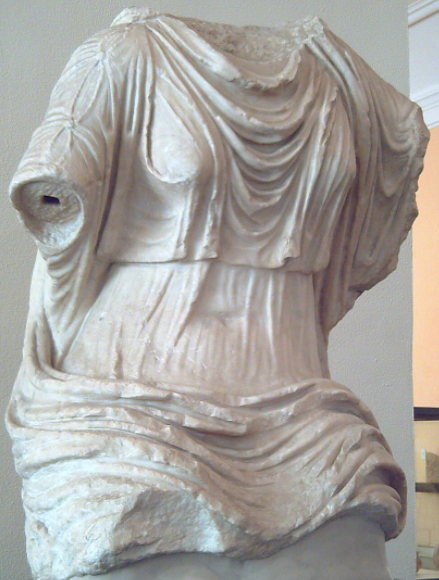
Women’s Beauty Regimen
Since Roman women were not legally citizens and couldn’t hold employment, their hair, dress, and makeup were in a way, a celebration of idleness, especially in the case of upper-class women. Aristocratic Roman women had their hair done in elaborate shapes like the Flavian hairstyle and wore elaborate Stoas to indicate how they didn’t have to work or labor in the fields.

In a production of Julius Caesar or Coriolanus, the director could exploit this concept of idleness by giving the more passive characters like Calpurnia or Fulvia more elaborate hairdos and elaborate brightly colored Stolas, while the more active characters like Portia or Valumnia could have a more austere or less fussy hairstyle and dress to show that they are more interested in engaging in politics or the military than sitting around and looking pretty.
References:
“The Romans – Clothing” History on the Net
© 2000-2022, Salem Media.
March 11, 2022 <https://www.historyonthenet.com/the-romans-clothing>
Ducksters. “Ancient Rome for Kids: Clothing and Fashion.” Ducksters, Technological Solutions, Inc. (TSI), http://www.ducksters.com/history/ancient_rome/clothing.php. Accessed 11 March 2022.
http://nationalclothing.org/565-traditional-clothing-in-ancient-rome-what-did-they-wear.html
The Roman Army Under Julius Caesar

Julius Caesar’s success as a politician was deeply tied to his success as a military leader. Therefore studying the Roman army during Caesar’s life helps one understand why he was so popular and why the Senate wanted him dead.

Caesar was commander (or legatus legionis) of the 10th mounted legion, which means his soldiers were mounted on horseback. Caesar was in charge of maintaining control over the warring tribes in Gaul (modern day France). Each legion was organized into 6 companies (cohorts) of 100 men, led by a Centurian, Source : http://thedioscuricollection.com/ejercito_romano_en.php


According to Imperiumromium.com, Caesar helped reform his army, and his Centurians carried out many different campaigns in Gaul:
As you can see, his soldiers were mainly armed with helmets, leather armor, and their large shields and Gladius swords. Below is an exploration of the different parts of the Roman uniform:
https://costumes.lovetoknow.com/roman-soldier-uniform
 The Shakespearean Student