Shakespeare on Ghosts

Since Halloween is right around the corner, and since this is a huge topic in Shakespeare, I would like to talk a little bit about Shakespeare’s treatment of the living impaired, specters, spirits, in a word GHOSTS.

Ghosts appear in five Shakespearean plays: Julius Caesar, Hamlet, Richard the Third, Macbeth and Cymbeline. In all but one of these plays, and in many other Elizabethan and Jacobean dramas, a ghost is a murdered person who needs someone to avenge their deaths. Their function is to warn the hero of the play to revenge their deaths, and/ or to torment their murderers.

Ghosts have been part of western drama almost as long as there have been ghost stories. After all, the Greek and Roman plays that Shakespeare emulated often mention ghosts as warnings from above and below the world is in some kind of chaos. Most of the time, the kind of play in which you see a ghost is a Revenge Tragedy, plays like The Spanish Tragedy, Locrine, Shakespeare’s Hamlet, and even the Disney movie of The Lion King.


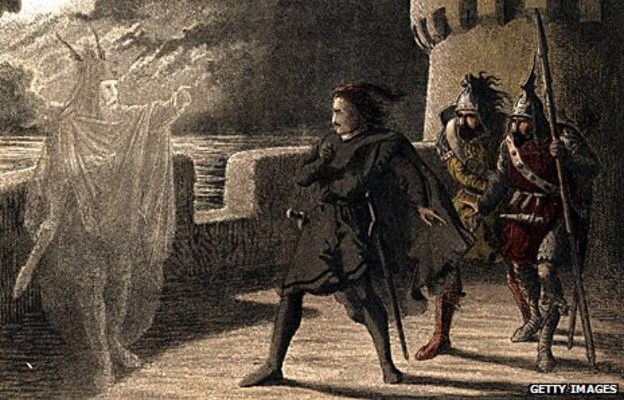
The most potent example of a Shakespearean ghost is definitely the ghost of Hamlet’s father. I actually played this role and, rumor has it, so did Shakespeare himself! Hamlet’s father appears as a ghost two months after his death, and soon after his brother Claudius marries his widow Gertrude. The ghost’s purpose in the play is to get his son’s attention so that he can correct the terrible regicide that Claudius committed, allowing the Ghost to Rest In Peace.
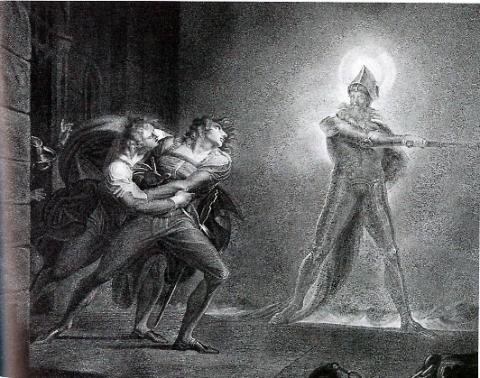
Shakespeare describes the ghost as a pale, sorrowful figure, dressed in full armor. The ghost only speaks to his son in the play, and he begins with a strange and terrifying description of the afterlife:

Ghost: I am thy father’s spirit,

Doom’d for a certain term to walk the night,

And for the day confin’d to fast in fires,

Till the foul crimes done in my days of nature

Are burnt and purg’d away. But that I am forbid

To tell the secrets of my prison house,

I could a tale unfold whose lightest word

Would harrow up thy soul, freeze thy young blood,

Make thy two eyes, like stars, start from their spheres,

Thy knotted and combined locks to part,

And each particular hair to stand on end

Like quills upon the fretful porcupine.

But this eternal blazon must not be

To ears of flesh and blood Hamlet Act I, Scene v.

Many scholars believe that the tormenting realm of fire that the ghost describes is actually Purgatory, an old Catholic concept that explains where the souls of the dead go if they are neither evil enough for Hell, or good enough for Heaven. It’s also the place where people go who didn’t confess their sins before death, which was the ghost’s fate since Claudius poisoned him while sleeping.

Though neither Hamlet nor his father explicitly say it, there is a strong implication that Hamlet must avenge his father by killing Claudius, which will presumably release the Ghost from Purgatory allowing it to ascend to Heaven.

Some suggest that the ghost is a manifestation of Hamlet’s superego:

Psychologist Ernest Jones (who studied under Signund Freud) in his book Hamlet And Oedipusbelieved Hamlet had an unresolved Oedipus complex and couldn’t bring himself to revenge because Claudius had achieved the very goals Hamlet himself secretly desires to kill his father and marry his mother

Faced with his guilt and lack of moral integrity Hamlet could have created a supernatural superego to spur him to revenge. As Freud describes it, the superego

The superego is the ethical component of the personality and provides the moral standards by which the ego operates. The superego’s criticisms, prohibitions, and inhibitions form a person’s conscience, and its positive aspirations and ideals represent one’s idealized self-image, or “ego ideal.”

In essence, since (in Jones’ view), Hamlet is too morally corrupt to be an effective avenger for his father, Hamlet imagines the ghost to help justify his revenge to himself. This is of course, only one way of interpreting the ghost and Hamlet as a whole. There is no right or wrong interpretation for any of Shakespeare’s characters, but it is a testament to Shakespeare’s genius that, 400 years after his own death, his ghostly writings helped inspire one the architects of modern psychology.

Ghosts Of Torment

The ghost of Banquo in Macbeth and the ghosts that plague Richard the Third the night before his battle help quicken the murderous kings’ his downward spiral. Macbeth becomes more and more paranoid, and therefore easier for his foes to defeat.

When Julius Caesar’s Ghost appears to Brutus, he does so the night before his final battle- the battle of Philippi, where Brutus was defeated and committed suicide.

When Richard III sees the ghosts of all the people he murdered, it not only terrifies him, it splits his soul in half! According to Sir Thomas More, Richard couldn’t sleep the night before his final battle at Bosworth Field. Shakespeare gives Richard a strange soliloquy where the ghosts awaken his conscience and awaken him from a fearful dream:

[The Ghosts vanish]

[KING RICHARD III starts out of his dream]

Richard III (Duke of Gloucester). Give me another horse: bind up my wounds.

Have mercy, Jesu!—Soft! I did but dream.

O coward conscience, how dost thou afflict me!

The lights burn blue. It is now dead midnight.

Cold fearful drops stand on my trembling flesh.

What do I fear? myself? there’s none else by:

Richard loves Richard; that is, I am I.

Is there a murderer here? No. Yes, I am:

Then fly. What, from myself? Great reason why:

Lest I revenge. What, myself upon myself?

Alack. I love myself. Wherefore? for any good

That I myself have done unto myself?

O, no! alas, I rather hate myself

For hateful deeds committed by myself!

I am a villain: yet I lie. I am not.

Fool, of thyself speak well: fool, do not flatter.

My conscience hath a thousand several tongues,
And every tongue brings in a several tale,

And every tale condemns me for a villain.

Perjury, perjury, in the high’st degree

Murder, stem murder, in the direst degree;

I shall despair. There is no creature loves me;

And if I die, no soul shall pity me:

Nay, wherefore should they, since that I myself

Find in myself no pity to myself? Richard III, Act V, Scene iii.

In these plays, the ghosts are a form of spectral punishment; the punishment of a guilty Conscience.

Shakespearean Friendly Ghosts

The only friendly Shakespearean ghosts appear in Shakespeare’s play Cymbeline and these ghosts appear before the god Jupiter to plead for their descendant, Posthumous Leonidas. They beg Jupiter, the most powerful Roman god, to end Posthumous’ suffering.

Like the witches in Macbeth, ghosts in Shakespeare are mysterious and sometimes frightening – they are sort of a mirror for how we see ourselves, our lives, and our hopes to be remembered after death; the final words Hamlet’s father utters before disappearing into the morning mist are: “Adieu, adieu, remember me.”

Thanks for reading! If you enjoyed this post, please consider signing up for my Outschool class: “Macbeth: An Immersive Horror Experience.” I perform live as the ghost of William Shakespeare and tell the story of Macbeth in an entertaining and spooky way.
For More Information:

https://www.bl.uk/shakespeare/articles/ghosts-in-shakespeare

https://www.bard.org/study-guides/ghosts-witches-and-shakespeare

Animated Richard III, 20:00 the ghosts appear:

References:

Greenblatt, Steven Hamlet In Purgatory 2001. Princeton University Press. Link: file:///Users/jrycik/Downloads/Hamlet-in-Purgatory-Princeton-Classics.pdf

Jones, Earnest, Hamlet and Oedipus.

https://people.ucsc.edu/~vktonay/migrated/psyc179d/HamletOedipus.pdf

Open Source Shakespeare, Cymbeline:

https://www.opensourceshakespeare.org/views/plays/play_view.php?WorkID=cymbeline&Act=5&Scene=4&Scope=scene&LineHighlight=3243#3243

http://www.markedbyteachers.com/gcse/english/which-version-of-the-hamlet-ghost-scene-act-1-scene-5-was-the-most-effective-and-why.html

Pearlman, E. Hamlet: Critical Essays: The Invention Of the Ghost. https://books.google.com/books?id=jdfWAQAAQBAJ&pg=PA71&lpg=PA71&dq=ghost+that+shrieked+hamlet+revenge&source=bl&ots=KY68gIrh2V&sig=MjEr2NxLQ7T4c2xW1QscrmdeMkc&hl=en&sa=X&ved=0ahUKEwiR5o6M4I_XAhUK0oMKHQIJBeAQ6AEIKDAA#v=onepage&q=ghost%20that%20shrieked%20hamlet%20revenge&f=false

https://www.shmoop.com/hamlet/ghost.html

https://www.jstor.org/stable/pdf/456606.pdf?refreqid=excelsior%3A3f62aed88fb9e9b9a8f8e462186ff95c
Shakespeare’s Perfect Halloween Play

With just a few days left until Halloween, many of us will be anxious to put the candy bowl away, dim the lights, and watch a scary movie. I’d like to recommend my pic for the single best Shakespeare play for Halloween, and you might be surprised to learn which one it is:

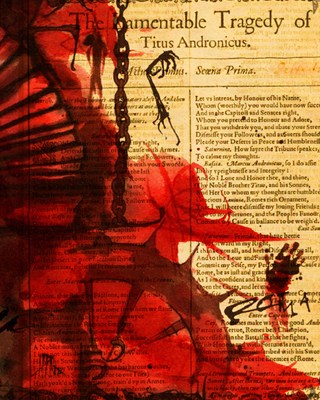
It’s not Macbeth, despite its ghosts and witches, it’s not Hamlet, though it has a famous scene in a graveyard. In my opinion, the scariest, most horrific, most disturbing Shakespearean play is the ancient Roman revenge tragedy Titus Andronicus!

Titus Who?

Titus is the most violent, most outrageous play in the Shakespearean cannon and features murder, mutilation, cannibalism, (and even featured the first recorded trick or treating). It was also his first tragedy ever, written around 1590. Back in this period, Shakespeare’s theater was also the site of public executions and blood sports like Bear-baiting, so Shakespeare knew that gore sells. He also knew that people were reading the bloody tragedies of the Roman poet Seneca, so he created a play that out-does the Roman master of bloody violence!

So why have you not heard of it?

  • Too violent for school For most people, their first encounters with Shakespeare is in the classroom, and because of the violence in this play it’s definitely not appropriate for high school. The most famous atrocity in the play happens to Titus’ daughter, who is raped offstage. Then, to keep her from incriminating the men who raped her, the rapists cut off her hands and cut out her tongue. Quite a departure from the “Honey tongued” Shakespeare we see in the comedies and sonnets.
  • It’s vulgar: T.S. Eliot declared that Titus Andronicus is “one of the stupidest and most uninspired plays ever written.” For people who expect Shakespeare to be poetic and romantic, this play is a sad dissapointment.
  • It’s Over the top- People don’t just die in this play, they get butchered horror movie style! Some get stabbed and thrown in a pit, some get their limbs chopped off, one character is buried alive! Many scholars say that after one atrocity after another, the only way you can react to the horror onstage is to laugh. Look at this scene where the villain of the play, Aaron the Moor, confesses to a laundry list of hideous atrocities which he did just for the pleasure of being evil:

Scholars often compare the dark comedy of Titus to the films of Quentin Tarantino, who will murder his characters in grotesque, but funny ways. I won’t even give away the surprise ending where Titus and his daughter gets their revenge, but let’s just say that they would certainly agree with Tarantino that revenge is a dish, best served cold!

  • It might be racist As I mentioned in the clip above, the main villain of the play is a black man. Aaron, like Richard III is completely evil and unapologetic about it.  When I was studying Shakespeare in college, James Earl Jones, (Darth Vader himself) came to my school to talk about Shakespeare’s racially diverse characters. He argued though that nobody treats Aaron any differently until they learn about his heinous crimes and that the person who seems to hate Aaron’s blackness the most is himself. Look at this passage and see if you agree:

AARON

I go, Andronicus: and for thy hand

Look by and by to have thy sons with thee.
Aside Their heads, I mean.

O, how this villany
Doth fat me with the very thoughts of it!
Let fools do good, and fair men call for grace.
Aaron will have his soul black like his face (Titus, Act III, Scene 1).

Now the question to ask about Aaron and most of Shakespeare’s villains, is are they bad because they’re different (different race, differently abled, illegitimate birth), or did they become bad from people treating them badly?

Serious note– Even though productions often dramatize the violence and rape in Titus as over-the-top black comedy, this kind of rape and violence happens in real life, every day, particularly violence against women like Lavinia. One reason why this play is gaining popularity is sadly, that this kind of violence is more common in our current society with the shocking number of rapes committed in this country (1 in 5 women, according to the National Sexual Violence Resource Center), and the brutal murders in this play suggest many real-life atrocities such as Abu ghraib,

Plot summary and more at Schmoop.com

More at http://www.gradesaver.com/titus-andronicus/study-guide/summary

Review of Julie Taymor’s Titus

If you can’t get to the theater this Halloween and want to watch a production of Titus, you’re in luck: In 1999, Julie Taymor, famed director of the Broadway production of The Lion King, directed a film adaptation of Titus which I consider the single greatest Shakespearean film of all time. The movie captures the grotesque comedy of the play, while also visually showing the beauty of Shakespeare’s poetry. It also doesn’t get hung up on historical accuracy just because the play is set in Rome. Best of all, the cast in incredible: Anthony Hopkins, Jessica Langue, Alan Cumming, Harry Lennox and more. This cast knows how to do Shakespeare for the movies and their work shows in every scene. Interesting side note: Hopkins actually considered making this movie the last movie of his career, which explains his amazing glee and energy in the role of Titus. Below is a nice in-depth analysis of the film

Another good review comes from the French Shakespeare Society: https://shakespeare.revues.org/1558

And finally, a review from Roger Ebert: http://www.rogerebert.com/reviews/titus-2000

So that’s my two cents on Titus Andronicus. Happy Halloween everybody!

Creating A Character: Richard III

In 2011, I wrote a graduate thesis about some of the challenges of playing Shakespeare’s Richard III, specifically those related to playing his deformity. What follows in this post is an adaptation of the presentation I gave at the American Shakespeare Center’s Blackfriars Playhouse, in Staunton Virginia. I gave this presentation with the help of my actors, Matt Carter, Jemma Levy, Amanda Noel Allen, and David Santangello. I also interviewed live onstage, one of the ASC’s greatest actors John Harrell and his director Thadd McQuade, about a unique production of Richard that he performed for the company back in 2002. What follows is the script I wrote for the presentation, as well as the video and Powepoint slides I projected for the audience, to help you see my work in performance. You can also consult a website I designed for the ASC’s production of Henry VI, Part III, where Richard was played by actor Ben Curns.


PRESENTATION SCRIPT

MATT CARTER:

Now is the winter of our discontent
Made glorious summer by this sun of York;
And all the clouds that lour’d upon our house
In the deep bosom of the ocean buried.
But I, that am not shaped for sportive tricks,
Nor made to court an amorous looking-glass;
I, that am curtail’d of this fair proportion,
Cheated of feature by dissembling nature,
Deformed, unfinish’d, sent before my time
Into this breathing world, scarce half made up,

And that so lamely and unfashionable
That dogs bark at me as I halt by them.

Why, I, in this weak piping time of peace,
Have no delight to pass away the time,
Unless to spy my shadow in the sun
And descant on mine own deformity: Applause, he sits on one of the gallant stools.

Section 1: Introduction

Slide01

PAUL:

Many of you recognize those famous lines from the opening soliloquy of Richard III, ably delivered by Matt Carter. Did you notice the ways Matt was moving and the qualities of his voice? Tonight, my actors and I will show you some of the choices actors have made in playing the deformity of Richard III. Deformity and Richard are so closely linked that I would argue that it is the central driving force of the character. The different performances we will discuss show changes in views on deformity, as well as changing theories on the actor’s craft.

Every actor is interested in the human body, every actor is interested in how the mind and body work together, and most importantly, how to present the mind and body of a character to an audience in a clear and articulate way. No matter how the actor decides to represent it, Richard’s deformity of mind and body are essential to the understanding of the character. In his first soliloquy, in the play Henry the Sixth, Part III, he expresses a deep pain, sorrow and bitterness at being denied a normal body. As Jemma delivers this speech, ask yourself- do you pity him? Does this man have a reason to be angry?

JEMMA LEVY:

Why, love forswore me in my mother’s womb:
And, for I should not deal in her soft laws,
She did corrupt frail nature with some bribe,
To shrink mine arm up like a wither’d shrub;
To make an enviousmountain on my back,
Where sits deformity to mock my body;
To shape my legs of an unequal size;
To disproportion me in every part,
And am I then a man to be beloved?
O monstrous fault, to harbour such a thought!

Henry VI, Part III, Act III, Scene i.

PAUL:

In this speech, like the previous one, Richard expresses the belief that his deformity was a curse, laid on by his mother. During the Renaissance, people believed that deformity was a mark of evil and a sign of being cursed by God. Like the Mark of Cain in the Bible, Richard’s deformity signifies that he was “determined,” (presumably by God), to prove a villain.” The deformity also gives Richard psychological motivation. Lacking a normal body, Richard is hungry for revenge, and in search of something to elevate himself above more fortunate people- power.

Section 2: Burbage

PAUL: The first Richard was almost certainly Richard Burbage, Shakespeare’s star actor. Burbage was associated with the role long after his death.

DAVID SANTAGELLO:

A funerall Elegy on the death of the famous Actor Richard Burbage:

Who died on Saturday in Lent, the 13th of March 1618′

No more young Hamlet though but scant of breath

Shall cry revenge for his dear father’s death:

Edward shall lack a representative,

And Crookback, as befits, shall cease to live.”

PAUL:

Unfortunately, we have no information on how Burbage played the deformity, but we have one clue as to how his performance might have been received, in the form of an apocryphal story from the diary of law student John Manningham, on 13 March 1602:

AMANDA:

Upon a time when [Richard] Burbage played Richard III,

There was a citizen grew so far in liking with him that before she went from the play,

She appointed him to come that night unto her by the name of Richard III.

Shakespeare, overhearing their conclusion, went before, was entertained, and at his game ere Burbage came.

The message being brought that Richard III was at the door,

Shakespeare caused return to be made that ‘William the Conqueror was before Richard III.’

Slide02

PAUL:

Although this story is apocryphal, it does hit upon other features of Richard’s deformity- his supreme confidence, and his beast-like sexuality. Scholars have pointed out that Richard’s lack of scruples, (the result of being born deformed), makes him completely focused and confident. Likewise, his non-conformity to traditional standards of beauty could also be seen as a rebellion against societal norms, and thus, a strange aphrodisiac. This dark creature, without a recognizable human shape, manages to exert a dark pull on the audience.

Section 3: Cibber

Slide03

Surprisingly, for nearly 300 years, portrayals of Richard III have been heavily influenced by an obscure author who was not even Shakespeare’s contemporary

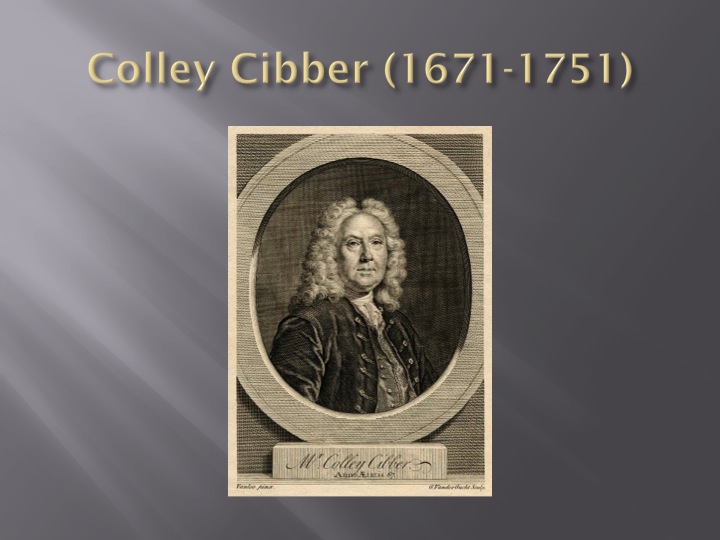
During the Restoration of theater in the 17th century Shakespeare’s plays were largely out of fashion, condemned by critics as “too vulgar for this refined age,” and playwrights began to rewrite and adapt them. The most successful adaptation of Richard the Third, came from poet-laureate Colley Cibber in 1671. Cibber’s text interpreted the story as one man’s evil rise to the crown, not the culminating story of the Wars of The Roses. Cibber cut most of the history involved. He condensed scenes, omitted others, and gave Richard 10% more of the dialogue, then Shakespeare. Cibber’s text also re-emphasizes the importance of deformity to Richard’s character- adding 8 more uses of the words “deformed,” or “ugly.” To further the point, Cibber inserted text from other Shakespeare plays that speak about Richard’s deformity, such as the Henry VI speech spoken earlier. Cibber freely cut-and pasted from Shakespeare’s histories, which can be demonstrated in this speech where the Lady Anne mourns for the death of Henry the Sixth, using lines written by Shakespeare for the funeral of King Henry the Fifth:

AMANDA:

Hung be the heavens with black, yield day to night!
Comets, importing change of times and states,
Brandish your firey tresses in the sky,
And with them scourge the bad revolting stars
That have consented unto Henry’s death!

O be accursed, the hand that shed his blood

Accursed the head that had the heart to do it!
If ever he have wife, let her be made
More miserable by the life of him
As I am made by Edward’s death and thine!

PAUL:

Cibber also wrote his own speeches for Richard, such as this one where Richard resolves to woo Lady Anne in spite of his deformity:

JOHN HARRELL:

But see! My love appears. Look where she shines

Through her dark veil of rainy sorrows

Tis true, my form perhaps may little move her;

But I’ve a tongue shall wheedle with the devil.

PAUL: Cibber’s text was extremely popular with actors because it raised Richard’s importance to a star role. Actors such as David Garrick made their debut as Cibber’s Richard, and some of Cibber’s editorital choices still survive in the two movie versions of Richard by Ian McKellen and Laurence Olivier.

13188-15979

IanMcKellen

Section 4: Olivier

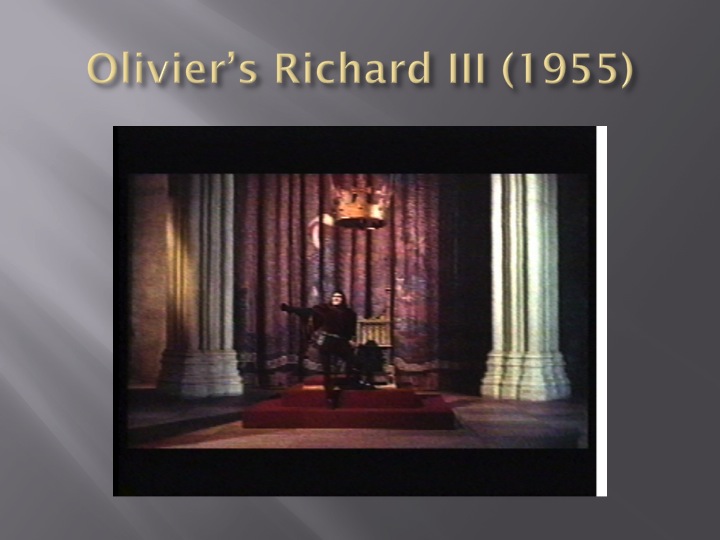
Olivier, in the 20th century was considered the definitive Richard. In his film version he emphasizes Richard’s evil and deceptive nature. He uses the character’s physical disabilities (as well as various cinematic techniques) to reveal his moral depravity.

Slide04

  • The Crown of England- the tremolos and the large crown that appears in the beginning, middle, and end of the film. Homage to Cibber.
  • CINEMATIC USE OF DEFORMITY
  • Long camera angles as he limps away, exposing hump and limp
  • Shadowy silhouette
  • In this shot, Richard slinks away from the camera, leaving his bizarre silhouette to unfurl like a snakeSlide06
  • In this shot, Richard bends over to whisper evil thoughts into the king’s ear.
  • Finally, in this shot, we see the shadow of Richard’s head, as he stares into the cell of his brother Clarence, as he plans his murder. We see through this shot, Richard looms as a great evil presence.

Section 5: Sher

Slide07

After Olivier, actors abandoned the approach of making Richard into a monster, and favored a more human, natural approach.

The role of Richard III however, presents unique challenges for actors attempting to do this; they are attempting to do something un-natural by playing a deformity that they do not actually have. Thus they are attempting to play something “un-natural” within the precepts of naturalistic acting.. Antony Sher’s massive preparation for the role, using Method acting techniques, included both a thorough research into the physical effects of real disability, and a deep examination of its psychological effects.

Slide08

  • Used Method acting techniques to create the role:
    • Real-life experience- Crutches came from his own real injury.
    • Research into physical deformity.
    • Textual Research
    • Image Research. He used Margaret’s text to create a visual design for his character, a bottled spider.
    • Psychoanalysis- brought Shakespeare’s text to a real psychiatrist to “put Richard on the couch.”
  • Sher’s technique led him to go into a deep, psychological probing of Richard’s mind. He viewed the deformity as a source of deep pain, through which we can identify with Richard as a human being.
  • Listen to how David, applying Method-inspired text analysis, conveys Richard’s human emotions.

DAVID:

But I, that am not shaped for sportive tricks,
Nor made to court an amorous looking-glass;
I, that am rudely stamp’d, and want love’s majesty
To strut before a wanton ambling nymph;
I, that am curtail’d of this fair proportion,
Cheated of feature by dissembling nature,
Deformed, unfinish’d, sent before my time
Into this breathing world, scarce half made up,
And that so lamely and unfashionable
That dogs bark at me as I halt by them;

PAUL: Sher’s massive preparation for the role represent the limits that an able bodied actor could go to portray a disability he himself did not have.

Section 6: From Sher to Harrell

Slide09

  • Sher’s Richard created an unexpected backlash from disabled community.
  • One response to this: a number of Richards played by disabled actors.
  • Henry Holden in 2007. Like Sher, on crutches, only he needed them.
  • Peter Dinklage played the role with none of the traditional deformities.
  • His size was a kind of disability, as it literally hindered him from taking the crown
    • He was tangled in his robes,
    • Couldn’t reach the throne.
  • Critics writing about the performance claimed watching him was more real. You weren’t watching a performance, you watched a real man, with a real struggle.
  • Another response is approaching the deformity from a more stylized perspective.
  • This was the approach favored by Thadd McQuade.Slide11
  • The essence of this performance was watching a man struggle through life trying to overcome obstacles and find a place for himself in the world, a struggle that is the essence of all tragedy.

Section 7: 10 minute interview with Thadd and John.

Slide12

Both– Explain the way you chose to represent deformity (bowling ball) and why.

  • John- I got an email from actor JP Schiedler, (who was in the production) who said “ As I recall John was very interested in working inside of some form of restriction which forced his body to adapt, struggle and physically change how he could deal with the world around him which the ball did.” If this is true, I’d like you to talk about this idea- why was it important for you to have something that restricted you? I want to get an idea of how you saw the physicality of Richard and how it is important to the character.
  • Thadd, when I interviewed you, you mentioned that doing the play naturalistically can actually be off-putting because an able-bodied actor will never completely pull off the deformity. I want you to repeat some of that to explain the virtues of a more presentational Richard.
  • Both- How did your techniques contribute to a better understanding of the play for the audience?

Conclusion: Richard’s deformities and disabilities are both physical and psychological. They are the driving force in his life. Portraying Richard’s deformity is a microcosm of the challenges that face all actors: making choices of how to explore the mind and body of a character. Watching an actor take on the challenge of portraying this man’s struggles. This struggle is the essence of tragedy and watching an actor take on the challenge of creates powerful and poignant theatre.

Useful Richard III Website, starring Ian McKellen!

Here’s a lovely website designed to help you learn about Richard’s first soliloquy by interacting with Sir Ian McKellen himself!

First, a video to see it in action:


And here’s the final website: http://www.stageworkmckellen.com/

As a bonus, here’s a review of Sir Ian’s new app, Heuristic Shakespeare:


http://www.avclub.com/article/ian-mckellen-launches-app-make-shakespeare-easier–236049

This app looks incredible, listen to this satisfied customer:

So far, the only play on the app is “The Tempest,” but hopefully if enough people buy it, it’ll expand and encompass all the plays. I hope you’ll check it out!
 

My Top Ten Shakespearean Apps For Teachers and Students, Part 1

Hi everyone! Well, it’s nearly August, which means back to school. Everyone is looking in the stores for the latest educational gear to help young minds on the journey to knowledge. To hopefully aid your journey teachers and students, I’ve compiled some of my favorite Shakespeare apps. There are a lot of apps out there of course, and I couldn’t hope to review them all, but I had a few criteria to limit the results:

  1. The app had to be free,
  2. It has to be functional (educational or useful in life,)
  3. Fun!

I also discovered that most Shakespeare apps out there seem to follow three basic categories: Shakespeare quotes, Shakespeare guides, and Shakespearean insults. Generally speaking, every app on this list is designed to either help you learn Shakespeare by showing and testing you on famous quotations, to help you engage with the text of the plays, or to just have fun making vintage Tudor insults such as: “I was looking for a fool when I found you. I desire we may be better strangers!” So here are the first five apps I am ready to recommend to students and teachers that bring the Bard into the mobile electronic age!

I. 3x The Bard

IMG_1040

This app is a series of quizzes on Shakespearean quotes. It gets is title because the quiz goes on and on until you make three mistakes. Just like in baseball, three strikes and you’re out! I found it fun but not functional. You don’t learn what the quotes mean, and you’re not tested on how well you can recite it, it just quizzes you on which play the quote comes from. Still, worth a look.

II. Shx at Play Two word review: very useful.

Combines the interactivity of an app, with the format of the  Sourcebook Shakespeare books I mentioned in my “Which Shakespeare Edition Is Right For You” post. It features annotated texts of Shakespearean plays,  videos, and a glossary. It’s really good stuff. I encourage teachers and students to use it. The only problem is that, while the plays are free, some features don’t become available until you pay to download them, but you might want to if you’re serious about studying the play.

IMG_1081

III. Globe Theater 360 

This is one of my favorite apps ever. I would call it the Pokemon Go of Shakespeare apps. As you move your phone, you get a 360 degree of Shakespeare’s Globe Theater, as if you were actually there! Even cooler, if you put your phone or tablet over the Globe Theater logo, it will make a computerized theater appear on your phone’s camera in real time, just like the creatures of Pokemon Go! Furthermore, you can click on various part of the Globe to learn about the theater, how the plays were performed, and the colorful history of Shakespeare’s Company. I think this is a must-have app for anyone interested in Shakespeare.


IV. Globe Player

Ok, I’ll be honest, this one isn’t free either, but it’s still incredible. I love that The Globe is well aware that not everyone can get out to London and see a play in Shakespeare’s re-constructed Globe theater, so they have a pay-per-view style app that allows you to watch videos of Globe Theater performances in your own home. You can also watch or stream international Shakespearean performances and documentaries right to your phone, tablet, or online at https://globeplayer.tv/

V. Genius

The best thing about this app is that you probably own it already! This is an extremely popular app for deciphering the meaning of song lyrics. Well guess what? People have also contributed commentary of some of Shakespeare’s famous speeches too! If you’re a teacher, you might consider having your class upload a Shakespearean text, and have them write line-by-line commentary to show just how well they understand it.  

So that’s Part I of my look into my favorite apps Shakespearean apps, and I hope you enjoyed it. If you find any other apps you’d like me to review, leave a comment below!


Till next time,


The Shakespearean Student.

The Witches Of Macbeth

Happy Halloween everybody!

Tonight I’d like to discuss some of the spookiest, most enigmatic, and above all WEIRDEST characters in Shakespeare: the Three Weird Sisters in Macbeth.

1. Who are they?

Every production has to answer who the witches are, and many have very different answers. Are they temptress? Are they evil agents controlling Macbeth?Furies trying to destroy Macbeth?

I would argue in their basic form the witches are harbingers of change. Their very name “Wyrd Sisters” refers to an old Anglo Saxon concept of fate or destiny. Whether or not they have any effect on Macbeth mind or soul, they point the finger at him and say “things are going to change for you.” Then, he either makes the choices that determine his fate, or they change his fate for him.

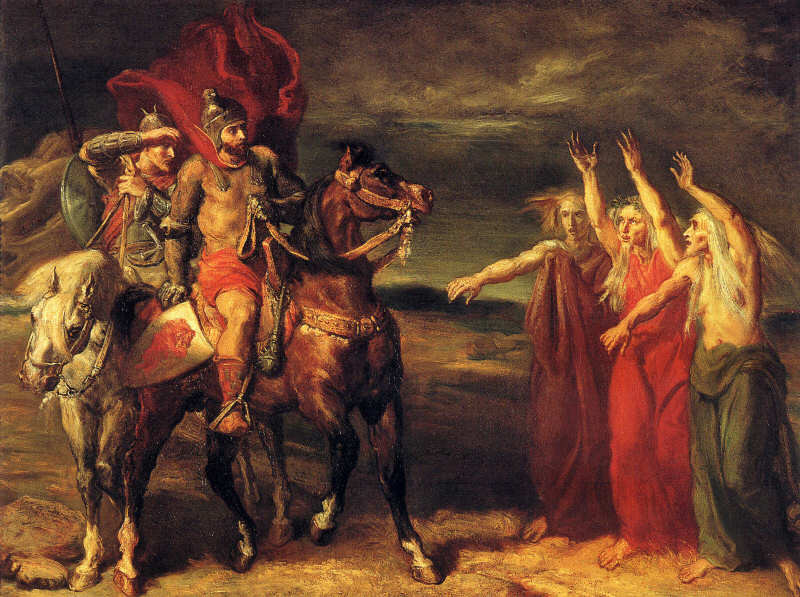
“Macbeth and Banquo First Encounter the Witches,” Théodore Chassériau, 1854.

Macbeth meets the witches on a heath, which means land that is literally out of bounds– the wild, untamed wilderness, which the old Anglo Saxons believed was the lair of many cursed spirits and monsters. This could symbolize Macbeth’ sin or transgressions, slowly turning into a murderer, usurper, and a tyrant. It could also symbolize the chaos in Macbeth’s life.

What Do They Look Like?

Shakespeare’s descriptions of the witches are highly contradictory- they seem to be floating, yet on the ground, they seem to be women, but they have beards! They don’t look Earthly, but here they are on the Earth. This gives them an other worldly quality that keeps us guessing as to who they are, and helps them tempt Macbeth more easily.

BANQUO
What are these
So wither’d and so wild in their attire,
That look not like the inhabitants o’ the earth,
And yet are on’t? Live you? or are you aught
That man may question? You seem to understand me,
By each at once her chappy finger laying
Upon her skinny lips: you should be women,
And yet your beards forbid me to interpret
That you are so.

MACBETH
Speak, if you can: what are you? (Act I, Scene iii).

The Witches’ Language:
You know from my earlier posts that the norm for Shakespearean characters is to speak in iambic pentameter- 10 syllable lines of unrhymed poetry that sounds like a normal heartbeat. The witches break these norms- they generally speak in Trochaic Tetrameter- 8 syllable lines with the off beat emphasized. The witches are literally offbeat, and that’s why their speeches are unsettling. Look at the contrast between a normal iambic line like:

“In sooth I know not why I am so sad.” (Merchant Of Venice I,i).

and

Dou-ble Dou-ble, Toil and Tro-ble.

Fire burn and Caul-dren Bu-ble. (Macbeth, Act IV, Scene i).

For more info on the verse forms of the Witches, click here:

The witches also speak their prophesies in a vague, ambiguous manner They like to play with obscuring their prophesies with lines that make Macbeth think one thing, but the opposite is true. The famous example here is when they claim Macbeth will never be vanquished “until Birnam Wood comes to Dunsinane Hill.” Macbeth assumes this means he’s invincible, but it actually means that the enemy carry wood from the forrest. This is called Equivocation.

Witches and mythology

Illustration from William Blake's
Illustration from William Blake’s “Europe a Prophecy,” 1794.

1. During the reign of King James, the modern witch hunt began; the king was fascinated with witches and even wrote a book called Daemonology on how to identify and destroy them. This was the era where people believed that witchcraft, rather than a pagan religious practice, was a forbidden craft that could only come from a pact with the devil. However, Shakespeare borrows from both Satanic and early pagan ritual in the characters of his witches.

2. Shakespeare took a couple of details about witchcraft from ancient Celtic and Greek mythology. First of all, the use of a cauldron. In Celtic myth, a cauldron is a symbol of rebirth and was sometimes used to resurrect the dead, just as the witches do in IV i. Of course, the ideal time for raising the spirits was on the feast of the pagan god Samhain, at the point where the veil between the living and dead was the thinnest. The feast took place on October 31st, our modern day Halloween!

Illustration of witches and their familiar spirits, 1647.

3. Familiar spirits In Act I, the witches speak to animal spirits called familiar spirits, which call to them and tell them where to go. King James himself wrote about how the witches found and communicated with these spirits.

Hecate.
In Act IV, Hecate, Ancient Greek goddess of magic appears. She is clearly the lord of all the witches, and is very displeased that they are riddling with Macbeth. Maybe not all witches believe in giving out prophesies that can destroy the Scottish monarchy. Hecate was always enigmatic in myths- she was born one of the Titans who opposed the gods, but frequently changed sides. More then being two faced, she was often portrayed as having three faces! Shakespeare refers to her frequently as “Triple Hecate.”

“The Triple Hecate,” by William Blake, 1794.

For more information on this mysterious goddess, consult the video below, (WARNING, ADULT-ONLY CONTENT).

In conclusion, the witches are meant to be ambiguous because the play examines the source of evil- whether it is inspired by other people, or if it comes from one’s own heart. The witches can be either or both, depending on how you want to tell the story, which is why they act and speak in contradictory ways.

Thanks for reading! If you enjoyed this posting, please consider signing up for my online class, “Macbeth: An Immersive Horror Experience.” I tell you the story of Macbeth and you get to play through an escape room, where you must solve the witches’ puzzles or be added to their Cauldron!

Visions Of Lady Macbeth

One of the greatest icons of female villainy, Lady Macbeth has been portrayed onstage by our greatest actresses, and immortalized in many alluring and terrifying works of art. Here are some of my favorites:

Ellen Terry as Lady Macbeth 1889 John Singer Sargent 1856-1925 Presented by Sir Joseph Duveen 1906 http://www.tate.org.uk/art/work/N02053
Ellen Terry as Lady Macbeth 1889 John Singer Sargent 1856-1925 Presented by Sir Joseph Duveen 1906. Tate Modern Gallery: http://www.tate.org.uk/art/work/N02053. More Info Here.
For commentary: http://www.bbc.co.uk/arts/yourpaintings/paintings/ideal-portrait-of-lady-macbeth-97937
An Ideal Portrait of Lady Macbeth by John Francis Dicksee, 1870. View gallery information here: http://www.the-athenaeum.org/art/detail.php?ID=190776
FMI: http://en.wahooart.com/@@/8Y3AD3-Henry-Fuseli-(Johann-Heinrich-F%C3%BCssli)-Lady-Macbeth-with-the-Daggers
“Lady Macbeth and the Daggers” by Henry Fuseli, 1812. Tate Modern Gallery: 

http://www.tate.org.uk/art/artworks/fuseli-lady-macbeth-seizing-the-daggers-t00733 

http://collections.vam.ac.uk/item/O1068192/lady-macbeth-watercolour-cattermole-george/
Lady Macbeth observes King Duncan  by George Cattermole, 1850. Victoria and Albert Museum: 

http://collections.vam.ac.uk/item/O1068192/lady-macbeth-watercolour-cattermole-george/

http://www.louvre.fr/oeuvre-notices/lady-macbeth-somnambule
Johann Heinrich Fuseili, “Lady Macbeth Sleepwalking Scene.”(1741). Louve Museum in Paris: 

http://www.louvre.fr/oeuvre-notices/lady-macbeth-somnambule

http://aworldelsewhere-finn.blogspot.com/2012/03/dante-gabriel-rossetti-death-of-lady.html
The Death of Lady Macbeth by Dante Gabriel Rossetti (c. 1875). Gallery info here: 

http://aworldelsewhere-finn.blogspot.com/2012/03/dante-gabriel-rossetti-death-of-lady.html 

Romeo and Juliet Extended Play Of the Month

Hi everyone,

Just wanted to let you know that I’ll be extending Romeo and Juliet for the next two weeks because it’s the start of the school year, and I still have plenty more to say about this play. So for the moment, here’s the list of posts I’ve done so far:

  1. Romeo and Juliet Summaries For Your Viewing Pleasure.
  2. Romeo and Juliet, How To Read This Play, Parts 1-3
  3. Where Did This Play Come From? The Narrative Sources of Romeo and Juliet.
  4. The Genesis Of Romeo and Juliet: Shakespeare’s creative process adapting the story
  5. Book Review: The Manga Shakespeare- Romeo and Juliet
  6. Romeo and Juliet Spin Offs
  7. Happy Birthday Juliet!

By the way, here’s a hilarious summary of the play from “Zounds, Alack, and By My Troth,”

The Genesis of Romeo and Juliet

Hello loyal subscribers and first-time readers!

If you’ve read any of my last four posts, hopefully I gave you some insight as to the literary sources of Shakespeare’s Romeo and Juliet, and a little bit of what Shakespeare accomplished in writing the play, so now I’d like to focus on what was going on when Shakespeare wrote it; what was going on in his own life and his career. Unfortunately, nobody knows when Shakespeare’s company first performed Romeo and Juliet, but since it was published in 1597, it must have been written sometime between 1593, and 1596.

Above- Video Bio of Shakespeare by me!

  • In 1593, Shakespeare was in a bit of a creative slump; all the London theaters were closed down, thanks to an outbreak of Bubonic Plague Shakespeare knew intimately the pain, fear, and heartbreak that plague could bring- At age 7, he saw his sister Anne die in April 4, 1579. Anne Shakespeare was 8 years old.
  • In addition, Shakespeare had gained success from his four English history plays,, but great tragedy had never been his forte. In fact, although he was a commercial success, Shakespeare wasn’t respected much in his own artistic community. In 1592, Robert Greene, a well-known smarty-pants dramatist in 1593, saw that his plays were getting passed over by theatre goers in favor of Shakespeare, who was an uneducated ACTOR!!! This set Greene’s teeth on edge, and he published an insulting pamphlet which slyly satirizes Shakespeare as:
    • Greene's Essay An upstart Crow, beautified with our feathers, that with his Tygers hart wrapt in a Players hyde, supposes he is as well able to bombast out a blanke verse as the best of you: and being an absolute Iohannes fac totum, is in his owne conceit the onely Shake-scene in a countrey

    -Robert Greene, Greenes, Groats-worth of Witte, Bought With a Nillion Of Repentance (with original spelling) [1592].

More criticism ensued from Shakespeare’s distant relative, a poet and Jesuit missionary named Robert Southwell. Because of his Catholic beliefs, Southwell was an outlaw and a traitor to the Queen, yet he continued to try and convert England back to Catholicism with everything he did and wrote. Somewhere between his secret arrival in England in 1586, and his capture, torture, and execution in 1595, Southwell wrote a dedicatory essay addressed “To my poet cousin, Master W.S,”

the text of the title page is reprinted below:

Worthy Cousin, Poets by abusing their talents and making the follies and fainings of love the subject of their base endeavors, have so discredited this faculty (ability) that a poet, a lover, and a liar are but three words of one signification.

Southwell’s speech strongly echoes the speech Shakespeare gives to Theseus in his play A Midsummer Night’s Dream, especially the comment where Theseus claims “The lunatic, the lover, and the poet are of imagination all compact.” We don’t know how much influence Southwell had on Shakespeare, but in any case, it’s clear that around 1593, Shakespeare was trying to establish himself as a true Renaissance writer, which meant writing great poetry and not just crowd-pleasing histories full of blood and gore.

So Shakespeare had to face two great challenges- to defend his art from his detractors, and to make a living without the theatre in a time of plague. To pay his rent, he took a job writing poetry for the Earl of Southampton, Henry Wriothesley (pronounced “Rizely,” left). By all accounts, the Earl was a spoiled, vain pretty- boy who loved patronizing poets. To please Wriothesley, Shakespeare composed two long epic poems, “Venus and Adonis,” and “The Rape Of Lucrece,” classical stories inspired by Shakespeare’s favorite Roman poet, Ovid.

According to The Poetry Foundation, a lot of the themes and language devices Shakespeare employed in these two poems contributed greatly to Romeo and Juliet. Most notably, Shakespeare’s use of the concept of forbidden love, his creation of strong, tragic heroines who conquer their predicaments in their deaths, Shakespeare’s use of paradox to describe impossible situations, and perhaps, in the case of Adonis, a model for the character of Romeo:

it features an innocent hero, Adonis, who encounters a world in which the precepts he has acquired from his education are tested in the surprising school of experience. His knowledge of love, inevitably, is not firsthand (“I have heard it is a life in death, / That laughs and weeps, and all but with a breath.”

(reprinted 8/30/12 from http://www.poetryfoundation.org/bio/william-shakespeare).

In these two poems Shakespeare was refining his craft, and examining questions about the nature of love. In Venus and Adonis, the title characters explore love as a giddy romp through the forest, but their relationship ends with a tragic accident when a wild boar kills Adonis. In The Rape Of Lucreece, Shakespeare shows the destructive quality of male desire, and the nobility of self-possessed women. I think that Romeo and Juliet would not have existed without Shakespeare making a meditation on his craft, on the nature of love, and the fragility of human life.

Shakespeare’s Romeo and Juliet

As you saw from my post last week, Romeo and Juliet wasn’t a new story- it had appeared as a poem in 1587 and in several versions before that. When Shakespeare adapted the story, he used his new-found powers of poetic language to make the story more alive, more beautiful, and to make the characters more complete.

What Did Shakespeare Do Differently With His Version Of the Story?

              • Plot- Generally, Shakespeare keeps the same plot as the poem version of the play, but compresses characters, times, and speeds the action along faster.
                • Shakespeare compresses the story to 5 days, making the love affair even more passionate and volatile.
                • He changes the Capulet’s feast from a Christmas celebration to a summer’s feast, making the time of year hot and dangerous.
                • He makes Juliet 13 instead of 16 as she was in the poem.
                • He makes Peter Capulet’s servant, instead of Romeo’s.
                        • Themes- Shakespeare, more than most poets who have interpreted this story, refuses to put the blame squarely on Romeo and Juliet, which is why he invents thematic devices to put the blame on chance, fate, or possibly an angry God.
                                    • Plague Themes– In the 16th century, plagues were viewed as a consequence of angering God. The fact that Mercutio curses the two warring families with “A plague on both your houses,” suggests that the lover’s deaths was a just punishment from God, or at least a horrible instance of random chance.

                                    Importance of Fate- Romeo and Juliet are first described as “Star-crossed lovers,” which means their destinies are intertwined, and determined by an unlucky star, (like being crossed by a black cat). In addition, Medieval and renaissance poets often invoked the goddess Fortuna, who guides people’s destinies and controls whether they have good fortune or bad fortune. Some said this destiny was written in the stars, as Romeo angrily denounces after he hears of Juliet’s death:

                                    “Is it even so? Then I DEFY you stars!”

                                    Shakespeare uses these thematic devices to make the fates of Romeo and Juliet less clear and more open to interpretation. Without a clear-cut moral, Shakespeare’s audiences could make up their own minds.

                                    The Language Of Romeo and Juliet

                                    • Steven Greenblatt, editor of the Norton Anthology of Shakespeare’s plays, points out the amazing variety of wordplay and language devices in Romeo and Juliet, which Shakespeare employs to allow characters to insult each other (like verbal artillery), to curse, to mock, to impress, and in the case of Romeo and Juliet themselves, “To create a new Heaven and a new Earth” (Norton, 889). Romeo and Juliet are unable to be together due to their feuding families, so through poetic imagery they turn their situation into paradise and turn each other into gods. Romeo turns Juliet into the Sun, the force that sustains all life on Earth, and Juliet asks God to:

                                    Take him and cut him out in little stars,

                                    And he will make the face of heaven so fine

                                    That all the world will be in love with night

                                    And pay no worship to the garish sun (R&J III.i).

                                    • Antithesis-To characterize the powerful and contradictory forces at work in the hearts of the characters, Shakespeare frequently has them speak using antithesis- putting two opposite terms next to each other, such as in the phrase,“Why then, O brawling love, O loving hate, O anything of nothing first create” (R&J, I. i).

                                                • One big way Shakespeare uses antithesis is the repeated imagery of night and day. Night stands for beauty, danger, love, and hidden love, as in the example from Act III above, and from the phrase: “I have night’s cloak to hide them from my eyes,” from the Balcony Scene. Day on the other hand, is associated with fighting, unpleasantness, and rudeness, like in the example above, where Juliet describes the Sun as “garish” or rude. In fact, the first time the word “day” is used in the play, Shakespeare follows it with the rhyme, “fray,” which immediately sets up how the day means hotblooded violence.
                                                  • One final example occurs in Act IV, Scene v, where Romeo has slipped into Juliet’s bedroom during the night, where Romeo laments how, as it comes closer to day time, the time for him to leave draws near:
                                                  • JULIET: O, now be gone; more light and light it grows.
                                                    ROMEO More light and light; more dark and dark our woes!
                                                  • I could go on talking about Shakespeare’s literary devices, but the important thing is that, to establish himself as a great Rennaisance poet, Shakespeare put his love of language in this play more than he had ever done before, and it shows in every line.

                                                What was the first performance like?

                                                • Above is the trailer for a production of Romeo and Juliet at the re-built Globe Theatre in 1999, which illustrates how this production relied thoroughly on the imagination of the audience.
                                                • Just like us at Open Air Shakespeare NRV, the first production of Romeo and Juliet was outdoors during the afternoon, (we know from the records of the time that plays took place about 2PM most of the time).
                                                • There were minimal props and scenery, no lighting and few sound effects, and the actors were able to talk directly to the audience.

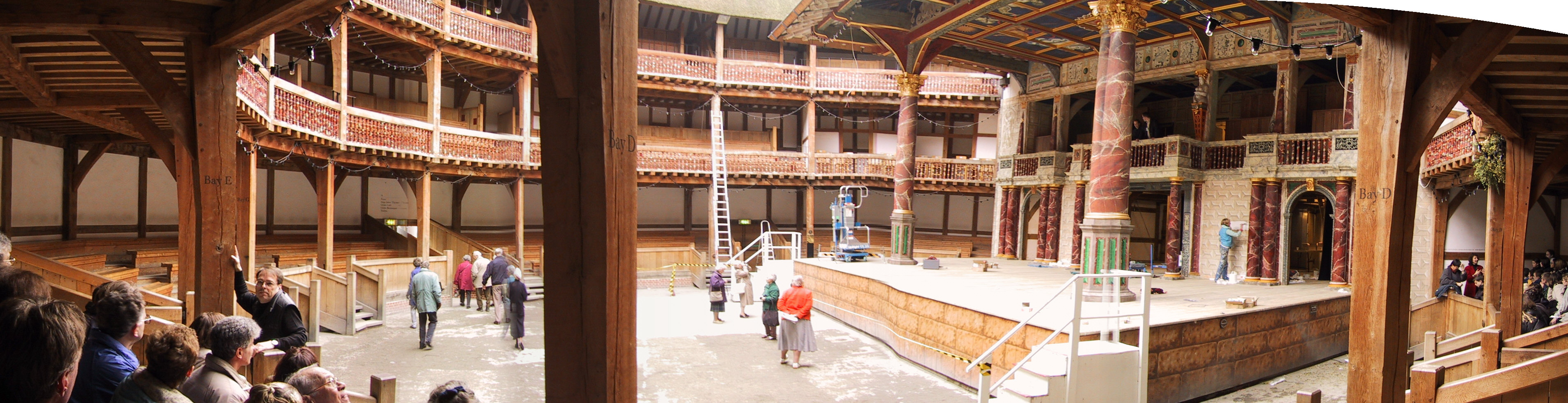
                                                The Globe Theatre Panorama

                                                • Another important thing about Elizabethan performance is the multiple levels of the audience. As you can see, audience members can stand on a semi-circle around the stage. These audience members were called “groundlings,” and they paid a penny to stand through the show. For another penny, audience members sat on wooden planks like the people in the foregrounds. The upper galleries were a little less expensive, since they were further away from the stage, and the most expensive seats of all were The Lord’s Rooms (far right just below the roof of the stage). The Lord’s Rooms allowed wealthy patrons to be seen by everyone in the house, showing off their aristocratic status. The Lord’s Rooms also doubled as a musicians gallery, and also as Juliet’s balcony, as you can see in this video
                                                • The backstage facade area that the actors went through for costume changes was called the Tiring House, where at the end of the play, they would push out Juliet on a stone slab, to represent her tomb.
                                                • Since the Globe Theatre wasn’t built until 1599, Romeo and Juliet was not originally performed there. You can see a contemporary sketch of The Swan, Shakespeare’s first theatre, by clicking here: http://internetshakespeare.uvic.ca/Library/SLT/stage/public%20theater/sources.html

                                                Success for Shakespeare

                                                • Without question, Romeo and Juliet was popular in Shakespeare’s lifetime;
                                                • It was printed in 1597, two more times during Shakespeare’s lifetime, then it was printed four more times between 1622, and 1637. It would probably have continued printing continuously till this day, if not for the Puritans abolishing theater in 1642.
                                                • The same year Shakespeare first performed the play, we know he became a shareholder in the Chamberlain’s Men, which meant he not only got a salary for writing and performing, he also got a share in the profits.
                                                • Critics praised Shakespeare’s poetry, calling him “The poet of the heart-robbing line.”

                                                So, to sum up, Shakespeare composed this masterpiece during a very turbulent time- he was unable to act, the theaters were closed. He was no doubt afraid of being killed by the plague, and all the while he was being plagued by critics. When he wrote the play, he expanded his art and craft to a new and unheard of degree, ensuring his place in history as the finest dramatist in the English-speaking world. It was truly a labor of love.
                                                – Shakespearean Student