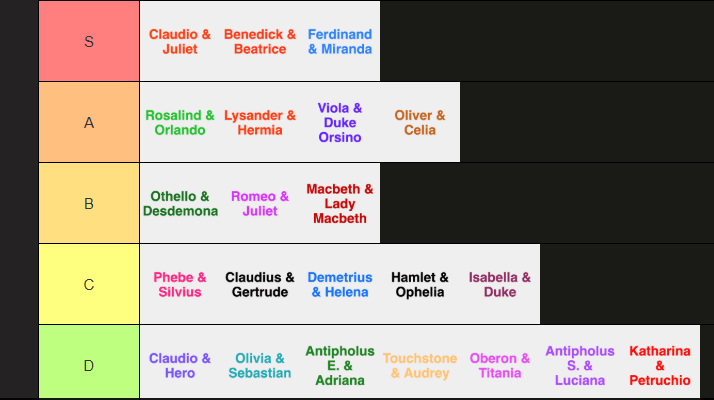
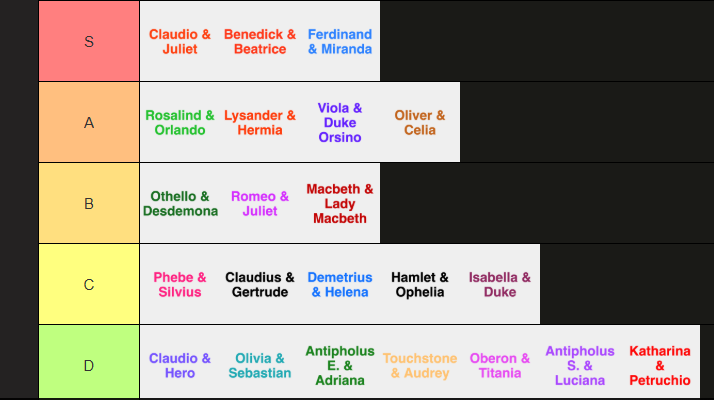
Since it’s still the month of love, I thought I’d rank Shakespearean couples and see if the allegation is true that Shakespeare has no good married couples. Naturally, this is my opinion, but I will try to back my opinions up with quotations and moments from the plots. Let me know what you think!
S Tier- the Super Couples
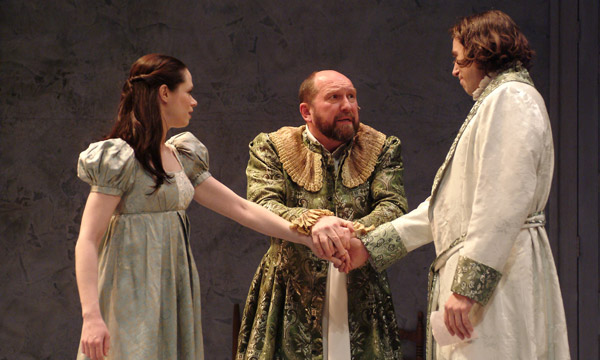
Simonides grants permission for Pericles to wed his daughter. Production shot from Mary Zimmerman’s 2006 production of “Pericles.”
My criteria for the best couples in Shakespeare are this:
Trust
Mutual respect and affection
Devotion, or as Shakespeare puts it “Love is not love, which alters when it alteration finds.”
A Tier- the ones who Passed the Test
Couples in this tier all tried and failed at first- Orsino spent years mooning over Olivia not able to see how wonderful Viola is. Lysander drops Hermia for Helena, (but to be fair, that was Puck’s fault, not his). At the end though, all these lovers reconcile and are better people for their trials and tribulations.
B Tier- Affection, but no devotion
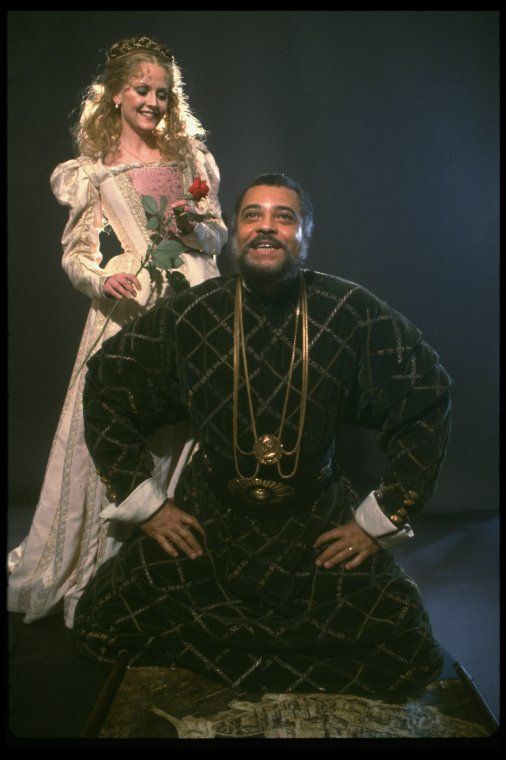
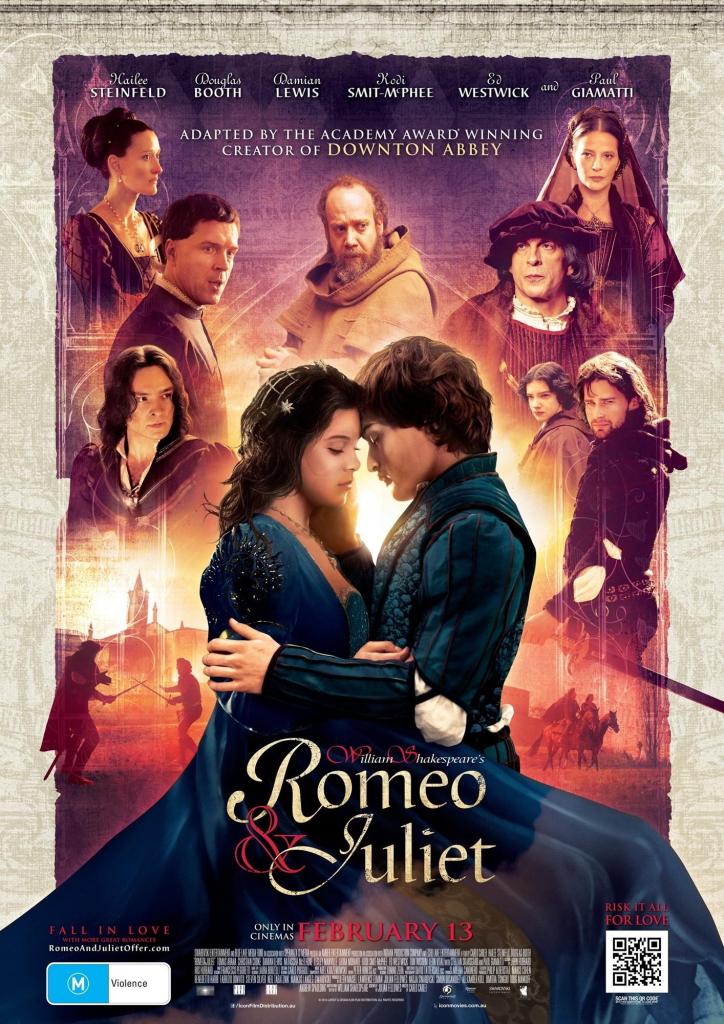
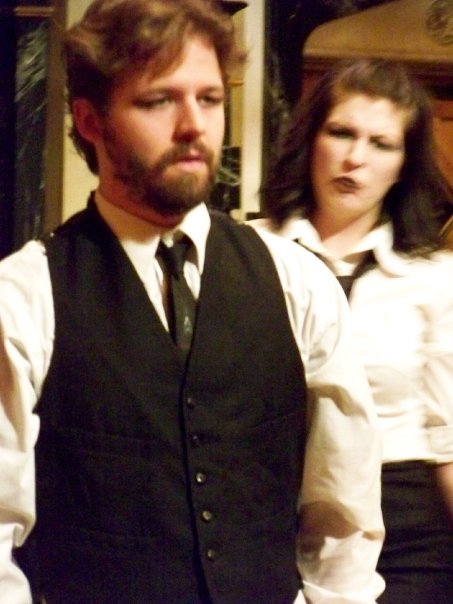
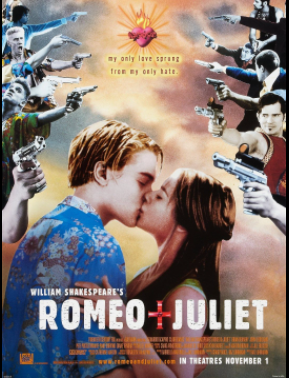
James Earl Jones as Othello and Cecilia Hart as Desdemona in a scene from the Broadway revival of the play “Othello.”Movie poster with Hailee Steinfeld and Douglas BMe and my Lady Macbeth, Katie Crandol.1996 movie poster for Romeo and Juliet starring Leonardo DiCaprio and Claire Danes.
Couples in B-tier are passionate and willing to break rules, laws, and sometimes necks for their loves. However, as Friar Laurence says “These violent delights have violent ends.” Every couple in B-tier ultimately fails to create a lasting relationship.
C Tier- The ones hanging by a thread
All the C-couples have some very toxic traits. Claudius hates Gertrude’s son and murdered his own brother, so his relationship with his wife/ sister-in-law is ultimately doomed. Hamlet has little to no respect for Ophelia and flies into mysygenistic rage at the slightest provocation. Even Demetrius, who is magically compelled to love Helena forever, has a history of loving women, and then abandoning them. Who’s to say he won’t get hit by the arrow again, and throw Helena off?
D Tier- Actively ABusive/ A Relationship Based on lies
I truly despise Taming Of the Shrew, or as I like to call it, Stockholm Syndrome: The Play. The men in D-tier (and Phoebe in the case of As You Like It) are controlling, abusive, cruel, and pathological liars. They don’t want a partner, so much as a toy to beat around when they feel like it.
Special Mention- Cordelia and the King of France from “King Lear”
These guys might be low key the best couple in Shakespeare. The King of France marries Cordelia and comes to her defense after her father disowns her and humiliates him. Based on this, you can tell he doesn’t care about her title or her dowry (“Thy truth then be thy dower. Thou hast her France, let her be thine, for we have no such daughter.”
Not only that, France goes with Cordelia and lends her an army to recapture England for Lear! Clearly this guy loves Cordelia and is ride or die on making her happy.
Special Mention- Antony and Cleopatra
I know they are an iconic couple, but I think Antony and Cleopatra are a very toxic pair. When I first read the play, I hated Cleopatra for leading Antony on and mocking and teasing him every chance she got. Now I hate Antony for his selfishness. Cleopatra is trying to save her sons, her kingdom, and her family’s legacy and he is throwing away everything just to appease his own ego. He also shames Cleopatra for her promiscuity, which is extremely hypocritical coming from him. This couple is clearly in need of MASSIVE counseling, and I pity poor Enobarbus and Charmian for getting caught in their drama.
I hope you enjoyed this tier list. One pattern I noticed in all these plays is that every couple in Shakespeare is tested, whether through magic, deceit, long journeys, or just jealousy. Shakespeare does a good job of showing how young love is beautiful and exciting, but real love is based on respect and the will to choose your partner in spite of obstacles.
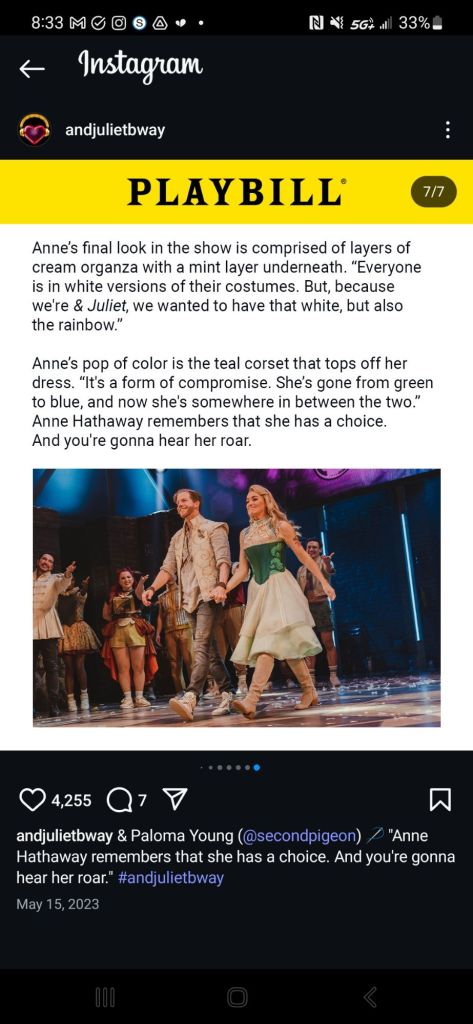
It’s around 1597 and Shakespeare is putting the finishing touches on his new play, Romeo and Juliet, when his wife Anne Hathaway arrives. Anne frankly, hates the double-suicide ending and takes Will’s quill. She then proceeds to write a new story where, after Romeo dies, Juliet packs up and flees with her Nurse and her two best friends to have a holiday in Paris (the city, not her ex-fiance).
To find a jukebox musical that is so self-aware in its writing, so humorous in the way it includes its songs through the narrative, and so blatantly charming, is a pure joy…and really, if you asked me to summarise this review into just a sentence it would be that: & Juliet is pure joy. –Carly Fisher
Stuff you Might have Missed
1609 collection of Shakespeare’s Sonnets, which were published without his permission.
Anne Hathaway Shakespeare- the sonnet Anne complains that Shakespeare never mentions her in his work, except once in sonnet 145, where he writes: “I hate, from hate away she threw, and saved my life saying, ‘not you’.”
Anne and the Second Best Bed– After breaking the fourth wall, Anne also complains that her husband left nothing to her in his will but “My second best bed with the furniture.” This is true, and some scholars have attempted to defend this choice, but it certainly doesn’t look good. In the myth of Shakespeare, this story has helped to construct the Shakespeare who cares more about his work than his wife. What’s interesting is that “&Juliet” helps address this myth and examines it. For more information about the myth of Anne and Will, click here to see my review of “Hamnet”
Yes, Juliet might be based on a historical character. One reason Will objects to his wife changing the play is that it violates the historical accuracy of the story. Like I said in my “Genesis of Romeo and Juliet,” the Capulets and Montegues might have been based on real political factions in Verona.
The Characters
The Music
All the songs in “& Juliet” came from one man- Max Martin, a Sweedish songwriter who has composed songs for Brittney Spears, Celene Dion, and The Backstreet Boys. These mega pop-hits were a huge part of my childhood, so seeing them combined with my favorite writer definitely tickled me and set off my nostalgia goggles. More importantly, it’s very interesting to see how the playwright David West Read turned these songs into a musical.
Setting “Romeo and Juliet” to pop music is by no means a new idea- “Gnomio and Juliet” underscored the whole movie with music by Elton John (who also produced the film). Making Shakespeare into a kind of rock or pop star is also not a new idea- Something Rotten and the musical version of “Shakespeare In Love” also did that. What is new is the concept of turning the story of Romeo and Juliet into a jukebox musical- a story where all the songs are pre-existing pop songs.
Normally I hate jukebox musicals- I find it irritating when producers take an artists’ songs and try to stitch them together into a coherent musical play. In normal musicals, the songs are designed to further the plot and help explain the characters’ internal and external conflicts. In my experience with most jukebox musicals, the songs feel like a waste of time, because the songs were never designed to tell an overarching story, so when they are integrated into a play, the story grinds to a halt. When it’s done badly, either you’re bored with the songs, or bored with the play.
With this in mind, I was prepared to dislike “&Juliet”. I was expecting either to hate the songs for slowing down the plot, or to hate the plot because I wanted to get back to the songs. But… miraculously, both the songs and the story WORKS! David West Read did a great job seeing the overarching themes of loss, love, and conflict within relationships within the music of Max Martin, and translate them into Romeo and Juliet- the iconic lovesick teenagers.
I’d like to highlight the incredible effect of one of these songs in the context of the play- “Hit Me Baby One More Time,” by Miller, made popular by Brittney Spears:
Oh, baby, baby The reason I breathe is you Boy, you got me blinded Oh, pretty baby There’s nothing that I wouldn’t do It’s not the way I planned it
It’s very clever that the writer gave this song to Juliet when she us at her most down and most self-destructive. She feels like her life is over without Romeo (her loneliness is killing her). What’s nice about this musical is that this moment is the beginning of Juliet’s arch, not the end.
Costumes
I could write a whole post about how clever the costumes are, and I will at a later date. Suffice it to say that they compliment the story and music by blending Elizabethan costumes with the sort of late 90s-early 2000s pop-star fashion favored by The Backstreet Boys, Katy Perry, and of course, Brittney Spears.
My Final Word
This show might not please everyone- hardcore Shakespeare nerds might find the concept hard to swallow, and honestly since the songs are mostly from the 90s and early 2000s, the music might be a little dated for a modern audience. Also, with the positive portrayal of homosexual relationships this show is DEFINATELY NOT FOR CONSERVATIVES. That said, it might do exactly what I’d hoped it would do- make fun of Shakespeare with care and in the process, get audiences to enjoy it anew.
In a world and in an age where everything is taken so seriously, it’s a complete delight to return to the idea of going to the theatre simply for fun and entertainment. Yes, the storyline is light and the line up of songs is a laundry list of bops, but in my opinion, there’s no problem in any of that! Quite the opposite! Packed to the brim with exceptional talent and some of Australia’s top dancers filling the ensemble…this is entertainment for entertainment’s sake and that is a lost art form in and of itself. – Carly Fisher
LADY CAPULET  Good night.
Get thee to bed and rest, for thou hast need.
Lady Capulet and the Nurse exit.
JULIET
Farewell.—God knows when we shall meet again.
I have a faint cold fear thrills through my veins
That almost freezes up the heat of life.
I’ll call them back again to comfort me.—
Nurse!—What should she do here?
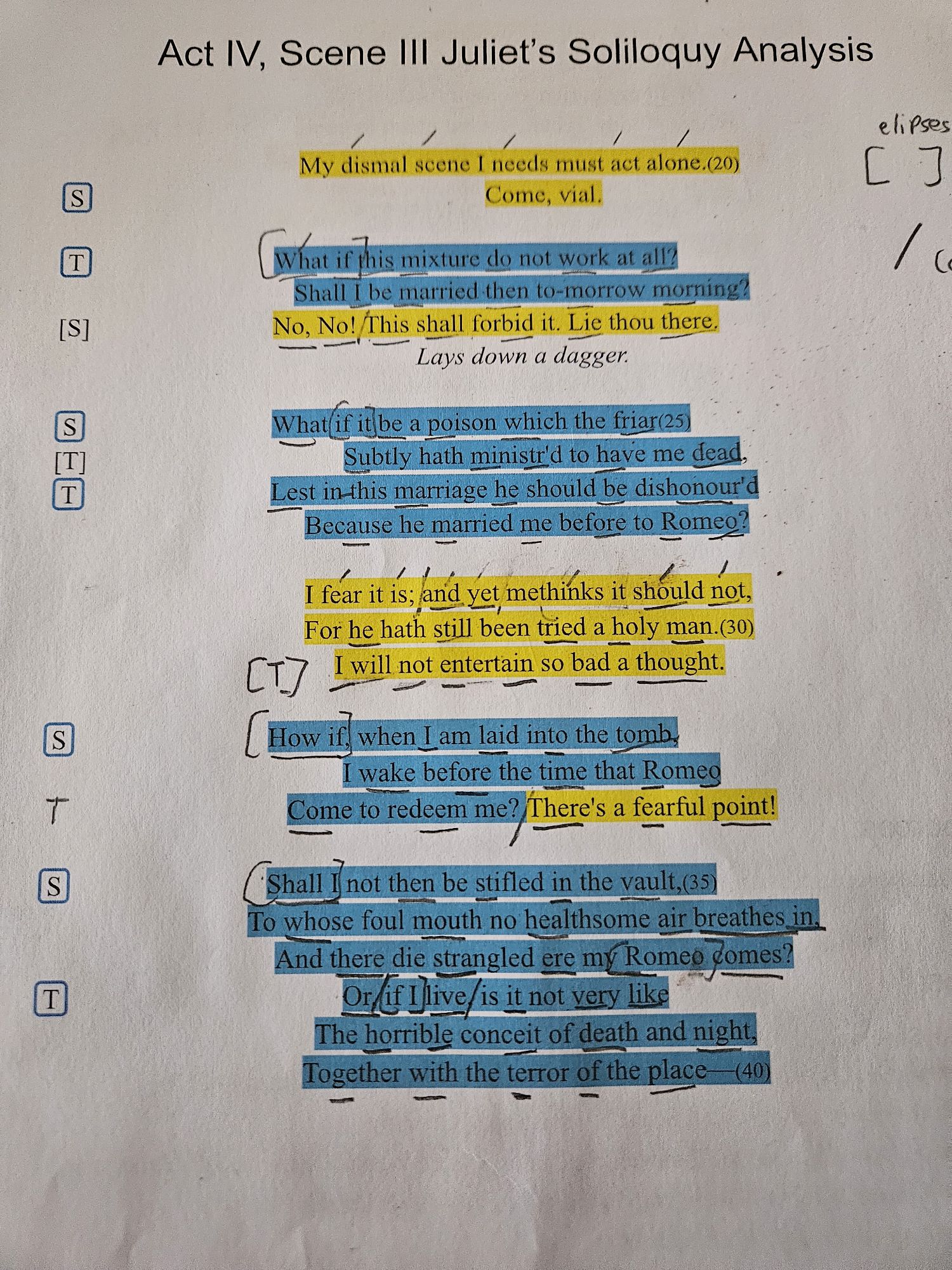
My dismal scene I needs must act alone.
Come, vial. She takes out the vial.
What if this mixture do not work at all?
Shall I be married then tomorrow morning?
She takes out her knife
and puts it down beside her.
No, no, this shall forbid it. Lie thou there.
What if it be a poison which the Friar
Subtly hath ministered to have me dead,
Lest in this marriage he should be dishonored
Because he married me before to Romeo?
I fear it is. And yet methinks it should not,
For he hath still been tried a holy man.
How if, when I am laid into the tomb,
I wake before the time that Romeo
Come to redeem me? There’s a fearful point.
Shall I not then be stifled in the vault,
To whose foul mouth no healthsome air breathes in,
And there die strangled ere my Romeo comes?
Or, if I live, is it not very like
The horrible conceit of death and night,
Together with the terror of the place—
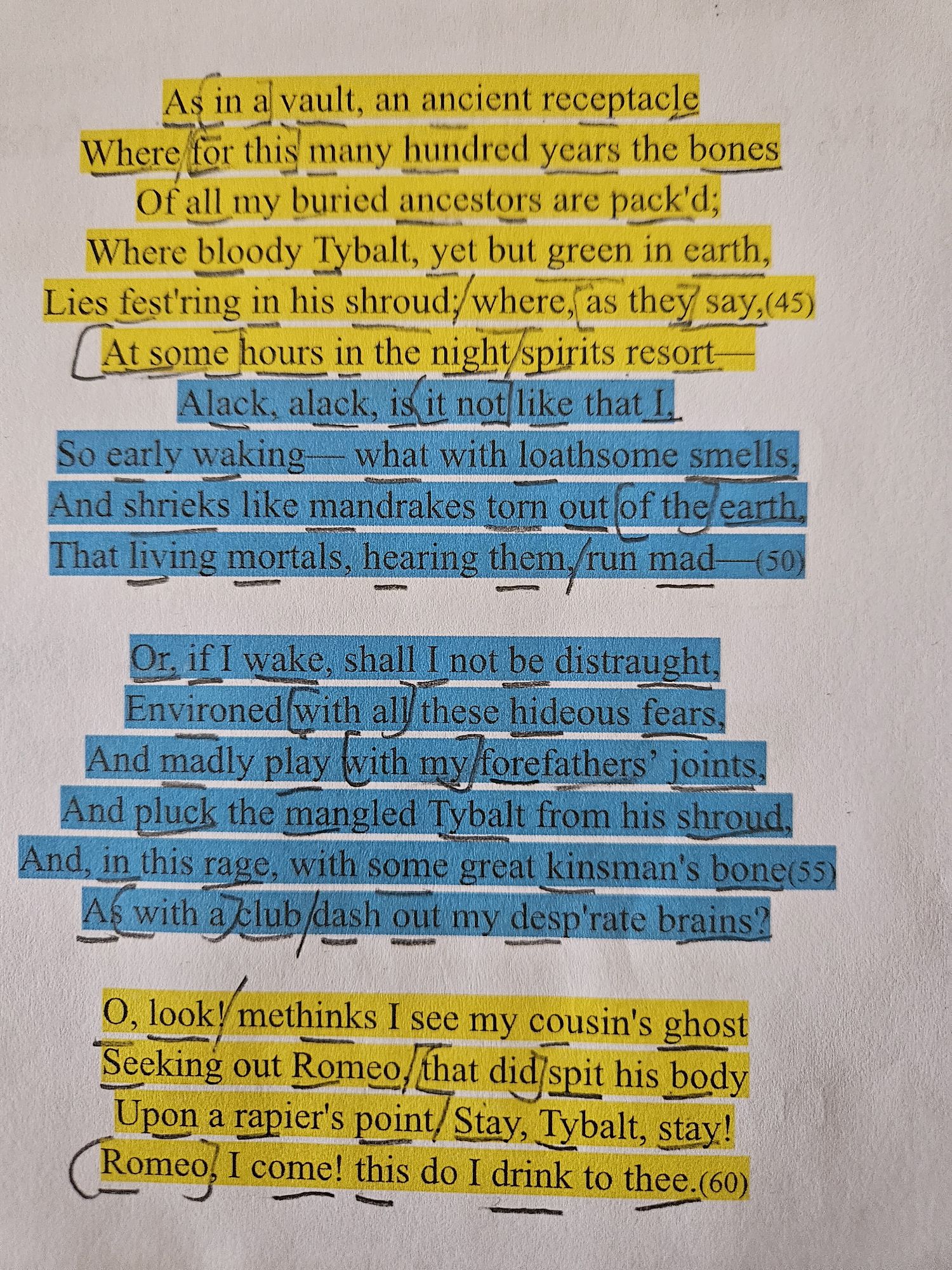
As in a vault, an ancient receptacle
Where for this many hundred years the bones
Of all my buried ancestors are packed;
Where bloody Tybalt, yet but green in earth,
Lies fest’ring in his shroud; where, as they say,
At some hours in the night spirits resort—
Alack, alack, is it not like that I,
So early waking, what with loathsome smells,
And shrieks like mandrakes torn out of the earth,
That living mortals, hearing them, run mad—
O, if I wake, shall I not be distraught,
Environèd with all these hideous fears,
And madly play with my forefathers’ joints,
And pluck the mangled Tybalt from his shroud,
And, in this rage, with some great kinsman’s bone,
As with a club, dash out my desp’rate brains?
O look, methinks I see my cousin’s ghost
Seeking out Romeo that did spit his body
Upon a rapier’s point! Stay, Tybalt, stay!
Romeo, Romeo, Romeo! Here’s drink. I drink to
thee.
She drinks and falls upon her bed
within the curtains.
The Given Circumstances
This famous soliloquy comes from Act IV, Scene iii. In this speech, Juliet grapples with her fears and anxieties about taking the Friar’s sleeping potion.
Traditional Interpretations
Ellen Terry (Vinal Record Recording, C. 1911)
Ms. Terry, like her famous grandson John Gielgud, is more interested in delivering the text clearly, beautifully, and strongly than getting Juliet’s character across. Consequently, by our standards, her reading of the speech is slow, declamatory, and maybe a bit over-the-top. However, this kind of delivery really brings out the rhythm of the verse, the beauty of the individual words, and the structure of the speech itself, so I recommend actors listen to it as a jumping off point. In my opinion, having a good technical grasp of the speech will keep an actor from going too far with the emotion, (making it hard for the audience to hear and understand them). This is why there’s still value in these dusty old recordings.
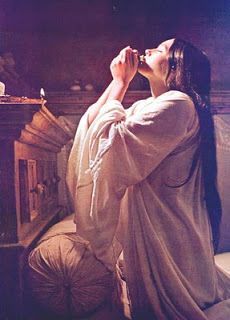
Olivia Hussey (Romeo and Juliet directed by Franco Zephirelli, 1966)
Zephirelli was very sparing with the dialogue- choosing to condense this entire speech to one line “Love, give me strength.” Hussey has a great deal of passion in the speech, as if she is absolutely certain that taking the potion will re-unite her with Romeo.
Claire Danes (Romeo +Juliet, 1996)
Claire Danes contemplating the vial in Romeo + Juliet
Danes has a sense of almost macabe trance-like energy when she delivers the speech. Like all the edged weapons in the movie, the dagger is replaced by a gun. Most of the speech is cut because Luhrman wanted to emphasize the character’s obsession with violence, rather than fears about ghosts and arranged marriages. Consequently, Danes does little other than put the gun under her pillow, take out the vial, and drink it.
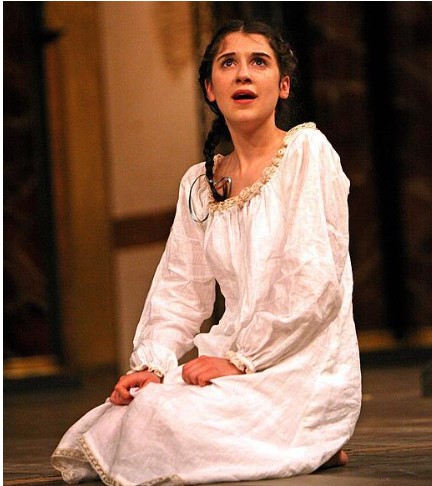
Ellie Kendrick (Globe Theater, 2009)
Ms. Kendrick is one of my favorite Juliets ever! She is a wonderful blend of sweetness and naivety, tempered with anxiety and practical thinking. She delivers the whole speech to different parts of the audience and makes sure every idea and every horrible thought of Juliet lands. Furthermore, her fast pacing around the stage helps her not only connect with the audience, but to use the Globe theater to make them imagine the Capulet vault.
Verse
As I always say, verse is the heartbeat of a character, and based on this, Juliet’s heart is beating a mile a minute. You’ll notice that five of these lines start with a trochee (T), and five of them have trochees. This means Juliet is unsettled, she’s literally off-beat. In addition, there are frequently pauses in the middle of the lines called cesuras, which might indicate that either Juliet is trying to answer her own questions, or that she is so worried, that she’s gasping for breath.
In this second part of the speech, the lines start running together. Juliet’s pace is quickening and she breathes every 2-3 lines instead of at the end of each line.
Structure
The speech is organized as a series of questions:
“What if…”
“What if…”
“How if…”
“Or if I live…”
“O, if I wake, shall I not…”
and then the terrifying statement: “O look…”
So, with this in mind, the actress needs to convey Juliet’s overactive imagination, her fears, and her ability to answer these fears with inner calm and inner strength.
Imagery
It’s a horrific idea being shut up alive with the dead. Shakespeare gives us the sights and smells and the grim reality of feeling “stifled” in a vault. I created this image to demonstrate the smells, the fear, and the claustrophobic nature of the vault.
I chose to have the vault lit with candles, and to use green smoke to represent decay and possibly noxious gas, like the nitre that sometimes dips from walls of tombs. I also added some stone faces of ancestors to stare down at Juliet.
Historical Research
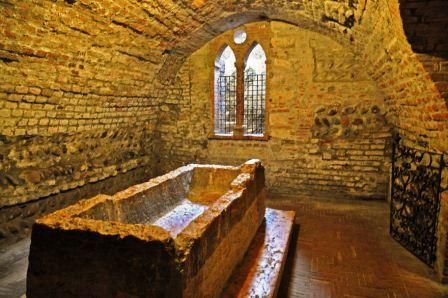
Sarcophagus in church of San Francesco al Corso, an old Franciscan monastery in Verona.
The plain stone sarcophagus above has become a tourist attraction as the traditional ‘resting place’ of Juliet. As I mentioned in my Friar Lawrence post, the Friar who marries Juliet is a Franciscan, which is probably why they chose this church in Verona as the ‘site’ for Juliet’s grave.
It is a plain, open, and partly decayed sarcophagus, in a wild and desolate conventual garden once a cemetery now ruined to the very graves. The situation struck me as very appropriate to the legend, being blighted as their love.
– Lord Byron, Letters and Journals Vol. III
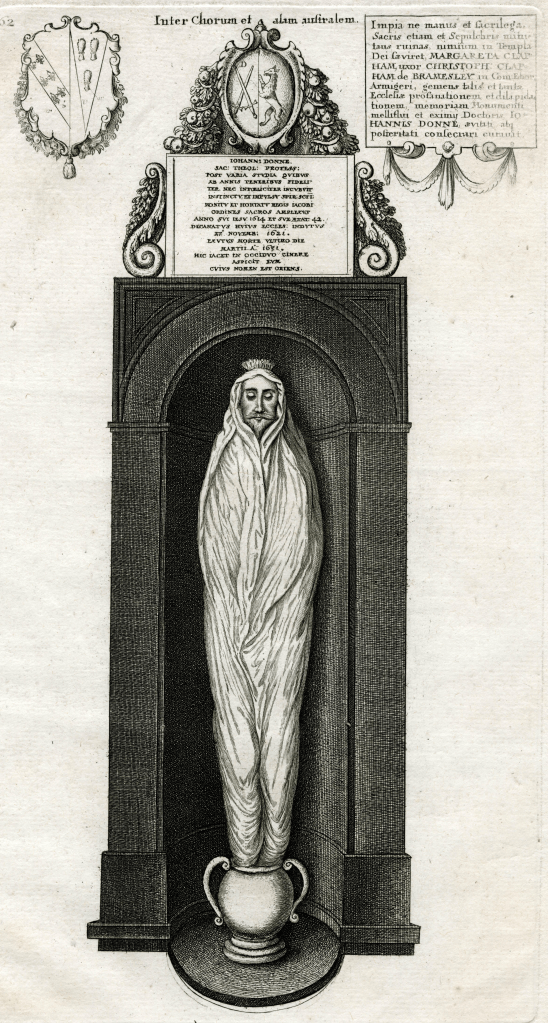
Since Italy is a small, hot country, bodies in the 16th century were buried almost immediately. First, the body would be wrapped up in a shroud or winding sheet, as Juliet mentions at the end. The corpses might be decorated with Rosemary or other sweet-smelling herbs.
A winding sheet for a corpse
Wealthy families like the Capulets or the church, would store all the bodies of their ancestors in burial vaults or crypts. Some bodies would be anointed with oil or preserved with vinegar.
Literary Inspiration: The Cask of Amontillado
Montressor and Fortunato move through the burial crypt in “The Cask of Amontillado”
When I think of the dark, macabre atmosphere of a family tomb, I think of The Cask of Amontillado, a short story by Edgar Allen Poe where the anti-hero Montressor, tricks his enemy Fortunato into going into his family crypt and buries him alive! There are some interesting parallels between Montressor and Tybalt from Romeo and Juliet- both men belong to ancient families, both men are violent, and both refuse to let any kind of insult stand. I think Juliet sees the vault as a hostile place, where her ancestors are angry at her for “betraying the Capulet name,” after marrying a Montague.
Image Research 4: Tybalt’s Angry Ghost
AI image of Tybalt’s Ghost
Like Montressor in The Cask of Amontillado, Tybalt embodies the Capulet feud, and it makes sense that Juliet would see him when she thinks of being shut up in the vault. The real question is, what does seeing him do to her? Is she terrified? Is she remorseful? Is she moved to protect Romeo? How does seeing Tybalt’s ghost motivate her to take the potion?
Other Questions to consider
Why is Juliet so nervous?
How does Juliet feel about running away from home?
Do the ghosts represent something? Guilt? Judgement? Some kind of ticking clock?
What does she see Tybalt’s ghost doing?
How does Juliet pull it together at the end?
Emotional
Not only is Juiet worried about her health, (mental and physical), I get a sense that she might also be experiencing guilt. The notion of her being tormented by spirits that shriek like mandrakes, suggests that maybe the ancient Capulets aren’t very pleased with Juliet. This makes sense because she married a Montegue. I get the sense that maybe, for the first time, Juliet actually feels guilty, as if she’s failed her ancestors. However, for whatever reason, she definitely re-focuses and thinks about Romeo. Either she rejects her ancestors and Tybalt, or maybe she sees the potion as a way of protecting Romeo, or possibly Juliet just wants these fears and anxieties to end, and takes the potion as a release. My actor and I will no doubt try these ideas out and figure out what works within the structure and within her interpretation of the character.
Our Interpretation
Again, it’s a little too early for me to tell you our interpretation yet, but I’ll post it later.
Resources:
Myshakespeare.com. This website will allow you to look up unfamilliar words, download pictures and videos of the scene, and even watch an ‘interview’ with Juliet, where, just as in this speech, she becomes more and more anxious and fearful until the very end.
Outschool.com will be honoring the contributions of Shakespeare during the very first Shakespeare Week on March 21-27th.
course image: Immersive Guide To Romeo and JulietCourse image: Intro To Stage Combat
Course image: Shakespearean Acting Course image: The Violent Rhetoric Of Julius Caesar Course image: Basics of Shakespearean ActingCourse image: Immersive Guide To Macbeth course image: How to Write Like Shakespeare course image: Intro to Shakespeare
I’m honored to take part in this celebration, and I’m offering several aclasses which relate to Shakespeare in an engaging way. Here’s the schedule below:
If you want to sign up for one of my classes, please visit my Outschool page:
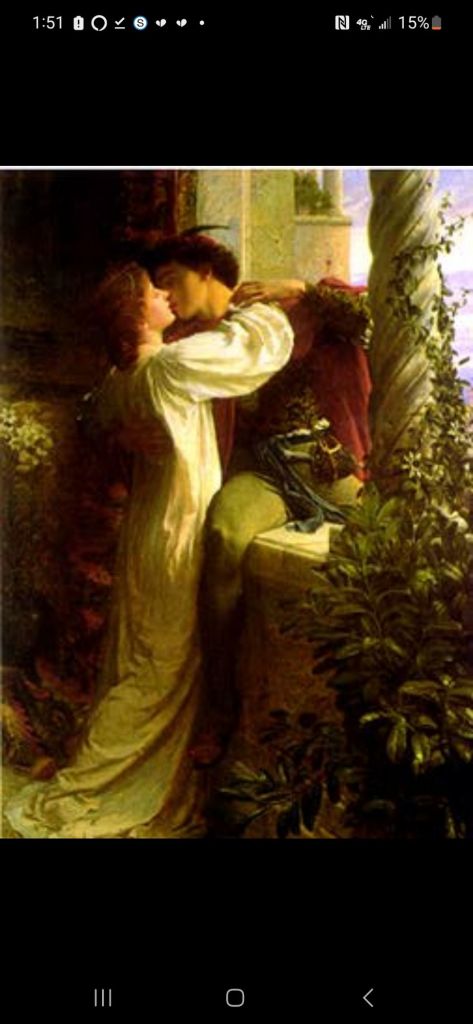
Costumes from thr 1968 Romeo and Juliet FilmOlivia Hussey as Juliet, 1968.“Romeo and Juliet” by Francis Dicksee, 1884.Juliet- Glibe Theater 2007
I’ve seen four live productions of Romeo and Juliet, (5 if you include West Side Story). I’ve also watched four films (6 if you include West Side Story and Gnomio and Juliet) and one thing that I’ve noticed again and again, and again is that you can tell the whole story of the play with clothing. This is a story about families who are part of opposite factions whose children secretly meet, marry, die, and fuse the families into one, and their clothes can show each step of that journey.
The feud Nearly every story about a conflict or war uses contrasting colors to show the different factions. Sometimes even real wars become famous for the clothes of the opposing armies. The Revolutionary War between the redcoats and the blue and gold Continentals, the American Civil War between the Rebel Grays and the Yankee Bluebellies. In almost every production I’ve ever seen, the feud in Romeo and Juliet is also demonstrated by the opposing factions wearing distinctive clothing.
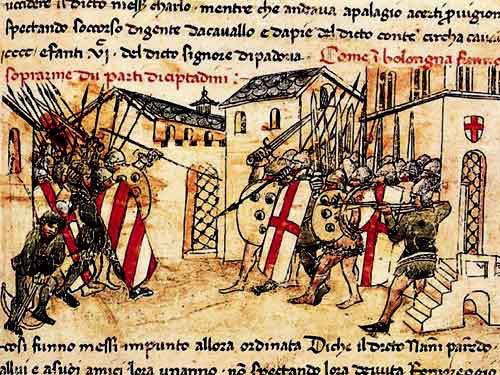
Historically, warring factions in Itally during the period the original Romeo and Juliet is set, wore distinctive clothes and banners as well. . In this medieval drawing, you can see Italians in the Ghibelline faction, who were loyal to the Holy Roman Empire, fighting the Guelph faction (red cross), who supported the Pope. Powerful families were constantly fighting and taking sides in the Guelf vs. ghibelines conflict in Verona, which might have inspired the Capulet Montegue feud in Romeo and Juliet.
Even the servants of the nobles got roped into these conflicts, and they literally wore their loyalties on their sleeves. The servants wore a kind of uniform or livery to show what household they belonged to. The servants Gregory and Sampson owe their jobs to Lord Capulet, and are willing to fight to protect his honor. Perhaps Shakespeare started the play with these servants to make this distinction very obvious. Here’s a short overview on Italian Liveries from the Metropolitan Museum of Art:
In 1966, director Franco Zepherelli set a trend with his iconic use of color in his movie. He chose to make the Capulets wear warm tones while the Montegues wore blue and silver. Juliet (Olivia Hussey) wore a gorgeous red dress that made her look youthful, passionate, and lovely, while Tybalt (Michael York), wore red, orange, and black to emphasize his anger, and jealousy (which has been associated for centuries with the color orange). By contrast, the Montagues like Romeo (Leonard Whiting) wore blue, making him look peaceful and cool. These color choices not only clearly indicate who belongs to which contrasting factions, but also help telegraph the character’s personalities. Look at the way these costumes make the two lovers stand out even when they’re surrounded by people at the Capulet ball:
Dance scene from the iconic 1968 film of Romeo and Juliet, directed by Franco Zeffirelli.Poster for “Gnomio and Juliet, 2011
Zepherilli’s color choices were most blatantly exploited in the kids film Gnomio and Juliet, where they did away with the names Capulet and Montegue altogether, and just called the two groups of gnomes the Reds and the Blues.
The Dance
To get Romeo and Juliet to meet and fall in love, Shakespeare gives them a dance scene for them to meet and fall in love. He further makes it clear that when they first meet, Romeo is in disguise. The original source Shakespeare used made the dance a carnival ball, (which even today is celebrated in Italy with masks). Most productions today have Romeo wearing a mask or some other costume so that he is not easily recognizable as a Montague. Masks are a big part of Italian culture, especially in Venice during Carnival:
In the 1996 movie, Baz Luhrman creates a bacchanal costume party, where nobody wears masks but the costumes help telegraph important character points. Mercutio is dressed in drag, which not only displays his vibrant personality but also conveniently distracts everyone from the fact that Romeo is at the Capulet party with no mask on.
Capulet is dressed like a Roman emperor, which emphasizes his role as the patriarch of the Capulet family. Juliet (Claire Danes) is dressed as an angel, to emphasize the celestial imagery Shakespeare uses to describe her. Finally, Romeo (Leonardo DiCaprio) is dressed as a crusader knight because of the dialogue in the play when he first meets Juliet:
Romeo. [To JULIET] If I profane with my unworthiest hand
This holy shrine, the gentle fine is this:720
My lips, two blushing pilgrims, ready stand
To smooth that rough touch with a tender kiss.
Juliet. Good pilgrim, you do wrong your hand too much,
Which mannerly devotion shows in this;
For saints have hands that pilgrims' hands do touch,725
And palm to palm is holy palmers' kiss.
Romeo. Have not saints lips, and holy palmers too?
Juliet. Ay, pilgrim, lips that they must use in prayer.
Romeo. O, then, dear saint, let lips do what hands do;
They pray, grant thou, lest faith turn to despair.730
Juliet. Saints do not move, though grant for prayers' sake.
Romeo. Then move not, while my prayer's effect I take.
Thus from my lips, by yours, my sin is purged.
Juliet. Then have my lips the sin that they have took.
Romeo. Sin from thy lips? O trespass sweetly urged!735
Give me my sin again.
Juliet. You kiss by the book. Romeo and Juliet, Act I, Scene V, Lines 719-737.
Notice that Romeo calls Juliet a saint, and later an angel in the famous balcony scene, which explains her costume at the ball. Juliet refers to Romoe as a Pilgrim, which is a cheeky comment on his crusader knight costume. In the Crusades, crusader knights made pilgrimages to the holy land, with the hope that God (and presumably, his angels) would forgive their sins. Romeo’s name even means “Pilgrim.” Luhrman makes clever nods to Shakespeare’s text by dressing Romeo and Juliet in this way, and gives the dialogue a bit of a playful roleplay as the characters make jokes about each other’s costumes- Romeo hopes that he will go on a pilgrimage and that this angel will take his sin with a kiss.
In Gnomio and Juliet, the titular characters meet in a different kind of disguise. Rather than going to a dance with their family, they are both simultaneously trying to sneak into a garden and steal a flower, so they are both wearing black, ninja-inspired outfits. Their black clothing helps them meet and interact without fear of retribution from their parents (since they do not yet know that they are supposed to be enemies. The ninja clothes also establishes that for these two gnomes, love of adventure unites them. Alas though, it doesn’t last; Juliet finds out that Gnomio is a Blue, when they both accidentally fall in a pool, stripping their warpaint off and revealing who they are.
Trailer for “West Side Story,” (2021) directed by Steven Spielberg.
Sometimes the dance shows a fundamental difference between the lovers and the feuding factions. West Side Story is a 20th-century musical that re-imagines the feuding families as juvenile street gangs, who like their Veronese counterparts, wear contrasting colors. The Jets (who represent the Montagues) wear Blue and yellow, while the Sharks (Capulets), wear red and black. The gang members continue wearing these colors on the night of the high school dance, except for Tony and Maria (the Romeo and Juliet analogs). In most productions I’ve seen, (including the 2021 movie), these young lovers wear white throughout the majority of the play, to emphasize the purity of their feelings, and their rejection of violence. Thus, unlike Shakespeare’s version of the story, West Side Story makes the lovers unquestionably purer are more peaceful than Shakespeare’s Romeo and Juliet, and their clothing makes this clear.
Romeo (John Warren), meets Juliet (Alesia Lawson) in the 2010 Ashland University production of “Romeo and Juliet,” directed by Ric Goodwin.
The Merging of the family (8:30-11:00)
Costume Designer Charlene in the 2006 AU production deliberately had the characters change clothes when they get married. Juliet was wearing the same iconic red dress as Olivia Hussey for the first two acts of the play but then changed into a pale blue gown that matches Romeo. The clothes re-enforce the idea that the marriage represents Romeo and Juliet abandoning their family’s conflicts, and simply showing their true colors.
Two sets of costumes for Juliet in the 2006 Ashland University Production. Pull the slider bar left to see how Juliet’s costume changes from the start of the show to the end.
Another way of getting everyone in the family to subconsciously unite in grief would be to costume everyone wearing black except Romeo and Juliet. At the end of the play, The Capulets are already mourning Juliet, (because she faked her death in Act IV), and the Montegues are already mourning Lady Montegue (who died offstage). Just by these circumstances, everyone could come onstage wearing black, uniting in their grief, which is further solidified when they see their children dead onstage.
Not all productions choose to costume the characters like warring factions, but nevertheless, any theatrical production’s costumes must telegraph something about the characters. In these production slides for a production I worked on in 2012, the costumes reflect the distinct personality of each character and show a class difference between the Montagues and the Capulets.
The 2013 Film: Costumes Done Badly
The 2013 movie is more concerned with showing off the beauty of the actor’s faces, and the literal jewels than the clothes:
Most of the actors and costumes are literally in the dark for most of the film, probably because the film was financed by the Swarofski Crystal company, who literally wanted the film to sparkle. Ultimately, like most jewelry, I thought the film was pretty to look at, but the costumes and cinematography had little utilitarian value. The costumes and visual didn’t tell the story efficiently, but mainly was designed to distract the audience with the beauty of the sets, costumes and the attractive young actors. The only thing I liked was a subtle choice to make Juliet’s mask reminiscent of Medusa, the monster in Greek Myth, who could turn people to stone with a look. I liked that the film was subtly implying that love, at first sight, can be lethal.
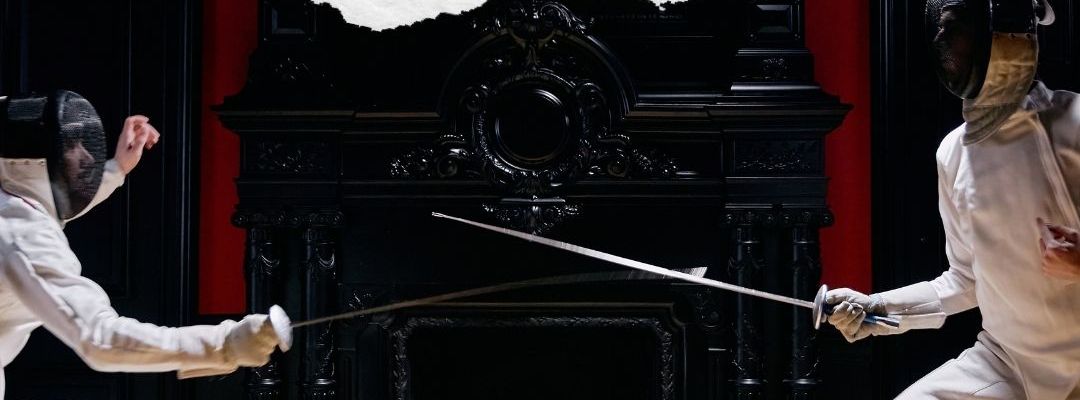
This 7 part class is geared towards students who have taken my class or some other combat class in the past. We will go in-depth into how to train for, rehearse, and perform a fight from a Shakespeare play. We'll cover fight safety, footwork, proper cuing, and selling the fight. I will also contextualize the fights in "Romeo and Juliet," (the play with more fights than any other in Shakespeare), to explain how the Elizabethans felt about violence, and what this play says about violence in our own time.

The class will mostly be up-on- your feet demonstrations with me in front of the camera and the students mirroring my movements, but there will also be handouts, websites, and video presentations to help supplement what I say.

Class Structure:
Week of  March 5th: Background on swords/ sword crafts
-We will learn about the history of swords from ancient military weapons, to the instrument of private dueling. We’ll also cover the culture of duelling that permeated 17th century Europe, as well as the text of Shakespeare’s Romeo and Juliet. The class will conclude with me instructing the kids how to make a practice sword themselves!

Week of March 12: Proper Footwork/ Stances For Sword Combat-
We’ll cover proper stance and en guard positions
We’ll practice advances and retreats
We’ll show you how to do a lunge and the footwork involved.
We’ll incorporate advances and retreats with simple high-low parries and cuts.

Week of March 19th : Cuts, Swipes, and Thrusts
You’ll learn the lines of attack and defense
You’ll learn the proper way to hold a blade and deliver realistic-looking cuts.
Learn how to thrust (online and offline)

Week of March 26th: Parries and other defensive moves
We’ll cover the 6 basic parries to stop an attacker’s blade.
We’ll also cover ducking, avoidances, and

Week April 2nd: Fight Rehearsal 1
We’ll assign roles for the fight between Mercutio, Tybalt and Romeo in Act III I of "Romeo and Juliet." The students will then get a fight
script, and you can practice the fight at ½ speed. We will also explain the concept of Cue-Reaction-Action: A basic stage combat principle/process used to achieve a safe and dramatically effective sequence of events.
We will discuss the importance of eye contact and cuing to ensure that the combatants know what to expect at all times.

Week of April 9th: Fight practice 2
- We'll go through a warm-up fight drill
- We'll rehearse the fight at 3/4 speed to make sure you understand all the moves.
- We'll Incorporate acting into the fight- selling pain, anger, and fear. Use distance to show character relationships.

Week of April 16th: Final Fight performance
- We'll go through a warm-up fight drill again
- We'll rehearse the fight at 3/4 speed again to make sure you understand all the moves.
-We’ll pretend we’re doing this fight for an audience at ¾ speed. If need be, I’ll play one of the aggressors and you can do the fight pretending I’m in the room with you.
At the end of class, I’ll show you a similar fight from my production of Romeo and Juliet and we’ll discuss the differences between our fight and the one I showed the students. Finally, we will discuss the way Shakespeare portrays violence in the play and its relevance in our world.
From now to January 13th, I’m offering a $5 discount for any class that is $10 or more! You can take my Shakespeare classes for as little as $4! Go to my Outschool.com class and enter the coupon code: HTHESNIF6B5 at checkout!
If you’re new to Outschool, use the referral code below when you sign up. You’ll automatically get $20 USD offas a thank you to use on future classes! My referral code is: MaRDyJ13






























 The Shakespearean Student