Outschool.com will be honoring the contributions of Shakespeare during the very first Shakespeare Week on March 21-27th.
course image: Immersive Guide To Romeo and JulietCourse image: Intro To Stage Combat
Course image: Shakespearean Acting Course image: The Violent Rhetoric Of Julius Caesar Course image: Basics of Shakespearean ActingCourse image: Immersive Guide To Macbeth course image: How to Write Like Shakespeare course image: Intro to Shakespeare
I’m honored to take part in this celebration, and I’m offering several aclasses which relate to Shakespeare in an engaging way. Here’s the schedule below:
If you want to sign up for one of my classes, please visit my Outschool page:
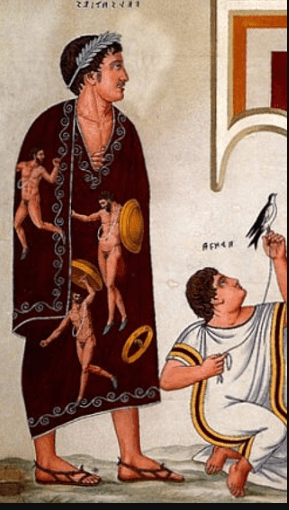
Myth 1: Everyone wore togas! The toga was a formal garment that was worn by male citizens, usually on business, therefore women and slaves couldn’t wear them. Basically, think of a toga as like a 3 piece suit, (which is probably how it felt to those men in the hot Mediterranean sun). Togas were very hot because they were made of wool. As the video below shows, many Romans couldn’t wait to get out of their togas and wear a simple tunic.
Myth 2: All Togas were white
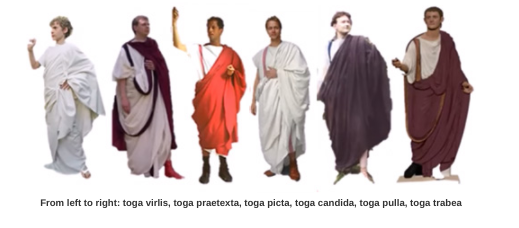
In most movies, and pictures set in Rome, we see rooms full of men wearing white togas, especially in the Senate. However, togas gradually evolved into a variety of styles and colors and helped indicate a Roman man’s status and maturity.
Mosaic of Virgil
Types of Togas and how to wear them:
Shakespeare makes reference to a specific type of toga called a Toga candida: "Bright toga"; a toga rubbed with white chalk to make it appear bright white. In Titus Andronicus, the title character is offered a toga candida by his brother Marcus, when the Senate nominates him for emperor:

Marcus: Titus Andronicus, the people of Rome,
Whose friend in justice thou hast ever been,
Send thee by me, their tribune and their trust,
This palliament of white and spotless hue;
And name thee in election for the empire,
With these our late-deceased emperor's sons:
Be candidatus then, and put it on- Titus Andronicus, Act I, Scene i.

There were many other types of togas for different occasions:
- Dark colors were for funerals
- Red and purple sleeves were for magistrates and senators
- Purple togas with gold embroidery were for victorious generals, and later emperors
Manly garb: Toga virillis
A Toga virilis ("toga of manhood") also known as toga alba or toga pura was A plain white toga, worn on formal occasions by adult male commoners, and by senators not having a curule magistracy. It was a right of passage for young men to put on their toga virilis and assume adult male citizenship and its attendant rights, freedoms and responsibilities.
Women’s fashion
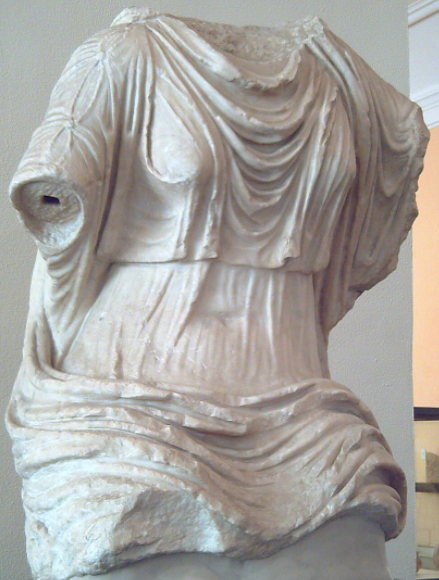
Like men, women most commonly wore tunics, especially when they were unmarried. When women married, they would don a long, elaborate garment called a Stola . The stola was a long dress held on by belts. Sometimes women decorated their Stolas with ribbons and they came in many colors. In the statue below, note how the belts below the breast drape the fabric into elaborate folds, and how the sleeves are slightly slashed on this sumptuous 1st century stola.
Torso of a Roman woman wearing a Stoa (1st century)
Women’s Beauty Regimen
Since Roman women were not legally citizens and couldn’t hold employment, their hair, dress, and makeup were in a way, a celebration of idleness, especially in the case of upper-class women. Aristocratic Roman women had their hair done in elaborate shapes like the Flavian hairstyle and wore elaborate Stoas to indicate how they didn’t have to work or labor in the fields.
In a production of Julius Caesar or Coriolanus, the director could exploit this concept of idleness by giving the more passive characters like Calpurnia or Fulvia more elaborate hairdos and elaborate brightly colored Stolas, while the more active characters like Portia or Valumnia could have a more austere or less fussy hairstyle and dress to show that they are more interested in engaging in politics or the military than sitting around and looking pretty.
One way to learn about Julius Caesar is to learn about the weapons he used as general of on of the most fearsome legions in Rome. In this blade-forging competition from the History Channel, 2 master blacksmiths forge their own versions of a Roman Gladius, and put them to the test!
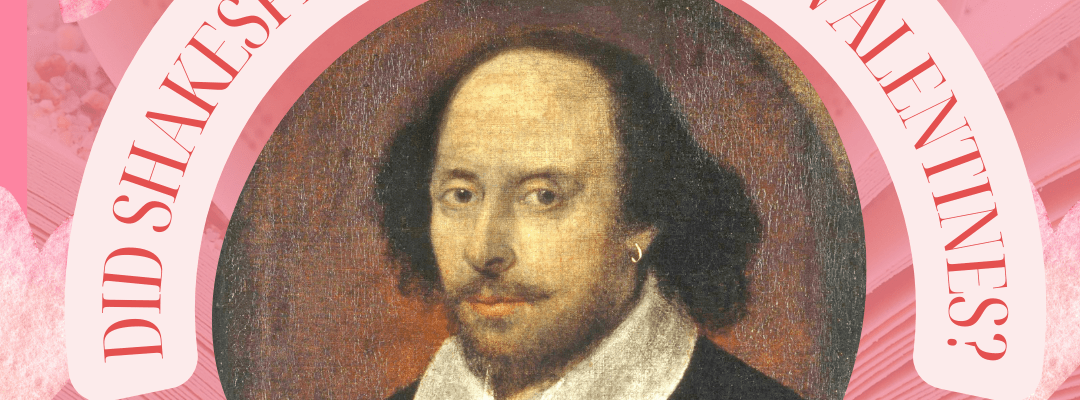
You probably know that I love to speculate and do a little historical detective work and find out whether Elizabethans like Shakespeare celebrated our modern holidays and then compare and contrast how they celebrated them back then versus how we do today. Valentine’s Day is a day we associate with love and poetry, so of course, I wondered if the most celebrated poet of the Renaissance celebrated it himself!
Based on my findings, if Shakespeare celebrated Valentine’s Day, he probably did mainly what we did- writing letters and poems to his beloved and maybe sending a trinket of love. It’s unlikely he celebrated it like modern Catholics do to honor the martyrdom of a Catholic saint. In my research, I was surprised to learn that Valentine’s Day has been celebrated for hundreds of years and has its roots in a holiday that Shakespeare describes in one of his most famous plays.
Part I: The Feast of Lupercal: Valentine’s Day’s Dark Ancestor
According to NPR’s podcast: “The Dark Origins of Valentine’s Day”, like Christmas, Halloween, and many other holidays, the Christian holiday of St. Valentine’s day was designed to replace the pagan holiday of Lupercal, which was a Roman fertility festival where men engaged in basically what we’d now call- swingers’ parties or key parties where they’d draw a woman’s name from a lottery and… couple for the night.
The Lupercal was also synonymous with the founding of Rome. Lupa is the name of the wolf that saved the infants Romulus and Remus, who would become the first kings of Rome. If you click here, you can read an article about a recent archeological discovery; a cave found under Rome that was once revered as the place where Romulus and Remus lived with Lupa:
Shakespeare actually starts his play of Julius Caesar on the Lupercal, and makes reference to its status as a fertility festival. In Act I, Caesar is watching Antony run a race and tells him to be sure to touch Calpurnia, owing to the superstition that if a man touches a barren woman on Lupercal, it will make her capable of bearing children:
Caesar. Calpurnia!
Calpurnia. Here, my lord. 85
Caesar. Stand you directly in Antonius' way,
When he doth run his course. Antonius!
Antony. Caesar, my lord?
Caesar. Forget not, in your speed, Antonius,
To touch Calpurnia; for our elders say, 90

The barren, touched in this holy chase,
Shake off their sterile curse.
Antony. I shall remember:
When Caesar says 'do this,' it is perform'd.
Caesar. Set on; and leave no ceremony out. Julius Caesar, Act I, Scene ii, Lines 84-95
Shakespeare leaves out that, according to tradition, Antony should be naked and anointed with goat’s blood and slap Calpurnia with a goatskin thong, but that was part of the Roman Lupercal festival.
St. Valentine was either a Catholic priest or bishop who was martyred in the 3rd century AD (Source History.com). According to tradition, he conducted Christian marriages in defiance of Roman law, and rejected the concept of Lupercalian coupling, which is why Emperor Claudius murdered him. Thus, the holiday is intentionally meant to replace Lupercalia, and celebrate monogamous relationships under the Christian God. The popular story is that before his death, he sent a letter to the young daughter of a family he converted to Christianity and signed it: “Your Valentine,” thus starting the tradition of signing cards in this manner. In the 5th century, Pope Gelasius made Valentine’s day an official Catholic feast day to replace Lupercal once and for all.
Part III: The oldest surviving Valentines
Evidence is sketchy on how the traditions of Valentine’s Day evolved, in the Middle Ages, but in Catholic Europe, the concept of celebrating married love on Valentine’s Day spread, and poets like Chaucer and Shakespeare helped popularize it.
Geoffrey Chaucer wrote in the 14th century of how birds would choose their mates on Valentine’s Day:
For this was sent on Seynt Valentyne's day
Whan every foul cometh ther to choose his mate.
According to History.com, there’s a possibility that Chaucer invented the idea of a St. Valentine’s feast, and forever linked it with the celebration of love:
The medieval English poet Geoffrey Chaucer often took liberties with history, placing his poetic characters into fictitious historical contexts that he represented as real. No record exists of romantic celebrations on Valentine’s Day prior to a poem Chaucer wrote around 1375. In his work “Parliament of Foules,” he links a tradition of courtly love with the celebration of St. Valentine’s feast day–an association that didn’t exist until after his poem received widespread attention. The poem refers to February 14 as the day birds (and humans) come together to find a mate.
This theme has been repeated in other pieces of literature. In John Lydgate’s 15th-century poem, “A Valentine to Her that Excelleth All”, he writes of how it was the custom on Valentine’s Day for people to choose their love:
To look and search Cupid’s Calendar and choose their choose by great affection.
John Ludgate: “”A Valentine to her that Excelleth All”
The Paston’s oldest surviving valentines
In the 1470s in a series of correspondence, from Margery Brews to her husband John Paston refers to the latter as “My right well-beloved Valentine, John Paston, Esquire.”
Margery also wrote adoring letters to John, who was probably away frequently, fighting in the Hundred Years War, and advising Margary’s kinsman, John Fastolfe, (whom Shakespeare mentions in Henry VI, Part I. Her poetry is very tender and must have comforted her husband much:
And if ye command me to keep me true wherever I go,
I wis I will de all my might you to love, and never no mo(re).
And if my friends say, that I do amiss,
They shall not me let so for to do,
Mine heart me bids ever more to love you
Truly over all earthly thing,
And if they be never so wrath
I trust it shall be better in time coming.
Margery’s letters are some of the earliest surviving Valentine’s poetry. Her letters prove that the tradition of giving poetry to one’s beloved during February was around in the 15th century, and probably while Shakespeare was a child in the 16th.
Shakespeare’s contributions to Valentine’s Day
Shakespeare mentions Saint Valentine’s Day twice in his works. In A Midsummer Night’s Dream, (a play that is set in Ancient Greece and has connections to Lupercal), he builds on Chaucer’s claim that Valentine’s Day is the day that birds couple for the night. Duke Theseus and Aegeus discover the four lovers asleep. They are surprised that they are sharing the same ground, since Lysander and Demetrius (as far as the old men know), are rivals for Hermia’s affection.
Good morrow, friends. Saint Valentine is past: Begin these wood-birds but to couple now?
— A Midsummer Night Dream, Act IV, Scene ii.
Egeus. My lord, this is my daughter here asleep; And this, Lysander; this Demetrius is; This Helena, old Nedar’s Helena:1685 I wonder of their being here together. Theseus. No doubt they rose up early to observe The rite of May, and hearing our intent, Came here in grace our solemnity. But speak, Egeus; is not this the day1690 That Hermia should give answer of her choice? Egeus. It is, my lord. Theseus. Go, bid the huntsmen wake them with their horns. [Horns and shout within. LYSANDER, DEMETRIUS,] HELENA, and HERMIA wake and start up]1695 Good morrow, friends. Saint Valentine is past: Begin these wood-birds but to couple now?
Shakespeare has a much darker reference to Valentine’s Day in Hamlet:
Ophelia has gone mad with the loss of her brother, her father, and Hamlet breaking her heart. She starts wandering the castle and can only communicate through songs. She sings a very melancholy song that alludes to the superstition that if two single people meet on the morning of Saint Valentine’s Day they will likely get married: Tomorrow is Saint Valentine’s Day, All in the morning betime, And I a maid at your window, To be your Valentine. Then up he rose And donned his clothes And dupped the chamber door Let in a maid then out a maid Never departed more.
Ophelia seems to be darkly admitting that she and Hamlet have had pre-marital intimate relations and she is no longer a virgin, The song implies that Ophelia entered Hamlet’s chamber a maid (that is, an unmarried virgin), but is let out a maid (unmarried), while the Hamlet very clearly has taken her virginity. Hamlet re-enforces this suspicion by commanding her to go to a nunnery, one of the only recourse for single mothers. It is reasonable to assume that Shakespeare is implying that Ophelia is in fact pregnant, and is driven mad with sorrow that she now has to deliver her baby without any form of support from her father (who is dead), from her brother (who is in France), or her baby’s father, who wants her to leave and never return. Ophelia’s song is a lament that she wishes the superstition were true, and Hamlet had indeed married her.
It’s unlikely that Shakespeare celebrated Valentine’s Day as a religious holiday, after all, Queen Elizabeth had made England a Protestant country. Celebrating a saint day could have been seen as idolatrous in Protestant England. Nevertheless, Shakespeare and other romantic writers helped transform Valentine’s Day into less of a religious holiday, and more as a secular celebration of love and monogamy, very different from its bloody, promiscuous roots.
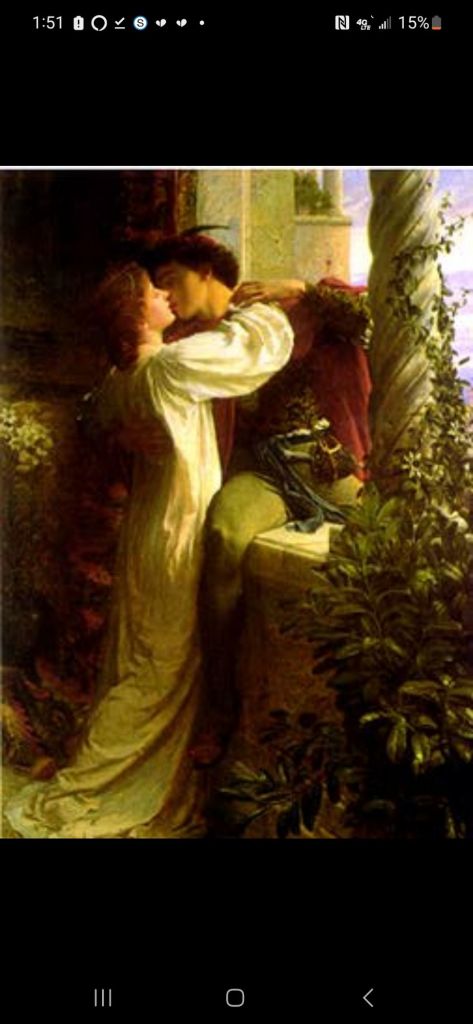
Costumes from thr 1968 Romeo and Juliet FilmOlivia Hussey as Juliet, 1968.“Romeo and Juliet” by Francis Dicksee, 1884.Juliet- Glibe Theater 2007
I’ve seen four live productions of Romeo and Juliet, (5 if you include West Side Story). I’ve also watched four films (6 if you include West Side Story and Gnomio and Juliet) and one thing that I’ve noticed again and again, and again is that you can tell the whole story of the play with clothing. This is a story about families who are part of opposite factions whose children secretly meet, marry, die, and fuse the families into one, and their clothes can show each step of that journey.
The feud Nearly every story about a conflict or war uses contrasting colors to show the different factions. Sometimes even real wars become famous for the clothes of the opposing armies. The Revolutionary War between the redcoats and the blue and gold Continentals, the American Civil War between the Rebel Grays and the Yankee Bluebellies. In almost every production I’ve ever seen, the feud in Romeo and Juliet is also demonstrated by the opposing factions wearing distinctive clothing.
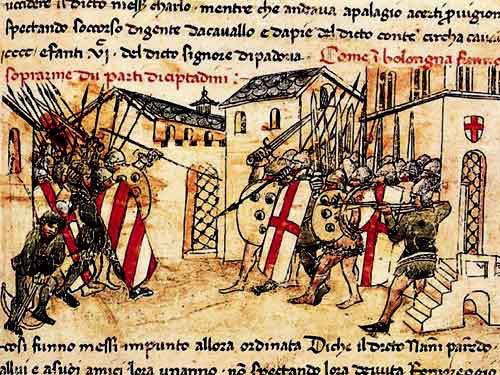
Historically, warring factions in Itally during the period the original Romeo and Juliet is set, wore distinctive clothes and banners as well. . In this medieval drawing, you can see Italians in the Ghibelline faction, who were loyal to the Holy Roman Empire, fighting the Guelph faction (red cross), who supported the Pope. Powerful families were constantly fighting and taking sides in the Guelf vs. ghibelines conflict in Verona, which might have inspired the Capulet Montegue feud in Romeo and Juliet.
Even the servants of the nobles got roped into these conflicts, and they literally wore their loyalties on their sleeves. The servants wore a kind of uniform or livery to show what household they belonged to. The servants Gregory and Sampson owe their jobs to Lord Capulet, and are willing to fight to protect his honor. Perhaps Shakespeare started the play with these servants to make this distinction very obvious. Here’s a short overview on Italian Liveries from the Metropolitan Museum of Art:
In 1966, director Franco Zepherelli set a trend with his iconic use of color in his movie. He chose to make the Capulets wear warm tones while the Montegues wore blue and silver. Juliet (Olivia Hussey) wore a gorgeous red dress that made her look youthful, passionate, and lovely, while Tybalt (Michael York), wore red, orange, and black to emphasize his anger, and jealousy (which has been associated for centuries with the color orange). By contrast, the Montagues like Romeo (Leonard Whiting) wore blue, making him look peaceful and cool. These color choices not only clearly indicate who belongs to which contrasting factions, but also help telegraph the character’s personalities. Look at the way these costumes make the two lovers stand out even when they’re surrounded by people at the Capulet ball:
Dance scene from the iconic 1968 film of Romeo and Juliet, directed by Franco Zeffirelli.Poster for “Gnomio and Juliet, 2011
Zepherilli’s color choices were most blatantly exploited in the kids film Gnomio and Juliet, where they did away with the names Capulet and Montegue altogether, and just called the two groups of gnomes the Reds and the Blues.
The Dance
To get Romeo and Juliet to meet and fall in love, Shakespeare gives them a dance scene for them to meet and fall in love. He further makes it clear that when they first meet, Romeo is in disguise. The original source Shakespeare used made the dance a carnival ball, (which even today is celebrated in Italy with masks). Most productions today have Romeo wearing a mask or some other costume so that he is not easily recognizable as a Montague. Masks are a big part of Italian culture, especially in Venice during Carnival:
In the 1996 movie, Baz Luhrman creates a bacchanal costume party, where nobody wears masks but the costumes help telegraph important character points. Mercutio is dressed in drag, which not only displays his vibrant personality but also conveniently distracts everyone from the fact that Romeo is at the Capulet party with no mask on.
Capulet is dressed like a Roman emperor, which emphasizes his role as the patriarch of the Capulet family. Juliet (Claire Danes) is dressed as an angel, to emphasize the celestial imagery Shakespeare uses to describe her. Finally, Romeo (Leonardo DiCaprio) is dressed as a crusader knight because of the dialogue in the play when he first meets Juliet:
Romeo. [To JULIET] If I profane with my unworthiest hand
This holy shrine, the gentle fine is this:720
My lips, two blushing pilgrims, ready stand
To smooth that rough touch with a tender kiss.
Juliet. Good pilgrim, you do wrong your hand too much,
Which mannerly devotion shows in this;
For saints have hands that pilgrims' hands do touch,725
And palm to palm is holy palmers' kiss.
Romeo. Have not saints lips, and holy palmers too?
Juliet. Ay, pilgrim, lips that they must use in prayer.
Romeo. O, then, dear saint, let lips do what hands do;
They pray, grant thou, lest faith turn to despair.730
Juliet. Saints do not move, though grant for prayers' sake.
Romeo. Then move not, while my prayer's effect I take.
Thus from my lips, by yours, my sin is purged.
Juliet. Then have my lips the sin that they have took.
Romeo. Sin from thy lips? O trespass sweetly urged!735
Give me my sin again.
Juliet. You kiss by the book. Romeo and Juliet, Act I, Scene V, Lines 719-737.
Notice that Romeo calls Juliet a saint, and later an angel in the famous balcony scene, which explains her costume at the ball. Juliet refers to Romoe as a Pilgrim, which is a cheeky comment on his crusader knight costume. In the Crusades, crusader knights made pilgrimages to the holy land, with the hope that God (and presumably, his angels) would forgive their sins. Romeo’s name even means “Pilgrim.” Luhrman makes clever nods to Shakespeare’s text by dressing Romeo and Juliet in this way, and gives the dialogue a bit of a playful roleplay as the characters make jokes about each other’s costumes- Romeo hopes that he will go on a pilgrimage and that this angel will take his sin with a kiss.
In Gnomio and Juliet, the titular characters meet in a different kind of disguise. Rather than going to a dance with their family, they are both simultaneously trying to sneak into a garden and steal a flower, so they are both wearing black, ninja-inspired outfits. Their black clothing helps them meet and interact without fear of retribution from their parents (since they do not yet know that they are supposed to be enemies. The ninja clothes also establishes that for these two gnomes, love of adventure unites them. Alas though, it doesn’t last; Juliet finds out that Gnomio is a Blue, when they both accidentally fall in a pool, stripping their warpaint off and revealing who they are.
Trailer for “West Side Story,” (2021) directed by Steven Spielberg.
Sometimes the dance shows a fundamental difference between the lovers and the feuding factions. West Side Story is a 20th-century musical that re-imagines the feuding families as juvenile street gangs, who like their Veronese counterparts, wear contrasting colors. The Jets (who represent the Montagues) wear Blue and yellow, while the Sharks (Capulets), wear red and black. The gang members continue wearing these colors on the night of the high school dance, except for Tony and Maria (the Romeo and Juliet analogs). In most productions I’ve seen, (including the 2021 movie), these young lovers wear white throughout the majority of the play, to emphasize the purity of their feelings, and their rejection of violence. Thus, unlike Shakespeare’s version of the story, West Side Story makes the lovers unquestionably purer are more peaceful than Shakespeare’s Romeo and Juliet, and their clothing makes this clear.
Romeo (John Warren), meets Juliet (Alesia Lawson) in the 2010 Ashland University production of “Romeo and Juliet,” directed by Ric Goodwin.
The Merging of the family (8:30-11:00)
Costume Designer Charlene in the 2006 AU production deliberately had the characters change clothes when they get married. Juliet was wearing the same iconic red dress as Olivia Hussey for the first two acts of the play but then changed into a pale blue gown that matches Romeo. The clothes re-enforce the idea that the marriage represents Romeo and Juliet abandoning their family’s conflicts, and simply showing their true colors.
Two sets of costumes for Juliet in the 2006 Ashland University Production. Pull the slider bar left to see how Juliet’s costume changes from the start of the show to the end.
Another way of getting everyone in the family to subconsciously unite in grief would be to costume everyone wearing black except Romeo and Juliet. At the end of the play, The Capulets are already mourning Juliet, (because she faked her death in Act IV), and the Montegues are already mourning Lady Montegue (who died offstage). Just by these circumstances, everyone could come onstage wearing black, uniting in their grief, which is further solidified when they see their children dead onstage.
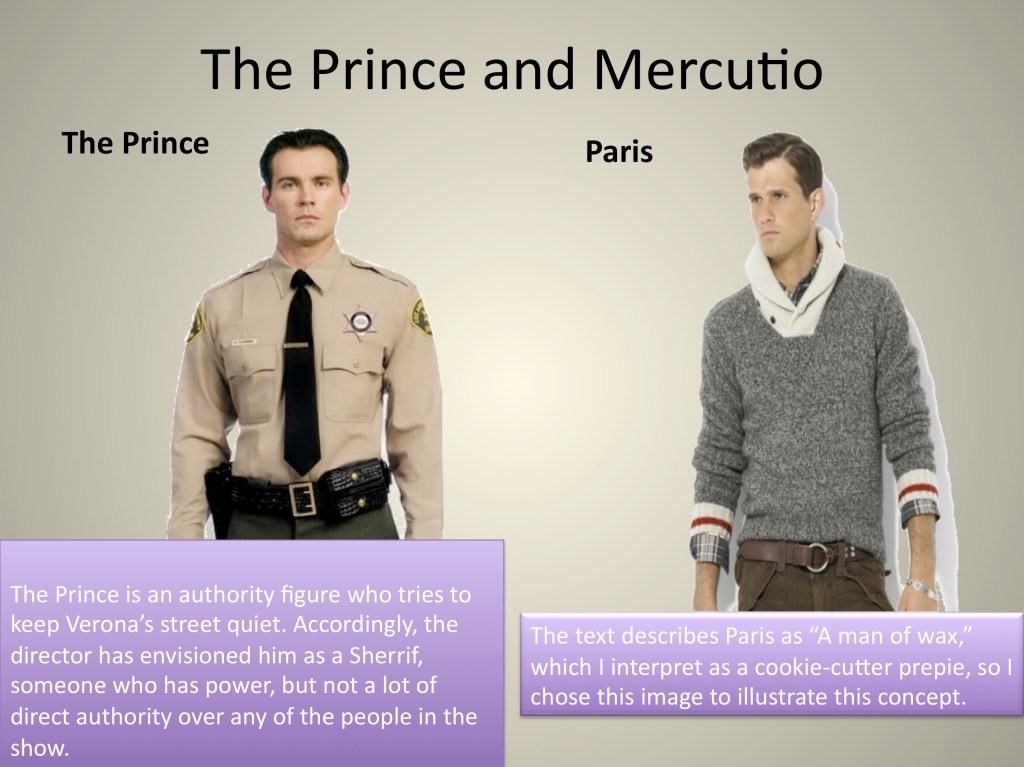
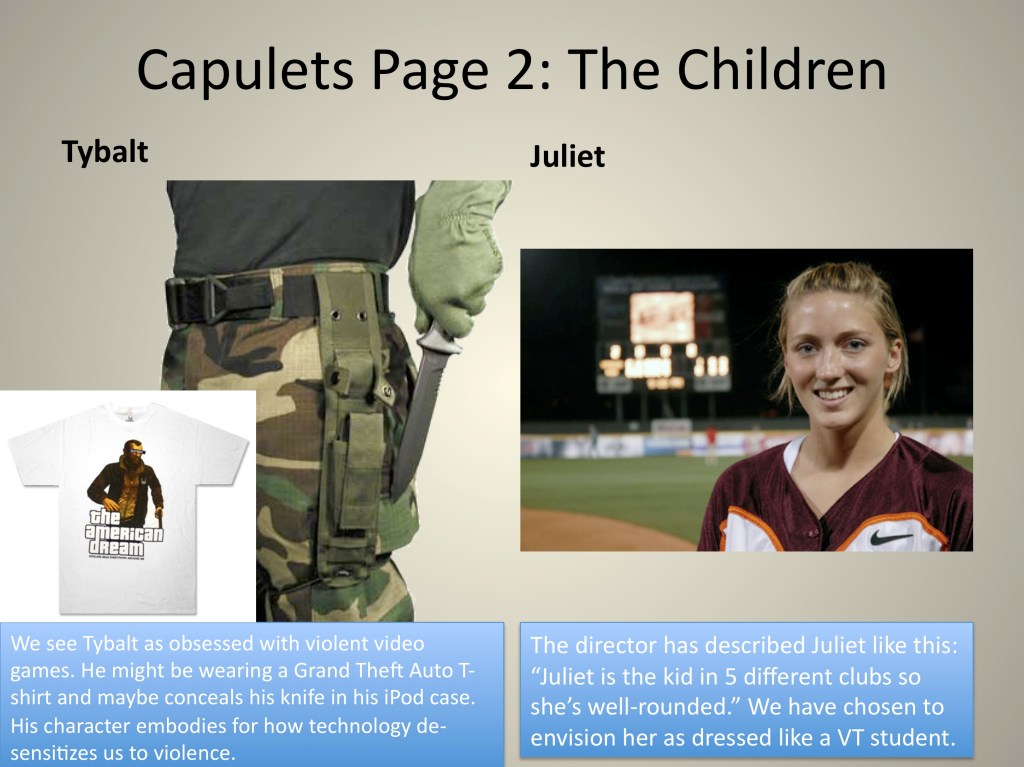
Not all productions choose to costume the characters like warring factions, but nevertheless, any theatrical production’s costumes must telegraph something about the characters. In these production slides for a production I worked on in 2012, the costumes reflect the distinct personality of each character and show a class difference between the Montagues and the Capulets.
The 2013 Film: Costumes Done Badly
The 2013 movie is more concerned with showing off the beauty of the actor’s faces, and the literal jewels than the clothes:
Most of the actors and costumes are literally in the dark for most of the film, probably because the film was financed by the Swarofski Crystal company, who literally wanted the film to sparkle. Ultimately, like most jewelry, I thought the film was pretty to look at, but the costumes and cinematography had little utilitarian value. The costumes and visual didn’t tell the story efficiently, but mainly was designed to distract the audience with the beauty of the sets, costumes and the attractive young actors. The only thing I liked was a subtle choice to make Juliet’s mask reminiscent of Medusa, the monster in Greek Myth, who could turn people to stone with a look. I liked that the film was subtly implying that love, at first sight, can be lethal.
If you’re like me, you are probably saddened by the loss of the great American actor, Sidney Poitier. He was part of the original cast of the great American play A Raisin In the Sun, and earned countless accolades for his roles on stage and screen like In the Heat Of the Night, Porgey and Bess, Guess Who’s Coming To Dinner? and The Greatest Story Ever Told.
In this interview, Poitier’s friend Denzel Washington talks about how Poitier was a beacon, not just for black actors but a gold standard for all actors.
Washington also discusses his role in the film Macbeth, in which he plays the title role. As I mentioned in my Much Ado About Nothing review, Denzel is a consummate performer of Shakespeare and I for one can’t wait to see him as Macbeth. This is nor just because he was an absolute joy in Much Ado, but because Denzel is famous for playing characters that start out as good men become violent and evil in films like Training Day, American Gangster, and Flight. I have high hopes that Denzel’s Macbeth will rank among his greatest performances.
Macbeth is now playing at selected theaters and streaming online on Apple+. I plan to see it and hope that you will too.
From now to January 13th, I’m offering a $5 discount for any class that is $10 or more! You can take my Shakespeare classes for as little as $4! Go to my Outschool.com class and enter the coupon code: HTHESNIF6B5 at checkout!
If you’re new to Outschool, use the referral code below when you sign up. You’ll automatically get $20 USD offas a thank you to use on future classes! My referral code is: MaRDyJ13
I know Halloween is over, but since I am doing a research project on the Salem Witch Trials, I thought I would trace the history of Witch Hunts from Shakespeare’s day to Salem:



























 The Shakespearean Student