Close Reading: Viola’s “I Left No Ring With Her” Soliloquy

For my Shakespeare club, I’m coaching two young actors on Viola’s celebrated soliloquy in Act II, Scene ii.I thought I’d share some of that work with you. In this speech, Viola has an epiphany; the lady she was sent to woo on her master Orsino’s behalf LOVES HER!

The Text

VIOLA

I left no ring with her: what means this lady?
Fortune forbid my outside have not charm’d her!
She made good view of me; indeed, so much,
That sure methought her eyes had lost her tongue,
For she did speak in starts distractedly.
She loves me, sure; the cunning of her passion
Invites me in this churlish messenger.
None of my lord’s ring! why, he sent her none.
I am the man: if it be so, as ’tis,
Poor lady, she were better love a dream.
Disguise, I see, thou art a wickedness,
Wherein the pregnant enemy does much.
How easy is it for the proper-false
In women’s waxen hearts to set their forms!
Alas, our frailty is the cause, not we!
For such as we are made of, such we be.
How will this fadge? my master loves her dearly;
And I, poor monster, fond as much on him;
And she, mistaken, seems to dote on me.
What will become of this? As I am man,
My state is desperate for my master’s love;
As I am woman,–now alas the day!–
What thriftless sighs shall poor Olivia breathe!
O time! thou must untangle this, not I;
It is too hard a knot for me to untie!

Exit

Twelfth Night, Act II, Scene ii, lines 648-672.

The Given Circumstances

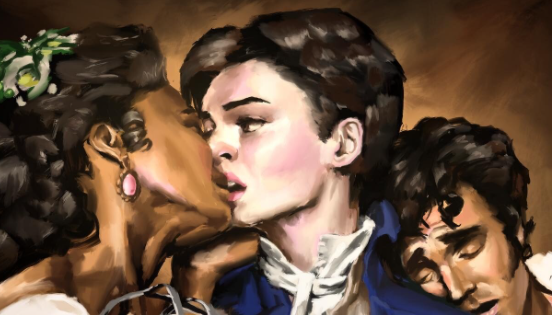
Viola has spent an unspecified amount of time disguised as a man. She has just tried (unsuccessfully) to woo Countess Olivia on behalf of her employer, Duke Orsino. Olivia seemed intrigued by her in her disguise as “Cesario,” and refused to hear any more words about Orsino, but asked Viola to come see her again. The Countess then sent her messenger Malvolio to give Viola a ring, which he claims she tried to give to Olivia as a gift. At first, Viola is confused and upset by the accusation, but slowly realizes that the ring is actually a gift for her; in fact, it’s a love token.

Traditional Interpretations

I think the comedy depends on how Viola reacts to the realization that Olivia loves her. I’ve seen some Violas that are embarrassed, some that are a little frightened (after all, hell hath no fury like a woman scorned), and others with sad sympathy. Viola is a good person, so she can’t laugh at the lovesick countess, but she can have a wry laugh at herself and how her disguise has caused all this trouble; making her unable to confess her love to him, while at the same time making Olivia think she is a handsome young man.

Michelle Terry In the Globe Theater (2021)

Michelle Terry as Viola in the 2021 production of “Twelfth Night”

Michelle Terry is very matter-of-fact in her portrayal. She doesn’t pause, she doesn’t drag out the lines. In fact, she seems more annoyed and scandalized than anything else. The comedy comes mainly from her gestures and movements as she talks to the audience as if they were one of her gal-pals- venting her frustration with this ridiculous situation.

 Michelle Terry excels as Viola, straight-faced, tormented, only occasionally raising a conspiratorial eyebrow at the audience. 

https://www.theguardian.com/stage/2021/aug/08/twelfth-night-review-shakespeares-globe-theatre

Judy Dench in the RSC TV show “Playing Shakespeare” is very sympathetic to “Poor Olivia, ” and plays the speech with a romantic sentimentality. She’s focused on Olivia, and feels awful for the false hope she’s given her.

Both these interpretations are valid, and they’re a good baseline for two sides of Viola’s personality- the sensitive genteel duke’s daughter who is sympathetic to Olivia, and the down-to-earth funny one who is willing to disguise herself as a boy to survive.

Literary Devices

Imagery
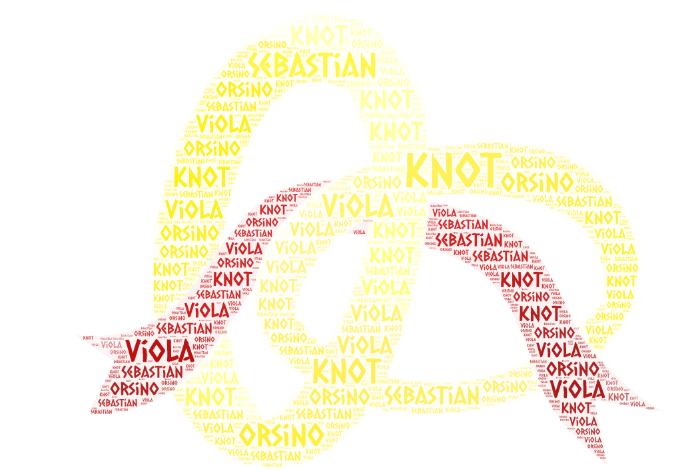
The main image here is the image of the knot- a central image of how convoluted this love triangle is.

Verse
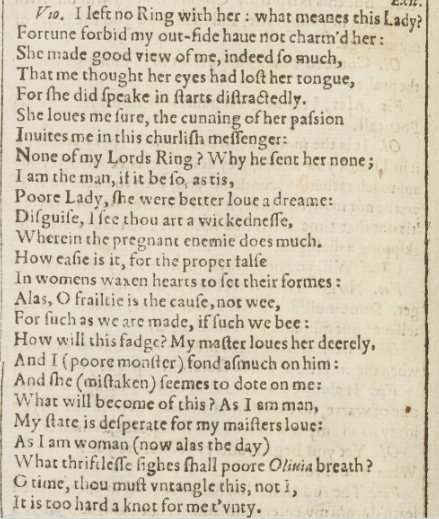
First Folio Reprint from The Boldlien Library.
I left no Ring with her: what meanes this Lady?
Fortune forbid my out‑side haue not charm'd her:
[650]
She made good view of me, indeed so much,
That me thought her eyes had lost her tongue,
For she did speake in starts distractedly.
She loues me sure, the cunning of her passion
Inuites me in this churlish messenger:
[655]
None of my Lords Ring? Why he sent her none;
I am the man, if it be so, as tis,
Poore Lady, she were better loue a dreame:
Disguise, I see thou art a wickednesse,
Wherein the pregnant enemie does much.
[660]
How easie is it, for the proper false
In womens waxen hearts to set their formes:
Alas, O frailtie is the cause, not wee,
For such as we are made, if such we bee:
How will this fadge? My master loues her deerely,
[665]
And I (poore monster) fond asmuch on him:
And she (mistaken) seemes to dote on me:
What will become of this? As I am man,
My state is desperate for my maisters loue:
As I am woman (now alas the day)
[670]
What thriftlesse sighes shall poore Oliuia breath?
O time, thou must vntangle this, not I,
It is too hard a knot for me t'vnty.

It’s interesting to note that (in the First Folio text), the verse alternates between being regular, and using a run-on technique called enjabment, where the thoughts continue after the end of the lines, starting with lines three and four. Ironically, when Viola says that Olivia was distracted and confused when she visited her, her own thoughts are disjointed and fragmentary as she reaches the inevitable conclusion that Olivia is infatuated with Viola in her disguise.

Viola’s Emotional Journey

In the book “Shakespeare’s First Texts” by Neil Freeman he describes how the Folio prints the speech in four distinct sections. Freeman hypothesizes that Shakespeare organized this speech into four phrases that chart the stages of emotions Viola goes through:

Each stage has its own easily identifiable quality, reflecting the growing steps of Viola’s journey in what for her is a huge struggle not only to comprehend, but also to deal with the enormous complications of the dreadful love triangle- the potential results of which are now becomming only too clear.

Freeman, 175.

Stage 1: Introduction

In the first three and a half sentences, Viola goes through the facts- she gave no ring to Olivia, Olivia was eying her, and half paying attention to what Viola was saying. The phrase ends with Viola’s conclusion that Olivia must be in love with her.

Stage 2: Complications

The sentences are of very irregular length- sometimes six words per line, sometimes a few as four. According to Freeman, the irregularity of the verse shows how Viola’s emotions are getting the better of her. Viola could be gasping with remorse over the pain she’s caused Olivia, or shocked at how easily she was taken in by Viola’s disguise.

Stage 3: Crisis/ Catharsis

Each line of this section mentions the people in this love triagle: “My master,” “And I,” “And She,” etc. Viola might be thinking about the possible outcomes to this situation- getting fired, getting discovered, getting married, etc.

Stage 4: Summary: “O Time, Thou Must Untangle This, Not I.”

Like Hamlet before her and Macbeth after her, Viola ends her soliloquy by saying she has no conclusion. She has no idea how to solve this problem, but can only hope that Time will provide a solution.

Audience Interaction

As I said, this is a soliloquy, which is to say, a speech where the character is solo or alone onstage. Some people think this means that the characters are talking to themselves, but I firmly disagree with this notion. One reason why Shakespeare writes soliloquies is because they allow a character to share their thoughts and feelings with the audience. They are the ancestors of every aria or solo in opera and musical theater, and every Disney Princess/ Villain song. I’ve even said before that there are some similarities between Viola and a famous Disney Princess:
Resources:
Illustrations

The Awesome World of “Six” Part II: Full Review Of the Show

I am just ecstatic to talk about this year’s hit Broadway Musical Six. It swept the Tonys, and has opened up touring productions across the country, and I JUST GOT TO SEE IT!

Part I: The Concept: A Historemix.

Welcome to the show, to the histo-remix
Switching up the flow as we add the prefix
Everybody knows that we used to be six wives

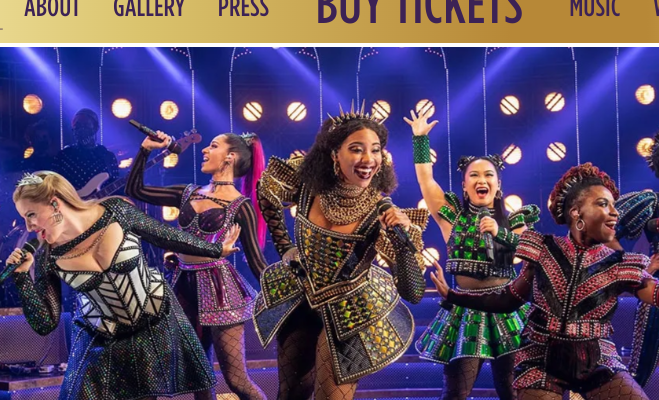
The cast of Six “Ex Wives”

This vibrant, clever retelling of Tudor her-story was created by TOBY MARLOW & LUCY MOSS in association with the Chicago Shakespeare Festival. The show is incredibly smart, and creative, and delves into the lives of some fascinating women, re-told as a singing contest with the characters singing their lives for you to judge what it was like being the queen of England and living with the turbulent and fickle Henry VIII.

What really appeals to me in this show is that like Hamilton, the musical takes these six semi-mythical women and tells their story in a way that is fresh and exciting. It bridges the gap between Tudor History and the modern-day by equating being a queen with being a celebrity, with all the drama of ambitious parents, romantic drama, public opinion, and even being exploited and sexualized by a male-dominated society. This comes across in the music, the costumes, the lyrics, and even the lighting!

Why “Six” Slaps

The costumes are brilliant and iconic. Catherine Of Aragon is like a cross between Beyonce, a saint, and a medieval knight. The lighting is incredible! You could tell the whole story using the lighting design as it pulsates, dances, changes into different colors, turns into different shapes, and finally flashes the name of the show in triumphant gold letters.

One particularly brilliant way the music works in “Six” is the fact that it uses the song “Greensleeves” as a motif both musically and thematically. One big theme of the show is how, unlike Henry VIII, most of the history of his six queens is lost and replaced by legends and even songs. The first line of the show is the famous rhyme about their fates: “Divorced. Beheaded. Died. Divorced. Beheaded. Survived.” As the video above helps illustrate, Marlowe and Moss know that most people only know the rhyme about their deaths and the myth that Henry wrote a song about one of them; that their lives are overshadowed by their deaths and the misconceptions that people have written over the years. Howard Ho points out how the song musically forces itself into the first number, “Ex Wives,” but by the end of the show, the six queens break free from these musical bars! You can hear the change of key and notes during this performance at the Tonys, which puts the opening number and closing reprise together.

The Cast of “Six” perform live at the 2021 Tony Awards.

But how do the queens go from “one word in a stupid rhyme,” to a group of powerful, individual queens singing in harmony, without the man who made them famous? That’s what the solo numbers in “Six” do so incredibly well- tell each queen’s solo stories as rocking ballads, hilarious dis-tracks, soulful love songs, and… well stay tuned.

Part II: The Women and Their Queenspirations

1. Catherine of Aragon

Catherine of Aragon was Henry’s first wife and is still universally beloved, even though Henry decided to divorce her. As the epitome of a stand-alone power queen, it makes sense that Six modeled her character, costume, and songs after Beyonce, with a Shakira-inspired Spanish beat for good measure:

My favorite thing about her solo, “No Way” is how the writers paraphrase her real-life speech during the divorce trial in 1529. Below are the lyrics and the real speech:

You’ve got me down on my knees
Please tell me what you think I’ve done wrong
Been humble, been loyal, I’ve tried
To swallow my pride all along
If you can just explain
A single thing I’ve done to cause you pain, I’ll go

(spoken)
No?

[sung]
You’ve got nothing to say

I’m not going away
There’s no way

Alas, Sir, where have I offended you? Or what occasion have you of displeasure, that you intend to put me from you? I take God and all the world to witness that I have been to you a true, humble and obedient wife, ever conformable to your will and pleasure. This twenty years and more I have been your true wife, and whether it be true or no, I put it to your conscience.

— Katherine of Aragon, 1529

2. Anne Boleyn

In some ways, the version of Anne Boleyn in “Six” is less a pop version of the real queen and more of a commentary on the nature of celebrity. If you watch the video, you can see how in life she was admired for her beauty and fashion but hated for her comments on Queen Katherine, her scandalous love affairs, and her brash nature. This explains the spiky pop-punk princess look they gave her, (which evidently resonates with many audiences since I saw at least two girls cosplaying as Anne in the audience). Sort of like a celebrity who gets canceled on Twitter or Princess Diana, Anne shows how a person can be undone when they dare challenge an established order, especially the Royal Family.

After the show, I found it a bit weird that they portrayed Anne Boleyn as a jetsetting airhead, but then again she is one of the best-known queens in history, so they can get away with it. In reality, Anne Boleyn was highly educated and a member of an ambitious and social climbing family who basically pushed her to woo Henry. As you can see in this clip from “Anne Of A Thousand Days,” Henry and Anne’s family bullied her constantly to become the King’s mistress after HE ALREADY GOT HER SISTER PREGNANT, so Anne knew that the only way to keep Henry from ruining her life was to convince him to divorce Katherine of Aragon and marry her.

Of course, this strategy didn’t save Anne in the end, which says more about how cruel Henry VIII was, chewing up women and spitting them out in his ravenous quest for a son. So is this an accurate portrayal of Anne’s life? No. Is it fun, ABSOLUTELY!

III. Jane Seymore

I’m more than I seem, or am I?

“Six” The Musical.

This version of Jane Seymore was inspired by Adele, so appropriately, she has a heart-wrenching power ballad about her turbulent relationship with Henry. Sadly, we don’t know much about Jane’s real life, so the song takes some liberties. If you go to the Hampton Court Website, you can actually vote as to whether Jane was a devoted wife or a social climbing gold-digger. Probably the real woman was something even more complicated, though we’ll never know for sure.

IV. Anne of Cleaves

Anne of Cleaves is the funniest part of the show! Many of us have heard the story that Henry divorced Anne after he found her ‘ugly.’ What “Six The Musical” does is amend the story, by pointing out that after he divorced her, Henry gave her a castle and a huge retainer, allowing her to live like a queen, without being married to a king! Accordingly, her song is a Rhianna-style dis track that shows off her awesome lifestyle, and spits in Henry’s stupid face!

As fun as this, rags-to-riches story is, the truth is less fun- Anne was the sister of a German duke, so Henry’s lord Chancellor Thomas Cromwell probably forced Henry to marry her for diplomatic reasons (source: Hampton Court: “Anne of Cleaves”). Naturally, Henry didn’t like being told what to do- I suspect he resented Anne before even meeting her because he didn’t get to pick her himself.

As for whether Anne was actually ugly, the truth is really surprising- Henry actually disguised himself as a peasant during a masked ball when he first courted Anne, and she found him repulsive. At the time, Henry was 49 years old, and in very poor health. As such, he was intermittently impotent and blamed his inability to conceive a child with her on her supposed ugliness to save face.

Even though Anne in the show hates Henry, in reality, once the marriage was annulled, Anne and Henry remained good friends for years! She attended his next wedding to Katherine Howard, and, just like in the show, Henry treated her much better after the divorce:

‘YOU SHALL FIND US A PERFECT FRIEND, CONTENT TO REPUTE YOU AS OUR DEAREST SISTER. WE SHALL, WITHIN FIVE OR SIX DAYS …DETERMINE YOUR STATE MINDING TO ENDOW YOU WITH £4000 OF YEARLY REVENUE…YOUR LOVING BROTHER AND FRIEND.’

Henry VIII, 1548, six months after their wedding, when the annullment went through.

V. Katherine Howard

Without question, Katherine Howard is portrayed as the most tragic of Henry’s six wives and her song is a huge sucker punch. The writers never let you forget that Katherine’s first affair was when she was 13, and she died at age 19. Like Anne Boleyn and Jane Seymore, Henry picked Katherine for his queen among his ladies in waiting and her song “All You Wanna Do” satirizes his and many other men’s lustful appetites. The song begins as a raunchy, sexy pop ballad in the vein of Britney Spears’ “Toxic” and “Womanizer” about Katherine Howard’s love affairs, but then devolves into a cry for help, as Katherine confesses how she was abused, used, and manipulated by the men in her life, (including her own cousin Thomas Culpepper) until she was beheaded in 1542. It masterfully satires both Henry’s cruelty and the hypersexualization of teenage pop stars which certainly took its toll on Britney Spears and Ariana Grande, Katherine’s major ‘Queenspirations.’

VI. Katherine Parr

Historically, Katherine Parr had to turn away her fiancee Thomas Seymore (just like Anne Boleyn was previously engaged to Henry Percy) once the king set his eyes on her for his wife, so her song is a sad, soulful Alicia Keys-inspired bittersweet song where she tearfully says goodbye to Thomas to spare his feelings and probably his life.

Not only does this song once again show how Henry’s selfishness and his lust ruined the lives of the women he married, (as well as the men who already wanted to marry them), but it also sets up the main idea of the show:

His-Story overthrown

In the final number, the wives turn the tables on Henry- they have spent centuries being defined by him, but in reality, he is just as much defined by them! Going forward, history should not define these great women as just, “The Six Wives of Henry the Eighth,” but to celebrate their individual lives and contributions to history. Katherine Parr mentions this when she points out that in life, she fought to allow women to be educated, she wrote books, and was a scholar of theology. Historically, Henry and Katherine would argue about religion and he nearly executed her after she disagreed on points of theology, but Katherine kept her life by claiming she was “Not disagreeing with [him], but simply learning from [him].”

Remember that I was a writer
I wrote books and psalms and meditations

Fought for female education
So all my women can independently study scripture
I even got a woman to paint my picture
Why can’t I tell that story?
‘Cause in history
I’m fixed as one of six
And without him
I disappear
We all disappear

Genius Annotation2 contributors

I Don’t Need Your Love is sung by Catherine Parr in SIX: The Musical. The first part of the song refers to her love of Thomas Seymour, whom she probably wanted to marry rather than Henry (and did marry after Henry’s death). However, the song also protests at the fact that women are often defined by their relationship with men, rather than as people in their own right. Catherine wants to be remembered for what she did, rather than the men she married or loved.

Katherine Parr, Six.

The final number completes the idea of the ‘historemix’ by having the Six queens/pop stars come up with a re-imagined happy ending for themselves, one that doesn’t include the pain that Henry inflicted on them: Katherine A becomes a singing nun, (like Whoopi Goldberg in Sister Act), while Anne Boleyn starts writing lyrics for Shakespeare (which is a fun idea since he does mention “Greensleeves” twice). Jane Seymore forms a band with her many surviving children, Katherine Howard goes solo, and Katherine Parr joins the other queens in a supergroup. It’s not at all historical, but it is a fun and sweet way to put an epilogue on these (mostly) tragic lives.

It’s odd, however, that the show invents an epilogue instead of talking about the six queen’s greatest legacy- Queens Elizabeth and Mary I. For a show that wants to highlight the often-forgotten legacy of these queens, it is an odd oversight. Remember Catherine and Anne gave birth to queens who eventually ruled England without a king. Jane Seymore gave birth to a king, and Catherine Parr helped raise them and restored them to the line of succession- She’s the reason her stepdaughters were able to become queens in the first place.

My issues with the epilogue aside, it is great to see history be recontextualized and shared in such an accessible way. We all know that European history is dominated by the names of white guys- king whoever, duke what’s-his name. To see important women in history be given a voice by a multi-ethnic cast is a great way to make it resonate, and using the metaphor of pop stars works extremely well in this context- these women mostly didn’t choose stardom, but they deserve it for what they went through.

Brava.

Educational links related to the six wives of Henry VIII:

Books

TV:

Web:
https://www.history.com/news/henry-viii-wives

https://sixonbroadway.com/about.php

https://www.hrp.org.uk/hampton-court-palace/history-and-stories/anne-of-cleves/

Resources on Shakespeare’s History Plays:

Books

  1. Shakespeare English Kings by Peter Saccio. Published Apr. 2000. Preview available: https://books.google.com/books?id=ATHBz3aaGn4C
  2. Shakespeare, Our Contemporary by Jan Kott. Available online at https://books.google.com/books/about/Shakespeare_Our_Contemporary.html?id=QIrdQfCMnfQC
  3. The Essential Shakespeare Handbook
  4. The Essential Shakespeare Handbook by Leslie Dunton-Downer and Alan Riding Published: 16 Jan 2013.
    77ace26dfdee4259bf48d6eed1a59d57
  5. Will In the World by Prof. Steven Greenblatt, Harvard University. September 17, 2004. Preview available https://www.amazon.com/Will-World-How-Shakespeare-Became/dp/1847922961

TV:

The Tudors (TV Show- HBO 2007)

“The Six Wives of Henry VIII” (BBC, 1970)

Websites

Happy Twelfth Day of Christmas Everyone!

Hello everyone! I’m back from break and happy to celebrate one of my favorite holidays with you- the one that gave its name to one of Shakespeare’s greatest comedies- Twelfth Night

How to throw a Twelfth Night Party

How To Throw A Twelfth Night Party

How to Make a Twelfth Night Cake

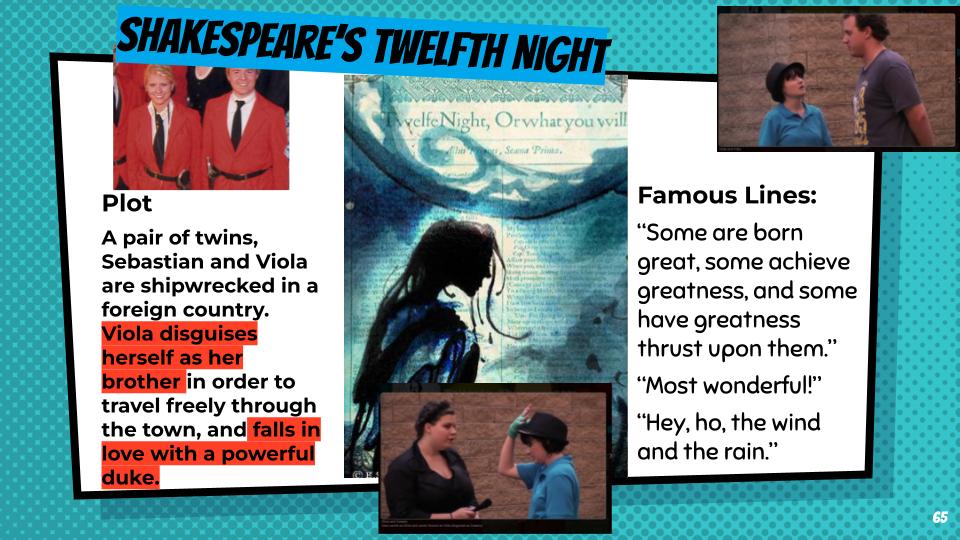
Intro to Twelfth Night (THe play)

I’ve been in this play three times and I’m continually struck by how fun, romantic, and progressive it is. It raises questions about gender roles, social norms, bullying, and even catfishing and heteronormativity! It’s a fascinating and thought-provoking play and it’s my favorite of Shakespeare’s comedies!

Shakespeare’s early comedies are about young love, infatuation, and being ‘madly in love’ (sometimes literally). His middle plays are about mature relationships between men and women and the need for commitment. I would argue that Twelfth Night, (and possibly Much Ado About Nothing), are the best examples of Shakespeare telling meaningful stories about romantic relationships.

Past Posts on “Twelfth Night”

  1. Play of the Month: Twelfth Night
  2. The Fashion Is the Fashion: Twelfth Night
  3. Crafting a Character: Malvolio
  4. Exquisite Artwork from Twelfth Night

Would you like to know more? Take a class!

In honor of “Twelfth Night,” I’ve created a coupon for my course on Shakespeare’s comedies from now till January 31st: Get $10 off my class “Shakespeare’s Comic Plays” with coupon code HTHESYTIT110 until Jan 31, 2023. Get started at https://outschool.com/classes/shakespeares-comic-plays-868BR5hg and enter the coupon code at checkout.

To finish I wanted to give you a complete production of Twelfth Night for your viewing pleasure, but I can’t decide which one, so I will post a bunch today! 

1. 1996 TV movie starring Geoffrey Rush (Pirates of the Caribbean)

2.1996 Thames TV directed by Kenneth Branaugh 

The Awesome world of “Six”

One really fun thing I like to see each Thanksgiving is the live previews of some of Broadway’s hottest shows. You may remember that I first became acquainted with the musical “Something Rotten,” after seeing a live performance at the Macy’s Day Parade. I am just ecstatic to see and talk about this year’s hit Broadway Musical Six. It swept the Tonys, and has opened up touring productions across the country.

The Cast of “Six” perform live at the 2021 Tony Awards.

This vibrant, clever retelling of Tudor her-story was created by TOBY MARLOW & LUCY MOSS in association with the Chicago Shakespeare Festival.

The show is incredibly smart, and creative, and delves into the lives of some fascinating women, re-told as a singing contest with the characters singing their lives for you to judge what it was like being the queen of England, and living with the turbulent and fickle Henry VIII. What really appeals to me in this show is that like Hamilton, the musical takes these six semi-mythical women and tells their story in a way that is fresh and exciting.

Part I: Shakespeare’s “Henry VIII:” How NOT to tell a queen’s story

Around 1613, Shakespeare wrote his final play- his 10th history play which loosely told the life of English king Henry the Eighth.

I happen to know a lot about this play since I was in it back in 2008, as you can see in the slideshow above. As you might notice, this play doesn’t tell the story of all of Henry’s wives. We only see the last few years of Catherine of Aragon’s life, and the beginning of Henry’s marriage to Anne Boleyn. Most of the drama actually centers around Henry and his scheming advisor, Cardinal Wolsey. Maybe I’m biased because I played this role, but frankly, Woolsey is treated in the play as a stereotypical Machiavellian villain, who conveniently leads the king astray so he can be the hero of the play. Woolsey does all of Henry’s dirty work; taking over his government, spearheading his divorce to Catherine, and trying to dissuade the king from listening to Anne Boleyn’s Protestant ideas, dismissing her as a “spleeny Lutheran.” Shakespeare leaves it ambiguous as to whether Henry actually told Woolsey to do any of these things so the audience will blame Woosey, instead of the king.

I’ll be blunt, aside from the courtroom scene at Blackfriars, where Katherine pleads for Henry not to dissolve their marriage, and the fun dances and costumes in the scene where Anne flirts with Henry, the play is really quite boring. though I blame Jacobean censors more than Shakespeare for this. Even after the entire Tudor dynasty was dead and buried, powerful people in the English government controlled what Shakespeare could say about them.

Part II: The women take wing

During Shakespeare’s life time, the wives of Henry VIII were bit players at best. With the exception of Katherine of Aragon and Anne Boleyn (who in most narratives have often been cast as either virgins or whores), the lives of Jane Seymore, Anne of Cleaves, Catherine Howard and Catherine Parr were barely told until the 20th century, where new feminist scholarship sparked renewed interest in these women and how they lived.

TV series like The Tudors, movies like The Other Boleyn Girl, and of course books and documentaries by

III. Why “Six” Slaps

Let husbands know
Their wives have sense like them: they see and smell
And have their palates both for sweet and sour,
As husbands have.
Emilia, “Othello,” Act IV, Scene iii.

Well, I can’t yet give an objective view of the plot and characters of “Six,” because I haven’t seen it…(yet). But until then, let’s just say that like “Hamilton,” it is great to see history be recontextualized and shared in such an accessible way. We all know that European history is dominated by the names of white guys- king whoever, duke what’s-his name. To see important women in history be given a voice by a multi-ethnic cast is a great way to make it acessible.

Bravo.

Educational links related to the six wives of Henry VIII:

Books

TV:

Web:
https://www.history.com/news/henry-viii-wives

https://sixonbroadway.com/about.php

Resources on Shakespeare’s History Plays:

Books

  1. Shakespeare English Kings by Peter Saccio. Published Apr. 2000. Preview available: https://books.google.com/books?id=ATHBz3aaGn4C
  2. Shakespeare, Our Contemporary by Jan Kott. Available online at https://books.google.com/books/about/Shakespeare_Our_Contemporary.html?id=QIrdQfCMnfQC
  3. The Essential Shakespeare Handbook
  4. The Essential Shakespeare Handbook by Leslie Dunton-Downer and Alan Riding Published: 16 Jan 2013.
    77ace26dfdee4259bf48d6eed1a59d57
  5. Will In the World by Prof. Steven Greenblatt, Harvard University. September 17, 2004. Preview available https://www.amazon.com/Will-World-How-Shakespeare-Became/dp/1847922961

TV:

The Tudors (TV Show- HBO 2007)

“The Six Wives of Henry VIII” (BBC, 1970)

Websites

THe Fashion Is the Fashion: Ancient Roman Fashion and Beauty

http://www.historyofclothing.com/clothing-history/roman-clothing/#:~:text=Roman%20clothing%20consisted%20of%20toga,in%20water%20and%20then%20aired.

Roman Fashion 101:

Roman clothing Myths!

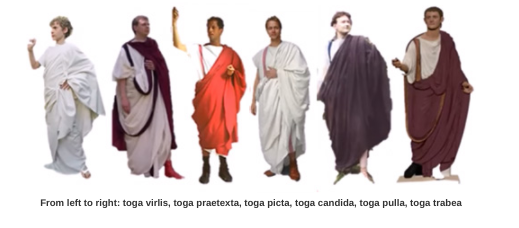
  1. Myth 1: Everyone wore togas! The toga was a formal garment that was worn by male citizens, usually on business, therefore women and slaves couldn’t wear them. Basically, think of a toga as like a 3 piece suit, (which is probably how it felt to those men in the hot Mediterranean sun). Togas were very hot because they were made of wool. As the video below shows, many Romans couldn’t wait to get out of their togas and wear a simple tunic.

Myth 2: All Togas were white

In most movies, and pictures set in Rome, we see rooms full of men wearing white togas, especially in the Senate. However, togas gradually evolved into a variety of styles and colors and helped indicate a Roman man’s status and maturity.

Types of Togas and how to wear them:

Shakespeare makes reference to a specific type of toga called a Toga candida: "Bright toga"; a toga rubbed with white chalk to make it appear bright white. In Titus Andronicus, the title character is offered a toga candida by his brother Marcus, when the Senate nominates him for emperor:

Marcus: Titus Andronicus, the people of Rome,
Whose friend in justice thou hast ever been,
Send thee by me, their tribune and their trust,
This palliament of white and spotless hue;
And name thee in election for the empire,
With these our late-deceased emperor's sons:
Be candidatus then, and put it on- Titus Andronicus, Act I, Scene i.

There were many other types of togas for different occasions:
- Dark colors were for funerals
- Red and purple sleeves were for magistrates and senators
- Purple togas with gold embroidery were for victorious generals, and later emperors

Manly garb: Toga virillis

A Toga virilis ("toga of manhood") also known as toga alba or toga pura was A plain white toga, worn on formal occasions by adult male commoners, and by senators not having a curule magistracy. It was a right of passage for young men to put on their toga virilis and assume adult male citizenship and its attendant rights, freedoms and responsibilities.

Women’s fashion

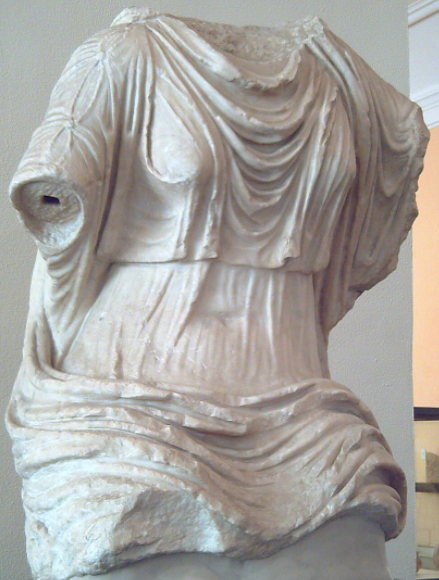
Like men, women most commonly wore tunics, especially when they were unmarried. When women married, they would don a long, elaborate garment called a Stola . The stola was a long dress held on by belts. Sometimes women decorated their Stolas with ribbons and they came in many colors. In the statue below, note how the belts below the breast drape the fabric into elaborate folds, and how the sleeves are slightly slashed on this sumptuous 1st century stola.

Read more at: https://www.ducksters.com/history/ancient_rome/clothing.php

Torso of a Roman woman wearing a Stoa (1st century)

Women’s Beauty Regimen

Since Roman women were not legally citizens and couldn’t hold employment, their hair, dress, and makeup were in a way, a celebration of idleness, especially in the case of upper-class women. Aristocratic Roman women had their hair done in elaborate shapes like the Flavian hairstyle and wore elaborate Stoas to indicate how they didn’t have to work or labor in the fields.

Major female Roman hairstyles, nationalclothing.org

In a production of Julius Caesar or Coriolanus, the director could exploit this concept of idleness by giving the more passive characters like Calpurnia or Fulvia more elaborate hairdos and elaborate brightly colored Stolas, while the more active characters like Portia or Valumnia could have a more austere or less fussy hairstyle and dress to show that they are more interested in engaging in politics or the military than sitting around and looking pretty.

References:

“The Romans – Clothing” History on the Net
© 2000-2022, Salem Media.
March 11, 2022 <https://www.historyonthenet.com/the-romans-clothing>

Ducksters. “Ancient Rome for Kids: Clothing and Fashion.” Ducksters, Technological Solutions, Inc. (TSI), http://www.ducksters.com/history/ancient_rome/clothing.php. Accessed 11 March 2022.

http://nationalclothing.org/565-traditional-clothing-in-ancient-rome-what-did-they-wear.html