Crafting a Character: Brutus

Happy Ides of March every one. I hope you have enjoyed all the posts for my Roman week. If I have time, I will try to post a few more, since I have not touched on Cymbaline or Titus Andronicus.This will not be an in depth character analysis. I won’t go into every scene and speech of Brutus’. My goal is to look at the history and the actions of Brutus in the play to show why he is such an amazing and ambigous character.

Marcus Brutus was born in 85 BC. Shakespeare’s source for the play, Plutarch’s lives of the Noble Greeks and Romans, mentions that his desire to kill Caesar might have been tied to his family: Brutus’ ancestor was Lucius Junius Brutus, the man who drove out the last king of Rome, and first consul. Below is the famous painting of Lucius foiling a plot to restore the monarchy, but to do so, he had to sentence his own sons to death:
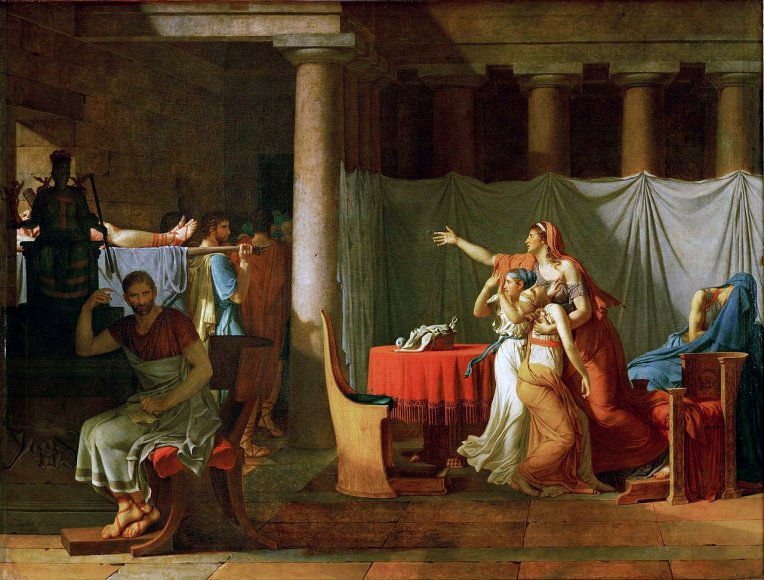
Jaques Louis David, The Lictors Bring to Brutus the Bodies of His Sons, 1789.

https://www.khanacademy.org/humanities/monarchy-enlightenment/neo-classicism/v/david-the-lictors-returning-to-brutus-the-bodies-of-his-sons-1789

This was how seriously the Brutus family took defending the Roman Republic, they valued it even beyond their own family.

Brutus’ mother was Servilia, half sister of Caesar’s longtime critic, the senator Cato. He even married Cato’s daughter Portia! So you can see that once Caesar starts acting like a king, Brutus must have felt a tremendous amount of pressure from his Family to stay true to his Republican ideology. On the other hand, Servillia was actually Caesar’s mistress and Brutus owed his life to Caesar. After Brutus fought against Casesar, they reconciled after the Battle of Pharsalus in 48 BC:

Most of those who were taken alive Caesar incorporated in his legions, and to many men of prominence he granted immunity. One of these was Brutus, who afterwards slew him. Caesar was distressed, we are told, when Brutus was not to be found, but when he was brought into his presence safe and sound, was pleased beyond measure- Plutarch, retrieved from: http://penelope.uchicago.edu/Thayer/E/Roman/Texts/Plutarch/Lives/Caesar*.html

Despite his close ties to Caesar, Brutus chose to betray and assassinate him, so the question remains, why?

In the play and in Plutarch, Brutus is persuaded by Cassius Longinus, his brother in law and colleague in the Roman Senate. As you remember from my post on “Friends, Romans, Countrymen,” there are three basic kinds of persuasive speech, and Cassius uses all three:

1. Ethos “If you do know that I do fawn on men, and hold them hard, and after scandal them… then hold me dangerous.”

2. Logos- Cassius points out a series of embarrassing stories about Caesar that set up the following argument:

• Caesar is weak and frail

• Gods cannot be frail

• Why is Caesar treated like a god?

3. Pathos

• The people

• Fear of tyranny

• Brutus’ family honor- this is the real knife that kills any doubt Brutus had. Cassius reminds Brutus of his ancestor Lucius and how he would rather die than see a king in Rome again.

The soliloquy

Brutus. It must be by his death: and for my part,
I know no personal cause to spurn at him,

But for the general. He would be crown’d:
How that might change his nature, there’s the question.
It is the bright day that brings forth the adder;
And that craves wary walking. Crown him?—that;—
And then, I grant, we put a sting in him,
That at his will he may do danger with.
The abuse of greatness is, when it disjoins
Remorse from power: and, to speak truth of Caesar,
I have not known when his affections sway’d
More than his reason. But ’tis a common proof,
That lowliness is young ambition’s ladder,
Whereto the climber-upward turns his face;
But when he once attains the upmost round.
He then unto the ladder turns his back,
Looks in the clouds, scorning the base degrees
By which he did ascend. So Caesar may.
Then, lest he may, prevent. And, since the quarrel
Will bear no colour for the thing he is,
Fashion it thus; that what he is, augmented,
Would run to these and these extremities:
And therefore think him as a serpent’s egg
Which, hatch’d, would, as his kind, grow mischievous,
And kill him in the shell.

• This speech is a direct predecessor for “To be or not to be,” and Macbeth’s “If it were done,” soliloquy. https://youtu.be/IoDwXjKIenI

  • All three speakers are talking about murder and can’t bring themselves to say either the word murder, nor mention the name of the man who will die.

• All references to murder are in passive voice, as if Brutus wishes a lightning bolt would kill Caesar, so he doesn’t have to accept the responsibility of killing.

•Compared to Hamlet and Macbeth, Brutus’ text is flat, The speech depends on the actor to show the torment in his soul.

  • One question that the actor must answer for himself is, is Brutus really concerned for the well being of Rome, or does he want Caesar dead for another reason?

After the soliloquy, Brutus throws himself into the role of head conspirator: https://youtu.be/ibzqdoV-BcU https://youtu.be/ibzqdoV-BcU

You can see in this video that Brutus speaks eloquently about how just the cause is and how only Caesar will die. This illustrates that Brutus is well spoken but not pragmatic. As we all know, Marc Anthony eventually gets the crowd to turn on Brutus and will become part of the army that hunts him and Cassius down. The dramatic irony is what helps the argument that Brutus is the real tragic hero of this play.

The murder and its aftermath

The rest as they say, is history. On March 15th, 44 BC, Brutus and the conspirators stabbed Caesar 17 times. In the play, before Caesar dies, he utters the famous line, “Et tu, Brute? Then fall Caesar!”

The line stands out because it is the only time anyone in this Roman play speaks in Latin. Now, I have heard a compelling argument from Professor J. Rufus Fears, that this might actually be a misquote, and what Caesar really said will amaze you. As I have mentioned, Brutus’ mother was Caesar’s mistress and the two of them were very close. At the time of Caesar’s death he was 40, while Caesar was 16 years his senior. Why did Caesar forgive Brutus fighing against him? Is it not possible that what he actually said was: “Et tu, son?” That’s a question for directors and actors, but it does heighten Brutus’ emotional conflic. Much like his ancestor Lucius, Marcus Brutus is caught between his ideals and his family.

During the funeral, Brutus has a very well crafted speech where he lays out his reasons for killing Caesar. He sets himself up as the friend of Rome. This video from the Royal Shakespeare Company explores the techniques that Brutus uses to get the crowd on his side: https://youtu.be/nyPlvuv8SSk

After Antony makes his speech however, the mob burns Brutus’ house and even slaughters a man just because he shares a name with one of the conspirators. Brutus and Cassius take their armies and flee Rome, and prepare to take on Antony and Octavian. The adversity Cassius and Brutus go through pushes them together and they behave like brothers; they fight and reconcile constantly: https://youtu.be/K9EAxjVC22M

In a way, these men are two sides of the same coin: Cassius is fiery but pragmatic while Brutus is stoic and idealistic. It’s like a tragedy in and of itself that these men weren’t melded into one man with Brutus’ heart and Cassius’ mind.

Is Brutus A Traitor?

Unlike Macbeth, Shakespeare’s text leaves it ambiguous as to whether Brutus was right or wrong to kill Caesar. Even Antony, who leads an army against him, ends the play by calling Brutus “The noblest Roman of them all.” Shakespeare also gives us few clues to Brutus’ motivations other than the speech I quoted earlier. Mainly we have to go on Brutus’ actions and their consequences.

One moment that I think perfectly encapsulates the ambiguity of Brutus’ actions is the moment where he’s visited by Caesar’s ghost. In other tragedies like Macbeth and Richard III, the villain is tormented by the ghost or ghosts of people he murdered. The ghost serves as a manifestation of the murderer’s guilty conscience and torments him before his death. When Brutus sees Caesar, he does not follow this trope. He isn’t horrified, not struck by guilt, in fact, he wishes that the ghost would stay longer.

Julius Caesar by William Shakespeare

Julius Caesar book cover

MENU

In Act 4, why does Caesar’s ghost appear? I don’t understand why Caesar’s ghost shows up. I dont understand the significance of that scene.

Expert Answers info

JUANAMAC

eNotes educator

| CERTIFIED EDUCATOR

Shakespeare, as other Elizabethan writers, uses the idea of ghosts in his plays usually as a foreshadowing of events to come. In “Hamlet,” Hamlet has to deal with working out what to do with his father’s request for revenge, and also, whether the ghost is indeed his father. In “Macbeth“, Macbeth has to deal with the Ghost of Banquo showing up to dinner, literally haunting him. In “Richard III“, Richard deals with the ghosts of the men he has wronged right at the start of the play.

This haunting is significant also in “Julius Caesar“. The Ghost of Julius arrives on the eve of battle to literally haunt Brutus. Brutus had hoped that by killing Caesar he would enact change in Rome, however, the Roman Empire goes on, as does the reign of Caesar (albeit, a new Caesar).

As Brutus goes into battle, and the battle doesn’t go his way, he again turns to Julius Caesar, blaming him for the outcome of the battle,

O Julius Caesar, thou art mighty yet!
Thy spirit walks abroad, and turns our swords
In our own proper entrails. (5.3.94–96)

Shakespeare’s ghosts are visible to one person (as well as the audience, clearly) so those who react to the ghost are the ones who are supposed to learn from the arrival of the ghost, heeding the message from beyond the grave.

Enter the Ghost of CAESAR

How ill this taper burns! Ha! who comes here?
I think it is the weakness of mine eyes
That shapes this monstrous apparition.
It comes upon me. Art thou any thing?
Art thou some god, some angel, or some devil,
That makest my blood cold and my hair to stare?
Speak to me what thou art.

GHOST

Thy evil spirit, Brutus.

BRUTUS

Why comest thou?

GHOST

To tell thee thou shalt see me at Philippi.

BRUTUS

Well; then I shall see thee again?

GHOST

Ay, at Philippi.

BRUTUS

Why, I will see thee at Philippi, then.

Exit Ghost

Now I have taken heart thou vanishest.
Ill spirit, I would hold more talk with thee.

The ghost itself also resists the clearcut definition as a sign of a guilty conscience. It doesn’t accuse Brutus of murder, it doesn’t curse in fact, all the ghost says is that Brutus will see him at Philippi. Unlike Richard III or Macbeth, the ghost utters no curses or scare Brutus out of his mind.

The only conclusion that Brutus gleans is that his end is near. According to Dr. John Langdon, many Elizabethan ghosts serve as a shorthand to indicate that the play’s denouement is on its way. Brutus seems aware of this as well- he knows that if he sees a ghost, he’s likely to be one soon. Yet the reality of his impending death doesnt change Brutus; he doesn’t express remorse like Richard III or hopelessness like Macbeth, if anything his stocism and seeming world weariness makes him seem more like a hero like Hamlet during his “Not a whit, we defy augery,” speech. This passive embrace of fate is at the core Brutus and it illustrates how hard it is to truly decide if he is a villain or a hero.

Though Shakespeare wrote the character of Brutus as ambiguous, over the centuries many artists and cultures have passed judgment on Brutus. Dante in his book Inferno example places Brutus and Cassius in the lowest circle of Hell, who along with Judas Iscariot, are being forever devoured by Satan himself, imagined below in a medieval illustration as a three-headed beast. You can see the name Brut in the head on the right.

By contrast, during the French Revolution, many statesmen referred to Brutus as a hero for his noble attempt to destroy a corrupt monarchy.

One day men will be astonished by the fact that humanity in the eighteenth century was less advanced than in the time of Caesar. Then a tyrant was slain in the midst of the Senate with no formalities but thirty blows of a dagger and with no other law save the liberty of Rome Louis Antoine de Saint-Just, November 13th, 1792, (2 months before the execution of Louis XVI).

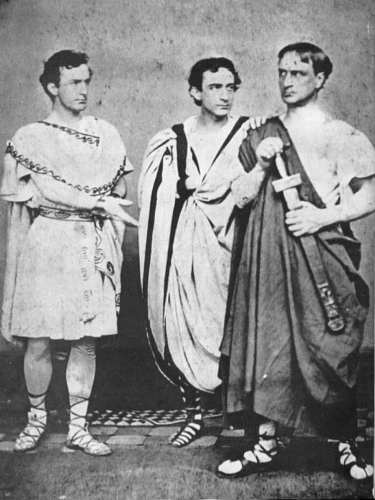
As I have written before, in the 20th and 21st centuries, America has a somewhat more complex relationship with the character of Brutus. On the one hand, America was founded on the principle of resisting tyranny; it’s even on the state flag of Virginia, which is why some early productions of the play make Brutus a hero. On the other hand, as you see above, rebels and traitors like John Wilkes Booth have also taken inspiration from Brutus. His father and brother’s middle name was Brutus and all three brothers performed in the play one year before John turned theater performance into American tragedy.

Like Brutus, Booth seemed amazed with the world’s reaction to his deed, for after he assassinated the president, he wrote this in his journal:

[W]ith every man’s hand against me, I am here in despair. And why; For doing what Brutus was honored for … And yet I for striking down a greater tyrant than they ever knew am looked upon as a common cutthroat.”

John Wilkes Booth, April 21, 1865.
The most recent controversy over Brutus’ actions is the 2017 Shakespeare in the Park production of Caesar directed by Oscar Eustis. As I wrote before, when portraying Caesar as an American president, it tends to anger the political party of his supporters, but the play shows how unplanned political violence can destabilize a country. In these productions, Brutus seems a bit of a well meaning dupe or an naive patsy acting out of fear. On the other hand in cultures that have suffered many violent uprisings, Brutus is a figure that is all to common in places like Uganda, Iran, and the Taliban controlled world: https://youtu.be/5HU8SA33j2w

Brutus is a great character because Shakespeare keeps enough of his motives in the dark to allow for new interpretations, but also showing a man with relatable desires and fears get swept up in a dangerous and unpredictable time.

Why Mechant Of Venice is the Perfect Play For the Holidays 

The Merchant Of Venice is unquestionably Shakespeare’s most controversial play- it covers such topics as anti-semitism, religious hypocrisy, racism, slavery, and the meaning of justice and mercy. As I have written before, few people read this play in school, but I believe that it has many lessons to teach our children. I also believe its lessons are also very much a part of the Christmas/ Hanukkah/ Kwanza holiday season, and here’s why:

Short summary

Famous quotes

  • All that glitters is not gold.
  • Hath not a Jew Eyes
  • The quality of mercy is not strained

You may very well wonder why this play about greed and prejudice reflects the warm holiday spirit. I would argue that, like cold winter snow, this play emphasizes the importance and the need for compassion, humanity, and generosity because without it society becomes truly frigid.

Merchant Of Venice takes an unflinching look at greed, prejudice, and religious hypocrisy, while at the same time retaining a hope for peace on Earth and goodwill towards men.

One of the best ways I can justify the connection between Merchant and the holidays is by comparing it to the quintessential Christmas story, Charles Dickens’ A Christmas Carol. In terms of tone, themes and especially characters, these two classics are very close indeed. Shylock is an ancestor of Scrooge- in addition to both being money lenders, both men are miserly, cold, and willing to destroy lives for wealth. Shylock even has a ghost that comes back to haunt him. Shylock mentions a ring that he got from his late wife Leah, similar to how Scrooge lost his only love, Belle. Just as Scrooge is a counterexample of everything that Christmas stands for, Shylock’s greediness, cruelty, and hatred of the people around him make him a figure to avoid, no matter what holiday you celebrate.

Merchant also raises questions about materialism, which we should all consider around the holidays. Shylock especially mentions this in quotes like: “You take my life when you take the means whereby I live.”

The themes of Merchant also reflect a modern multicultural holiday season. In one example which I wrote about before, The Prince Of Morocco has a great speech that calls to mind the concept of kuchijagulia, or self determination, one of the 7 principles of Kwanzaa.

According to the official Kwanza website, kuchijagulia means, “To speak up for oneself,” and Morocco definitely does that:

Mislike me not for my complexion,

The shadow’d livery of the burnish’d sun,

To whom I am a neighbour and near bred.

Bring me the fairest creature northward born,

Where Phoebus’ fire scarce thaws the icicles,

And let us make incision for your love,

To prove whose blood is reddest, his or mine.

I tell thee, lady, this aspect of mine

Hath fear’d the valiant: by my love I swear

The best-regarded virgins of our clime

Have loved it too: I would not change this hue,

Except to steal your thoughts, my gentle queen. Merchant Of Venice, Act II, Scene I.

Moracco’s unwillingness to change who he is makes him a model of the kind of pride African Americans celebrate during Kwanza. In addition Shylock, the Jewish moneylender, is also very proud of his heritage. His famous quip: “Sufferance is the badge of all our tribe,” expresses perfectly the resilience of the Jewish people, which of course is the central point of Hanukkah.

When it comes to Christmas, Antonio demonstrates a Christ- like self sacrifice, when he lets himself be arrested and nearly killed by Shylock.

Bassanio. Good cheer, Antonio! What, man, courage yet!

▪ The Jew shall have my flesh, blood, bones and all, 2045

▪ Ere thou shalt lose for me one drop of blood.

Antonio. I am a tainted wether of the flock,

▪ Meetest for death: the weakest kind of fruit

▪ Drops earliest to the ground; and so let me

▪ You cannot better be employ’d, Bassanio, 2050

▪ Than to live still and write mine epitaph.

While Antonio’s actions mirror Christ’s sacrifice. Portia’s famous “The Quality Of Mercy Is Not Strained,” speech, goes to the heart of the reason why Christ came to earth; to grant mercy to the sinners who would be damned otherwise

Portia. Do you confess the bond?

Antonio. I do.

Portia. Then must the Jew be merciful.

Shylock. On what compulsion must I? tell me that.

Portia. The quality of mercy is not strain’d, 2125

▪ It droppeth as the gentle rain from heaven

▪ Upon the place beneath: it is twice blest;

▪ It blesseth him that gives and him that takes:

▪ ‘Tis mightiest in the mightiest: it becomes

▪ The throned monarch better than his crown; 2130

▪ His sceptre shows the force of temporal power,

▪ The attribute to awe and majesty,

▪ Wherein doth sit the dread and fear of kings;

▪ But mercy is above this sceptred sway;

▪ It is enthroned in the hearts of kings, 2135

▪ It is an attribute to God himself;

▪ And earthly power doth then show likest God’s

▪ When mercy seasons justice. Therefore, Jew,

▪ Though justice be thy plea, consider this,

▪ That, in the course of justice, none of us 2140

▪ Should see salvation: we do pray for mercy;

▪ And that same prayer doth teach us all to render

▪ The deeds of mercy. Merchant Of Venice, Act IV Scene I.

Shakespeare no doubt wrote these characters to reflect the Christian values many people celebrate at Christmas. Meanwhile the play’s comic subplot with Bassanio and Portia teaches Christians about generosity and mercy. As I have written before, the character Bassanio is the moral center of the play, and his journey mirrors many characters in classic Christmas stories who learn about giving and receiving, the true meaning of Christmas.

In Act III, Scene ii, Bassanio participates in the highest stakes Secret Santa gift exchange ever: three boxes of gold, silver, and lead are set before him.

If Bassanio picks the right gift, he will be rich, powerful, and married to a beautiful woman, but the winning box is inscribed with a warning: “Who chooses me must give and hazard all he has.” Bassanio wins the gift auction, which means he may marry the beautiful Portia, but he gives her the choice to marry him or not: https://youtu.be/6IFSMgggS8k

[Music, whilst BASSANIO comments on the caskets to himself]

Bassanio. So may the outward shows be least themselves: 1440

The world is still deceived with ornament.

▪ In law, what plea so tainted and corrupt,

▪ But, being seasoned with a gracious voice,

▪ Obscures the show of evil? In religion,

▪ What damned error, but some sober brow 1445

▪ Will bless it and approve it with a text,

▪ Hiding the grossness with fair ornament?

▪ There is no vice so simple but assumes

▪ Some mark of virtue on his outward parts:

▪ How many cowards, whose hearts are all as false 1450
Look on beauty, 1455

▪ And you shall see ’tis purchased by the weight;

▪ Which therein works a miracle in nature,

▪ Therefore, thou gaudy gold,

▪ Hard food for Midas, I will none of thee;

▪ Nor none of thee, thou pale and common drudge 1470

▪ ‘Tween man and man: but thou, thou meagre lead,

▪ Which rather threatenest than dost promise aught,

▪ Thy paleness moves me more than eloquence;

▪ And here choose I; joy be the conseque

[Reads] 1500

▪ You that choose not by the view,

▪ Chance as fair and choose as true!

▪ Since this fortune falls to you,

▪ Be content and seek no new,

▪ If you be well pleased with this 1505

▪ And hold your fortune for your bliss,

▪ Turn you where your lady is

▪ And claim her with a loving kiss.

▪ A gentle scroll. Fair lady, by your leave;

▪ I come by note, to give and to receive. 1510

▪ Like one of two contending in a prize,

▪ That thinks he hath done well in people’s eyes,

▪ Hearing applause and universal shout,

▪ Giddy in spirit, still gazing in a doubt

▪ Whether these pearls of praise be his or no; 1515

▪ So, thrice fair lady, stand I, even so;

▪ As doubtful whether what I see be true,

▪ Until confirm’d, sign’d, ratified by you. Merchant of Venice Act III, Scene ii.

Like the story The Gift Of the Magi, Bassanio prizes Portia’s love, and is willing to give her all he has in return, which is what separates him from the other suitors. Bassanio also understands it’s not the physical gift that is really the gift, it’s the love that it represents that really matters, which allows him to look past the outward appearance of the lead chest. Having gratitude for the gifts we receive and pledging our love to others is something that everyone should remember at Christmas and all festive occasions.

In Conclusion, it isn’t cheery, and it is not as hopeful as most holiday stories, but in the season when people of all faiths celebrate together, Merchant Of Venice is a great reminder of our shared humanity and how we can show love and mercy to our fellow people.

Resources:
Merchant Of Venice Website: http://www.themerchantinvenice.org

Book– Will in the world by Steven Greenblatt- An amazing analysis of Shakespeare’s life and career. The chapter “Laughter At the Scaffold,” traces the link between Merchant Of Venice and the real life treatment of Jews in the 16th century

Book/ TV- Playing Shakespeare by John Barton.

MovieMerchant Of Venice 2004 Movie starring Al Pacino. I like the way the director films the drama documentary style, using a single handheld camera in most of the shots. Pacino is very good at playing Shylock as a bitter, cynical old man who is trying to survive in a powerful Christian country.

Official Kwanza website: http://www.officialkwanzaawebsite.org/NguzoSaba.shtml

http://internetshakespeare.uvic.ca/m/lifetimes/plays/the%20merchant%20of%20venice/mershylock.html

Trump Family Attacks Shakespeare- Julius Caesar Protest

Donald Trump Jr tweeted two questions after the Julius Caesar play protest I posted over the weekend:

“When does art become political speech, and does it change things?”

I would like to try to answer these questions and by doing so, see if I can explain this fascinating moment in Shakespearean performance history.

Though this production raised new questions about art, and has raised passion from many people, it is not as radical as the protesters might think. Here is a list of historical points of reference to show you the many similarities between this protest and others throughout the history of Shakespearean performance:
1. This is not the first time a Shakespeare play has been seen as a spur to violence: In February of 1601, The Earl of Essex commissioned Shakespeare’s company to perform a scene of the deposing and killing of King Richard the Second one day before he attempted to overthrow queen Elizabeth, and make himself head of the English government.

Deposition by Augustine Phillips (one of Shakespeare’s actors), pleading that his company was innocent of treason.

Shakespeare’s company was exonerated, but Essex himself was tried convicted, and executed for high treason.

Similarly, when John Wilkes Booth assassinated President Lincoln in 1865, he had previously performed in Julius Caesar, and reportedly complained, (while on the run from the law), that “I am being hunted for what Brutus did so freely”

Source: New York Times Review. Now in both cases it is worth noting that Shakespeare’s play was not responsible for the death of a political figure, it was the people who interpreted his work that bear the responsibility themselves.

2. This play is also not the first time a director has portrayed Caesar as a contemporary president-

An Obama-like Caesar is murdered in The Acting Company’s 2012 production of “Caesar”

As many people have pointed out, in 2012 The Acting Company put on a production of Caesar with an Obama-esque version of the title character. No protests came from the left or right, though Caesar died in the exact same way- bloodily stabbed onstage. I would argue that these shows demonstrate that portraying Caesar as a contemporary figure does not itself incite violence. The audience knows that the figure of Caesar is simply meant as a link between Shakespeare and contemporary politics. This is how the director Oskar Eustis of the Shakespeare in the Park production defended himself against criticism of his staging: https://www.google.com/amp/s/mobile.nytimes.com/2017/06/13/theater/donald-trump-julius-caesar-oskar-eustis.amp.html

I frankly also find the disproportionate reaction to these two Caesars rather insulting. When Obama was in office, he got plenty of negative criticism that sometimes extended to threats of violence. If you click here you can see a threat by country music singer Ted Nugent who threatens to shoot the president with a machine gun. The double standard that threatening a president on the left has no consequences, but threatening a Republican president is worthy of scorn, derision, and its backers pulling their support, deeply hypocritical.

3. Thirdly, this is not the first time a Shakespeare play has depicted Trump negatively. If you look at the comments of my Trump villain post, a director mentioned his production of Henry the Sixth Part Two, in which an actor portrayed the character Jack Cade as Trump. Like Caesar, Cade also murdered in the course of the play. Clearly, portraying Donald Trump as a Shakespearean character is not what is unique here.

4. Though it is certainly true that the play depicts violence and the overthrow of a regime, it doesn’t endorse violence, and is not intended to glorify the murder of a president or even a demagogue like Caesar. As I will later discuss, this play can’t be an endorsement of violence, since everyone who commits violence is duly punished.

So why has this particular production, that uses a Caesar that resembles this president, gotten such a big reaction? Part of the issue admittedly is the timing. The protest specifically mentions the attempted murder of a GOP senator, which happened last week. It is only natural that, given this recent threat of violence, some would fear that this production might incite others to violence. Yet, as I said before, a thorough analysis of the play shows that it does not condone violence against a political leader.

Additionally, given today’s divisive political environment, it is understandable why an audience of right wing protesters might be concerned about this scene in which Caesar is murdered on stage. They may vey well think the play is wish fulfillment for those on the left, who might enjoy watching the bloody assassination of someone who is vey unpopular right now. However, let me emphatically point out that first of all, no one on the left has endorsed violence against Trump. If you look at the backlash to Kathy Griffin’s picture of herself holding a bloody makeshift Trump head, you can see that no one left or right has endorsed support for such a treasonous un-American act. Secondly, with regards to Caesar, the play’s message is actually nonviolent. When Brutus and Cassius kill Caesar, it starts a violent uprising that leads to anarchy, precisely the outcome the two Roman senators hoped to avoid. Seeing their designs fail would certainly discourage anyone attempting violence against a sitting authority figure.

Perhaps the best way I can prove this point is to remind everyone that Shakespeare himself lived in a monarchy. His theatre was strictly controlled by the government. If anyone in 1599 believed that Julius Caesar seemed to support the killing of queen Elizabeth, the play would have been burned and Shakespeare and his whole company would have been arrested and hanged.

https://youtu.be/Y7BtKlGGFKs

Also, people have criticized the murder of Caesar as “too realistic,” again believing that the gore is intended to glorify violence. In reality the violence of the murder is intended to incite revulsion and disgust. Look at Mark Antony’s reaction when he shows Caesar’s body to the crowd. https://youtu.be/tRceRJAz6_Q

I frankly think that the main reason why this production is getting bad press is because it’s a portrayal of President Trump, not Obama, not the historical Caesar, not Hitler, not even Trump before he was president, but the current president, that a group of people elected, and who believe that he supports their values.

I believe that the main reason Trump’s supporters are angry at this production is they feel an attack on him is an attack on them. The president’s supporters have shown repeatedly that they are willing to overlook almost anything to show their support of him. I imagine that they have no desire to see him as an autocrat and dictator, let alone entertain the notion that he might ever be taken down by his opponents.

The irony is that the real Caesar was a man of the people who died because his opponents thought he was an autocrat. The real Caesar helped create the modern calendar, gave money to the entire city, and according to Marc Antony, “When the poor hath cried, Caesar hath wept.” Trump is the exact opposite; he is a self-centered con artist who pretends to be a man of the people. As I predicted, after his inauguration, he has vowed to cut taxes on businesses like his own, put his family in positions of power, used diplomatic meetings and press conferences to sell his products, and obstructed justice when his FBI director tried to investigate him. With this in mind, it seems bizarre to claim that this production is designed to ridicule the right, since Trump is neither Julius Caesar, nor is he an embodiment of the political right. He only stands for his own interests. Therefore an attack on Trump is not an attack on conservative values.

So to go back to the beginning point, “When does art become political speech?” I would argue art always becomes political when it comments about our world, and this quality of art is essential for our society to function. We need a healthy dose of satire and critical thinking, and art can provide it to us. However, there is a difference between disagreeing with a play and openly shunning it onstage.

To address Mr. Trump’s second question, art doesn’t change things, people change things, so we need to temper our reactions, especially to art pieces like Julius Caesar. Remember, Caesar only died because people said he wanted to be king. Cinna the poet died because the mob said he should. This play warns us all to be careful and remain critical thinkers, or mob rule will result.

References

What depicting Julius Caesar as Donald Trump really means – CBS News

https://www.google.com/amp/s/www.theatlantic.com/amp/article/530037/

https://www.google.com/amp/s/mobile.nytimes.com/2017/06/12/theater/julius-caesar-shakespeare-donald-trump.amp.html

https://apple.news/AW6FmlDY3TEe4C97AG7UI4Q

Ted Nugent once said Obama should ‘suck on my machine gun.’ Now he wants to tone down ‘hateful rhetoric.’ – The Washington Post

View at Medium.com

https://apple.news/AE9eeH-L6TxeY1qJwq4Ur8w

Romeo and Juliet: Why Do We Have To Read This Play? (Part I of 3)

Most schools in the US and the UK study Romeo and Juliet at one time or another, so for this blog entry, I wanted to ask the question you might have asked at some point in your life:

“WHY DO WE HAVE TO READ THIS PLAY?”

https://www.youtube.com/watch?v=wE5jB2tl70M
I will answer this question in three posts, with three different responses, to try and make my answers as complete, and yet concise as possible:
Reason #1: Shakespeare Himself Is Part Of the Educational Establishment.

From the beginning of American education, Shakespeare has influenced education. What follows is a brief history that hopefully helps explain why, even though he was born in England, Shakespeare is as American as it gets.

Prologue: Life Imitates Art

The first settlements in Virginia occurred in Shakespeare’s lifetime. After all, Virginia was named after Shakespeare’s ruler, the virgin queen Elizabeth. In 1609, a voyage to repopulate the Jamestown Settlement in Virginia hit a terrible storm and was shipwrecked in an island in the Bermudas. The survivors wrote down their story in  a book called A Discovery of the Bermudas, Otherwise Called the Isle Of Devils in 1610, which could have inspired Shakespeare to write The Tempest. Shakespeare wasn’t ignorant of the New World; he references America in The Comedy Of Errors, so it’s not impossible that Shakespeare based his last great play on this “Brave New World.”

The Beginning Of Shakespeare In American Education

In England during the 18th and 19th centuries, Shakespeare was considered a way of educating people in the Greco-Roman tradition, since his plays were based on such Roman authors as Plautus, Seneca, Plutarch, and Ovid (Saccio). Romeo & Juliet is a perfect example of Shakespeare borrowing from the older western traditions- he took the plot and characters from an Italian Renaissance story recorded in Mateo Bandello’s Novelle (1554). The concept of forbidden love though, is much older. Like many Renaissance stories, Romeo and Juliet has roots that go all the way back to the Trojan war, which according to Greek mythology, started with a man from Troy who dared to love a woman from his city’s mortal enemy. Our founding fathers were schooled in this tradition and they helped transplant Shakespeare to the new world.

Shakespeare Comes to America:

Picture of the first ever edition of Shakespeare printed in America, the 1795 Hopkinson Edition by Bioren and Madan

Our country’s early settlers were Puritans and Quakers, who disapproved of theatre in general and tried to have it banned. Nevertheless, many of the founding fathers loved Shakespeare and enjoyed reading his plays ; John Adams and Thomas Jefferson took a pilgrimage to Shakespeare’s birthplace, and George Washington even staged some of his plays (Behn). Even though he was an English playwright, most early Americans were quick to adopt Shakespeare as their own .

Shakespeare In the Classroom

In the 1830s, Shakespeare first appeared in American textbooks as something called “The McGuffey Reader,” a book that contained short snippets of text ranging from old nursery rhymes, to passages from Nathanial Hawthorne. In this sample, you can see that there is one passage from Shakespeare called: “Shylock: the pound of flesh” listed in the table of contents.

At the same time, going to Shakespearean plays and owning copies of Shakespeare’s works became more and more popular in the post Civil War period. As Mark Twain mentions in The Adventures of Huckelberry Finn, productions of Shakespeare were common to early settlers, which is why Twain writes the So-called Duke and Dauphin characters, who pose as actors and perform a perfectly awful rendition of a soliloquy:

To be, or not to be; that is the bare bodkin That makes calamity of so long life; For who would fardels bear, till Birnam Wood do come to Dunsinane, But that the fear of something after death Murders the innocent sleep, Great nature’s second course, And makes us rather sling arrows of outrageous fortune Than fly to others that we know not of . . . (The Adventures of Huckleberry Finn by Mark Twain).

As this passage indicates, even people in rural towns on the Mississippi knew the basics of Shakespeare. In fact, by the mid-19thcentury, you were more likely to see a Bible and a copy of Shakespeare’s works in an American home, than any other book (Source: Lawrence Levine, “Shakespeare In America”). For another funny example of Shakespeare in this period, check out this clip from the film My Darling Clementine, where an old English Shakespearean actor performs for cowboys, which was a common practice during the gold rush.

https://www.youtube.com/watch?v=5UrcR_01-bM
Shakespeare Goes to Harvard

In the 1870s and 80s, Shakespeare became part of the curriculum of many colleges and universities like Harvard, since studying Shakespeare taught undergraduates the critical thinking skills they would use if they chose to study law or psychology. After the universities let Shakespeare in, high schools integrated Shakespeare into the curriculum to prepare students for college. This is why we study Shakespeare in most high schools today; according to a recent study, about 84% of American high schools are required to read Romeo and Juliet (Source: Hoffman, Jeremy The Western Canon In Today’s High Schools).

To sum up, the first reason we read this play is because it helps us broaden our minds and connect to the wisdom of the past. Also, a huge amount of our culture is inexplicably tied to Shakespeare.

Sources:

  1. Behn, Richard J: “America’s Founding Dramas” (online article) Retrieved 8/1/15 from http://lehrmaninstitute.org/history/essays15.html. 
  2. Levine, Lawrence:”William Shakespeare in America”
    from Highbrow/Lowbrow: The Emergence of Cultural Hierarchy in America, Harvard University Press, 1998.
  3. Saccio, Peter. Lecture 1: “Shakespeare Then and Now.” Shakespeare: Comedies, Histories and Tragedies. The Teaching Company, 2001. CD. Dartmouth College.
  4. Waterson, Sam (Narrator) et. all. “The Father of the Man in America: Shakespeare in Civic life and Education.” Shakespeare in American Life, (radio documentary). Produced by Richard Paul. Originally airing on Public Radio International (PRI) stations April 2007.Retrieved 21st of August, 2012 from http://www.shakespeareinamericanlife.org/education/episode.cfm
That’s all for now, stay tuned for later posts this week!
-Shakespeare Guru