For my Shakespeare club, I’m coaching two young actors on Viola’s celebrated soliloquy in Act II, Scene ii.I thought I’d share some of that work with you. In this speech, Viola has an epiphany; the lady she was sent to woo on her master Orsino’s behalf LOVES HER!
Viola has spent an unspecified amount of time disguised as a man. She has just tried (unsuccessfully) to woo Countess Olivia on behalf of her employer, Duke Orsino. Olivia seemed intrigued by her in her disguise as “Cesario,” and refused to hear any more words about Orsino, but asked Viola to come see her again. The Countess then sent her messenger Malvolio to give Viola a ring, which he claims she tried to give to Olivia as a gift. At first, Viola is confused and upset by the accusation, but slowly realizes that the ring is actually a gift for her; in fact, it’s a love token.
Traditional Interpretations
I think the comedy depends on how Viola reacts to the realization that Olivia loves her. I’ve seen some Violas that are embarrassed, some that are a little frightened (after all, hell hath no fury like a woman scorned), and others with sad sympathy. Viola is a good person, so she can’t laugh at the lovesick countess, but she can have a wry laugh at herself and how her disguise has caused all this trouble; making her unable to confess her love to him, while at the same time making Olivia think she is a handsome young man.
Michelle Terry In the Globe Theater (2021)
Michelle Terry as Viola in the 2021 production of “Twelfth Night”
Michelle Terry is very matter-of-fact in her portrayal. She doesn’t pause, she doesn’t drag out the lines. In fact, she seems more annoyed and scandalized than anything else. The comedy comes mainly from her gestures and movements as she talks to the audience as if they were one of her gal-pals- venting her frustration with this ridiculous situation.
Michelle Terry excels as Viola, straight-faced, tormented, only occasionally raising a conspiratorial eyebrow at the audience.
Judy Dench in the RSC TV show “Playing Shakespeare” is very sympathetic to “Poor Olivia, ” and plays the speech with a romantic sentimentality. She’s focused on Olivia, and feels awful for the false hope she’s given her.
Both these interpretations are valid, and they’re a good baseline for two sides of Viola’s personality- the sensitive genteel duke’s daughter who is sympathetic to Olivia, and the down-to-earth funny one who is willing to disguise herself as a boy to survive.
Literary Devices
Imagery
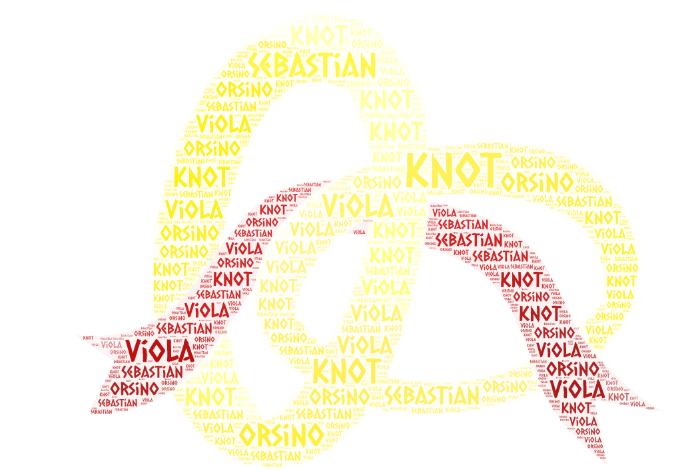
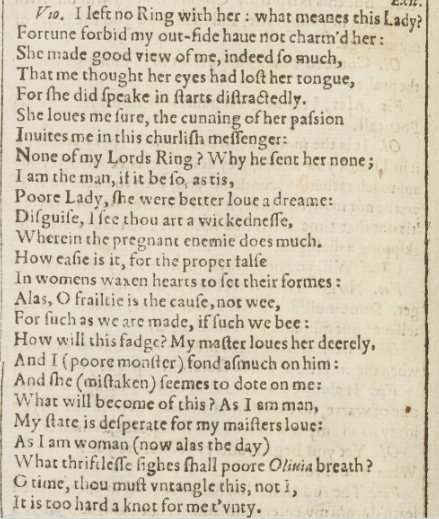
The main image here is the image of the knot- a central image of how convoluted this love triangle is.
I left no Ring with her: what meanes this Lady?
Fortune forbid my out‑side haue not charm'd her:
[650]
She made good view of me, indeed so much,
That me thought her eyes had lost her tongue,
For she did speake in starts distractedly.
She loues me sure, the cunning of her passion
Inuites me in this churlish messenger:
[655]
None of my Lords Ring? Why he sent her none;
I am the man, if it be so, as tis,
Poore Lady, she were better loue a dreame:
Disguise, I see thou art a wickednesse,
Wherein the pregnant enemie does much.
[660]
How easie is it, for the proper false
In womens waxen hearts to set their formes:
Alas, O frailtie is the cause, not wee,
For such as we are made, if such we bee:
How will this fadge? My master loues her deerely,
[665]
And I (poore monster) fond asmuch on him:
And she (mistaken) seemes to dote on me:
What will become of this? As I am man,
My state is desperate for my maisters loue:
As I am woman (now alas the day)
[670]
What thriftlesse sighes shall poore Oliuia breath?
O time, thou must vntangle this, not I,
It is too hard a knot for me t'vnty.
It’s interesting to note that (in the First Folio text), the verse alternates between being regular, and using a run-on technique called enjabment, where the thoughts continue after the end of the lines, starting with lines three and four. Ironically, when Viola says that Olivia was distracted and confused when she visited her, her own thoughts are disjointed and fragmentary as she reaches the inevitable conclusion that Olivia is infatuated with Viola in her disguise.
Viola’s Emotional Journey
In the book “Shakespeare’s First Texts” by Neil Freeman he describes how the Folio prints the speech in four distinct sections. Freeman hypothesizes that Shakespeare organized this speech into four phrases that chart the stages of emotions Viola goes through:
Each stage has its own easily identifiable quality, reflecting the growing steps of Viola’s journey in what for her is a huge struggle not only to comprehend, but also to deal with the enormous complications of the dreadful love triangle- the potential results of which are now becomming only too clear.
Freeman, 175.
Stage 1: Introduction
In the first three and a half sentences, Viola goes through the facts- she gave no ring to Olivia, Olivia was eying her, and half paying attention to what Viola was saying. The phrase ends with Viola’s conclusion that Olivia must be in love with her.
Stage 2: Complications
The sentences are of very irregular length- sometimes six words per line, sometimes a few as four. According to Freeman, the irregularity of the verse shows how Viola’s emotions are getting the better of her. Viola could be gasping with remorse over the pain she’s caused Olivia, or shocked at how easily she was taken in by Viola’s disguise.
Stage 3: Crisis/ Catharsis
Each line of this section mentions the people in this love triagle: “My master,” “And I,” “And She,” etc. Viola might be thinking about the possible outcomes to this situation- getting fired, getting discovered, getting married, etc.
Stage 4: Summary: “O Time, Thou Must Untangle This, Not I.”
Like Hamlet before her and Macbeth after her, Viola ends her soliloquy by saying she has no conclusion. She has no idea how to solve this problem, but can only hope that Time will provide a solution.
Audience Interaction
As I said, this is a soliloquy, which is to say, a speech where the character is solo or alone onstage. Some people think this means that the characters are talking to themselves, but I firmly disagree with this notion. One reason why Shakespeare writes soliloquies is because they allow a character to share their thoughts and feelings with the audience. They are the ancestors of every aria or solo in opera and musical theater, and every Disney Princess/ Villain song. I’ve even said before that there are some similarities between Viola and a famous Disney Princess:
I am just ecstatic to talk about this year’s hit Broadway Musical Six. It swept the Tonys, and has opened up touring productions across the country, and I JUST GOT TO SEE IT!
This vibrant, clever retelling of Tudor her-story was created by TOBY MARLOW & LUCY MOSS in association with the Chicago Shakespeare Festival. The show is incredibly smart, and creative, and delves into the lives of some fascinating women, re-told as a singing contest with the characters singing their lives for you to judge what it was like being the queen of England and living with the turbulent and fickle Henry VIII.
What really appeals to me in this show is that like Hamilton, the musical takes these six semi-mythical women and tells their story in a way that is fresh and exciting. It bridges the gap between Tudor History and the modern-day by equating being a queen with being a celebrity, with all the drama of ambitious parents, romantic drama, public opinion, and even being exploited and sexualized by a male-dominated society. This comes across in the music, the costumes, the lyrics, and even the lighting!
Why “Six” Slaps
The costumes are brilliant and iconic. Catherine Of Aragon is like a cross between Beyonce, a saint, and a medieval knight. The lighting is incredible! You could tell the whole story using the lighting design as it pulsates, dances, changes into different colors, turns into different shapes, and finally flashes the name of the show in triumphant gold letters.
One particularly brilliant way the music works in “Six” is the fact that it uses the song “Greensleeves” as a motif both musically and thematically. One big theme of the show is how, unlike Henry VIII, most of the history of his six queens is lost and replaced by legends and even songs. The first line of the show is the famous rhyme about their fates: “Divorced. Beheaded. Died. Divorced. Beheaded. Survived.” As the video above helps illustrate, Marlowe and Moss know that most people only know the rhyme about their deaths and the myth that Henry wrote a song about one of them; that their lives are overshadowed by their deaths and the misconceptions that people have written over the years. Howard Ho points out how the song musically forces itself into the first number, “Ex Wives,” but by the end of the show, the six queens break free from these musical bars! You can hear the change of key and notes during this performance at the Tonys, which puts the opening number and closing reprise together.
The Cast of “Six” perform live at the 2021 Tony Awards.
But how do the queens go from “one word in a stupid rhyme,” to a group of powerful, individual queens singing in harmony, without the man who made them famous? That’s what the solo numbers in “Six” do so incredibly well- tell each queen’s solo stories as rocking ballads, hilarious dis-tracks, soulful love songs, and… well stay tuned.
Part II: The Women and Their Queenspirations
1. Catherine of Aragon
Catherine of Aragon was Henry’s first wife and is still universally beloved, even though Henry decided to divorce her. As the epitome of a stand-alone power queen, it makes sense that Six modeled her character, costume, and songs after Beyonce, with a Shakira-inspired Spanish beat for good measure:
My favorite thing about her solo, “No Way” is how the writers paraphrase her real-life speech during the divorce trial in 1529. Below are the lyrics and the real speech:
Alas, Sir, where have I offended you? Or what occasion have you of displeasure, that you intend to put me from you? I take God and all the world to witness that I have been to you a true, humble and obedient wife, ever conformable to your will and pleasure. This twenty years and more I have been your true wife, and whether it be true or no, I put it to your conscience.
— Katherine of Aragon, 1529
2. Anne Boleyn
In some ways, the version of Anne Boleyn in “Six” is less a pop version of the real queen and more of a commentary on the nature of celebrity. If you watch the video, you can see how in life she was admired for her beauty and fashion but hated for her comments on Queen Katherine, her scandalous love affairs, and her brash nature. This explains the spiky pop-punk princess look they gave her, (which evidently resonates with many audiences since I saw at least two girls cosplaying as Anne in the audience). Sort of like a celebrity who gets canceled on Twitter or Princess Diana, Anne shows how a person can be undone when they dare challenge an established order, especially the Royal Family.
After the show, I found it a bit weird that they portrayed Anne Boleyn as a jetsetting airhead, but then again she is one of the best-known queens in history, so they can get away with it. In reality, Anne Boleyn was highly educated and a member of an ambitious and social climbing family who basically pushed her to woo Henry. As you can see in this clip from “Anne Of A Thousand Days,” Henry and Anne’s family bullied her constantly to become the King’s mistress after HE ALREADY GOT HER SISTER PREGNANT, so Anne knew that the only way to keep Henry from ruining her life was to convince him to divorce Katherine of Aragon and marry her.
Of course, this strategy didn’t save Anne in the end, which says more about how cruel Henry VIII was, chewing up women and spitting them out in his ravenous quest for a son. So is this an accurate portrayal of Anne’s life? No. Is it fun, ABSOLUTELY!
III. Jane Seymore
I’m more than I seem, or am I?
“Six” The Musical.
This version of Jane Seymore was inspired by Adele, so appropriately, she has a heart-wrenching power ballad about her turbulent relationship with Henry. Sadly, we don’t know much about Jane’s real life, so the song takes some liberties. If you go to the Hampton Court Website, you can actually vote as to whether Jane was a devoted wife or a social climbing gold-digger. Probably the real woman was something even more complicated, though we’ll never know for sure.
IV. Anne of Cleaves
Anne of Cleaves is the funniest part of the show! Many of us have heard the story that Henry divorced Anne after he found her ‘ugly.’ What “Six The Musical” does is amend the story, by pointing out that after he divorced her, Henry gave her a castle and a huge retainer, allowing her to live like a queen, without being married to a king! Accordingly, her song is a Rhianna-style dis track that shows off her awesome lifestyle, and spits in Henry’s stupid face!
As fun as this, rags-to-riches story is, the truth is less fun- Anne was the sister of a German duke, so Henry’s lord Chancellor Thomas Cromwell probably forced Henry to marry her for diplomatic reasons (source: Hampton Court: “Anne of Cleaves”). Naturally, Henry didn’t like being told what to do- I suspect he resented Anne before even meeting her because he didn’t get to pick her himself.
As for whether Anne was actually ugly, the truth is really surprising- Henry actually disguised himself as a peasant during a masked ball when he first courted Anne, and she foundhim repulsive. At the time, Henry was 49 years old, and in very poor health. As such, he was intermittently impotent and blamed his inability to conceive a child with her on her supposed ugliness to save face.
Even though Anne in the show hates Henry, in reality, once the marriage was annulled, Anne and Henry remained good friends for years! She attended his next wedding to Katherine Howard, and, just like in the show, Henry treated her much better after the divorce:
‘YOU SHALL FIND US A PERFECT FRIEND, CONTENT TO REPUTE YOU AS OUR DEAREST SISTER. WE SHALL, WITHIN FIVE OR SIX DAYS …DETERMINE YOUR STATE MINDING TO ENDOW YOU WITH £4000 OF YEARLY REVENUE…YOUR LOVING BROTHER AND FRIEND.’
Henry VIII, 1548, six months after their wedding, when the annullment went through.
V. Katherine Howard
Without question, Katherine Howard is portrayed as the most tragic of Henry’s six wives and her song is a huge sucker punch. The writers never let you forget that Katherine’s first affair was when she was 13, and she died at age 19. Like Anne Boleyn and Jane Seymore, Henry picked Katherine for his queen among his ladies in waiting and her song “All You Wanna Do” satirizes his and many other men’s lustful appetites. The song begins as a raunchy, sexy pop ballad in the vein of Britney Spears’ “Toxic” and “Womanizer” about Katherine Howard’s love affairs, but then devolves into a cry for help, as Katherine confesses how she was abused, used, and manipulated by the men in her life, (including her own cousin Thomas Culpepper) until she was beheaded in 1542. It masterfully satires both Henry’s cruelty and the hypersexualization of teenage pop stars which certainly took its toll on Britney Spears and Ariana Grande, Katherine’s major ‘Queenspirations.’
VI. Katherine Parr
Historically, Katherine Parr had to turn away her fiancee Thomas Seymore (just like Anne Boleyn was previously engaged to Henry Percy) once the king set his eyes on her for his wife, so her song is a sad, soulful Alicia Keys-inspired bittersweet song where she tearfully says goodbye to Thomas to spare his feelings and probably his life.
Not only does this song once again show how Henry’s selfishness and his lust ruined the lives of the women he married, (as well as the men who already wanted to marry them), but it also sets up the main idea of the show:
His-Story overthrown
In the final number, the wives turn the tables on Henry- they have spent centuries being defined by him, but in reality, he is just as much defined by them! Going forward, history should not define these great women as just, “The Six Wives of Henry the Eighth,” but to celebrate their individual lives and contributions to history. Katherine Parr mentions this when she points out that in life, she fought to allow women to be educated, she wrote books, and was a scholar of theology. Historically, Henry and Katherine would argue about religion and he nearly executed her after she disagreed on points of theology, but Katherine kept her life by claiming she was “Not disagreeing with [him], but simply learning from [him].”
I Don’t Need Your Love is sung by Catherine Parr in SIX: The Musical. The first part of the song refers to her love of Thomas Seymour, whom she probably wanted to marry rather than Henry (and did marry after Henry’s death). However, the song also protests at the fact that women are often defined by their relationship with men, rather than as people in their own right. Catherine wants to be remembered for what she did, rather than the men she married or loved.
Katherine Parr, Six.
The final number completes the idea of the ‘historemix’ by having the Six queens/pop stars come up with a re-imagined happy ending for themselves, one that doesn’t include the pain that Henry inflicted on them: Katherine A becomes a singing nun, (like Whoopi Goldberg in Sister Act), while Anne Boleyn starts writing lyrics for Shakespeare (which is a fun idea since he does mention “Greensleeves” twice). Jane Seymore forms a band with her many surviving children, Katherine Howard goes solo, and Katherine Parr joins the other queens in a supergroup. It’s not at all historical, but it is a fun and sweet way to put an epilogue on these (mostly) tragic lives.
It’s odd, however, that the show invents an epilogue instead of talking about the six queen’s greatest legacy- Queens Elizabeth and MaryI. For a show that wants to highlight the often-forgotten legacy of these queens, it is an odd oversight. Remember Catherine and Anne gave birth to queens who eventually ruled England without a king. Jane Seymore gave birth to a king, and Catherine Parr helped raise them and restored them to the line of succession- She’s the reason her stepdaughters were able to become queens in the first place.
My issues with the epilogue aside, it is great to see history be recontextualized and shared in such an accessible way. We all know that European history is dominated by the names of white guys- king whoever, duke what’s-his name. To see important women in history be given a voice by a multi-ethnic cast is a great way to make it resonate, and using the metaphor of pop stars works extremely well in this context- these women mostly didn’t choose stardom, but they deserve it for what they went through.
Brava.
Educational links related to the six wives of Henry VIII:
The global phenomenon “Five Nights At Freddie’s” (FNAF) has spawned 11 major games, spinoff games, 19 books, countless comics, and a big Hollywood movie premiering this week:
My video podcast on FNAF
One other thing this franchise has spawned is ENDLESS FAN THEORIES. I admit, when I first heard of this jump-scare-based game with haunted animatronics, I viewed it as a silly novelty- a clever way to create cheap horror using monsters who jump out at you in a dark room… then I saw this:
2023- The Game Theorist Youtube show tells the entire chronology of the FNAF saga.
The YouTube channel Game Theory, which has been analyzing and dissecting the games for the last 8 years finally created a complete chronology of the games’ lore. Like a lot of the best horror stories like Dracula and “Sleep No More,” the game scatters a lot of its lore throughout the game in the form of mini-games, security guard notebooks, newspaper clippings, and of course, the iconic, nervous late-night phone calls that your character (a nameless night watchman) receives from a mysterious character known only as THE PHONE GUY.
This story is truly the stuff of nightmares- serial killers, murdered children, ghosts, possessed robots, broken families, and unending quests for revenge from beyond the grave. Of course, a few of these tropes Mr. Shakespeare would be very familiar with, so I thought I’d delve into some of the themes, tropes, and ideas that link these two franchises. My goal is to get fans of the video game to understand that, since Shakespeare and Scott Cawthorne (the creator of the game) use a lot of the same horror plots and ideas, that, if you can understand FNAF you can understand Shakespeare!
Part I: The mad scientist- William Afton Vs. William Shakespeare’s Prospero
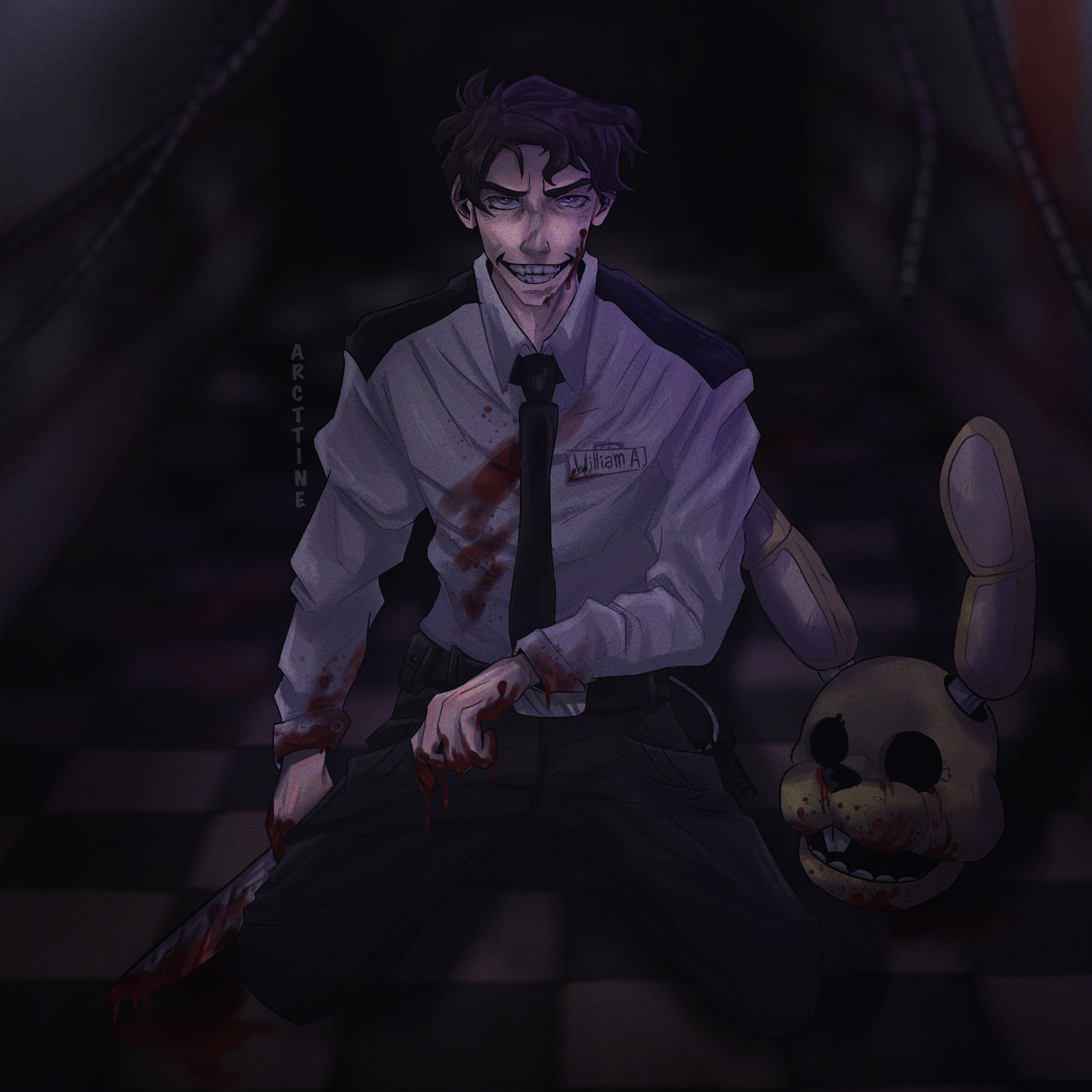
The story of Five Nights At Freddie’s revolves around its main antagonist- a genius roboticist-turned-serial killer named William Afton, who starts out as a successful businessman and children’s entertainer obsessed with bringing his creations to life. Any horror fan will tell you that this is an automatic sign of a villain because he is trying to master the skill that only God possesses- the ability to create life.
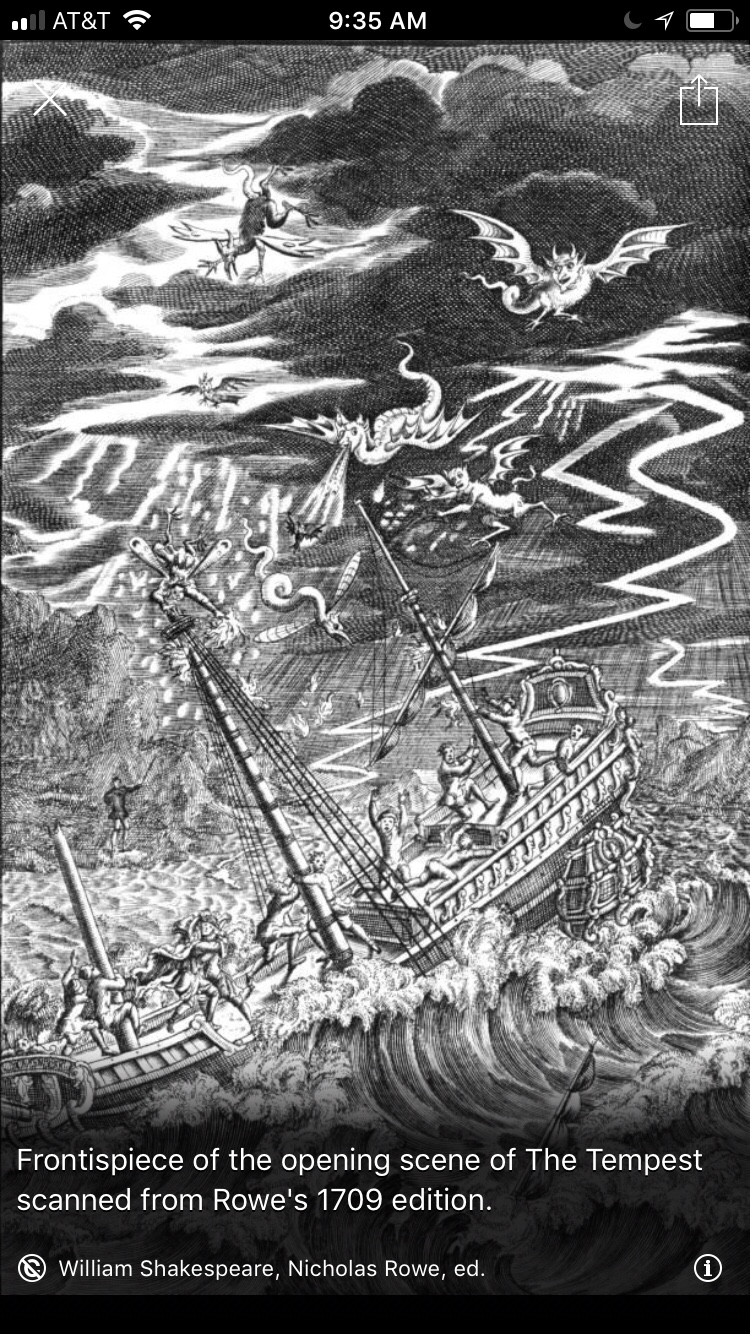
In Shakespeare’s final play, The Tempest, the hero is a brilliant magician who, after his brother exiles him to a desert island, masters many crafts considered unnatural for the 1600s:
I have bedimm'd
The noontide sun, call'd forth the mutinous winds,
And 'twixt the green sea and the azured vault
Set roaring war: to the dread rattling thunder
Have I given fire and rifted Jove's stout oak
With his own bolt; the strong-based promontory
Have I made shake and by the spurs pluck'd up
The pine and cedar: graves at my command
Have waked their sleepers, oped, and let 'em forth
By my so potent art.
The Tempest, Act V, Scene i, Lines 2063-
Like I discussed in my post on Shakespeare and Star Trek, Prospero’s magic is both benevolent and terrifying. He uses it to rescue himself and his daughter Miranda from the island, and he creates beautiful visions of gods and angelic music for Miranda and her young lover Sebastian, but he also creates nightmarish visions to torment his enemies:
Both Afton and Prospero are motivated by revenge against the men who betrayed them. In Afton’s case it’s his rival/ partner Henry Emily who bankrupted his business and later got him fired from his own company. Afton torments Henry by murdering his daughter and ruining his business by luring kids to their death inside the pizzeria, disguised as one of the animatronic characters. Afton also figures out how to torment people using sound alone, like Prospero does to his slave Caliban:
Caliban. All the infections that the sun sucks up
From bogs, fens, flats, on Prosper fall and make him
By inch-meal a disease! His spirits hear me
And yet I needs must curse.
For every trifle are they set upon me;
Sometime like apes that mow and chatter at me
And after bite me, then like hedgehogs which
Lie tumbling in my barefoot way and mount
Their pricks at my footfall; sometime am I
All wound with adders who with cloven tongues
Do hiss me into madness.
Here comes a spirit of his, and to torment me! The Tempest, Act II, Scene ii.
Prospero isn’t a killer, but like Afton, he has learned the secret to life after death, which makes him powerful and dangerous. Even more unsettling, both men are on an endless quest for revenge and torment men whom they saw as brothers. Other Shakespearean characters take their lust for revenge to the same dark place Afton did- the murder of children.
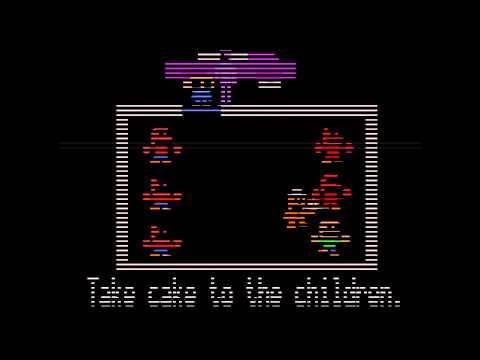
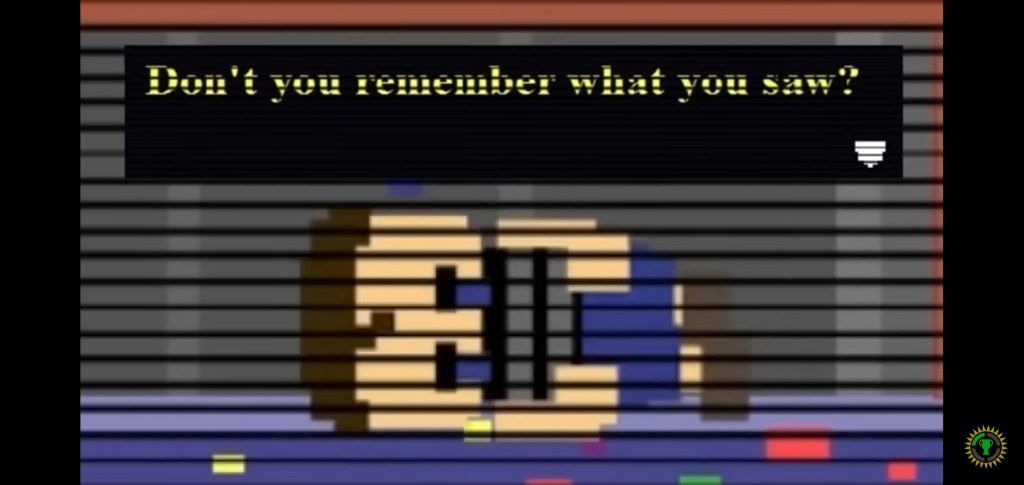
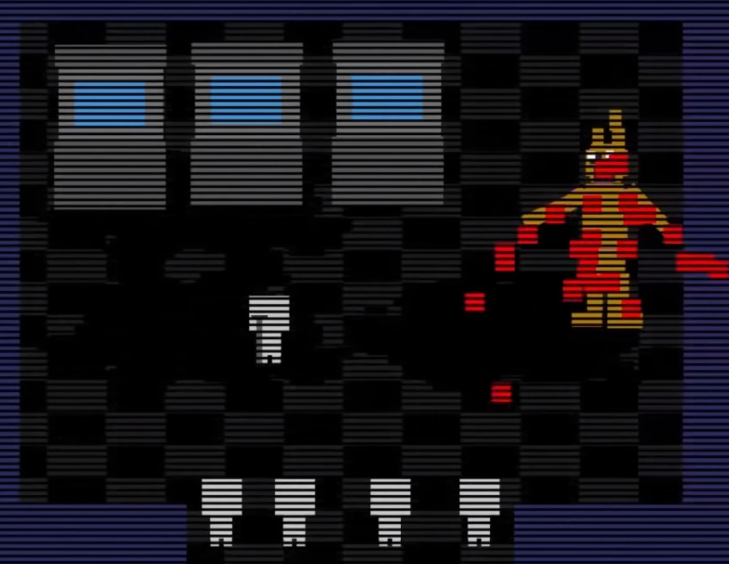
For the first four games, Afton isn’t directly part of the game- he’s merely mentioned in pieces of the lore. Frequently we see 8- bit re-enactments of his crimes in a series of mini-games, where he appears as a faceless, purple killer.
Screenshot of William’s first murder of Henry’s daughter Charlie outside of the pizzeria.
Why purple though? It’s true that purple is associated with royalty, and sometimes associated with villainy, (since it isn’t a color found much in nature). I think though, there might be a deeper, more macabre meaning to this color associated with this killer: It is a scientific fact that human blood, when it is shed and deprived of oxygen, actually turns purple:
The colors of arterial and venous blood are different. Oxygenated (arterial) blood is bright red, while dexoygenated (venous) blood is dark reddish-purple
Shakespeare was very aware of this medical fact. He lived in an age where traitors’ heads were placed on spikes on London Bridge, and people would pay to watch wild dogs attack bears (the FNAF of his time). Shakespeare makes many gory references to murderers watching red blood turn purple:
I make as good use of it as many a man doth of a Death’s-head or a memento mori: I never see thy face but I think upon hell-fire and Dives that lived in purple;
Henry IV, Part I, Act III, Scene iii.
Woe above woe! grief more than common grief! O that my death would stay these ruthful deeds! O pity, pity, gentle heaven, pity! The red rose and the white are on his face, The fatal colours of our striving houses: The one his purple blood right well resembles;
Henry VI, Part III, Act II, Scene v.
Now, whilst your purpled hands do reek and smoke,
Julius Caesar Act III, Scene i.
With purple falchion, painted to the hilt In blood of those that had encounter’d him:
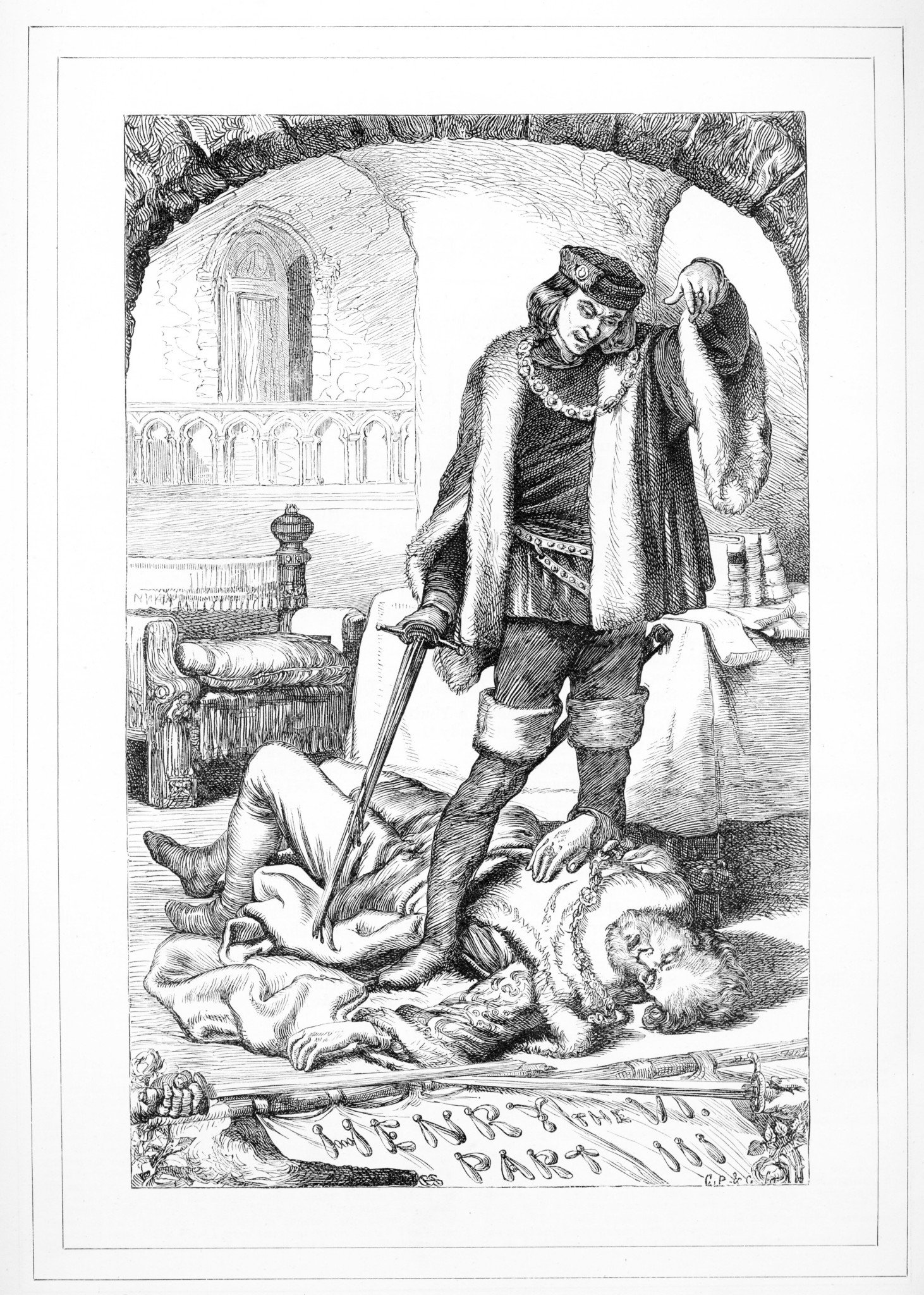
Henry VI, Part III, Act II, Scene v (Richard of Gloucester)
This last quote is spoken by Richard of Gloucester, who, in the play that bears his name, becomes King Richard III, Shakespeare’s most irredeemable villain. Just like William Afton, he kills without remorse and dispatches anyone who gets in his way on the path to the crown. In addition, like many of Shakespeare’s villains, his turn to pure evil occurs right after he does the unthinkable- when he murders children.
Richard (Ian McKellen), orders the secret murder of his nephews in the tower in order to keep his crown.
Throughout the rest of the play, Richard kills a lot of his political and personal enemies and we go along with them because he’s the protagonist. But once he murders the princes, who have done nothing to harm him or anyone else, Richard crosses the line from anti-hero to monstrous villain. It is also at this part of the play when his victims begin to take their revenge… FROM BEYOND THE GRAVE!
Part III: The ghostly revenge story
I’ve written before that in Shakespeare, ghosts are usually murder victims either out for revenge, or trying to convince a living person to avenge their death. Likewise, in the subsequent games, Affton’s victims possess the animatronics, seeking to kill their murderer!
One of the creepiest scenes in Shakespeare comes when Richard III is visited the night before his final battle by the ghosts of all the people he’s killed:
Similarly, when Macbeth murders his friend Banquo (and attempts to murder his young son Fleance), he is visited by Banquo’s ghost, during a party, no less! Even more ironic, look at the language Macbeth uses when he sees the ghost:
Approach thou like the rugged Russian bear, The arm’d rhinoceros, or the Hyrcan tiger; Take any shape but that, and my firm nerves Shall never tremble: or be alive again.
It’s truly ironic that, while in FNAF, the ghosts of Afton’s slaughtered children appear in the forms of angry animatronics, shaped like fearsome animals, Macbeth would rather see the fearsome animal, than the ghost of the man he murdered! Though Macbeth himself doesn’t fear bears, in both FNAF and Shakespeare, bears and other animals have long had a symbolism associated with wrath, anger, and taking bitter vengeance on the wicked.
Part IV: The Forrest of Beasts
1930s-style ad for the original Fredbear’s Singin’ Show, where a real dancing bear entertained travelers.
Bear Baiting
Even the animals in FNAF have some significance that Shakespeare has touched on in some of his plays, especially bears. In many renaissance and medieval sources, bears are symbols of wrath, revenge, and fierce protectors of children. Both Shakespeare and FNAF exploit this symbolism, and both the game and Shakespearean plays create horrifying beastly images in stories of revenge.
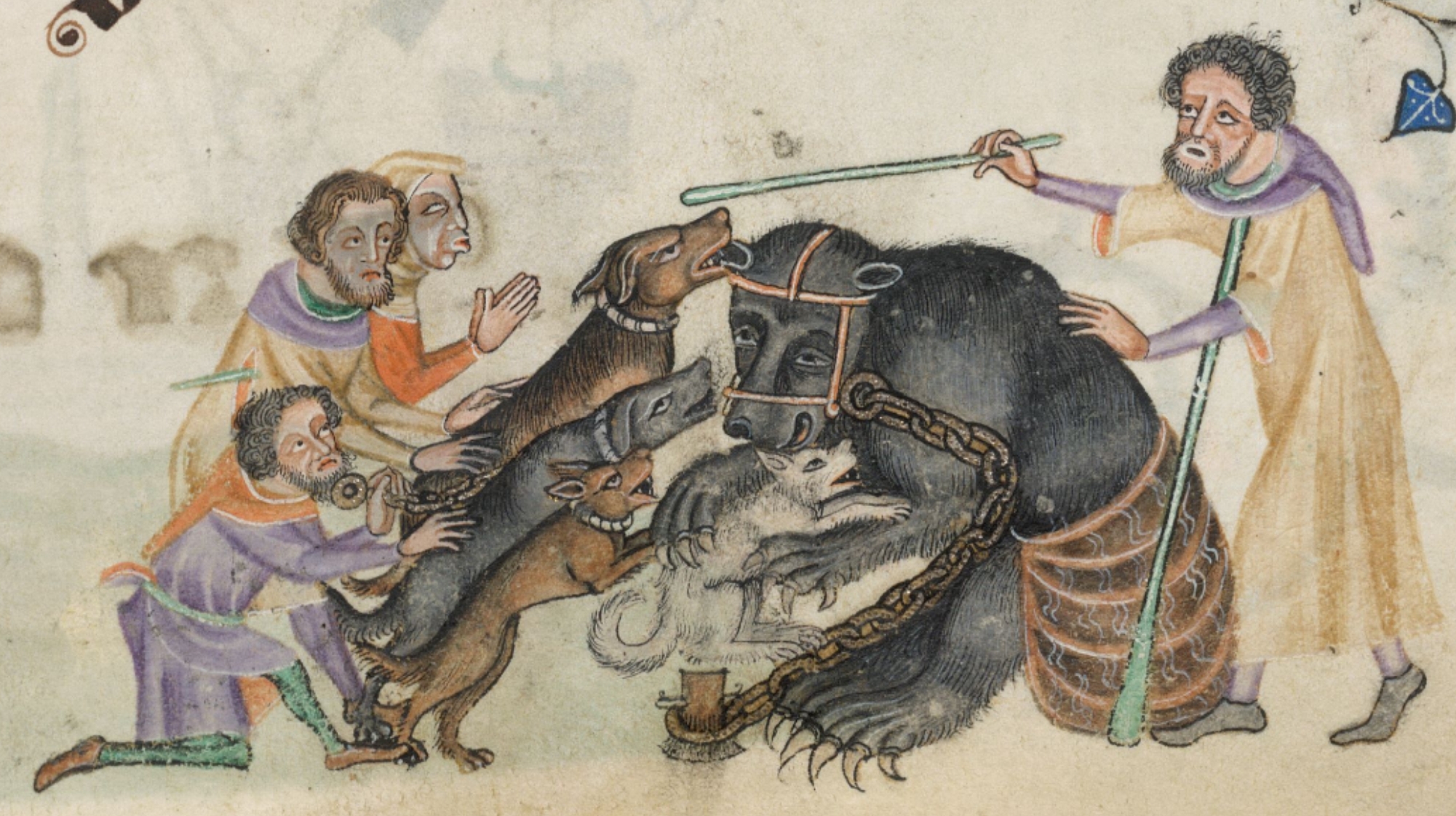
Just like the Fredbear singin’ show, Elizabethans liked to watch real bears perform onstage, sometimes as dancers, but also IN BLOODY FIGHTS TO THE DEATH. In the 1590s, there was a popular sport called “Bear baiting,” where bears would be chained, sometimes to a pole, and set on by vicious dogs. The ‘sport’ was watching to see who would prevail- the fierce and free dogs, or the powerful, bound bear.
As you can see from this close-up of Wenceslaus Hollar’s famous Panorama Of London (1647), we know that Shakespeare had to pass bear beating pits on his way to the Globe all the time, (you can see ‘Beer bayting’ or bear beating, written on the playhouse on the left, and Shakespeare’s Globe Theater on the right). Not only that, Shakespeare writes about the bloody sport frequently in his plays. When Macbeth knows he’s losing the battle with Malcolm, he compares himself to a bear, tied to a stake, forced to fight until his last breath. It calls to mind the moment in the game when the ghosts shed their animatronic skins and attack William directly, while he’s trapped in the Springtrap suit.
The ghosts of Afton’s original five victims gang up on him, possibly causing his golden Bonnie suit to malfunction, and kill him… for now.
It’s worth noting that when the ghosts kill Afton, he’s wearing his Golden Bonnie suit. As Mat Pat mentioned, yes it is the disguise he wore to commit his crimes, but it is also symbolic of who Afton has become- a beastly, inhuman creature who looks friendly on the outside, but inside is cold and robotic on the inside. This also calls to mind the beast symbolism in the aforementioned ghost scene from Richard III. The real King Richard III used a boar as his royal sigil, and Shakespeare exploits that beast imagery by comparing Richard to a bloody, rooting hog, grown fat on the blood of his victims. Richard doesn’t wear a pig suit, but he does wear his cruelty and bloodlust literally as a badge of honor!
In both the games and the plays, the ghosts become a manifestation of the murderer’s guilty conscience, and beast-like imagery is used to convey how cruel and beast-like the murderer has become. Macbeth and Richard don’t dress like beasts, but they do kill like them.
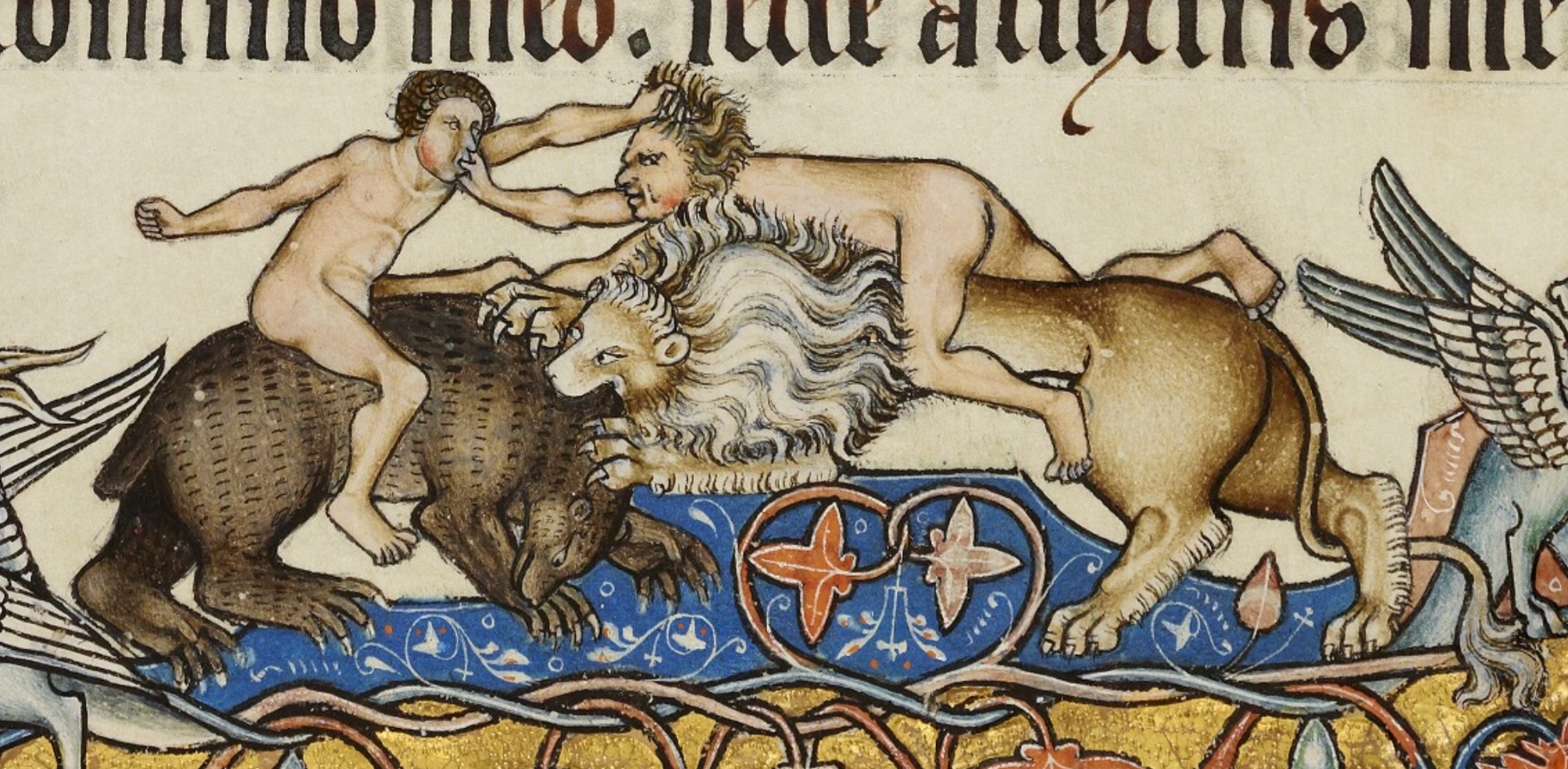
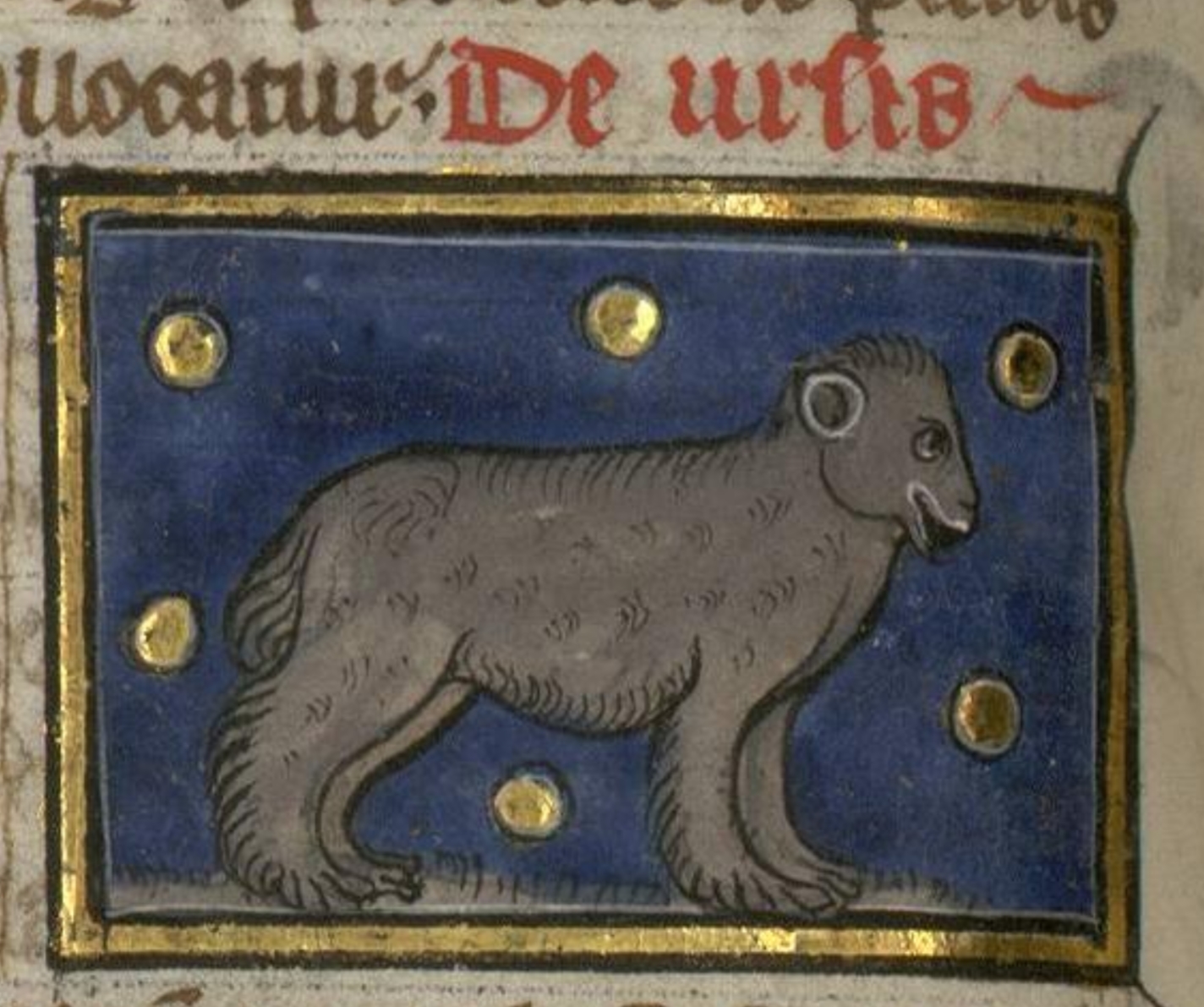
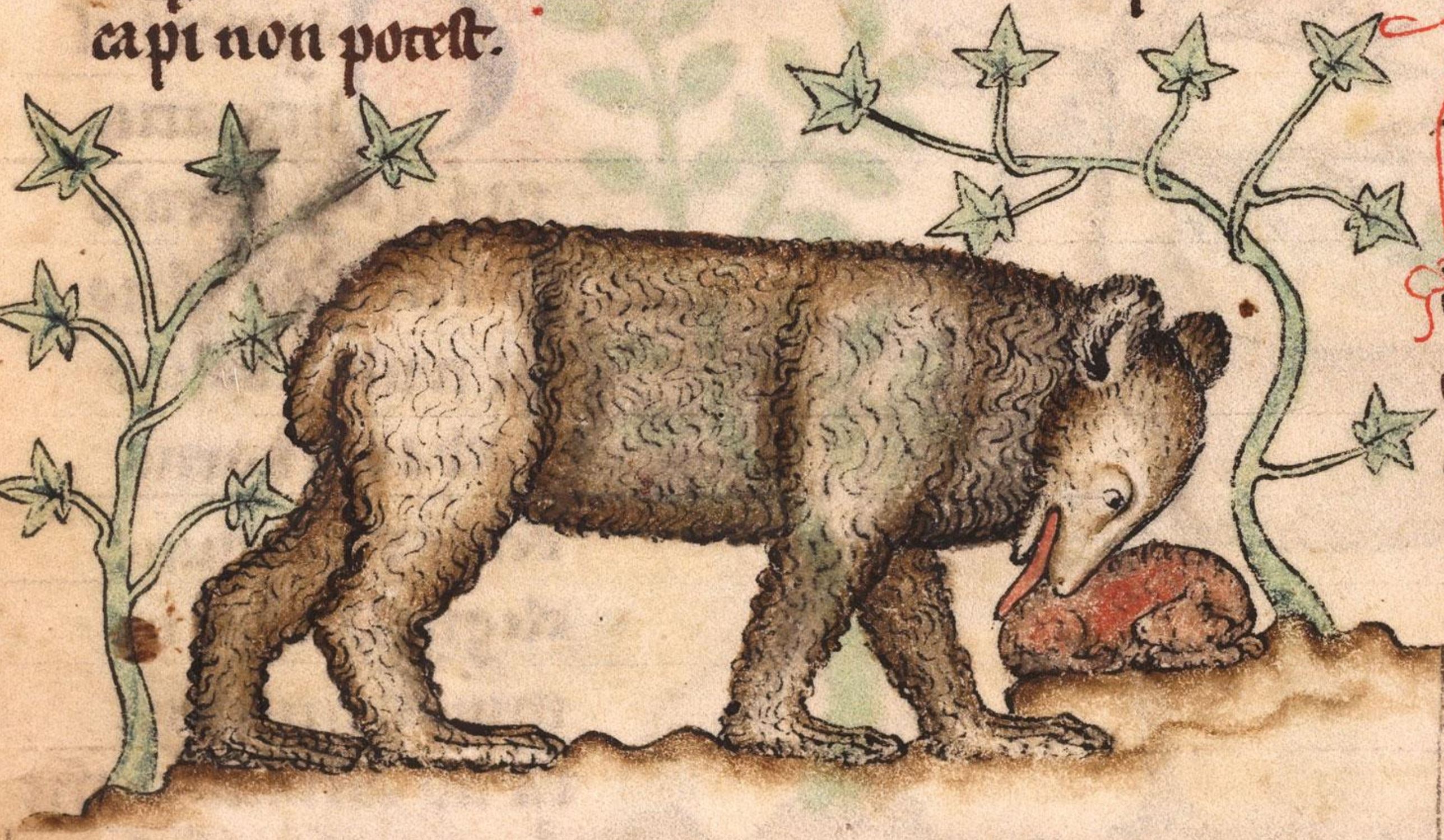
A bear fighting a lion, while both are ridden by naked men viciously fighting each other. Marginal illustration from a psalter.A very shaggy bear.The bear’s cub is born as a lump of flesh; the bear has to lick it into its proper shape.Two bears fight with a unicorn, a scene not described in any bestiary. Marginal illustration.
The beast imagery also extends to the concept of revenge. One big theme in Five Nights At Freddie’s is the concept that revenge, (whether justified or not), is blind and indiscriminately destructive. Even though the five ghosts that possess the animatronics are justifiably angry for being murdered, they don’t just try to kill Afton- they attack any poor soul who sticks around the pizzeria at night. Like Hamlet, who wants to avenge his father’s murder, but kills the wrong people, the five souls trapped in their metal cages have a noble goal- protect the children in the pizzeria, and destroy Afton, but they are full of beastlike rage and are unable to see friends from foes. This kind of blind rage reminds me of how real bears will fight off anyone whom they perceive as a threat. In medieval manuscripts, bears are tender to their cubs and literally form them out of little hairy lumps by licking them into shape. At the same time, they are powerful, deadly, and violent to anyone that threatens the cubs.
This kind of blind violence is something Shakespeare explores a lot in his history plays and his tragedies. Every time he talks about a society going wrong, he describes it as if it were populated with beasts, not humans. In Timon of Athens, the titular character, having left Athens to go live in the woods, laments to his frenemy, the cynical philosopher Apemantus, how his city has become like a collection of beasts:
Timon. What wouldst thou do with the world, Apemantus, if it lay in thy power?
Apemantus. Give it the beasts, to be rid of the men.
Timon. Wouldst thou have thyself fall in the confusion of2025 men, and remain a beast with the beasts?
Timon. A beastly ambition, which the gods grant thee t’ attain to! If thou wert the lion, the fox would beguile thee; if thou wert the lamb, the fox would eat three: if thou wert the fox, the lion would suspect thee, when peradventure thou wert accused by the ass: if thou wert the wolf, thy greediness would afflict thee, and oft thou shouldst hazard thy life for thy dinner: wert thou a bear, thou wouldst be killed by the horse: What beast couldst thou be, that2045 were not subject to a beast? and what a beast art thou already, that seest not thy loss in transformation!
Apemantus. If thou couldst please me with speaking to me, thou mightst have hit upon it here: the commonwealth of2050 Athens is become a forest of beasts.
Timon. How has the ass broke the wall, that thou art out of the city? Timon Of Athens, Act IV, Scene iii.
In short, the history of horror, which Shakespeare helped shape in plays like Macbeth, Richard III, Hamlet, and others, has a lot of classic tropes and the Five Nights At Freddie’s games exploit them quite well; tropes like supernatural vengeance, the death of innocents, beast-like killers, and unquiet ghosts. What works the best about this franchise is that it tells its lore like a mystery, slowly revealing Afton’s gruesome crimes over multiple installments. I wonder if someone has ever applied this to Shakespeare…
Shameless plug: Romeo and Juliet Murder Mystery
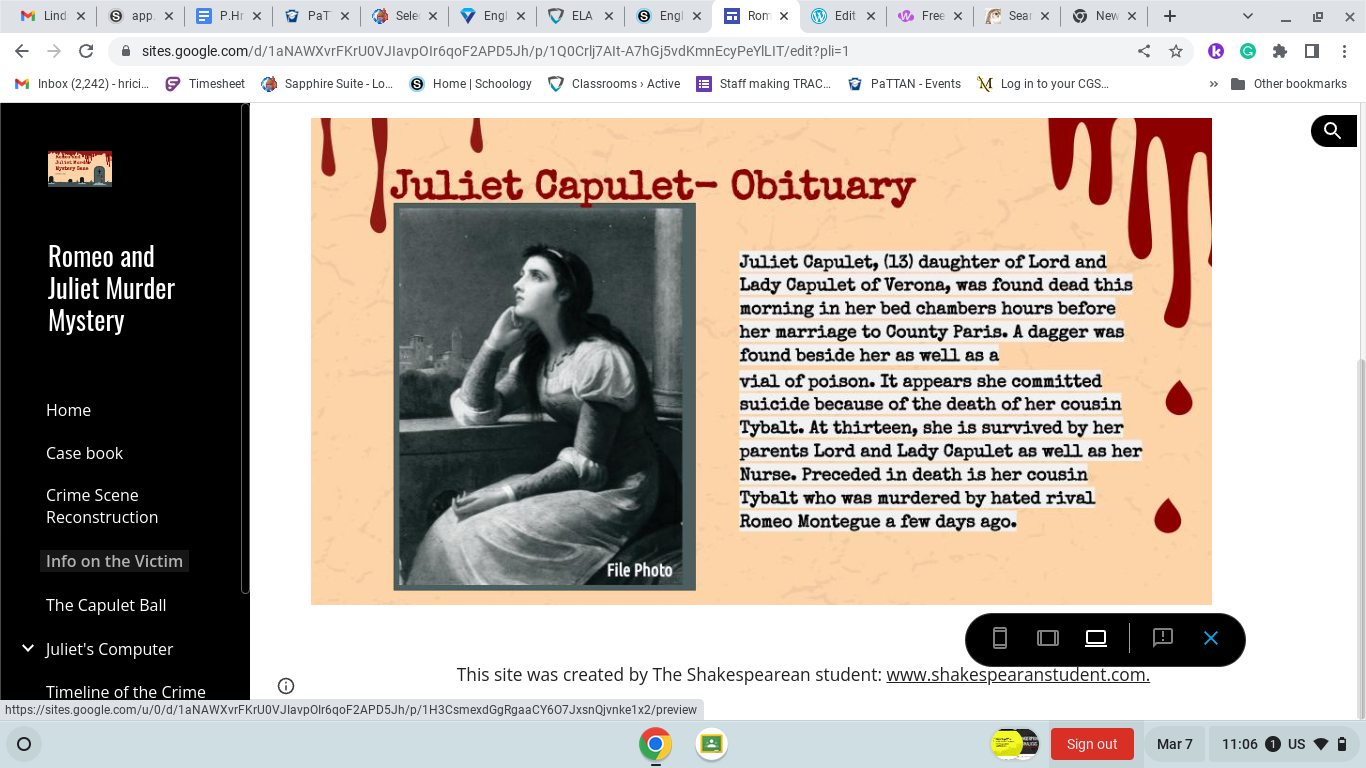
I’m proud to announce that I’ve just been approved to present a fully online, fully immersive murder mystery-style game, where you play as a detective trying to solve the mysterious death of Juliet Capulet! This is a really cool mixture of Shakespeare and forensics science as you examine crime scenes, look for clues, interrogate suspects, and untangle the story of Romeo and Juliet, and it even takes place over the course of five nights! Classes start March 17th. Register now at www.outschool.com!
Would Shakespeare enjoy playing FNAF well, who knows, but I do like to think he would appreciate the lore, if not the jump scares……
One really fun thing I like to see each Thanksgiving is the live previews of some of Broadway’s hottest shows. You may remember that I first became acquainted with the musical “Something Rotten,” after seeing a live performance at the Macy’s Day Parade. I am just ecstatic to see and talk about this year’s hit Broadway Musical Six. It swept the Tonys, and has opened up touring productions across the country.
The Cast of “Six” perform live at the 2021 Tony Awards.
This vibrant, clever retelling of Tudor her-story was created by TOBY MARLOW & LUCY MOSS in association with the Chicago Shakespeare Festival.
The show is incredibly smart, and creative, and delves into the lives of some fascinating women, re-told as a singing contest with the characters singing their lives for you to judge what it was like being the queen of England, and living with the turbulent and fickle Henry VIII. What really appeals to me in this show is that like Hamilton, the musical takes these six semi-mythical women and tells their story in a way that is fresh and exciting.
Part I: Shakespeare’s “Henry VIII:” How NOT to tell a queen’s story
Around 1613, Shakespeare wrote his final play- his 10th history play which loosely told the life of English king Henry the Eighth.
I happen to know a lot about this play since I was in it back in 2008, as you can see in the slideshow above. As you might notice, this play doesn’t tell the story of all of Henry’s wives. We only see the last few years of Catherine of Aragon’s life, and the beginning of Henry’s marriage to Anne Boleyn. Most of the drama actually centers around Henry and his scheming advisor, Cardinal Wolsey. Maybe I’m biased because I played this role, but frankly, Woolsey is treated in the play as a stereotypical Machiavellian villain, who conveniently leads the king astray so he can be the hero of the play. Woolsey does all of Henry’s dirty work; taking over his government, spearheading his divorce to Catherine, and trying to dissuade the king from listening to Anne Boleyn’s Protestant ideas, dismissing her as a “spleeny Lutheran.” Shakespeare leaves it ambiguous as to whether Henry actually told Woolsey to do any of these things so the audience will blame Woosey, instead of the king.
I’ll be blunt, aside from the courtroom scene at Blackfriars, where Katherine pleads for Henry not to dissolve their marriage, and the fun dances and costumes in the scene where Anne flirts with Henry, the play is really quite boring. though I blame Jacobean censors more than Shakespeare for this. Even after the entire Tudor dynasty was dead and buried, powerful people in the English government controlled what Shakespeare could say about them.
Part II: The women take wing
During Shakespeare’s life time, the wives of Henry VIII were bit players at best. With the exception of Katherine of Aragon and Anne Boleyn (who in most narratives have often been cast as either virgins or whores), the lives of Jane Seymore, Anne of Cleaves, Catherine Howard and Catherine Parr were barely told until the 20th century, where new feminist scholarship sparked renewed interest in these women and how they lived.
TV series like The Tudors, movies like The Other Boleyn Girl, and of course books and documentaries by
Well, I can’t yet give an objective view of the plot and characters of “Six,” because I haven’t seen it…(yet). But until then, let’s just say that like “Hamilton,” it is great to see history be recontextualized and shared in such an accessible way. We all know that European history is dominated by the names of white guys- king whoever, duke what’s-his name. To see important women in history be given a voice by a multi-ethnic cast is a great way to make it acessible.
Bravo.
Educational links related to the six wives of Henry VIII:
I’m delighted to share with you my recommendations for the best Hamlets committed to film! I was pretty strict with my criteria which left a few Hamlets out, so if I missed yours, let me know in the comments.
In order to make this list:
I have to have seen the whole thing. Sadly that excludes a lot of unfilmed productions or films I haven’t got around to seeing.
The interpretation has to take a unique stance on the play.
The actor has to have a clear grasp of the part.
I personally have to like it. This is subjective, and I will make it clear if something is my opinion, or if I think this interpretation works for classes or private viewing.
By the way, if you’re a teacher, I’ll be sure to mention which productions work for classes, and which, for whatever reason, do not. I also can recommend Common Sense Media to give you a good idea what age group this film works best for:
So, without any further adieu (get it?):
The Good Hamlets
#10: Arnold SChwarzenegger in “Last Action Hero”
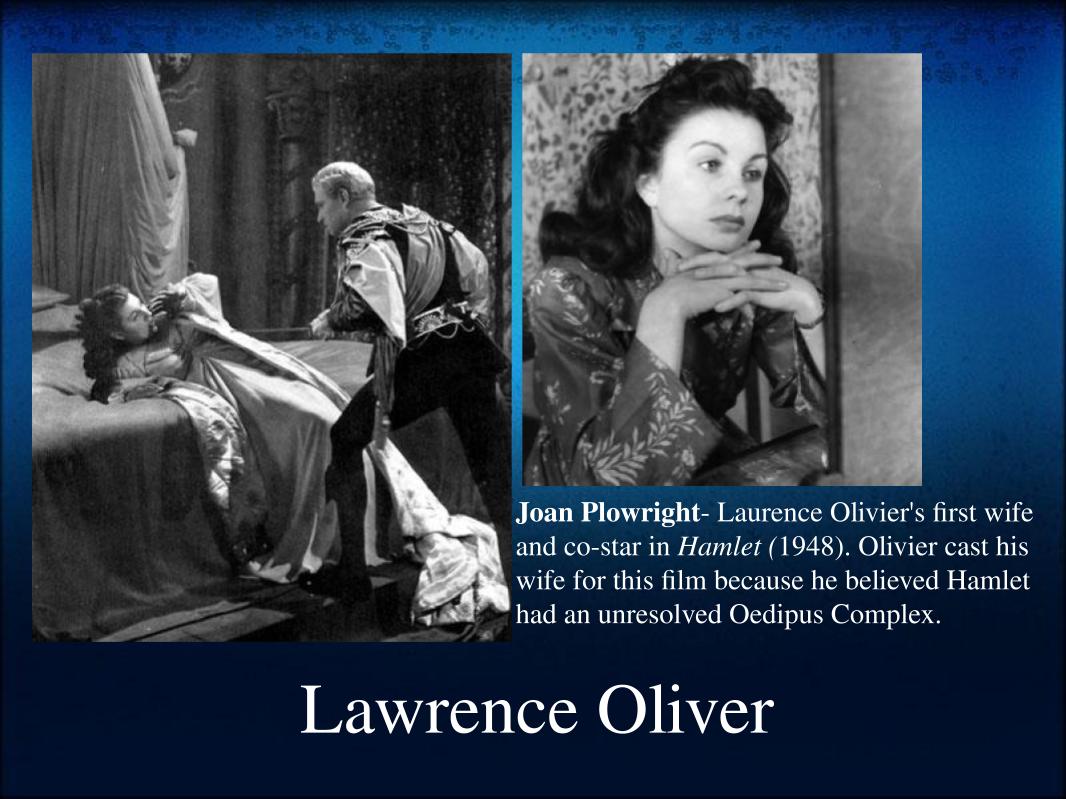
I would love to do a full review of this movie. When it works, it is actually a thoughtful deconstruction of the action movie genre, and as this clip shows, the movie concedes that Hamlet was actually the first great action hero. Schwarzenegger is really funny as an action movie parody of “Hamlet,” and everything he does is pretty cathartic for bored school boys who have to read the play in class. Plus, as a funny easter egg, the teacher in the scene who is showing Olivier’s Hamlet on the screen is played by Joan Plowright, who played Gertrude IN THAT FILM, and was married to Olivier in real life!
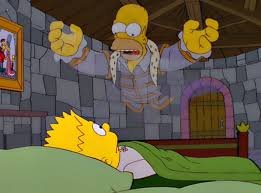
#9: Bart Simpson in “Tales from the Public Domain”
It’s absolutely astonishing how many Shakespeare easter eggs are in this little episode! How they make fun of medieval history, (the Danes were in fact Vikings in the early middle ages), Elizabethan theater, (when Bart does a soliloquy and is surprised that Claudius can hear him), and the way they compress Shakespeare’s longest play into a five minute episode is masterful satire.
In addition, the cast is perfectly chosen among the Simpsons’ core cast. Long-time viewers know that Moe has wanted to sleep with Homer’s wife for years, so making him Claudius is a brilliant choice. Plus, Dan Castellaneta steals the show with his over-the-top performance as the ghost, which actually reminds me of a 1589 review of Hamlet by Thomas Lodge:
“[He] walks for the most part in black under cover of gravity, and looks as pale as the vizard [mask] of the ghost who cried so miserably at the Theatre like an oyster-wife, Hamlet, revenge!”
THOMAS NASHE, “PREFACE” TO ROBERT GREENE, MENAPHON, (1589)
In any case, this clip is a great way to introduce anyone to Hamlet and I highly recommend it.
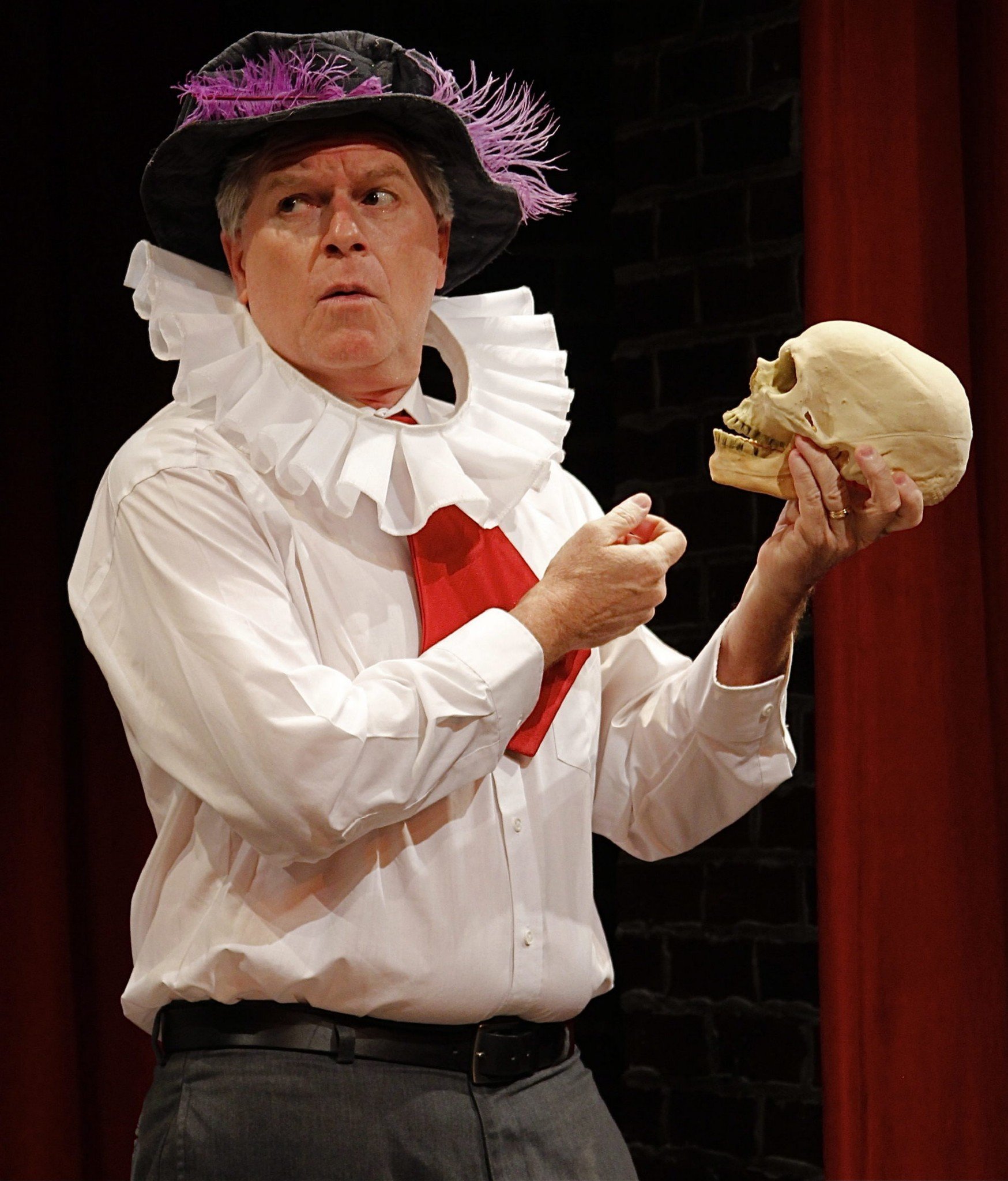
#8: Austin Tichenor in “The Complete Works of Shakespeare- Abridged”
Part 1 of a 4 part series of clips from “The Complete Works Of Shakespeare (Abridged)” Starring Austin Tichenor, Reed Martin, and Adam Long.
This show is very special to me- in around 1997 my parents went to England and brought home a copy of The Complete Works of Shakespeare (Abridged). I’d only read “Romeo and Juliet” previously and through this show, I gained an appreciation for all of Shakespeare’s plays. Seeing the plays through parody made them seem less lofty and stuffy, and made me want to see and read the original works. This is especially true for “Hamlet,” which occupies the second half of the show, where Hamlet is portrayed by Austin Tichenor.
Tichenor wins my award for “Hammiest Hamlet,” which is just delightful to watch. He clearly takes the part WAAAY too seriously, as evidenced by how emphatically he demands solemn silence from the audience while he attempts to do “To Be Or Not To Be.” Tichenor also serves as the pedantic straight man who tries to keep the show moving and academic, while mediating between his bickering co-stars Adam and Reed. This wonderful Three-stooges dynamic makes every minute of the show fun and frenetic. However, the cast makes it very clear that they are making fun of Shakespeare with love; they never mock the play, they inform as well as entertain, and occasionally they even move the audience as Adam does at the end. In short, this show helped me form my approach to Shakespeare, and it’s largely through Tichenor that I read Hamlet at all, so he’s to blame for this website.
#7: Richard Burton, 1964 (stage production directed by John Gielgud).
With the advent of TV and film making theater seem obsolete, directors knew they had to do something drastic in order to get people to come to the playhouses. Enter John Gielgud, one of the greatest Hamlets of the early 20th century, who directed Richard Burton in a highly-acclaimed production with minimum sets and with actors wearing rehearsal clothes. The idea was to let Shakespeare’s words and the actors’ performances be the focus, and save spectacle for film and TV. This approach has been adopted by many theater companies since, including a few I’ve been a pat of.
Burton has a lot of energy and manic physicality in his portrayal and it makes his Hamlet engaging to watch. Plus Gielgud himself as the ghost is almost operatic to hear. I highly recommend any theater fan to watch it, though it might not translate in a classroom much.
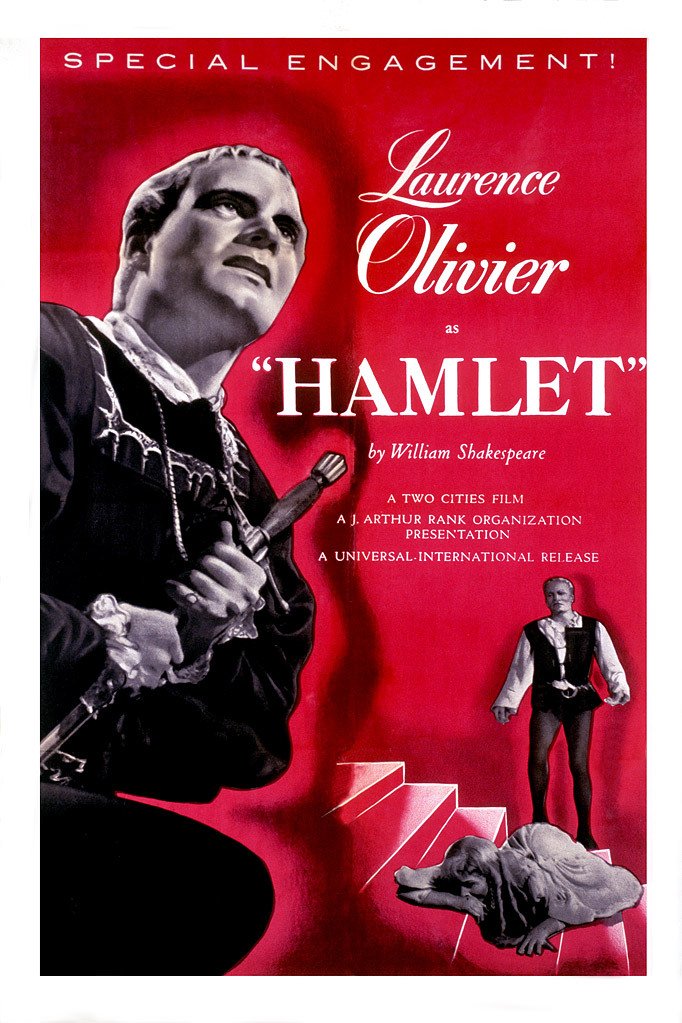
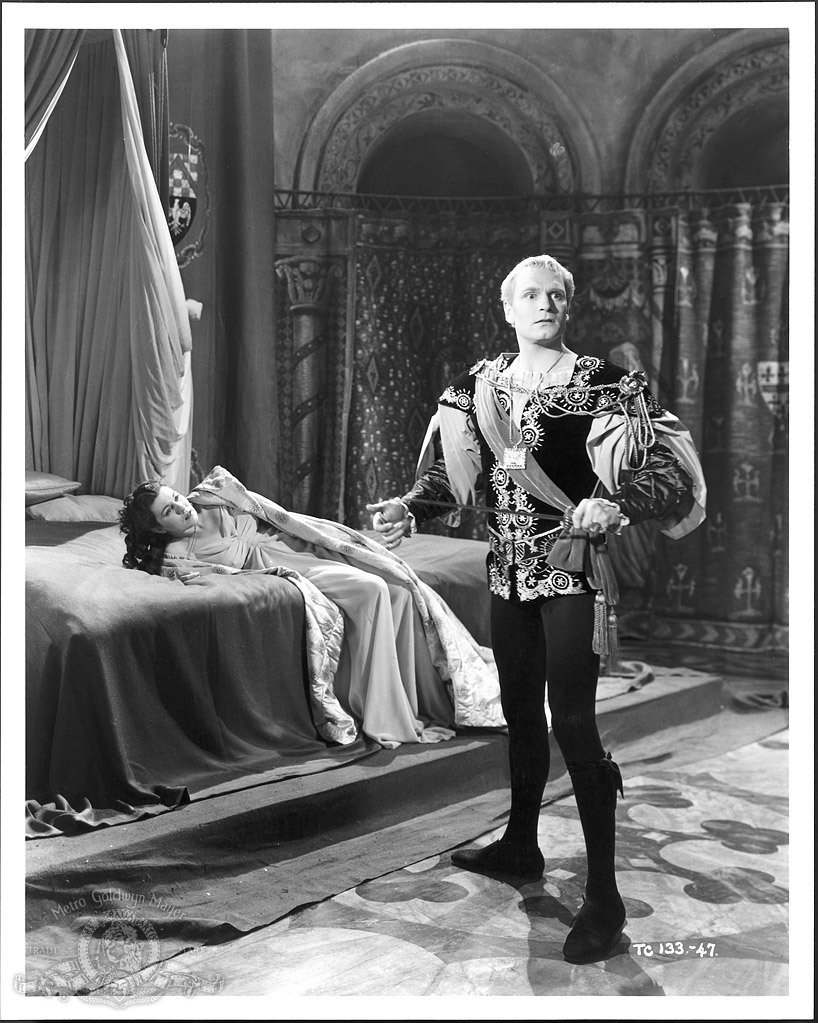
# 6: Laurence Olivier, (Film 1948)
I have my issues with Olivier as an actor and apparently I’m not alone:
I find Olivier’s acting over-the-top, lacking in emotion and subtlety, and I think his directing is generally self-centered. He rarely deigns to give close-ups to anyone but himself and a lot of the scenes he directs are filmed like stage plays. That said, Olivier’s Hamlet is really good. SIr Laurence talked to Ernest Jones about the theory that Hamlet might have had an Oedipus Complex and created a unique and well-thought-out interpretation for his Hamlet. First off, casting his real-life wife Joan Plowright as Gertrude, fills the Closet scene with uncomfortable tension. He also did a great job making the ghost seem as imposing and accusatory as possible, as well as making Claudius as disgusting as possible.
You get the idea that this film is how Hamlet sees the world with its dark and shadowy towers, representing Hamlet’s melancholic mind, his imprisoned spirit, and his dark desires. Also as many people have pointed out, Gertrude’s bed chamber looks like a female organ, making the Oedipus theory even more explicit.
Even I have to admit that Olivier nailed the “To Be Or Not To Be,” Speech. He squirms at his own Oedipal fantasies, and contemplates jumping off the battlements in a captivating and subtle way. The performance and cinematography is iconic, and it makes me grudgingly admit Olivier, for all his faults, is still one of the best Hamlets of all time.
I would recommend this film to every Shakespeare film fan and any hardcore Shakespeare scholars. I would caution against showing the whole thing in a class however, since it’s black and white, and again, I find Oliver’s delivery very old-fashioned.
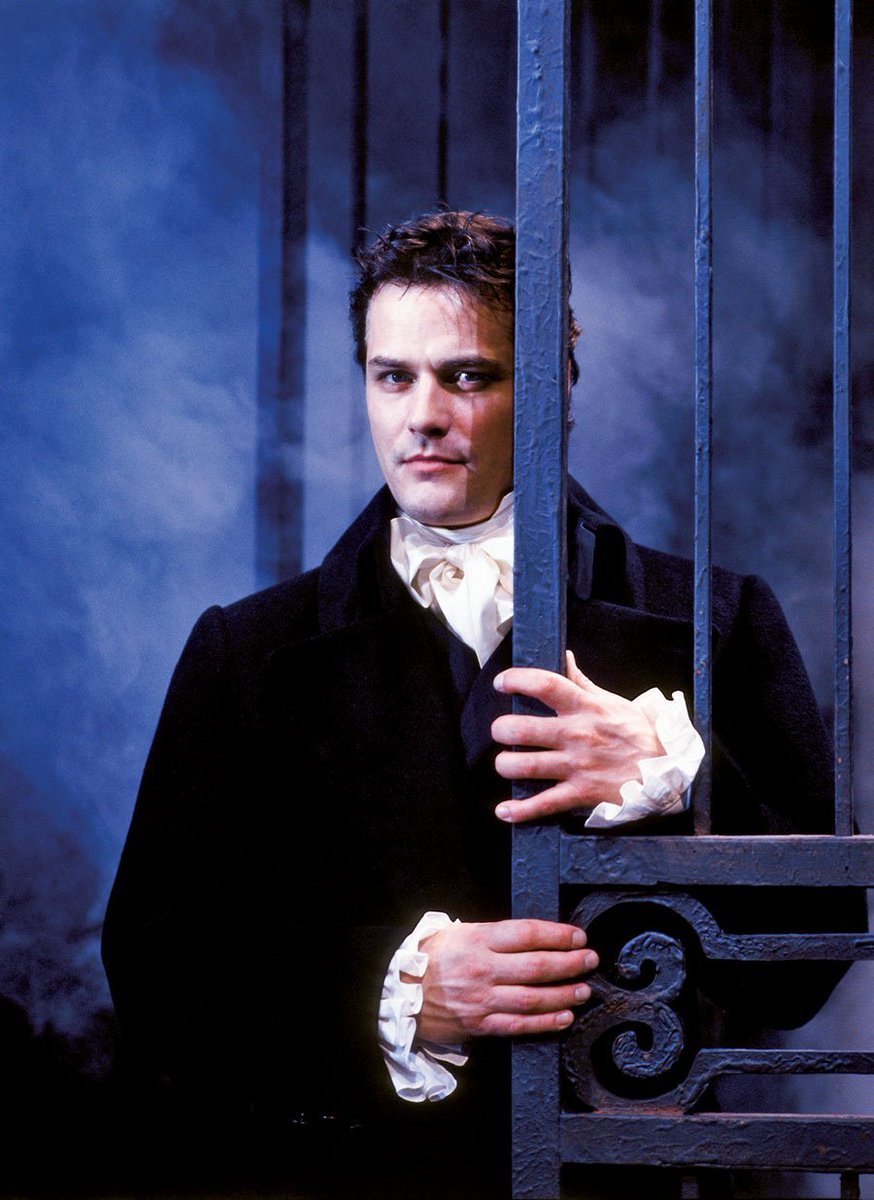
#5: Paul Gross, (StratforD Festival, 2000)
Thus far, I’ve mainly reviewed British and American Hamlets. Paul Gross is one of Canada’s most celebrated actors who gained fame as one of the best Hamlets at Toronto’s Stratford Festival. Unlike most Hamlets who go for the humanistic prince version of Hamlet, Gross plays him with sort of an animal intensity, like a wounded bear who will growl at you if you get in his way.
I have to admit I broke my own rule with this one- I haven’t really seen Gross’ portrayal, but I believe I saw it well-represented in his role as Geoffery Tennent, the Shakespearean Actor-turned madman-turned director in the Canadian TV show “Slings and Arrows.” This amazing dark comedy portrays the ins and outs of a Shakespeare Company from the normal problems of mounting a play to backstage drama, even the funding and marketing gets focus! Basically, the show is The Office for Shakespeare nerds, except for one ghostly cast member (no spoilers).
4. Benedick Cumberbatch / John Harrell
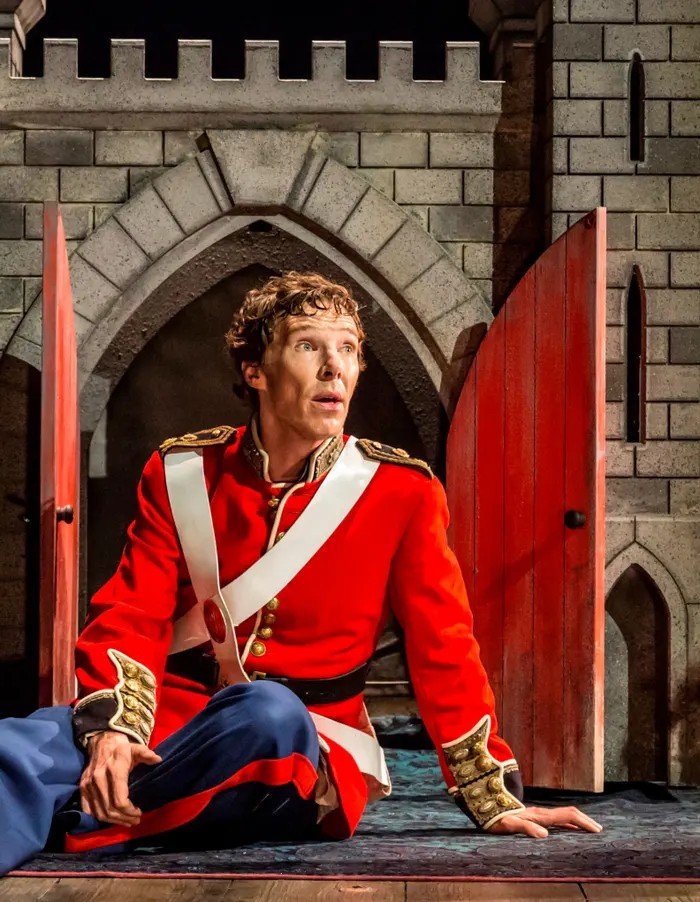
I couldn’t make up my mind between these two Hamlets, so I’m listing them together (guess that makes me Hamlet too). One is one of the most accomplished Shakespearean actor in recent memory, an RSC alumn, and a Hollywood star to boot, Benedick Cumberbatch.
Left- Benedick Cumberbatch as Hamlet, National Theater. Right- John Harrell at the Blackfriars Playhouse, Staunton VA.
Both these actors have similar strengths- they’re both tall and imposing with aquiline features. They are also highly physical performers. I talked in my lecture on Richard III about how Harrell performed the role of Gloucester with his legs tied together and a bowling ball strapped to his hand. Appearance-wise- Harrell and Cumberbatch are so similar, that it’s actually a joke at the ASC that they must be long-lost twins.
That said, when it comes to their approach to Hamlet, these two actors couldn’t be more different. Cumberbatch focused on Hamlet’s emotional turmoil- he was tortured and angry, full of youthful angst and volatility. This particular production is sort of an anachronistic mash-up of modern and period, which gives it a sort of dream-like quality that I really enjoy. Like Richard Burton, the director knows how to stage a play differently from a movie or TV show, which is especially important with this actor, since we can see him on all those platforms.
Nor should they have. Full of scenic spectacle and conceptual tweaks and quirks, this “Hamlet” is never boring. It is also never emotionally moving — except on those occasions when Mr. Cumberbatch’s Hamlet is alone with his thoughts, trying to make sense of a loud, importunate world that demands so much of him.
John Harrell on the other hand is a more mature and subtle Hamlet, more interested in saving his hide than contemplating his navel. This Hamlet masks pain with humor and sardonic wit and it translates to all his relationships with the King, Queen, and courtiers.
John Harrell as Hamlet, American Shakespeare Center, 2011
Rather than a sour, dour, morose, obtuse, naval-gazing Hamlet, this prince was cunning, cynical, devious, sarcastic, and very much enjoying his feigned madness, his chess game with the king, and his fencing bout with Laertes.
OK, I have to admit that I didn’t see this whole production either, but it’s so cool and the acting is so good I wish I had! Papaa Essiedu is an electrifying blend of wit, sadness, manic excitement, and rage. His fresh take on a role that can be rather dour is why even the little I’ve seen of his performance makes it one of my favorites!
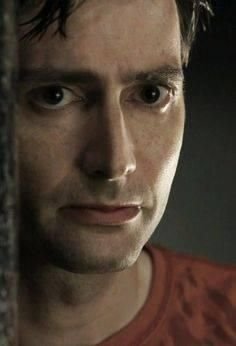
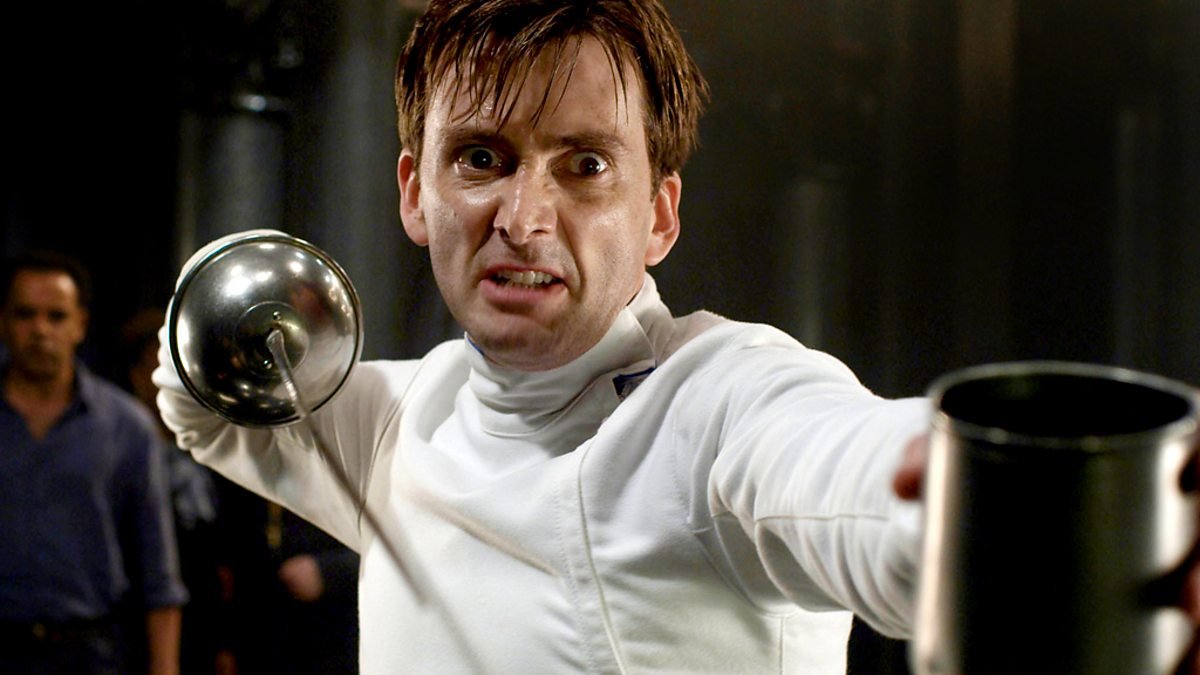
#2: David Tennet, RSC 2009
Tennet does an incredible job of encapsulating Hamlet’s quick wit, giddy excitement, frailty, fury, and frustration, especially with himself. I love the fact that he does “To Be Or Not To Be” in a superhero T-Shirt. In a way, this Hamlet is constantly wishing he was more of the action-movie type that Schwartzenegger parodies at the top of this list. Like Harrell, Tennent’s Hamlet masks his pain with humor, but you can see him struggle with it and try to pull himself out of despair. All these Hamlets find a way to nail at least one aspect of the character, but Tennet in his short 3 hours on the stage, manages to highlight all of them.
I recommend this version for any viewer in any classroom. It’s beautifully shot, extremely well acted, fast-paced, funny, and exciting. I cannot recommend it highly enough.
Honorable mentions: Anton Lester, Ian McKellen, MiChelle Terry, and Sir John Gielgud
I haven’t seen any of these Hamlets and have been unable to locate any clips, but I have the deepest respect for all of these actors, so I thought I’d highlight them here.
I’d also like to give special mention to Michelle Terry. Gender-blind productions of Shakespeare get a lot of flack that is undeserved, and there’s nothing wrong with a female Hamlet. To quote Geoffrey Tennet in Slings and Arrows: “Shakespeare didn’t care about anachronism, and neither should we.”
I didn’t include Ms. Terry in this list, simply because I wasn’t able to get to the Globe, and I wanted to focus on productions that people can watch for free. If you wish, you can watch her 2018 performance on the Globe Theater’s steaming website:
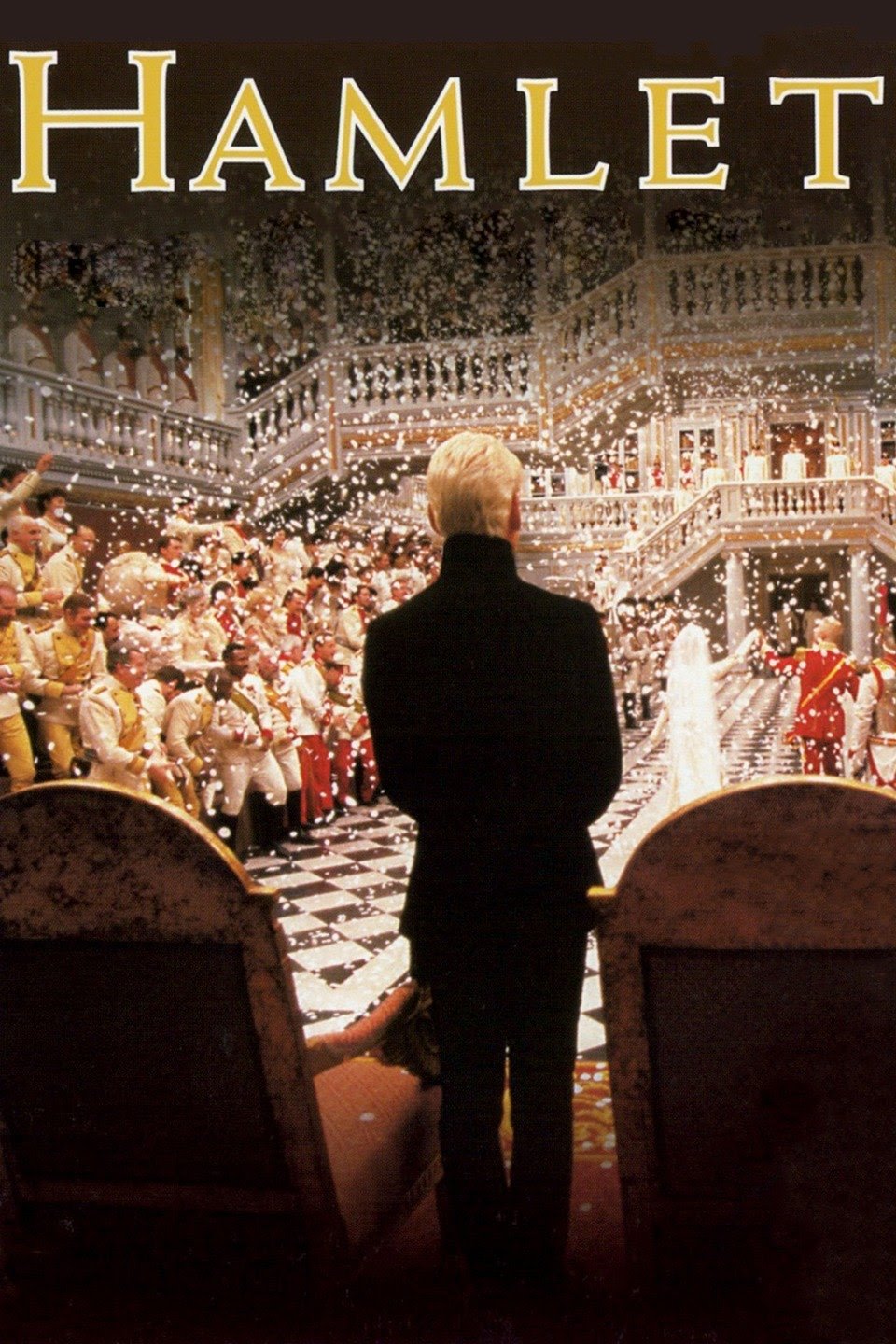
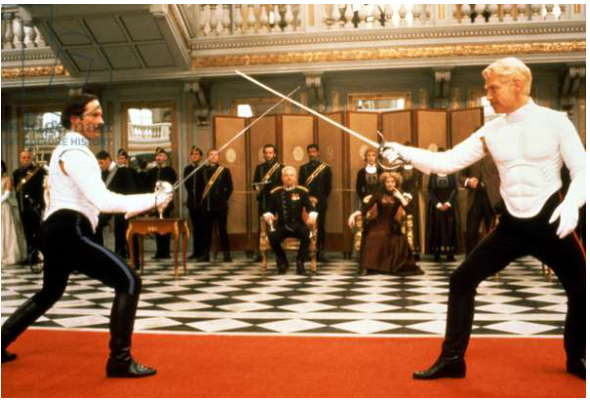
Hamlet (Kenneth Branaugh) duels with Laertes (Michael Maloney) in Branaugh’s 1996 film.Stills from Kenneth Branaugh’s Hamlet (1996).
You probably saw this coming. I’ve made it clear in other posts that I absolutely love Branaugh’s Hamlet, after all his film was one of the first Shakespeare movies I ever saw and the first one I really enjoyed. I discuss in detail why I love this movie the best in my review of the film, but to summarize, I think the direction is incredible, the music is excellent, the cast is nearly perfect, and Branaugh himself puts a huge amount of love, craft, skill, experience, and maybe a little madness into his portrayal of the character. I know Branaugh isn’t everyone’s cup of tea; other Hamlets on this list might be more enjoyable, fun, or subtle, for you. But for me, Branaugh’s will always be my favorite.































 The Shakespearean Student