I’m helping to coach an actor who’s doing Hamlet’s first soliloquy in Act I, “O that this too, too, solid flesh.”
The text of the speech
Hamlet. O that this too too solid flesh would melt,
Thaw, and resolve itself into a dew!
Or that the Everlasting had not fix'd
His canon 'gainst self-slaughter! O God! God!
How weary, stale, flat, and unprofitable
Seem to me all the uses of this world!
Fie on't! ah, fie! 'Tis an unweeded garden
That grows to seed; things rank and gross in nature
Possess it merely. That it should come to this!
But two months dead! Nay, not so much, not two.
So excellent a king, that was to this
Hyperion to a satyr; so loving to my mother
That he might not beteem the winds of heaven
Visit her face too roughly. Heaven and earth!
Must I remember? Why, she would hang on him
As if increase of appetite had grown
By what it fed on; and yet, within a month-
Let me not think on't! Frailty, thy name is woman!
A little month, or ere those shoes were old
With which she followed my poor father's body
Like Niobe, all tears- why she, even she
(O God! a beast that wants discourse of reason
Would have mourn'd longer) married with my uncle;
My father's brother, but no more like my father
Than I to Hercules. Within a month,
Ere yet the salt of most unrighteous tears
Had left the flushing in her galled eyes,
She married. O, most wicked speed, to post
With such dexterity to incestuous sheets!
It is not, nor it cannot come to good.
But break my heart, for I must hold my tongue!
Hamlet, Act I, Scene ii, lines 332-363.
Given Circumstances
This is the first time Hamlet really speaks. He’s extremely tight-lipped to Claudius and his mother, and for good reason: he just witnessed his father die under mysterious circumstances, his mother remarried, his school year canceled, and himself proclaimed heir to the throne. All of this happened within a month! It’s very hard to process this kind of massive shift in your life, so Hamlet waits until he is alone.
The speech is full of distrust for his uncle, contempt for his mother, and deep starry-eyed mourning for his father. Hamlet compares his father to Hyperion, the Greek Titan who ruled the Sun- a being who inspired awe and terror. He then contrasts that with Claudius whom he compares to a satyr- an old, half-goat man who is horny in more ways than one. Hamlet clearly doesn’t like or trust his uncle and is disgusted by the notion that he is now Hamlet’s stepfather.
How does Hamlet feel about himself? Well, the text is somewhat ambiguous. The soliloquy’s first line might be saying that Hamlet wants to melt away into air, but it could just as easily apply to the Ghost (who is still on Hamlet’s mind), Claudius (who he hates), or Gertrude (whom he’s disgusted at because she’s sleeping with his uncle). We don’t have a clear picture yet how Hamlet feels about himself in this moment, but we do know that his world is shattered and is no longer as happy as it once was:
How weary, stale, flat, and unprofitable seem to me all the uses of this world.
Act I, Scene ii, Line 336.
Verse
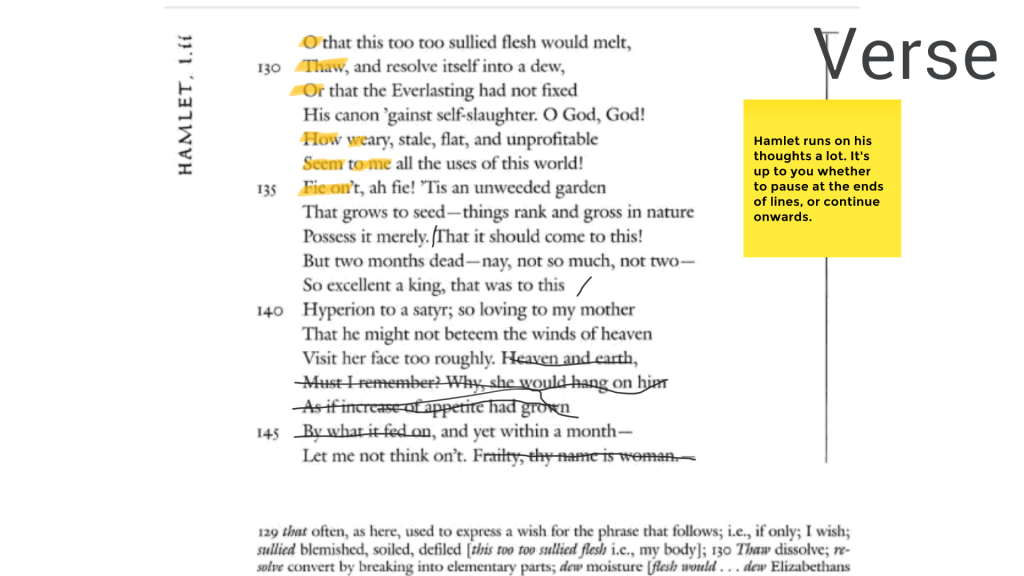
Analysis of the verse of Hamlet’s 1.2 Soliloquy. Note the trochaic meter in the first 3 lines.
As I often say, verse is the heartbeat of a character, and as Hamlet says, his own heart is broken so his verse is very irregular. Ideas spill over into multiple lines instead of tight, 10-syllable lines. In the excellent book, “Speak the Speech”, Rhona Silverbush and Sami Plotkin comb the speech for clues in the verse that suggest Hamlet’s fragile emotional state:
The piece is riddled with starts and stops mid line, sentence fragments, and [self] interruptions, which underscore Hamlet’s extreme agitation.
In the picture below, you can see how Hamlet often inverts his lines from Iambic to Trochaic (emphasis on the odd beats, rather than the even beats):
It’s up to the actor to decide which emotions Hamlet is showing and how this effects his breath, voice, and physicality, but the structure of the verse, the punctuation, and the flow of the thoughts gives him or her clues to play with, as you can see in this video with RSC actor Pappa Essiedu:
Imagery
Ambiguity and textual choices
Hamlet is a play that is all about the ambiguities that plague us as we go through life and its title character is constantly second-guessing, third-guessing, and fourth-guessing himself. In this speech, there are questions that the actor must decide for him/herself, because Hamlet and Shakespeare leave them open:
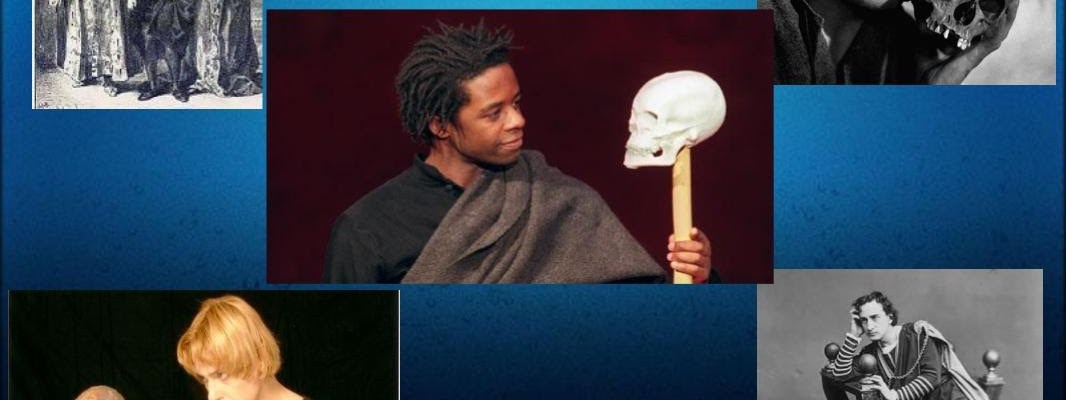
Whose flesh is solid? His father’s? His own? The world? Claudius?
Educators love to compare Shakespeare to classic Disney, myself included. After all, both Shakespeare and Walt Disney were popular entertainers who adapted classic stories into new forms for larger audiences.
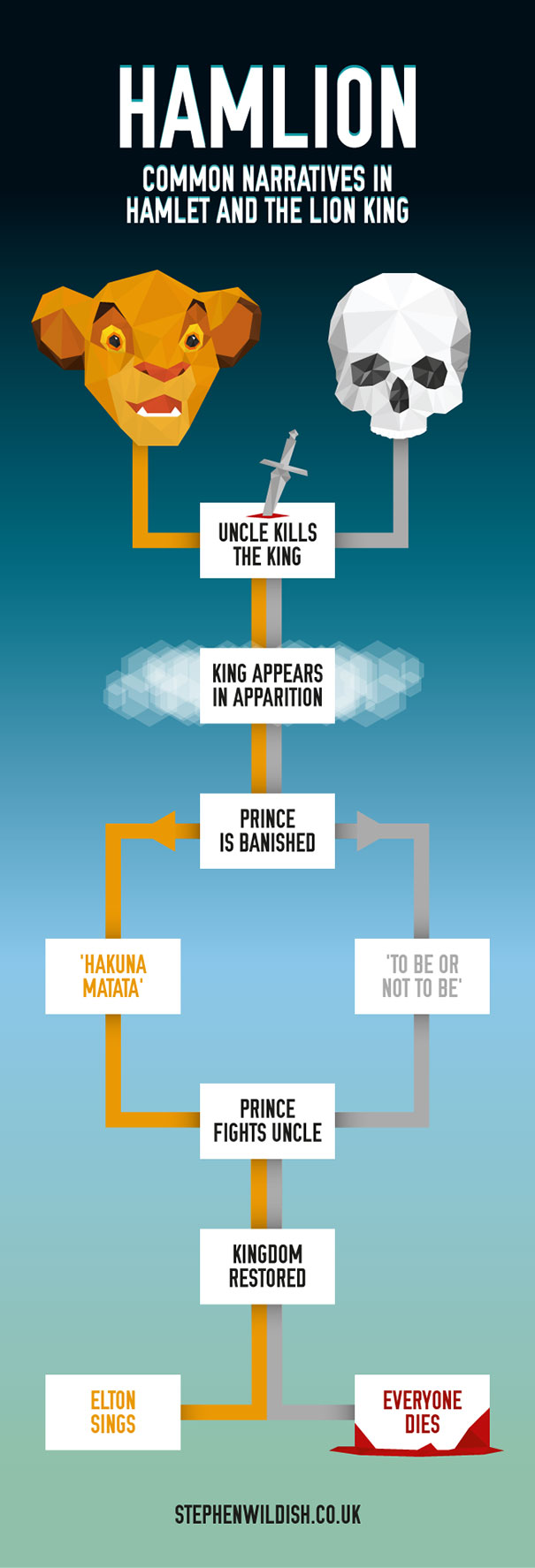
You can make a pretty strong case that Hamlet is “The Lion King” from these narrative similarities:
Infographic of Lion King similarities from Daily Infographic.com
It’s also true that, when the story artists at Disney decided to make the villain Mufasa’s brother, they noted the parallels to Shakespeare as the film was being written:
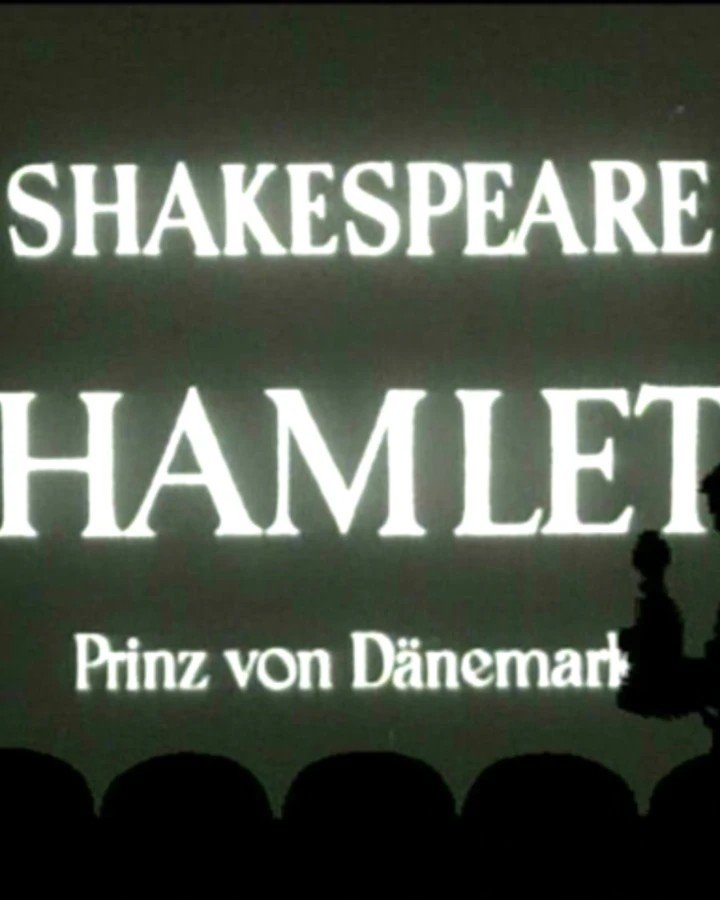
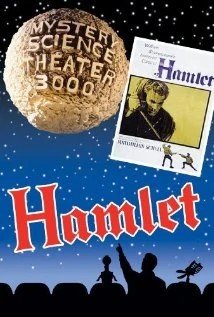
Mystery Science Theater 3000 has been on the air for over 20 years. The show originally aired in 1988 on KTMA TV in Eden Prairie MN. Since then it’s spawned over 13 seasons, (still going strong on Netflix), a huge cult following, and countless parodies in many versions of pop culture.The premise is that three guys watch bad movies and make sarcastic comments about the acting, sets, costumes, etc. The show thrives on meta-commentary, obscure references, and satirizing anything and anyone.
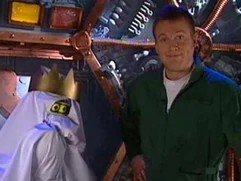
Crow T. Robot (Bill Corbit) trying to play the ghost of Mike’s father (Michael J. Nelson)
Full circle for the show
Kevin Murphy (right), as Fortinbras, who makes a brief appearance at the end of the episode, along with Bill Corbit and Mary Jo Pehl.
Kevin Murphy, one of the show’s creators actually had reservations of even doing the episode, as he is a big Shakespeare fan. This makes sense as I would argue that the very premise of the show lies in Shakespeare, and in particular, Hamlet. As I said in the last paragraph, the show thrives on reference humor, meta-commentary, and satire, and one person who loves that kind of humor is in fact, Shakespeare’s own drama critic- Hamlet, Prince of Denmark.
In Act III, Scene ii of Hamlet, there is a play within a play, where Hamlet sits back and makes sarcastic comments about how bad the production is:
Enter Prologue.
Hamlet. We shall know by this fellow. The players cannot keep counsel; they’ll tell all. Ophelia. Will he tell us what this show meant?2035 Hamlet. Ay, or any show that you’ll show him. Be not you asham’d to show, he’ll not shame to tell you what it means. Ophelia. You are naught, you are naught! I’ll mark the play. Pro. For us, and for our tragedy, Here stooping to your clemency, We beg your hearing patiently. [Exit.] Hamlet. Is this a prologue, or the posy of a ring? Ophelia. ‘Tis brief, my lord. Hamlet. As woman’s love.
Hamlet, Act III, Scene ii
If Hamlet had two robot companions, he’d essentially be doing an episode of the show!
Begin Murderer! Pox! Leave thy damnable faces and begin!
Hamlet, Act III, Scene ii.
So it’s an interesting kind of irony that after 13 years, MST3K finally got around to review the very source of their humor. Not only is Hamlet highly meta and satirical, Many educators, myself included, say that teaching Shakespeare with a healthy dose of irreverence is a good way to draw in new students and get them interested in the play:
Mystery Science Theater 3000’s “Hamlet ” episode reveals a common reaction to Hamlet that often goes unspoken by high school and college students too afraid to sound anti-intellectual. Despite this irreverent tone, however, this unique appropriation of Shakespeare adds to our understanding of a play that today very few read and even fewer see performed. As an author who reveled in making serious, yet sometimes playful, fun at human weakness, I think this respectful irreverence would have delighted the Bard were able to see it.
Dan Mills. “Mystery Science Theater 3000, Shakespeare, and Postmodern Canonization,” Interdisciplinary Literary Studies, 17.2 (2015): 206-227.
3. Divisive episode
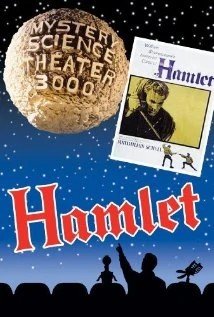
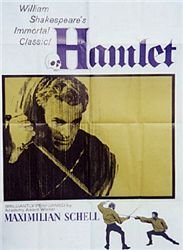
Original film artwork for “Hamlet”, 1961
This episode is somewhat controversial among the MST3K fandom. While almost everyone agrees it was a good idea for Mike and the bots to do Shakespeare, many fans question the choice to do this Shakespeare. The 1961 film was produced for German TV, and starred Maximillian Schell, (who would later win an Oscar for his performance in “Judgement at Nuremberg).”
First of all, the film is very slow and badly paced with no distinctive production choices. The sets and costumes are generic, (except for the Liberace-looking ghost), and the cinematography is competent but dull. Finally it’s Hamlet; the play that even Mike Nelson called “The greatest work of fiction ever written.” Even with the dreary set, the bad dubbing, and nonexistent pacing, it’s still a good story with magnificent dialogue, and the cast is still pretty good. Perhaps the ultimate backhanded compliment Mike Nelson and company could have handled is that even the worst production of Hamlet is very difficult to riff. Still, when the jokes land, they hit extremely well. Here are some of my favorites:
C’mon, man. We’ve seen like eight ghosts, none of ’em have been even close to my dad. MIKE NELSON
Rap artist, The Notorious K.I.N.G.”
Hamlet: To die: to sleep. Crow: Yeah, that’s what we’re doing right now, Bub.
Hamlet: TO BE OR NOT TO BE…. and lose the name of action.
Mike: So I’m a chicken for not stabbing myself—that’s all you needed to say!
[Having stabbed an intruder behind Gertrude’s tapestry, Hamlet discovers it is not the King, but Polonius.] Hamlet: Thou wretched, rash, intruding fool! Crow [as Polonius]: Oh, right, it’s my fault you killed me.
My reaction
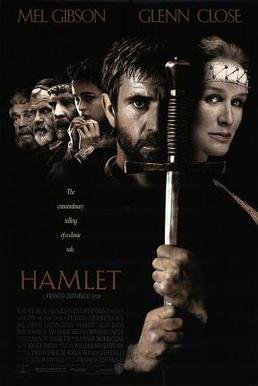
On the one hand, it’s great to watch the MST3K guys look at a piece of classic theater, especially since the show owes a lot to Shakespeare. That said, they never acknowledge this, not even during the play within a play scene. In addition, the critics are right that the film is so dreary it’s hard to make fun of. I would love to see how the bots and Mike riff on Branaugh or Gibson! Finally, maybe part of the problem was that Hamlet has already been riffed and mocked before. As the clip above from The Reduced Shakespeare Company shows, gently ribbing on the plot and characters of Hamlet has been done before. Once something becomes famous as the best or the worst, it becomes a target for mockery. I was hoping that my favorite riffers would have more fun riffing on the play that helped create their art form. That said, this show is a classic comedy series, and this episode always makes me smile.
This is a play I’ve been obsessed with since I was 16 years old. There’s so much to say about it, but I’ll be focused mainly on the mysteries of its famous plot and characters. In the meantime, here’s some background info on the play collected from the posts I’ve done on it over the years:
Play of the Month: Hamlet. My complete summary with pictures, videos, and discussion questions
How Accurate Is Hamnet? I review the novel “Hamnet” which is a work of historical fiction. It focuses on the possibility that Shakespeare wrote “Hamlet” after the death of his 11-year-old son.
Shakespeare on Ghosts: In this post, I discuss the meaning and psychological significance of the Ghost in “Hamlet”.
Internet Shakespeare Editions: https://internetshakespeare.uvic.ca/Library/Texts/Ham/. Has all four quartos in modern and original type, lots of background sources, and the text of the German Hamlet “Bestrafte Brudermord.”
Today I pay tribute to a remarkable book written by a great actor, who has inspired me and countless others.
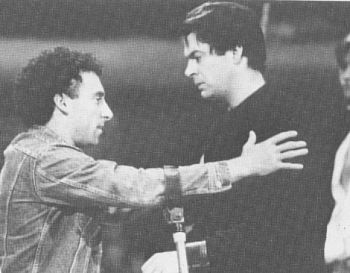
I was privileged back in 2011 to see Anthony Sher on stage playing is playing Edmund Kean in John Paul Sartre’s pastiche of Shakespeare entitled “Kean.” It was a very good casting because this actor very clearly had a lot of raw energy and at the same time charisma and wit. But at the same time, he also seemed to have tenderness, sadness, and insecurity behind his eyes. I didn’t realize it but this actor, Sir Antony Sher, who sadly passed away just last year, would change my life.
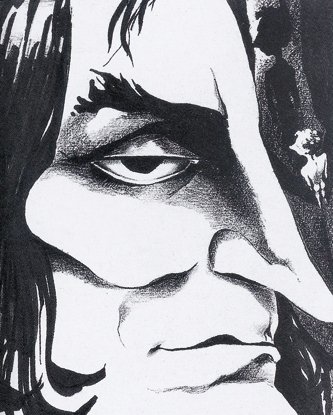
When I was still in college I knew that I was going to go to grad school, and I wanted to write a graduate thesis on Richard III. Through my research, I came to realize that this same actor produced what is still regarded it as one most acclaimed and influential productions of the play ever. In 1984, Sir Antony played an iconic Richard III at the Royal Shakespeare Company which was revolutionary for its raw energy, tragic emotions, and creative physicality. Mr. Sher played the role on crutches and was able to scuttle around the stage like a spider.
I feel very therefore very privileged that I was able to see him perform live and to research his performance for my thesis.
One of my greatest aids for this was Sir Antony’s own book about the process of writing Richard that he wrote while in the process of doing Richard, “A Year Of the King. It’s organized in the form of a diary and a lot of the pages are available for free on Google Books. I strongly recommend it. In this review, I’m going to praise his massive preparations for the role and talk about the effects of the production going forward in future productions of Richard III.
In 1982, Sir Antony was playing the Fool in a production of King Lear with Michael Gambon, (the future Dumbledore from Harry Potter). During the performance, Sher suffered a leg injury that required him to be on crutches for several months. In his diary, Sher records how angry being perceived as disabled made him feel. His physical therapy took place at the Remedial Dance Clinic, Harley St.
Six months later in August of 1983 Sher was cast in Tartuffe with Bill Alexander as director, (who would later direct him again in Richard III). A chance meeting with Trevor Nunn, (who was the Artistic director at the time), put the idea of Sher playing Richard into Alexander’s head. After another meeting with Terry Hands, Sher was offered the role.
Sher rehearsing for Richard.
“The truth of the matter was I was terrified of the verse, ashamed of my inexperience with it and nursing a fear that I was trespassing anyway. Wasn’t classical theatre the territory of handsome, rich-voiced Brittish giants like Gielgud and Oliver, and out of bounds for little Cape Town newbies like me?”
Sher, Year Of the King, page 9
Fighting with Olivier
Drawing of Olivier’s iconic Richard by Antony Sher, 1983.
When Antony Sher approached the role of Richard in his 1984 RSC production, his first intention was to make his portrayal of Richard’s deformity and disability different from Laurence Olivier’s. Sher and Olivier believed Richard is both physically and mentally deformed, therefore, Sher’s massive preparation for the role included thorough research into the physical effects of real disability and a deep examination of its psychological effects.
Unlike Olivier, Mr. Sher believed that Richard’s deformity was the key to understanding his character and that every aspect of Sher’s characterization stemmed from his interpretation of that deformity. This work produced a captivating physical characterization and a startlingly human re-conception of Richard’s mind.
The Physicality
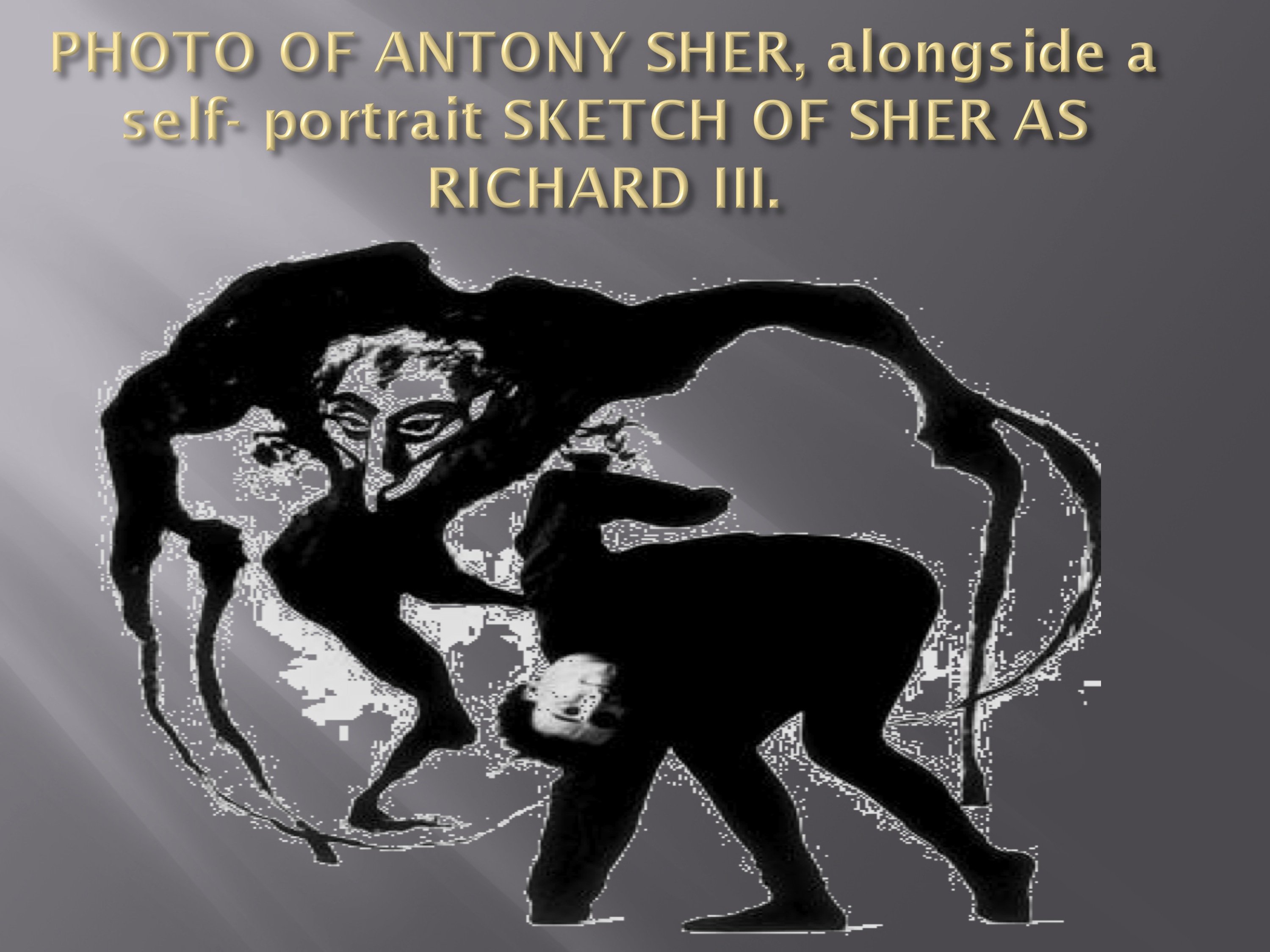
Sher’s characterization of Richard’s body resulted in an image, which he referred to as “The Bottled Spider.” Richard had a massive hump in the center of his back, massive arms, and two crutches that fitted onto Sher’s forearms, allowing him to scuttle across the stage, giving the impression of a poisonous spider. Sher created this iconic physical characterization through a combination of textual research, sketches, medical research into real deformities, image research, and real-life experience. The guiding principles that Sher used in creating Richard’s deformity were creating a severely deformed character that the audience would identify with. At the same time, Sher attempted to create a physicality that he could sustain through the run of the show without major injuries (21 &30). According to Sher, the role of Richard III is notorious for crippling actors who sustain severe damage to their backs and shoulders (39). Thus Antony Sher’s Richard was physically designed to be both functional for the actor, as well as realistic and remarkable for the audience.
The first step towards Sher’s physical characterization of Richard was going through the text for clues. Sher found several references to what Richard’s deformity looks like in the speeches of Queen Margaret. Margaret refers to Richard repeatedly as various beasts, alternating between boars, hounds, and the bottled spider that would become so important to the final characterization. Before Sher settled on a spider as the animal Richard most resembles, he experimented with several others, including boars, apes and bulls. Sher did several sketches of bulls, which he saw in a BBC TV program. Sher was attracted to bulls and their raw power and massive shoulders. Sher wanted an animal that was threatening and powerful to give his portrayal a ‘tragic dimension’ (64).
Having to say ‘I was born in South Africa’ stuck in my throat like a confession of guilt.’
Sher, p. 25
Another image from the text that Sher thought about repeatedly was the image of Richard’s hump as a mountain. When Richard refers to his hump as “an envious mountain on my back,” Sher thought back to the Lion’s Head mountain in Kingstown South Africa. Sher grew up in South Africa and visited there during apartheid. The mountain spoke to Sher’s notion of Richard’s raw, tragic power. Sher sketched the mountain several times, and combined it with other images of bulls and spiders and this became the overall concept for Richard’s hump- an image of thick power that simultaneously weighs down the figure of Richard, and gives him his strength.
I feel he should be severely deformed, not just politely crippled as he’s often played. Bill says one should identify with him: a man looking in from the outside and thinking, ‘I’ll have some of that.’
November 7, 1983
Sher and Brian Blessed in the final play.
The most memorable part of Sher’s physical performance as Richard was the way he manipulated the two arm crutches that he wore for the first half of the performance. Sher’s Bottled Spider image mainly depended on his ability to manipulate the crutches. The crutches became part of Richard’s body (Cerasano 621) and, far from making Sher’s movements clumsy or stiff, they gave him the ability to transform himself into a strange four-legged creature that would move around the stage incredibly fast.
Director Bill Alexander told Sher during rehearsals that he intended to use the crutches in as many ways as possible. For example, the crutches also served as a weapon because of Sher’s ability to swing them around like clubs. One chilling moment of the performance occurred when Sher’s Richard entraps lord Hastings (Brian Blessed) by folding his crutch-arm across Hasting’s neck; foreshadowing Richard’s later decision to chop off Hastings’ head (Cerasano 621).
The problem in playing him extremely deformed is to devise a position that would be 100 per-cent safe to sustain over three hours, and for a run that could last for two years. Play him on crutches perhaps? They would take a lot of the strain off the danger areas: lower back, pelvis and legs. And my arms are quite strong after months at the gym. Also I was on crutches for months after the operation so they have a personal association for me of being disabled. They could be permanently part of Richard tied to his arms. The line, ‘Behold mine arm is like a blasted sapling wither’d up,’ could refer to one of them literally. The crutches idea is attractive, too attractive at this early stage. Must keep an open mind on the subject.
Sunday Nov, 19, 1983
Physical therapist Charlette Arnold, helped Sher get into clinics for people with real disabilities. She also provided Sher with books on back disorders, which led Sher to choose the disorder Kyphosis as the model for Richard’s hump. Kyphosis causes a large central hump in the back, which Sher immediately adopted because it resembled the mountain image of his sketches. Also, the central hump was different from Olivier’s side hump.
Sher’s research on back disorders was of great use in the coronation scene in which he and Lady Anne appear with bare backs. Bill Alexander hired makeup artist Christopher Tucker to create a lifelike prosthetic for Richard’s back. The audience was thus forced to see Richard as a naked, deformed man, contrasted next to the beautiful bare back of his wife, creating a powerful moment that re-enforced Richard’s humanity. Sher would also use a humanistic approach to his portrayal of Richard’s mind, which, like Richard’s body, he developed through extensive research.
Richard (Antony Sher) is killed by Henry Tudor at the play’s conclusion.
Psychology- Richard III on the couch
“In several copies I’ve looked at it’s called The Tragedy of King Richard the Third. Yet a tradition has evolved of playing it as black comedy. I’ve never seen anyone play Richard’s pain, his anger, his bitterness, all of which is abundant in the text. It seems to me that Richard’s personality has been deeply and dangerously affected by his deformity, and that one has to show this connection.
November 19, 1983 p. 30
In his research, Sher made the link between deformity and psychopathology. Unlike Oliver, who played Richard as a paranoic, Sher played Richard as a psychopath. In his research into psychopaths, Sher uncovered the idea that psychopaths often suffer childhood traumas. The text of Richard suggests that Richard’s mother hated him, and such a lack of affection could realistically change a boy into a psychopath. Through this probing of the text and research into psychology, Sher concluded that Richard’s deformity is a realistic source of desire for revenge.
Sher talked to his own psychiatrist, Monty Berman who provided him with insight into Richard’s mind. Monty helped Sher dispel the idea that Richard is a superhuman fiend. On the contrary, Richard’s persona is very similar to real live psychopaths. Berman theorized that the pain at being deformed, coupled with the violent upbringing Richard living through in the Wars of the Roses, could transform him into a remorseless killer.
Sher: “How do you explain Richard the Third then?” Monty: “Well, how did you feel when you were on crutches last year?” Sher: “I hated people staring at me.” Monty: “What did you want to say to them?” Sher: “F#$% off! What are you staring at?” Monty: “Precisely. Anger. Richard is revenging himself on the whole world, destroying a world he sees as hating him.”
Monty: “We treat the disabled appallingly. They come up against dreadful prejudice. The disabled person experiences frustration and if given the chance, will lash out.” Sher: “So are you saying Richard’s behavior is normal?” Monty: “Under the circumstances, absolutely normal.”
Sher and Berman also believe Richard has the humor of a psychopath- a sardonic wit that has no regard for the feelings of his audience. Sher looked at the parallels between Richard III, and serial killer David Nilsen, who would invite people over for tea and strangle them, and boil their heads on his stove. Nilsen once told police with Richard-like humor that; “Having corpses was better than going back to an empty house.” One could easily hear the same sort of gruesome wit in the phrase: “I do love thee so, that I shall shortly send thy soul to heaven,” (R3 I,i).
A psychopath like Richard kills in order to try and feel emotion; “Each murder is an attempt to release anger, an attempt at catharsis, and each time it is unrelieved. It’s like promiscuous sex without love. Each climax is less and less fulfilling so the appetite grows until it is insatiable.” Thus Berman allowed Sher to break with the tradition of playing Richard as an inhuman monster, and play him as a very real, very tortured, human soul.
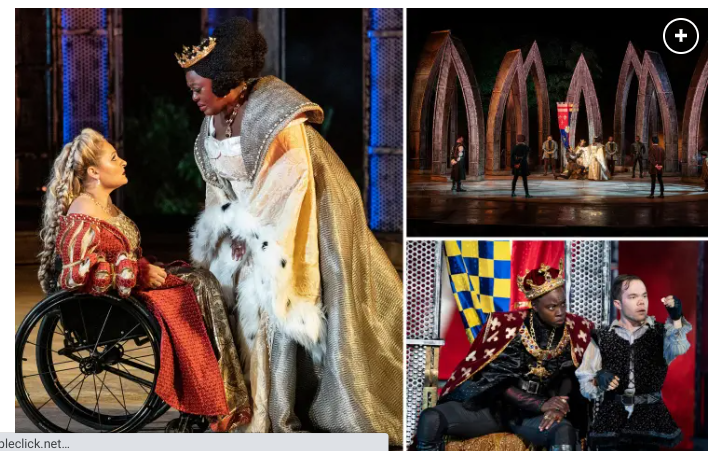
Although Antony Sher attempted to play Richard as a psychopath, his portrayal of Richard’s pain could become sympathetic. His observation of people in clinics and his own personal experience of being on crutches taught him about the cruelty that the disabled suffer. However, although he did great work to try and understand the condition of being deformed and disabled, his portrayal was still an affected disability; an act. In the book “Framed: Interpreting Disability in Today’s Media,” the author speaks about how watching an able bodied actor play disability can actually alienate the audience from the character he is portraying. The performance is seen as an act, a novelty, not an honest representation of real people. One way to eliminate this barrier between character and actor is to cast a Richard who really does suffer from a disability or deformity. I’ve talked in previous posts about how last month’s Public Theater performance was a deliberate attempt to move away from theatrical illusion and re-contextualize Richard’s deformity in the form of race, and contextualize disability by letting actors with disabilities play the heroic parts, while only Richard was able-bodied.
In a way, like Olivier, Sher’s performance is a new monolith that actors must work hard to distinguish themselves from. He spent an entire year building his Richard from the ground up, experimenting with new ways to portray his deformities, his disability, his psychology, and of course, how he looks and moves onstage. Reading this book, an actor gets a great appreciation for all the work Sir Antony Sher included in this wonderful performance, and hopefully, the book will inspire new and creative ways to portray this character in the future.
Thank you for reading. If you want to see some of Sher’s physical and psychological techniques in practice, please watch the thesis presentation that I did at the Blackfriars playhouse below. If you are interested in signing up for one of my acting courses, click here. Thank you!
Today I’m going to talk about the unique costume challenges in dressing the cast for a production of Shakespeare’s history play, “Richard III.”
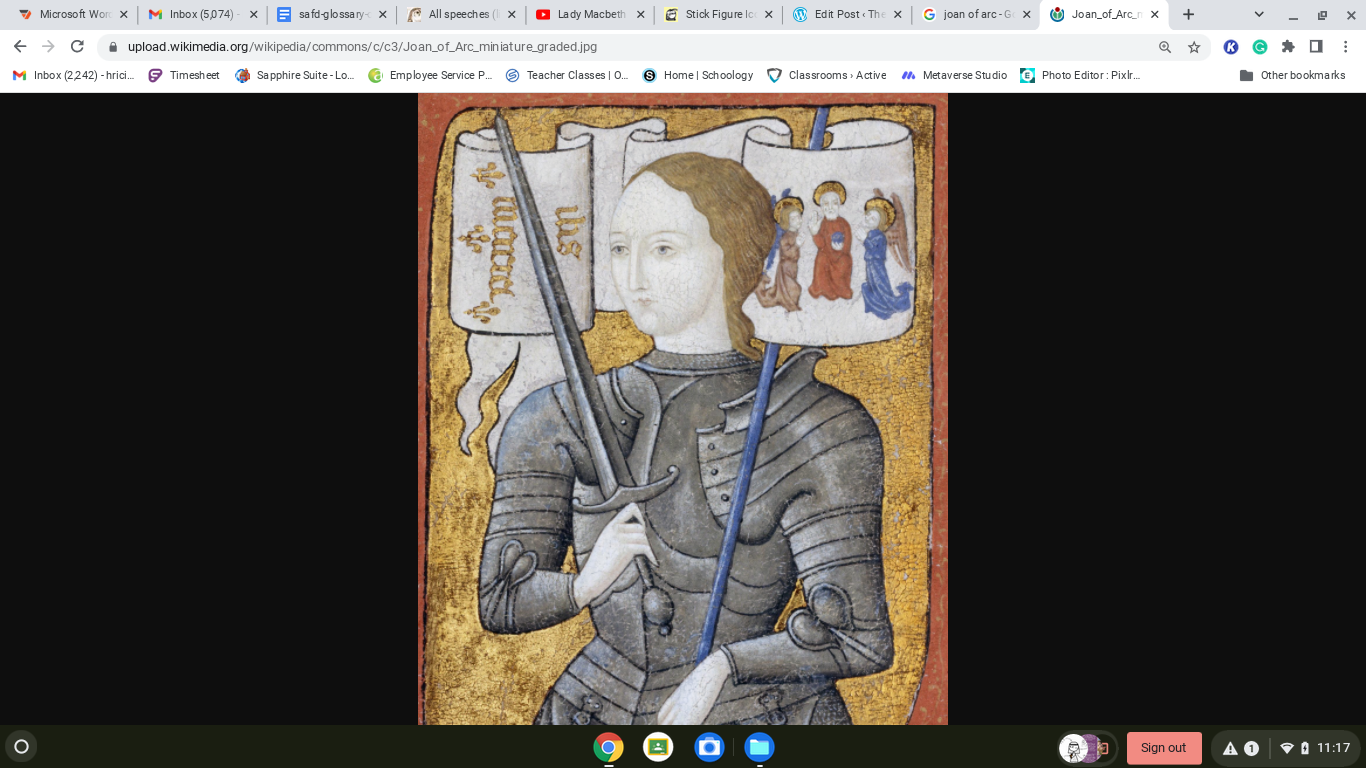
Antony Sher in the 1984 RSC production of Richard IIIConstance from King JohnProduction stills from the 2022 Public Theater production.Contempory drawing of Joan of ArcLaurence Olivier in his 1955 film “Richard III.”
The play is set in 1483, a time period where, even though many European countries were at war, many nobles had sumptuous, more form-fitting clothes with fur, gold, leather, and other exotic fabrics. If you look at the sketch I did above, I gave Richard designs using velvet, leather, fur, and gold. After all, Richard is a powerful duke even before he takes the crown. For more information about this period, visit Fashion History.edu.
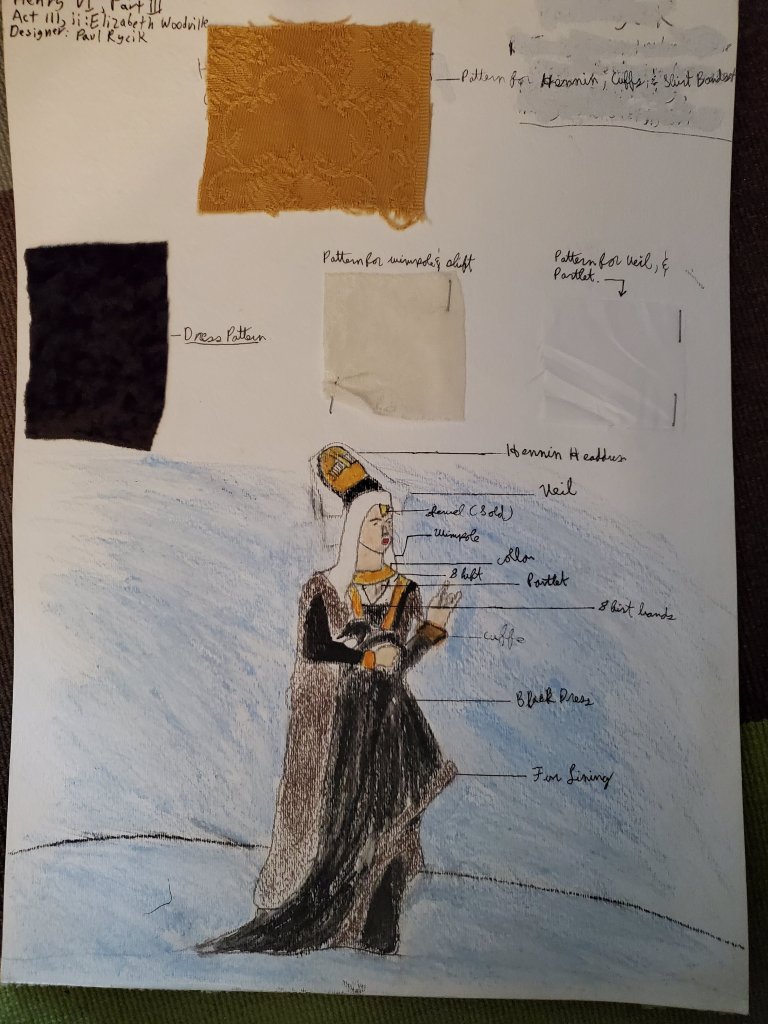
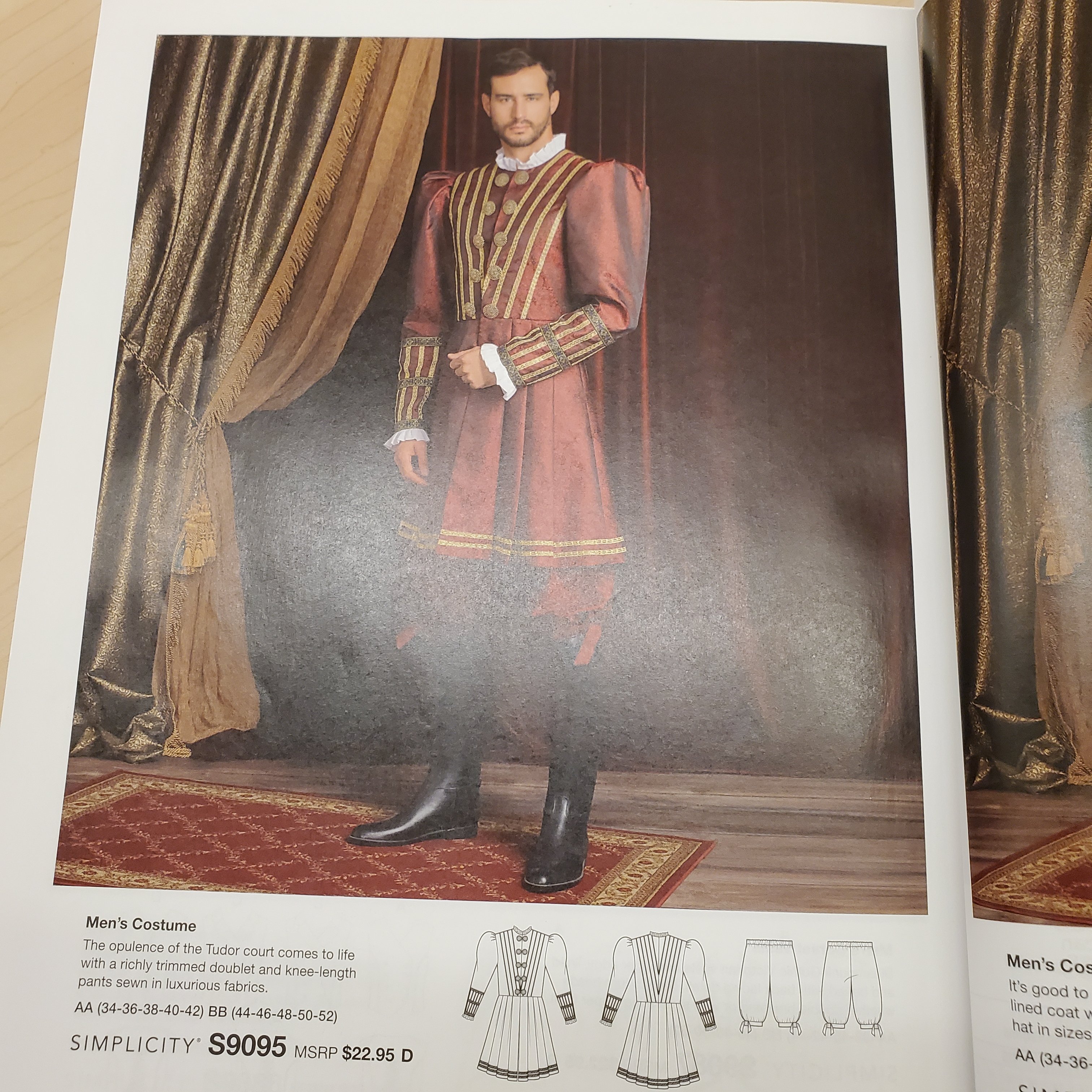
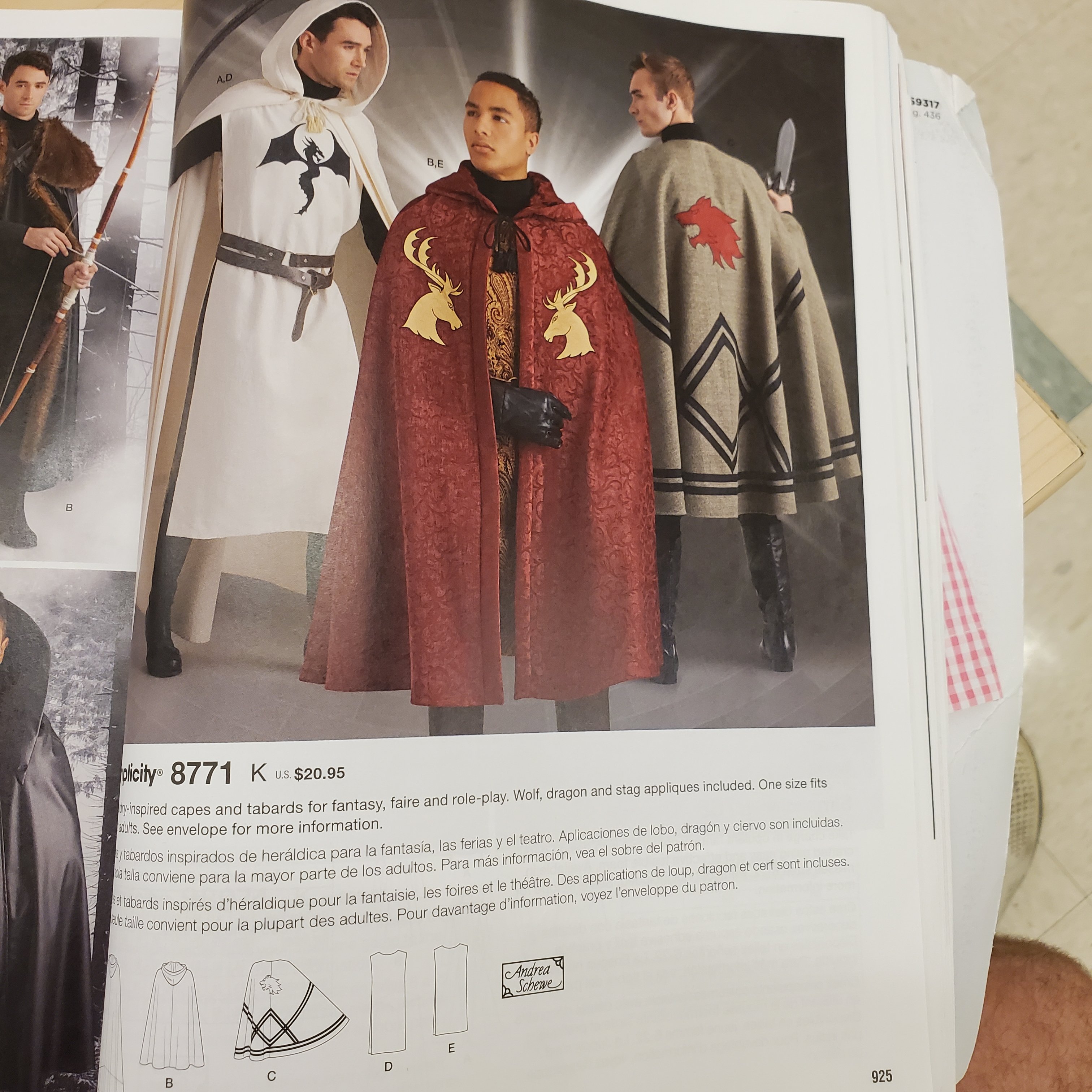
Further, if you’re interested in finding pre-made patterns of 15th century-inspired costumes, go to your fabric store and look for kits like the ones I photographed below.
My design was based on a drawing by the 19th century illustrator HC. Seleous, and the color were taken largely from Richard’s royal portrait in the National Portrait Gallery. I also used a royal portrait of Elizabeth Woodville, queen to Edward IV, (Richard’s brother).
Royal Portrait of Queen Elizabeth Woodville, 1437-1492.National Portrait of King Richard III.
Donning the Hump
Interestingly, x-ray photography has recently revealed that Richard’s alleged hump was added to his portrait after his death. In reality, the king only suffered from merely a curvature of the spine. Just like in Shakespeare’s play, the Tudor Chroniclers literally defaced Richard’s image to make him look like an evil, deformed maniac.
Costume designers are vital to help the actors realize the deformity when playing Richard III, and they have done so in many ways. Ian Holm wore a boot on his leg. John Harrel had a bowling ball fastened to his hand, and Antony Sher had a large hump in the center of his back, both a cloth one that was built into his clothes, and an elaborate makeup prosthetic for scenes where he was partially undressed. When I researched for my thesis, I consulted Sir Antony’s book “Year Of the King,” where the actor explained his research into real spinal deformities, and how he incorporated them into the performance. You can see how my actor Matthew figured out how the hump would impede his walk and other movements.
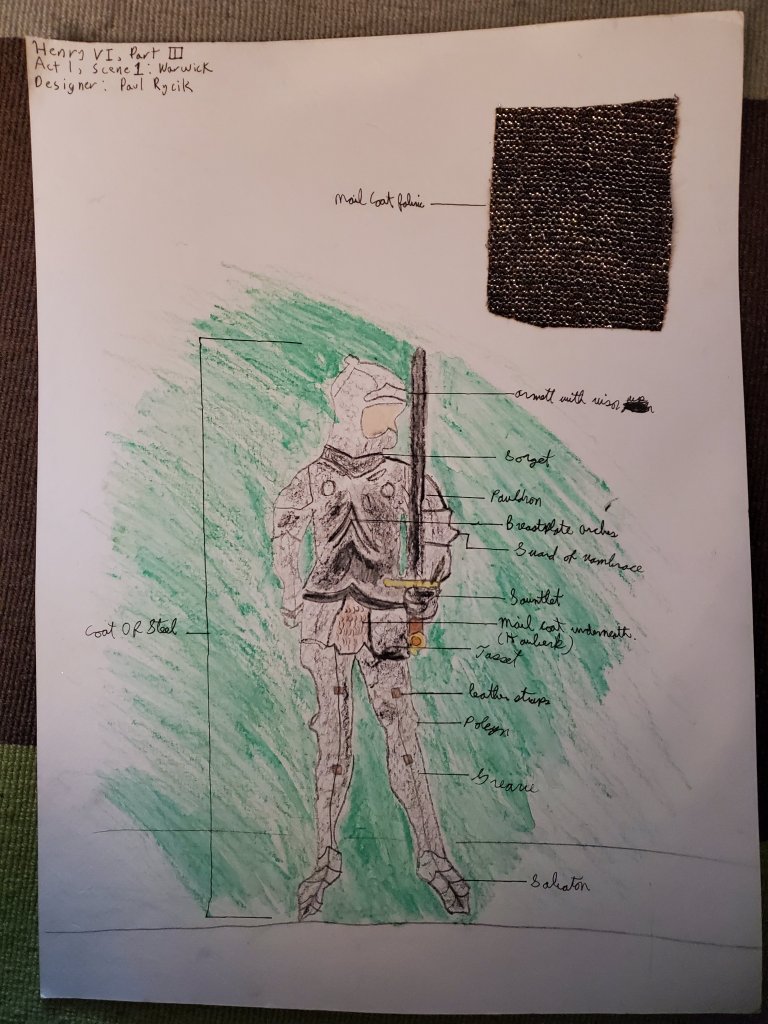
For the final battle between Richard and Richmond, one has to decide on the period and think carefully of the fitness of the actors. 1485 was at the height of the era of suits of armor, and many films have chosen to have Richard fight to the death, while encased in a heavy metal coat of plates.
Benedict Cumberbatch in the 2017 BBC TV mini-series “The Hollow Crown.”Design for a suit of armour for Henry Tudor
However, this has not always been the case. Ian McKellen had Richard fight in a gas mask in a 1940s British military uniform, driving around on a jeep that gets stuck once Richard utters his most famous line:
Richard III is a play about political intrigue, mafia-like turf-wars, and literal backstabbing and the clothes need to reflect this brutal and Machiavellian world. The costumer needs to help all the actors, not just Richard realize their place in the corrupt medieval political landscape of The Wars Of The Roses, as these characters go from an uneasy peace, to the last gasp of civil war.
Ian Mckellen in the 1995 movie version of Richard III.
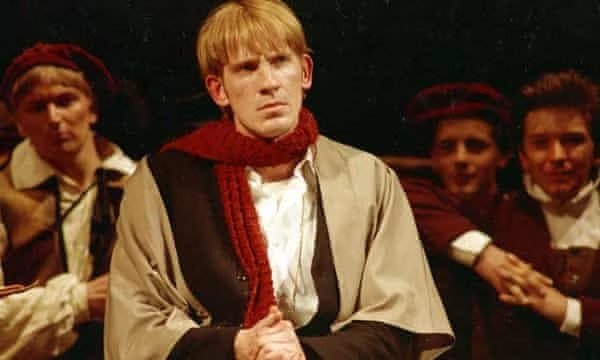
I’m saddened to report the death of a great British thespian and a versitile character actor. David Warner rose to priminance at the Royal Shakespeare Company, whre he played a celebrated Hamlet, a saintly King H enry VI, and many many others.
Warner’s stage career falls into two distinct halves: a youthful decade of riotous acclaim and a late-life flowering separated by a period from 1972 to 2001 when he forsook the stage to carve out a career in cinema. Yet in both youth and age he showed similar gifts: an innate gentleness of spirit, a sense of latent melancholy, an inquisitive intellect
Now put your shields before your hearts, and fight With hearts more proof than shields
Coriolanus, Act 1, Scene iv.
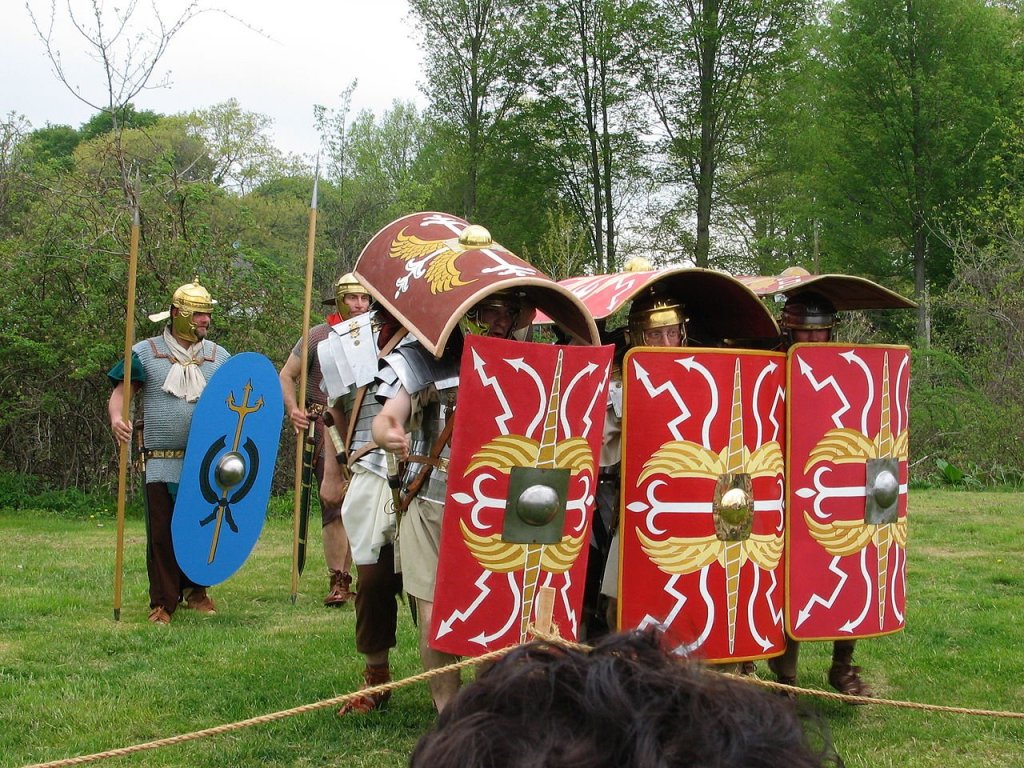
Roman re-enactors demonstrate a testudo formation (The Tortoise). Wikimedia Commons.
Shakespeare uses the word “shield” over 30 times, often as a verb meaning ‘to protect.’ However, there are a few very important references to this ancient tool of defense, and constructing one can teach you a lot about the history of a culture, and that culture’s methods of waging war.
A Brief History of Shields
The seven-fold shield of Ajax cannot keep
The battery from my heart
Antony and Cleopatra, Act IV, Scene 14.
As the quote above from Antony and Cleopatra mentions, the shield has been around since the dawn of history, certainly since Roman times. The Romans prized their large shields called scuta, which they used in defensive formations as the soldiers crashed through their enemies’ defenses.
DIY Roman shieldA replica of an ancient Celtic shield.
In medieval times, Anglo-Saxons and Vikings used new and more sophisticated shield formations in some of the most important battles in early British history. This included the Battle of Hastings in 1066, which ended the Anglo-Saxon era when the English abandoned the protection of their shield wall to chase the Norman invaders, who then annihilated their forces and proclaimed their leader William of Normandy, the conqueror of all England.
In this excellent video, historian and fight choreographer Mike Loads traces the history of medieval shields and shows step-by-step how to make an authentic Anglo-Saxon shield!
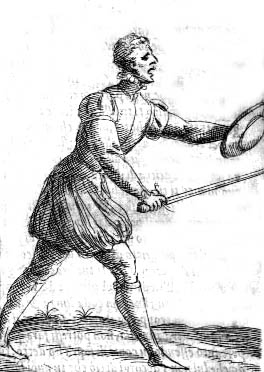
Illustration of a man fighting with a sword and buckler
Swashbuckling
[Enter SAMPSON and GREGORY, of the house of Capulet, armed with swords and buckles]
Shakespeare’s Romeo and Juliet begins with servants armed with swords and small shields called bucklers. These shields were designed to be used in single combat (duels) and were very light and agile. According to Mike Loads, young men would wear their swords and bucklers on their hips and make a loud racket as they walked through the streets. The shield proclaimed that they were armed and dangerous. This macho swaggering is the origin of the term “swashbuckling,” which is probably how these servants see themselves since they spend the first scene of the play trying to pick a fight.
What Is heraldry?
A series of heraldic devices from the Royal College of Arms.
Just as the sound of a buckler announced to the world that a young man was armed and ready to fight, the design on a nobleman’s shield announced his status, his house, and his family motto. The popular historical consensus is that once the medieval knight arrived on the battlefield, they started using their shields and tabards as a colorful display; one that made it clear that they were noble. In war, a knight or other nobleman could collect a hefty ransom if they captured another knight alive, so if you belonged to a rich noble house, your brightly decorated shield could save your life on a battlefield in more ways than one.
Each heraldic design would be registered in the College Of Arms, and many of them are still on record today. In Shakespeare’s Pericles, a group of knights presents their shields to King Simonides and his daughter Thaisa right before a joust and she reads their mottos. The shields are like the knight’s ID tags and help the princess know whom to award the prize money once the jousting is over:
Simonides. Are the knights ready to begin the triumph?
First Lord. They are, my liege;
And stay your coming to present themselves.
Simonides. Return them, we are ready; and our daughter,
In honour of whose birth these triumphs are,
[To Thaisa] 'Tis now your honour, daughter, to explain
The labour of each knight in his device.
Thaisa. Which, to preserve mine honour, I'll perform.
[Enter a Knight; he passes over, and his Squire]
presents his shield to the Princess]
Simonides. Who is the first that doth prefer himself?
Thaisa. A knight of Sparta, my renowned father;
And the device he bears upon his shield
Is a black Ethiope reaching at the sun
The word, 'Lux tua vita mihi.'
Simonides. He loves you well that holds his life of you.  Pericles, Act II, Scene ii.
How to make your own shield!
Since shields are an important part of Shakespeare’s plays, here’s how you can make a shield activity at home or in the classroom.
Making the basic shape
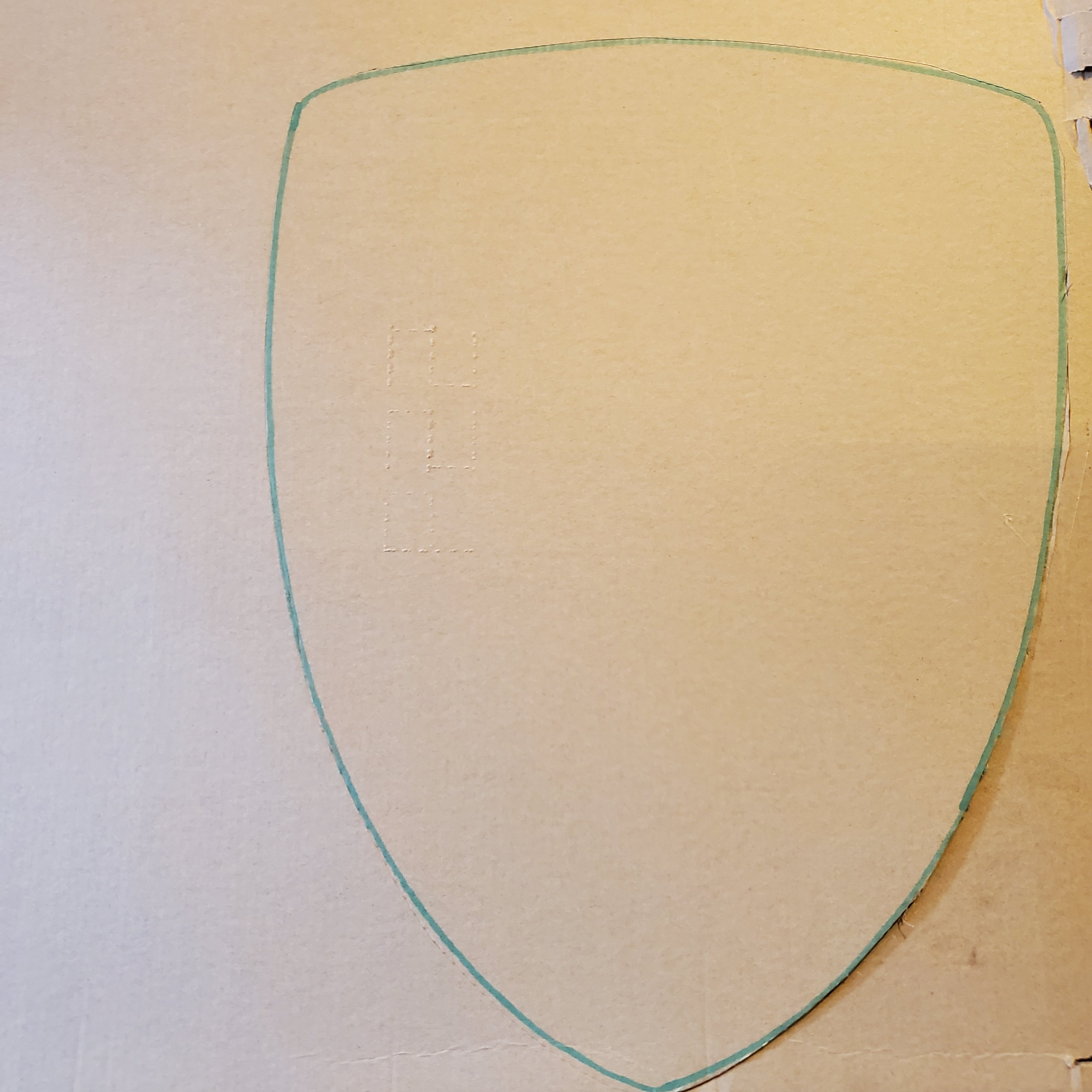
If you want to make a buckler, you need a round surface a little bigger than a dinner plate. You should be able to hold it and move it like an extension of your fist. If you want to make a basic 14th-century type shield like the ones I have below, cut out the familiar, ‘State of Ohio’ shape below. I made mine about 11 inches long, and 10 inches wide. I used cardboard but you can also use paper or wood or metal if you have real craftsperson talent.
Choosing a color and design
I got a lot of good information on how people chose designs for their shields by visiting English Herritage.org’s Guide to Heraldry: https://www.english-heritage.org.uk/guide-to-heraldry. The website has a lovely catalog of the colors and designs real knights and barons and lords used to make their shields/ coats of arms stand out. You can choose a simple background with a plant, animal, etc. in the foreground, or you can divide the shield into a cross, a diagonal line called a Fess, or a triangle called a chevron.
The Personal Touch
You need not be constrained by historical precedent in coming up with your shield. Like any canvas, the only limits on your shield design are your imagination. Check out these designs I made with my kids!
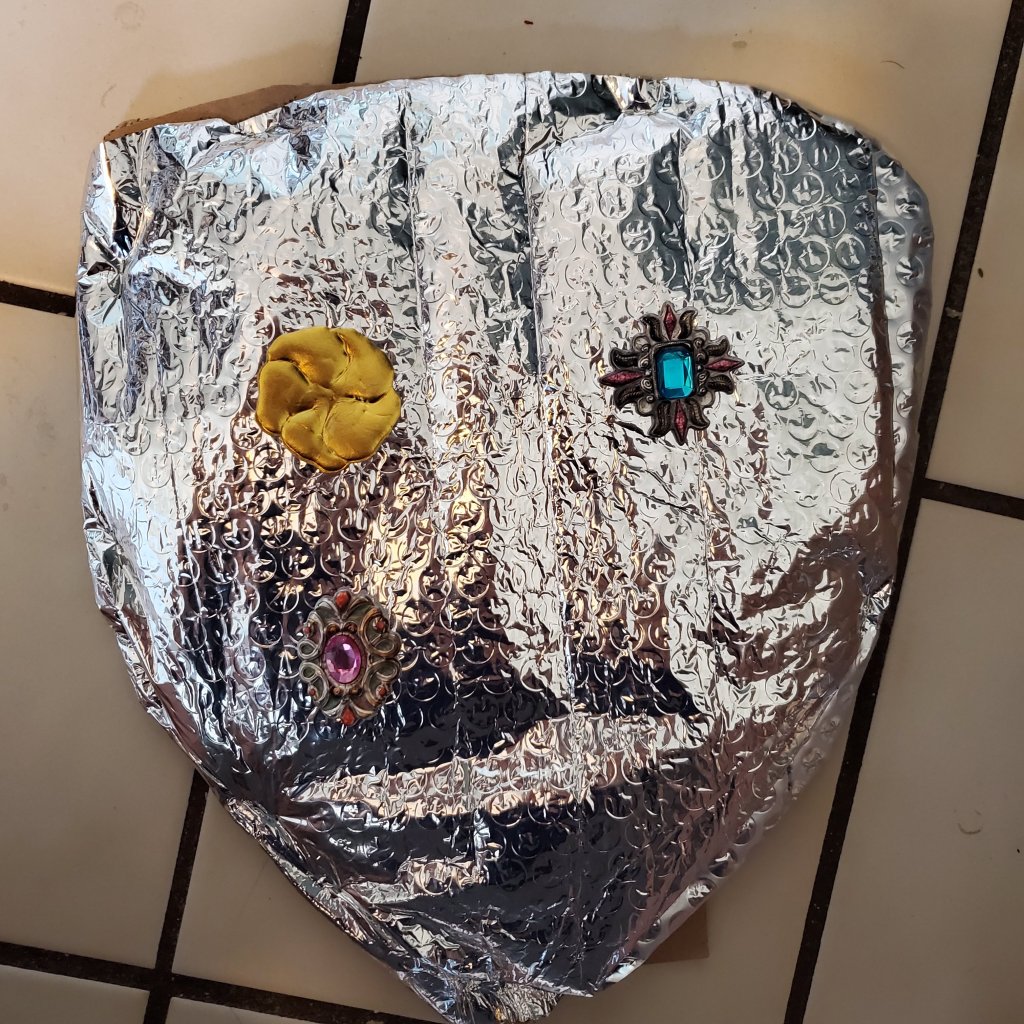
Henry V inspired shield.I wrapped this shield in heat-resistant blankets, and decorated it with stickers from the dollar store.My daughter paints an apple tree on her shield. Why not?My son used a stencil to make a dragon for his shield. We’re going to cover the dragon in glow0in-the dark paint.
Your Motto
Most mottos are single lines of text (usually in Latin), that illustrate what is important to the house that sports it. For example, Richard II’s motto was: “loyalté me lie,” (“Loyalty binds me.”). You could come up with a simple motto and Google Translate it into Latin or French, etc.
Regal coat of arms for King Richard III. Note the white boar, (Richard’s personal charge). Note also that he has combined the 3 red lions of the royal house of Plantagenet, with the blue and gold fleur de lis of the crown of France. Richard claims the throne of England and France and combining heraldic imagery is known as “marshaling.”
Now that you have your shield, with its own unique motto and design, it can be a useful tool to explain how people saw themselves in Shakespeare’s day. Nowadays we mainly see ourselves as individuals, but this kind of heraldry illustrates how knights, nobles and servants saw themselves mainly as part of a house, with its own values, its own traditions, and sometimes an us vs. them mentality against other houses.
This kind of household mentality is of course, at the core of Romeo and Juliet and the Wars of the Roses cycle of plays, and Shakespeare uses heraldry to illustrate this mentality. Look how the knights in the tournament scene from the 2013 film are dressed in their houses’ colors and the nobles and servants are also wearing those same colors:
Like sports fans who wear the jerseys of their favorite teams, shields and heraldry proclaim the allegiance of the servants and nobles who belong to powerful houses/ kingdoms. This kind of emblem can help students understand a piece of medieval and Renaissance history, and how that history shapes our own mentalities today.






























 The Shakespearean Student