Creating A Character: Richard III

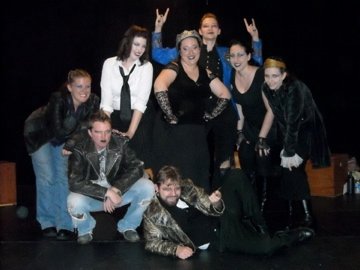
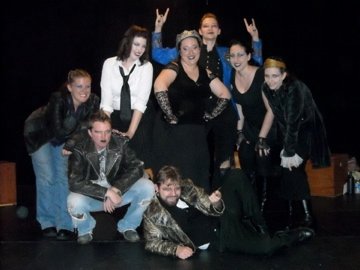
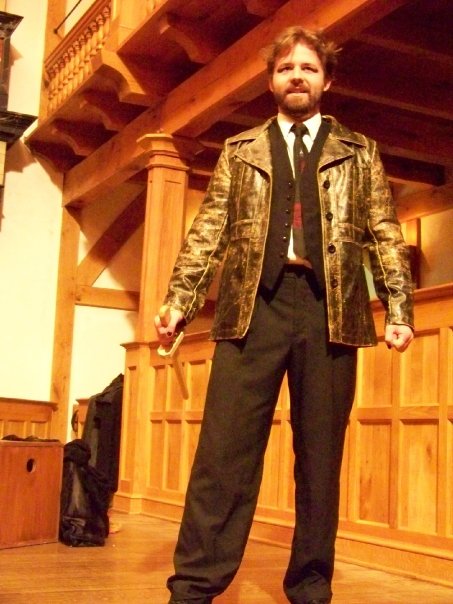
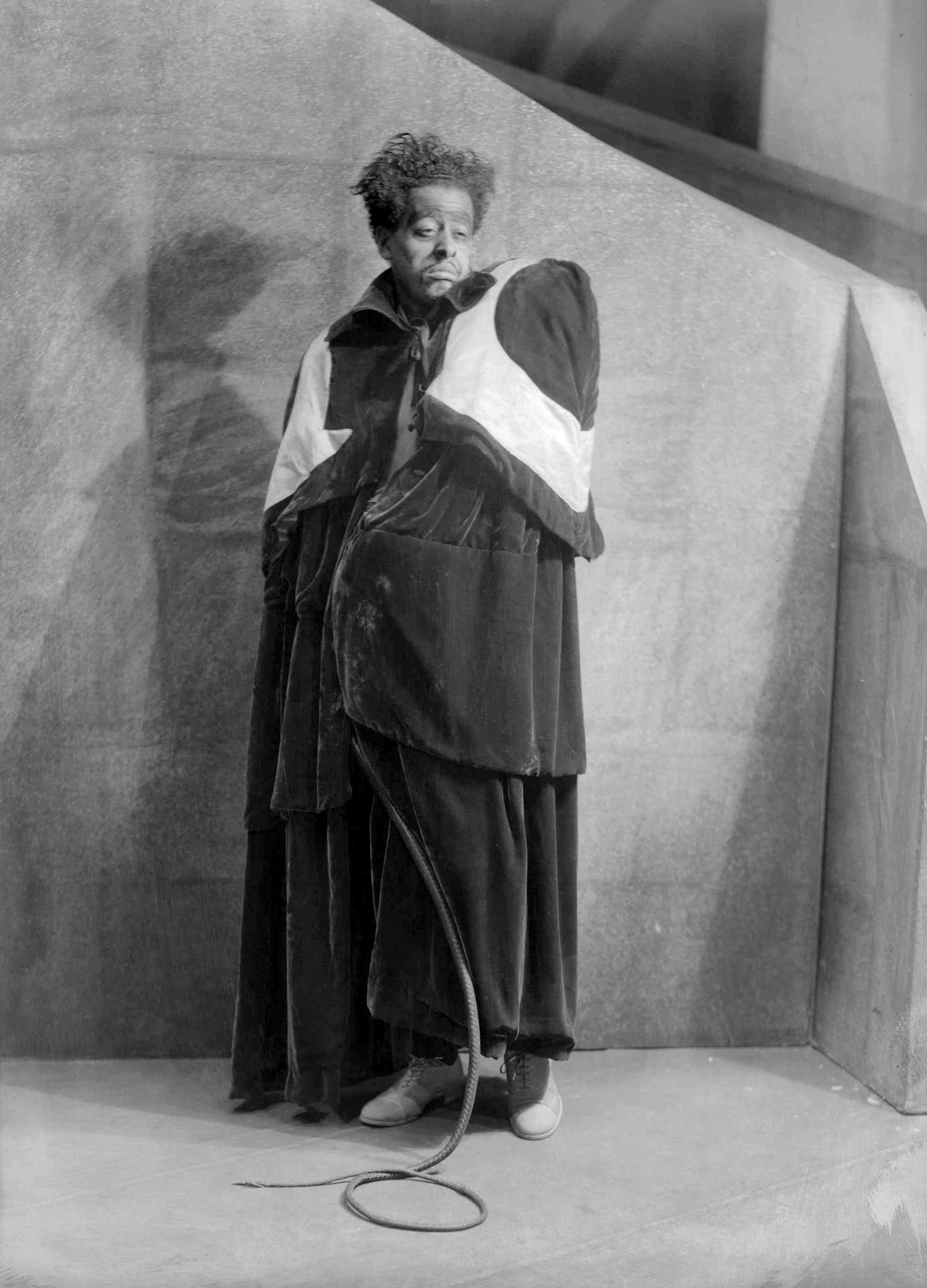
In 2011, I wrote a graduate thesis about some of the challenges of playing Shakespeare’s Richard III, specifically those related to playing his deformity. What follows in this post is an adaptation of the presentation I gave at the American Shakespeare Center’s Blackfriars Playhouse, in Staunton Virginia. I gave this presentation with the help of my actors, Matt Carter, Jemma Levy, Amanda Noel Allen, and David Santangello. I also interviewed live onstage, one of the ASC’s greatest actors John Harrell and his director Thadd McQuade, about a unique production of Richard that he performed for the company back in 2002. What follows is the script I wrote for the presentation, as well as the video and Powepoint slides I projected for the audience, to help you see my work in performance. You can also consult a website I designed for the ASC’s production of Henry VI, Part III, where Richard was played by actor Ben Curns.


PRESENTATION SCRIPT

MATT CARTER:

Now is the winter of our discontent
Made glorious summer by this sun of York;
And all the clouds that lour’d upon our house
In the deep bosom of the ocean buried.
But I, that am not shaped for sportive tricks,
Nor made to court an amorous looking-glass;
I, that am curtail’d of this fair proportion,
Cheated of feature by dissembling nature,
Deformed, unfinish’d, sent before my time
Into this breathing world, scarce half made up,

And that so lamely and unfashionable
That dogs bark at me as I halt by them.

Why, I, in this weak piping time of peace,
Have no delight to pass away the time,
Unless to spy my shadow in the sun
And descant on mine own deformity: Applause, he sits on one of the gallant stools.

Section 1: Introduction

Slide01

PAUL:

Many of you recognize those famous lines from the opening soliloquy of Richard III, ably delivered by Matt Carter. Did you notice the ways Matt was moving and the qualities of his voice? Tonight, my actors and I will show you some of the choices actors have made in playing the deformity of Richard III. Deformity and Richard are so closely linked that I would argue that it is the central driving force of the character. The different performances we will discuss show changes in views on deformity, as well as changing theories on the actor’s craft.

Every actor is interested in the human body, every actor is interested in how the mind and body work together, and most importantly, how to present the mind and body of a character to an audience in a clear and articulate way. No matter how the actor decides to represent it, Richard’s deformity of mind and body are essential to the understanding of the character. In his first soliloquy, in the play Henry the Sixth, Part III, he expresses a deep pain, sorrow and bitterness at being denied a normal body. As Jemma delivers this speech, ask yourself- do you pity him? Does this man have a reason to be angry?

JEMMA LEVY:

Why, love forswore me in my mother’s womb:
And, for I should not deal in her soft laws,
She did corrupt frail nature with some bribe,
To shrink mine arm up like a wither’d shrub;
To make an enviousmountain on my back,
Where sits deformity to mock my body;
To shape my legs of an unequal size;
To disproportion me in every part,
And am I then a man to be beloved?
O monstrous fault, to harbour such a thought!

Henry VI, Part III, Act III, Scene i.

PAUL:

In this speech, like the previous one, Richard expresses the belief that his deformity was a curse, laid on by his mother. During the Renaissance, people believed that deformity was a mark of evil and a sign of being cursed by God. Like the Mark of Cain in the Bible, Richard’s deformity signifies that he was “determined,” (presumably by God), to prove a villain.” The deformity also gives Richard psychological motivation. Lacking a normal body, Richard is hungry for revenge, and in search of something to elevate himself above more fortunate people- power.

Section 2: Burbage

PAUL: The first Richard was almost certainly Richard Burbage, Shakespeare’s star actor. Burbage was associated with the role long after his death.

DAVID SANTAGELLO:

A funerall Elegy on the death of the famous Actor Richard Burbage:

Who died on Saturday in Lent, the 13th of March 1618′

No more young Hamlet though but scant of breath

Shall cry revenge for his dear father’s death:

Edward shall lack a representative,

And Crookback, as befits, shall cease to live.”

PAUL:

Unfortunately, we have no information on how Burbage played the deformity, but we have one clue as to how his performance might have been received, in the form of an apocryphal story from the diary of law student John Manningham, on 13 March 1602:

AMANDA:

Upon a time when [Richard] Burbage played Richard III,

There was a citizen grew so far in liking with him that before she went from the play,

She appointed him to come that night unto her by the name of Richard III.

Shakespeare, overhearing their conclusion, went before, was entertained, and at his game ere Burbage came.

The message being brought that Richard III was at the door,

Shakespeare caused return to be made that ‘William the Conqueror was before Richard III.’

Slide02

PAUL:

Although this story is apocryphal, it does hit upon other features of Richard’s deformity- his supreme confidence, and his beast-like sexuality. Scholars have pointed out that Richard’s lack of scruples, (the result of being born deformed), makes him completely focused and confident. Likewise, his non-conformity to traditional standards of beauty could also be seen as a rebellion against societal norms, and thus, a strange aphrodisiac. This dark creature, without a recognizable human shape, manages to exert a dark pull on the audience.

Section 3: Cibber
Slide03

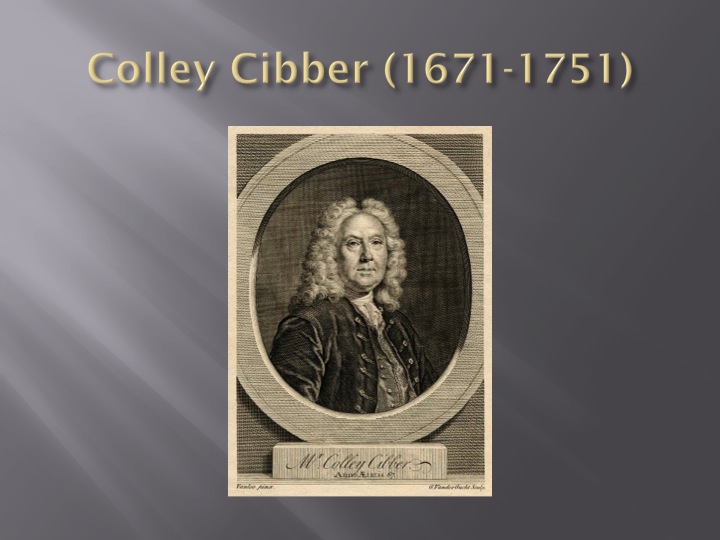
Surprisingly, for nearly 300 years, portrayals of Richard III have been heavily influenced by an obscure author who was not even Shakespeare’s contemporary

During the Restoration of theater in the 17th century Shakespeare’s plays were largely out of fashion, condemned by critics as “too vulgar for this refined age,” and playwrights began to rewrite and adapt them. The most successful adaptation of Richard the Third, came from poet-laureate Colley Cibber in 1671. Cibber’s text interpreted the story as one man’s evil rise to the crown, not the culminating story of the Wars of The Roses. Cibber cut most of the history involved. He condensed scenes, omitted others, and gave Richard 10% more of the dialogue, then Shakespeare. Cibber’s text also re-emphasizes the importance of deformity to Richard’s character- adding 8 more uses of the words “deformed,” or “ugly.” To further the point, Cibber inserted text from other Shakespeare plays that speak about Richard’s deformity, such as the Henry VI speech spoken earlier. Cibber freely cut-and pasted from Shakespeare’s histories, which can be demonstrated in this speech where the Lady Anne mourns for the death of Henry the Sixth, using lines written by Shakespeare for the funeral of King Henry the Fifth:

AMANDA:

Hung be the heavens with black, yield day to night!
Comets, importing change of times and states,
Brandish your firey tresses in the sky,
And with them scourge the bad revolting stars
That have consented unto Henry’s death!

O be accursed, the hand that shed his blood

Accursed the head that had the heart to do it!
If ever he have wife, let her be made
More miserable by the life of him
As I am made by Edward’s death and thine!

PAUL:

Cibber also wrote his own speeches for Richard, such as this one where Richard resolves to woo Lady Anne in spite of his deformity:

JOHN HARRELL:

But see! My love appears. Look where she shines

Through her dark veil of rainy sorrows

Tis true, my form perhaps may little move her;

But I’ve a tongue shall wheedle with the devil.

PAUL: Cibber’s text was extremely popular with actors because it raised Richard’s importance to a star role. Actors such as David Garrick made their debut as Cibber’s Richard, and some of Cibber’s editorital choices still survive in the two movie versions of Richard by Ian McKellen and Laurence Olivier.

13188-15979

IanMcKellen

Section 4: Olivier

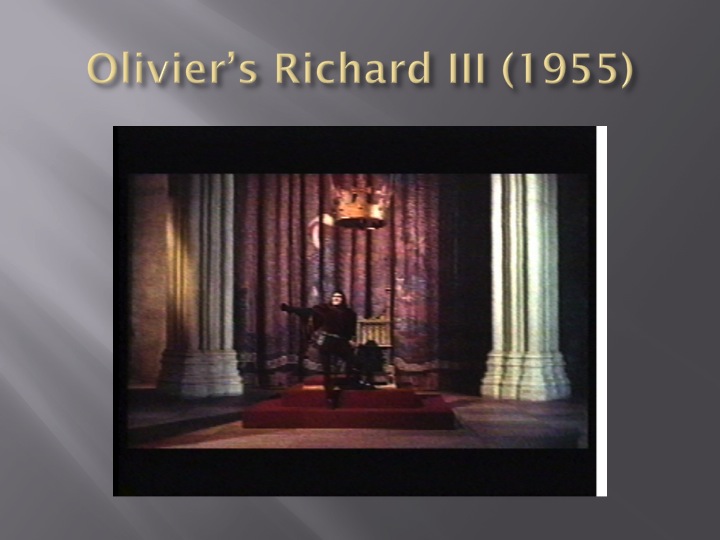
Olivier, in the 20th century was considered the definitive Richard. In his film version he emphasizes Richard’s evil and deceptive nature. He uses the character’s physical disabilities (as well as various cinematic techniques) to reveal his moral depravity.
Slide04

  • The Crown of England- the tremolos and the large crown that appears in the beginning, middle, and end of the film. Homage to Cibber.
  • CINEMATIC USE OF DEFORMITY
  • Long camera angles as he limps away, exposing hump and limp
  • Shadowy silhouette
  • In this shot, Richard slinks away from the camera, leaving his bizarre silhouette to unfurl like a snakeSlide06
  • In this shot, Richard bends over to whisper evil thoughts into the king’s ear.
  • Finally, in this shot, we see the shadow of Richard’s head, as he stares into the cell of his brother Clarence, as he plans his murder. We see through this shot, Richard looms as a great evil presence.

Section 5: Sher

Slide07

After Olivier, actors abandoned the approach of making Richard into a monster, and favored a more human, natural approach.

The role of Richard III however, presents unique challenges for actors attempting to do this; they are attempting to do something un-natural by playing a deformity that they do not actually have. Thus they are attempting to play something “un-natural” within the precepts of naturalistic acting.. Antony Sher’s massive preparation for the role, using Method acting techniques, included both a thorough research into the physical effects of real disability, and a deep examination of its psychological effects.

Slide08

  • Used Method acting techniques to create the role:
    • Real-life experience- Crutches came from his own real injury.
    • Research into physical deformity.
    • Textual Research
    • Image Research. He used Margaret’s text to create a visual design for his character, a bottled spider.
    • Psychoanalysis- brought Shakespeare’s text to a real psychiatrist to “put Richard on the couch.”
  • Sher’s technique led him to go into a deep, psychological probing of Richard’s mind. He viewed the deformity as a source of deep pain, through which we can identify with Richard as a human being.
  • Listen to how David, applying Method-inspired text analysis, conveys Richard’s human emotions.

DAVID:

But I, that am not shaped for sportive tricks,
Nor made to court an amorous looking-glass;
I, that am rudely stamp’d, and want love’s majesty
To strut before a wanton ambling nymph;
I, that am curtail’d of this fair proportion,
Cheated of feature by dissembling nature,
Deformed, unfinish’d, sent before my time
Into this breathing world, scarce half made up,
And that so lamely and unfashionable
That dogs bark at me as I halt by them;

PAUL: Sher’s massive preparation for the role represent the limits that an able bodied actor could go to portray a disability he himself did not have.

Section 6: From Sher to Harrell

Slide09

  • Sher’s Richard created an unexpected backlash from disabled community.
  • One response to this: a number of Richards played by disabled actors.
  • Henry Holden in 2007. Like Sher, on crutches, only he needed them.
  • Peter Dinklage played the role with none of the traditional deformities.
  • His size was a kind of disability, as it literally hindered him from taking the crown
    • He was tangled in his robes,
    • Couldn’t reach the throne.
  • Critics writing about the performance claimed watching him was more real. You weren’t watching a performance, you watched a real man, with a real struggle.
  • Another response is approaching the deformity from a more stylized perspective.
  • This was the approach favored by Thadd McQuade.Slide11
  • The essence of this performance was watching a man struggle through life trying to overcome obstacles and find a place for himself in the world, a struggle that is the essence of all tragedy.

Section 7: 10 minute interview with Thadd and John.

Slide12

Both– Explain the way you chose to represent deformity (bowling ball) and why.

  • John- I got an email from actor JP Schiedler, (who was in the production) who said “ As I recall John was very interested in working inside of some form of restriction which forced his body to adapt, struggle and physically change how he could deal with the world around him which the ball did.” If this is true, I’d like you to talk about this idea- why was it important for you to have something that restricted you? I want to get an idea of how you saw the physicality of Richard and how it is important to the character.
  • Thadd, when I interviewed you, you mentioned that doing the play naturalistically can actually be off-putting because an able-bodied actor will never completely pull off the deformity. I want you to repeat some of that to explain the virtues of a more presentational Richard.
  • Both- How did your techniques contribute to a better understanding of the play for the audience?

Conclusion: Richard’s deformities and disabilities are both physical and psychological. They are the driving force in his life. Portraying Richard’s deformity is a microcosm of the challenges that face all actors: making choices of how to explore the mind and body of a character. Watching an actor take on the challenge of portraying this man’s struggles. This struggle is the essence of tragedy and watching an actor take on the challenge of creates powerful and poignant theatre.

Useful Richard III Website, starring Ian McKellen!

Here’s a lovely website designed to help you learn about Richard’s first soliloquy by interacting with Sir Ian McKellen himself!

First, a video to see it in action:


And here’s the final website: http://www.stageworkmckellen.com/

As a bonus, here’s a review of Sir Ian’s new app, Heuristic Shakespeare:


http://www.avclub.com/article/ian-mckellen-launches-app-make-shakespeare-easier–236049

This app looks incredible, listen to this satisfied customer:

So far, the only play on the app is “The Tempest,” but hopefully if enough people buy it, it’ll expand and encompass all the plays. I hope you’ll check it out!
 

My Top Ten Shakespearean Apps For Teachers and Students, Part 1

Hi everyone! Well, it’s nearly August, which means back to school. Everyone is looking in the stores for the latest educational gear to help young minds on the journey to knowledge. To hopefully aid your journey teachers and students, I’ve compiled some of my favorite Shakespeare apps. There are a lot of apps out there of course, and I couldn’t hope to review them all, but I had a few criteria to limit the results:

  1. The app had to be free,
  2. It has to be functional (educational or useful in life,)
  3. Fun!

I also discovered that most Shakespeare apps out there seem to follow three basic categories: Shakespeare quotes, Shakespeare guides, and Shakespearean insults. Generally speaking, every app on this list is designed to either help you learn Shakespeare by showing and testing you on famous quotations, to help you engage with the text of the plays, or to just have fun making vintage Tudor insults such as: “I was looking for a fool when I found you. I desire we may be better strangers!” So here are the first five apps I am ready to recommend to students and teachers that bring the Bard into the mobile electronic age!

I. 3x The Bard

IMG_1040

This app is a series of quizzes on Shakespearean quotes. It gets is title because the quiz goes on and on until you make three mistakes. Just like in baseball, three strikes and you’re out! I found it fun but not functional. You don’t learn what the quotes mean, and you’re not tested on how well you can recite it, it just quizzes you on which play the quote comes from. Still, worth a look.

II. Shx at Play Two word review: very useful.

Combines the interactivity of an app, with the format of the  Sourcebook Shakespeare books I mentioned in my “Which Shakespeare Edition Is Right For You” post. It features annotated texts of Shakespearean plays,  videos, and a glossary. It’s really good stuff. I encourage teachers and students to use it. The only problem is that, while the plays are free, some features don’t become available until you pay to download them, but you might want to if you’re serious about studying the play.

IMG_1081

III. Globe Theater 360 

This is one of my favorite apps ever. I would call it the Pokemon Go of Shakespeare apps. As you move your phone, you get a 360 degree of Shakespeare’s Globe Theater, as if you were actually there! Even cooler, if you put your phone or tablet over the Globe Theater logo, it will make a computerized theater appear on your phone’s camera in real time, just like the creatures of Pokemon Go! Furthermore, you can click on various part of the Globe to learn about the theater, how the plays were performed, and the colorful history of Shakespeare’s Company. I think this is a must-have app for anyone interested in Shakespeare.
 

IV. Globe Player

Ok, I’ll be honest, this one isn’t free either, but it’s still incredible. I love that The Globe is well aware that not everyone can get out to London and see a play in Shakespeare’s re-constructed Globe theater, so they have a pay-per-view style app that allows you to watch videos of Globe Theater performances in your own home. You can also watch or stream international Shakespearean performances and documentaries right to your phone, tablet, or online at https://globeplayer.tv/

V. Genius

The best thing about this app is that you probably own it already! This is an extremely popular app for deciphering the meaning of song lyrics. Well guess what? People have also contributed commentary of some of Shakespeare’s famous speeches too! If you’re a teacher, you might consider having your class upload a Shakespearean text, and have them write line-by-line commentary to show just how well they understand it.  

So that’s Part I of my look into my favorite apps Shakespearean apps, and I hope you enjoyed it. If you find any other apps you’d like me to review, leave a comment below!


Till next time,


The Shakespearean Student.

Crafting A Character: Malvolio

The venerated Shakespearean actor, Sir Antony Sher, once said with frustration while he was acting at the RSC that, “even the best Feste is less funny than the worst Malvolio.” I actually have a rare insight into these two roles since I’ve played them both! So allow me if you will to present you with some insights I’ve gained into these two characters that are very much polar opposites. Although they are as different as night and day, they form the central comic premise of the whole play, and have some truly hilarious moments!

Me. as Malvolio, Wooster. High School 2002

I played Malvolio when I was a senior in high school; he was my first principal Shakespearean role. My director chose to set the play in the 1940s and he re-purposed the kingdom of Illyria as the Hotel Illyria, with Malvolio as the concierge or lead butler in charge of all the hotel maids and other housekeepers. This not only made the play more accessible to a 2002 audience, it also really helped me understand Malvolio’s role: he is first and foremost a snob who is obsessed with efficiency and pleasing his mistress Olivia (in this version the owner of the hotel). I would soon also discover that, although Malvolio is certainly snobby and can be a bit of a killjoy, he also has qualities that make him appealing to everyone who has ever felt put down or bullied, and that’s what makes him a complex and endearing character today.

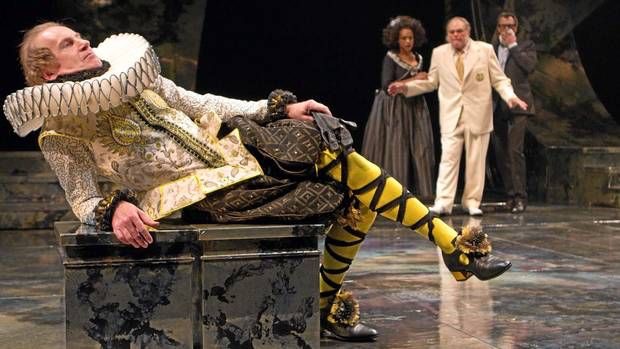
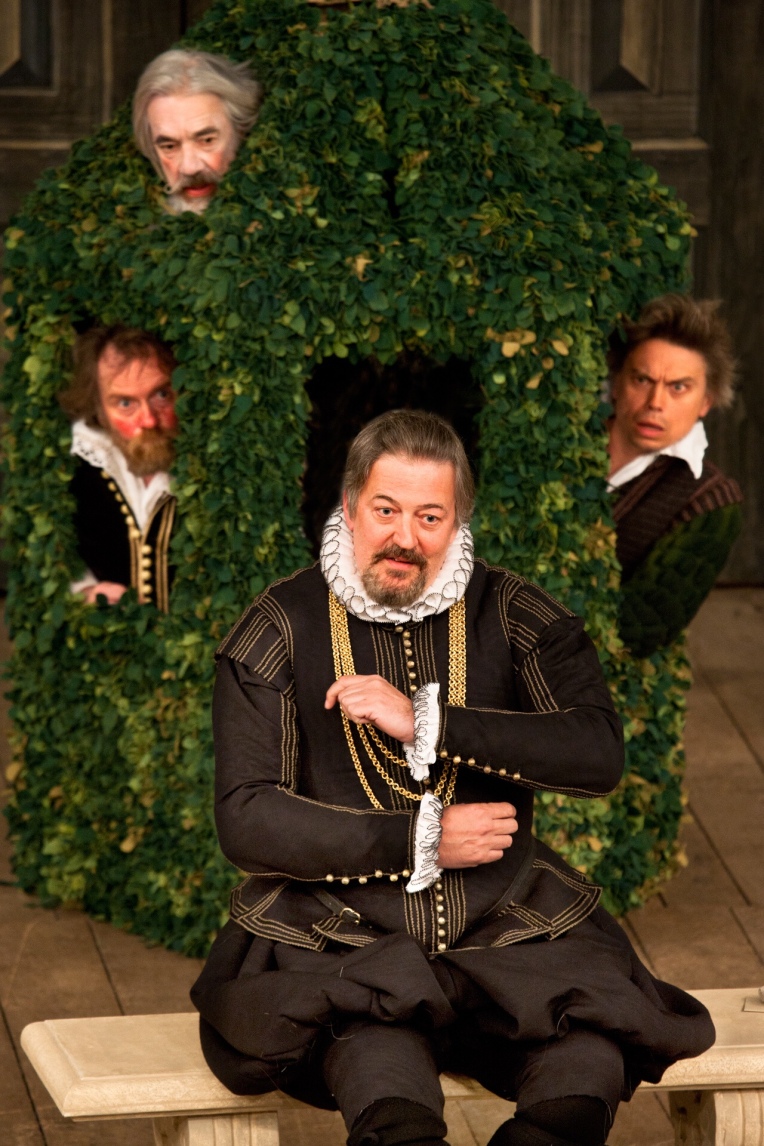
Richard Briars as Malvolio

Some notes on the character: Malvolio’s name means “unsatisfied desire”- somebody who aspires to be what he is not. I find the relationship between Feste and Malvolio interesting because the two are partially defined by how each one is unlike the other. Feste is a clown, hired by the nobles to help them have a good time. He is described as “a merry fellow who cares for nothing.” In other words, Feste never takes anything seriously, except making a living with his jokes and songs. Malvolio is the exact opposite- he is also a servant, but he is a steward, in charge of running the Countess Olivia’s household. As such, he is obsessed with efficiency, commanding respect, and pleasing his mistress through his obsequious manner.

Like the Joker and Batman, both characters live according to an opposing viewpoint; Feste is a chaotic, happy-go-lucky sort, while Malvolio has a strict code of behavior which he expects everyone to follow. Their opposing world views bring them into conflict every time they meet. Plus, in most productions Feste is wearing brightly colored clown apparel or “motley wear,” while Malvolio is dressed in black. I’m not saying Malvolio is anywhere near as cool as Batman, but Malvolio can be just as sanctimonious. His journey is how he goes from being the trusted household servant, to a raving madman, to at last the Spectre at the feast at Olivia’s wedding.

I think the appeal of the character, which balances out the aforementioned snobbery, is that Malvolio is also a nerd: he dreams of becoming a count, he tries to make friends, but he does so by working far too hard at his job and not knowing how to fit in. This is why we inevitably feel sorry for him at the end of the play when he begs to know why his tormentors have locked him in a dark room, treated him like a lunatic, and made him think his lady was in love with him only to utterly destroy his hopes. The balance between the Nerd and the Snob that makes Malvolio a universal and complex part, and that’s why some of history’s greatest actors have played it!

Prepping for the Role: Alec Guinness, Laurence Olivier, Patrick Stewart, Donald Sinden, Nigel Hawthorne, Richard Briars, Steven Fry- these are just some of the names of actors who have played this part over the years. The first actor to play the role was Shakespeare’s leading actor, Richard Burbage, who also played Richard III, Hamlet, and Macbeth. Here’s a sample from Burbage’s famous eulogy, which mentions some of his most famous parts:

A Funeral Elegy
On the Death of the Famous Actor, Richard Burbage,

He’s gone, and with him what a world are dead,
Friends, every one, and what a blank instead!

Tyrant Macbeth, with unwash’d, bloody hand,
We vainly now may hope to understand.
Brutus and Marcius henceforth must be dumb,
For ne’er thy like upon the stage shall come,
Vindex is gone, and what a loss was he!
Frankford, Brachiano, and Malevole.

One big decision that every Shakespearean actor needs to make is how to approach their role in a different way. To be honest, I was kind of a thief with my Malvolio- one of the first things I did was read a book by actor Sir Donald Sinden where he talks about how he delivered Malvolio’s first line, which occurs in Act I, Scene iii:

Olivia. What think you of this fool, Malvolio? doth he not mend?

Malvolio. Yes, and shall do till the pangs of death shake him:
infirmity, that decays the wise, doth ever make the 365
better fool (Act I, Scene v).

Donald Sinden and Judy Dench in Twelfth Night, RSC 1969

Sinden described his first line as a snobby “nyess,” as if he were simultaneously bored and embarrassed by Feste’s jokes. The director told me to act around Feste as if I were the villain in a Charlie Chaplin movie- basically to bully Feste and make him feel very small with my lines, in order to justify the revenge Feste innevitably takes on him. Like any character in Shakespeare, this is only one way to play the role, so you don’t have to agree with me.

The Gulling Scene

Malvolio’s most famous scene is called “The Gulling Scene,” the scene in which he’s tricked into thinking Olivia is in love with him. This is the moment where Malvolio goes from being a respectable prudish servant, into a raving madman. He enters full of dreams and plans to become “Count Malvolio” and creates an elaborate fantasy of what his life would be like if he married the Countess.

Annotated text of Twelfth Night from Shakespeare Navigators.com

Act II Scene v. From Shakespeare Navigators.com

No sooner does Malvolio compete his fantasy of marrying Olivia, when lo and behold, a letter from her suddenly appears! Of course, the audience knows it’s all a trap and even worse, Sir Toby, Sir Andrew, and a boy named Fabian are watching him! It’s a moment of exquisite comedy that’s nearly impossible to get wrong.

Malvolio and the Countess, 1840 by Daniel Maclise

One question I had when I did the scene was whether Malvolio really loves Olivia, or just loves her riches and her title. As a high schooler, I chose to believe that he really does have a crush on Olivia, but is too socially awkward to tell her. Having the letter is a chance to make his feelings known, which Malvolio can get very genuinely excited about! On the other hand, as you can see above, Malvolio might just be greedy to make himself even more respected and admired, and to have the power to throw out the likes of Sir Toby, Sir Andrew, and Maria. Malvolio’s revenge fantasy is also fun to watch, since we know he’ll be punished for it later.

Part of the fun involved in the scene is that it’s basically a “play within a play,” a device that Shakespeare used to great effect in Hamlet, A Midsummer Night’s Dream, Love’s Labor’s Lost, and both parts of Henry the Fourth. I think it’s the charm of seeing a character as he really is, Malvolio shows you his fantasies and creates a whole world in the middle of the orchard. Meanwhile, you feel complicit as you watch the people watching him, who could just as easily be part of your audience.Workshop on Twelfth Night and Bullying

On the other hand, the scene has also been called an example of bullying, since Sir Toby and Maria are using the letter to manipulate then humiliate Malvolio. Remember, Malvolio dresses like a fool and act like a fool in front of Olivia in Act III because he believes it will please the Coubtess. Basically Toby and Maria are Catfishing Malvolio, which can seriously hurt psychologically, as anyone who has been deceived over the internet knows. Plus, it ruins Malvolio’s reputation as you can see in this clip:

Again, as a teenager, I could certainly relate to a man making a fool of himself in a vain attempt to impress a girl. Seeing a man lose his head over a girl and then have her break his heart over a prank, is in some ways truly terrible to watch; even Olivia agrees by the end of the play that the joke has gone too far.

Malvolio. Madam, you have done me wrong,
Notorious wrong.

Olivia. Have I, Malvolio? no.

Malvolio. Lady, you have. Pray you, peruse that letter.
You must not now deny it is your hand:
Write from it, if you can, in hand or phrase;
Or say ’tis not your seal, nor your invention:
You can say none of this: well, grant it then
And tell me, in the modesty of honour,
Why you have given me such clear lights of favour,
Bade me come smiling and cross-garter’d to you,
To put on yellow stockings and to frown 2550
Upon Sir Toby and the lighter people;
And, acting this in an obedient hope,
Why have you suffer’d me to be imprison’d,
Kept in a dark house, visited by the priest,
And made the most notorious geck and gull
That e’er invention play’d on? tell me why!

Olivia. Alas, Malvolio, this is not my writing,
Though, I confess, much like the character
But out of question ’tis Maria’s hand.
And now I do bethink me, it was she 2560
First told me thou wast mad; then camest in smiling,
And in such forms which here were presupposed
Upon thee in the letter. Prithee, be content:
This practise hath most shrewdly pass’d upon thee;
But when we know the grounds and authors of it, 2565
Thou shalt be both the plaintiff and the judge
Of thine own cause.

That’s the tragic part of Malvolio’s journey. We’ve all known a Malvolio, and we’ve all been him from time to time. That’s what makes him such an enduring character.

Continue reading

Shakespeare’s only All Soul’s Day Speech

Today (Monday) is All Souls Day, AKA  “Dia DeLos Muertos.”  Shakespeare writes an incredible speech for a character when he realizes it’s all soul’s day, but i couldn’t find a version of it online. That’s why I decided to do it myself! This is a speech that comes from Shakespeare’s bloody history play, “Richard the Third.”

The ending shot of the BBC's 1978 TV version of "Richard III."
The ending shot of the BBC’s 1978 TV version of “Richard III.”

To set the scene, the character Buckingham has worked as a vile two-faced politician working for Richard Gloucester, Shakespeare’s most evil and tyrannical king. To support Richard’s quest for the throne, Buckingham has arranged the murders of kings, princes, lords, ladies, and basically anyone who got in their way. All the while, he has acted like a nice and loyal Yorkist nobleman, and even swears to protect and serve them.

BUCKINGHAM

Whenever Buckingham doth turn his hate
On you or yours, To the Queen

but with all duteous love
Doth cherish you and yours, God punish me
With hate in those where I expect most love!
When I have most need to employ a friend,
And most assured that he is a friend
Deep, hollow, treacherous, and full of guile,
Be he unto me! this do I beg of God,
When I am cold in zeal to yours (Richard III, Act II, Scene ii).

After Richard becomes king, he slights Buckingham, who then gets bitter and joins Richard’s  enemies. Richard then captures the duke, and sentences him to death by beheading. The day he is to be executed is, you guessed it, All Soul’s Day, which forces Buckingham to confront all the souls Buckingham is directly or indirectly responsible for taking. I hope you enjoy my interpretation!


Here’s the text of the speech here:

BUCKINGHAM

Why, then All-Souls’ day is my body’s doomsday.
This is the day that, in King Edward’s time,
I wish’t might fall on me, when I was found
False to his children or his wife’s allies
This is the day wherein I wish’d to fall
By the false faith of him I trusted most;
This, this All-Souls’ day to my fearful soul
Is the determined respite of my wrongs:
That high All-Seer that I dallied with
Hath turn’d my feigned prayer on my head
And given in earnest what I begg’d in jest.
Thus doth he force the swords of wicked men
To turn their own points on their masters’ bosoms:
Now Margaret’s curse is fallen upon my head;
‘When he,’ quoth she, ‘shall split thy heart with sorrow,
Remember Margaret was a prophetess.’
Come, sirs, convey me to the block of shame;
Wrong hath but wrong, and blame the due of blame.

The Witches Of Macbeth

Happy Halloween everybody!

Tonight I’d like to discuss some of the spookiest, most enigmatic, and above all WEIRDEST characters in Shakespeare: the Three Weird Sisters in Macbeth.

1. Who are they?

Every production has to answer who the witches are, and many have very different answers. Are they temptress? Are they evil agents controlling Macbeth?Furies trying to destroy Macbeth?

I would argue in their basic form the witches are harbingers of change. Their very name “Wyrd Sisters” refers to an old Anglo Saxon concept of fate or destiny. Whether or not they have any effect on Macbeth mind or soul, they point the finger at him and say “things are going to change for you.” Then, he either makes the choices that determine his fate, or they change his fate for him.

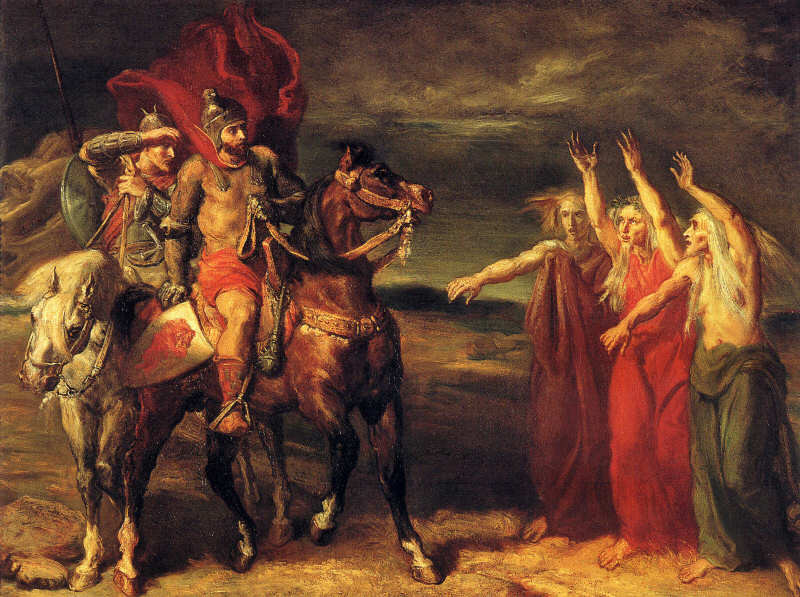
“Macbeth and Banquo First Encounter the Witches,” Théodore Chassériau, 1854.

Macbeth meets the witches on a heath, which means land that is literally out of bounds– the wild, untamed wilderness, which the old Anglo Saxons believed was the lair of many cursed spirits and monsters. This could symbolize Macbeth’ sin or transgressions, slowly turning into a murderer, usurper, and a tyrant. It could also symbolize the chaos in Macbeth’s life.

What Do They Look Like?

Shakespeare’s descriptions of the witches are highly contradictory- they seem to be floating, yet on the ground, they seem to be women, but they have beards! They don’t look Earthly, but here they are on the Earth. This gives them an other worldly quality that keeps us guessing as to who they are, and helps them tempt Macbeth more easily.

BANQUO
What are these
So wither’d and so wild in their attire,
That look not like the inhabitants o’ the earth,
And yet are on’t? Live you? or are you aught
That man may question? You seem to understand me,
By each at once her chappy finger laying
Upon her skinny lips: you should be women,
And yet your beards forbid me to interpret
That you are so.

MACBETH
Speak, if you can: what are you? (Act I, Scene iii).

The Witches’ Language:
You know from my earlier posts that the norm for Shakespearean characters is to speak in iambic pentameter- 10 syllable lines of unrhymed poetry that sounds like a normal heartbeat. The witches break these norms- they generally speak in Trochaic Tetrameter- 8 syllable lines with the off beat emphasized. The witches are literally offbeat, and that’s why their speeches are unsettling. Look at the contrast between a normal iambic line like:

“In sooth I know not why I am so sad.” (Merchant Of Venice I,i).

and

Dou-ble Dou-ble, Toil and Tro-ble.

Fire burn and Caul-dren Bu-ble. (Macbeth, Act IV, Scene i).

For more info on the verse forms of the Witches, click here:

The witches also speak their prophesies in a vague, ambiguous manner They like to play with obscuring their prophesies with lines that make Macbeth think one thing, but the opposite is true. The famous example here is when they claim Macbeth will never be vanquished “until Birnam Wood comes to Dunsinane Hill.” Macbeth assumes this means he’s invincible, but it actually means that the enemy carry wood from the forrest. This is called Equivocation.

Witches and mythology

Illustration from William Blake's
Illustration from William Blake’s “Europe a Prophecy,” 1794.

1. During the reign of King James, the modern witch hunt began; the king was fascinated with witches and even wrote a book called Daemonology on how to identify and destroy them. This was the era where people believed that witchcraft, rather than a pagan religious practice, was a forbidden craft that could only come from a pact with the devil. However, Shakespeare borrows from both Satanic and early pagan ritual in the characters of his witches.

2. Shakespeare took a couple of details about witchcraft from ancient Celtic and Greek mythology. First of all, the use of a cauldron. In Celtic myth, a cauldron is a symbol of rebirth and was sometimes used to resurrect the dead, just as the witches do in IV i. Of course, the ideal time for raising the spirits was on the feast of the pagan god Samhain, at the point where the veil between the living and dead was the thinnest. The feast took place on October 31st, our modern day Halloween!

Illustration of witches and their familiar spirits, 1647.

3. Familiar spirits In Act I, the witches speak to animal spirits called familiar spirits, which call to them and tell them where to go. King James himself wrote about how the witches found and communicated with these spirits.

Hecate.
In Act IV, Hecate, Ancient Greek goddess of magic appears. She is clearly the lord of all the witches, and is very displeased that they are riddling with Macbeth. Maybe not all witches believe in giving out prophesies that can destroy the Scottish monarchy. Hecate was always enigmatic in myths- she was born one of the Titans who opposed the gods, but frequently changed sides. More then being two faced, she was often portrayed as having three faces! Shakespeare refers to her frequently as “Triple Hecate.”

“The Triple Hecate,” by William Blake, 1794.

For more information on this mysterious goddess, consult the video below, (WARNING, ADULT-ONLY CONTENT).

In conclusion, the witches are meant to be ambiguous because the play examines the source of evil- whether it is inspired by other people, or if it comes from one’s own heart. The witches can be either or both, depending on how you want to tell the story, which is why they act and speak in contradictory ways.

Thanks for reading! If you enjoyed this posting, please consider signing up for my online class, “Macbeth: An Immersive Horror Experience.” I tell you the story of Macbeth and you get to play through an escape room, where you must solve the witches’ puzzles or be added to their Cauldron!

Crafting A Character: Macbeth

Me and the cast of “Macbeth,” 2009.

Back in 2009, I had the opportunity to play the lead in a touring production of “Macbeth.” It was the first time I’d ever played a titular Shakespearean character and I was really excited to play this part. I feel that playing one of these parts gives you an insight into the character that no other research can, so I’d like to share the steps of my process, with some pictures and videos from other famous Macbeths to give you an idea of what I learned.


  1. The Auditions-
    1. As I said in one of my earliest posts, if you’re auditioning for a Shakespeare play, Read the whole play, not just a monologue book. Monologue books won’t give you a sense of the whole story and you’ll miss a lot of details about who your character is by not hearing what he/she says, and what other people say about him/her. Fortunately for me, I first read the play when I was 17 and remembered the story pretty well. Unfortunately, my first reading of the part was a disaster. Unlike Hamlet, Macbeth didn’t feel like a part I could play; he seemed like this huge Scottish warrior who everyone loved until he turned into a psycho killer. I’m not a warrior, not a psycho, and (like most actors), often feel a lot of doubt and loneliness about my self. Ironically, that was what helped me get into the heart of the character!
    2. Figure out what’s the hard part. When directors cast, they need to make sure you can handle the part. If your character has to sing, you better be able to carry a tune. If your character needs to be able to contort into a pretzel and talk to dolphins, he or she will probably make that part of the audition. My advice to anyone auditioning for a specific part in a play (Shakespeare or not), is to think like a director and try and figure out what the hardest thing that your character will have to do, and try to prepare for that. For me, the hardest part of playing Macbeth, was the famous Dagger Speech.
    3. Perform your monologue for someone first. I was fortunate that while I was prepping for the audition, the great Shakespearean director Rob Claire was doing a workshop and he helped me work on Macbeth’s soliloquy in Act I, where he decides whether or not to murder Duncan.
  2. Table work

Table work is the point in the process where the actors sit around and read the play, trying to get an idea of the character’s journey from beginning to end. To me is the most exciting time in rehearsals because it’s just the actor and Shakespeare’s words- you can imagine how the play will go, discover how the lines make you feel, and form a bond with your character and fellow actors.

Me and my Lady Macbeth, Katie Crandol.

Macbeth’s Motive- During the table read, I decided on Macbeth’s motivation: to prove himself to his wife. In the play, Lady Macbeth frequently criticizes him and seems to define true manhood as taking what you want, regardless of fear or ethics. Take a look at this horrific passage where she first critiques Macbeth’s manhood, then says she would rather bash her baby’s head in rather than give up on murdering the king!


MACBETH

Prithee, peace:
I dare do all that may become a man;
Who dares do more is none.

LADY MACBETH

What beast was’t, then,
That made you break this enterprise to me?
When you durst do it, then you were a man;

I have given suck, and know
How tender ’tis to love the babe that milks me:
I would, while it was smiling in my face,
Have pluck’d my nipple from his boneless gums,
And dash’d the brains out, had I so sworn as you
Have done to this.

MACBETH

If we should fail?

LADY MACBETH

We fail!
But screw your courage to the sticking-place,
And we’ll not fail. (Macbeth, Act I, Scene vii).

One interesting contradiction in the play, although Lady M mentions that she’s nursed a baby, later on in the play Macduff says that Macbeth has no children. I therefore decided that Lady Macbeth has lost a child, and this has caused unimaginable pain for the couple. Therefore, Macbeth is willing to do anything to win his wife’s affection again, even murder.

5136_1180294546018_2683021_n

Study the verse– Another point I’d advise when you’re doing table work is pay attention to Shakespeare’s verse because it provides clues to help you keep your hand on the pulse of your character. Just like a heartbeat, when a line of verse changes or fragments it usually signals an emotional or mental change in the character. Here is a quick analysis of the verse in Shakespeare’s Macbeth. Click here to find some great books about how to study Shakespeare’s verse.

  • Voice and Body

Mackers poseWhen creating any character, you have to decide how (s)he walks and talks. Most Macbeth’s I’ve seen are big, heroic guys, and I’m not big and imposing. I talked to one of my mentors at American Shakespeare Center and he suggested that maybe Macbeth has a bit of a Napoleonic Complex. This made a lot of sense to me. I thought about how Macbeth gets honored at the beginning of the play; what if he just got lucky killing the Norwegians? What if deep down, he doesn’t feel he deserves to be honored just for killing in war? That kind of self hatred and desire for approval could easily lead to violent behavior. I therefore based my physical choices on alternately shrinking and sulking when Macbeth feels low, and trying very hard to look big and imposing for the rest of the play.

  1. I worked on my arms for the sword work and my back because I believe that’s where Macbeth caries himself. When I wanted to appear like a king I would stand straight and puff out my chest, however in moments like the appearance of Banquo’s ghost, I shrank and turned my head away.
  2. I didn’t try to do a voice for Macbeth, I just tried to let my voice go through the changes. When Macbeth is paranoid or afraid, my voice went up, when he feels in control, I kept it at a low, strong register.
  3. The one time I shouted was at the end, when Macduff demands that

    I prepare to fight Macduff.
    I prepare to fight Macduff.

    Macbeth surrender. I snarled and barked the line: “I WILL NOT YIELD!” At the end of the play, when Macbeth gets to fight Macduff, I feel he finally feels brave and strong, challenging Macduff even though he knows he will lose. At last he can feel like a valliant hero, even though everyone else sees him as a villain. I gleefully assumed a fighting stance and put all the power in my body into my limbs, ready to attack!

    1. The Speeches. All of Shakespeare’s great characters have fabulous speeches that allow the audience to peer into their hearts. With Macbeth, we see a good man’s journey into becoming a demented, paranoid tyrant through the following speeches.
      1. I contemplate murder in Act I, scene vii.
        I contemplate murder in Act I, scene vii.

        “If It Were Done,” Act I, Scene vii. This speech was my favorite. It’s basically Macbeth’s version of “To Be Or Not To Be.” In both speeches, the character is contemplating murder, without saying the word “murder.” This is the “IT” Macbeth refers to; killing the king to get his crown. Macbeth is tortured by his ambition and his desire, and you get to see him wrack his brain and body over what to do. Below is Sir Ian McKellen’s interpretation of the speech in a 1979 RSC production.

      2. The Dagger Speech Act II, Scene i. The night of the murder,

        Macbeth stands alone during the Dagger Speech, Act II, scene i
        Macbeth stands alone during the Dagger Speech, Act II, scene i

        Macbeth sees a bloody dagger that points his way to the king. It’s up to the actor to determine where and what the dagger is: if it is the Witches’ magic, his own psychosis, or a hellish prophesy. Does Macbeth love or fear the dagger? Does it stay in one place or move? Answering these questions and keeping track of the answers makes the speech very hard to do. Here is Sir Antony Sher’s kinetic and frantic version of the Dagger Speech:


  1. 5136_1180295466041_8211516_n“Tomorrow and Tomorrow” Act V, Scene v. This speech is often quoted out of context, given that it has a nearly perfect metaphor for the futility of life: “Life’s but a walking shadow, a poor player who struts and frets his hour upon the stage… it is a tale, told by an idiot, full of sound and fury, signifying nothing.” Since this is the most famous speech in the play, I had to do something different than other Macbeths. What many people forget is that Macbeth says all this when he’s trying to command his army, and gets word that his wife is dead.


I chose to play the speech as a fight within Macbeth to not give into despair. At first he’s furious when he hears the news; he didn’t need this news, especially not today! He tries to suppress his grief, delaying it until tomorrow, but he can’t; now that he knows his wife is dead, his life seems completely pointless, including the battle he was trying to fight. I then gave Macbeth an epithany near the end of the speech: If life is pointless, fighting a battle and dying would be a glorious way to end it! Why not die, after all, life is just “a tale told by an idiot?” At last, Macbeth has a reason to fight again, and he concludes the speech as a call to his soldiers to fight without fear of death. Now, you may disagree with my interpretation, but the point is that it’s mine. I wasn’t trying to imitate Antony Sher, or Laurence Olivier, or Patrick Stewart when they played the part. I was doing my Macbeth, and that’s what made it worth watching.

  1. I also drew some inspiration from this video where Ian McKellen analyzes the imagery and ideas within this speech:http://www.youtube.com/watch?v=zGbZCgHQ9m8


I hope you enjoyed this look into the process of creating this complex and fascinating character. If you’ve played this character before, leave me a comment about your interpretation, or tell me which Macbeth you liked best and why. Finally, below are links to two full-length productions of Macbeth for your viewing pleasure.

The full Ian McKellen production of Macbeth: https://www.youtube.com/watch?v=YpKWWK0Pj34


BBC Macbeth https://www.youtube.com/watch?v=w0LrdOa7uZQ


Shakespeare Spooky Stories 2: The Voodoo Macbeth

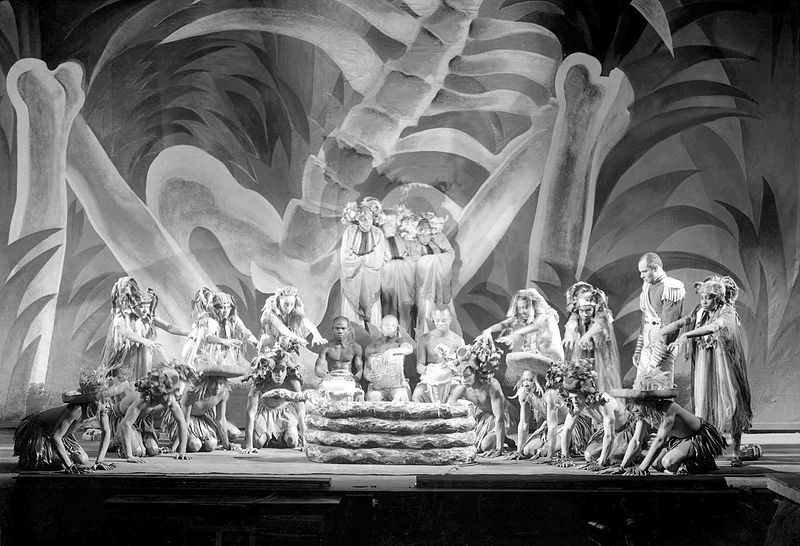
In 1936, famed director Orson Welles, (known for his iconic film Citizen Kane), produced an equally memorable production of Macbeth. At the time, Welles was a theater director, working with a government-funded theater group called The Federal Theater Project. The goal of the FTP was to help support the theater during the Great Depression. Welles also found a way to have his production help black actors by, and casting exclusively African Americans.

Opening night of Orson Welles' "Macbeth" outside the Lafayette Theater in Harlem, 1936.
Opening night of Orson Welles’ “Macbeth” outside the Lafayette Theater in Harlem, 1936.

Although Welles kept Shakespeare’s text, he changed the setting to a tribe in Haiti instead of medieval Scotland, and changed the witches into Voodoo priestesses. Below is the only surviving footage of the production, the final scene in which (spoiler alert), Macduff carries Macbeth’s head and sets it on a pole, proclaiming Malcolm the new king. You can see the witches taking a wicked joy when Macbeth’s cursed head is impaled, implying that Welle’s witches had vengeance on their mind when they drove him to kill Duncan.

Eric Burroughs as Hecate.

Notice also the actor who screams “Peace, the charm’s wound up,” at the end of the play. He is playing the part of Hecate, the goddess of magic who appears before Macbeth in Act IV. According to legend, Actor Eric Burroughs was a real Voodoo priest, as were the drummers Welles used to spectacular effect during the show. Many critics called the frenetic drumming that occurred during the show and in scene changes an experience that they’d never forget.

Welles’ innovations helped black actors and theater in general survive during the Depression, but not everyone praised his efforts. Journalist Percy Hammond criticized the merits of the performance, arguing that the government shouldn’t pay for artistic projects. The next day when he returned to the theater, he was greeted by a rhythmic thumping underneath the stage that intensified until the critic abandoned his seat and left the theater. The next day, he fell suddenly ill and died! Was his illness a voodoo curse? We may never know, but this story clearly illustrates the effectiveness of Welles’ staging, and the dark occult appeal that lurks beneath the text in any production of Macbeth.

Macbeth meets the witches around their cauldron, (Act IV, Scene i).

Works Cited:

1.     Dunton-Downer Leslie and Alan Riding.The Essential Shakespeare Handbook: Macbeth p.367. New York: DK Publising Inc, 2004.

2.    Rippy, Marguerite. Orson Welles and the Unfinished RKO Projects: A Postmodern Perspective pp 75-76. Retrieved 10/21/15 from Google Books.

3.  Smith, Wendy. The Play That Electrified Harlem. The Library of Congress. Retrieved 10/21/15 from http://memory.loc.gov/ammem/fedtp/ftsmth00.html

4. Digital Public Library: The Show Must Go On! American Theater In the Great Depression: Impact On African American  Theater. Retrieved 10/21/15 from http://dp.la/exhibitions/exhibits/show/the-show/african-american-theatre-impac 

5. The Juggler (online publication): “The Voodoo Macbeth.” Retrieved 10/21/15 from http://culture.pagannewswirecollective.com/2011/04/orson-welles-and-the-voodoo-macbeth/