In addition to Shakespeare, I love learning about educational technology, so I was very excited to learn about this resource from the website Plotting Plots. This is a free site that allows you to analyze the words in a text: how often they occur, and when.
This particular page is all about Julius Caesar and it allows you to plot how often a word is used. Julius Caesar is a play obsessed with ideas of government and what it means to be a citizen, a Roman, and what good government means. Therefore, the changing rhetoric of the play shows the journey of the characters- who stays true to his ideals and who doesn’t.
The website uses bar graphs and charts to show the appearance of words and concepts but once you have the data, you can translate it into other forms, such as Word clouds. When I made my class image for my Outschool class on Julius Caesar, I copied Antony’s “Friends, Romans, Countrymen” speech, and made a word cloud of it. Notice that the biggest words are ‘Brutus,’ ‘Men,’ and ‘Cause,’
I created this infographic to simply explain how Caesar’s cultural influence continues to this day. Obviously, Caesar also did a lot more for the Roman empire- he added parts of Brittain, all of Gaul (modern-day France), and many German tribes laying the groundwork for most of the Roman Empire.
I was surprised to learn that THE CAESAR SALAD ISN”T NAMED AFTER JULIUS CAESAR!
The salad was actually named for its inventor, chef Caesar Cardini, who created the iconic dish in a restaurant in Tijuana Mexico. You can read more about the salad and its creator here:
However, the Romans gave way before the good fortune of the man and accepted the bit, and regarding the monarchy as a respite from the evils of the civil wars, they appointed him dictator for life. This was confessedly a tyranny, since the monarchy, besides the element of irresponsibility, now took on that of permanence
Patrick Stewart (Cassius), convinces Brutus (Ian Richardson), to betray Caesar, RSC, 1970
Under these circumstances the multitude turned their thoughts towards Marcus Brutus, who was thought to be a descendant of the elder Brutus on his father’s side, on his mother’s side belonged to the Servilii, another illustrious house, and was a son-in‑law and nephew of Cato. 2 The desires which Brutus felt to attempt of his own accord the abolition of the monarchy were blunted by the favours and honours that he had received from Caesar. 3 For not only had his life been spared at Pharsalus after Pompey’s flight, and the lives of many of his friends at his entreaty, but also he had great credit with Caesar. 4 He had received the most honourable of the praetorships for the current year, and was to be consul three years later, having been preferred to Cassius, who was a rival candidate. 5 For Caesar, as we are told, said that Cassius urged the juster claims to the office, but that for his own part he could not pass Brutus by.105 6 Once, too, when certain persons were actually accusing Brutus to him, the conspiracy being already on foot, Caesar would not heed them, but laying his hand upon his body said to the accusers: “Brutus will wait for this shrivelled skin,”106 implying that Brutus was worthy to rule because of his virtue, but that for the sake of ruling he would not become a thankless villain. 7 Those, however, who p589 were eager for the change, and fixed their eyes on Brutus alone, or on him first, did not venture to talk with him directly, but by night they covered his praetorial tribune and chair with writings, most of which were of this sort: “Thou art asleep, Brutus,” or, “Thou art not Brutus.”107 8 When Cassius perceived that the ambition of Brutus was somewhat stirred by these things, he was more urgent with him than before, and pricked him on, having himself also some private grounds for hating Caesar;
So far, perhaps, these things may have happened of their own accord; the place, however, which was the scene of that struggle and murder, and in which the senate was then assembled, since it contained a statue of Pompey and had been dedicated by Pompey as an additional ornament to his p597 theatre, made it wholly clear that it was the work of some heavenly power which was calling and guiding the action thither.
Well, then, Antony, who was a friend of Caesar’s and a robust man, was detained outside by Brutus Albinus,110 who purposely engaged him in a lengthy conversation; 5 but Caesar went in, and the senate rose in his honour. Some of the partisans of Brutus took their places round the back of Caesar’s chair, while others went to meet him, as though they would support the petition which Tulliusº Cimber presented to Caesar in behalf of his exiled brother, and they joined their entreaties to his and accompanied Caesar up to his chair. 6 But when, after taking his seat, Caesar continued to repulse their petitions, and, as they pressed upon him with greater importunity, began to show anger towards one and another of them, Tullius seized his toga with both hands and pulled it down from his neck. This was the signal for the assault. 7 It was Casca who gave him the first blow with his dagger, in the neck, not a mortal wound, nor even a deep one, for which he was too much confused, as was natural at the beginning of a deed of great daring; so that Caesar turned about, grasped the knife, and held it fast. p599 8 At almost the same instant both cried out, the smitten man in Latin: “Accursed Casca, what does thou?” and the smiter, in Greek, to his brother: “Brother, help!”
9 So the affair began, and those who were not privy to the plot were filled with consternation and horror at what was going on; they dared not fly, nor go to Caesar’s help, nay, nor even utter a word. 10 But those who had prepared themselves for the murder bared each of them his dagger, and Caesar, hemmed in on all sides, whichever way he turned confronting blows of weapons aimed at his face and eyes, driven hither and thither like a wild beast, was entangled in the hands of all; 11 for all had to take part in the sacrifice and taste of the slaughter. Therefore Brutus also gave him one blow in the groin. 12 And it is said by some writers that although Caesar defended himself against the rest and darted this way and that and cried aloud, when he saw that Brutus had drawn his dagger, he pulled his toga down over his head and sank, either by chance or because pushed there by his murderers, against the pedestal on which the statue of Pompey stood. 13
And the pedestal was drenched with his blood, so that one might have thought that Pompey himself was presiding over this vengeance upon his enemy, who now lay prostrate at his feet, quivering from a multitude of wounds. 14 For it is said that he received twenty-three; and many of the conspirators were wounded by one another, as they struggled to plant all those blows in one body.
-Plutarch’s Life Of Caesar
Artwork
Bust of Caesar Artwork for Julius Caesar. Immoral Longings, 2013.
Video 📹
Commentary
James Shapiro in his book 1599, addresses the common complaint that in the play that bears his name, Julius Caesar dies halfway through the play and has little time onstage to make a connection with the audience. The play is about tyrananicide, what causes it, what it looks like, and especially its aftermath. In a time when Jesuits and Catholic radicals threatened to assassinate Queen Elizabeth, Shakespeare wrote a powerful story about how fragile government systems can be; how striking the head off Rome leads to anarchy and sometimes tyranny.
Ave and Happy Pie Day ! Since it’s Roman month, I thought I’d talk about the most infamous pie in Shakespeare’s Roman plays, and give you an ancient Roman recipe that tastes a lot better!
In Act V of Titus Andronicus, the titular general and his household cook and serve the Empress’ sons to their mother in a pie! Here’s how the scene plays out in the 1999 film Titus:
The infamous pie scene from Titus Andronicus
Before he cooks the Empress’ sons, Titus actually tells them what he is going to do to them, like some kind of psychotic chef giving a cooking program:
This one hand yet is left to cut your throats,
Whilst that Lavinia 'tween her stumps doth hold
The basin that receives your guilty blood.
You know your mother means to feast with me,
And calls herself Revenge, and thinks me mad:
Hark, villains! I will grind your bones to dust
And with your blood and it I'll make a paste,
And of the paste a coffin I will rear
And make two pasties of your shameful heads,
And bid that strumpet, your unhallow'd dam,
Like to the earth swallow her own increase.
This is the feast that I have bid her to,
And this the banquet she shall surfeit on;
I’ve adapted Titus’ recipe into this creepy recipe card below:
Now when Titus says coffin he’s actually referring to a pie crust, (though ironically this coffin will also be a tomb for two human bodies). Ancient Romans did in fact make meat pies, so Tamara wouldn’t have immediately been suspicious It also was not unheard of for the ancient Romans to actually eat brains! According to DE RE COQUINARIA, one of the oldest surviving Roman cookbooks, there was a recipe called Patina frisilis, a pudding made of fresh vegetables, wine, and calf brains:
Take vegetables, clean and wash, shred and cook them cool them off and drain them. Take 4 calf’s brains, remove the skin and strings and cook them4 in the mortar put 6 scruples of pepper, moisten with broth and crush fine; then add the brains, rub again and meanwhile add the vegetables, rubbing all the while, and make a fine paste of it. Thereupon break and add 8 eggs. Now add a glassful of broth, a glassful of wine, a glassful of raisin wine, taste this preparation. Oil the baking dish thoroughly put the mixture in the dish and place it in the hot plate, (that is above the hot ashes) and when it is done unmould it sprinkle with pepper and serve.
APICIUS- DE RE COQUINARIA (c. 1st century CE).
Medieval edition of De Re Coquinaria
My research suggests that the coffin was mainly just flour and oil and was not actually intended to be eaten. It would be similar to a modern salt crust pie that seals in juices and helps preserve the pie in the absence of refrigerators.
Thankfully Apicius has another recipe for a Roman pie that I find much more appetizing
Elderberry Custard or Pie– Patina de sambuco
A dish of elderberries, either hot or cold, is made in this manner: take elderberries, wash them; cook in water, skim and strain. Prepare a dish in which to cook the custard; crush 6 scruples of pepper with a little broth; add this to the elderberry pulp with another glass of broth, a glass of wine, a glass of raisin wine and as much as 4 ounces of oil. Put the dish in the hot bath and stir the contents. As soon as it is getting warm, quickly break 6 eggs and whipping them, incorporate them, in order to thicken the fluid. When thick enough sprinkle with pepper and serve up.
A modern recipe for Elderberry pie 🥧
While I’m at it, here’s another historical pie recipe that was a favorite of Shakespeare’s Richard II:
Outschool.com will be honoring the contributions of Shakespeare during the very first Shakespeare Week on March 21-27th.
course image: Immersive Guide To Romeo and JulietCourse image: Intro To Stage Combat
Course image: Shakespearean Acting Course image: The Violent Rhetoric Of Julius Caesar Course image: Basics of Shakespearean ActingCourse image: Immersive Guide To Macbeth course image: How to Write Like Shakespeare course image: Intro to Shakespeare
I’m honored to take part in this celebration, and I’m offering several aclasses which relate to Shakespeare in an engaging way. Here’s the schedule below:
If you want to sign up for one of my classes, please visit my Outschool page:
Myth 1: Everyone wore togas! The toga was a formal garment that was worn by male citizens, usually on business, therefore women and slaves couldn’t wear them. Basically, think of a toga as like a 3 piece suit, (which is probably how it felt to those men in the hot Mediterranean sun). Togas were very hot because they were made of wool. As the video below shows, many Romans couldn’t wait to get out of their togas and wear a simple tunic.
Myth 2: All Togas were white
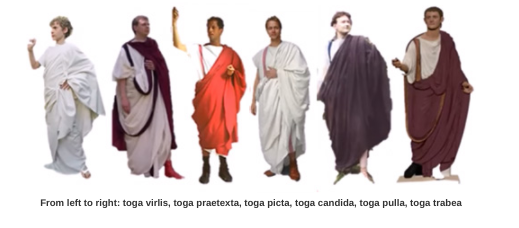
In most movies, and pictures set in Rome, we see rooms full of men wearing white togas, especially in the Senate. However, togas gradually evolved into a variety of styles and colors and helped indicate a Roman man’s status and maturity.
Mosaic of Virgil
Types of Togas and how to wear them:
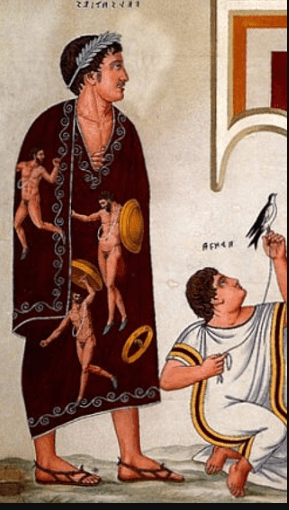
Shakespeare makes reference to a specific type of toga called a Toga candida: "Bright toga"; a toga rubbed with white chalk to make it appear bright white. In Titus Andronicus, the title character is offered a toga candida by his brother Marcus, when the Senate nominates him for emperor:

Marcus: Titus Andronicus, the people of Rome,
Whose friend in justice thou hast ever been,
Send thee by me, their tribune and their trust,
This palliament of white and spotless hue;
And name thee in election for the empire,
With these our late-deceased emperor's sons:
Be candidatus then, and put it on- Titus Andronicus, Act I, Scene i.

There were many other types of togas for different occasions:
- Dark colors were for funerals
- Red and purple sleeves were for magistrates and senators
- Purple togas with gold embroidery were for victorious generals, and later emperors
Manly garb: Toga virillis
A Toga virilis ("toga of manhood") also known as toga alba or toga pura was A plain white toga, worn on formal occasions by adult male commoners, and by senators not having a curule magistracy. It was a right of passage for young men to put on their toga virilis and assume adult male citizenship and its attendant rights, freedoms and responsibilities.
Women’s fashion
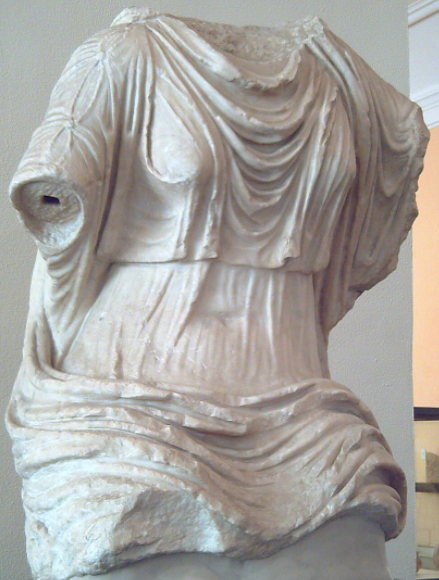
Like men, women most commonly wore tunics, especially when they were unmarried. When women married, they would don a long, elaborate garment called a Stola . The stola was a long dress held on by belts. Sometimes women decorated their Stolas with ribbons and they came in many colors. In the statue below, note how the belts below the breast drape the fabric into elaborate folds, and how the sleeves are slightly slashed on this sumptuous 1st century stola.
Torso of a Roman woman wearing a Stoa (1st century)
Women’s Beauty Regimen
Since Roman women were not legally citizens and couldn’t hold employment, their hair, dress, and makeup were in a way, a celebration of idleness, especially in the case of upper-class women. Aristocratic Roman women had their hair done in elaborate shapes like the Flavian hairstyle and wore elaborate Stoas to indicate how they didn’t have to work or labor in the fields.
In a production of Julius Caesar or Coriolanus, the director could exploit this concept of idleness by giving the more passive characters like Calpurnia or Fulvia more elaborate hairdos and elaborate brightly colored Stolas, while the more active characters like Portia or Valumnia could have a more austere or less fussy hairstyle and dress to show that they are more interested in engaging in politics or the military than sitting around and looking pretty.










 The Shakespearean Student