
I just finished uploading my trailer for my new course on Shakespeare’s tragedies for your viewing pleasure:
The first session is on November 5th (Remember the day)! Hope to see you then.


I just finished uploading my trailer for my new course on Shakespeare’s tragedies for your viewing pleasure:
The first session is on November 5th (Remember the day)! Hope to see you then.

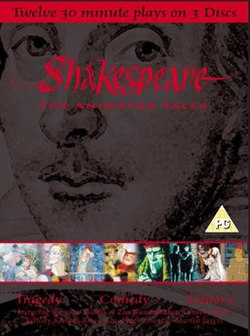
This is a 30 minute cartoon version of Macbeth originally produced for the BBC in 1992. It features Brian Cox as the voice of Macbeth (before he was the voice of McDonald’s), and Zoë Wanamaker as Lady Macbeth (before she was a witch who teaches at Hogwarts).
I like the way it portrays the horror imagery of the play in sort of a European-manga animation hybrid. Admittedly, there are better ones in the series, but this one is still pretty neat.
To check out other episodes in the series, view this playlist:


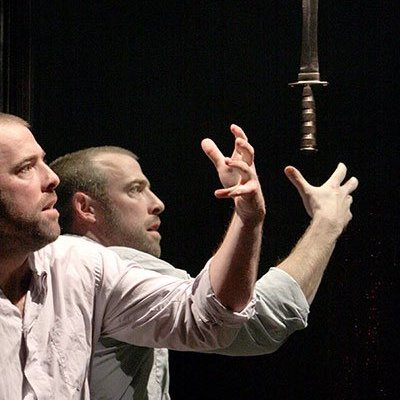
Basics Of Stage Combat: Students will learn the basics of safely enacting a fight onstage, in preparation for a Shakespeare play. We will also learn about the history of sword fighting in the military and the duel.
My daughter really enjoyed taking this class. She was actually able to use her sabre and try out her routine on her father. Paul is quite knowledgeable about Shakespeare and made the class really fun by teaching a fight scene from Romeo and Juliet. It is amazing watching her practice with Paul over Zoom. I hope Paul will have. more combat classes, it is a different way to learn Shakespeare.
IB, Parent
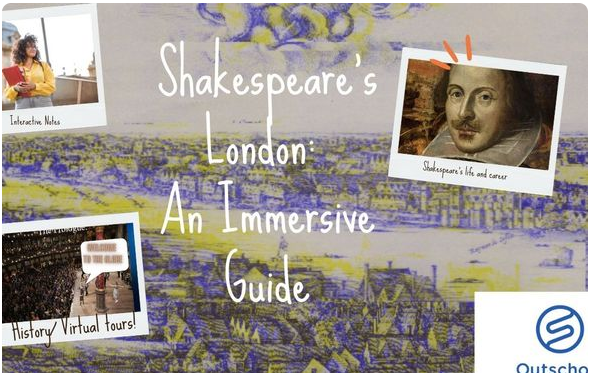
A virtual tour of Shakespeare’s London will get kids to interact with the culture of Elizabethan England.
To teach kids about the Elizabethan era and the background of Romeo and Juliet, The Instructor will interact with the class (via pre-recorded videos), pretending to be Shakespeare. The class, pretending to be actors in Romeo and Juliet, will get a virtual tour of The Globe Theater, Hampton Court Palace, and a virtual visit to an Elizabethan doctor's office. This activity is an immersive way for them to learn about the period, how it relates to the world of the play, and how Shakespeare changed theater.

The class will take the form of a guided WebQuest activity.  First, the students will get a worksheet that has a series of fill-in-the-blanks about Elizabethan society (below). The students will fill out this worksheet based on a Nearpod and in conjunction with a website I’ve made, https://sites.google.com/nebobcats.org/visit-to-elizabethan-london/home?authuser=0
Both the Nearpod and each webpage will have a virtual tour, a video, and text explaining some aspects of Elizabethan life. Before they go to each location, I will give a short introduction via prerecorded video:

In this one-hour course, your child will discover the enchanting world of science through a series of magical experiments. Learn about such topics as Astronomy, Static Electricity, chemistry, and optical illusions.
In this one-hour course, students will learn and play games that will explore the history behind Christmas traditions. We will also discuss the themes, characters, and famous quotes from Shakespeare’s play “Twelfth Night.”


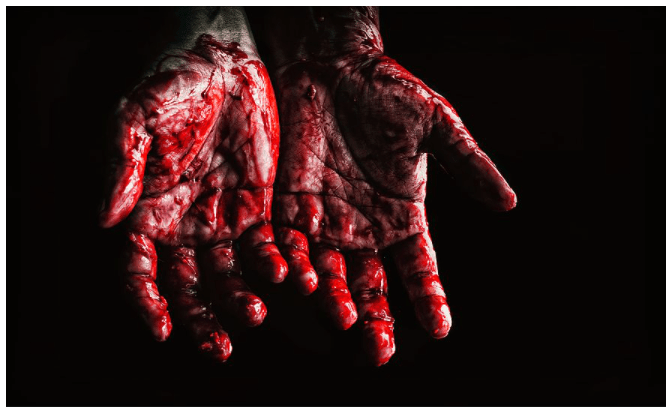


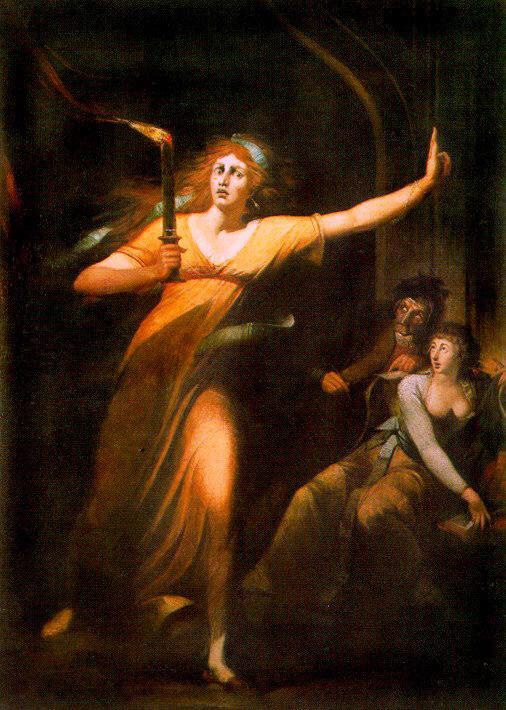


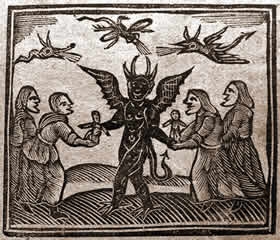



For the spookiest and most cursed month of the year, I’ve chosen Shakespeare’s Macbeth as my play of the Month for October because it’s full of witches, ghosts, and other supernatural creatures. It also shows the terrible effects of fear on people’s minds. Plus, as I explained in my post on Shakespeare and Halloween, most Halloween witches would be all but silent without Macbeth’s witches.
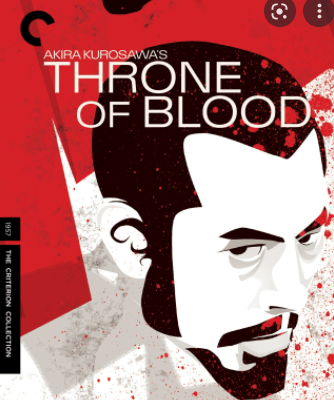
One of the most celebrated international film versions of Shakespeare comes from Japanese director Akira Kurasawa, (1910-1998). The innovative filmmaker is famous for combining Shakespeare with traditional forms of Japanese theater like Kabuki and Noh. Kurasawa’smost celebrated film was his film Throne of Blood, (1957), which was a fusion of Shakespeare’s Macbeth with Japanese Noh theater.
Here’s a short analysis of the film:


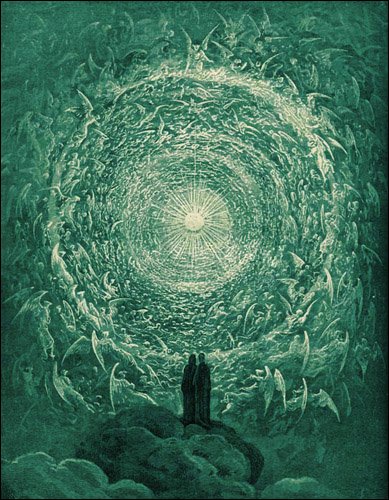


Since Easter and Passover are coming up, (and we are already in the middle of Rhamadan), I thought I’d examine Shakespeare’s depiction of other worlds both celestial and infernal. As the quote above says, philosophers and poets often wonder what greets us in the hereafter, so let me be your guide through Shakespeare’s poetic renderings of heaven and he’ll, accompanied by some gorgeous artwork from HC Selous, William Blake, and others.
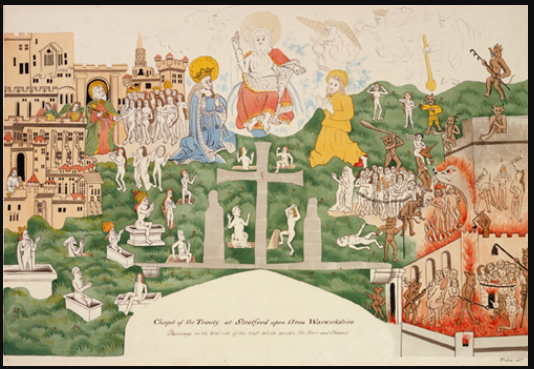
Shakespeare was no doubt interested in religion. He quotes from and alludes to the Bible many times in his plays. More importantly, he lived in a time when the national religion changed three times in just 4 years! When Henry VIII changed England to a protestant country, the religious identity of England completely changed:
This change was not just felt in monasteries, but in all English churches. King Henry decreed that certain Catholic traditions like Purgatory, indulgences, and praying to saints were idolatrous, and were therefore banned in the Church of England. So, when Shakespeare’s father was called to destroy the “idolatrous” images of the Last Judgement in the Guild Chapel of Stratford’s Holy Trinity Church, he had no choice but to comply. If you click on the link below, you can see a detailed description of the images that Shakespeare no doubt knew well in his family’s church, until his father was forced to literally whitewash them.
Like the images on the Stratford Guild chapel, the ideas of Catholic England didn’t disappear, they were merely hidden from view. Shakespeare refers to these Catholic ideas many times in his plays, especially in Hamlet, a play where a young scholar, who goes to the same school as Martin Luther, is wrestling with the idea of whether the ghost he has seen is a real ghost from purgatory, or a demon from hell, (as protestant churches preached in Shakespeare’s life).
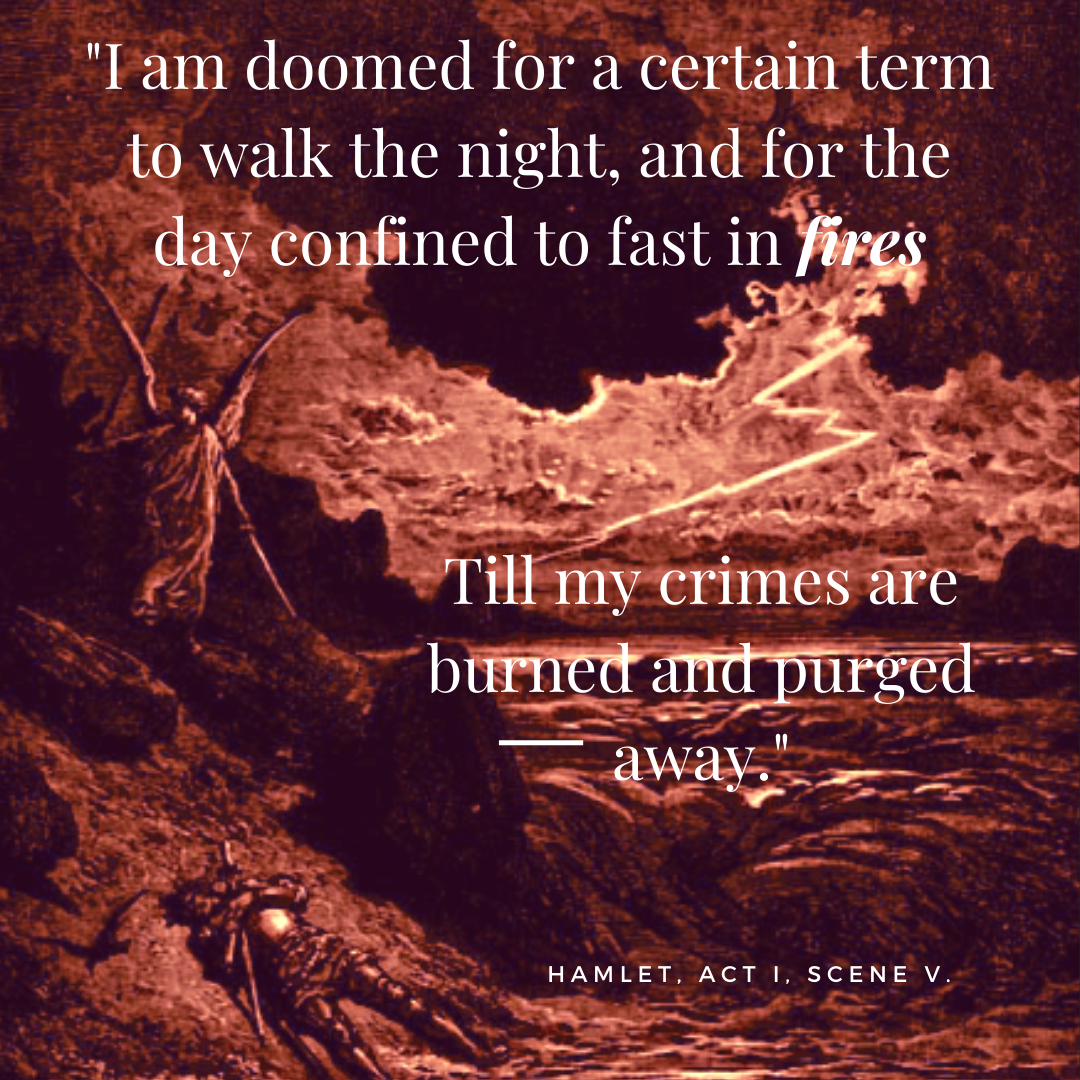
I’ve written before that the ghost of Hamlet’s father teases us with the possibility that he might be a soul in purgatory, the Catholic afterlife realm for those not evil enough for Hell, nor good enough for Heaven. At the height of their powers, monks and bishops sold prayers called indulgences that supposedly allowed a soul’s loved ones to buy them time out of purgatory, thus making them able to ascend to Heaven quicker. The image above is an illustration from Purgatorio, part of Dante’s Divine Comedy, where he visits the soul of
Buonconte da Montefeltro, who is languishing because he doesn’t yet have the strength to get out of purgatory and enter Heaven.
Of course, the Tudor monarchs Henry VIII and Elizabeth I abolished indulgences and proclaimed that purgatory itself didn’t exist, but ideas can’t die, and I feel that Shakespeare was at least inspired by the notion of purgatory, even if he didn’t believe in it himself.

(Horatio) Hamlet, Act I, Scene i.
As a young boy, William Shakespeare was entertained by medieval Mystery plays; amateur theater pieces performed by local artisans that dramatized great stories from the Bible. We know this because he refers to many of the characters in these mystery plays in his own work, especially the villains. King Herod is mentioned in Hamlet and many other plays in and many of Shakespeare’s villains seem to be inspired by the biblical Lucifer, as portrayed in Medieval Mystery Plays.
In this short video of the Yorkshire Mystery play “The Rise and Fall of Lucifer,” we see God (voiced by Sir Patrick Stewart), creating Lucifer as a beautiful angel, who then, dissatisfied with his place in God’s kingdom, is transformed into an ugly devil. At first, Lucifer mourns losing his place in Paradise, but then finds comfort by becomming God’s great antagonist.
Compare this character arc with Shakespeare’s Richard of Gloucester, who also blames his unhappiness on God, (since he feels his disability and deformity are a result of God’s curse). Richard is angry with God, nature, and society, so he wages against them all to become king.
“Then since the heavens hath shaped my body so, let Hell make crook’d my mind to answer it.”
Richard of Gloucester, Henry VI, Part III, Act III, Scene i.

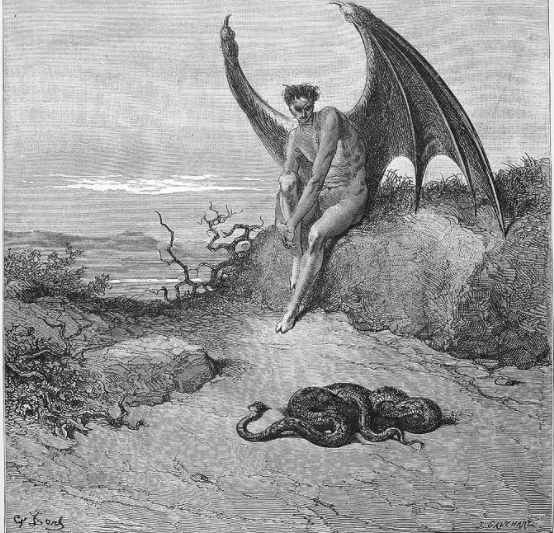
“All is not lost, the unconquerable will, and study of revenge, immortal hate, and the courage never to submit or yield.”
Lucifer― John Milton, Paradise Lost
Claudio. Ay, but to die, and go we know not where;
To lie in cold obstruction and to rot;
This sensible warm motion to become
A kneaded clod; and the delighted spirit
To bathe in fiery floods, or to reside
In thrilling region of thick-ribbed ice;
To be imprison’d in the viewless winds,
And blown with restless violence round about
The pendent world; or to be worse than worst
Of those that lawless and incertain thought Imagine howling: ’tis too horrible!
—Measure For Measure, Act III, Scene i
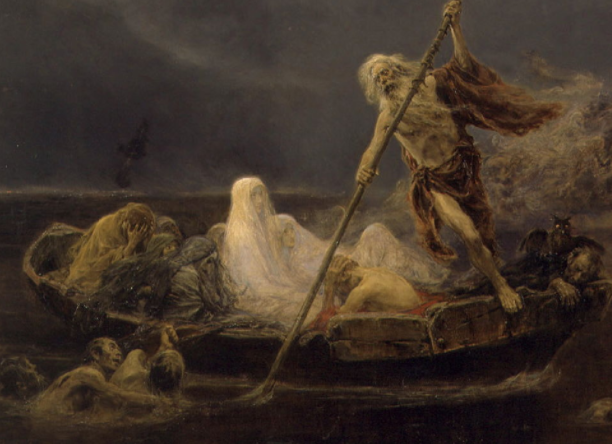
“Methought I crossed the meloncholy flood with that grim ferryman the poets write of, into the kingdom of perpetual night.”
— Richard III, Act I, Scene iv.

The heavens themselves, the planets and this centre
Observe degree, priority and place,
Insisture, course, proportion, season, form,
Office and custom, in all line of order;
And therefore is the glorious planet Sol
In noble eminence enthroned and sphered
Amidst the other; whose medicinable eye
Corrects the ill aspects of planets evil,
And posts, like the commandment of a king,
Sans cheque to good and bad: but when the planets
In evil mixture to disorder wander,
What plagues and what portents! what mutiny!
What raging of the sea! shaking of earth! Commotion in the winds! frights, changes, horrors,
Divert and crack, rend and deracinate
The unity and married calm of states
Quite from their fixure! O, when degree is shaked,
Which is the ladder to all high designs,
Then enterprise is sick!      - Troilus and Cressida, Act I, Scene iii.
https://folgerpedia.folger.edu/Idolatry:_Icons_and_Iconoclasm
If you’re like me, you are probably saddened by the loss of the great American actor, Sidney Poitier. He was part of the original cast of the great American play A Raisin In the Sun, and earned countless accolades for his roles on stage and screen like In the Heat Of the Night, Porgey and Bess, Guess Who’s Coming To Dinner? and The Greatest Story Ever Told.
In this interview, Poitier’s friend Denzel Washington talks about how Poitier was a beacon, not just for black actors but a gold standard for all actors.
Washington also discusses his role in the film Macbeth, in which he plays the title role. As I mentioned in my Much Ado About Nothing review, Denzel is a consummate performer of Shakespeare and I for one can’t wait to see him as Macbeth. This is nor just because he was an absolute joy in Much Ado, but because Denzel is famous for playing characters that start out as good men become violent and evil in films like Training Day, American Gangster, and Flight. I have high hopes that Denzel’s Macbeth will rank among his greatest performances.
Macbeth is now playing at selected theaters and streaming online on Apple+. I plan to see it and hope that you will too.
I made a digital escape room for Macbeth, as part of my Outschool.com class, “Macbeth: An Immersive Educational Experience,” which you can register for at a discount this week only. I’m presenting this digital escape room as an activity for teachers to teach their student’s knowledge of the plot of the play and use their observation and research skills to escape from a “cursed castle.”
In a normal escape room, you are locked in a room and have to follow clues and solve puzzles in order to find a series of keys, codes, and combinations to unlock the door and get out of the room. In a digital escape room, you solve online puzzles and use passwords and key codes to unlock some kind of digital content.
My escape room is designed to test your knowledge of the play, give you a chance to learn about the history behind it. Most escape rooms use the a variety of locks such as:
A digital escape room uses these concepts and adapts them to work within the context of a website or other digital experience. For example, I made a direction lock based on the direction a dagger points and made a short animation of a dagger with the text of Macbeth’s famous dagger speech.

The student has to surf through five webpages to find the answers to the puzzles, then imputs the answer in a Google form. Once he or she unlocks all six puzzles, they are permitted to leave the witches’ castle. Here’s a preview of the puzzles:

There’s a website called Flippity which allows you to make little online puzzles so I embedded it on one page of my website. In this case, it has six locks that you have to unlock by typing answers to trivia questions related to “Macbeth,” such as “What object appeared to Macbeth before he killed the king?” The final lock requires you to read a short article on the curse of Macbeth, so you can enter it on the website.
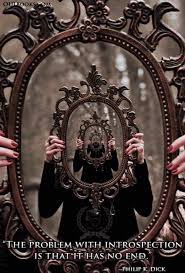
There’s a website called a magic mirror, which if you click on the mirror, it hyperlinks to an image that spells out the next answer for the Google form.
I wanted to teach the students about verse scantion and what an iambic pentamer iine is. I wanted to get the class to learn the pattern of unaccented beats (which Shakespeare scholars mark with a U), and accented beats marked with a /, as in the couplet below:
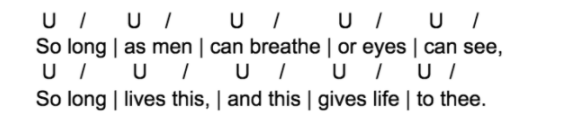
To get the students to practice making an iambic pentameter line, I embedded a Google Slides presentation in the website which has pictures of unarmed and armed soldiers. A key indicates that you are to count the soldiers and input the U/U/ pattern into the Google Form:
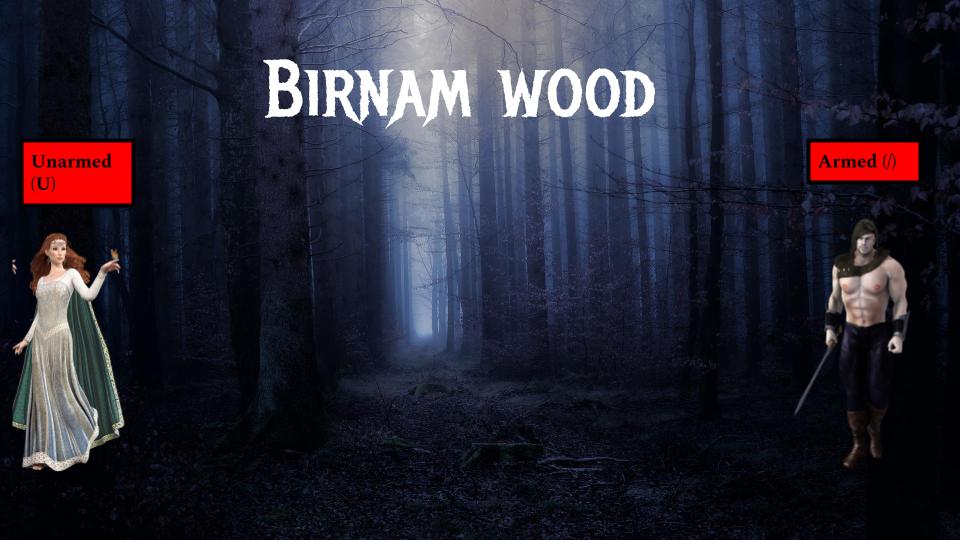
So, there’s a preview of the Digital Escape Room I hope this inspires you to try this type of activity in your class. If you want to use this activity, shoot me an email and I’ll give you a teacher’s guide. Please also consider signing up for my Outschool.com class!

 The Shakespearean Student