I’m beyond excited that I am able to offer three multiple week courses through Outschool for kids aged 6-12. If you scan the QR code below, you can see class descriptions and individual trailers. You can also check out the “My classes,” Page on this blog. I hope you and your family will join me this summer!
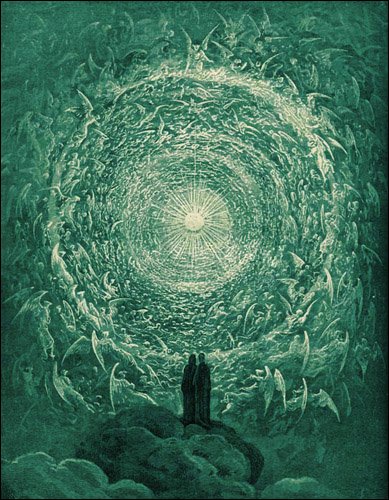
Paradiso: BeatriceParadiso: The Primum MobileInferno: The HereticsInferno: TraitorsInferno: JudeccaInferno: The LustfulPurgatorio: The Earthly ParadiseWilliam Blake- illustration from Canto 5
Since Easter and Passover are coming up, (and we are already in the middle of Rhamadan), I thought I’d examine Shakespeare’s depiction of other worlds both celestial and infernal. As the quote above says, philosophers and poets often wonder what greets us in the hereafter, so let me be your guide through Shakespeare’s poetic renderings of heaven and he’ll, accompanied by some gorgeous artwork from HC Selous, William Blake, and others.
The whitewashed images of Shakespeare’s childhood
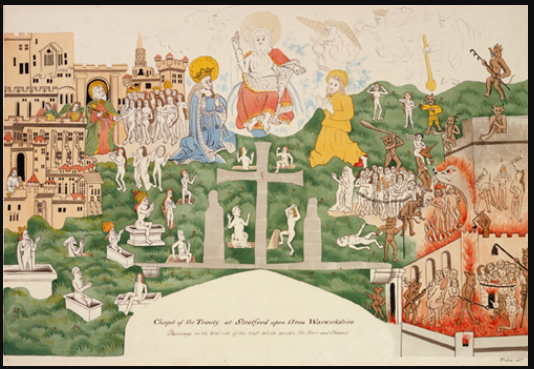
Fisher, Thomas (1781? -1836), “Chapel of the Trinity at Stratford upon Avon, Warwickshire” [1804?]. ART Vol. d58 nos.1, 3.
Shakespeare was no doubt interested in religion. He quotes from and alludes to the Bible many times in his plays. More importantly, he lived in a time when the national religion changed three times in just 4 years! When Henry VIII changed England to a protestant country, the religious identity of England completely changed:
This change was not just felt in monasteries, but in all English churches. King Henry decreed that certain Catholic traditions like Purgatory, indulgences, and praying to saints were idolatrous, and were therefore banned in the Church of England. So, when Shakespeare’s father was called to destroy the “idolatrous” images of the Last Judgement in the Guild Chapel of Stratford’s Holy Trinity Church, he had no choice but to comply. If you click on the link below, you can see a detailed description of the images that Shakespeare no doubt knew well in his family’s church, until his father was forced to literally whitewash them.
Like the images on the Stratford Guild chapel, the ideas of Catholic England didn’t disappear, they were merely hidden from view. Shakespeare refers to these Catholic ideas many times in his plays, especially in Hamlet, a play where a young scholar, who goes to the same school as Martin Luther, is wrestling with the idea of whether the ghost he has seen is a real ghost from purgatory, or a demon from hell, (as protestant churches preached in Shakespeare’s life).
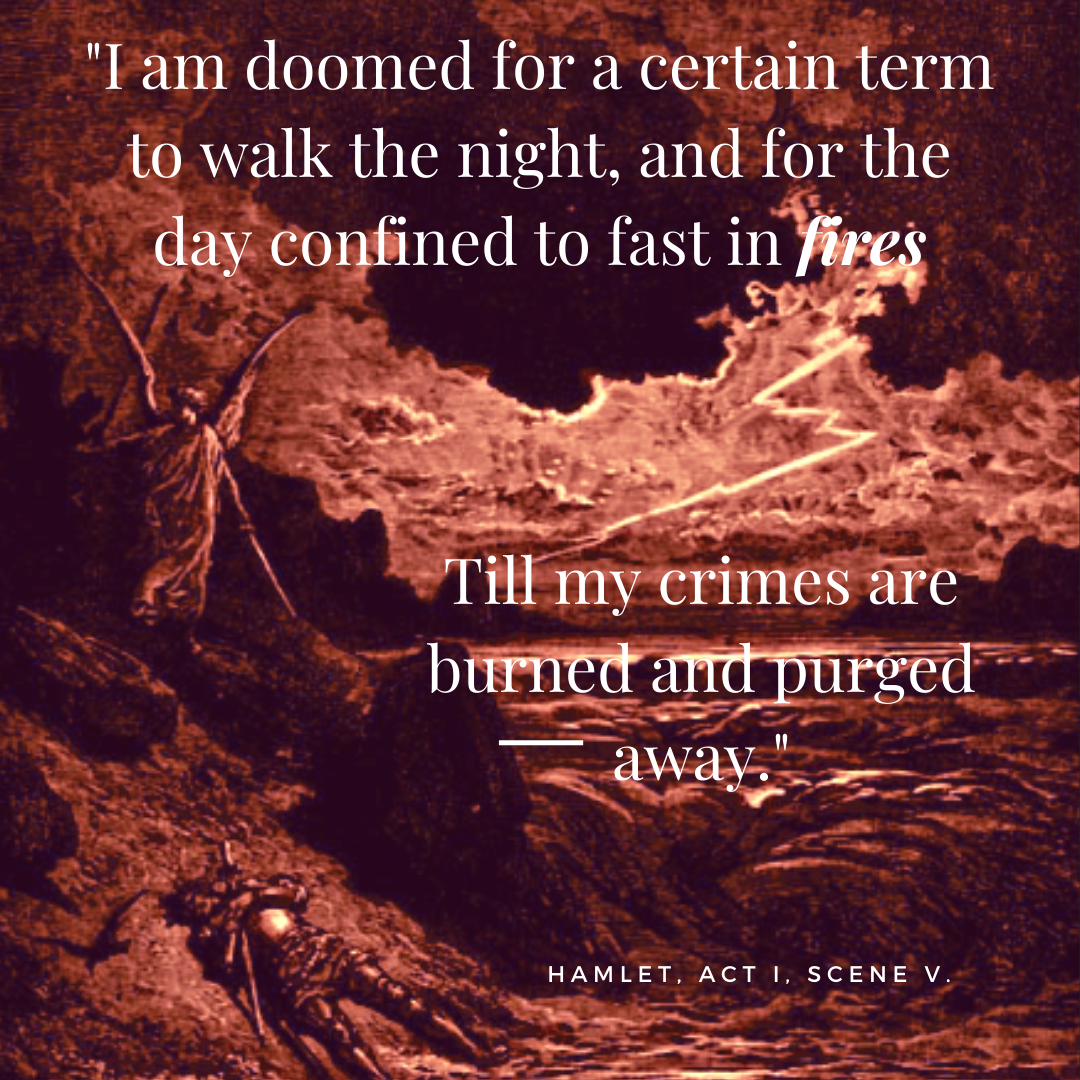
I’ve written before that the ghost of Hamlet’s father teases us with the possibility that he might be a soul in purgatory, the Catholic afterlife realm for those not evil enough for Hell, nor good enough for Heaven. At the height of their powers, monks and bishops sold prayers called indulgences that supposedly allowed a soul’s loved ones to buy them time out of purgatory, thus making them able to ascend to Heaven quicker. The image above is an illustration from Purgatorio, part of Dante’s Divine Comedy, where he visits the soul of Buonconte da Montefeltro, who is languishing because he doesn’t yet have the strength to get out of purgatory and enter Heaven.
Of course, the Tudor monarchs Henry VIII and Elizabeth I abolished indulgences and proclaimed that purgatory itself didn’t exist, but ideas can’t die, and I feel that Shakespeare was at least inspired by the notion of purgatory, even if he didn’t believe in it himself.
“It Harrows me with fear and wonder.”
(Horatio) Hamlet, Act I, Scene i.
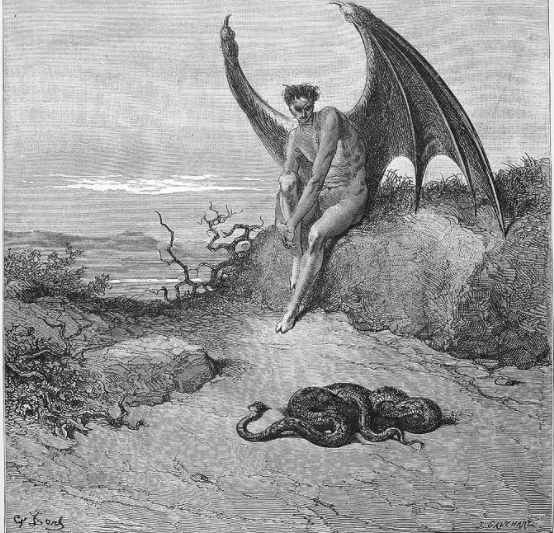
Lucifer and the vice of kings
As a young boy, William Shakespeare was entertained by medieval Mystery plays; amateur theater pieces performed by local artisans that dramatized great stories from the Bible. We know this because he refers to many of the characters in these mystery plays in his own work, especially the villains. King Herod is mentioned in Hamlet and many other plays in and many of Shakespeare’s villains seem to be inspired by the biblical Lucifer, as portrayed in Medieval Mystery Plays.
In this short video of the Yorkshire Mystery play “The Rise and Fall of Lucifer,” we see God (voiced by Sir Patrick Stewart), creating Lucifer as a beautiful angel, who then, dissatisfied with his place in God’s kingdom, is transformed into an ugly devil. At first, Lucifer mourns losing his place in Paradise, but then finds comfort by becomming God’s great antagonist.
Compare this character arc with Shakespeare’s Richard of Gloucester, who also blames his unhappiness on God, (since he feels his disability and deformity are a result of God’s curse). Richard is angry with God, nature, and society, so he wages against them all to become king.
“Then since the heavens hath shaped my body so, let Hell make crook’d my mind to answer it.”
Richard of Gloucester, Henry VI, Part III, Act III, Scene i.
“All is not lost, the unconquerable will, and study of revenge, immortal hate, and the courage never to submit or yield.”
Claudio. Ay, but to die, and go we know not where; To lie in cold obstruction and to rot; This sensible warm motion to become A kneaded clod; and the delighted spirit To bathe in fiery floods, or to reside In thrilling region of thick-ribbed ice; To be imprison’d in the viewless winds, And blown with restless violence round about The pendent world; or to be worse than worst Of those that lawless and incertain thought Imagine howling: ’tis too horrible!
—Measure For Measure, Act III, Scene i
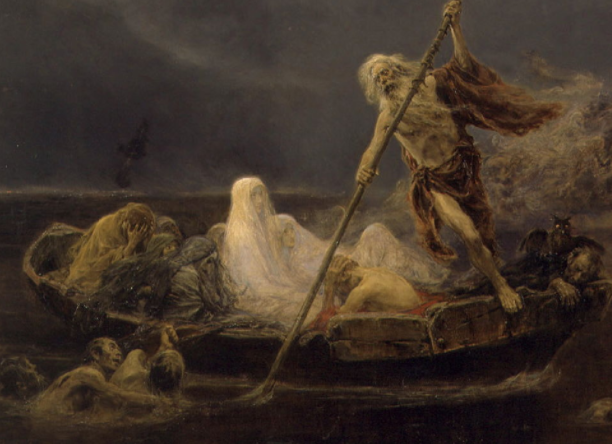
Inferno: Traitors
José Benlliure y Gil (1855–1937), Charon’s Boat
“Methought I crossed the meloncholy flood with that grim ferryman the poets write of, into the kingdom of perpetual night.”
— Richard III, Act I, Scene iv.
1579 drawing of the Great Chain of Being from Didacus Valades
The heavens themselves, the planets and this centre
Observe degree, priority and place,
Insisture, course, proportion, season, form,
Office and custom, in all line of order;
And therefore is the glorious planet Sol
In noble eminence enthroned and sphered
Amidst the other; whose medicinable eye
Corrects the ill aspects of planets evil,
And posts, like the commandment of a king,
Sans cheque to good and bad: but when the planets
In evil mixture to disorder wander,
What plagues and what portents! what mutiny!
What raging of the sea! shaking of earth! Commotion in the winds! frights, changes, horrors,
Divert and crack, rend and deracinate
The unity and married calm of states
Quite from their fixure! O, when degree is shaked,
Which is the ladder to all high designs,
Then enterprise is sick!      - Troilus and Cressida, Act I, Scene iii.
Shakespeare and the Civil War are forever linked. All the major players had a connection to the Bard, and some might surprise you:
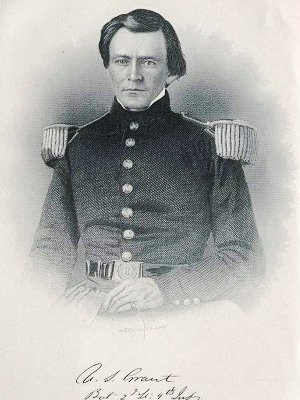
1. Did you know US Grant played a woman in a Shakespeare play!
US Grant as a US army colonel in the Mexican American War, c. 1846
We rarely see images of the future general and future president without his well-kept beard, but if this apocryphal tale is true, Grant might have grown a beard after he was embarrassed by the reaction of his fellow soldiers during a performance of Othello, where Grant rehearsed the part of Desdemona:
That December, officers decided to stage “Othello.” They looked for someone to play the beautiful Desdemona. Grant was urged to try out for the part. He had a trim figure and almost girlish good looks; his friends called him “Beauty.” Though the costume fit perfectly, the officer playing the Moor couldn’t look at Grant without laughing. They sent to New Orleans for a professional actress to play Desdemona. After that, Grant grew a beard to hide his girlish good looks. He was “Beauty” no more.
Civilwartalk.com
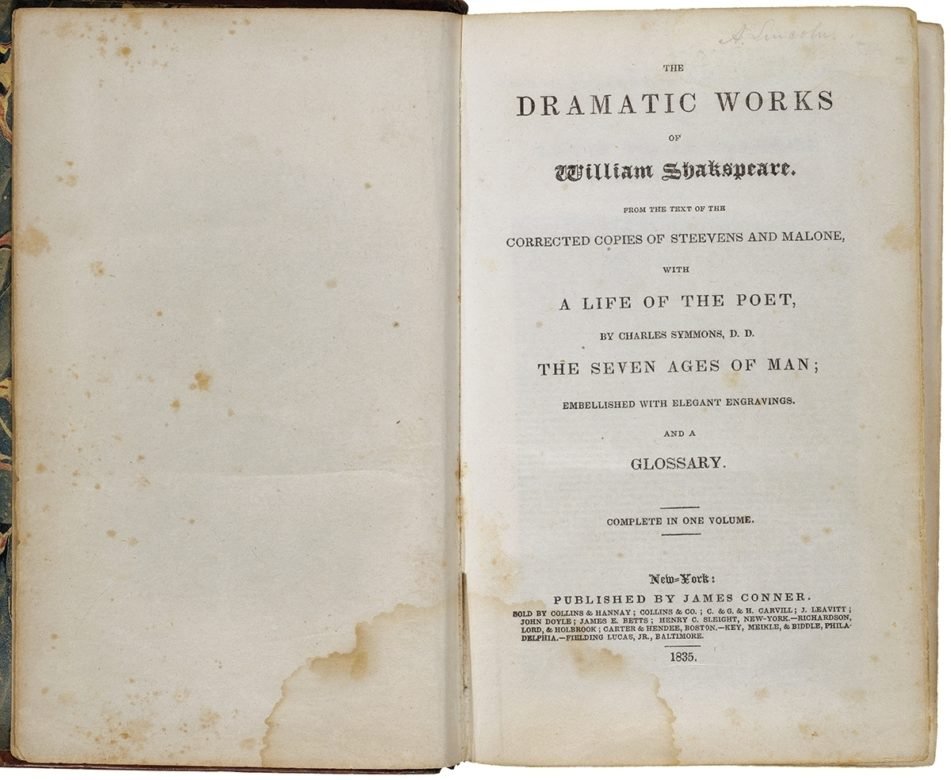
#2. President Lincoln, Shakespearean Gentleman
A copy of Shakespeare’s Plays, c. 1865. In the top-right corner, written in pencil is inscribed “A. Lincoln.”
I’ve talked before about how, to the South, President Lincoln was as big a tyrant as Julius Caesar, and how John Wilkes Booth was determined to cast himself as a real life Brutus
What you might not know is that Lincoln’s favorite Shakespeare play was Macbeth. I find a more fitting character for the compassionate and eloquent president would be the good King Duncan from Macbeth. According to Whitehousehistory.org. Lincoln quoted some lines about the good king’s death, a few days before his own:
On Sunday, April 9, 1865, with the war over, he was returning to Washington on the River Queen from City Point, Virginia, where he had visited the front, and he talked Shakespeare to his companions, read aloud to them, and recited his favorite passages from memory. He spent most of his time on Macbeth. “The lines after the murder of King Duncan. Lincoln’s companions were struck by the slow, quiet way he read the lines:
“Duncan is in his grave;
After life’s fitful fever, he sleeps well,
Treason has done his worst; not steel, nor poison,
Malice domestic, foreign levy, nothing can touch
him farther.”
When Lincoln finished, he paused for a moment, and then read the lines slowly over again. “I then wondered,” reflected one of his friends, “whether he felt a presentiment of his impending fate.”
Whitehousehistory.org.
If you choose to sign up for my Outschool class: The Violent Rhetoric Of Julius Caesar, I compare Antony’s speech, (which essentially started a civil war in Rome), with Lincoln’s Gettysburg Address. I also discuss John Wilkes Booth and his obsession with the character Brutus.
Title image for my Outschool class: “The Violent Rhetoric Of Julius Caesar.“
#3: Ex Confederates hid out in Shakespeare’s home town!
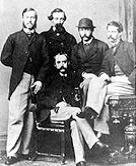
Ex-Confederate soldiers gathered in Royal Leamington Spa in England, c. 1865.
I was pretty shocked to learn this one, and it took a while before I found a decent amount of evidence to justify reporting on it here, but apparently a few ex confederates fled to England after the war, and took refuge at inns and houses in and around Stratford, including Royal Leamington Spa, which is a town just 12 miles from Stratford-upon-Avon.
I had scarcely become domesticated before the visits of the Confederates began, & we have now quite a little Southern Society. Mr & Mrs Fry of N. York, & Mrs Leigh reside very near us. Mr & Mrs Westfeldt also; but just now they are absent. Mr & Mrs Dugan, Mr & Mrs & the Misses Stewart, Mrs Hanna & Miss Reynolds, Mr & Mrs Clements, Mr & Mrs Skinner, Capt Flinn, & various others who are here, off & on, compose the little nest of Confederates in Leamington.
Nathaniel Beverley Tucker, US Consul, 1861
England was anti Slavery in the 1860s but they were also partners with the Confederates in the lucrative cotton trade. CSA president Jefferson Davis dispatched a number of ambassadors and negotiators to hopefully gain support from the English to help them fight the US in the Civil War.
Once President Lincoln signed the Emancipation Proclamation, England politely declined to aid the confederacy militarily, but Davis’ visits opened the door for Confederates in England, and that is why they wound up living in Leamington Spa.
While they were there, some purchased English warships to become part of the Confederate Navy. Some even got married!
I’m teaching a number of clases on poetry this National Poetry Month, and I wanted to make suggestion if you want to woo a sweetheart this poetry month but don’t know where to start. So here are some resources for you you use, and some links to some of my own work on the subject:
1. Mindup.com
This website is very good at helping you organize your writing into small blocks, webs, charts, etc. This is really useful when you’re creating sonnets because it helps you set up your argument. You can even add pictures to think about the images you’re going to use in your poem!.
This website is very fun and useful for teachers and students. You plug in various adjectives, verbs, and nouns and it does the rest. The sonnets aren’t great, but you do get a clear idea of how sonnets work, and that makes it very useful for students.
A sample sonnet I made about money.
3. Folger.edu- How to Write a sonnet
One of the best pieces of advice I can give to an aspiring poet is to read other poets and learn what you like. The Folger has a yearly competition of student sonnets which you can read on their website, and lots of handouts and info that teaches you about sonnet form, so check it out!
6. My OUtschool Classes on Sonnets and Shakespeare’s writing:
If you want some one-on-one help with writing Elizabethan poetry, consider signing up for my online classes! I teach 2 classes on writing poetry and literary devices:
Love Poetry: Shakespeare Style
This class is a live brainstorming session where I’ll teach you to use the resources I’ve listed above to craft an Elizabethan sonnet of your very own! We’ll also discuss some of Shakespeare’s own sonnets, and the enduring mystery of the Dark Lady and the Fair Young Man.
Trailer video fo “Love Poetry: Shakespeare Style”Page Icon for my Outschool class on Shakespearean writing.
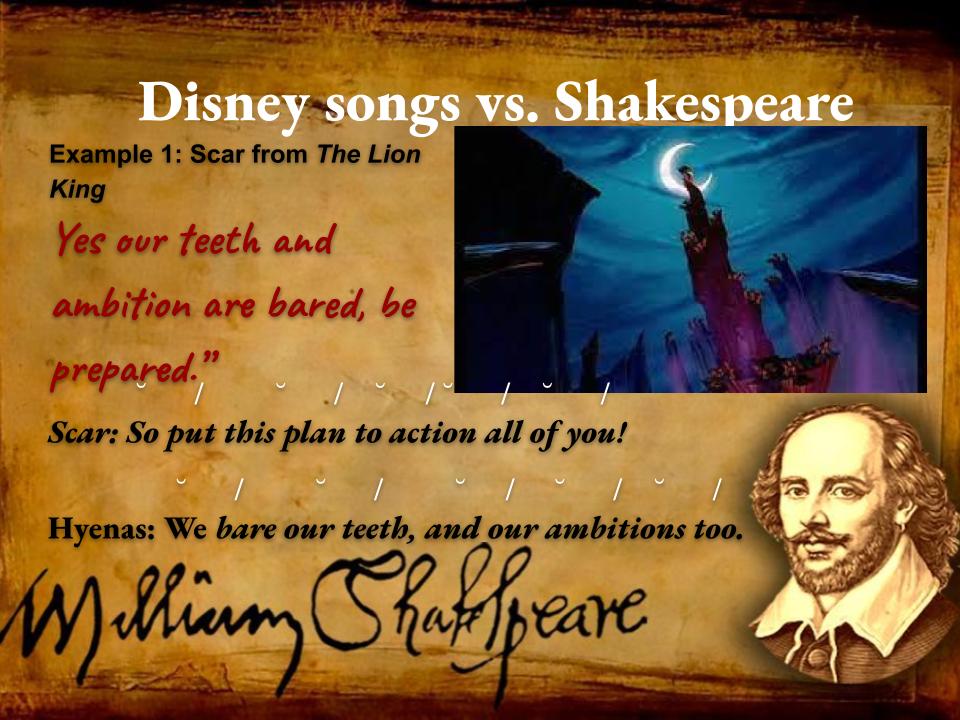
This class is a general intro to Shakespeare’s writing. I discuss the structure of his plays and poems, and I play a fun game where I rewrite some very famous lines in iambic pentameter:
So thanks for reading this list! I hope this helps you out, and if you do consider signing up for my class, I’m offering a special discount for the Love Poetry course: Get $5 off my class “Love Poetry- Shakespeare Style!” with coupon code HTHESVFDPO5 until May 5, 2022. Get started at https://outschool.com/classes/love-poetry-shakespeare-style-k8lL9yLK and enter the coupon code at checkout.
Let thy verse flow like a river, ye merry balladiers!
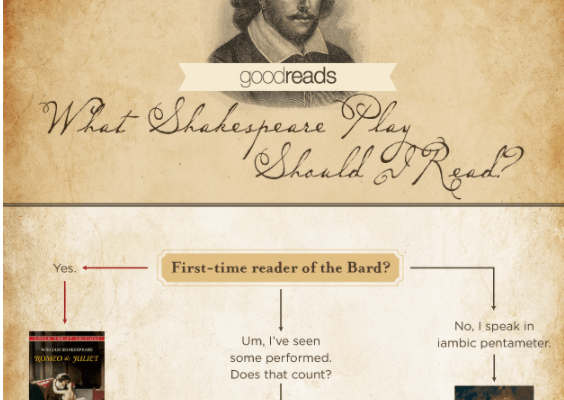
So now I want to hear from you! I want you to take the quiz and tell me what play you get! You can respond to me via the comments on www.shakespeareanstudent.com, or on Twitter at @shakestud. Can’t wait to hear from you!

























 The Shakespearean Student