In this section, I review a Shakespeare book, movie, or TV show that I feel has some kind of value, either as an interpretation of Shakespeare, or a means to learn more about the man and his writing.
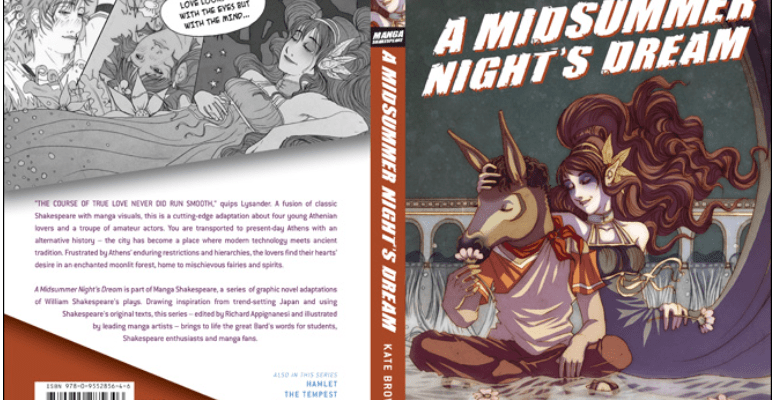
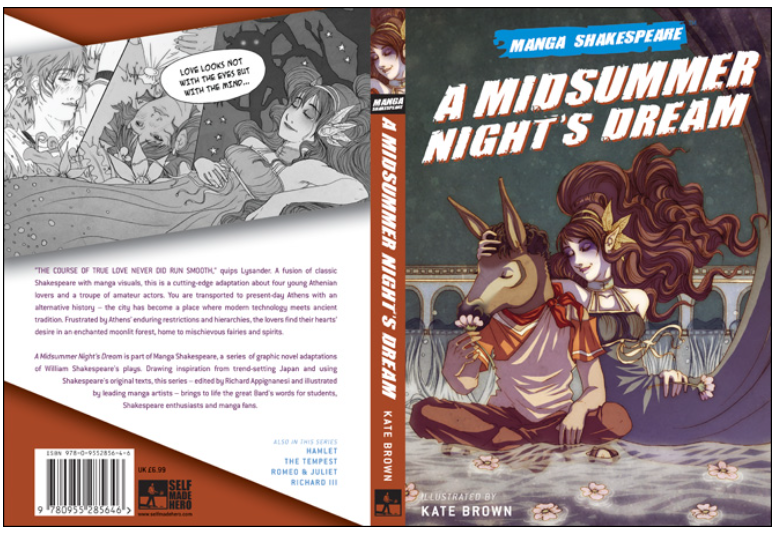
Name: The Manga Shakespeare: “A Midsummer Night’s Dream.
Ages: Pre Teen- Adult. No violence or explicit imagery, but the visual format might be confusing for younger viewers.
Premise:
My reaction:
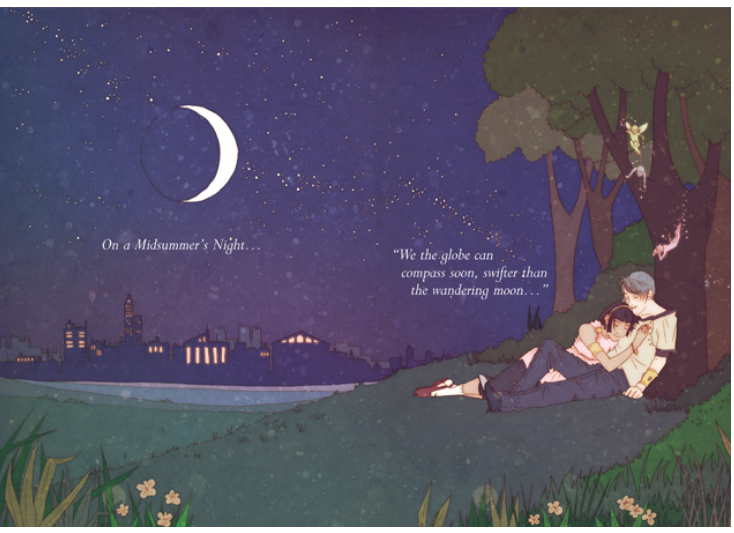
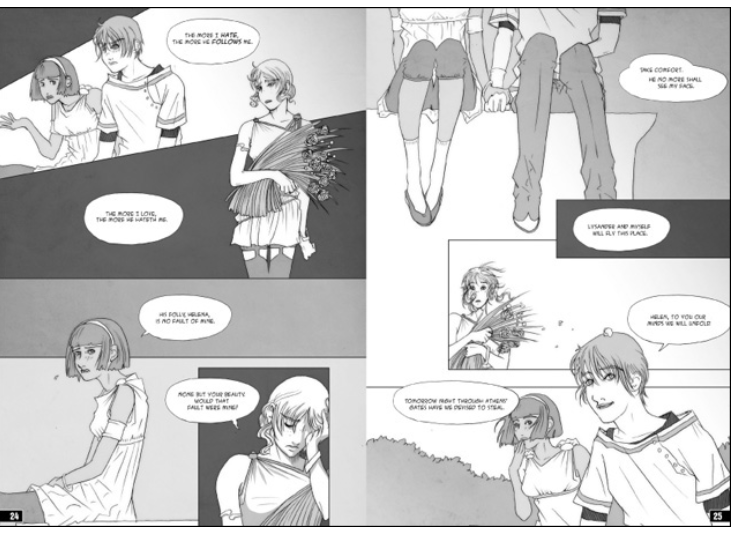
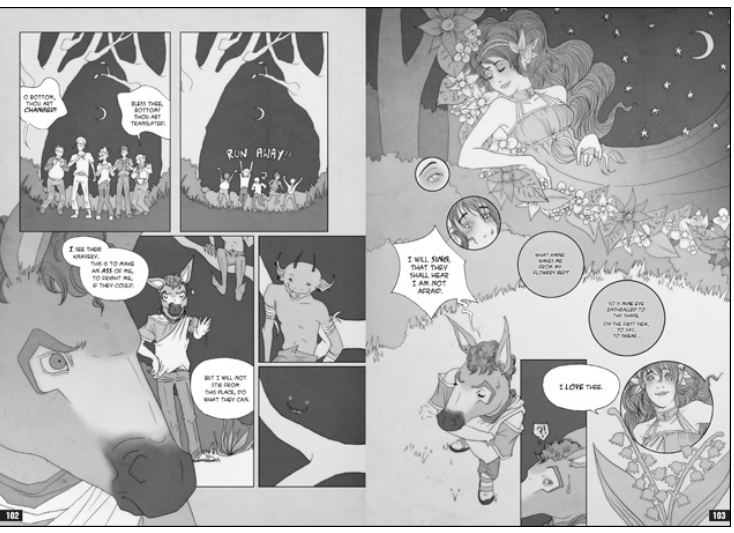
This series is very creative and in general, has a distinct and exciting style that works well for Shakespeare, though I would argue that “Midsummer” is one of the weaker ones in the series. The character designs are somewhat generic, and although the emotions are clearly conveyed, I feel that the style doesn’t clearly show who these people are or the different environments in the play- Athens, the Woods, and the Court.
Basic Details:
Sometimes the over-the top nature of manga drawings works well with this play. When Helena is mooning over Demetrius, we can see highlights in her eyes that work very well within the big-eyed, expressive style of Manga. By contrast, some other characters like Oberon are drawn very sharply, making him appear stern and even grim.
Another thing the style of pictures does is to literally illustrate the poetic passages of the For example, when Titania delivers her “These are the forgeries of jealousy,” speech, the images of the text compliment her concerns that the king and queen of the fairies are effecting the natural world.
Critique
I enjoy how well the characters convey emotions in this version because they help convey the meaning of the text. However, I think this visual style is too austere and sharp for such a vibrant, silly, colorful play. I wish the style of Manga didn’t dictate that most of the pages are black and white, because some color in the fairy scenes would add some much-needed magic.
Recommendation: This book is a good resource for classrooms exploring the text of “A Midsummer Night’s Dream,” but honestly I wouldn’t read it for pleasure.
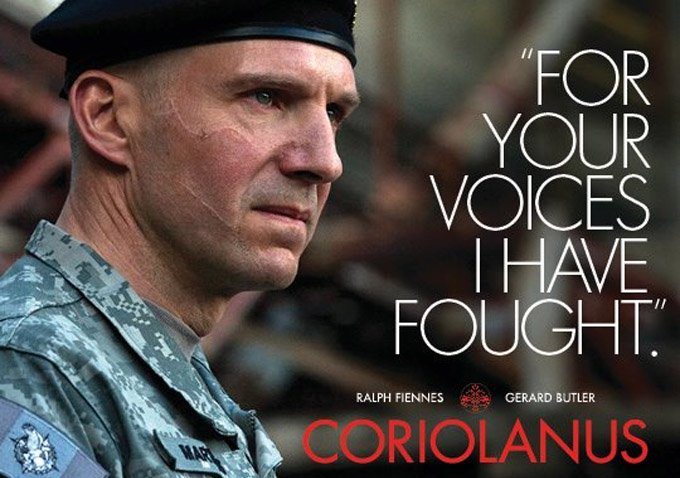
On this Memorial Day, I’m inspired by a quote to ponder what it really means to “Support Our Troops,” living and dead. The quote comes from an epilogue written for a 1778 performance of Shakespeare’s obscure Roman Tragedy, “Coriolanus:”
The most interesting thing about the play is how modern it is. One of his few plays that deals directly with the drama of democracy. And more than that, it deals with the seemingly modern phenomenon of officials undone by public opinion. So many of Shakespeare’s characters have to answer to their God or their king, or (as Coriolanus does), his family. Only rarely, do they answer to the people.
Coriolanus is one of Shakespeare’s strangest and most controversial plays. Its principal figure is a warrior, exemplary in his courage and single-minded dedication, who finds it difficult to adjust to life away from the battlefield. Refusing to compromise and contemptuous of anyone who does not live up to his exacting standards, Coriolanus, not long after being nominated for the high political office of consul, is cast into exile, accused of treason and ends up leading an army to invade and destroy Rome.
Warren Chernaik, Emeritus Professor of English in the University of London
What do we not owe soldiers?
Throughout the play, Coriolanus shows nothing but contempt for popular rule. This certainly suggests that he is aristocratic in his political views, but arguably he is much more militaristic. Remember that to be a Consul or any kind of high ranking position in the Senate, the senators all served in the army for a set term. Coriolanus respects the Senate more than the Assembly because the former is full of his fellow comrades in arms.
Coriolanus is first and last a soldier, and he represents a society run by the war machine. For centuries, authoritarians who rule through a cult of personality have propped up Caius Martius as an ideal of a military society. After all, it was Mussoluini who organized his fascist dictatorship around the Roman Empire, and the play Coriolanus was taught in literature classes during the Third Reich. They probably looked like Starship Troopers.
So to recap, though we owe soldiers a lot for their courage and sacrifice, nobody owes them Blind obedience, because that is the root of fascism. Look at this actual excerpt from a literary textbook about Coriolanus that was given to children in Nazi Germany.
The poet deals with the problem of the peaople and its leader, he depicts the ture nature of the leader in contrast to the aimless masses; he shows a people led in a false manner, a false democracy, whose exponents yield to the wishes of the people for egotistical reasons. Above these weaklings towers the figure of the true hero and leader, Coriolanus, who would like ot guide the deceived people to its health in the same way as, in our days, Adolf Hitler would do with our beloved German Fatherland.
Martin Brunkhorst, “Shakespeare’s Coriolanus in Deutscher Bearbeitung. Quoted from Weida
So now that I’ve established what we don’t owe our soldiers, what do we owe them?
What do we owe our soldiers?
[ ] Honesty- why are you fighting? Is dying for one’s country worth it? Unlike Henry V, in which Shakespeare makes it very clear why the king is trying to conquer France, we don’t really understand why Rome wants to destroy the Volskies, and it seems somewhat arbitrary. I think one of the ways we sympathize with Coriolanus is that he never “asks the reason why; his is but to do and die,” as Tennyson puts it. He has one speech where he rallies the troops, but it just seems flat and hollow without a clear reason why the soldiers should risk their lives.
[ ] A chance to heal When he comes home to run for Consul, Coriolanus is required to show his battle scars to the people and refuses to stay in the room when the patricians talk about them. This could be interpreted as more arrogance where he is disgusted to be in the same room as common men, but I think there’s another aspect. I think Coriolanus has PTSD, and every time he sees or hears about his scars, his repressed memories bubble up to the surface and drown him in fear. His story is partially a story of how all soldiers need help to deal with the trauma they endure on a regular basis.
[ ] Love for their courage and sacrifice. Whether the conflict is right or wrong men and women risked their lives for it, and that is worth compassion. [ ] Good leaders.Coriolanus is a play where arguably nobody cares about the people. Coriolanus and the Patricians look down on them, and the tribunes see them as a means to gain power. With all this political in fighting who is really trying to make life better? Better for the starving Romans? Better for soldiers like Coriolanus? In a republican society like Rome, we owe it to our soldiers to participate in politics so men like Coriolanus aren’t sent to die on a whim. If we don’t use our voices, we are the common cry of curs that Coriolanus characterizes us as:
Compassion– in John Osborne’s version the title character goes mad from his trauma and of course, in Shakespeare’s version, he’s driven out of Rome and then killed by Aufidius. Even today, many soldiers suffer from poverty, sickness, life-altering injuries, and of course, PTSD. This Memorial Day, let’s all try to help ease the lives of the men and women who have suffered for us.
Sources:
SHAKESPEARE AND BRITISH OCCUPATION POLICY IN GERMANY, 1945-1949 by Katherine Elizabeth Weida B.A. (Washington College) 2011
In this section, I review a Shakespeare book, movie, or TV show that I feel has some kind of value, either as an interpretation of Shakespeare, or a means to learn more about the man and his writing.
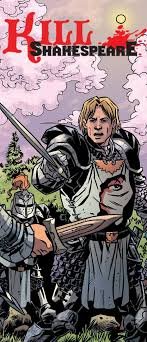
Name: Kill Shakespeare (Vol. 2) by Connor McCreery and Anthony Del Col
Ages: Adult/ Teen. There’s some PG-13 language and a lot of fighting and gore, so it’s not really for kids
Premise: William Shakespeare is more than just a simple playwright- he has a magic quill that brings his characters to life. Some of the characters worship him like a god or like a father. Unfortunately, others (namely, the villain characters), are unhappy with their stories and want revenge, causing a civil war led by Richard III, Macbeth, Lady Macbeth, and Iago (who is once again, betraying Othello). Our heroes include Juliet, Othello, Falstaff, Hamlet, and Captain Cesario (who is actually Viola from Twelfth Night in disguise). Can the heroes defeat the villains? Can Shakespeare save his precious creations from destroying each other before it’s too late?
My reaction: In essence, this graphic novel is like Season 4 of one of my favorite TV shows, Once Upon A Time. The premise is that an ordinary writer is given the power to create living characters, some good and some evil. In fact, in Once Upon A Time Lore, Shakespeare WAS one of the Authors in the OUAT universe
Basic Details:
The main difference between Once Upon A Time and Kill Shakespeare is that the action is far more violent, and the characters have one main quality- ANGST. As I said, the villains are not happy with Shakespeare, which makes perfect sense. Macbeth famously called his life a “Tale told by an idiot,” and Richard III loves to blame his problems on either God, or his mother, since one or both of them cursed him with deformity and love of wickedness. It makes complete sense that these characters would rage against their creators. The heroes (especially the tragic ones) are also struggling with their sad pasts and trying to reconcile their feelings for Shakespeare. Is he their god? Is he their father? If so, is he a good one or a bad one?
What I like the most about this graphic novel is that the characters are consistent with how the real Shakespeare wrote him, yet they make different choices in the graphic novel. They also grow and play off each other in many interesting ways. Here are some examples:
Juliet in this version is much more of a fighter than a lover. She is a general of all the heroic Shakespearean characters and uses her hope and her wits to rally the troops. That said, she still misses Romeo, who died from the poison just like in Shakespeare’s version, and still has love in her heart. I won’t give anything away but, let’s just say that this time she climbs someone else’s balcony.
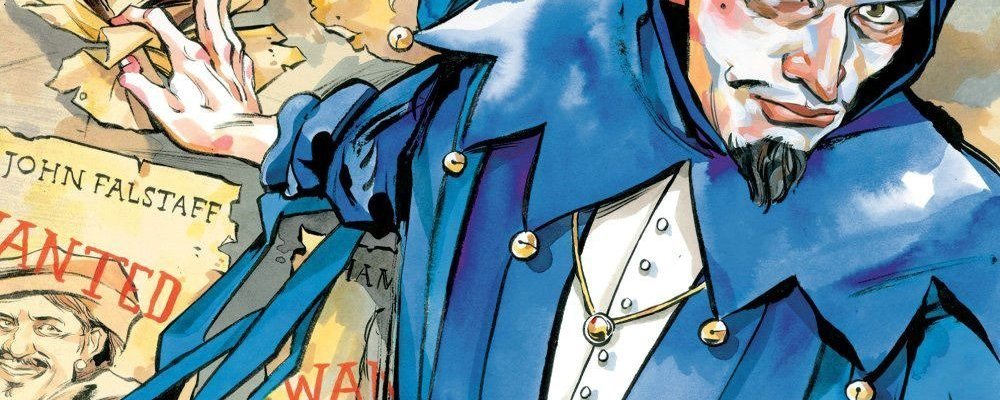
Falstaff This might be my favorite change in this version. Falstaff is still witty and gluttonous, but in this version, he’s on a bit of a redemption arc. He commits himself to fight with the rebels and even has faith in Shakespeare and the people around him. Plus, just like his moments with Prince Hal, Falstaff forms a father-son bond with Hamlet in this version, which is really fun to watch. It’s like they took everything bad about Falstaff and metaphorically ‘trimmed the fat.’
Hamlet (AKA The Shadow King in this version), is still brooding over the loss of his father, his murder of Polonius, and his loss of Ophelia. He has once again been thrust into a quest that he’s not sure he can complete- fighting King Richard, finding Shakespeare, and convincing him to help the heroes. That said, he is still capable of warmth, humor, and even romance (no spoilers).
MAJOR SPOILER ALERT
William Shakespeare
In Volume 2, Shakespeare is a jaded mentor figure who has retreated to an enchanted forest after failing to protect his creations. His arc is very similar to Luke Skywalker in The Last Jedi, in that he made a major mistake, failed to live up to the impossibly high standards people had for him, and hides away at the bottom of a bottle. He now has to choose whether to take responsibility for his creations or stay hidden away alone. I love this arc, I love the scene where he talks to Hamlet, and I love the way they develop his character.
Critique
It’s a small point, but with the exception of Falstaff and Viola, the comic characters in Shakespeare (at least in Volume 2), don’t have much to do. Feste and Sir Toby Belch appear as traveling players but they barely interact with the tragic leads. I think this was to keep the tone of the novel consistent, but honestly, I do kind of wish they had broken up some of the tragedy with some more comedy.
Recommendation: I’d recommend this book to all mature fans of Shakespeare, anime, Manga, D&D, or any kind of nerd stuff!
I’m beyond excited that I am able to offer three multiple week courses through Outschool for kids aged 6-12. If you scan the QR code below, you can see class descriptions and individual trailers. You can also check out the “My classes,” Page on this blog. I hope you and your family will join me this summer!
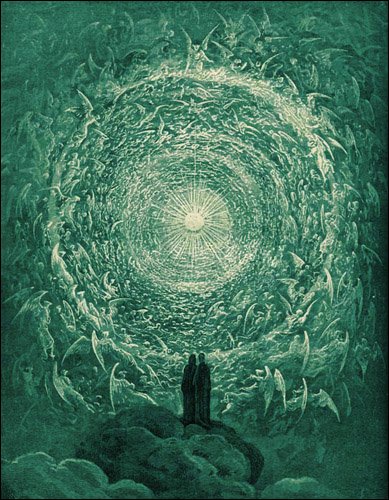
Paradiso: BeatriceParadiso: The Primum MobileInferno: The HereticsInferno: TraitorsInferno: JudeccaInferno: The LustfulPurgatorio: The Earthly ParadiseWilliam Blake- illustration from Canto 5
Since Easter and Passover are coming up, (and we are already in the middle of Rhamadan), I thought I’d examine Shakespeare’s depiction of other worlds both celestial and infernal. As the quote above says, philosophers and poets often wonder what greets us in the hereafter, so let me be your guide through Shakespeare’s poetic renderings of heaven and he’ll, accompanied by some gorgeous artwork from HC Selous, William Blake, and others.
The whitewashed images of Shakespeare’s childhood
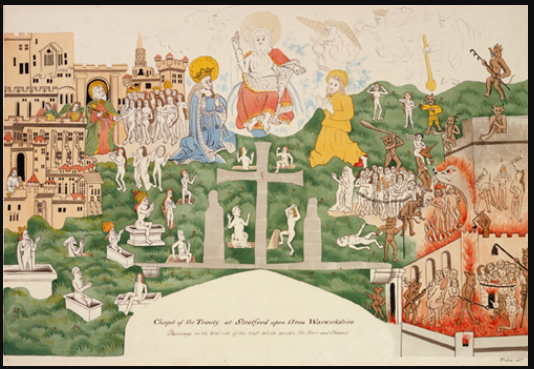
Fisher, Thomas (1781? -1836), “Chapel of the Trinity at Stratford upon Avon, Warwickshire” [1804?]. ART Vol. d58 nos.1, 3.
Shakespeare was no doubt interested in religion. He quotes from and alludes to the Bible many times in his plays. More importantly, he lived in a time when the national religion changed three times in just 4 years! When Henry VIII changed England to a protestant country, the religious identity of England completely changed:
This change was not just felt in monasteries, but in all English churches. King Henry decreed that certain Catholic traditions like Purgatory, indulgences, and praying to saints were idolatrous, and were therefore banned in the Church of England. So, when Shakespeare’s father was called to destroy the “idolatrous” images of the Last Judgement in the Guild Chapel of Stratford’s Holy Trinity Church, he had no choice but to comply. If you click on the link below, you can see a detailed description of the images that Shakespeare no doubt knew well in his family’s church, until his father was forced to literally whitewash them.
Like the images on the Stratford Guild chapel, the ideas of Catholic England didn’t disappear, they were merely hidden from view. Shakespeare refers to these Catholic ideas many times in his plays, especially in Hamlet, a play where a young scholar, who goes to the same school as Martin Luther, is wrestling with the idea of whether the ghost he has seen is a real ghost from purgatory, or a demon from hell, (as protestant churches preached in Shakespeare’s life).
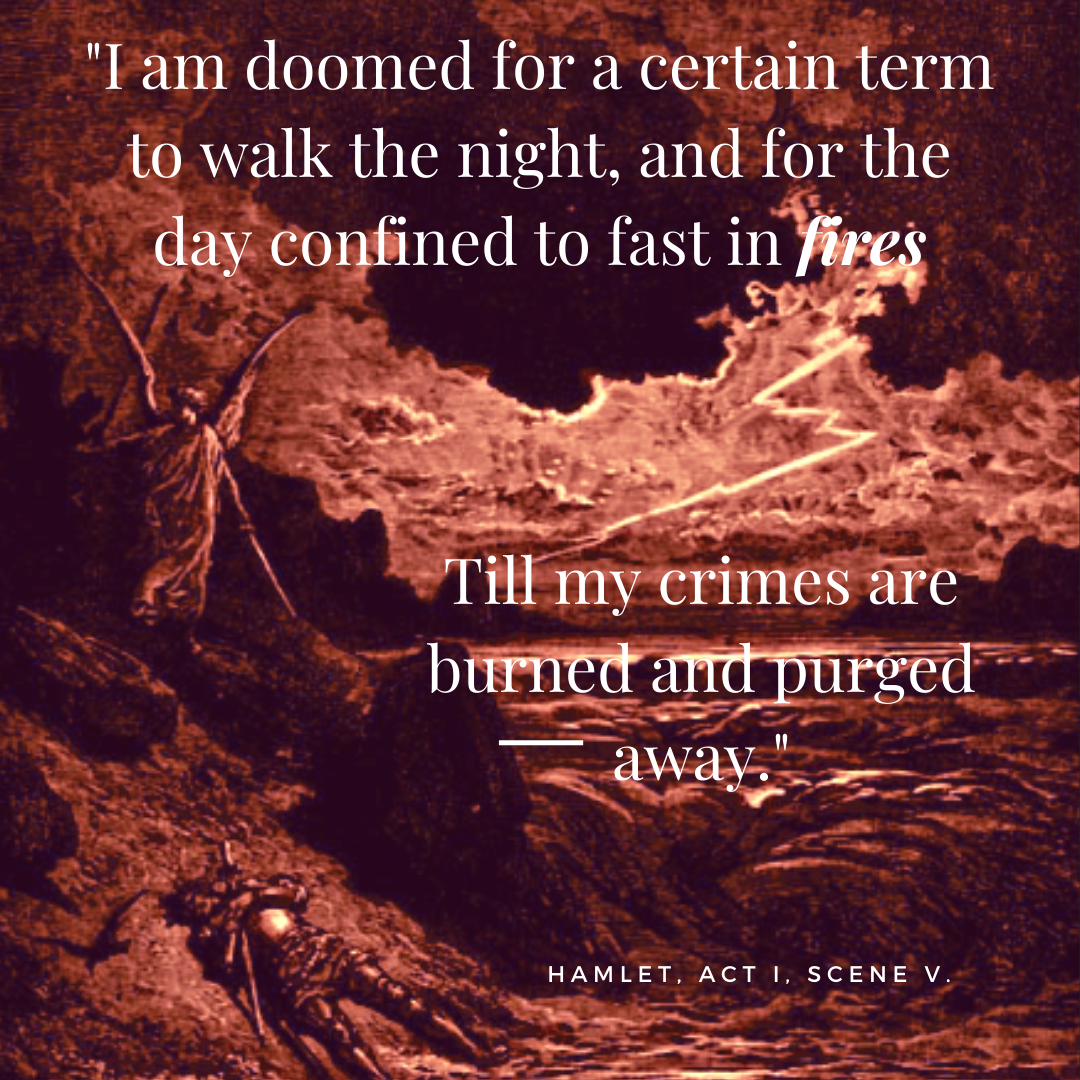
I’ve written before that the ghost of Hamlet’s father teases us with the possibility that he might be a soul in purgatory, the Catholic afterlife realm for those not evil enough for Hell, nor good enough for Heaven. At the height of their powers, monks and bishops sold prayers called indulgences that supposedly allowed a soul’s loved ones to buy them time out of purgatory, thus making them able to ascend to Heaven quicker. The image above is an illustration from Purgatorio, part of Dante’s Divine Comedy, where he visits the soul of Buonconte da Montefeltro, who is languishing because he doesn’t yet have the strength to get out of purgatory and enter Heaven.
Of course, the Tudor monarchs Henry VIII and Elizabeth I abolished indulgences and proclaimed that purgatory itself didn’t exist, but ideas can’t die, and I feel that Shakespeare was at least inspired by the notion of purgatory, even if he didn’t believe in it himself.
“It Harrows me with fear and wonder.”
(Horatio) Hamlet, Act I, Scene i.
Lucifer and the vice of kings
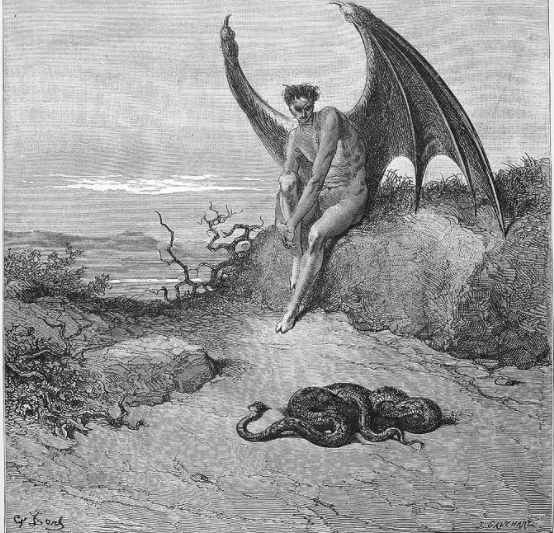
As a young boy, William Shakespeare was entertained by medieval Mystery plays; amateur theater pieces performed by local artisans that dramatized great stories from the Bible. We know this because he refers to many of the characters in these mystery plays in his own work, especially the villains. King Herod is mentioned in Hamlet and many other plays in and many of Shakespeare’s villains seem to be inspired by the biblical Lucifer, as portrayed in Medieval Mystery Plays.
In this short video of the Yorkshire Mystery play “The Rise and Fall of Lucifer,” we see God (voiced by Sir Patrick Stewart), creating Lucifer as a beautiful angel, who then, dissatisfied with his place in God’s kingdom, is transformed into an ugly devil. At first, Lucifer mourns losing his place in Paradise, but then finds comfort by becomming God’s great antagonist.
Compare this character arc with Shakespeare’s Richard of Gloucester, who also blames his unhappiness on God, (since he feels his disability and deformity are a result of God’s curse). Richard is angry with God, nature, and society, so he wages against them all to become king.
“Then since the heavens hath shaped my body so, let Hell make crook’d my mind to answer it.”
Richard of Gloucester, Henry VI, Part III, Act III, Scene i.
“All is not lost, the unconquerable will, and study of revenge, immortal hate, and the courage never to submit or yield.”
Claudio. Ay, but to die, and go we know not where; To lie in cold obstruction and to rot; This sensible warm motion to become A kneaded clod; and the delighted spirit To bathe in fiery floods, or to reside In thrilling region of thick-ribbed ice; To be imprison’d in the viewless winds, And blown with restless violence round about The pendent world; or to be worse than worst Of those that lawless and incertain thought Imagine howling: ’tis too horrible!
—Measure For Measure, Act III, Scene i
Inferno: Traitors
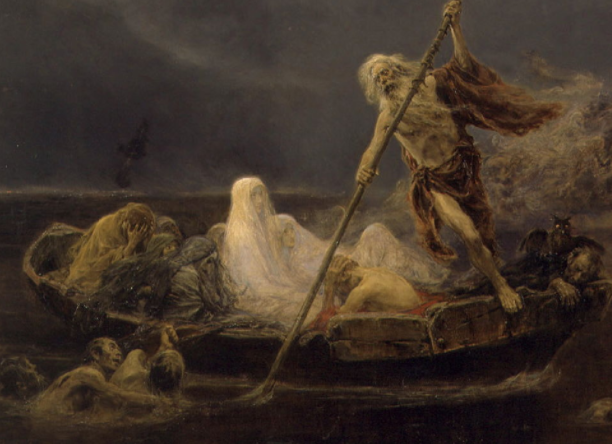
José Benlliure y Gil (1855–1937), Charon’s Boat
“Methought I crossed the meloncholy flood with that grim ferryman the poets write of, into the kingdom of perpetual night.”
— Richard III, Act I, Scene iv.
1579 drawing of the Great Chain of Being from Didacus Valades
The heavens themselves, the planets and this centre
Observe degree, priority and place,
Insisture, course, proportion, season, form,
Office and custom, in all line of order;
And therefore is the glorious planet Sol
In noble eminence enthroned and sphered
Amidst the other; whose medicinable eye
Corrects the ill aspects of planets evil,
And posts, like the commandment of a king,
Sans cheque to good and bad: but when the planets
In evil mixture to disorder wander,
What plagues and what portents! what mutiny!
What raging of the sea! shaking of earth! Commotion in the winds! frights, changes, horrors,
Divert and crack, rend and deracinate
The unity and married calm of states
Quite from their fixure! O, when degree is shaked,
Which is the ladder to all high designs,
Then enterprise is sick!      - Troilus and Cressida, Act I, Scene iii.
Shakespeare and the Civil War are forever linked. All the major players had a connection to the Bard, and some might surprise you:
1. Did you know US Grant played a woman in a Shakespeare play!
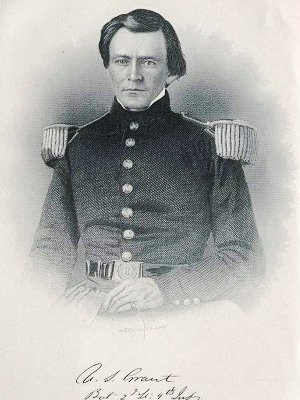
US Grant as a US army colonel in the Mexican American War, c. 1846
We rarely see images of the future general and future president without his well-kept beard, but if this apocryphal tale is true, Grant might have grown a beard after he was embarrassed by the reaction of his fellow soldiers during a performance of Othello, where Grant rehearsed the part of Desdemona:
That December, officers decided to stage “Othello.” They looked for someone to play the beautiful Desdemona. Grant was urged to try out for the part. He had a trim figure and almost girlish good looks; his friends called him “Beauty.” Though the costume fit perfectly, the officer playing the Moor couldn’t look at Grant without laughing. They sent to New Orleans for a professional actress to play Desdemona. After that, Grant grew a beard to hide his girlish good looks. He was “Beauty” no more.
Civilwartalk.com
#2. President Lincoln, Shakespearean Gentleman
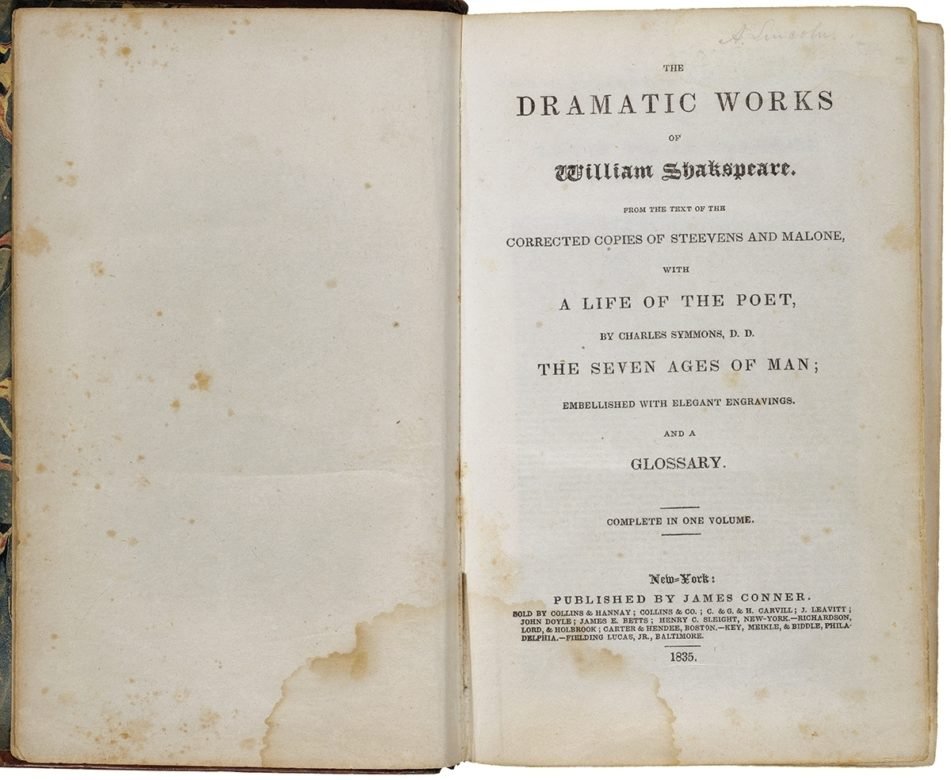
A copy of Shakespeare’s Plays, c. 1865. In the top-right corner, written in pencil is inscribed “A. Lincoln.”
I’ve talked before about how, to the South, President Lincoln was as big a tyrant as Julius Caesar, and how John Wilkes Booth was determined to cast himself as a real life Brutus
What you might not know is that Lincoln’s favorite Shakespeare play was Macbeth. I find a more fitting character for the compassionate and eloquent president would be the good King Duncan from Macbeth. According to Whitehousehistory.org. Lincoln quoted some lines about the good king’s death, a few days before his own:
On Sunday, April 9, 1865, with the war over, he was returning to Washington on the River Queen from City Point, Virginia, where he had visited the front, and he talked Shakespeare to his companions, read aloud to them, and recited his favorite passages from memory. He spent most of his time on Macbeth. “The lines after the murder of King Duncan. Lincoln’s companions were struck by the slow, quiet way he read the lines:
“Duncan is in his grave;
After life’s fitful fever, he sleeps well,
Treason has done his worst; not steel, nor poison,
Malice domestic, foreign levy, nothing can touch
him farther.”
When Lincoln finished, he paused for a moment, and then read the lines slowly over again. “I then wondered,” reflected one of his friends, “whether he felt a presentiment of his impending fate.”
Whitehousehistory.org.
If you choose to sign up for my Outschool class: The Violent Rhetoric Of Julius Caesar, I compare Antony’s speech, (which essentially started a civil war in Rome), with Lincoln’s Gettysburg Address. I also discuss John Wilkes Booth and his obsession with the character Brutus.
Title image for my Outschool class: “The Violent Rhetoric Of Julius Caesar.“
#3: Ex Confederates hid out in Shakespeare’s home town!
Ex-Confederate soldiers gathered in Royal Leamington Spa in England, c. 1865.
I was pretty shocked to learn this one, and it took a while before I found a decent amount of evidence to justify reporting on it here, but apparently a few ex confederates fled to England after the war, and took refuge at inns and houses in and around Stratford, including Royal Leamington Spa, which is a town just 12 miles from Stratford-upon-Avon.
I had scarcely become domesticated before the visits of the Confederates began, & we have now quite a little Southern Society. Mr & Mrs Fry of N. York, & Mrs Leigh reside very near us. Mr & Mrs Westfeldt also; but just now they are absent. Mr & Mrs Dugan, Mr & Mrs & the Misses Stewart, Mrs Hanna & Miss Reynolds, Mr & Mrs Clements, Mr & Mrs Skinner, Capt Flinn, & various others who are here, off & on, compose the little nest of Confederates in Leamington.
Nathaniel Beverley Tucker, US Consul, 1861
England was anti Slavery in the 1860s but they were also partners with the Confederates in the lucrative cotton trade. CSA president Jefferson Davis dispatched a number of ambassadors and negotiators to hopefully gain support from the English to help them fight the US in the Civil War.
Once President Lincoln signed the Emancipation Proclamation, England politely declined to aid the confederacy militarily, but Davis’ visits opened the door for Confederates in England, and that is why they wound up living in Leamington Spa.
While they were there, some purchased English warships to become part of the Confederate Navy. Some even got married!
However, the Romans gave way before the good fortune of the man and accepted the bit, and regarding the monarchy as a respite from the evils of the civil wars, they appointed him dictator for life. This was confessedly a tyranny, since the monarchy, besides the element of irresponsibility, now took on that of permanence
Patrick Stewart (Cassius), convinces Brutus (Ian Richardson), to betray Caesar, RSC, 1970
Under these circumstances the multitude turned their thoughts towards Marcus Brutus, who was thought to be a descendant of the elder Brutus on his father’s side, on his mother’s side belonged to the Servilii, another illustrious house, and was a son-in‑law and nephew of Cato. 2 The desires which Brutus felt to attempt of his own accord the abolition of the monarchy were blunted by the favours and honours that he had received from Caesar. 3 For not only had his life been spared at Pharsalus after Pompey’s flight, and the lives of many of his friends at his entreaty, but also he had great credit with Caesar. 4 He had received the most honourable of the praetorships for the current year, and was to be consul three years later, having been preferred to Cassius, who was a rival candidate. 5 For Caesar, as we are told, said that Cassius urged the juster claims to the office, but that for his own part he could not pass Brutus by.105 6 Once, too, when certain persons were actually accusing Brutus to him, the conspiracy being already on foot, Caesar would not heed them, but laying his hand upon his body said to the accusers: “Brutus will wait for this shrivelled skin,”106 implying that Brutus was worthy to rule because of his virtue, but that for the sake of ruling he would not become a thankless villain. 7 Those, however, who p589 were eager for the change, and fixed their eyes on Brutus alone, or on him first, did not venture to talk with him directly, but by night they covered his praetorial tribune and chair with writings, most of which were of this sort: “Thou art asleep, Brutus,” or, “Thou art not Brutus.”107 8 When Cassius perceived that the ambition of Brutus was somewhat stirred by these things, he was more urgent with him than before, and pricked him on, having himself also some private grounds for hating Caesar;
So far, perhaps, these things may have happened of their own accord; the place, however, which was the scene of that struggle and murder, and in which the senate was then assembled, since it contained a statue of Pompey and had been dedicated by Pompey as an additional ornament to his p597 theatre, made it wholly clear that it was the work of some heavenly power which was calling and guiding the action thither.
Well, then, Antony, who was a friend of Caesar’s and a robust man, was detained outside by Brutus Albinus,110 who purposely engaged him in a lengthy conversation; 5 but Caesar went in, and the senate rose in his honour. Some of the partisans of Brutus took their places round the back of Caesar’s chair, while others went to meet him, as though they would support the petition which Tulliusº Cimber presented to Caesar in behalf of his exiled brother, and they joined their entreaties to his and accompanied Caesar up to his chair. 6 But when, after taking his seat, Caesar continued to repulse their petitions, and, as they pressed upon him with greater importunity, began to show anger towards one and another of them, Tullius seized his toga with both hands and pulled it down from his neck. This was the signal for the assault. 7 It was Casca who gave him the first blow with his dagger, in the neck, not a mortal wound, nor even a deep one, for which he was too much confused, as was natural at the beginning of a deed of great daring; so that Caesar turned about, grasped the knife, and held it fast. p599 8 At almost the same instant both cried out, the smitten man in Latin: “Accursed Casca, what does thou?” and the smiter, in Greek, to his brother: “Brother, help!”
9 So the affair began, and those who were not privy to the plot were filled with consternation and horror at what was going on; they dared not fly, nor go to Caesar’s help, nay, nor even utter a word. 10 But those who had prepared themselves for the murder bared each of them his dagger, and Caesar, hemmed in on all sides, whichever way he turned confronting blows of weapons aimed at his face and eyes, driven hither and thither like a wild beast, was entangled in the hands of all; 11 for all had to take part in the sacrifice and taste of the slaughter. Therefore Brutus also gave him one blow in the groin. 12 And it is said by some writers that although Caesar defended himself against the rest and darted this way and that and cried aloud, when he saw that Brutus had drawn his dagger, he pulled his toga down over his head and sank, either by chance or because pushed there by his murderers, against the pedestal on which the statue of Pompey stood. 13
And the pedestal was drenched with his blood, so that one might have thought that Pompey himself was presiding over this vengeance upon his enemy, who now lay prostrate at his feet, quivering from a multitude of wounds. 14 For it is said that he received twenty-three; and many of the conspirators were wounded by one another, as they struggled to plant all those blows in one body.
-Plutarch’s Life Of Caesar
Artwork
Bust of Caesar Artwork for Julius Caesar. Immoral Longings, 2013.
Video 📹
Commentary
James Shapiro in his book 1599, addresses the common complaint that in the play that bears his name, Julius Caesar dies halfway through the play and has little time onstage to make a connection with the audience. The play is about tyrananicide, what causes it, what it looks like, and especially its aftermath. In a time when Jesuits and Catholic radicals threatened to assassinate Queen Elizabeth, Shakespeare wrote a powerful story about how fragile government systems can be; how striking the head off Rome leads to anarchy and sometimes tyranny.
Julius Caesar’s success as a politician was deeply tied to his success as a military leader. Therefore studying the Roman army during Caesar’s life helps one understand why he was so popular and why the Senate wanted him dead.
Uniforms of the 10th Legion (Julius Caesar’s Legion) during Caesar’s life, the reign of Augustus, and afterwards.
Caesar was commander (or legatus legionis) of the 10th mounted legion, which means his soldiers were mounted on horseback. Caesar was in charge of maintaining control over the warring tribes in Gaul (modern day France). Each legion was organized into 6 companies (cohorts) of 100 men, led by a Centurian, Source : http://thedioscuricollection.com/ejercito_romano_en.php
Organization of the 10th Legion. As you can see from the key below, each company of 80 to 100 men is led by a Centurian, and each company has 3 Tesserarius (watch commanders)
According to Imperiumromium.com, Caesar helped reform his army, and his Centurians carried out many different campaigns in Gaul:
As you can see, his soldiers were mainly armed with helmets, leather armor, and their large shields and Gladius swords. Below is an exploration of the different parts of the Roman uniform:






























 The Shakespearean Student