No, you aren’t hallucinating. This is a clip from the short-lived Warner Brothers kids cartoon show “Histeria,” an educational variety show, sort of like Horrible Histories or “Who Was.” This clip is a song about the life of Henry VIII.
The show was produced by Worner Brothers for the WB back in 1996. It starred many successful voice actors from other WB projects like Billy West (Renn and Stimpy), Tess McNeill (Tiny Toon Adventures), and Frank Welker (The current voice of Curious George). In addition, the show was created by Tom Ruegger, Executive Producer of Warner Animation, who also created Tiny Toons, Animaniacs, and Pinky and the Brain. Those of you who grew up in the 90s know that the WB occasionally sprinkled their shows with educational sketches especially with Animaniacs:
So the idea of using these creative people to create a show about history was not a bad one in and of itself. It could have been a modern-day Schoolhouse Rock. The problem is that the characters are TERRIBLE.While Tiny Toons had likeable characters who were the modern-day successors to classic Warner characters like Buster Bunny, Plucky Duck, and Hampton pig, Histeria has lame characters nobody knows or has any interest in like Froggo, World’s Oldest Woman, and Big Fat Baby. In addition, there is no through line to any of these sketches so it seems like a bunch of random skits. While the Animaniacs was about crazy weird characters trying to escape from the Warner Bros. lot, it seems unclear as to why these characters are talking to me about history.
In short, Histeria feels like a bunch of talented people were forced to make it, and they gave little thought to how to make it a popular series. Still, the animation is good, the voice acting is top-notch, and occasionally, the jokes land very well, and the songs are very catchy. Not surprisingly, my favorite song is this one, where the cast summarizes in song, all 37 plays of William Shakespeare:
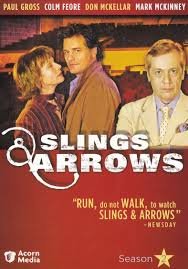
Slings And Arrows is a Canadian sitcom about a theater festival loosely based on the Stratford Shakespeare Festival in Ontario. Its hero, Geoffrey Tennant (Paul Gross), in addition to dealing with the seemingly endless problems (or should I say, “Slings and Arrows?”) mounting a Shakespeare play, is also worried he’s going mad, since he keeps seeing the ghost of his old mentor/ director Oliver Wells (Stephen Ouimette). For a recap of Season One and Two, click here to read my review.
Series Retrospective
I describe this show as a funny, tragic, bittersweet comedy about drama. It’s The Office for Shakespeare Nerds!
Season 3 Retrospective: The Promised End?
Before settling in to write this review, I went back and read some of your comments on the whole of the series, and if there was a common thread to them, it was the idea that season three is almost too painful to bear by the end, that watching these last three episodes where everything we’ve come to love so much utterly falls apart is something like ripping off a Band Aid. I can see that. I usually watch season three all in one gulp, and having to delay my viewings every week became almost torturous, both because of the plot momentum the show builds up and because I had a week to let the things happening at New Burbage stew away in my brain. What makes it even worse is that nobody here is a bad person.
To succinctly summarize this season, it’s a bad season with a good finale. This season is the show at its most raw, and frankly most of it I can’t bear to rewatch. Accordingly, this won’t be a review of the season, so much as a review of one great episode; the series finale, “The Promised End”. But first, I’ll talk about the characters and tropes that got us there.
The Cast
William Hutt as Charles Kingman
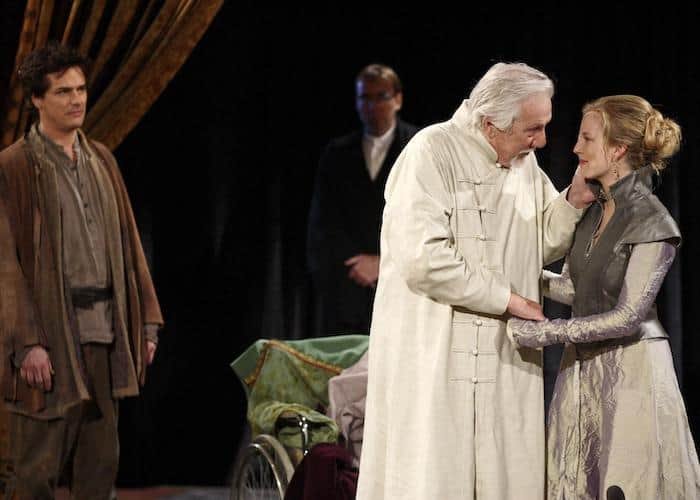
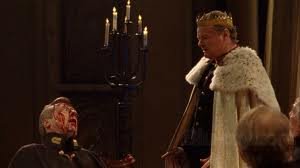
The majority of the drama around season three revolves around Charles Kingman (William Hutt). Mr. Hutt was a distinguished Shakespearean actor and while he was working on this season, Hutt was struggling with leukemia. The final episode aired on August 28, 2006, and Mr. Hutt died peacefully in his sleep on June 27, 2007.
Hutt delivers a great performance as Lear and Charles, and you’d never know he was dying with all the incredible energy and skill he delivers. However, once you know he’s dying, the arc of his character and the way Charles talks about age and death is heartbreakingly poignant:
Stephen Oimette as Oliver Wells
I’ve avoided talking about Oliver because he’s honestly more of a comic relief or a Shakespearean fool for most of the series. In this season, however, he becomes a real character as this clip shows. Geoffrey finally goes to therapy, (which Oliver twists into a ghost couple’s counseling session). It’s wonderful to see them finally address their love-hate relationship and I think it carries over into Geoffrey’s arc (more on that later).
Darren Nichols
Again, Darren Nichols is mostly comic relief, but he actually becomes a full-fledged antagonist in Season 3. In Seasons 1-2 he was a character foil- a director who hates theater, except as a vehicle for himself. In Season 1 he’s literally a foil for Geoffry, (in that he clashes with Geoffrey with literal fencing foils). In addition, he crams his production of Hamlet with pointless spectacle. In Season 2 Darren is a foil to Sarah in Romeo and Juliet– he loves being clever and cynical and wages war on the sentimentality of the love story. In this season, first Daren is a foil to Richard- mocking the sentimental storytelling of musical theatre, (as you can see in the clip above). Next, he becomes Richard’s pawn; taking credit for Richard’s skill as a director and propelling himself to become the new Artistic Director. He’s basically Edmund in King Lear- a narcissist and a cynic who loves to mock and tear down institutions.
Paul Gross as Geoffrey Tennet
Geoffrey has a very dynamic arc this season, but to achieve it, he actually regresses a lot. In the first few episodes, Geoffrey seems to hate being at this theater even after his Macbeth became a great success. He starts crying randomly, which I interpret to mean he’s horrified at the possibility that he might have to be in this theater for another year. In essence, after a full year of growth, Geoffrey has regressed to the selfish, obsessive jerk he was in Season One. As you’ll see later, this regression was necessary in order to justify his arc, but I find it nearly unbearable to watch.
That said, it’s nice to see that Geoffrey isn’t a perfect person, and he still hasn’t addressed the source of his pain- his breakdown, Oliver’s betrayal, losing Ellen, and losing his job as an actor. The only glimmer of hope in this bleak season is that Geoffrey finally confronts his pain and learns to make peace with himself, with Ellen, and Olliver.
King Lear tropes in Season 3
Trope 1: a kingdom divided
Shakespeare wrote King Lear at the same time that King James was trying to unite England and Scotland, which is why a big theme of the play is how foolish it is to divide a kingdom. In Season three of Slings and Arrows, the Lear production has to share the theater with a new musical about addiction (loosely inspired by Rent). As you can see in this clip; while they rehearse this corny, ridiculous musical, Charles is telling the story of Shakespeare’s King Lear.
Often in theater rehearsals, actors will tell the story of the play from their character’s perspective. What’s brilliant about this clip is that, while the musical demonstrates a paper-thin understanding of addiction, dramatic storytelling, or even good musical theater, Charles is conveniently leaving out Lear’s cruelty to his daughters, his failure to see their flattery, and his insane clinging to power when he has already given it away. Charles’ inability to see Lear’s flaws also mirrors his inability to see his own, which brings me to my next trope:
Trope 2: Love, or enabling addiction?
Like I said earlier, Charles understands the positive aspects of Lear, but fails to see the negative, which is why he also fails to see them it in himself. Lear is not just a dear old man who was betrayed for no reason; he’s a selfish, deluded, violent, old narcissist who cares about no one but himself. That is why he goes mad- he defines himself by power, and when he loses it, he loses his identity.
What’s really great about this season is that it doesn’t just show the dark and light aspects of Lear, it also questions the ethics of Kent and Cordelia, (the heroes of the play), who try to save him. Geoffrey eventually plays Kent in the final episode, and it’s quite obvious that he mirrors Kent’s arc; sacrificing everything to help Charles play Lear one last time. He and Anna (who is basically Cordelia in this season) even get Charles drugs to help him with the pain of cancer. Charles’ desire to play Lear mirrors Lear’s desire to play the king; they are both addicted to something that is ultimately killing them.
As you look at the season as a whole, you have to ask, was it worth it? Was it worth it for Geoffrey to lose his job and his theatre, get a bunch of other people fired, and eventually lose the festival as we know it just for one man? In the play and the show, this question is never answered, but it is useful to contemplate.
Episode Six: The Promised End
Just like in Season two, we get a beautifully directed, beautifully shot, condensed version of “King Lear” in the final episode, but the tone is completely changed. Everyone has been told that if they do this show, they will be fired, and they do it anyway. This conflict means that onstage and on screen for the actors and characters, this is a bittersweet last-ride for everyone. We know this is not just the last show for Charles, Jeffrey, Ellen, and the company, it’s also the last for Paul Gross, Steven Oimette, and the rest of the terrific TV cast.
The truly heartbreaking moments in this episode come from Geoffrey, Oliver, and Charles. We see how amazingly good Charles is, (once he accepts his age and mortality). In essence, making this everyone’s last performance made it better all around.
“A Higher Purpose”
In a great twist of fate, Geoffrey has to fill in for Jerry as the Earl of Kent. He’s horrified since the last time he acted he had a nervous breakdown. This has been a problem the whole series for Geoffrey- he blames Oliver for his breakdown and he hates the New Burbage theater because it reminds him of his breakdown. But now, he must confront his fears and get back onstage and who helps him? Oliver. He coaxes Geoffrey through his stage fright by getting Geoffrey to focus on Charles. This, by the way, is how all actors deal with it- we find an objective and spend 2-3 hours fighting for it so we don’t have time for fretting about the audience.
It’s truly lovely to watch Oliver coaching Geoffrey- not only does it mirror Geoffrey doing the same thing for Jack in season one, but we see the story of Lear from Kent’s perspective- a man trying to serve his king. This puts Geoffrey’s arc through the season into sharp focus as well- he was trying to save Charles, not Lear- Charles.
“What are we doing here?” “Putting on a play.”
Like I said before, Geoffrey starts this season with a real self-destructive streak and it’s telling that in therapy he admits that he has no work-life balance. He defines himself by making art. Through playing Kent and doing something outside the theater, Geoffrey finds meaning in his life offstage. This is why I can bear to watch this episode instead of the others- yes the theater is gone, yes Darren and Richard win and all the characters I care about have been fired, but at least Geoffrey, Ellen, Oliver, and Charles finally grow and get to move on. Charles can die in peace now that he gets to do one last performance, (without letting it drive him mad). Geoffrey gains a new perspective on his life, and thus he doesn’t need Oliver anymore. I now have reason to hope that he and Ellen can now make a life together and not mess it up like they did the last time.
In conclusion, Season Three is not fun or cheerful, and there’s no satisfying conclusion for most of the characters. That said, this might be the best-written, most amazingly performed, and most heartrending sign off for a series I’ve ever seen, and if it took so much toil and pain to get here, so be it. It’s also a tremendous tribute to a great actor, William Hutt; I feel privileged to see his final performance on this show, and rejoice that at least one more time, I got to see the king bow:
When we our betters see bearing our woes, We scarcely think our miseries our foes. Who alone suffers suffers most i’ th’ mind, Leaving free things and happy shows behind; But then the mind much sufferance doth o’erskip When grief hath mates, and bearing fellowship. How light and portable my pain seems now, When that which makes me bend makes the King bow
Edgar, Act III, Scene vi.
Play ME OUT CYRILL!
Shameless plug! If you’re here for more Lear, I’ll actually be playing Kent in an online radio play this Saturday, October 22nd, at 1PM EST. Here’s a link to the Youtube channel where it will be broadcast:
Stagecraft has a fascinating and interesting history. The way we portray spectacle on stage has changed a lot since the advent of television and movies, which utilize computers and animatronics, etc. to create impossible things that could never be is shown live. In a way, the pre-recorded nature of film and TV gives theater practitioners an advantage because the more clever they are with their stagecraft, the more impressive it is for the simple fact that it is live- happening right now in front of an audience.
What I want to do with this post is to speculate whether, with the technology of the time, if Shakespeare could have used some kind of visual spectacle to portray otherworldly creatures, such as the ghosts in Hamlet and Macbeth
The conventional wisdom
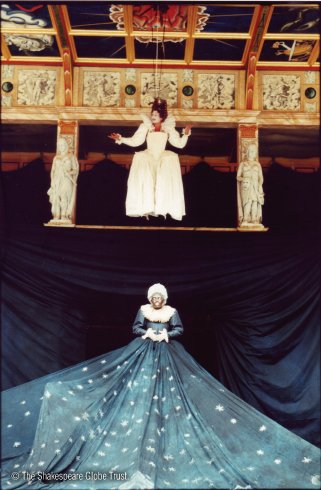
Contemporary accounts of the Globe theater mention two trap doors, one in the ceiling for angels and gods, and one in the floor for ghosts or devils.
Most books I’ve read on Elizabethan stagecraft say that the theaters of this era were very minimalistic in design. They had trap doors, they had galleries, they had a primitive flying rig, and they had music and some simple sound effects, but most of the experience was watching the actors, their costumes, their bodies, and hearing their voices hence ‘audience’- audio, “To hear.”
Professor Stephen Greenblatt of Harvard University explains the way the ghost probably haunted the Globe Theater in 1600.
We are told there wasn’t much visual representation of spectacle and fantasy on Shakespeare’s stage, which which is is odd because there are some pretty fantastical elements in his plays, especially Hamlet and Macbeth, where the former calls for a ghost and the latter calls for a ghost, witches, and a literal goddess to appear on stage. How may one ask, was this achieved back in Shakespeare’s day, the late 1590s and the early 1600s? The conventional wisdom is that the ghosts in Hamlet and the ghost in Macbeth came through a trap door in the stage known as Hell.
If you’re you go to the Globe now you can see this actual trap door being used. It used a primitive pully system to open up in the middle of the floor. The ghost would ascend to the stage through a small step ladder. Hamlet’s father’s ghost is described as wearing a suit of armor and being very pale. Banquo’s ghost is described as having long hair dappled with blood.
Banquo’s ghost appears during a banquet in Macbeth’s honor. Based on this hypothesis it’s likely that a banqueting table was brought out into the middle of a stage to conceal the ghost, to make it more of a surprise when it ascends onstage through the trap door, but the effect to modern taste would be rather dull. However impressive the performance, this cannot stand up to the stunning nature of visual effects using computer technology, motion capture, et cetera. I wanted to see if there are any Elizabethan theatrical illusions that would still have been accessible to Shakespeare back in the 1590s.
Idea #1: A Smoke-monster ghost?
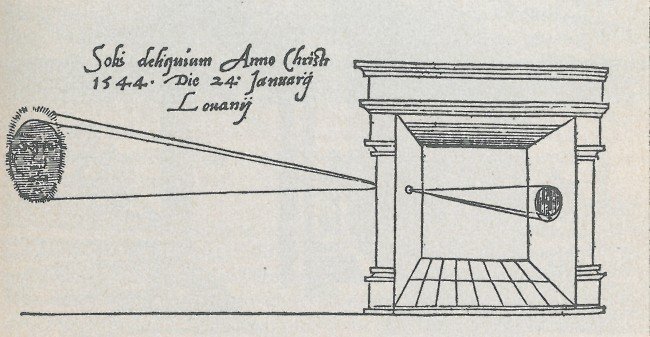
My research began with this video from the YouTube History Channel Atun-Shei Films, where the author traces the history of film, (both as photography and film as a projection). He cites at the start, an incident in 1536 where a supposed necromancer appeared to conjure a ghost for an unsuspecting rube. According to The Lives Of the Necromancers, the solution was achieved by creating huge clouds of smoke within the theater space, (which was the Colosseum) and then using a primitive camera obscure to project a frightening image Into this space.
Sketch for an early camera obscura, dated 1544 by Leonardo Da Vinci.
Camera Obscura is a term is it Latin for dark chamber the principal had been discovered for century had existed for centuries bit is for centuries but only in the 1530s this was the 1st recorded example of it being used to create a theatrical illusion.
The question is, could Shakespeare’s company have performed the same illusion with the technology of the day? Honestly, I find it rather unlikely that Shakespeare’s audience would’ve put up with huge clouds of smoke in a wooden amphitheater. Still, the fact remains that primitive projection technology existed back in Shakespeare’s day, which means a director could reasonably implement it in a production of Hamlet or Macbeth, even under the constraints of Original Practices.
Theoretically, Shakespeare’s company could have crushed this rock into a powder and made it into a paint that glowed onstage. There is precedent for this- in The Hound Of the Baskervilles, Sherlock Holmes discovers that the terrifying ghost-hound is merely a large dog painted with phosphorescent paint:
In mere size and strength it was a terrible creature which was lying stretched before us. It was not a pure bloodhound and it was not a pure mastiff; but it appeared to be a combination of the two–gaunt, savage, and as large as a small lioness. Even now in the stillness of death, the huge jaws seemed to be dripping with a bluish flame and the small, deep-set, cruel eyes were ringed with fire. I placed my hand upon the glowing muzzle, and as I held them up my own fingers smouldered and gleamed in the darkness.
“Phosphorus,” I said.
“A cunning preparation of it,” said Holmes, sniffing at the dead animal.
Doyle, Part IV.
Though this paint would potentially make a terrifying effect, this would be impossible at an outdoor theater during the day. This makes it unlikely that Shakespeare used glow-in-the-dark paint at the Globe, as most of the performances took place in the afternoon. That said, both Hamlet and were written just at the point in which Shakespeare’s company was in the process of acquiring an indoor theater, the Blackfriars.
The Blackfriars and Shakespeare’s stagecraft
Almost all of these ideas would depend on Shakespeare having access to a theatre in which he could control the lighting. As you can see, the Blackfriars was lit with candles and its indoor nature meant that performances weren’t dependent on sunlight. Greg Doran, former director of the Royal Shakespeare Company has theorized in the past that maybe while his company was preparing to move into the Blackfriars, Shakespeare was changing his material to make it both literally and figuratively darker.
In the reconstructed Blackfriars, (where I studied and interned for three years), there is a trap-door and flying rig like the Globe, so the conventional trap-door ghost can and has been utilized there. I would also argue that in the Blackfriars unlike the Globe, there was a chance for more variety of theatrical illusions- perhaps a smoke projection, magic lantern, or even…
Idea 3: A Pepper’s ghost
A Peppers Ghost is a stage illusion that dates back to the 19th century. It uses the principle of refracted light to project the image of a ghost on top of a piece of glass. This image will appear translucent and could be very impressive to an audience at the Blackfriars! As you can see in the diagram below, the actor could be under the stage in the trap door standing in front of a mirror, and the glass sheet could be used to project his image to the audience. The only concern would be that this could limit the blocking of the other actors, and it might not make the ghost visible to the audience members in the upper galleries, but it would still be an impressive visual effect that uses scientific principles known in the 17th century.
Pepper’s ghost diagram.
Pepper’s Ghost illusions are still used frequently in theme parks, trade shows, and concerts where singers interact with “holograms.” As a special Halloween treat, (or trick as the case may be), I’ve included a video that will allow you to make your own Pepper’s ghost at home. If you choose to make one, leave me a comment!
So, in conclusion, though we are taught that Shakespeare’s theater often reveled in simplistic theatrical designs, I personally think that there is more room to explore low-tech theatrical illusions like these, especially at companies like the Globe Theater and the American Shakespeare Company, which pride themselves on using Shakespeare’s original staging practices. Live theater has dodged giving up its ghost for 2,000 years by exploring the limits of live theater through movement, voice, story, music, and yes spectacle. I think theater practitioners, even Original Practitioners should keep innovating new kinds of spectacular means to keep creating fresh interpretations of Shakespeare, that still keep within the spirit of the play’s original time and place.
Bonus: If you want to learn more about the stage illusions of Shakespeare’s company, click here to listen to That Shakespeare Life Podcast with Cassidy Cash. In this episode, she interviews theater professor Frank Mohler, who describes how thunder and flying effects were done in the 17th century, using records of the period, and his own experimentation.
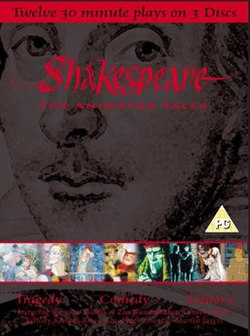
This is a 30 minute cartoon version of Macbeth originally produced for the BBC in 1992. It features Brian Cox as the voice of Macbeth (before he was the voice of McDonald’s), and Zoë Wanamaker as Lady Macbeth (before she was a witch who teaches at Hogwarts).
I like the way it portrays the horror imagery of the play in sort of a European-manga animation hybrid. Admittedly, there are better ones in the series, but this one is still pretty neat.
DVD box art for “Shakespeare the Animated Tales.”
To check out other episodes in the series, view this playlist:
Geraint Wyn Davies as “Macbeth”Darren’s “Chess PawnOliver plays Banquo’s Ghost
Slings And Arrows is a Canadian sitcom about a theater festival loosely based on the Stratford Shakespeare Festival in Ontario. Its hero, Geoffrey Tennant (Paul Gross), in addition to dealing with the seemingly endless problems (or should I say, “Slings and Arrows?”) mounting a Shakespeare play, is also worried he’s going mad, since he keeps seeing the ghost of his old mentor/ director Oliver Wells (Stephen Ouimette). For a recap of Season One, click here to read my review.
The premise of the Series
I describe this show as a funny, tragic, bittersweet comedy about drama. It’s The Office for Shakespeare Nerds!
Season 2 Retrospective
Whereas Season One was sometimes extremely dramatic and raw, Season Two is much more relaxed; it feels a little bit more like The Office for Shakespeare nerds. Each episode focuses much more on the work-a-day frustrations of running a theater. We see it through multiple perspectives and even multiple shows- we see one director not being able to complete Romeo and Juliet, we see another trying to cast for Pirates of Penzance, and finally we see Geoffrey trying to fulfill Oliver’s posthumous concept for Macbeth.
“You just need to sell more tickets.”
“It’s not that simple, we’re talking about THEATER!”
Season Two doesn’t just focus on the artistic side. The theater is going broke, and Richard is begging for money from sponsors and the government. Susan Coyne as the overworked Executive Assitant Anna also has her hands full taking calls, organizing the schedule, and of course her new additional frustration with the internship program.
Grace Lynn Kuhn as Emily sobs contritely in front of Geoffrey (Paul Gross)
This particularly made me laugh the first time I saw the show because at the time, I was interning for the American Shakespeare Center. I know what it’s like to feel like if you’re out of your depth but excited, thinking that this is going to be your big break, (while also being keenly aware that your job is mostly obviously getting coffee and writing notes in the prompt book). I have to give a shout-out to Grace Lynn Kung who plays intern Emily Wu; she does a great job of portraying this mixture of anxiety and youthful desire to please.
To be brief, this season has a much greater level of authenticity and realism that shows the series graduating from a soap opera into a real workplace comedy.
The Cast
Paul Gross as Geoffrey Tennet
In the first three episodes, Geoffrey is afraid to put on Macbeth because he thinks that Oliver will come back. Just like Season one, Geoffrey is still not sure whether Oliver is actually a ghost or is actually a manifestation of Geoffrey’s madness. As he continues to work on the production, he and Oliver quarrel as conflicting directors, and their private struggles as friends and colleagues even spill over into rehearsals, which threatens the production itself.
Gerand Wynt Davies as Henry Breedlove
Geraint Wyn Davies as Henry Breedlove, onstage as Macbeth
The main curse in this production is the old guard of actors who are threatened by Jeffrey’s leadership; they got used to Oliver’s more relaxed style and they do not want Geoffrey shaking things up. Chiefly among them is Brian Cabbott and Henry Breedlove played by Geraint Wyn Davies, (who is really a classically trained actor from the Royal Shakespeare Company). Brian starts out by playing Claudius in Hamlet in the tail end to Season One. He’s disrespectful to Geoffrey and criticizes him to his face. Like Prince Hal dismissing Falstaff, Geoffrey dismisses Brian from the company.
One theme of Macbeth that is echoed again and again in Season two is middle-aged people feeling threatened by the young. It’s shown in Geoffrey’s clashes with Henry and Brian, with Richard being seduced by the hotshot young marketers at Froghammer, and especially with Darren Nichols, who is forced to direct Romeo and Juliet, and clashes with the young and idealistic Sarah (Joanne Kelly). She gives a passionate performance both as Juliet and as a young actress who desperately wants to do her best, and actually asks Geoffrey to direct her behind Darren’s back, as this adorable scene illustrates:
What’s great about this scene is it doesn’t just set up the star-crossed romance between Sarah and her costar; it also cleverly points out the similarities between Macbeth, and Romeo and Juliet. As you see at the end, Geoffrey is inspired by Sarah’s performance and it carries over to how he directs Henry and Ellen in Macbeth. Both couples are impulsive and reactive- they love pitting themselves against the world, and that is one reason why their affairs end in tragedy. Many scholars echo this interpretation, that if Romeo and Juliet had lived, they might have become the Macbeths. Seeing the balance between backstage drama, clever Shakespearean commentary, brilliant Shakespearean acting, and workplace comedy is at the heart of why this show works, and it’s handled masterfully in each and every episode of Season 2.
My favorite episodes
Episode 1: Season’s End
The Departure of Rachel McAdams As Kate
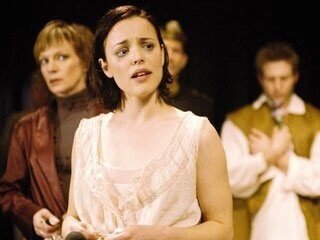
Rachel McAdams as Kate playing Ophelia in Season 1.
In the first episode, there is the tearful goodbye of Luke Kirby and Rachel McAdams, mirroring the fact that, as big Hollywood stars the two of them were unable to continue for a second season, even though everyone involved from the cast to the creators wishes they could. The life imitates art aspect of this episode makes it particularly tearful and sad to watch and yet it is a thoughtful and deeply well-earned sendoff.
Episode 2: Fallow Time
One of my favorite episodes is technically the Christmas episode of the show, and as such, Oliver gives Geoffrey a gift- he leaves him costume sketches, set designs, and notes on the play’s concept, which the ghost of Oliver explains in detail to Geoffrey and the audience. Maybe this kind of glimpse into the nitty gritty of theatrical concepts will only appeal to theater nerds, but I truly love it.
Episode 4: Fair Is Foul and Foul is Fair
While all the drama onstage is going on, Anna is getting some romantic attention from a playwright, unaware that (SPOILER ALERT), he’s using her for ideas for his script. In a way, this subplot shows us another aspect of Macbeth and Romeo and Juliet; in both these stories, the men use women for their own gain. Romeo arguably is using Juliet to play out his romantic fantasies, and Macbeth certainly depends on Lady Macbeth’s courage and cunning in order to go through with their plan to kill the king. Not surprisingly, all three romances end in tragedy.
Meanwhile on the stage during Macbeth rehearsals, Geoffrey is trying to get an organic, serious performance out of Henry, but he thinks he knows more than his director so Geoffrey has no choice but to fire him as he did Brian.
Episode 5: Steeped In Blood
S
In this episode Geoffrey puts the lovable understudy Jerry onstage as Macbeth. What’s interesting in this episode is, while Henry plays Macbeth as a larger-than-life soldier, Jerry plays him as sort of an everyman, letting himself be seduced by power and delusions of grandeur. Looking back, I actually owe a lot to this episode, since it helped inspire my own interpretation of Macbeth.
Episode Six: Birnam Wood
If I were going to pick one episode of Slings And Arrows for the time capsule, one episode of the show to stick up against every other show ever made, it would be “Birnam Wood.” I don’t honestly know if this is the best episode of the show—the series finale proper is probably that—but it’s my favorite episode of the show. It makes me cackle with delight, thrill with excitement, and smile with sympathy every time I watch it.
The season finale gives us a fully formed version of Macbeth and Romeo and Juliet: we get to see the designs, the technical rehearsals, the marketing, everything that the whole season was building up to into, not one but two complete theatrical performances!
First, Geoffrey cooks up an elaborate scheme to touch Darren’s heart and get him to scrap his cynical concept for Romeo and Juliet.
Geoffrey tricks Darren into re-directing “Romeo and Juliet”
As you can see, the scheme works, and Darren has an epiphany during tech rehearsals.
Darren has an epithany during tech for “Romeo and Juliet.”
In the show’s climax, for 20 minutes we get to see Henry perform as Macbeth and Ellen as Lady M. Geoffrey reluctantly re-hires Henry, but he refuses to let him walk all over him or his production. I won’t go into spoilers, but let’s just say Henry finally learns his lesson, with a little help from Oliver:
As I said last time, anyone who’s ever had a boring office job loves and recognizes the characters from “The Office,” while those of us in the theater recognize the crazy directors, the hopeful understudies, the divas, and the money-grubbing management. What’s great about this season is that, while Season one focused on them all broken apart, this season has them all coming together, using their talents to put on two excellent shows. After seeing the characters grow and change professionally and personally, we feel like proud parents and this fictional theater company feels more like a family, but any family can be broken… stay tuned.
I’m helping to direct a young actor playing Hamlet and we’re going over the “O That This Too Too Solid Flesh” speech. Going over the text, it occurred to me: what happened to Hamlet’s father?
Shakespeare makes it clear that Claudius poisoned Hamlet’s father with a vial of poison that he put in the king’s ear:
Sleeping within my orchard,
My custom always of the afternoon,
Upon my secure hour thy uncle stole,
With juice of cursed hebona in a vial,
And in the porches of my ears did pour
The leperous distilment; whose effect
Holds such an enmity with blood of man
That swift as quicksilver it courses through
The natural gates and alleys of the body. Hamlet, Act I, Scene v, lines 796-805.
The Ghost calls the poison “cursed hebannon,” which fis a poison that Shakespeare made up. Interestingly, Shakespeare’s original source for Hamlet makes no reference to poisoning, but that the king was stabbed in front of his own court. I think Shakespeare might have changed this simply because Queen Elizabeth was concerned about assassination herself, and Shakespeare didn’t want to make it look like he approved of assassination. Then again, maybe he changed it so that the murder didn’t seem like a repeat of Julius Caesar, (which Shakespeare’s company performed the year before Hamlet, (Source: New York Times, 1982).
The Ghost describes how, when the poison went through his ear canal, he experienced violent swelling, sores, and unimaginable pain. He actually compares himself to Lazarus, Jesus’ friend in the Bible who died of leprosy.
And with a sudden vigour it doth posset And curd, like eager droppings into milk, The thin and wholesome blood. So did it mine; And a most instant tetter bark’d about, Most lazar-like, with vile and loathsome crust All my smooth body. Hamlet, Act I, Scene v, lines 807-811.
Detail from “The Raising of Lazarus” by Rembrandt c. 1630
Sadly, Leprosy is still prevalent in third world countries so its symptoms are still very well understood: CONTENT WARNING: DISTURBING IMAGES IN THIS VIDEO
The poison is made up, but could such a poison actually exist? I found a wonderful article from the Journal of ENT (Ear, Nose, and Throat), where the author John Riddington Young posits the kinds of real-world poisons that might have this horrific effect on Hamlet’s father.
What actual poison was used? Shakespeare states, “the juice of cursed Hebenon” [6] but sadly, there is no such drug. Did he mean hemlock, or perhaps henbane? Laurence Olivier actually substitutes the name hemlock in his 1948 film. Belladonna, aconite and nicotine have all been suggested, but the most likely culprit is taxine from the yew tree. It is a deadly poison and its Old English name was heben. Shakespeare would certainly have known of it; he says in Richard II, archers bend ‘their bows of doubly fatal Eugh’ [7] (implying that apart from the arrows killing foes, there is an intrinsic toxicity in the wood).
I found a case study of a real case of Yew poisoning that emphasizes that it is incredibly fast-acting, “Fast as quicksilver”, that it can be misdiagnosed as another poison (like a snake bite, as Claudius later claims), and that it has no known antidote, the perfect way to kill a king:
. The taxine alkaloids (for example, taxine A, 2-deacetyltaxine A, isotaxine B, 1-deoxytaxine B) derived from p-dimethylaminohydroxycinnamic acid are the effective poisons of the yew [1]. In chemical terms, the compound is structurally related to veratrine, and the presence of an unsaturated lactone group makes this group of alkaloids similar to digitalis. Poisoning with the latter may be falsely diagnosed during a toxicological examination. Cardiac disturbances after intoxication by yew are ascribed mainly to the alkaloids paclitaxel and taxine B, affecting sodium/calcium permeability in cells [2]. The taxine alkaloid is absorbed through the digestive tract very rapidly, and the signs of poisoning manifest themselves after 30 to 90 minutes. An infusion made from 50 to 100g of needles is considered to be fatal [3–5], as no antidote is known.
So if you are playing Hamlet, in addition to the sadness and anger you feel after losing your father, you could also feel revulsion and pity at the painful, disgusting and cowardly way he was murdered. Truly, “MOST FOUL STRANGE AND MOST UNNATURAL.”
In 2008, I was in grad school studying Shakespeare. My roommate Robbie invited me to watch this show on DVD. I loved the show at the first watch and bought my own copy soon after. I also shared watching them with the woman who would later become my wife. Watching this show was our unofficial first date!
So as you can see, I clearly have a bias and a nostalgic connection to this show, but I think it has garnered enough praise that I can justify my admiration of it. The creators are Tony award-winning writers. The actors are acclaimed stars on stage and screen, all of whom have experience with Shakespeare, musicals, improv-comedy, or all three! So we have a comedy written by talented theater practitioners, acted by professional Shakespearean actors, and half the dialogue is Shakespeare? Was this show made specifically for me?
The premise of the Series
Something is rotten at the New Burbage Shakespeare Festival- a fictional Canadian Shakespeare company that is loosely based on the Stratford Shakespeare festival. The Artistic Director, Oliver Wells has died in suspicious circumstances, right before he was to start rehearsing “Hamlet.” Wells’ successor is a volatile actor-manager named Geoffry Tennet, who, in addition to dealing with the work-a-day demands of running a theater, the backstage drama of directing a play, his own romantic feelings for lead actress Ellen, is also having ghostly visits from his old mentor, Olliver! What follows is a funny, tragic, bittersweet comedy about drama. It’s The Office for Shakespeare Nerds!
The Cast
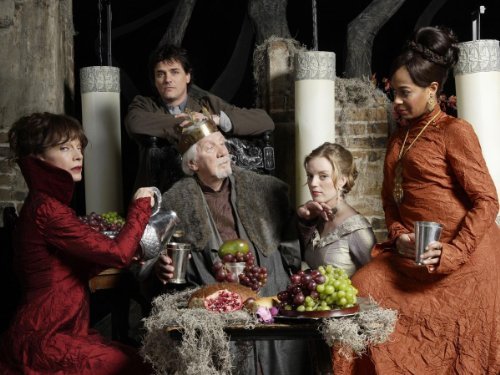
The drama centers around the actors and actresses in the New Burbage Festival as they rehearse a Shakespeare play; Hamlet in Season 1, Macbeth in Season 2, and King Lear in Season 3. The subplots are more often than not workplace drama. Ironically, though the main cast parallels hamlet, the management team of Richard St-John (with a hyphen, played by Mark McKinney) and Holly Day (Jennifer Irwin), are unknowingly playing Lord and Lady Macbeth. The two of them plan to sabotage the production and eventually replace all Shakespeare shows with a more profitable musical-theatre-centered festival. It’s deliciously ironic that McKinney plays the scheming musical-loving Richard, since he himself is one of the Tony-award-winning writers of the Drowsy Chaperone.
Paul Gross as Geoffrey Tennet
I’ve said before that Gorss gives a kind of animal intensity as Hamlet and Geoffrey, and this is especially true in Season 1. When we first meet him, Geoffrey lost his girlfriend, his sanity, and his career as a respected actor. Then he has to return to the theatre where the man who betrayed him works, and is forced to take over this same theater as Artistic Director.
Geoffrey’s Journey
If you’ve never seen the show before, I should warn you, GEOFFREY IS AN ABSOLUTE JERK in the first few episodes. Like I said, he starts out hating his job and pushing away everyone who comes in contact with him. However, little by little, he re-discovers why he loves theater, Shakespeare, and his friends and colleagues. Look at how he goes from a sarcastic pedant to a real director as he teaches these businesspeople how to act!
Rachel McAdams As Kate
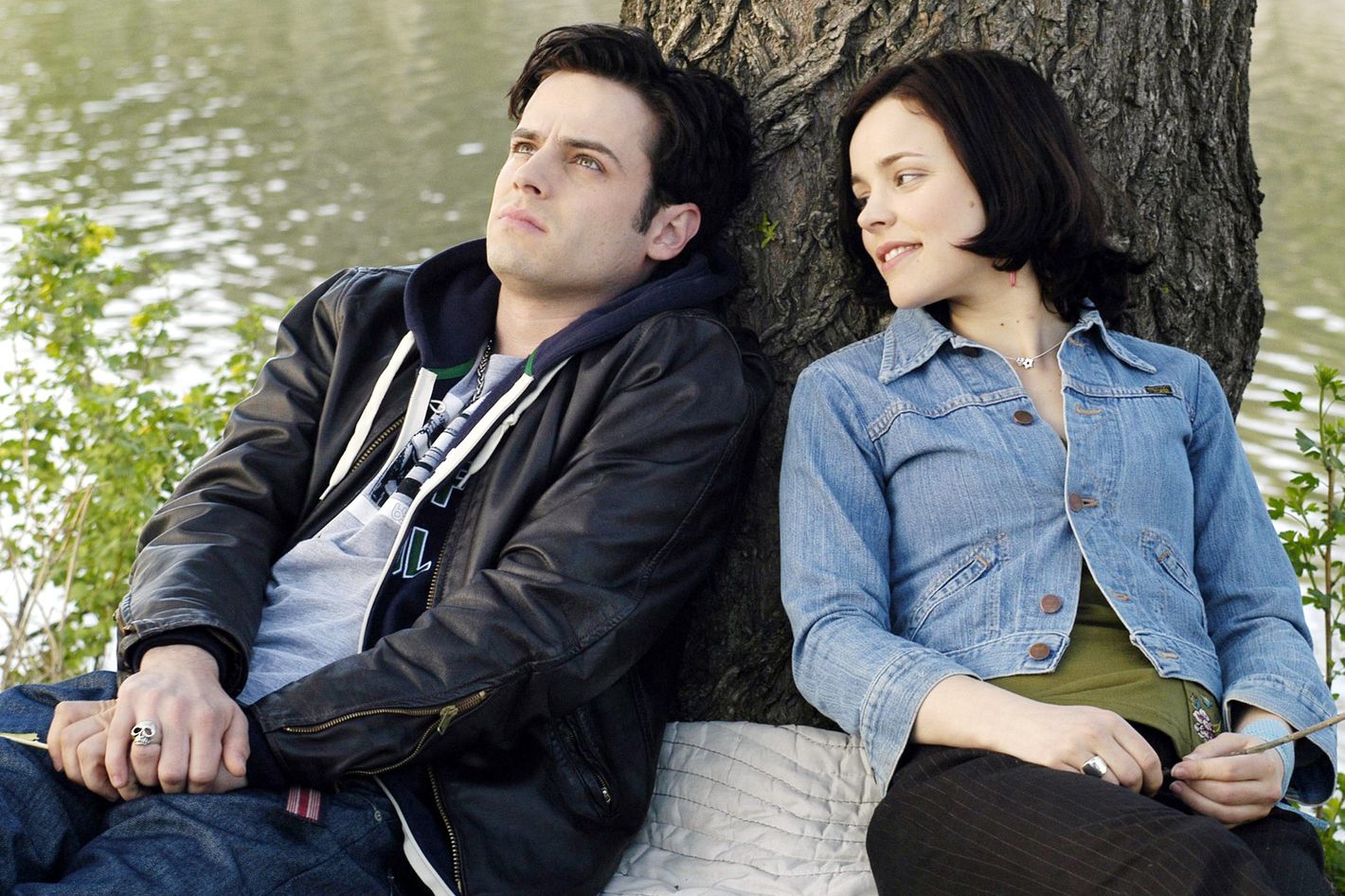
Rachel McAdams and Luke Kirby in “Slings and Arrows”
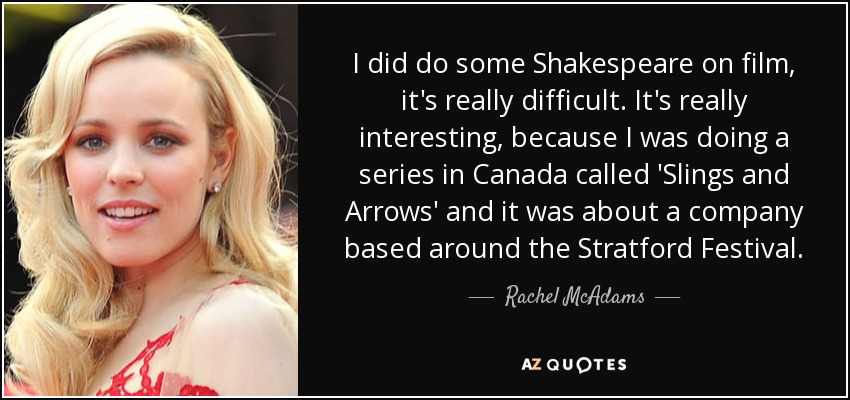
The most truly lovely thing about season 1 in particular, is watching Rachel McAdams’ charming and heartfelt performance as Kate. She plays a struggling actor who deeply loves the theater and dreams of becoming a respected actress. Her dreams are tested however when she falls in love with one of her co-stars and is accused of sleeping her way into a better role.
McAdams is the perfect ingenue in this show: She is naive, charming, Ernest, and kind. You watch Kate struggle and desperately want her luck to turn around and then rejoice when she gets to fulfill her dreams.
As Kate on Slings, she’s the understudy who knows better — happy to be cast, sad that she’s not really cast, and trying not to be bitter that the actual Ophelia is such a wreck. Her smarts and capability of course find her pairing off with Jake (Kirby), who’s more famous but less theatrical.
Slings and Arrows Is the Show Rachel McAdams (and All of Us) Deserved By Margaret Lyons. Vulture Magazine, Aug, 2015.
Then you remember… she was Regina George! It’s easy to overlook how good an actor Ms. McAdams is since she frequently is overshadowed by her co-stars. Much like Ophelia herself, people heap all the praise on Hamlet and forget Ophelia. When I keep in mind the breadth of emotions Ms. McAdams has to portray, and how incredibly different this role is from her role in Mean Girls, I feel compelled to say her acting rivals Paul Gross as Geoffrey Tennet
Season 1 Retrospective
Geoffrey: “Are you dead, or am I insane?
Oliver’s ghost: “I don’t see how those things are mutually exclusive.”
S&A Episode 3
My favorite episodes
I recommend watching all six episodes of Season 1 consecutively, but I can’t deny, some episodes are better than others, especially in Season 1. The first three episodes mainly focus on Oliver’s death and the tragedy of the falling out between Geoffrey, Oliver, and Ellen. This is important for backstory purposes, but it’s a little uncomfortable and sad to watch. My favorite episodes are episodes 4,5 and 6. Here’s why:
Episode 4: Outrageous fortune
After a drunken sword fight at his ex-girlfriend’s house, Geoffrey winds up in jail. This is his rock bottom. He even paraphrases Hamlet’s most famous speech as he contemplates ending it all in his cell. Thankfully, Oliver’s Ghost talks him out of it. Once he’s released, Geoffrey is re-energized and has a new purpose in life- directing Hamlet. Again, after three episodes of Geoffrey hurting, irritating, and sometimes even stabbing people, it’s nice to see our hero do what he was put here to do.
Episode 5:A Mirror Up to Nature
Geoffrey is finally fully committed to making the best Hamlet he can be, but he’s having problems with his Ophelia.
Geoffrey’s star is missing! With the production stalled, Geoffrey and Ellen finally have it out, and finally, share their tragic past with each other. Now the race is on to, “Repent what’s past, avoid what is to come, and fulfill their promise to Oliver.
So I hope I’ve articulated why I love this show and its characters. Just like anyone who’s ever had a boring office job loves and recognizes the characters from “The Office,” those of us in the theater recognize the crazy directors, the hopeful understudies, the divas, and the money-grubbing management. These characters feel like our friends and colleagues and they care so much about the universal dogma of “The show must go on,” no matter what kind of agonizing problems slow it down. Whether it be death, dementia, or a dislocated knee caused by a chameleon. the show within-this incredibly clever comedy about drama will catch your conscience… and your heart.
I was saddened to hear of the recent passing of actor Kevin Conroy, world-renowned as the voice of Batman and Bruce Wayne on Batman The Animated Series, the Arkham Asylum games, and many others. Conroy is definitely my favorite Batman, and as I and many others have said before, there are Shakespearean tropes in the Caped Crusader. From the very beginning, Conroy drew inspiration from a particular Shakespearean play, the melancholy prince, dressed in black, who seeks to revenge his father’s murder: Hamlet, Prince of Denmark:
I did a cold audition, I had never done an animated voice before. I said the only exposure I’ve had is the Adam West show from the 60’s and they said “NO! NO! NO! That’s not it.” I said ZIP POW POP and they said “NO! It’s, think film noir, think the 40’s New York. Think dark, think a kid who just watched his parents get murdered and spends his life avenging their deaths and he lives in the shadows. He’s got this dual personality and he’s never resolved this torture of his youth. I said you are telling the Hamlet story, this is heavy stuff. And he said yeah, no one has ever said that before, but yeah I guess it is. This is like a classic archetypal, Shakespearian tragedy. So I just used my theater training and put myself into that head (Batman voice) And I got into this very dark place and came up with this voice. (Regular Voice) And as I did it I saw them all running around in the booth. And I thought well either I did something really bad or something really good because I hit a nerve, I know I hit a nerve. And they came out and they said well we’ve seen about over 600 people and how would you like to do the part?
Kevin Conroy
It makes sense that Conroy would use Shakespeare to flesh out Batman. He was a veteran of the Old Globe Theater in San Diego, and performed in Hamlet several times. He even played the prince himself for the New York Shakespeare Festival in 1984. Yet I don’t think Conroy’s decision to make Batman a sort of modern-day Hamlet was entirely based on just his past experiences with Hamlet.
“Batman is basically the American version of Hamlet,” Affleck said. “We accept that he’s played by actors with different interpretations.”
Ben Afleck, Entertainment Weekly, 2015.
Batman and Hamlet are basically Revenge Tragedies; age-old stories that began with Oedipus Rex and the Orestia in ancient Greek plays, where a hero must lift a plague on his society by avenging the death of a parent (usually the father). This kind of play was very popular in Shakespeare’s day and included a host of others such as Shakespeare’s Titus Andronicus, The Spanish Tragedy, Locrine, The Dutchess of Malfi, and later The Revenger’s Tragedy.
But Hamlet, like Batman, is an avenger. He didn’t make Denmark rotten. That was Claudius, and if Claudius self-punished like Oedipus, Claudius would be a tragic hero too. But Claudius is just a garden-variety villain, and so Denmark needs a hero to set things right. Enter Hamlet. He’s “tragic” only in the sense that he dies, and since he dies after completing his heroic mission, he dies triumphant. But unlike the deaths of Claudius, Oedipus, and Macbeth, his death isn’t necessary to restore order. It’s just an epilogue.
As this clip above indicates Hamlet is unique among revengers because his conflict doesn’t come from the machinations of his villain; he’s stopped by his own internal conflicts. Batman is more active than Hamlet, but he also wrestles with internal conflicts and Conroy plays these conflicts with a lot of subtlety and nuance. To illustrate this conflict, let’s look at some great clips from the series!
Batman admits he wanted Revenge: “The Curious case of Hugo Strange”
In this episode, Dr. Strange (not the Marvel Superhero), uses a dream-reading machine to try and blackmail Bruce Wayne, and inadvertently discovers his secret identity. Not only does this episode dramatize Wayne’s literal worst nightmare, (someone figuring out who he is), it also touches on the pain of his past and how even though now Batman is a deputized agent of the law who never kills, he began as an angry, vengeful vigilante, like Hamlet:
I am myself indifferent honest, but yet I could accuse me of such things that it were better my mother had not borne me. I am very proud, revengeful, ambitious; with more offences at my beck than I have thoughts to put them in, imagination to give them shape, or time to act them in.
Hamlet, Act III, Scene i.
Batman’s Conflict With His parents.
In this clip from the animated movie Mask Of the Phantasm (1993), a pre-Batman Bruce Wayne feels a conflict between his obligation to avenge his parent’s death, and his budding romance with Ms. Andrea Beaumont:
One can almost sense an Ophelia- Hamlet-like conflict where Bruce knows his quest to avenge will consume him, and leave no time to pursue romance. In all revenge tragedies, the hero has to avenge alone, or at least without the support of a spouse or partner. Hamlet also makes the choice to cut Ophelia out of his life, though it’s not clear why. It could be he’s worried that Claudius will harm her, it could be he’s worried she’s compromised since her father tried to spy on him, or it could simply be that he doesn’t trust her. It’s up to the actor and director to “Pluck the heart of Hamlet’s mystery.”
Eventually though, the choice is made for him, and Bruce Wayne completely commits to his quest to battle the crime in Gotham, as this epic scene from “Mask of The Phantasm” shows:
Haste me to know’t, that I, with wings as swift As meditation or the thoughts of love, May sweep to my revenge.
Hamlet, Act I, Scene v.
Hamlet and Batman’s Demons
The spirit that I have seen May be a devil; and the devil hath power T’ assume a pleasing shape; yea, and perhaps Out of my weakness and my melancholy, As he is very potent with such spirits, Abuses me to damn me.
Hamlet, Act II, Scene ii.
What’s truly unique about the animated version of Batman is that it’s the only one that takes time to show Batman’s complex relationship with the ghosts of his parents. As previously discussed, Bruce Wayne’s desire to revenge their death and to punish the wickedness of Gotham is what spurs him to keep fighting as Batman, but he also wonders many times if he’s doing more harm than good. He’s also tempted to forget them and try to lead a normal life, like in the episode “Perchance to Dream,” (which itself is a quote from Hamlet). Above all, the animated show knows that, since children are watching this show, they will connect with Batman’s fear of not living up to his parent’s expectations, a fear to which every child can relate.
In the first season episode “Nothing To Fear,” the villainous Scarecrow exploits Batman’s fear of disappointing his parents by drugging him with a fear toxin, causing Bruce to hallucinate that his father is berating him and calling him a failure. Hamlet gets a similar ghostly chewing out in The Closet Scene:
Father’s Ghost. Do not forget. This visitation Is but to whet thy almost blunted purpose.
Hamlet, Act III, Scene iv
While The Ghost of Hamlet’s Father is mostly supportive in this scene, Hamlet worries many times in the play if Claudius is in fact innocent, and the Ghost is a demon sent by the Devil to get him to kill an innocent man, and thus damn him for eternity. This uncertainty is the same that Batman wrestles with, as he confronts his own demon-like apparition. Batman then defiantly responds to this fiendish hallucination with one of the most iconic lines in the series:
Only a consummate professional like Conroy with his grounding in Shakespeare in general and Hamlet in particular could portray such an iconic character. Many fans of Batman like me believe that Conroy’s portrayal was the peak of the franchise, and I feel fortunate that it came out when I was a child. I mourn Conroy’s loss, yet as Mr. Affleck mentioned in the quote above, like Hamlet, the character of Batman has many possible interpretations, and though Conroy will always be my favorite, I hope new and exciting interpretations will arise from the shadows in time, bringing this complex, Shakespearean character to a new audience.
“Good Night, Sweet Prince and flights of bat wings fly thee to thy rest.”

















 The Shakespearean Student