Shakespeare On Dragons

Tonight is the Chinese New Year, beginning the Year of the Dragon. I’ve talked before about the fascinating relationship between Shakespeare and China, and I thought I’d illustrate it here by talking about a shared cultural mythology- the concept of dragons. Both Western and Eastern cultures use dragons in their myths, but as you’ll see, they have very different cultural meanings.

Quotes from Shakespeare About Dragons

Before thee stands this fair Hesperides,
With golden fruit, but dangerous to be touch’d;
For death-like dragons here affright thee hard:

Antiocus, Pericles

Sometimes we see a cloud that’s dragonish;
A vapour sometime like a bear or lion,

A tower’d citadel, a pendent rock,
A forked mountain, or blue promontory

Antony and Cleopatra

In Western myths, dragons are symbols of wrath and fierceness. In ancient Greek and Viking myths, dragons are often guards of treasure, (and sometimes in modern stories like Harry Potter). In the myth of Hercules, a multi-headed dragon guarded the golden apples of the Hesperides, (the apples that kept the gods young and immortal). King Antiochus wants to scare Pericles by comparing his daughter to the apples; if he fails to win her love, he’ll be devoured as Hercules almost was.

Coriolanus and Dragons

His CORIOLANUS is grown
from man to dragon: he has wings; he’s more than a
creeping thing.

Coriolanus

Shakespeare’s Roman general Coriolanus is frequently compared to a dragon in Shakespeare’s play. According to Dr. Peter Saccio of Dartmouth College, this is because the general is unable to relate to other humans- he is solitary, violent, jealous of his power and wealth, and prefers to strike first, then retreat from other people when the battle is won. This is why he utterly fails to get the Roman people to elect him consul in this scene from Ralph Fiennes’ movie. I find it ironic that Fiennes has played not only this character, (who is associated with dragons), but with Lord Voldemort, (who controls several large serpents), and also Francis Dollarhyde in the film Red Dragon:

Swift, swift, you dragons of the night, that dawning
May bare the raven’s eye! I lodge in fear;
Though this a heavenly angel, hell is here.

Cymbeline

Sometime he angers me
With telling me of the mouldwarp and the ant,
Of the dreamer Merlin and his prophecies,
And of a dragon and a finless fish,
A clip-wing’d griffin and a moulten raven,
A couching lion and a ramping cat,
And such a deal of skimble-skamble stuff
As puts me from my faith. 

Hotspur, Henry IV, Part I

A thousand hearts are great within my bosom;

Advance our standards, set upon our foes

Our ancient word of “courage,” fair Saint George,

Inspire us with the spleen of fiery dragons!

Richard III

St. George and the Dragon

In the medieval story of St. George, the titular knight defeats a dragon, which is basically a stand-in for Satan. George was seen as the ideal knight- virtuous, devoted to his cause, strong, and patriotic. His defeat of the dragon was an allegory for how knights should devote themselves to protecting their lords, ladies, and the innocent against evil. Therefore, it’s intentionally unsettling that Shakespeare has Richard III telling his soldiers to act not like the virtuous St. George, but like the cruel and violent dragon. Richard is Shakespeare’s most villainous king, so it makes sense in context that he would side with the dragon, and thus his defeat would seem even more like a triumph of good over evil. In addition, the real King Richard flew this flag with a dragon on it during the actual Battle of Bosworth Field.

Royal standard of Richard III, using the dragon of St. George

Peace, Kent!
Come not between the dragon and his wrath.

King Lear

Dragons and Chinese Culture

None of the animals is so wise as the dragon. His blessing power is not a false one. He can be smaller than small, bigger than big, higher than high, and lower than low.”

–Chinese scholar Lu Dian (AD 1042-1102)

Qualities of Dragons

Dragons didn’t have the negative connotations of Western myths. In China, they were symbols of good luck, strength, and success. They were also known to be proud and temperamental-sometimes kind but sometimes vengeful to people who didn’t show them proper respect. In a sense, the dragon was like the ancient Greek gods- they should be viewed with respect and gratitude as well as fear.

Zodiac

The Chinese calendar goes by a cycle of years, not months. It has 12 animals that represent various qualities and those qualities will characterize the coming year. So hopefully a year of a dragon will be a year marked with courage, good fortune, and justice.

IV. What would a Chinese Lear look like?

Looking at the quotes I showed you earlier, it’s interesting that King Lear calls himself a dragon, and it made me think- Lear is a powerful warlord who demands absolute loyalty from his children. Would a Chinese version of King Lear work?

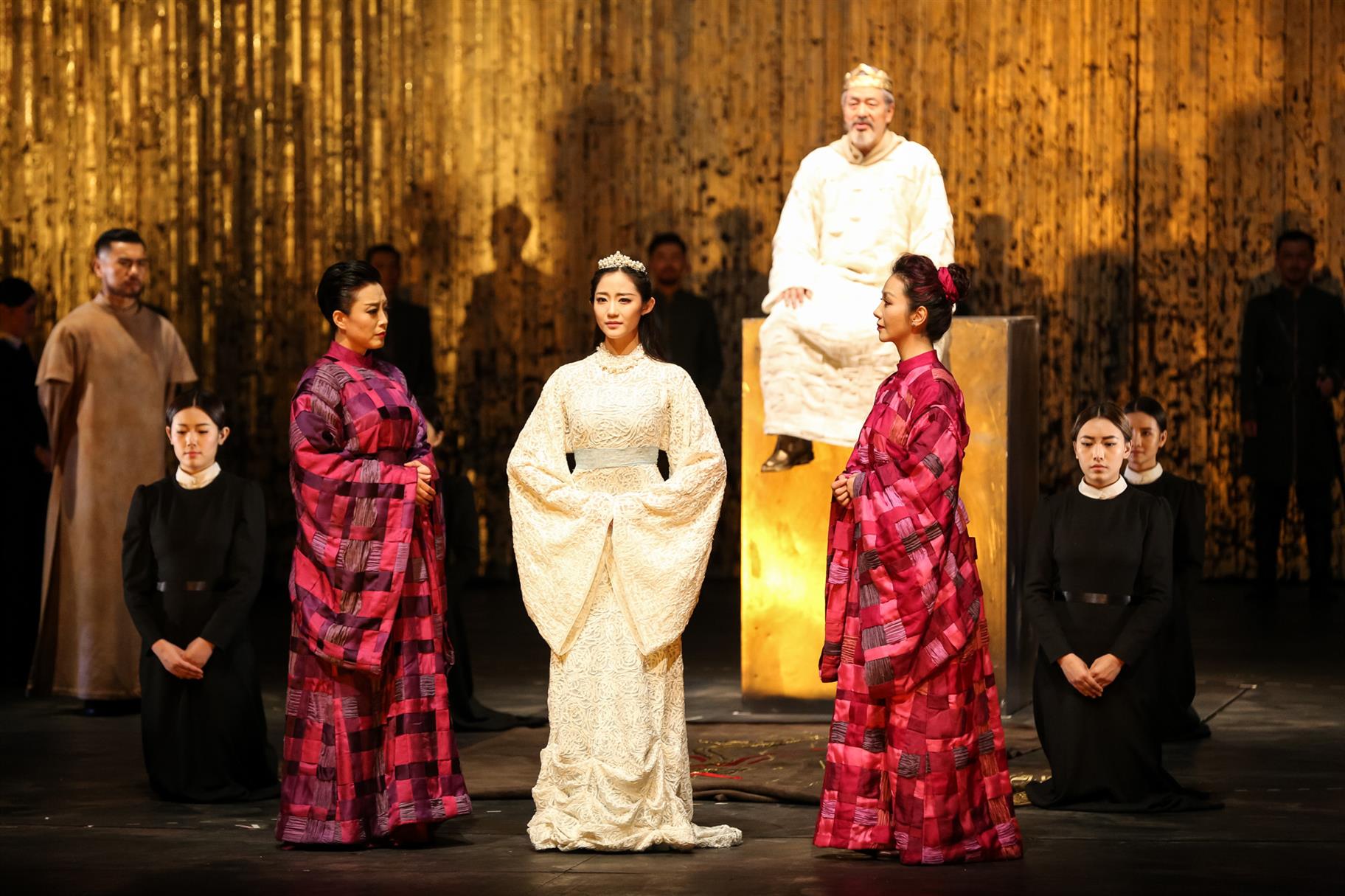
2017 Chinese Language production of “King Lear” at the Royal Shakespeare Company.

There was a Chinese production of King Lear back in 2017, where the translator and director traveled to the Royal Shakespeare Company in England and worked with the actors and directors of a London production to make their production gain insight into the characters’ motivations. However, I wonder how successfully they translated the Western ideas and values of the play for a Chinese audience. One of the reviews from China Daily.com describes the play like this:

Originating from old British legend, King Lear is one of Shakespeare’s four most famous tragedies. Through the internal disorder of the royal family, the rise and fall of King Lear’s fate and the final punishment of evil powers, Shakespeare expresses his optimistic views in the future of society, thereby adding the glory of strong idealism into his work.

ChinaDaily.com

The last word I would use to describe King Lear is “optimistic”. It is the only tragedy where not only does everyone die, but the entire future of the monarchy is in question. Nevertheless, reading about this production makes me interested in imagining my own version of King Lear, one that emphasizes Chinese values, but also questions them.

Many Chinese stories stress family loyalty, communalism, and respect for elders. You could portray King Lear as a story about the disastrous consequences of self-interest. After all, Regan and Goneril cast their father out and dismissed his followers, and it led their kingdom into civil war. In that version, Lear is like the Dragon King, who in Chinese folklore, was a powerful ruler of the seas, (giving new meaning to the lines “Blow winds, and crack your cheeks”). As a bonus, historically, many imperial Chinese rulers decorated their palaces with images of dragons, and the emperors themselves were associated with the creature, (especially during the Han Dynasty), so when Lear says “Come not between the dragon and his wrath,” In his mind, he literally is a dragon.

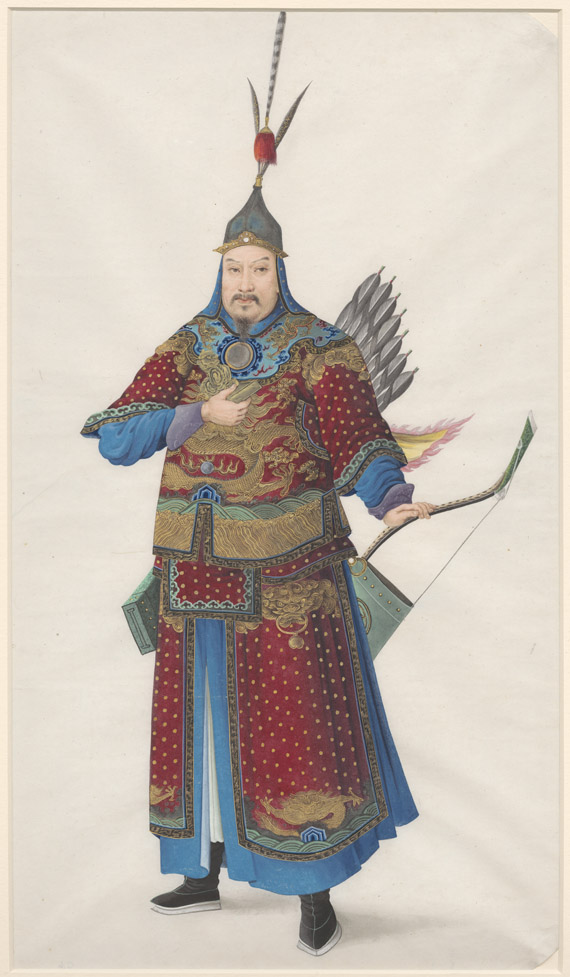
Han Dynasty watercolor print of a Han warrior whose clothing is embroidered with dragons.

In 1736, Jean-Baptiste Du Halde wrote about the Emperor: “His clothing is embroidered with dragons: they are his emblem, and only He can wear dragons with five claws – any infringement to this rule is punished severely.”

Cornell University: Emblems and Mascots of Rulers:
Chinese Imperial Dragon
s

That said, some dragons were associated with bad luck and ill omens. I’ve said before that Lear’s biggest flaw is that he fails to take time to examine himself or think about the consequences of his actions until it is too late. Maybe Lear thinks of himself as a benevolent dragon, but really is a bad man cursed with bad luck; he is not a dragon, he just has one on his back. So, in short, a Chinese re-imagining of King Lear could be a fascinating look at Chinese culture and give a fresh re-imagining of Shakespeare’s tragic story.

I hope you enjoyed this look into dragons in Shakespeare and Chinese culture. Joseph Campbell said that all cultures share and interpret archetypes to understand their own culture, but also to grasp what makes us all human. For whatever reason, every culture on Earth has some kind of large serpent- Chinese dragons, European dragons, The Aztec god Quetzalcoatl, the Viking Yormungand, even the Piasa of the native tribes of the Mississippi. and they can mean many different things to many different people, which means that we as humans are in some way tied to gether through all these dragon tales (no pun intended).

V. Sources

  1. https://www.kennedy-center.org/whats-on/explore-by-genre/young-audiences/2023-2024/dragon-kings-daughter/#:~:text=Chinese%20dragon%20mythology%2C%20martial%20arts,inspiring%20songs%20by%20Marcus%20Yi.
  2. https://www.historyskills.com/classroom/year-7/chinese-dragons/#:~:text=Another%20well%2Dknown%20legend%20involves,benevolent%2C%20divine%20force%20in%20nature.
  3. https://www.amnh.org/exhibitions/mythic-creatures/dragons/asian-dragons
  4. https://www.topchinatravel.com/china-guide/chinese-dragon-language.htm
  5. https://studycli.org/chinese-culture/chinese-dragons
  6. https://rmc.library.cornell.edu/AnimalLegends/exhibition/emblems/dragons.html#:~:text=Already%20a%20royal%20symbol%20in,and%20his%20brother%20Yan%20Di.

Book Review: William Shakespeare and the Globe

Video Book Review:

Content: 

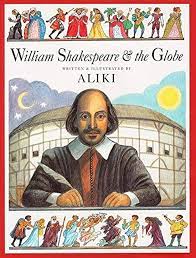
This is a story of two boys, centuries apart, but united by their love of theater in general, and the Globe Theater in particular. The first is William Shakespeare, whose story Aliki tells from his birth, to his boyhood days, to his rise to prominence in the theater. The second is Sam Wannamaker, the man who spearheaded the project of re-building the Globe Theater from 1949 to the first performance of the Globe in June of 1997. 

Aliki tells this story in the format of an Elizabethan play, dividing it into five acts. Acts I-4 tell the story of Shakespeare’s life while Act V focuses on Sam Wannamaker pursuing his dream. The book concludes with a chronology of Shakespeare’s plays, and a table of his most famous words and expressions, illustrated with adorable characters.

Illustrations: Medium and Style of Illustration

Like many of her books, Aliki’s illustrations are layered and detailed. She uses ink pen outlines to draw her characters, but then fills them in with bright, vibrant colors. She then painstakingly shades them using the crosshatching technique, to create textures that are complex but have a hand-drawn almost impressionistic feel. The characters aren’t ultra-realistic, and the color palette is limited mainly to bright primaries and warm browns, making it look like a child’s box of crayons or colored pencils. This book is designed to appeal to children with its hand-drawn quality. 

Format:

Cover- The cover makes the subject of the book clear to the audience. We see Shakespeare and Globe Theater, but also illustrated moments from his plays. This helps establish that this is not only a biography, it is an introduction to Shakespeare’s plays and poems as well.

Front Matter: The book opens with four pages of quotes from Shakespeare’s plays illustrated with fairies, pipers, and Elizabethan men and women. There is no half-title, no frontispiece and no Half title verso.

Title page verso (copyright page) In the center of the copyright page is an Illustration of Shakespeare standing atop a globe, over the famous lines: “All the world’s a stage, and all the men and women merely players.”  Below the quote in very small letters is the copyright date, a short summary, the ISBN data, card catalog information, and the typography information.

Title Page The title is laid out on a white background with a thin black border. Below the title is an image of a boy (presumably Sam Wanamaker), assembling a paper model of Shakespeare’s globe, with a portrait of Shakespeare in the background. This helps establish that this biography focuses on both Shakespeare and Wanamaker, and makes the reader excited to see the real Globe brought to life in full illustration.

Table of Contents As stated before, the book is organized like an Elizabethan play, so rather than Chapter 1, etc. the book has five Acts with 1-4 scenes in them. Each chapter in the table of contents is labeled with a description that sets the scene; either a location (like London, Stratford, The Globe), or what will happen in the scene (such as “Building” or “Uncovering”). The table then details four appendices that are part of the back matter. 

Preface:  The Preface is referred in the book as an aside, (an Elizabethan theater term meaning something spoken between a character and the audience). This preface acknowledges that, because of the lack of surviving historical information on William Shakespeare, Aliki, like many Shakespearean biographers, has to use some guesswork to fill out the narrative of his life. A second preface (referred to as a Prologue), introduces the story of the book, (namely the lives of Will Shakespeare and Sam Wanamaker). This preface mimics how in Shakespeare’s plays, a prologue would tell the audience what would happen before the narrative started.

Back Matter/ Appendices: There are four appendices in the back matter- A table of Shakespeare’s collected works, a timeline of the book’s events from 1564-1999,  an illustrated list of Shakespearean words and expressions, and finally a list of Shakespearean sites to visit in London and Shakespeare’s home town of Stratford Upon Avon. These appendices show the reader that Shakespeare has an important role in history and in the English language, and encourage the reader to learn more about him. 

Value As an Educational Tool

This story not only tells Shakespeare’s life, it also introduces the reader to his plays and his influence on the English language through the illustrations and frequent Shakespearean quotations. The reader also gains an insight into Elizabethan life and culture by following Will’s journey from Stratford to London. Finally, by juxtaposing Shakespeare’s life with Sam Wannamaker’s, the reader sees Shakespeare through Sam’s eyes as he works his whole life to restore Shakespeare’s Globe to its former glory. The reader develops a love of Shakespeare, (or at least an empathetic respect), and may feel empowered to read more about Shakespeare, see his plays or maybe even become a Shakespearean artist in the future. In short, Aliki’s book brings the world of Shakespeare to young readers in a way that is beautiful to look at, full of insight, and with enough supplemental materials to encourage them to learn more.

Overall Impression:

Like Prospero’s magic in The Tempest, this story is magically told- it is not intended to create a totally realistic representation of Elizabethan life, but to give an exciting, colorful impression of Will’s life and work to the reader. Due to the scant historical details of Will’s life, Aliki chose not to do a standard biography, but, like Shakespeare’s own history plays, to tell a historically authentic story, rooted in truth that brings a time and a place to life, while portraying it an exciting and visually appealing way.

Citation:

Aliki. (2000). William Shakespeare & the Globe. HarperCollins Publishers. 

My Top 10 Favorite Shakespeare/ Harry Potter Actors

This list is not about skill or the talent of the actor. This is to honor the contributions of Shakespearean actors who also appeared in one of my favorite film and book franchises of all time: Harry Potter. Accordingly, some of the actors who weren’t essential to either Harry Potter or Shakespeare or both are placed lower on the list even if I personally love the actor or the character they portrayed.

#10: Richard Harris- Albus Dumbledore

The Irish-born actor has been a veteran of stage and screen for decades before his death in 2002, after the second Harry Potter film. Here is him on Johnny Carson, telling a funny story about a production of Macbeth he did early in his career:

#9: Kenneth Branaugh- Gilderoy Lockheart

If you visit this website regularly, you know I’m a fan of Kenneth Branaugh– I’ve reviewed three of his Shakespeare movies and he’s my all-time favorite Hamlet. I’m also aware that he has a reputation of being a bit of an egotist and a womanizer, (since he had affairs with two women on this list), so even though he was a bit too old to play the part, it was nice to see him have a laugh at his own expense as the attention-hogging Gilderoy Lockheart. The humbug professor’s name actually Gilderoy (as in a man painted with false gold), gives away the twist that he takes credit for other witches and wizards’ work and Branaugh shamelessly mugs to the camera whenever he’s on screen. My favorite scene of his though, is the one serious scene where he teaches dueling with the help of the much more competent Professor Snape:

Kenneth Branaugh and Alan Rickman in Harry Potter and the Chamber of Secrets, (2002).

If you saw my post on the duel at the end of Hamlet, you can see that the way wizards duel is directly inspired by the way fencers fought in Hamlet, right down to the flashy salute and bow beforehand, and it’s neat to see two legendary Hamlets fight in it.

#8: Jim Broadbent (Horace Slughorn) / Timothy Spall (Peter Pettigrew [aka ‘Wormtail’]

I couldn’t decide between these fabulous actors, so I grouped them together. After seeing Timothy Spall as the cowardly, foolish incompetent spy and traitor Rosencrantz in Hamlet, I knew that the only Harry Potter role for him would be as Lord Voldemort’s toady and pathetic rat, Peter Pettigrew, aka Wormtail.

Broadbent on the other hand, is completely different and unrecognizable during his excellent portrayal of Lord Buckingham in Ian McKellen’s 1995 film version of Shakespeare’s Richard III. Unlike the meek and easily broken Horace Slughorn, Broadbent as Buckingham is an oily politician who very nearly sells his soul to McKellen’s diabolical Richard:

What unites these two portrayals is that both characters are corrupted by a figure of pure evil, but both have a breaking point- Buckingham, (as you see in the clip above), refuses to be a party to child murder, while Slughorn eventually helps Harry Potter destroy Voldemort. In a way, they’re two sides of a very flawed coin.

#7 Michael Gambon (Albus Dumbledore 2)

Like Richard Harris, Michael Gambon, (who passed away in September of 2023) was an accomplished stage and screen actor, famous for playing King Lear multiple times, including a famous performance with Antony Sher at the Royal Shakespeare Company. Here are some highlights of his stage work:

https://www.theguardian.com/stage/gallery/2015/feb/09/michael-gambon-on-stage-from-king-lear-to-krapp-in-pictures

#6: Fiona Shaw (Petunia Dursley)

I feel I have to give Fiona Shaw a good spot on this list, though I think her talent was wasted in the role of Petunia Dursley. She is an icon of British theater and her work in Shakespeare is superb. She famously played Richard II back in 1995, and in the short film below, she talks about her amazing interpretation of Measure For Measure, with fellow Harry Potter alumn, David Tennant.

I’d also like to include the best-deleted scene from Deathly Hallows with Shaw in it, where she admits to Harry for the first time that she misses her sister Lilly.

#5: Ralph Fiennes (Lord Voldemort)

In a way, Lord Voldemort was a role that Fiennes had trained for all his life. He has played smarmy, serpentine characters before in films like Red Dragon and Schindler’s List. But Fiennes’ Shakespeare training allowed him to tap into the evil megalomaniac at the heart of Voldemort when he played roles like Richard III, (another deformed autocrat), and Coriolanus, the Roman general who is himself compared to a dragon. In the video above, YouTube critic Kyle Kalgren analyzes how Fiennes’ past roles and experience with Shakespeare translated well in his performance and his direction of the 2011 film Coriolanus.

#4 Imelda Stanton (Delores Umbridge)

By contrast, I give more credit to Imelda Stanton, who mainly plays sweet mom-like characters (or nurse-like in the case of Shakespeare In Love), for embodying the utterly loathsome Delores Umbridge. Reportedly, the role made Stanton feel physically ill and unlike Richard III, people hate her character with a passion. By contrast, look at her sweet and charming portrayal of Maria in the 1996 film Twelfth Night, (which also starred Helena Bonham Carter):

#3 Helena Bonham Carter (Bellatrix Lestrange)/ Emma Thompson (Sybyl Trelawney)

Again, I had to give credit to both of these women for the startling transformations they did for their Harry Potter characters, as well as their stellar work in Shakespeare. Helena Bonham Carter mainly plays apealing aristocratic characters such as Olivia in Twelfth Night, and Ophelia in Hamlet:

Seeing Ms. Carter as the demented Bellatrix Lestrange was quite a shock for me, yet the performance was no less impressive. I especially love this scene in Deathly Hallows where she has to act like a 17 year old girl, TRYING TO BE BELLATRIX LESTRANGE

#2: Alan Rickman (Severus Snape)

I already wrote a tribute to Alan Rickman after his death in 2016, so I don’t wish to repeat myself. Suffice it to say that Mr. Rickman was always a consummate professional, and his iconic portrayal of Severus Snape was the performance of a lifetime.

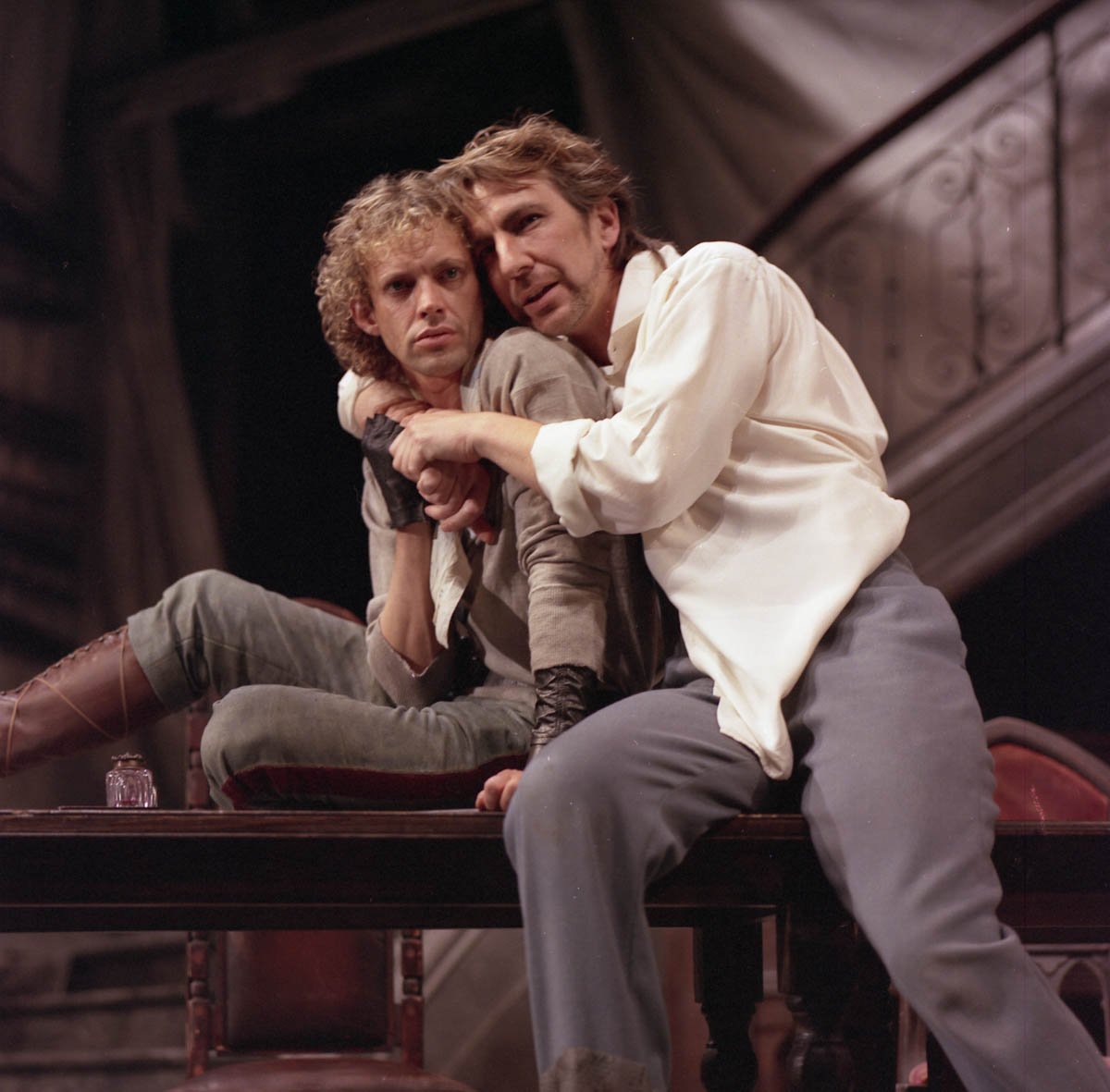
Alan Rickman as Achilles in Troilus and Cressida, Royal Shakespeare Company.

Honorable Mention: David Tennent (Barty Crouch)

To be honest, I thought Tennant was miscast in Harry Potter- he can play villains, (as Good Omens fans know well), but he just isn’t great at being maniacal and evil. That said, Tennant is a rising Shakespearean star and has created many memorable performances from Richard II, to Benedick in Much Ado About Nothing, to Hamlet.

#1: Dame  Maggie Smith (Professor McGonigal)

Say it with me… you probably saw this coming. No one can deny that Dame Maggie’s contributions to Shakespeare, as well as her ubiquitous portrayal of Hogwarts’ current Headmistress Minerva McGonigal, stand the test of time as strongly as the animated chess pieces she placed in the school basement. Let’s look at some of her greatest Shakespearean moments.

Plug for my Acting Class

If you enjoyed this list, you might want to sign up for my Intro to Acting class or my extended acting course, where I delve into Shakespearean acting techniques, and answer the big question, “WHY DO SHAKESPEAREAN ACTORS KEEP GETTING CAST AS WITCHES AND WIZARDS?” To sign up, click the link below: https://outschool.com/classes/609658d1-3f9f-4371-8af2-4fe81ad13d8c

Cover art for my Outschool Beginning Acting Class.

Thanks for reading!

Richard the Third and Toxic Masculinity

This past month, there was a free production of Richard III in New York’s Shakespeare In the Park, starring Danai Gurira as the title character. I have not seen this production, though I wish I had. I enjoyed the actress Ms. Gurrira in such films as “Black Panther,” and would love to see her do Shakespeare. What is more, the concept intrigues me. This project explores themes of toxic masculinity, racial identity, inferiority, and misogyny.

Danai Gurira as Richard III, Shakespeare in the Park, 2024

https://www.npr.org/2022/07/10/1110359040/why-it-matters-that-danai-gurira-is-taking-on-richard-iii

Unsurprisingly, with so many heady topics in the production, this Richard III is still somewhat controversial. Some right-wing critics dismissed the whole production as a piece of ‘woke propaganda,’ but I feel this is unfair.

When Danai Gurira of Marvel’s “Black Panther” first takes the stage in the title role, the actress has no perceivable hunchback or arm trouble. And yet the dialogue suggesting Richard suffers from a lifelong physical issue (“rudely stamped”) has been kept in. Perhaps we are to use our imaginations. Who knows? We are certainly tempted to close our eyes.

By Johnny Oleksinski

I will not judge this production based on the acting because I haven’t been able to see it. What I will do is take a stance on the validity of the concept. Specifically, I want to ask if this play is a good examination of toxic masculinity and if it would it be worthwhile to see it portrayed by a black woman, as opposed to a white man. The short answer is an emphatical “Yes.”

https://variety.com/2022/legit/features/danai-gurira-richard-iii-toxic-masculinity-central-park-1235318196/

Richard’s Toxic Masculity

Richard III is definately an example of toxic masculinity. He is violent, full of hatred, vengeance, and mysogeny. He is constantly insulting women from Lady Anne, Jane Shore, Queen Elizabeth, and even his own mother. In fact, the source of Richard’s toxic attitude is that he blames his mother for his disability and deformity:

Well, say there is no kingdom then for Richard;1635
What other pleasure can the world afford?
I'll make my heaven in a lady's lap,
And deck my body in gay ornaments,
And witch sweet ladies with my words and looks.
O miserable thought! and more unlikely1640
Than to accomplish twenty golden crowns!
Why, love forswore me in my mother's womb:
And, for I should not deal in her soft laws,
She did corrupt frail nature with some bribe,
To shrink mine arm up like a wither'd shrub;1645
To make an envious mountain on my back,
Where sits deformity to mock my body;
To shape my legs of an unequal size;
To disproportion me in every part,
Like to a chaos, or an unlick'd bear-whelp1650
That carries no impression like the dam.
And am I then a man to be beloved?
O monstrous fault, to harbour such a thought!. 3H6, Act III, Scene i, lines 1635-1653.

Now I should clarify the difference between deformity and disability, which are characteristics that Richard III has as part of his character makeup. According to the Americans With Disabilities Act, a disability is defined as: “A physical or mental impairment that substantially limits one or more major life activities.” This could include paralysis, autism, or any number of congenital or acquired conditions. Richard’s disability is primarily his limp (caused by his unequally shaped limbs), and his withered arm. What’s interesting in this production is that while the title role is played by an able-bodied woman, most of the rest of the cast have actual disabilites. Watch this clip of the famous courtship scene between Richard and Lady Anne, who plays her role in a wheel-chair.

While a disability is a legal term that is recognized by lawyers and governments alike, the term “deformity” is more subjective; it generally refers to any kind of cosmetic imperfection. In Richard III, this applies to Richard’s hump and withered arm. 

The Elizabethans thought that deformity was a sign of disfavor from God, and that deformed people were constantly at odds with God and nature, as Francis Bacon puts it in his essay, “On Deformity.”

As deformed people are physically impaired by nature; they, in turn, devoid themselves of ‘natural affection’ by being unmerciful and lacking emotions for others. By doing so, they get their revenge on nature and hence achieve stability.

Richard III has this drive for revenge in spades and I believe it manifests itself as a particularly terrible form of toxic masculinity. Richard definitely wants the crown to make up for his lack of ‘natural affection,’ but he is also especially malevolent towards women.

I, that am rudely stamp’d, and want love’s majesty

To strut before a wanton ambling nymph;

And therefore, since I cannot prove a lover,

To entertain these fair well-spoken days,

I am determined to prove a villain

And hate the idle pleasures of these days

Seeing a woman play this kind of misogynist dialogue forces the audience to take it out of context and question Richard’s point of view. We see casual misogyny every day, and seeing a woman deliver it is quite illuminating.

Richard’s deformity and Blackness

Another provocative choice by Danai Gurira’s portrayal of Richard is the fact that she plays the role of Richard without the hump or withered arm. She herself explains that for her production, Richard’s perceived deformity, is actually represented by her being a black woman:

He’s dealing with the otherness compared to his family, in terms of not being Caucasian and fair like them.” The word ‘fair’, is used a lot in the play.

Danai Gurira’s

Shakespeare writes Richard as constantly striving to compensate for his deformities by being clever, violent, and eventually, by becoming king. As I wrote before in my review of Othello, for centuries black people have been portrayed as inferior; aberrations of the ‘ideal fair-skinned form’. So, to the Elizabethans, blackness itself was a form of deformity, and the rawness of addressing this uncomfortable fact in this production should be commended.

English people are already trained—and we have scholars like Anthony Barthelemy has talked about this in his book Black Face, Maligned Race, where the image of blackness, as associated with sin, with the devil, all of these things, makes it quite easy to map onto then Black people these kinds of characteristics. Then, those kinds of characteristics allow for the argument that these people are fit to be enslaved. – Dr. Ambereen Dadabhoy, Race and Blackness in Elizabethan England Shakespeare Unlimited: Episode 168

https://www.folger.edu/shakespeare-unlimited/elizabethan-race-blackness-dadabhoy

So while I can’t speak to the production’s acting or staging, I will emphatically defend the notion that this production’s concept is valid. Richard III is an example of toxic masculinity through his self-hatred, violence, misogyny, and narcissism. In addition, as I’ve written before, in the Early Modern Period, blackness was considered an aberration or deformity, and seeing it in the person of Richard, with the implicit understanding that black people still face this kind of prejudice today, opens a much-needed dialogue that any production of Shakespeare shouldn’t be afraid to open.

In short, by re-contextualizing Richard’s deformity and disabilities, this production gets to the heart of the play’s moral for our times. The early modern period’s toxic attitudes towards deformity and disability created the Renaissance monster of Richard III. We in the 21st century must examine our own societal prejudices and toxic attitudes so this monster does not come to haunt us in real life.

The Awesome World of “Six” Part II: Full Review Of the Show

I am just ecstatic to talk about this year’s hit Broadway Musical Six. It swept the Tonys, and has opened up touring productions across the country, and I JUST GOT TO SEE IT!

Part I: The Concept: A Historemix.

Welcome to the show, to the histo-remix
Switching up the flow as we add the prefix
Everybody knows that we used to be six wives

The cast of Six “Ex Wives”

This vibrant, clever retelling of Tudor her-story was created by TOBY MARLOW & LUCY MOSS in association with the Chicago Shakespeare Festival. The show is incredibly smart, and creative, and delves into the lives of some fascinating women, re-told as a singing contest with the characters singing their lives for you to judge what it was like being the queen of England and living with the turbulent and fickle Henry VIII.

What really appeals to me in this show is that like Hamilton, the musical takes these six semi-mythical women and tells their story in a way that is fresh and exciting. It bridges the gap between Tudor History and the modern-day by equating being a queen with being a celebrity, with all the drama of ambitious parents, romantic drama, public opinion, and even being exploited and sexualized by a male-dominated society. This comes across in the music, the costumes, the lyrics, and even the lighting!

Why “Six” Slaps

The costumes are brilliant and iconic. Catherine Of Aragon is like a cross between Beyonce, a saint, and a medieval knight. The lighting is incredible! You could tell the whole story using the lighting design as it pulsates, dances, changes into different colors, turns into different shapes, and finally flashes the name of the show in triumphant gold letters.

One particularly brilliant way the music works in “Six” is the fact that it uses the song “Greensleeves” as a motif both musically and thematically. One big theme of the show is how, unlike Henry VIII, most of the history of his six queens is lost and replaced by legends and even songs. The first line of the show is the famous rhyme about their fates: “Divorced. Beheaded. Died. Divorced. Beheaded. Survived.” As the video above helps illustrate, Marlowe and Moss know that most people only know the rhyme about their deaths and the myth that Henry wrote a song about one of them; that their lives are overshadowed by their deaths and the misconceptions that people have written over the years. Howard Ho points out how the song musically forces itself into the first number, “Ex Wives,” but by the end of the show, the six queens break free from these musical bars! You can hear the change of key and notes during this performance at the Tonys, which puts the opening number and closing reprise together.

The Cast of “Six” perform live at the 2021 Tony Awards.

But how do the queens go from “one word in a stupid rhyme,” to a group of powerful, individual queens singing in harmony, without the man who made them famous? That’s what the solo numbers in “Six” do so incredibly well- tell each queen’s solo stories as rocking ballads, hilarious dis-tracks, soulful love songs, and… well stay tuned.

Part II: The Women and Their Queenspirations

1. Catherine of Aragon

Catherine of Aragon was Henry’s first wife and is still universally beloved, even though Henry decided to divorce her. As the epitome of a stand-alone power queen, it makes sense that Six modeled her character, costume, and songs after Beyonce, with a Shakira-inspired Spanish beat for good measure:

My favorite thing about her solo, “No Way” is how the writers paraphrase her real-life speech during the divorce trial in 1529. Below are the lyrics and the real speech:

You’ve got me down on my knees
Please tell me what you think I’ve done wrong
Been humble, been loyal, I’ve tried
To swallow my pride all along
If you can just explain
A single thing I’ve done to cause you pain, I’ll go

(spoken)
No?

[sung]
You’ve got nothing to say

I’m not going away
There’s no way

Alas, Sir, where have I offended you? Or what occasion have you of displeasure, that you intend to put me from you? I take God and all the world to witness that I have been to you a true, humble and obedient wife, ever conformable to your will and pleasure. This twenty years and more I have been your true wife, and whether it be true or no, I put it to your conscience.

— Katherine of Aragon, 1529

2. Anne Boleyn

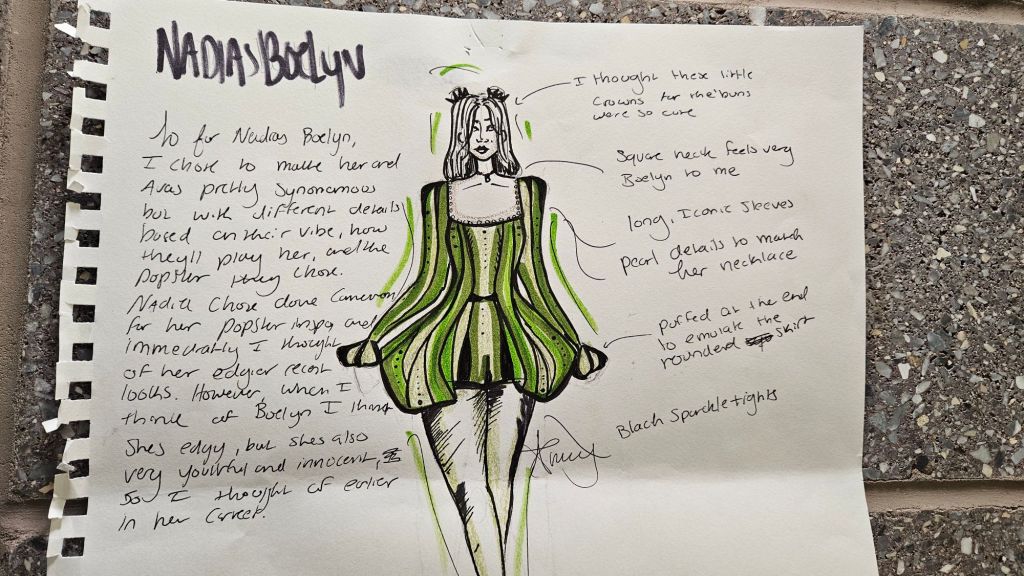
In some ways, the version of Anne Boleyn in “Six” is less a pop version of the real queen and more of a commentary on the nature of celebrity. If you watch the video, you can see how in life she was admired for her beauty and fashion but hated for her comments on Queen Katherine, her scandalous love affairs, and her brash nature. This explains the spiky pop-punk princess look they gave her, (which evidently resonates with many audiences since I saw at least two girls cosplaying as Anne in the audience). Sort of like a celebrity who gets canceled on Twitter or Princess Diana, Anne shows how a person can be undone when they dare challenge an established order, especially the Royal Family.

After the show, I found it a bit weird that they portrayed Anne Boleyn as a jetsetting airhead, but then again she is one of the best-known queens in history, so they can get away with it. In reality, Anne Boleyn was highly educated and a member of an ambitious and social climbing family who basically pushed her to woo Henry. As you can see in this clip from “Anne Of A Thousand Days,” Henry and Anne’s family bullied her constantly to become the King’s mistress after HE ALREADY GOT HER SISTER PREGNANT, so Anne knew that the only way to keep Henry from ruining her life was to convince him to divorce Katherine of Aragon and marry her.

Of course, this strategy didn’t save Anne in the end, which says more about how cruel Henry VIII was, chewing up women and spitting them out in his ravenous quest for a son. So is this an accurate portrayal of Anne’s life? No. Is it fun, ABSOLUTELY!

III. Jane Seymore

I’m more than I seem, or am I?

“Six” The Musical.

This version of Jane Seymore was inspired by Adele, so appropriately, she has a heart-wrenching power ballad about her turbulent relationship with Henry. Sadly, we don’t know much about Jane’s real life, so the song takes some liberties. If you go to the Hampton Court Website, you can actually vote as to whether Jane was a devoted wife or a social climbing gold-digger. Probably the real woman was something even more complicated, though we’ll never know for sure.

IV. Anne of Cleaves

Anne of Cleaves is the funniest part of the show! Many of us have heard the story that Henry divorced Anne after he found her ‘ugly.’ What “Six The Musical” does is amend the story, by pointing out that after he divorced her, Henry gave her a castle and a huge retainer, allowing her to live like a queen, without being married to a king! Accordingly, her song is a Rhianna-style dis track that shows off her awesome lifestyle, and spits in Henry’s stupid face!

As fun as this, rags-to-riches story is, the truth is less fun- Anne was the sister of a German duke, so Henry’s lord Chancellor Thomas Cromwell probably forced Henry to marry her for diplomatic reasons (source: Hampton Court: “Anne of Cleaves”). Naturally, Henry didn’t like being told what to do- I suspect he resented Anne before even meeting her because he didn’t get to pick her himself.

As for whether Anne was actually ugly, the truth is really surprising- Henry actually disguised himself as a peasant during a masked ball when he first courted Anne, and she found him repulsive. At the time, Henry was 49 years old, and in very poor health. As such, he was intermittently impotent and blamed his inability to conceive a child with her on her supposed ugliness to save face.

Even though Anne in the show hates Henry, in reality, once the marriage was annulled, Anne and Henry remained good friends for years! She attended his next wedding to Katherine Howard, and, just like in the show, Henry treated her much better after the divorce:

‘YOU SHALL FIND US A PERFECT FRIEND, CONTENT TO REPUTE YOU AS OUR DEAREST SISTER. WE SHALL, WITHIN FIVE OR SIX DAYS …DETERMINE YOUR STATE MINDING TO ENDOW YOU WITH £4000 OF YEARLY REVENUE…YOUR LOVING BROTHER AND FRIEND.’

Henry VIII, 1548, six months after their wedding, when the annullment went through.

V. Katherine Howard

Without question, Katherine Howard is portrayed as the most tragic of Henry’s six wives and her song is a huge sucker punch. The writers never let you forget that Katherine’s first affair was when she was 13, and she died at age 19. Like Anne Boleyn and Jane Seymore, Henry picked Katherine for his queen among his ladies in waiting and her song “All You Wanna Do” satirizes his and many other men’s lustful appetites. The song begins as a raunchy, sexy pop ballad in the vein of Britney Spears’ “Toxic” and “Womanizer” about Katherine Howard’s love affairs, but then devolves into a cry for help, as Katherine confesses how she was abused, used, and manipulated by the men in her life, (including her own cousin Thomas Culpepper) until she was beheaded in 1542. It masterfully satires both Henry’s cruelty and the hypersexualization of teenage pop stars which certainly took its toll on Britney Spears and Ariana Grande, Katherine’s major ‘Queenspirations.’

VI. Katherine Parr

Historically, Katherine Parr had to turn away her fiancee Thomas Seymore (just like Anne Boleyn was previously engaged to Henry Percy) once the king set his eyes on her for his wife, so her song is a sad, soulful Alicia Keys-inspired bittersweet song where she tearfully says goodbye to Thomas to spare his feelings and probably his life.

Not only does this song once again show how Henry’s selfishness and his lust ruined the lives of the women he married, (as well as the men who already wanted to marry them), but it also sets up the main idea of the show:

His-Story overthrown

In the final number, the wives turn the tables on Henry- they have spent centuries being defined by him, but in reality, he is just as much defined by them! Going forward, history should not define these great women as just, “The Six Wives of Henry the Eighth,” but to celebrate their individual lives and contributions to history. Katherine Parr mentions this when she points out that in life, she fought to allow women to be educated, she wrote books, and was a scholar of theology. Historically, Henry and Katherine would argue about religion and he nearly executed her after she disagreed on points of theology, but Katherine kept her life by claiming she was “Not disagreeing with [him], but simply learning from [him].”

Remember that I was a writer
I wrote books and psalms and meditations

Fought for female education
So all my women can independently study scripture
I even got a woman to paint my picture
Why can’t I tell that story?
‘Cause in history
I’m fixed as one of six
And without him
I disappear
We all disappear

Genius Annotation2 contributors

I Don’t Need Your Love is sung by Catherine Parr in SIX: The Musical. The first part of the song refers to her love of Thomas Seymour, whom she probably wanted to marry rather than Henry (and did marry after Henry’s death). However, the song also protests at the fact that women are often defined by their relationship with men, rather than as people in their own right. Catherine wants to be remembered for what she did, rather than the men she married or loved.

Katherine Parr, Six.

The final number completes the idea of the ‘historemix’ by having the Six queens/pop stars come up with a re-imagined happy ending for themselves, one that doesn’t include the pain that Henry inflicted on them: Katherine A becomes a singing nun, (like Whoopi Goldberg in Sister Act), while Anne Boleyn starts writing lyrics for Shakespeare (which is a fun idea since he does mention “Greensleeves” twice). Jane Seymore forms a band with her many surviving children, Katherine Howard goes solo, and Katherine Parr joins the other queens in a supergroup. It’s not at all historical, but it is a fun and sweet way to put an epilogue on these (mostly) tragic lives.

It’s odd, however, that the show invents an epilogue instead of talking about the six queen’s greatest legacy- Queens Elizabeth and Mary I. For a show that wants to highlight the often-forgotten legacy of these queens, it is an odd oversight. Remember Catherine and Anne gave birth to queens who eventually ruled England without a king. Jane Seymore gave birth to a king, and Catherine Parr helped raise them and restored them to the line of succession- She’s the reason her stepdaughters were able to become queens in the first place.

My issues with the epilogue aside, it is great to see history be recontextualized and shared in such an accessible way. We all know that European history is dominated by the names of white guys- king whoever, duke what’s-his name. To see important women in history be given a voice by a multi-ethnic cast is a great way to make it resonate, and using the metaphor of pop stars works extremely well in this context- these women mostly didn’t choose stardom, but they deserve it for what they went through.

Brava.

Educational links related to the six wives of Henry VIII:

Books

TV:

Web:
https://www.history.com/news/henry-viii-wives

https://sixonbroadway.com/about.php

https://www.hrp.org.uk/hampton-court-palace/history-and-stories/anne-of-cleves/

Resources on Shakespeare’s History Plays:

Books

  1. Shakespeare English Kings by Peter Saccio. Published Apr. 2000. Preview available: https://books.google.com/books?id=ATHBz3aaGn4C
  2. Shakespeare, Our Contemporary by Jan Kott. Available online at https://books.google.com/books/about/Shakespeare_Our_Contemporary.html?id=QIrdQfCMnfQC
  3. The Essential Shakespeare Handbook
  4. The Essential Shakespeare Handbook by Leslie Dunton-Downer and Alan Riding Published: 16 Jan 2013.
    77ace26dfdee4259bf48d6eed1a59d57
  5. Will In the World by Prof. Steven Greenblatt, Harvard University. September 17, 2004. Preview available https://www.amazon.com/Will-World-How-Shakespeare-Became/dp/1847922961

TV:

The Tudors (TV Show- HBO 2007)

“The Six Wives of Henry VIII” (BBC, 1970)

Websites

Verily, May the Fourth Be With Thee

Hi everyone!

Well today is May 4rth, when a lot of people have chosen to celebrate one of the most iconic movies of the 20th century: Star Wars! And why not? The story is full of conflict, introspection, love, change, the conflict between fathers and sons, and occasionally guidance from ghosts. Wait, that sounds familiar- it’s a lot like Shakespeare! Yes, the movie has a lot of parallels with the Shakespearean canon, and I’d like to share some of those similarities here. Below is a post I did for the American Shakespeare Center about how the Star Wars prequels parallel Shakespeare’s history saga of Henry the Sixth:

http://asc-blogs.com/2011/05/04/in-the-force-of-his-will-shakespeare-and-star-wars/

More recent posts for May 4rth

Videos

Podcasts

Enjoy May the Fourth!

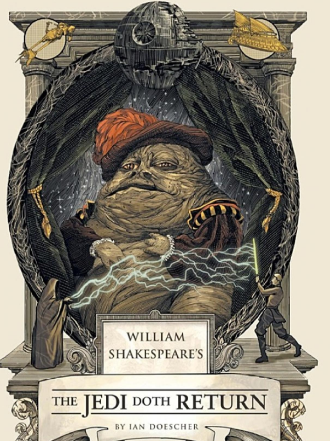
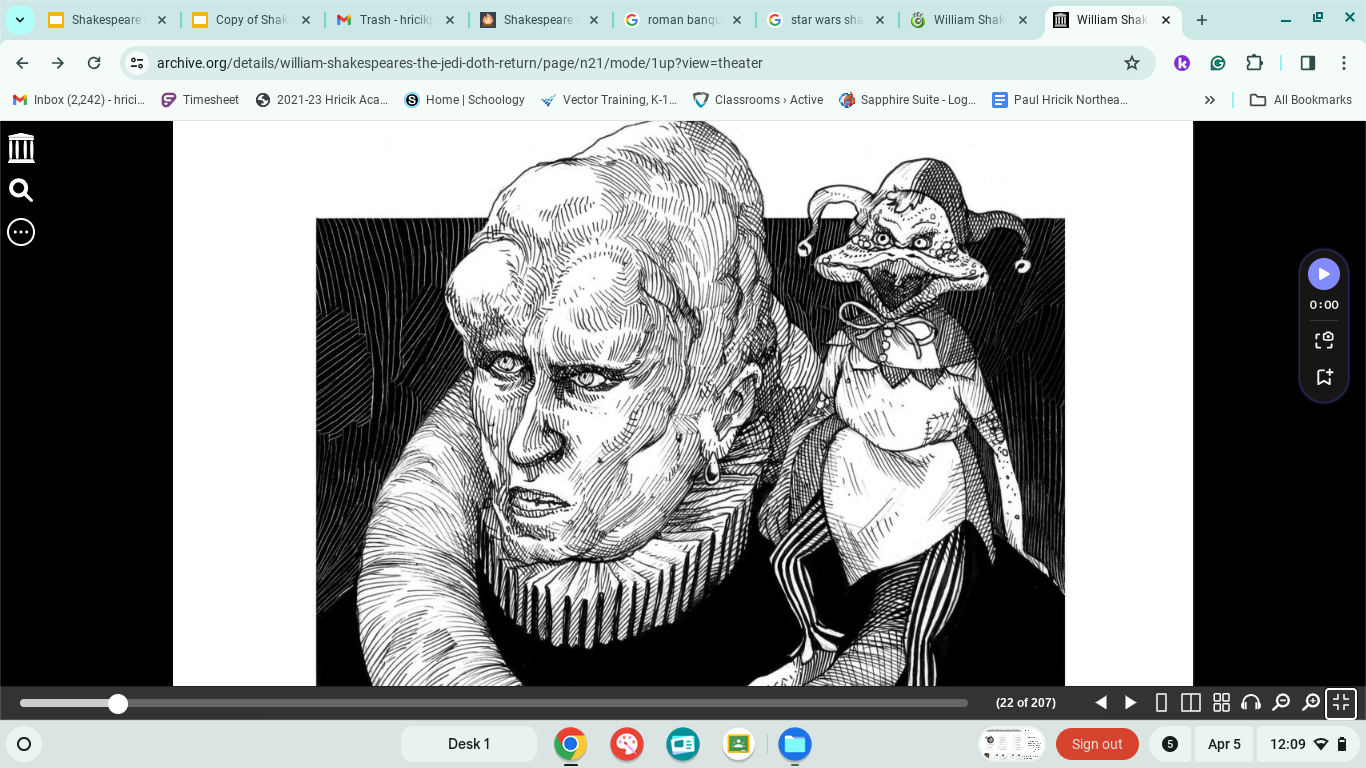
Review: “Star Wars-  the Empire Striketh Back.” by Ian Doescher

As I was writing William Shakespeare’s The Empire Striketh Back, I was surprised to realize I had made more references to Shakespeare’s Much Ado About Nothing than any other play. Much Ado is a comedy—probably my favorite of Shakespeare’s comedies—so it was strange that lines from it kept popping up in the darkest of the original Star Wars® trilogy.

Ian Doescher, https://iandoescher.com/

Introduction

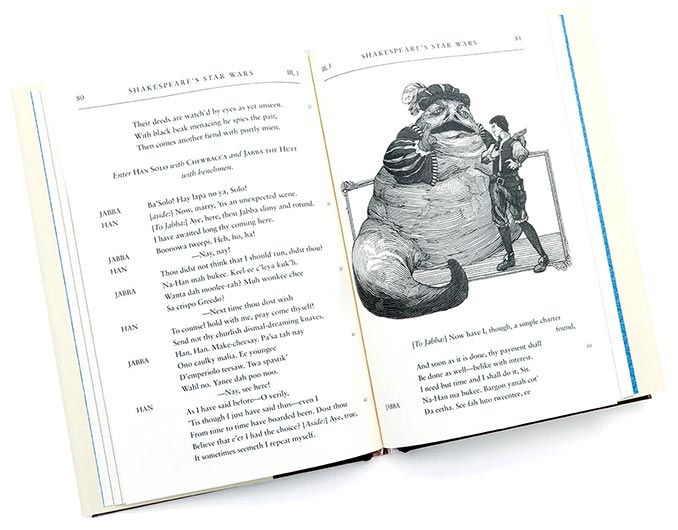
What Is William Shakespeare’s Star Wars?

William Shakespeare’s Star Wars is a series of parody plays written by Ian Doescher that takes the prose screenplays of the Star Wars story and transforms them into Elizabethan verse. Last time I mentioned how much I loved the cheeky references to Shakespeare and Star Wars, and how Doescher adapts the cinematic quality into Elizabethan drama very well. In my podcast, I also emphasized the way Doescher gives each character verbose Shakespearan language that works very well for radio and theater:

My podcast episode where I do dramatic readings of “Verily A New Hope.”

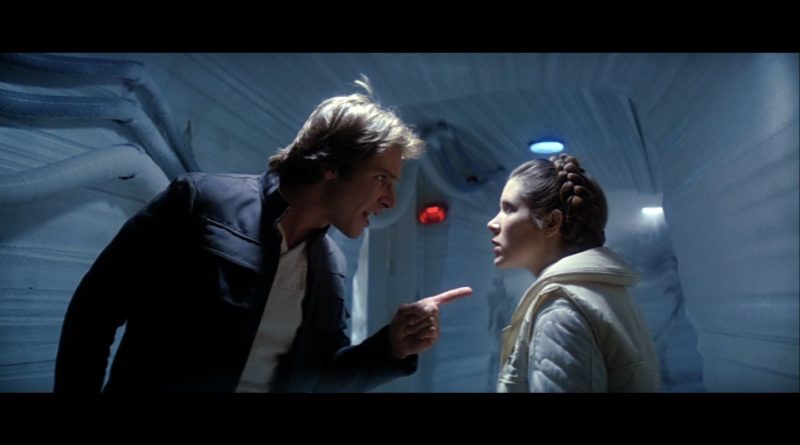
What I want to do with this post, (and the accompanying podcast), is to see whether this edition captures the fun, the clever wordplay, and the Shakespearean storytelling of “A New Hope,” with the second installment of the series, and if it helps to capture the shift in tone between the two movies, as Luke is tempted by the dark side and Han is betrayed and frozen by Lando.

Notes about the play

  1. The first play in the series, Verily, A New Hope,” took plot and structure inspiration from Henry V; it tells the story as an epic heroic story of Luke’s heroic deeds, much like how Henry V is about a king who grows from boy to man.
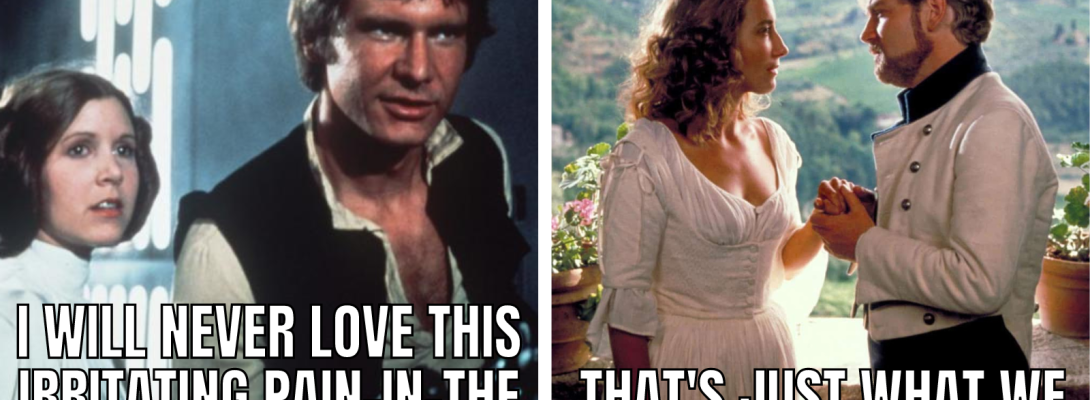
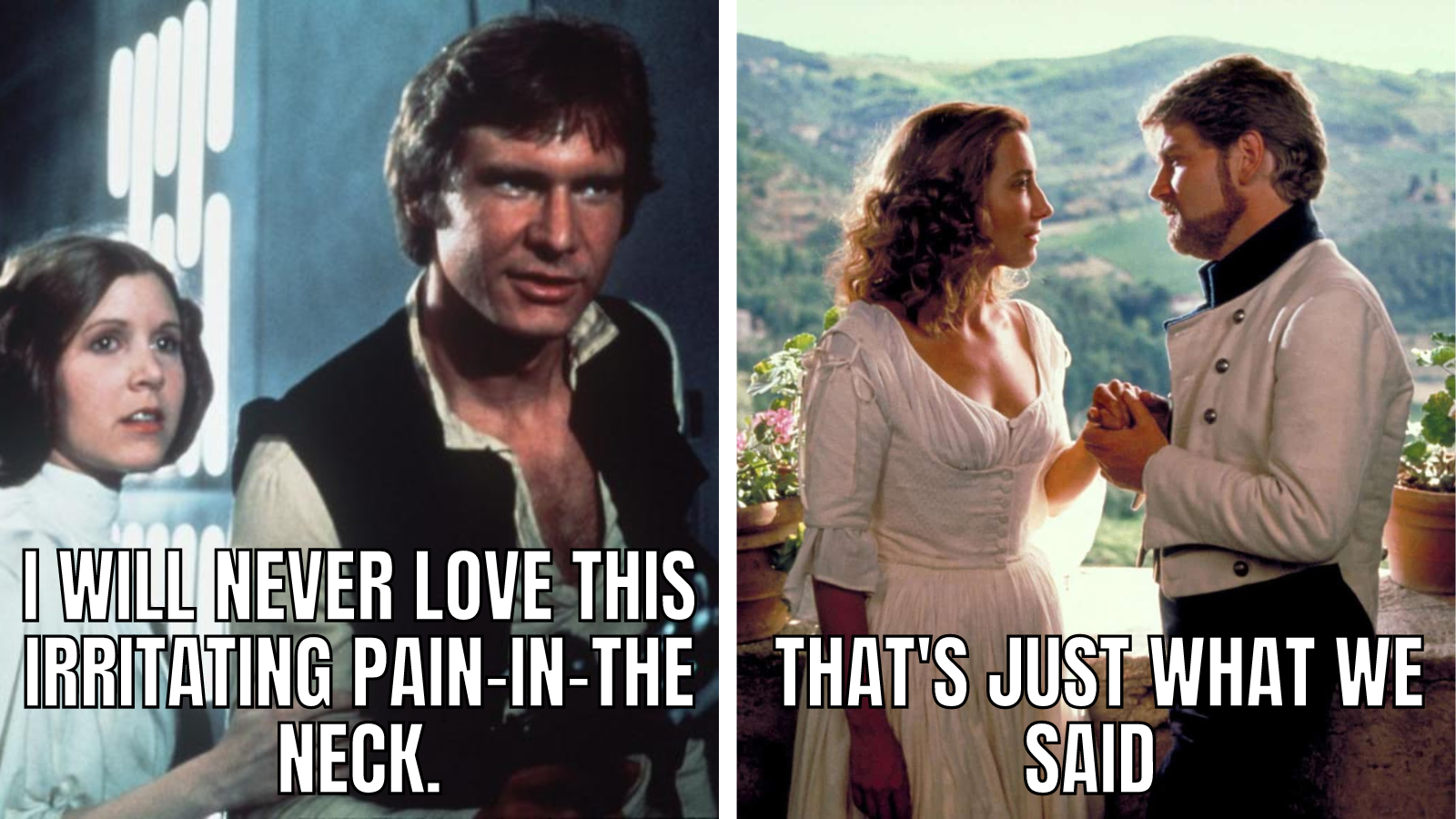
  2. By the playwright’s own admission, the dialogue is stuffed with lots of re-purposed quotes from Much Ado About Nothing, Shakespeare’s comedy of a womanizing, self-centered soldier who becomes a devoted husband. This is appropriate since the Leia/ Han plot within the play and movie starts out with them bickering like Beatrice and Benedick. Doescher says this was an accident, but I think he might have subconsciously taken inspiration from their love affair to help structure the dialogue. In the accompanying podcast episode, I talk more about how the use of Much Ado quotes helped to flesh out the characters of Luke, Leia, and especially Han.

Structure

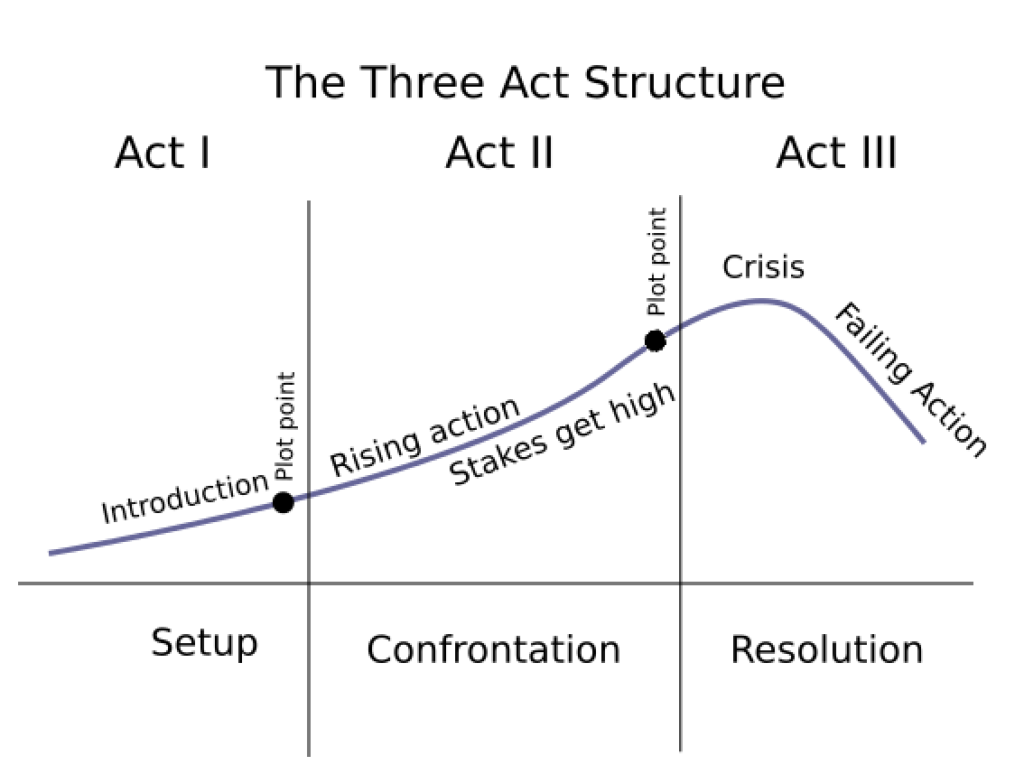
Movies and plays follow a similar structure where the action starts at a static place, tension rises, and finally, things get resolved at the end. A lot of the same elements are in both issues. The main difference is how they are arranged. Let’s see how Doescher translated the three-act structure of a screenplay, to the five-act structure of an Elizabethan tragedy.

As you can see, films have a 3 act structure

Elements to Watch for:

  1. The Language
    1. Choruses
    • A Chorus is a short speech where a character who is not part of the action of the play introduces the plot.  It functions the same way as the famous title crawl at the beginning of Star Wars.
  1. I mentioned last time that “Verily: A New Hope” uses choruses liberally, which is appropriate because the tone of this story is so much darker, and since the action follows the journeys of Han and Luke so closely Ian doesn’t use choruses as much. I suspect this is partly because unlike The Empire Strikes Back, A New Hope jumped around more between planets and locations and used wipes and other transitions heavily:

Below is a link to the Royal Shakespeare Company’s Learning Zone, where you can learn about the language of the Henry V chorus.

https://www.rsc.org.uk/shakespeare-learning-zone/henry-v/language/facts#

2. Repeated lines/ Half lines

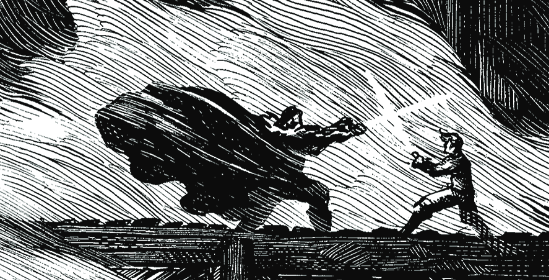
The literary technique of stichomythia has characters who speak at more or less the same time, using slightly different forms of dialogue. Doescher uses this well as a staging device by having Vader and Luke speak similar lines as Luke plummets down the shaft after losing his lightsaber duel:

These similar lines highlight the connection these two have (no spoilers), and also emphasize that, though the actors might be physically close onstage, their characters are meant to be far apart; they wouldn’t be saying this to each other.

In Romeo and Juliet, there’s an excellent example of stichomythia in Act IV, Scene iv, right after Juliet’s parents and Nurse discovers her, apparently dead. There is a long series of laments by her parents and nurse where they are shocked and horrified at her sudden death:

Lady CapuletAccursed, unhappy, wretched, hateful day! 2702
Most miserable hour that e’er time saw
In lasting labour of his pilgrimage!
But one, poor one, one poor and loving child,
But one thing to rejoice and solace in,
And cruel death hath catch’d it from my sight!
NurseO woe! O woful, woful, woful day!
Most lamentable day, most woful day,
That ever, ever, I did yet behold!2710
O day! O day! O day! O hateful day!
Never was seen so black a day as this:
O woful day, O woful day!
ParisBeguiled, divorced, wronged, spited, slain!
Most detestable death, by thee beguil’d,2715
By cruel cruel thee quite overthrown!
O love! O life! not life, but love in death!
CapuletDespised, distressed, hated, martyr’d, kill’d!
Uncomfortable time, why camest thou now
To murder, murder our solemnity?2720
O child! O child! my soul, and not my child!
Dead art thou! Alack! my child is dead;
And with my child my joys are buried.
Romeo and Juliet, Act IV, Scene v lines 2702-2723.

When I played Friar Laurence and the cast and I rehearsed this scene, the actors playing the Nurse and Juliet’s parents were struck by how similar the lines are and worried that these long passages of laments would get tedious to an audience. I realized by looking at the similar lines, the similar words (especially at the ends of lines), and the fact that Friar Laurence interrupts them at the end, led me to believe that these lines are meant to be spoken AT THE SAME TIME. This creates an effect of organized chaos where the actors seem to be wailing and ranting, but are actually speaking a carefully composed quartet of grief. Thus Doescher cleverly mimics Shakespeare’s use of stichomythia to convey Vader and Luke’s physical distance, and complementary feelings at the same time.

3. Parody Lines

The biggest appeal of William Shakespeare’s Star Wars is the fact that it is a parody, and I’ve said for many years that parody and gentle riffing on Shakespeare is a great way to get students to overcome their fear of Shakespeare and engage with him. Students who know Star Wars but don’t know Shakespeare will recognize the familiar characters and plots of the movies and then see how Shakespeare’s language tells the story anew. Similarly, people who know Shakespeare will recognize the way Doescher re-tools famous Shakespeare quotes to give to characters in the Star Wars Universe, like here, where he spoofs the intentionally bad speech of Snug the Joiner and gives it to the Wampa from Empire Strikes Back:

Peter Keavy as Snug the Joyner in “A Midsummer Night’s Dream,” 2017.

In the Educator’s guide, which I’ve attached below, Doescher tells you exactly which lines he has parodied and the plots of the original plays so the students can learn about Shakespeare through these famous speeches. Orson Wells once said that “We sit through Shakespeare in order to recognize the quotations,” and this edition gives us thrilling space battle, wonderful characters, and witty dialogue to keep us entertained while we wait.

Staged moments

As Doescher worked his way through all nine installments of Star Wars, he continued to expand and experiment with his storytelling. There are a couple of moments in “Empire” that work only onstage such as the aforementioned moment of stichomythia after the lightsaber duel, and the scene in Act II, Scene ii where the Imperial Walkers known as AT-ATs actually speak to each other onstage. Like the French in Henry V, it’s interesting to see the battle from the enemy’s point of view, albeit a highly biased one. I won’t reprint it here for copyright reasons, but I will put this funny sketch in as a placeholder:

My Criticism

Although I loved “Verily, A New Hope,” I feel that Doescher didn’t go far enough to adapt the dialogue in interesting ways and play with the stagecraft of Star Wars to make it more distinct from the film and the first installment. My favorite moment of the play was the Wampa speech which was great because it not only parodies one of my favorite speeches in “A Midsummer Night’s Dream, it also made the Wampa attack tonally distinct from the film- the film is tense and grim, while the Wampa speech is funny and charming. I wish Doescher had embraced the parody and silly tone he shows in this speech and applied it more to the rest of the play; we already know Empire is the darkest installment of the series, but that doesn’t mean it needs to be played like that the whole time.

What I think works best in the film is the romantic comedy between Han and Leia; Doescher does a wonderful job pointing out the parallels between Han and Leia and Benedick and Beatrice which is not only fun, but helps Star Wars fans appreciate the comedy of Much Ado About Nothing even more. This is why I’m glad Doescher took painstaking notes on how he parodied Much Ado and other plays in the guide below:

The Education Guide

Doescher’s official website.

Support My podcast

If you enjoyed the accompanying podcast episode to this post, please consider subscribing and donating to help me continue making fun and educational content like this!

Special Discount For My Online Class:

Scan the QR code to see my list of classes.

This Friday is the grand premiere of my new online class: “Shakespeare: The Lost Play,” where you discover who stole Shakespeare’s play. Below is the latest trailer.

Since I want as many people to play as possible, I’m creating a coupon: Get $10 off my class “Shakespeare’s Lost Play Mystery Game” with coupon code HTHES4OXNY10 until May 8, 2023. Get started at https://outschool.com/classes/shakespeares-lost-play-mystery-game-ny9HhlxI and enter the coupon code at checkout.