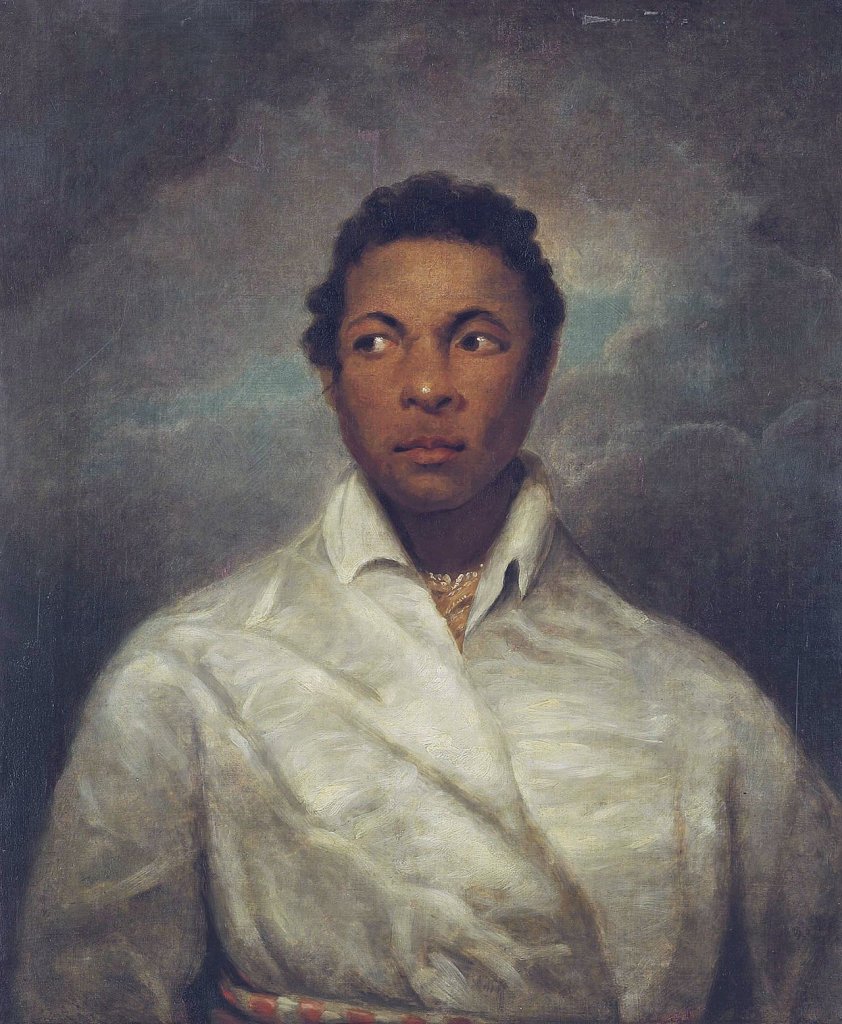
Happy Black History Month Everyone! Today I’m paying tribute to a great actor and activist, Mr. Ira Aldridge (1807-1867).
Ira Aldridge portrait by James Northcote
Mr Ira Aldridge was not only a great actor but also an influential figure in the abolitionist movement. He rose from the depths of discrimination and dehumanization to become a famous, respected international actor. Furthermore, his life was marked by creating new opportunities for himself and other people of color.
Mr. Aldridge as Othello.
Who Was Ira Aldridge?
Early Life
True feeling and just expression are not confined to any clime or colour.
Ira Adridge
Born in New York in 1807, Mr. Aldridge had dreams to found an all-black theater even as a teenager. His first job was with William Brown’s African Theatre, the first African American theater company. However, discrimination and racism blocked Mr. Aldridge from success in New York, when another theater manager “hired thugs to beat up the actors”. The theatre subsequently burned down and the actors were abused by the New York police. Undaunted, Aldridge decided to take his talents to England, boarding a ship, and arriving in the early 1820s. (Howard, qtd in Thorpe 1). Even though he faced discrimination and violence as a child, Mr. Aldridge would not be deterred. Soon his skill as a Shakespearean actor would soon command respect from all.3.) He refused to be defined by the color of his skin, but by his skill as an actor.
Success In Shakespeare
Ira Aldridge as Aaron in “Titus Andronicus”
In order to become a professional actor, Ira Aldridge boarded a ship to London and became a Shakespearean actor in the early 1820s. He not only became the first black actor to play the role of Othello, he also played other roles such as Shylock in The Merchant of Venice, Gambia in The Slave, and other roles that denounced the evils of slavery:
Aldridge chose to play a lot of anti-slavery roles, including Othello, as well as the standard lead parts in the repertoire,” said Tony Howard, professor of English at Warwick University.
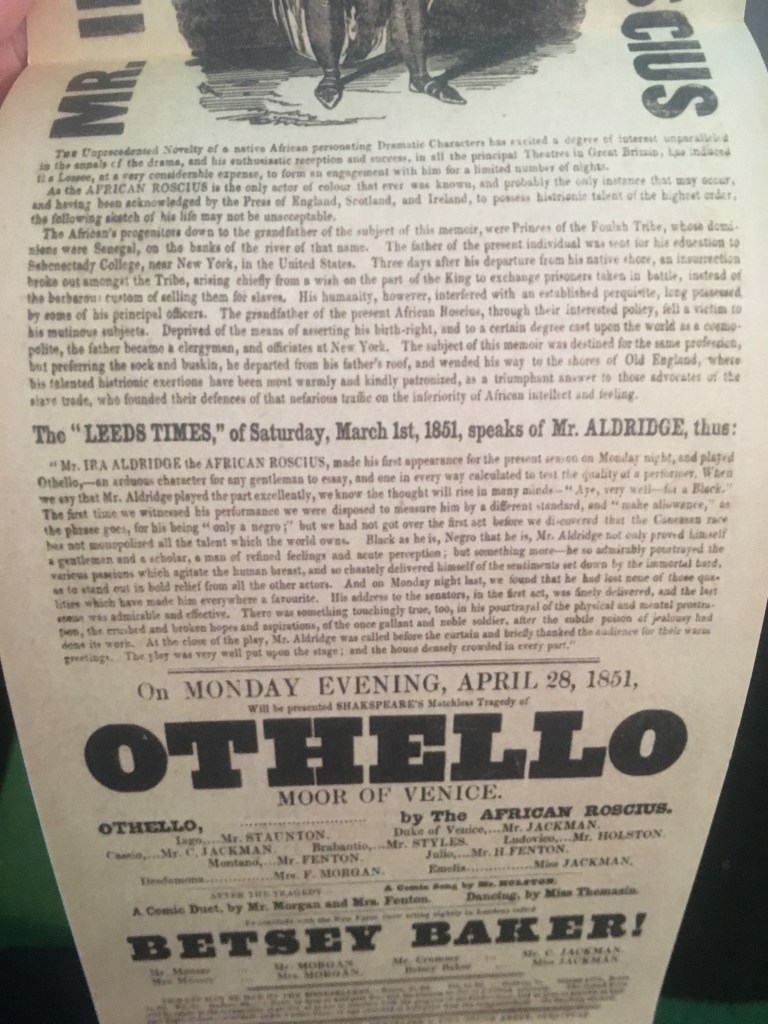
Not only did his performances call attention to the evils of slavery, they also challenged preconceived notions of what black people were capable of. As you can see in this reproduction of Mr. Aldridge’s 1851 tour advertisements, Ira Aldridge chose to bill himself as “The African Roscius,” a reference to an ancient Roman actor. His performances were heralded for his poise and dignity. The Leeds Times highlights “The passions he admirably portrayed in the human breast.”
No sooner did the Moor make his appearance, than I felt myself, I confess it, instantly subjugated, not by the terrible and menacing look of the hero, but by the naturalness, calm dignity, and by the stamp of power and force that he manifested.
Ira Aldridge
From 1820 to his death in 1867, Mr. Aldridge touredmore than 250 theatres across Britain and Ireland, and more than 225 theatres in Europe. Though he had much more success in Europe, Mr. Aldridge still had to confront prejudices. According to ArtUK.org:
One scathing (and racist) review for The Times claimed that: ‘His figure is unlucky for the stage; he is baker-knee’d and narrow-chested; and owing to the shape of his lips it is utterly impossible for him to pronounce English in such a manner as to satisfy even the fastidious ears of the gallery.’
Thus, Aldridge’s performances confronted and challenged racist views of whether or not a real black person could play Othello, subtly changing the hearts and minds of the European public, at a time when the question of slavery threatened to rip Europe, (and later the United States) apart.
Abolitionism
Although Aldridge didn’t arrive in Britain with the sole purpose of promoting the abolitionist movement, his impressive skill, charisma and oratory capabilities inevitably swayed public opinion. He became known for directly addressing the audience about the injustices of slavery on the closing night of his play at a given theatre (Source: https://artuk.org/discover/stories/ira-aldridge-a-brief-visual-history-of-the-black-shakespearean-actor )
As I’ve written before, Shakespeare has a complicated relationship with the American Civil War, and ironically, many people in the Civil War were Shakespearean actors. More importantly, England at this time was deeply divided about whether or not to support the Union or the Confederacy. England was embroiled in the cotton trade with America, and thus had an economic incentive to support the South. At the same time, public opinion was very much against slavery at the time, and Aldridge helped keep England’s public within that mindset.
Ira Aldridge cared about abolitionism and making life better for black people, especially actors. Not only did he speak out against slavery onstage, he also helped change hearts and minds in local communities. According to ArtUK, in 1828, Mr. Aldridge was approached by Sir Skears Rew to become the new manager of the Coventry Theater. He was the first black man to manage an English theater. Aldridge became a beloved member of the community of Coventry and may have helped inspire the community to petition Parliament to abolish slavery. EThus, Mr. Aldridge’s success in Europe helped open doors for European black actors and encouraged the abolitionist movement, while his sympathetic portrayals of former slaves and oppressed peoples helped change hearts and minds.
Aldridge’s Influence Today
“Aldridge has always interested black stars, but the wider influence he had is not well known,” said Howard. “Robeson was a great fan of his, and when he came to London to play Othello in 1930 at the Savoy, he put on an exhibition about Aldridge in respect of his memory.”
For nearly 100 years, actors and devotees of Mr. Aldridge have been inspired by his life. As the quote above indicates, the next great American Shakespearean Paul Robeson helped build his career on Aldridge’s success; being the first black man to play Othello on the American stage, and eventually touring Europe himself as an actor and a distinguished opera singer. Click below to read more about how Aldridge inspired generations of black actors, and his tours helped bring Shakespeare to many previously unknown European countries.
In modern films and plays, Mr. Aldridge is remembered as a hero, and rightfully so. In the play “Red Velvet,” actor Adrian Lester plays Aldridge and highlights his struggles and successful contributions to the theatre. He was not only a great actor but a dignified and courageous champion of the rights of all people. I’m proud to conclude my black history month posts with this review of the life and career of a man who inspires all Shakespeareans and turned his profession into a powerful call for change.
In this section, I review a Shakespeare book, movie, or TV show that I feel has some kind of value, either as an interpretation of Shakespeare, or a means to learn more about the man and his writing.
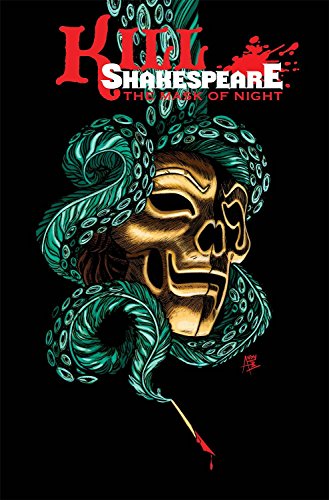
Name: Kill Shakespeare (Vol. 4) by Connor McCreery and Anthony Del Col
Ages: Adult/ Teen. There’s some PG-13 language and a lot of fighting and gore, so it’s not really for kids
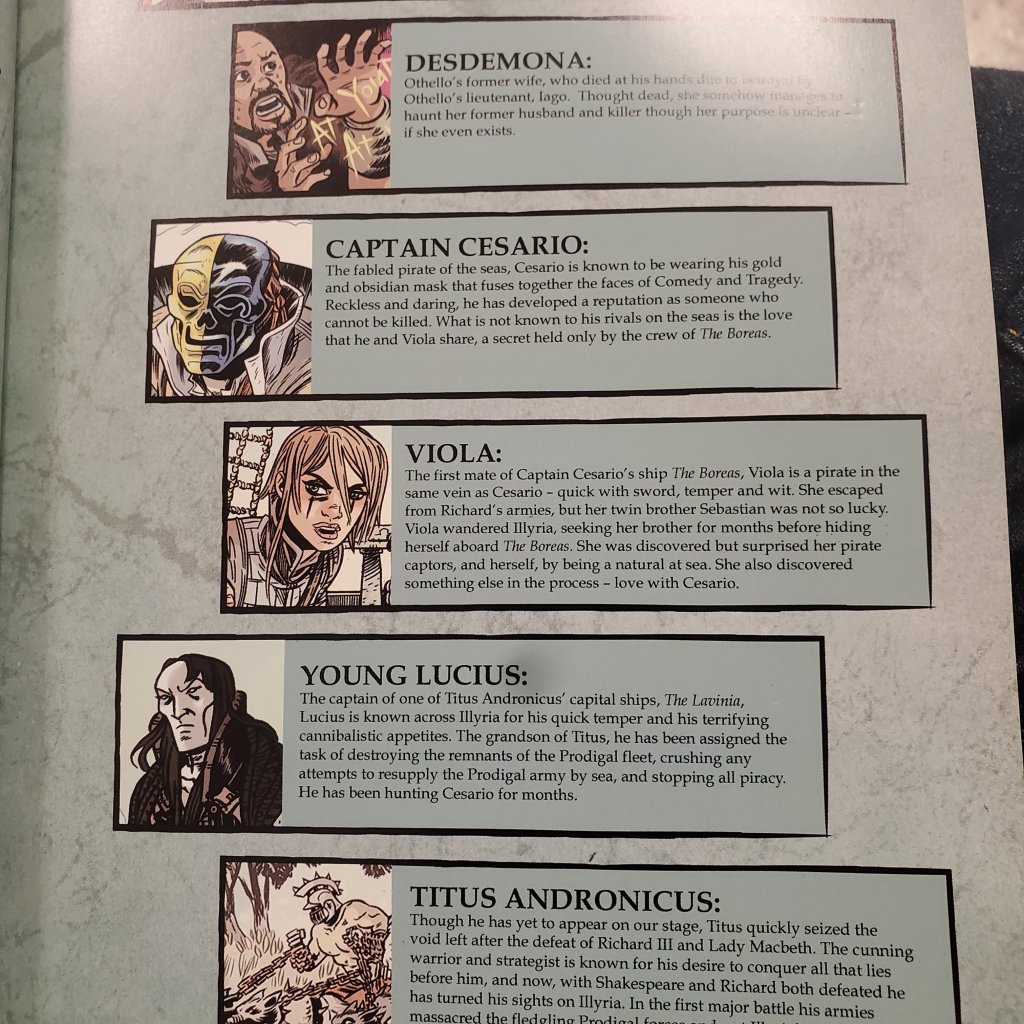
Premise: William Shakespeare is more than just a simple playwright- he has a magic quill that brings his characters to life. Some of the characters worship him like a god or like a father. Many others, (as the title implies), want him dead. A faction of outlaw heroes who call themselves The Prodigals are trying to protect Shakespeare, including Juliet and Hamlet, but in this volume, they’ll have to face raging seas, bloodthirsty pirates, and the mind-altering effects of the island in Volume 3, which has pushed them all to near-madness.
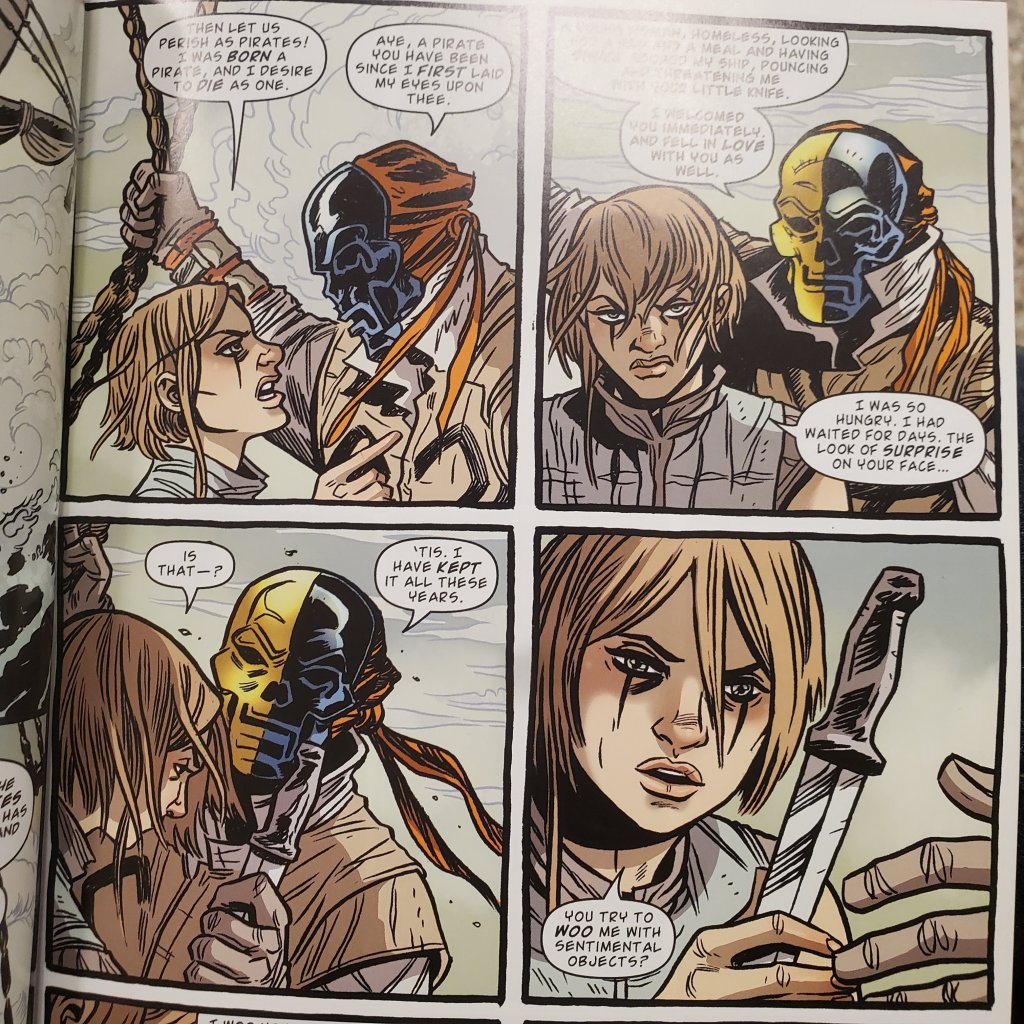
My reaction: Volumes 1&2 were framed as a civil war between the heroes and villains of the Shakespeare canon- basically an Infinity War for Shakespeare nerds. This volume is in the context of a high-seas pirate adventure. It has a lot of cool fights and the drama between Cesario and Viola is great, but honestly, I thought it was poorly paced. Maybe it’s my personal taste, but it’s hard to keep myself invested in the story when everyone is stuck on a boat.
Basic Details:
As I said in my review of Volume 2, what I like the most about this graphic novel is that the characters are consistent with how the real Shakespeare wrote him, yet they make different choices in the graphic novel. They also grow and play off each other in many interesting ways. Here are some examples:
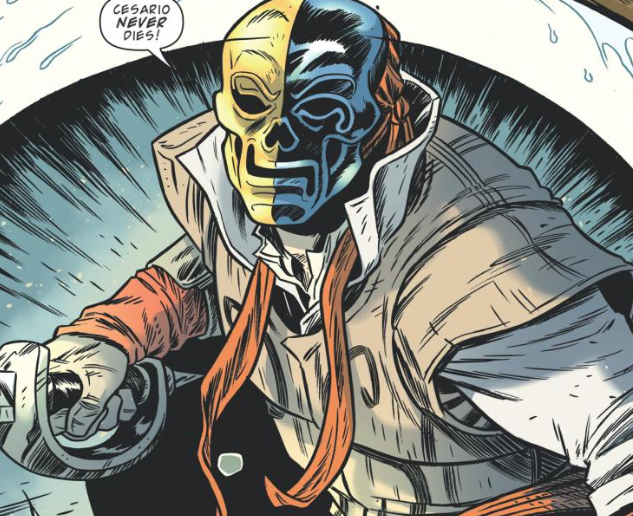
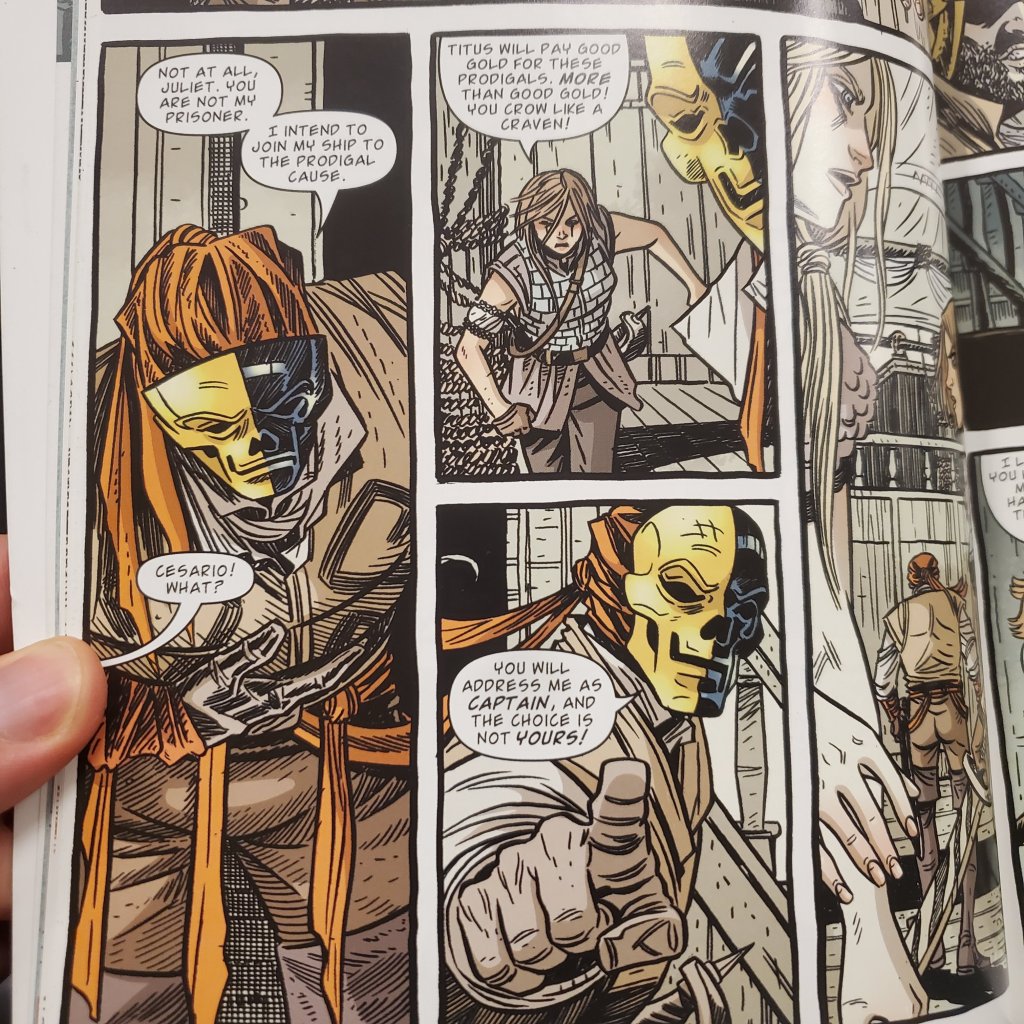
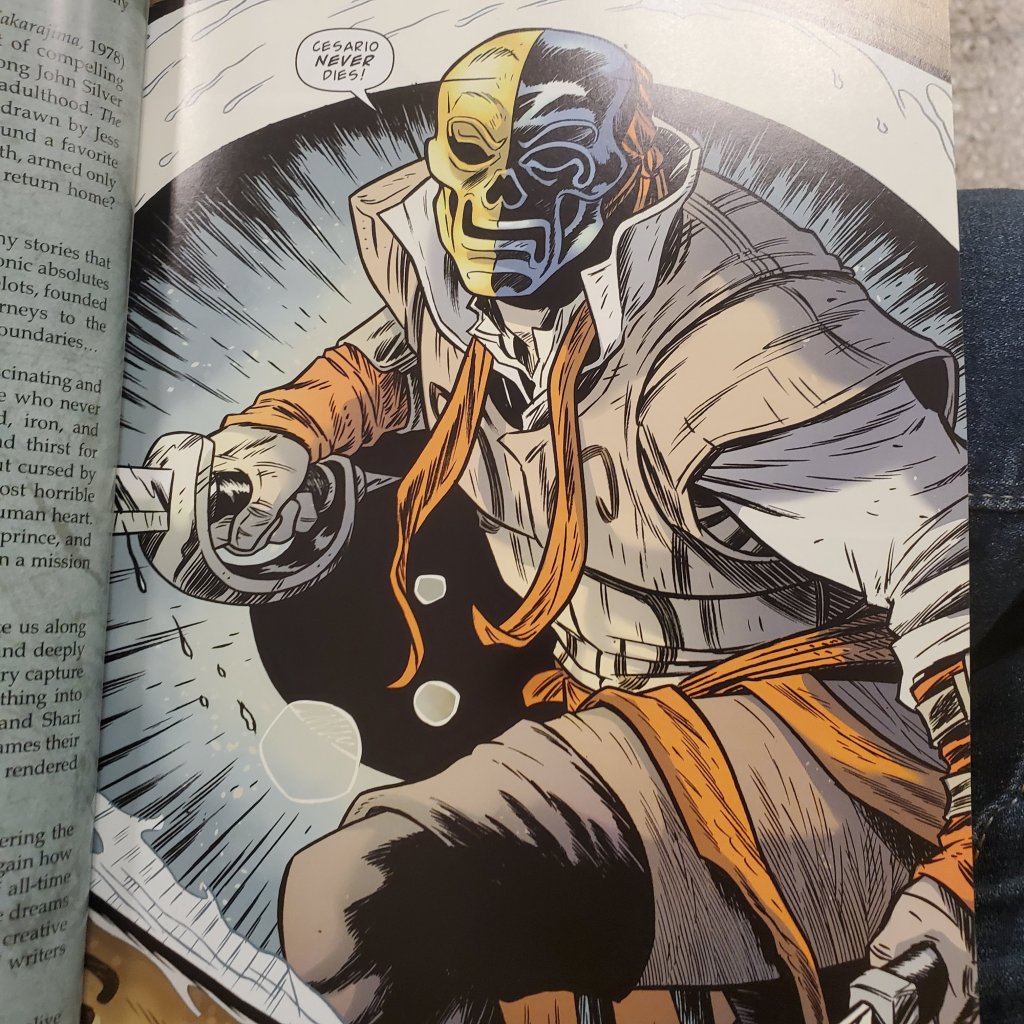
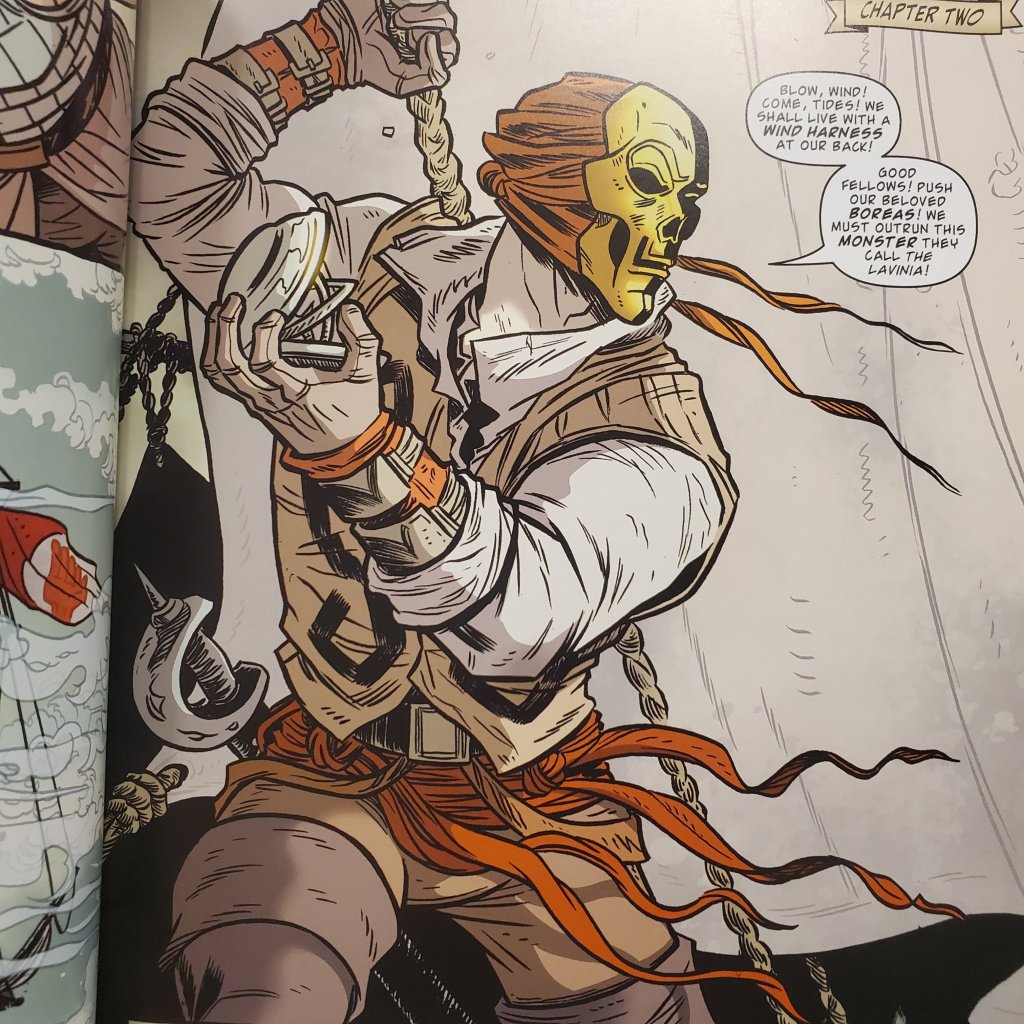
Most of the drama of the graphic novel centers around Captain Cesario, a dashing rogue pirate, and his first mate/ girlfriend Viola. The main characters from Volume 2, (Shakespeare, Hamlet, Juliet, and Othello), have escaped the effects of the island run by the mad wizard Prospero, but are still shell-shocked at feeling the terrifying psychic effects of that island. This is a clever plot device that basically makes it makes all the characters unnecessary except for Hamlet and Juliet. You could look at this installment as the story of 2 couples, (dare I say twin couples) where Viola and Cesario are fighting over whether or not to join Shakespeare and the other Prodigals, to remain on the high sea as pirates, or to betray them and become ingratiated with the fearsome cannibal-pirate Lucius Andronicus.
I won’t give too much away (there are some spoilers), but let’s just say that the relationships in Volume 2 have been tested to the breaking point; Hamlet and Juliet are having extreme problems, (almost as bad as Hamlet and Ophelia). Viola and Cesario are also fighting constantly. In addition, the ship is constantly under threat from the feared pirate Lucius Andronicus. Will the characters solve their internal conflicts before a mutiny breaks out? Or will they all be cut to pieces by the cannibal Lucius? On this boat, tempests are not kind, and salt waves are fresh with DEATH!
Shakespeare Easter Eggs
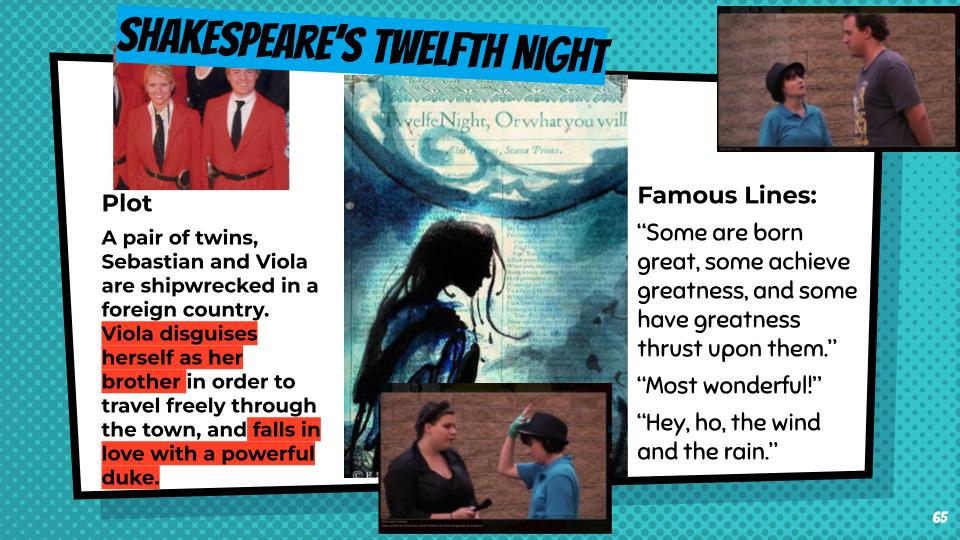
Kill Shakespeare, Volume 4 is largely based on Shakespeare’s Twelfth Night, which, although it mainly focuses on the courts of Duke Orsino and Countess Olivia, does have aspects of pirates, deception, and lovers quarreling. It is interesting (and I give the writers credit) for taking a light-hearted comedy with songs and dances and turning it into a swashbuckling pirate adventure; that takes real imagination, yet it works with the text; the first time we see Viola she is shipwrecked and the captain that saves her life is arrested offstage. This prompts Viola to disguise herself by wearing her twin brothers’ clothes and donning the non-de-plume Cesario, to freely behave like a man in a man’s world. Shakespeare already made Viola’s fate intertwined with the sea, so it makes sense that she might want to be a pirate. Kill Shakespeare takes Viola’s two identities and makes them two separate people, both intertwined with a love of the sea.
The graphic novel also conflates and expands other pirate characters from the play; there’s another captain in the play named Antonio who saves Viola’s brother Sebastian and is accused of being a pirate, While Viola in Twelfth Night is a noblewoman who out of necessity disguises herself as a man and becomes a servant to a Duke, Viola in this version is trying to escape being a noblewoman and becomes a pirate by choice. Meanwhile, Antonio, who denies being a pirate, is changed into the roguish Cesario, who loves Viola as much as Antonio loves her brother Sebastian in the play. Like Antonio, Cesario cares about Viola’s well-being and is willing to sacrifice everything to keep her safe, even being a pirate. This causes friction between the two since again, Viola wants to continue to be a pirate and would rather die than give it up. Their conflicting roles as shipmates and soulmates keep them at odds during the play, sort of like how Cesario’s mask is split down the middle; half tragic, and half comic.
Critique
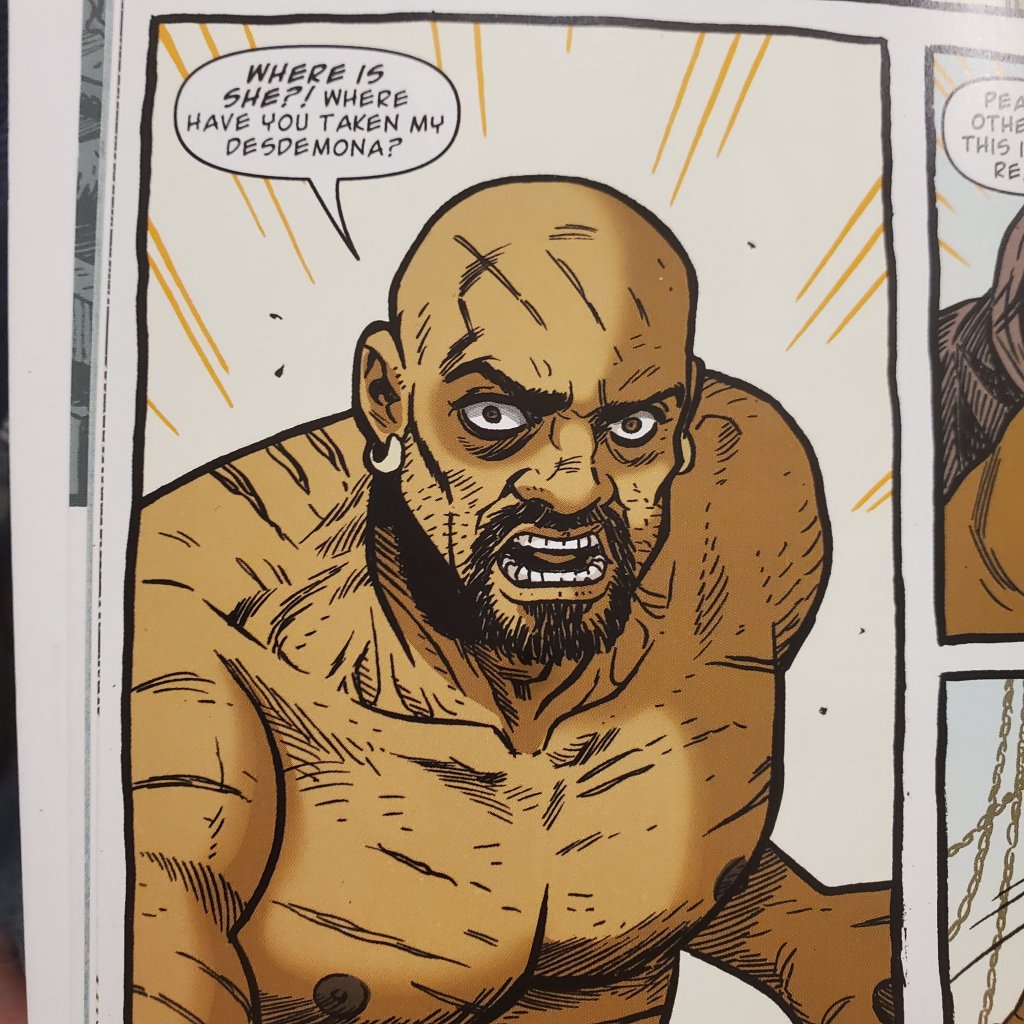
I think this graphic novel is poorly paced. Most of the first half consists of Cesario and Viola arguing about what to do with Shakespeare and the rest of the Prodigals. Their drama is good, but it supersedes everybody else, and I found myself wondering what was going to happen to Shakespeare and the rest, and wishing that they’d got more focus. Othello is reduced to a plot device because he is madly searching for Desdemona, whom he killed during the events of Shakespeare’s play. Othello is no longer the honest, loyal friend to Juliet that he was in the previous editions; now he’s more like The Incredible Hulk, filled with animalistic rage and unable to be controlled except by the love of his friend Juliet. In some ways, Othello was the most likable character in the previous volumes so I hated to see him like this.
In addition, the constant couples’ bickering gets a little bit tedious; I suppose that’s inevitable when you take all the comic elements out of Twelfth Night, (Sir Toby and Feste are back in Volume One, and Malvolio, Fabian, and Olivia are nowhere to be seen). I did enjoy the ending where Viola resolves her conflict with Cesario much the same way Viola solves the problem of her being Cesario in the play. I also like the way that they built up the antagonist Lucius from Titus Andronicus. Lucius is a good choice for a villain in this world because he’s seen some truly horrible things in his own play like his father mutilating people, his brothers and sister murdered, and the worst pie recipe of all time. Making Lucius a bloodthirsty, cannibalistic pirate is a great choice. Still, I wish they spent more time fighting with him instead of sailing away from him. In short, the characters are as compelling as ever but the action is lagging and the drama is reduced to mostly petty couple squabbling. I would like to see this series pick up in a more action-packed version more in keeping with a graphic novel.
Recommendation: I’d recommend this book to all mature fans of Shakespeare, anime, Manga, D&D, or any kind of nerd stuff!
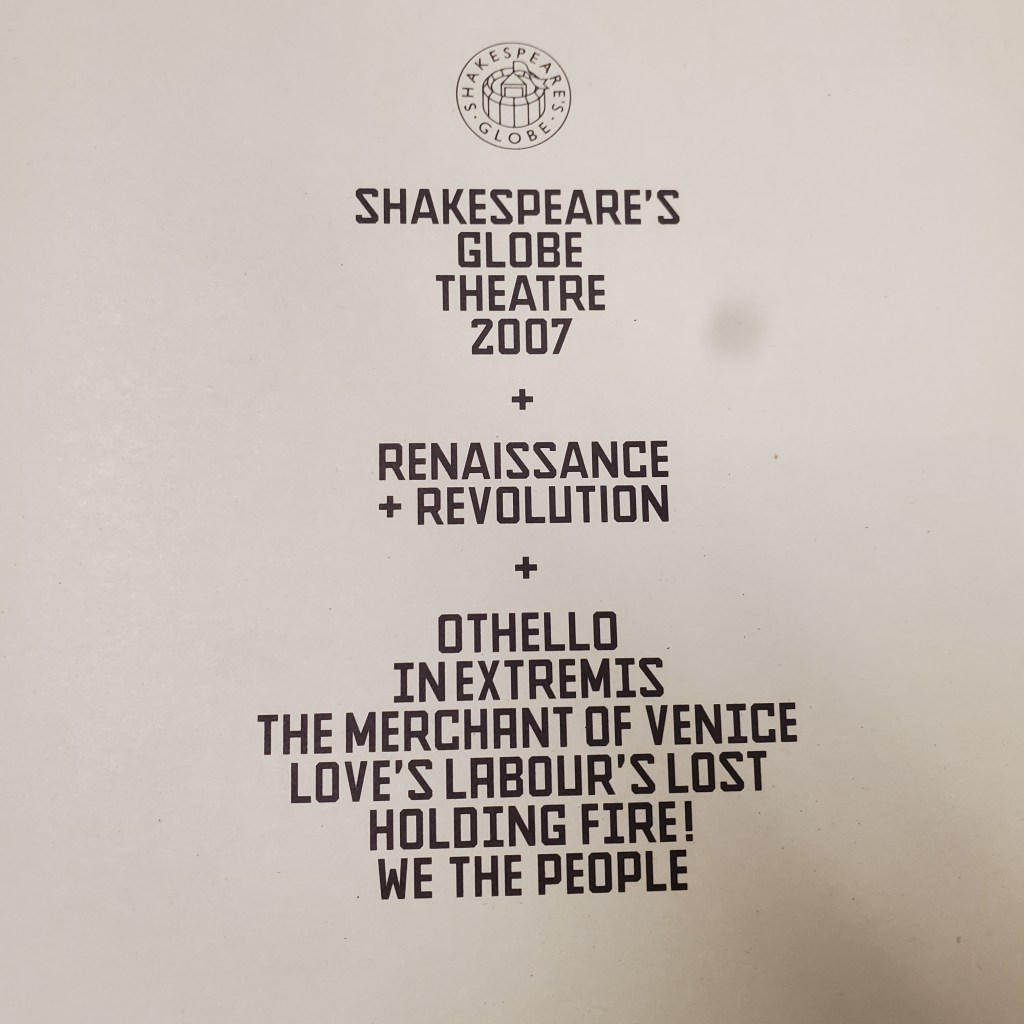
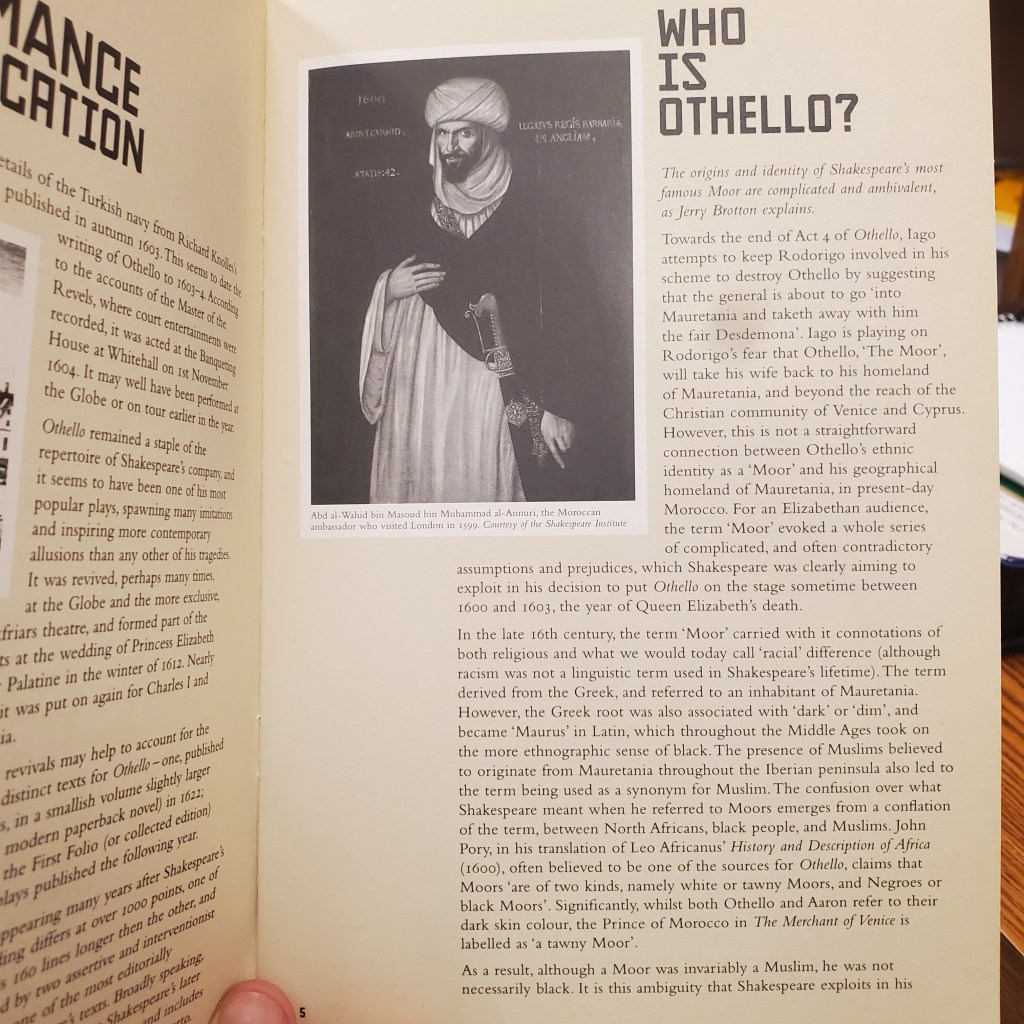
For Throwback Thursday, I’m talking about my first-ever experience going to the Globe Theater. Back in 2007, I saw a production of “Othello” starring Eamon Walker as Othello, and Tim McInerney as Iago. Below are some images from the excellent souvenir program I purchased:
The experience was very special to me I went to London for the second time with my classmates in a college theater class, many of whom I’d also performed with earlier that year in Romeo and Juliet. I got to see over 15 shows in London’s west end , but going to the Globe was definitely a highlight. It felt like a pilgrimage and the icing on the cake after studying Shakespeare’s plays all year long. It was also very serendipitous that the play we saw was Othello, since, as you can see in the video below, I noticed that Sam Wannamaker, the founder of the Globe, performed in the play himself as Iago:
THe concept
Again, since this was my first time seeing a play at the Globe, I appreciated that they played it straight- Elizabethan costumes, no bizarre staging. This felt very much like stepping back in time. Some critics in recent years say that all Globe Productions should be staged like this, and decry more experimental productions. I see an argument for both camps. The Globe is both a temple to Shakespeare’s life and work, and a modern theater that tries to push the boundaries of live performances, and I think this kind of variety is good. That said, I’m glad that every once in a while, they just let a Shakespeare play be classic.
Yes, this is one of the first ever Othellos I saw, and the first one I ever saw live, but Mr. Walker will always be one of my favorites. He really nails the complexities of Othello’s emotions- from powerful and stoic, to sweet and romantic, to rage-filled and abusive. I really felt for him and truly hated Iago for taking such a worthy person and turning him into a monster.
What Mr. Walker does incredibly well is show Othello’s journey to fight the simmering hatred and jealousy he feels towards Desdemona. You can see it in his face when Desdamona casually mentions that Cassio (the man Othello suspects is sleeping with his wife), has just been in the room with her.
I’ve heard critics claim that Mr. Walker’s voice is hard to hear, and I have to admit, his voice is a little hard to hear in an outdoor amphitheater like the Globe, but his physicality and his sublime characterizations of the role of Othello more than makeup for it. In addition, his great portrayal of Othello was also immortalized in a great TV (which I’ll talk about another time), which makes the aforementioned critique of his voice irrelevant.
In 2000, Mr. Walker starred in a made-for-TV movie modern-day Othello which has this heartbreaking scene at a restaurant (1:12:00- 1:15:00) where John Othello, (the first black police chief in England), talks about how his people left Africa, came to England and were given “Other men’s leavings.” He also makes it clear that for years he wanted to be white. This Othello is very clearly not healed from his generational trauma, and it comes out in violent ways:
I honestly liked Tim McInerney less as Iago than in other roles, such as his film role in Ian McKellen’s Richard III. I thought his character voice was too gruff to be understood, and though his physicality is good, I didn’t get much of a sense of his concept for the character. As I’ve written before, Iago is a compelling part, but the actor has to have a clear objective to help us in the audience understand why he feels the need to destroy Othello.
These minor nitpicks aside, this was an excellent production, and I’m really pleased to retell my experience to you. Below are links to reviews and photo slideshows.
Tomorrow is the first session of my course on Shakespeaere’s tragedies! I’m so excited to teach this great group whom I’ve worked with before. To mark this occasion, I present this silly, catchy, and informative song about the tragic fates of Cleopatra, Juliet, Hamlet, and others.
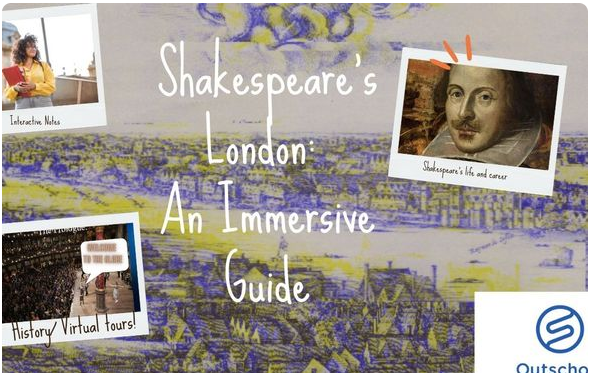
Title page for my course on Shakespeare’s Tragedies
If you want to sign up for this course or request a private session, you can do so at http://www.outschool.com, or by scanning the QR code below:
This is a 30 minute cartoon version of Macbeth originally produced for the BBC in 1992. It features Brian Cox as the voice of Macbeth (before he was the voice of McDonald’s), and Zoë Wanamaker as Lady Macbeth (before she was a witch who teaches at Hogwarts).
I like the way it portrays the horror imagery of the play in sort of a European-manga animation hybrid. Admittedly, there are better ones in the series, but this one is still pretty neat.
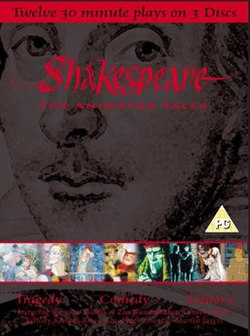
DVD box art for “Shakespeare the Animated Tales.”
To check out other episodes in the series, view this playlist:
Basics Of Stage Combat: Students will learn the basics of safely enacting a fight onstage, in preparation for a Shakespeare play. We will also learn about the history of sword fighting in the military and the duel.
Trailer for Basics of Stage Combat.
My daughter really enjoyed taking this class. She was actually able to use her sabre and try out her routine on her father. Paul is quite knowledgeable about Shakespeare and made the class really fun by teaching a fight scene from Romeo and Juliet. It is amazing watching her practice with Paul over Zoom. I hope Paul will have. more combat classes, it is a different way to learn Shakespeare.
IB, Parent
An Interactive Guide To Shakespeare’s London (New Class)
A virtual tour of Shakespeare’s London will get kids to interact with the culture of Elizabethan England.
Class Experience
To teach kids about the Elizabethan era and the background of Romeo and Juliet, The Instructor will interact with the class (via pre-recorded videos), pretending to be Shakespeare. The class, pretending to be actors in Romeo and Juliet, will get a virtual tour of The Globe Theater, Hampton Court Palace, and a virtual visit to an Elizabethan doctor's office. This activity is an immersive way for them to learn about the period, how it relates to the world of the play, and how Shakespeare changed theater.

The class will take the form of a guided WebQuest activity.  First, the students will get a worksheet that has a series of fill-in-the-blanks about Elizabethan society (below). The students will fill out this worksheet based on a Nearpod and in conjunction with a website I’ve made, https://sites.google.com/nebobcats.org/visit-to-elizabethan-london/home?authuser=0
Both the Nearpod and each webpage will have a virtual tour, a video, and text explaining some aspects of Elizabethan life. Before they go to each location, I will give a short introduction via prerecorded video:
Wizard Science
In this one-hour course, your child will discover the enchanting world of science through a series of magical experiments. Learn about such topics as Astronomy, Static Electricity, chemistry, and optical illusions.
In this one-hour course, students will learn and play games that will explore the history behind Christmas traditions. We will also discuss the themes, characters, and famous quotes from Shakespeare’s play “Twelfth Night.”
Today I pay tribute to a remarkable book written by a great actor, who has inspired me and countless others.
I was privileged back in 2011 to see Anthony Sher on stage playing is playing Edmund Kean in John Paul Sartre’s pastiche of Shakespeare entitled “Kean.” It was a very good casting because this actor very clearly had a lot of raw energy and at the same time charisma and wit. But at the same time, he also seemed to have tenderness, sadness, and insecurity behind his eyes. I didn’t realize it but this actor, Sir Antony Sher, who sadly passed away just last year, would change my life.
When I was still in college I knew that I was going to go to grad school, and I wanted to write a graduate thesis on Richard III. Through my research, I came to realize that this same actor produced what is still regarded it as one most acclaimed and influential productions of the play ever. In 1984, Sir Antony played an iconic Richard III at the Royal Shakespeare Company which was revolutionary for its raw energy, tragic emotions, and creative physicality. Mr. Sher played the role on crutches and was able to scuttle around the stage like a spider.
I feel very therefore very privileged that I was able to see him perform live and to research his performance for my thesis.
One of my greatest aids for this was Sir Antony’s own book about the process of writing Richard that he wrote while in the process of doing Richard, “A Year Of the King. It’s organized in the form of a diary and a lot of the pages are available for free on Google Books. I strongly recommend it. In this review, I’m going to praise his massive preparations for the role and talk about the effects of the production going forward in future productions of Richard III.
In 1982, Sir Antony was playing the Fool in a production of King Lear with Michael Gambon, (the future Dumbledore from Harry Potter). During the performance, Sher suffered a leg injury that required him to be on crutches for several months. In his diary, Sher records how angry being perceived as disabled made him feel. His physical therapy took place at the Remedial Dance Clinic, Harley St.
Six months later in August of 1983 Sher was cast in Tartuffe with Bill Alexander as director, (who would later direct him again in Richard III). A chance meeting with Trevor Nunn, (who was the Artistic director at the time), put the idea of Sher playing Richard into Alexander’s head. After another meeting with Terry Hands, Sher was offered the role.
Sher rehearsing for Richard.
“The truth of the matter was I was terrified of the verse, ashamed of my inexperience with it and nursing a fear that I was trespassing anyway. Wasn’t classical theatre the territory of handsome, rich-voiced Brittish giants like Gielgud and Oliver, and out of bounds for little Cape Town newbies like me?”
Sher, Year Of the King, page 9
Fighting with Olivier
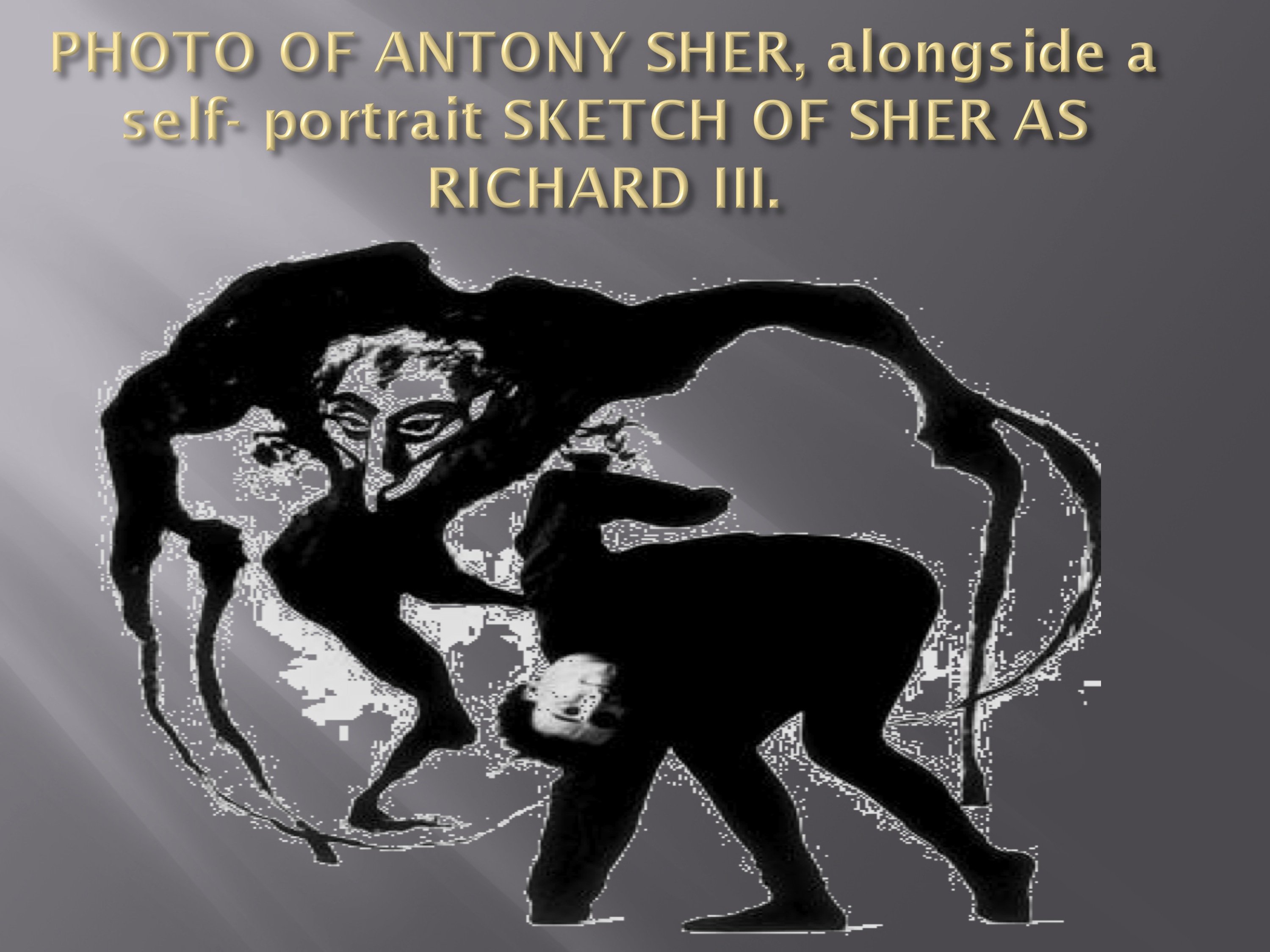
Drawing of Olivier’s iconic Richard by Antony Sher, 1983.
When Antony Sher approached the role of Richard in his 1984 RSC production, his first intention was to make his portrayal of Richard’s deformity and disability different from Laurence Olivier’s. Sher and Olivier believed Richard is both physically and mentally deformed, therefore, Sher’s massive preparation for the role included thorough research into the physical effects of real disability and a deep examination of its psychological effects.
Unlike Olivier, Mr. Sher believed that Richard’s deformity was the key to understanding his character and that every aspect of Sher’s characterization stemmed from his interpretation of that deformity. This work produced a captivating physical characterization and a startlingly human re-conception of Richard’s mind.
The Physicality
Sher’s characterization of Richard’s body resulted in an image, which he referred to as “The Bottled Spider.” Richard had a massive hump in the center of his back, massive arms, and two crutches that fitted onto Sher’s forearms, allowing him to scuttle across the stage, giving the impression of a poisonous spider. Sher created this iconic physical characterization through a combination of textual research, sketches, medical research into real deformities, image research, and real-life experience. The guiding principles that Sher used in creating Richard’s deformity were creating a severely deformed character that the audience would identify with. At the same time, Sher attempted to create a physicality that he could sustain through the run of the show without major injuries (21 &30). According to Sher, the role of Richard III is notorious for crippling actors who sustain severe damage to their backs and shoulders (39). Thus Antony Sher’s Richard was physically designed to be both functional for the actor, as well as realistic and remarkable for the audience.
The first step towards Sher’s physical characterization of Richard was going through the text for clues. Sher found several references to what Richard’s deformity looks like in the speeches of Queen Margaret. Margaret refers to Richard repeatedly as various beasts, alternating between boars, hounds, and the bottled spider that would become so important to the final characterization. Before Sher settled on a spider as the animal Richard most resembles, he experimented with several others, including boars, apes and bulls. Sher did several sketches of bulls, which he saw in a BBC TV program. Sher was attracted to bulls and their raw power and massive shoulders. Sher wanted an animal that was threatening and powerful to give his portrayal a ‘tragic dimension’ (64).
Having to say ‘I was born in South Africa’ stuck in my throat like a confession of guilt.’
Sher, p. 25
Another image from the text that Sher thought about repeatedly was the image of Richard’s hump as a mountain. When Richard refers to his hump as “an envious mountain on my back,” Sher thought back to the Lion’s Head mountain in Kingstown South Africa. Sher grew up in South Africa and visited there during apartheid. The mountain spoke to Sher’s notion of Richard’s raw, tragic power. Sher sketched the mountain several times, and combined it with other images of bulls and spiders and this became the overall concept for Richard’s hump- an image of thick power that simultaneously weighs down the figure of Richard, and gives him his strength.
I feel he should be severely deformed, not just politely crippled as he’s often played. Bill says one should identify with him: a man looking in from the outside and thinking, ‘I’ll have some of that.’
November 7, 1983
Sher and Brian Blessed in the final play.
The most memorable part of Sher’s physical performance as Richard was the way he manipulated the two arm crutches that he wore for the first half of the performance. Sher’s Bottled Spider image mainly depended on his ability to manipulate the crutches. The crutches became part of Richard’s body (Cerasano 621) and, far from making Sher’s movements clumsy or stiff, they gave him the ability to transform himself into a strange four-legged creature that would move around the stage incredibly fast.
Director Bill Alexander told Sher during rehearsals that he intended to use the crutches in as many ways as possible. For example, the crutches also served as a weapon because of Sher’s ability to swing them around like clubs. One chilling moment of the performance occurred when Sher’s Richard entraps lord Hastings (Brian Blessed) by folding his crutch-arm across Hasting’s neck; foreshadowing Richard’s later decision to chop off Hastings’ head (Cerasano 621).
The problem in playing him extremely deformed is to devise a position that would be 100 per-cent safe to sustain over three hours, and for a run that could last for two years. Play him on crutches perhaps? They would take a lot of the strain off the danger areas: lower back, pelvis and legs. And my arms are quite strong after months at the gym. Also I was on crutches for months after the operation so they have a personal association for me of being disabled. They could be permanently part of Richard tied to his arms. The line, ‘Behold mine arm is like a blasted sapling wither’d up,’ could refer to one of them literally. The crutches idea is attractive, too attractive at this early stage. Must keep an open mind on the subject.
Sunday Nov, 19, 1983
Physical therapist Charlette Arnold, helped Sher get into clinics for people with real disabilities. She also provided Sher with books on back disorders, which led Sher to choose the disorder Kyphosis as the model for Richard’s hump. Kyphosis causes a large central hump in the back, which Sher immediately adopted because it resembled the mountain image of his sketches. Also, the central hump was different from Olivier’s side hump.
Sher’s research on back disorders was of great use in the coronation scene in which he and Lady Anne appear with bare backs. Bill Alexander hired makeup artist Christopher Tucker to create a lifelike prosthetic for Richard’s back. The audience was thus forced to see Richard as a naked, deformed man, contrasted next to the beautiful bare back of his wife, creating a powerful moment that re-enforced Richard’s humanity. Sher would also use a humanistic approach to his portrayal of Richard’s mind, which, like Richard’s body, he developed through extensive research.
Richard (Antony Sher) is killed by Henry Tudor at the play’s conclusion.
Psychology- Richard III on the couch
“In several copies I’ve looked at it’s called The Tragedy of King Richard the Third. Yet a tradition has evolved of playing it as black comedy. I’ve never seen anyone play Richard’s pain, his anger, his bitterness, all of which is abundant in the text. It seems to me that Richard’s personality has been deeply and dangerously affected by his deformity, and that one has to show this connection.
November 19, 1983 p. 30
In his research, Sher made the link between deformity and psychopathology. Unlike Oliver, who played Richard as a paranoic, Sher played Richard as a psychopath. In his research into psychopaths, Sher uncovered the idea that psychopaths often suffer childhood traumas. The text of Richard suggests that Richard’s mother hated him, and such a lack of affection could realistically change a boy into a psychopath. Through this probing of the text and research into psychology, Sher concluded that Richard’s deformity is a realistic source of desire for revenge.
Sher talked to his own psychiatrist, Monty Berman who provided him with insight into Richard’s mind. Monty helped Sher dispel the idea that Richard is a superhuman fiend. On the contrary, Richard’s persona is very similar to real live psychopaths. Berman theorized that the pain at being deformed, coupled with the violent upbringing Richard living through in the Wars of the Roses, could transform him into a remorseless killer.
Sher: “How do you explain Richard the Third then?” Monty: “Well, how did you feel when you were on crutches last year?” Sher: “I hated people staring at me.” Monty: “What did you want to say to them?” Sher: “F#$% off! What are you staring at?” Monty: “Precisely. Anger. Richard is revenging himself on the whole world, destroying a world he sees as hating him.”
Monty: “We treat the disabled appallingly. They come up against dreadful prejudice. The disabled person experiences frustration and if given the chance, will lash out.” Sher: “So are you saying Richard’s behavior is normal?” Monty: “Under the circumstances, absolutely normal.”
Sher and Berman also believe Richard has the humor of a psychopath- a sardonic wit that has no regard for the feelings of his audience. Sher looked at the parallels between Richard III, and serial killer David Nilsen, who would invite people over for tea and strangle them, and boil their heads on his stove. Nilsen once told police with Richard-like humor that; “Having corpses was better than going back to an empty house.” One could easily hear the same sort of gruesome wit in the phrase: “I do love thee so, that I shall shortly send thy soul to heaven,” (R3 I,i).
A psychopath like Richard kills in order to try and feel emotion; “Each murder is an attempt to release anger, an attempt at catharsis, and each time it is unrelieved. It’s like promiscuous sex without love. Each climax is less and less fulfilling so the appetite grows until it is insatiable.” Thus Berman allowed Sher to break with the tradition of playing Richard as an inhuman monster, and play him as a very real, very tortured, human soul.
Although Antony Sher attempted to play Richard as a psychopath, his portrayal of Richard’s pain could become sympathetic. His observation of people in clinics and his own personal experience of being on crutches taught him about the cruelty that the disabled suffer. However, although he did great work to try and understand the condition of being deformed and disabled, his portrayal was still an affected disability; an act. In the book “Framed: Interpreting Disability in Today’s Media,” the author speaks about how watching an able bodied actor play disability can actually alienate the audience from the character he is portraying. The performance is seen as an act, a novelty, not an honest representation of real people. One way to eliminate this barrier between character and actor is to cast a Richard who really does suffer from a disability or deformity. I’ve talked in previous posts about how last month’s Public Theater performance was a deliberate attempt to move away from theatrical illusion and re-contextualize Richard’s deformity in the form of race, and contextualize disability by letting actors with disabilities play the heroic parts, while only Richard was able-bodied.
In a way, like Olivier, Sher’s performance is a new monolith that actors must work hard to distinguish themselves from. He spent an entire year building his Richard from the ground up, experimenting with new ways to portray his deformities, his disability, his psychology, and of course, how he looks and moves onstage. Reading this book, an actor gets a great appreciation for all the work Sir Antony Sher included in this wonderful performance, and hopefully, the book will inspire new and creative ways to portray this character in the future.
Thank you for reading. If you want to see some of Sher’s physical and psychological techniques in practice, please watch the thesis presentation that I did at the Blackfriars playhouse below. If you are interested in signing up for one of my acting courses, click here. Thank you!
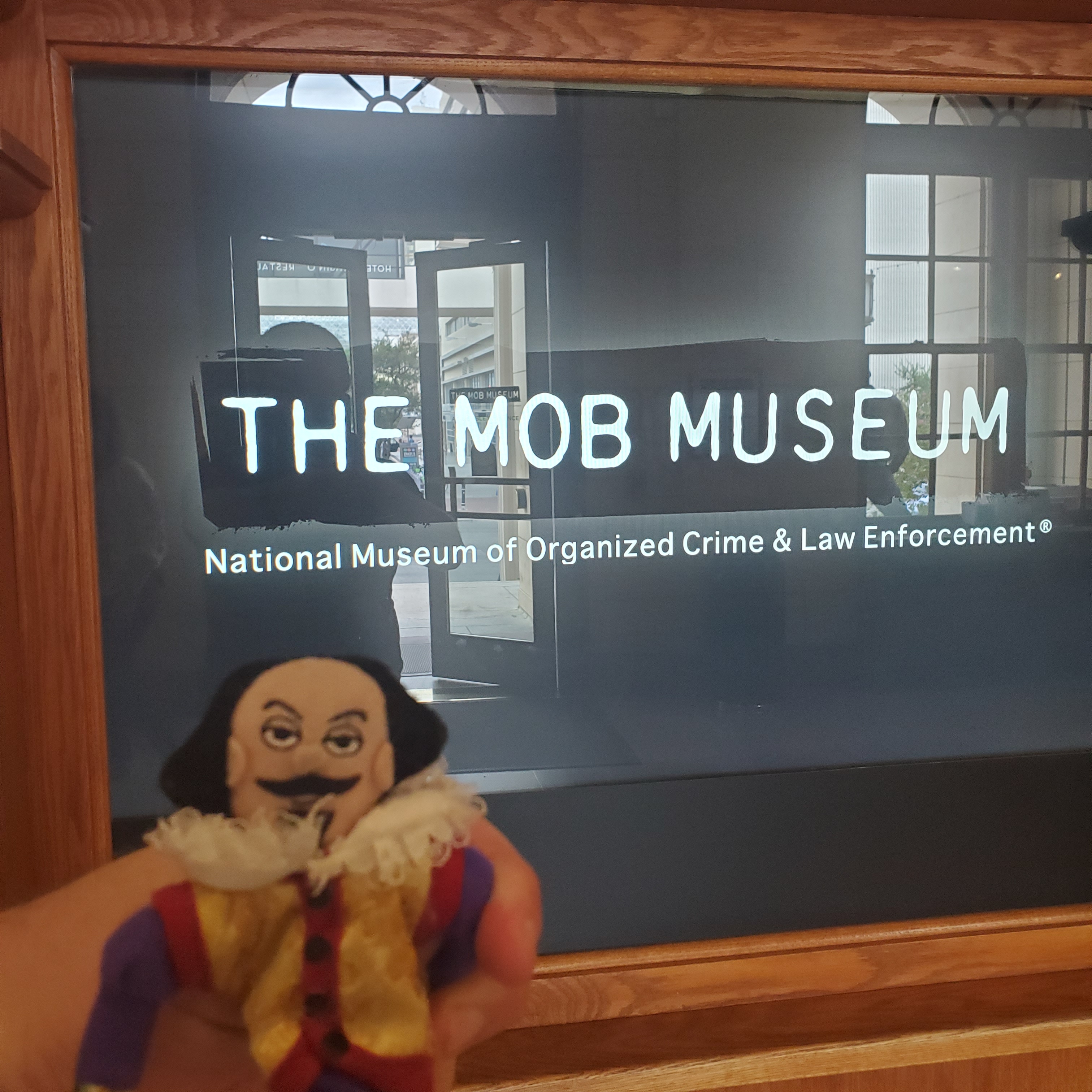
Last month, I took a short vacation to Las Vegas, where, as some of you know, I went to Area 15 and the Omega Mart Exhibit. I also visited the Las Vegas Mob Museum. I’ve been fascinated by the mob for years. The Mob (AKA The Outfit), has within its many threads a potent combination of corruption, seduction vice, and violence all hidden behind the veneer of honorable men who do what they feel they have to to protect their families and their communities.
Not surprisingly, while at the museum, I saw parallels between the history of organized crime and Shakespeare, specifically his most popular history play about a powerful family that takes over the crown of England in a brutal turf war, and then one of its most feared soldiers bribes, intimidates, and murders his way to the top; Richard III.
A Protection Racket: Feudalism vs. La Cosa Nostra
The structure of the mafia paralleled the feudal system. In a world where a police force didn’t offer much protection for marginalized communities, the mafia thrived by offering protection for these communities, (especially to immigrants and people of color in the 19th and early 20th century).
Much earlier than that, the feudal system of the middle ages, which started to crumble after Richard’s reign ended, was designed specifically so poor peasants could get protection from wealthy landowners after the fall of the Roman Empire. These lords offered the protection of their knights to these peasants i. Return for labor and a percentage of their income working the field. Like the mafia, these peasants paid tributes to their lords and these lords demanded loyalty. In the museum, there’s an interactive video where you can become a ‘made man,’ which means become an official member of a mafia crew. Like a king knighting a lord, this ceremony meant pledging your life to your superiors, and being at their beck and call no matter what. In addition, like medieval knights, mafiosos were not allowed to murder other made men without permission from their capo or boss.
However benevolent they might appear, In both cases the Dons and the medieval lords were extorting their underclass. Failing to pay tribute to their lords would cause the peasants to lose their lands, and any disloyalty to the mafia would be severely punished. These powerful, violent thugs used their private armies to intimidate the weak into giving them what they wanted.
Part II: The Two Families
To thoroughly explain the parallels between the Wars of the Roses and the mob, I need to make clear that Richard iii is more than just the story of one man’s rise to power, although there are also mafia stories that fit this mold such as Scarface, White Heat, and the real-life story of Al Capone.
As this hilarious “weather report” from “Horrible Histories,” makes clear, during the Wars of the Roses two powerful families, (each with a claim to the English crown) fought each other in a brutal turf war. As Shakespeare characterizes in his play Henry VI, Part III, the battles between the houses of York and Lancaster shook England like a mighty storm, and for a while it was hard to tell who would prevail:
Henry VI. This battle fares like to the morning's war,
When dying clouds contend with growing light,
What time the shepherd, blowing of his nails,1105
Can neither call it perfect day nor night.
Now sways it this way, like a mighty sea
Forced by the tide to combat with the wind;
Now sways it that way, like the selfsame sea
Forced to retire by fury of the wind:1110
Sometime the flood prevails, and then the wind;
Now one the better, then another best;
Both tugging to be victors, breast to breast,
Yet neither conqueror nor conquered:
So is the equal of this fell war.
Henry VI, Act II, Scene i
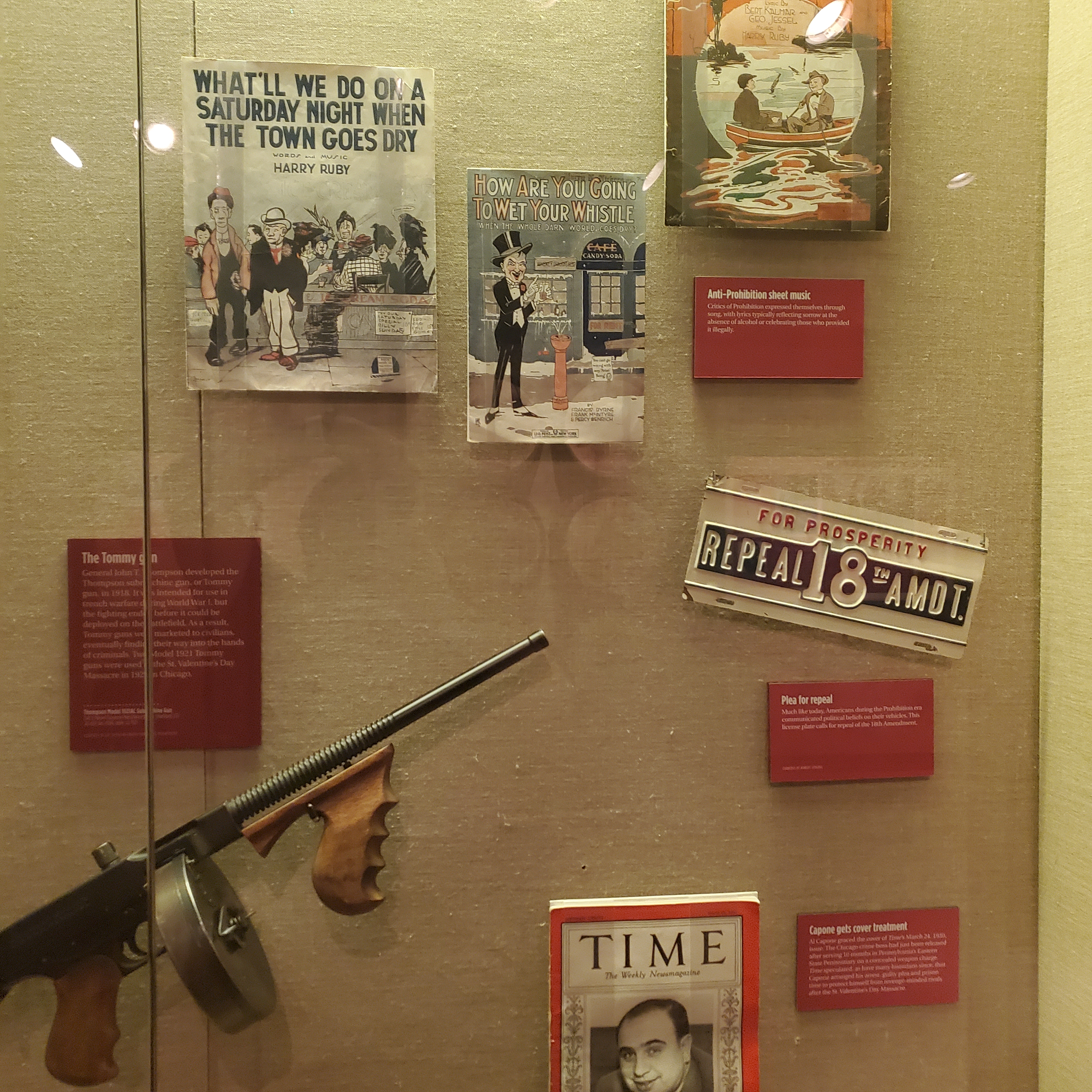
During the Wars of the Roses, it was King Henry’s incompetence and mental illness that gave the Yorkists the ability to challenge the House of Lancaster for the crown. In the 1920s, the passage of the 18th amendment, (which made alcohol illegal, and thus a profitable commodity for organized crime), that allowed the mob to rise to unheard-of power through illegally buying, distributing, and selling alcohol. As the photo and subsequent video shows, Prohibition largely led to the rise in organized crime in America, especially in Chicago. During Prohibition, the Italian Sough-side Gang fought for control of Chicago’s bootlegging trade and subsequently destroyed their competition from the Irish gangs through corruption, intimidation, and violence.
The Don rises- Richard Vs. Al Capone
Opening Scene from Ian Mckellen’s 1995 movie of Richard III.
Like the Italian and Irish gangs In Prohibition-era Chicago, the Yorkist and Lancastrian armies battled for the English throne. As Ian McKellen’s excellent movie (set in the 1930s) shows, Richard was instrumental in destroying the leading Lancastrians at the Battle of Tewkesbury, including Prince Edward and King Henry.
In Chicago, the most feared mobster soldier was Al Capone, who many scholars believe was responsible for killing off high ranking members of the Irish gang during the infamous St. Valentines Day Massacre, where the gang members were ‘arrested’ by South Side gangsters disguised as cops. As the Irish stood against the wall with their hands behind their heads, the phony cops pulled out Tommy guns from their coats and let out a hail of bullets on their unsuspecting quarry.
In Shakespeare’s play, the only Lancastrian to survive the war is Queen Margaret, wife to the murdered King Henry, and mother to the slaughtered Prince Edward. In this scene from Al Pacino’s “Looking For Richard,” she curses Richard for his cruel slaughters. It’s not surprising that Pacino was so drawn to Richard II that he starred in and directed this film. After all, Pacino is famous for playing mafia characters who slaughter their way to the top.
Once Capone killed the competition, he ruled a multimillion-dollar empire of bootleggers and maintained that empire through corruption, intimidation, and by constantly playing innocent, just like Richard himself.
Hypocrisy, Corruption and hidden violence
“Men in general judge more by the sense of sight than by the sense of touch, because everyone can see, but few can test by feeling. Everyone sees what you seem to be, few know what you really are; and those few do not dare take a stand against the general opinion.”
Niccolo Machiavelli
Both Richard III and mobsters are masters of double-speak, that is, seeming to say one thing and meaning something else. Look at this passage where Richard talks about killing his nephew, then denies it:
Richard III (Duke of Gloucester). I say, without characters, fame lives long. [Aside] Thus, like the formal vice, Iniquity, I moralize two meanings in one word.
Las Vegas: The town that bedded and abetted the mob.
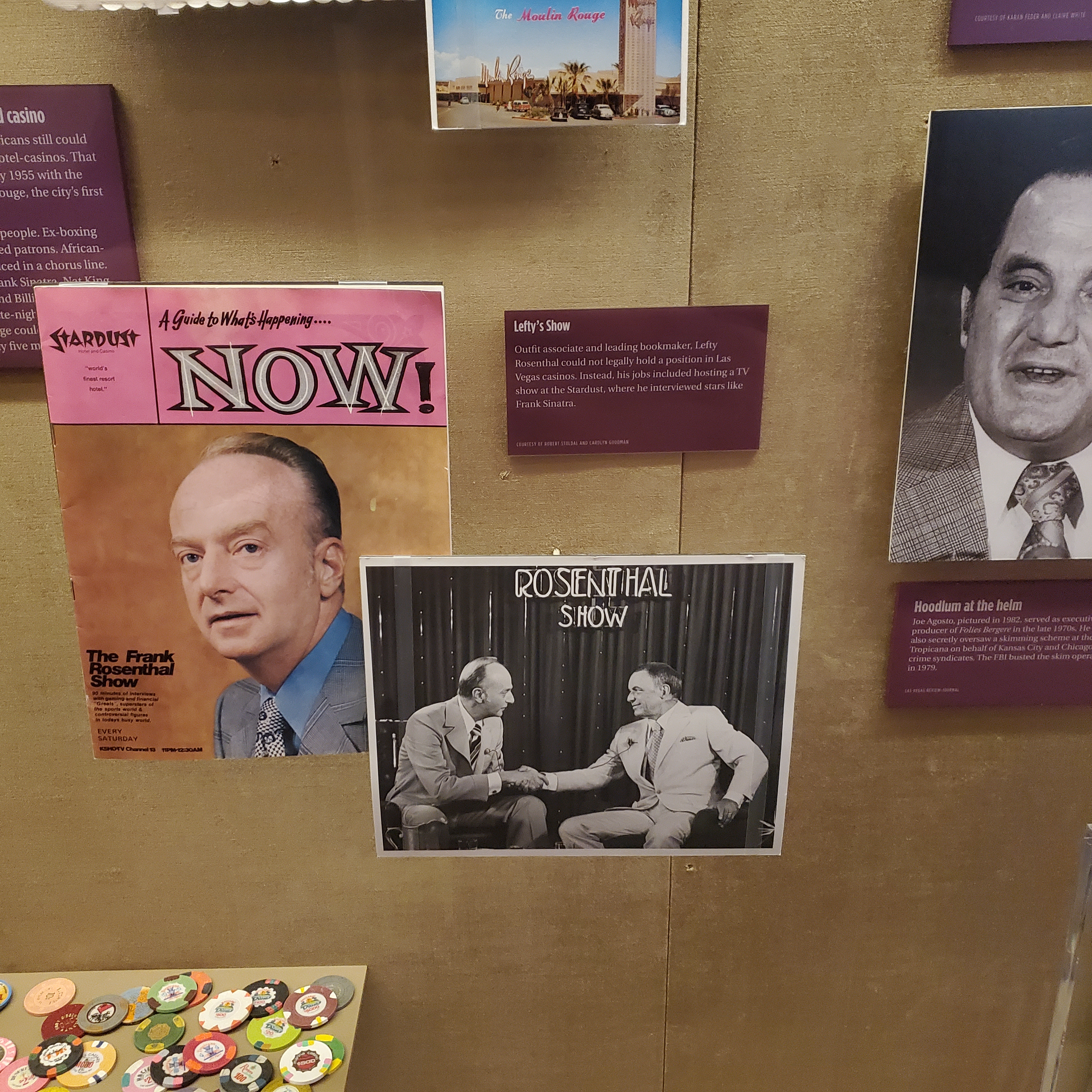
Photos from the museum that shows how the mob-controlled most of the Vegas casinos and skimmed casino profits illegally.
After Al Capone’s demise and the repeal of Prohibition, the mafia found another vice to capitalize on: gambling. As the video below indicates, using their connections with the Teamsters Union and midwestern bookmakers, the mob in the midwest financed, built, and run almost every casino in Las Vegas, including The StarDust and the Hassienda. Once the casinos were built, the mob extorted millions of dollars from the casinos every month!
The profits from the casinos bought the mob even more power and influence, but this skim depended on making sure the bosses controlled their underlings, and defended their casinos from cheaters and snitches, which is why they defended their casinos through intimidation and violence.
Murders in The White tower and the city of sin.
A series of quotes from Las Vegas Mobsters
“Simple, plain, Clarence. I do love thee so, that I shall shortly send thy soul to Heaven.”
—Richard III, Act I, Scene i
When Richard of Gloucester starts his quest to become king, he begins by convincing his brother King Edward to execute his other brother George. Richard bribes the murderers to kill George before the king can reverse the death sentence. Richard has thus eliminated another obstacle in his way, and gained two loyal followers who will do anything for his gold.
Richard hires two murderers to kill the duke of Clarence (Nigel Hawthorne).
The mafia dealt the same way with traitors, stool pigeons, and anyone who tried to challenge the bosses. Look at this tour of the Mafia museum, where the grandson of the gangster Meyer Lansky starts by reminiscing about the glamourous lifestyle of Las Vegas mobsters, but the tour quickly takes a dark turn as Lansky II talks about how his grandfather ordered brutal executions for anyone who crossed The Las Vegas Outfit.
Exterior of the Mafia Museum
It was an enormously interesting trip going to the Mafia Museum, and if you can get out to Las Vegas, be sure to visit, (don’t forget the password to visit the speakeasy bar in the basement!) It was eye-opening for me how prevalent the sort of corrupt protection racket that started in the middle ages and continued into most of the 20th century helped define The Wars of the Roses and the mafia. As long as the strong prey on the weak and the law can’t protect everyone equally, these kinds of violent thugs will be lurking in the shadows, waiting for a shot at the crown.
































 The Shakespearean Student