Why Everyone Should Read (Or Teach) “The Merchant Of Venice.”

I am disgusted by the recent violence in Charlottesville VA. The fact that in 2017, White supremacists threatened, hurt, and killed innocent Americans is despicable and truly disheartening. I won’t go into my political views here since this tragedy transcends politics and forces everyone in this country to re-examine who we are and what we stand for as a people, and do our part to help prevent this kind of mindless hatred.

I’m not a politician, I’m not a policeman. My area of expertise is Shakespeare, so I am going to try to make a case for why the study of Shakespeare can help people, (especially young people), learn about the world, examine new points of view, and try to improve the world. I will then add a list of resources for teachers and students to deepen your understanding of the play.

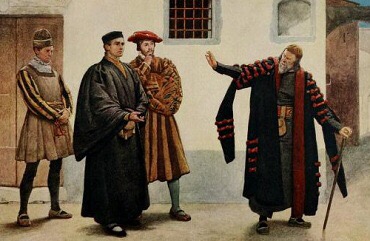
My first argument for the play is that Merchant has two of the best speeches about intolerance ever written.

You’ve probably heard of this speech, (spoken by the Jewish moneylender Shylock), and I’m also well aware of the fact that, in context, it is not entirely about peaceful coexistence and tolerance, but it nevertheless establishes Shakespeare’s argument that condemns bigotry and violence, particularly against Jews:

Hath not a Jew eyes? hath not a Jew hands, organs,
dimensions, senses, affections, passions? fed with
the same food, hurt with the same weapons, subject
to the same diseases, healed by the same means,
warmed and cooled by the same winter and summer, as
a Christian is? If you prick us, do we not bleed?
if you tickle us, do we not laugh? if you poison
us, do we not die? and if you wrong us, shall we not
revenge? If we are like you in the rest, we will
resemble you in that. If a Jew wrong a Christian,
what is his humility? Revenge. If a Christian
wrong a Jew, what should his sufferance be by
Christian example? Why, revenge. The villany you
teach me, I will execute, and it shall go hard but I
will better the instruction.
Merchant, Act III, Scene i.
img_5431

Al Pacino when he did this speech said that it has the eloquence and power of Dr. Martin Luther King. Patrick Stewart initially had the same reaction, but later realized that Shylock turns midway through and the speech becomes a justification for revenge. What’s clever here is that Shakespeare manages to give Shylock two good arguments against bigotry; by emphasizing how Jews are no different than any other racial or religious group, and also warning that oppressing a people will only result in more retribution and pain on both sides. This is what he means when he says: “The villainy you teach me, I will execute.” We’re seeing this sort of reaction right now with the recent surge of violence by both white supremacists and the Antifa; without tolerance and common decency, chaos and bloodshed reins.

Another speech, much less well-known, is this speech of the Prince Of Morocco, one of Shakespeare’s only black characters. The speech below is the first time he speaks while attempting to woo the heroine Portia:

Prince of Morocco. Mislike me not for my complexion,
The shadow’d livery of the burnish’d sun,
To whom I am a neighbour and near bred.
Bring me the fairest creature northward born,
Where Phoebus’ fire scarce thaws the icicles,
And let us make incision for your love,
To prove whose blood is reddest, his or mine.
I tell thee, lady, this aspect of mine
Hath fear’d the valiant: by my love I swear
The best-regarded virgins of our clime
Have loved it too: I would not change this hue,
Except to steal your thoughts, my gentle queen. Merchant Of Venice, Act II, Scene i.

People often forget that this speech condemns pre-judging a person based on the color of their skin. Morocco tells Portia, (who in all probability has never seen a black man before), to not judge him by his appearance. His tone is gentle, but it is not apologetic. He says he won’t change his skin color for anything, (except maybe if it would win her heart). The Prince is a dignified and proud representative of his country and his race.

My second argument for reading or teaching this play is that it reveals how bigotry and racism is usually tied to money and profit. In Act IV, Scene i, Shylock points out the hypocrisy of his Christian brethren in keeping slaves, which they justify by saying that they are not people, but property:

  • Shylock. You have among you many a purchased slave, Which, like your asses and your dogs and mules, You use in abject and in slavish parts, Because you bought them: shall I say to you, Let them be free, marry them to your heirs? Why sweat they under burthens? let their beds Be made as soft as yours and let their palates Be season’d with such viands? You will answer ‘The slaves are ours:’ so do I answer you: The pound of flesh, which I demand of him, Is dearly bought; ’tis mine and I will have it. If you deny me, fie upon your law! There is no force in the decrees of Venice. I stand for judgment: answer; shall I have it? Merchant, Act IV, Scene i.

Shylock turns this hypocrisy back on the Christians by saying basically, “How can you call me inhuman when you debase and subjugate your fellow creatures?” The answer to both questions of course, is that it is economically convenient. Shylock earns his money by lending money at interest, and threatens dear penalties if not repaid on time. Similarly, the Christians need Shylock because their religious practices forbid them from lending money, so they have to go to him instead of other Christians. We see echoes of this unfortunate tendency today: the white supremacists in Charlottesville were chanting: “Jews will not replace us,” which clearly exposes their fear of losing political and economic influence to minorities. In addition, our country has refused countless immigrants from poor, war-torn countries which we justify to ourselves by saying the cost of letting them in is too great.

The play’s comic sub-plot also has many lessons for today’s world. The hero Bassanio undergoes dramatic transformation from a spoiled prodigal son to enlightened married man. At the play’s beginning, he has a close friendship with the merchant Antonio, that might be played as a one sided homosexual relationship. Antonio is very affectionate to Bassanio, and lends him a large amount of money without any expectation of repayment, which has sometimes been interpreted as a hinting of Antonio’s unrequited love for Bassanio. Though Basanio doesn’t reciprocate any romantic feelings, he eventually saves Antonio’s life, and at least tries to repay him for his kindness.

robert-alexander-hillingford-the-three-caskets--the-merchant-of-venice,-act-iii,-scene-ii
Robert Alexander-Hillingford: The Three Caskets, The Merchant Of Venice, Act III, Sceneii

Bassanio also takes a very feminist attitude towards the play’s heroine Portia- he understands that being married means making your spouse a partner, and giving her an equal say. At the beginning of the play, he sails to an island called Belmont, to try to win Portia’s hand, by correctly solving a riddle. You may have heard of the three caskets, gold, silver, and lead. If Bassanio guesses right, he wins Portia and her fortune. Bassanio chooses the correct casket, but halts afterwards, and does something unexpected; he asks Portia herself if she wants to marry him. He doesn’t treat her as his prize, and throughout the play asks her opinion, and her permission before he acts, just as a good husband should.

Fair lady, by your leave;
I come by note, to give and to receive.
Like one of two contending in a prize,
That thinks he hath done well in people’s eyes,
Hearing applause and universal shout,
Giddy in spirit, still gazing in a doubt
Whether these pearls of praise be his or no;
So, thrice fair lady, stand I, even so;
As doubtful whether what I see be true,
Until confirm’d, sign’d, ratified by you. Merchant Of Venice, Act III, Scene ii

I would argue that, although Portia is a far more important character, Bassanio is the moral center of the play. He is the only person who treats Shylock like a human being, by trying to reason with him and pay Antonio’s debt, instead of spitting in Shylock’s face like Antonio, or forcing him to convert like the characters at the end of the play. Bassanio also is one of the only characters who call Shylock by name, everyone else just calls him “Jew.” Thus, audiences and students can learn from this kind of person; the kind of person Christ said could be saved and become a true Christian, because he acknowledges his sins and tries to correct them. Bassanio is the prodigal son in this play, and we benefit from the parable of his life.

By contrast, some of the other characters, Christian and Jewish, are examples of the kind of morality that we all wish to discourage in our children, and society in general. Though they are outwardly pious, the Christians like Antonio and Portia, are capable of vindictive, cruel, and definitely impious behavior. Portia, (probably due to her sheltered life on Belmont), can be deeply racist and prejudicial. She is prejudiced against the Prince of Morocco because of his race, hoping that “All of his complexion,” will fail to win her love. In addition, when she poses as a judge presiding over the court case between Antonio and Shylock, she throws vengeance at Shylock, even though she barely knows either of them. She strips Shylock of his property and nearly gets him sentenced to death, even though she preaches mercy to him in her most famous speech. If you look at the contrast between her words and actions, she is a deeply hypocritical person. Shakespeare shows how toxic it can be to raise a child in an isolated environment. Portia’s isolation makes it harder for Portia to relate to and understand different types of people, and it planted her predjudices within her heart.

Antonio for his part, seems to define himself by how “un-Jewish” he is, believing that generosity and mercy are anathema to all Jews, particularly when Shylock confronts Antonio in the courtroom:

I pray you, think you question with the Jew:
You may as well go stand upon the beach
And bid the main flood bate his usual height;
You may as well use question with the wolf
Why he hath made the ewe bleat for the lamb;
You may as well forbid the mountain pines
To wag their high tops and to make no noise,
When they are fretten with the gusts of heaven;
You may as well do anything most hard,
As seek to soften that—than which what’s harder?—
His Jewish heart: therefore, I do beseech you,
Make no more offers, use no farther means, Merchant, Act IV, Scene i.

Although Jesus preached loving ones neighbor, and being the Good Samaritan to other religions, Antonio seems to think that being a true Christian, means being Anti-Jew. He is a counter example of piety that audiences and students can learn to mollify and avoid within themselves.

My final example of religious counter examples, Shylock himself, shows how prejudice can destroy a man if he lets it. At the beginning of the play, Shylock has had to endure losing his wife, having Antonio spit on him, mock him, encourage his enemies, and call him a host of dehuminizing names. That’s not even taking into account the horrible Venetian ghettos of the 1590s, in which Shylock would have been forced to live were he a real Venetian Jew. One quote that helps explain his behavior comes from Henry Norman Hudson in 1882:

[In Shylock] “we see the remains of a great and noble nature, out of which all the genial sap of humanity has been pressed by accumulated injuries.” – Shakespeare: His Life, Art, and Characters, H. N. Hudson, Ginn and Company, Boston, p. 291. “

Scholars and actors have emphasized ever since the end of the Second World War, that, although Shylock is still guilty of reprehensible acts, his cruelty is a reaction to the cruelty he has had to endure, or as he puts it: “The villainy you teach me, I will execute.
img_5433
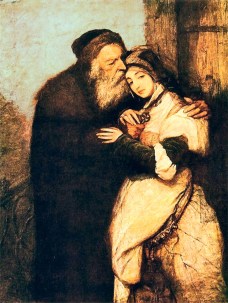
Maurycy Gottlieb: “Shylock and Jessica,” 1876

Shylock’s lack of joy and love manifests itself by the way he treats everyone in the play. He keeps his daughter locked away from anyone, which later compels her to run away with the Christian Lorenzo, (while stealing a huge amount of Shylock’s money). Shylock then rages against the citizens of Venice, especially Antonio, whom he blames for his losses, and concocts a plan to kill him by taking a pound of flesh away from his heart.

Shylock’s pain and hardships have turned him into the kind of bloodthirsty Jewish stereotype his enemies have always assumed to be. At the same time, he constantly points out the cruelty and hypocrisy of Christians, calling them no better than himself. In the end though, through Portia and the Duke sentencing Shylock to will his money to Lorenzo, and convert to Christianity, Shylock has to become what he hates, and surround himself with people who will never accept him; an ending that fills the audience with pity and maybe even remorse.

Now, there are compelling arguments that teaching this play can actually encourage stereotypes, which it can, and has in ages past. I read several articles that debate this issue in various ways. I’d like to discuss two articles written within one year of each other that are particularly fascinating. The first one was an article from The New Yorker by Professor Steven Greenblatt, who claimed that Merchant is “Shakespeare’s Cure For Xenophobia.” The other was a Washington Post article that argues that in the interest of keeping negative Jewish stereotypes from perpetuating themselves, this play should be ignored altogether.

On the other hand, as Professor Greenblatt says, the genius of the play is that it shows stereotypes, but it also shows the people under them. If you compare Shylock in The Merchant Of Venice, to other contemporary Jewish characters like Barrabas in Marlowe’s Jew Of Malta, he is a much more compelling, complete, interesting, and at times moving character. Love him or hate him, Shylock inevitably gets under your skin. He’s a man who strips the varnish off our culture and exposes the hypocrisy, greed, and prejudice that lurk just beneath the waters of the Rialto, (as well as the modern Potomac and the Hudson). The saving grace of this play is that it forces us to examine ourselves- how do we treat people, how do we see people who are different than us? What makes our points of view good and bad, and what can we do to heal our misunderstandings? Though this play cannot answer these questions, it encourages us to confront them, to open a dialogue, and hopefully, open avenues for change.

Artwork: For a wonderful selection of pictures of Portia, please visit: http://themerchantofveniceportia.weebly.com/fair-portias-counterfeit.html
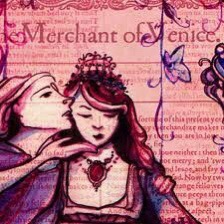
Elizabeth Shuh: “Merchant Of Venice.” Reprinted with permission from Immortal Longings.com
Portrait of Edmund Keene as Shylock, circa 1815
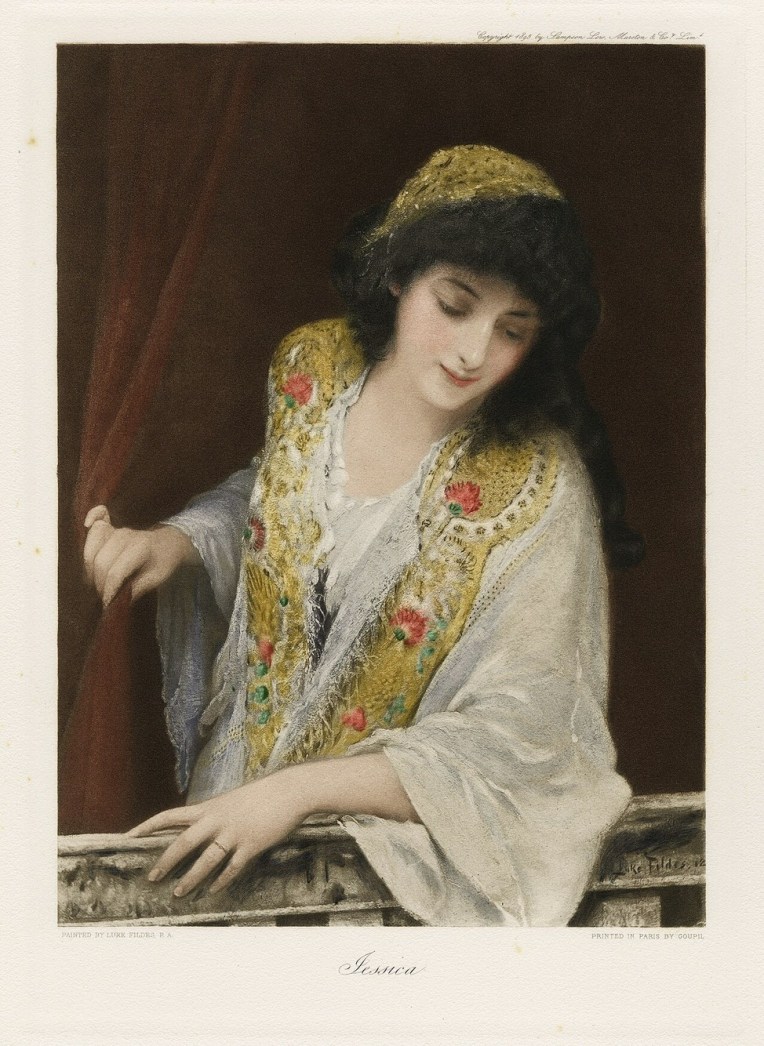
Portrait of Jessica by Luke Fildes, 1888

Music: Where is fancy bred?

Resources

  1. Schmoop.com Summary of The Merchant Of Venice: https://www.shmoop.com/merchant-of-venice/summary.htmlhttps://www.shmoop.com/merchant-of-venice/summary.html
  2. Shakespearehelp.com- lesson plans for teachers on The Merchant Of Venice: https://www.shakespearehelp.com/the-merchant-of-venice-lesson-plans/
  3. Teaching English.org: Lesson Plans for Shakespeare’s Merchant Of Venice: https://www.teachingenglish.org.uk/sites/teacheng/files/Mercy%20in%20Shakespeare’s%20The%20Merchant%20of%20Venice%20Lesson%20Plan.pdf
  4. Thug Notes: Merchant Of Venice (explicit language) https://m.youtube.com/watch?v=Tw9q2P2N028
  5. Varsity Tutors: Merchant Of Venice: https://www.varsitytutors.com/englishteacher/merchant
  6. Intermediate Worksheets: Merchant Of Venice: http://www.macmillanreaders.com/wp-content/uploads/2010/08/The-Merchant-of-Venice-Worksheet.pdf
  7. Prestwick House: Worksheets for Students: Merchant Of Venice: https://www.prestwickhouse.com/samples/200958.pdf
  8. Shakespeare In the Schools: The Merchant Of Venice- Evaluating Values: https://witf.pbslearningmedia.org/resource/ca3e6c02-0eb6-436f-b605-f741673dd399/evaluating-values-merchant-of-venice/https://witf.pbslearningmedia.org/resource/ca3e6c02-0eb6-436f-b605-f741673dd399/evaluating-values-merchant-of-venice/
  9. Internet Shakespeare Editions: The Merchant Of Venice- http://internetshakespeare.uvic.ca/m/lifetimes/plays/the%20merchant%20of%20venice/
  10. RSC Production History: The Merchant Of Venice: https://www.rsc.org.uk/the-merchant-of-venice/about-the-play/stage-history

Trump Family Attacks Shakespeare- Julius Caesar Protest

Donald Trump Jr tweeted two questions after the Julius Caesar play protest I posted over the weekend:

“When does art become political speech, and does it change things?”

I would like to try to answer these questions and by doing so, see if I can explain this fascinating moment in Shakespearean performance history.

Though this production raised new questions about art, and has raised passion from many people, it is not as radical as the protesters might think. Here is a list of historical points of reference to show you the many similarities between this protest and others throughout the history of Shakespearean performance:
1. This is not the first time a Shakespeare play has been seen as a spur to violence: In February of 1601, The Earl of Essex commissioned Shakespeare’s company to perform a scene of the deposing and killing of King Richard the Second one day before he attempted to overthrow queen Elizabeth, and make himself head of the English government.

Deposition by Augustine Phillips (one of Shakespeare’s actors), pleading that his company was innocent of treason.

Shakespeare’s company was exonerated, but Essex himself was tried convicted, and executed for high treason.

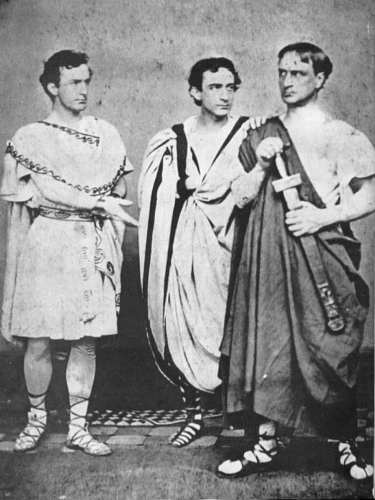
Similarly, when John Wilkes Booth assassinated President Lincoln in 1865, he had previously performed in Julius Caesar, and reportedly complained, (while on the run from the law), that “I am being hunted for what Brutus did so freely”

Source: New York Times Review. Now in both cases it is worth noting that Shakespeare’s play was not responsible for the death of a political figure, it was the people who interpreted his work that bear the responsibility themselves.

2. This play is also not the first time a director has portrayed Caesar as a contemporary president-

An Obama-like Caesar is murdered in The Acting Company’s 2012 production of “Caesar”

As many people have pointed out, in 2012 The Acting Company put on a production of Caesar with an Obama-esque version of the title character. No protests came from the left or right, though Caesar died in the exact same way- bloodily stabbed onstage. I would argue that these shows demonstrate that portraying Caesar as a contemporary figure does not itself incite violence. The audience knows that the figure of Caesar is simply meant as a link between Shakespeare and contemporary politics. This is how the director Oskar Eustis of the Shakespeare in the Park production defended himself against criticism of his staging: https://www.google.com/amp/s/mobile.nytimes.com/2017/06/13/theater/donald-trump-julius-caesar-oskar-eustis.amp.html

I frankly also find the disproportionate reaction to these two Caesars rather insulting. When Obama was in office, he got plenty of negative criticism that sometimes extended to threats of violence. If you click here you can see a threat by country music singer Ted Nugent who threatens to shoot the president with a machine gun. The double standard that threatening a president on the left has no consequences, but threatening a Republican president is worthy of scorn, derision, and its backers pulling their support, deeply hypocritical.

3. Thirdly, this is not the first time a Shakespeare play has depicted Trump negatively. If you look at the comments of my Trump villain post, a director mentioned his production of Henry the Sixth Part Two, in which an actor portrayed the character Jack Cade as Trump. Like Caesar, Cade also murdered in the course of the play. Clearly, portraying Donald Trump as a Shakespearean character is not what is unique here.

4. Though it is certainly true that the play depicts violence and the overthrow of a regime, it doesn’t endorse violence, and is not intended to glorify the murder of a president or even a demagogue like Caesar. As I will later discuss, this play can’t be an endorsement of violence, since everyone who commits violence is duly punished.

So why has this particular production, that uses a Caesar that resembles this president, gotten such a big reaction? Part of the issue admittedly is the timing. The protest specifically mentions the attempted murder of a GOP senator, which happened last week. It is only natural that, given this recent threat of violence, some would fear that this production might incite others to violence. Yet, as I said before, a thorough analysis of the play shows that it does not condone violence against a political leader.

Additionally, given today’s divisive political environment, it is understandable why an audience of right wing protesters might be concerned about this scene in which Caesar is murdered on stage. They may vey well think the play is wish fulfillment for those on the left, who might enjoy watching the bloody assassination of someone who is vey unpopular right now. However, let me emphatically point out that first of all, no one on the left has endorsed violence against Trump. If you look at the backlash to Kathy Griffin’s picture of herself holding a bloody makeshift Trump head, you can see that no one left or right has endorsed support for such a treasonous un-American act. Secondly, with regards to Caesar, the play’s message is actually nonviolent. When Brutus and Cassius kill Caesar, it starts a violent uprising that leads to anarchy, precisely the outcome the two Roman senators hoped to avoid. Seeing their designs fail would certainly discourage anyone attempting violence against a sitting authority figure.

Perhaps the best way I can prove this point is to remind everyone that Shakespeare himself lived in a monarchy. His theatre was strictly controlled by the government. If anyone in 1599 believed that Julius Caesar seemed to support the killing of queen Elizabeth, the play would have been burned and Shakespeare and his whole company would have been arrested and hanged.

https://youtu.be/Y7BtKlGGFKs

Also, people have criticized the murder of Caesar as “too realistic,” again believing that the gore is intended to glorify violence. In reality the violence of the murder is intended to incite revulsion and disgust. Look at Mark Antony’s reaction when he shows Caesar’s body to the crowd. https://youtu.be/tRceRJAz6_Q

I frankly think that the main reason why this production is getting bad press is because it’s a portrayal of President Trump, not Obama, not the historical Caesar, not Hitler, not even Trump before he was president, but the current president, that a group of people elected, and who believe that he supports their values.

I believe that the main reason Trump’s supporters are angry at this production is they feel an attack on him is an attack on them. The president’s supporters have shown repeatedly that they are willing to overlook almost anything to show their support of him. I imagine that they have no desire to see him as an autocrat and dictator, let alone entertain the notion that he might ever be taken down by his opponents.

The irony is that the real Caesar was a man of the people who died because his opponents thought he was an autocrat. The real Caesar helped create the modern calendar, gave money to the entire city, and according to Marc Antony, “When the poor hath cried, Caesar hath wept.” Trump is the exact opposite; he is a self-centered con artist who pretends to be a man of the people. As I predicted, after his inauguration, he has vowed to cut taxes on businesses like his own, put his family in positions of power, used diplomatic meetings and press conferences to sell his products, and obstructed justice when his FBI director tried to investigate him. With this in mind, it seems bizarre to claim that this production is designed to ridicule the right, since Trump is neither Julius Caesar, nor is he an embodiment of the political right. He only stands for his own interests. Therefore an attack on Trump is not an attack on conservative values.

So to go back to the beginning point, “When does art become political speech?” I would argue art always becomes political when it comments about our world, and this quality of art is essential for our society to function. We need a healthy dose of satire and critical thinking, and art can provide it to us. However, there is a difference between disagreeing with a play and openly shunning it onstage.

To address Mr. Trump’s second question, art doesn’t change things, people change things, so we need to temper our reactions, especially to art pieces like Julius Caesar. Remember, Caesar only died because people said he wanted to be king. Cinna the poet died because the mob said he should. This play warns us all to be careful and remain critical thinkers, or mob rule will result.

References

What depicting Julius Caesar as Donald Trump really means – CBS News

https://www.google.com/amp/s/www.theatlantic.com/amp/article/530037/

https://www.google.com/amp/s/mobile.nytimes.com/2017/06/12/theater/julius-caesar-shakespeare-donald-trump.amp.html

https://apple.news/AW6FmlDY3TEe4C97AG7UI4Q

Ted Nugent once said Obama should ‘suck on my machine gun.’ Now he wants to tone down ‘hateful rhetoric.’ – The Washington Post

View at Medium.com

https://apple.news/AE9eeH-L6TxeY1qJwq4Ur8w

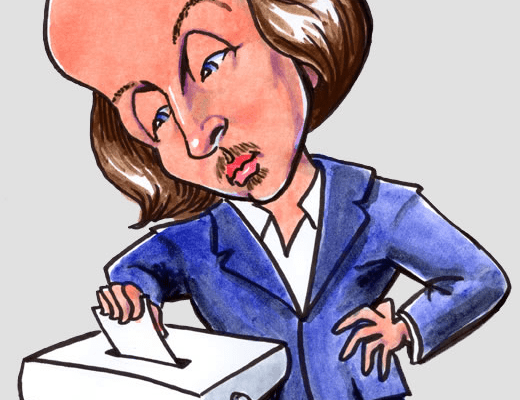
Some thoughts on the Innauguation, or “Whom Would Shakespeare vote for?”

Well, it happened. A man whom I have described as a villain of Shakespearean proportions is now the president. You might have read in my Richard III post that I had hoped that the election would play out like the history play about a deformed tyrannical king with bad hair. What I forgot when I made that prediction was that the king in question, Richard III, does become king for a little while.

Here’s another way of putting it. I found it on the Facebook page of a friend of mine, Austin Tichnor of The Reduced Shakespeare Company:

https://www.youtube.com/watch?v=BChFmHTIH2A&sns=em

I don’t want to talk too much about devisive politics because I feel that the country and the world is hurting too much because of people who want to reduce the world into “my party,” “my country,” and turn everything and everyone else into “the other.”

What I want to talk about in this post, is what I hope for our new president, some words of wisdom from The Bard, and maybe some words of healing for those people who feel like “the other,” starting with some of the people I might have offended with my earlier posts.

Why Donald Trump is like Henry V, (we hope).

A lot of people are full of anxiety right now because nobody is really sure what kind of president Trump will be; will he follow through with his campaign promises? Will he take power from those in Washington and give it to the people, as he said in his inaugural address? How much will his past life as a real-estate tycoon influence his work as president? This uncertain climate reminds me very much of the end of Shakespeare’s Henry IV, Part II, where the old king dies leaving the kingdom to his son. Thus far, the prince, (known as Hal to his friends), has been wasting his time drinking in a bar in Eastcheap with his disreputable friend, Sir John Falstaff. Watch this scene where he and Falstaff mock the king and trade insults with each other:

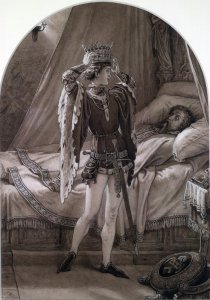
But, on his deathbed the real king summons his son and knocks some sense into him, demanding that he take the job of running the country seriously. In Act IV, Scene v, the prince, (thinking his father is dead) tries on his father’s crown right before King Henry wakes up and curses his son with a long and terrible speech.   Below is King Henry’s deep rebuke of his son Hal, detailing his fears of what will happen  when the prince becomes king.

henry-iv-part-ii-act-iv-scene-v-prince-hal-tries-on-his-fathers-crown
Prince Hal tries on his father’s crown. Henry IV, Part II. Act IV, Scene v.

KING HENRY:

What! canst thou not forbear me half an hour?
Then get thee gone and dig my grave thyself,
And bid the merry bells ring to thine ear
That thou art crowned, not that I am dead.
Pluck down my officers, break my decrees;
For now a time is come to mock at form:
Harry the Fifth is crown’d: up, vanity!
Down, royal state! all you sage counsellors, hence!
And to the English court assemble now,
From every region, apes of idleness!
Now, neighbour confines, purge you of your scum:
Have you a ruffian that will swear, drink, dance,
Revel the night, rob, murder, and commit
The oldest sins the newest kind of ways?
Be happy, he will trouble you no more;
England shall double gild his treble guilt,
England shall give him office, honour, might;
For the fifth Harry from curb’d licence plucks
The muzzle of restraint, and the wild dog
Shall flesh his tooth on every innocent.
O my poor kingdom, sick with civil blows!
When that my care could not withhold thy riots,
What wilt thou do when riot is thy care?
O, thou wilt be a wilderness again,
Peopled with wolves, thy old inhabitants! King Henry IV, Part II, Act IV Scene v.

I have to wonder if Obama feels a little like King Henry, since Trump has promised to repeal Obamacare, reverse many of his executive orders, and put his own “Mad Dog” ruffians in charge of the country. I also find it ironic that King Henry is worried about foreign ruffians becoming part of English society, while Trump is worried about keeping them out of America.

The good news is that Prince Hal eventually became a wise and effective ruler. In the play that bears his name, King Henry V united his country, and achieved a famous victory over the French. Everyone in the play was shocked and amazed by how he transformed himself from a drunk into an effective king. Trump has that same opportunity; although his poll numbers are low right now, he can prove his commitment to the job and amaze the country.

This is what I’m sure all of America hopes Trump will do for the country, although I have trouble believing that it will actually happen. It seems more likely to me that he will exploit his position to help his businesses, just as he has done his entire career, and he already shows signs of doing now. It seems unlikely that he will achieve anything that will protect the dignity of Americans, or achieve prosperity for anyone but himself.

 I believe that the best we can hope for with Trump is a presidency that mirrors one of Shakespeare’s most mediocre kings. Richard II, who stole land away from his nobles because he believed being king gave him God’s permission to do whatever he wants.  Trump was practically quoting Richard, when people wondered about his many potential conflicts of interests between the presidency and his business empire. Moments like this make me and many others like me curse the way businessmen-turned-politicians can give away America’s dignity dollar by dollar, as John of Gaunt famously cursed in Richard II:

JOHN OF GAUNT

Methinks I am a prophet new inspired
And thus expiring do foretell of him:
His rash fierce blaze of riot cannot last,
For violent fires soon burn out themselves;
Small showers last long, but sudden storms are short;
He tires betimes that spurs too fast betimes;
With eager feeding food doth choke the feeder:
Light vanity, insatiate cormorant,
Consuming means, soon preys upon itself.
This royal throne of kings, this scepter’d isle,
This earth of majesty, this seat of Mars,
This other Eden, demi-paradise,
This fortress built by Nature for herself
Against infection and the hand of war,
This happy breed of men, this little world,
This precious stone set in the silver sea,
Which serves it in the office of a wall,
Or as a moat defensive to a house,
Against the envy of less happier lands,
This blessed plot, this earth, this realm, this England,
This nurse, this teeming womb of royal kings,
This land of such dear souls, this dear dear land,
Dear for her reputation through the world,
Is now leased out, I die pronouncing it,
Like to a tenement or pelting farm:
England, bound in with the triumphant sea
Whose rocky shore beats back the envious siege
Of watery Neptune, is now bound in with shame,
With inky blots and rotten parchment bonds:
That England, that was wont to conquer others,
Hath made a shameful conquest of itself.
Ah, would the scandal vanish with my life,
How happy then were my ensuing death! Richard II, Act II, Scene i.

If you’re like me and millions of other people around the country who don’t have a lot of faith in this new government, the question becomes, “What do we do now?”

I believe that once again, Shakespeare can offer words of wisdom and comfort in this moment of doubt and uncertainty. One quote I keep coming back to is from a play you’ve likely never heard of- The History Of Sir Thomas More. You won’t see this text in any collected edition of Shakespeare, because the play is actually unfinished. Only a tiny portion of it survives, and it was never published. It has the incredible distinction to be one of the only surviving play manuscripts from Shakespeare’s day, and if he did write it (which no one can definitively prove), it is the only play written in his own handwriting. Even if Shakespeare did not have a hand in writing it, it is one of the most poignant speeches I’ve ever read, and it has an incredible message for our nation and for the entire world.

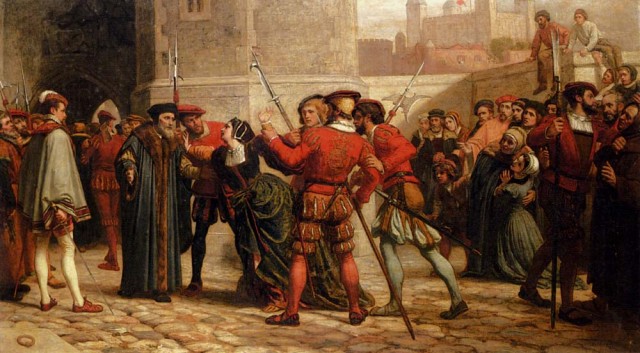
more-meeting-with-daughter-640x353
Sir Thomas More (left in the gown), attempting to control a riot.

First, a little background. Sir Thomas More was a real man who worked as Chancellor of England under Henry VIII. He was famously executed for refusing to support the king’s divorce of Queen Katherine Of Aragon because of his devout Catholic beliefs, and for that reason he is still considered a man of great principle and honor. The scene which Shakespeare allegedly helped  write however, takes place earlier, when More was just a sheriff of London. 

In the speech below, More is trying to break up a riot where a mob of people are trying to murder a group of immigrants from the country, accusing them of stealing jobs from Englishmen, (sound familiar)? More pleads with them to show compassion and to be open to other points of view. Here is More’s speech, performed by Sir Ian McKellen.

Here’s the text of the speech:

Imagine that you see the wretched strangers,
Their babies at their backs and their poor luggage,
Plodding to the ports and coasts for transportation,
And that you sit as kings in your desires,
Authority quite silent by your brawl,
And you in ruff of your opinions clothed;
What had you got? I’ll tell you: you had taught
How insolence and strong hand should prevail,
How order should be quelled; and by this pattern
Not one of you should live an aged man,
For other ruffians, as their fancies wrought,
With self same hand, self reasons, and self right,
Would shark on you, and men like ravenous fishes
Would feed on one another….
Say now the king
Should so much come too short of your great trespass
As but to banish you, whether would you go?
What country, by the nature of your error,
Should give you harbour? go you to France or Flanders,
To any German province, to Spain or Portugal,
Nay, any where that not adheres to England,
Why, you must needs be strangers: would you be pleased
To find a nation of such barbarous temper,
That, breaking out in hideous violence,
Would not afford you an abode on earth,
Whet their detested knives against your throats,
Spurn you like dogs, and like as if that God
Owed not nor made not you, nor that the claimants
Were not all appropriate to your comforts,
But chartered unto them, what would you think
To be thus used? this is the strangers case;
And this your mountainish inhumanity. 

Sir Thomas More, Act II, Scene 4.

Finally, here’s a link to view the original manuscript, which is on display in the British Library in London.

The obvious condemnation of xenophobia and hatred of immigrants in More’s speech is obvious, so I won’t belabor it, but it’s worth noting that this problem has been going on for over 400 years. What I’d like to focus on is what More says at the end: when a nation erupts into violence against immigrants it cheapens itself and the world takes notice. Also, it is the job of those in authority to protect, not stay silent when such attacks take place. This is why we need to think carefully about Trump’s proposals regarding immigrants, Muslims , and other such “strangers.”

In a more general sense, I feel that in our divided nation, we all are feeling like strangers. Whether you’re a man or a woman, Democrat or Republican, Caucasian or Non-Caucasian, many thousands of people in this nation all seem to feel that someone is treating them like “strangers,” and our task, all of us, as Americans and human beings, is to “take the stranger’s case,” by looking at other people’s points of view with compassion and an open mind. That, by the way was made Shakespeare a great writer; his own ability to see into the minds of kings and peasants, women and warriors, ghosts and gods.

So here’s the big question: whom would Shakespeare vote for? I believe he would vote for whomever would try to learn from the lives of these strangers, and use his or her authority to protect their right to speak their minds. Deciding who that person is, is a task I leave to you.

The Battle Of Bosworth

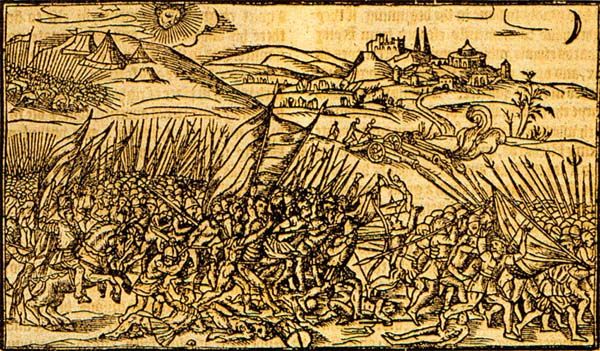
To begin wrapping up our Richard III month, I thought it might be appropriate to speak a little about the battle that ended the real Richard’s life, the Battle of Bosworth Field, August 22, 1485.

What does Shakespeare Say about the battle:

KING RICHARD III

Come, bustle, bustle; caparison my horse.

Call up Lord Stanley, bid him bring his power:
I will lead forth my soldiers to the plain,
And thus my battle shall be ordered:
My foreward shall be drawn out all in length,
Consisting equally of horse and foot;
Our archers shall be placed in the midst
John Duke of Norfolk, Thomas Earl of Surrey, Shall have the leading of this foot and horse. They thus directed, we will follow                    In the main battle, whose puissance on either side Shall be well winged with our chiefest horse. This, and Saint George to boot! 

What think’st thou, Norfolk?

NORFOLK

A good direction, warlike sovereign. 

Richard III, Act V, Scene iii.
This speech matches very well with what the chronicles mention about the battle. In those days the English archers were more deadly than their cavalry, so Richard probably wanted to pick off as many soldiers as possible with the archers, then mow the rest down with his charge toward Henry.

Contemporary Accounts, (courtesy of the Richard III Society). The most complete, and unbiased account I could find was Polydore Virgil, which is also likely the one from which Shakespeare got his information. You’ll notice that it mentions the long line of foot soldiers and horsemen, and the mention of the Duke of Norfolk commanding one of Richard’s forces.


‘The day after King Richard, well furnished in all things, drew his whole army out of their encampments, and arrayed his battle-line, extended at such a wonderful length, and composed of footmen and horsemen packed together in such a way that the mass of armed men struck terror in the hearts of the distant onlookers. In the front he placed the archers, like a most strong bulwark, appointing as their leader John, duke of Norfolk. To the rear of this long battle-line followed the king himself, with a select force of soldiers.‘Meanwhile … early in the morning [Henry Tudor] commanded his soldiery to set to arms, and at the same time sent to Thomas Stanley, who now approached the place of the fight, midway between the two armies, to come in with his forces, so that the men could be put in formation. He answered that Henry should set his own men in line, while he would be at hand with his army in proper array. Since this reply was given contrary to what was expected, and to what the opportunity of the time and greatness of the cause demanded, Henry became rather anxious and began to lose heart. Nevertheless without delay he arranged his men, from necessity, in this fashion. He drew up a simple battle-line on account of the fewness of his men. In front of the line he placed archers, putting the earl of Oxford in command; to defend it on the right wing he positioned Gilbert Talbot, and on the left wing in truth he placed John Savage. He himself, relying on the aid of Thomas Stanley, followed with one company of horsemen and a few foot-soldiers. For all in all the number of soldiers was scarcely 5,000, not counting the Stanleyites of whom about 3,000 were in the battle under the leadership of William Stanley. The king’s forces were at least twice as many.

‘Thus the battle-line on each side was arrayed. As soon as the two armies came within sight of each other, the soldiers donned their helms and prepared for the battle, waiting for the signal to attack with attentive ears. There was a marsh between them, which Henry deliberately left on his right, to serve his men as a defensive wall. In doing this he simultaneously put the sun behind him. The king, as soon as he saw the enemy advance past the marsh, ordered his men to charge. Suddenly raising a great shout they attacked first with arrows, and their opponents, in no wise holding back from the fight, returned the fire fiercely. When it came to close quarters, however, the dealing was done with swords.‘In the mean time the earl of Oxford, afraid that in the fighting his men would be surrounded by the multitude, gave out the order through the ranks that no soldier should go more than ten feet from the standards. 

Here’s a short infographic I made about the kinds of weapons people used during the Battle Of Bosworth.

When in response to the command all the men massed together and drew back a little from the fray, their opponents, suspecting a trick, took fright and broke off from the fighting for a while. In truth many, who wished the king damned rather than saved, were not reluctant to do so, and for that reason fought less stoutly. Then the earl of Oxford on the one part, with tightly grouped units, attacked the enemy afresh, and the others in the other part pressing together in wedge formation renewed the battle.

Royal Portrait of King Richard III, holding a broken sword.

While the battle thus raged between the front lines in both sectors, Richard learnt, first from spies, that Henry was some way off with a few armed men as his retinue, and then, as the latter drew nearer, recognised him more certainly from his standards. Inflamed with anger, he spurred his horse, and road against him from the other side, beyond the battle line. Henry saw Richard come upon him, and since all hope of safety lay in arms, he eagerly offered himself for this contest. In the first charge Richard killed several men; toppled Henry’s standard, along with the standard-bearer William Brandon; contended with John Cheney, a man of surpassing bravery, who stood in his way, and thrust him to the ground with great force; and made a path for himself through the press of steel.

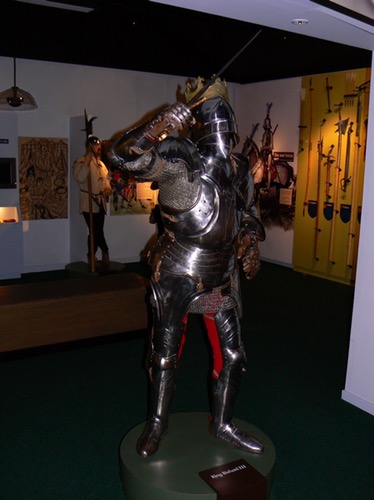
This is a re-construction of the kind of armor Richard might have worn into battle. Notice that the helmet has the crown ontop. Photo reprinted from the Bosworth Field museum

‘Nevertheless Henry held out against the attack longer than his troops, who now almost despaired of victory, had thought likely. Then, behold, William Stanley came in support with 3,000 men. Indeed it was at this point that, with the rest of his men taking to their heels, Richard was slain fighting in the thickest of the press. Meanwhile the earl of Oxford, after a brief struggle, likewise quickly put to flight the remainder of the troops who fought in the front line, a great number of whom were killed in the rout. Yet many more, who supported Richard out of fear and not out of their own will, purposely held off from the battle, and departed unharmed, as men who desired not the safety but the destruction of the prince whom they detested. About 1,000 men were slain, including from the nobility John duke of Norfolk, Walter Lord Ferrers, Robert Brackenbury, Richard Radcliffe and several others. Two days after at Leicester, William Catesby, lawyer, with a few associates, was executed. Among those that took to their heels, Francis Lord Lovell, Humphrey Stafford, with Thomas his brother, and many companions, fled into the sanctuary of St. John which is near Colchester, a town on the Essex coast. There was a huge number of captives, for when Richard was killed, all men threw down their weapons, and freely submitted themselves to Henry’s obedience, which the majority would have done at the outset, if with Richard’s scouts rushing back and forth it had been possible. Amongst them the chief was Henry earl of Northumberland and Thomas earl of Surrey. The latter was put in prison, whree he remained for a long time, the former was received in favour as a friend at heart. Henry lost in the battle scarcely a hundred soldiers, amongst whom one notable was William Brandon, who bore Henry’s battle standard. The battle was fought on the 11th day before the kalends of September, in the year of man’s salvation 1486, and the struggle lasted more than two hours.

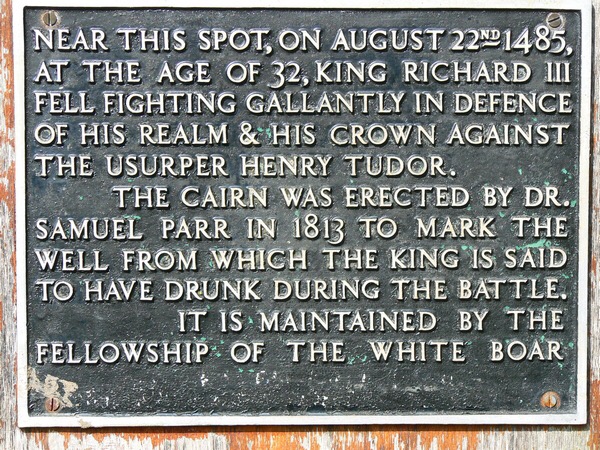
Plaque erected near a small well on Bosworth field, which Richard himself supposedly drank from.


‘The report is that Richard could have saved himself by flight. His companions, seeing from the very outset of the battle that the soldiers were wielding their arms feebly and sluggishly, and that some were secretly deserting, suspected treason, and urged him to flee. When his cause obviously began to falter, they brought him a swift horse. Yet he, who was not unaware that the people hated him, setting aside hope of all future success, allegedly replied, such was the great fierceness and force of his mind, that that very day he would make an end either of war or life. Knowing for certain that that day would either deliver him a pacified realm thenceforward or else take it away forever, he went into the fray wearing the royal crown, so that he might thereby make either a beginning or an end of his reign. Thus the miserable man suddenly had such an end as customarily befalls them that for justice, divine law and virtue substitue wilfulness, impiety and depravity. To be sure, these are far more forcible object-lessons than the voices of men to deter those persons who allow no time to pass free from some wickedness, cruelty, or mischief.


Immediately after gaining victory, Henry gave thanks to Almighty God with many prayers. Then filled with unbelievable happiness, he took himself to the nearest hill, where after he had congratulated his soldiers and ordered them to care for the wounded and bury the slain, he gave eternal thanks to his captains, promising that he would remember their good services. In the mean time the soldiers saluted him as king with a great shout, applauding him with most willing hearts. Seeing this, Thomas Stanley immediately placed Richard’s crown, found among the spoil, on his head, as though he had become king by command of the people, acclaimed in the ancestral manner; and that was the first omen of his felicity.’


-Polydore Virgil, c. 1500. Reprinted from the Richard III Society:

http://www.r3.org/richard-iii/the-battle-of-bosworth/bosworth-contemporary-tudor-accounts/ 
What most people can agree:

  • The battle took place on August 22nd, 1485 in a small field in Leicester.
  • Richard had about 70,000 troops, and Richmond had far fewer, aided mostly by French, Scot, and Welsh mercenaries.
  • Many of Richard’s people like the Earl Of Stanley betrayed him and turned sides.
  • Several sources record Richard wearing the crown in battle, which Henry Tudor immediately seized after he murdered Richard.
  • Richard fought bravely against Richmond, charging alone into combat and refusing to be rescued by his army. One account has Richard say: “This day I will die as king or win.” In another account, a lone Welshman killed the king’s horse, which probably was the origin of the line “A horse, a horse, my kingdom for a horse!”
  • Richard’s body was hacked to pieces, stripped naked, covered with a noose, and displayed at a poor local church for the citizens to mock at for two days. Even contemporary accounts allege that Henry treated his vanquished foe shamefully.
    Infographic of Richard’s post-battle wounds.

    Above- infographic of Richard’s battle wounds, courtesy of Lifescience.com

To conclude, even Shakespeare admits that Richard was a great commander, who lost the battle when his own soldiers betrayed him, and he was piteously murdered by the man who took over the crown from him. It’s a good thing that the real King Richard’s remains were discovered in 2012, and we now know more about the real man in addition to the myth.

RIP Richard.

Intro to Richard III

Hi everyone,

Introducing our new Play of the Month: Shakespeare’s dark history play about murder and corruption, Richard III. First, a short presentation I made that introduces the characters and themes of the play.


Second, a quick, funny summary of the play from the Reduced Shakespeare Company


And finally, this incredible animated version of the play, which looks like a stained-glass window come to life!