How To Write Romantic Poetry Like Shakespeare 

Since this is national poetry month, I thought I’d talk a little bit about Shakespeare’s poetry.  Shakespeare wrote 154 short love poems called sonnets. What follows is kind of a do-it-yourself poetry manual that would be great if you want to write a poem for a spouse or a loved one for Valentine’s Day, Christmas, Mother’s Day or any other time, to show that you care. Sonnet writing has been a time honored tradition for showing the people we care about just how much they mean to us.
If you’ve never written a sonnet , don’t worry, the kind of sonnet Shakespeare wrote is pretty easy to write, and it follows just a few simple rules. I don’t want to lie; it takes a lot of patience and thought to craft a sonnet, but the rules are easy to follow. So let’s get to it!


analyzing-sonnet-011.jpgWhat Is A Sonnet? A sonnet is a short poem that’s only 14 lines long, written in what is called Iambic Pentameter, Shakespeare’s preferred form of poetry. I’ve written before about Iambic Pentameter, but just to be clear it’s a 10 syllable line that goes da-Dum- daDum-da-Dum-daDum-daDum. So all you need is 14 lines that follow a particular rhyme scheme. You’ll notice that in the sonnet above, every other line rhymes except the end. This is called an ABAB rhyme pattern, and it is the trickiest thing about writing a sonnet. One reason Shakespeare has this rhyme pattern is to draw your attention to the last two lines, then draw the sonnet to a close with the simpler rhyme of the couplet.

Sonnet Form A sonnet’s 14 lines are arranged into three short groups or quatrains which are four lines long. Usually around line 9, there is a kind of “turn” or change in the direction of the argument, like at line 9 in Sonnet 8 above, where Shakespeare stops talking about summer, and starts talking about the person to whom he’s writing. If it helps, you can think of this as the “But…” part of the sonnet, because it’s the part where he changes the argument using the word “but,” (and what a but it is). The sonnet then concludes with two rhymed lines of Iambic called a rhymed couplet. These last two lines are a way of wrapping up the main idea of the poem in a short, catchy way.

Step by step Tips and Tricks:

  1. Start by planning out your sonnet.

It’s often useful to consider your sonnet like a speech or a short argument. The three quatrains give you a chance to come up with an idea, then develop the idea, and then come to a conclusion, much like any other form of persuasive writing that you might’ve had to do for English class. For example, Sonnet 8 pictured above, (one of Shakespeare’s most famous sonnets), begins with the question: “Shall I compare the to a summers day?” He then goes to flatter the person he’s writing about by talking about how much better they are than a summers day, saying that actual summers are too windy and too hot, and the flowers of the summer are all too brief. By contrast, Shakespeare argues that the  subject of the sonnet has beauty that will last forever, particularly if that person goes on to have children. This is the form that Shakespeare sonnets often take and I would advise you to try and make your sonnet into a clear argument.

Example Of Sonnet Writing:  Since Mother’s Day is coming up, if you wanted to write about the mother of your child, and thank her for her for being there for your child, you might want to structure your sonnet by using the three stanzas to express three simple ideas like:

1. Thank you for being the mother of our child(ren) 

2. A specific time she did something awesome for your child (give examples!)

3. Thank you from you, me, and our child(ren).

Tip 2: Plan Out The Rhyming Couplet: As I mentioned before, the last two lines of every sonnet are called a rhyming couplet; two lines of iambic pentameter that rhyme together and help conclude the sonnet. Just like a English paper, a good conclusion is very important, which is why it’s it’s often useful to work on this these two lines first before you get into writing the meat of your sonnet. For example, here’s a couplet I wrote about preparing breakfast in bed and doing chores for one’s wife on Mother’s Day.

All chores this day will I do in thy stead

Commence I shall with breakfast in thy bed!

Tip 3: Writing Poetry  Now that you have the ideas you want to express now comes the hard part: putting them into poetry. I often find it helps to just get a piece of paper, write as much as possible to express the three ideas in your sonnet in prose, then get down to translating your ideas into iambic pentameter.

Quick Tips to help you along:

  1. Make sure the important words are on the right beats. Remember, in a normal Iambic line, every other beat (2, 4, 6, 8, and 10) are emphasized. This means the important words/ sylables need to be on those beats. You might have to invert the order of a word or two to keep those beats clear. like I did in my couplet when I wrote “will I do” instead of “I will do”
  2. You don’t have to use iambic in every line. Shakespeare was never a slave to a particular verse form, and a whole poem in iambic pentameter can sound a little dull sometimes. This is why, if you really want to, you can change a line or two to emphasize different beats
    • Trochees A clever way to wake up your audience is to start off with a few regular iambic pentameter lines, and then change it to a line where the first beat is the one that’s important. Like a dance or song that suddenly changes tempo, this creates a sense of excitement in the reader.
    • Spondees Sometimes you can emphasize two syllables at the same time, as Shakespeare does in lines 1 and 3 of Sonnet 8. You wouldn’t pronounce “Shall I” as “SHALL I or shall I,” and the phrase “rough winds” demands that both words are important, so Shakespeare is clearly changing the verse a little just to make the poetry more interesting.
    • For More information on other types of Meter, read Sam Rame’s Literary Analysis Blog: http://samrames.blogspot.com/2013/03/william-shakespeares-sonnet-60-like-as.html

Tip 4: Use Literary Devices: I find Shakespeare very often tried to express an idea by using metaphor and allusion to create images in the listeners mind. Sonnet 8 which we’ve been discussing, is structured around creating a contrast between the speaker and a pretty day in summer. You can do this kind of flattering comparison yourself, but, as we’ve seen, it’s often useful to put a “but” in the argument around line 9, to make it clear that you love the person more than for example a warm summer day. Imagine getting a sonnet that claims that someone loves you more than ice cream!

Sometimes Shakespeare uses contradictory images in his poetry for dramatic effect. Romeo often and talks about “Oh brawling love, O loving hate”. He uses this to express the wildness of his passion. This is called antithesis, and it’s very useful when you want to add a little spice to your poetry. Try comparing your beloved to both ice and fire!
Alliteration and assonance: Remember, Shakespeare wrote for the theater not for people reading in the book this is why he often plays with words that sound a particular way and worked very hard to come up with sounds that would grab a listeners attention rather than readers. When a word when several words start the same letter it creates a sense of order and gets the readers attention. Assonance is when consonants are repeated within the middle of a line.

Useful Websites when you’re working

  • Rhymezone.com– a convenient online rhyming dictionary
  • Thesaurus.com– useful if you need another word that fits into iambic better.
  • Kotsheet.com- a website for teachers with lots of useful worksheets to help you organize your sonnet. Useful for writing or teaching sonnets!

I hope this post was helpful. If you have any questions, please comment, or email me in the “Ask the Shakespeare Guru” page. If you write any sonnets yourself and wish to share them on this site, let me know and I’ll gladly re-post them!

Till Next Time,

-The Shakespearean Student.

References

  1. The Sonnets Edited by Rex Gibson. Cambridge University Press, 1997.
  2. Shakespeare’s Wordcraft  by Scott Kaiser. Limelight Editions, 2007. Free preview here: https://books.google.com/books/about/Shakespeare_s_Wordcraft.html?id=IdVuj0IY2ekC&printsec=frontcover&source=kp_read_button&hl=en#v=onepage&q&f=false 
  3. Literary Devices.net: https://literarydevices.net/
  4. Cummings Study Guide: https://cummingsstudyguides.net/xSonnets.html
Intro to Richard III

Hi everyone,

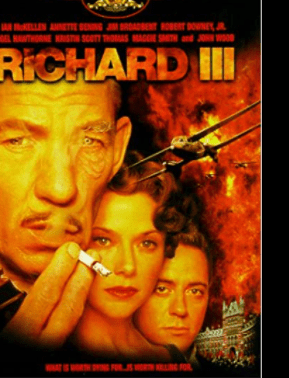
Introducing our new Play of the Month: Shakespeare’s dark history play about murder and corruption, Richard III. First, a short presentation I made that introduces the characters and themes of the play.


Second, a quick, funny summary of the play from the Reduced Shakespeare Company


And finally, this incredible animated version of the play, which looks like a stained-glass window come to life!

Crafting A Character: Malvolio

The venerated Shakespearean actor, Sir Antony Sher, once said with frustration while he was acting at the RSC that, “even the best Feste is less funny than the worst Malvolio.” I actually have a rare insight into these two roles since I’ve played them both! So allow me if you will to present you with some insights I’ve gained into these two characters that are very much polar opposites. Although they are as different as night and day, they form the central comic premise of the whole play, and have some truly hilarious moments!

Me. as Malvolio, Wooster. High School 2002

I played Malvolio when I was a senior in high school; he was my first principal Shakespearean role. My director chose to set the play in the 1940s and he re-purposed the kingdom of Illyria as the Hotel Illyria, with Malvolio as the concierge or lead butler in charge of all the hotel maids and other housekeepers. This not only made the play more accessible to a 2002 audience, it also really helped me understand Malvolio’s role: he is first and foremost a snob who is obsessed with efficiency and pleasing his mistress Olivia (in this version the owner of the hotel). I would soon also discover that, although Malvolio is certainly snobby and can be a bit of a killjoy, he also has qualities that make him appealing to everyone who has ever felt put down or bullied, and that’s what makes him a complex and endearing character today.

Richard Briars as Malvolio

Some notes on the character: Malvolio’s name means “unsatisfied desire”- somebody who aspires to be what he is not. I find the relationship between Feste and Malvolio interesting because the two are partially defined by how each one is unlike the other. Feste is a clown, hired by the nobles to help them have a good time. He is described as “a merry fellow who cares for nothing.” In other words, Feste never takes anything seriously, except making a living with his jokes and songs. Malvolio is the exact opposite- he is also a servant, but he is a steward, in charge of running the Countess Olivia’s household. As such, he is obsessed with efficiency, commanding respect, and pleasing his mistress through his obsequious manner.

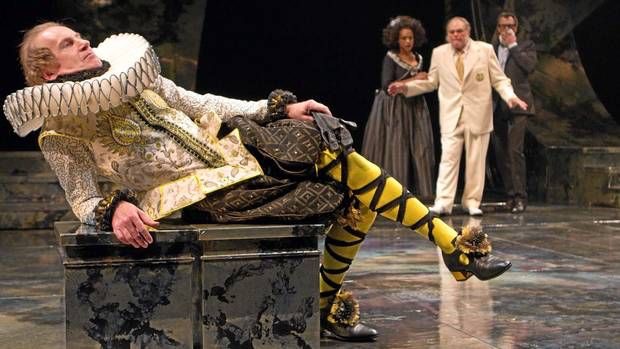
Like the Joker and Batman, both characters live according to an opposing viewpoint; Feste is a chaotic, happy-go-lucky sort, while Malvolio has a strict code of behavior which he expects everyone to follow. Their opposing world views bring them into conflict every time they meet. Plus, in most productions Feste is wearing brightly colored clown apparel or “motley wear,” while Malvolio is dressed in black. I’m not saying Malvolio is anywhere near as cool as Batman, but Malvolio can be just as sanctimonious. His journey is how he goes from being the trusted household servant, to a raving madman, to at last the Spectre at the feast at Olivia’s wedding.

I think the appeal of the character, which balances out the aforementioned snobbery, is that Malvolio is also a nerd: he dreams of becoming a count, he tries to make friends, but he does so by working far too hard at his job and not knowing how to fit in. This is why we inevitably feel sorry for him at the end of the play when he begs to know why his tormentors have locked him in a dark room, treated him like a lunatic, and made him think his lady was in love with him only to utterly destroy his hopes. The balance between the Nerd and the Snob that makes Malvolio a universal and complex part, and that’s why some of history’s greatest actors have played it!

Prepping for the Role: Alec Guinness, Laurence Olivier, Patrick Stewart, Donald Sinden, Nigel Hawthorne, Richard Briars, Steven Fry- these are just some of the names of actors who have played this part over the years. The first actor to play the role was Shakespeare’s leading actor, Richard Burbage, who also played Richard III, Hamlet, and Macbeth. Here’s a sample from Burbage’s famous eulogy, which mentions some of his most famous parts:

A Funeral Elegy
On the Death of the Famous Actor, Richard Burbage,

He’s gone, and with him what a world are dead,
Friends, every one, and what a blank instead!

Tyrant Macbeth, with unwash’d, bloody hand,
We vainly now may hope to understand.
Brutus and Marcius henceforth must be dumb,
For ne’er thy like upon the stage shall come,
Vindex is gone, and what a loss was he!
Frankford, Brachiano, and Malevole.

One big decision that every Shakespearean actor needs to make is how to approach their role in a different way. To be honest, I was kind of a thief with my Malvolio- one of the first things I did was read a book by actor Sir Donald Sinden where he talks about how he delivered Malvolio’s first line, which occurs in Act I, Scene iii:

Olivia. What think you of this fool, Malvolio? doth he not mend?

Malvolio. Yes, and shall do till the pangs of death shake him:
infirmity, that decays the wise, doth ever make the 365
better fool (Act I, Scene v).

Donald Sinden and Judy Dench in Twelfth Night, RSC 1969

Sinden described his first line as a snobby “nyess,” as if he were simultaneously bored and embarrassed by Feste’s jokes. The director told me to act around Feste as if I were the villain in a Charlie Chaplin movie- basically to bully Feste and make him feel very small with my lines, in order to justify the revenge Feste innevitably takes on him. Like any character in Shakespeare, this is only one way to play the role, so you don’t have to agree with me.

The Gulling Scene

Malvolio’s most famous scene is called “The Gulling Scene,” the scene in which he’s tricked into thinking Olivia is in love with him. This is the moment where Malvolio goes from being a respectable prudish servant, into a raving madman. He enters full of dreams and plans to become “Count Malvolio” and creates an elaborate fantasy of what his life would be like if he married the Countess.

Annotated text of Twelfth Night from Shakespeare Navigators.com

Act II Scene v. From Shakespeare Navigators.com

No sooner does Malvolio compete his fantasy of marrying Olivia, when lo and behold, a letter from her suddenly appears! Of course, the audience knows it’s all a trap and even worse, Sir Toby, Sir Andrew, and a boy named Fabian are watching him! It’s a moment of exquisite comedy that’s nearly impossible to get wrong.

Malvolio and the Countess, 1840 by Daniel Maclise

One question I had when I did the scene was whether Malvolio really loves Olivia, or just loves her riches and her title. As a high schooler, I chose to believe that he really does have a crush on Olivia, but is too socially awkward to tell her. Having the letter is a chance to make his feelings known, which Malvolio can get very genuinely excited about! On the other hand, as you can see above, Malvolio might just be greedy to make himself even more respected and admired, and to have the power to throw out the likes of Sir Toby, Sir Andrew, and Maria. Malvolio’s revenge fantasy is also fun to watch, since we know he’ll be punished for it later.

Part of the fun involved in the scene is that it’s basically a “play within a play,” a device that Shakespeare used to great effect in Hamlet, A Midsummer Night’s Dream, Love’s Labor’s Lost, and both parts of Henry the Fourth. I think it’s the charm of seeing a character as he really is, Malvolio shows you his fantasies and creates a whole world in the middle of the orchard. Meanwhile, you feel complicit as you watch the people watching him, who could just as easily be part of your audience.Workshop on Twelfth Night and Bullying

On the other hand, the scene has also been called an example of bullying, since Sir Toby and Maria are using the letter to manipulate then humiliate Malvolio. Remember, Malvolio dresses like a fool and act like a fool in front of Olivia in Act III because he believes it will please the Coubtess. Basically Toby and Maria are Catfishing Malvolio, which can seriously hurt psychologically, as anyone who has been deceived over the internet knows. Plus, it ruins Malvolio’s reputation as you can see in this clip:

Again, as a teenager, I could certainly relate to a man making a fool of himself in a vain attempt to impress a girl. Seeing a man lose his head over a girl and then have her break his heart over a prank, is in some ways truly terrible to watch; even Olivia agrees by the end of the play that the joke has gone too far.

Malvolio. Madam, you have done me wrong,
Notorious wrong.

Olivia. Have I, Malvolio? no.

Malvolio. Lady, you have. Pray you, peruse that letter.
You must not now deny it is your hand:
Write from it, if you can, in hand or phrase;
Or say ’tis not your seal, nor your invention:
You can say none of this: well, grant it then
And tell me, in the modesty of honour,
Why you have given me such clear lights of favour,
Bade me come smiling and cross-garter’d to you,
To put on yellow stockings and to frown 2550
Upon Sir Toby and the lighter people;
And, acting this in an obedient hope,
Why have you suffer’d me to be imprison’d,
Kept in a dark house, visited by the priest,
And made the most notorious geck and gull
That e’er invention play’d on? tell me why!

Olivia. Alas, Malvolio, this is not my writing,
Though, I confess, much like the character
But out of question ’tis Maria’s hand.
And now I do bethink me, it was she 2560
First told me thou wast mad; then camest in smiling,
And in such forms which here were presupposed
Upon thee in the letter. Prithee, be content:
This practise hath most shrewdly pass’d upon thee;
But when we know the grounds and authors of it, 2565
Thou shalt be both the plaintiff and the judge
Of thine own cause.

That’s the tragic part of Malvolio’s journey. We’ve all known a Malvolio, and we’ve all been him from time to time. That’s what makes him such an enduring character.

Continue reading

Announcing The Best Fathers In the Shakespearean Cannon

Announcing The Best and Worst Fathers In the Shakespearean Cannon

Podcast Link: https://www.buzzsprout.com/45002/282555-the-shakespearean-student-episode-5-the-best-dads-in-the-shakespearean-cannon

Shakespeare himself was a father, and he frequently wrote about the dynamic between fathers and their children. There are many different types of fathers in Shakespeare’s 40 plus plays, and this week I’m ranking them in terms of three categories: Good Dads, Bad Dads, and “Dad Dads.” You’ve probably already read the “Worst Dad” post, so now we’re looking at the good, and the not so good. I used the following criteria when choosing the top 5 dads in each categories:

The Good Dads

  • Are supportive for their kids
  • Try to keep their children happy
  • Offer help and advice, especially on their children’s future.
  • Are willing to sacrifice themselves
  • They let their children become their own people.

The Bad Dads

  • Treat their children as property
  • Have little to no interest in their children
  • Put their children in danger
  • Subject their children to abuse
  • In some cases, they murder them!

The “Dad” Dads

  • Are basically good hearted, but they have some kind of flaw that prevents them from becoming really good parents.
  • In my view, are the most human, modern dads on the list.
  • I’ve chosen to award these dads a necktie, something every ok dad needs.

Now, onto the Dad Dads:

aclk

aclk

5. Aegean from The Comedy Of Errors. Aegean wonders around for 20 years looking for his lost children, which I call devoted parenting, but a little aimless and undisciplined. I therefore award Aegean two ties with little anchors on them, to remind him to stay in one place and wait for his sons to find him!

Alexandre Bida,
Alexandre Bida, “The death of Lord and John Talbott,” 1895

4. Lord Talbott from Henry the Sixth Part I. Talbott is the hero of the English fight against the French at the close of the Hundred Years War. He goes toe to toe with Joan of Arc on numerous occasions. He also raises a fine and valliant son, John Talbott who is also a warrior. The two die bravely in a siege against the French, rather than surrendering, or leaving the other to die. Talbott is clearly also devoted to his child, but his career choice doesn’t allow his son to grow up in a safe environment! I therefore award Talbott two ties with little English and French flags on them.

imgres-3

imgres-1

The Ghost of Hamlet's Father by William Blake, 1806.
The Ghost of Hamlet’s Father by William Blake, 1806.

3. The Ghost Of Hamlet’s Father from Hamlet/ Portia’s Dad from Merchant Of Venice. Both these parents die before their plays begin, yet they still try to improve their children’s lives from beyond the grave! The Ghost helps Hamlet become king of Denmark, and Portia’s dad tries to help her find a good husband, (one who will love her for something besides her beauty or riches). Although these parents achieve their goals, waiting this long to help their kids seems a bit like absentee parenting! I therefore award these posthumous parents ties with little skulls on them.

imgres-4

imgres-4

2

imgres-5

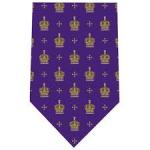
. King Henry IV, from King Henry IV King Henry is the classic career dad, one who wants his son Hal (the future King Henry V), to follow in his footsteps. The two have a terrible fight when Henry thinks Hal is trying to steal his crown on his deathbed! Eventually though, father and son reconcile, and dad even gives the future king some last minute advice; if you fight a war with France it’ll help secure your crown, which Hal does and succeeds! I therefore award King Henry a tie with little crowns on it, hoping that nobody with a dagger ties tries to steal it when he’s sleeping!

42-44949227-1

1. Prince Pericles from Pericles Pericles is another busy dad- King Antiocus tries to murder him, and he has to leave his own kingdom. Then he gets shipwrecked 3 times! In fact, his only daughter is born onboard a ship in the middle of a storm! Pericles raises the girl for a number of years, but then has to leave again, and guess what, he gets shipwrecked AGAIN! He eventually finds his daughter and they live happily ever after, but you kind of get the idea that Pericles is a little accident-prone, which keeps him from being on the Best Dads list. Sorry Pericles, but at least you get a tie with, what else, Boats on it! Maybe next Fathers Day, someone will get you a life preserver.

url-2

And now at Long LAST, the BEST Dads in Shakespeare!

Aaron fights to protect his baby child.

5. Aaron the Moor from Titus Andronicus. Ironically, one of the worst villains in Shakespeare is also one of the best fathers. Aaron is fiercely protective of his child, even threatening people at sword point if they dare come near his baby. He also plans out the child’s future and is willing to give his own life for a promise that Lucius will protect and nourish his son. He may be a monster to everyone else, but to his baby, Aaron is simply, a good dad!

4. The Old Shepherd from The Winter’s Tale. This character is a very mirror of generosity and kindness; not only does he take care of his son The Clown, he adopts a poor discarded child, the princess Perdita, with no obligation to do so. He raises her for 16 years and constantly brags about her to the entire town. She becomes a beautiful, wise, and modest girl who fills her adopted father with pride because of his good parenting. Even when Perdita meets her real father, she speaks of The Old Shepherd with real filial affection “Oh my poor father.”

3.

Lord Capulet, from Romeo and Juliet. I know this was a controversial choice, and I discuss my choice in detail on my podcast, but I’ll sum up my major arguments here:

  1. Even though a lot of actors choose to have him smack Juliet around, there’s no mention of it in Shakespeare’s text. The most he ever does is threaten to strike her, but the stage directions never indicate he does it. Capulet is clearly more bark than bite.
  2. From the very beginning of the play, Capulet has shown that he cares about Juliet, and wants her to marry for love, not money.
  3. Lord Capulet hovers and frets constantly when Juliet tells him she will marry Paris, staying up late to plan the wedding! I ask you, does that sound like a tyrannical father? I wonder sometimes if Lord Capulet would’ve forgiven Juliet for marrying Romeo if she had just told him. In any case, based on my criteria above, Capulet is a good dad, bad tempered, yes, but fundamentally concerned for the welfare of his children.
BOL143705 Prospero and Miranda, fragment from 'The Tempest', c.1790 (oil on canvas) by Romney, George (1734-1802); © Bolton Museum and Art Gallery, Lancashire, UK; English,  out of copyright
Prospero and Miranda, fragment from ‘The Tempest’, c.1790 (oil on canvas) by Romney, George (1734-1802); ¬© Bolton Museum and Art Gallery, Lancashire, UK; English, out of copyright

3. Prospero from The Tempest I chose this high spot for Prospero mainly because he seems to have the most success of any other dad in the cannon. Like Pericles, he too is shipwrecked with his daughter, but Prospero stays with Miranda, raises her alone, teaches her everything she knows, and calls her an angel that helped preserve his life. Prospero cares so much for his daughter that he refuses to give into despair, even though he’s lost his wife, his dukedom, and his home.

Prospero also hatches a plan to get him and Miranda off the island, to get his dukedom back, and to get her married to a handsome prince name Ferdinand, and he succeeds with every one of these endeavors, even though it takes 12 years. Prospero gets extra points for his patience and his wisdom, but I have to admit he’s a bit of a control freak; he demands that Miranda listen to him and obey him no matter what, and he warns Ferdinand that there will be dire consequences if he dare try to do anything illicit with his daughter before the wedding. In addition, there’s no denying that Prospero is also acting out of self interest- he wants to become duke again, and he wants revenge against his enemies and that’s partially why he raises a tempest, (or a huge storm), instead of just sending a message back to Milan.

1.

Simonides grants permission for Pericles to wed his daughter. Production shot from Mary Zimmerman's 2006 production of
Simonides grants permission for Pericles to wed his daughter. Production shot from Mary Zimmerman’s 2006 production of “Pericles.”

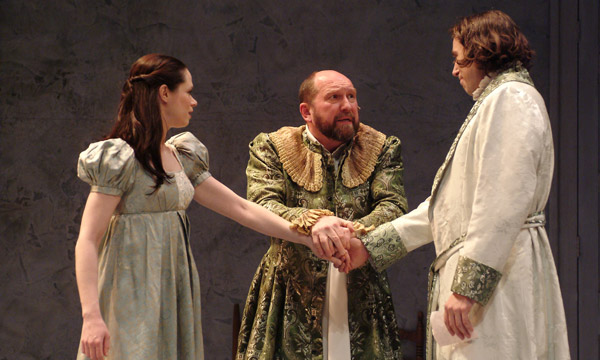
King Simonedes from Pericles, Prince Of Tyre You might forget this character because he only has a short time onstage, but I defy anyone to come up with a better father. He’s kind, supportive, stable, funny, and has a wonderful relationship with his daughter Thaisa. Above all, Simonedes actually listens to his child and does everything in his power to help her when she decides she wants to marry Pericles. Also, like Prospero, Simonedes pretends to object to the marriage, but you kind of get the sense that, rather than testing the affection of the couple, he’s actually just playing a joke on them. You can hear a “gotcha” and a fatherly wink in the final line of the speech in Act II, where he pretends to object to their marriage:

Congratulations to all our fabulous fictional fathers! Thank you for reading, and see you soon!

How to read a Shakespeare Play for the first time!

Hi folks! Since this site is basically a Shakespeare appreciation site, I wanted to start off this week by showing you how you can enjoy Shakespeare at the first reading, even if you’ve never read him before! What follows is a list of advice based on the way I myself learned to enjoy Shakespeare, backed up with some nuggets of wisdom I’ve picked up from teachers along the way.
https://youtu.be/knWg6Mf4MiM?feature=shared
I. Learn the Story of the play.
I would argue that the biggest advantage the Elizabethans had over us was they knew the story of the play before they even came into the theater. All of Shakespeare’s plays were adapted from other sources, including myths and fairy tales. A Midsummer Night’s Dream is literally a fairy tale about the Fairy Queen Titania. There was no such thing as “spoiler alert” in Shakespeare’s day, in fact the prologue of “Romeo and Juliet” gives away the ending before the play has begun!
Clearly, Shakespeare wasn’t interested in making his plays a surprise. The thing is that back then audiences didn’t want new stories, they wanted familiar stories told in a new way, the same way we base movies off of comic books and novels. So the first thing you can do to put you on the same level is read the story of the play before hand. Quiz yourself about what happens: who are the characters you should be rooting for? Whom are they fighting against? What is stopping the hero(s) from achieving their goals? This is a rare time when cliff notes and spark notes actually help; learning the story of the play will help you connect with the action on the stage and instead allow you to concentrate on the characters and the language. I also recommend websites like Crash Course that tell the story with a sense of fun.
II. Read the play- the whole thing, (preferably out loud).
The first time you read Shakespeare, you probably won’t get every word, but don’t worry, you’re not supposed to. Every single edition of Shakespeare has a glossary on the opposite page that translates the basic idea of what you’re reading. If you’re a first time reader, I highly recommend the Folger Shakespeare edition, (available at amazon.com). These editions not only have a good glossary, but big, friendly pictures of a lot of the terms. They also have a free online version of Shakespeare’s texts which you can look at here: http://www.folgerdigitaltexts.org/
I would also advise you to read the plays out loud. Shakespeare loved playing with the sounds of words- having characters hiss and bellow and whisper and seduce the ear. Some of the most fun I ever had with Shakespeare was having a Shakespeare reading party with my friends, where we discovered a play by reading it together and playing with voices and accents.
Another option is to listen to the play while you read it. There are great websites like Audible.com and Librivox that allow you to listen to the play spoken by voice actors. Hearing the play will open it up in a way that just reading it can’t After all, the plays are meant to be heard, that’s why they call it an audience (audio- to hear).
Finally, if you go to nearly every public library there’s a recording of The Archangel Shakespeare, a series of CD recordings of professional actors performing every one of Shakespeare’s plays. Many of these performers have done Shakespeare professionally, so you know they know what they’re taking about.
III. Watch a movie. There are hundreds of Shakespeare movies out there, and each one can show you a little bit about how the play feels and looks when it is placed in the hands of an actor or director. You may be expecting some guy in wrinkled tights bellowing his lines in a fake-Elizabethan set, but lots of Shakespeare movies have chosen inventive settings for Shakespeare in different times and places, like Ian McKellen’s Fascist-era Richard III, Michael Hoffman’s 19th century Midsummer Night’s Dream, or my favorite, Julie Taymor’s epic retelling of Titus Andronicus in a fictionalized blend of ancient Rome and modern Italy. A movie allows you to hear the text read, and allows you to see ideas from the play brought to life on the big screen.
IV. Go see it if you can. Almost every major city has a Shakespeare festival, and lots of regional theaters also choose to do Shakespeare. The reason is simple- he’s royalty free, and everyone recognizes his name. As you watch the play, try to answer these questions:
-Which characters did you like?
-Was there a line you really liked or one that seemed to speak to you?
-Did this play remind you of another play or movie? Did it remind you of something from your own life?
V. If I can recommend a good play to start with, start with Å Midsummer Night’s Dream. This play is not only very easy to understand, it’s also charming, funny, romantic, magical, and has a lot of colorful characters. I myself have directed and starred in Dream, and seen no less than 15 productions on stage and screen! If I can quell the fear you may have about Shakespeare, my wife and I directed the play with actors who had never read Shakespeare before, never acted before, and most of them were only 8 years old! So if they can learn this play and grow to love it as much as I do, then I firmly believe you can too!
Helpful hints-
1. Shakespeare’s company performed outdoors in the middle of the day, so they had no control over their environment. All the actors had was a bare stage, costumes, and a couple of props. This is why Shakespeare devotes lots of passages to just tell you where the characters are, and what time of day it is. His is a theater of the imagination, so read the descriptions and let the world come to life in your head.
2. Shakespeare drew heavily on images from Greek/Roman mythology and the Bible. If you need help looking up some of these resources up, I can recommend the Encyclopedia Mythica for Greco-roman references, and the Catholic Encyclopedia for Christian references.
3. There is a glossary of every single word Shakespeare ever used and plenty of books too. In terms of simplicity and ease of use, I recommend http://www.shakespeareswords.com/Glossary.
4. Shakespeare wrote four types of plays – Comedy, History, Tragedy, and Romances.

In Tragedy, the hero dies by the end, and the overall tone is one of change and struggle.
In Comedy, the hero and the heroine usually get married by the end.
The History Plays- are all about a struggle for the English crown and are based on historical chronicles. Most of them conclude in a battle or in the peace after a battle.
Romances– “Romance” is a term invented by scholars to describe some of the last plays Shakespeare wrote that don’t end in death like tragedies, and don’t end as happily as the comedies. One such play has a man get eaten by a bear, and another has a man forced to marry a prostitute! Some scholars don’t like this title, but i keep it here because it’s the most common term for these weird plays that include Cymbeline, Pericles, The Winter’s Tale, and The Tempest.
4. DO NOT READ THE NO-FEAR SHAKESPEARE EDITIONS. These books and websites advertise to be a clear-cut translation of Shakespeare with his text on the left, and a modern translation on the right. I believe these editions don’t do justice to the cleverness of Shakespeare’s writing. For example, here’s the famous speech of Macbeth when he discovers that his wife is dead:
https://youtu.be/pDdhiTvFcFw?si=mMy6zg8gmM9_K9bo

She should have died hereafter.
There would have been a time for such a word.
Tomorrow, and tomorrow, and tomorrow,
Creeps in this petty pace from day to day
To the last syllable of recorded time,
And all our yesterdays have lighted fools
The way to dusty death. Out, out, brief candle!
Life’s but a walking shadow, a poor player
That struts and frets his hour upon the stage
And then is heard no more. It is a tale
Told by an idiot, full of sound and fury,
Signifying nothing.
I’ve actually played Macbeth, and when I saw this speech, I played it as a struggle to deal with the loss of his wife, (the only person he truly cares about), while at the same time dealing with imminent war. Macbeth wants to put off dealing with the news until tomorrow because he can’t possibly handle it now. What’s really cool about Shakespeare is you don’t have to agree with me; you could just as easily interpret the speech as a manifestation of psychosis, of loneliness, or how bitter and unfair Macbeth’s life is and it would still work! That’s why actors and directors love going on and on about Shakespeare; he gives us the freedom to interpret the speech the way we want, as long as we stay true to the basic text. I don’t think anybody could claim that this is a happy speech! The problem is that No Fear Shakespeare makes it too simple, and doesn’t allow you to really consider the possibilities for interpretation. Read their translation of the speech below:

MACBETH
She would have died later anyway. That news was bound to come someday. Tomorrow, and tomorrow, and tomorrow. The days creep slowly along until the end of time. And every day that’s already happened has taken fools that much closer to their deaths. Out, out, brief candle. Life is nothing more than an illusion. It’s like a poor actor who struts and worries for his hour on the stage and then is never heard from again. Life is a story told by an idiot, full of noise and emotional disturbance, but devoid of meaning.

Of course, if you bear in mind the limitations of translating Shakespeare and give yourself the freedom to take it with a grain of salt, that could work too.
So there’s a basic guide for first time readers. Let me know if you agree with my approach, what strategies work for you, and if these techniques were helpful!

For more tips and tricks on analyzing Shakespeare, please sign up for my 30 minute Online Shakespeare class on Outschool.com:

Title card for my Intro to Shakespeare Class

https://outschool.com/classes/8535d86b-c4c5-4c75-aec0-6b43e020ee4e/schedule