With summer break approaching, why not give your kids the gift of learning Shakespeare in a low-key, no-pressure scenario? I have classes on Shakespeare’s life, Romeo and Juliet, and my celebrated Stage Combat class! Sign up now for all the fun on Outschool.com!
Shakespeare and Star Wars
Class Description: Using self-paced online activities, your child(ren) will compare the plot and characters of Star Wars to Shakespeare’s plays. We will also discuss Shakespeare’s writing by looking at “William Shakespeare’s Star Wars” by Ian Doescher.
Romeo and Juliet Murder Mystery
Course Description: A flexible schedule class that teaches kids the plot and characters of “Romeo and Juliet,” in the context of a detective story where you solve the mystery of the young lovers’ deaths.
Course Descriptions
How to Write Like Shakespeare: Learn the basics of iambic pentameter, sonnet form, and Shakespeare’s dramatic structure, and practice writing Shakespearean speeches.
With awards season in full swing, there has been a lot of controversy over two stories that Shakespeare had a great influence over- Hamnet, based on the novel of the same name, and Guillermo Del Toro’s adaptation of Frankenstein. Despite getting five golden globe nominations, Frankenstein went home with a hand emptier than the monster floating off on an iceberg. Meanwhile, Hamnet took the best actress and best picture award, and is poised for an Oscar nomination.
I’ll review Hamnet at a later date. What I want to do now is discuss the influence Shakespeare and other Renaissance writers had on the classic 1818 novel, and how well Del Toro hints at the story’s Renaissance roots.I would argue that, although rooted in the 10th century Romantic world, Frankenstein has many Shakespearean and Early Modern influences, notably Dr Faustus by Christopher Marlowe, and The Tempest by Shakespeare
In 1818, a young woman named Mary Wolstonecraft, heard from her friend, a Swiss doctor, about a prominent experiment called galvanism and was faced with the terrifying prospect that man might someday be able to resurrect the dead, (a feat that had only successfully been done by God). When Mary Shelley wrote the novel Frankenstein she redefined the Faustus story and made it about Man not taking responsibility for the consequences of his actions, and also a warning to progress for its own sake without compassion without reason without wisdom. As we shall see, Shelly was a trailblazer in turning the Faustian wizard into the mad scientist.
The Morality Tale
Faustus is one of the oldest and most quintessential German stories it is a morality tale medieval in its origins it also is loosely based on a real person a real scholar named Doctor John foustis and this story was influential on forming German cultural identity and the story itself has inspired countless authors some German and some merely influenced by German culture and it’s very interesting to trace the way that it’s being used And how the the trope of the Faustian bargain has influenced Germany America and and England other Anglo sects and countries so the story of Faustus is Medieval in origin but he became extremely popular when English playwright Christopher Marlowe Shakespeare’s contemporary and rival wrote it down in his play of Dr. Faustus
What’s interesting about this interpretation is that you could easily see it as Faustus Rejects from the beginning the notion of divine grace he believes that he cannot that he is either unwilling or unable to believe that he is beloved by God and therefore he turns to satanic poworse it’s somewhat ambiguous why he does this one possible interpretation is that Faustus might actually be a that faustis like Marlow might be a possible gay man and is convinced that he is an abomination under the Lord and therefore he might as well indulge in satanic activities.
Whatever the reason the play does a great job of showing the struggle of Faustus as he is presented several times with the chance to repent, and actively refuses it every single time.
“Tutors Not So Careful”
In Marlow’s version, Faustus studies at the University of vittenburg in Germany, whicb also boasts other notable allumni- Prince Hamlet which Shakespeare would later write in his own play Hamlet Prince of Denmark. The prince broods over whether the creature he has seen return from the dead is actually a devil, sent to destroy him.
Shelley admits that a lot of her as a source for that her sources for Shakespeare her sources for Frankenstein included Shakespeare in The Tempest. Though Doctor Frankenstein his book is not a is Swiss not German he is educated at the University of english stat in Germany where he learns organic chemistry and acquires the ambition to do with the alchemists and conjurors of faustis day failed to do namely create the elixir of life.
“Graves, at my command, Hath waked their sleepers”
One big trope in Frankenstein is the danger of man crossing over into God’s domain- that from the beginning of time there has been a knowledge that God deliberately kept from humankind. In Frankenstein, this takes the form of scientific knowledge, but in Shakespeare, it is magic. In Macbeth, the title character is tempted by witches to know his destiny and is punished severely for it. Remember that when Shakespeare wrote the play, King James presided over hundreds of witch hunts and wrote a book on how to identify witches.
In The Tempest, Shakespeare gives us a more ambiguous look at magic where the magician Prospero has the power to create storms, conjure up spirits, and like Frankenstein, raise the dead:
 I have bedimm'd
The noontide sun, call'd forth the mutinous winds,
And 'twixt the green sea and the azured vault
Set roaring war: to the dread rattling thunder2065
Have I given fire and rifted Jove's stout oak
With his own bolt; the strong-based promontory
Have I made shake and by the spurs pluck'd up
The pine and cedar: graves at my command
Have waked their sleepers, oped, and let 'em forth
By my so potent art. The Tempest, Act V, Scene i.
Even though Prospero is the protagonist and he faces no consequences for his magic, for some reason he chooses to abandon it. It’s almost as if Shakespeare was anticipating Frankenstein by having a proto mad scientist character give up his art before it is too late:
 But this rough magic
I here abjure, and, when I have required
Some heavenly music, which even now I do,
To work mine end upon their senses that
This airy charm is for, I'll break my staff,2075
Bury it certain fathoms in the earth,
And deeper than did ever plummet sound
I'll drown my book.
Prospero, Act V, Scene i.
“This thing of Darkness”
“You taught me language, and my profit in’t is I know how to curse!”
“Cursed, cursed creator! Why did I live? Why, in that instant, did I not extinguish the spark of existence which you had so wantonly bestowed? I know not; despair had not yet taken possession of me; my feelings were those of rage and revenge. I could with pleasure have destroyed the cottage and its inhabitants and have glutted myself with their shrieks and misery.
Shelly, Chapter 16
If you’ve never read the book Frankenstein, you might be surprised to learn that unlike Boris Karloff’s grunting silent monster, in the novel the Monster is actually intelligent and well-spoken. One thing I enjoyed about Guillermo Del Toro’s version is that the Monster gets time to tell his tale. As we in the audience get to know him, the notion of who is the true Monster and who is truly human becomes as murky as the subterranean lair the doctor chains his creation within. He engages in intellectual debates with his creator and demands to know why Frankenstein chose to abandon him.
My abhorrence of this fiend cannot be conceived. When I thought of him I gnashed my teeth, my eyes became inflamed, and I ardently wished to extinguish that life which I had so thoughtlessly bestowed. When I reflected on his crimes and malice, my hatred and revenge burst all bounds of moderation.
With the holidays approaching, why not give your kids the gift of learning Shakespeare in a low-key, no-pressure scenario? I have classes on Shakespeare’s life, Romeo and Juliet, and my celebrated Stage Combat class! Sign up now for all the fun on Outschool.com!
Shakespeare and Star Wars
Class Description: Using self-paced online activities, your child(ren) will compare the plot and characters of Star Wars to Shakespeare’s plays. We will also discuss Shakespeare’s writing by looking at “William Shakespeare’s Star Wars” by Ian Doescher.
Romeo and Juliet Murder Mystery
Course Description: A flexible schedule class that teaches kids the plot and characters of “Romeo and Juliet,” in the context of a detective story where you solve the mystery of the young lovers’ deaths.
Course Descriptions
How to Write Like Shakespeare: Learn the basics of iambic pentameter, sonnet form, and Shakespeare’s dramatic structure, and practice writing Shakespearean speeches.
So, why Ghostbusters? Well, as William Shakespeare’s Star Wars has shown, it’s not only fun to adapt popular stories into Shakespearean parodies, it can also be educational. I knew I wanted to do a short play for my school’s fall festival, but I didn’t think to do “Ghostbusters” until I saw the final joke in the Simpson’s parody of Hamlet, where Homer says: “Son, [Hamlet] is not only a great play, but also became a great movie, called Ghostbusters!”
This joke got me thinking- Hamlet has a comic scene where the prince and his two friends are running around the stage away from a ghost, one that refuses to speak to them and then terrifies them. This reminds me of the moment where the ghost of the librarian shushes the heroes, and becomes a hideous creature:
The librarian in Ghostbusters is similar to the Ghost of Hamlet’s Father.
From this realization. I took it as a personal challenge to adapt Ghostbusters into a one-act stage play with as much Shakespearean dialogue as possible.
My Process
Re-writing the script of a movie into a Shakespeare text required me to overhaul the story of Ghostbusters, as well as retrofitting Shakespearean lines and speeches from Hamlet, Macbeth, Henry IV & Henry V. I knew I wanted to freely cut-and-paste from Shakespeare, as if he’d written the original Ghostbusters. The result is a sort of stitched together blanket of Shakespeare lines, lines adapted from Ghostbusters, and some lines I created myself.
The Outline
Like I said, I kept the story limited to how the four Ghostbusters learn that ghosts are real, become professional ghost catchers, and then receive a call from a damsel in distress (Ms. Dana Barrett), who allows them to become heroes by defeating the ghost that has possessed her. I also decided to use the commercial in the movie as a framing device:
In my version, the Ghostbusters start by doing a commercial that then becomes a flashback where the heroes recap everything that has happened to them over the past week. I then ended the play by joking referring to the play as “A very long commercial.”
Scenes I Included/ Scenes I Cut
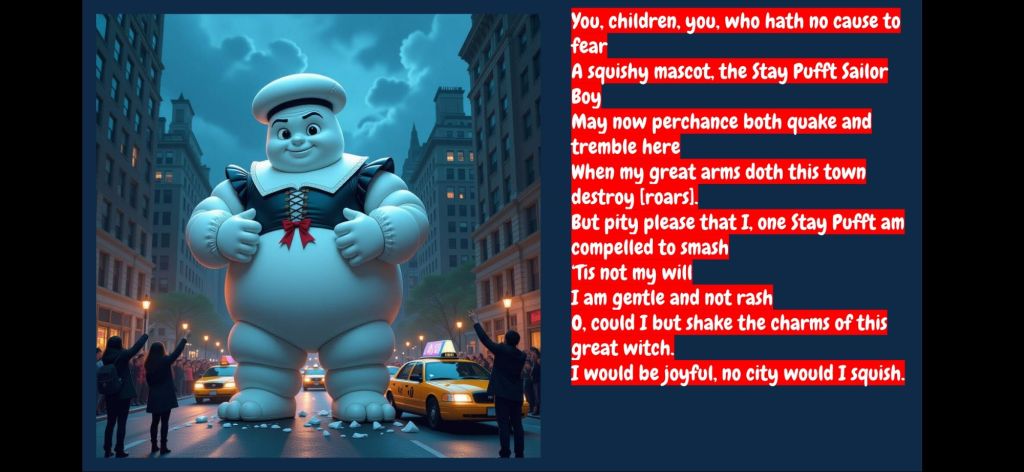
I only had 30 minutes allocated for my show, so I knew I’d have to pare down the story to its bare bones. This meant I had to eliminate a lot of subplots and characters and condense several scenes. As much as I love Walter Peck, Dean Jaeger, Louis Tully, Janine Melnitz, and the guy who gets electrocuted, they are not absolutely essential to the plot, so I cut them from my version. I also combined the characters of Dana and Gozer, eliminating the two terror dogs and limiting the antagonists to Gozer and the Stay Pufft Marshmallow Man. So I watched the film a few times, and created an outline of just 7 scenes.
Character Models
One thing I’ve said again and again is that Shakespeare’s characters are all based on archetypes that we see everywhere throughout literature, theater, and yes, movies. While I was watching Ghostbusters, I tried to find the Shakespearean archetypes that match the best with the characters in the movie:
Ray Stantz- Hamlet from Hamlet– Ray is a bookish man who is obsessed with death and with the occult, which makes him very much like the scholarly Prince Hamlet. He’s also a man on a mission to try and understand the supernatural and help keep it from destroying our world. Dr. Venkman describes him as “The heart of the Ghostbusters”, and that humorous heart gets him into trouble sometimes.
Egon Spangler- Horatio from Hamlet If Ray is the heart of the team, Egon is the brain. He is the no-nonsense scientist who provides the team with data and equipment to help them fight ghosts effectively, much like how Horatio reports to Hamlet that his father’s ghost has returned from the grave.
Dr. Venkman– Sir John Falstaff/ King Henry V
Dana Barret- Ophelia from Hamlet
Gozer– Hecate from Macbeth
The Stay Pufft Marshmallow Man- Snug the Joiner from A Midsummer Night’s Dream
Sneak Peak
Here’s one of the scenes I wrote, with the original scene for context
[The ghostbusters climb the stairway to the penthouse, where Gozer is sitting in a cloud. They have been going for a while and are clearly tired]. Venkman: Though I have not known fair Dana long, I know she must be a virtuous maid. Ascend this penthouse tower and let’s rescue she! Like to the Knights of ancient chivalry! Egon: These apparitions whizzing in the air Give so much light that I may read by them. [They reach the top and behold Gozer] Ray: I am resolved to speak to Gozer. This is the latest parle we will admit. Gozer: Art thou a god? Ray: Nay. Gozer: Then perish, half-man! Winston: Enough Ray of thy diplomacy! Speak, thou proton pack for me! [He fires, then the rest join in] Gozer disappears Venkman: The sky hath bubbles as the water hath, and she be one of them! Gozer [in Voice Over]: Sub creatures! Hark! Tis time! Pick the Destructor’s form Be it a Goblin damned or angel bright! Tornado or a earthy bright Or greatest Monkey with an appetite! Winson: Our thoughts contain the form that seals our doom? Then make them blank as a new-made room! [They all gesture to their heads as if pushing thoughts out] Gozer: Thy choice is made. Prepare to meet thy doom! Venkman: Nay! I chose nothing Winston: Nor I! Egon: Nor I [Pause] All: Ray? Ray: Twas not my fault! It popped into my mind Venkman: What? What hast popped in? Egon: LOOOK!!!
I’m beyond excited that The Deleclrte Theater is continuing their tradition of producing high-quality, free Shakespeare in the Park, and then giving everyone the chance to see it via streaming over PBS.
This summer’s show is Twelfth Night, my favorite Shakespearean comedy, with an all-star cast
I’m so excited to see Peter Dinklage as Malvolio, one of my favorite characters in Shakespeare, and one that I have played myself. I’m also very interested in Sandra Oh’s interpretation of Olivia. She has proven herself in both dramatic and comic roles, which works well for Olivia, a character who starts out in mourning and ends up madly in love.
The performance I am the most excited about, though, is Lupita N’ongo as Viola. I’ve said before that Viola is one of the greatest characters in all of Shakespeare, so I can’t wait to see her portrayed by Lupita N’ongo, an actress I greatly admire. I loved her performances in Avengers Endgame, Us, and my whole family adored her excellent voice work in The Wild Robot. She has simultaneously a childlike enthusiasm, and a calm and stoicism that I’m sure will translate excellently for Viola, who survives a shipwreck and losing her brother (she thinks) through courage and humor.
Hopefully, I can stream this program soon, and give you a full review. In the meantime, enjoy my past posts and videos about Twelfth Night
Title Card- “The Violent Rhetoric Of Julius Caesar”Title for my Outschool class on Codes and Ciphers, inspired by the Disney show “Gravity Falls.”Digital business card for my online classes with a QR code if you want to know moreTitle art for my Outschool course on Shakespeare’s comediesCover art for my Outschool class: “Shakespeare- the Lost Play”Title of my Outschool murder mystery gameTitle image for my online course on “Romeo and Juliet.”Title card for my Outchool Intro To Shakespeare cs.Title art for my Outschool course on Shakespeare’s comediesTitle for my Outschool class in swords and Stage Combat.
Great online classes in Shakespeare and science are available for students all this month at Outschool.com.
From now until June 1st, you can get a $20 discount with referral code PAULHT20. Share the joy with other curious minds in the family too! Spread the word and let’s ignite the passion for learning together!
Class Descriptions
Live Classes
For these classes you meet with me live over Zoom:
Introduction to Shakespeare- Tuesdays 9-9:30AM (EST)
This is my 30 minute short and sweet intro to Shakespeare’s life, his plays, and why his work still matters to us today!
Intro To STage Combat (With SwordS)- Tuesdays 9:30-10AM (EST)-
Like the Intro to Shakespeare class above, this is an intro to the basic footwork, attacks, and defensive parries of swordplays for someone just begeinning to learn about swords.
Title image for my online course on “Romeo and Juliet.”
An Immersive Guide To “Romeo and Juliet- Tuesdays from 10-11AM (EST)
This multi-week course delves into the plot, characters and themes of “Romeo and Juliet,” while also providing interactive activities, virtual tours, and webquests.
Shakespeare’s History Plays- SaturdAYs 8:30 AM IST
This is a new course I’m working on to cover all of Shakespeare’s History plays including Henry V, Richard II, and Richard III. More info as it becomes available.
Asynchronous Classes
These classes are Flex Schedule, which means the teacher prepares the activities in advance and allows you to do them at your own pace without direct consultation.
A flexible schedule class that teaches kids the plot and characters of “Romeo and Juliet,” in the context of a detective story where you solve the mystery of the young lovers’ deaths.
Did you know that Star Wars is based on the ideas and writings of William Shakespeare? This class will teach you about writing and characters though games, interactive activities and dramatic readings of both Star Wars and Shakespeare!
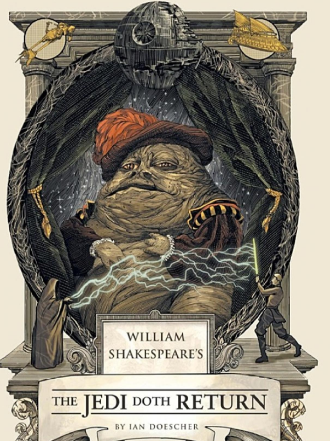
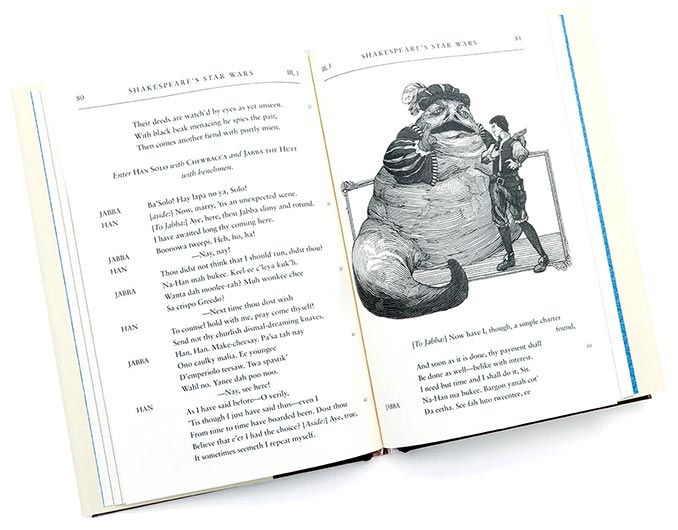
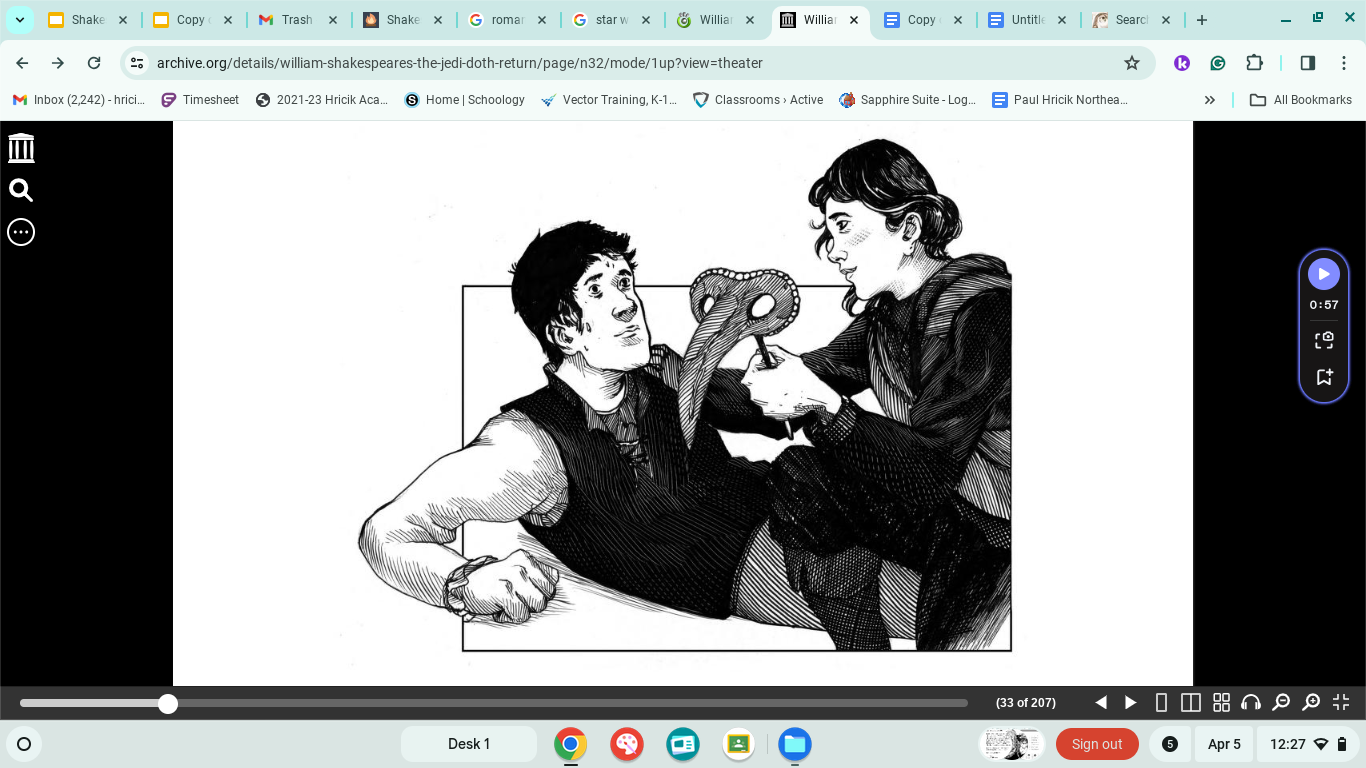
William Shakespeare’s Star Wars is a series of parody plays written by Ian Doescher that takes the prose screenplays of the Star Wars story and transforms them into Elizabethan verse. Last time I mentioned how much I loved the cheeky references to Shakespeare and Star Wars, and how Doescher adapts the cinematic quality into Elizabethan drama very well. In my podcast, I also emphasized the way Doescher gives each character verbose Shakespearean language that works very well for radio and theater:
My podcast episode where I do dramatic readings of “Verily A New Hope.”
I must confess, Return of the Jedi is my favorite Star Wars movie. I’ve seen all 9 films and it’s still my favorite. I adore the effects, the tight storytelling, the emotional farewells, and the dramatic victories. What I want to do with this post, (and the accompanying podcast), is to see whether this edition captures what I love about Jedi. The short answer is- no. It doesn’t capture it, IT EXPANDS IT! In many ways this play is Doescher’s triumph- he manages to capture the tone and characters of Star Wars perfectly, and makes the Shakespearean style his own!
Notes about the play
The first play in the series, “Verily, A New Hope,” took plot and structure inspiration from Henry V; it tells the story as an epic heroic story of Luke’s heroic deeds, much like how Henry V is about a king who grows from boy to man.
The second play “The Empire Striketh Back,” takes inspiration from Hamlet and Macbeth to explore Luke’s temptation by the Dark Side of the Force. It also uses Much Ado About Nothing as an inspiration for the burgeoning relationship between Han and Leia
I would argue that “Jedi Doth Return” is a mixture of all the other plays Doescher took inspiration from. Unlike the previous plays, this feels less like a parody, and more like an adaptation. I feel that Doescher has finally become so comfortable writing in the Shakespearean style, that he rarely needs to flat out parody lines and speeches, and simply uses Shakespearean dialogue to tell the story.
Moments to Watch for:
The Language
I’ll discuss the language of Jedi in greater detail in my podcast, but I’d like to highlight one or two here.
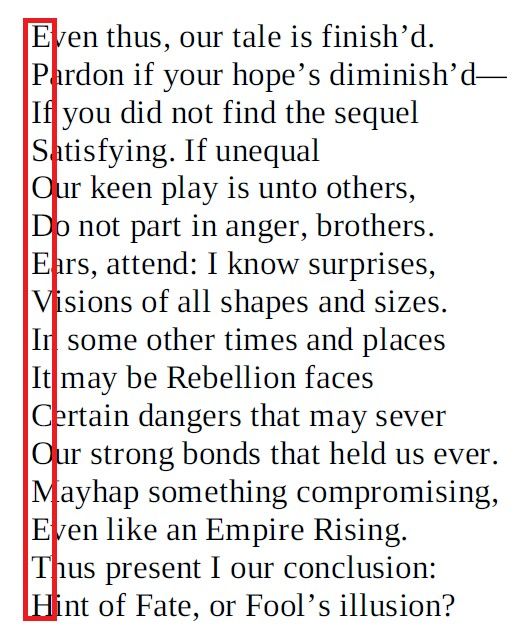
Extended metaphors:
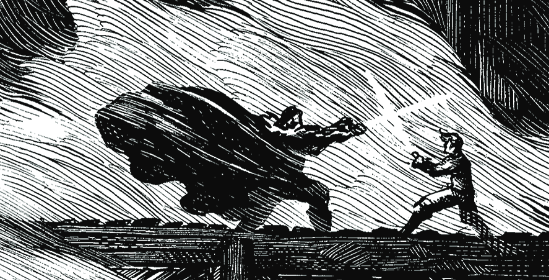
Vader: It is the role I play, my destiny—
The grand performance for which I am made.
Come, author of the dark side of the Force,
Make me the servant of thy quill and write
The tale wherein my son and I are seal’d As one.
Come, take mine ev’ry doubt from me,
 And fashion from my heart of flesh and wires
A perfect actor: callous, cold, and harsh.
Let this, the second Death Star, be the stage,
And all the galaxy be setting to
The greatest moment of my narrative:

The scene in which the Empire’s fight is won
Whilst I decide the Fate of mine own son - The Jedi Doth Return Act I, Scene i
3. Parody Lines
The biggest appeal of William Shakespeare’s Star Wars is the fact that it is a parody, and I’ve said for many years that parody and gentle riffing on Shakespeare is a great way to get students to overcome their fear of Shakespeare and engage with him. Students who know Star Wars but don’t know Shakespeare will recognize the familiar characters and plots of the movies and then see how Shakespeare’s language tells the story anew. Similarly, people who know Shakespeare will recognize the way Doescher re-tools famous Shakespeare quotes to give to characters in the Star Wars Universe, like here, where he spoofs the famous “All the World’s A Stage” speech:
In the Educator’s guide, which I’ve attached below, Doescher tells you exactly which lines he has parodied and the plots of the original plays so the students can learn about Shakespeare through these famous speeches. Orson Wells once said: “We sit through Shakespeare to recognize the quotations,” and this edition gives us thrilling space battle, wonderful characters, and witty dialogue to keep us entertained while we wait.
Characterizations
What I love the most about the movie and the play is that it’s a very character-driven story. Instead of long trench runs with pilots we’ve never met, we get duels to the death between characters we’ve known for years. At its heart, Jedi is the story of the Skywalker family reuniting after Darth Vader ripped it apart. It’s also the culmination of Luke growing from a boy to a man. Doescher does an incredible job voicing these characters through the verse, and his use of the language helps highlight each character’s struggle and journey.
Luke/ Vader
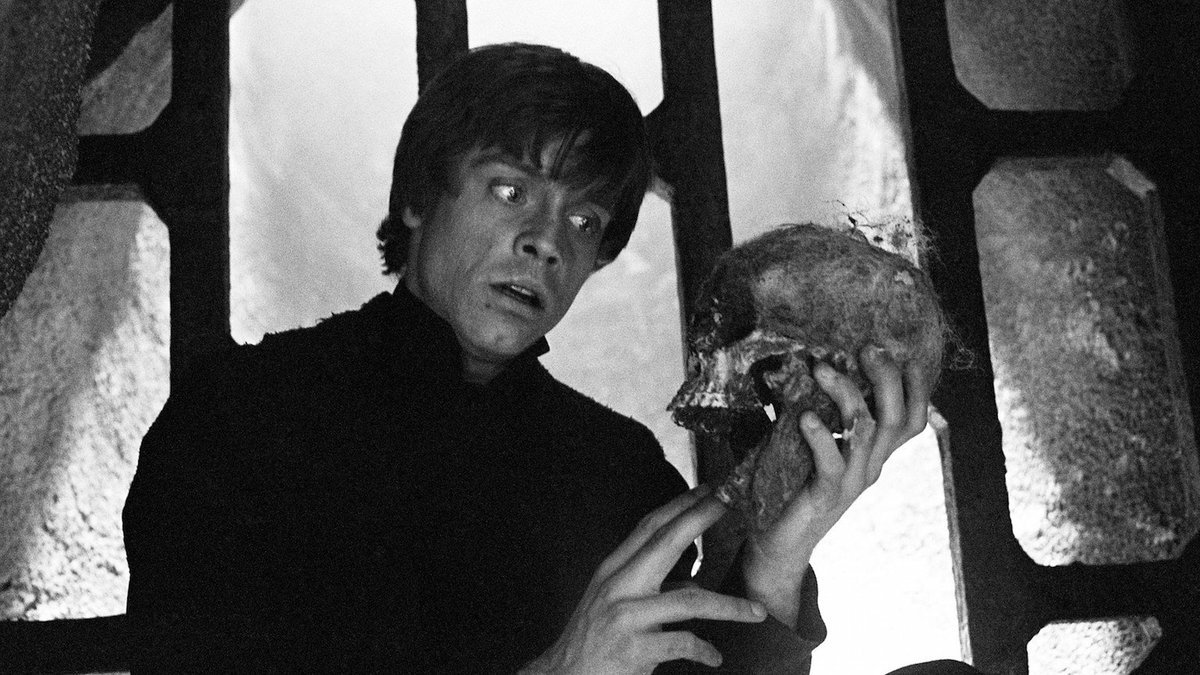
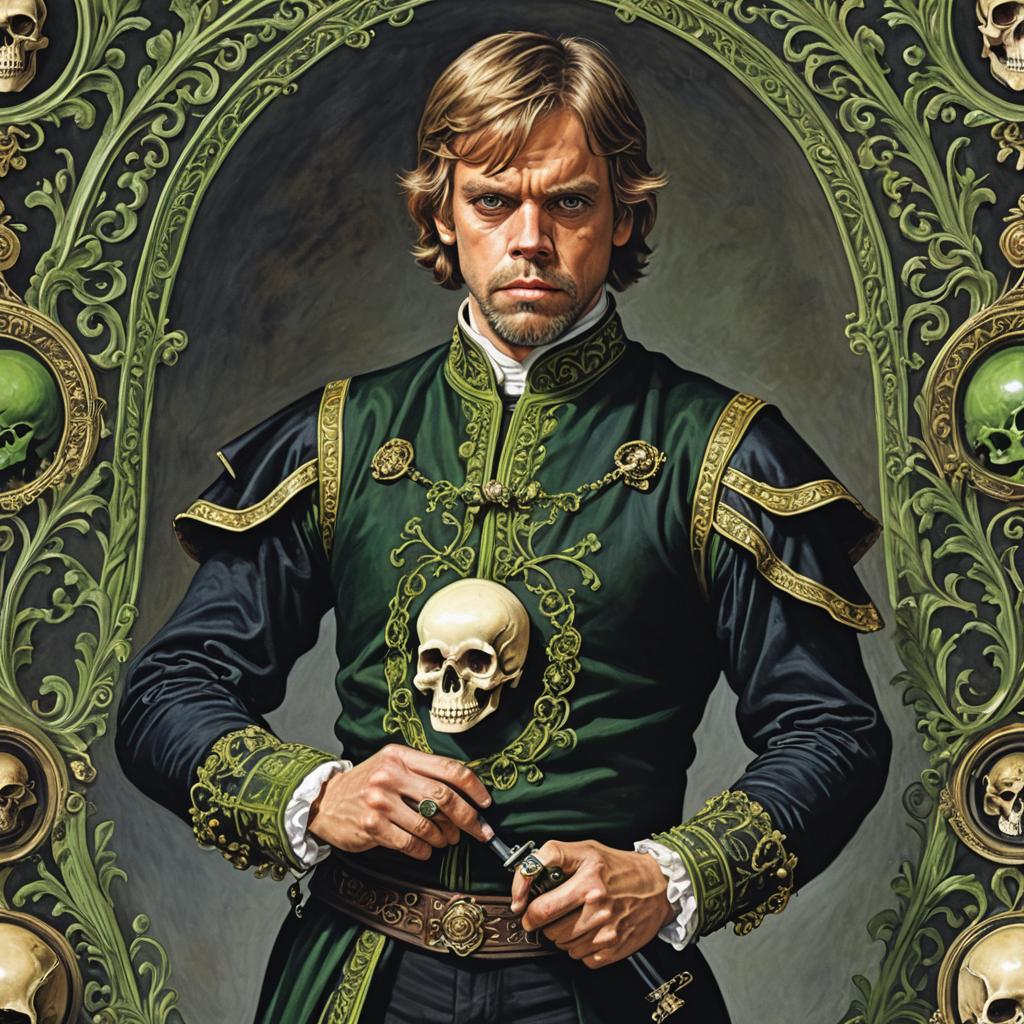
Left- production photo of Mark Hamil holding a skull Yorrick-style. Right- AI art I created of Luke as Hamlet.
Luke has more of a duality in this story- sometimes his speeches are hopeful, positive, and full of decisive language, while other times he is bitter, angry, and mournful. This is a perfect characterization for a young man whom the Emperor hopes to turn to the Dark Side, and these speeches excellently bring out his character. Sometimes Luke even repeats lines spoken by Vader and the Emperor just to drive this point home.
Emperor
A speech from “Jedi Doth Return.” Notice how the ideas run on past the ends of lines and how long each sentence is
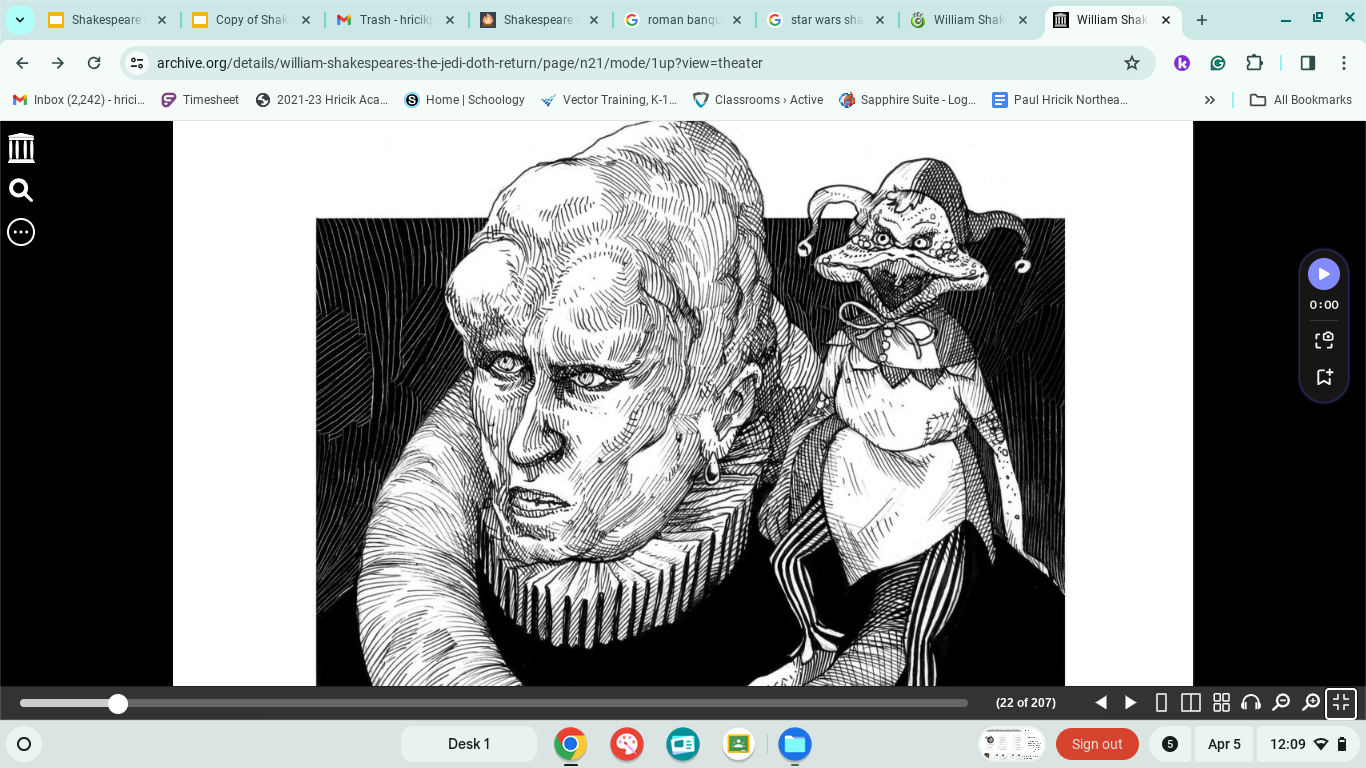
As for Emperor Palpatine, his speech is similar to Claudius in Hamlet in the sense that he has many run-on lines that only get to the point at the very end. This man knows he has the ea of the entire galaxy, so he can afford to make people wait for him to finish talking. As Luke himself says: “Your overconfidence is your weakness,” and Doescher does a great job conveying that weakness through the language.
Leia/ Han
My favorite part of The Empire Striketh Back was how Doescher conveys the love between Han and Leia. In that play/ movie, it was done through irritating each other in public, and soliloquizing in private. In Jedi, Han and Leia are more of a couple, supporting each other in their fights and the language has more of a romantic tone.
Han (Hal Jourdan) and Leia (Janine Ashley) finally confess their love in this scene.
My Criticism
To sum up, Jedi is a milestone in the William Shakespeare’s Star Wars Series where Ian Doescher learned how to make the language his own, rather than borrowing lines and phrases from Shakespeare. It’s a pity there aren’t more books in this series…. right?
If you enjoyed the accompanying podcast episode to this post, please consider subscribing and donating to help me continue making fun and educational content like this!
Last weekend I saw a wonderful production of “Six” The Musical at the Cab Calloway School Of the Arts in Wilmington DE. After seeing the professional production, I was worried that I wouldn’t enjoy these student performers but it was incredible! The young performers were all terrific and the director managed to use inventive, creative, and entertaining setpieces to both capture the essence of the Broadway show, and also make a version that is distinct and its own with student performers!
The Direction
DIRECTOR’S NOTE I thought original I’d never Broadway get a show chance only to has direct six it at actors Cab. in AS the luck cast, would so/ have it, the teen edition came out this past summer, which allows the addition of a singing and dancing ensemble. I immediately applied for the rights and we were one of the lucky schools to get them. This new teen edition is the perfect fit for our school community and it highlights the talents of studentsfrom every arts area. I wanted to create a Beyoncé or Taylor Swift concert-type at- mosphere, and I think we have achieved that with our show. The fabulous lighting, the beautiful costumes and make-up, the rocking pit band, the fabulous cast and crew and especially the epic choreography have culminated into quite a spectacle! It has always been a joy to work with my colleagues on these projects. and I want to give a particular shout-out to my team of choreog- raphers. They have taken my vision and turned it into something amazing. The creativity in this team is fierce, and if ever there was a group that fed off of each other’s ideas, it’s this one. We’ve had a blast collaborating on this production Also, I would like to acknowledge Brian Touchette, Peter Kuo and Jared DeStafney for their tireless work on this production. With- out them, this show would not be possible.
Marjorie Eldreth
As the director notes in the program, the challenge with doing a musical like “Six” at a high school or community setting is that there are only six major roles, which means it would be hard to find ways for the whole student body to participate. What I loved about this version is that, by utilizing dance, pantomime, and choruses, the director has found ways to not only involve more people, but help use the additional cast to tell the story in ways that the professional touring production I saw earlier didn’t!
My Favorite Moments
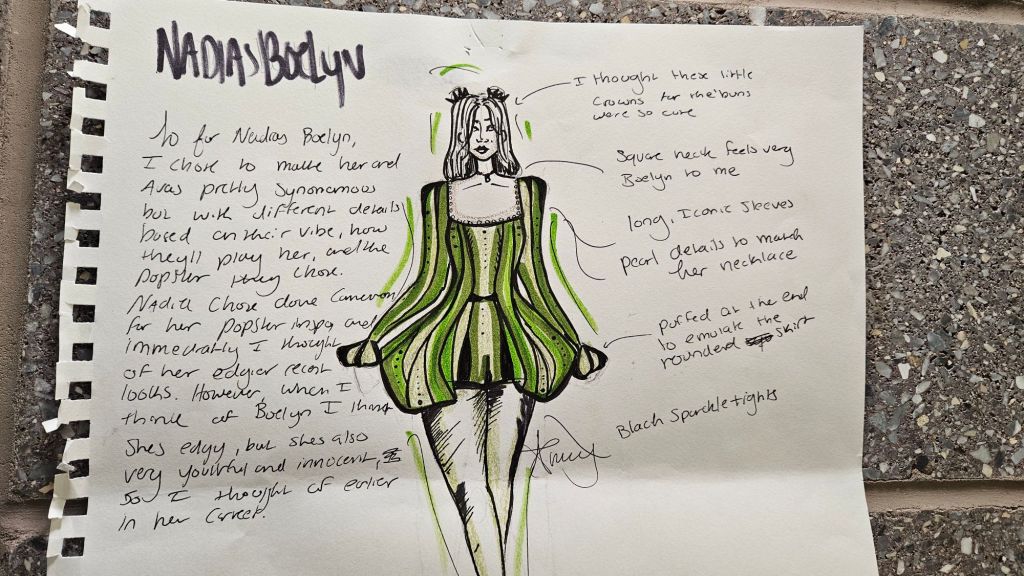
Normally I hate dance numbers in musicals. Don’t get me wrong, I admire the skill and athleticism that dancers have, but when I see a play or musical, I come for the story and the songs. Dance always seems like the black sheep in the musical theater trifecta to me. Not so with this production of “Six.” The dance numbers help tell the story in clever and moving ways! For instance, during Anne Boleyn’s “Don’t Lose Your Head,” a team of dancers with green sticks accompanied her. Their movements were cheeky and brash, which helps encapsulate her bubbly yet tart personality. During the choruses, the dancers and Anne rested their hands on the sticks, drawing attention to their heads moving back and forth, which reinforced both the title, and Anne’s air-headedness. Then, at the end of the number, the dancers got into a circle and pointed their sticks at Anne’s neck- pantomiming how she would eventually be beheaded! Thus, the dancers complimented Anne’s song perfectly, in a way that was not originally part of the show!
“My Heart Of Stone”
The most moving moment of dance was during Jane Seymore’s song “My Heart Of Stone.” When I saw this number in Hershey, it was by far my least favorite. I thought the lyrics were generic, that the song itself was bland, and that gave little depth to Jane character. All that changed this time around. While Jane belted her heart out about the son she never got to raise and the husband who mistreated her, we got to see elegant ballet dancers perform those moments for us. I particularly liked that the male dancers had red hair, (much like the real Henry VIII and his son). The dance actually helped me see Jane’s conflicting feelings for Henry- how she feels genuine love and affection one minute, and terror the next. How she and her son are both ghosts, now that they were denied the chance to live together on Earth. I don’t wish to diminish the wonderful singing and acting of the Hershey production, but Six: Teen Edition did a masterful job of showing, in addition to telling Jane’s story.
THe Cast
The Cab Calloway School of the Arts boasts some of the top young actors in the country, and all of them have tremendous chops as actors, dancers, and singers. Some of them already have professional acting credits. So it should come as no surprise that all the performances were incredible. It was very exciting, however to see a real 19-year-old play Catherine Howard, (since that was the real age she was when she died).
This production also took the bold leap of casting two men in the show. In one cast Anne of Cleaves was played by a man, and in the other (the one I watched), Katherine of Aragon was played by a man. I have no problem with this choice, (after all boys have been playing Katherine ever since Shakespeare’s Day), but I was a little disappointed that the actor had to modify the song to fit his range- I was looking forward to the extravagantly high Shakira and Beyonce inspired vocals that I’ve come to expect from the part. Nevertheless, the actor I saw was incredibly talented and his acting and dancing were completely appropriate for the part.
THe Dramaturg
For those of you who don’t know, a dramaturg’s responsibility is to help the actors, director, and production designer by doing research into the play’s historical or political context. It’s a role that is very important in period plays like Shakespeare. I’ve worked as a dramaturg myself and, though the work one does as a dramaturg is mostly unnoticed by the audience, the dramaturg can greatly contribute to the way the actors understand the text and give the director tools and ideas with which to explore themes and ideas present in it. I don’t know what the dramaturg did for this production, but I could tell based on the performances that every cast member was fully committed to their character. Each actor was able to clearly articulate their character’s emotional journey and that meant they must have learned the history and context of the Tudor period. Again, I don’t know if the dramaturg had any effect on this, but I’m going to assume they did a terrific job, because their end goal was accomplished- the actors and director gave a coherent and well thought out performance that captures the spirit of the Tudor period, so great job!

















 The Shakespearean Student