How Accurate is Hamnet Part II

For Shakespeare’s birthday, I thought I’d re-visit one of my most popular posts, especially since the Royal Shakespeare Company is celebrating by putting on an adaptation of Maggie O’Farrell’s novel Hamnet:

https://www.theguardian.com/stage/2023/apr/02/hamnet-on-stage-maggie-ofarrell-and-lolita-chakrabarti-on-adapting-the-hit-novel-for-the-rsc

RSC video of the first day of rehearsals for Hamnet

Biography of Hamnet

Just like his famous father, we know very little about the life of Hamnet Shakespeare. Since infant mortality rates were high, we don’t know his exact birthday, only that he was baptized on February 2nd, 1582. Like most 11-year old boys, he probably had started going to school at the King Edward Grammer School, the same as his father. This means he spent long hours away from his parents learning to read and write in Latin and Greek. When he was home, he lived with his mother, his two sisters, and his grandparents in the house of Henley Street.

https://www.kes.net/about-us/history-of-the-school/

O’Farrel portrays the boy Hamnet as sensitive and somewhat lonely, which makes sense, since he probably didn’t see his father for long periods of the year; Will Shakespeare spent much of the year writing, going on tour, and performing at the Globe- he commuted from London to Stratford for most of the year. He probably only came around during Lent, Christmas, and times of plague when the theaters were closed.

1589-1596

Never mind what I know. You must go.” She pushes at his chest, putting air and space between them, feeling his arms slide off her, disentangling them. His face is crumpled, tense, uncertain. She smiles at him, drawing in breath. “I won’t say goodbye,” she says, keeping her voice steady. “Neither will I.” “I won’t watch you walk away.” “I’ll walk backwards,” he says, backing away, “so I can keep you in my sights.” “All the way to London?” “If I have to.” She laughs. “You’ll fall into a ditch. You’ll crash into a cart.” “So be it.

O’Farrell
Hollar’s panorama of London, 1647

The novel portrays Anne Shakespeare realizing that her husband is stifled and unhappy living with his parents in Stratford, and so she suggests to his father that he go to London to ‘expand the family business,’ though in reality, she wants him to go to make his fortune and find more fulfilling work. Scholars have wondered for years how Shakespeare got his start in theater- as a man with children he was legally unable to become an apprentice, and as a glover’s son from Stratford, he didn’t know anyone in London. O’Farrell solves the mystery by making him start out as a costume maker and mender for a theater company, who later became a writer and actor.

This idea of Shakespeare starting out as the company’s glove mender actually has some historical merit- records from the time confirm that many playwrights and actors were also local artisans. Men like John Webster, Richard Tarlton, Edward Kyneston, and even Richard Burbage were skilled drapers, textile merchants, haberdashers (men’s tailors) and ( like the Bottom in “A Midsummer Night’s Dream,”) some of these men were weavers-turned actors (Source: Anna Gonzales) So it’s entirely possible that Shakespeare started in London by selling gloves to theaters, before selling his plays.

When Will moved to London, he lived in a number of locations throughout the city, probably because it wasn’t a safe place. Theaters were located in the same districts as bear baiting and brothels, so Will probably had to move to get away from bad neighborhoods, as this video from The History Squad illustrates:

https://www.shakespeare.org.uk/explore-shakespeare/shakespedia/william-shakespeare/william-shakespeares-family/hamnet-shakespeare/

Gloves

A glover will only ever want the skin, the surface, the outer layer. Everything else is useless, an inconvenience, an unnecessary mess. She thinks of the private cruelty behind something as beautiful and perfect as a glove.

Hamnet
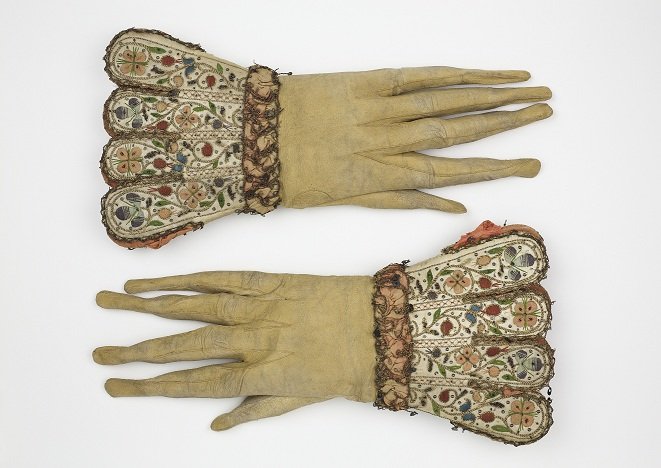
https://www.shakespeare.org.uk/explore-shakespeare/blogs/shakespeare-100-objects-pair-gloves/

Almost immediately after Will leaves, Anne is full of remorse. She knows his work in London will consume him and his success will make the distance between him and her even greater.

She walks back, more slowly, the way she came. How odd it feels, to move along the same streets, the route in reverse, like inking over old words, her feet the quill, going back over work, rewriting, erasing. Partings are strange. It seems so simple: one minute ago, four, five, he was here, at her side; now, he is gone. She was with him; she is alone. She feels exposed, chill, peeled like an onion.

The Plague

He wants to tear down the sky, he wants to rip every blossom from that tree, he wishes to take a burning branch and drive that pink-clad girl and her nag over a cliff, just to be rid of them, to clear them all out of his way. So many miles, so much road stands between him and his child, and so few hours left.

Hamnet

As I’ve said in previous posts, Shakespeare survived three epidemics of Plague; one in 1563, (before he was born), one in 1593, and one in 1603. In O’Farell’s novel, the germs that kill Hamnet came not from a massive outbreak, but a few germs that were transported in a box that his sister had the misfortune of opening. This frightful passage shows the grim tenacity and eve-present fear that, while England expanded and became more interconnected with the world, it also brought death and disease to and from the rest of Europe.

In the book, the plague germs that infect Judith and later Hamnet, lie inside a box with some glass beads that the Shakespeare’s ordered from Italy to decorate a pair of fancy gloves. As this video from National Geographic shows, trade routs then as now are prime spreaders of disease and even one ship that slips by can turn any box of goods into a Pandora’s Box, waiting for a poor unsuspecting girl like Judith to release it unto the world.

Hamnet’s Death

He can feel Death in the room, hovering in the shadows, over there beside the door, head averted, but watching all the same, always watching. It is waiting, biding its time. It will slide forward on skinless feet, with breath of damp ashes, to take her, to clasp her in its cold embrace, and he, Hamnet, will not be able to wrest her free.

Hamnet
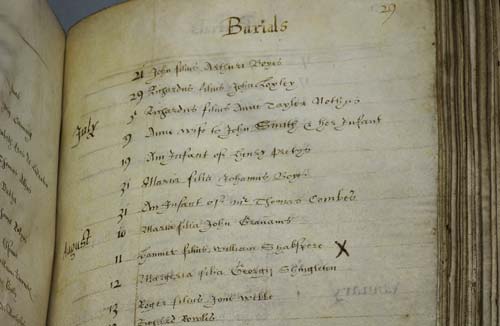
Burial Registry of Hamnet Shakespeare

In the novel, Hamnet somehow takes the plague away from his sister and dies in her place. Though it is hardly conclusive, I do find it interesting that Shakespeare stopped writing comedies about twins for another four years after Hamnet’s death, until he wrote Twelfth Night, which unlike earlier comedies like The Comedy of Errors, has a pair of twins mourning each other’s apparent death. They seem to share one soul, and one tries to resurrect the other, like Viola mourning her brother by, (in a sense), becoming her brother.

What should I do in Ilyria? My brother is in Elysium

Viola- “Twelfth Night”, Act I, Scene ii.

ELIZABETHAN FUNERAL CUSTOMS

In the book, Anne makes a winding sheet for her son. This was a cloth of linen or wool that was wrapped around dead bodies, since at the time, coffins were re-used. This must have been a somber and deeply upsetting activity for Anne.

J4W9B7 Woodcut Woman Spinning

As this quote from “The Evolution of the English Shroud” illustrates, the act of making a winding sheet was a sort of sad family responsibility, a way of ensuring that your loved ones die with dignity, and Anne clearly takes the task of making one very seriously.

The 16th-century shroud for the poor and lower middle classes was a large sheet that was gathered at the head and feet, and tied in knots at both ends, covering every part of the body. It resembled earlier Medieval practices and was a functional, yet modest way of preserving the deceased’s dignity. It was also economical, with very little cost involved, as the burial sheet was usually taken from the family home.  At this point, linens dominated as the material of choice; after all, it was a biblical tradition as Jesus was wrapped in a linen cloth. Linen was also considered more fashionable than wool.

Coffin Works Archive

The Aftermath Of Hamnet’s Death (Spoilers)
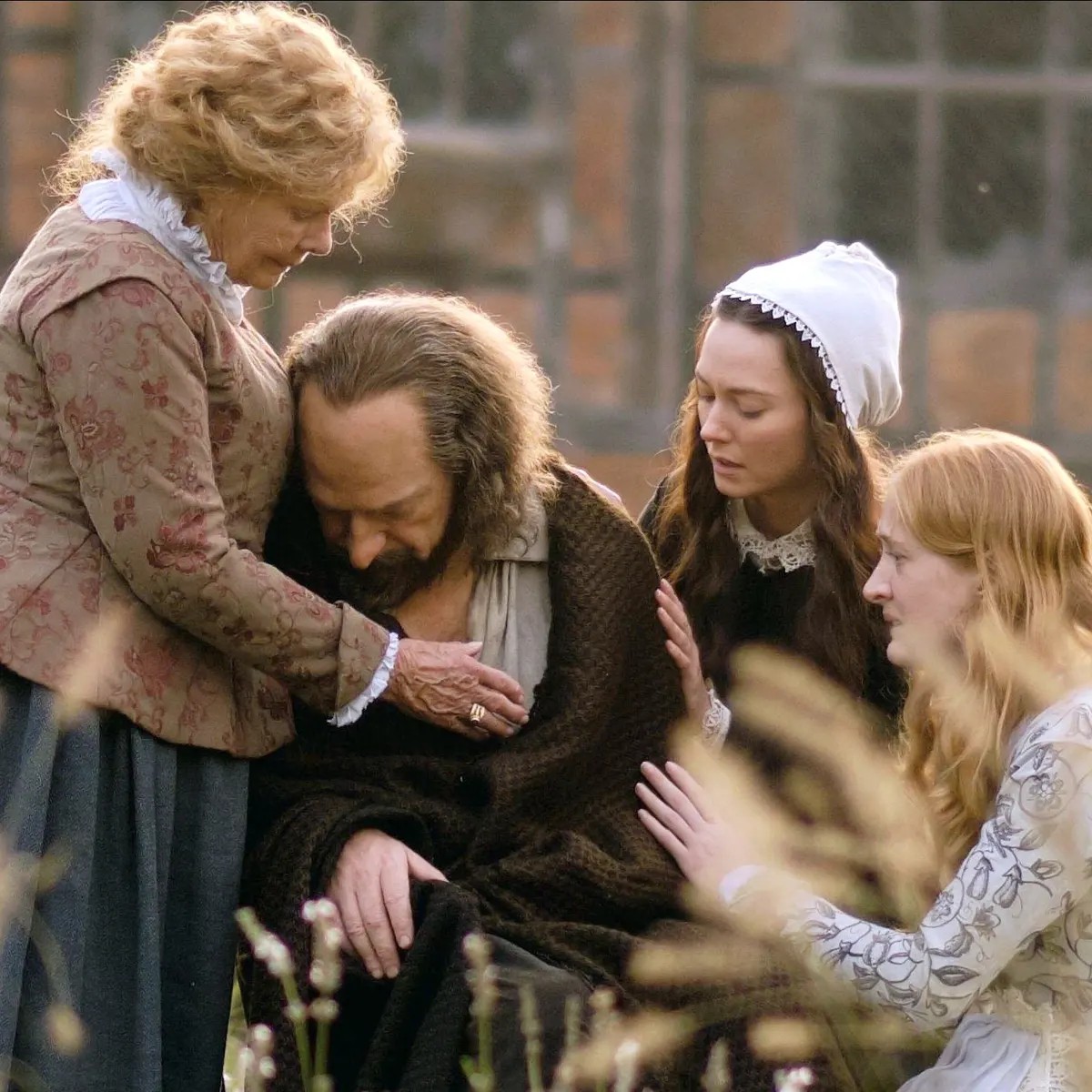
The Shakespeares in the 2011 film “All Is True,” starring Kenneth Branaugh as Will and Judy Dench as Anne Hathaway.

She discovers that it is possible to cry all day and all night. That there are many different ways to cry: the sudden outpouring of tears, the deep, racking sobs, the soundless and endless leaking of water from the eyes. That sore skin around the eyes may be treated with oil infused with a tincture of eyebright and chamomile. That it is possible to comfort your daughters with assurances about places in Heaven and eternal joy and how they may all be reunited after death and how he will be waiting for them, while not believing any of it. That people don’t always know what to say to a woman whose child has died. That some will cross the street to avoid her merely because of this. That people not considered to be good friends will come, without warning, to the fore, will leave bread and cakes on your sill, will say a kind and apt word to you after church, will ruffle Judith’s hair and pinch her wan cheek.

The Women of Hamnet

The most unique thing about this novel is how it shows the interdependence of women in Elizabethan society. Since Shakespeare spends most of the novel away from Anne, her support system mostly comes from Will’s mother Mary, as well as Anne’s daughters, her sister, and all the other women of the town. Nowadays we do most of our socialization online and barely know our own neighbors, but in the 1590s, especially for women, community was a way of building strength where women got through things like childbirth, loss, the managing of households, and many other difficulties through their relationships with other women. This video below shows the kinds of home remedies that women would share and later write down during the Tudor period:

Other Mysteries Solved


Once Hamnet dies, Will buys her a new house, New Place so she isn’t forced to live with his parents and no longer has to live in the house where her son died. But Will’s success comes with a price- he still has to leave for London. he offers to move them there but Agnes won’t hear of it. This solves the riddle of why Shakespeare commuted between town and country for his entire career- she knows the plague that took her son literally came from London, and she won’t risk losing her daughter as well. She probably also sees London like another woman that took her husband away as well, and therefore refuses to look it in the face.

It is no matter,” she pants, as they struggle there, beside the guzzling swine. “I know. You are caught by that place, like a hooked fish.” “What place? You mean London?” “No, the place in your head. I saw it once, a long time ago, a whole country in there, a landscape. You have gone to that place and it is now more real to you than anywhere else. Nothing can keep you from it. Not even the death of your own child. I see this,” she says to him, as he binds her wrists together with one of his hands, reaching down for the bag at his feet with the other. “Don’t think I don’t.”

O’Farrell, Hamnet.

The Shakespeares’ Marriage after Hamnet

I mean’, he says, ‘that I don´t think you have any idea what it is like to be married to someone like you.’
‘Like me?’
‘Someone who knows everything about you, before you even know it yourself. Someone who can just loo at you and divine your deepest secrets, just with a glance. Someone who can tell what you are about to say- and what you might not- before you say it. It is’ he says, ‘both a joy and a curse.

Hamnet

The ugly truth that O’Farrell highlights in Hamnet is that it must have been very hard for the Shakespeares to endure Hamnet’s death, especially since Will was probably not there when it happened, and probably didn’t stay around long after burying his son. It must have been catastrophic on his marriage, sort of like this tragic moment in the musical Hamilton, where the couple mourns the loss of their son, who died in a duel trying to defend his father’s honor.

Agnes is a woman broken into pieces, crumbled and scattered around. She would not be surprised to look down, one of these days, and see a foot over in the corner, an arm left on the ground, a hand dropped to the floor. Her daughters are the same. Susanna’s face is set, her brows lowered in something like anger. Judith just cries, on and on, silently; the tears leak from her and will, it seems, never stop. — How were they to know that Hamnet was the pin holding them together? That without him they would all fragment and fall apart, like a cup shattered on the floor?

Maggie O’Farrell, Hamnet

The Second Best Bed mystery

Though Anne is angry at Will for a while, she does eventually forgive him, as evidenced by another solved historical mystery. In Shakespeare’s will he gives his wife “My second-best bed, with the furniture,” which O’Farell explains, is their marriage bed. The best bed was the one they gave to guests and was therefore newer. In the book, Will offers to replace it after Hamnet dies, but Anne won’t hear of it; although she partially blames Will for Hamnet’s death, she still loves him and her love is stronger than her grief, as is her love for her surviving daughters.
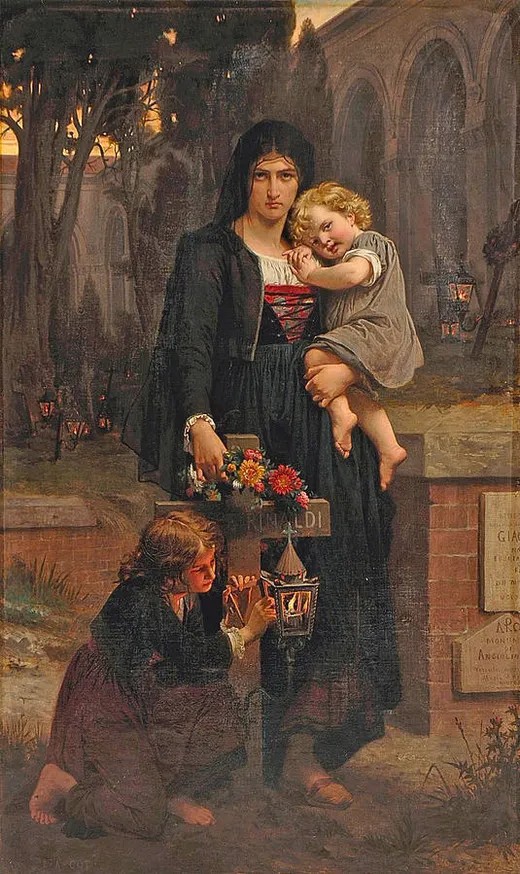
Sa Mere Avec Ses Deux Enfants A La Tombe Du Pere. / The Mother With Her Two Children at the Tomb of Her Father by Pierre Auguste Cot, 1870.

What is the word, Judith asks her mother, for someone who was a twin but is no longer a twin?
Her mother, dipping a folded, doubled wick into heated tallow, pauses, but doesn’t turn around.
If you were a wife, Judith continues, and your husband dies, then you are a widow. And if its parents die, a child becomes an orphan. But what is the word for what I am?
I don’t know, her mother says.
Judith watches the liquid slide off the ends of the wicks, into the bowl below.
Maybe there isn’t one, she suggests.
Maybe not, says her mother

Raising the Dead

Aran Murphy in the Abbey Theater’s production of Hamnet, a play not based on O’Farell’s novel.

At the end of the book, Shakespeare plays the Ghost of Hamlet’s father, and writes Hamlet as a tribute to his late son. We don’t know for a fact that the real William Shakespeare did this but Stratford legend says that Shakespeare played the Ghost of Hamlet’s father onstage, and this has captivated the imagination of authors and scholars alike. In any case, as Stephen Greenblatt says in his book Will In The World, Shakespeare’s father’s health faded around the same time that he wrote Hamlet. it must have been hard for Shakespeare to write a name that was one letter away from his son’s over and over again. Hamlet is Shakespeare’s longest play, and the titular character has over 40% of the dialogue, so it must have been haunting at the very least for Shakespeare to have to write his son’s name nearly 4,000 times.

Whatever he determined at the time, Shakespeare must have still
   been brooding in late 1600 and early 1601, when he sat down to
   write a tragedy whose doomed hero bore the name of his dead son.
   His thoughts may have been intensified by news that his elderly
   father was seriously ill back in Stratford, for the thought of his
   father's death is deeply woven into the play. And the death of his
   son and the impending death of his father--a crisis of mourning
   and memory--could have caused a psychic disturbance that helps to
   explain the explosive power and inwardness of Hamlet. 
Greenblatt,
2004, p. 8)

In the book, Anne secretly goes to London to see Hamlet onstage and is overcome with emotion. Not only does Will play a ghost as tribute to his dying father, not only does he put his son’s name onstage, he directs the actor playing Hamlet to affect his own son’s mannerisms and gestures, to use theater to bring his son back from the dead. Anne is both appalled and moved by this act- Hamnet is dead, but his story is now immortal.

O’ Farrell has done a fantastic job of taking what little we know about the Shakespeare’s lives, infusing them with some clever inferences from the plays of Will Shakespeare, and finally fleshing them out with her own Shakespearean knowledge of the human heart- how it feels to bury someone, how it feels to go through trauma and what it’s like to be part of a family and to truly love someone, even though they often fail to properly love you back. As the end of the book implies, maybe Will didn’t intend to immortalize his son and share his powers of theatrical resurrection with the world, maybe this was just his way of apologizing to the love of his life. To try to make amends for the time he lost and to express a wish that he could give her son back to her, which in a way, he does:

Hamlet, here, on this stage, is two people, the young man, alive, and the father, dead. He is both alive and dead. Her husband has brought him back to life, in the only way he can. As the ghost talks, she sees that her husband, in writing this, in taking the role of the ghost, has changed places with his son. He has taken his son’s death and made it his own; he has put himself in death’s clutches, resurrecting the boy in his place. “O horrible! O horrible! Most horrible!” murmurs her husband’s ghoulish voice, recalling the agony of his death.

O’Farrell, “Hamnet”

References

Journals

Bray, Peter. “Men, loss and spiritual emergency: Shakespeare, the death of Hamnet and the making of Hamlet.” Journal of Men, Masculinities and Spirituality, vol. 2, no. 2, June 2008, pp. 95+. Gale Literature Resource Center, link.gale.com/apps/doc/A189052376/LitRC?u=pl9286&sid=bookmark-LitRC&xid=ea79f235. Accessed 20 Apr. 2023.

Period Documents

Document-specific information
Creator: Holy Trinity Church, Stratford-upon-Avon
Title: Parish Register of Holy Trinity Church, Stratford-upon-Avon
Date: 1558-1776
Repository: The Shakespeare Birthplace Trust, Stratford-upon-Avon, UK
Call number and opening: DR243/1: Baptismal register, fol. 22v
View online bibliographic record

Web

King Edward Grammar School History: https://www.kes.net/about-us/history-of-the-school/

Shakespeare’s Birthplace Trust- The Second Best Bed: https://www.shakespeare.org.uk/explore-shakespeare/shakespedia/william-shakespeare/second-best-bed/

Coffin Archive.org- The Evolution of the English Shroud: From Single Sheet To Draw-Strings and Sleeves: http://www.archive.coffinworks.org/uncategorised/the-evolution-of-the-english-shroud-from-single-sheet-to-draw-strings-and-sleeves/

My Top 10 Favorite Shakespeares

Shakespeare’s birthday is coming up! This is the week where I usually stop talking about individual plays, and talk about the man himself. Today I’d like to cover how he’s been portrayed in fiction. As you’ll see, with such a famous and at the same time mysterious figure like Shakespeare, there is a lot of leeway in terms of how you portray him. This list shows multiple interpretations of Shakespeare and at different stages (ages) of his life. Some are comic, some are tragic, but all are fascinating to discuss:

#10: Rhys Ivans (Anonymous, as The Earl Of Oxford).

Like I said in my podcast, I don’t believe Oxford was the real Shakespeare, and I have some issues with the character and his lack of humanity. That said, I do like the character they were going for- a tortured genius who has to create, in spite of himself, and it destroys him and his family.

#9: Hugh Laurie

I love what they do here- Shakespeare’s a temperamental artist who hates editors, but ultimately accepts that he has to put butts in seats. It’s very true-to-life and Rowan Atkinson and Hugh Laurie do a great job in this sketch!

#8: Kill Shakespeare Volume 2

Like I said in my full review, I really like the idea of an aging Shakespeare buckling under the pressures of being an icon. Bardolatry, the worship of Shakespeare as a literary god, has been a real thing in academic circles for at least the last 200 years and I think it really hampers first-time readers from even attempting to read Shakespeare. Since this comic is very much attempting to get people to do just that, it makes sense that they portray Shakespeare as a deeply flawed human who is trying his best, but not able to live up to his god-like persona.

#7 Matthew Baynton- Horrible Histories

Even though this history show for kids is also trying to make Shakespeare accessible for British schoolchildren, it actually takes the opposite approach for Shakespeare- make him cocky, self-assured, silly, and a bit of a schlamaazel, who like his own creation of Mercutio, talks too much and invariably gets himself into trouble.

#6: King Of Shadows

Cover of “King Of Shadows,” an excellent Young adult novel for anyone who loves Shakespeare.

“Nat, say hello to William Shakespeare”. They might as well have said, “Nat, say hello to GOD!”

-King Of Shadows

Again, most interpretations of Shakespeare are aware of and try to subvert the god-like status he has in our culture, which is why this YA novel attempts to humanize him, by having him interact with the hero, Nathan, a 20th-century child actor, go back in time and finds himself switching places with another Nathan Field, a real boy actor in Shakespeare’s company. Nathan then meets and befriends Shakespeare and the two form a father-son bond.

This book takes place just a few years after the death of Shakespeare’s own son, Hamnet, so this William Shakespeare has a son-shaped hole in his heart. It’s really heartwarming to see the two broken people form a family bond.

#5: Hamnet

As I said before, Shakespeare is not the main character of this novel; he pops in and out of the life of the real main character; his wife Anne, as he visits her at his parents’ home, and later when he sees her on periodic trips home from London. His characterization is entirely indirect. That said, we learn a ton about him through her perceptive eyes. We see his hatred of his abusive father, his frustration with being a glover’s son with no time to make a living in the theater. We see his ambition take hold as he travels to London, and at last, his contrite return to finally become a good husband after the death of his son. This Shakespeare is sort of a prodigal son, who searches for fame and fortune as a young man in the big city, but eventually comes to value his life at home. This solves the mystery of why Shakespeare never moved his family to London, why he retired in the early 1610s, and why his writings have nothing about his relationship with his family, his wife, or especially his son. This Shakespeare is scarred; trying to redeem himself from the sins of his past.

#3 Kenneth Branaugh- “All Is True”

This Shakespeare is at the end of the journey he took in “Hamnet.” He’s retired from theater, trying to pick up the pieces of his life in Stratford, and trying to reconcile his feelings for the fair-young-man (played by Ian McKellen), and his wife, (played by Judy Dench). It’s melancholic, but still funny in a dour way.

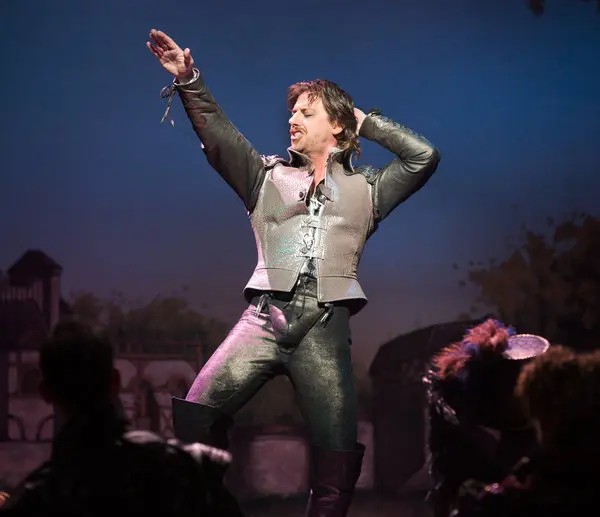
#3: Christian Borle- “Something Rotten”

Like I said in the review of the Broadway musical, Borle is the best part of this show. Like Matthew Baynton, he plays Shakespeare as a cocky young self-assured genius on the outside, but unlike Baynton, we see he has a deeper side underneath. As he sings in the incredibly catchy “Hard To Be the Bard,” Shakespeare is once again dealing with the problem of maintaining his success and is under a tremendous amount of pressure to crank out new and successful plays all the time. Even though he’s the antagonist, he’s more sympathetic than the heroes.

#2: Jacob Fiennes- “Shakespeare In Love”

I realize this movie has lost a lot of prestige over the years, thanks to the controversy over its loathsome producer, Harvey Weinstein. I realize that the film Shakespeare In Love might not have deserved best picture over films like Saving Private Ryan. That said, I still think it’s a fantastic movie and every single element from the sets to the costumes to the near-perfect casting, is top-notch, especially the casting of Jacob Fiennes as Shakespeare. This young, heartthrob Shakespeare hasn’t yet become the self-assured genius we see elsewhere on this list. He’s constantly out-classed by Christopher Marlowe, which is a very good choice because it helps us sympathize and root for this man, whom we all know will become a rich, successful genius, but hasn’t yet.

Fiennes also gives Shakespeare a very good arc- he’s a selfish dreamer like Bottom at the beginning and a sweet, sensitive man at the end. In the end, he writes for all the right reasons- supporting his family, immortalizing his love Lady Viola, and helping his friends and partners in the Chamberlain’s Men. Most of these Shakespeare are fairly static, but this movie gives him a great hero’s arc which allows us to like him and hope that his play is a success. As you can see in this alternate version of the final scene, Shakespeare makes a tearful goodbye to Viola, and sets about paying tribute to her in a play that will eventually become Twelfth Night. He also begins his lifelong partnership with Richard Burbage, who will go on to play Malvolio in that play, as well as Hamlet, Othello, and many others. It’s a satisfying conclusion to his arch, which like Viola, shows that Shakespeare is ready to take on a “brave new world” with a new sense of purpose.

#1: Dean Lennox Kelly From Dr. Who: The Shakespeare Code

Dr. Who (David Tennent) and Dr. Martha Jones ( Freema Agymann), are… disappointed when they meet Shakespeare in person in 1599.

Though this episode has an inauspicious start, Dean Lennox Kelly from this 2007 episode of Dr. Who finds a way to incorporate every aspect of every other Shakespeare on this list! He’s a cocky, self-assured showman on the outside who knows he’s a genius but is also a middle-class man of the people, playing to the groundlings. On the inside though, he is mourning the loss of his son and yearning for love, which is why he falls in love with Martha and (spoiler alert) makes her the Dark Lady of the sonnets. He also is clever enough to figure out what’s going on as three aliens try to manipulate him into using his gift of words to conjure the end of the world for them. Finally, he is still a hard-working writer and does occasionally doubt his own work:

Shakespeare: “To be or not to be”. Oh, that’s quite good.

10th Doctor: You should write that down

Shakespeare: I dunno… bit pretentious?

-The Shakespeare Code.

Again, the best thing about this Shakespeare is his arc- he drops his mask of genius and opens up to Martha and the Doctor, just like how the Doctor confides in Shakespeare how he is mourning the loss of his previous companion, Rose. In the end though, he draws strength in the memory of his son, and actually uses it to save the world!

Is this a historically accurate biopic? No. Is it a silly cartoon? Also no. The reason I ranked this episode the highest is because they managed to encompass the myth and the man of Shakespeare in a very compressed time, with tons of Shakespeare easter eggs, and historical references, and it was filmed in the real re-creation of Shakespeare’s own theater! Someday I’ll write a full review of this episode, but for now, I hope you’ve enjoyed this list, and are hungry for more Shakespeare’s Birthday Week content!

Help Support my podcast

As of right now, if you want to help support the work I do here and my podcast, you can sign up for monthly donations. I have a lot of new ideas for the podcast, but I can’t do them without your support, so please consider being a supporter now!

If you go to my podcast website, there’s now a button that says “Support this Podcast,” where you can choose your monthly rate of contribution, from $9.99 per month to as low as $1 per month! If enough people support this podcast, I’ll start taking requests and giving out rewards to my generous supporters. In short, if you support me, I’ll create content designed to your interests so you can feel that this is YOUR podcast.

Thanks for reading, and please consider donating today!

Intro to King Lear

Lear at its core is a play about growing older, and not just for its title character. Goneril and Regan learn their father is a lousy dad and learn to stand up to him. Edgar learns about the cruelty of the world and how to deceive his enemies.


Plot Summary

Lear, a king in pre-Christian England, is too old to rule, so he decides to divide his kingdom among his three daughters. He then tells them he will give the the kingdom to the one who loves him most.

Lear’ youngest daughter Cordelia, refuses to flatter her father, so she banishes her. He also banishes the Earl of Kent, who warns the king that his actions are foolish and rash. Finally, Lear demands that, although he resigns his kingdom, his daughters call him king and agree to house him and his knights in their castle.

Lear is not the only rash old man who is blind to his true danger. His friend the Duke of Gloucester has a bastard son named Edmund, who schemes to usurp his father’s lands and marry into Lear’s family. Edmund frames his legitamite brother Edgar which forces him to disguise himself as the mad beggar Poor Tom

After his daughters refuse to house him and his knights, Lear goes stark-raving mad. He runs out into a storm on the heath, wishing the Earth were struck flat and all mankind was destroyed. He is soon cared for by his Fool, and Kent, disguised as a commoner named Caius.

Duels, wars, tears, and oblivion follow.

Dramaturgy Website: American Shakespeare Center

Contemporary Parallels:

“Empire” (TV Series 2015-2020)

Empire Cast - Original Soundtrack from Season 1 of Empire - Amazon.com Music
Poster for Empire with Lucius and Cookie, and their three sons Jamal

Succession (HBO- 2018- present)

https://www.telegraph.co.uk/tv/2018/08/02/succession-hbos-new-dramais-king-lear-modern-media-age/
This scene from “Brave”

“Slings and Arrows,” Season three

Slings and Arrows, Season 3

“Ran” by Akira Kurasawa-

Encanto (2021): Click here to read my post about Encanto and Lear

Videos

More Posts

Shameless Plug

I’ll be playing Kent in King Lear October 22nd, 1PM EST. It’ll be streamed on Discord and live on YouTube here:

Did Shakespeare use visual effects?

Stagecraft has a fascinating and interesting history. The way we portray spectacle on stage has changed a lot since the advent of television and movies, which utilize computers and animatronics, etc. to create impossible things that could never be is shown live. In a way, the pre-recorded nature of film and TV gives theater practitioners an advantage because the more clever they are with their stagecraft, the more impressive it is for the simple fact that it is live- happening right now in front of an audience.

What I want to do with this post is to speculate whether, with the technology of the time, if Shakespeare could have used some kind of visual spectacle to portray otherworldly creatures, such as the ghosts in Hamlet and Macbeth

The conventional wisdom

Contemporary accounts of the Globe theater mention two trap doors, one in the ceiling for angels and gods, and one in the floor for ghosts or devils.

Most books I’ve read on Elizabethan stagecraft say that the theaters of this era were very minimalistic in design. They had trap doors, they had galleries, they had a primitive flying rig, and they had music and some simple sound effects, but most of the experience was watching the actors, their costumes, their bodies, and hearing their voices hence ‘audience’- audio, “To hear.”

Professor Stephen Greenblatt of Harvard University explains the way the ghost probably haunted the Globe Theater in 1600.

We are told there wasn’t much visual representation of spectacle and fantasy on Shakespeare’s stage, which which is is odd because there are some pretty fantastical elements in his plays, especially Hamlet and Macbeth, where the former calls for a ghost and the latter calls for a ghost, witches, and a literal goddess to appear on stage. How may one ask, was this achieved back in Shakespeare’s day, the late 1590s and the early 1600s? The conventional wisdom is that the ghosts in Hamlet and the ghost in Macbeth came through a trap door in the stage known as Hell.

If you’re you go to the Globe now you can see this actual trap door being used. It used a primitive pully system to open up in the middle of the floor. The ghost would ascend to the stage through a small step ladder. Hamlet’s father’s ghost is described as wearing a suit of armor and being very pale. Banquo’s ghost is described as having long hair dappled with blood.

Banquo’s ghost appears during a banquet in Macbeth’s honor. Based on this hypothesis it’s likely that a banqueting table was brought out into the middle of a stage to conceal the ghost, to make it more of a surprise when it ascends onstage through the trap door, but the effect to modern taste would be rather dull. However impressive the performance, this cannot stand up to the stunning nature of visual effects using computer technology, motion capture, et cetera. I wanted to see if there are any Elizabethan theatrical illusions that would still have been accessible to Shakespeare back in the 1590s.

Idea #1: A Smoke-monster ghost?

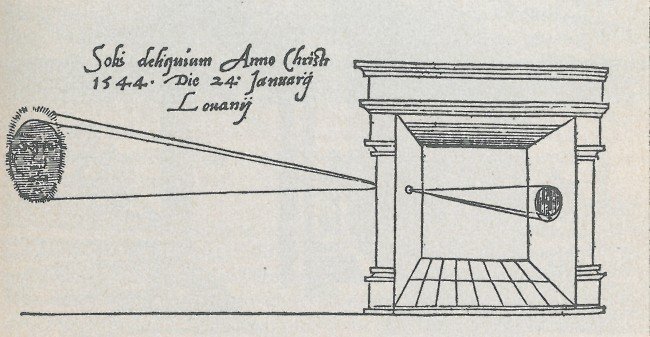
My research began with this video from the YouTube History Channel Atun-Shei Films, where the author traces the history of film, (both as photography and film as a projection). He cites at the start, an incident in 1536 where a supposed necromancer appeared to conjure a ghost for an unsuspecting rube. According to The Lives Of the Necromancers, the solution was achieved by creating huge clouds of smoke within the theater space, (which was the Colosseum) and then using a primitive camera obscure to project a frightening image Into this space.

Sketch for an early camera obscura, dated 1544 by Leonardo Da Vinci.

Camera Obscura is a term is it Latin for dark chamber the principal had been discovered for century had existed for centuries bit is for centuries but only in the 1530s this was the 1st recorded example of it being used to create a theatrical illusion.

The question is, could Shakespeare’s company have performed the same illusion with the technology of the day? Honestly, I find it rather unlikely that Shakespeare’s audience would’ve put up with huge clouds of smoke in a wooden amphitheater. Still, the fact remains that primitive projection technology existed back in Shakespeare’s day, which means a director could reasonably implement it in a production of Hamlet or Macbeth, even under the constraints of Original Practices.

Banquo’s ghost in Macbeth

So the question remains, is there a visually striking way to represent the ghosts that could actually work in Shakespeare’s theater. My first idea is…

Idea 1: Glow In the Dark Paint

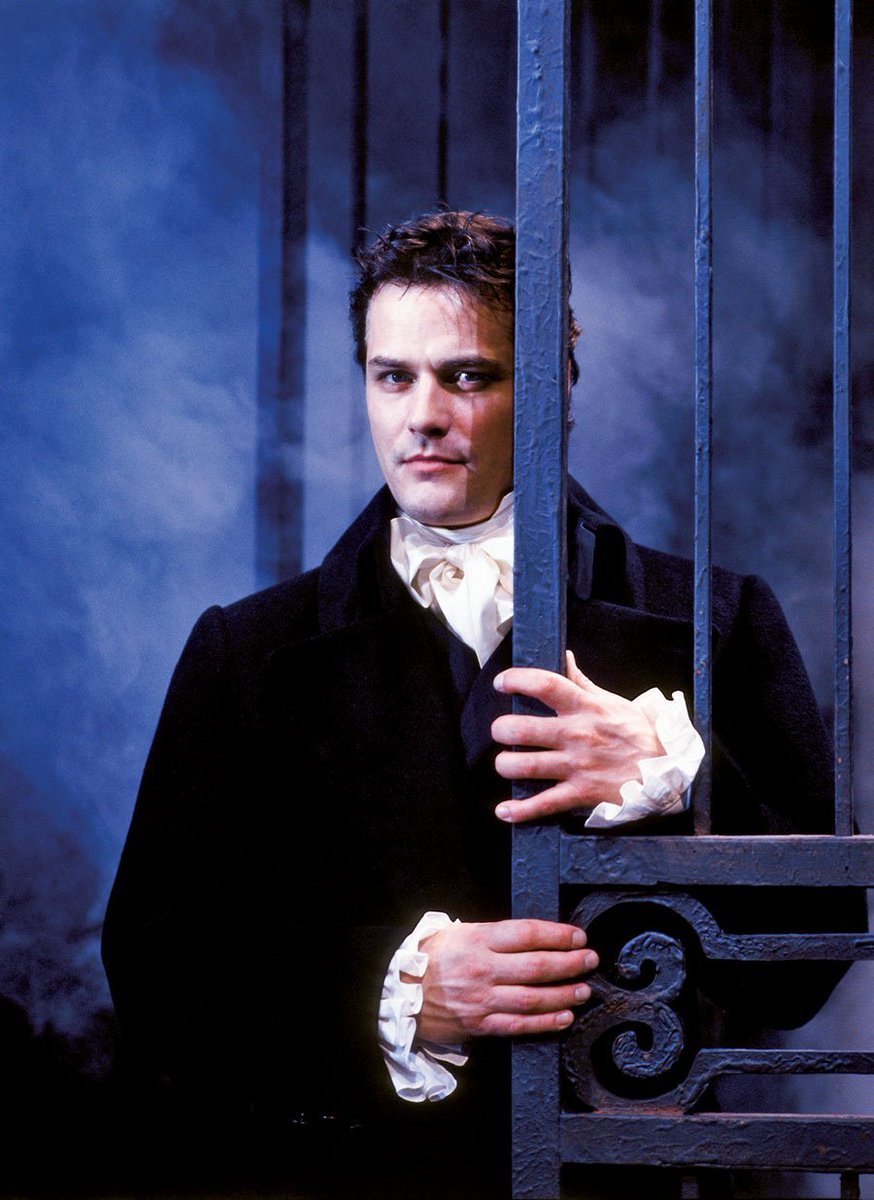
Paul Scoffield as The Ghost in Hamlet (1990, dir. Franco Zefirelli). Notice that he appears to glow pale blue.

Glow-in-the-dark paint wasn’t invented until 1908, but there are some rocks that naturally glow such as hackmanite and phosphorus.

https://www.sciencealert.com/scientists-have-figured-out-how-this-natural-stone-glows-in-the-dark/amp

Theoretically, Shakespeare’s company could have crushed this rock into a powder and made it into a paint that glowed onstage. There is precedent for this- in The Hound Of the Baskervilles, Sherlock Holmes discovers that the terrifying ghost-hound is merely a large dog painted with phosphorescent paint:

In mere size and strength it was a terrible creature which was
lying stretched before us. It was not a pure bloodhound and it
was not a pure mastiff; but it appeared to be a combination of
the two–gaunt, savage, and as large as a small lioness. Even
now in the stillness of death, the huge jaws seemed to be dripping
with a bluish flame and the small, deep-set, cruel eyes were ringed
with fire. I placed my hand upon the glowing muzzle, and as I
held them up my own fingers smouldered and gleamed in the darkness.

“Phosphorus,” I said.

“A cunning preparation of it,” said Holmes, sniffing at the dead
animal. 

Doyle, Part IV.

Though this paint would potentially make a terrifying effect, this would be impossible at an outdoor theater during the day. This makes it unlikely that Shakespeare used glow-in-the-dark paint at the Globe, as most of the performances took place in the afternoon. That said, both Hamlet and were written just at the point in which Shakespeare’s company was in the process of acquiring an indoor theater, the Blackfriars.

The Blackfriars and Shakespeare’s stagecraft

Almost all of these ideas would depend on Shakespeare having access to a theatre in which he could control the lighting. As you can see, the Blackfriars was lit with candles and its indoor nature meant that performances weren’t dependent on sunlight. Greg Doran, former director of the Royal Shakespeare Company has theorized in the past that maybe while his company was preparing to move into the Blackfriars, Shakespeare was changing his material to make it both literally and figuratively darker.

In the reconstructed Blackfriars, (where I studied and interned for three years), there is a trap-door and flying rig like the Globe, so the conventional trap-door ghost can and has been utilized there. I would also argue that in the Blackfriars unlike the Globe, there was a chance for more variety of theatrical illusions- perhaps a smoke projection, magic lantern, or even…

Idea 3: A Pepper’s ghost

A Peppers Ghost is a stage illusion that dates back to the 19th century. It uses the principle of refracted light to project the image of a ghost on top of a piece of glass. This image will appear translucent and could be very impressive to an audience at the Blackfriars! As you can see in the diagram below, the actor could be under the stage in the trap door standing in front of a mirror, and the glass sheet could be used to project his image to the audience. The only concern would be that this could limit the blocking of the other actors, and it might not make the ghost visible to the audience members in the upper galleries, but it would still be an impressive visual effect that uses scientific principles known in the 17th century.

Pepper's ghost diagram
Pepper’s ghost diagram.

Pepper’s Ghost illusions are still used frequently in theme parks, trade shows, and concerts where singers interact with “holograms.” As a special Halloween treat, (or trick as the case may be), I’ve included a video that will allow you to make your own Pepper’s ghost at home. If you choose to make one, leave me a comment!

So, in conclusion, though we are taught that Shakespeare’s theater often reveled in simplistic theatrical designs, I personally think that there is more room to explore low-tech theatrical illusions like these, especially at companies like the Globe Theater and the American Shakespeare Company, which pride themselves on using Shakespeare’s original staging practices. Live theater has dodged giving up its ghost for 2,000 years by exploring the limits of live theater through movement, voice, story, music, and yes spectacle. I think theater practitioners, even Original Practitioners should keep innovating new kinds of spectacular means to keep creating fresh interpretations of Shakespeare, that still keep within the spirit of the play’s original time and place.

Bonus: If you want to learn more about the stage illusions of Shakespeare’s company, click here to listen to That Shakespeare Life Podcast with Cassidy Cash. In this episode, she interviews theater professor Frank Mohler, who describes how thunder and flying effects were done in the 17th century, using records of the period, and his own experimentation.

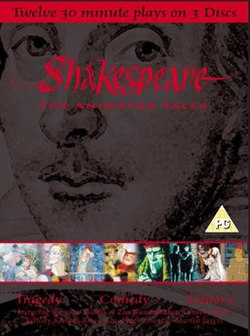
Shakespeare: The Animated Tales- “Macbeth”

This is a 30 minute cartoon version of Macbeth originally produced for the BBC in 1992. It features Brian Cox  as the voice of Macbeth (before he was the voice of McDonald’s), and Zoë Wanamaker as Lady Macbeth (before she was a witch who teaches at Hogwarts).

I like the way it portrays the horror imagery of the play in sort of a European-manga animation hybrid. Admittedly, there are better ones in the series, but this one is still pretty neat.

DVD box art for “Shakespeare the Animated Tales.”

To check out other episodes in the series, view this playlist:

Hamlet (2000)

I’ve talked about some great Hamlets and some awful Hamlets. Now I want to talk about one that I find very much a mixed bag. The direction is incredible, for the most part it’s very well cast, and it has some truly memorable visuals, even though they’re very much rooted in the world-weary pre-9/11 New York of Y2K.

The mid 90s were the golden age for teenage Shakespeare adaptations with films like “Romeo+Juliet,” “10 Things I Hate About You,” and “O.” All of these films chose to do Shakespeare in modern day, and use youthful actors in the main parts. Since many teen novels and stories feature a brooding young protagonist dealing with the loss of a parent, while trying to find his/her place in the world, it makes sense Hollywood would continue this trend with Hamlet.

The trailer markets this as a sort of “cool Hamlet,” which is more about drama and exciting visuals then long-winded speeches. Director / screenwriter Michael Almereyda has a lot of interesting experience that translates well in this film., in addition to making films he also makes documentaries and short films. I think he wanted to tell this story like a documentary of a high-profile murder case, one where one of the victims happens to be an amateur short-film maker

The Acting

I actually really liked Ethan Hawke as Hamlet. He has a real effortless delivery of Shakespeare and he plays Hamlet as a troubled art-student type of kid who wants to see life through a film lens instead of dealing with the chaos of real life. The film also has some creative staging choices for Hake’s soliloquies. Look at how they staged “To Be Or Not To Be,” in a way that though dated, is a clever way of establishing Hamlet’s worldview. This Hamlet wants to be an action hero like Schwartzenegger, but is cursed with a conscience, anxiety, and fear of the unknown:

Sam Shepherd as the Ghost

Before he was a movie star, Ethan Hawke was an accomplished stage actor appearing frequently in the gritty western-inspired dramas of playwright Sam Shepherd. It seems appropriate that for Hamlet, the ghost of his father was played by one of Hawke’s theatrical mentors, plus as I said in my post on ghosts, it’s very true to form having the ghost played by a playwright

Sam Shepherd as the Ghost in Hamlet

Shepherd is my favorite incarnation of The Ghost. He’s simultaneously fatherly and terrifying, he’s mournful and hopeful. He doesn’t have any special effects to detract from his performance, nor is he just a disembodied voice. The understated nature of Shepherd’s performance works perfectly for film!

Polonius and his family

I have to give special mention to Julia Styles (Ophelia), Liev Schrieber (Laertes), and Bill Murray (Polonius). All their scenes are great and they play off each other very well. You really feel bad for this family which winds up broken by Hamlet and the king, even though they did nothing wrong.

I particularly love this staging of Act I, Scene iii, where Laertes gives his sister Ophelia some advice before leaving for France. Their father Polonius in turn, gives Laertes some fatherly advice, concluding in the famous line: “This above all, to thine own self be true.”

Liev Schrieber as Laertes Shrieber was a great choice for a more movie -like American Laertes. He has a distinguished way of talking and a no-nonsense air about him that works well for the son of a corporate executive like Murray’s Polonius. At the same time, you can sense his boiling hatred of Hamlet, even in this first scene. He’s a great antagonist and plays well with Murray and Hawke.

Bill Murray As Polonius If you read my review of Branaugh’s Hamlet, you noticed I said that I thought his casting was terrific with two exceptions. One of which was casting Richard Briars as Polonius. Branaugh, (and Derek Jacobi in the stage production that inspired the movie), chose to direct Polonius as having no humor whatsoever- to play him as Claudius’ right-hand man. A controlling and micromanaging father who is obsessed with keeping up appearances. While Briars is a fantastic actor, you lose a lot of Polonius without giving him at least a little comic pedantry.

Bill Murry has no problem balancing the funny and business-like aspects of Polonius’ character. Like Peter Venkmen in Ghostbusters, he takes himself too seriously and loves to hear himself talk, and lke his character in Lost In Translation, he has a great deal of fatherly tenderness with Julia Styles. I also love the bit where he puts some extra money in Laertes’ backpack. This Polonius isn’t a fool, but he’s also a bit of a worry wart- and his fretting over his kids blinds him to what Hamlet is really up to.

Julia Styles as Ophelia As I mentioned, Ms. Styles did a number of great Shakespeare movies in the mid 90s, including her iconic portrayal of Kat Stratford in “10 Things I hate About You.” Sadly, the director didn’t give her much to do in the fisrt half of this movie. Her Ophelia mostly looks pretty and does as little as possible. The only moment that stood out to me was the look of guilt on her face after Hamlet discovers she’s wearing a wire in the “Get Thee To A Nunnery” scene.

Styles shines however in The Mad scene. I think her strong personality clashed in the first half of the film with the rather weak and docile Ophelia they were going for. Thankfully, during the Mad Scene, she screams, gets in people’s faces, and has a lot of fury towards the men in the scene. Also, putting the scene in the famous Guggenheim Art Museum works very well- it’s a public place, so anything Ophelia says makes Claudius look bad. Also, the spiral design of the museum feeds into the disorientation Ophelia feels without her father. Finally, the art itself calls back her love of photography and Hamlet’s love of film.

The BEST MOUSETRAP EVER!

A lot of the scenes and soliloquies of this film are very hit-and-miss, but the one moment of the play Almereyda absolutely nails is the play-within-a-play in Act III, Scene i. First of all, the director cuts all the intentionally bad dialogue and turns the play into a silent film-within-a-film, with lots of homemade charm and disturbing imagery. Mr. Almereyda carefully adapted the often-cut dumb show that happens before the play, and used that to fashion Hamlet’s short film:

  • [Hautboys play. The dumb show enters.]2015
    Enter a King and a Queen very lovingly; the Queen embracing
    him and he her. She kneels, and makes show of protestation
    unto him. He takes her up, and declines his head upon her
    neck. He lays him down upon a bank of flowers. She, seeing
    him asleep, leaves him. Anon comes in a fellow, takes off his
    crown, kisses it, pours poison in the sleeper’s ears, and
    leaves him. The Queen returns, finds the King dead, and makes
    passionate action. The Poisoner with some three or four Mutes,
    comes in again, seem to condole with her. The dead body is
    carried away. The Poisoner wooes the Queen with gifts; she
    seems harsh and unwilling awhile, but in the end accepts
    his love.

Not only does this film fulfill its dramatic function, (making Claudius betray his guilt), but we also get a window into Hamlet’s mind. We see how he sees his father, his mother, and his life before his father’s death. As an added bonus, the film is subtle enough that Claudius would’ t be able to make sense of it unless he had actually murdered Hamlet’s father.

My problems with the film:

Like I said, my problem isn’t with Hawke. My problem is the rest of the film. Some actors just mumble their lines. Sometimes the director wastes time with pointless film clips which only seem to exist to remind you that “This Hamlet is artsy.” But my biggest problem with the film is the pace. Almereyda does a great job paring down Hamlet to its core drama- Hamlet vs Claudius and the poor people who get caught in the crossfire. Though he is sparing with dialogue, he wastes time with silence. A lot of the film is the characters sitting around watching TVs, looking at photos, sleeping, or just staring off into space. In addiiton, the delivery is very mixed. Like I said, Hawke’s quiet, understated delivery works very well, but not for every character. To varying degrees, everyone in the film is guilty of what I call “movie Shakespeare acting,” which is to say, being so afraid of sounding like Oliver and Branaugh, that they mumble their lines, slow the pace down, and turn the emotion down to nearly zero, because they don’t want their performances to appear over-the-top. The thing is, Hamlet is a tragedy about people who are fighting for their lives and souls. A little quiet introspection is important, but too much of it drags the play or the movie down.

The STUPID ENDING

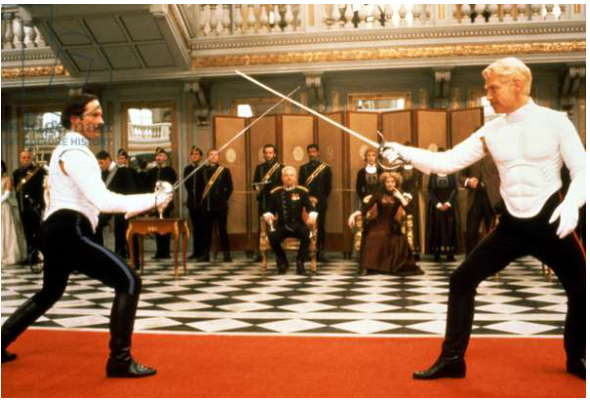
As you read in my post on the duel in Hamlet, Shakespeare’s play, ends in a fencing match where Laertes betrays Hamlet by fighting with a poisoned sword, which Hamlet eventually uses to kill Laertes and Claudius. It’s a powerful moment of poetic justice. In Almereyda’s version, LAERTES JUST SHOOTS HAMLET.

To be fair, the whole scene doesn’t work well in a 21st-century context. Laertes just told Hamlet to literally “Go to Hell,” but then in the very next scene Hamlet agrees to play against him in a friendly fencing match? Only a complete idiot wouldn’t know that something suspicious is up. In every good production I’ve seen, Hamlet knows this is a trap, but he does it anyway. I think he intends to let God decide their quarrel like in old-fashioned judicial combat.

Since dueling isn’t practiced anymore (except in episodes of The Office), it seems bizarre that Hawke’s Hamlet would agree to be in the same room with Laertes, let alone fight with him. I wish the director had done something, anything to justify Hamlet’s choice to fence with Laertes, or just do away with the fencing entirely and have them fight over Ophelia’s grave.

The other thing I hate about this scene is that it isn’t a fight; it’s a murder and a very stupid one. Laertes shoots Hamlet but instead of shooting him at a distance, he walks right over and shoots Hamlet, close enough for Hamlet to turn the gun on Laertes. This makes Shreiber’s character seem incredibly stupid and completely unsympathetic. Not only is it stupid, but it’s also cowardly. Hamlet is unarmed, and can’t defend himself against a bullet. If Laertes had a knife, Hamlet would’ve at least have had a fighting chance. As it is, we get a pointless, bloody end to a great character, and Laertes does it in a cowardly ignoble way.

The Film’s Influence

Whether or not you’ve seen and liked this film, it definitely influenced one of the most well-received Hamlets of recent memory.The Royal Shakespeare Company’s 2009 TV movie of Hamlet takes a lot of cues from Michael Almereyda’s film.

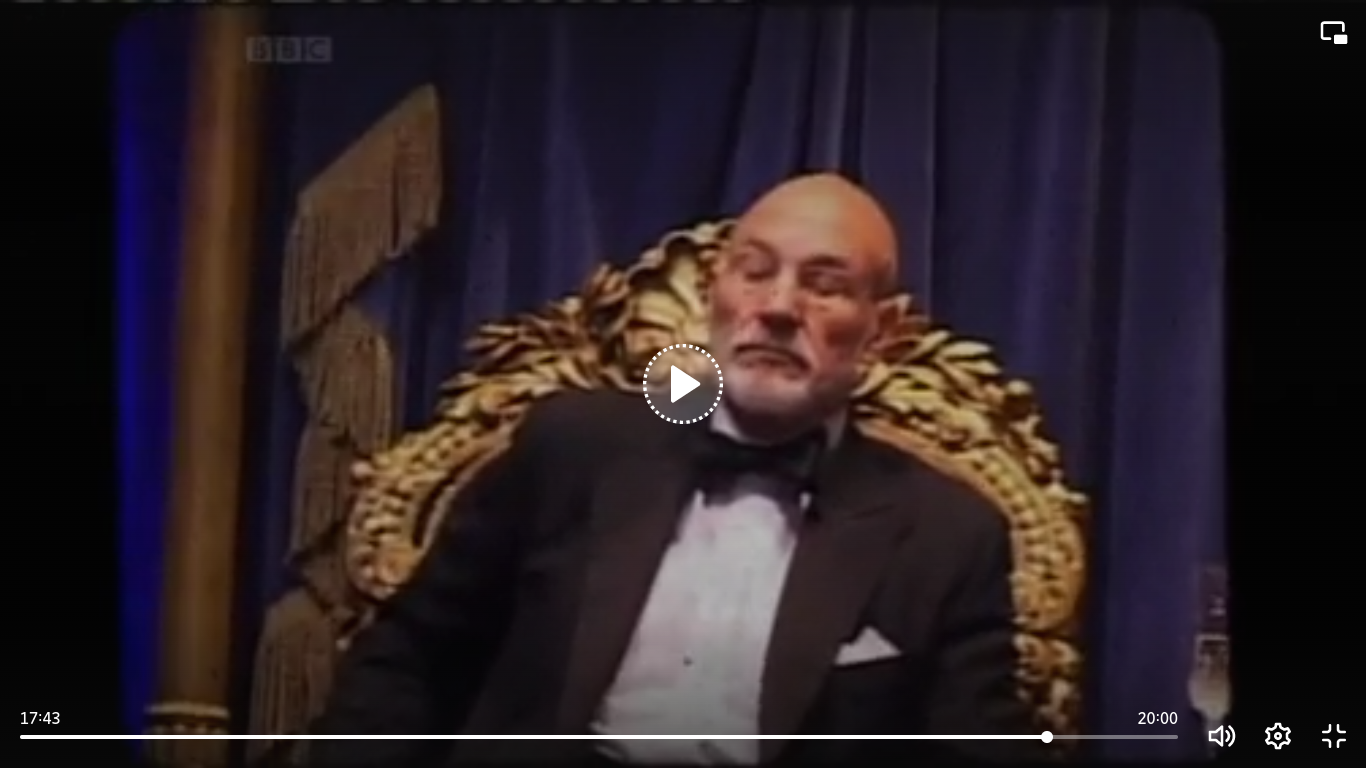
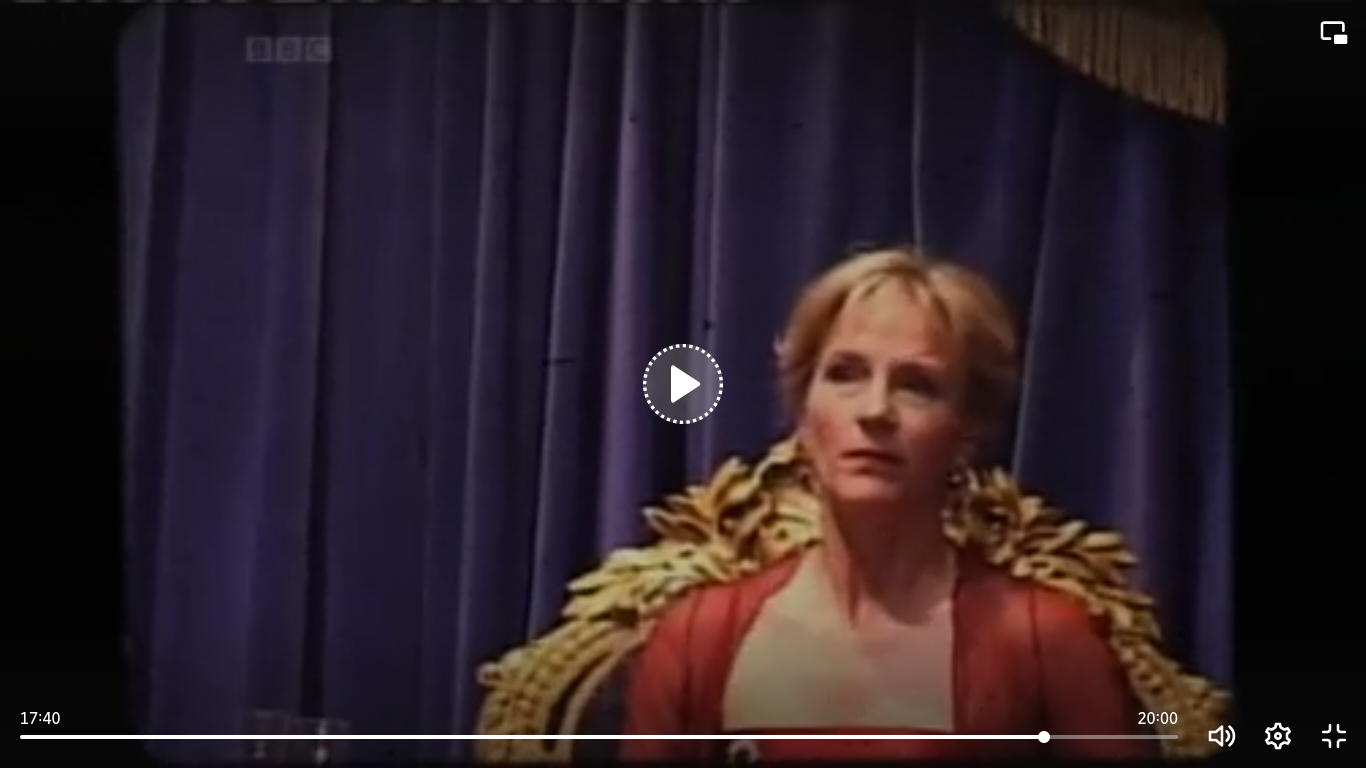
  1. The Concept- Court intrigue Both films immerse themselves in the trappings of wealth and status in American and British society. In Act I, Scene iii Kyle Mcglaughlin as Claudius holds large press conferences, surrounds himself with bodyguards, security cameras, and lives in the luxury Hotel Elsinore. Patrick Stewart in the same scene holds an exclusive black-tie soiree attended by bishops, men in tails and women in ballgowns. Plus the British version keeps the monarchy, it just updates it with marble pillars, spotless floors, and golden chains and thrones.
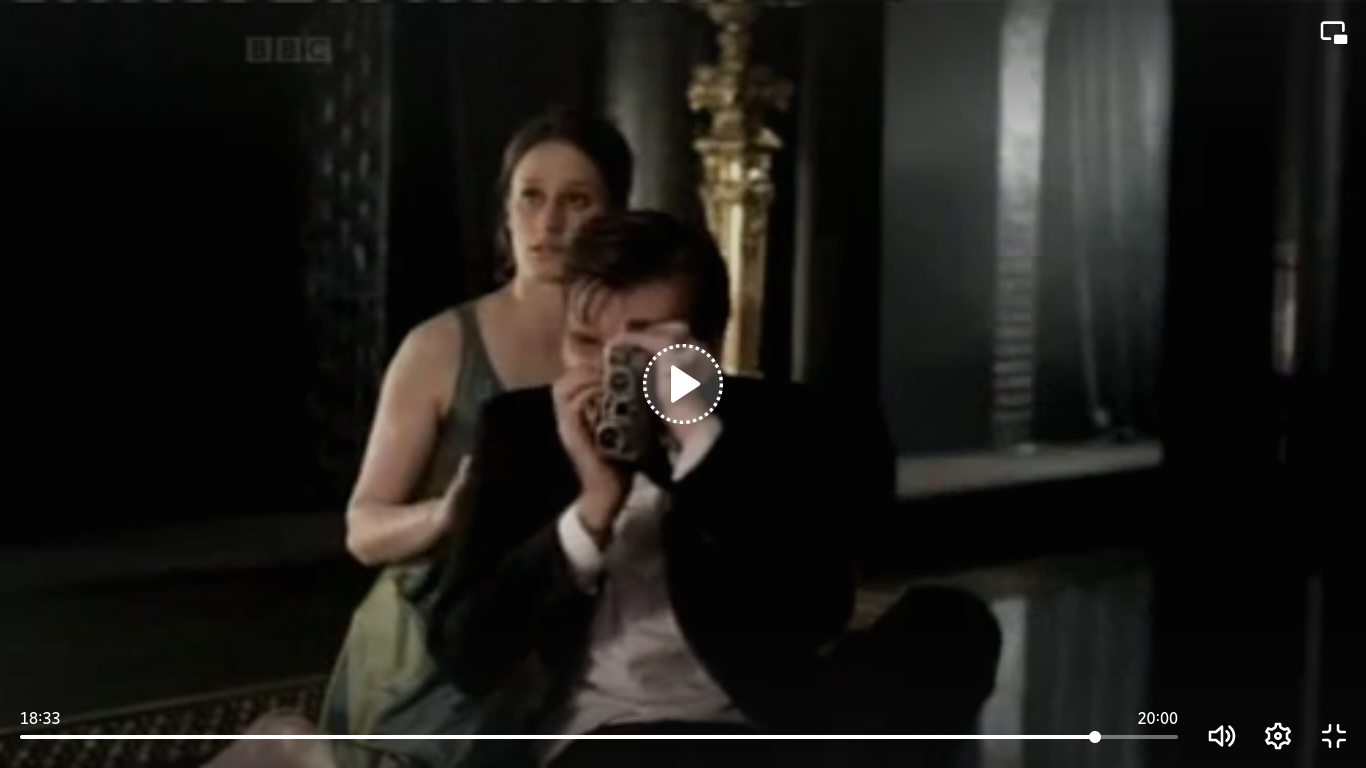
  2. Watching and being watched– Both films start off with security camera footage, and shots of security cameras become a running motif that demonstrates Claudius’ control over Hamlet’s life. Also in both films Hamlet defies his uncle by filming him back with his own camera.
  3. Updating Gertrude One of the flaws of Shakespeare’s text is that he judges Gertrude far too harshly. To Hamlet, it is incomprehensible that his mother could fall in love and marry anyone else. I like that in both versions, Gertrude is still relatively young, and the Claudius figure is relatively charming and handsome, while the ghost seems warlike and cold. You get the sense that Hamlet’s father was a good king, but a lousy husband. Little touches like this flesh out her character, and make us compelled to see what happens to her.
  4. You cannot call it love; for at your age2460
    The heyday in the blood is tame, it’s humble,
    And waits upon the judgment; 

So, to be brief, this version isn’t the best, but it has plenty of clever set pieces, good performances, and early 2000s angst to trigger any millennial’s nostalgia goggles. More than that, I think later productions are indebted to this little movie for paving the way to bring Hamlet into the 21st century.

My Top 10 FAVORITE Hamlets

I’m delighted to share with you my recommendations for the best Hamlets committed to film! I was pretty strict with my criteria which left a few Hamlets out, so if I missed yours, let me know in the comments.

In order to make this list:

  1. I have to have seen the whole thing. Sadly that excludes a lot of unfilmed productions or films I haven’t got around to seeing.
  2. The interpretation has to take a unique stance on the play.
  3. The actor has to have a clear grasp of the part.
  4. I personally have to like it. This is subjective, and I will make it clear if something is my opinion, or if I think this interpretation works for classes or private viewing.

By the way, if you’re a teacher, I’ll be sure to mention which productions work for classes, and which, for whatever reason, do not. I also can recommend Common Sense Media to give you a good idea what age group this film works best for:

So, without any further adieu (get it?):

The Good Hamlets

#10: Arnold SChwarzenegger in “Last Action Hero”

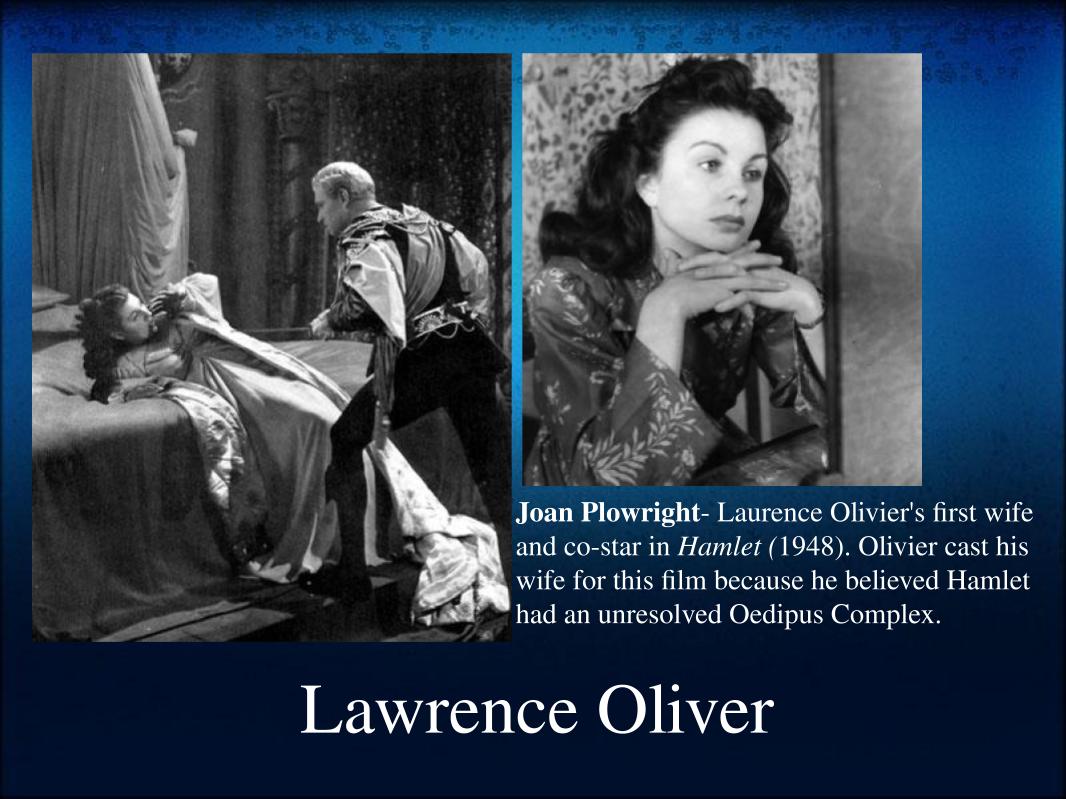
I would love to do a full review of this movie. When it works, it is actually a thoughtful deconstruction of the action movie genre, and as this clip shows, the movie concedes that Hamlet was actually the first great action hero. Schwarzenegger is really funny as an action movie parody of “Hamlet,” and everything he does is pretty cathartic for bored school boys who have to read the play in class. Plus, as a funny easter egg, the teacher in the scene who is showing Olivier’s Hamlet on the screen is played by Joan Plowright, who played Gertrude IN THAT FILM, and was married to Olivier in real life!

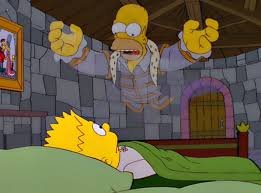
#9: Bart Simpson in “Tales from the Public Domain”

It’s absolutely astonishing how many Shakespeare easter eggs are in this little episode! How they make fun of medieval history, (the Danes were in fact Vikings in the early middle ages), Elizabethan theater, (when Bart does a soliloquy and is surprised that Claudius can hear him), and the way they compress Shakespeare’s longest play into a five minute episode is masterful satire.

In addition, the cast is perfectly chosen among the Simpsons’ core cast. Long-time viewers know that Moe has wanted to sleep with Homer’s wife for years, so making him Claudius is a brilliant choice. Plus, Dan Castellaneta steals the show with his over-the-top performance as the ghost, which actually reminds me of a 1589 review of Hamlet by Thomas Lodge:

“[He] walks for the most part in black under cover of gravity, and looks as pale as the vizard [mask] of the ghost who cried so miserably at the Theatre like an oyster-wife, Hamlet, revenge!”

THOMAS NASHE, “PREFACE” TO ROBERT GREENE, MENAPHON, (1589)

In any case, this clip is a great way to introduce anyone to Hamlet and I highly recommend it.

#8: Austin Tichenor in “The Complete Works of Shakespeare- Abridged”

Part 1 of a 4 part series of clips from “The Complete Works Of Shakespeare (Abridged)” Starring Austin Tichenor, Reed Martin, and Adam Long.

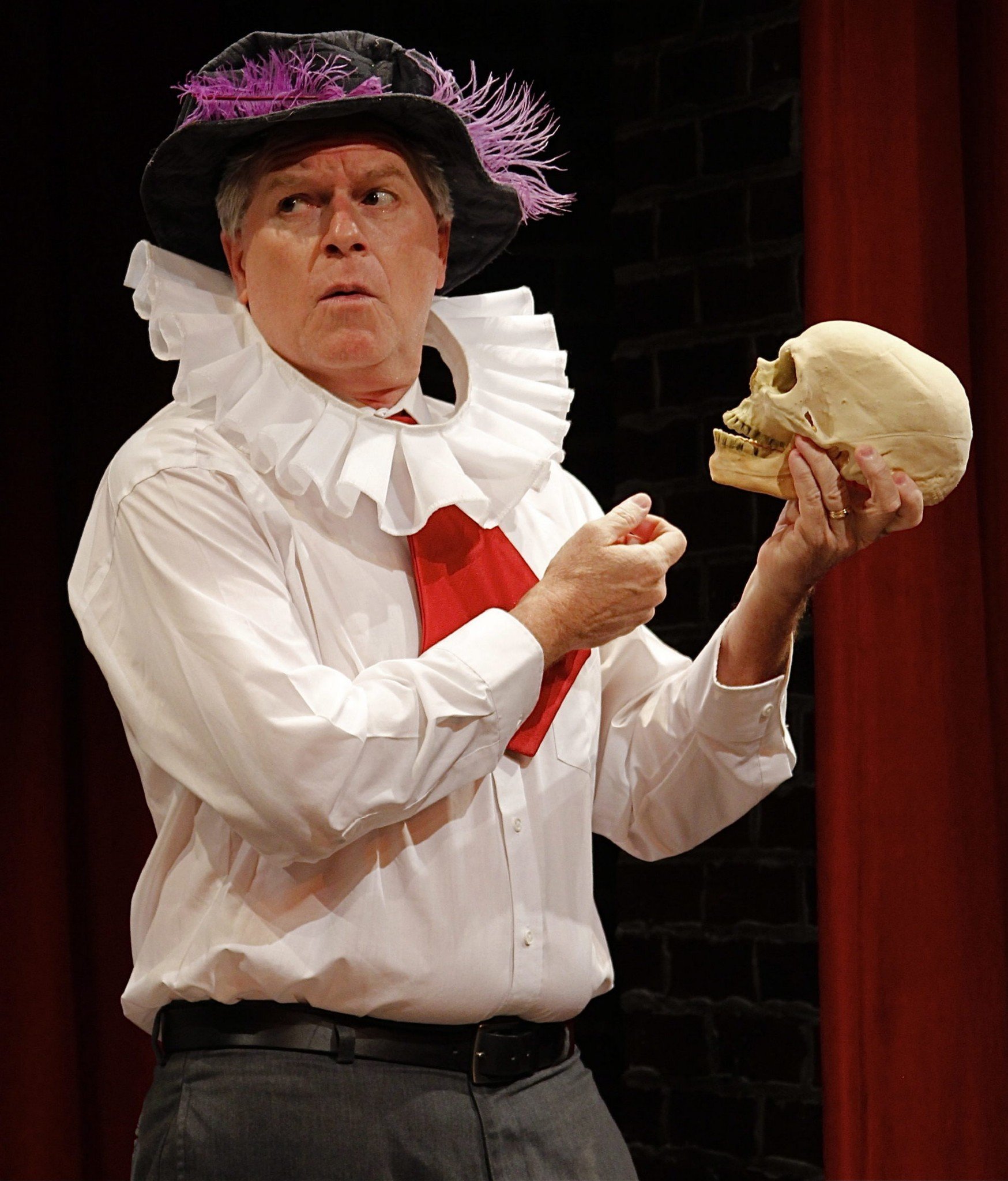
This show is very special to me- in around 1997 my parents went to England and brought home a copy of The Complete Works of Shakespeare (Abridged). I’d only read “Romeo and Juliet” previously and through this show, I gained an appreciation for all of Shakespeare’s plays. Seeing the plays through parody made them seem less lofty and stuffy, and made me want to see and read the original works. This is especially true for “Hamlet,” which occupies the second half of the show, where Hamlet is portrayed by Austin Tichenor.

Tichenor wins my award for “Hammiest Hamlet,” which is just delightful to watch. He clearly takes the part WAAAY too seriously, as evidenced by how emphatically he demands solemn silence from the audience while he attempts to do “To Be Or Not To Be.” Tichenor also serves as the pedantic straight man who tries to keep the show moving and academic, while mediating between his bickering co-stars Adam and Reed. This wonderful Three-stooges dynamic makes every minute of the show fun and frenetic. However, the cast makes it very clear that they are making fun of Shakespeare with love; they never mock the play, they inform as well as entertain, and occasionally they even move the audience as Adam does at the end. In short, this show helped me form my approach to Shakespeare, and it’s largely through Tichenor that I read Hamlet at all, so he’s to blame for this website.

#7: Richard Burton, 1964 (stage production directed by John Gielgud).

With the advent of TV and film making theater seem obsolete, directors knew they had to do something drastic in order to get people to come to the playhouses. Enter John Gielgud, one of the greatest Hamlets of the early 20th century, who directed Richard Burton in a highly-acclaimed production with minimum sets and with actors wearing rehearsal clothes. The idea was to let Shakespeare’s words and the actors’ performances be the focus, and save spectacle for film and TV. This approach has been adopted by many theater companies since, including a few I’ve been a pat of.

Burton has a lot of energy and manic physicality in his portrayal and it makes his Hamlet engaging to watch. Plus Gielgud himself as the ghost is almost operatic to hear. I highly recommend any theater fan to watch it, though it might not translate in a classroom much.

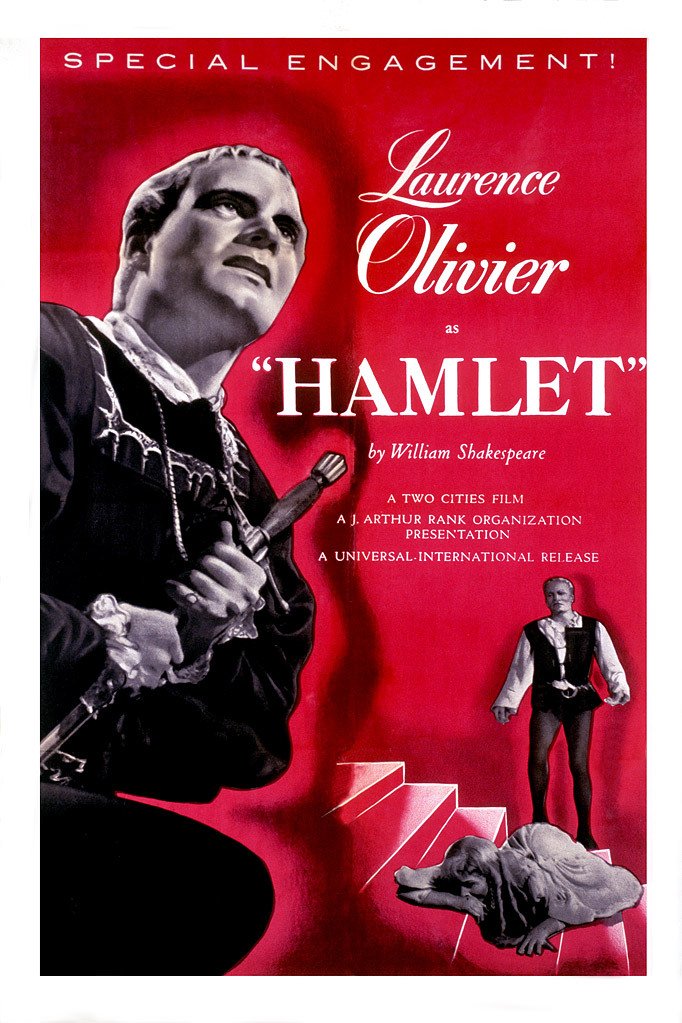
# 6: Laurence Olivier, (Film 1948)


I have my issues with Olivier as an actor and apparently I’m not alone:

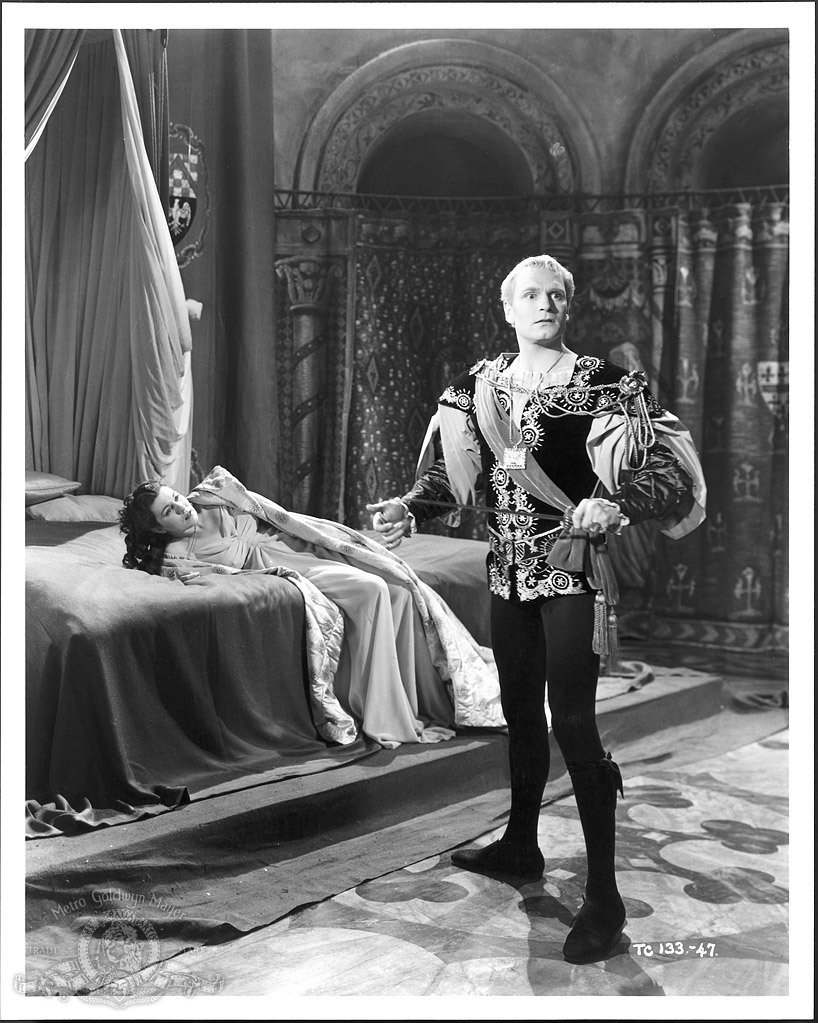
I find Olivier’s acting over-the-top, lacking in emotion and subtlety, and I think his directing is generally self-centered. He rarely deigns to give close-ups to anyone but himself and a lot of the scenes he directs are filmed like stage plays. That said, Olivier’s Hamlet is really good. SIr Laurence talked to Ernest Jones about the theory that Hamlet might have had an Oedipus Complex and created a unique and well-thought-out interpretation for his Hamlet. First off, casting his real-life wife Joan Plowright as Gertrude, fills the Closet scene with uncomfortable tension. He also did a great job making the ghost seem as imposing and accusatory as possible, as well as making Claudius as disgusting as possible.

You get the idea that this film is how Hamlet sees the world with its dark and shadowy towers, representing Hamlet’s melancholic mind, his imprisoned spirit, and his dark desires. Also as many people have pointed out, Gertrude’s bed chamber looks like a female organ, making the Oedipus theory even more explicit.

Even I have to admit that Olivier nailed the “To Be Or Not To Be,” Speech. He squirms at his own Oedipal fantasies, and contemplates jumping off the battlements in a captivating and subtle way. The performance and cinematography is iconic, and it makes me grudgingly admit Olivier, for all his faults, is still one of the best Hamlets of all time.


I would recommend this film to every Shakespeare film fan and any hardcore Shakespeare scholars. I would caution against showing the whole thing in a class however, since it’s black and white, and again, I find Oliver’s delivery very old-fashioned.

#5: Paul Gross, (StratforD Festival, 2000)

Thus far, I’ve mainly reviewed British and American Hamlets. Paul Gross is one of Canada’s most celebrated actors who gained fame as one of the best Hamlets at Toronto’s Stratford Festival. Unlike most Hamlets who go for the humanistic prince version of Hamlet, Gross plays him with sort of an animal intensity, like a wounded bear who will growl at you if you get in his way.

I have to admit I broke my own rule with this one- I haven’t really seen Gross’ portrayal, but I believe I saw it well-represented in his role as Geoffery Tennent, the Shakespearean Actor-turned madman-turned director in the Canadian TV show “Slings and Arrows.” This amazing dark comedy portrays the ins and outs of a Shakespeare Company from the normal problems of mounting a play to backstage drama, even the funding and marketing gets focus! Basically, the show is The Office for Shakespeare nerds, except for one ghostly cast member (no spoilers).

4. Benedick Cumberbatch / John Harrell

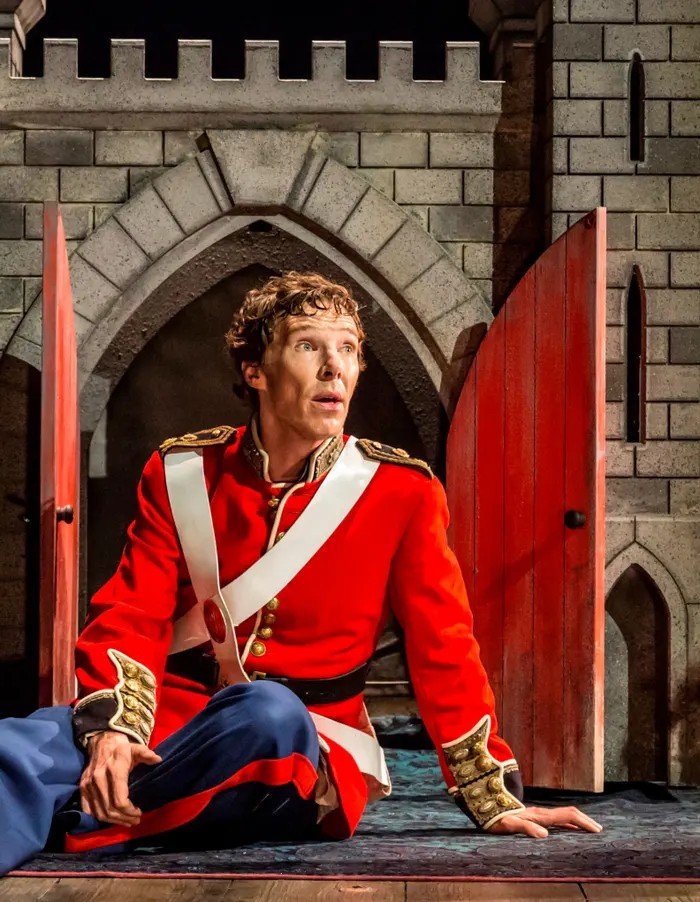
I couldn’t make up my mind between these two Hamlets, so I’m listing them together (guess that makes me Hamlet too). One is one of the most accomplished Shakespearean actor in recent memory, an RSC alumn, and a Hollywood star to boot, Benedick Cumberbatch.

Left- Benedick Cumberbatch as Hamlet, National Theater. Right- John Harrell at the Blackfriars Playhouse, Staunton VA.

Both these actors have similar strengths- they’re both tall and imposing with aquiline features. They are also highly physical performers. I talked in my lecture on Richard III about how Harrell performed the role of Gloucester with his legs tied together and a bowling ball strapped to his hand. Appearance-wise- Harrell and Cumberbatch are so similar, that it’s actually a joke at the ASC that they must be long-lost twins.

That said, when it comes to their approach to Hamlet, these two actors couldn’t be more different. Cumberbatch focused on Hamlet’s emotional turmoil- he was tortured and angry, full of youthful angst and volatility. This particular production is sort of an anachronistic mash-up of modern and period, which gives it a sort of dream-like quality that I really enjoy. Like Richard Burton, the director knows how to stage a play differently from a movie or TV show, which is especially important with this actor, since we can see him on all those platforms.

Nor should they have. Full of scenic spectacle and conceptual tweaks and quirks, this “Hamlet” is never boring. It is also never emotionally moving — except on those occasions when Mr. Cumberbatch’s Hamlet is alone with his thoughts, trying to make sense of a loud, importunate world that demands so much of him.

By Ben Brantley
New York Times, Aug. 25, 2015

John Harrell on the other hand is a more mature and subtle Hamlet, more interested in saving his hide than contemplating his navel. This Hamlet masks pain with humor and sardonic wit and it translates to all his relationships with the King, Queen, and courtiers.

John Harrell as Hamlet, American Shakespeare Center, 2011

Rather than a sour, dour, morose, obtuse, naval-gazing Hamlet, this prince was cunning, cynical, devious, sarcastic, and very much enjoying his feigned madness, his chess game with the king, and his fencing bout with Laertes.

Eric Minton

https://www.shakespeareances.com/willpower/onstage/Hamlet-11-ASC11.html

#3: Papaa Essiedu, Royal Shakespeare company

Trailer for Hamlet at the Kennedy Center

OK, I have to admit that I didn’t see this whole production either, but it’s so cool and the acting is so good I wish I had! Papaa Essiedu is an electrifying blend of wit, sadness, manic excitement, and rage. His fresh take on a role that can be rather dour is why even the little I’ve seen of his performance makes it one of my favorites!

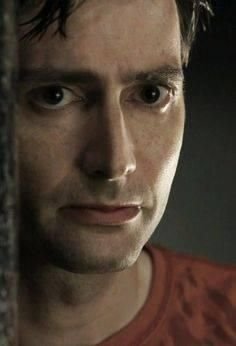
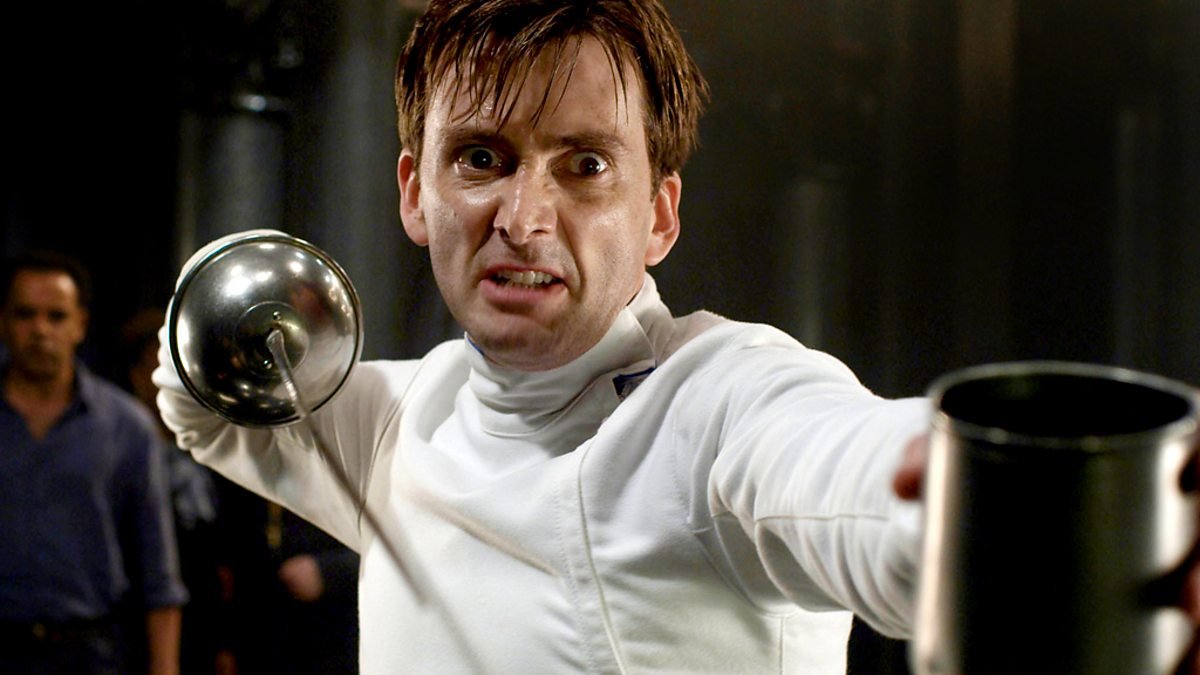
#2: David Tennet, RSC 2009

Tennet does an incredible job of encapsulating Hamlet’s quick wit, giddy excitement, frailty, fury, and frustration, especially with himself. I love the fact that he does “To Be Or Not To Be” in a superhero T-Shirt. In a way, this Hamlet is constantly wishing he was more of the action-movie type that Schwartzenegger parodies at the top of this list. Like Harrell, Tennent’s Hamlet masks his pain with humor, but you can see him struggle with it and try to pull himself out of despair. All these Hamlets find a way to nail at least one aspect of the character, but Tennet in his short 3 hours on the stage, manages to highlight all of them.

I recommend this version for any viewer in any classroom. It’s beautifully shot, extremely well acted, fast-paced, funny, and exciting. I cannot recommend it highly enough.

Honorable mentions: Anton Lester, Ian McKellen, MiChelle Terry, and Sir John Gielgud

I haven’t seen any of these Hamlets and have been unable to locate any clips, but I have the deepest respect for all of these actors, so I thought I’d highlight them here.

I’d also like to give special mention to Michelle Terry. Gender-blind productions of Shakespeare get a lot of flack that is undeserved, and there’s nothing wrong with a female Hamlet. To quote Geoffrey Tennet in Slings and Arrows: “Shakespeare didn’t care about anachronism, and neither should we.”

I didn’t include Ms. Terry in this list, simply because I wasn’t able to get to the Globe, and I wanted to focus on productions that people can watch for free. If you wish, you can watch her 2018 performance on the Globe Theater’s steaming website:

https://player.shakespearesglobe.com/productions/hamlet-2018/

#1: Kenneth Branaugh


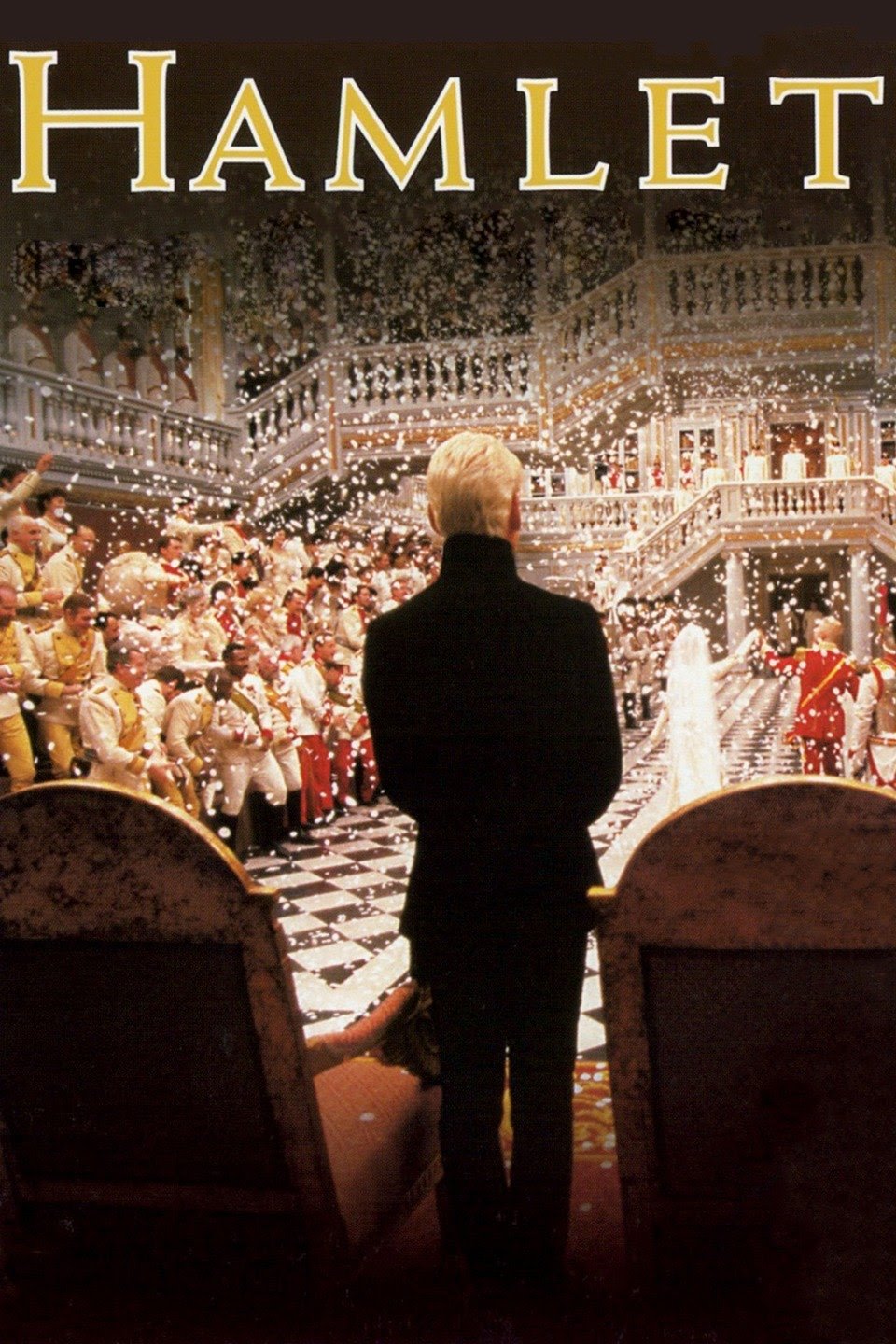
You probably saw this coming. I’ve made it clear in other posts that I absolutely love Branaugh’s Hamlet, after all his film was one of the first Shakespeare movies I ever saw and the first one I really enjoyed. I discuss in detail why I love this movie the best in my review of the film, but to summarize, I think the direction is incredible, the music is excellent, the cast is nearly perfect, and Branaugh himself puts a huge amount of love, craft, skill, experience, and maybe a little madness into his portrayal of the character. I know Branaugh isn’t everyone’s cup of tea; other Hamlets on this list might be more enjoyable, fun, or subtle, for you. But for me, Branaugh’s will always be my favorite.