What was Christmas Like For William Shakespeare?

Well, Christmas is almost here; soon many of us will be traveling home to celebrate the holidays with our families, enjoying parties, presents, carols, and decorations. However, our modern traditions weren’t always the norm for people who celebrate Christmas. In the interest of historical curiosity, we here at Shakespearean Student would like to talk a little bit about how William Shakespeare might’ve celebrated Christmas!

As with everything in Shakespeare’s life, many times scholars have nothing but “what if’s” to go on, because few records exist, there were no photos from the period, and very few documents survive related to Shakespeare. He also kept no journals or diaries to record what his life might’ve been like. However, based in the holiday traditions of England that have lingered on to this day, we can surmise what Christmas might’ve been like in the late 16th century.

Part 1: Stratford

Shakespeare was born in 1564, in the town of Stratford-Upon-Avon in the county of Warwickshire England. As I mentioned earlier, Shakespeare would not have known many of our modern Christmas traditions. The Christmas Tree as we know it didn’t come into being until Queen Victoria’s reign, (and she certainly didn’t light hers with electric lights). Victoria also invented the idea of putting presents under the tree. I’m not an expert on Christmas, but my research would indicate that probably Elizabethans like Shakespeare didn’t even give out presents on Christmas Day! Instead, in country towns like Stratford in Tudor times, Christmas was a time of feasting, singing, caroling, and theatre!

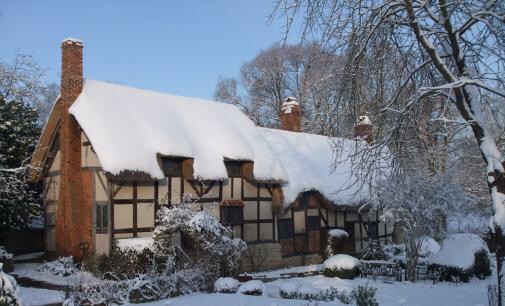
The Shakespeare family home at Christmas

Candleglow%20PR%20small[1]

The Christmas season in Shakespeare’s day usually extended from Christmas Eve to the twelfth night after Christmas also known as Twelfth Night or Epithany. Common people usually decorated their homes with holly and ivy, and celebrated Christmas Eve by lighting their homes with candles and by burning the Yule log, an ancient tradition dating back over 1,000 years when the Vikings controlled most of England. It was a symbol of light and warmth in the darkest time of the year.

Replica of Shakespeare’s kitchen.

Feasting-

Roast goose was a staple of the common man’s feast at Christmas. In 1588, Queen Elizabeth commanded the whole country to consume geese to commemorate England’s victory over the Spanish Armada. Other traditional fare included plum porridge, beer or ale, and the most celebrated Christmas beverage of all: Wassail!

Wasailing-

The old tradition of caroling comes from an ancient pagan holiday tradition of showing charity to the poor at the winter solstice. People would go door to door asking for alms and occasionally a warm beverage. This ancient practice evolved into caroling and Wasailing!

The word “wassail” is an old Celtic word that means “lambswool,” it refers to the fact that the drink is covered with a thin foam that looks kind of like the wool of a sheep. It is also derived from the Anglo-Saxon “wassail,” which means “be in health,” so it is simultaneously a drink, a toast, and an explanation of what the drink looks like.

Like our modern-day caroling, people would sing and dance going door to door asking for a traditional glass of wassail or a mince pie. A mince pie is a traditional meat pie that is often filled with 12 different ingredients to symbolize the 12 days of Christmas.
Mince pies were popular with both peasants and kings, and contains both fruit and different types of meat including rabbit chicken duck and hare.
Wasailing also has its roots in ancient pagan holidays and that’s why it’s often accompanied with a traditional Morris dance, where the dancers are waving handkerchiefs, knocking sticks together and dancing with brightly colored ribbons. This was a great tradition back in the small towns and shires of England and continues to this very day. Below you’ll find a video where you can make some wassail yourself! I Just a note that in this recipe, the cook has left out the alcohol and has also left out the egg which is necessary to create the foamy lambswool. Nonetheless I think it’s a very good recipe and I welcome you to try it for yourself.

Plays

As the mayor’s son, young William had a VIP pass to see all traveling actors who came to town. Shakespeare’s dad would’ve decided who got to perform at the guild halls and local inns, so he and his son would’ve watched private performances of all the shows first. After that, John Shakespeare decided who got to perform, and who would be sent away. In addition to professional troupes at Christmas, craftsmen in Will’s hometown people in Warwickshire would come together and put on a show! These amateur dramatic pieces were known as Mystery Plays.

Mystery Plays got their name from the old meaning of mystery: a trade or skill. Much like modern nativity plays or community theaters, every year all the craftsmen from the town would put on a series of short shows derived from Bible stories at Christmas time, and showcase their crafts as well as their acting talents. For example the goldsmiths were in charge of the Three Wise Men story.

We know that Shakespeare liked these plays because he refers to one in particular many, many times: The play of King Herod. in the Bible, Herod The Great is fearful of the baby Jesus and sends his soldiers to kill any young baby that they can find in the city of Jerusalem. Very often when Shakespeare refers to any of his villainous characters he describes them as Herod-like.

The Mysteries were printed during Shakespeare’s lifetime and people in York, Coventry, and Wakefield England still perform them today! Here’s a video of a little girl who performed in the York Mystery play last year:

I hope you enjoyed this little sojourn into the ancient traditions of the common folk back in Shakespeare’s England.

If you liked this post, please consider signing up for my new online class, “What Was Christmas Like For William Shakespeare?” I’ll go further into the traditions of Elizabethan Christmas and add some insight into Shakespeare’s play “Twelfth Night.” Register now at Outschool.com!

Till next time!

-The Shakespearean Student

Sources:

  1. Historic UK: A Tudor Christmas: http://www.historic-uk.com/HistoryUK/HistoryofEngland/A-Tudor-Christmas/
  2. Shakespeare Birthplace Trust: Christmas At Shakespeare’s Houses: http://www.shakespeare.org.uk/visit-the-houses/whats-on.html/christmas-holidays.html
  3. The Anne Bolyn Files: A Tudor Christmas: http://www.theanneboleynfiles.com/resources/tudor-life/tudor-christmas/
  4. Wassailing and Mumming: http://www.whychristmas.com/customs/wassailing.shtml

New Play of the Month: MACBETH

Just in time for Halloween, I’ve decided to abandon the Julius Caesar posts and spend the rest of the month talking about the most mysterious, most bloody, and most occult play Shakespeare ever wrote- MACBETH.

As you probably know, I already wrote a review of an amazing adaptation of Macbeth called “Sleep No More,” which you can read here. I also mentioned that there’s a new movie adaptation of this play, starring Michael Fassbender, (look at my last post to see the trailer). In future weeks, I’ll create a new play of the month page, and delve into the magic and curses associated with the play.

But for now, here are some nice tidbits from around the internet.

First, a funny comic from “Zounds, Alack, and By My Troth.”

Macbeth, Act IV summary cartoon from "Zounds, Alack, and By My Troth."
Macbeth, Act IV summary cartoon from “Zounds, Alack, and By My Troth.”

Next, a short recap of the play from 60 Second Recap. 

Third, a feminist interpretation of the play: 

And finally, a modern retelling of the play from a BBC series called: “Shakespeare Retold,” starring James Macavoy: 

Enjoy (devilish last).

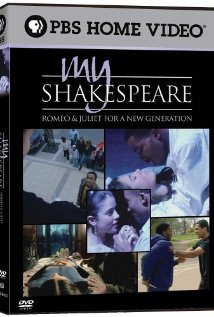
Shakespeare Review: My Shakespeare

On this page, I review a Shakespeare book, movie, or TV show that I feel has some kind of value, either as an interpretation of Shakespeare, or a means to learn more about the man and his writing. This post will introduce you to an incredible documentary, and in my view one of the best ways to encourage, excite, and challenge young people reading Romeo and Juliet Aptly titled, it is called, My Shakespeare.

  1. Name:My Shakespeare
  2. Year: 2004
  3. Director: Michael Waldman
  4. Ages:PG for frank discussions of violence, and occasional suggestive language.
  5. Media:Full length documentary, (available on Amazon and Netflix DVD)
  6. Recommendation: I’d recommend this to high school and college students, as well as all theater teachers and practitioners. A word of caution though- nearly everyone in the documentary speaks with various British accents (from posh London to poor Harlesden), and thus if you think your class might not be able to understand foreign accents, you might want a different version, or put on the subtitles.
  7. Premise: Director Patterson Joseph is a man on a mission- to prove that the people in his home town, (the poor, violence-ridden town of Harlesden England), that these same people can and will put on a production of Romeo and Juliet, in just four weeks. The cast has never acted before, and Patterson sometimes has to drag them kicking and screaming into rehearsals, but eventually they all learn that putting on a Shakespeare play can become an extremely personal experience. In the beginning, they are attempting Shakespeare, but by the end they live it. In between the action, there are interviews with Baz Luhrman, the celebrated director of the Leonardo Dicaprio film version of Romeo and Juliet back in 1996. Baz serves as a sort of chorus, explaining some of the challenges a director like Patterson will inevitably face as he and his actors bring the play to life.
  8. Repeated Ideas That Run Through the Documentary:
    1. You can do this- you can act, you can understand Shakespeare, you can finish something, you can show emotions, and you can direct.
    2. Shakespeare is able to tell stories that appeal to everyone, and here’s the proof.
    3. The best way to understand Shakespeare is to get on your feet and do it.
  9. Moments to watch for: Before I list my favorite moments in the documentary, I’d like to list the theatrical process by which Patterson and his company put on Romeo and Juliet. 
    • The Process Of Creating Romeo and Juliet:
      1. Auditions/ Improv Games (4 weeks to go)
      2. Table Work, where the actors read the script and talk about their characters.
      3. Paraphrasing the script and improv (9 days to go)
      4. Stage combat Rehearsals- prepping the fights.
      5. Opening Scene rehearsal on a basketball court.
      6. Vocal Rehearsal
      7. The Emotion Workshop (8 days to go) The actors try to tap into their own emotions to try and bring some real feelings into their parts.
      8. Death Scene Rehearsal in a Graveyard!
      9. Last minute changes (5 days to go)
      10. Globe theater rehearsal
      11. Nighttime Balcony Scene Rehearsal at the aptly named, “Shakespeare Road.”
      12. Tech Rehearsal at the Royal Academy Of Dramatic Arts.
      13. Speed Through Rehearsal/ The final rehearsal (1 day to go)
      14. Performance at the Royal Academy Of Dramatic Art
    • Now a look at some of my favorite parts of the documentary.
    1. The audition/ casting scene- In this scene you watch the future cast members explore the story of the play through improvisation, then you see their background through a series of headshots and dossiers. The whole cast is more diverse than any West End production: black, white, Christian, Muslim, young people and old people. Patterson’s casting choices alone makes this production fresh and relevant to our shrinking little world. A few cast members are refugees that came to England because of their countries’ own family feuds in Somalia and Afghanistan. Even more striking, Romeo and Juliet are very young- 18 and 22 respectively, which gives their love scenes an amazing truth and honesty. At first they think they have nothing in common with their characters, but in reality they have even more in common than most of us who read Romeo and Juliet.
    2. The table work scene where the cast learns about their characters You see Mustafa as Mercutio learn that Shakespeare can be funny, you see Jonathan as Romeo learn that some of Shakspeare’s words are still used today, and you see Muska just start to flirt with the idea of playing Juliet.
    3. Jonathan’s Story- Unlike most actors who have played Romeo, Jonathan Thomas has been in a real fight, and he describes it in brutal detail, even showing the scars he got from his stab wounds. Hearing his story gives his performance a truth and poignancy that I’ve never seen in any other version.
    4. The Balcony Scene Rehearsals- In this documentary the two leads perform the scene many times, in rehearsal where they talk about how hard it is to play love realistically, in Shakespeare’s Globe, where they see how it was done in Shakespeare’s day, in a modern balcony back in Harlesden, (on the appropriately named “Shakespeare Road,” and at last in the final performance. Few documentaries show just how hard it is to do a Shakespearean scene, particularly if it’s famous, and how many different ways a director and a pair of talented actors can play it and find new things each and every time.
    5. The scene where Patterson lets one of the actors go. Everyone in this production has to overcome obstacles, even the director; when one of his actors fails to perform, he simply has to drop the axe and recast one of his lead roles. Theater is hard work, and just like any job, the director has to take control and do what is necessary to make sure that the production is a success.
    6. Rehearsal at the Globe Theater On one very special day, the actors step onto the stage of the reconstructed Globe, and take a few tentative steps into the 1500s. Once in the space, they take to it like fish to water, playing with the audience, playing with projection, and their lines are infused with a special kind of energy that only arises from the boards of an Elizabethan stage. I found it interesting that when Jonathan was talking to Mark Rylance, the artistic director of the Globe, he asks what kind of man Shakespeare was, because he’s starting to see Shakespeare as a peer!
  1. My reaction: This documentary gives me hope every time I see it. Over and over again Patterson instills in his cast the idea of “Yes, you can,” yes, these people can understand Shakespeare, yes they can learn their lines, yes they can act, yes they can do something intelligent, and moving, and honest, and beautiful and what better play to bring that message across than Romeo and Juliet, which is full of youthful energy and excitement. My only complaint is the interviews with Baz Luhrman don’t really add much to the documentary side of things; Luhrman was really only there for name recognition, and he certainly knows less about Shakespeare than the RSC veteran Patterson. Nevertheless, the whole documentary Is nothing short of inspiring from beginning to end.
  2. Notable cast members
  1. Muska Khpal as Juliet. An 18 year- old Afghan refugee who came to England in 1996, without even speaking English, now playing one of the greatest characters in English literature! Like Juliet herself, Muska has very strict parents (who didn’t approve of her playing the part), and is at first is extremely shy towards Romeo, toward the play, and even the director, but when you hear her talk about her dream to return to Afghanistan and become a doctor, you can sense Juliet’s strength and independence.
  2. Jonathan Taylor 22 year-old Jonathan is a very charismatic and intelligent young man. After this production he became a professional actor. He speaks articulately about the experience of acting for the first time, reading Shakespeare for the first time, and even his own experiences with love and violence on the streets of Harlesden. He is also very talented and speaks the lines with an effortless panache. I found myself rooting for him the whole time, and the fact that I got to see this production spark his interest in acting and then to see him change and grow was truly inspiring.
  3. Mustafa as Mercutio Tiny, sparkle eyed Somali refugee. He is truly Mercurial- he frequently jokes and kids with the cast, yet at the same time, he is deathly serious when he talks about his life in Somalia- seeing people die in front of him. When he dies onstage, you know his performance is drawn from some real world experience.
  1. Grade: 5 Shakespeare globes.

Another Review: Films Media Group – “My Shakespeare: Romeo and Juliet for a New Generation:” http://www.films.com/ecTitleDetail.aspx?TitleID=20674&r=

Interview with the director, Joseph Patterson: http://www.theguardian.com/culture/2012/jul/01/shakespeare-and-me-paterson-joseph-julius-caesar

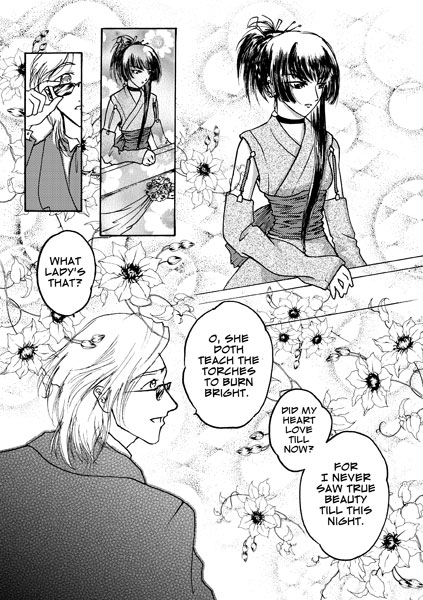
Book Review: The Manga Shakespeare: “Romeo and Juliet,” a clever modern interpretation.

Shakespeare Review:

In this section, I review a Shakespeare book, movie, or TV show that I feel has some kind of value, either as an interpretation of Shakespeare, or a means to learn more about the man and his writing.

Official Wallpaper from “Manga Shakespeare: Romeo and Juliet.”

Basic Details:

  1. Name: The Manga Shakespeare: Romeo and Juliet
  2. Media: Comic book, with accompanying website
  3. Ages: Young adult/ Teen.
  4. Premise: A slick, clever interpretation of Shakespeare that pares down the story and uses Japanese-inspired Manga comic book design to bring to life the violence and youthful energy of Romeo and Juliet. It transposes the story to a Tokyo suburb with two katana-wielding rival versions of the Capulets and Montegues.

Sample Images

rj_079 rj_033  rj_063My reaction: I think this is a very clever and very exciting way to get young people interested in Shakespeare. The pictures help bring the emotions out with great clarity and the storytelling is very condensed and clever. In addition, the website has helpful resources for Shakespeare newbie’s.

Recommendation: I’d recommend this book to all teens and high-school students and fans of Shakespeare.

url

Grade: 4 Shakespeare globes.urlurlurl

  • Official Website/ Reader’s Guide:
  1. http://www.mangashakespeare.com/titles/romeo_and_juliet.html
  2. http://www.mangashakespeare.com/glossary/ROMEO&JULIET_Glossary.pdf

Fun Posts about Friar Lawrence from our Friends at “Zounds, Alack, and By My Troth.”

I love it every time I come across some Shakespearean humor. One of the ideas I keep coming back to in “Romeo and Juliet,” is how close the play comes to being a comedy- it has two lovers, a funny nurse, a wisecracking friend, if people didn’t die it could be a sitcom. Even more ridiculous is the clichéd comic device of having people fake their own deaths, which Shakespeare does again in his comedy Much Ado About Nothing. So here is a humorous take on the old friar, and his go-to advice:

Web comic strip from “Zounds, Alack and By My Troth,” Used with permission.

https://zoundsalackandbymytroth.wordpress.com/comic/friar/

Romeo and Juliet: “Why Do We Read This Play?” (Part II of 3)

Romeo and Juliet: “Why Do We Read This Play?” (Part II of 3)

Posted on August 23, 2012 by Open Air Shakespeare NRV

Hello loyal subscribers and first time readers!

On Tuesday I posted an article about why schools are required to read “Romeo and Juliet.” I’d like to continue with another answer that is not quite as good, but has shaped the course of the play’s history.

Romeo and Juliet: Why Do We Have To Read This Play?

Answer # 2: We still read it because at one time, Romeo and Juliet was considered to be good for ‘moral instruction.’

In the 1770s, Shakespeare’s plays were read aloud, not as dramatic literature, but moral lectures to teach people about jealousy or love or ambition (Source: This American Life). Shakespeare was considered by many to be “The best judge of human nature,” as the dedication page says on the 1753 edition of Romeo and Juliet. This 18th century concept continued into the 19th, as evidenced in this painting, The Reconciliation Of the Capulets and Montegues, 1854.

“The Reconciliation of the Capulets and Montegues ” by Frederick Leighton, 1856.

Notice how in this picture, we see Romeo and Juliet as the lightest objects in the play, while their parents are directly center, holding hands. The “glooming peace” starts with the window, reflects off the dead lovers, and inspires the parents.

To readers and playgoers in the genteel age of the 18th and 19th centuries, Romeo and Juliet seem to champion love and peaceful co-existence, making the play seems to be a good play to teach young people. There is evidence in the play that supports this idea that Shakespeare was judging the youthful Romeo and Juliet to be morally superior to their parents. Shakespeare describes their parent’s hate as a canker or a parasite, sucking the life out of a flower, the feud has infected so much of Romeo and Juliet’s world, that it makes it impossible for their love to take root. In response, the young fight with their peaceful love to save the destructive world that their parents have created, and die as a sacrifice to true love. Looking at it this way, Romeo and Juliet take on a Christ-like status, dying to redeem their parent’s sins, which certainly would have appealed to the predominantly Christian audiences of the 18th and 19th centuries.

This approach does have its problems though:

  • Problem #2: The Language is FILTHY! When people like David Garrick adapted Romeo and Juliet, he cut all of Sampson and Gregory’s dirty jokes, and most of Mercutio’s. Even audiences today might be shocked to learn that one passage in Romeo and Juliet is still considered by modern standards to be PG-13:Problem #1: Although he dies nobly, Romeo also engages in many immoral behaviors, including his attempts to seduce Rosalind at the start of the play, his hot-blooded murder of Tybalt, and his purchase of illegal drugs from the Apothecary.
  • Mercutio:
    • Now will he sit under a medlar tree,
      And wish his mistress were that kind of fruit
      As maids call medlars, when they laugh alone.
      Romeo, that she were, O, that she were
      An open a**, thou a poperin pear!

Romeo and Juliet, Act II, Scene ii

I won’t go into what Mercutio is actually talking about when he mentions the pear-like medlars, which women used to joke about when they were alone. Suffice it to say that if you ever believed that Shakespeare ennobles us because he only speaks in proper, age-appropriate language, I can only say that you are:

  • Problem #3: Nobody ever thinks in this play!
Claire Danes from “Romeo and Juliet” (1996) holds a gun to her head, and threatens suicide rather than marrying Paris.
    •  Even though their parent’s feud is morally wrong, neither Romeo nor Juliet try to deal with it in a lasting, practical way, but instead try to run away from the problem. As Peter Saccio says in his lecture on Shakespearean tragedy, this approach is highly flawed: “Romeo and Juliet cannot live outside the social strata that their parents have created,” which means that they can’t run away forever or their lives will literally waste away. However lovely Romeo and Juliet’s  love is, it blinds their judgement too.
    • Even Friar Lawrence acts rashly as this wonderful video demonstrates:
  • Problem #4: The parents, (especially Lord Capulet), are also terrible moral figures-
  • As you can see in this lovely video from the BBC, Capulet attempts to fix his daughter up with an arranged marriage to manipulate the Prince to favor the Capulets. When Juliet refuses, Capulet reacts violently and threatens to disown her and hit her. Hardly an example of proper fatherly devotion.

Looking at all these examples, one could make the argument that Romeo and Juliet is a better example of immoral behavior. One could even argue that the tragic death of the two lovers was just the natural consequence of  their hasty, overly passionate affair.

As dubious as the morals in this play are, they can and have been used to construct several moral arguments, such as arguments against  pre-marrital sex,  or  arguments to pursue peace, or arguments for young people to be wiser in relationships. Each one is legitimate and Shakespeare gives each one its time to shine.

Thanks for reading, and stay tuned for Part III!

-Shakespeare Guru

Romeo and Juliet: Why Do We Have To Read This Play? (Part I of 3)

Most schools in the US and the UK study Romeo and Juliet at one time or another, so for this blog entry, I wanted to ask the question you might have asked at some point in your life:

“WHY DO WE HAVE TO READ THIS PLAY?”

I will answer this question in three posts, with three different responses, to try and make my answers as complete, and yet concise as possible:
Reason #1: Shakespeare Himself Is Part Of the Educational Establishment.

From the beginning of American education, Shakespeare has influenced education. What follows is a brief history that hopefully helps explain why, even though he was born in England, Shakespeare is as American as it gets.

Prologue: Life Imitates Art

The first settlements in Virginia occurred in Shakespeare’s lifetime. After all, Virginia was named after Shakespeare’s ruler, the virgin queen Elizabeth. In 1609, a voyage to repopulate the Jamestown Settlement in Virginia hit a terrible storm and was shipwrecked in an island in the Bermudas. The survivors wrote down their story in  a book called A Discovery of the Bermudas, Otherwise Called the Isle Of Devils in 1610, which could have inspired Shakespeare to write The Tempest. Shakespeare wasn’t ignorant of the New World; he references America in The Comedy Of Errors, so it’s not impossible that Shakespeare based his last great play on this “Brave New World.”

The Beginning Of Shakespeare In American Education

In England during the 18th and 19th centuries, Shakespeare was considered a way of educating people in the Greco-Roman tradition, since his plays were based on such Roman authors as Plautus, Seneca, Plutarch, and Ovid (Saccio). Romeo & Juliet is a perfect example of Shakespeare borrowing from the older western traditions- he took the plot and characters from an Italian Renaissance story recorded in Mateo Bandello’s Novelle (1554). The concept of forbidden love though, is much older. Like many Renaissance stories, Romeo and Juliet has roots that go all the way back to the Trojan war, which according to Greek mythology, started with a man from Troy who dared to love a woman from his city’s mortal enemy. Our founding fathers were schooled in this tradition and they helped transplant Shakespeare to the new world.

Shakespeare Comes to America:

Picture of the first ever edition of Shakespeare printed in America, the 1795 Hopkinson Edition by Bioren and Madan

Our country’s early settlers were Puritans and Quakers, who disapproved of theatre in general and tried to have it banned. Nevertheless, many of the founding fathers loved Shakespeare and enjoyed reading his plays ; John Adams and Thomas Jefferson took a pilgrimage to Shakespeare’s birthplace, and George Washington even staged some of his plays (Behn). Even though he was an English playwright, most early Americans were quick to adopt Shakespeare as their own .

Shakespeare In the Classroom

In the 1830s, Shakespeare first appeared in American textbooks as something called “The McGuffey Reader,” a book that contained short snippets of text ranging from old nursery rhymes, to passages from Nathanial Hawthorne. In this sample, you can see that there is one passage from Shakespeare called: “Shylock: the pound of flesh” listed in the table of contents.

At the same time, going to Shakespearean plays and owning copies of Shakespeare’s works became more and more popular in the post Civil War period. As Mark Twain mentions in The Adventures of Huckelberry Finn, productions of Shakespeare were common to early settlers, which is why Twain writes the So-called Duke and Dauphin characters, who pose as actors and perform a perfectly awful rendition of a soliloquy:

To be, or not to be; that is the bare bodkin That makes calamity of so long life; For who would fardels bear, till Birnam Wood do come to Dunsinane, But that the fear of something after death Murders the innocent sleep, Great nature’s second course, And makes us rather sling arrows of outrageous fortune Than fly to others that we know not of . . . (The Adventures of Huckleberry Finn by Mark Twain).

As this passage indicates, even people in rural towns on the Mississippi knew the basics of Shakespeare. In fact, by the mid-19thcentury, you were more likely to see a Bible and a copy of Shakespeare’s works in an American home, than any other book (Source: Lawrence Levine, “Shakespeare In America”). For another funny example of Shakespeare in this period, check out this clip from the film My Darling Clementine, where an old English Shakespearean actor performs for cowboys, which was a common practice during the gold rush.

Shakespeare Goes to Harvard

In the 1870s and 80s, Shakespeare became part of the curriculum of many colleges and universities like Harvard, since studying Shakespeare taught undergraduates the critical thinking skills they would use if they chose to study law or psychology. After the universities let Shakespeare in, high schools integrated Shakespeare into the curriculum to prepare students for college. This is why we study Shakespeare in most high schools today; according to a recent study, about 84% of American high schools are required to read Romeo and Juliet (Source: Hoffman, Jeremy The Western Canon In Today’s High Schools).

To sum up, the first reason we read this play is because it helps us broaden our minds and connect to the wisdom of the past. Also, a huge amount of our culture is inexplicably tied to Shakespeare.

Sources:

  1. Behn, Richard J: “America’s Founding Dramas” (online article) Retrieved 8/1/15 from http://lehrmaninstitute.org/history/essays15.html. 
  2. Levine, Lawrence:”William Shakespeare in America”
    from Highbrow/Lowbrow: The Emergence of Cultural Hierarchy in America, Harvard University Press, 1998.
  3. Saccio, Peter. Lecture 1: “Shakespeare Then and Now.” Shakespeare: Comedies, Histories and Tragedies. The Teaching Company, 2001. CD. Dartmouth College.
  4. Waterson, Sam (Narrator) et. all. “The Father of the Man in America: Shakespeare in Civic life and Education.” Shakespeare in American Life, (radio documentary). Produced by Richard Paul. Originally airing on Public Radio International (PRI) stations April 2007.Retrieved 21st of August, 2012 from http://www.shakespeareinamericanlife.org/education/episode.cfm
That’s all for now, stay tuned for later posts this week!
-Shakespeare Guru

Wrap Up On “Much Ado About Nothing”

Hello everyone!

Well, today is the last day of July, so I wanted to go out with a bang!

First of all I finally finished my Play of the Month Page for Much Ado About Nothing, so that’s up for you. Also, I’m going to post three reviews of Shakespearean movies. So enjoy this last look at Much Ado, while I prepare for my new play of the month!

  1. Review: Kenneth Branaugh’s “Much Ado About Nothing.”
  2. Review: Joss Whedon’s “Much Ado About Nothing.”
  3. Review: Shakespeare Retold: “Much Ado About Nothing.”
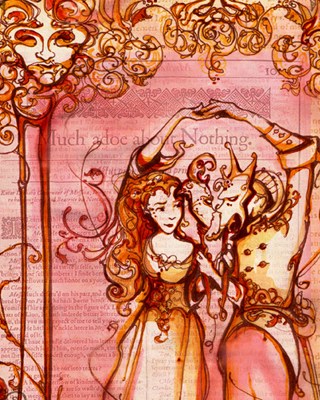
Artwork for “Much Ado About Nothing” by Elizabeth Schuch, reproduced with permission.