Ages: Pre Teen- teen. The story is highly condensed so older readers might want a more in-depth adaptation to understand the themes and ideas of the plot.
Premise: This graphic novel is a good introduction to “A Midsummer Night’s Dream.” It tells the bare minimum of the story with very little dialogue and almost none of the original text. Most of the story is conveyed through the visual medium.
ABOUT THE ILLUSTRATORS (Reprinted from the graphic novel)
https://www.behance.net/berelince?locale=en_US Berenice Muniz is a graphic designer and illustrator from Monterrey, Mexico. In the past, she has done work for publicity agencies, art exhibitions, and she’s even created her own webcomic. These days, Berenice is devoted to illustrating comics as part of the CGraphikslava crew. In her spare time, “Bere” loves to draw, read manga, watch animated movies, play videogames, and kill zombies Fares Maese is a graphic designer and illustrator. He has worked as a colorist for Marvel Comics and as a concept artist for the card and role-playing games Pathfinder and Warhammer. Fares loves spending time playing video games with his Graphikslava comrades, and he’s an awesome drum player: https://faresmaese.artstation.com/
About the Retelling Author
The career path of Nel Yomtov has taken him from the halls of Marvel Comics, as an editor, writer, and colorist, to the world of toy development. He then became editorial and art director at a children’s nonfiction book publisher, and now Nel is a writer and editor of books, websites, and comics for children. A harmonica-honking blues enthusiast, Nel lives in New York with his wife, Nancy. They have a son. Jess.
mY rEACTION
I read this version to my five year old son and he enjoyed the colors and characters, which is why I feel confident recommending this version to younger children. It won’t help you pass a test on Midsummer and you won’t get the whole story. But you might get a tantalizing glimpse of Shakespeare’s world of fairies, lovers, and funny fools and honestly, that’s fine with me. As I’ve stated before, parody and short pop-culture adaptations of Shakespeare are great ways to connect with young people, and I see this book as a tool to do just that.
tECHNICAL eXECUTION
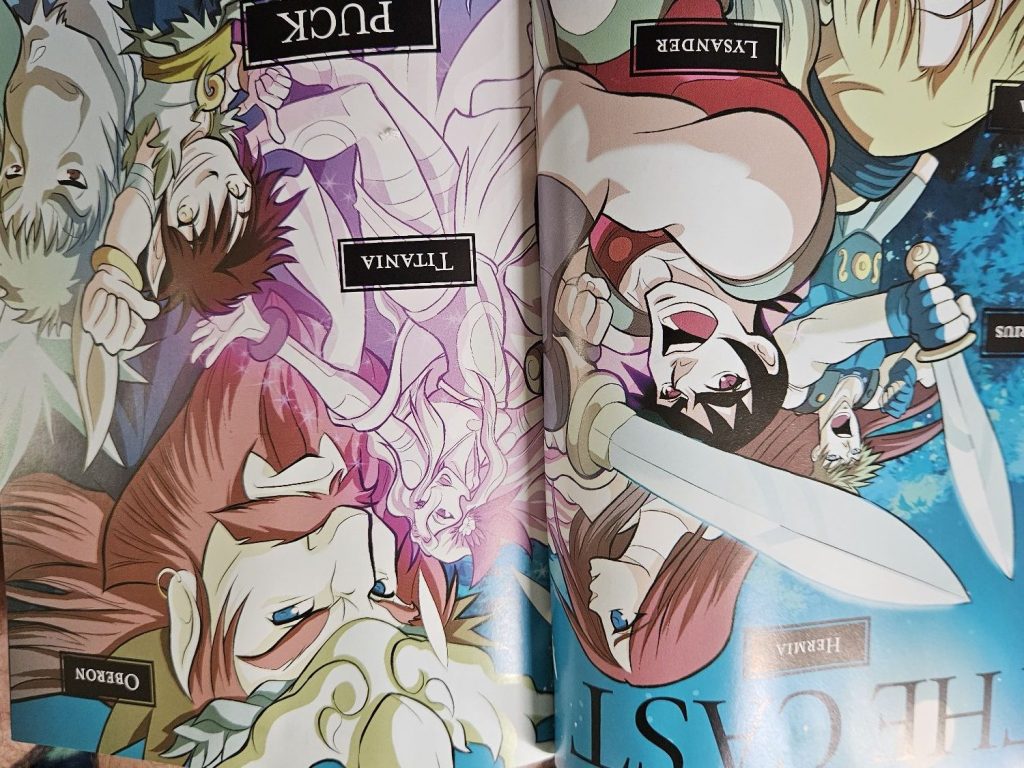
Character Design. It’s interesting to see the difference in style between this version, and the Manga Shakespeare version I previously read. That one was very much inspired by the Shoujo manga style, which emphasizes drama and relationships. This version’s drawings are softer, more cartoonish, and the expressions are less stiff, (except for Oberon, who is drawn very austerely). I particularly like the design for Puck with his big mischievous eyes and squat, childlike shape. I would argue however that the lovers and Mechanicals aren’t distinct enough, which is a problem since they are the most important characters.
The Adaptation
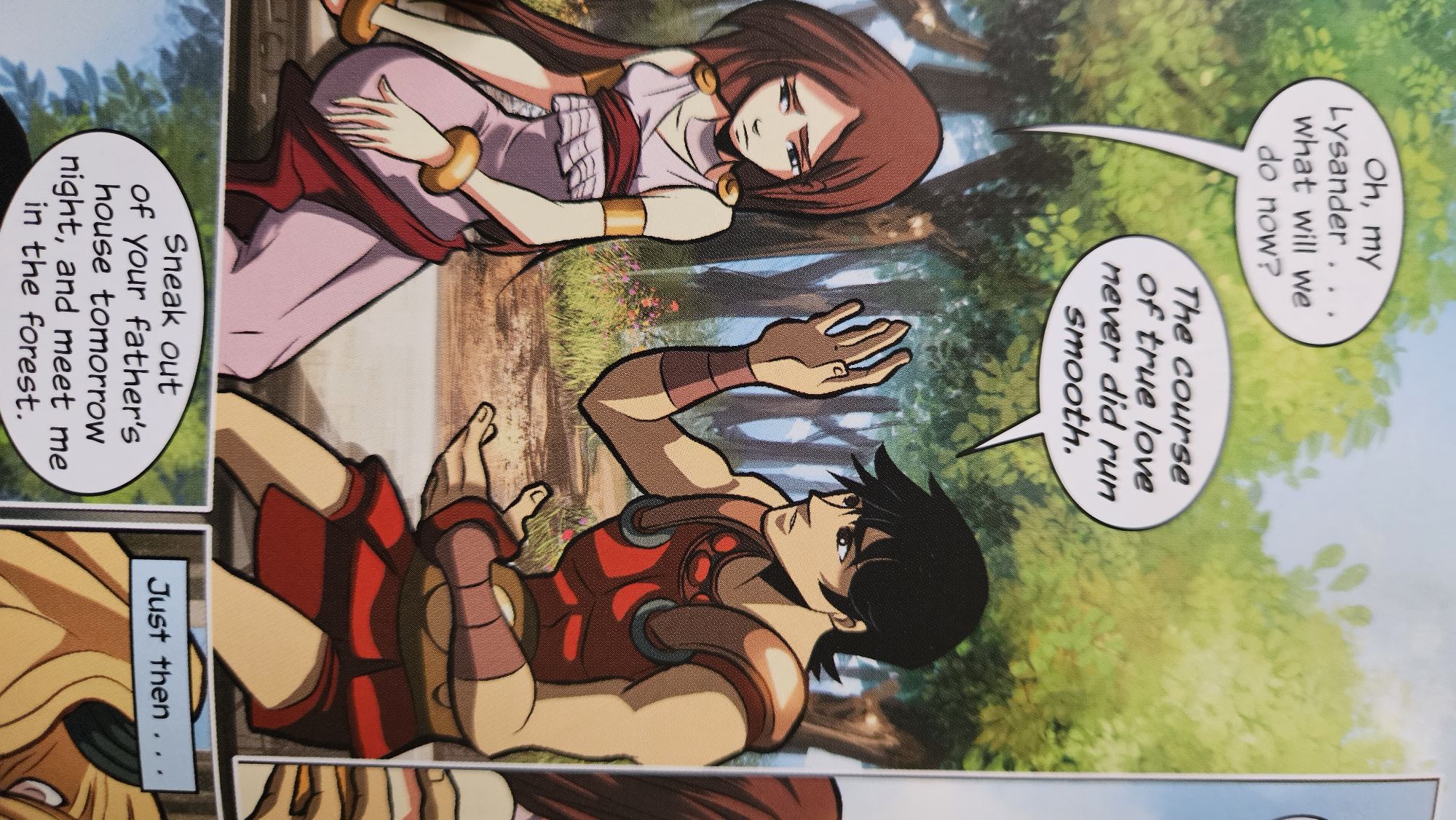
Like I said, this is a bare minimum adaptation of the play. None of Shakespeare’s text is used and the lines and speeches are cut liberally. The entire book is only 77 pages which of course means, that there are a lot of cuts. There’s no mention of the Indian boy, Titania’s tiff with Oberon, Philostrate, the other fairies, and all the great speeches are cut. This version is focused entirely on the plot, and it cuts it quite efficiently. To demonstrate this, below on the left is a panel that shows how Lysander and Hermia express their frustration with not being allowed to marry. On the right is the original text of the scene.
Ay me! for aught that I could ever read, Could ever hear by tale or history, The course of true love never did run smooth; But, either it was different in blood, Lysander. Or else misgraffed in respect of years, Lysander. Or else it stood upon the choice of friends, Or, if there were a sympathy in choice, War, death, or sickness did lay siege to it, Making it momentany as a sound, Swift as a shadow, short as any dream; Brief as the lightning in the collied night, That, in a spleen, unfolds both heaven and earth, And ere a man hath power to say ‘Behold!’ The jaws of darkness do devour it up: So quick bright things come to confusion.
The Colors
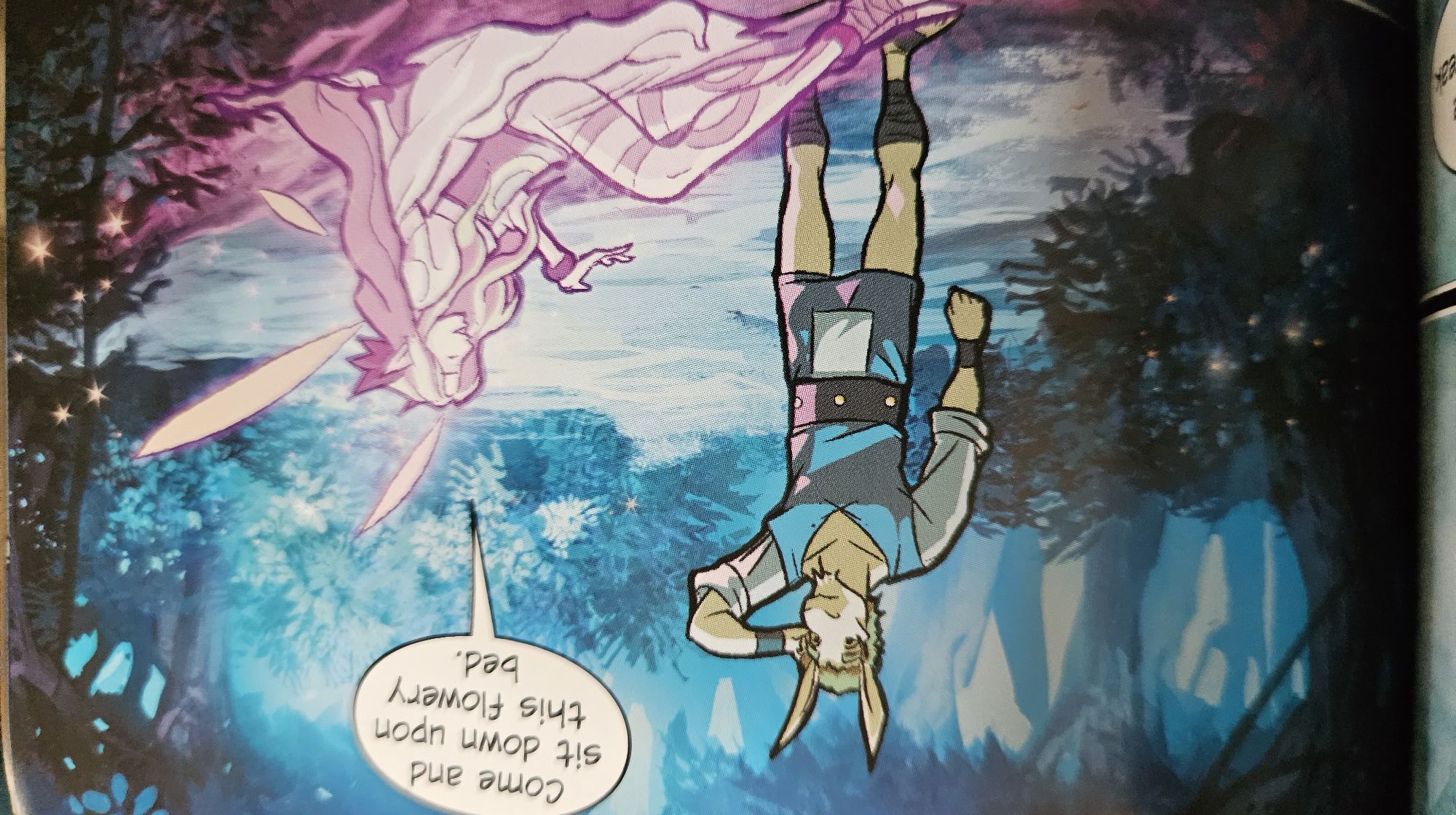
The colors are very beautiful. Other manga stories have colorful title pages but no color in the panels. This comic is alive with color and the colors help tell the story. Athens represents the world of the daytime, so the colors are very warm and vibrant. In the nighttime, the colors are cool and the characters are drawn with very sharp lines to make sure they don’t fade into the background.
IN Conclusion
This version tells l the story quickly and entertainingly with a vibrant and colorful style that was lacking in the Manga version. Granted, the Manga Shakespeare did allow me to focus on the text more, but I think I actually prefer this version, simply because of its beautiful artwork. Check it out if you get a chance!.
The popular Netflix show “Bridgerton”, takes place in England during the reign of King George III (reigned 1760-1820). This was a time of enormous cultural and political upheaval- less than one century after the monarchy was restored, with the American and French Revolutions taking place across the pond. This was an era of power and privilege for the aristocracy, but a time of great uncertainty for nearly everyone else.
Crash Course in Sentimental Comedies, the preferred theater of the late 18th century.
Shakespeare in this period was considered a bit old hat and too vulgar for the refined age of the 18th century. During the Regency, Sentimental Comedies were all the rage. These comedies and tragedies were designed to instill audiences with Catharsis or empathy with the characters, rather than get people to think or use their reason. Gone were the days of laughing at people’s humorous behaviors and more along the lines of pitying the poor fates of middle-class rustics. These poor characters remained good-natured at the cruelty of powerful aristocrats. This explains the popularity of such plays as Beaumarchais‘ The marriage of Figaro, or Mozart’s opera Don Giovanni, in which an evil aristocrat is ruining the lives of common people like the naive peasant Zerlina with his insatiable sex drive.
After the religious wars of the 16th century and the civil wars of the 17th century, early 19th century people were more disillusioned about the monarchy, especially after the seismic shifts of the French revolution and the American Revolution. This was the beginning of the end of the aristocracy, and even though we don’t see it in Bridgerton for comedy reasons, you can sense that the eponymous family is preserving their family and houses, rather than crown and country, which is one reason why the show still resonates with young people.
The Bridgertons might be aristocratic but they have no illusions about their own self-importance. They’re rich, yes but, like modern rich people, they don’t believe that they deserve their riches because of God- they merely fight to preserve their riches for their children, to find their daughters good love matches, and to survive the complex social Laviathon of eighteenth Century and Nineteenth Century England.
Popular Productions Of the Georgian Era
Georgian Shakespeareans
The Georgian Era was the first time in history that Shakespeare started to have a Global audience. French and German writers like Goethe, Schiller and Voltaire helped to kick off the practice of Shakespeare being translated and performed in non English speaking countries in the 18th century. In addition, Empress Catherine the Great brought Shakespeare as far as Russia with her 1786 production of The Merry Wives of Windsor. By the end of the 19th century, Shakespeare had been translated into French, German, Hindi, Hungarian, Italian, Spanish, and Danish (Downer, 468).
In England, however, with the trend towards sentimentality and accessibility, (as the video above mentions), the idea of adapting and modernizing Shakespeare became more common in this type period. What’s interesting is that, just when Shakespeare seemed to be on the way out culturally, people like David Garrick began to rehabilitate Shakespeare (McDonald 358).
English writers of the 18th century were trying their best to use Shakespeare as a tool of moral instruction.
Not only did Garrick create popular adaptations of Shakespeare, he also successfully made Shakespeare a cultural icon. Garrick’s famous jubilee of enthroned Shakespeare as the perfect example of english writing and the common man (even though most of his characters are aristocrats), the fact that Shakespeare was a common writer a not an aristocrat or a University educated man, actually benefited his reputation in the 18th century.
Even though Bridgerton prides itself on its colorblind casting and the black & white characters haven’t a shred of racial discrimination (except in the spin-off), this society is still plagued with sexism. What I find the most interesting about Bridgerton is that, like a Shakespearean comedy, the show’s conflicts center around how women navigate sexist patriarchal systems.
In Bridgerton, the London season and the annual balls are more than just a chance to to socialize and meet handsome young man, dance, and wear pretty dresses; they are the only hope that upper class women had for the future security of their houses. These systems were put in place because women were denied the ability to determine their own destinies. Though Queen Charlotte runs the social season, she is enforcing a patriarchal system; one that places a woman’s value entirely on her ability to charm and retain the affections of men.
the bridgerton ladies are extremely aware of this and you can see their anxiety every time they attend a ball. They know that their future depends on this and the show isn’t shy about that. So so like a Shakespearean heroine, the comedy and the central conflict is how these women will navigate this socio-economic gender-based political mindfield.
Cleopatra and her son CesareanPortia, wife of Brutus, swallow coals rather than be captured by Octavius.Beatrice from “Much Ado About Nothing”Cordelia Disenherited Jessica prepares to elope with Lorenzo Rosalind in “As You Like It”
What Shakespeare frequently does in his comedies is have women deliberately challenge or abandon this strict social structure. Young Shakespearean heroines frequently omen disguise themselves as men and/ or go traveling abroad so that they can find husbands and determine their own destinies. Shakespeare won’t Go So Far as to abandon the notions of marriage and childbearing, but he does create a sort of Female Fantasy: “wouldn’t it be nice to determine a one’s Future for oneself?”
Rosalind courts Orlando in As You Like It
In As You Like It, Rosalind, in disguise as a man, is able to dictate for herself the way that she marries and courts Orlando, which must have been shocking and hilarious for Elizabethans. Viola again disguised as a Man is able to criticize his outdated notions of women to his face, and disdains his repeated attempts to woo a woman who does not share his affections. Meanwhile Juliet, a woman whose arranged is dramatically portrayed from start to finish, abandons her father’s choice and marries for love. All these women have the same conflict as the bit bridgerton women they just confront them in more extreme way
With the new season just released on Netflix, I’m sure a lot of us literary nerds will rejoice and be happy to have an excuse to play dress up, eat some scrumptious food, and converse on the sweet little confection that is Bridgerton. What follows is by no means a comprehensive list of ideas, I just wanted to share some of my research that went into my own party in the hopes that it gives you ideas. Please feel free to respond to this post by commenting or by hitting me up on Twitter at @Shakestud and share your own Bridgerton Party Pics!
“I seek you out at every social assembly because I know you will lift my spirits and make me see the world in ways I could not have imagined.”
Colin Bridgerton.
I need to give a special thank you to my wife in this post. She’s the one who introduced me to Bridgerton, did a lot of research into Regency etiquette and dining, and bought all the ingredients for the party. More than that, she is an extremely talented writer and educator who inspires me in ways even Penelope Featherington couldn’t enumerate. Watching Bridgerton has become a kind of nightly tradition for us and I am very grateful
Background: Bridgerton and the Gorgeous Georgian Era
Bridgerton is a period comedy on Netflix based on the popular novel series. It is set in an idealized version of the late 18th and early 19th century; a time when England was wealthy, cosmopolitan, and when one’s social standing was everything. The shows writers pay homage to great literary figures like Jane Austin, George Brimsley Sheridan’s The School For Scandal, Shakespeare (of course), and real-life scandal writers of the time; rags like Town and Country, The Spectator, and Courtesans.
My Personal Opinion on the SHow
Some people have criticized the show for not being historically accurate. Others claim that the show’s plots and characters are highly derivative from other comedies like Gossip Girl and others. I would argue that THAT’S THE POINT. Bridgerton is not trying to do anything original- it is nostalgia bait for literature nerds like me who know that shows like Gossip Girl are ripped off from classical sources. What Bridgerton does, is take these classic tropes, put them back into the period where they became popular, and then update the setting to make it more accessible to a modern audience. Much like the party ideas I’ll give you later, this show is like a sweet confection- comforting, unassuming, with an air of nostalgia and romance like a cup of tea and a crumpet.
The show focuses on the hopes, dreams, and above all, loves of the Bridgeton family; a noble family in Georgian England. Viola, the matriarch of the house, seeks to find love matches for all her children and to avoid scandalous gossip. She does so through her own intelligence and through the help of her network of female friends, all while avoiding the watchful eye of Queen Charlotte (the powerful wife of King George III), and the mysterious scandal monger Lady Whistledown
Like its dazzling costumes, the show is very much fluff and feathers. Bridgerton’s use of color blind casting is extremely refreshing to me and it signals loudly and clearly that Bridgerton doesn’t want to be painstakingly historically accurate. This is an candy-coated and show that concocts an idealized version of Georgian society- one where painful racial problems are thrown out, there are few economic or political problems to sour one’s pallate, but everybody is rich and pretty and looking to fall in love with a wealthy eligible young man or lady. So, with a concept this delicious, I knew I had to throw a party based on it!
Part One: The Invitations
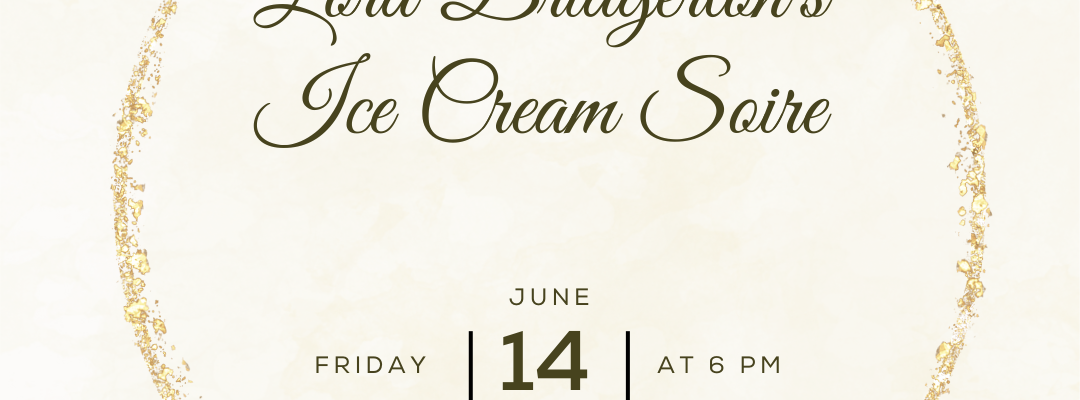
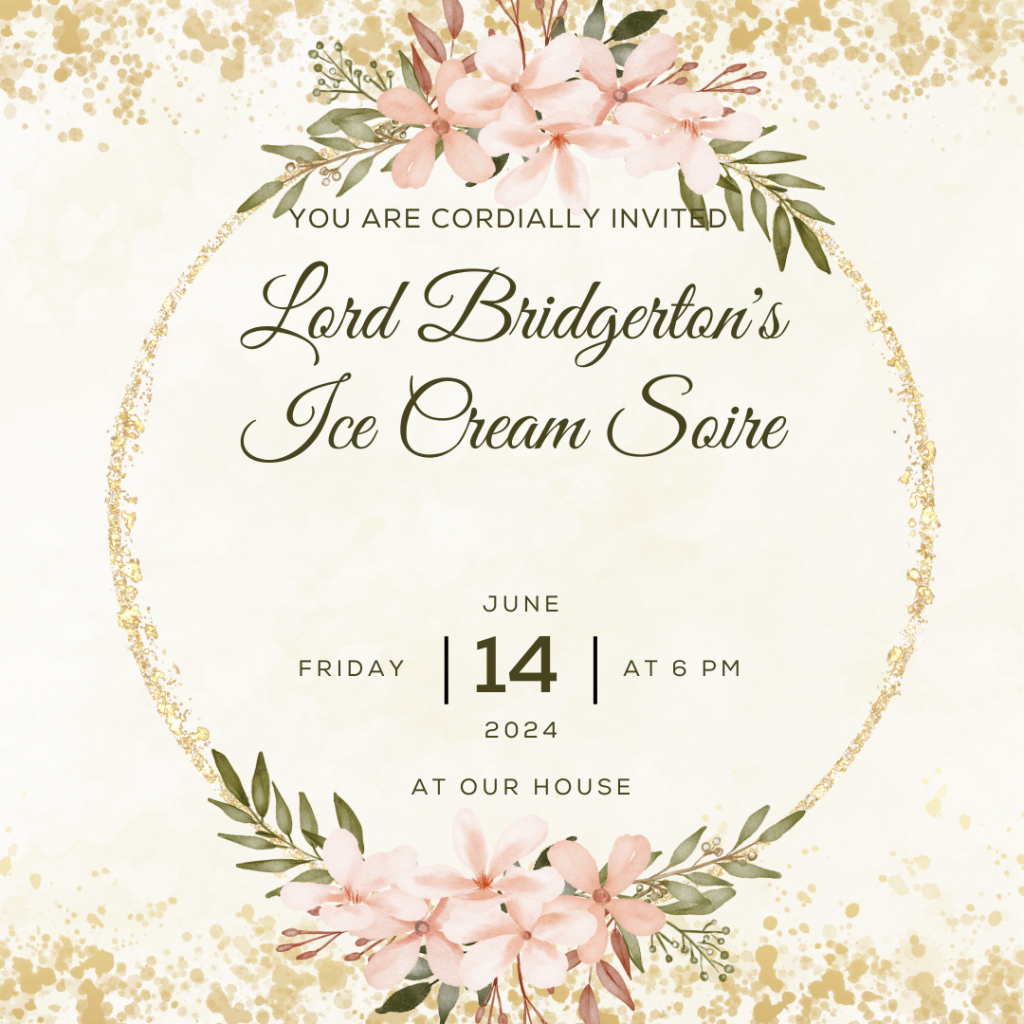
There’s a ton of fancy invitations templates online. Below is an invitation I created for free with an app called Canva and a parchment background picture I found online.
You probably also know that I am a huge fan of the website Immortal Longings because of their excellent Shakespearean art and they sell cards too. You can buy the cards or download the pictures on their website.
Shakespearean Greeting Cards from Immortal Longings.com
Part Two: Decorations
The Georgian Era was firmly in the Baroque era- a time known for opulence, excess, and as many frills as possible. Deck your home with as much gold, crystal lace as possible! Use electric candles liberally. Also, use curtains and fancy throw pillows to fancy up your dining room! Here are some more ideas from Chateau Challain:
Part Three: The Feast
As you can see, since the Georgian era was known as a time of wealth and excess, you could very easily break your wallet or your back trying to replicate an authentic Georgian dinner party, (especially if you lack an entire household staff to bring it to life). What we tried to do was distill some of my favorite foods from the Georgian era down and come up with an easy plan so that a plebian cooking-impaired soul like myself could make them at a reasonable price. I did not want my wife to have to cook for this, though she did wind up trying out a very interesting Georgian recipe:
Salmagundi
Thought I honestly doubt that the upper crust Bridgertons would ever eat this, it is an authentic Georgian recipe and it was common among middle class people, American Revolutionary War soldiers, and even pirates! It’s a savory salad that uses eggs, pickles, mixed greens and anchovies. The name is French for “hodge-podge” and it honestly can be swapped out with any number of ingredients. Here’s a recipe that’s pretty close to what my wife used:
Just like decor, a party or ball amongst the nobility was a sign of wealth and status. If you wanted to impress foreign dignitaries or net a wealthy spouse, you had to show off the wealth and sophistication of your household. We served duck as the main dish since it’s the sort of game the Bridgertons would have on their land. My wife and I also served a meat pie as an homage to the one Daphne eats excitedly in Season 1. Meat pies were very popular in the British isles due to the lack of refrigeration in the Georgian era. For our party, my wife bought the Steak and Stout pie from Trader Joes, which I realize not everyone likes, but it does have a good hearty feel to it. Accompanying the pie, we served cheese, grapes, and some good red wine!
Dessert
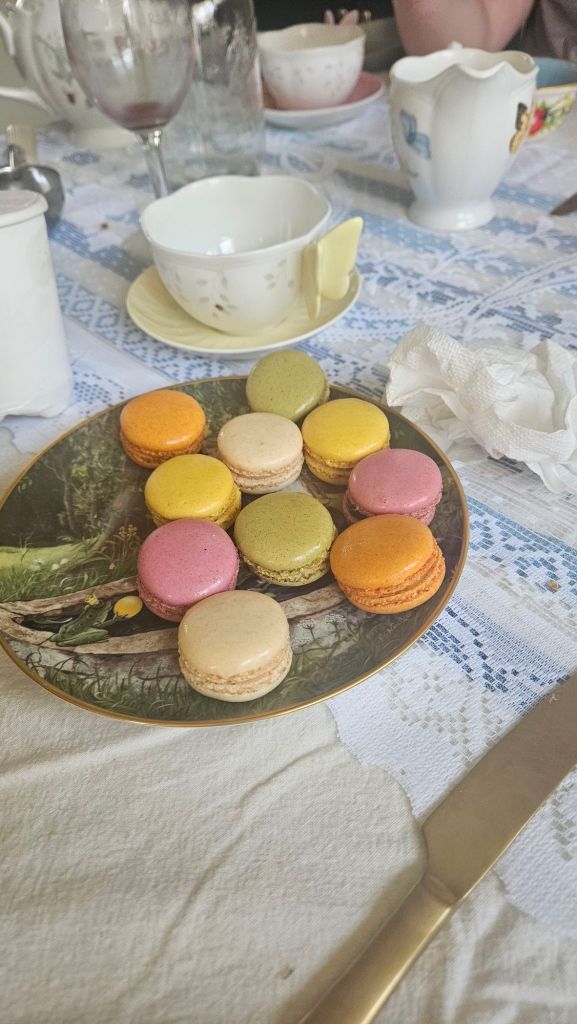
High tea is a real ritual in England to this day, and if you don’t have a lot of time or money on your hand it can be a bit daunting. Again, we relied on Trader Joes to help fill in the gaps of my cooking skills (since again, I wanted my wife to enjoy the party, not cook). I leaned heavily on ice cream, macarons, and of course, tea since they are all foods featured on the show. In fact, there’s a whole scene at the house where the family fight over the last chocolate macaron.
In case you don’t know, macarons are delicious French sandwich cookies made by sifting dry ingredients, combining them with egg whites, piping them onto a baking sheet, and baking them into light, flaky little half circles. From there you can add any kind of filling you like. Now, these cookies are notoriously temperamental, so I just bought some, but for the brave souls with a little more time on their hands, here’s a recipe from NYT:
Other Dessert ideas: You could incorporate scones petit fours, or jam/ cucumber sandwiches. I find a dessert tower is really nice for this kind of “take what you like” dessert atmosphere. Also, don’t forget the ice cream!
Tea-
I’m sure I don’t need to tell you that tea has great cultural significance to the British and I labored over what kind of tea to serve during the party. I personally love Indian Chai and that would be appropriate since it’s mentioned in Season 2. I also enjoy Earl Grey (though that one might be too bitter for most people). However, I decided on Harney and Sons Paris Tea, which is my wife’s favorite, and in my humble opinion, is one of the best teas readily available. It’s a black tea that has been withered, rolled, and baked to make it more flavorful and aromatic, though easy to mass produce. I LOVE THIS TEA. Here’s a link if you want to learn more:
Now, I should mention that there is a lot of officially branded Bridgerton tea, coffee, and tea snacks (of course), but this post isn’t an ad. If you’re interested in the branded stuff, here’s a few links below:
Bridgerton is famous for featuring classical music covers of pop songs, which I really enjoy- it is a nice way of retelling the story of the characters by connecting them with something contemporary. Most of these covers were done by a group called the Vitamin String Quartet and there are playlists on Youtube, Spotify, and others.
During the Regency, music by Mozart and Hayden were all the rage, so if you want to intercut the covers with real classical music from the time period, you can also use them. I would recommend using waltzes or minuets if you want to get people on the dance floor:
Again, for people on a budget, you might want to forgo full Georgian outfits, but this was a time of ball gowns and elaborate wigs for ladies, and men with waistcoats, knickerbockers, and breeches. For more information on the period, here’s a link to Fashion History Timeline:
And to conclude, I want to dedicate this post to my wife who introduced me to the wonderful, sweet, and heartfelt world of Bridgerton. I hope this post helps you bring a fun, fancy-but laid back evening into your home. I hope also that it helps you become closer to and appreciate your loved ones, just as I wish to keep enjoying the show with my wonderful wife.
Parent Description- A fully online, fully interactive course into Shakespeare’s histories taught by a professional text coach and actor.
Students- Uncover the scandalous and gory history behind Shakespeare’s most action-packed plays! Shakespeare’s histories have inspired such works as “Empire,” “Game of Thrones,” “Hamilton” and even the “Star Wars” trilogy. This class will unlock for you why these stories of power and betrayal have been so popular for 400 years.
Format:
0. The class will have a Nearpod with slides, activities, and links to my other resources. The class will be a combination of slides, activities, and videos. Each class will have
Weekly Discussion questions via Google Forms such as: “What do you know about Shakespeare the man?” or, “Are Shakespeare plays still relevant today?”
Video Analysis- Every week I’ll discuss a different play with a short video.
I’ll provide some context, explaining what is happening in the play durin the speech, and any relevant historical context.
We’ll watch a recording and the students can write their impressions on what they like and don’t like.
Immersive activities such as:
– Shakespeare arts and crafts and recipes such as making costumes and props.
– My online Shakespeare board game.
Virtual tours of the Tower Of London,
Weekly Web Quests like “find a Shakespeare quote that you use in normal speech,” “find a movie or character that’s based on Shakespeare,” or “Draw a picture of a Shakespearean character (stick figures are acceptable).
6 Week Course
Week 1 – Why Hamilton is Like A Shakespeare History Play Hamilton and Shakespearean History We’ll discuss what makes a history play a history play, why they were so popular in Shakespeare’s day, and draw parallels between Shakespeare and the Broadway Musical “Hamilton.”
What is a history play?
Song quest: Watch the Horrible histories king song
Worksheet- which Shakespearean character reminds you most of Hamilton?
What would you call the tone of this speech? Patriotic? Mournful? Excited? Bitter?
The deposition Scene (video- 3 minutes)
The danger of this scene:
Though Queen Elizabeth I is now almost universally beloved, she wasn’t always in Shakespeare’s time. By 1601, she was 68 years old and had no male heir. Her government had also failed to put down a rebellion in Ireland. Some people in her government were getting restless.
Robert Devereaux, Earl of Essex was one of those restless nobles. He’d been one of the Queen’s favorites, but after failing to crush the rebellion in Ireland, his relationship with her sourered. He then plotted to rebel against the Queen, and take the throne for himself.
To do that though, Essex would need to get people on his side, so he recruited Shakespeare! One of Essex’s servants paid Shakespeare’s companies to perform a scene from Shakespeare’s Richard II; the scene where a handsome and charismatic nobleman convinces the king to willingly give up his power.
This scene was so dangerous that when the play was published, it was taken out by Elizabeth’s censors.
Playing Richard video: Fiona Shaw Questions What does making Richard female emphasize for an audience? What point does Shaw’s performance say about women in power?
Week 3 Henry V week
Tom Hiddleston as Henry V
Basic plot- Young king fights a war and conquers France proving himself to the world.
Olivier vs. Branaugh
-Concept- what if the play was a Hockey movie?
Henry is like the coach or team captain who gives inspirational speeches
The underdogs win
The snooty bad guys lose
How this translates to staging fights/ directing the characters (website/ youtube interviews)
Activity= write a trailer or design a poster for Henry with a cool tag line.
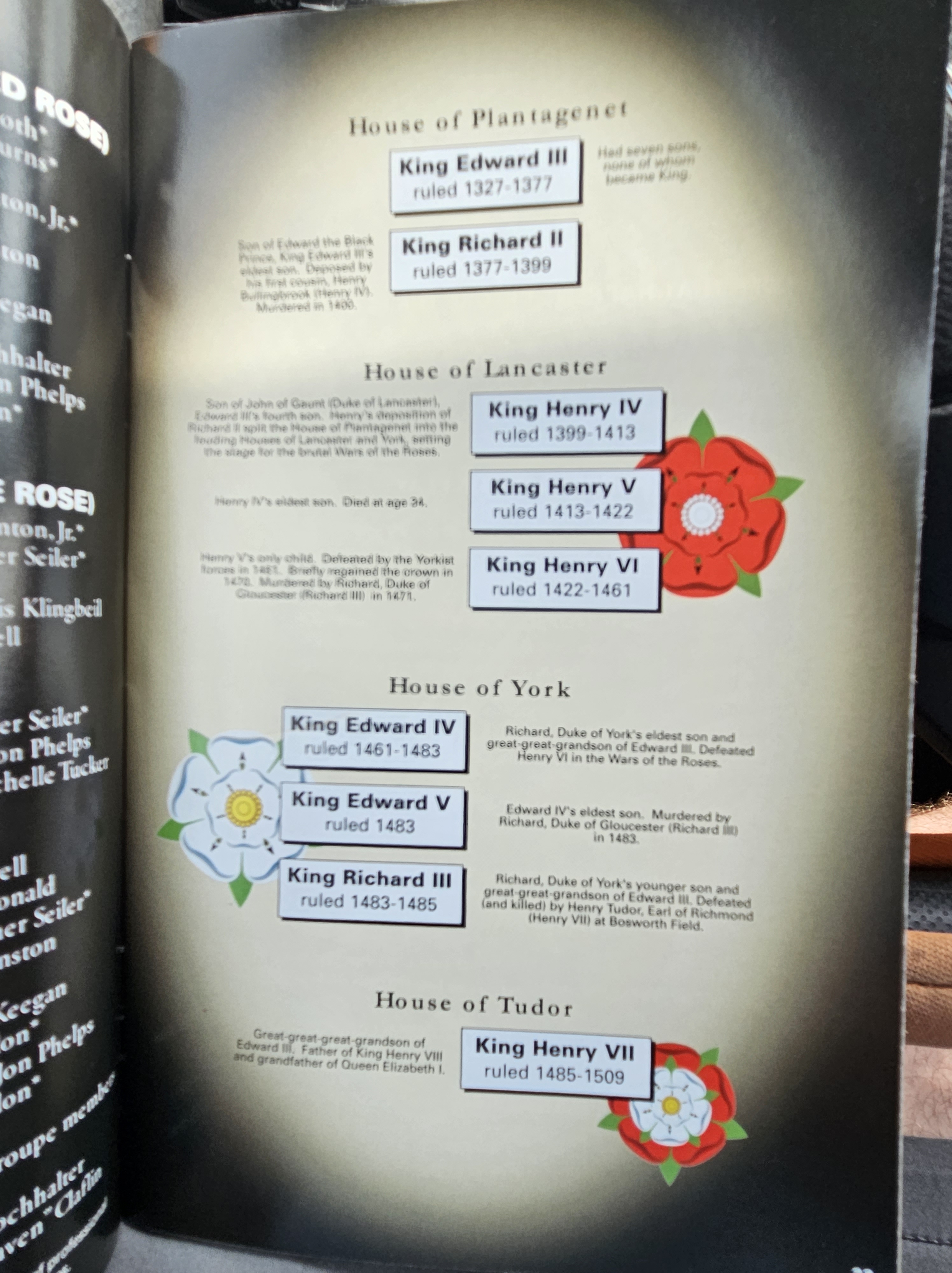
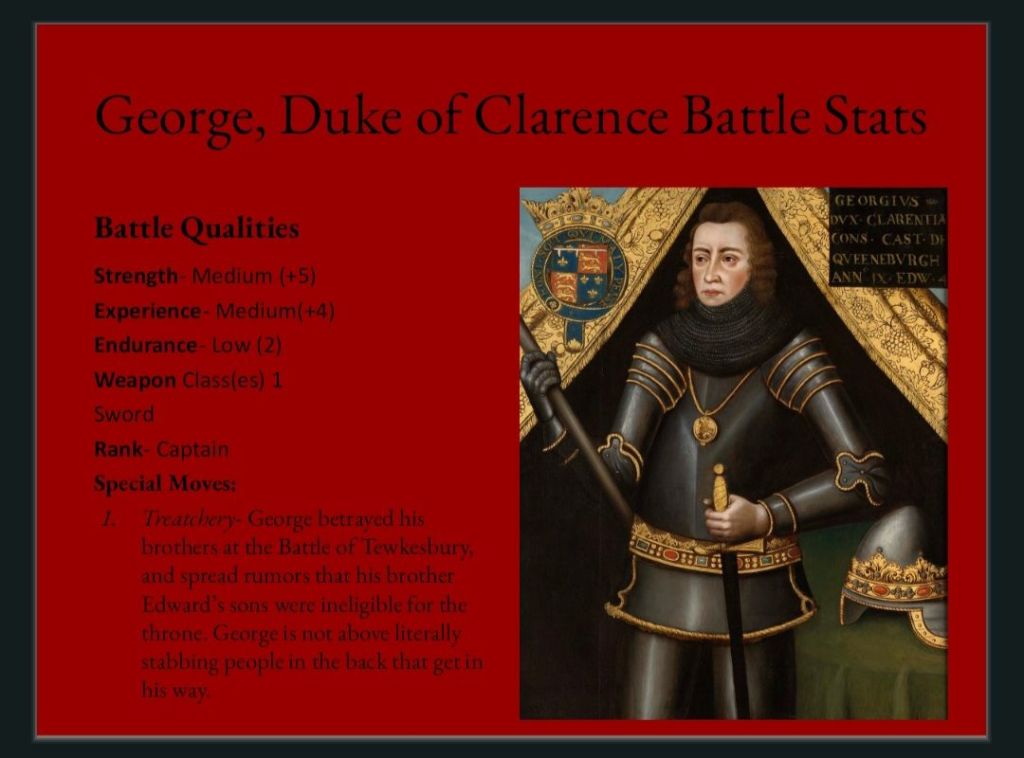
Week 4- The Wars of the Roses-
Summary of the three Henry VI plays
Wars of the Roses Horrible Histories
Web quest- research one major character from the 3H6 ASC website:
Richard of Gloucester
Henry VI
Margaret of Anjou
Richard of York
Medieval warfare
Watch one of the Weapons that Made Brittain videos and answer 5 questions.
The battles of the Wars of the roses
Costumes
Week 5- Richard III- The rise of the corrupt king
Close reading- “Now Is the Winter of Our Discontent”
Slides on Richard’s plot.
Richard and Machiavelli
Richard and Emperor Palpatine
Richard and Modern Leaders
Richard vs. the Amir of Gloucester
Propaganda activity- make a campaign slogan/ poster for Richard.
Title Card- “The Violent Rhetoric Of Julius Caesar”Title for my Outschool class on Codes and Ciphers, inspired by the Disney show “Gravity Falls.”Digital business card for my online classes with a QR code if you want to know moreTitle art for my Outschool course on Shakespeare’s comediesCover art for my Outschool class: “Shakespeare- the Lost Play”Title of my Outschool murder mystery gameTitle image for my online course on “Romeo and Juliet.”Title card for my Outchool Intro To Shakespeare cs.Title art for my Outschool course on Shakespeare’s comediesTitle for my Outschool class in swords and Stage Combat.
Great online classes in Shakespeare and science are available for students all this month at Outschool.com.
From now until June 1st, you can get a $20 discount with referral code PAULHT20. Share the joy with other curious minds in the family too! Spread the word and let’s ignite the passion for learning together!
Class Descriptions
Live Classes
For these classes you meet with me live over Zoom:
Introduction to Shakespeare- Tuesdays 9-9:30AM (EST)
This is my 30 minute short and sweet intro to Shakespeare’s life, his plays, and why his work still matters to us today!
Intro To STage Combat (With SwordS)- Tuesdays 9:30-10AM (EST)-
Like the Intro to Shakespeare class above, this is an intro to the basic footwork, attacks, and defensive parries of swordplays for someone just begeinning to learn about swords.
Title image for my online course on “Romeo and Juliet.”
An Immersive Guide To “Romeo and Juliet- Tuesdays from 10-11AM (EST)
This multi-week course delves into the plot, characters and themes of “Romeo and Juliet,” while also providing interactive activities, virtual tours, and webquests.
Shakespeare’s History Plays- SaturdAYs 8:30 AM IST
This is a new course I’m working on to cover all of Shakespeare’s History plays including Henry V, Richard II, and Richard III. More info as it becomes available.
Asynchronous Classes
These classes are Flex Schedule, which means the teacher prepares the activities in advance and allows you to do them at your own pace without direct consultation.
A flexible schedule class that teaches kids the plot and characters of “Romeo and Juliet,” in the context of a detective story where you solve the mystery of the young lovers’ deaths.
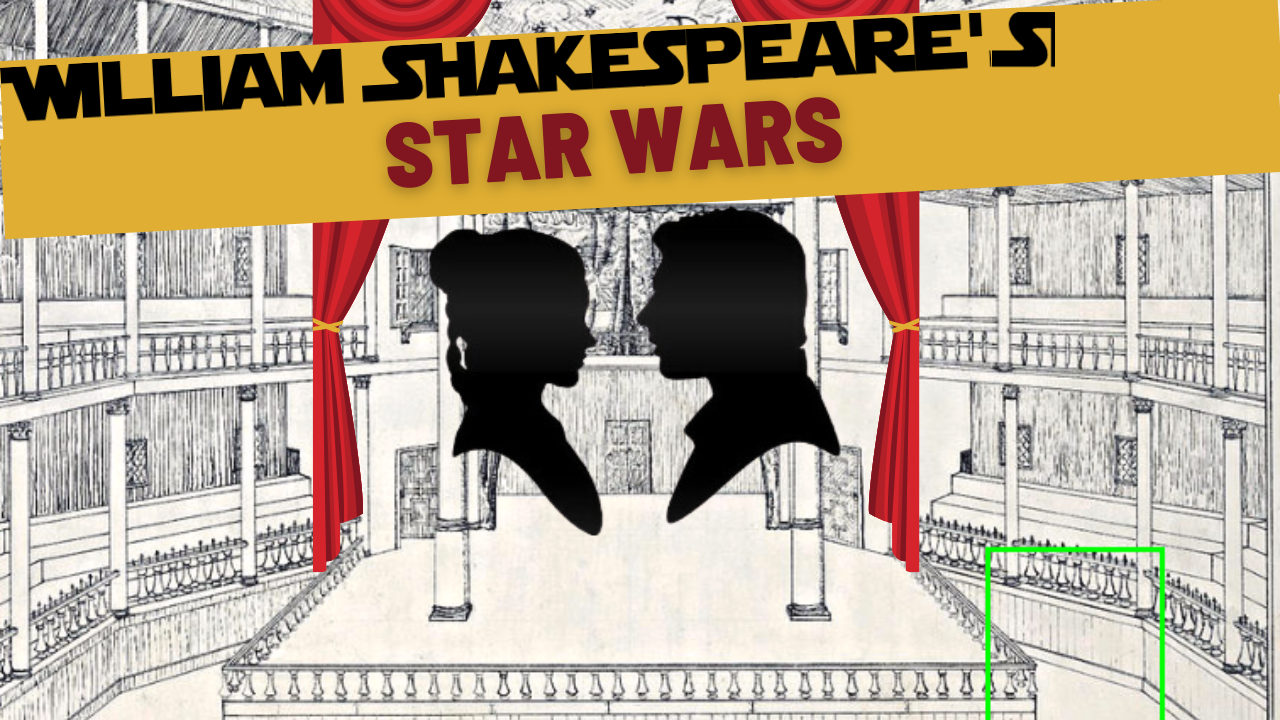
Did you know that Star Wars is based on the ideas and writings of William Shakespeare? This class will teach you about writing and characters though games, interactive activities and dramatic readings of both Star Wars and Shakespeare!
Using self-paced online activities, your child(ren) will compare the plot and characters of Star Wars to Shakespeare’s plays. We will also discuss Shakespeare writing by looking at “William Shakespeare’s Star Wars” by Ian Doescher.
Course Description
Concept: To compare and contrast the plot, characters, themes, and language of Shakespeare’s plays with Star Wars
Student Description:
Epic battles, quests for revenge, pirates, funny characters, powerful warriors swinging swords. Star Wars has something for everyone. But did you know that in many ways, Star Wars is based on the ideas and writings of William Shakespeare? In this course we’ll peer beneath the veil of Shakespeare and Star Wars to find the universal stories of love, revenge, power, and growing up, using games, artwork, and dramatic readings by professional actors!
Did you know that Star Wars is based on the ideas and writings of William Shakespeare? This class will teach you about writing and characters though games, interactive activities and dramatic readings of both Star Wars and Shakespeare!
Course organization (the class is divided into 6 parts that students can complete at their own pace over a week-long period.
What parts of the Star Wars story are like Shakespeare’s plays?
Are Shakespeare and the Star Wars movies saying anything similar about war? Families? Growing up?
Lesson Objectives
To teach about the characters and plot of Star Wars by comparing them to Star Wars
To introduce the concept of archetypes, tropes,
Set the Scene
Star Wars is about an evil empire trying to take over the galaxy. They have more ships, more soldiers, and a fearsome weapon that can blow up planets. The rebels on the other hand, though fewer in number, are faster, smarter, and have the advantage of fighting for a good cause.
In addition, the story is about growing up- Luke becomes a Jedi Knight. He takes revenge on the man who destroyed his father.
The Players (slides)
Luke
Obi Wan/ Yoda
Vader
Leia
Han
R2D2 and C3PO
The Emperor
Words Words Words
Epic
Parody
Theme
Plot
Archetype
Character
Trope
Theme
Class 2: The Journey of Han and Leia
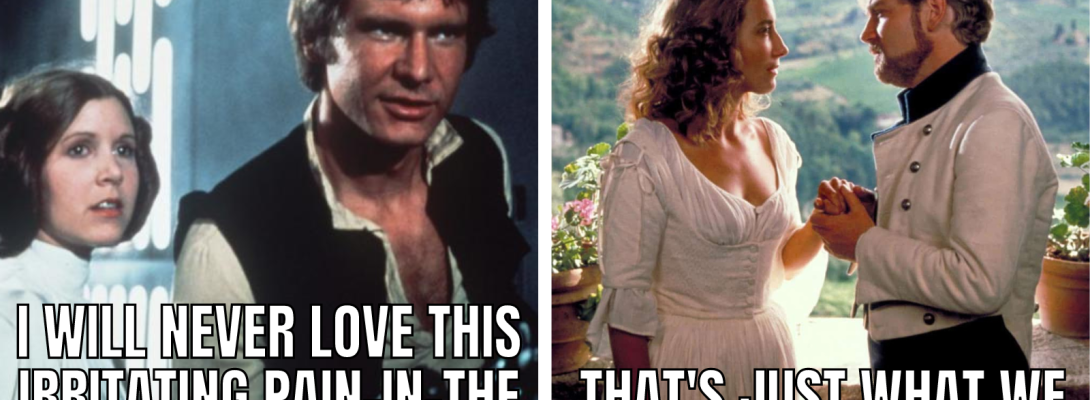
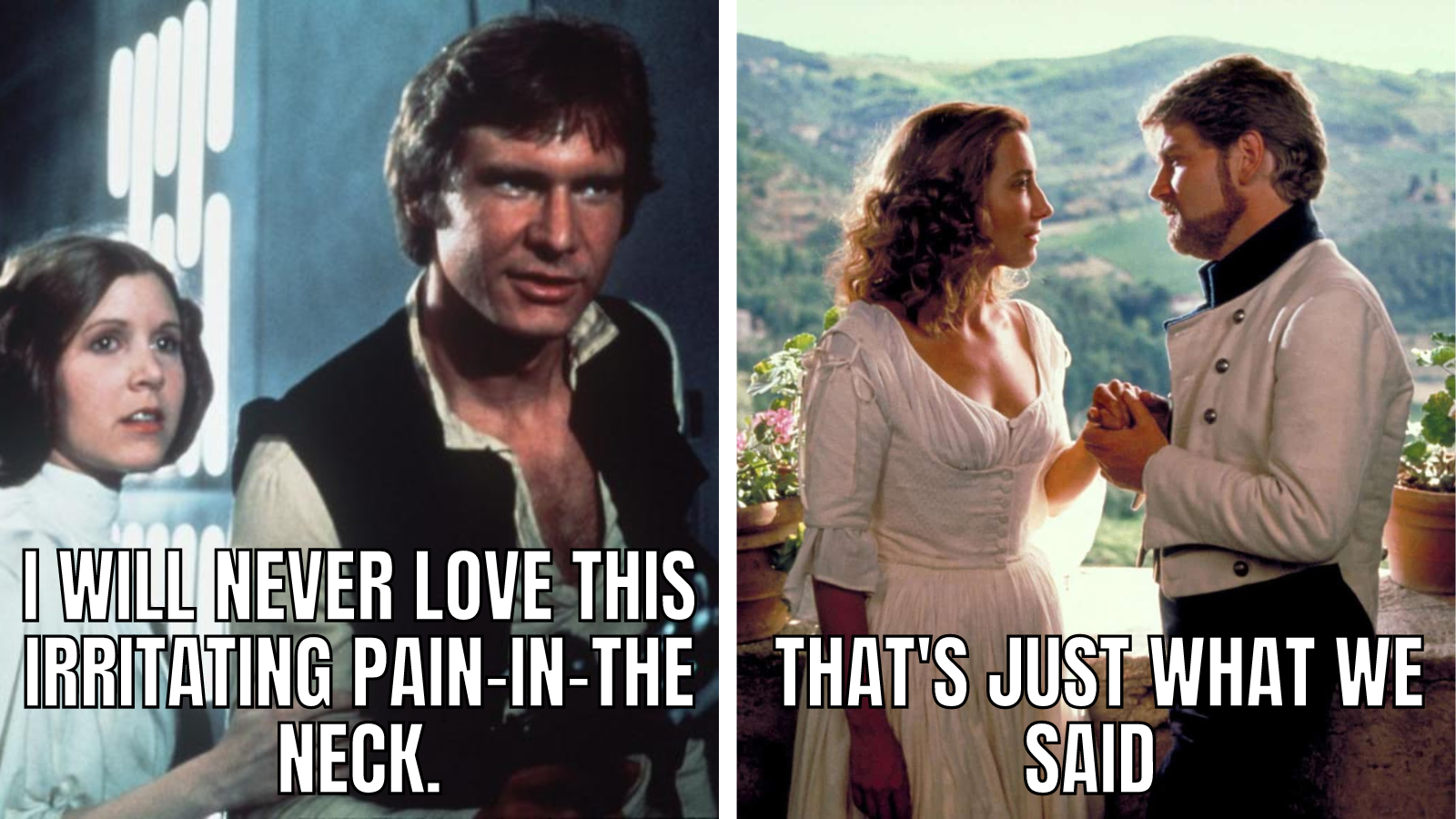
Han and Leia vs. Beatrice and Benedick
Show videos of Han before Leia
Plot summary of Much Ado
Clips of the bickering of Benedick and Beatrice
Read blog and look at the writing.
Activity- how would you write a love letter to Han or Leia?
Play the scene from Jedi
Unit 2- The Prequels and Shakespeare’s Histories
A Crash Course in Shakespeare’s Histories
The Rise of Palpatine/ Richard III
Emperor Palpatine in Star Wars rises to power through a combination of manipulation, intimidation, and by killing his opponents.
Bio of Richard III
Slide- Richard’s rise to power
Slide- Palpatine’s rise to power
Quizlet
Unit 3- The Verse of William Shakespeare’s Star Wars by Ian Doescher
What is William Shakespeare’s Star Wars
Introduce the plays
Explain how Shakespeare’s verse works
Look at the common verse elements
Sonnets
Show the chorus of “Verily a New Hope”
It is a period of civil war. The spaceships of the rebels, striking swift From base unseen, have gain’d a vict’ry o’er The cruel Galactic Empire, now adrift. Amidst the battle, rebel spies prevail’d And stole the plans to a space station vast,Whose pow’rful beams will later be unveil’d And crush a planet: ’tis the DEATH STAR blast. Pursu’d by agents sinister and cold,Now Princess Leia to her home doth flee, Deliv’ring plans and a new hope they hold:Of bringing freedom to the galaxy .In time so long ago begins our play,In star-crossed galaxy far, far away
Stychomichia
Half lines
Enjambment
Title Crawl (make a gif via Canva)
Side By Side Comparisons
Read/ watch segments of the play
To Be Or Not To Be
All the World’s a Stage
St. Crispin’s Day Speech
Try to turn a Star Wars line into verse, and then look at the reveal.
Unit 4- Literary Devices of William Shakespeare’s Star Wars
Using the educational guide, we’ll learn about the following literary devices:
Extended Metaphors (Luke’s green lightsaber)
Anaphora (Luke’s call to action in Jedi)
Premonatory Dreams (Calpurnia)
Stichomythia Richard III vs. Han and Leia
Unit5- The Hero’s Journey of Luke Skywalker
Class 1: What is a Hero’s Journey (Slides)
Learn a little about Joseph Campbell’s monomyth. using the Percy Jackson post, Crash course video about monomyth
Chart Luke’s monomyth journey
Activity- Mad libs- write a star wars movie!
Quiz on plot elements from the monomyth (Quizzes or Quizlet)
Class 2 : Hamlet and Luke Skywalker
Plot comparison
(use infographic)
Quote from Doescher:
Hamlet The Tragedy of Hamlet, Prince of Denmark is Shakespeare’s most famous play. It’s also the play I make the most references to in William Shakespeare’s Star Wars.
To Be Or Not to Be
Use my video about the speech to explain the structure
Note how Doescher repurpuses every line in the Star Wars Trilogy:
Sometimes it expresses fear:
Sometimes concern:
Frustration: “The whips and scorns of time”
Hope: “The undiscovered galaxy” “Tis a consummation devoutly to be wished.”
Activity: write your own paraphrase of Hamlet’s speech, using the 6 beats I provided.
For my Shakespeare club, my actors and I are reading William Shakespeare’s Star Wars: The Empire Striketh Back. We started staging the scene today and I’d like to publish some of our work and our discoveries going through the text.
The Scene In Context
Han and Leia have a fight before he leaves in “The Empire Strikes Back”
The scene is the first moment where Han Solo and Princess Leia display their repressed feelings for each other. Han wants to stay with Leia, but he has a bounty hunter trying to hunt him down. Also, Leia has not directly given him any sign of affection, (though Han suspects that she does have feelings for him). He wants her to ask him to stay, not because of his service to the rebellion, but because she loves him back.
Ian Doescher’s Version
Leia And Han, Act I, Scene ii
[Enter Han SL, Leia enters after. stops.
L: Han, halt!
		H:[Turn to her, bows]  What is thy pleasure, Highness?
		L: I did believe that thou had chos’n to stay.
		H: [Center Stage turn out] The bounty hunter we did meet on Ord
		Mantell hath chang’d my mind
		L: 				-We need thee Han.
		H: [Turn to her] What “we?” Why speakest thou of “we?”
		(circling her) Dost thou in royal terms speak her of “we?”
		(Hands on shoulders) Hast thou a rodent in thy pocket such
		That thou and he are “we? (holding her hands)” What meanest thou?
		What need is there that thou dost share with all? [moving her center stage]
		[Turning to audience] Speak not of “we,” but “I.” O princess, what
		Dost thou most need? Not “we,” not “they,” but thou?
		L: [Turning to him] I know not what thou speakest of.
		H: [pointing at her]		- ‘Tis true.
		Most probably thou dost not know thyself.
		L: Thy vanity [takes his pointer finger and points it to the sky]
		Hath puffed up thine imagination.
		H:					-Aye?
		(Smiling) Then why doest thou yet follow me? Wert thou
		Afraid I would depart without a kiss? [He stands behind her, looking at her as if he's about to kiss her cheek. She steps on his foot]
		L: I would as eagerly kiss Wookie lips.
		H: That can arran`ed be. [He turns SR, starts to leave, then turns back to her.] By heaven’s breath,
		A kiss would suit thee well! [Exits SR}
My podcast episode about the scene
Like Han in the original script, Doescher latches on to the fact that Leia says “We need you Han,” instead of “I need you,” (which would confirm Han’s suspicions that she has feelings for him). Doescher’s Han has a mocking speech where he tries to coax Leia into saying what she truly wants from him. In both versions Leia, (annoyed with Han’s childish behavior), retorts by saying that she would rather kiss a Wookie, but in Doescher’s version, she also has a soliloquy where, like Beatrice in Much Ado About Nothing, she laments that she would admit her affections if Han could put his ego aside and woo her gently, instead of his accustomed taunts and mockery.
The Verse
If you read my review of the first Shakespeare’s Star Wars play, you know that Doescher put almost every line in iambic pentameter- the standard verse for Shakespeare that has 10 beats per line. I like to call verse the heartbeat of a character and iambic pentameter is sort of a baseline for a character who is calm or in control of their emotions. What’s great about this scene is that Doescher intentionally breaks from the norm of iambic pentameter, which is appropriate because these characters are bubbling with emotions; anger, jealousy, fear, and of course, love.
Leia’s Verse
Leia only has two regular verse lines- right after she enters and right before she leaves:
		L: I did believe that thou had chos’n to stay.
Leia is a princess, used to giving orders and being obeyed. Accordingly her first line is a simple two word command "Han halt." Then Leia clearly. simply, and in standard iambic pentameter, asks Han to explain why he is going. From that point on, none of her lines are 10 syllables long- they either complete his or his lines complete hers. This kind of rapid-fire call and response is called Stichomythia, and it indicates how intelligent these characters are, how passionate they are, and how impatient they are with each other. It's not unlike some of Shakespeare's other great lovers like Beatrice and Benedick, or characters who dispise each other like Richard III and Lady Anne:
Notice that in this “keen encounter of wits,” the characters talk on top of each other. The verse lines indicate that Han and Leia need to keep topping each other and pick up the tempo. This helps convey how frustrated Leia is with Han and is trying to get him to get to the point! The only other regular verse line is her coup-de-gras at the end where she says “I would as soon kiss Wookie lips!” At that point, she’s done talking to Han and just wants him to go, and the verse reflects her decisive choice.
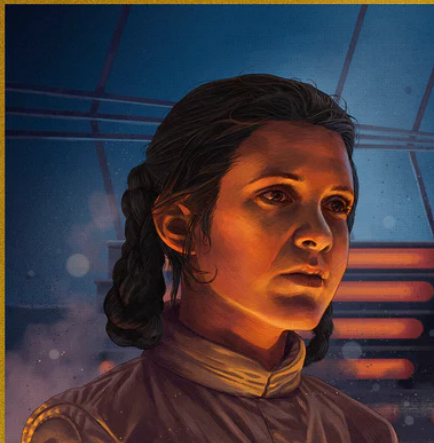
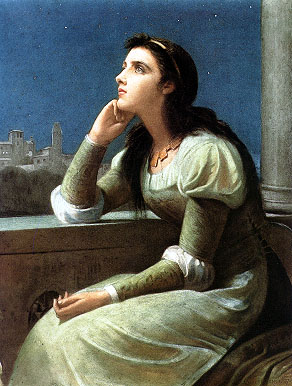
Left- Ruiz Burgos “Princess Leia & Han Solo” Right- Juliet by Philip H. Calderon (1888)
However, as you can hear in the podcast, alone in soliloquy, Leia reveals to the audience that she is still conflicted with her feelings for Han- listing all his best qualities like his hands, his face, his eyes, etc. This rhetorical technique is called anaphora, and it helps Leia build in excitement getting lost in Han’s attractive qualities. For my staging of the scene, Leia puts her hand on her cheek while standing under a balcony to emulate Juliet’s famous musings on Romeo:
Juliet. ‘Tis but thy name that is my enemy; Thou art thyself, though not a Montague. What’s Montague? it is nor hand, nor foot, Nor arm, nor face, nor any other part Belonging to a man. O, be some other name! What’s in a name? That which we call a rose By any other name would smell as sweet; So Romeo would, were he not Romeo call’d, Retain that dear perfection which he owes Without that title. Romeo, doff thy name, And for that name which is no part of thee Take all myself. – Romeo and Juliet, Act II, Scene ii.
Han’s Verse
While Leia’s verse is quick and direct, Han’s is slower and longer. His sentences spill over from one verse line to another because he’s taking his time. Again, his objective is to basically “neg” Leia into admitting that she loves him, so he’s enjoying goading her. He’s sort of like Benedick in Much Ado About Nothing, though Han speaks verse and Benedick speaks prose:
Han’s Extended Metaphor
Again, Han’s goal is to tease Leia into admitting that she loves him, so when she says: “We need thee Han,” he feigns ignorance and asks her to clarify her phrasing- going through all the permutations of “we” (including the colloquial, “Do you have a mouse in your pocket?”) to get her to specify what she means by “we.” If you look at Doescher’s official education guide for the William Shakespeare’s Star Wars series, you can see how Shakespearean characters often go into lengthy metaphors or comparisons to explore an idea or theme:
As I was writing William Shakespeare’s The Empire Striketh Back, I was surprised to realize I had made more references to Shakespeare’s Much Ado About Nothing than any other play. Much Ado is a comedy—probably my favorite of Shakespeare’s comedies—so it was strange that lines from it kept popping up in the darkest of the original Star Wars® trilogy. –
Both of my actors are female and obviously, they aren’t Carrie Fisher or Harrison Ford. Since this play is a parody of the original Star Wars, I wanted to incorporate some physicality and vocal elements, without telling them to impersonate the Star Wars actors.
Han
Harrison Ford is much taller than Carrie Fisher and he uses his height to mock and irritate her. He also crosses his arms and points his index finger at her frequently in this movie, so I used that in the blocking. He also has a “cowboy stance”- legs apart, slight bend in the knees, slow, deliberate gait. Ironically, another man who has this kind of walk is David Tennant in his performance as Benedick in “Much Ado About Nothing.”
David Tennant and Catherine Tate in “Much Ado About Nothing,” Act I, Scene ii.
As for Carrie Fisher, she has a faster pace and keeps her arms close to her body. She looks like a ball of stress and anxiety, which is appropriate. After all, not only is she going to lose the man she loves, she’s under attack from an empire and living on a cold, dark planet made of ice! I told my actor to put these characterizations into her performance to not imitate Carrie Fisher, but to get the essence of how her emotions affect how the character moves and speaks. That’s the difference between acting this scene, and just doing impressions of the original actors.
I’m excited to see how my actors bring these techniques to life, and I hope you have enjoyed this little insight into how Doescher’s writing once again pulls back the curtain on how Shakespeare used his verse to show the hearts of his characters!
Concept: To explore the plot, characters, and themes of Shakespeare’s Julius Caesar while also gaining an insight into Ancient Roman history and culture.
Student Description: Delve into the passionate speeches of Brutus and Antony in Shakespeare’s Julius Caesar, which led a whole country to revolution.
Parent Description Using self-paced online activities, and a helpful handout, your child(ren) will analyze the rhetoric and persuasive power in two speeches from Shakespeare’s “Julius Caesar.” The course will also cover the culture of Ancient Rome, and the circumstances that led to Julius Caesar’s assasination, which inadvertently led to the birth of the Roman Empire.
Course Organizaiton (the class is divided into 4 parts that students can complete at their own pace over a week-long period
Each lesson will have:
“That Is the Question” (Essential Question)
Lesson Objectives
Set the Scene (Background and context)- 1-3 slides
The Players (biography) 1-3 slides
Go Deeper (Webquest)
Explore military life and the lives of women in Rome using my blog and other websites as a guide.
Post 3 things you learned to the Outschool page or send a photo of your completed handout.
Words, Words Words (Vocabulary, famous lines)
A Taste of Your Quality (Independant Project)
Show us your mettle (Test)
So each class should be 14-15 slides long.
Outline
Class I- Background on Caesar and Roman Culture
That is the Question:
Why did Brutus feel Julius Caesar had to die?
What was the aftermath?
Can one person’s speech effect an entire nation?
Lesson Objectives
To provide historical and political context to explain why Julius Caesar was assassinated, and how his death inadvertantly created the Roman Empire.
To explain the Rhetorical Triangle, the building blocks of persuasive speech.
To go through the story of Julius Caesar focusing on the effect of the speeches.
To study the famous “Friends, Romans Countrymen” speech.
To contrast this speech with some more recent political speeches and you think critically about:
Brutus- Podcast episode. I posit in this episode that Brutus is
Words, Words, Words-
Traitor
Republic
Dictator
Revolution
Ethos
Pathos
Logos
Rhetoric
Colossus
Aeneus
A Taste Of Your Quality:
(Independent work): We’ll examine a painting of Brutus’ ancestor Lucius and learn why Brutus values Rome more than even family.
Show Us Your Mettle:
Quizzes on Brutus
Class 3- Antony and Brutus’ Dueling Speeches
(c) Hartlepool Museums and Heritage Service; Supplied by The Public Catalogue Foundation
That Is the Question
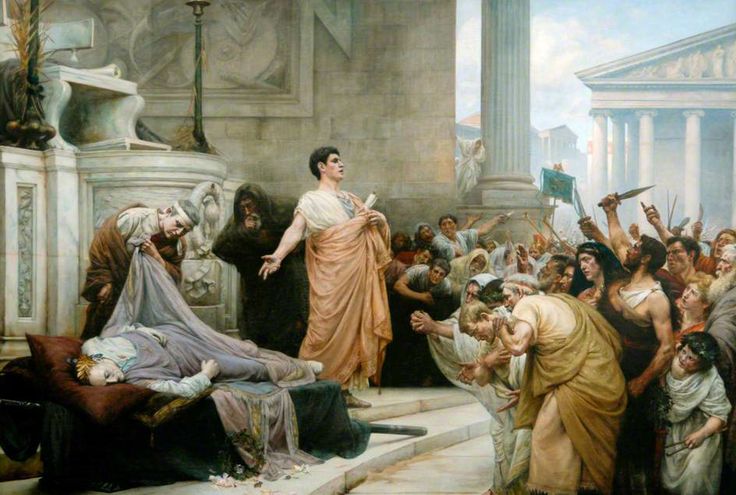
After Caesar’s Death, his friend Marc Antony held a funeral for him where he gives the famous “Friends, Romans, Countrymen” speech. How did Antony’s speech affect the crowd?
Brutus has a speech where he explains why he killed Caesar. What does he say, and how effectively does he say it?
Antony was secretly plotting to take power for himself, and get Brutus and Cassius killed. How did he do it?
Do speeches have the power to change a nation?
Learning Objectives
To explain the Rhetorical Triangle, the building blocks of persuasive speech.
To study the famous “Friends, Romans Countrymen” speech, as well
To look at these speeches and get you to think critically about:
We’ll talk about the consequences of violent revolutions and how Julius Caesar has inspired some of the greatest speeches in political history.
-Patrick Henry
– Gettysburg Address
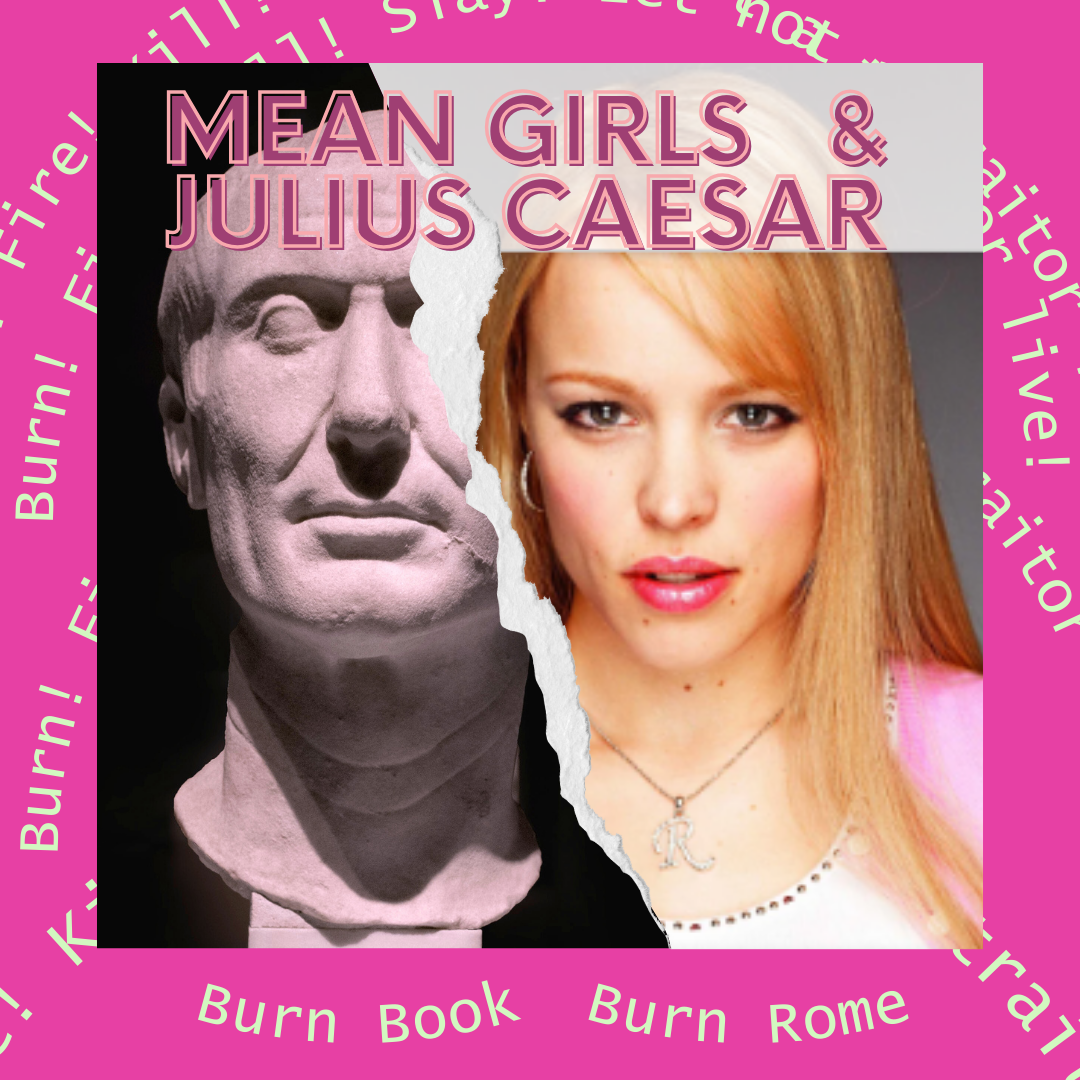
– Mean Girls
That Is the Question
How have people interpreted the play “Julius Caesar” in America?
Does this play promote violence?
What kind of violent speech do we deal with in politics today?
Learning Objectives
To show the link between American History and Julius Caesar
To address the controversy and the misconception that the play promotes violent assassination.
To end on a cautionary note people must think critically about what they hear in politics and not make rash decisions based on appeals to fear.
Setting the Scene- US History
America was founded using the principles of republican government that Ancient Rome used- with a senate, and a series of checks and balances to ensure no one has too much power.
America was founded in a violent revolution, and some of our country’s early leaders used Brutus as an inspiration- to overcome a tyrannical king.
In later years, however, some people have forgotten what happened to Brutus
Today, we are often bombarded with speech that encourages fear and anger and we must think critically when we hear such speech in whatever forum- Roman, or Reddit.
The Players (use my JC lecture?)
Patrick Henry
Abraham Lincoln
John Wilkes Booth
Donald Trump
Go Deeper
-Watch the Caesar Video
– How does the play promote nonviolence?
– How did Brutus’ assassination fail to save the Roman Republic?
Last weekend I saw a wonderful production of “Six” The Musical at the Cab Calloway School Of the Arts in Wilmington DE. After seeing the professional production, I was worried that I wouldn’t enjoy these student performers but it was incredible! The young performers were all terrific and the director managed to use inventive, creative, and entertaining setpieces to both capture the essence of the Broadway show, and also make a version that is distinct and its own with student performers!
The Direction
DIRECTOR’S NOTE I thought original I’d never Broadway get a show chance only to has direct six it at actors Cab. in AS the luck cast, would so/ have it, the teen edition came out this past summer, which allows the addition of a singing and dancing ensemble. I immediately applied for the rights and we were one of the lucky schools to get them. This new teen edition is the perfect fit for our school community and it highlights the talents of studentsfrom every arts area. I wanted to create a Beyoncé or Taylor Swift concert-type at- mosphere, and I think we have achieved that with our show. The fabulous lighting, the beautiful costumes and make-up, the rocking pit band, the fabulous cast and crew and especially the epic choreography have culminated into quite a spectacle! It has always been a joy to work with my colleagues on these projects. and I want to give a particular shout-out to my team of choreog- raphers. They have taken my vision and turned it into something amazing. The creativity in this team is fierce, and if ever there was a group that fed off of each other’s ideas, it’s this one. We’ve had a blast collaborating on this production Also, I would like to acknowledge Brian Touchette, Peter Kuo and Jared DeStafney for their tireless work on this production. With- out them, this show would not be possible.
Marjorie Eldreth
As the director notes in the program, the challenge with doing a musical like “Six” at a high school or community setting is that there are only six major roles, which means it would be hard to find ways for the whole student body to participate. What I loved about this version is that, by utilizing dance, pantomime, and choruses, the director has found ways to not only involve more people, but help use the additional cast to tell the story in ways that the professional touring production I saw earlier didn’t!
My Favorite Moments
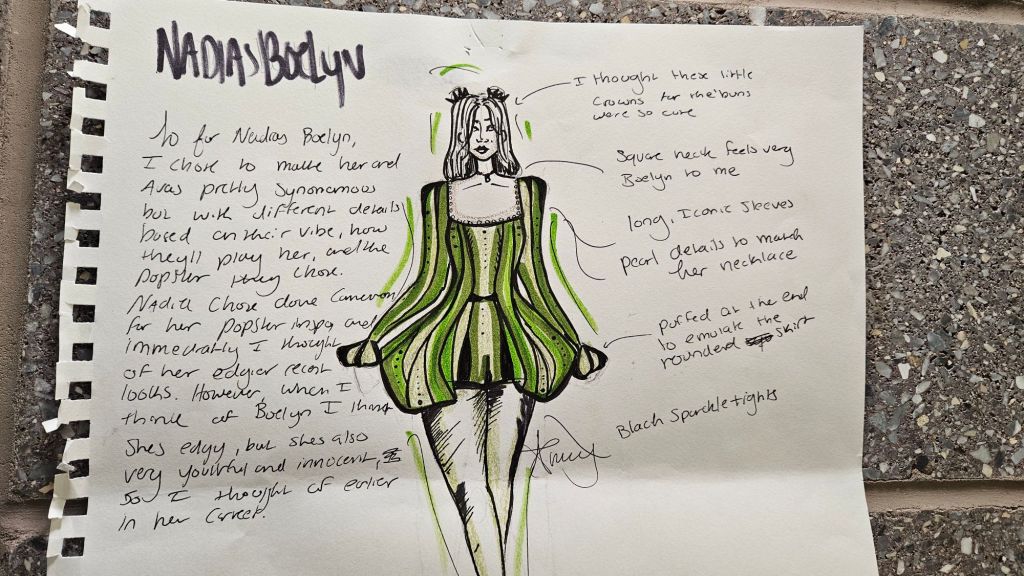
Normally I hate dance numbers in musicals. Don’t get me wrong, I admire the skill and athleticism that dancers have, but when I see a play or musical, I come for the story and the songs. Dance always seems like the black sheep in the musical theater trifecta to me. Not so with this production of “Six.” The dance numbers help tell the story in clever and moving ways! For instance, during Anne Boleyn’s “Don’t Lose Your Head,” a team of dancers with green sticks accompanied her. Their movements were cheeky and brash, which helps encapsulate her bubbly yet tart personality. During the choruses, the dancers and Anne rested their hands on the sticks, drawing attention to their heads moving back and forth, which reinforced both the title, and Anne’s air-headedness. Then, at the end of the number, the dancers got into a circle and pointed their sticks at Anne’s neck- pantomiming how she would eventually be beheaded! Thus, the dancers complimented Anne’s song perfectly, in a way that was not originally part of the show!
“My Heart Of Stone”
The most moving moment of dance was during Jane Seymore’s song “My Heart Of Stone.” When I saw this number in Hershey, it was by far my least favorite. I thought the lyrics were generic, that the song itself was bland, and that gave little depth to Jane character. All that changed this time around. While Jane belted her heart out about the son she never got to raise and the husband who mistreated her, we got to see elegant ballet dancers perform those moments for us. I particularly liked that the male dancers had red hair, (much like the real Henry VIII and his son). The dance actually helped me see Jane’s conflicting feelings for Henry- how she feels genuine love and affection one minute, and terror the next. How she and her son are both ghosts, now that they were denied the chance to live together on Earth. I don’t wish to diminish the wonderful singing and acting of the Hershey production, but Six: Teen Edition did a masterful job of showing, in addition to telling Jane’s story.
THe Cast
The Cab Calloway School of the Arts boasts some of the top young actors in the country, and all of them have tremendous chops as actors, dancers, and singers. Some of them already have professional acting credits. So it should come as no surprise that all the performances were incredible. It was very exciting, however to see a real 19-year-old play Catherine Howard, (since that was the real age she was when she died).
This production also took the bold leap of casting two men in the show. In one cast Anne of Cleaves was played by a man, and in the other (the one I watched), Katherine of Aragon was played by a man. I have no problem with this choice, (after all boys have been playing Katherine ever since Shakespeare’s Day), but I was a little disappointed that the actor had to modify the song to fit his range- I was looking forward to the extravagantly high Shakira and Beyonce inspired vocals that I’ve come to expect from the part. Nevertheless, the actor I saw was incredibly talented and his acting and dancing were completely appropriate for the part.
THe Dramaturg
For those of you who don’t know, a dramaturg’s responsibility is to help the actors, director, and production designer by doing research into the play’s historical or political context. It’s a role that is very important in period plays like Shakespeare. I’ve worked as a dramaturg myself and, though the work one does as a dramaturg is mostly unnoticed by the audience, the dramaturg can greatly contribute to the way the actors understand the text and give the director tools and ideas with which to explore themes and ideas present in it. I don’t know what the dramaturg did for this production, but I could tell based on the performances that every cast member was fully committed to their character. Each actor was able to clearly articulate their character’s emotional journey and that meant they must have learned the history and context of the Tudor period. Again, I don’t know if the dramaturg had any effect on this, but I’m going to assume they did a terrific job, because their end goal was accomplished- the actors and director gave a coherent and well thought out performance that captures the spirit of the Tudor period, so great job!



































 The Shakespearean Student