This is a 30 minute cartoon version of Macbeth originally produced for the BBC in 1992. It features Brian Cox as the voice of Macbeth (before he was the voice of McDonald’s), and Zoë Wanamaker as Lady Macbeth (before she was a witch who teaches at Hogwarts).
I like the way it portrays the horror imagery of the play in sort of a European-manga animation hybrid. Admittedly, there are better ones in the series, but this one is still pretty neat.
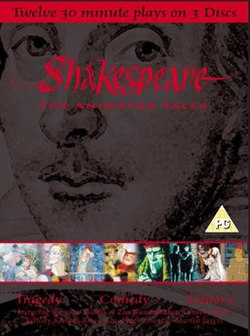
DVD box art for “Shakespeare the Animated Tales.”
To check out other episodes in the series, view this playlist:
Basics Of Stage Combat: Students will learn the basics of safely enacting a fight onstage, in preparation for a Shakespeare play. We will also learn about the history of sword fighting in the military and the duel.
Trailer for Basics of Stage Combat.
My daughter really enjoyed taking this class. She was actually able to use her sabre and try out her routine on her father. Paul is quite knowledgeable about Shakespeare and made the class really fun by teaching a fight scene from Romeo and Juliet. It is amazing watching her practice with Paul over Zoom. I hope Paul will have. more combat classes, it is a different way to learn Shakespeare.
IB, Parent
An Interactive Guide To Shakespeare’s London (New Class)
A virtual tour of Shakespeare’s London will get kids to interact with the culture of Elizabethan England.
Class Experience
To teach kids about the Elizabethan era and the background of Romeo and Juliet, The Instructor will interact with the class (via pre-recorded videos), pretending to be Shakespeare. The class, pretending to be actors in Romeo and Juliet, will get a virtual tour of The Globe Theater, Hampton Court Palace, and a virtual visit to an Elizabethan doctor's office. This activity is an immersive way for them to learn about the period, how it relates to the world of the play, and how Shakespeare changed theater.

The class will take the form of a guided WebQuest activity.  First, the students will get a worksheet that has a series of fill-in-the-blanks about Elizabethan society (below). The students will fill out this worksheet based on a Nearpod and in conjunction with a website I’ve made, https://sites.google.com/nebobcats.org/visit-to-elizabethan-london/home?authuser=0
Both the Nearpod and each webpage will have a virtual tour, a video, and text explaining some aspects of Elizabethan life. Before they go to each location, I will give a short introduction via prerecorded video:
Wizard Science
In this one-hour course, your child will discover the enchanting world of science through a series of magical experiments. Learn about such topics as Astronomy, Static Electricity, chemistry, and optical illusions.
In this one-hour course, students will learn and play games that will explore the history behind Christmas traditions. We will also discuss the themes, characters, and famous quotes from Shakespeare’s play “Twelfth Night.”
Now put your shields before your hearts, and fight With hearts more proof than shields
Coriolanus, Act 1, Scene iv.
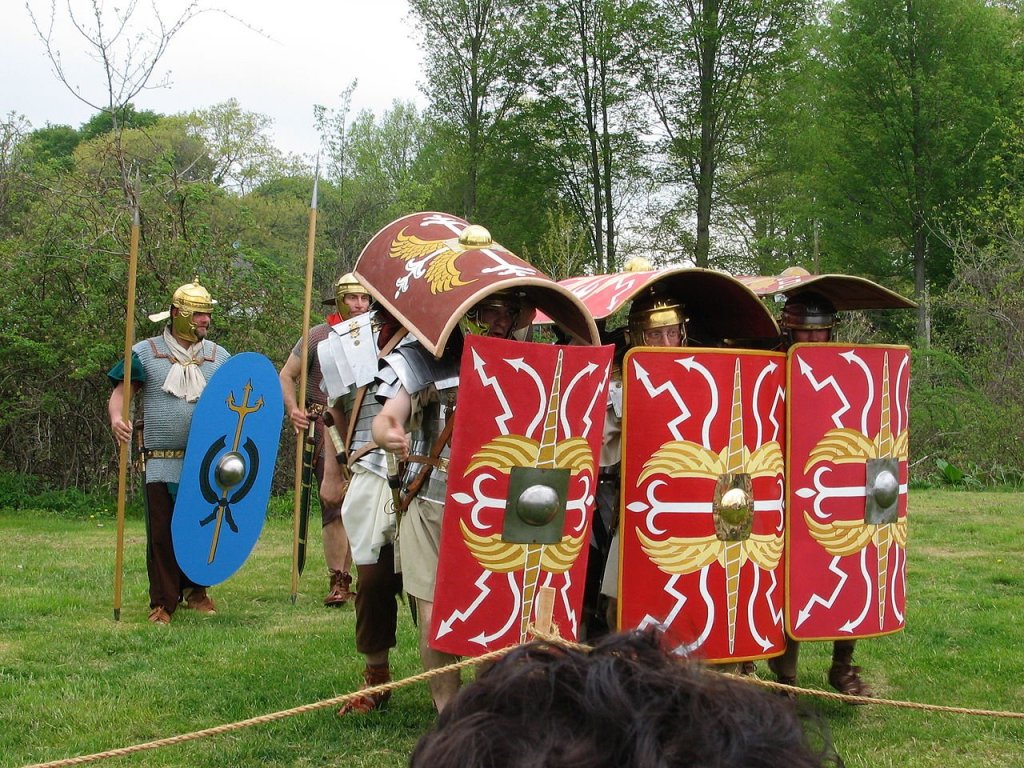
Roman re-enactors demonstrate a testudo formation (The Tortoise). Wikimedia Commons.
Shakespeare uses the word “shield” over 30 times, often as a verb meaning ‘to protect.’ However, there are a few very important references to this ancient tool of defense, and constructing one can teach you a lot about the history of a culture, and that culture’s methods of waging war.
A Brief History of Shields
The seven-fold shield of Ajax cannot keep
The battery from my heart
Antony and Cleopatra, Act IV, Scene 14.
As the quote above from Antony and Cleopatra mentions, the shield has been around since the dawn of history, certainly since Roman times. The Romans prized their large shields called scuta, which they used in defensive formations as the soldiers crashed through their enemies’ defenses.
DIY Roman shieldA replica of an ancient Celtic shield.
In medieval times, Anglo-Saxons and Vikings used new and more sophisticated shield formations in some of the most important battles in early British history. This included the Battle of Hastings in 1066, which ended the Anglo-Saxon era when the English abandoned the protection of their shield wall to chase the Norman invaders, who then annihilated their forces and proclaimed their leader William of Normandy, the conqueror of all England.
In this excellent video, historian and fight choreographer Mike Loads traces the history of medieval shields and shows step-by-step how to make an authentic Anglo-Saxon shield!
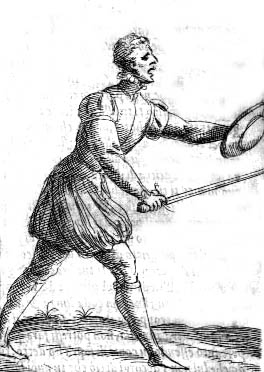
Illustration of a man fighting with a sword and buckler
Swashbuckling
[Enter SAMPSON and GREGORY, of the house of Capulet, armed with swords and buckles]
Shakespeare’s Romeo and Juliet begins with servants armed with swords and small shields called bucklers. These shields were designed to be used in single combat (duels) and were very light and agile. According to Mike Loads, young men would wear their swords and bucklers on their hips and make a loud racket as they walked through the streets. The shield proclaimed that they were armed and dangerous. This macho swaggering is the origin of the term “swashbuckling,” which is probably how these servants see themselves since they spend the first scene of the play trying to pick a fight.
What Is heraldry?
A series of heraldic devices from the Royal College of Arms.
Just as the sound of a buckler announced to the world that a young man was armed and ready to fight, the design on a nobleman’s shield announced his status, his house, and his family motto. The popular historical consensus is that once the medieval knight arrived on the battlefield, they started using their shields and tabards as a colorful display; one that made it clear that they were noble. In war, a knight or other nobleman could collect a hefty ransom if they captured another knight alive, so if you belonged to a rich noble house, your brightly decorated shield could save your life on a battlefield in more ways than one.
Each heraldic design would be registered in the College Of Arms, and many of them are still on record today. In Shakespeare’s Pericles, a group of knights presents their shields to King Simonides and his daughter Thaisa right before a joust and she reads their mottos. The shields are like the knight’s ID tags and help the princess know whom to award the prize money once the jousting is over:
Simonides. Are the knights ready to begin the triumph?
First Lord. They are, my liege;
And stay your coming to present themselves.
Simonides. Return them, we are ready; and our daughter,
In honour of whose birth these triumphs are,
[To Thaisa] 'Tis now your honour, daughter, to explain
The labour of each knight in his device.
Thaisa. Which, to preserve mine honour, I'll perform.
[Enter a Knight; he passes over, and his Squire]
presents his shield to the Princess]
Simonides. Who is the first that doth prefer himself?
Thaisa. A knight of Sparta, my renowned father;
And the device he bears upon his shield
Is a black Ethiope reaching at the sun
The word, 'Lux tua vita mihi.'
Simonides. He loves you well that holds his life of you.  Pericles, Act II, Scene ii.
How to make your own shield!
Since shields are an important part of Shakespeare’s plays, here’s how you can make a shield activity at home or in the classroom.
Making the basic shape
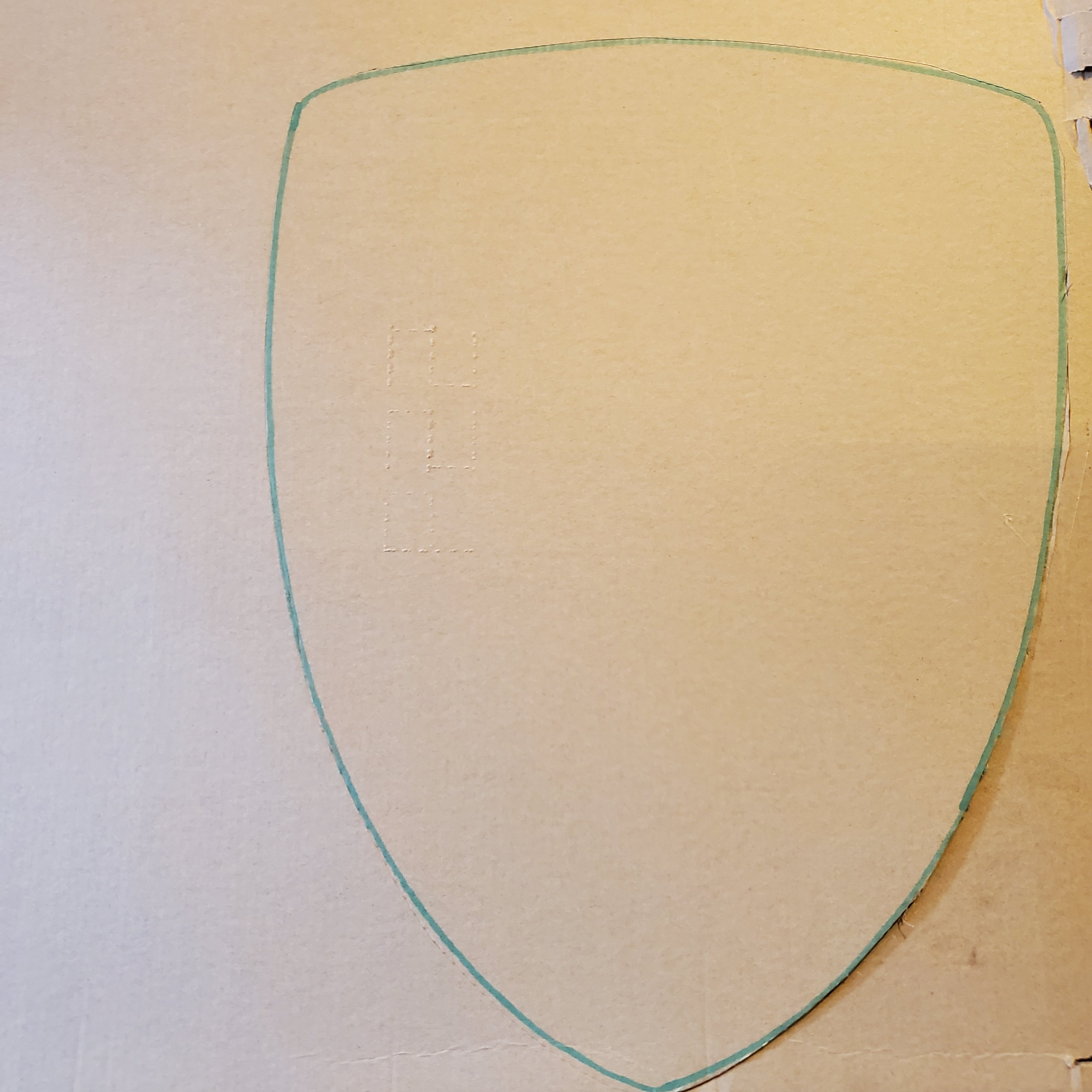
If you want to make a buckler, you need a round surface a little bigger than a dinner plate. You should be able to hold it and move it like an extension of your fist. If you want to make a basic 14th-century type shield like the ones I have below, cut out the familiar, ‘State of Ohio’ shape below. I made mine about 11 inches long, and 10 inches wide. I used cardboard but you can also use paper or wood or metal if you have real craftsperson talent.
Choosing a color and design
I got a lot of good information on how people chose designs for their shields by visiting English Herritage.org’s Guide to Heraldry: https://www.english-heritage.org.uk/guide-to-heraldry. The website has a lovely catalog of the colors and designs real knights and barons and lords used to make their shields/ coats of arms stand out. You can choose a simple background with a plant, animal, etc. in the foreground, or you can divide the shield into a cross, a diagonal line called a Fess, or a triangle called a chevron.
The Personal Touch
You need not be constrained by historical precedent in coming up with your shield. Like any canvas, the only limits on your shield design are your imagination. Check out these designs I made with my kids!
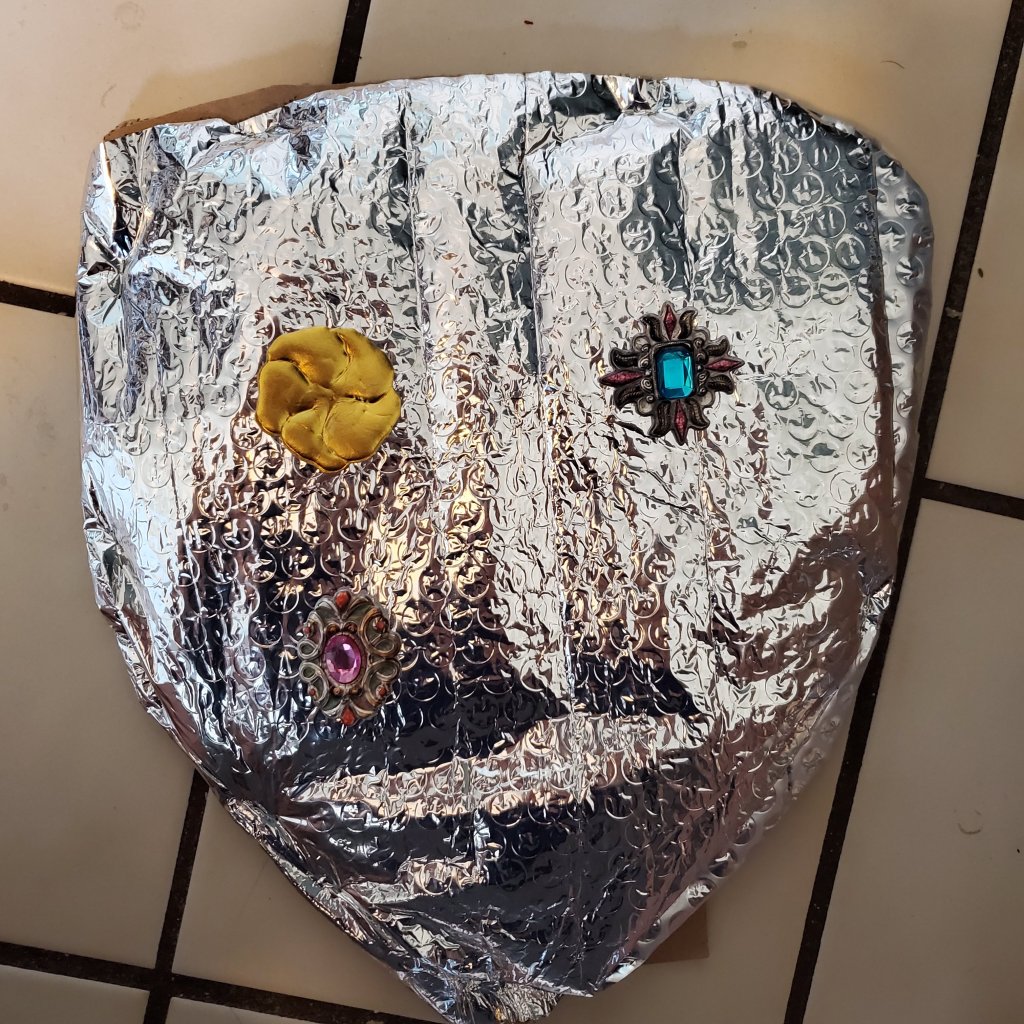
Henry V inspired shield.I wrapped this shield in heat-resistant blankets, and decorated it with stickers from the dollar store.My daughter paints an apple tree on her shield. Why not?My son used a stencil to make a dragon for his shield. We’re going to cover the dragon in glow0in-the dark paint.
Your Motto
Most mottos are single lines of text (usually in Latin), that illustrate what is important to the house that sports it. For example, Richard II’s motto was: “loyalté me lie,” (“Loyalty binds me.”). You could come up with a simple motto and Google Translate it into Latin or French, etc.
Regal coat of arms for King Richard III. Note the white boar, (Richard’s personal charge). Note also that he has combined the 3 red lions of the royal house of Plantagenet, with the blue and gold fleur de lis of the crown of France. Richard claims the throne of England and France and combining heraldic imagery is known as “marshaling.”
Now that you have your shield, with its own unique motto and design, it can be a useful tool to explain how people saw themselves in Shakespeare’s day. Nowadays we mainly see ourselves as individuals, but this kind of heraldry illustrates how knights, nobles and servants saw themselves mainly as part of a house, with its own values, its own traditions, and sometimes an us vs. them mentality against other houses.
This kind of household mentality is of course, at the core of Romeo and Juliet and the Wars of the Roses cycle of plays, and Shakespeare uses heraldry to illustrate this mentality. Look how the knights in the tournament scene from the 2013 film are dressed in their houses’ colors and the nobles and servants are also wearing those same colors:
Like sports fans who wear the jerseys of their favorite teams, shields and heraldry proclaim the allegiance of the servants and nobles who belong to powerful houses/ kingdoms. This kind of emblem can help students understand a piece of medieval and Renaissance history, and how that history shapes our own mentalities today.
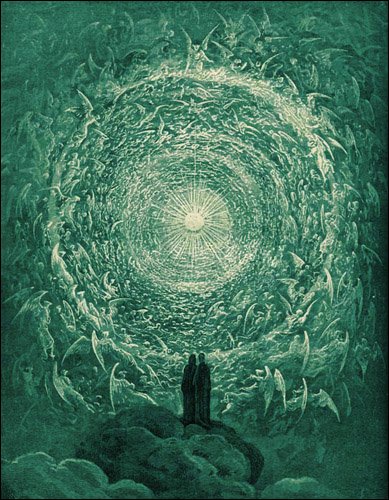
Paradiso: BeatriceParadiso: The Primum MobileInferno: The HereticsInferno: TraitorsInferno: JudeccaInferno: The LustfulPurgatorio: The Earthly ParadiseWilliam Blake- illustration from Canto 5
Since Easter and Passover are coming up, (and we are already in the middle of Rhamadan), I thought I’d examine Shakespeare’s depiction of other worlds both celestial and infernal. As the quote above says, philosophers and poets often wonder what greets us in the hereafter, so let me be your guide through Shakespeare’s poetic renderings of heaven and he’ll, accompanied by some gorgeous artwork from HC Selous, William Blake, and others.
The whitewashed images of Shakespeare’s childhood
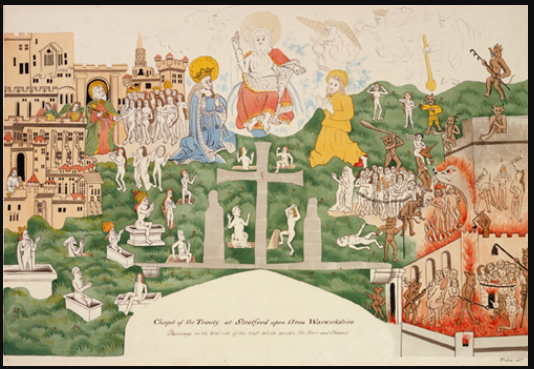
Fisher, Thomas (1781? -1836), “Chapel of the Trinity at Stratford upon Avon, Warwickshire” [1804?]. ART Vol. d58 nos.1, 3.
Shakespeare was no doubt interested in religion. He quotes from and alludes to the Bible many times in his plays. More importantly, he lived in a time when the national religion changed three times in just 4 years! When Henry VIII changed England to a protestant country, the religious identity of England completely changed:
This change was not just felt in monasteries, but in all English churches. King Henry decreed that certain Catholic traditions like Purgatory, indulgences, and praying to saints were idolatrous, and were therefore banned in the Church of England. So, when Shakespeare’s father was called to destroy the “idolatrous” images of the Last Judgement in the Guild Chapel of Stratford’s Holy Trinity Church, he had no choice but to comply. If you click on the link below, you can see a detailed description of the images that Shakespeare no doubt knew well in his family’s church, until his father was forced to literally whitewash them.
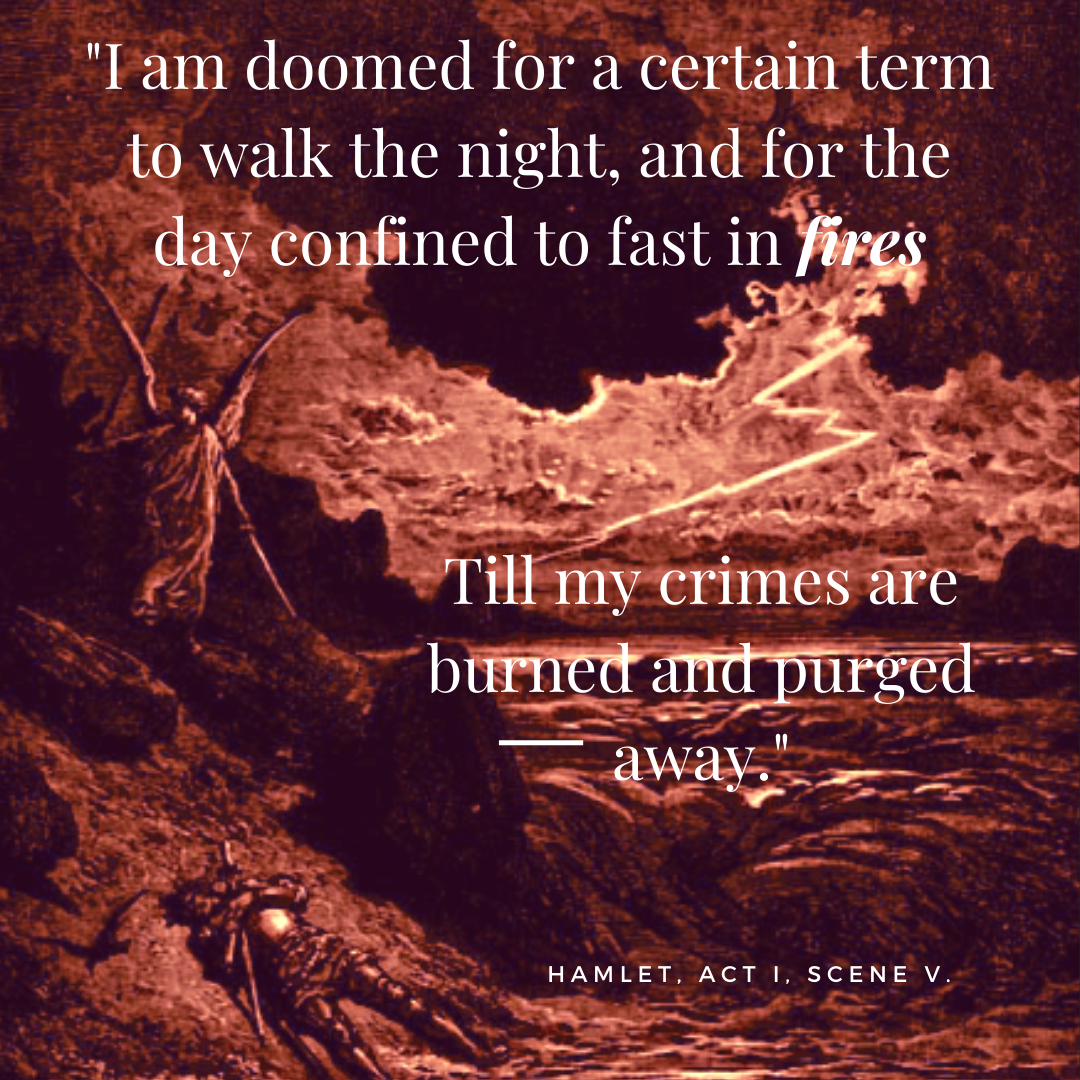
Like the images on the Stratford Guild chapel, the ideas of Catholic England didn’t disappear, they were merely hidden from view. Shakespeare refers to these Catholic ideas many times in his plays, especially in Hamlet, a play where a young scholar, who goes to the same school as Martin Luther, is wrestling with the idea of whether the ghost he has seen is a real ghost from purgatory, or a demon from hell, (as protestant churches preached in Shakespeare’s life).
I’ve written before that the ghost of Hamlet’s father teases us with the possibility that he might be a soul in purgatory, the Catholic afterlife realm for those not evil enough for Hell, nor good enough for Heaven. At the height of their powers, monks and bishops sold prayers called indulgences that supposedly allowed a soul’s loved ones to buy them time out of purgatory, thus making them able to ascend to Heaven quicker. The image above is an illustration from Purgatorio, part of Dante’s Divine Comedy, where he visits the soul of Buonconte da Montefeltro, who is languishing because he doesn’t yet have the strength to get out of purgatory and enter Heaven.
Of course, the Tudor monarchs Henry VIII and Elizabeth I abolished indulgences and proclaimed that purgatory itself didn’t exist, but ideas can’t die, and I feel that Shakespeare was at least inspired by the notion of purgatory, even if he didn’t believe in it himself.
“It Harrows me with fear and wonder.”
(Horatio) Hamlet, Act I, Scene i.
Lucifer and the vice of kings
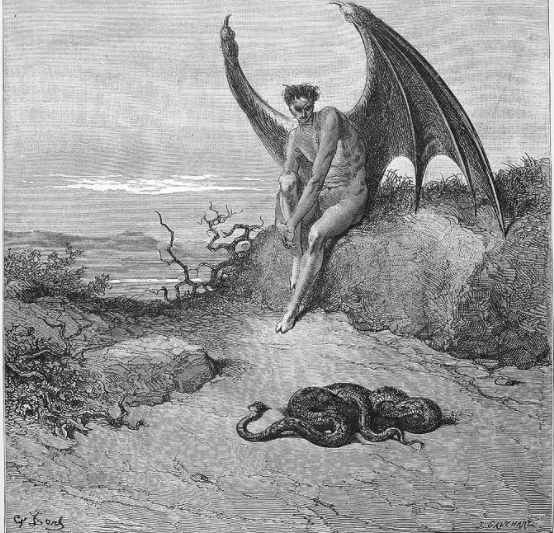
As a young boy, William Shakespeare was entertained by medieval Mystery plays; amateur theater pieces performed by local artisans that dramatized great stories from the Bible. We know this because he refers to many of the characters in these mystery plays in his own work, especially the villains. King Herod is mentioned in Hamlet and many other plays in and many of Shakespeare’s villains seem to be inspired by the biblical Lucifer, as portrayed in Medieval Mystery Plays.
In this short video of the Yorkshire Mystery play “The Rise and Fall of Lucifer,” we see God (voiced by Sir Patrick Stewart), creating Lucifer as a beautiful angel, who then, dissatisfied with his place in God’s kingdom, is transformed into an ugly devil. At first, Lucifer mourns losing his place in Paradise, but then finds comfort by becomming God’s great antagonist.
Compare this character arc with Shakespeare’s Richard of Gloucester, who also blames his unhappiness on God, (since he feels his disability and deformity are a result of God’s curse). Richard is angry with God, nature, and society, so he wages against them all to become king.
“Then since the heavens hath shaped my body so, let Hell make crook’d my mind to answer it.”
Richard of Gloucester, Henry VI, Part III, Act III, Scene i.
“All is not lost, the unconquerable will, and study of revenge, immortal hate, and the courage never to submit or yield.”
Claudio. Ay, but to die, and go we know not where; To lie in cold obstruction and to rot; This sensible warm motion to become A kneaded clod; and the delighted spirit To bathe in fiery floods, or to reside In thrilling region of thick-ribbed ice; To be imprison’d in the viewless winds, And blown with restless violence round about The pendent world; or to be worse than worst Of those that lawless and incertain thought Imagine howling: ’tis too horrible!
—Measure For Measure, Act III, Scene i
Inferno: Traitors
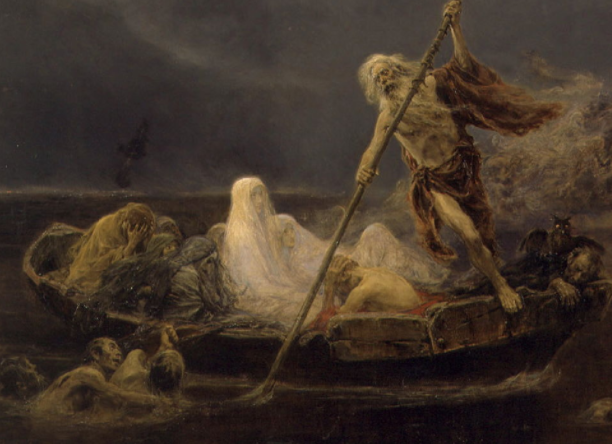
José Benlliure y Gil (1855–1937), Charon’s Boat
“Methought I crossed the meloncholy flood with that grim ferryman the poets write of, into the kingdom of perpetual night.”
— Richard III, Act I, Scene iv.
1579 drawing of the Great Chain of Being from Didacus Valades
The heavens themselves, the planets and this centre
Observe degree, priority and place,
Insisture, course, proportion, season, form,
Office and custom, in all line of order;
And therefore is the glorious planet Sol
In noble eminence enthroned and sphered
Amidst the other; whose medicinable eye
Corrects the ill aspects of planets evil,
And posts, like the commandment of a king,
Sans cheque to good and bad: but when the planets
In evil mixture to disorder wander,
What plagues and what portents! what mutiny!
What raging of the sea! shaking of earth! Commotion in the winds! frights, changes, horrors,
Divert and crack, rend and deracinate
The unity and married calm of states
Quite from their fixure! O, when degree is shaked,
Which is the ladder to all high designs,
Then enterprise is sick!      - Troilus and Cressida, Act I, Scene iii.
Shakespeare and the Civil War are forever linked. All the major players had a connection to the Bard, and some might surprise you:
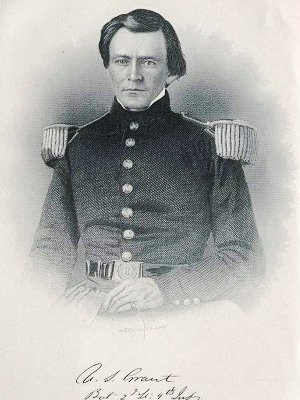
1. Did you know US Grant played a woman in a Shakespeare play!
US Grant as a US army colonel in the Mexican American War, c. 1846
We rarely see images of the future general and future president without his well-kept beard, but if this apocryphal tale is true, Grant might have grown a beard after he was embarrassed by the reaction of his fellow soldiers during a performance of Othello, where Grant rehearsed the part of Desdemona:
That December, officers decided to stage “Othello.” They looked for someone to play the beautiful Desdemona. Grant was urged to try out for the part. He had a trim figure and almost girlish good looks; his friends called him “Beauty.” Though the costume fit perfectly, the officer playing the Moor couldn’t look at Grant without laughing. They sent to New Orleans for a professional actress to play Desdemona. After that, Grant grew a beard to hide his girlish good looks. He was “Beauty” no more.
Civilwartalk.com
#2. President Lincoln, Shakespearean Gentleman
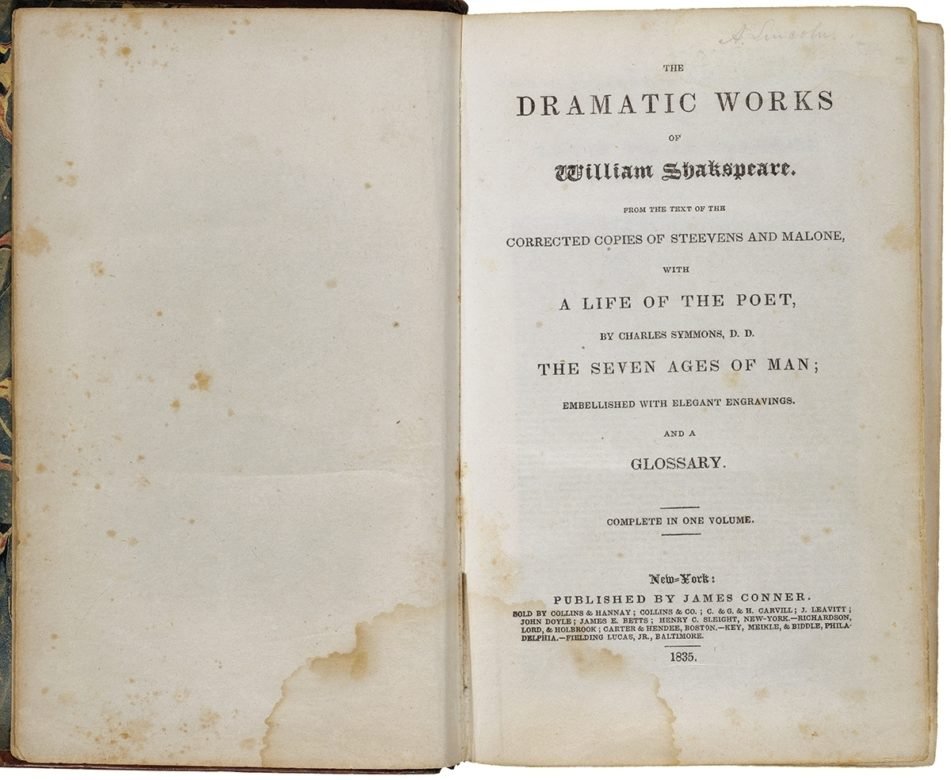
A copy of Shakespeare’s Plays, c. 1865. In the top-right corner, written in pencil is inscribed “A. Lincoln.”
I’ve talked before about how, to the South, President Lincoln was as big a tyrant as Julius Caesar, and how John Wilkes Booth was determined to cast himself as a real life Brutus
What you might not know is that Lincoln’s favorite Shakespeare play was Macbeth. I find a more fitting character for the compassionate and eloquent president would be the good King Duncan from Macbeth. According to Whitehousehistory.org. Lincoln quoted some lines about the good king’s death, a few days before his own:
On Sunday, April 9, 1865, with the war over, he was returning to Washington on the River Queen from City Point, Virginia, where he had visited the front, and he talked Shakespeare to his companions, read aloud to them, and recited his favorite passages from memory. He spent most of his time on Macbeth. “The lines after the murder of King Duncan. Lincoln’s companions were struck by the slow, quiet way he read the lines:
“Duncan is in his grave;
After life’s fitful fever, he sleeps well,
Treason has done his worst; not steel, nor poison,
Malice domestic, foreign levy, nothing can touch
him farther.”
When Lincoln finished, he paused for a moment, and then read the lines slowly over again. “I then wondered,” reflected one of his friends, “whether he felt a presentiment of his impending fate.”
Whitehousehistory.org.
If you choose to sign up for my Outschool class: The Violent Rhetoric Of Julius Caesar, I compare Antony’s speech, (which essentially started a civil war in Rome), with Lincoln’s Gettysburg Address. I also discuss John Wilkes Booth and his obsession with the character Brutus.
Title image for my Outschool class: “The Violent Rhetoric Of Julius Caesar.“
#3: Ex Confederates hid out in Shakespeare’s home town!
Ex-Confederate soldiers gathered in Royal Leamington Spa in England, c. 1865.
I was pretty shocked to learn this one, and it took a while before I found a decent amount of evidence to justify reporting on it here, but apparently a few ex confederates fled to England after the war, and took refuge at inns and houses in and around Stratford, including Royal Leamington Spa, which is a town just 12 miles from Stratford-upon-Avon.
I had scarcely become domesticated before the visits of the Confederates began, & we have now quite a little Southern Society. Mr & Mrs Fry of N. York, & Mrs Leigh reside very near us. Mr & Mrs Westfeldt also; but just now they are absent. Mr & Mrs Dugan, Mr & Mrs & the Misses Stewart, Mrs Hanna & Miss Reynolds, Mr & Mrs Clements, Mr & Mrs Skinner, Capt Flinn, & various others who are here, off & on, compose the little nest of Confederates in Leamington.
Nathaniel Beverley Tucker, US Consul, 1861
England was anti Slavery in the 1860s but they were also partners with the Confederates in the lucrative cotton trade. CSA president Jefferson Davis dispatched a number of ambassadors and negotiators to hopefully gain support from the English to help them fight the US in the Civil War.
Once President Lincoln signed the Emancipation Proclamation, England politely declined to aid the confederacy militarily, but Davis’ visits opened the door for Confederates in England, and that is why they wound up living in Leamington Spa.
While they were there, some purchased English warships to become part of the Confederate Navy. Some even got married!
However, the Romans gave way before the good fortune of the man and accepted the bit, and regarding the monarchy as a respite from the evils of the civil wars, they appointed him dictator for life. This was confessedly a tyranny, since the monarchy, besides the element of irresponsibility, now took on that of permanence
Patrick Stewart (Cassius), convinces Brutus (Ian Richardson), to betray Caesar, RSC, 1970
Under these circumstances the multitude turned their thoughts towards Marcus Brutus, who was thought to be a descendant of the elder Brutus on his father’s side, on his mother’s side belonged to the Servilii, another illustrious house, and was a son-in‑law and nephew of Cato. 2 The desires which Brutus felt to attempt of his own accord the abolition of the monarchy were blunted by the favours and honours that he had received from Caesar. 3 For not only had his life been spared at Pharsalus after Pompey’s flight, and the lives of many of his friends at his entreaty, but also he had great credit with Caesar. 4 He had received the most honourable of the praetorships for the current year, and was to be consul three years later, having been preferred to Cassius, who was a rival candidate. 5 For Caesar, as we are told, said that Cassius urged the juster claims to the office, but that for his own part he could not pass Brutus by.105 6 Once, too, when certain persons were actually accusing Brutus to him, the conspiracy being already on foot, Caesar would not heed them, but laying his hand upon his body said to the accusers: “Brutus will wait for this shrivelled skin,”106 implying that Brutus was worthy to rule because of his virtue, but that for the sake of ruling he would not become a thankless villain. 7 Those, however, who p589 were eager for the change, and fixed their eyes on Brutus alone, or on him first, did not venture to talk with him directly, but by night they covered his praetorial tribune and chair with writings, most of which were of this sort: “Thou art asleep, Brutus,” or, “Thou art not Brutus.”107 8 When Cassius perceived that the ambition of Brutus was somewhat stirred by these things, he was more urgent with him than before, and pricked him on, having himself also some private grounds for hating Caesar;
So far, perhaps, these things may have happened of their own accord; the place, however, which was the scene of that struggle and murder, and in which the senate was then assembled, since it contained a statue of Pompey and had been dedicated by Pompey as an additional ornament to his p597 theatre, made it wholly clear that it was the work of some heavenly power which was calling and guiding the action thither.
Well, then, Antony, who was a friend of Caesar’s and a robust man, was detained outside by Brutus Albinus,110 who purposely engaged him in a lengthy conversation; 5 but Caesar went in, and the senate rose in his honour. Some of the partisans of Brutus took their places round the back of Caesar’s chair, while others went to meet him, as though they would support the petition which Tulliusº Cimber presented to Caesar in behalf of his exiled brother, and they joined their entreaties to his and accompanied Caesar up to his chair. 6 But when, after taking his seat, Caesar continued to repulse their petitions, and, as they pressed upon him with greater importunity, began to show anger towards one and another of them, Tullius seized his toga with both hands and pulled it down from his neck. This was the signal for the assault. 7 It was Casca who gave him the first blow with his dagger, in the neck, not a mortal wound, nor even a deep one, for which he was too much confused, as was natural at the beginning of a deed of great daring; so that Caesar turned about, grasped the knife, and held it fast. p599 8 At almost the same instant both cried out, the smitten man in Latin: “Accursed Casca, what does thou?” and the smiter, in Greek, to his brother: “Brother, help!”
9 So the affair began, and those who were not privy to the plot were filled with consternation and horror at what was going on; they dared not fly, nor go to Caesar’s help, nay, nor even utter a word. 10 But those who had prepared themselves for the murder bared each of them his dagger, and Caesar, hemmed in on all sides, whichever way he turned confronting blows of weapons aimed at his face and eyes, driven hither and thither like a wild beast, was entangled in the hands of all; 11 for all had to take part in the sacrifice and taste of the slaughter. Therefore Brutus also gave him one blow in the groin. 12 And it is said by some writers that although Caesar defended himself against the rest and darted this way and that and cried aloud, when he saw that Brutus had drawn his dagger, he pulled his toga down over his head and sank, either by chance or because pushed there by his murderers, against the pedestal on which the statue of Pompey stood. 13
And the pedestal was drenched with his blood, so that one might have thought that Pompey himself was presiding over this vengeance upon his enemy, who now lay prostrate at his feet, quivering from a multitude of wounds. 14 For it is said that he received twenty-three; and many of the conspirators were wounded by one another, as they struggled to plant all those blows in one body.
-Plutarch’s Life Of Caesar
Artwork
Bust of Caesar Artwork for Julius Caesar. Immoral Longings, 2013.
Video 📹
Commentary
James Shapiro in his book 1599, addresses the common complaint that in the play that bears his name, Julius Caesar dies halfway through the play and has little time onstage to make a connection with the audience. The play is about tyrananicide, what causes it, what it looks like, and especially its aftermath. In a time when Jesuits and Catholic radicals threatened to assassinate Queen Elizabeth, Shakespeare wrote a powerful story about how fragile government systems can be; how striking the head off Rome leads to anarchy and sometimes tyranny.
Julius Caesar’s success as a politician was deeply tied to his success as a military leader. Therefore studying the Roman army during Caesar’s life helps one understand why he was so popular and why the Senate wanted him dead.
Uniforms of the 10th Legion (Julius Caesar’s Legion) during Caesar’s life, the reign of Augustus, and afterwards.
Caesar was commander (or legatus legionis) of the 10th mounted legion, which means his soldiers were mounted on horseback. Caesar was in charge of maintaining control over the warring tribes in Gaul (modern day France). Each legion was organized into 6 companies (cohorts) of 100 men, led by a Centurian, Source : http://thedioscuricollection.com/ejercito_romano_en.php
Organization of the 10th Legion. As you can see from the key below, each company of 80 to 100 men is led by a Centurian, and each company has 3 Tesserarius (watch commanders)
According to Imperiumromium.com, Caesar helped reform his army, and his Centurians carried out many different campaigns in Gaul:
As you can see, his soldiers were mainly armed with helmets, leather armor, and their large shields and Gladius swords. Below is an exploration of the different parts of the Roman uniform:



























 The Shakespearean Student