

Tomorrow in honor of Thanksgiving, I’ll be talking about the smash-hit Broadway show “Six,” a musical history retelling of the lives of the six wives of Henry VIII. In preparation, watch this excellent documentary about the Tudor Dynasty!
history
The Lion In Winter On Discord

Please join me and the Shakespeare Online Repertory Company on Discord.com at 1PM. We’ll be reading “The Lion In Winter” by James Goldman, which, you may remember was made into an Oscar-winning film in 1968:
As many of you know, I’ve been in two plays with the Shakespeare Online Rep before, and like the production of “Lear” I did last month, this play is about a king, (the historical King Henry II played by Peter O’Toole), and his three children, who ruins his kingdom through his selfishness and inability to connect with his children. In addition, his wife Elenor De’Aquitaine (Hepburn) is powerful, cunning, and ruthless and will stop at nothing to get power away from Henry. She even manipulates her own children against Henry; John (the infamous king of the Robin Hood Legend), Richard (known later as Richard the Lionheart), and Jeffrey.
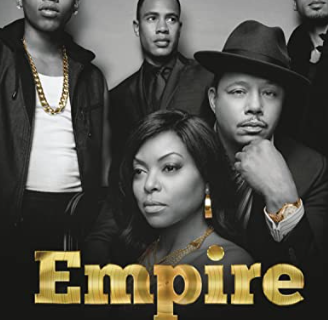
The acclaimed TV show “Empire” owes a lot to “King Lear,” but as you can see, it owes a lot more to “The Lion In Winter.” The character Lucius Lyon is much more based on King Henry, with his violent past, his mistresses, and his powerful wife Cookie, who is clearly an African American Elenor De’Aquitaine. Furthermore, the children are even more clearly derived from the three Plantagenet children: Hakeem, the spoiled, foolish philanderer played by Bryshere Gray, definitely has echoes of Kanye West, but Prince John is definitely in his DNA. Similarly, the talented Jamal, who is loved by his mother and hated by his homophobic father could definitely swap stories over dinner with Richard the Lionhearted, (though I doubt Jamal ever went on crusades). And lastly, the emotionally damaged Andre does have some Macbeth-like traits with his vaulting ambition and his brilliant, cunning wife Rhonda. But unlike Macbeth, Andre uses his business-savvy mind and his ability to manipulate his brothers to take power away from his father, which is exactly what Jeffrey does in “The Lion In Winter.”
Will our production be as cool as Empire, or as star-studded as the movie? Honestly, no. But I will say that after working with these actors before on multiple projects, this production should be fun, exciting, and moving, and definitely worth the hearing.

8 lessons from ‘King Lear’ as we head back to work or nights out after COVID-19

Slings and Arrows, Season 3

What Is Slings and Arrows?
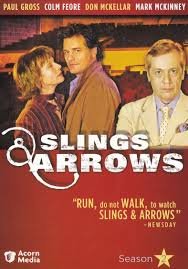
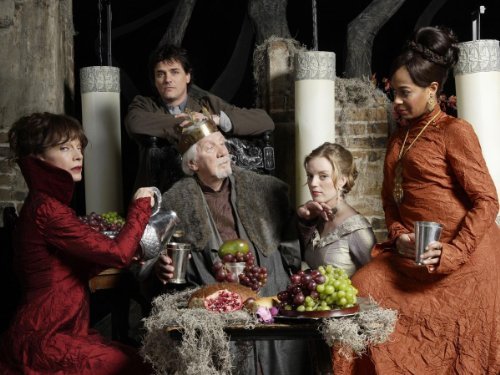
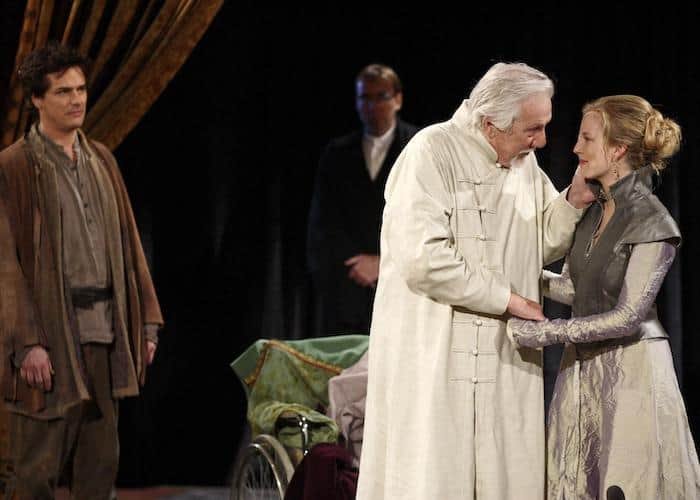


Slings And Arrows is a Canadian sitcom about a theater festival loosely based on the Stratford Shakespeare Festival in Ontario. Its hero, Geoffrey Tennant (Paul Gross), in addition to dealing with the seemingly endless problems (or should I say, “Slings and Arrows?”) mounting a Shakespeare play, is also worried he’s going mad, since he keeps seeing the ghost of his old mentor/ director Oliver Wells (Stephen Ouimette). For a recap of Season One and Two, click here to read my review.
Series Retrospective
I describe this show as a funny, tragic, bittersweet comedy about drama. It’s The Office for Shakespeare Nerds!
Season 3 Retrospective: The Promised End?
Before settling in to write this review, I went back and read some of your comments on the whole of the series, and if there was a common thread to them, it was the idea that season three is almost too painful to bear by the end, that watching these last three episodes where everything we’ve come to love so much utterly falls apart is something like ripping off a Band Aid. I can see that. I usually watch season three all in one gulp, and having to delay my viewings every week became almost torturous, both because of the plot momentum the show builds up and because I had a week to let the things happening at New Burbage stew away in my brain. What makes it even worse is that nobody here is a bad person.
Emily St. James, AV Club, 2013.
https://www.npr.org/2007/07/21/12144988/outrageously-entertaining-slings-arrows
To succinctly summarize this season, it’s a bad season with a good finale. This season is the show at its most raw, and frankly most of it I can’t bear to rewatch. Accordingly, this won’t be a review of the season, so much as a review of one great episode; the series finale, “The Promised End”. But first, I’ll talk about the characters and tropes that got us there.
The Cast
William Hutt as Charles Kingman
The majority of the drama around season three revolves around Charles Kingman (William Hutt). Mr. Hutt was a distinguished Shakespearean actor and while he was working on this season, Hutt was struggling with leukemia. The final episode aired on August 28, 2006, and Mr. Hutt died peacefully in his sleep on June 27, 2007.
Hutt delivers a great performance as Lear and Charles, and you’d never know he was dying with all the incredible energy and skill he delivers. However, once you know he’s dying, the arc of his character and the way Charles talks about age and death is heartbreakingly poignant:
Stephen Oimette as Oliver Wells
I’ve avoided talking about Oliver because he’s honestly more of a comic relief or a Shakespearean fool for most of the series. In this season, however, he becomes a real character as this clip shows. Geoffrey finally goes to therapy, (which Oliver twists into a ghost couple’s counseling session). It’s wonderful to see them finally address their love-hate relationship and I think it carries over into Geoffrey’s arc (more on that later).
Darren Nichols
Again, Darren Nichols is mostly comic relief, but he actually becomes a full-fledged antagonist in Season 3. In Seasons 1-2 he was a character foil- a director who hates theater, except as a vehicle for himself. In Season 1 he’s literally a foil for Geoffry, (in that he clashes with Geoffrey with literal fencing foils). In addition, he crams his production of Hamlet with pointless spectacle. In Season 2 Darren is a foil to Sarah in Romeo and Juliet– he loves being clever and cynical and wages war on the sentimentality of the love story.
In this season, first Daren is a foil to Richard- mocking the sentimental storytelling of musical theatre, (as you can see in the clip above). Next, he becomes Richard’s pawn; taking credit for Richard’s skill as a director and propelling himself to become the new Artistic Director. He’s basically Edmund in King Lear- a narcissist and a cynic who loves to mock and tear down institutions.
Paul Gross as Geoffrey Tennet
Geoffrey has a very dynamic arc this season, but to achieve it, he actually regresses a lot. In the first few episodes, Geoffrey seems to hate being at this theater even after his Macbeth became a great success. He starts crying randomly, which I interpret to mean he’s horrified at the possibility that he might have to be in this theater for another year. In essence, after a full year of growth, Geoffrey has regressed to the selfish, obsessive jerk he was in Season One. As you’ll see later, this regression was necessary in order to justify his arc, but I find it nearly unbearable to watch.
That said, it’s nice to see that Geoffrey isn’t a perfect person, and he still hasn’t addressed the source of his pain- his breakdown, Oliver’s betrayal, losing Ellen, and losing his job as an actor. The only glimmer of hope in this bleak season is that Geoffrey finally confronts his pain and learns to make peace with himself, with Ellen, and Olliver.
King Lear tropes in Season 3
Trope 1: a kingdom divided
Shakespeare wrote King Lear at the same time that King James was trying to unite England and Scotland, which is why a big theme of the play is how foolish it is to divide a kingdom. In Season three of Slings and Arrows, the Lear production has to share the theater with a new musical about addiction (loosely inspired by Rent). As you can see in this clip; while they rehearse this corny, ridiculous musical, Charles is telling the story of Shakespeare’s King Lear.
Often in theater rehearsals, actors will tell the story of the play from their character’s perspective. What’s brilliant about this clip is that, while the musical demonstrates a paper-thin understanding of addiction, dramatic storytelling, or even good musical theater, Charles is conveniently leaving out Lear’s cruelty to his daughters, his failure to see their flattery, and his insane clinging to power when he has already given it away. Charles’ inability to see Lear’s flaws also mirrors his inability to see his own, which brings me to my next trope:
Trope 2: Love, or enabling addiction?
Like I said earlier, Charles understands the positive aspects of Lear, but fails to see the negative, which is why he also fails to see them it in himself. Lear is not just a dear old man who was betrayed for no reason; he’s a selfish, deluded, violent, old narcissist who cares about no one but himself. That is why he goes mad- he defines himself by power, and when he loses it, he loses his identity.
What’s really great about this season is that it doesn’t just show the dark and light aspects of Lear, it also questions the ethics of Kent and Cordelia, (the heroes of the play), who try to save him. Geoffrey eventually plays Kent in the final episode, and it’s quite obvious that he mirrors Kent’s arc; sacrificing everything to help Charles play Lear one last time. He and Anna (who is basically Cordelia in this season) even get Charles drugs to help him with the pain of cancer. Charles’ desire to play Lear mirrors Lear’s desire to play the king; they are both addicted to something that is ultimately killing them.
As you look at the season as a whole, you have to ask, was it worth it? Was it worth it for Geoffrey to lose his job and his theatre, get a bunch of other people fired, and eventually lose the festival as we know it just for one man? In the play and the show, this question is never answered, but it is useful to contemplate.
Episode Six: The Promised End
Just like in Season two, we get a beautifully directed, beautifully shot, condensed version of “King Lear” in the final episode, but the tone is completely changed. Everyone has been told that if they do this show, they will be fired, and they do it anyway. This conflict means that onstage and on screen for the actors and characters, this is a bittersweet last-ride for everyone. We know this is not just the last show for Charles, Jeffrey, Ellen, and the company, it’s also the last for Paul Gross, Steven Oimette, and the rest of the terrific TV cast.
The truly heartbreaking moments in this episode come from Geoffrey, Oliver, and Charles. We see how amazingly good Charles is, (once he accepts his age and mortality). In essence, making this everyone’s last performance made it better all around.
“A Higher Purpose”
In a great twist of fate, Geoffrey has to fill in for Jerry as the Earl of Kent. He’s horrified since the last time he acted he had a nervous breakdown. This has been a problem the whole series for Geoffrey- he blames Oliver for his breakdown and he hates the New Burbage theater because it reminds him of his breakdown. But now, he must confront his fears and get back onstage and who helps him? Oliver. He coaxes Geoffrey through his stage fright by getting Geoffrey to focus on Charles. This, by the way, is how all actors deal with it- we find an objective and spend 2-3 hours fighting for it so we don’t have time for fretting about the audience.
It’s truly lovely to watch Oliver coaching Geoffrey- not only does it mirror Geoffrey doing the same thing for Jack in season one, but we see the story of Lear from Kent’s perspective- a man trying to serve his king. This puts Geoffrey’s arc through the season into sharp focus as well- he was trying to save Charles, not Lear- Charles.
“What are we doing here?” “Putting on a play.”
Like I said before, Geoffrey starts this season with a real self-destructive streak and it’s telling that in therapy he admits that he has no work-life balance. He defines himself by making art. Through playing Kent and doing something outside the theater, Geoffrey finds meaning in his life offstage. This is why I can bear to watch this episode instead of the others- yes the theater is gone, yes Darren and Richard win and all the characters I care about have been fired, but at least Geoffrey, Ellen, Oliver, and Charles finally grow and get to move on. Charles can die in peace now that he gets to do one last performance, (without letting it drive him mad). Geoffrey gains a new perspective on his life, and thus he doesn’t need Oliver anymore. I now have reason to hope that he and Ellen can now make a life together and not mess it up like they did the last time.
In conclusion, Season Three is not fun or cheerful, and there’s no satisfying conclusion for most of the characters. That said, this might be the best-written, most amazingly performed, and most heartrending sign off for a series I’ve ever seen, and if it took so much toil and pain to get here, so be it. It’s also a tremendous tribute to a great actor, William Hutt; I feel privileged to see his final performance on this show, and rejoice that at least one more time, I got to see the king bow:
When we our betters see bearing our woes,
Edgar, Act III, Scene vi.
We scarcely think our miseries our foes.
Who alone suffers suffers most i’ th’ mind,
Leaving free things and happy shows behind;
But then the mind much sufferance doth o’erskip
When grief hath mates, and bearing fellowship.
How light and portable my pain seems now,
When that which makes me bend makes the King bow
Play ME OUT CYRILL!
Shameless plug! If you’re here for more Lear, I’ll actually be playing Kent in an online radio play this Saturday, October 22nd, at 1PM EST. Here’s a link to the Youtube channel where it will be broadcast:
Intro to King Lear


Lear at its core is a play about growing older, and not just for its title character. Goneril and Regan learn their father is a lousy dad and learn to stand up to him. Edgar learns about the cruelty of the world and how to deceive his enemies.
Plot Summary
Lear, a king in pre-Christian England, is too old to rule, so he decides to divide his kingdom among his three daughters. He then tells them he will give the the kingdom to the one who loves him most.
Lear’ youngest daughter Cordelia, refuses to flatter her father, so she banishes her. He also banishes the Earl of Kent, who warns the king that his actions are foolish and rash. Finally, Lear demands that, although he resigns his kingdom, his daughters call him king and agree to house him and his knights in their castle.
Lear is not the only rash old man who is blind to his true danger. His friend the Duke of Gloucester has a bastard son named Edmund, who schemes to usurp his father’s lands and marry into Lear’s family. Edmund frames his legitamite brother Edgar which forces him to disguise himself as the mad beggar Poor Tom
After his daughters refuse to house him and his knights, Lear goes stark-raving mad. He runs out into a storm on the heath, wishing the Earth were struck flat and all mankind was destroyed. He is soon cared for by his Fool, and Kent, disguised as a commoner named Caius.
Duels, wars, tears, and oblivion follow.
Dramaturgy Website: American Shakespeare Center
Contemporary Parallels:
“Empire” (TV Series 2015-2020)
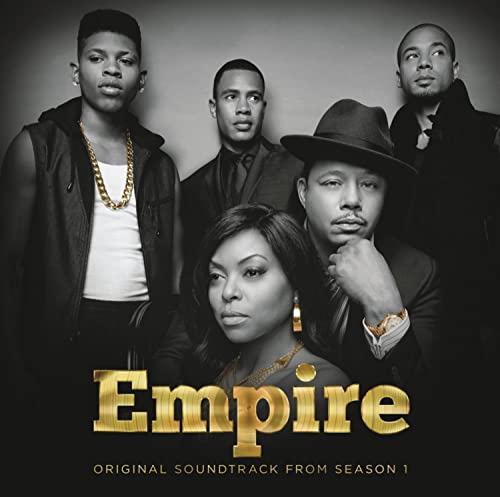
Succession (HBO- 2018- present)
https://www.telegraph.co.uk/tv/2018/08/02/succession-hbos-new-dramais-king-lear-modern-media-age/
This scene from “Brave”
“Slings and Arrows,” Season three
Slings and Arrows, Season 3
“Ran” by Akira Kurasawa-
Encanto (2021): Click here to read my post about Encanto and Lear
Videos
More Posts
Shameless Plug
I’ll be playing Kent in King Lear October 22nd, 1PM EST. It’ll be streamed on Discord and live on YouTube here:
Did Shakespeare use visual effects?

Stagecraft has a fascinating and interesting history. The way we portray spectacle on stage has changed a lot since the advent of television and movies, which utilize computers and animatronics, etc. to create impossible things that could never be is shown live. In a way, the pre-recorded nature of film and TV gives theater practitioners an advantage because the more clever they are with their stagecraft, the more impressive it is for the simple fact that it is live- happening right now in front of an audience.
What I want to do with this post is to speculate whether, with the technology of the time, if Shakespeare could have used some kind of visual spectacle to portray otherworldly creatures, such as the ghosts in Hamlet and Macbeth
The conventional wisdom
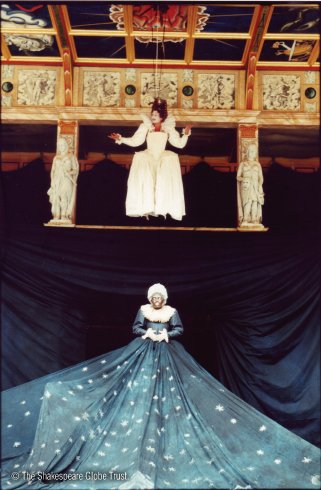

Most books I’ve read on Elizabethan stagecraft say that the theaters of this era were very minimalistic in design. They had trap doors, they had galleries, they had a primitive flying rig, and they had music and some simple sound effects, but most of the experience was watching the actors, their costumes, their bodies, and hearing their voices hence ‘audience’- audio, “To hear.”
We are told there wasn’t much visual representation of spectacle and fantasy on Shakespeare’s stage, which which is is odd because there are some pretty fantastical elements in his plays, especially Hamlet and Macbeth, where the former calls for a ghost and the latter calls for a ghost, witches, and a literal goddess to appear on stage. How may one ask, was this achieved back in Shakespeare’s day, the late 1590s and the early 1600s? The conventional wisdom is that the ghosts in Hamlet and the ghost in Macbeth came through a trap door in the stage known as Hell.
If you’re you go to the Globe now you can see this actual trap door being used. It used a primitive pully system to open up in the middle of the floor. The ghost would ascend to the stage through a small step ladder. Hamlet’s father’s ghost is described as wearing a suit of armor and being very pale. Banquo’s ghost is described as having long hair dappled with blood.
Banquo’s ghost appears during a banquet in Macbeth’s honor. Based on this hypothesis it’s likely that a banqueting table was brought out into the middle of a stage to conceal the ghost, to make it more of a surprise when it ascends onstage through the trap door, but the effect to modern taste would be rather dull. However impressive the performance, this cannot stand up to the stunning nature of visual effects using computer technology, motion capture, et cetera. I wanted to see if there are any Elizabethan theatrical illusions that would still have been accessible to Shakespeare back in the 1590s.
Idea #1: A Smoke-monster ghost?
My research began with this video from the YouTube History Channel Atun-Shei Films, where the author traces the history of film, (both as photography and film as a projection). He cites at the start, an incident in 1536 where a supposed necromancer appeared to conjure a ghost for an unsuspecting rube. According to The Lives Of the Necromancers, the solution was achieved by creating huge clouds of smoke within the theater space, (which was the Colosseum) and then using a primitive camera obscure to project a frightening image Into this space.
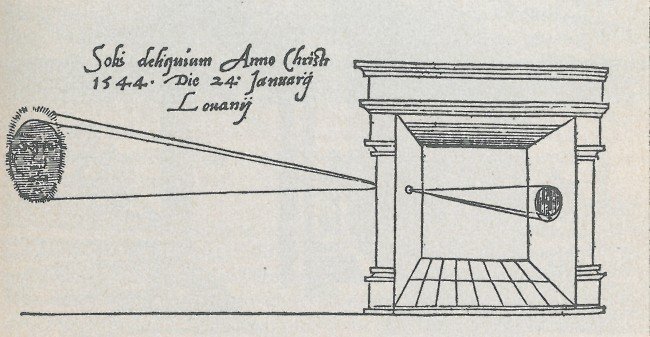
Camera Obscura is a term is it Latin for dark chamber the principal had been discovered for century had existed for centuries bit is for centuries but only in the 1530s this was the 1st recorded example of it being used to create a theatrical illusion.
The question is, could Shakespeare’s company have performed the same illusion with the technology of the day? Honestly, I find it rather unlikely that Shakespeare’s audience would’ve put up with huge clouds of smoke in a wooden amphitheater. Still, the fact remains that primitive projection technology existed back in Shakespeare’s day, which means a director could reasonably implement it in a production of Hamlet or Macbeth, even under the constraints of Original Practices.

So the question remains, is there a visually striking way to represent the ghosts that could actually work in Shakespeare’s theater. My first idea is…
Idea 1: Glow In the Dark Paint

Glow-in-the-dark paint wasn’t invented until 1908, but there are some rocks that naturally glow such as hackmanite and phosphorus.
Theoretically, Shakespeare’s company could have crushed this rock into a powder and made it into a paint that glowed onstage. There is precedent for this- in The Hound Of the Baskervilles, Sherlock Holmes discovers that the terrifying ghost-hound is merely a large dog painted with phosphorescent paint:
In mere size and strength it was a terrible creature which was
lying stretched before us. It was not a pure bloodhound and it
was not a pure mastiff; but it appeared to be a combination of
the two–gaunt, savage, and as large as a small lioness. Even
now in the stillness of death, the huge jaws seemed to be dripping
with a bluish flame and the small, deep-set, cruel eyes were ringed
with fire. I placed my hand upon the glowing muzzle, and as I
held them up my own fingers smouldered and gleamed in the darkness.“Phosphorus,” I said.
“A cunning preparation of it,” said Holmes, sniffing at the dead
Doyle, Part IV.
animal.
Though this paint would potentially make a terrifying effect, this would be impossible at an outdoor theater during the day. This makes it unlikely that Shakespeare used glow-in-the-dark paint at the Globe, as most of the performances took place in the afternoon. That said, both Hamlet and were written just at the point in which Shakespeare’s company was in the process of acquiring an indoor theater, the Blackfriars.
The Blackfriars and Shakespeare’s stagecraft
Almost all of these ideas would depend on Shakespeare having access to a theatre in which he could control the lighting. As you can see, the Blackfriars was lit with candles and its indoor nature meant that performances weren’t dependent on sunlight. Greg Doran, former director of the Royal Shakespeare Company has theorized in the past that maybe while his company was preparing to move into the Blackfriars, Shakespeare was changing his material to make it both literally and figuratively darker.
In the reconstructed Blackfriars, (where I studied and interned for three years), there is a trap-door and flying rig like the Globe, so the conventional trap-door ghost can and has been utilized there. I would also argue that in the Blackfriars unlike the Globe, there was a chance for more variety of theatrical illusions- perhaps a smoke projection, magic lantern, or even…
Idea 3: A Pepper’s ghost
A Peppers Ghost is a stage illusion that dates back to the 19th century. It uses the principle of refracted light to project the image of a ghost on top of a piece of glass. This image will appear translucent and could be very impressive to an audience at the Blackfriars! As you can see in the diagram below, the actor could be under the stage in the trap door standing in front of a mirror, and the glass sheet could be used to project his image to the audience. The only concern would be that this could limit the blocking of the other actors, and it might not make the ghost visible to the audience members in the upper galleries, but it would still be an impressive visual effect that uses scientific principles known in the 17th century.

Pepper’s Ghost illusions are still used frequently in theme parks, trade shows, and concerts where singers interact with “holograms.” As a special Halloween treat, (or trick as the case may be), I’ve included a video that will allow you to make your own Pepper’s ghost at home. If you choose to make one, leave me a comment!
So, in conclusion, though we are taught that Shakespeare’s theater often reveled in simplistic theatrical designs, I personally think that there is more room to explore low-tech theatrical illusions like these, especially at companies like the Globe Theater and the American Shakespeare Company, which pride themselves on using Shakespeare’s original staging practices. Live theater has dodged giving up its ghost for 2,000 years by exploring the limits of live theater through movement, voice, story, music, and yes spectacle. I think theater practitioners, even Original Practitioners should keep innovating new kinds of spectacular means to keep creating fresh interpretations of Shakespeare, that still keep within the spirit of the play’s original time and place.
Bonus: If you want to learn more about the stage illusions of Shakespeare’s company, click here to listen to That Shakespeare Life Podcast with Cassidy Cash. In this episode, she interviews theater professor Frank Mohler, who describes how thunder and flying effects were done in the 17th century, using records of the period, and his own experimentation.
New Video Trailer for my new Course!

I just finished uploading my trailer for my new course on Shakespeare’s tragedies for your viewing pleasure:
The first session is on November 5th (Remember the day)! Hope to see you then.
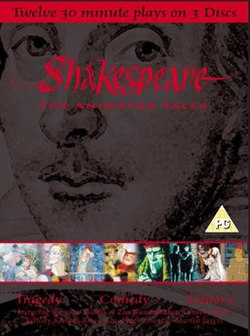
Shakespeare: The Animated Tales- “Macbeth”

This is a 30 minute cartoon version of Macbeth originally produced for the BBC in 1992. It features Brian Cox as the voice of Macbeth (before he was the voice of McDonald’s), and Zoë Wanamaker as Lady Macbeth (before she was a witch who teaches at Hogwarts).
I like the way it portrays the horror imagery of the play in sort of a European-manga animation hybrid. Admittedly, there are better ones in the series, but this one is still pretty neat.
To check out other episodes in the series, view this playlist:
Great classes are available December 1st.

Scehdule

Class Descriptions:
Basics Of Stage Combat: Students will learn the basics of safely enacting a fight onstage, in preparation for a Shakespeare play. We will also learn about the history of sword fighting in the military and the duel.
My daughter really enjoyed taking this class. She was actually able to use her sabre and try out her routine on her father. Paul is quite knowledgeable about Shakespeare and made the class really fun by teaching a fight scene from Romeo and Juliet. It is amazing watching her practice with Paul over Zoom. I hope Paul will have. more combat classes, it is a different way to learn Shakespeare.
IB, Parent
An Interactive Guide To Shakespeare’s London (New Class)
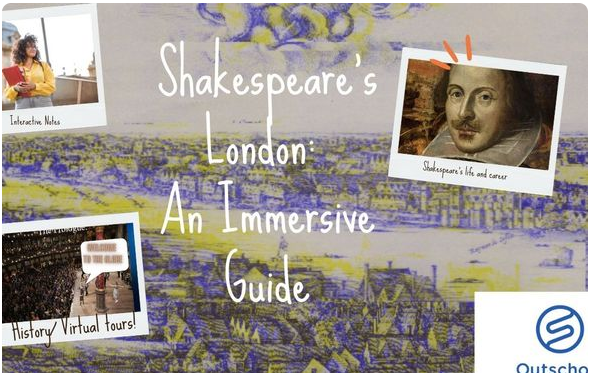
A virtual tour of Shakespeare’s London will get kids to interact with the culture of Elizabethan England.
Class Experience
To teach kids about the Elizabethan era and the background of Romeo and Juliet, The Instructor will interact with the class (via pre-recorded videos), pretending to be Shakespeare. The class, pretending to be actors in Romeo and Juliet, will get a virtual tour of The Globe Theater, Hampton Court Palace, and a virtual visit to an Elizabethan doctor's office. This activity is an immersive way for them to learn about the period, how it relates to the world of the play, and how Shakespeare changed theater.

The class will take the form of a guided WebQuest activity.  First, the students will get a worksheet that has a series of fill-in-the-blanks about Elizabethan society (below). The students will fill out this worksheet based on a Nearpod and in conjunction with a website I’ve made, https://sites.google.com/nebobcats.org/visit-to-elizabethan-london/home?authuser=0
Both the Nearpod and each webpage will have a virtual tour, a video, and text explaining some aspects of Elizabethan life. Before they go to each location, I will give a short introduction via prerecorded video:
Wizard Science

In this one-hour course, your child will discover the enchanting world of science through a series of magical experiments. Learn about such topics as Astronomy, Static Electricity, chemistry, and optical illusions.
What was Christmas like For Shakespeare?
In this one-hour course, students will learn and play games that will explore the history behind Christmas traditions. We will also discuss the themes, characters, and famous quotes from Shakespeare’s play “Twelfth Night.”
 The Shakespearean Student