I’m pleased to announce my brand-new, fully immersive, fully online murder mystery game! Similar to my “Macbeth” and “Interactive Guide To London,” course, the course is a series of slides, videos, digital activities, and websites that you explore and complete based on your knowledge of a Shakespeare play. Unlike that course, this one also includes real-life science experiments and handy guides to both the play “Romeo and Juliet” and forensic science!
Background on the game
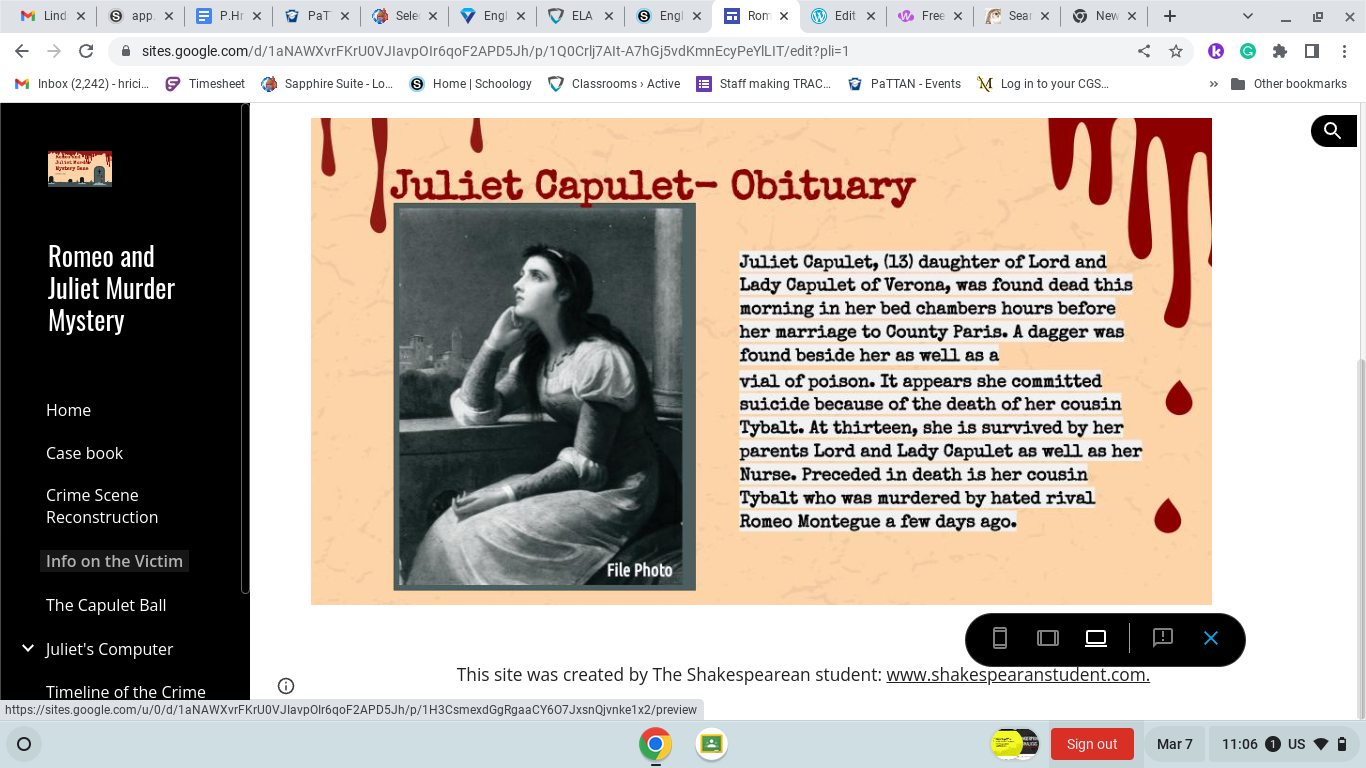
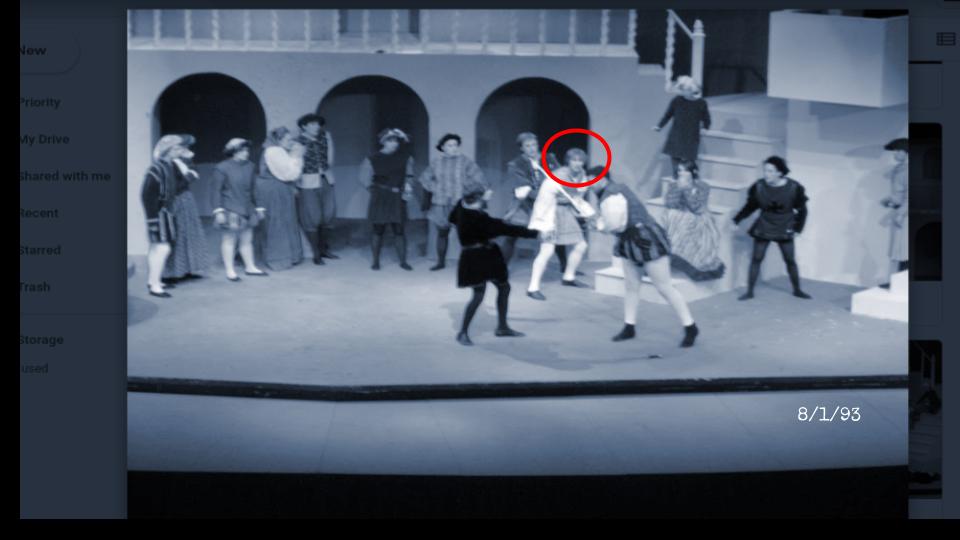
Through a series of slides, you’ll learn that you are playing the part of a detective, hired by Juliet’s parents to investigate her sudden death. You’ll read her obituary, look at a crime scene photo, and the story so far.
Parts of the course:
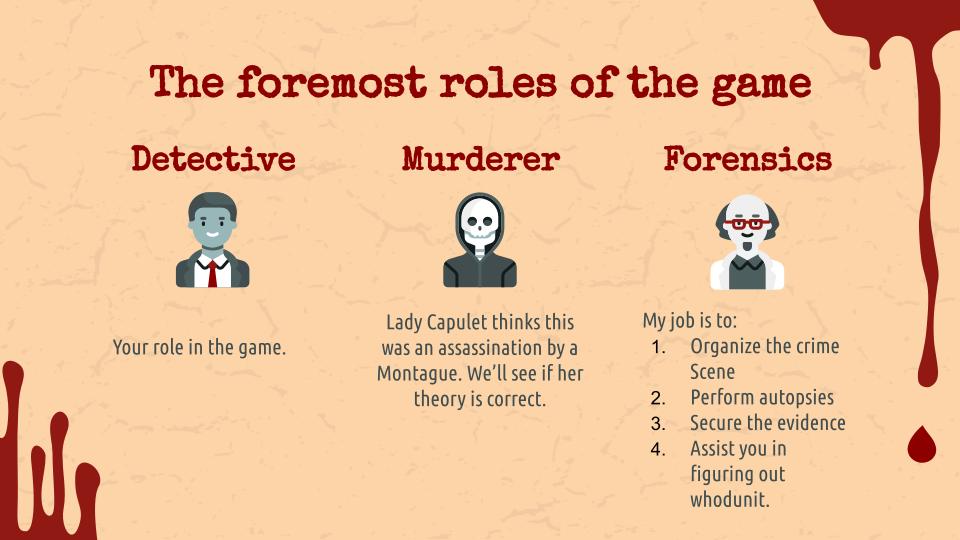
The major players of the game
The class is divided into 8 parts that students can complete at their own pace over a 4-week period. Once you are signed up for the class, you will receive a link to a Nearpod Presentation that has links to all the online activities. You will also receive a detective case file, that will serve as your notes as you record your discoveries through the mystery. Finally, I will provide you with a course cheat sheet and a list of resources in case you need help through the various activities.
Week 1: The Scene Of the Crime
The student will learn, not only about the plot of “Romeo and Juliet,” but also the way real detectives and forensic scientists follow clues and try to solve crimes, in this case, an apparent death by poisoning.
Activity 1: Poison Analysis
In a pre-recorded video, The Investigator introduces himself. He is in the middle of doing a toxicology test on the vial found near Juliet’s bed. He explains that most poisons are either highly acidic or highly alkali (aka, bases). Testing the liquid’s PH will help you determine if the substance is poisonous or not. In a short simulation via Nearpod, you will test multiple liquids for acidity or alkalinity. You’ll even learn how to test substances in your own home for acidity and for alkaline properties!
Week 2: Crime Scene Investigation
Crime Scene Analysis, Romeo and Juliet Style
Using the Nearpod slides and a linked website, you’ll figure out what happened to Juliet’s cousin Tybalt the day before her own mysterious death.
Activity 3: Unlock Juliet’s Computer
Using Shakespeare’s text, you will decode a secret password to unlock Juliet’s website (Google Sites). Using Juliet’s (fake) Twitter account, you will read her account of the events of the play thus far. Each tweet is paraphrased from a line of Shakespearean dialogue. Once you’ve read the fake tweets, you can play a game where you match them with the real Shakespearean dialogue.
Activity 4: Fingerprint Analysis
Fingerprint Analysis experiment
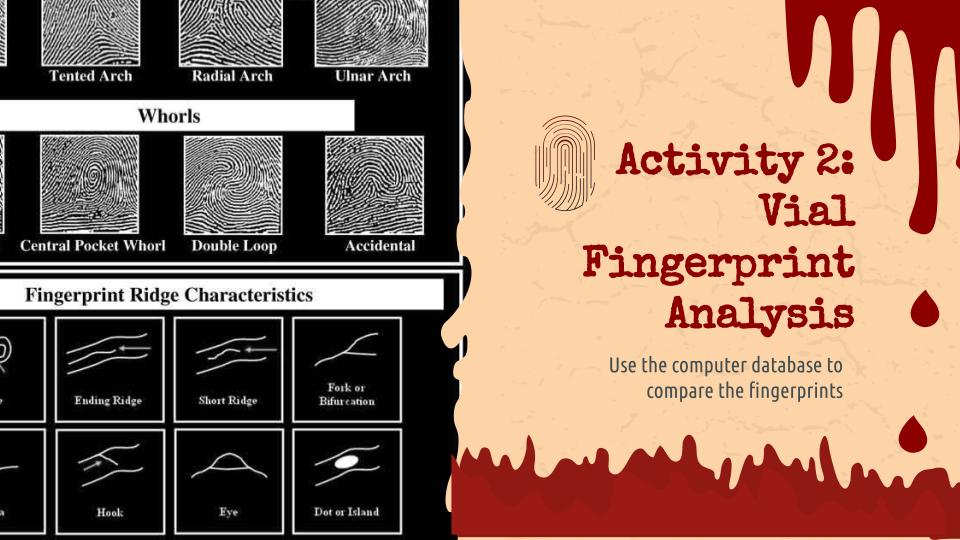
You will ‘scan’ a fingerprint found on the vial found in Juliet’s bed. The website will tell you who it’s from and you will record it in your case file. You’ll also learn how to take your own fingerprints, and the characteristics real detectives look for when analyzing them.
Week 4: Construct a Timeline/ Make the Arrest:
Using your case file, you will write the sequence of events thus far in your case file and write down information about the suspects (the characters in the play), in the format of a police dossier.
The activities will enrich the student(s)’ understanding of the plot and characters of “Romeo and Juliet” using the format of a murder mystery In addition, the students will learn the methods practiced by detectives, investigators, and forensic scientists when they solve real crimes including toxicology, fingerprint analysis, CSI, and interrogation techniques.
The global phenomenon “Five Nights At Freddie’s” (FNAF) has spawned 11 major games, spinoff games, 19 books, countless comics, and a big Hollywood movie premiering this week:
My video podcast on FNAF
One other thing this franchise has spawned is ENDLESS FAN THEORIES. I admit, when I first heard of this jump-scare-based game with haunted animatronics, I viewed it as a silly novelty- a clever way to create cheap horror using monsters who jump out at you in a dark room… then I saw this:
2023- The Game Theorist Youtube show tells the entire chronology of the FNAF saga.
The YouTube channel Game Theory, which has been analyzing and dissecting the games for the last 8 years finally created a complete chronology of the games’ lore. Like a lot of the best horror stories like Dracula and “Sleep No More,” the game scatters a lot of its lore throughout the game in the form of mini-games, security guard notebooks, newspaper clippings, and of course, the iconic, nervous late-night phone calls that your character (a nameless night watchman) receives from a mysterious character known only as THE PHONE GUY.
This story is truly the stuff of nightmares- serial killers, murdered children, ghosts, possessed robots, broken families, and unending quests for revenge from beyond the grave. Of course, a few of these tropes Mr. Shakespeare would be very familiar with, so I thought I’d delve into some of the themes, tropes, and ideas that link these two franchises. My goal is to get fans of the video game to understand that, since Shakespeare and Scott Cawthorne (the creator of the game) use a lot of the same horror plots and ideas, that, if you can understand FNAF you can understand Shakespeare!
Part I: The mad scientist- William Afton Vs. William Shakespeare’s Prospero
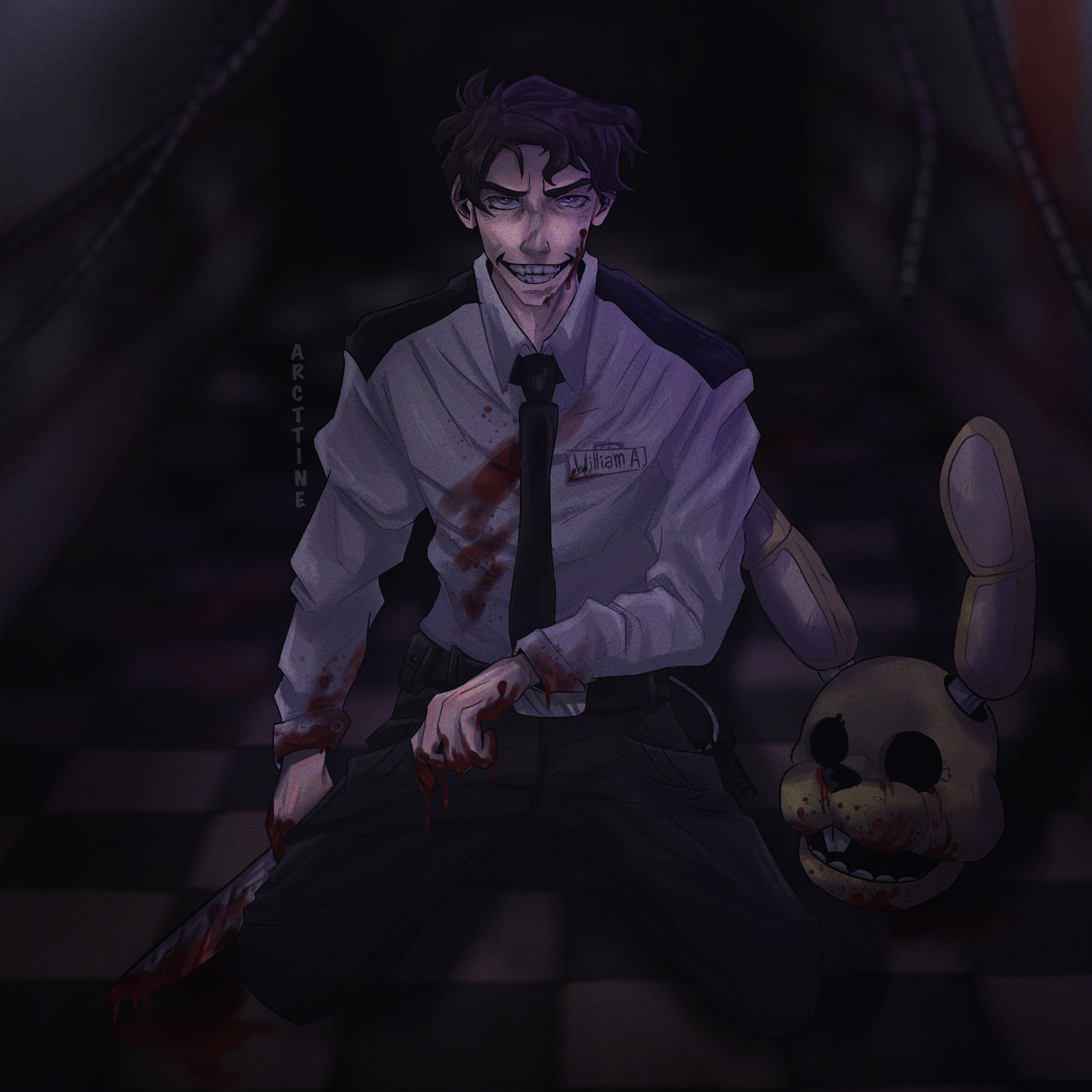
The story of Five Nights At Freddie’s revolves around its main antagonist- a genius roboticist-turned-serial killer named William Afton, who starts out as a successful businessman and children’s entertainer obsessed with bringing his creations to life. Any horror fan will tell you that this is an automatic sign of a villain because he is trying to master the skill that only God possesses- the ability to create life.
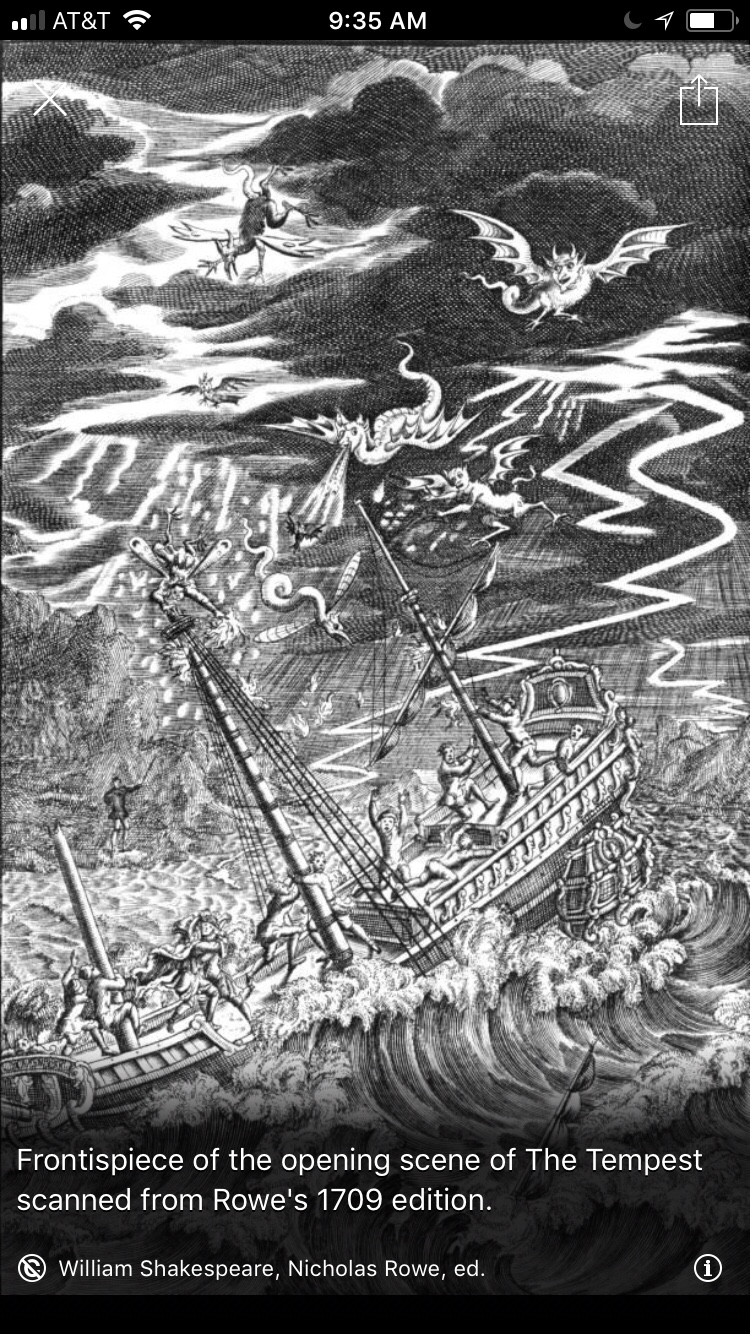
In Shakespeare’s final play, The Tempest, the hero is a brilliant magician who, after his brother exiles him to a desert island, masters many crafts considered unnatural for the 1600s:
I have bedimm'd
The noontide sun, call'd forth the mutinous winds,
And 'twixt the green sea and the azured vault
Set roaring war: to the dread rattling thunder
Have I given fire and rifted Jove's stout oak
With his own bolt; the strong-based promontory
Have I made shake and by the spurs pluck'd up
The pine and cedar: graves at my command
Have waked their sleepers, oped, and let 'em forth
By my so potent art.
The Tempest, Act V, Scene i, Lines 2063-
Like I discussed in my post on Shakespeare and Star Trek, Prospero’s magic is both benevolent and terrifying. He uses it to rescue himself and his daughter Miranda from the island, and he creates beautiful visions of gods and angelic music for Miranda and her young lover Sebastian, but he also creates nightmarish visions to torment his enemies:
Both Afton and Prospero are motivated by revenge against the men who betrayed them. In Afton’s case it’s his rival/ partner Henry Emily who bankrupted his business and later got him fired from his own company. Afton torments Henry by murdering his daughter and ruining his business by luring kids to their death inside the pizzeria, disguised as one of the animatronic characters. Afton also figures out how to torment people using sound alone, like Prospero does to his slave Caliban:
Caliban. All the infections that the sun sucks up
From bogs, fens, flats, on Prosper fall and make him
By inch-meal a disease! His spirits hear me
And yet I needs must curse.
For every trifle are they set upon me;
Sometime like apes that mow and chatter at me
And after bite me, then like hedgehogs which
Lie tumbling in my barefoot way and mount
Their pricks at my footfall; sometime am I
All wound with adders who with cloven tongues
Do hiss me into madness.
Here comes a spirit of his, and to torment me! The Tempest, Act II, Scene ii.
Prospero isn’t a killer, but like Afton, he has learned the secret to life after death, which makes him powerful and dangerous. Even more unsettling, both men are on an endless quest for revenge and torment men whom they saw as brothers. Other Shakespearean characters take their lust for revenge to the same dark place Afton did- the murder of children.
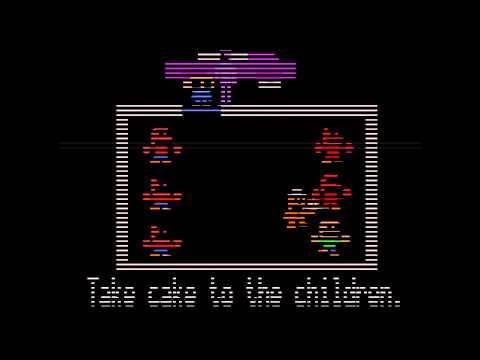
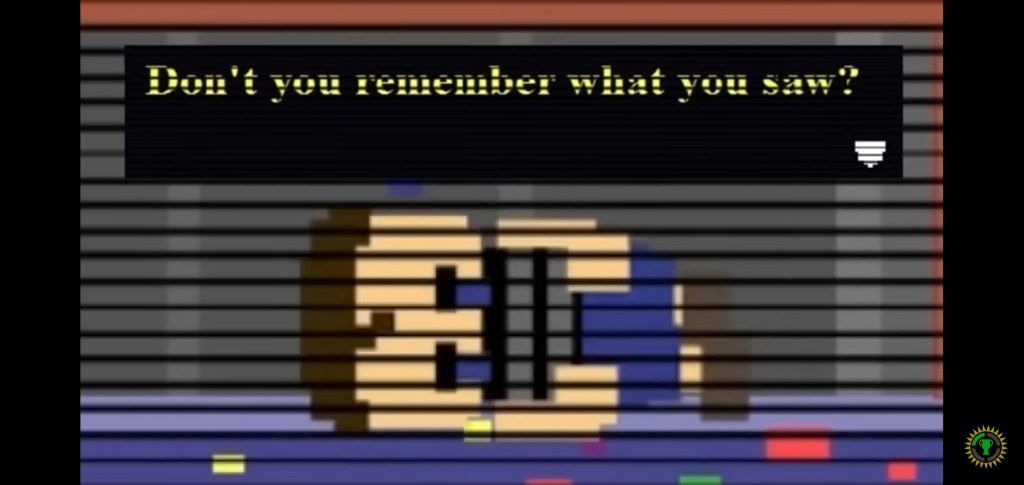
For the first four games, Afton isn’t directly part of the game- he’s merely mentioned in pieces of the lore. Frequently we see 8- bit re-enactments of his crimes in a series of mini-games, where he appears as a faceless, purple killer.
Screenshot of William’s first murder of Henry’s daughter Charlie outside of the pizzeria.
Why purple though? It’s true that purple is associated with royalty, and sometimes associated with villainy, (since it isn’t a color found much in nature). I think though, there might be a deeper, more macabre meaning to this color associated with this killer: It is a scientific fact that human blood, when it is shed and deprived of oxygen, actually turns purple:
The colors of arterial and venous blood are different. Oxygenated (arterial) blood is bright red, while dexoygenated (venous) blood is dark reddish-purple
Shakespeare was very aware of this medical fact. He lived in an age where traitors’ heads were placed on spikes on London Bridge, and people would pay to watch wild dogs attack bears (the FNAF of his time). Shakespeare makes many gory references to murderers watching red blood turn purple:
I make as good use of it as many a man doth of a Death’s-head or a memento mori: I never see thy face but I think upon hell-fire and Dives that lived in purple;
Henry IV, Part I, Act III, Scene iii.
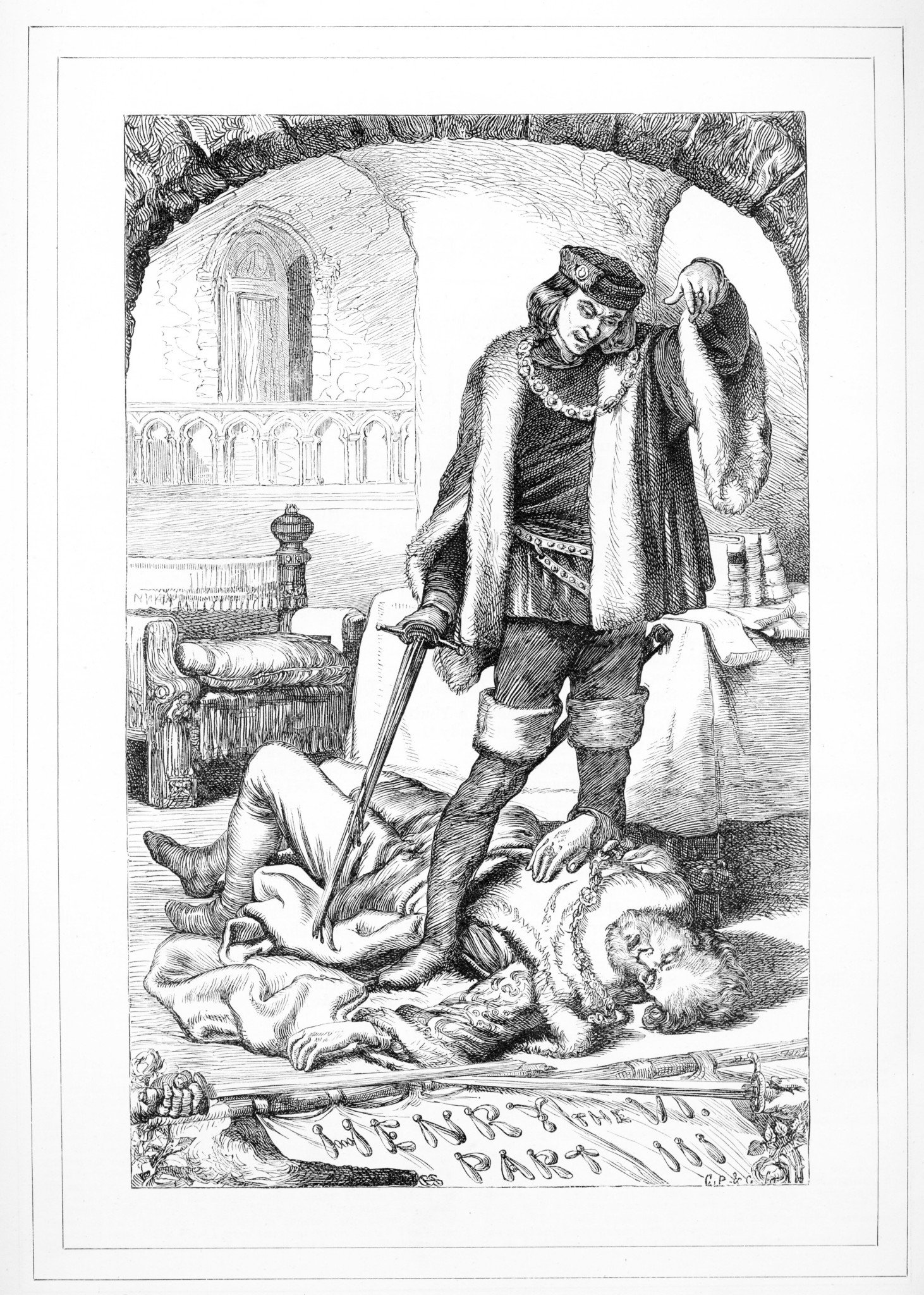
Woe above woe! grief more than common grief! O that my death would stay these ruthful deeds! O pity, pity, gentle heaven, pity! The red rose and the white are on his face, The fatal colours of our striving houses: The one his purple blood right well resembles;
Henry VI, Part III, Act II, Scene v.
Now, whilst your purpled hands do reek and smoke,
Julius Caesar Act III, Scene i.
With purple falchion, painted to the hilt In blood of those that had encounter’d him:
Henry VI, Part III, Act II, Scene v (Richard of Gloucester)
This last quote is spoken by Richard of Gloucester, who, in the play that bears his name, becomes King Richard III, Shakespeare’s most irredeemable villain. Just like William Afton, he kills without remorse and dispatches anyone who gets in his way on the path to the crown. In addition, like many of Shakespeare’s villains, his turn to pure evil occurs right after he does the unthinkable- when he murders children.
Richard (Ian McKellen), orders the secret murder of his nephews in the tower in order to keep his crown.
Throughout the rest of the play, Richard kills a lot of his political and personal enemies and we go along with them because he’s the protagonist. But once he murders the princes, who have done nothing to harm him or anyone else, Richard crosses the line from anti-hero to monstrous villain. It is also at this part of the play when his victims begin to take their revenge… FROM BEYOND THE GRAVE!
Part III: The ghostly revenge story
I’ve written before that in Shakespeare, ghosts are usually murder victims either out for revenge, or trying to convince a living person to avenge their death. Likewise, in the subsequent games, Affton’s victims possess the animatronics, seeking to kill their murderer!
One of the creepiest scenes in Shakespeare comes when Richard III is visited the night before his final battle by the ghosts of all the people he’s killed:
Similarly, when Macbeth murders his friend Banquo (and attempts to murder his young son Fleance), he is visited by Banquo’s ghost, during a party, no less! Even more ironic, look at the language Macbeth uses when he sees the ghost:
Approach thou like the rugged Russian bear, The arm’d rhinoceros, or the Hyrcan tiger; Take any shape but that, and my firm nerves Shall never tremble: or be alive again.
It’s truly ironic that, while in FNAF, the ghosts of Afton’s slaughtered children appear in the forms of angry animatronics, shaped like fearsome animals, Macbeth would rather see the fearsome animal, than the ghost of the man he murdered! Though Macbeth himself doesn’t fear bears, in both FNAF and Shakespeare, bears and other animals have long had a symbolism associated with wrath, anger, and taking bitter vengeance on the wicked.
Part IV: The Forrest of Beasts
1930s-style ad for the original Fredbear’s Singin’ Show, where a real dancing bear entertained travelers.
Bear Baiting
Even the animals in FNAF have some significance that Shakespeare has touched on in some of his plays, especially bears. In many renaissance and medieval sources, bears are symbols of wrath, revenge, and fierce protectors of children. Both Shakespeare and FNAF exploit this symbolism, and both the game and Shakespearean plays create horrifying beastly images in stories of revenge.
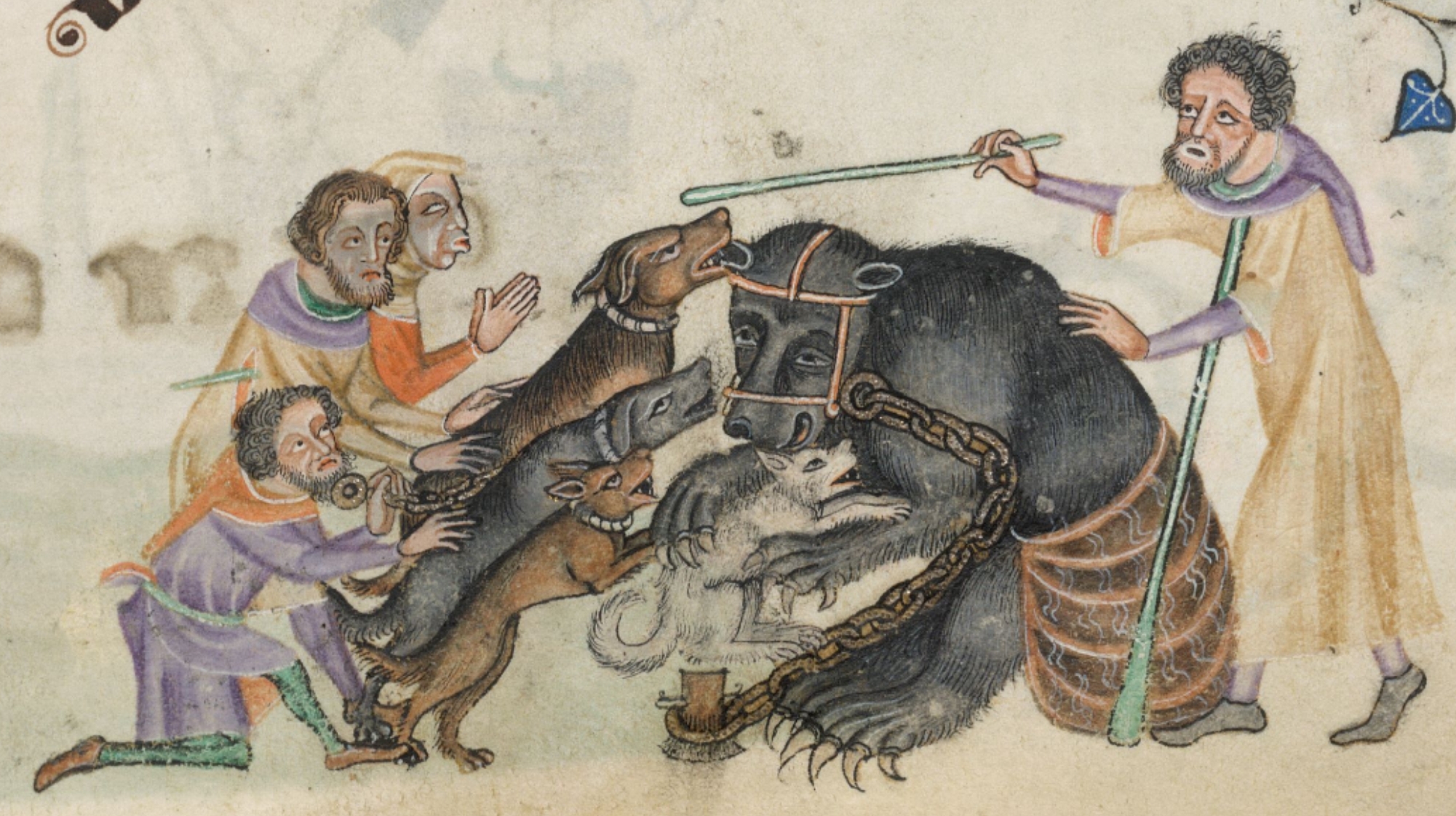
Just like the Fredbear singin’ show, Elizabethans liked to watch real bears perform onstage, sometimes as dancers, but also IN BLOODY FIGHTS TO THE DEATH. In the 1590s, there was a popular sport called “Bear baiting,” where bears would be chained, sometimes to a pole, and set on by vicious dogs. The ‘sport’ was watching to see who would prevail- the fierce and free dogs, or the powerful, bound bear.
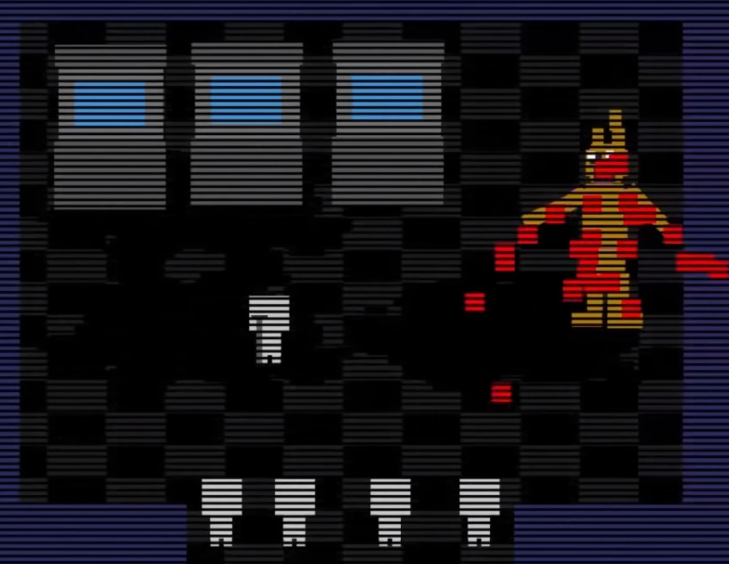
As you can see from this close-up of Wenceslaus Hollar’s famous Panorama Of London (1647), we know that Shakespeare had to pass bear beating pits on his way to the Globe all the time, (you can see ‘Beer bayting’ or bear beating, written on the playhouse on the left, and Shakespeare’s Globe Theater on the right). Not only that, Shakespeare writes about the bloody sport frequently in his plays. When Macbeth knows he’s losing the battle with Malcolm, he compares himself to a bear, tied to a stake, forced to fight until his last breath. It calls to mind the moment in the game when the ghosts shed their animatronic skins and attack William directly, while he’s trapped in the Springtrap suit.
The ghosts of Afton’s original five victims gang up on him, possibly causing his golden Bonnie suit to malfunction, and kill him… for now.
It’s worth noting that when the ghosts kill Afton, he’s wearing his Golden Bonnie suit. As Mat Pat mentioned, yes it is the disguise he wore to commit his crimes, but it is also symbolic of who Afton has become- a beastly, inhuman creature who looks friendly on the outside, but inside is cold and robotic on the inside. This also calls to mind the beast symbolism in the aforementioned ghost scene from Richard III. The real King Richard III used a boar as his royal sigil, and Shakespeare exploits that beast imagery by comparing Richard to a bloody, rooting hog, grown fat on the blood of his victims. Richard doesn’t wear a pig suit, but he does wear his cruelty and bloodlust literally as a badge of honor!
In both the games and the plays, the ghosts become a manifestation of the murderer’s guilty conscience, and beast-like imagery is used to convey how cruel and beast-like the murderer has become. Macbeth and Richard don’t dress like beasts, but they do kill like them.
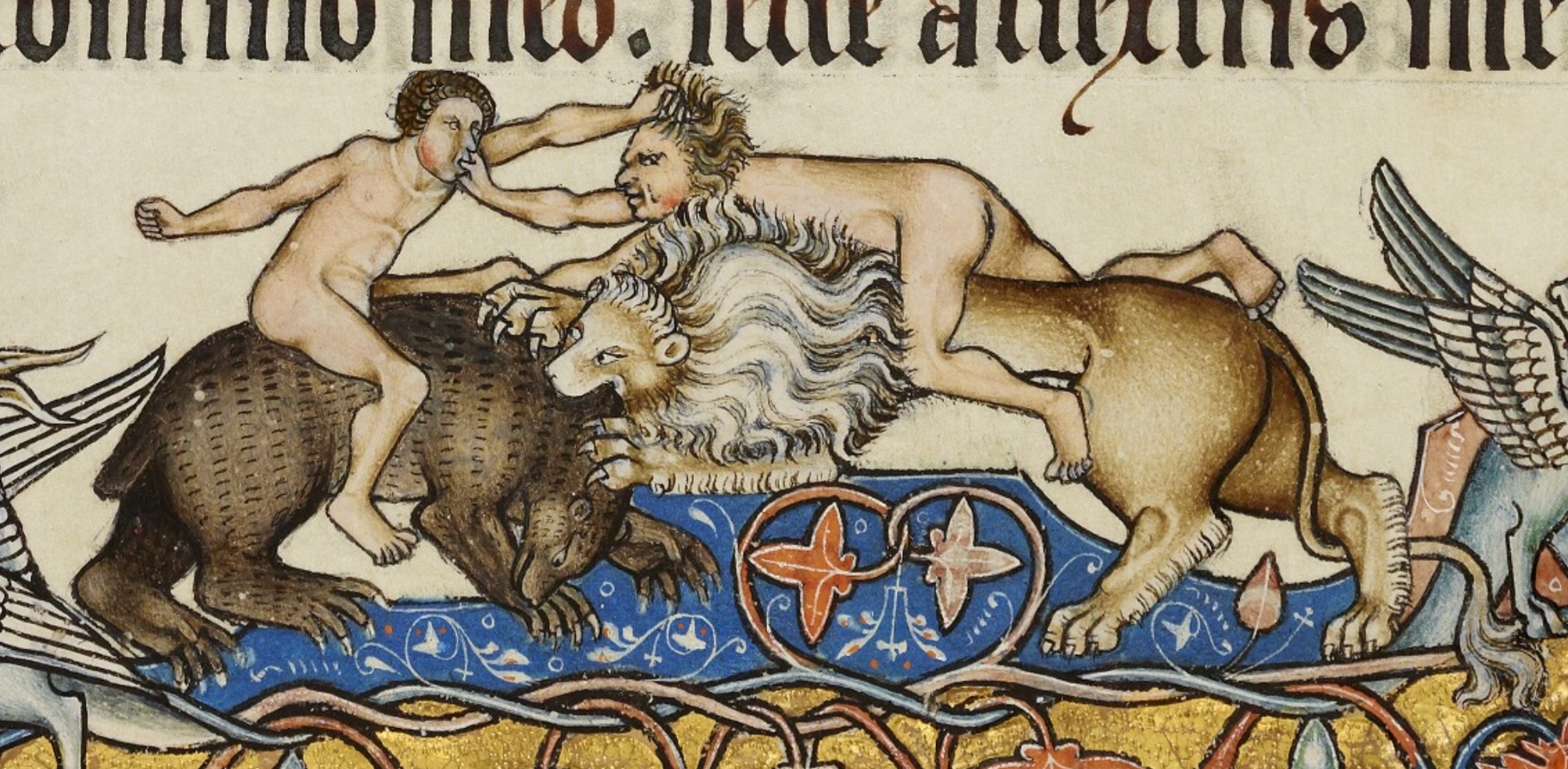
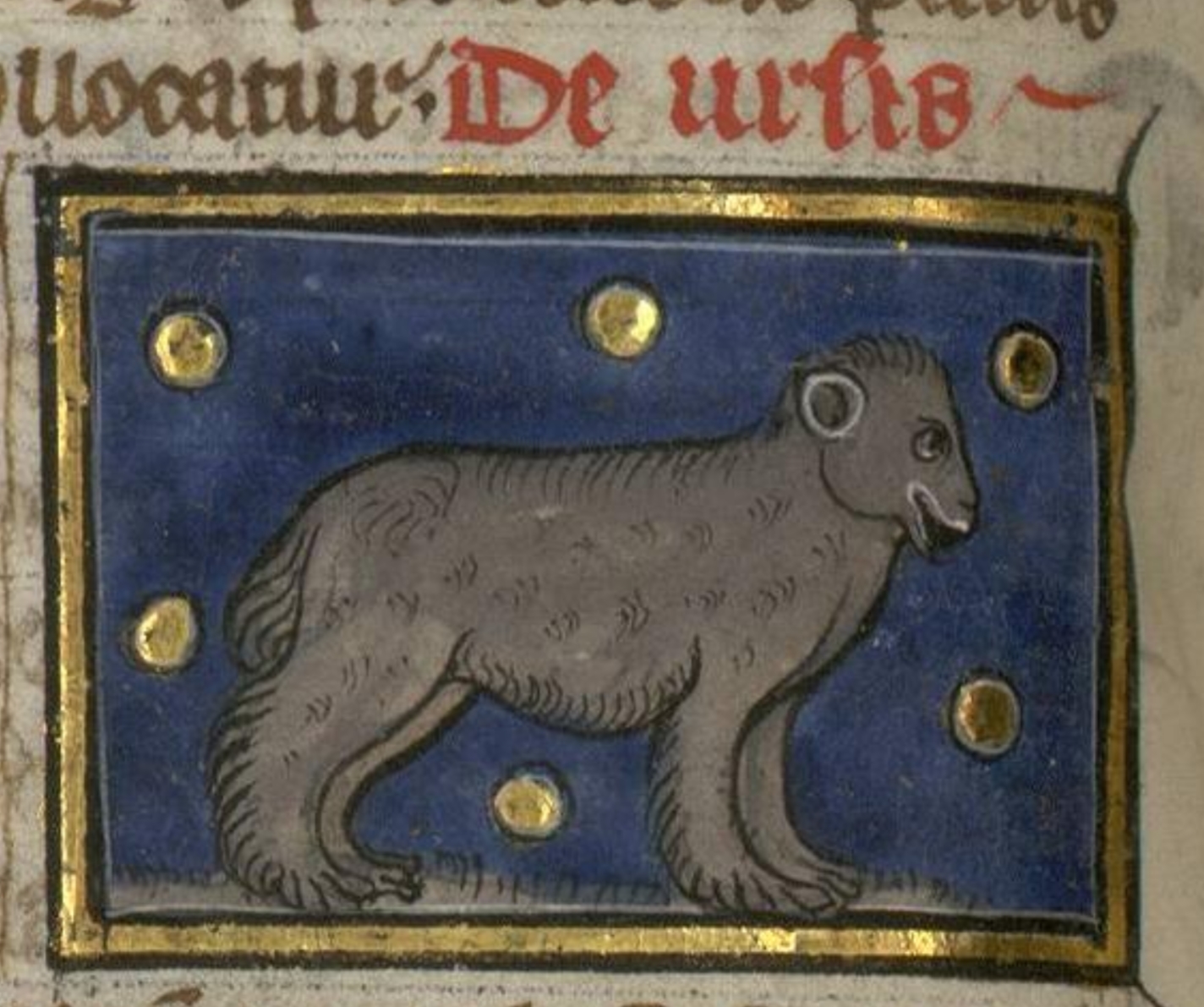
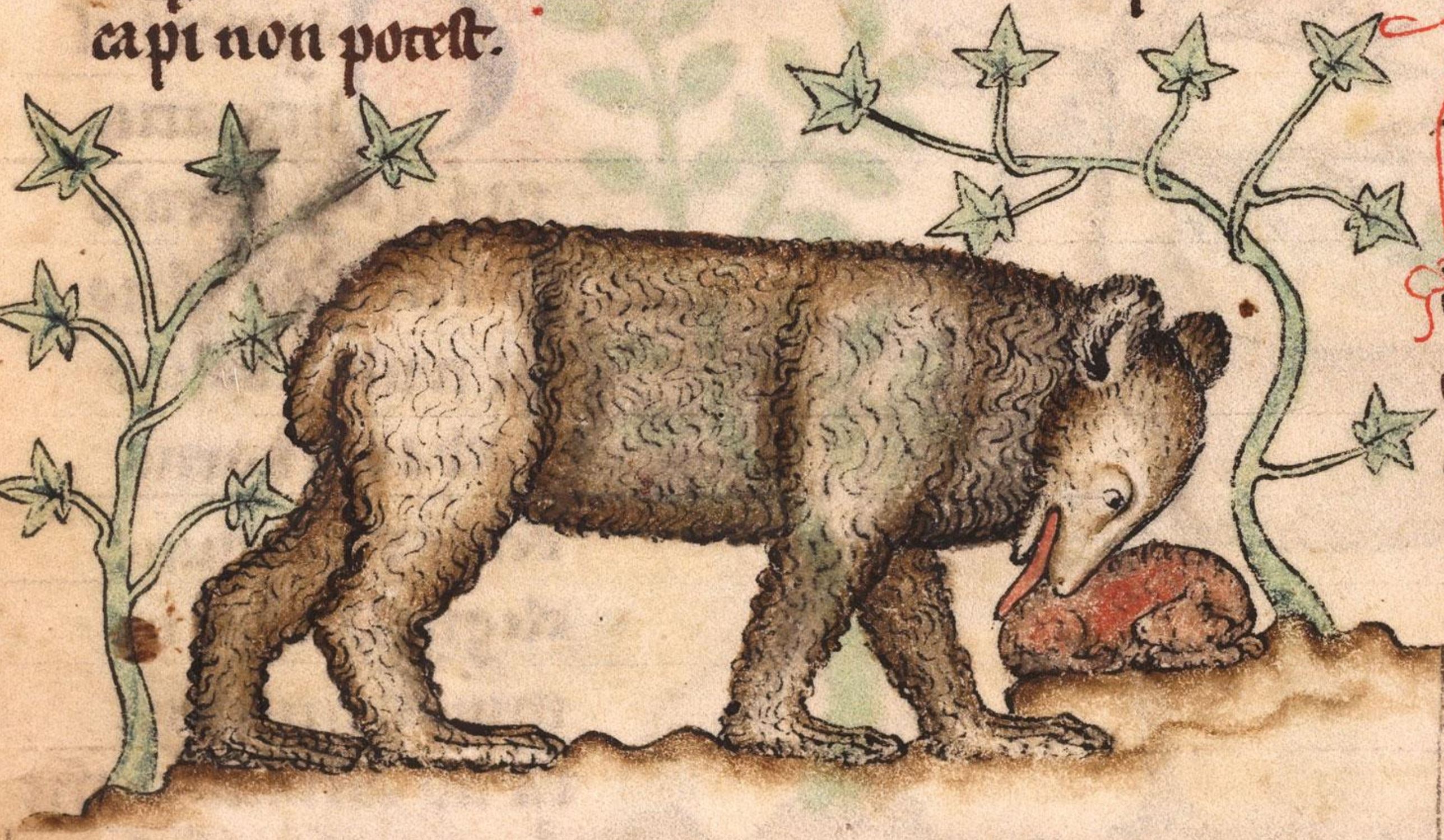
A bear fighting a lion, while both are ridden by naked men viciously fighting each other. Marginal illustration from a psalter.A very shaggy bear.The bear’s cub is born as a lump of flesh; the bear has to lick it into its proper shape.Two bears fight with a unicorn, a scene not described in any bestiary. Marginal illustration.
The beast imagery also extends to the concept of revenge. One big theme in Five Nights At Freddie’s is the concept that revenge, (whether justified or not), is blind and indiscriminately destructive. Even though the five ghosts that possess the animatronics are justifiably angry for being murdered, they don’t just try to kill Afton- they attack any poor soul who sticks around the pizzeria at night. Like Hamlet, who wants to avenge his father’s murder, but kills the wrong people, the five souls trapped in their metal cages have a noble goal- protect the children in the pizzeria, and destroy Afton, but they are full of beastlike rage and are unable to see friends from foes. This kind of blind rage reminds me of how real bears will fight off anyone whom they perceive as a threat. In medieval manuscripts, bears are tender to their cubs and literally form them out of little hairy lumps by licking them into shape. At the same time, they are powerful, deadly, and violent to anyone that threatens the cubs.
This kind of blind violence is something Shakespeare explores a lot in his history plays and his tragedies. Every time he talks about a society going wrong, he describes it as if it were populated with beasts, not humans. In Timon of Athens, the titular character, having left Athens to go live in the woods, laments to his frenemy, the cynical philosopher Apemantus, how his city has become like a collection of beasts:
Timon. What wouldst thou do with the world, Apemantus, if it lay in thy power?
Apemantus. Give it the beasts, to be rid of the men.
Timon. Wouldst thou have thyself fall in the confusion of2025 men, and remain a beast with the beasts?
Timon. A beastly ambition, which the gods grant thee t’ attain to! If thou wert the lion, the fox would beguile thee; if thou wert the lamb, the fox would eat three: if thou wert the fox, the lion would suspect thee, when peradventure thou wert accused by the ass: if thou wert the wolf, thy greediness would afflict thee, and oft thou shouldst hazard thy life for thy dinner: wert thou a bear, thou wouldst be killed by the horse: What beast couldst thou be, that2045 were not subject to a beast? and what a beast art thou already, that seest not thy loss in transformation!
Apemantus. If thou couldst please me with speaking to me, thou mightst have hit upon it here: the commonwealth of2050 Athens is become a forest of beasts.
Timon. How has the ass broke the wall, that thou art out of the city? Timon Of Athens, Act IV, Scene iii.
In short, the history of horror, which Shakespeare helped shape in plays like Macbeth, Richard III, Hamlet, and others, has a lot of classic tropes and the Five Nights At Freddie’s games exploit them quite well; tropes like supernatural vengeance, the death of innocents, beast-like killers, and unquiet ghosts. What works the best about this franchise is that it tells its lore like a mystery, slowly revealing Afton’s gruesome crimes over multiple installments. I wonder if someone has ever applied this to Shakespeare…
Shameless plug: Romeo and Juliet Murder Mystery
I’m proud to announce that I’ve just been approved to present a fully online, fully immersive murder mystery-style game, where you play as a detective trying to solve the mysterious death of Juliet Capulet! This is a really cool mixture of Shakespeare and forensics science as you examine crime scenes, look for clues, interrogate suspects, and untangle the story of Romeo and Juliet, and it even takes place over the course of five nights! Classes start March 17th. Register now at www.outschool.com!
Would Shakespeare enjoy playing FNAF well, who knows, but I do like to think he would appreciate the lore, if not the jump scares……
I can think of no better wrapup to my play of the month “Twelfth Night,” than by reporting on my visit to an actual Twelfth night Party, presented by the Society For Creative Anachronism.
What’s a Twelfth Night Party?
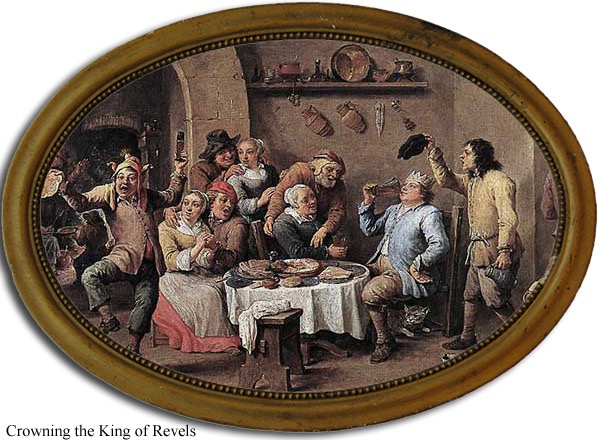
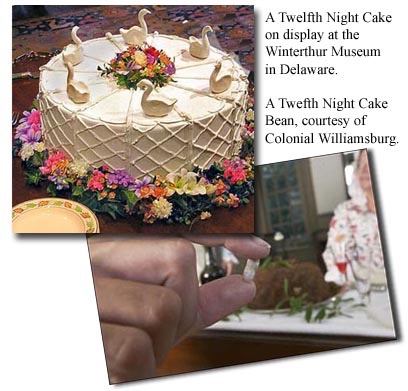
If you took my class on Shakespearean Christmas traditions or read my blog posts, you know that, back in Shakespeare’s day, Twelfth Night was a party to end the Christmas season. It was presided over by a Lord of Misrule, who would lead people in games and songs. The party would also have a Twelfth Night Cake with a bean in the center. If you found the bean, you’d have good luck for the year! So I was pleased to come to a real-life Twelfth Night party and see these traditions come to life!
What is the society for Creative anachronism?
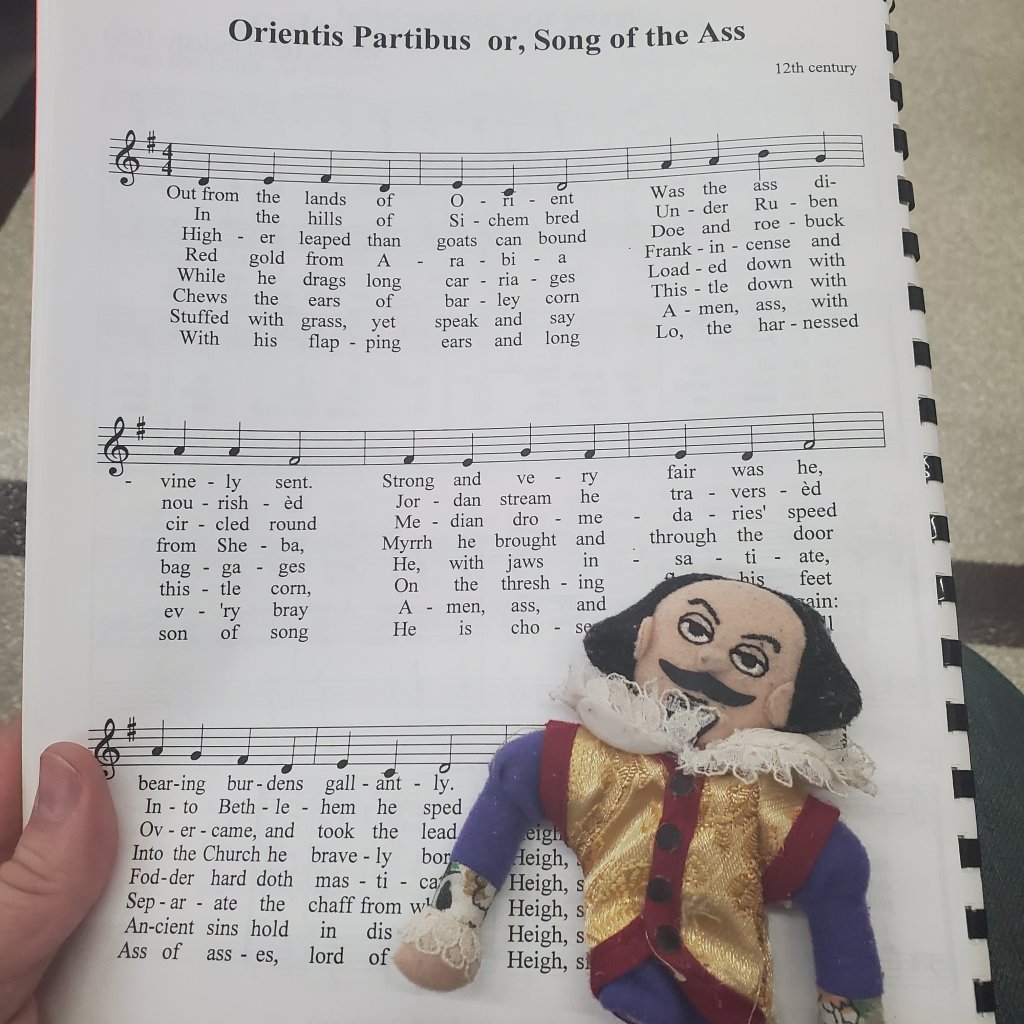
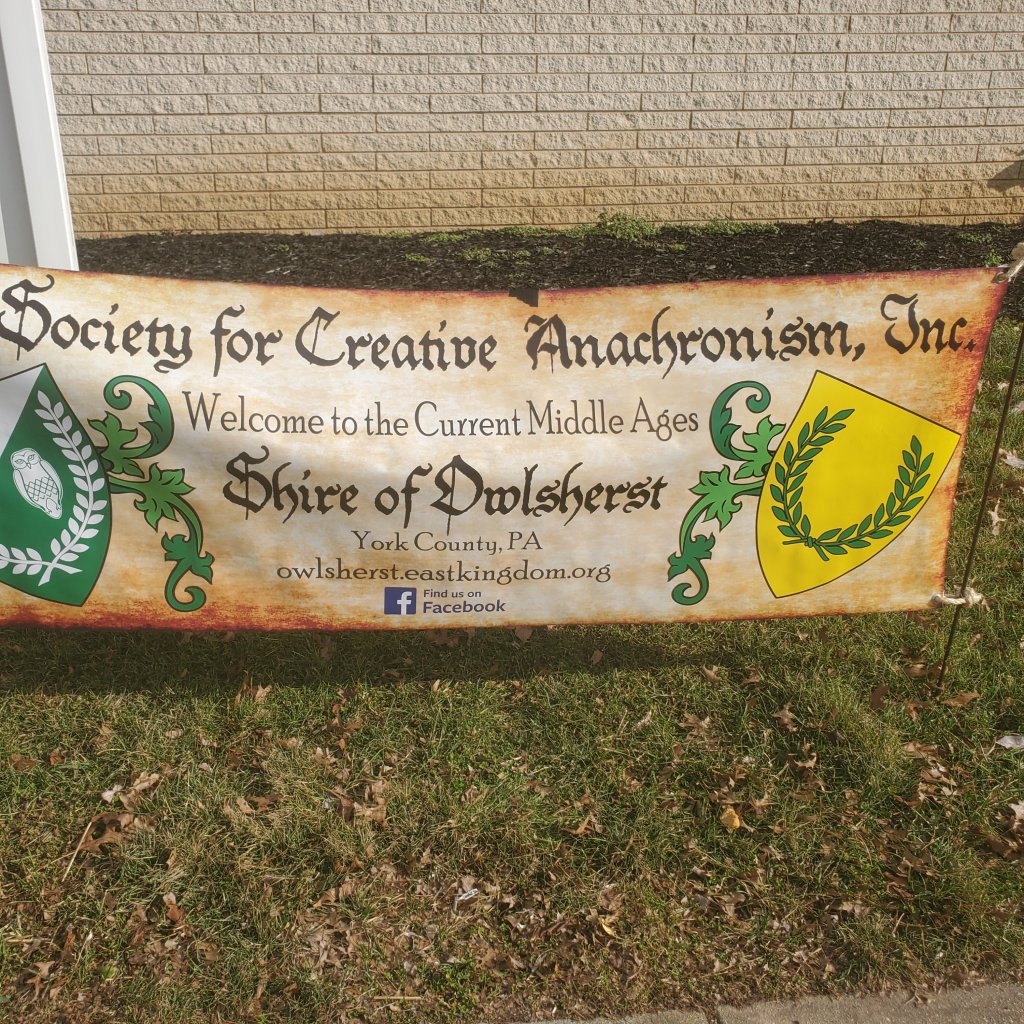
The short answer is- it’s LARPING for history nerds. Rather than creating a D&D persona and then getting arms and armor to play-fight in the backyard, SCA members create personas based on real medieval history, make or buy real historical arms and armor, (or arts and crafts as the case may be) and spend years of their lives studying and perfecting their immersion in that character’s life. SCA-ers learn how to fight with swords, daggers, spears, etc, how to sing medieval songs, medieval dances, and many other medieval ‘mysteries,’ which in this case means arts, crafts, and professions.
The Shire of Owlsherst
Owlsherst is the SCA’s local chapter in York PA. They have a number of dedicated members who specialize in textiles to rapier-dagger fighting. I’ve posted some videos of their fighting demonstrations on Youtube and Tiktok and their archery master has his own Tiktok channel. They hosted this year’s Twelfth Nigh party and have many other events throughout the year. For more information on this chapter, go to https://owlsherst.eastkingdom.org/
My reaction
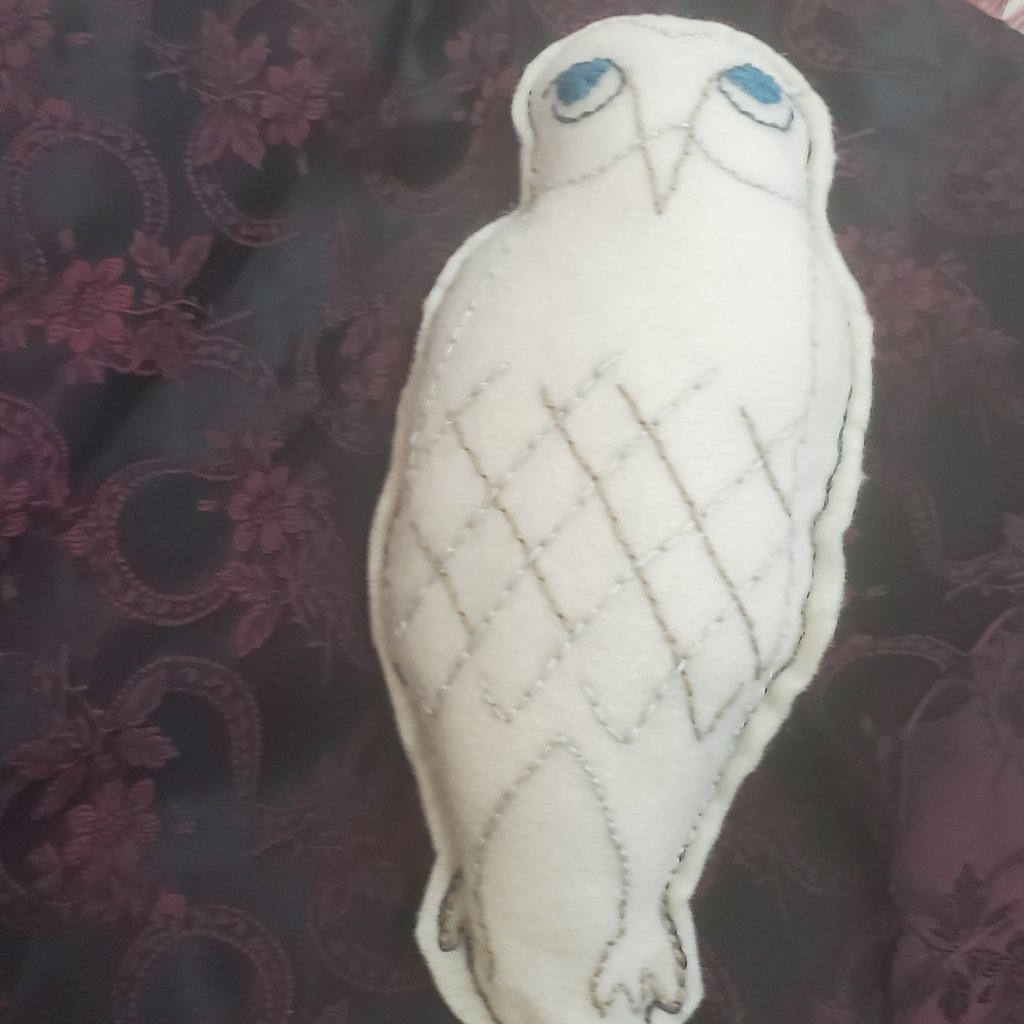
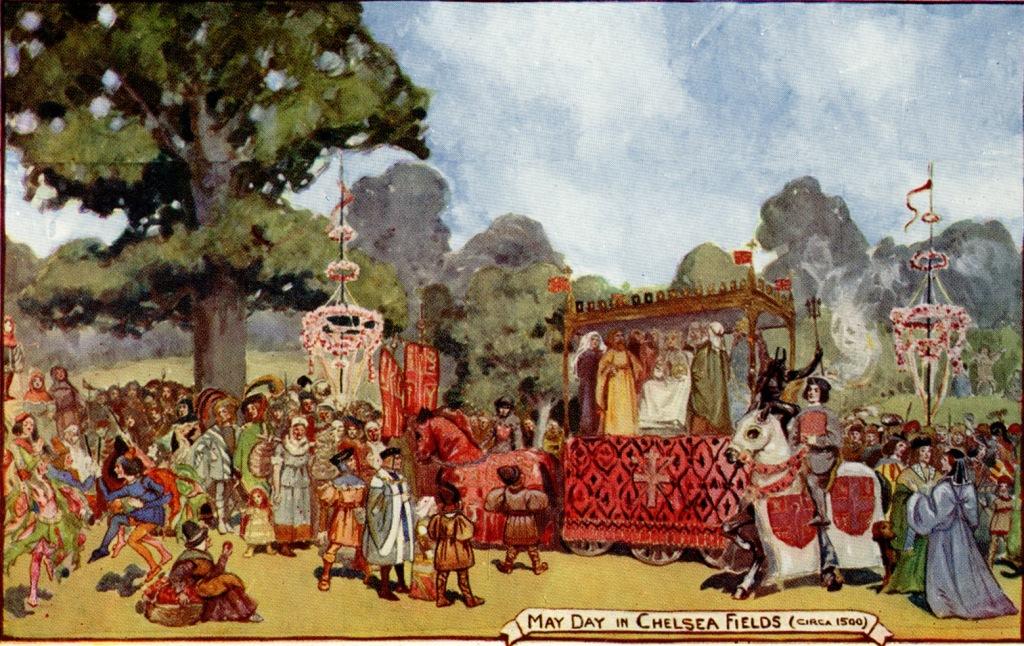
Every SCA event is a great way to celebrate people who are passionate about history and have talents for arts and crafts. Everything from the tapestries to the to the food, to the adorable owl toys, was made by hand by these dedicated people (most of whom brought their own medieval costumes). More members were doing live demonstrations of rapier/ dagger fights, binding books in cow leather, and singing medieval Christmas songs. I was inspired by everyone’s dedication and hard work to put this together. I also wonder if this is how Shakespeare himself felt when, as a child, he went to sheep shearing fairs and saw his friends and fellow artisans put on amateur bible plays on medieval pageant wagons.
That said…
I should warn you that, like a lot of historical reenacting societies like Civil War reenactors, etc, this society is more aimed at hardcore history nerds, than anyone else. This isn’t Medieval Times or a big-budget renaissance fair which is aimed at children and casual fun seekers. As such, it wasn’t really family-friendly. There aren’t many activities for kids and many of the arts and crafts are too delicate for toddlers and young kids. Also, this event isn’t particularly immersive or organized. People mostly just mingled, ate, and watched the various demonstrations. Keep in mind, this is just one chapter and just one event, which means your experience may vary. Nevertheless, because of the organization’s amateur historical nature, I would caution you to manage your expectations. Like I said before, this isn’t some big-budget Disney theme-park ride, but it is a chance for hardcore history nerds to get together, share their knowledge, and celebrate the traditions of a bygone era. If that’s your thing, I highly recommend it!
Hello everyone! I’m back from break and happy to celebrate one of my favorite holidays with you- the one that gave its name to one of Shakespeare’s greatest comedies- Twelfth Night
I’ve been in this play three times and I’m continually struck by how fun, romantic, and progressive it is. It raises questions about gender roles, social norms, bullying, and even catfishing and heteronormativity! It’s a fascinating and thought-provoking play and it’s my favorite of Shakespeare’s comedies!
Shakespeare’s early comedies are about young love, infatuation, and being ‘madly in love’ (sometimes literally). His middle plays are about mature relationships between men and women and the need for commitment. I would argue that Twelfth Night, (and possibly Much Ado About Nothing), are the best examples of Shakespeare telling meaningful stories about romantic relationships.
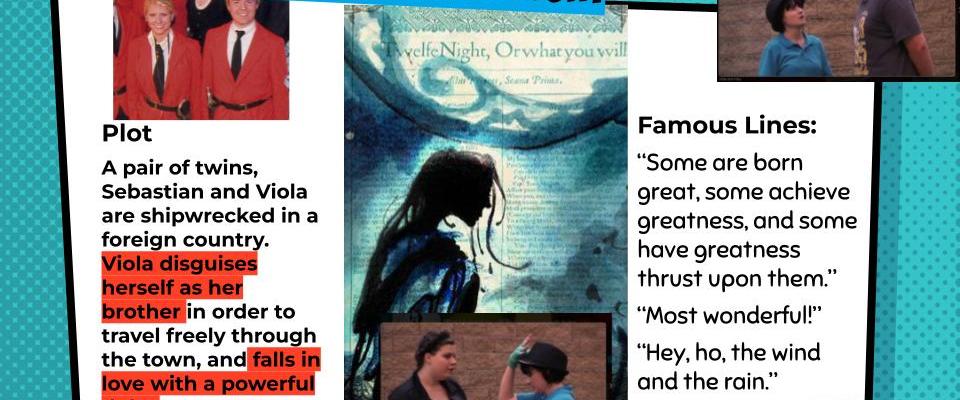
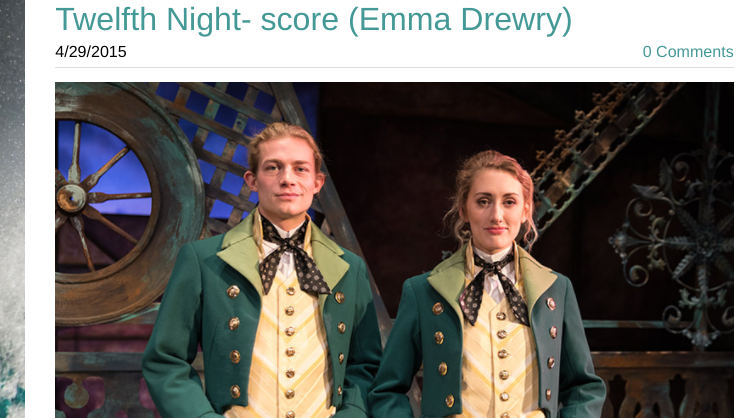
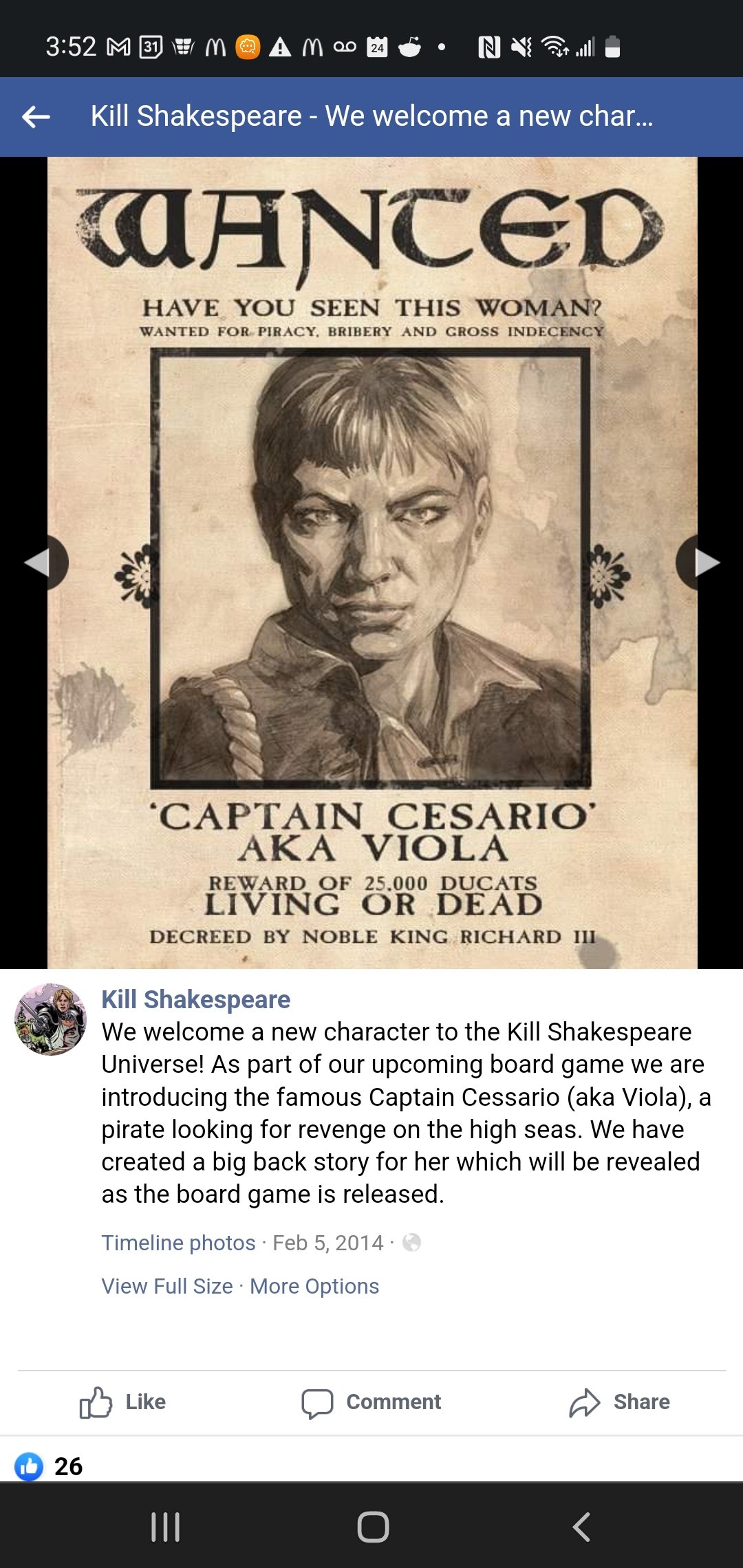
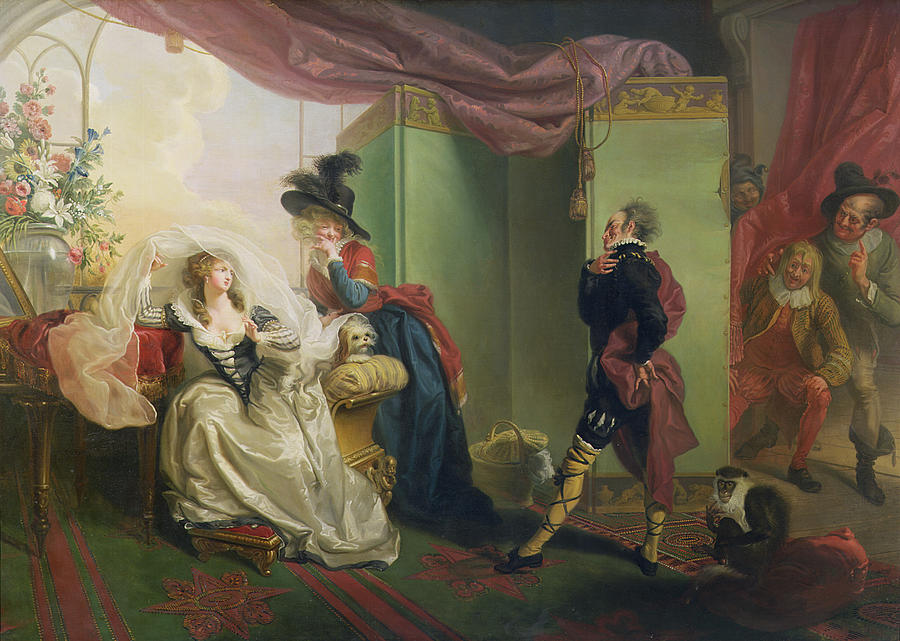
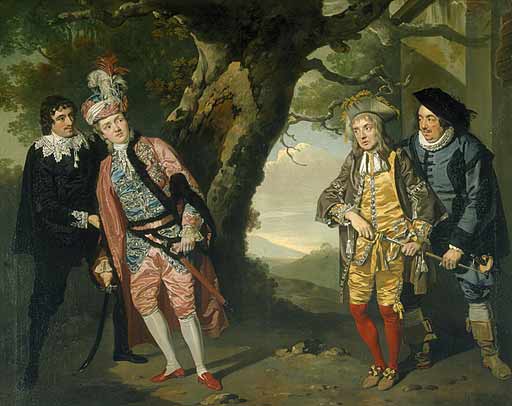
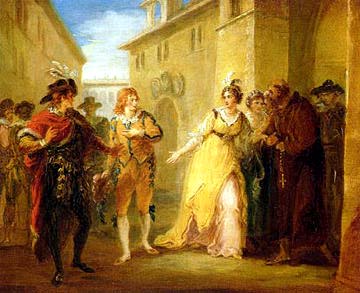
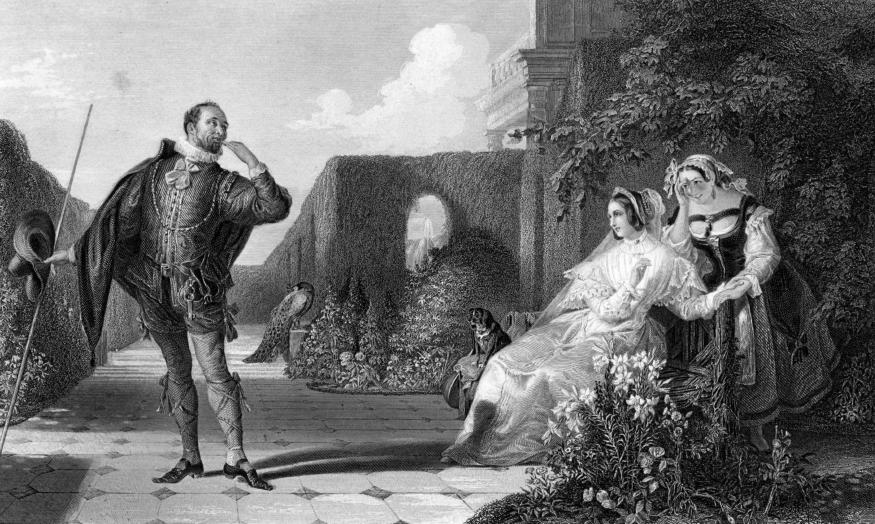
Images from various productions and paintings of “Twelfth Night.”
In honor of “Twelfth Night,” I’ve created a coupon for my course on Shakespeare’s comedies from now till January 31st: Get $10 off my class “Shakespeare’s Comic Plays” with coupon code HTHESYTIT110 until Jan 31, 2023. Get started at https://outschool.com/classes/shakespeares-comic-plays-868BR5hg and enter the coupon code at checkout.
To finish I wanted to give you a complete production of Twelfth Night for your viewing pleasure, but I can’t decide which one, so I will post a bunch today!
1. 1996 TV movie starring Geoffrey Rush (Pirates of the Caribbean)
Basics Of Stage Combat: Students will learn the basics of safely enacting a fight onstage, in preparation for a Shakespeare play. We will also learn about the history of sword fighting in the military and the duel.
Trailer for Basics of Stage Combat.
My daughter really enjoyed taking this class. She was actually able to use her sabre and try out her routine on her father. Paul is quite knowledgeable about Shakespeare and made the class really fun by teaching a fight scene from Romeo and Juliet. It is amazing watching her practice with Paul over Zoom. I hope Paul will have. more combat classes, it is a different way to learn Shakespeare.
IB, Parent
An Interactive Guide To Shakespeare’s London (New Class)
A virtual tour of Shakespeare’s London will get kids to interact with the culture of Elizabethan England.
Class Experience
To teach kids about the Elizabethan era and the background of Romeo and Juliet, The Instructor will interact with the class (via pre-recorded videos), pretending to be Shakespeare. The class, pretending to be actors in Romeo and Juliet, will get a virtual tour of The Globe Theater, Hampton Court Palace, and a virtual visit to an Elizabethan doctor's office. This activity is an immersive way for them to learn about the period, how it relates to the world of the play, and how Shakespeare changed theater.

The class will take the form of a guided WebQuest activity.  First, the students will get a worksheet that has a series of fill-in-the-blanks about Elizabethan society (below). The students will fill out this worksheet based on a Nearpod and in conjunction with a website I’ve made, https://sites.google.com/nebobcats.org/visit-to-elizabethan-london/home?authuser=0
Both the Nearpod and each webpage will have a virtual tour, a video, and text explaining some aspects of Elizabethan life. Before they go to each location, I will give a short introduction via prerecorded video:
Wizard Science
In this one-hour course, your child will discover the enchanting world of science through a series of magical experiments. Learn about such topics as Astronomy, Static Electricity, chemistry, and optical illusions.
In this one-hour course, students will learn and play games that will explore the history behind Christmas traditions. We will also discuss the themes, characters, and famous quotes from Shakespeare’s play “Twelfth Night.”
Since “Macbeth” is my Play of the Month, I’m offering a discount for my online class on the play. You can get $5 off my class “Macbeth: An Immersive Learning Experience” with coupon code HTHES6G3YH5 until Nov 4, 2022. Get started at https://outschool.com/classes/macbeth-an-immersive-learning-experience-xGKHeHgH and enter the coupon code at checkout.
To learn more about the class, watch the trailer above, and read my description of the escape room:
Though Shakespeare’s Hamlet is very much the story of a renaissance prince, it’s important to remember that the play’s sources date back to the Dark Ages. The anonymous “UR-Hamlet,” (later published in the early 1590s ), is based on an ancient legend about a prince who fights to the death to revenge his father’s murder. Shakespeare’s adaptation still contains a nod to this ancient culture that praised and highly ritualized the concept of judicial combat.
Back in Anglo-Saxon times, private disputes, (such as the murder of one’s father) could be settled through means of a duel. In this period, England was occupied by the Danes, (which we would now call Vikings), and several Viking practices of judicial combat survive. For example, the Hólmgangan, an elaborate duel between two people who fight within the perimeter of a cloak.
At the end of Shakespeare’s Hamlet, the revenge cycle between Hamlet, Leartes, and Fortinbras, comes to a close using a duel. Hamlet has murdered Leartes’ father but Hamlet did not intentionally kill him. This kind of legal dispute would certainly have been settled with a duel in Saxon times. This is one reason why Leartes scorns Hamlet’s offer of forgiveness at the beginning of the scene, and instead trusts in the outcome of the fight to prove his cause. Hamlet and Leartes begin fighting officially under the terms of a friendly fencing match, but it becomes clear early on that at least in the mind of Leartes, this is actually a blood-combat. He is demanding blood for the death of his father, as the Danes would have done during the Anglo Saxon times when Shakespeare’s source play of Hamlet was written.
What happens in the fight
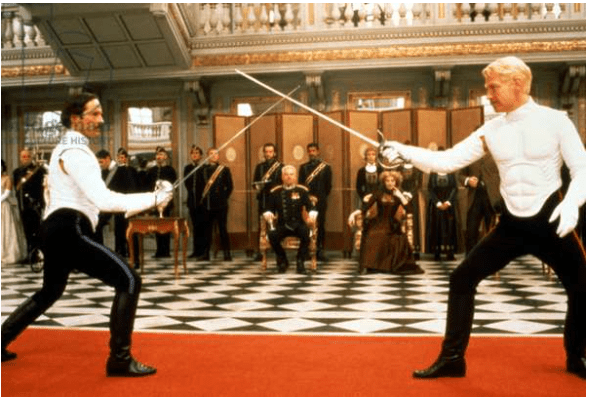
Olivier’s Sword Fight in Act V, Scene iii (1948).
The sword fight at the end of Hamlet is surprising in many ways. First of all, it is much more choreographed than many of Shakespeare’s other fights which are usually dramatized on the page very simply with two words: “They fight.” In Hamlet by contrast, Shakespeare has a series of important and descriptive stage directions. Furthermore, the fight is divided into three distinct bouts or phrases, or if you like “mini fights.” Below is the full text of the fight. I shall then explain what happens in each phrase.
PHrase One
Shakespeare it very clear that Hamlet gets a normal fencing rapier, while Leartes gets a sharp one, they fight one fencing bout where Hamlet scores a point. This is the most “sportsman like” part of the fight:
Enter King, Queen, Laertes, Osric, and Lords, with other

Attendants with foils and gauntlets.

A table and flagons of wine on it.

Claudius. Come, Hamlet, come, and take this hand from me.
[The King puts Laertes' hand into Hamlet's.]

Hamlet. Give me your pardon, sir. I have done you wrong;
But pardon't, as you are a gentleman.
Laertes. I am satisfied in nature,
Whose motive in this case should stir me most
To my revenge. But till that time
I do receive your offer'd love like love,
And will not wrong it.3890
Hamlet. I embrace it freely,
And will this brother's wager frankly play.
Give us the foils. Come on.
Laertes. Come, one for me.
Hamlet. I'll be your foil, Laertes. In mine ignorance3895
Your skill shall, like a star i' th' darkest night,
Stick fiery off indeed.
Laertes. You mock me, sir.
Hamlet. No, by this hand.
Claudius. Give them the foils, young Osric. Cousin Hamlet,3900
You know the wager?
Hamlet. Very well, my lord.
Your Grace has laid the odds o' th' weaker side.
Claudius. I do not fear it, I have seen you both;
But since he is better'd, we have therefore odds.3905
Laertes. This is too heavy; let me see another.
Hamlet. This likes me well. These foils have all a length?
They Prepare to play.

Osric. Ay, my good lord.
Claudius. Set me the stoups of wine upon that table.3910
If Hamlet give the first or second hit,
Or quit in answer of the third exchange,
Let all the battlements their ordnance fire;
The King shall drink to Hamlet's better breath,
And in the cup an union shall he throw3915
Richer than that which four successive kings
In Denmark's crown have worn. Give me the cups;
And let the kettle to the trumpet speak,
The trumpet to the cannoneer without,
The cannons to the heavens, the heaven to earth,3920
'Now the King drinks to Hamlet.' Come, begin.
And you the judges, bear a wary eye.
Hamlet. Come on, sir.
Laertes. Come, my lord. They play.
Hamlet. One.3925
Laertes. No.
Hamlet. Judgment!
Osric. A hit, a very palpable hit.
Laertes. Well, again!
Claudius. Stay, give me drink. Hamlet, this pearl is thine;3930
Here's to thy health.
[Drum; trumpets sound; a piece goes off [within].]
Give him the cup.
Hamlet. I'll play this bout first; set it by awhile.
Phrase Two
Mel Gibson in “Hamlet” (1990)
Claudius. Come. [They play.] Another hit. What say you?3935
Laertes. [aside] And yet it is almost against my conscience.
Again, Hamlet gets the upper hand and scores a point. While his mother is celebrating his victory, she accidently drinks the poisoned cup that Claudius meant for Hamlet. Now Claudius is enraged, Laertes is angry because of losing the first two bouts, and Hamlet is blissfully unaware that he is in mortal danger.
Phrase Three
When Hamlet isn’t expecting it, Leartes wounds him with the poisoned sword. From there, the fight degenerates into a violent, bloody mess where Hamlet disarms Laertes, then stabs Leartes. After this, the Queen dies, and Hamlet kills Claudius:
Hamlet. Come for the third, Laertes! You but dally.3950 Pray you pass with your best violence; I am afeard you make a wanton of me.
Gertrude. No, no! the drink, the drink! O my dear Hamlet!3965 The drink, the drink! I am poison’d. [Dies.]
Hamlet. O villany! Ho! let the door be lock’d. Treachery! Seek it out.
[Laertes falls.]
Laertes. It is here, Hamlet. Hamlet, thou art slain;3970 No medicine in the world can do thee good. In thee there is not half an hour of life. The treacherous instrument is in thy hand, Unbated and envenom’d. The foul practice Hath turn’d itself on me. Lo, here I lie,3975 Never to rise again. Thy mother’s poison’d. I can no more. The King, the King’s to blame.
Hamlet. The point envenom’d too? Then, venom, to thy work. Hurts the King.
Claudius. O, yet defend me, friends! I am but hurt.
Hamlet. Here, thou incestuous, murd’rous, damned Dane, Drink off this potion! Is thy union here? Follow my mother. King dies.
God’s providence in Hamlet (or lack therEof)
It is telling that everyone dies in this scene, which indicates that the concept of providence seems somewhat ambiguous in this scene- yes, Claudius dies but so does Hamlet. In addition, Leartes dies justly for his own treachery as he claims, but he also tries to avoid damnation. Leartes is guilty of treason for killing Hamlet, but Hamlet is guilty of killing an old man and a young maid, so Leartes asks God to forgive Hamlet for two murders, while he has only committed one. Providence doesn’t seem clear which crimes are worse. Further, Providence fails to reveal the guilt or innocence of Queen Gertrude- did she know her second husband murdered her first? Did she support Hamlet’s banishment? Did she know the cup was poisoned, and is therefore guilty of suicide, or was she ignorant and punished by fate for her adultery and incest? Knowing the conventions of judicial combat help the reader understand the compex world of Hamlet, a world devoid of easy answers.
How Would I Stage the Fight?
Phrase 1 I want the two combatants to start en guarde, their blades touching, then there will be a series of attacks on the blade. Hamlet will advance and attack the low line of Leartes’ sword Hamlet will advance and attack the high line of Leartes’ sword Leartes will advance and beat attack the high line of Hamlet’s sword Leartes will advance and attack the low line of Hamlet’s sword
Hamlet performs a bind on Leartes’ sword, sending it off on a diagonal high line. Hamlet attacks Leartes leg and Leartes will react in mild pain.
Phrase 2 Leartes is no longer fighting in polite manner, so this will be the real fight where he’s actually going for targets Hamlet and Leartes come together and bow, Both go into en guarde and Osric signals the start of the fight. Hamlet attacks Leartes’ blade high Leartes attacks Hamlet’s blade low Leartes suddenly does a moulinet and attacks Hamlet’s right arm. Hamlet does a pass back and parries 3 Leartes attacks Hamlet’s Left Arm. Hamlet does another pass back and parries 4 Leartes cuts for Hamlet’s head. Hamlet passes back and does a hanging parry 6, which causes the sword to slide off. Hamlet ripostes, slips around Leartes’ ________side, and thrusts offline in suppination. He then flicks the sword, hiting the back of Leartes’ knee. Phrase 3 Concern- you need to have enough space for Hamlet to chase Leartes DS, and for Leartes to slice Hamlet with the forte of his sword. Before the bout is supposed to start, Hamlet walks toward the sword, point down to Leartes US L or USR “I am afeard you make a wanton of me” Leartes: “You mock me sir!” Hamlet: “No, by this hand” Hamlet presents his hand. Leartes places his sword on it, and slices it Leartes gives Hamlet a stomach punch Hamlet falls to his knees dropping the sword. If necessary, Hamlet can pull out a blood pack to put on his hand.
Leartes points his blade above Hamlet’s head, then brings it back, preparing to strike off Hamlet’s head. Leartes: “Have at you now” Hamlet ducks to the right, with his leg extended. Leartes Passes forward, trips on Hamlet’s leg. Hamlet does a slip and goes behind Leartes’ back. Hamlet rabbit punches Leartes on the back, picks up Leartes’ sword, noticing the blood on it Leartes slowly rises, then notices Hamlet with his sword, he quickly grabs Hamlet’s weapon Hamlet shoves Leartes DS into a corp a corp, then traps Leartes’ blade The two push each other for a while
Osric: “Nothing Neither way” Hamlet pushes Leartes downstage, then slices him across the back. Leartes stops DS, and falls to the ground
Murder of Claudius If Claudius is standing, we can have Horatio grab the king around the neck, Hamlet places the sword across Claudius’ stomach, and slices him. If Claudius is seated, Hamlet picks up the goblet with one hand, slices the king’s leg, then, (after establishing a good distance), Hamlet points the blade off line, just left of Claudius’ neck. Hamlet is giving Claudius a choice- drink or be stabbed. When Claudius chooses to drink, either Hamlet or Horatio can give him the cup. If Horatio gives it to Claudius, it might give him the idea to die later.
I love Game Of Thrones! If you’ve ever read the books or seen the series on HBO, like me you might be amazed by the scale and complexity of the world author George RR Martin created. He wove together a rich tapestry of medieval history, legends, and yes, Shakespeare. He used some of Shakespeare’s plots, commented and expanded on his themes, and adapted some of his iconic characters into a very rich and in a way, very modern story.
Since the prequel series “House Of The Dragons” premieres today, I’m going to examine the components of Martin’s narrative that he embroidered off of Shakespeare’s plots, themes, and characters. If you like my take on this, or if you disagree, please leave a comment below! If you have any suggestions for other popular works adapted from Shakespeare, let me know and I’ll review them on the blog!
Part I: Story
Shakespeare wrote four plays that chronicle a series of civil wars where powerful families battled each other for the crown of England. Like Game of Thrones, the conflict was mainly between the kingdoms in the North and South:
Shakespeare’s three parts of King Henry VI and Richard III chronicle the real struggle between the Yorkists in the north to take the crown from the Lancastrians in London in the South.
Part II: Themes
Power corrupts, especially those who go seeking it.
The death of chivalry and honor in favor of political backstabbing.
King Henry VI has a speech where he watches a great battle while sitting on a molehill, watching the tide turn back and forth between his soldiers and the Yorkists. As with Game Of Thrones, the more blood each side has on its hands, the harder it becomes to decide whom to truly root for. In the end, it doesn’t seem to matter- kingdoms are won and lost as arbitrarily as a game. All it takes is time, and a good player to win.
The silence of the Gods. Shakespeare’s King Lear is constantly making oaths to his gods and asking them to punish his enemies. Likewise, Lear’s friend the Duke Of Gloucester, places his faith in the gods to protect Lear and punish the usurpers Goneril and Regan. Nevertheless, the action of King Lear doesn’t show any kind of divine judgement- Lear is exiled, goes mad, is sent to prison, and finally dies. Gloucester loses his sight, his lands, and dies randomly right after he is re-united with his son Edgar. In both King Lear and Game Of Thrones, there is a persistent question as to the nature of the gods, or even the surety of their existence.
King Lear mourns Cordelia’s death by
James Barry, c. 1786.
No where is this more apparent than at the end of the play King Lear, when, just as it seems that the Duke of Albany is about to reward the good people and punish the wicked, King Lear arrives howling, with the dead Cordelia in his arms. “Is this the promised end?” in horror at the gods’ apparent cruelty. https://youtu.be/7acLWsal1FU
In Game Of Thrones, the good characters pray to their old gods and new, but never seem to hear from them or sense their influence. Osha, the Wildling even suggests that the gods have no power in King’s Landing, where the special God’s Wood trees have been cut down.
Part III: Characters
Below is a list of my favorite GOT characters, with my interpretation of their Shakespearean roots.
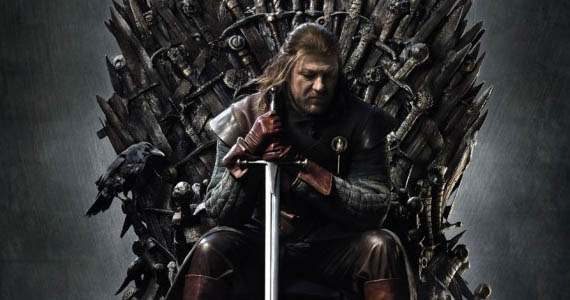
Ned Stark- Humphrey Duke of Gloucester from Henry VI, Part II
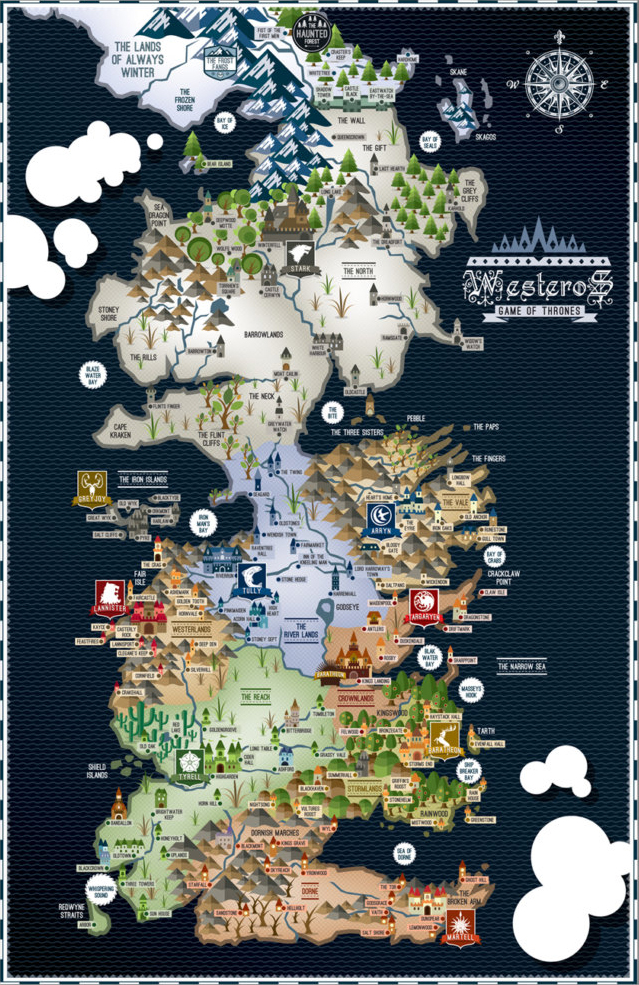
Duke Humphrey is a Yorkist from the north of England, just as Ned is Lord of Winterfell, a powerful kingdom in the north of Westeros. King Robert makes Ned Protector Of the Realm when he dies, which makes him king in all but name, and tasked with taking care of Robert’s young son Joffrey until he comes of age.
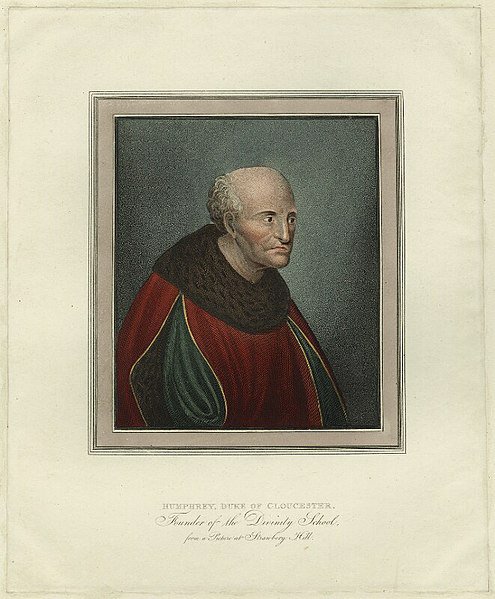
Portrait of the historical Humphrey, Duke of Gloucester from the National Portrait Gallery, artist unknown.
In Shakespeare’s Henry VI trilogy, King Henry the Fifth makes his brother Humphrey Lord Protector before he dies, to take care of England until his infant son Henry VI comes of age to rule. Like Ned, Humphrey is loyal, blunt, and only interested in keeping the realm at peace. In both Westminster and the Red Keep, all the lords are conniving and ambitious, and only interested in advancing themselves politically. These two lord protectors are the only ones with the good of the kingdom in mind.
Both Ned and Humphrey are betrayed and executed by those ambitious lords around them for the same reason; they stand in the way of the lords in their quest for power. In Henry VI, Part II, Henry’s ambitious queen Margaret starts a smear campaign against Humphrey’s wife, then pressures the King to force Gloucester to resign. As if that weren’t enough, Margaret also secretly conspires to murder the noble duke. Similarly, In Game of Thrones (Spoiler Alert), queen Circe puts her son on the throne and proclaims Ned a traitor. In both cases though, once the Lord Protector dies, the whole kingdom erupts in fights and arguments for the crown on all sides.
Ned Stark also resembles the heroes of Shakespeare’s Roman plays. He is cold and stoic as Brutus, and a devoted soldier like Titus Andronicus. Ned’s dire wolf is another connection with Shakespeare’s Roman plays; the wolf 🐺 is the symbol of the Roman Empire; packs of cold hunters who depend on each other for the survival of the family.
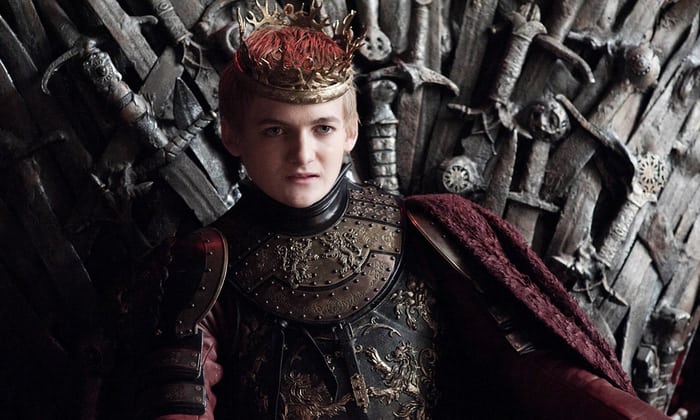
King Joffrey- Saturnine from Titus Andronicus– Joffrey is like the worst kind of tyrant- rash, proud, violent, and cruel. He lacks the maturity to make wise decisions and because of his privileged upbringing, he takes even the tiniest slight against him as an act of treason, and leaves a trail of heads in his wake. Worse still, he is easily manipulated by his mother Circe, who teaches him to act and feel superior to everyone else, and never care for the good of anyone but himself. In that way, he is very much like a Roman Emperor like Nero or Caligula, the real people whom Shakespeare adapted into the character of Emperor Saturnine in his play Titus Andronicus.
When we first meet Saturnine, he leads an angry mob into the streets of Rome, demanding to be made emperor, and threatening all out war if he doesn’t get his way. He also turns on the loyal soldier Titus, (who helped him win a war and win his crown), just because Titus wouldn’t give Saturnine his daughter in marriage. In the clip below from the 1999 movie Titus, Emperor Saturnine (Alan Cummings) is furious just because Titus wrote some mean scrolls about him, after Saturnine killed two of Titus’ sons, and banished a third.
King Robert Baratheon- Edward IV from Richard III.
◦ In the first book of the Game of Thrones series, Robert is the King of the Seven Kingdoms, having won a civil war to take it away from the Mad King Araes Targaryen. Edward in the play Richard III has just won the crown of England after a civil war against the mad King Henry VI. Both men were powerful warriors and used to be strong and handsome. People loved and feared him, but now the pressures of keeping the throne has literally consumed them.
P. 53
Next had come King Robert himself, with Lady Stark on his arm. The King was a great disappointment to Jon. His father had talked of him often: the peerless Robert Baratheon, demon of the Trident, the fiercest warrior of the realm, a giant among princes. Jon only saw a fat man, red-faced under his beard, sweating through his silks.
Jon had noticed that too. A bastard had to learn o notice things, to read the truth that people hid behind their eyes. Two seats away, the king had been drinking heavily all night. His broad face was flushed behind his black beard.
In this passage from Thomas More’s History Of Richard III, (Shakespeare’s primary source for the play), More chronicles how Edward went from a handsome young king, loved and feared by all, into a gluttonous, lecherous, sick old man, who was consumed by care.
He was a goodly personage, and very princely to behold: of heart, courageous; politic in counsel; in adversity nothing abashed; in prosperity, rather joyful than proud; in peace, just and merciful; in war, sharp and fierce; in the field, bold and hardy, and nevertheless, no further than wisdom would, adventurous. Whose wars whosoever would well consider, he shall no less commend his wisdom when he withdrew than his manhood when he vanquished. He was of visage lovely, of body mighty, strong, and clean made; however, in his latter days with over-liberal diet [1], he became somewhat corpulent and burly, and nonetheless not uncomely; he was of youth greatly given to fleshly wantonness, from which health of body in great prosperity and fortune, without a special grace, hardly refrains. This fault not greatly grieved the people, for one man’s pleasure could not stretch and extend to the displeasure of very many, and the fault was without violence, and besides that, in his latter days, it lessened and well left.
-Thomas More, History Of Richard III, c. 1513
There are also similarities in how the characters died. King Robert was killed by a wild boar, while King Edward was killed by his brother Richard, whose sign was a white boar. As a bonus, the stag that is the sigil of House Baratheon, is also the seal of King Richard II, the king who, in the Shakespearean tragedy that bears his name, started the civil war when he was murdered in the Tower Of London. Below is a picture of the famous Wilton Diptych, (Richard the Second’s private alter piece), which depicts the king and all the angels in heaven wearing a badge with a white stag on it.
LittleFinger -Lucio from Measure For Measure, Iachimo from Cymbeline, Bawd from Pericles, etc. Shakespeare has a host of character like this lord of Westeros, the Master of Coin. He is cowardly and cynical, but he is also very clever and understands people’s weaknesses, especially sex. Like Bawd from Pericles, Little Finger has grown rich off brothels, and like many real life governments, he turns his prostitutes into spies. This gives him not only cash, but dirt on every lord in the 7 kingdoms. He only worries about Ned Stark, (who can’t be bought), and Vares the eunuch, who can’t be seduced. Little Finger is basically an oily politician and exploits the power of lust in the men of King’s Landing.
Jon Snow– Edgar and Edmund in King Lear Philip the Bastard in King John.
◦ Snow is the illegitimate son of Ned Stark. He’s aware of what he is, so he joins thieves and rapers as a knight of the Night Watch to make a life for himself, just as Edgar becomes a mad beggar in King Lear once he is accused of attempted murder. He has few illusions and like all the base-born children in Shakespeare:
775
He was who he was, Jon Snow, bastard oath breaker motherless, friendless, and damned. For the rest of his life, however long that might be- he would be condemned to be an outsider, the silent man standing in the shadows who dares not speak his true name.”
◦ Shakespeare wrote several characters born out of wedlock such as Phillip Falconbridge in King John, and Edmund from King Lear.
Unlike Jon Snow, Edmund in King Lear uses deceitful and cruel cunning in order to advance his position in life. Snow doesn’t try to change the rules, but both of them know that no one is going to give them anything. Early in book one, Jon learns to accept the cruelty of the world, and to accept what he is:
Let me give you some council, bastard, never forget what you are, for surely the world will not. Make it your strength. Then it can never be your weakness. Armor yourself in it, and it will never be used to hurt you.
Song Of Ice And Fire, p. 57.
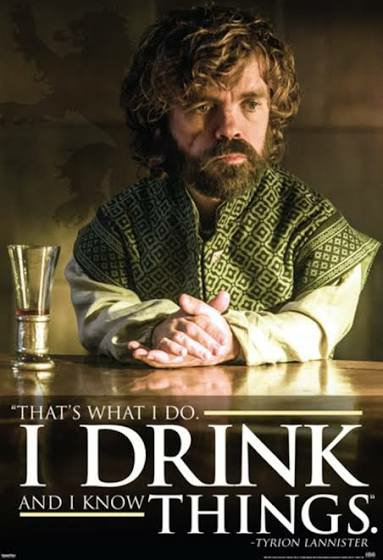
🦁 Tyrian Lannister –
Obviously he shares some parallels with Richard III, with his small size and the fact that he is the most hated member of a powerful family. In fact, Peter Dinklage who plays Tyrion played Richard the Third back in 2004.
In terms of his personality however, Tyrion has neither the cruelty, nor the bitterness of Richard. For this reason, I would argue that Tyrion more closely resembles Sir John Falstaff.
◦ Like Falstaff, Tyrion laughs at his physical form as a way of disarming his enemies.
◦ Both Characters are famous for talking their way out of anything.
◦ Both characters are down on their luck for most of the books
Both characters are, ahem, fond of drink. Falstaff even has a beer named after him:
◦ Most Of all, Tyrion and Falstaff are survivors – they will do anything to stay alive, good or bad. They are also unapologetic about acting cowardly and deceitfully to avoid death. In Falstaff’s famous ‘Catechism speech,’ he mocks the concept of honor and how it frequently gets men killed.
FALSTAFF
‘Tis not due yet; I would be loath to pay him before
his day. What need I be so forward with him that
calls not on me? Well, ’tis no matter; honour pricks
me on. Yea, but how if honour prick me off when I
come on? how then? Can honour set to a leg? no: or
an arm? no: or take away the grief of a wound? no.
Honour hath no skill in surgery, then? no. What is
honour? a word. What is in that word honour? what
is that honour? air. A trim reckoning! Who hath it?
he that died o’ Wednesday. Doth he feel it? no.
Doth he hear it? no. ‘Tis insensible, then. Yea,
to the dead. But will it not live with the living?
no. Why? detraction will not suffer it. Therefore
I’ll none of it. Honour is a mere scutcheon: and so
ends my catechism.
Now observe this passage where Tyrion reacts to the death of a noble knight who was foolish enough to wear armor while crossing a river on a raft.
“Good my lord,” the messenger said. “Lord Brax was clad in plate-and-mail when his raft overturned. He was so gallant.” “He was a fool,” Tyrion thought, willing his cup and staring down into the wind depths. Crossing a river at night on a crude raft, wearing armor, with an enemy waiting on the other side–if that was gallantry, he would take cowardice every time. Song of Ice and Fire, 765.
My favorite part of the books is the way Martin writes the female characters. All the female characters are dealing with the fact that women have very little power or say in their society and they all use Shakespearean means or methods to get what they want.
🦁 Circe- Tamara and Lady Macbeth
◦ Circe
Just as her son Joffrey has the arrogance and sadistic cruelty of a Roman emperor, Circe is a mirror image of the cruel empress Tamara, Queen Of Goths in Titus Andronicus. Both women are attracted to power and motivated by revenge. Tamara wants revenge against General Titus, who executed her son in the war. After seducing and marrying the emperor, she uses her influence to execute two of Titus’ sons. She then uses her lover Aaron the Moor (with Whom she secretly has a child), to concoct a plot to rape and mutilate Titus’ daughter. And if that weren’t enough, she tries to drive him mad by appearing at his home dressed as the Roman goddess Revenge. In short, Tamara is a classic femme fatale, who raises above the social oppression of her sex by seducing powerful men, and stabbing them in the back.
Circe is also a femme fatale, though Martin gives her more time to explain her motivations than Shakespeare gives Tamara. Like the Queen Of Goths, Circe marries King Robert Baratheon, while secretly having a taboo affair, this time with her brother Jamie. The difference is that Circe kills not strictly for vengeance, but mainly to conceal the fact that her son Joffrey is actually the product of her incest in order to protect him and eventually make him king. This is why Circe kills Ned Stark, Jon Aron, and consents to the murder of all or Robert Baratheon’s true born sons.
Circe does desire revenge, but not against anyone in particular. Instead, she wants to repay the patriarchy that keeps her down simply because she is a woman. Quote about Circe when she talks about how jealous she is of Jamie. In that chapter we get a great sense of who Circe really is. Because she’s a twin, she compares herself to her brother, observing how Jamie was given on her glory and respect when he became a knight and a member of the King’s Guard, while she was sold off to king Robert at the age of twelve like a slave or a common whore. Why, Circe asks, if she looks so much like him and acts so much like him, is she treated so differently just because she’s a woman? In a perverse sort of way, her incest might be a misguided attempt to claim part of Jamie’s honor and power through sexual conquest. Both Tamara and Circe show how an oppressive patriarchy can plant truly destructive thorns in the hearts of women, and these two queens reap that bitter harvest by cutting down the men in power one by one.
like camera Circe is driven by her love for her children and her desire and her pride and desire for vengeance. She spends the first half of the place seducing the emperor to gain his favor and then when she is made empress she uses her power to systematically destroy Titus and his family. Similarly, Circe marries king Robert and then when he dies she makes her son she then kills Ned Stark guy in prisons his daughter tries to kill the second of and
Catelyn-
Hermione From The Winters Tale ❄️ 🐺
◦ Pious
◦ Kindness and mercy are her weapons as well as her will and devotion to her friends and family. Even Tyrion is impressed by her integrity.
🐺 Aria- Imogen from Cymbeline
◦ If it’s a mans world, pretend you are one! She learns to use a sword ⚔️ and uses her small size and gender to sneak away from her enemies.
🐉 Daenerys Targaryen- Cleopatra!
◦ Crafty and beautiful
◦ Uses her sexuality to gain a powerful man’s protection
◦ Her dragons 🐉 make her a goddess, elevating her beyond a woman and even a queen. In a society that opposed and ignored women, female monarchs needed to practically deify themselves in order to get the same respect as their male counterparts.
Just as the real Cleopatra claimed to be a descendant of the goddess Isis and Elizabeth I was part of the cult of the virgin queen, The Mother Of Dragons has a mythic power that commands fear and adoration.
Spoiler Alert
In the final chapter of book one, Daenerys tries to simultaneously say goodbye to her warrior husband Khal Drogo, and to get her few remaining soldiers to swear loyalty to her. She dresses him, she braids his hair, she puts him atop a pyre, and waits for a star to pass overhead to give his funeral a cosmic significance:
“This is a wedding too.”
The pyre shifted and the logs exploded as the fire touched their secret hearts. She could hear the screams of frighten horses and the voices of the Dothraki. “No,” she wanted to shout to him, “No my good knight, do not fear for me. The fire is mine. I am Daenerys Stormborn, daughter of dragons, bride of Dragons, Mother Of Dragons.”
This mirrors how, once Cleopatra loses Antony and knows that the Romans are coming to capture her, she says goodbye to Antony, and asserts herself as queen.
CLEOPATRA
Give me my robe, put on my crown; I have Immortal longings in me: now no more The juice of Egypt’s grape shall moist this lip: Yare, yare, good Iras; quick. Methinks I hear Antony call; I see him rouse himself To praise my noble act; I hear him mock The luck of Caesar, which the gods give men To excuse their after wrath: husband, I come: Now to that name my courage prove my title! I am fire and air; my other elements I give to baser life.
Have I the aspic in my lips? Dost fall? If thou and nature can so gently part, The stroke of death is as a lover’s pinch, Which hurts, and is desired. Dost thou lie still? If thus thou vanishest, thou tell’st the world It is not worth leave-taking. Antony and Cleopatra, Act V, Scene ii.
Dany does the same thing. She lights the pyre to help her husband ascend to the heavens, taking his place among the stars. Then, she sits on top of the pyre along with her three dragon eggs. Miraculously, she survives the fire and the dragons hatch, thus establishing her as the true heir of House Targarean and the Mother Of Dragons.
After witnessing the queen embracing her serpentine children, the blood riders that swore oaths to defend her husband swear again to defend her, promising to help her win the Iron Throne. Her power to command loyalty can win her the throne, and unlike Robert, keep it!
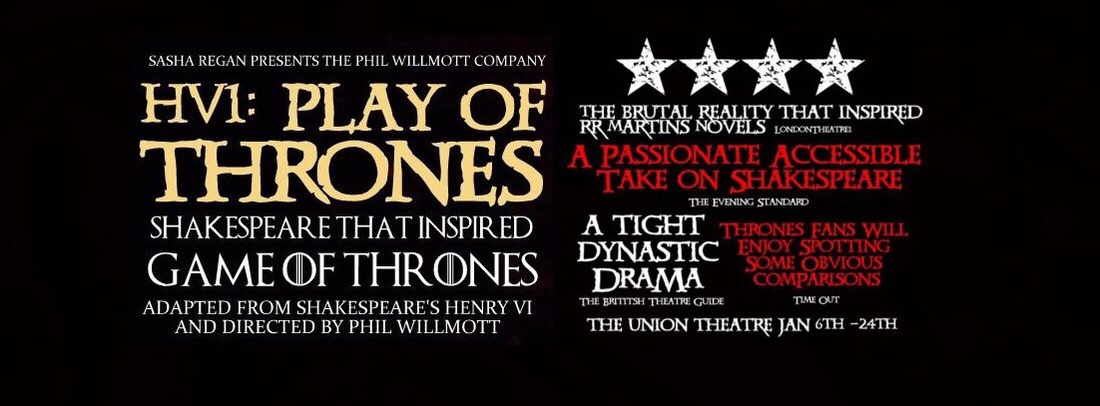
There are enough comparisons between Shakespeare and GOt that one playwright even adapted Shakespeare to resemble a Game Of Thrones story. Below is a poster of
Play Of Thrones, an adaption Of The Henry VI plays that, as I’ve mentioned, are full of characters and scenes similar to Game Of Thrones: