Graphic Novel Review: “Kill Shakespeare: VOl 4.” a Dark and angsty Shakespeare fanfic.

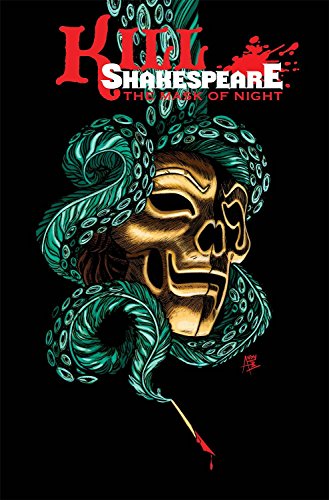
  • Cover art for Volume 4
  • Kill Shakespeare Comic

In this section, I review a Shakespeare book, movie, or TV show that I feel has some kind of value, either as an interpretation of Shakespeare, or a means to learn more about the man and his writing.

  1. Name: Kill Shakespeare (Vol. 4) by Connor McCreery and Anthony Del Col
  2. Media: Graphic Novel compilation, with accompanying website https://www.killshakespeare.com/ 
  3. Ages: Adult/ Teen. There’s some PG-13 language and a lot of fighting and gore, so it’s not really for kids
  4. Premise: William Shakespeare is more than just a simple playwright- he has a magic quill that brings his characters to life. Some of the characters worship him like a god or like a father. Many others, (as the title implies), want him dead. A faction of outlaw heroes who call themselves The Prodigals are trying to protect Shakespeare, including Juliet and Hamlet, but in this volume, they’ll have to face raging seas, bloodthirsty pirates, and the mind-altering effects of the island in Volume 3, which has pushed them all to near-madness.

   My reaction: Volumes 1&2 were framed as a civil war between the heroes and villains of the Shakespeare canon- basically an Infinity War for Shakespeare nerds. This volume is in the context of a high-seas pirate adventure. It has a lot of cool fights and the drama between Cesario and Viola is great, but honestly, I thought it was poorly paced. Maybe it’s my personal taste, but it’s hard to keep myself invested in the story when everyone is stuck on a boat.

Basic Details:

As I said in my review of Volume 2, what I like the most about this graphic novel is that the characters are consistent with how the real Shakespeare wrote him, yet they make different choices in the graphic novel. They also grow and play off each other in many interesting ways. Here are some examples:

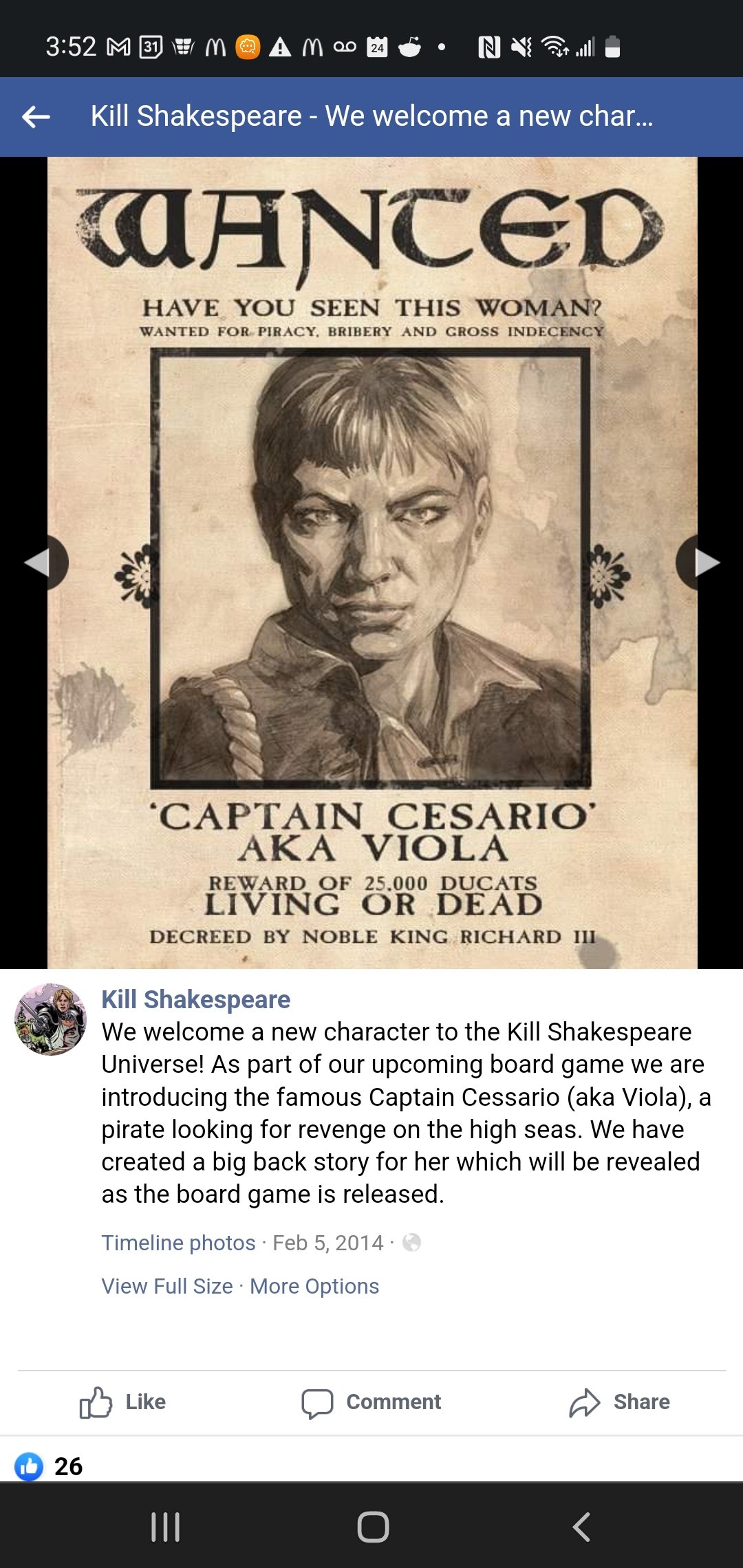
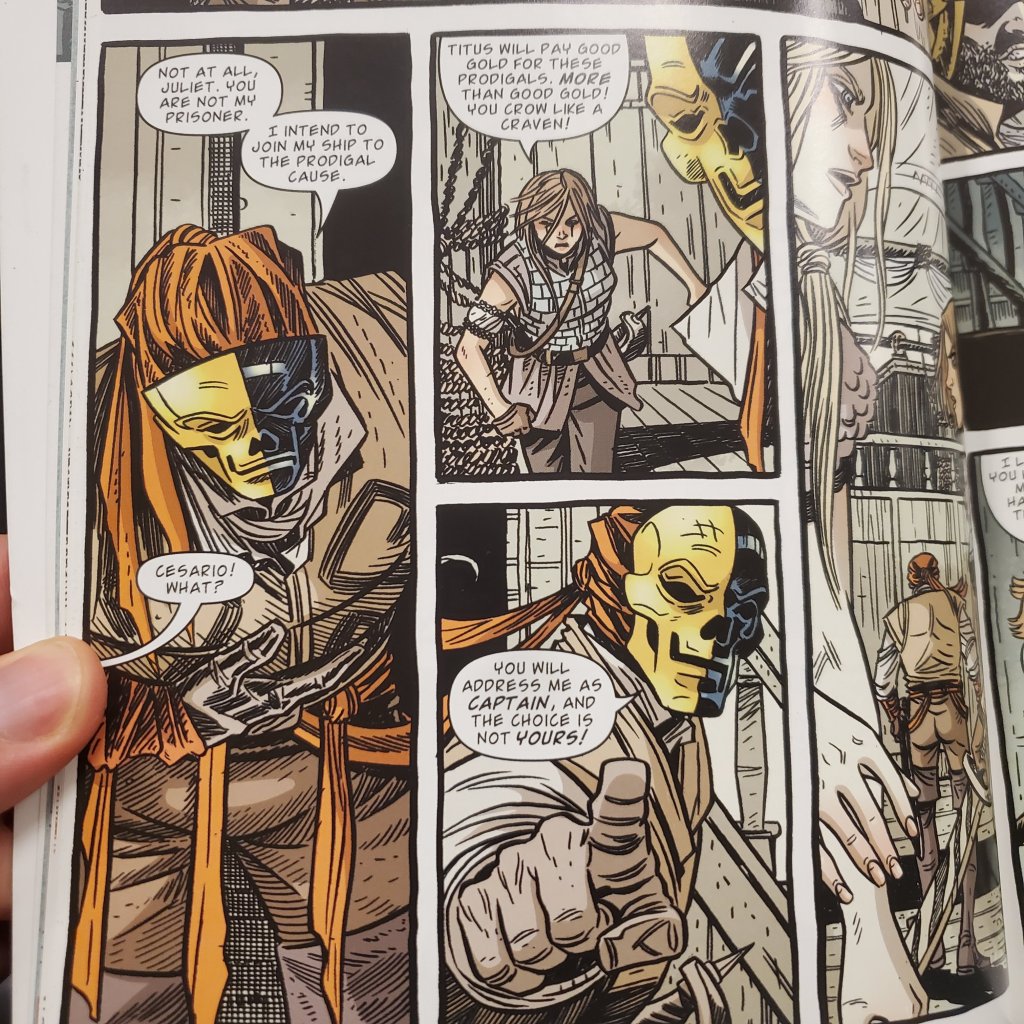
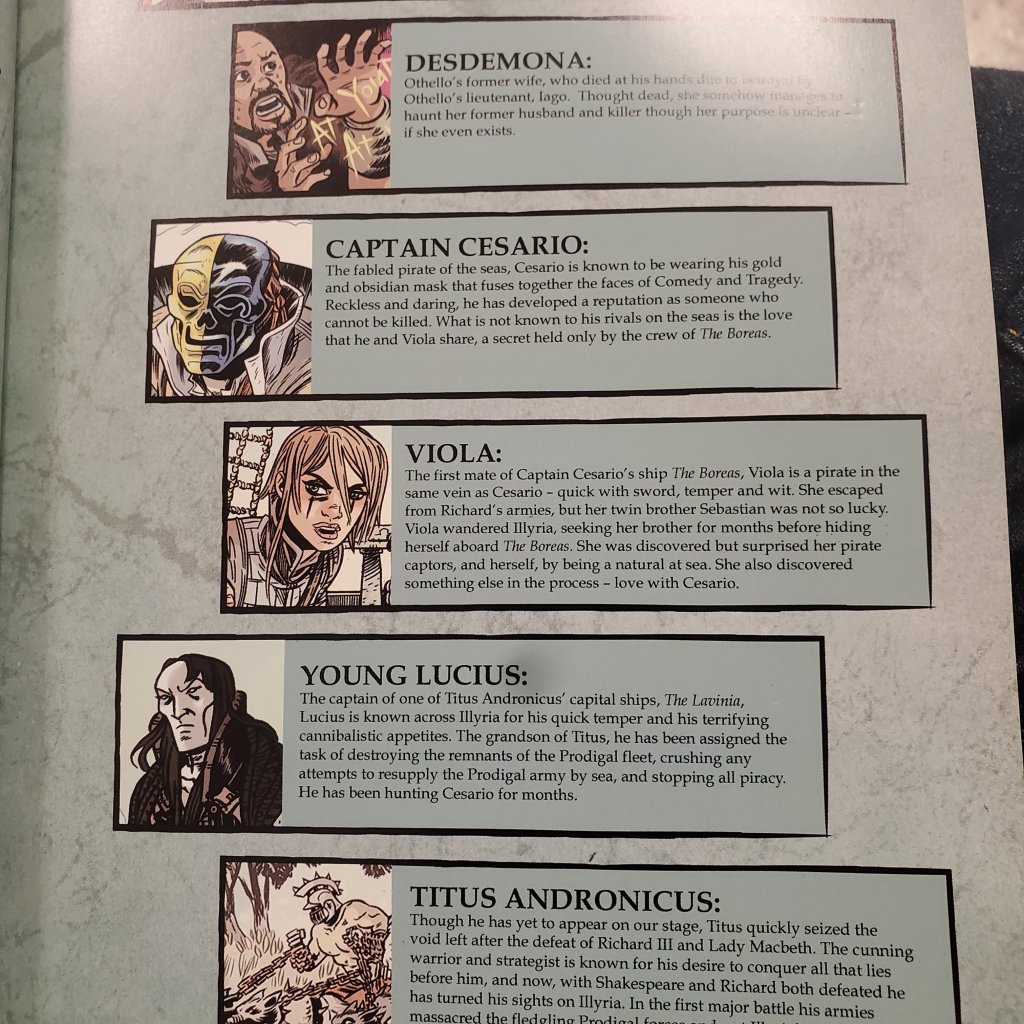
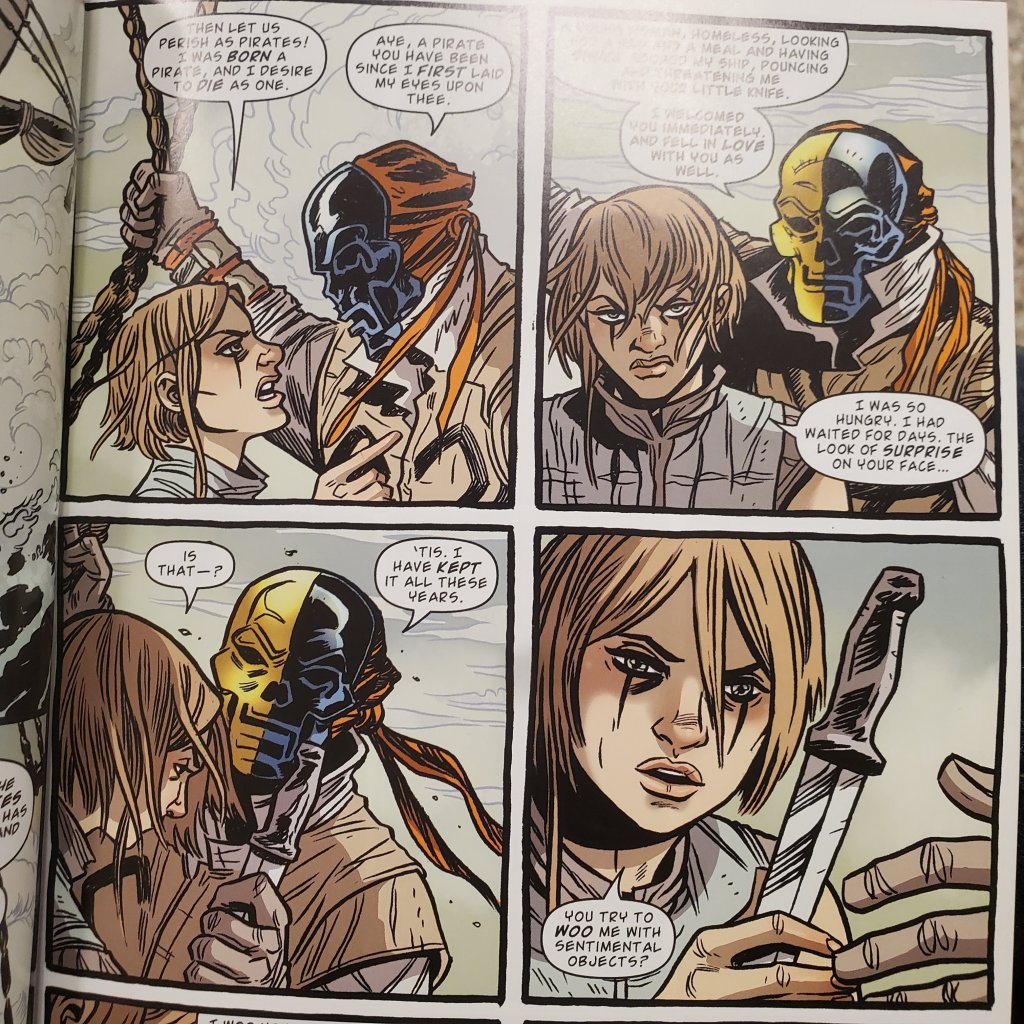
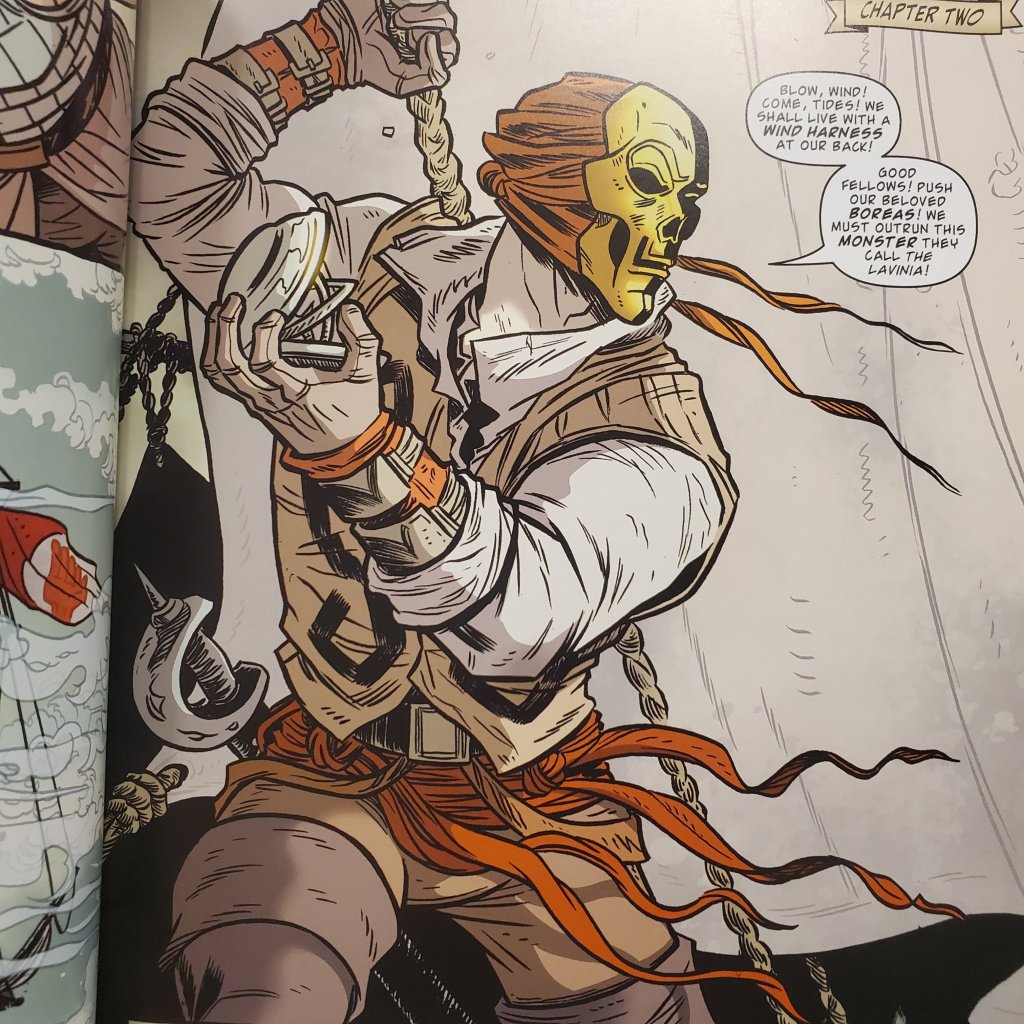
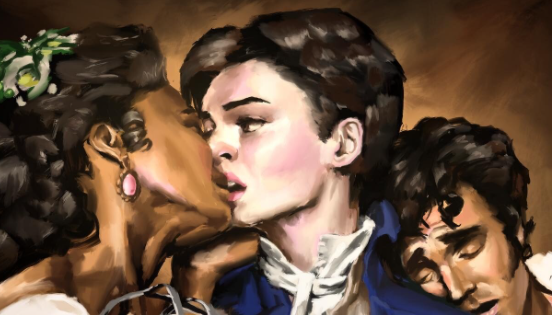
Most of the drama of the graphic novel centers around Captain Cesario, a dashing rogue pirate, and his first mate/ girlfriend Viola. The main characters from Volume 2, (Shakespeare, Hamlet, Juliet, and Othello), have escaped the effects of the island run by the mad wizard Prospero, but are still shell-shocked at feeling the terrifying psychic effects of that island. This is a clever plot device that basically makes it makes all the characters unnecessary except for Hamlet and Juliet. You could look at this installment as the story of 2 couples, (dare I say twin couples) where Viola and Cesario are fighting over whether or not to join Shakespeare and the other Prodigals, to remain on the high sea as pirates, or to betray them and become ingratiated with the fearsome cannibal-pirate Lucius Andronicus.

I won’t give too much away (there are some spoilers), but let’s just say that the relationships in Volume 2 have been tested to the breaking point; Hamlet and Juliet are having extreme problems, (almost as bad as Hamlet and Ophelia). Viola and Cesario are also fighting constantly. In addition, the ship is constantly under threat from the feared pirate Lucius Andronicus. Will the characters solve their internal conflicts before a mutiny breaks out? Or will they all be cut to pieces by the cannibal Lucius? On this boat, tempests are not kind, and salt waves are fresh with DEATH!

Shakespeare Easter Eggs
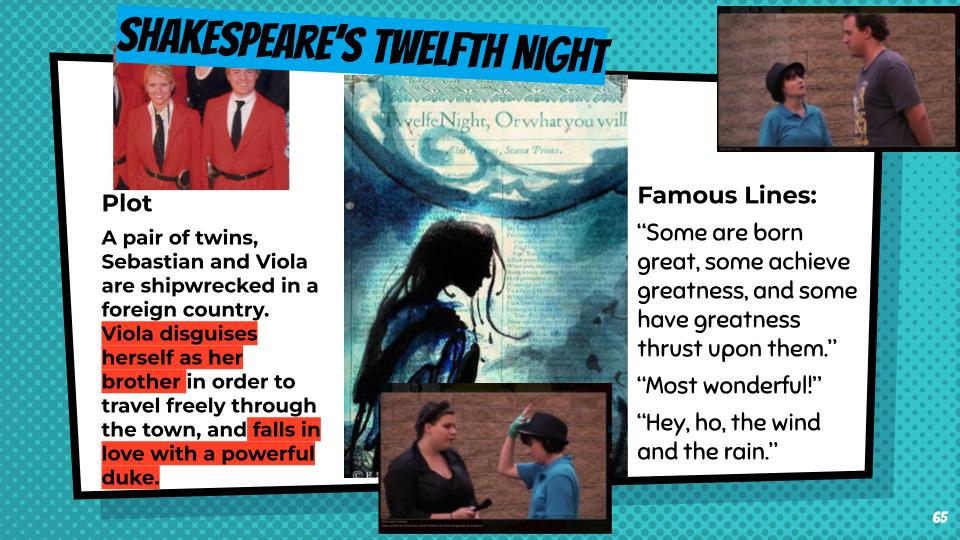
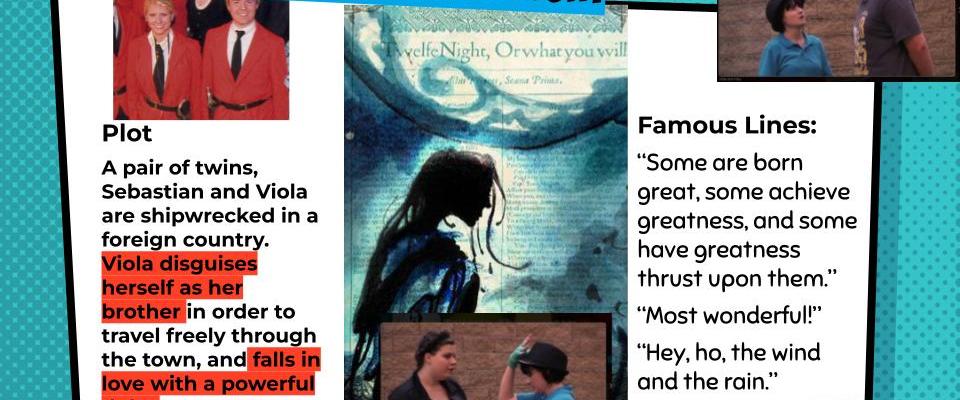
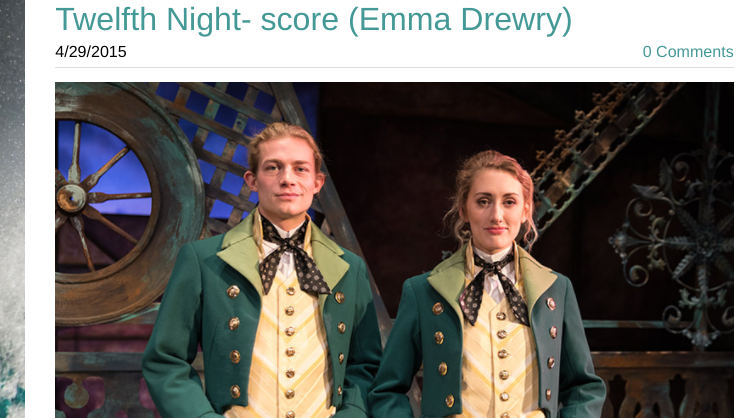
Kill Shakespeare, Volume 4 is largely based on Shakespeare’s Twelfth Night, which, although it mainly focuses on the courts of Duke Orsino and Countess Olivia, does have aspects of pirates, deception, and lovers quarreling. It is interesting (and I give the writers credit) for taking a light-hearted comedy with songs and dances and turning it into a swashbuckling pirate adventure; that takes real imagination, yet it works with the text; the first time we see Viola she is shipwrecked and the captain that saves her life is arrested offstage. This prompts Viola to disguise herself by wearing her twin brothers’ clothes and donning the non-de-plume Cesario, to freely behave like a man in a man’s world. Shakespeare already made Viola’s fate intertwined with the sea, so it makes sense that she might want to be a pirate. Kill Shakespeare takes Viola’s two identities and makes them two separate people, both intertwined with a love of the sea.
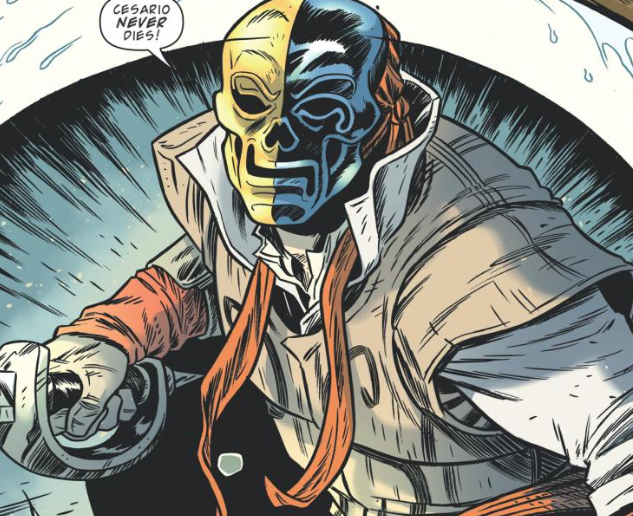
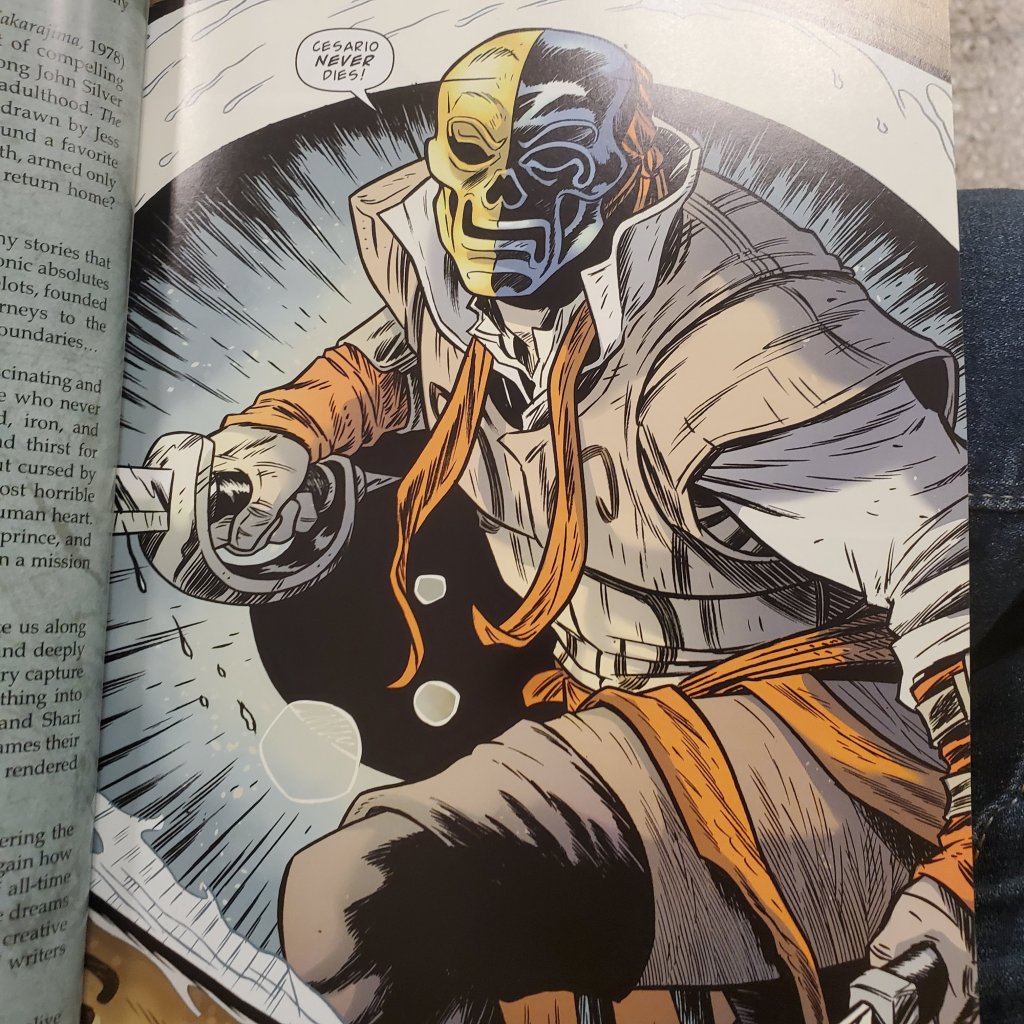
The graphic novel also conflates and expands other pirate characters from the play; there’s another captain in the play named Antonio who saves Viola’s brother Sebastian and is accused of being a pirate, While Viola in Twelfth Night is a noblewoman who out of necessity disguises herself as a man and becomes a servant to a Duke, Viola in this version is trying to escape being a noblewoman and becomes a pirate by choice. Meanwhile, Antonio, who denies being a pirate, is changed into the roguish Cesario, who loves Viola as much as Antonio loves her brother Sebastian in the play. Like Antonio, Cesario cares about Viola’s well-being and is willing to sacrifice everything to keep her safe, even being a pirate. This causes friction between the two since again, Viola wants to continue to be a pirate and would rather die than give it up. Their conflicting roles as shipmates and soulmates keep them at odds during the play, sort of like how Cesario’s mask is split down the middle; half tragic, and half comic.

Critique

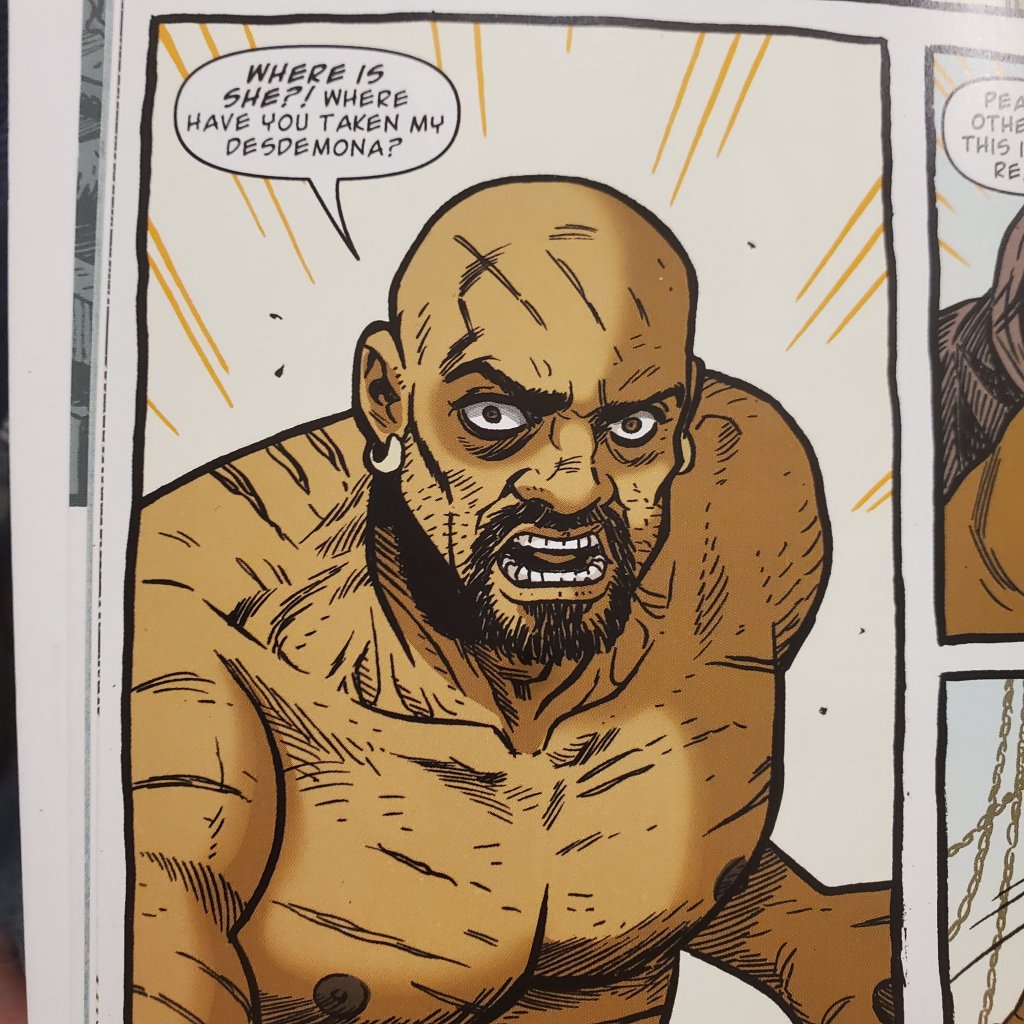
I think this graphic novel is poorly paced. Most of the first half consists of Cesario and Viola arguing about what to do with Shakespeare and the rest of the Prodigals. Their drama is good, but it supersedes everybody else, and I found myself wondering what was going to happen to Shakespeare and the rest, and wishing that they’d got more focus. Othello is reduced to a plot device because he is madly searching for Desdemona, whom he killed during the events of Shakespeare’s play. Othello is no longer the honest, loyal friend to Juliet that he was in the previous editions; now he’s more like The Incredible Hulk, filled with animalistic rage and unable to be controlled except by the love of his friend Juliet. In some ways, Othello was the most likable character in the previous volumes so I hated to see him like this.

In addition, the constant couples’ bickering gets a little bit tedious; I suppose that’s inevitable when you take all the comic elements out of Twelfth Night, (Sir Toby and Feste are back in Volume One, and Malvolio, Fabian, and Olivia are nowhere to be seen). I did enjoy the ending where Viola resolves her conflict with Cesario much the same way Viola solves the problem of her being Cesario in the play. I also like the way that they built up the antagonist Lucius from Titus Andronicus. Lucius is a good choice for a villain in this world because he’s seen some truly horrible things in his own play like his father mutilating people, his brothers and sister murdered, and the worst pie recipe of all time. Making Lucius a bloodthirsty, cannibalistic pirate is a great choice. Still, I wish they spent more time fighting with him instead of sailing away from him. In short, the characters are as compelling as ever but the action is lagging and the drama is reduced to mostly petty couple squabbling. I would like to see this series pick up in a more action-packed version more in keeping with a graphic novel.

Recommendation: I’d recommend this book to all mature fans of Shakespeare, anime, Manga, D&D, or any kind of nerd stuff!

url
url

Grade: 2 Shakespeare globes.

  • Official Website:
  1. www.killshakespeare.com

New Class: An Interactive Guide to “Macbeth”

Class Experience

In this virtual version of my popular “Macbeth” course, you will engage with William Shakespeare himself and learn about his play in a fun, spooky, and interactive way!

Unlike my previous “Macbeth” course, all teacher interactions will be done through the use of pre-recorded video.
Through a combination of multimedia lectures, online games, and a digital escape room, students will delve into the plot, characters, and themes of “Macbeth.” The class is designed to be interactive, fun, smart, and spooky.

Class organization

The class is organized into five parts using a combination of Nearpod, online games, videos, and a digital escape room.

Part I: The Plot of “Macbeth”

You will play a video where William Shakespeare (played by me), will introduce the plot, characters, and literary terms in the play, “Macbeth,” The video will feature graphics, video, and recordings that will explain the plot and who the characters are, and their significance to the plot. Shakespeare will also take time to define a series of vocabulary terms like “soliloquy” and “tragic flaw,” terms that explain his unique writing style and how he constructed his tragedies.
After the video, students will participate in a group quiz via Nearpod. The quiz will cover the vocabulary words the students just learned, as well as the characters. and see their scores that will show how well they applied their knowledge from Part I.

Part Two: Jacobean England

Students will learn via Nearpod and Youtube about the English King James I, the monarch for whom Shakespeare wrote “Macbeth.” First, the students will read 1-3 slides with some historical details about the king. Then the students will watch a funny parody song about the life of the Stuart monarchs and answer questions about King James’ life. The section will conclude with slides and a virtual tour of Parliament about the infamous Gunpowder Plot, where an assassin tried to blow up the English government!

Part THree: The Curse Of Macbeth

Using Nearpod, students will delve into the tragic history of the persecution of witches, which Shakespeare incorporated into “Macbeth.” The students will then read an article about the characters of the witches and answer open-ended questions on Nearpod. Next, the students will read an article about the alleged ‘Curse of Macbeth,’ and learn about the long-standing theater superstition. The class will conclude with an online game via Scratch, where you play as Macbeth and deliver the famous Dagger Speech before going to kill the king.

Part Four: Acting Shakespeare

As you know, I’ve played Macbeth professionally and have written articles about the experience. Using Nearpod slides, online articles, and a Youtube video of Sir Ian McKellen, students will deconstruct the process of creating a Shakespearean character, and how actors make famous speeches fresh and alive.


Part Five: Digital Escape Room

Part V: The Digital Escape Room (Spoiler Free Version)


In a combination video/ website, Shakespeare will direct the students to a digital Escape Room, a game where students pretend that the witches from Macbeth have trapped them and Shakespeare in a cursed castle, and the only way to get out is to finish a series of puzzles that cover the characters and vocabulary they learned. The Escape Room will include word searches, decoding ciphers, a sinister forest, and a clever interpretation of the famous dagger speech. The video is designed so Shakespeare allows you to solve the problems independently, or with him guiding you through them. Each puzzle you solve, you enter in a Google Form, getting you one step closer to escaping the cursed castle.

Special holiday offer!

Richard the Second: “Non Sans Droit?”

Richard the Second: “Non sans Droit?” by Paul Rycik
The motto which I titled this post means “Not Without Right.” I chose it because it’s Shakespeare’s family motto, but also because in my view, Richard the Second is a play about the Divine right of kings; it asks whether kings are appointed by God, and if so, does that mean that they are free to do what they want, and whether or not they can be deposed. Today I want to examine how these questions are addressed in the play. I’ll do this by showing you passages from the text on video with a few notes by me. These recordings are by the Royal Shakespeare Company, England’s premiere acting troupe.

Picture #1- The Wilton Diptych
http://www.nationalgallery.org.uk/cgi-bin/WebObjects.dll/CollectionPublisher.woa/wa/work?workNumber=NG4451
 
This picture from the National Gallery in London illustrates admirably how Richard, who was the son of the Black Prince, the greatest warrior in English history, truly believed he was appointed by God. It depicts the 10 year-old king in full golden robes, being blessed by the Baby Jesus, the Virgin Mary, John the Baptist, Edward the Confessor, and St. Edmund. As I said before, Richard was only 10 when he was crowned; he believed he was God’s representative his whole life.


Video #1– Act IV, Scene I David Tennent playing Richard the Second

This is a recording of the famous Deposition Scene in which Richard must give his crown up to Henry Bolingbroke. It is clear from the text that Richard considers this not only treason but a form of blasphemy. This is evidenced in such passages where Richard compares himself to Jesus, another king betrayed by his followers.

 “So Judas did to Christ, but he in 12 found truth in all but one, I in 12,00 none,” 

Richard is in no doubt that he is appointed by God, and anyone who tries to question or depose him is damned. 

Other characters take differing views on the divine right- the gardeners don’t believe in divine right- to them, a kingdom is ruled by men, not divine incarnations. They are pragmatic and think Richard’s claims foolish

Video #2 Act II, scene I- Patrick Stewart speaking as John of Gaunt

John of Gaunt believed in divine right, that’s why he killed Woodstock. In this famous speech, Gaunt reveals his passion for England, how he believes it has a special place among nations, and that a king’s duty is to protect it. But, when Richard sells land, Gaunt is forced to question how can a king be divine if his actions are wrong. He even suggests that Richard is no longer worthy of his royal blood: “O, spare me not, my brother Edward’s son; that blood already, like the pelican, hast thou tapped out and drunkenly caroused.”
 
Picture #2 Henry Bolingbroke from the 1975 production of Richard II

Bolingbroke’s motives are secret throughout the play. We don’t know if he always intended to seize the crown, whether he was forced to by his followers, or if he was forced to because Richard put him in an impossible position- his father’s lands seized by the crown and himself an exile. Equally enigmatic is if Bolingbroke believes in divine right. If he does, Bolingbroke must feel unimaginable guilt, especially in the scene when Richard is deposed. (Act IV, i) In the scene, Richard warns Bolingbroke that God will damn him for betraying his king, “The deposing of a king and cracking the strong warrant of an oath, marked with a blot, damned in the book of heaven.”

 
 Once Richard is dead, Bolingbroke is forever shaken, paranoid, and fearful of assassination. My thinking is that Bolingbroke did believe that what he did was truly terrible and he spends the rest of his life mourning over it. This is why in the next play, Henry IV, Bolingbroke, now the king, says one of the most famous lines Shakespeare ever wrote: “Uneasy is the head that wears the crown.”
 
As you can see- there are several differing viewpoints on the issue of divine right- some people believe in it, some don’t. Thus the issue is never resolved because no one is proven right. I’ve written before that on controversial issues, Shakespeare never presents one view stronger than the other; he gives voice to every side of an issue and merely shows the conflict that happens when these characters fight with each other. It is up to the audience to choose sides.

Interesting Side note: The Deposition Scene I referred to earlier has a very disreputable history- it was considered anti-government because the censors claimed it favored the deposing of kings. One of the Queen’s favorite lords, the Earl of Essex ordered the scene played on February 7th, 1601 for that purpose. He planned to use it to rally the people and start an armed rebellion against the queen. Shakespeare’s entire company was arrested and interrogated as co-conspirators. Fortunately, they got away with it, as this document shows:

Document: Examination of Augustine Phillips, February 17, 1601

Examination of Augustine Phillips, February 17th, 1601

Shakespeare’s company claimed that the only reason they put on the play was that the lords offered more cash than the usual fee for performing at court. They got the government to buy their story, but, (as scholar Michael Wood claims), maybe the Queen wasn’t fooled- she asked them to perform the same play, right before Essex’s execution. When he died, she was reported as saying: “I am Richard the Second, know ye not that.” 

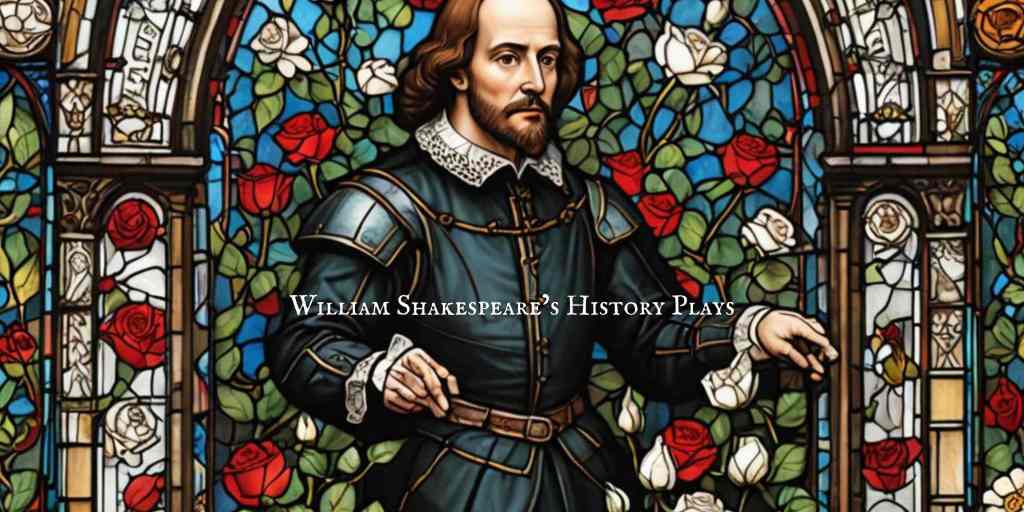
Outschool.com William Shakespeare’s Histories Poster

If you liked this post, you might enjoy signing up for my course on Shakespeare’s History Plays on Outschool.com. Click the link below to sign up:

https://outschool.com/teachers/The-Shakespearean-Student

Happy Twelfth Day of Christmas Everyone!

Hello everyone! I’m back from break and happy to celebrate one of my favorite holidays with you- the one that gave its name to one of Shakespeare’s greatest comedies- Twelfth Night

How to throw a Twelfth Night Party

How To Throw A Twelfth Night Party

How to Make a Twelfth Night Cake

Intro to Twelfth Night (THe play)

I’ve been in this play three times and I’m continually struck by how fun, romantic, and progressive it is. It raises questions about gender roles, social norms, bullying, and even catfishing and heteronormativity! It’s a fascinating and thought-provoking play and it’s my favorite of Shakespeare’s comedies!

Shakespeare’s early comedies are about young love, infatuation, and being ‘madly in love’ (sometimes literally). His middle plays are about mature relationships between men and women and the need for commitment. I would argue that Twelfth Night, (and possibly Much Ado About Nothing), are the best examples of Shakespeare telling meaningful stories about romantic relationships.

Past Posts on “Twelfth Night”

  1. Play of the Month: Twelfth Night
  2. The Fashion Is the Fashion: Twelfth Night
  3. Crafting a Character: Malvolio
  4. Exquisite Artwork from Twelfth Night

Would you like to know more? Take a class!

In honor of “Twelfth Night,” I’ve created a coupon for my course on Shakespeare’s comedies from now till January 31st: Get $10 off my class “Shakespeare’s Comic Plays” with coupon code HTHESYTIT110 until Jan 31, 2023. Get started at https://outschool.com/classes/shakespeares-comic-plays-868BR5hg and enter the coupon code at checkout.

To finish I wanted to give you a complete production of Twelfth Night for your viewing pleasure, but I can’t decide which one, so I will post a bunch today! 

1. 1996 TV movie starring Geoffrey Rush (Pirates of the Caribbean)

2.1996 Thames TV directed by Kenneth Branaugh 

Happy New Year From The Shakespearean Student

Thanks to all my longtime readers, this website has had its best year ever! Here’s to more fun, information, and insight in 2023.

Stats for the 2022 year on Shakespearean Student.

As a New Years gift, from now until January 31st, you can get $10 off my class “An Interactive Guide to Shakespeare’s London” with coupon code HTHESYTIT110 until Jan 31, 2023. Get started at https://outschool.com/classes/an-interactive-guide-to-shakespeares-london-E6KqeBQQ and enter the coupon code at checkout.

The Awesome world of “Six”

One really fun thing I like to see each Thanksgiving is the live previews of some of Broadway’s hottest shows. You may remember that I first became acquainted with the musical “Something Rotten,” after seeing a live performance at the Macy’s Day Parade. I am just ecstatic to see and talk about this year’s hit Broadway Musical Six. It swept the Tonys, and has opened up touring productions across the country.

The Cast of “Six” perform live at the 2021 Tony Awards.

This vibrant, clever retelling of Tudor her-story was created by TOBY MARLOW & LUCY MOSS in association with the Chicago Shakespeare Festival.

The show is incredibly smart, and creative, and delves into the lives of some fascinating women, re-told as a singing contest with the characters singing their lives for you to judge what it was like being the queen of England, and living with the turbulent and fickle Henry VIII. What really appeals to me in this show is that like Hamilton, the musical takes these six semi-mythical women and tells their story in a way that is fresh and exciting.

Part I: Shakespeare’s “Henry VIII:” How NOT to tell a queen’s story

Around 1613, Shakespeare wrote his final play- his 10th history play which loosely told the life of English king Henry the Eighth.

I happen to know a lot about this play since I was in it back in 2008, as you can see in the slideshow above. As you might notice, this play doesn’t tell the story of all of Henry’s wives. We only see the last few years of Catherine of Aragon’s life, and the beginning of Henry’s marriage to Anne Boleyn. Most of the drama actually centers around Henry and his scheming advisor, Cardinal Wolsey. Maybe I’m biased because I played this role, but frankly, Woolsey is treated in the play as a stereotypical Machiavellian villain, who conveniently leads the king astray so he can be the hero of the play. Woolsey does all of Henry’s dirty work; taking over his government, spearheading his divorce to Catherine, and trying to dissuade the king from listening to Anne Boleyn’s Protestant ideas, dismissing her as a “spleeny Lutheran.” Shakespeare leaves it ambiguous as to whether Henry actually told Woolsey to do any of these things so the audience will blame Woosey, instead of the king.

I’ll be blunt, aside from the courtroom scene at Blackfriars, where Katherine pleads for Henry not to dissolve their marriage, and the fun dances and costumes in the scene where Anne flirts with Henry, the play is really quite boring. though I blame Jacobean censors more than Shakespeare for this. Even after the entire Tudor dynasty was dead and buried, powerful people in the English government controlled what Shakespeare could say about them.

Part II: The women take wing

During Shakespeare’s life time, the wives of Henry VIII were bit players at best. With the exception of Katherine of Aragon and Anne Boleyn (who in most narratives have often been cast as either virgins or whores), the lives of Jane Seymore, Anne of Cleaves, Catherine Howard and Catherine Parr were barely told until the 20th century, where new feminist scholarship sparked renewed interest in these women and how they lived.

TV series like The Tudors, movies like The Other Boleyn Girl, and of course books and documentaries by

III. Why “Six” Slaps

Let husbands know
Their wives have sense like them: they see and smell
And have their palates both for sweet and sour,
As husbands have.
Emilia, “Othello,” Act IV, Scene iii.

Well, I can’t yet give an objective view of the plot and characters of “Six,” because I haven’t seen it…(yet). But until then, let’s just say that like “Hamilton,” it is great to see history be recontextualized and shared in such an accessible way. We all know that European history is dominated by the names of white guys- king whoever, duke what’s-his name. To see important women in history be given a voice by a multi-ethnic cast is a great way to make it acessible.

Bravo.

Educational links related to the six wives of Henry VIII:

Books

TV:

Web:
https://www.history.com/news/henry-viii-wives

https://sixonbroadway.com/about.php

Resources on Shakespeare’s History Plays:

Books

  1. Shakespeare English Kings by Peter Saccio. Published Apr. 2000. Preview available: https://books.google.com/books?id=ATHBz3aaGn4C
  2. Shakespeare, Our Contemporary by Jan Kott. Available online at https://books.google.com/books/about/Shakespeare_Our_Contemporary.html?id=QIrdQfCMnfQC
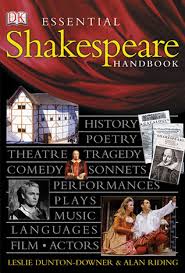
  3. The Essential Shakespeare Handbook
  4. The Essential Shakespeare Handbook by Leslie Dunton-Downer and Alan Riding Published: 16 Jan 2013.
    77ace26dfdee4259bf48d6eed1a59d57
  5. Will In the World by Prof. Steven Greenblatt, Harvard University. September 17, 2004. Preview available https://www.amazon.com/Will-World-How-Shakespeare-Became/dp/1847922961

TV:

The Tudors (TV Show- HBO 2007)

“The Six Wives of Henry VIII” (BBC, 1970)

Websites

Watch “Shakespeare Made You Die (Dumb Ways to Die Parody)” on YouTube

Tomorrow is the first session of my course on Shakespeaere’s tragedies! I’m so excited to teach this great group whom I’ve worked with before. To mark this occasion, I present this silly, catchy, and informative song about the tragic fates of Cleopatra, Juliet, Hamlet, and others.

Title page for my course on Shakespeare’s Tragedies

If you want to sign up for this course or request a private session, you can do so at http://www.outschool.com, or by scanning the QR code below:

The trailer for my course.

Thanks for reading and have a good weekend!