I was doing a little web searching today and came across this incredible link: You can read a review of the Globe Theater’s production of “Much Ado About Nothing,” and you can stream it online, (very useful for those of us who don’t live in London)! I’ve provided the link below:
While I’m at it, I would also like to mention that as July winds down, I’ll be giving you reviews of some of my favorite Shakespeare on film productions of Much Ado in the next two days, including the new movie version directed by Joss Whedon!
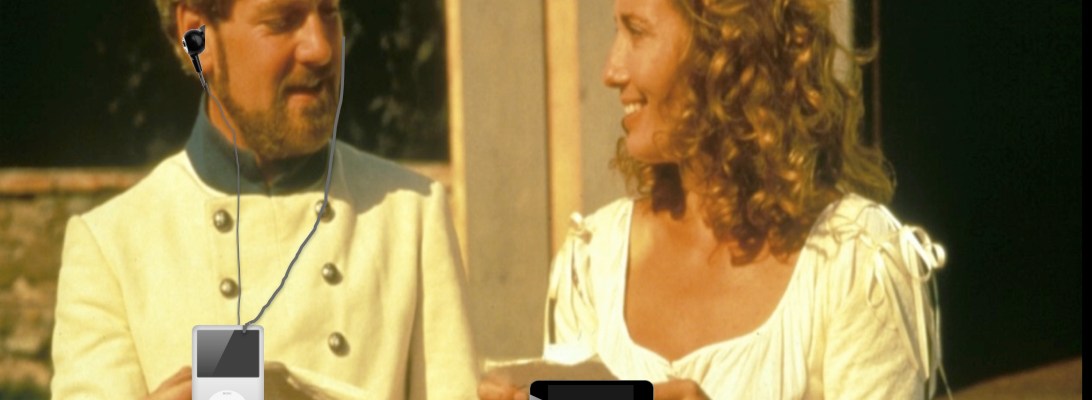
If you missed my earlier post, this week I’ve created a little game for you to play at home: you try to match up the songs that express a fictional character’s personality with the events that happen to him/her through the course of play. Yesterday I posted a playlist for Benedick from Shakespeare’s Much Ado About Nothing, and today I’m going to post one for Beatrice. Your mission is to read the events that happen to Beatrice below, and figure out which songs on the playlist below correspond to these events. If you want to suggest more songs, please leave a comment below and I’ll create an extended playlist for the end of the week! I’ll also post the correct results so you can see how well you did. Enjoy the game and, as Shakespeare said: “Play on!”
Paul Rycik 5/9/12
Events For Beatrice (Match these with the songs from the playlist below)
Benedick and Beatrice have a brief fling and break up before the play begins
Beatrice sees Benedick again at Leonato’s house and blows a flurry of words at him.
Beatrice advises Hero not to worry about her wedding, but instead tells her to “Dance out your answer.”
Beatrice dances with Benedick and pretends not to recognize him.
Beatrice overhears Margaret, Hero, and Ursula ‘secretly confessing’ Benedick’s love for Beatrice.
Beatrice is thunderstruck to discover that not only does Benedick love her, she loves him.
Beatrice is furious at Claudio’s treatment of Hero, and the way men in general treat women.
Beatrice challenges Benedick to prove his love to her by killing Claudio
After soul searching and after Benedick challenges Claudio, Beatrice is on the mend.
Having proved his worthiness to her like a chivalric soldier, Beatrice marries Benedick.
Today, June 24rth, is the ancient Roman festival of Fortuna, the goddess of luck and worldly fortunes. I’ve chosen to use this opportunity to explain a little bit about the concept of Fortune, which Shakespeare uses frequently in his tragedies. But first, a short musical interlude:
Does this song sound familiar? You’ve probably heard it underscored in hundreds of commercials, TV shows, maybe even in concerts, it’s a song composed by composer Carl Orff called “O Fortuna.”
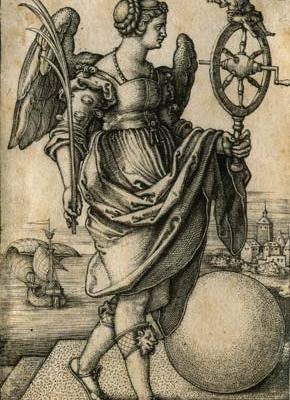
The Roman goddess Fortuna with her wheel and orb.
In Roman mythology, Fortuna was the goddess of luck, wealth, and fertility. If you listen to the lyrics of the song above, you can see that for centuries, people chose to represent Fortune as a fickle, changeable, and irresponsible goddess. Unfortunately, one of the reasons she’s personified as a woman is the long-held prejudice that women are weak, have frequent changes of mind and mood, and can’t commit to one person, (a view of women that I and Shakespeare believe to not be true). However, based on his writing he does seem to think Fortune fits these characteristics:
“I am Fortune’s fool” –Romeo and Juliet
O fortune, fortune! all men call thee fickle:If thou art fickle, what dost thou with him. That is renown’d for faith? Be fickle, fortune; For then, I hope, thou wilt not keep him long, But send him back. –Romeo and Juliet
“When Fortune means to men most good, She looks upon them with a threatening eye.” –King John
Out, out, thou strumpet, Fortune! All you gods,
In general synod ‘take away her power;
Break all the spokes and fellies from her wheel,
And bowl the round nave down the hill of heaven,
As low as to the fiends! -Hamlet
In Dante’s Inferno, Fortuna lives in the Underworld with Plutus the god of gold, helping to distribute the god’s wealth to people above ground. In the Middle ages she was an explanation for why some people have good luck, some have bad, and why luck frequently changes.
The Wheel of Fortune.
Fortuna’s most recognizable symbol is her wheel; the symbol of how luck can change; just when you think your life is perfect, the wheel turns and you find yourself on the bottom. Frequently in tragedy when things go wrong, the characters blame Fortune, such as when the Lord of Kent finds himself put in the stocks like a common thief and gripes: “Fortune good night, smile once more, turn thy wheel,” King Lear, Act II, Scene ii. And yes, the real game show was partially inspired by the goddess’ most famous symbol.
Fortuna In Tragedies
Shakespeare mentions fortune over 500 times in his plays and frequently in his tragedies. Characters in Shakespearean tragedy frequently single out Fortuna as the cause of their unhappiness and curse her as a liar and a strumpet. In a Christian society, it was a lot more appealing to blame a pagan goddess than a loving, Christian god, (which would probably be considered blasphemous). Now you see why she has become a popular scapegoat for misfortune in tragedy. At the same time, all tragedy raises questions about the nature of free will; how much of bad fortune is the result of fate, and how much is a direct result of the character’s bad choices? Edmund in King Lear laughs at the notion of any kind of fate, and accuses all of humanity of shirking responsibility in this speech:
EDMUND
This is the excellent foppery of the world, that, when we are sick in fortune,–often the surfeit of our own behavior,–we make guilty of our disasters the sun, the moon, and the stars: as if we were villains by necessity; fools by heavenly compulsion; knaves, thieves, and treachers, by spherical predominance; drunkards, liars, and adulterers, by an enforced obedience of planetary influence; and all that we are evil in, by a divine thrusting on: an admirable evasion of whoremaster man, to lay his goatish disposition to the charge of a star! (King Lear, Act I, Scene ii).
At the same time, the audience also knows that Edmund was cursed by Fortune from the beginning, since he is the illegitimate child of the Duke of Gloucester, which might prove exactly the opposite point of his speech. He may act like he is absolute in his free will, but his behavior and his violent end suggests otherwise. So when characters curse Fortune or Fortuna in Shakespeare’s plays, take a look at the language they use to characterize this abstract concept. The way we think about luck or fate helps shape our perspective of our own lives, and therefore how playwrights depict this mysterious goddess helps us see the possibilities of human choice, and maybe help us make better choices than the tragic men who slander her in these plays!
I realize Father’s day was last weekend, but I thought I’d like to cap off that week of posts with one final insight into Shakespearean fathers, only today they won’t be fictional! Today I’ll be sharing with you some details from the lives of William Shakespeare and his father, John Shakespeare. We’ve been talking about good, bad, and dad dads, so after reading this post, what do you think- were these men good fathers, or not?
-Bio of John Shakespeare c1530—to 1601
Ancestry-
Shakespeare Family Tree
John Shakespeare was born around the year 1530 (exact records no longer exist). He came from a long line of prominent farmers in Snitterfield, and moved to Stratford Upon Avon in Warwickshire, in the year 1557 John married Mary Arden, who also came from pretty posh country stock; records trace the Arden family back before the Norman conquest in 1066!
John and Mary’s children
Altogether, John and Mary had 8 children (see the family tree above.)
Sadly, their 2 eldest daughters Margaret and Anne died in infancy, making William the eldest child, and the son and heir of his father’s wealth.
William’s brother Edmund became an actor, while his sister Joan took over John’s old house.
Shakespeare was born in 1564 in a modest house on Henley Street, which still stands today!
The house on Henley Street, where Shakespeare was born in 1564. Click here to learn more about Shakespeare’s birthplace.
Mayor, Bailiff, Glover When John and Mary moved to Stratford, John established himself as a great fixture of the community- he started as the local glover, and rose to the highly respected office of town ale taster (no, I’m not kidding). At the height of his career, John became Mayor of Stratford, and an Alderman- a town counsilor who helped make decisions like whether or not to let local theater troupes come to town! Maybe John took his young son to watch the travelling players and helped inspire Will’s lifelong love of theater.
Teach Your Children Well Shakespeare got to go to one of the first ever public schools in England, where he learned English history, poetry, and the art of persuasive speech, everything he needed to become the great writer he would become.
Brogger not Blogger As I mentioned in my first post, Shakespeare’s dad had an illegal side business as a wool dealer. All wool was controlled by the English government, so selling it directly to people was a crime, and eventually John Shakespeare was caught. Fortunately, the fine he paid wasn’t enough to ruin him financially…yet.
Closet Catholic The biggest financial problem John Shakespeare faced was his religious beliefs. In 1757, archeologists unearthed a pamphlet where John confessed to be a secret Catholic in a society where the Church of England was the national religion. Scholar Michael Wood believes that John’s Catholicism led to financial ruin; he refused to go to Episcopal church and had to pay crippling fines every time he failed to appear.
John’s Descent At the same time, John’s debts kept mounting and he was afraid to go to the town council house for fear of more collectors, even though he was the mayor. The final blow came in 1576, when John was booted off the town council.
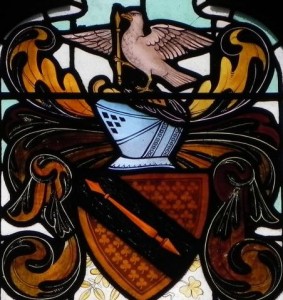
Son of Fortune John’s son William would eventually repair the family dignity when he became a success. In 1596, William made himself, and all the male members of his family gentlemen, by applying for a coat of arms. Below is a picture of Shakespeare’s family crest.
Shakespeare’s coat of arms, as depicted in the Folger Shakespeare Library window.
John Shakespeare died in 1601, shortly after his son’s play Hamlet was published. Willmight have honored his father’s memory by playing the Ghost of Hamlet’s father.
-Bio of William Shakespeare as a Father 1564-1616.
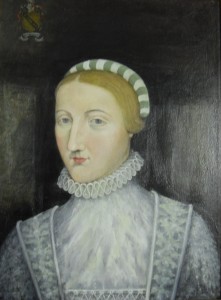
Oil reproduction by Roger Dunn of an alleged drawing of Anne Hathaway. Reproduced with Permission, Shakespeare’ Birthplace Trust. Click on the picture to find out more about this work of art!
Roger Dunn BA
Wedding Bells In 1582,Will married Anne Hathaway (not the Oscar winning actress from Les Miserables, although that one has shown some love for Shakespeare too. Based on the timeline, it’s very likely that Anne was already pregnant when William married her. Some claim that the Bard was basically in a “shotgun” marriage, but nobody has proven otherwise. We do know that he wrote a sonnet to her on their wedding day, click here to read it!
Shakespeare’s Children Shakespeare and Anne had three kids (Judith, Susanna, Hamnet) Susanna was born in 1583, while the twins were born 5 years later.
Hit the Road! Sometime around 1590, Shakespeare moved to London and must’ve gotten a job with a theater company. Unfortunately, no records survive between the birth of Shakespeare’s children, and his first success as a playwright in 1592, which is why scholars refer to this period as “The Lost Years.” It was probably a tough life for the Shakespeares, with the father away in the city while they were cooped up in Stratford with their grandparents.
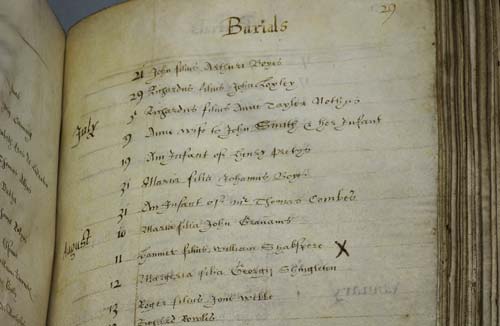
RIP Hamnet. Shakespeare’s only son died August 9th He was away in London at the time, and undoubtedly the news was a terrible shock.
Will’s daughters Shakespeare had two girls, Judith and Susanna. Naturally, it’s hard to tell anything about Shakespeare’s personal feelings, but looking at his plays and his future actions, Shakespeare must have really loved his girls. Many of his later plays explore the relationships between fathers and daughters, and as you’ve probably noticed, most of the fathers on my previous countdowns have at least 1 girl. Shakespeare was preoccupied with his daughter’s futures and helped them find husbands, Susanna Shakespeare was arrested for refusing to take protestant communion Susannah married Dr. John Hall, a respected puritan physician. She also bore William his only grandchild, Elizabeth Barnard (pictured below).
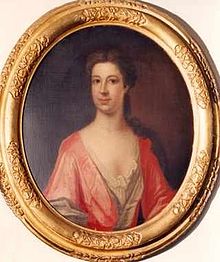
Elizabeth Hall, 1608-1680. Shakespeare’s granddaughter.
Will clearly loved his daughters, especially his daughter Susanna. His last 5 plays were about fathers trying their best to improve their daughter’s lives. In his will he gave his daughter Susannah 100 pounds of English money, as well as a dowry To his other daughter Judith he left 30 pounds, all of his silver, and permitted her to live in one of his houses on Henley street.
FMI:
by Michael Wood: A fantastic documentary/ book/ website, which looks at the life of William Shakespeare and his work. On this website is an interactive timeline that shows pictures of the places Shakespeare lived and worked, and the documents with his name on them: http://www.pbs.org/shakespeare/events/
Will In the World by Steven Greenblatt: A great biography of Shakespeare by a celebrated Harvard scholar and editor of tne Norton Shakespeare edition. Click here for a review: http://books.wwnorton.com/books/Will-in-the-World/.
So that ends my posts on Shakespeare and Father’s Day. Stay tuned for another post about a very interesting holiday!
Illustration of the Shakespeare family, wife and children, 1890.
Shakespeare himself was a father, and he frequently wrote about the dynamic between fathers and their children. There are many different types of fathers in Shakespeare’s 40 plus plays, and this week I’m ranking them in terms of three categories: Good Dads, Bad Dads, and “Dad Dads.” You’ve probably already read the “Worst Dad” post, so now we’re looking at the good, and the not so good. I used the following criteria when choosing the top 5 dads in each categories:
The Good Dads
Are supportive for their kids
Try to keep their children happy
Offer help and advice, especially on their children’s future.
Are willing to sacrifice themselves
They let their children become their own people.
The Bad Dads
Treat their children as property
Have little to no interest in their children
Put their children in danger
Subject their children to abuse
In some cases, they murder them!
The “Dad” Dads
Are basically good hearted, but they have some kind of flaw that prevents them from becoming really good parents.
In my view, are the most human, modern dads on the list.
I’ve chosen to award these dads a necktie, something every ok dad needs.
Now, onto the Dad Dads:
5. Aegean from The Comedy Of Errors. Aegean wonders around for 20 years looking for his lost children, which I call devoted parenting, but a little aimless and undisciplined. I therefore award Aegean two ties with little anchors on them, to remind him to stay in one place and wait for his sons to find him!
Alexandre Bida, “The death of Lord and John Talbott,” 1895
4. Lord Talbott from Henry the Sixth Part I. Talbott is the hero of the English fight against the French at the close of the Hundred Years War. He goes toe to toe with Joan of Arc on numerous occasions. He also raises a fine and valliant son, John Talbott who is also a warrior. The two die bravely in a siege against the French, rather than surrendering, or leaving the other to die. Talbott is clearly also devoted to his child, but his career choice doesn’t allow his son to grow up in a safe environment! I therefore award Talbott two ties with little English and French flags on them.
The Ghost of Hamlet’s Father by William Blake, 1806.
3. The Ghost Of Hamlet’s Father from Hamlet/ Portia’s Dad from Merchant Of Venice. Both these parents die before their plays begin, yet they still try to improve their children’s lives from beyond the grave! The Ghost helps Hamlet become king of Denmark, and Portia’s dad tries to help her find a good husband, (one who will love her for something besides her beauty or riches). Although these parents achieve their goals, waiting this long to help their kids seems a bit like absentee parenting! I therefore award these posthumous parents ties with little skulls on them.
2
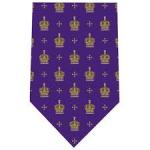
. King Henry IV, from King Henry IV King Henry is the classic career dad, one who wants his son Hal (the future King Henry V), to follow in his footsteps. The two have a terrible fight when Henry thinks Hal is trying to steal his crown on his deathbed! Eventually though, father and son reconcile, and dad even gives the future king some last minute advice; if you fight a war with France it’ll help secure your crown, which Hal does and succeeds! I therefore award King Henry a tie with little crowns on it, hoping that nobody with a dagger ties tries to steal it when he’s sleeping!
1. Prince Pericles from Pericles Pericles is another busy dad- King Antiocus tries to murder him, and he has to leave his own kingdom. Then he gets shipwrecked 3 times! In fact, his only daughter is born onboard a ship in the middle of a storm! Pericles raises the girl for a number of years, but then has to leave again, and guess what, he gets shipwrecked AGAIN! He eventually finds his daughter and they live happily ever after, but you kind of get the idea that Pericles is a little accident-prone, which keeps him from being on the Best Dads list. Sorry Pericles, but at least you get a tie with, what else, Boats on it! Maybe next Fathers Day, someone will get you a life preserver.
And now at Long LAST, the BEST Dads in Shakespeare!
Aaron fights to protect his baby child.
5. Aaron the Moor from Titus Andronicus. Ironically, one of the worst villains in Shakespeare is also one of the best fathers. Aaron is fiercely protective of his child, even threatening people at sword point if they dare come near his baby. He also plans out the child’s future and is willing to give his own life for a promise that Lucius will protect and nourish his son. He may be a monster to everyone else, but to his baby, Aaron is simply, a good dad!
4. The Old Shepherd from The Winter’s Tale. This character is a very mirror of generosity and kindness; not only does he take care of his son The Clown, he adopts a poor discarded child, the princess Perdita, with no obligation to do so. He raises her for 16 years and constantly brags about her to the entire town. She becomes a beautiful, wise, and modest girl who fills her adopted father with pride because of his good parenting. Even when Perdita meets her real father, she speaks of The Old Shepherd with real filial affection “Oh my poor father.”
3.
Lord Capulet, from Romeo and Juliet. I know this was a controversial choice, and I discuss my choice in detail on my podcast, but I’ll sum up my major arguments here:
Even though a lot of actors choose to have him smack Juliet around, there’s no mention of it in Shakespeare’s text. The most he ever does is threaten to strike her, but the stage directions never indicate he does it. Capulet is clearly more bark than bite.
From the very beginning of the play, Capulet has shown that he cares about Juliet, and wants her to marry for love, not money.
Lord Capulet hovers and frets constantly when Juliet tells him she will marry Paris, staying up late to plan the wedding! I ask you, does that sound like a tyrannical father? I wonder sometimes if Lord Capulet would’ve forgiven Juliet for marrying Romeo if she had just told him. In any case, based on my criteria above, Capulet is a good dad, bad tempered, yes, but fundamentally concerned for the welfare of his children.
3. Prospero fromThe Tempest I chose this high spot for Prospero mainly because he seems to have the most success of any other dad in the cannon. Like Pericles, he too is shipwrecked with his daughter, but Prospero stays with Miranda, raises her alone, teaches her everything she knows, and calls her an angel that helped preserve his life. Prospero cares so much for his daughter that he refuses to give into despair, even though he’s lost his wife, his dukedom, and his home.
Prospero also hatches a plan to get him and Miranda off the island, to get his dukedom back, and to get her married to a handsome prince name Ferdinand, and he succeeds with every one of these endeavors, even though it takes 12 years. Prospero gets extra points for his patience and his wisdom, but I have to admit he’s a bit of a control freak; he demands that Miranda listen to him and obey him no matter what, and he warns Ferdinand that there will be dire consequences if he dare try to do anything illicit with his daughter before the wedding. In addition, there’s no denying that Prospero is also acting out of self interest- he wants to become duke again, and he wants revenge against his enemies and that’s partially why he raises a tempest, (or a huge storm), instead of just sending a message back to Milan.
1.
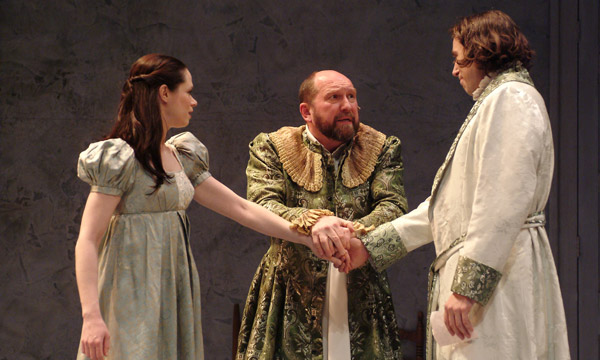
Simonides grants permission for Pericles to wed his daughter. Production shot from Mary Zimmerman’s 2006 production of “Pericles.”
King Simonedes from Pericles, Prince Of Tyre You might forget this character because he only has a short time onstage, but I defy anyone to come up with a better father. He’s kind, supportive, stable, funny, and has a wonderful relationship with his daughter Thaisa. Above all, Simonedes actually listens to his child and does everything in his power to help her when she decides she wants to marry Pericles. Also, like Prospero, Simonedes pretends to object to the marriage, but you kind of get the sense that, rather than testing the affection of the couple, he’s actually just playing a joke on them. You can hear a “gotcha” and a fatherly wink in the final line of the speech in Act II, where he pretends to object to their marriage:
Congratulations to all our fabulous fictional fathers! Thank you for reading, and see you soon!
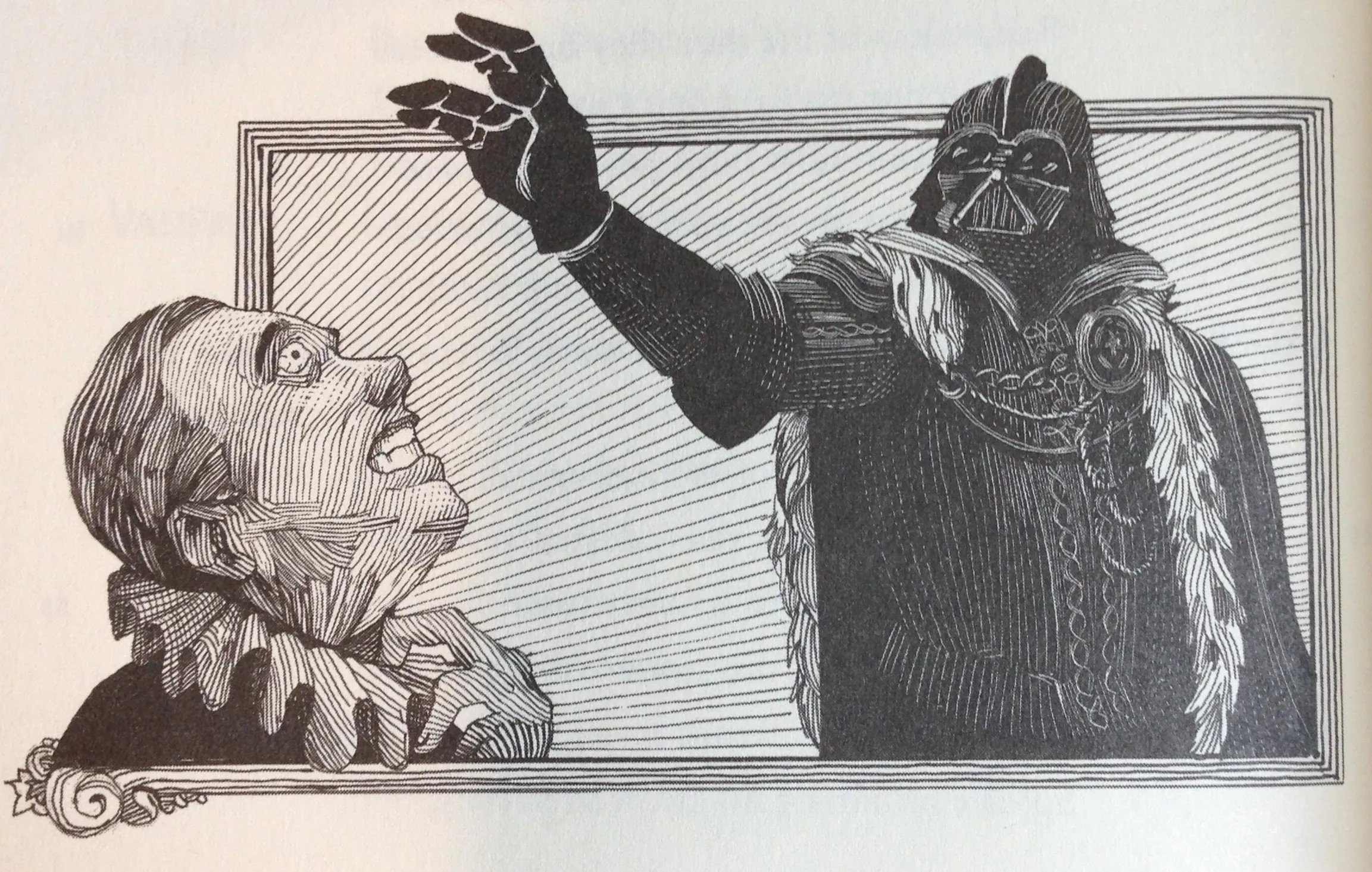
Illustration from “William Shakespeare’s Star Wars”
Play review: William Shakespeare’s Star Wars
Since Monday was May the Fourth, and since I got some encouraging comments about the previous post, I’m happy to review one of the most interesting Shakespeare spin-offs I’ve ever encountered: William Shakespeare’s Star Wars by Ian Doescher. For those of you who haven’t heard of this play, it’s basically the script of Star Wars put into Shakespearean verse. The writer clearly loves both Shakespeare and Star Wars, and puts lots of cheeky Shakespearean references in the text, such as Luke Skywalker parodying Hamlet as he steals a Stormtrooper’s uniform and Yorrick-like, holds up the helmet to his face:
“Alas poor Stormtrooper, I knew ye not,” (Doescher IV, vi, 1) The play lends itself perfectly for performance in an Elizabethan playhouse with its sparse stage directions and an Elizabethan chorus that comments on the action and tells the audience whenever action occurs offstage, such as when the Death Star gunners prepare their mighty laser to destroy the planet Alderon. I certainly got a kick out of reading this play since I too am a huge Shakespeare/ Star Wars fan. However, since this blog is meant to help us learn and appreciate Shakespeare, the question is, does this play have any value to Shakespearean students? At first I wasn’t sure, but now I say yes!
Before I read the play, I was a little apprehensive as I’ve seen Shakespearean gimmicks fall flat before; I once saw a dreadful production of Macbeth where the whole cast was made up to look like zombies for absolutely no purpose except to cash in on the zombie fad. So at first, I wondered, “Why bother translate Star Wars into Shakespearean language”? As I read on though, I realized what the author had done was give readers a rare glimpse into how Shakespeare himself wrote.
This helps prove one thing I’ve always felt about teaching Shakespeare- parody and gentle satire are a great way to deconstruct his plays into something a little easier to grasp. As I said before, Doescher’s play is full of tiny bite-size portions of real Shakespearean dialogue that allow you to digest some of The Bard’s most famous lines. Also, he’s following the same ‘recipe’ Shakespeare used in his plays and speeches, so I’m going to deconstruct some of the Shakespearean elements that Doescher employed to concoct this Shakespeare/Sci-fi classic hybrid. I’ll focus on the first play in the series: Verily A New Hope, but you can find these components in all of the plays in the Star Wars Saga.
Iambic pentameter- the most obvious difference between the original Star wars is that Doescher took the dialogue and put it into the same poetic meter Shakespeare used. For those who don’t know, Iambic pentameter is a kind of unrhymed poetry with 10 syllables per line. Each line also has 5 stressed beats that strike like a heart beat- Da DUM Da DUM Da DUM Da DUM Da DUM. To keep the emphasis on the right syllables, sometimes the writer has to shift the syntax or add and subtract words to get them to fit. This is why instead of the famous: “A long time ago, in a galaxy far, far away,” the Prologue at the beginning says:
“ In time so long ago begins our play,
In star-crossed galaxy far, far away.”
Doescher’s time-consuming process of translating a prose movie script into blank verse poetry is exactly Shakespeare did when he wrote his plays, only instead of movie scripts, he took the chronicles of English history to become Hamlet, Macbeth, Lear, and many others. With all the work involved in crafting poetry like this, it’s no wonder he didn’t have time to think up an original story!
Telling the audience what you’re doing- As I said last week, one thing to keep in mind when you read Shakespeare is that his plays were performed outdoors with no microphones, in an audience of nearly 3,000 people! It must have been extremely hard to see or hear the action onstage. Shakespeare tried to solve this problem by having characters announce what they’re doing, which would be tedious, if he didn’t also know how to spice up the dialogue with lines that reveal the character’s emotional state, like when Lord Capulet says: “My fingers itch,” to warn his daughter he’s about to hit her. Doescher captures this extremely well in the speech where Vader lifts up the Rebel Leader and begins to choke him to death:
I turn to thee, thou rebel. Aye, I lift
Thy head above my own. Thou canst now choose
To keep thy secrets lock’d safe in that head
Or else to keep thy head, and thus thy life (Doescher I, ii 6-10).
This passage explains to the reader or playgoer that Vader has lifted the man over his head, (demonstrating his cruelty and his strength), and subtly plays on the fact that Vader is looking at his head, wants the knowledge in his head, and will crush his head if the Rebel doesn’t cooperate. Shakespeare’s Richard III makes a similar threat: “Villain, set down the corpse, or by St. Paul, I’ll make a corpse of him that disobeys!”
The Aside One thing Shakespeare does that few modern writers ever do is have characters talk directly to the audience; thus establishing an intimate relationship between you and a person who is confiding their secrets in you. The most striking example of this in Shakespeare’s Star Wars is R2D2, who in the movie never spoke at all, but made cute little electronic beeps and whirrs. Having R2 speak gives the reader an unexpected closeness because R2 never speaks to anyone else.
Personification Shakespeare is really good at finding a clever visual metaphor for an abstract idea, and will write speeches or dialogue where characters explore the nature of that idea, a meditation if you will. One of my favorite examples from Shakespeare’s Star Wars is the scene in which Luke and his uncle debate about whether Luke will stay on the farm. Luke compares himself to a bird that’s trying to fly away, while his uncle uses farm metaphors to try and keep him to stay:
OWEN: Wilt thou here in the desert yet desert? Tis only one more season.
LUKE: Now cracks a hopeful heart, when by the land,
A man’s ambitions firmly grounded are:
So shall a bird ne’er learn to fly or soar
When wings are clipp’d by crops and roots and soil.
It’s really very clever the way Doescher mimicks Shakespeare’s wordplay here. Luke is like a bird because he’s a pilot and longs to fly. Owen is a farmer on a desert and is worried about Luke deserting him. We get a clear picture of their relationship from this scene.
Chorus Shakespeare sometimes uses a Chorus to tell us what is going on in plays where the location shifts from place to place- it’s a time honored device in epic storytelling. Nowadays we use a Chorus too, we just call it a Narrator. The difference is that a Chorus also can explain the tone and the mood of the action onstage, so that you can imagine it in your own mind. Take a look at this passage where the chorus describes the famous Star Wars Cantina:
Now mark thee well, good viewer, what you see,
The creatures gather round the central bar
While hammerheads and hornéd monsters talk.
A band composed of aliens bizarre:
This is the great cantina- thou may’st gawk! (III, I, 45-49).
You can see how, unlike a narrator who would just tell you there are a bunch of aliens here, the Chorus describes the sights and sounds of the bar so you can imagine it yourself. The Chorus in Shakespeare’s Henry the Fifth explicitly states that the audience needs to use their imagination to fill out the story of Henry’s conquest of France.
The soliloquy A soliloquy is a speech spoken by a character alone on stage. It often has to do with a complex dilemma such as Hamlet’s “To Be Or Not To Be.”
In Shakespeare’s Star Wars, Luke and Vader have the most soliloquis and with good reason- they have the most complicated emotional journeys- Luke goes from a simple farmboy from Tatooine to a Jedi Knight, while Vader goes from a Jedi to a Sith to a father. Shakespeare’s greatest power is his ability to put complex emotional journeys like these into speeches that the characters share right with us. I loved both these speeches too much to choose, so I’m going to talk about of both. The first is a soliloquy Vader speaks after he kills the Rebel leader:
And so another dies by my own hand,
This hand, which now encas’d in blackness is
O that the fingers of this wretched hand
Had not the pain of suffring ever known. Droescher I.ii, 27-30
This speech reminds me very much of Richard III, one of Shakespeare’s greatest villains. Richard, like Vader, has his life story told in 6 installments where he slowly becomes an evil mastermind. The images of this speech conjure up parts of Vader’s life story: how he lost his hand in Episode II and now has a robotic hand in a black glove. The speech also conjures the fact that his master the Emperor is able to shoot lightning from his hands, and of course, how Vader himself is able to kill by merely gesturing with his hand. Richard has a speech where he talks about all the people he’s killed to become king, and how he now has to kill even more to stay king:
I must be married to my brother’s daughter, Or else my kingdom stands on brittle glass. Murder her brothers, and then marry her! Uncertain way of gain! But I am in So far in blood that sin will pluck on sin: Tear-falling pity dwells not in this eye (Richard III, Act IV, Scene i)
Luke has another speech where he talks about his destiny staring at the twin suns of Tatooine, but I won’t spoil that one for you! Needless to say, it’s awesome. I bring it up because In the movie, it was John Williams’ job to literally underscore Luke’s emotions as the music swelled. Shakespeare’s gift on the other hand was to put powerful emotions and thoughts into carefully composed soliloquys that sound like music when spoken well.
So as you can see, the author’s loving parody of Shakespeare allows us a rare glimpse of how the Bard wrote; his cleverness at adapting stories, his use of verse, wordplay, metaphor, personification, choruses, and his unique ability to write characters that talk to us as if we were in on their deepest secrets.
Hi folks! Since this site is basically a Shakespeare appreciation site, I wanted to start off this week by showing you how you can enjoy Shakespeare at the first reading, even if you’ve never read him before! What follows is a list of advice based on the way I myself learned to enjoy Shakespeare, backed up with some nuggets of wisdom I’ve picked up from teachers along the way. https://youtu.be/knWg6Mf4MiM?feature=shared I. Learn the Story of the play.
I would argue that the biggest advantage the Elizabethans had over us was they knew the story of the play before they even came into the theater. All of Shakespeare’s plays were adapted from other sources, including myths and fairy tales. A Midsummer Night’s Dream is literally a fairy tale about the Fairy Queen Titania. There was no such thing as “spoiler alert” in Shakespeare’s day, in fact the prologue of “Romeo and Juliet” gives away the ending before the play has begun!
Clearly, Shakespeare wasn’t interested in making his plays a surprise.The thing is that back then audiences didn’t want new stories, they wanted familiar stories told in a new way, the same way we base movies off of comic books and novels. So the first thing you can do to put you on the same level is read the story of the play before hand. Quiz yourself about what happens: who are the characters you should be rooting for? Whom are they fighting against? What is stopping the hero(s) from achieving their goals? This is a rare time when cliff notes and spark notes actually help; learning the story of the play will help you connect with the action on the stage and instead allow you to concentrate on the characters and the language. I also recommend websites like Crash Course that tell the story with a sense of fun. II. Read the play- the whole thing, (preferably out loud).
The first time you read Shakespeare, you probably won’t get every word, but don’t worry, you’re not supposed to. Every single edition of Shakespeare has a glossary on the opposite page that translates the basic idea of what you’re reading. If you’re a first time reader, I highly recommend the Folger Shakespeare edition, (available at amazon.com). These editions not only have a good glossary, but big, friendly pictures of a lot of the terms. They also have a free online version of Shakespeare’s texts which you can look at here: http://www.folgerdigitaltexts.org/
I would also advise you to read the plays out loud. Shakespeare loved playing with the sounds of words- having characters hiss and bellow and whisper and seduce the ear. Some of the most fun I ever had with Shakespeare was having a Shakespeare reading party with my friends, where we discovered a play by reading it together and playing with voices and accents.
Another option is to listen to the play while you read it. There are great websites like Audible.com and Librivox that allow you to listen to the play spoken by voice actors. Hearing the play will open it up in a way that just reading it can’t After all, the plays are meant to be heard, that’s why they call it an audience (audio- to hear).
Finally, if you go to nearly every public library there’s a recording of The Archangel Shakespeare, a series of CD recordings of professional actors performing every one of Shakespeare’s plays. Many of these performers have done Shakespeare professionally, so you know they know what they’re taking about. III. Watch a movie. There are hundreds of Shakespeare movies out there, and each one can show you a little bit about how the play feels and looks when it is placed in the hands of an actor or director. You may be expecting some guy in wrinkled tights bellowing his lines in a fake-Elizabethan set, but lots of Shakespeare movies have chosen inventive settings for Shakespeare in different times and places, like Ian McKellen’s Fascist-era Richard III, Michael Hoffman’s 19th century Midsummer Night’s Dream, or my favorite, Julie Taymor’s epic retelling of Titus Andronicus in a fictionalized blend of ancient Rome and modern Italy. A movie allows you to hear the text read, and allows you to see ideas from the play brought to life on the big screen. IV. Go see it if you can. Almost every major city has a Shakespeare festival, and lots of regional theaters also choose to do Shakespeare. The reason is simple- he’s royalty free, and everyone recognizes his name. As you watch the play, try to answer these questions:
-Which characters did you like?
-Was there a line you really liked or one that seemed to speak to you?
-Did this play remind you of another play or movie? Did it remind you of something from your own life? V. If I can recommend a good play to start with, start with Å Midsummer Night’s Dream. This play is not only very easy to understand, it’s also charming, funny, romantic, magical, and has a lot of colorful characters. I myself have directed and starred in Dream, and seen no less than 15 productions on stage and screen! If I can quell the fear you may have about Shakespeare, my wife and I directed the play with actors who had never read Shakespeare before, never acted before, and most of them were only 8 years old! So if they can learn this play and grow to love it as much as I do, then I firmly believe you can too! Helpful hints-
1. Shakespeare’s company performed outdoors in the middle of the day, so they had no control over their environment. All the actors had was a bare stage, costumes, and a couple of props. This is why Shakespeare devotes lots of passages to just tell you where the characters are, and what time of day it is. His is a theater of the imagination, so read the descriptions and let the world come to life in your head.
2. Shakespeare drew heavily on images from Greek/Roman mythology and the Bible. If you need help looking up some of these resources up, I can recommend the Encyclopedia Mythica for Greco-roman references, and the Catholic Encyclopedia for Christian references.
3. There is a glossary of every single word Shakespeare ever used and plenty of books too. In terms of simplicity and ease of use, I recommend http://www.shakespeareswords.com/Glossary.
4. Shakespeare wrote four types of plays – Comedy, History, Tragedy, and Romances.
In Tragedy, the hero dies by the end, and the overall tone is one of change and struggle. In Comedy, the hero and the heroine usually get married by the end. The History Plays- are all about a struggle for the English crown and are based on historical chronicles. Most of them conclude in a battle or in the peace after a battle. Romances– “Romance” is a term invented by scholars to describe some of the last plays Shakespeare wrote that don’t end in death like tragedies, and don’t end as happily as the comedies. One such play has a man get eaten by a bear, and another has a man forced to marry a prostitute! Some scholars don’t like this title, but i keep it here because it’s the most common term for these weird plays that include Cymbeline, Pericles, The Winter’s Tale, and The Tempest.
4. DO NOT READ THE NO-FEAR SHAKESPEARE EDITIONS. These books and websites advertise to be a clear-cut translation of Shakespeare with his text on the left, and a modern translation on the right. I believe these editions don’t do justice to the cleverness of Shakespeare’s writing. For example, here’s the famous speech of Macbeth when he discovers that his wife is dead: https://youtu.be/pDdhiTvFcFw?si=mMy6zg8gmM9_K9bo
She should have died hereafter. There would have been a time for such a word. Tomorrow, and tomorrow, and tomorrow, Creeps in this petty pace from day to day To the last syllable of recorded time, And all our yesterdays have lighted fools The way to dusty death. Out, out, brief candle! Life’s but a walking shadow, a poor player That struts and frets his hour upon the stage And then is heard no more. It is a tale Told by an idiot, full of sound and fury, Signifying nothing.
I’ve actually played Macbeth, and when I saw this speech, I played it as a struggle to deal with the loss of his wife, (the only person he truly cares about), while at the same time dealing with imminent war. Macbeth wants to put off dealing with the news until tomorrow because he can’t possibly handle it now. What’s really cool about Shakespeare is you don’t have to agree with me; you could just as easily interpret the speech as a manifestation of psychosis, of loneliness, or how bitter and unfair Macbeth’s life is and it would still work! That’s why actors and directors love going on and on about Shakespeare; he gives us the freedom to interpret the speech the way we want, as long as we stay true to the basic text. I don’t think anybody could claim that this is a happy speech! The problem is that No Fear Shakespeare makes it too simple, and doesn’t allow you to really consider the possibilities for interpretation. Read their translation of the speech below:
MACBETH She would have died later anyway. That news was bound to come someday. Tomorrow, and tomorrow, and tomorrow. The days creep slowly along until the end of time. And every day that’s already happened has taken fools that much closer to their deaths. Out, out, brief candle. Life is nothing more than an illusion. It’s like a poor actor who struts and worries for his hour on the stage and then is never heard from again. Life is a story told by an idiot, full of noise and emotional disturbance, but devoid of meaning.
Of course, if you bear in mind the limitations of translating Shakespeare and give yourself the freedom to take it with a grain of salt, that could work too.
So there’s a basic guide for first time readers. Let me know if you agree with my approach, what strategies work for you, and if these techniques were helpful!
For more tips and tricks on analyzing Shakespeare, please sign up for my 30 minute Online Shakespeare class on Outschool.com:
In honor of Shakespeare’s birthday, I present this post to introduce you to some of the important events in his life and career!
5 Facts You Didn’t Know About Shakespeare
Shakespeare wrote 39 attributed plays, 154 sonnets, four epic poems, and (some believe), might have had a hand in writing the King James Bible.
He was the third of 8 children, but his elder siblings died as infants, so he was the eldest son.
Shakespeare’s father had a criminal record: In 1572, he was caught selling wool illegally. The government had a monopoly on the wool trade, so this would be like selling bootleg tapes or mp3s online. He was also in trouble for lending money, just like Shylock in The Merchant Of Venice.
Shakespeare’s whole company was suspected of treason and conspiracy! In late January of 1601, Shakespeare’s company was asked to perform a play February 7th, designed to foment rebellion against queen Elizabeth! The Earl of Essex hoped that the play would make people rise up and storm London, and planned to attack the castle the next day. Unfortunately, nobody showed up to the rebellion, and Essex was arrested and tried and convicted of treason. As for Shakespeare and his company, they were interrogated, but found not guilty; they just told the court officials that they did it for the money.
Now, so we don’t get on the wrong foot about Shakespeare, I would like to dispel some oft-perpetuated misconceptions:
Top 5 Lies About Shakespeare
The law forbade women from performing in Shakespeare’s Day. Although this lie inspired the plot of one of my favorite movies, Shakespeare In Love, I feel this lie needs to be dispelled. There was no law prohibiting women from performing in any country. In fact, it was quite common to see women perform in Italy and France for centuries. However, in England, given the low status of theatre at the time, acting was not considered a reputable occupation, and women didn’t have the freedom to pursue occupations that men did, so though it wasn’t illegal, it was not encouraged.
We know for a fact that Shakespeare had an affair Although pseudo scholars and conspiracy nuts claim that they can prove Shakespeare had a mistress, the so-called “Dark Lady,” there is no evidence from the poet’s life that he had any extramarital affair. He remained married to his wife Anne Hathaway until his death, and no one has ever testified that they ever saw him with any woman. Part of the basis of this lie comes from the fact that for the last 25 of his sonnets, Shakespeare refers to a woman of a darker complexion whom he calls his mistress, but you have to remember these were published poems that Shakespeare wrote for money. You wouldn’t assume Stephanie Myer wrote Twilight because of her unrequited love for a real sparkly vampire, would you?
Shakespeare was a starving artist. It’s sad to say good bye to this myth; even I love the image of Shakespeare as a struggling writer trying to make it and unknowingly composing the greatest canon of work in western theatre. But sadly, Shakespeare’s work wasappreciated in its own time. He made enough money to become a gentleman and was granted a coat of arms in 1596. He also bought the second best house in town to accommodate his wife and three kids:
Nice digs, huh?
4. Shakespeare was illiterate. This lie refers to the fact that Shaksespeare’s father signed his name with an X on legal documents, so people assume his father was illiterate, and that his son must have been too. However, Shakespeare’s father was a town official; he didn’t need to write his name on documents. In addition, we have a copy of Shakespeare’s will with his own signature on it.
Pretty good evidence that he can write, don’t you think?
5. Shakespeare never wrote any of his plays Here it is, the biggest, most bloated lie of all. Hundreds of books, and millions of words have been wasted on this tired conspiracy theory, most recently in the form of a film called Annonymous. Every argument against Shakespeare as author of the plays that bear his name has been disputed hundreds of times by reputable scholars and yet, this terrible lie just won’t bite the dust. I know I can’t convince every conspiracy nut out there, but I can present a few bits of hard evidence to help all normal thinking persons to make up their minds.
Evidence that supports Shakespeare as the author of the plays he’s credited with writing:
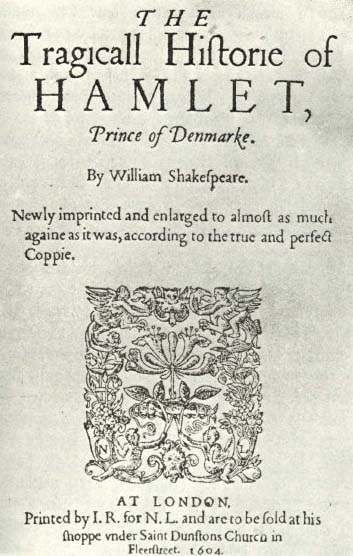
We have title pages of his plays with his name on them. Nearly all of Shakespeare’s work appeared in print before he died, then they were re-printed in the First Folio of 1623. A few of these plays actually have Shakespeare’s name on them, such as the 1604 edition of Hamlet (Above)
We have a manuscript of “Sir Thomas Moore” with Shakespeare’s handwriting on it. Although we don’t have a finished manuscript of a Shakespeare play, we do have copies of a play he didn’t finish called Sir Thomas Moore in the British Library. Analysis of the handwriting shows several writers, including one that closely corresponds to Shakespeare’s own. This play was written to be performed by Shakespeare’s company, so it confirms that he wrote their plays.
We have records of his plays being performed at court with his name attached to them. To me, this is the most important evidence to confirm Shakespeare’s authorship of his plays. Look at this account of the plays performed at court in 1604.
This document lists all the plays Shakespeare’s company performed for the king that Christmas , as well as the playwright’s names. In the right column Shakespeare (spelled Shaxberd by a careless clerk) is credited as the author of Measure for Measure, Henry the Fifth, andComedy of Errors, among others. This proves he was a writer who wrote plays for the company he said he did, and that the king himself paid him to do it. It takes a tremendous amount of conspiracy hocus-pocus to pull the wool over the eyes of an entire court!
We have references to him being a playwright written by his rivals, especially Robert Greene who hated Shakespeare for being an upstart “Johnny do-everything” who, although he was an actor, could still write plays and poems as well as Greene, and the rest of his University Wits. For more info on Greene, search for his famous pamphlet “Groatsworth of Wit.”
Nobody else comes close. Sorry to disappoint you, but most of the supposed candidates for the “real” Shakespeare have at least 1 terribly big problem preventing them from writing the whole cannon- THEY WERE DEAD. Shakespeare stopped writing in 1613, which prevents all of the top contenders from writing the entire cannon:
Christopher Marlowe– Died 1593
Thomas Kidd– Died 1594.
The Earl of Oxford- Died 1604
I could go on with this hotly debated issue, which has been dissected by scholars far better then me, but let me close by saying that the main argument of the people who don’t believe Shakespeare wrote his own plays is that they believe a guy who wasn’t an educated nobleman couldn’t have written such beautiful and insightful truths about human nature. To this I reply, genius is not constrained by one’s upbringing. I’d say Shakespeare lived a kind of American Dream- going from a middle class boy in a country town to becoming the hot-ticket in London, and then capturing the imagination, “Not of an age, but of all time.”
Happy Birthday Will!
If you want more information about Shakespeare’s life and career, here are some websites to help you out!


























 The Shakespearean Student