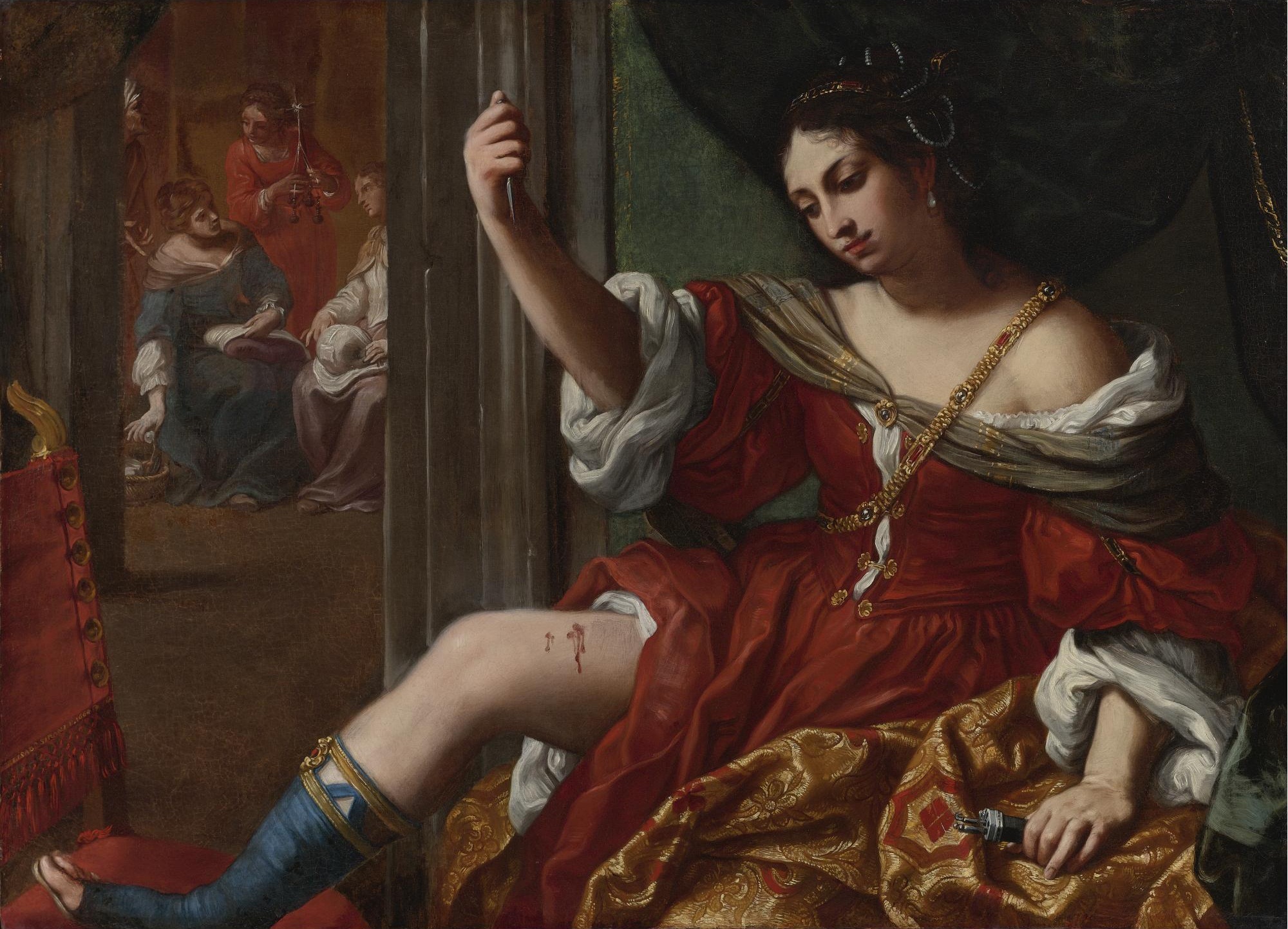
Elisabetta Sirani, Portia Wounding her Thigh, 1664, oil on canvas, 101 x 138 cm (Collezioni d’Arte e di Storia della Fondazione della Cassa di Risparmio, Bologna)The suicide of Porcia, Pierre Mignard. Museum of Fine Arts of Rennes, 1650.
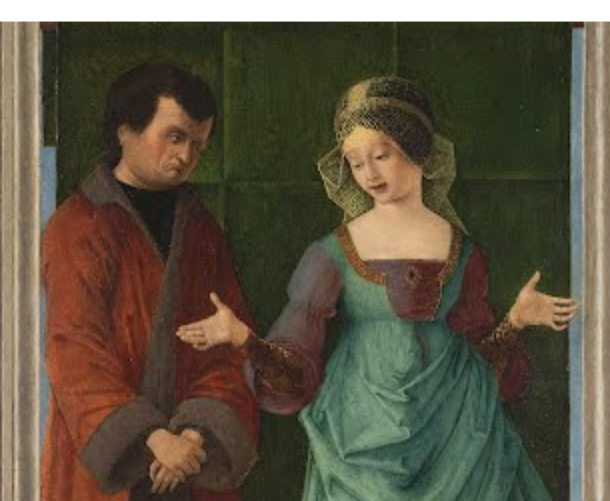
Portia (Or Porcia), was the wife of Marcus Brutus. Many ancient writers emphasize her courage, beauty, and devotion to her husband and Rome. Many painters and illustrators have chosen to depict her as a model of courage and grace.
Porcia, as has been said, was a daughter of Cato, and when Brutus, who was her cousin, took her to wife, she was not a virgin; she was, however, still very young, and had by her deceased husband17 a little son whose name was Bibulus. A small book containing memoirs of Brutus was written by him, and is still extant. 4 Porcia, being of an affectionate nature, fond of her husband, and full of sensible pride, did not try to question her husband about his secrets until she had put herself to the following test. 5 She took a little knife, such as barbers use to cut the finger nails, and after banishing all her attendants from her chamber, made a deep gash in her thigh, so that there was a copious flow of blood, and after a little while violent pains and chills and fever followed from the wound. 6 Seeing that Brutus was disturbed and greatly distressed, in the height of her anguish she spoke to him thus: 7 “Brutus, I am Cato’s daughter, and I was brought into thy house, not, like a mere concubine, to share thy bed and board merely, but to be a partner in thy joys, and a partner in thy troubles. 8 Thou, indeed, art faultless as a husband; but how can I show thee any grateful service if I am to share neither thy secret suffering nor the anxiety which craves a loyal confidant? 9 I know that woman’s nature is thought too weak to p155 endure a secret; but good rearing and excellent companionship go far towards strengthening the character, 10 and it is my happy lot to be both the daughter of Cato and the wife of Brutus. Before this I put less confidence in these advantages, but now I know that I am superior even to pain.” 11 Thus having spoken, she showed him her wound and explained her test; whereupon Brutus, amazed, and lifting his hands to heaven, prayed that he might succeed in his undertaking and thus show himself a worthy husband of Porcia. Then he sought to restore his wife. -Plutarch, Life of Brutus
She tried to conceal her distress, but a certain painting betrayed her, in spite of her noble spirit hitherto. 3 Its subject was Greek, — Andromache bidding farewell to Hector; she was taking from his arms their little son, while her eyes were fixed upon her husband. 4 When Porcia saw this, the image of her own sorrow presented by it caused her to burst into tears, and she would visit it many times a day and weep before it. 5 And when Acilius, one of the friends of Brutus, recited the verses containing Andromache’s words to Hector,
“But, Hector, thou to me art father and honoured mother
And brother; my tender husband, too, art thou,”
Brutus smiled and said: 6 “But I, certainly, have no mind to address Porcia in the words of Hector,
‘Ply loom and distaff and give orders to thy maids,’23
for though her body is not strong enough to perform such heroic tasks as men do, still, in spirit she is valiant in defence of her country, just as we are.” This story is told by Porcia’s son, Bibulus.
Portia marks a turning point in Shakespeare’s Roman female characters as we we go from more ‘traditional’ female characters, to ones who exemplify masculine virtues. Instead of women being subordinates to men’s affairs and keeping out of religion, politics, and the affairs of Roman society, Portia is a character who demands respect, and to share her husband’s dangers. Some ancient sources suggested possibly Portia might have been the one who inspired Brutus to kill Caesar, (more on that later), but in any case Portia is not a character who is subordinate to men, but who demands to be treated as a Roman citizen.
Happy April Fool’s Day! Today I’d like to look at the rich history of Shakespeare’s fools and clowns! Clowns are some of Shakespeare’s classic comic characters, but fools are complex characters that entertain, satirize, and even philosophize. They may dress the part, but they are no fools.
This clip from Mel Brooks’ comic masterpiece History of the World, Part I, has the writer/director perform as Comicus, a ‘stand-up philosopher’ from Ancient Rome- a philosopher who is basically a stand-up comic. As you’ll see, unlike clowns, most of Shakespeare’s fools basically fulfill this role- to satirize and make fun of people and institutions.
What Is A Fool?
Fools and clowns are based on medieval minstrels who, as this video from Monty Python’s Terry Jones shows, were itinerant entertainers who had to do a number of jobs including play music, dance, sing, compose poetry, juggle, and on occasion- START A WAR!
Fools Vs. Clowns
A fool is the renaissance version of a minstrel- an official royal entertainer who worked at royal courts. A clown is a comic part in a play. They often danced, sang, and did improv comedy. To illustrate the difference, here’s a short video about the life of Henry VIII’s favorite fool- Will Sommers
Foolish Founding Fathers
All of Shakespeare’s fools and clowns are based on ancient Italian sources-from the Roman comedies of Plautus and Terrence to the improvised comedy known as Commedia Del ‘ Arte
Short featurette documentary on the artform of “Commedia Del’ Arte” by The National Theater in London
Commedia is based on stock character types that Shakespeare adapted and fleshed out- Arlequinno became the constantly hungry Dromio, (among others), while Capitano became Falstaff and Pistol. Even Shylock has remnants of Brighella in his DNA. According to Dario Fo in his book: Manuale Minimodell’Attore, Shakespeare adapted stock characters from commedia to be his clowns, and sarcastic characters called sots, who commented on the action to become his fools (Fo, 107)
Will Kempe- Shakespeare’s First Great Clown
Despite his strength and skill as a dancer, Kempe specialized in playing oafish buffoons like Dogberry in Much Ado About Nothing, Falstaff in the Henry IV plays, and Peter in Romeo and Juliet. In the Second Quarto edition of Romeo and Juliet, you can see in the stage directions “Enter Will Kempe,” right before Peter speaks:
According to Will In the World by Steven Greenblatt, Kempe and Shakespeare had a falling out in the late 1590s, which many scholars have assumed might have been due to Shakespeare’s distaste for clowns wasting time with jokes that bogged down the play:
Hamlet:
 Let those that play your
clowns speak no more than is set down for them. For there
be of them will themselves laugh, to set on some
quantity of barren spectators to laugh too. Though in the
meantime, some necessary question of the play be then
to be considered. That's villainous, and shows a most pitiful
ambition in the fool that uses it. Hamlet, Act III, Scene ii.

Kempe, for his part, seemed a little big for his britches; he and his fellow clowns seemed to think that Shakespeare's scripts were just vehicles for his own jokes and songs (Reynolds, 247). He then sold his share in the Chamberlain's Men, derriding them in print as "My notable Shake-rags," and then staged a publicity stunt where he danced across England!
1600-1613: The Golden Age Of Foolery
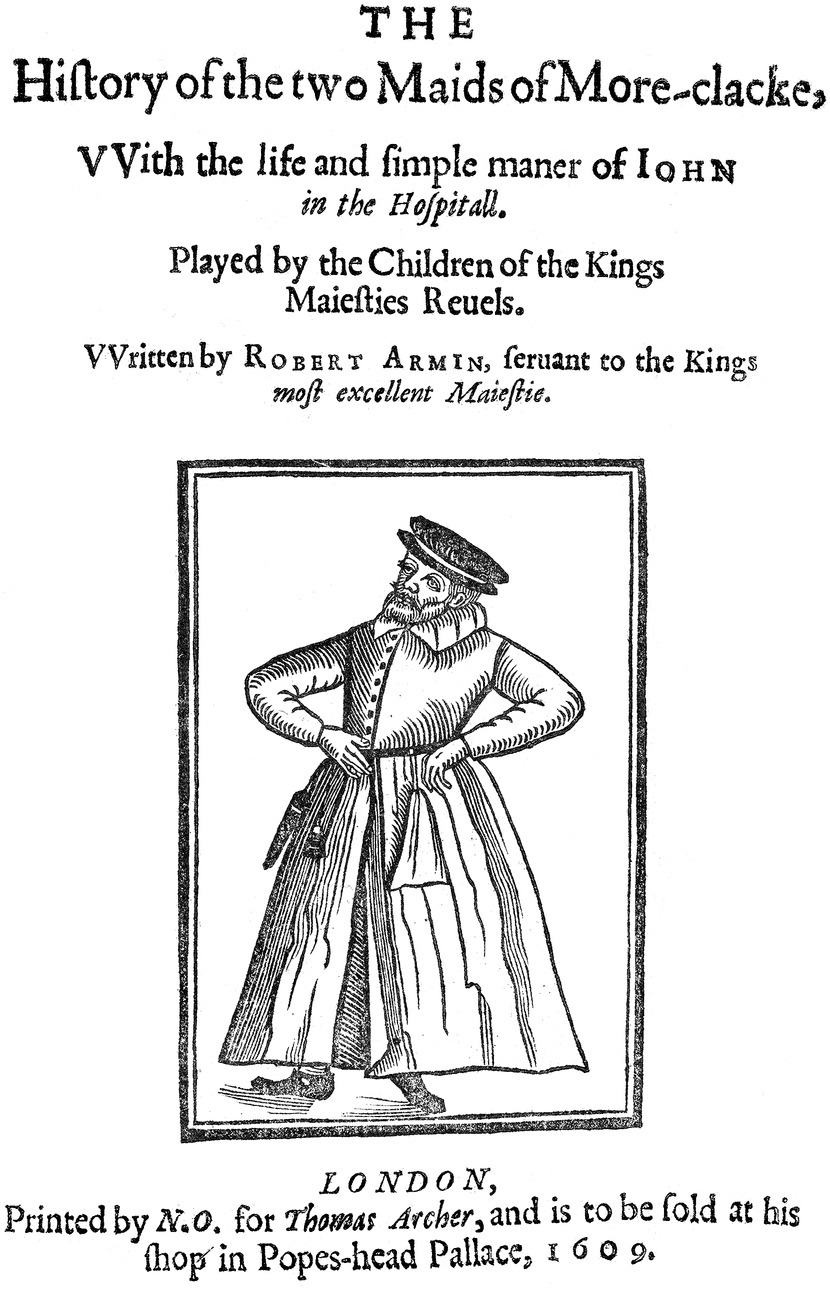
Kempe’s replacement was Robert Armin, an accomplished writer and singer, who specialized in playing satirical Fool roles. Armin appeared in several Shakespearean plays after 1599.
Unlike Kempe, Armin’s characters are essential to the plot of the play, and his jokes support the themes and ideas of the plays themselves. As Feste in Twelfth Night, Armin makes jokes that make fun of the overly-serious Orsino and Countess Olivia:
Feste. Good madonna, why mournest thou?
Olivia. Good fool, for my brother's death.
Feste. I think his soul is in hell, madonna.
Olivia. I know his soul is in heaven, fool.
Feste. The more fool, madonna, to mourn for your brother's
soul being in heaven. Take away the fool, gentlemen. Twelfth Night, Act I, Scene v.
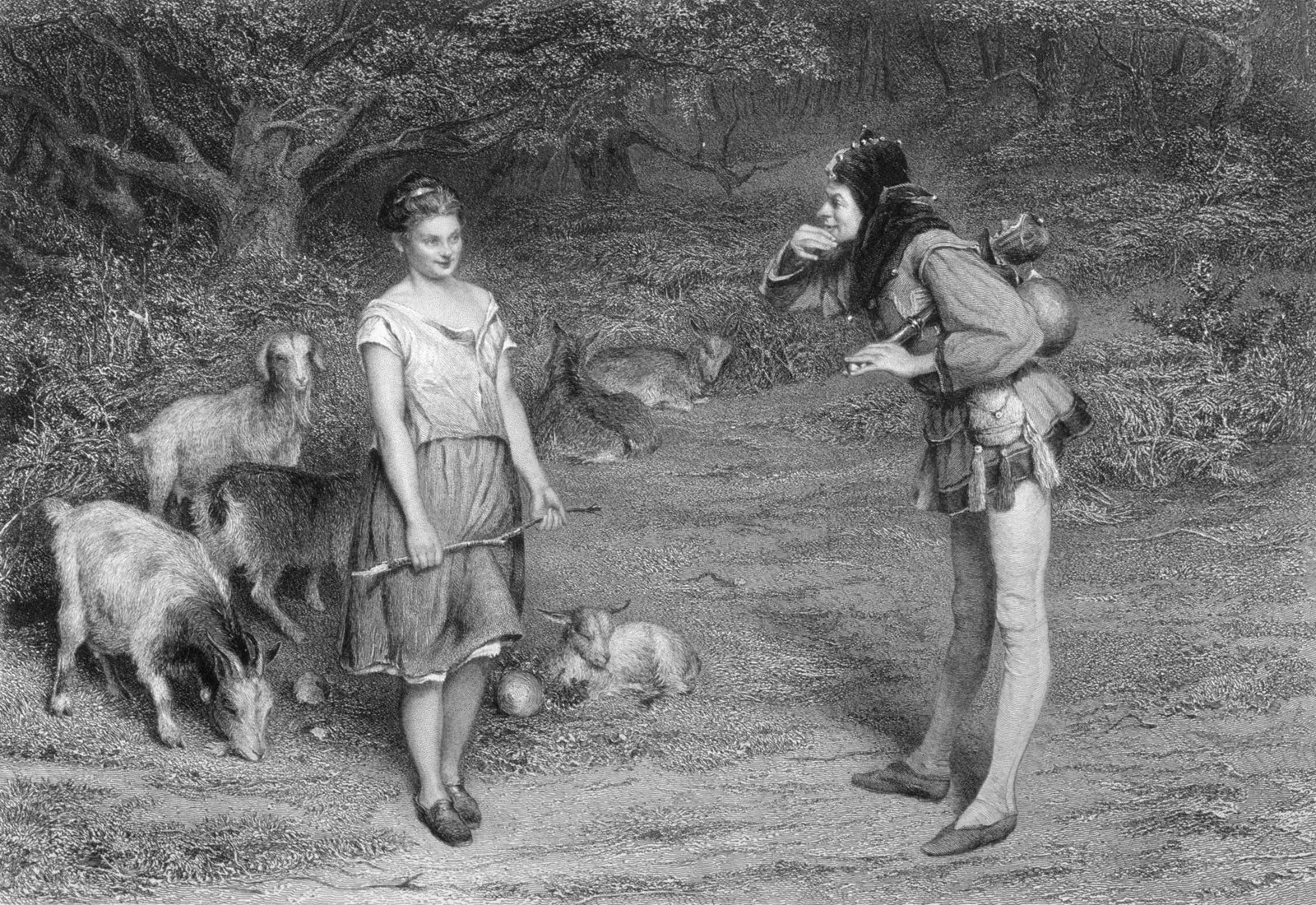
Touchstone in “As You Like It”
Sometimes Armin’s characters are satirical mirrors of Elizabethan society; in As You Like It, Touchstone the Fool mocks the culture of dueling; implying that there are hundreds of loopholes that a gentleman may use to challenge a man to a duel, without actually fighting.
Touchstone. I did dislike the cut of a certain courtier’s beard; he sent me word, if I said his beard was not cut well, he was in the mind it was. This is call’d the Retort Courteous. If I sent him word again it was not well cut, he would send me word he cut it to please himself. This is call’d the Quip Modest. If again it was not well cut, he disabled my judgment. This is call’d the Reply Churlish. If again it was not well cut, he would answer I spake not true. This is call’d the Reproof Valiant. If again it was not well cut, he would say I lie. This is call’d the Countercheck Quarrelsome. And so to the Lie Circumstantial and the Lie Direct.
Jaques (lord). And how oft did you say his beard was not well cut?
Touchstone. I durst go no further than the Lie Circumstantial, nor he durst not give me the Lie Direct; and so we measur’d swords and parted.
The Fool in “King Lear”
Perhaps Armin’s greatest comic creation was The Fool in King Lear; the ultimate satirist who makes fun of the king’s foolish choices. He tries to talk sense to the increasingly mad king, until he vanishes entirely, and Lear himself starts making fool-like cracks at the audience:
Lear Thou hast seen a
farmer's dog bark at a beggar?
Earl of Gloucester. Ay, sir.
Lear. And the creature run from the cur? There thou mightst behold
the great image of authority: a dog's obeyed in office.
The usurer hangs the cozener.
Through tatter'd clothes small vices do appear;
Robes and furr'd gowns hide all. Plate sin with gold,
And the strong lance of justice hurtless breaks;
Arm it in rags, a pygmy's straw does pierce it.
None does offend, none- I say none! Get thee glass eyes
And, like a scurvy politician, seem
To see the things thou dost not. King Lear, Act IV, Scene vi.
Through realizing his own foolishness, Lear recovers his sanity, and makes peace with his daughter, which beautifully shows the importance of fools, clowns, and satirists; to question ourselves, to sharpen our critical thinking, and to endure hardships with good humor. Therefore on this April Fools Day, I say,
“Here’s to the fools, to folly, to farce. Let them push the wealthy on the ar— APRIL FOOLS!”
References
Best, Michael. “Shakespeare’s Actors: Will Kempe” Internet Shakespeare Editions, University of Victoria, 28 Sept. 2016, ise.uvic.ca/Foyer/citing. Accessed 30 Sept. 2023.
I teach a class specifically on Shakespeare’s comedies where I’ll talk a lot about the way Shakespeare writes clowns. I’ll also delve into the history of Commedia Del’Arte and how it influenced Shakespeare’s characters! For more information, visit http://www.outschool.com
The global phenomenon “Five Nights At Freddie’s” (FNAF) has spawned 11 major games, spinoff games, 19 books, countless comics, and a big Hollywood movie premiering this week:
My video podcast on FNAF
One other thing this franchise has spawned is ENDLESS FAN THEORIES. I admit, when I first heard of this jump-scare-based game with haunted animatronics, I viewed it as a silly novelty- a clever way to create cheap horror using monsters who jump out at you in a dark room… then I saw this:
2023- The Game Theorist Youtube show tells the entire chronology of the FNAF saga.
The YouTube channel Game Theory, which has been analyzing and dissecting the games for the last 8 years finally created a complete chronology of the games’ lore. Like a lot of the best horror stories like Dracula and “Sleep No More,” the game scatters a lot of its lore throughout the game in the form of mini-games, security guard notebooks, newspaper clippings, and of course, the iconic, nervous late-night phone calls that your character (a nameless night watchman) receives from a mysterious character known only as THE PHONE GUY.
This story is truly the stuff of nightmares- serial killers, murdered children, ghosts, possessed robots, broken families, and unending quests for revenge from beyond the grave. Of course, a few of these tropes Mr. Shakespeare would be very familiar with, so I thought I’d delve into some of the themes, tropes, and ideas that link these two franchises. My goal is to get fans of the video game to understand that, since Shakespeare and Scott Cawthorne (the creator of the game) use a lot of the same horror plots and ideas, that, if you can understand FNAF you can understand Shakespeare!
Part I: The mad scientist- William Afton Vs. William Shakespeare’s Prospero
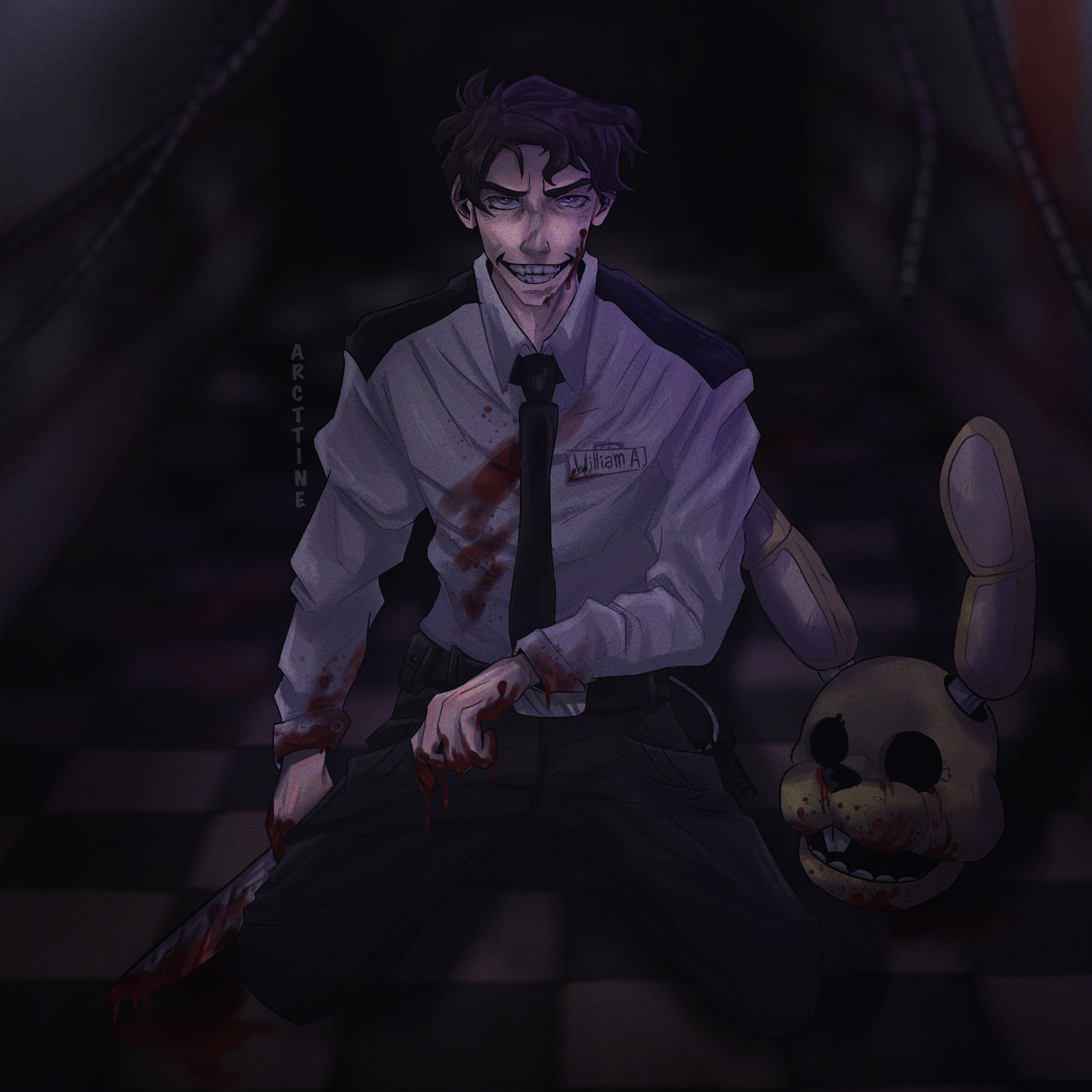
The story of Five Nights At Freddie’s revolves around its main antagonist- a genius roboticist-turned-serial killer named William Afton, who starts out as a successful businessman and children’s entertainer obsessed with bringing his creations to life. Any horror fan will tell you that this is an automatic sign of a villain because he is trying to master the skill that only God possesses- the ability to create life.
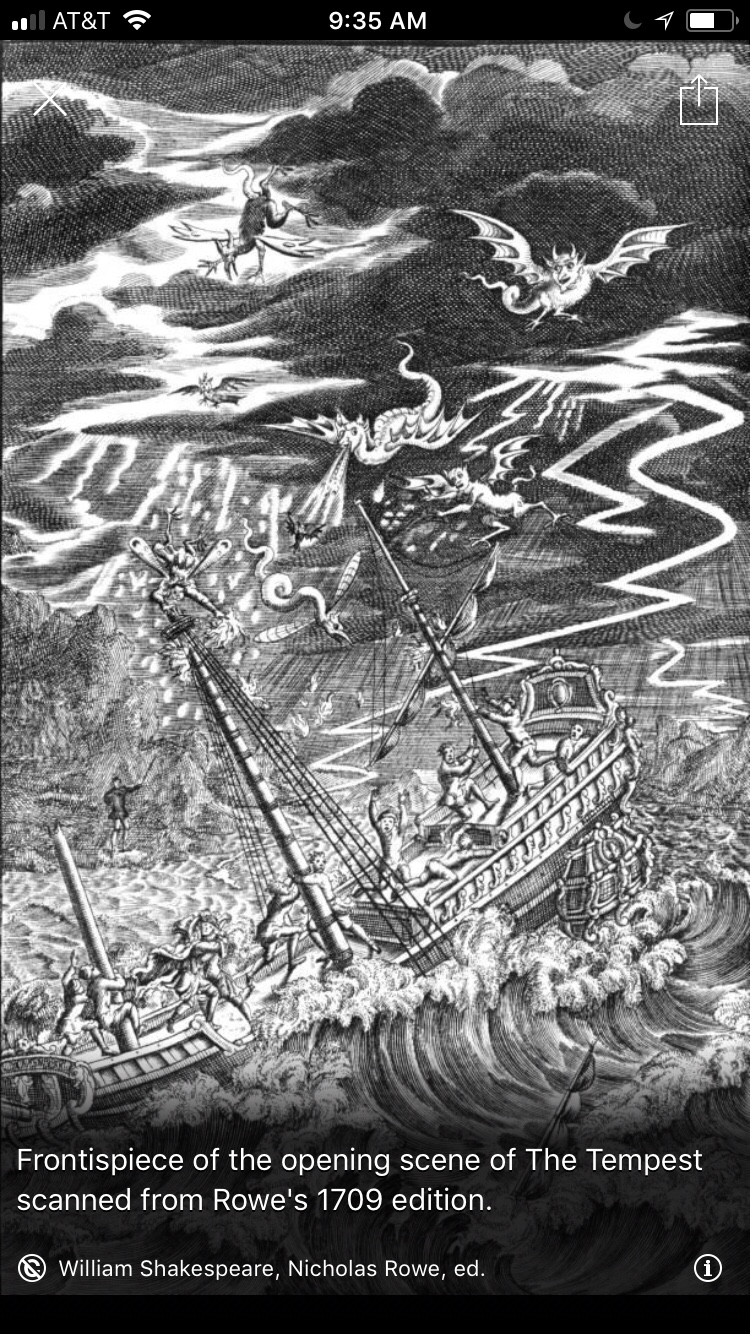
In Shakespeare’s final play, The Tempest, the hero is a brilliant magician who, after his brother exiles him to a desert island, masters many crafts considered unnatural for the 1600s:
I have bedimm'd
The noontide sun, call'd forth the mutinous winds,
And 'twixt the green sea and the azured vault
Set roaring war: to the dread rattling thunder
Have I given fire and rifted Jove's stout oak
With his own bolt; the strong-based promontory
Have I made shake and by the spurs pluck'd up
The pine and cedar: graves at my command
Have waked their sleepers, oped, and let 'em forth
By my so potent art.
The Tempest, Act V, Scene i, Lines 2063-
Like I discussed in my post on Shakespeare and Star Trek, Prospero’s magic is both benevolent and terrifying. He uses it to rescue himself and his daughter Miranda from the island, and he creates beautiful visions of gods and angelic music for Miranda and her young lover Sebastian, but he also creates nightmarish visions to torment his enemies:
Both Afton and Prospero are motivated by revenge against the men who betrayed them. In Afton’s case it’s his rival/ partner Henry Emily who bankrupted his business and later got him fired from his own company. Afton torments Henry by murdering his daughter and ruining his business by luring kids to their death inside the pizzeria, disguised as one of the animatronic characters. Afton also figures out how to torment people using sound alone, like Prospero does to his slave Caliban:
Caliban. All the infections that the sun sucks up
From bogs, fens, flats, on Prosper fall and make him
By inch-meal a disease! His spirits hear me
And yet I needs must curse.
For every trifle are they set upon me;
Sometime like apes that mow and chatter at me
And after bite me, then like hedgehogs which
Lie tumbling in my barefoot way and mount
Their pricks at my footfall; sometime am I
All wound with adders who with cloven tongues
Do hiss me into madness.
Here comes a spirit of his, and to torment me! The Tempest, Act II, Scene ii.
Prospero isn’t a killer, but like Afton, he has learned the secret to life after death, which makes him powerful and dangerous. Even more unsettling, both men are on an endless quest for revenge and torment men whom they saw as brothers. Other Shakespearean characters take their lust for revenge to the same dark place Afton did- the murder of children.
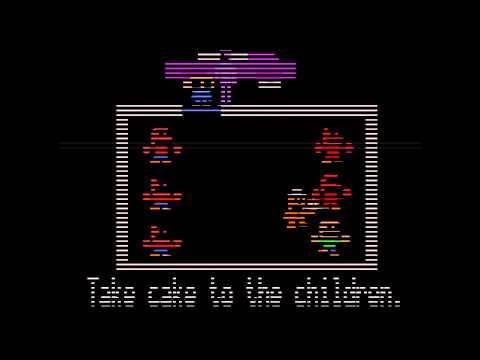
For the first four games, Afton isn’t directly part of the game- he’s merely mentioned in pieces of the lore. Frequently we see 8- bit re-enactments of his crimes in a series of mini-games, where he appears as a faceless, purple killer.
Screenshot of William’s first murder of Henry’s daughter Charlie outside of the pizzeria.
Why purple though? It’s true that purple is associated with royalty, and sometimes associated with villainy, (since it isn’t a color found much in nature). I think though, there might be a deeper, more macabre meaning to this color associated with this killer: It is a scientific fact that human blood, when it is shed and deprived of oxygen, actually turns purple:
The colors of arterial and venous blood are different. Oxygenated (arterial) blood is bright red, while dexoygenated (venous) blood is dark reddish-purple
Shakespeare was very aware of this medical fact. He lived in an age where traitors’ heads were placed on spikes on London Bridge, and people would pay to watch wild dogs attack bears (the FNAF of his time). Shakespeare makes many gory references to murderers watching red blood turn purple:
I make as good use of it as many a man doth of a Death’s-head or a memento mori: I never see thy face but I think upon hell-fire and Dives that lived in purple;
Henry IV, Part I, Act III, Scene iii.
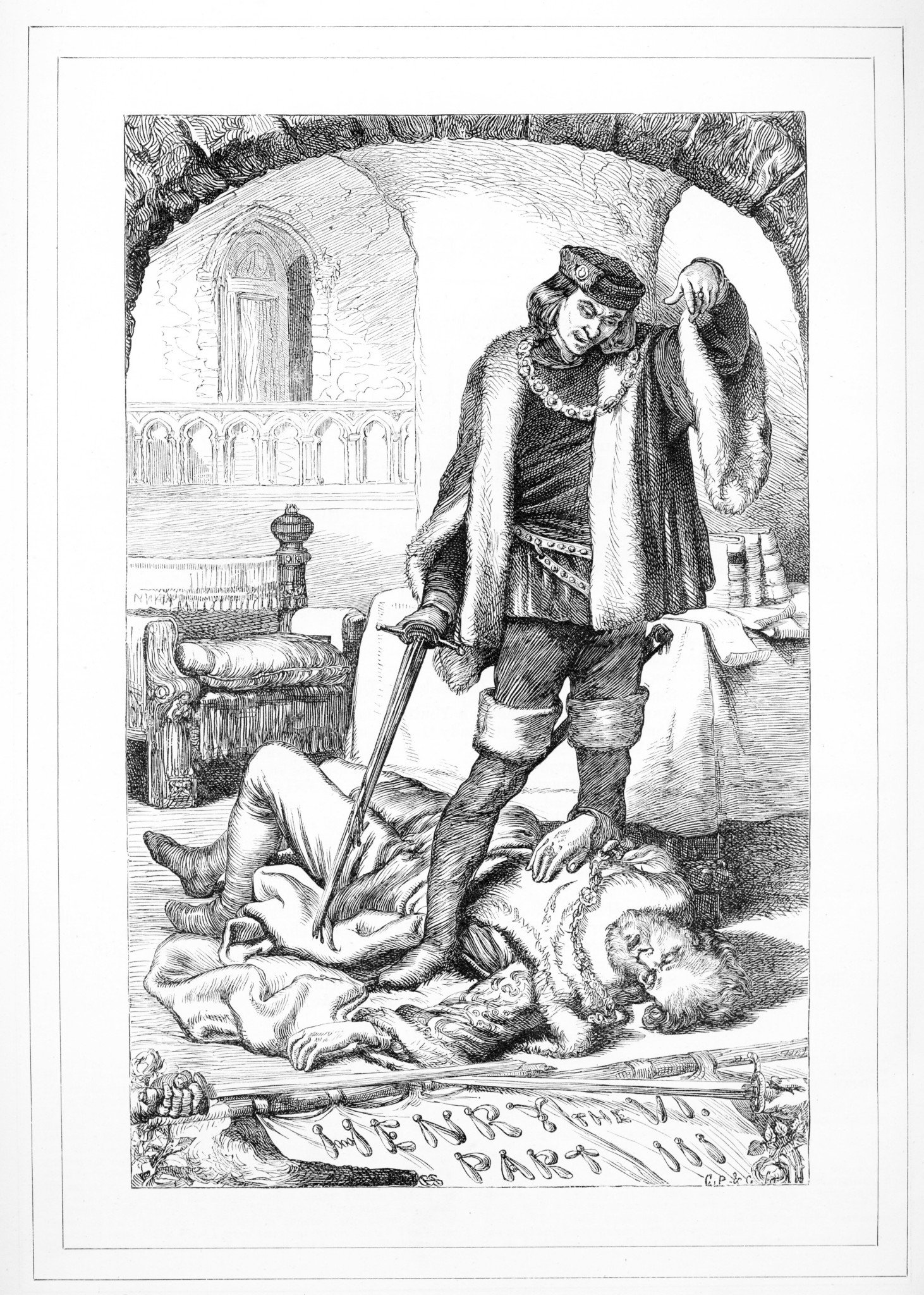
Woe above woe! grief more than common grief! O that my death would stay these ruthful deeds! O pity, pity, gentle heaven, pity! The red rose and the white are on his face, The fatal colours of our striving houses: The one his purple blood right well resembles;
Henry VI, Part III, Act II, Scene v.
Now, whilst your purpled hands do reek and smoke,
Julius Caesar Act III, Scene i.
With purple falchion, painted to the hilt In blood of those that had encounter’d him:
Henry VI, Part III, Act II, Scene v (Richard of Gloucester)
This last quote is spoken by Richard of Gloucester, who, in the play that bears his name, becomes King Richard III, Shakespeare’s most irredeemable villain. Just like William Afton, he kills without remorse and dispatches anyone who gets in his way on the path to the crown. In addition, like many of Shakespeare’s villains, his turn to pure evil occurs right after he does the unthinkable- when he murders children.
Richard (Ian McKellen), orders the secret murder of his nephews in the tower in order to keep his crown.
Throughout the rest of the play, Richard kills a lot of his political and personal enemies and we go along with them because he’s the protagonist. But once he murders the princes, who have done nothing to harm him or anyone else, Richard crosses the line from anti-hero to monstrous villain. It is also at this part of the play when his victims begin to take their revenge… FROM BEYOND THE GRAVE!
Part III: The ghostly revenge story
I’ve written before that in Shakespeare, ghosts are usually murder victims either out for revenge, or trying to convince a living person to avenge their death. Likewise, in the subsequent games, Affton’s victims possess the animatronics, seeking to kill their murderer!
One of the creepiest scenes in Shakespeare comes when Richard III is visited the night before his final battle by the ghosts of all the people he’s killed:
Similarly, when Macbeth murders his friend Banquo (and attempts to murder his young son Fleance), he is visited by Banquo’s ghost, during a party, no less! Even more ironic, look at the language Macbeth uses when he sees the ghost:
Approach thou like the rugged Russian bear, The arm’d rhinoceros, or the Hyrcan tiger; Take any shape but that, and my firm nerves Shall never tremble: or be alive again.
It’s truly ironic that, while in FNAF, the ghosts of Afton’s slaughtered children appear in the forms of angry animatronics, shaped like fearsome animals, Macbeth would rather see the fearsome animal, than the ghost of the man he murdered! Though Macbeth himself doesn’t fear bears, in both FNAF and Shakespeare, bears and other animals have long had a symbolism associated with wrath, anger, and taking bitter vengeance on the wicked.
Part IV: The Forrest of Beasts
1930s-style ad for the original Fredbear’s Singin’ Show, where a real dancing bear entertained travelers.
Bear Baiting
Even the animals in FNAF have some significance that Shakespeare has touched on in some of his plays, especially bears. In many renaissance and medieval sources, bears are symbols of wrath, revenge, and fierce protectors of children. Both Shakespeare and FNAF exploit this symbolism, and both the game and Shakespearean plays create horrifying beastly images in stories of revenge.
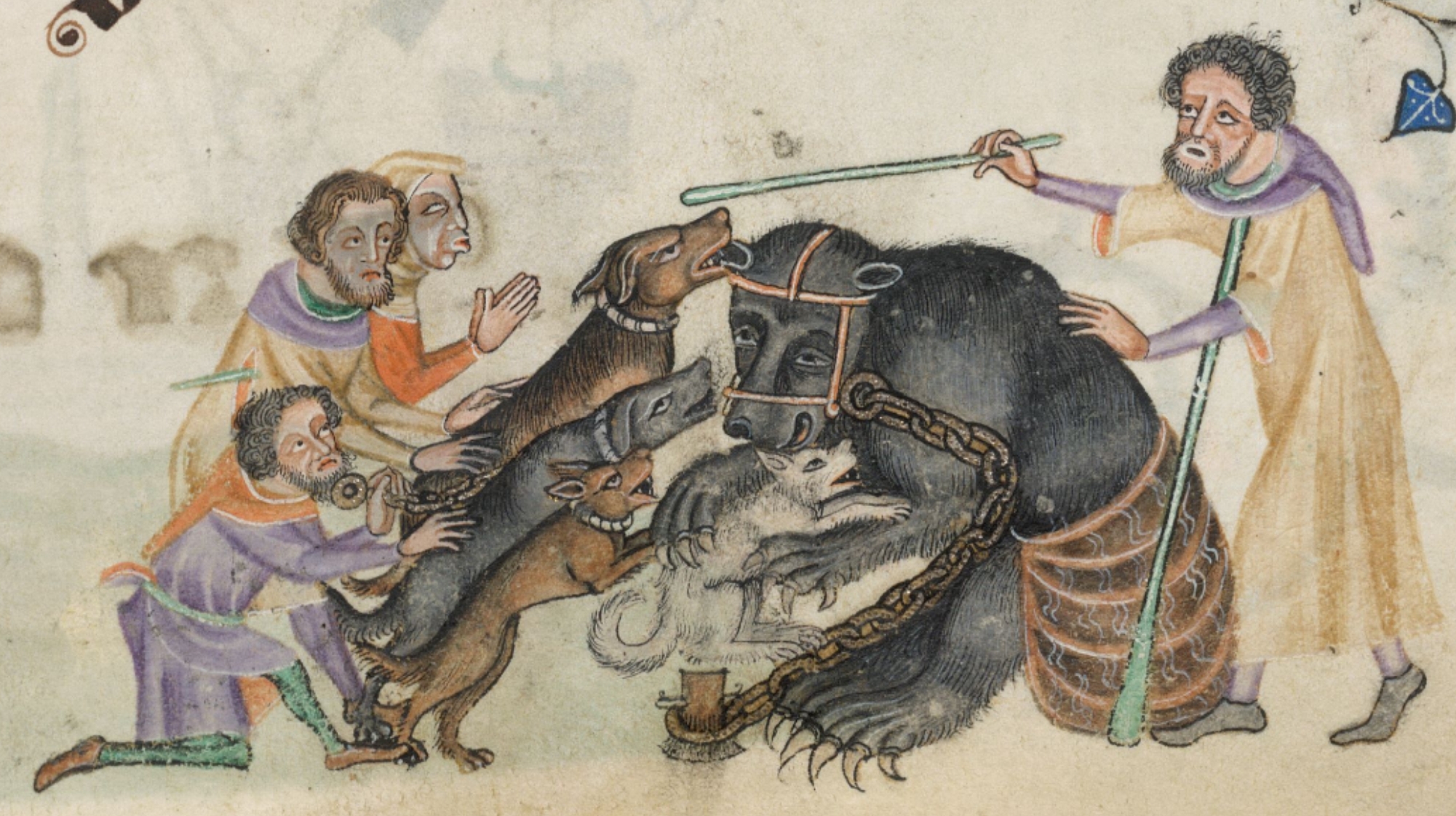
Just like the Fredbear singin’ show, Elizabethans liked to watch real bears perform onstage, sometimes as dancers, but also IN BLOODY FIGHTS TO THE DEATH. In the 1590s, there was a popular sport called “Bear baiting,” where bears would be chained, sometimes to a pole, and set on by vicious dogs. The ‘sport’ was watching to see who would prevail- the fierce and free dogs, or the powerful, bound bear.
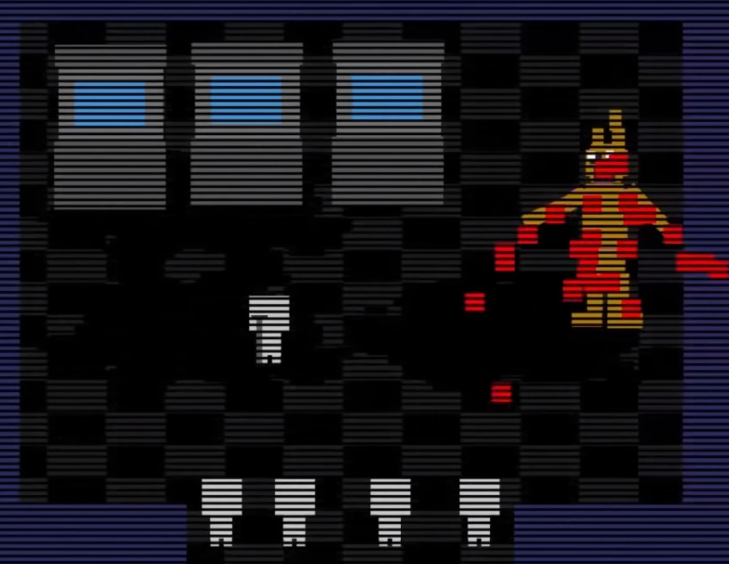
As you can see from this close-up of Wenceslaus Hollar’s famous Panorama Of London (1647), we know that Shakespeare had to pass bear beating pits on his way to the Globe all the time, (you can see ‘Beer bayting’ or bear beating, written on the playhouse on the left, and Shakespeare’s Globe Theater on the right). Not only that, Shakespeare writes about the bloody sport frequently in his plays. When Macbeth knows he’s losing the battle with Malcolm, he compares himself to a bear, tied to a stake, forced to fight until his last breath. It calls to mind the moment in the game when the ghosts shed their animatronic skins and attack William directly, while he’s trapped in the Springtrap suit.
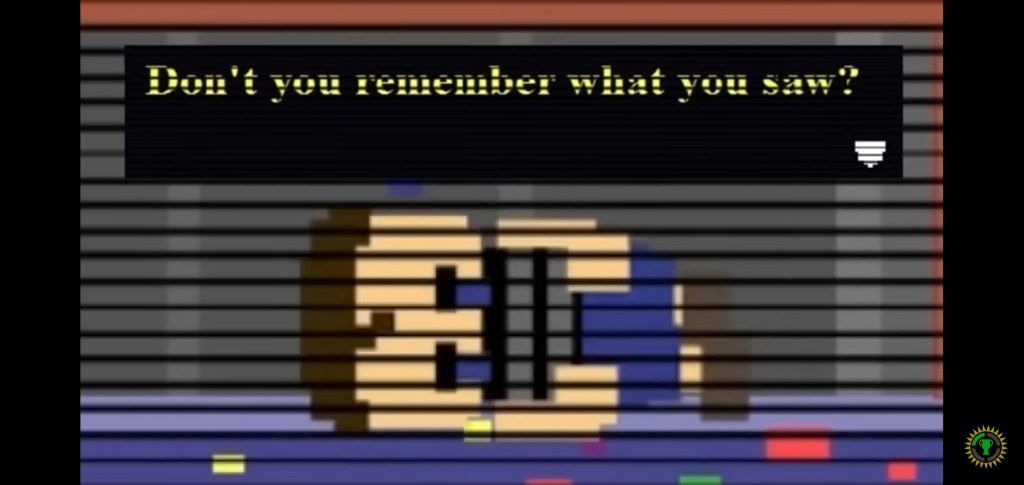
The ghosts of Afton’s original five victims gang up on him, possibly causing his golden Bonnie suit to malfunction, and kill him… for now.
It’s worth noting that when the ghosts kill Afton, he’s wearing his Golden Bonnie suit. As Mat Pat mentioned, yes it is the disguise he wore to commit his crimes, but it is also symbolic of who Afton has become- a beastly, inhuman creature who looks friendly on the outside, but inside is cold and robotic. This also calls to mind the beast symbolism in the aforementioned ghost scene from Richard III. The real King Richard III used a boar as his royal sigil, and Shakespeare exploits that beast imagery by comparing Richard to a bloody, rooting hog, grown fat on the blood of his victims. Richard doesn’t wear a pig suit, but he literally wears his cruelty and bloodlust as a badge of honor!
In both the games and the plays, the ghosts become a manifestation of the murderer’s guilty conscience, and beast-like imagery is used to convey how cruel and beast-like the murderer has become. Macbeth and Richard don’t dress like beasts, but they do kill like them.
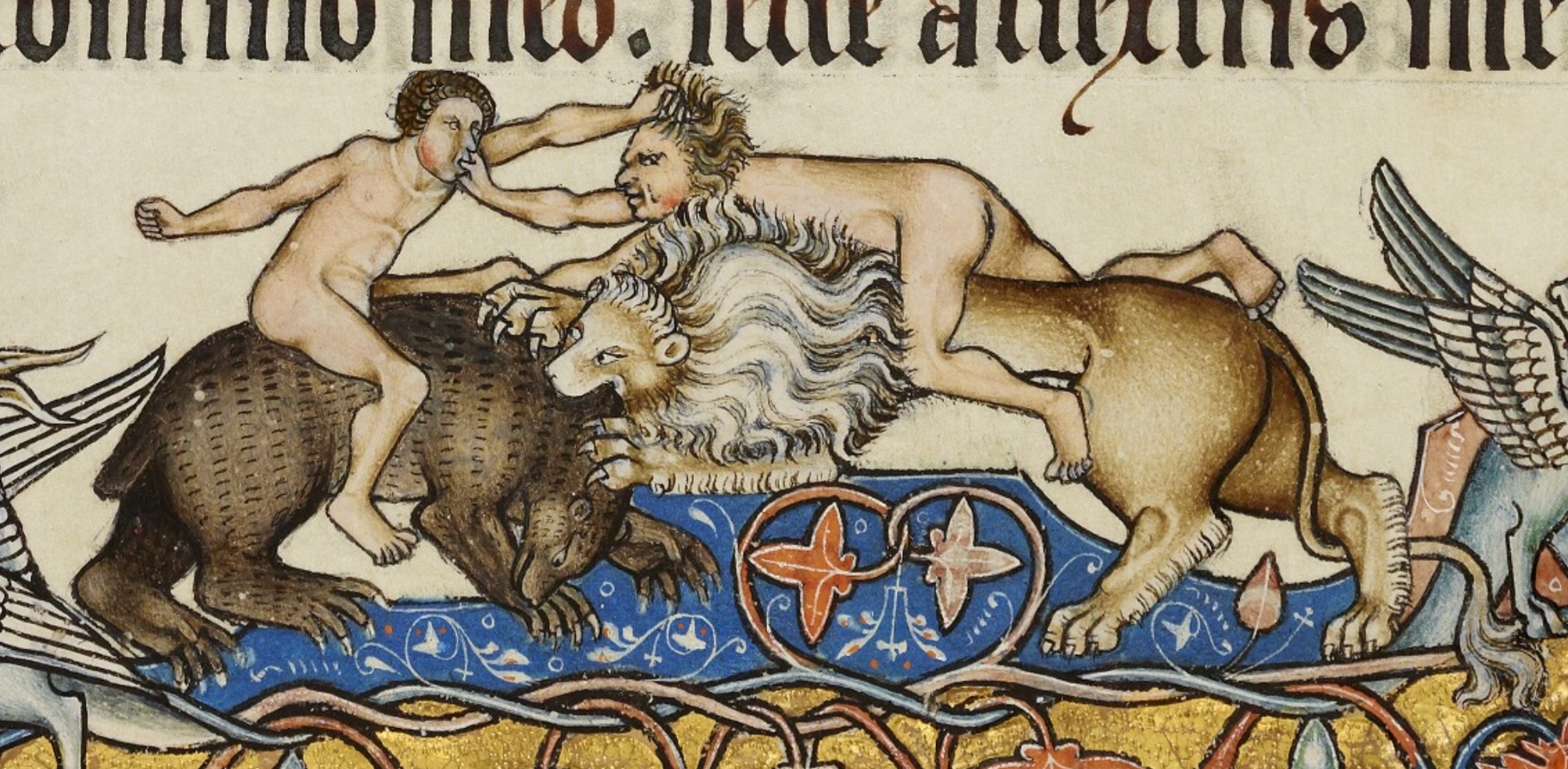
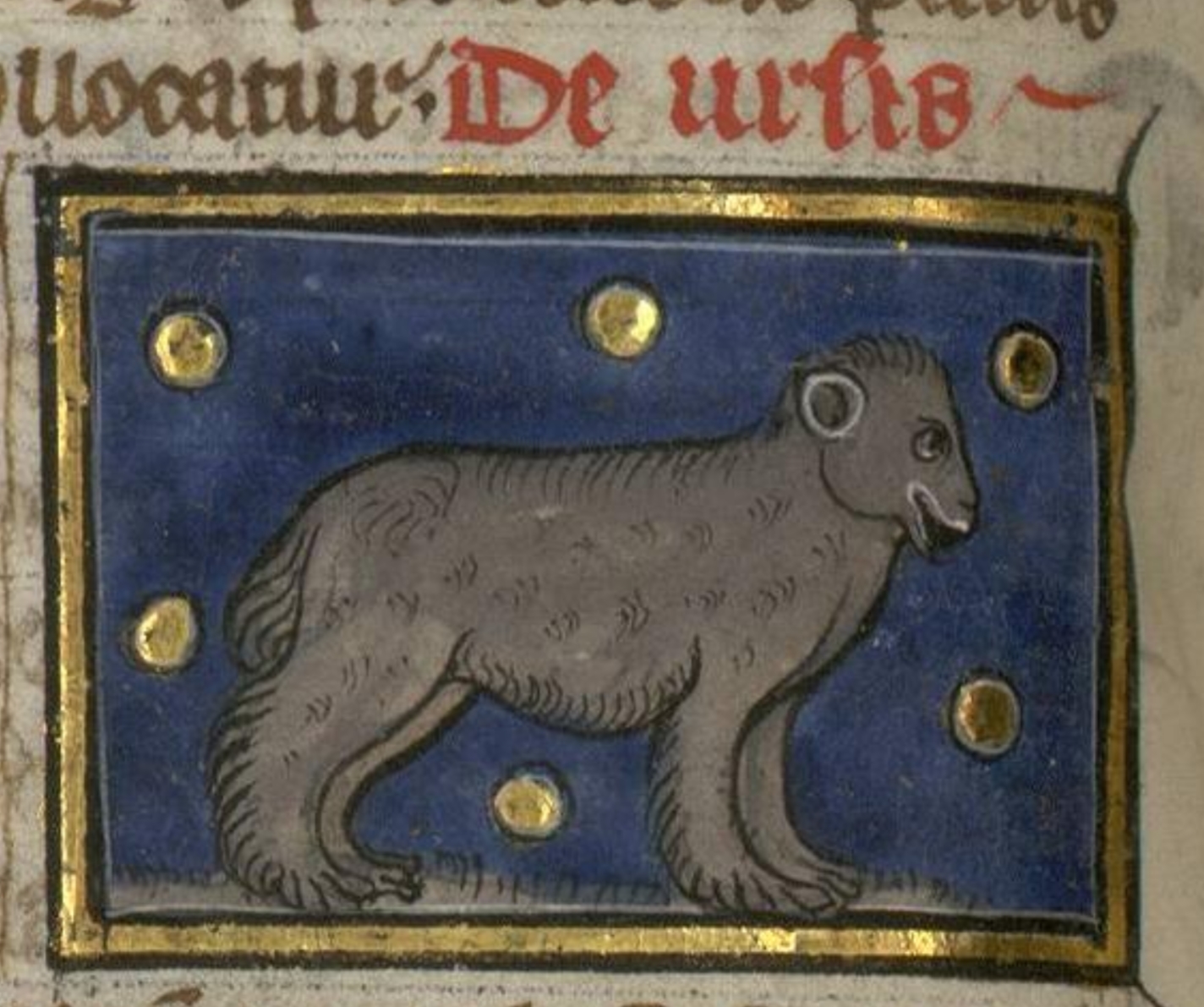
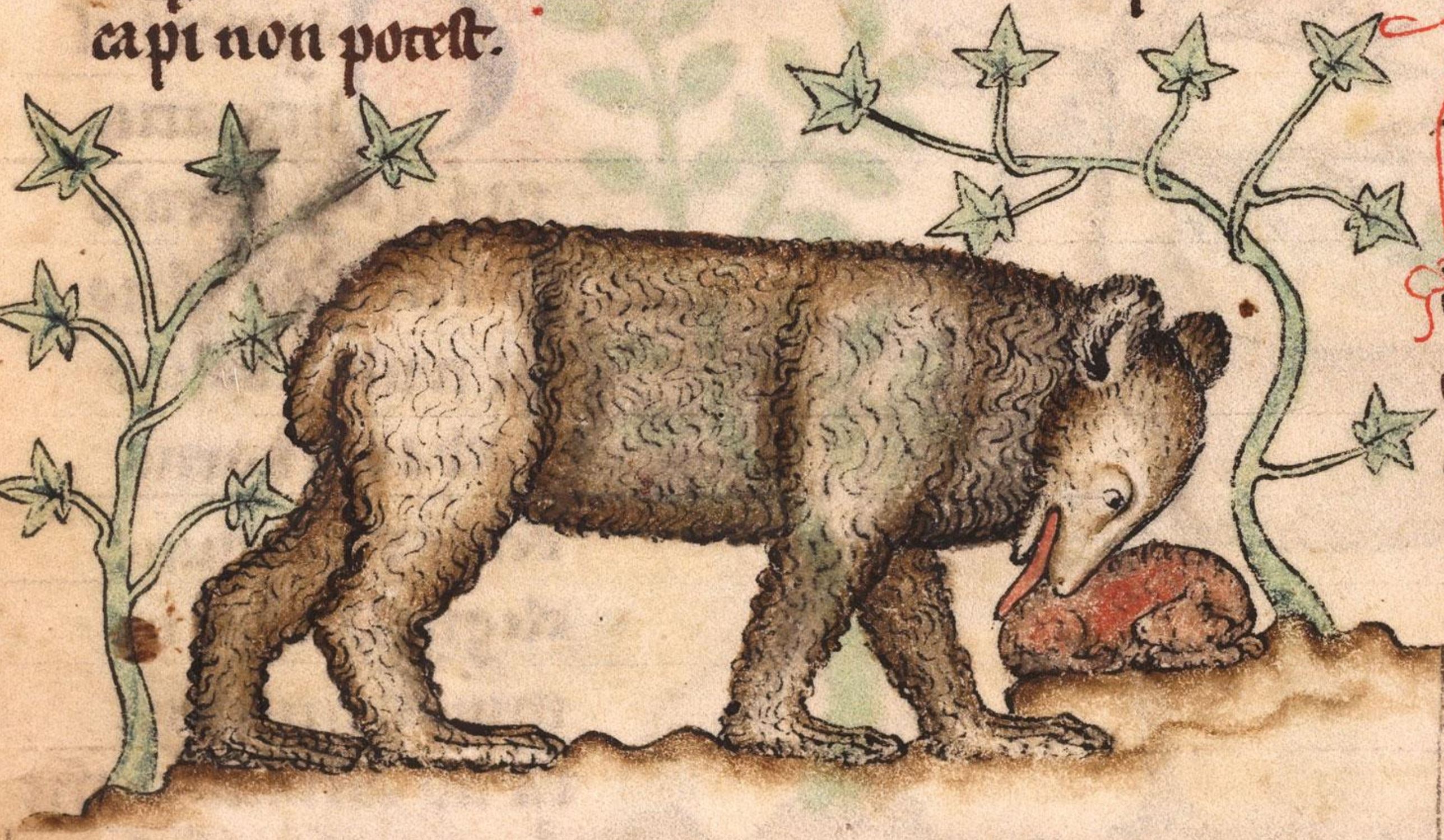
A bear fighting a lion, while both are ridden by naked men viciously fighting each other. Marginal illustration from a psalter.A very shaggy bear.The bear’s cub is born as a lump of flesh; the bear has to lick it into its proper shape.Two bears fight with a unicorn, a scene not described in any bestiary. Marginal illustration.
The beast imagery also extends to the concept of revenge. One big theme in Five Nights At Freddie’s is the concept that revenge, (whether justified or not), is blind and indiscriminately destructive. Even though the five ghosts that possess the animatronics are justifiably angry for being murdered, they don’t just try to kill Afton- they attack any poor soul who sticks around the pizzeria at night. Like Hamlet, who wants to avenge his father’s murder, but kills the wrong people, the five souls trapped in their metal cages have a noble goal- protect the children in the pizzeria, and destroy Afton, but they are full of beastlike rage and are unable to see friends from foes. This kind of blind rage reminds me of how real bears will fight off anyone whom they perceive as a threat. In medieval manuscripts, bears are tender to their cubs and literally form them out of little hairy lumps by licking them into shape. At the same time, they are powerful, deadly, and violent to anyone that threatens the cubs.
This kind of blind violence is something Shakespeare explores a lot in his history plays and his tragedies. Every time he talks about a society going wrong, he describes it as if it were populated with beasts, not humans. In Timon of Athens, the titular character, having left Athens to go live in the woods, laments to his frenemy, the cynical philosopher Apemantus, how his city has become like a collection of beasts:
Timon. What wouldst thou do with the world, Apemantus, if it lay in thy power?
Apemantus. Give it the beasts, to be rid of the men.
Timon. Wouldst thou have thyself fall in the confusion of2025 men, and remain a beast with the beasts?
Timon. A beastly ambition, which the gods grant thee t’ attain to! If thou wert the lion, the fox would beguile thee; if thou wert the lamb, the fox would eat three: if thou wert the fox, the lion would suspect thee, when peradventure thou wert accused by the ass: if thou wert the wolf, thy greediness would afflict thee, and oft thou shouldst hazard thy life for thy dinner: wert thou a bear, thou wouldst be killed by the horse: What beast couldst thou be, that2045 were not subject to a beast? and what a beast art thou already, that seest not thy loss in transformation!
Apemantus. If thou couldst please me with speaking to me, thou mightst have hit upon it here: the commonwealth of2050 Athens is become a forest of beasts.
Timon. How has the ass broke the wall, that thou art out of the city? Timon Of Athens, Act IV, Scene iii.
In short, the history of horror, which Shakespeare helped shape in plays like Macbeth, Richard III, Hamlet, and others, has a lot of classic tropes and the Five Nights At Freddie’s games exploit them quite well; tropes like supernatural vengeance, the death of innocents, beast-like killers, and unquiet ghosts. What works the best about this franchise is that it tells its lore like a mystery, slowly revealing Afton’s gruesome crimes over multiple installments. I wonder if someone has ever applied this to Shakespeare…
Shameless plug: Romeo and Juliet Murder Mystery
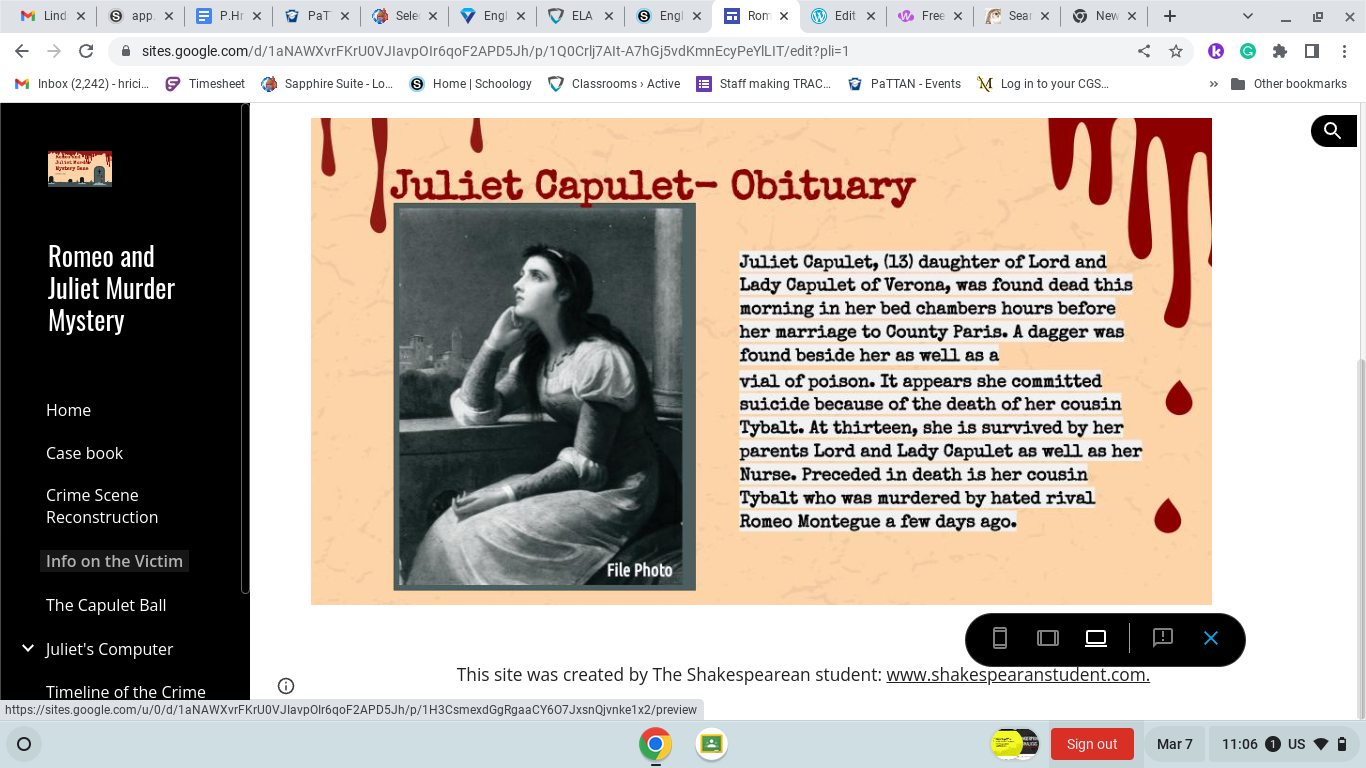
I’m proud to announce that I’ve just been approved to present a fully online, fully immersive murder mystery-style game, where you play as a detective trying to solve the mysterious death of Juliet Capulet! This is a really cool mixture of Shakespeare and forensics science as you examine crime scenes, look for clues, interrogate suspects, and untangle the story of Romeo and Juliet, and it even takes place over the course of five nights! Classes start March 17th. Register now at www.outschool.com!
Would Shakespeare enjoy playing FNAF well, who knows, but I do like to think he would appreciate the lore, if not the jump scares……
With the holidays approaching, why not give your kids the gift of learning Shakespeare in a low-key, no-pressure scenario? I have classes on Shakespeare’s life, Romeo and Juliet, and my celebrated Stage Combat class! Sign up now for all the fun on Outschool.com!
Shakespeare and Star Wars
Class Description: Using self-paced online activities, your child(ren) will compare the plot and characters of Star Wars to Shakespeare’s plays. We will also discuss Shakespeare’s writing by looking at “William Shakespeare’s Star Wars” by Ian Doescher.
Romeo and Juliet Murder Mystery
Course Description: A flexible schedule class that teaches kids the plot and characters of “Romeo and Juliet,” in the context of a detective story where you solve the mystery of the young lovers’ deaths.
Course Descriptions
How to Write Like Shakespeare: Learn the basics of iambic pentameter, sonnet form, and Shakespeare’s dramatic structure, and practice writing Shakespearean speeches.
I’ve criticized Ms Swift in the past, offering praise for her work as a whole, but not when she tackled Romeo and Juliet in “Love Story.” So, when I heard she was making a new song specifically about Ophelia, the young ingenue role in Hamlet, I wasn’t sure what to think. I am pleased to report that Taylor Swift’s song has a masterful grasp of not only Shakespeare, but of many classic iconic ingenues (both real and fictional). And her album, Life of a Showgirl, has a salient point to make about relationships, love, and Ms Swift as a woman and artist.
And I of ladies, most deject and wretched, Have sucked the honey of his music vows. -Hamlet, Act III, Scene i.
Put quite simply, the fate of Shakespeare’s Ophelia is, bad. In Hamlet, Ophelia is the prince’s girlfriend. Over the course of the play, her brother Laertes leaves her for France and Hamlet breaks up with her before accidentally killing her father, Polonius. Ophelia cannot take the strain of all this misery, and she loses her mind, unable to communicate except through flowers or little songs, as this clip from Slings and Arrows shows:
Geoffrey Tennent (Paul Gross) explains Ophelia’s torment to young actress Claire
Once Ophelia loses her mind, she dies by drowning. Hamlet’s mother, Queen Gertrude relates how she was picking flowers for garlands (flower crowns), and the branch she was holding broke. She was then weighed down by her gown and sank into the river:
Gertrude: There is a willow grows aslant a brook, That shows his hoar leaves in the glassy stream. There with fantastic garlands did she come Of crowflowers, nettles, daisies, and long purples, There on the pendant boughs her coronet weeds Clamb’ring to hang, an envious sliver broke, When down her weedy trophies and herself Fell in the weeping brook. Her clothes spread wide And, mermaid-like, awhile they bore her up; Which time she chanted snatches of old tunes, As one incapable of her own distress, Or like a creature native and indued Unto that element; but long it could not be Till that her garments, heavy with their drink, Pull’d the poor wretch from her melodious lay To muddy death.
Hamlet, Act IV, Scene vii.
It’s unclear whether Ophelia committed suicide, died by accident, or if Gertrude actually mercy killed her to end her suffering. In any case, Ophelia lost her family, her mind, and eventually, her life.
Ophelia’s Songs
Like Taylor Swift herself, Ophelia deals with her pain through songs and they range from upbeat and pretty, to deeply nihilistic:
And will he not come again? And will he not come again? No, no, he is dead; Go to thy deathbed; He never will come again. His beard was as white as snow, All flaxen was his poll. He is gone, he is gone, And we cast away moan. God ‘a’mercy on his soul! And of all Christian souls, I pray God. God b’ wi’ you. -Hamlet Act IV, Scene v.
It’s the actress’ ultimate test to determine what these songs mean, (“Though this be madness, yet there’s method in it)”. I’ve seen some Ophelias who seem vapid, and consumed by melancholy. Others are full of rage, particularly at Hamlet and Claudius, since they are responsible for her dire fate. As you probably know, if you read my review of Branaugh’s Hamlet, my favorite Ophelia is Kate Winslet, who manages to be all of these and more. Her songs tell the story of a woman who followed her heart, and ended up broken for it; a fate Taylor Swift knows all too well.
TS’ Literary Allusions
The eldest daughter of a nobleman Ophelia lived in fantasy But love was a cold bed full of scorpions The venom stole her sanity And if you’d never come for me I might’ve lingered in purgatory You wrap around me like a chain, a crown, a vine Pulling me into the fire All that time I sat alone in my tower You were just honing your powers Now I can see it all (see it all) Late one night You dug me out of my grave and Saved my heart from the fate of Ophelia
The central conceit of the song is how an unnamed person stopped the speaker from suffering the same fate as Ophelia. The song suggests that Ophelia’s first mistake was that she was too naive “living in a fantasy.” One thing Ophelia’s father and brother repeatedly impress on her is that she cannot be the wife of a prince like Hamlet, since (like so many Disney characters), she isn’t actually royal. There is a deep danger to this unequal power dynamic, which explains her image of a bed full of scorpions, (which by the way, could be cribbed from Macbeth’s line “O full of scorpions is my mind, dear wife”).
It’s particularly interesting that Swift uses allusions, not just to Ophelia, but to other characters as well: Her imagery of venom and purgatory suggests the Ghost of Hamlet’s father, who alludes to being stung by a serpent, and who might be trapped in purgatory. Like Ophelia, the ghost is languishing and suffering because of a man’s crime. I love how she intertwines the ghost and Ophelia with the metaphor of a chain, crown, and vine. While the ghost suffers due to his crown and his chains, one would wish someone would come up to Ophelia with a rope or vine, to save her from her drowning death.
The final image I’d like to discuss is the notion of being pulled out of a grave. Obviously, the Ghost comes out of his grave, but so does Ophelia! In Act V, Scene i, her brother Laertes jumps into his sister’s open grave and fights with Hamlet over her corpse!
Laertes. Lay her i’ th’ earth; And from her fair and unpolluted flesh May violets spring! I tell thee, churlish priest, A minist’ring angel shall my sister be When thou liest howling.
Gertrude. Sweets to the sweet! Farewell. [Scatters flowers.] I hop’d thou shouldst have been my Hamlet’s wife;3580 I thought thy bride-bed to have deck’d, sweet maid, And not have strew’d thy grave.
Laertes. O, treble woe Fall ten times treble on that cursed head Whose wicked deed thy most ingenious sense Depriv’d thee of! Hold off the earth awhile, Till I have caught her once more in mine arms. [Leaps in the grave.] Now pile your dust upon the quick and dead Till of this flat a mountain you have made T’ o’ertop old Pelion or the skyish head Of blue Olympus.
Hamlet. [comes forward] What is he whose grief Bears such an emphasis? whose phrase of sorrow Conjures the wand’ring stars, and makes them stand Like wonder-wounded hearers? This is I, Hamlet the Dane. [Leaps in after Laertes.]
Hamlet. Thou pray’st not well. I prithee take thy fingers from my throat; For, though I am not splenitive and rash, Yet have I in me something dangerous, Which let thy wisdom fear. Hold off thy hand!
The question is, who is this mystery figure who metaphorically pulled Taylor Swift from her grave? To answer that, we need to look at the music video itself.
Imagery In The Video
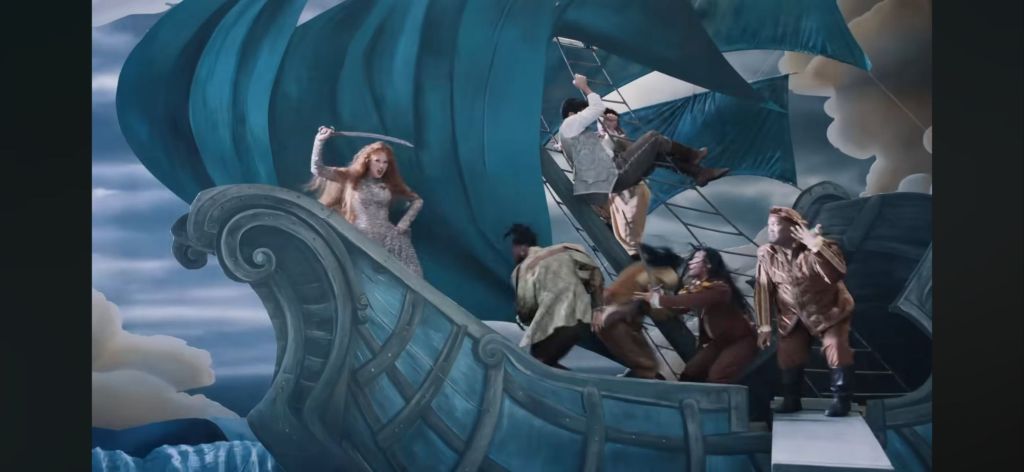
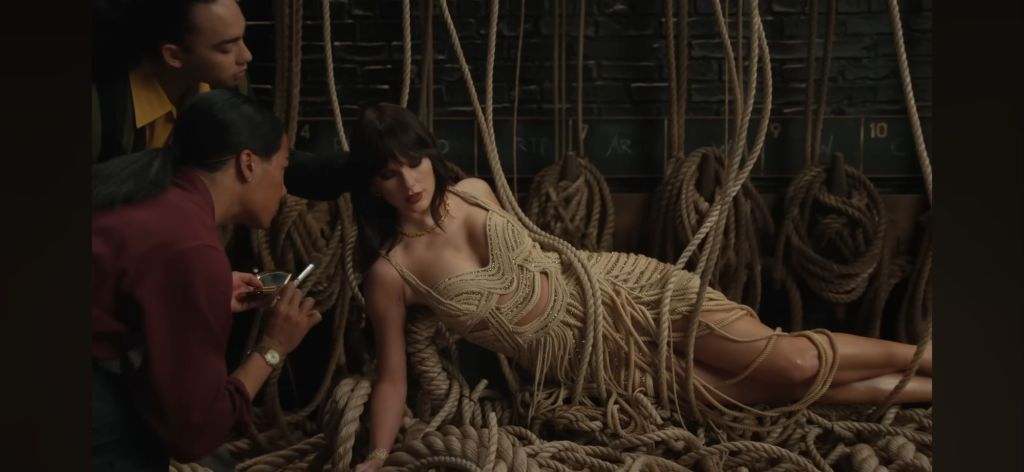
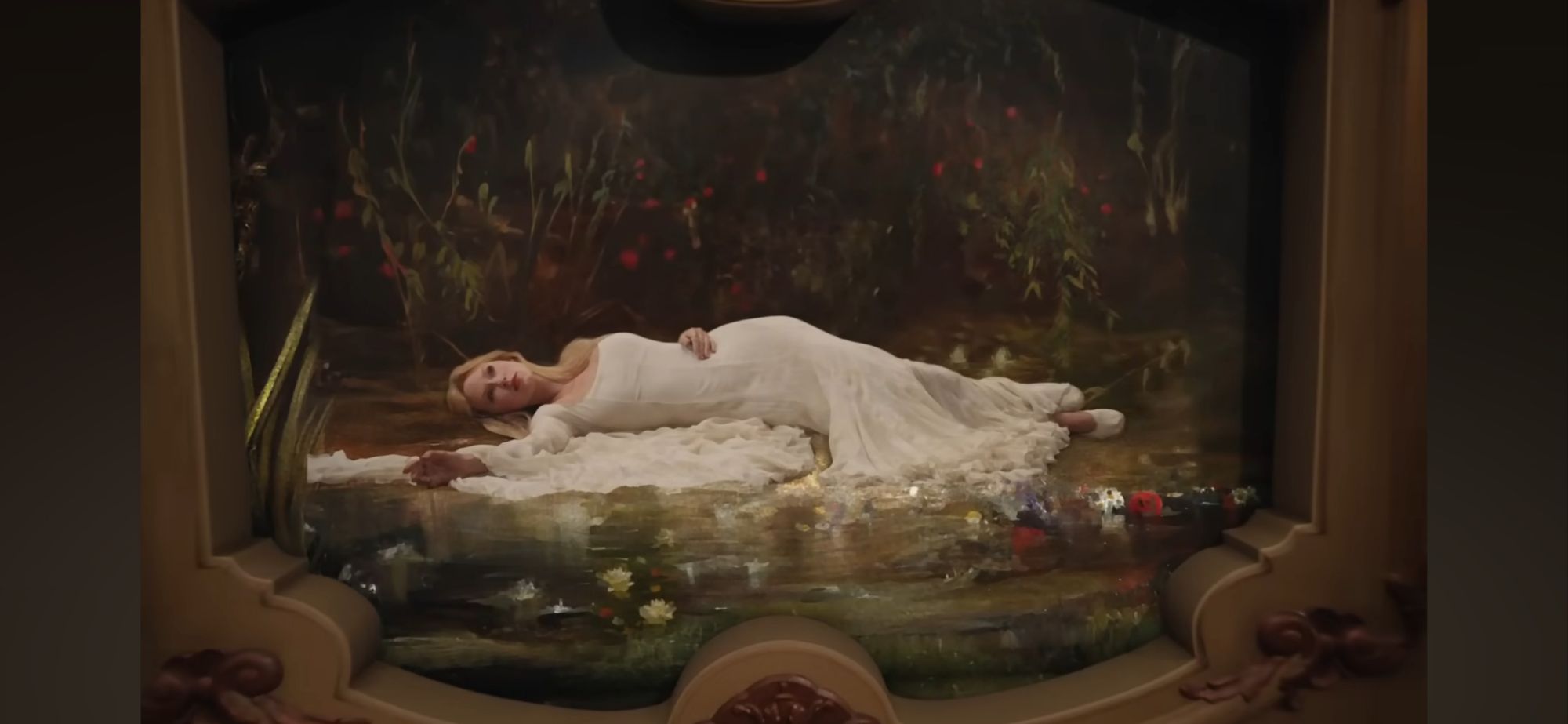
Taylor Swift poses as Ophelia in her 2025 music video Taylor stands her ground as a pirate/ siren in “The Fate of Ophelia”Taylor seems tied up backstage in The Fate Of OpheliaTaylor dons fiery red and seems happy to be a showgirl again
Taylor As Ophelia
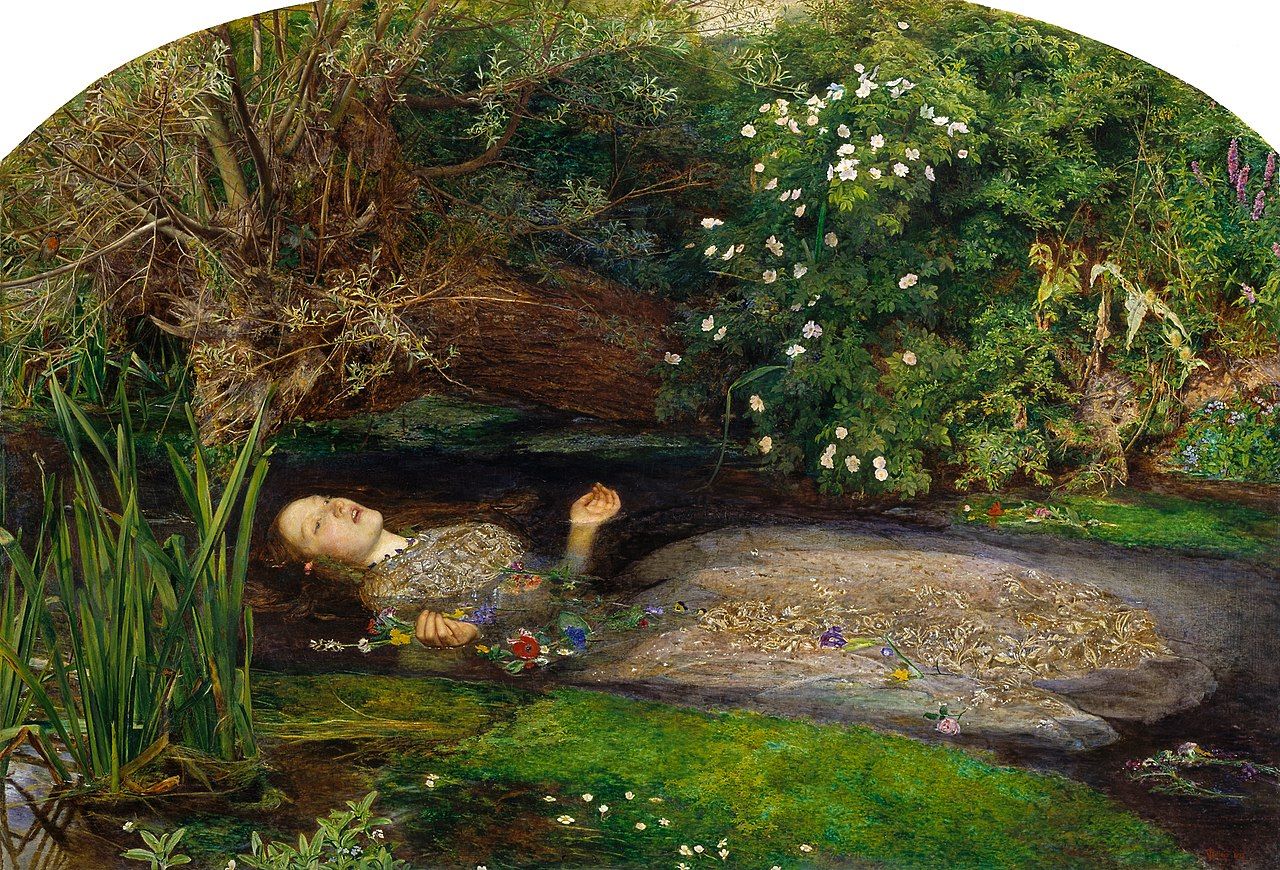
I certainly expected Taylor to appear in an Ophelia-like pose, and I suspected she’d base it on the famous 1851 painting Ophelia by John Everett Millais. For the record though, apparently the pose is based on a lesser-known painting by Friedrich Heyser from 1900 .
Ms Swift establishes who Ophelia is using a pose reminiscent of these late 19th and early 20th century paintings. They make Ophelia into a sort of fairy tale character. The lighting is bright and ethereal. The colors suggest a literal watercolor painting, which is important, given the motifs of water and fire in the song. Taylor seems placid, dreamy, and extremely passive.
Taylor as a mermaid/siren
Taylor as a Mermaid/ Siren
Taylor’s character keeps changing through the video- she goes from Ophelia “A creature incapable of her own distress,” into more active and more assertive characters. First, a mermaid. This isn’t so much of a departure from Shakespeare since, as you saw above, Gertrude compares her to a mermaid. Like Ophelia, mermaids are singers with strong connections to water, who sometimes give their lives for humans, (like in the iconic Hans Christian Anderson story The Little Mermaid).
Taylor stands her ground as a pirate/ siren in “The Fate of Ophelia”
However, in ancient Greek mythology, mermaids are known as sirens, and they can drive men mad with their songs. Taylor’s character has turned tables on Ophelia and is taking control of the men in her life in this image. She becomes a sort of siren/ pirate, using a sword to keep men at bay. This also echoes how, after being sent oversees, Hamlet himself boards a pirate ship and makes the pirates take him back to Denmark, so he can finally take revenge on Claudius. Of course, Taylor Swift wouldn’t settle for the supporting character of Ophelia, and has recast herself as the starring role.
Taylor seems tied up backstage in The Fate Of Ophelia
Waiting In the Wings
The title of Taylor’s album is The Life of a Showgirl, so the whole song is an homage to Taylor’s chameleon like persona, which evocatively, (and provocatively), come through in this shot. The strategic ropes and the bobbed haircut suggest a 1920s flapper, one of the most famous kinds of showgirls. In addition, Taylor is backstage in a dark theater, where ropes and pulleys are frequently used in stagecraft.
The shot and the album as a whole also explore the joys and sorrows of celebrity. Taylor is literally tied to the stage. Perhaps she sees herself as part of the scenery, not a real person. One might even recall how Prospero, one of Shakespeare’s self-insert characters, recalls how ephemeral the illusion of theater and film can be:
Our revels now are ended. These our actors, As I foretold you, were all spirits and1880 Are melted into air, into thin air: And, like the baseless fabric of this vision, The cloud-capp’d towers, the gorgeous palaces, The solemn temples, the great globe itself, Ye all which it inherit, shall dissolve1885 And, like this insubstantial pageant faded, Leave not a rack behind.
I interpret this image as Taylor enjoying the glamor and creativity of the limelight, but also feeling lonely and not totally fulfilling. A showgirl is still not totally alive, without an audience.
Taylor dons fiery red and seems happy to be a showgirl again
The Fire
At the climax of the song, Taylor’s persona becomes a dynamic showgirl in fiery red and orange; the complete opposite of the quiet and passive Ophelia. The song itself makes a reference to being pulled from the water into the fire- from cold, lonely death, to dazzling life. She seems to be happy to be a star and, for the first time, she is sharing the stage. Clearly, finding support and backup (pun intended), is what saves her from the fate of Ophelia. The question remains though, who saved her?
Ophelia In Art
Video from the Tate Modern art gallery about “Ophelia” by John Everett Millais
Ope not thy lips thou foolish one Nor turn to me thy face The blasts of heaven shall strike thee down ere I will give thee grace” –Elizabeth Siddall
Even famous paintings about Ophelia have a tragic story- I mentioned the famous John Millais painting, in which the model for Ophelia was a poet named Elizabeth Siddall. As you can see in the video above, Siddell modeled for Millais in a bathtub for hours in increasingly cold water, leaving her pale and her lips blue. Swift also alludes to Siddall in the shots where she herself is in a bathtub. Here yet again, we have a woman whose every action is dictated by a man, one who cares little for her physical and mental health.
Mystery Solved?
So, who is the mystery man who saved Taylor from the fate of Ophelia? Well, even though the song need not be autobiographical, since the song’s release coincides with her recent engagement, it’s easy to read the song as an ode to Taylor’s fiance, Travis Kelce.
My Take
I know I have been critical of TSs’ interpretation of Shakespeare in the past, but I think she nailed it this time. Her song, and album is a joyous celebration of a healthy relationship, one devoid of jealousy or control. Taylor is celebrating that she can truly be herself around Travis, and that means both her public persona as a superstar, and her private persona that is known only to Travis and herself. Ophelia represents the person Taylor feels pressured to be- a face frozen in time and cold water. Taylor wants a more active persona, and her fiance gives her the courage to do so!
Dream Album-
Now that Ms Swift has tackled both Romeo and Juliet, and Hamlet, I would adore it if she wrote songs for more iconic Shakespearean characters:
Antony and Cleopatra- who better to write about the original power couple than Tay Tay!
Twelfth Night- Both Viola and Taylor know what being a tomboy feels like
Lady Anne from Richard III Let’s be honest, Taylor is known for her celebrity feuds, and who had more beef than the Yorkists and the Lancastrians?
Do you agree with my analysis? If you were TS, what Shakespeare plays would you write about? Let me know in the comments!
Lots of teachers play this game and there are many Youtube videos of people playing it. Occassionally, even Shakespearean actors have played it:
There are also online quiz forms available on Quizlet and Gimkit. You can also show your students this video below:
Richard III and Henry Tudor- Bad Blood
Macbeth- Look What You Made Me Do
King Lear- Anti-hero
Lady Macbeth- No Body No Crime
Julius Caesar- My Tears Ricochet
Richard II- Castles Crumbling
Antony and Cleopatra- Style
Mercutio from “Romeo and Juliet”- 22 and “Shake it Off”
Goneril from “King Lear”- Blank Space
Do you agree with my list?
Teachers are increasingly seeing the value in analyzing Taylor Swift with their students to teach them about literature. What a gift Ms Swift has given us with this song!
I’m pleased to announce that I’ve created a fully online, interactive Shakespeare class for kids ages 6-11 to start them on a lifelong journey of Shakespeare! The course will include games, videos, webquest activities, and puppet shows!
Title: Shakespeare for Kids!
Purpose:
Video trailer
The goal of this class is to introduce Shakespeare to young children in a fun and interactive way. For example, each lesson starts with a fun and funny introduction to a Shakespearean topic by our friend Puppet Shakespeare. Each class will also feature interactive games and quizzes that break down the poetry, language, characters, and plots of Shakespeare to help kids lose their “Shakes-fear” and begin engaging with classic literature
Each class builds from learning about Shakespeare to learning about the language and poetry of his plays, to finally an in-depth analysis of one play: “A Midsummer Night’s Dream.” After watching videos, playing games, and filling out handouts about these topics, the student will go on a “webquest,” that is, a series of webpages that feature activities, outside websites, and a short- puppet show retelling of “Midsummer” for the student. The goal is that by the end of the course, the student will be able to understand the dialogue of the play, summarize the story, know the characters, and enjoy the poetry.
Format: Nearpod with video and web links.
Ages 6-10
Description: 2 week course, $10 per week.
Part I: Who Is Shakespeare?
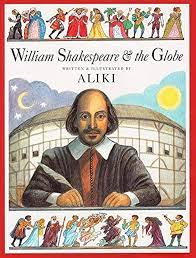
Learn about Shakespeare’s life and career with an interactive timeline, handouts, and an engaging puppet show! This section will include me reading from the excellent children’s book: William Shakespeare and the Globe by Aliki.
Part II: Words, Words, Words
WIlliam Shakespeare (Or Bill as I like to call him), wrote in a very special way. Back then playwrights were called poets, so not only did he have to make plays, he had to write them so they would sound like lines of poetry.
Part III: Shakespeak
Figure out how to translate all the “thees” and “thous” that make reading Shakespeare a challenge nowadays
Part IV The Play’s the Thing!
What kinds of plays did Shakespeare write? This handy lesson will teach you about the basic types of plays Shakespeare wrote, and give you a quick summary of each!
Part V: Disney vs. Shakespeare
Poster for Disney’s Elemental, which bears many similarities to Shakespeare’s Romeo and JulietContinue reading →
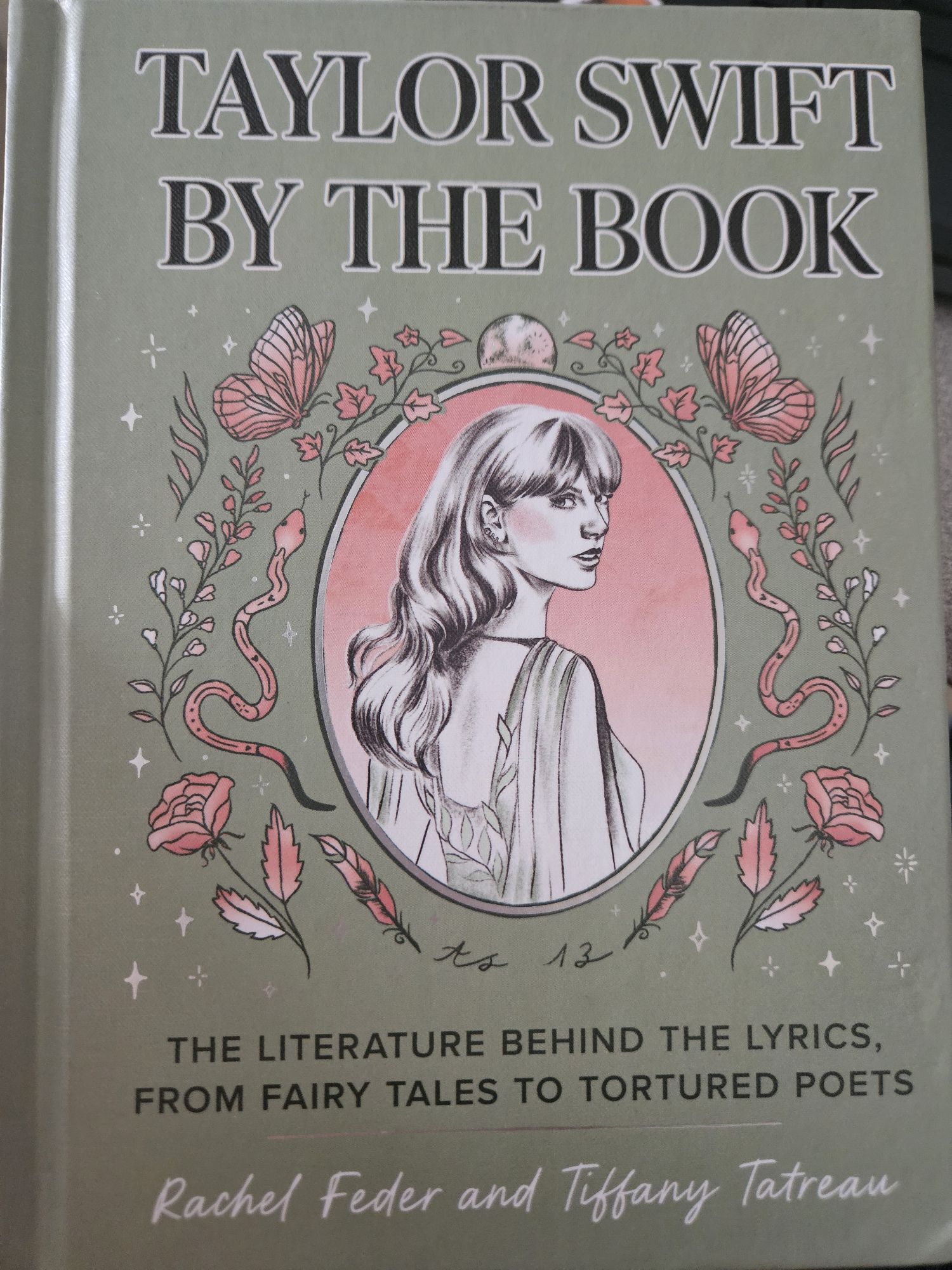
One of my colleagues at work showed me this book, and it really fired my imagination. Taylor Swift is one of the most if not THE MOST successful singer/songwriter of our era. Her songs go across multiple genres and tones and, like many writers, they often contain allusions to classical poetry, nursery rhymes, and occassionally even Shakespeare.
My own Reservations with Taylor
I’m not exactly a Swifite, and I know I’m running the risk of offending MILLIONS of people here by offering criticisms of Taylor Swift, but I honestly think it’s a good idea to be able to critique the things you love. In the past I’ve criticized Shakespeare’s plays, his characters, and even suggested that he might be racist. I would like to offer that, in the case of Love Story, Ms. Swift simplifies the plot of Romeo and Juliet, and leaves out its tragic elements, which kind of misses the point. As an allusion, it seems a little watered down. That said, I feel other TS songs are better, use their allusions more skillfully, and create a more coherent picture in the listeners’ mind. Dispite my issues with this one song, I heartily admit that Ms. Swift is prolific, talented, and has created songs that are classic works of art!
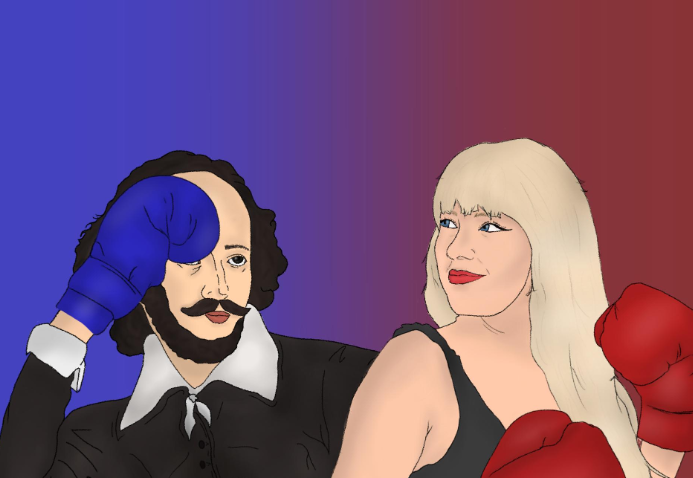
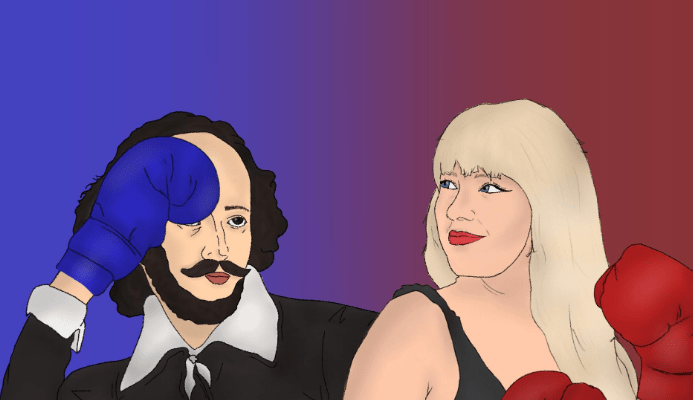
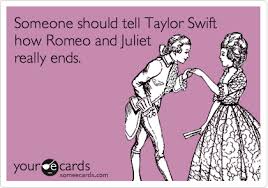
What I’m not interested in doing is getting into a “battle” where I try to justify Shakespeare as being better than Taylor Swift. When I see memes like the one above, it makes me immediately disengage with whoever posted it. I don’t want a Swiftie to talk in the comments about how Shakespeare was a talentless hack. Alternatively, I don’t want a Shakespeare nerd to dismiss Taylor as being infantile or any other critique. Both these writers had different goals, went about them differently, and achieved success in their own special ways. So now, let’s look at how Taylor Swift borrowed from different literary traditions to make her songs more dramatic, more visceral, more insightful, and more poetic.
Her Literary Allusions
Obviously, Love Story mentions Romeo and Juliet, as well as The Scarlet Letter and various princess stories. TS rarely makes direct references to Shakespeare in her work, but some scholars have suggested that there might be more oblique references in some of her songs. For instance, when I look at the lyrics of Willow, I can’t help wonder if she wasn’t at least partially inspired by Shakespeare’s song of the same name in Othello:
Wait for the signal and I’ll meet you after dark Show me the places where the others gave you scars Now this is an open-shut case Guess I should’ve known from the look on your face Every bait and switch was a work of art
The more that you say The less I know Wherever you stray I follow I’m begging for you to take my hand Wreck my plans That’s my man
I can’t hear this song and not hear the parallels with the Othello story- the speaker alludes to eloping with her beloved (which Desdemona nearly does in the first act), that he has scars (which Othello clearly does mentally and physically). In addition, I imagine the refrain as like a duet between Othello (who is reluctant to kill Desdemona), and Desdemona (who wants to leave Cyprus and have a normal married life with Othello:
Desdemona: The more that you say
The less I know
Othello: Wherever you stray
I follow
I'm begging for you to take my hand
Wreck my plans
Desdemona: That's my man

Even if Shakespeare isn't mentioned directly in many of Taylor's songs, like Shakespeare she often uses Greek myths, the Bible, and other popular works as allusions. Some scholars have suggested that both Shakespeare and TS write using their own experiences through the lenses of classical poetry and literature. Simmilar to how Shakespeare probably wrote Hamlet to deal with his grief over his son's death, Taylor writes songs about past relationships, feuds with pop stars, and her own evolution as an artist through the lens of Shakespeare, novels, poetry, and other works.
TS’s Poetry
Ms. Swift’s songs are more than just catchy beats with a few allusions stuffed in. Like Shakespeare, she makes use of alliterations, internal rhymes, clever metaphors, and strong rhythms that help her songs tell their stories clearly and effectively. As an exercise, I fed the lyrics to “Bad Blood” into a poetry analyzer and found a very interesting analysis:
The poem features a rhythmic and catchy structure, typical of song lyrics. The syllabic patterns vary but often maintain a consistent beat, enhancing its musical quality. The use of internal rhymes and alliteration (e.g., “mad love,” “bad blood”) adds to the flow and memorability. The stresses often fall on the first word of each line, creating a strong start and a compelling rhythm that engages the listener. The word choice in the poem is evocative and charged with emotion. Phrases like “bad blood,” “deep cut,” and “salt in the wound” create vivid imagery and convey the depth of the narrator’s pain. The use of questions, such as “Did you have to do this?” and “Did you think we’d be fine?” emphasizes feelings of confusion and hurt. –Studycorgi.com
I highly encourage students and teachers to do an analysis of both Shakespeare and Taylor Swift because studying one can help us appreciate the other. Similarly, learning the way each writer conveys ideas can help the reader become more creative!
Who Said It? Shakespeare or T.Swift?
Lots of teachers play this game and there are many Youtube videos of people playing it. Occassionally, even Shakespearean actors have played it:
There are also online quiz forms available on Quizlet and Gimkit. You can also show your students this video below:
What iF SHakespeare’s Characters were Swifties?
I posted on Reddit a while back to ask the internet which Swift songs would be great soundtracks for the lives of Shakespearean characters. This is sort of an outgrowth of my: Infinite (Variety) Playlist activity. Here are some of the results I got:
Mercutio from “Romeo and Juliet”- 22 and “Shake it Off”
Goneril from “King Lear”- Blank Space
Do you agree with my list?
I hope this post can help teachers see the value in analyzing Taylor Swift with their students, and help students in analyzing Shakespeare. I think the term “classic” applies to anything good enough to stand the test of time. Shakespeare has already passed that test, and based on her clever allusions, evocative wordplay, and emotionally-charged subjects, I believe Taylor Swift to be classic too!
LADY CAPULET  Good night.
Get thee to bed and rest, for thou hast need.
Lady Capulet and the Nurse exit.
JULIET
Farewell.—God knows when we shall meet again.
I have a faint cold fear thrills through my veins
That almost freezes up the heat of life.
I’ll call them back again to comfort me.—
Nurse!—What should she do here?
My dismal scene I needs must act alone.
Come, vial. She takes out the vial.
What if this mixture do not work at all?
Shall I be married then tomorrow morning?
She takes out her knife
and puts it down beside her.
No, no, this shall forbid it. Lie thou there.
What if it be a poison which the Friar
Subtly hath ministered to have me dead,
Lest in this marriage he should be dishonored
Because he married me before to Romeo?
I fear it is. And yet methinks it should not,
For he hath still been tried a holy man.
How if, when I am laid into the tomb,
I wake before the time that Romeo
Come to redeem me? There’s a fearful point.
Shall I not then be stifled in the vault,
To whose foul mouth no healthsome air breathes in,
And there die strangled ere my Romeo comes?
Or, if I live, is it not very like
The horrible conceit of death and night,
Together with the terror of the place—
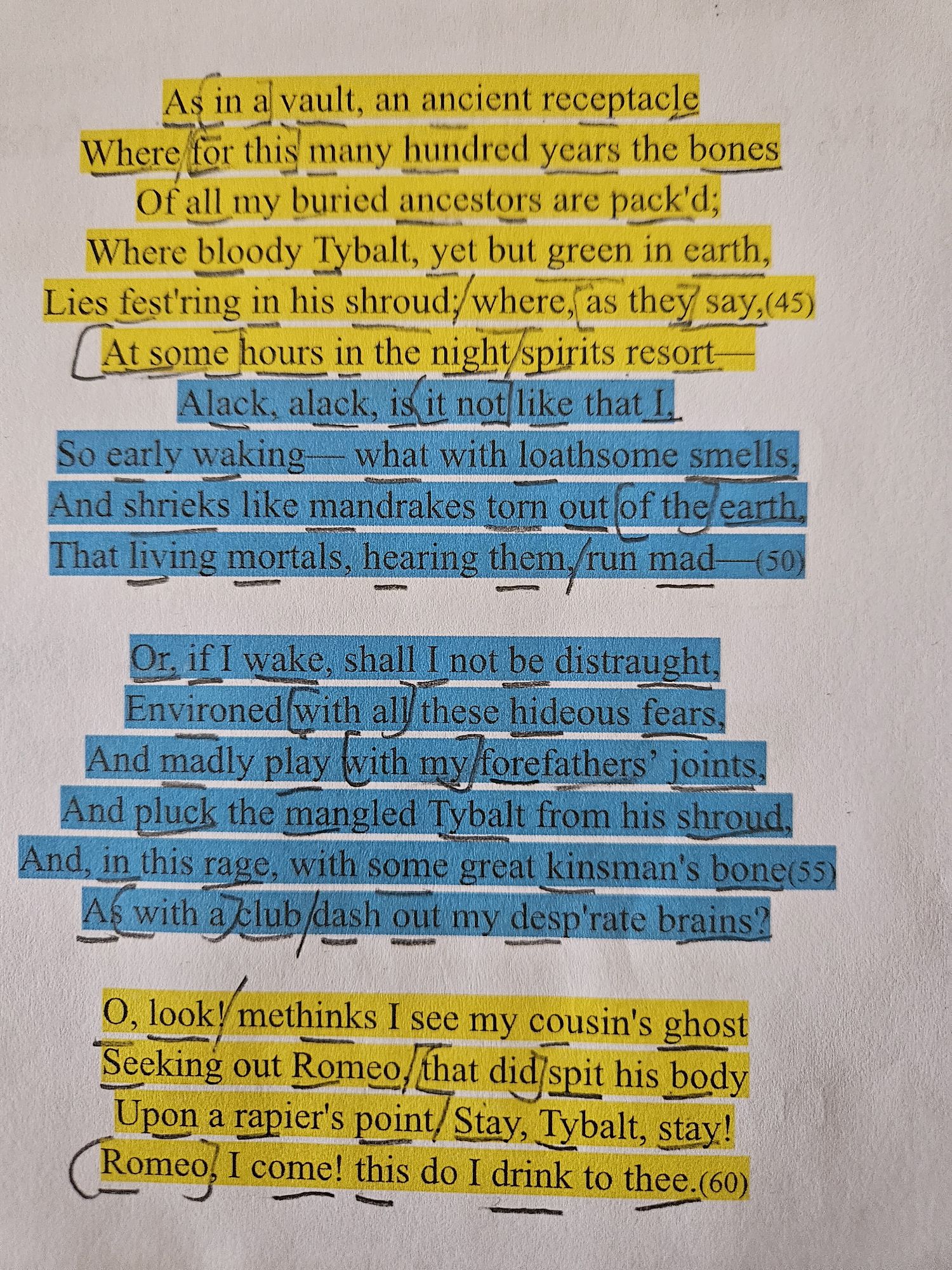
As in a vault, an ancient receptacle
Where for this many hundred years the bones
Of all my buried ancestors are packed;
Where bloody Tybalt, yet but green in earth,
Lies fest’ring in his shroud; where, as they say,
At some hours in the night spirits resort—
Alack, alack, is it not like that I,
So early waking, what with loathsome smells,
And shrieks like mandrakes torn out of the earth,
That living mortals, hearing them, run mad—
O, if I wake, shall I not be distraught,
Environèd with all these hideous fears,
And madly play with my forefathers’ joints,
And pluck the mangled Tybalt from his shroud,
And, in this rage, with some great kinsman’s bone,
As with a club, dash out my desp’rate brains?
O look, methinks I see my cousin’s ghost
Seeking out Romeo that did spit his body
Upon a rapier’s point! Stay, Tybalt, stay!
Romeo, Romeo, Romeo! Here’s drink. I drink to
thee.
She drinks and falls upon her bed
within the curtains.
The Given Circumstances
This famous soliloquy comes from Act IV, Scene iii. In this speech, Juliet grapples with her fears and anxieties about taking the Friar’s sleeping potion.
Traditional Interpretations
Ellen Terry (Vinal Record Recording, C. 1911)
Ms. Terry, like her famous grandson John Gielgud, is more interested in delivering the text clearly, beautifully, and strongly than getting Juliet’s character across. Consequently, by our standards, her reading of the speech is slow, declamatory, and maybe a bit over-the-top. However, this kind of delivery really brings out the rhythm of the verse, the beauty of the individual words, and the structure of the speech itself, so I recommend actors listen to it as a jumping off point. In my opinion, having a good technical grasp of the speech will keep an actor from going too far with the emotion, (making it hard for the audience to hear and understand them). This is why there’s still value in these dusty old recordings.
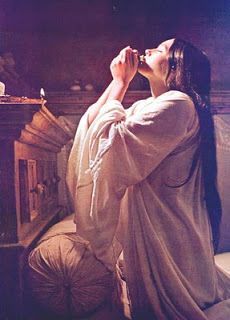
Olivia Hussey (Romeo and Juliet directed by Franco Zephirelli, 1966)
Zephirelli was very sparing with the dialogue- choosing to condense this entire speech to one line “Love, give me strength.” Hussey has a great deal of passion in the speech, as if she is absolutely certain that taking the potion will re-unite her with Romeo.
Claire Danes (Romeo +Juliet, 1996)
Claire Danes contemplating the vial in Romeo + Juliet
Danes has a sense of almost macabe trance-like energy when she delivers the speech. Like all the edged weapons in the movie, the dagger is replaced by a gun. Most of the speech is cut because Luhrman wanted to emphasize the character’s obsession with violence, rather than fears about ghosts and arranged marriages. Consequently, Danes does little other than put the gun under her pillow, take out the vial, and drink it.
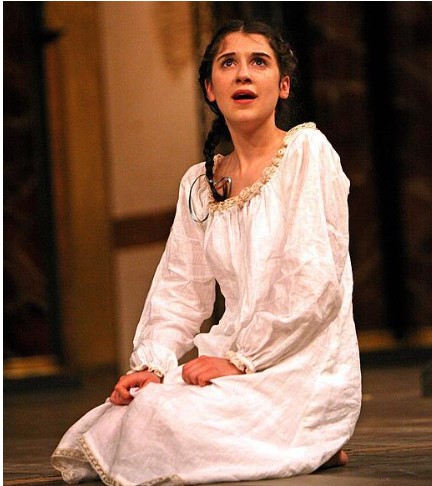
Ellie Kendrick (Globe Theater, 2009)
Ms. Kendrick is one of my favorite Juliets ever! She is a wonderful blend of sweetness and naivety, tempered with anxiety and practical thinking. She delivers the whole speech to different parts of the audience and makes sure every idea and every horrible thought of Juliet lands. Furthermore, her fast pacing around the stage helps her not only connect with the audience, but to use the Globe theater to make them imagine the Capulet vault.
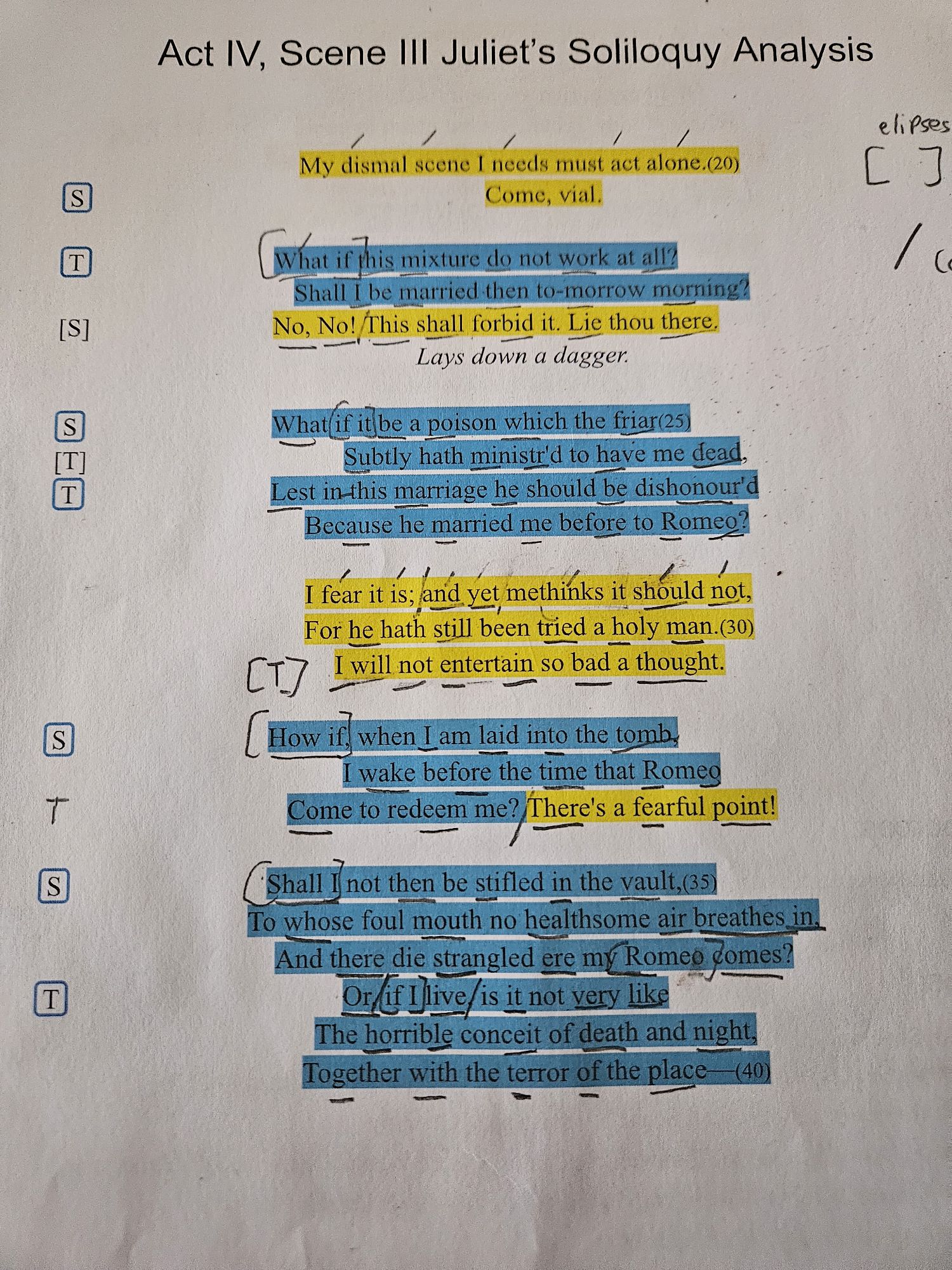
Verse
As I always say, verse is the heartbeat of a character, and based on this, Juliet’s heart is beating a mile a minute. You’ll notice that five of these lines start with a trochee (T), and five of them have trochees. This means Juliet is unsettled, she’s literally off-beat. In addition, there are frequently pauses in the middle of the lines called cesuras, which might indicate that either Juliet is trying to answer her own questions, or that she is so worried, that she’s gasping for breath.
In this second part of the speech, the lines start running together. Juliet’s pace is quickening and she breathes every 2-3 lines instead of at the end of each line.
Structure
The speech is organized as a series of questions:
“What if…”
“What if…”
“How if…”
“Or if I live…”
“O, if I wake, shall I not…”
and then the terrifying statement: “O look…”
So, with this in mind, the actress needs to convey Juliet’s overactive imagination, her fears, and her ability to answer these fears with inner calm and inner strength.
Imagery
It’s a horrific idea being shut up alive with the dead. Shakespeare gives us the sights and smells and the grim reality of feeling “stifled” in a vault. I created this image to demonstrate the smells, the fear, and the claustrophobic nature of the vault.
I chose to have the vault lit with candles, and to use green smoke to represent decay and possibly noxious gas, like the nitre that sometimes dips from walls of tombs. I also added some stone faces of ancestors to stare down at Juliet.
Historical Research
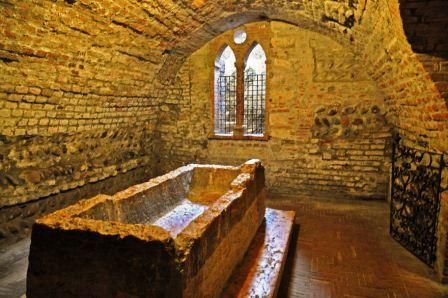
Sarcophagus in church of San Francesco al Corso, an old Franciscan monastery in Verona.
The plain stone sarcophagus above has become a tourist attraction as the traditional ‘resting place’ of Juliet. As I mentioned in my Friar Lawrence post, the Friar who marries Juliet is a Franciscan, which is probably why they chose this church in Verona as the ‘site’ for Juliet’s grave.
It is a plain, open, and partly decayed sarcophagus, in a wild and desolate conventual garden once a cemetery now ruined to the very graves. The situation struck me as very appropriate to the legend, being blighted as their love.
– Lord Byron, Letters and Journals Vol. III
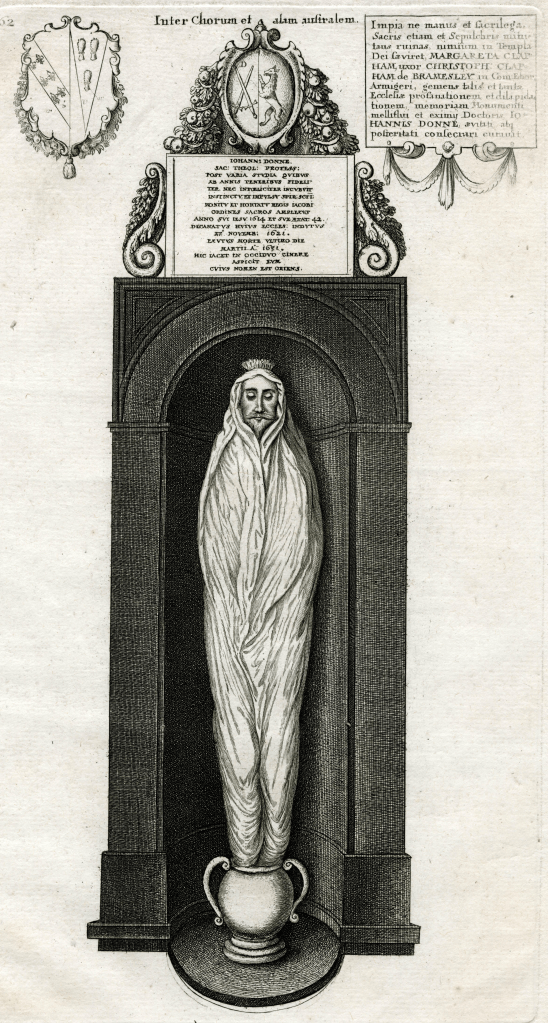
Since Italy is a small, hot country, bodies in the 16th century were buried almost immediately. First, the body would be wrapped up in a shroud or winding sheet, as Juliet mentions at the end. The corpses might be decorated with Rosemary or other sweet-smelling herbs.
A winding sheet for a corpse
Wealthy families like the Capulets or the church, would store all the bodies of their ancestors in burial vaults or crypts. Some bodies would be anointed with oil or preserved with vinegar.
Literary Inspiration: The Cask of Amontillado
Montressor and Fortunato move through the burial crypt in “The Cask of Amontillado”
When I think of the dark, macabre atmosphere of a family tomb, I think of The Cask of Amontillado, a short story by Edgar Allen Poe where the anti-hero Montressor, tricks his enemy Fortunato into going into his family crypt and buries him alive! There are some interesting parallels between Montressor and Tybalt from Romeo and Juliet- both men belong to ancient families, both men are violent, and both refuse to let any kind of insult stand. I think Juliet sees the vault as a hostile place, where her ancestors are angry at her for “betraying the Capulet name,” after marrying a Montague.
Image Research 4: Tybalt’s Angry Ghost
AI image of Tybalt’s Ghost
Like Montressor in The Cask of Amontillado, Tybalt embodies the Capulet feud, and it makes sense that Juliet would see him when she thinks of being shut up in the vault. The real question is, what does seeing him do to her? Is she terrified? Is she remorseful? Is she moved to protect Romeo? How does seeing Tybalt’s ghost motivate her to take the potion?
Other Questions to consider
Why is Juliet so nervous?
How does Juliet feel about running away from home?
Do the ghosts represent something? Guilt? Judgement? Some kind of ticking clock?
What does she see Tybalt’s ghost doing?
How does Juliet pull it together at the end?
Emotional
Not only is Juiet worried about her health, (mental and physical), I get a sense that she might also be experiencing guilt. The notion of her being tormented by spirits that shriek like mandrakes, suggests that maybe the ancient Capulets aren’t very pleased with Juliet. This makes sense because she married a Montegue. I get the sense that maybe, for the first time, Juliet actually feels guilty, as if she’s failed her ancestors. However, for whatever reason, she definitely re-focuses and thinks about Romeo. Either she rejects her ancestors and Tybalt, or maybe she sees the potion as a way of protecting Romeo, or possibly Juliet just wants these fears and anxieties to end, and takes the potion as a release. My actor and I will no doubt try these ideas out and figure out what works within the structure and within her interpretation of the character.
Our Interpretation
Again, it’s a little too early for me to tell you our interpretation yet, but I’ll post it later.
Resources:
Myshakespeare.com. This website will allow you to look up unfamilliar words, download pictures and videos of the scene, and even watch an ‘interview’ with Juliet, where, just as in this speech, she becomes more and more anxious and fearful until the very end.






































 The Shakespearean Student