The Battle Of Bosworth

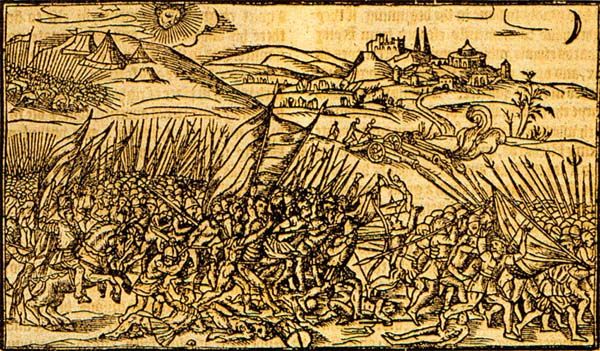
To begin wrapping up our Richard III month, I thought it might be appropriate to speak a little about the battle that ended the real Richard’s life, the Battle of Bosworth Field, August 22, 1485.

What does Shakespeare Say about the battle:

KING RICHARD III

Come, bustle, bustle; caparison my horse.

Call up Lord Stanley, bid him bring his power:
I will lead forth my soldiers to the plain,
And thus my battle shall be ordered:
My foreward shall be drawn out all in length,
Consisting equally of horse and foot;
Our archers shall be placed in the midst
John Duke of Norfolk, Thomas Earl of Surrey, Shall have the leading of this foot and horse. They thus directed, we will follow                    In the main battle, whose puissance on either side Shall be well winged with our chiefest horse. This, and Saint George to boot! 

What think’st thou, Norfolk?

NORFOLK

A good direction, warlike sovereign. 

Richard III, Act V, Scene iii.
This speech matches very well with what the chronicles mention about the battle. In those days the English archers were more deadly than their cavalry, so Richard probably wanted to pick off as many soldiers as possible with the archers, then mow the rest down with his charge toward Henry.

Contemporary Accounts, (courtesy of the Richard III Society). The most complete, and unbiased account I could find was Polydore Virgil, which is also likely the one from which Shakespeare got his information. You’ll notice that it mentions the long line of foot soldiers and horsemen, and the mention of the Duke of Norfolk commanding one of Richard’s forces.


‘The day after King Richard, well furnished in all things, drew his whole army out of their encampments, and arrayed his battle-line, extended at such a wonderful length, and composed of footmen and horsemen packed together in such a way that the mass of armed men struck terror in the hearts of the distant onlookers. In the front he placed the archers, like a most strong bulwark, appointing as their leader John, duke of Norfolk. To the rear of this long battle-line followed the king himself, with a select force of soldiers.‘Meanwhile … early in the morning [Henry Tudor] commanded his soldiery to set to arms, and at the same time sent to Thomas Stanley, who now approached the place of the fight, midway between the two armies, to come in with his forces, so that the men could be put in formation. He answered that Henry should set his own men in line, while he would be at hand with his army in proper array. Since this reply was given contrary to what was expected, and to what the opportunity of the time and greatness of the cause demanded, Henry became rather anxious and began to lose heart. Nevertheless without delay he arranged his men, from necessity, in this fashion. He drew up a simple battle-line on account of the fewness of his men. In front of the line he placed archers, putting the earl of Oxford in command; to defend it on the right wing he positioned Gilbert Talbot, and on the left wing in truth he placed John Savage. He himself, relying on the aid of Thomas Stanley, followed with one company of horsemen and a few foot-soldiers. For all in all the number of soldiers was scarcely 5,000, not counting the Stanleyites of whom about 3,000 were in the battle under the leadership of William Stanley. The king’s forces were at least twice as many.

‘Thus the battle-line on each side was arrayed. As soon as the two armies came within sight of each other, the soldiers donned their helms and prepared for the battle, waiting for the signal to attack with attentive ears. There was a marsh between them, which Henry deliberately left on his right, to serve his men as a defensive wall. In doing this he simultaneously put the sun behind him. The king, as soon as he saw the enemy advance past the marsh, ordered his men to charge. Suddenly raising a great shout they attacked first with arrows, and their opponents, in no wise holding back from the fight, returned the fire fiercely. When it came to close quarters, however, the dealing was done with swords.‘In the mean time the earl of Oxford, afraid that in the fighting his men would be surrounded by the multitude, gave out the order through the ranks that no soldier should go more than ten feet from the standards. 

Here’s a short infographic I made about the kinds of weapons people used during the Battle Of Bosworth.

When in response to the command all the men massed together and drew back a little from the fray, their opponents, suspecting a trick, took fright and broke off from the fighting for a while. In truth many, who wished the king damned rather than saved, were not reluctant to do so, and for that reason fought less stoutly. Then the earl of Oxford on the one part, with tightly grouped units, attacked the enemy afresh, and the others in the other part pressing together in wedge formation renewed the battle.

Royal Portrait of King Richard III, holding a broken sword.

While the battle thus raged between the front lines in both sectors, Richard learnt, first from spies, that Henry was some way off with a few armed men as his retinue, and then, as the latter drew nearer, recognised him more certainly from his standards. Inflamed with anger, he spurred his horse, and road against him from the other side, beyond the battle line. Henry saw Richard come upon him, and since all hope of safety lay in arms, he eagerly offered himself for this contest. In the first charge Richard killed several men; toppled Henry’s standard, along with the standard-bearer William Brandon; contended with John Cheney, a man of surpassing bravery, who stood in his way, and thrust him to the ground with great force; and made a path for himself through the press of steel.
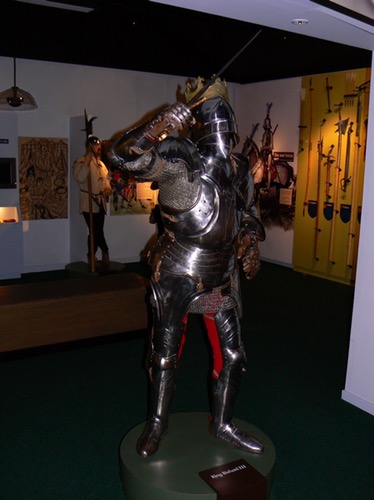
This is a re-construction of the kind of armor Richard might have worn into battle. Notice that the helmet has the crown ontop. Photo reprinted from the Bosworth Field museum

‘Nevertheless Henry held out against the attack longer than his troops, who now almost despaired of victory, had thought likely. Then, behold, William Stanley came in support with 3,000 men. Indeed it was at this point that, with the rest of his men taking to their heels, Richard was slain fighting in the thickest of the press. Meanwhile the earl of Oxford, after a brief struggle, likewise quickly put to flight the remainder of the troops who fought in the front line, a great number of whom were killed in the rout. Yet many more, who supported Richard out of fear and not out of their own will, purposely held off from the battle, and departed unharmed, as men who desired not the safety but the destruction of the prince whom they detested. About 1,000 men were slain, including from the nobility John duke of Norfolk, Walter Lord Ferrers, Robert Brackenbury, Richard Radcliffe and several others. Two days after at Leicester, William Catesby, lawyer, with a few associates, was executed. Among those that took to their heels, Francis Lord Lovell, Humphrey Stafford, with Thomas his brother, and many companions, fled into the sanctuary of St. John which is near Colchester, a town on the Essex coast. There was a huge number of captives, for when Richard was killed, all men threw down their weapons, and freely submitted themselves to Henry’s obedience, which the majority would have done at the outset, if with Richard’s scouts rushing back and forth it had been possible. Amongst them the chief was Henry earl of Northumberland and Thomas earl of Surrey. The latter was put in prison, whree he remained for a long time, the former was received in favour as a friend at heart. Henry lost in the battle scarcely a hundred soldiers, amongst whom one notable was William Brandon, who bore Henry’s battle standard. The battle was fought on the 11th day before the kalends of September, in the year of man’s salvation 1486, and the struggle lasted more than two hours.
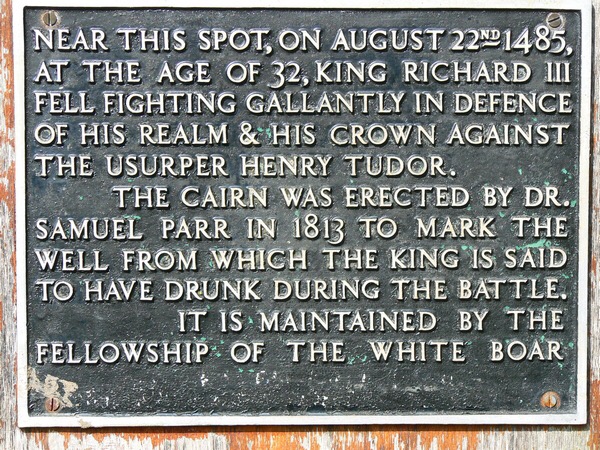
Plaque erected near a small well on Bosworth field, which Richard himself supposedly drank from.


‘The report is that Richard could have saved himself by flight. His companions, seeing from the very outset of the battle that the soldiers were wielding their arms feebly and sluggishly, and that some were secretly deserting, suspected treason, and urged him to flee. When his cause obviously began to falter, they brought him a swift horse. Yet he, who was not unaware that the people hated him, setting aside hope of all future success, allegedly replied, such was the great fierceness and force of his mind, that that very day he would make an end either of war or life. Knowing for certain that that day would either deliver him a pacified realm thenceforward or else take it away forever, he went into the fray wearing the royal crown, so that he might thereby make either a beginning or an end of his reign. Thus the miserable man suddenly had such an end as customarily befalls them that for justice, divine law and virtue substitue wilfulness, impiety and depravity. To be sure, these are far more forcible object-lessons than the voices of men to deter those persons who allow no time to pass free from some wickedness, cruelty, or mischief.


Immediately after gaining victory, Henry gave thanks to Almighty God with many prayers. Then filled with unbelievable happiness, he took himself to the nearest hill, where after he had congratulated his soldiers and ordered them to care for the wounded and bury the slain, he gave eternal thanks to his captains, promising that he would remember their good services. In the mean time the soldiers saluted him as king with a great shout, applauding him with most willing hearts. Seeing this, Thomas Stanley immediately placed Richard’s crown, found among the spoil, on his head, as though he had become king by command of the people, acclaimed in the ancestral manner; and that was the first omen of his felicity.’


-Polydore Virgil, c. 1500. Reprinted from the Richard III Society:

http://www.r3.org/richard-iii/the-battle-of-bosworth/bosworth-contemporary-tudor-accounts/ 
What most people can agree:

  • The battle took place on August 22nd, 1485 in a small field in Leicester.
  • Richard had about 70,000 troops, and Richmond had far fewer, aided mostly by French, Scot, and Welsh mercenaries.
  • Many of Richard’s people like the Earl Of Stanley betrayed him and turned sides.
  • Several sources record Richard wearing the crown in battle, which Henry Tudor immediately seized after he murdered Richard.
  • Richard fought bravely against Richmond, charging alone into combat and refusing to be rescued by his army. One account has Richard say: “This day I will die as king or win.” In another account, a lone Welshman killed the king’s horse, which probably was the origin of the line “A horse, a horse, my kingdom for a horse!”
  • Richard’s body was hacked to pieces, stripped naked, covered with a noose, and displayed at a poor local church for the citizens to mock at for two days. Even contemporary accounts allege that Henry treated his vanquished foe shamefully.
    Infographic of Richard’s post-battle wounds.

    Above- infographic of Richard’s battle wounds, courtesy of Lifescience.com

To conclude, even Shakespeare admits that Richard was a great commander, who lost the battle when his own soldiers betrayed him, and he was piteously murdered by the man who took over the crown from him. It’s a good thing that the real King Richard’s remains were discovered in 2012, and we now know more about the real man in addition to the myth.

RIP Richard.

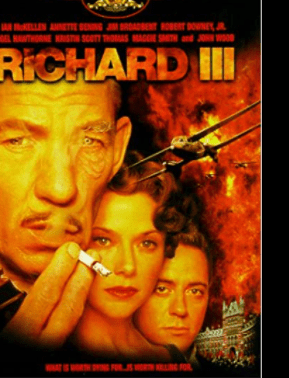
Useful Richard III Website, starring Ian McKellen!

Here’s a lovely website designed to help you learn about Richard’s first soliloquy by interacting with Sir Ian McKellen himself!

First, a video to see it in action:


And here’s the final website: http://www.stageworkmckellen.com/

As a bonus, here’s a review of Sir Ian’s new app, Heuristic Shakespeare:


http://www.avclub.com/article/ian-mckellen-launches-app-make-shakespeare-easier–236049

This app looks incredible, listen to this satisfied customer:

So far, the only play on the app is “The Tempest,” but hopefully if enough people buy it, it’ll expand and encompass all the plays. I hope you’ll check it out!
 

My Top Ten Shakespearean Apps For Teachers and Students, Part 2

As I said before, my criteria for these apps was “Free, functional (educational or useful in life,) and fun.”
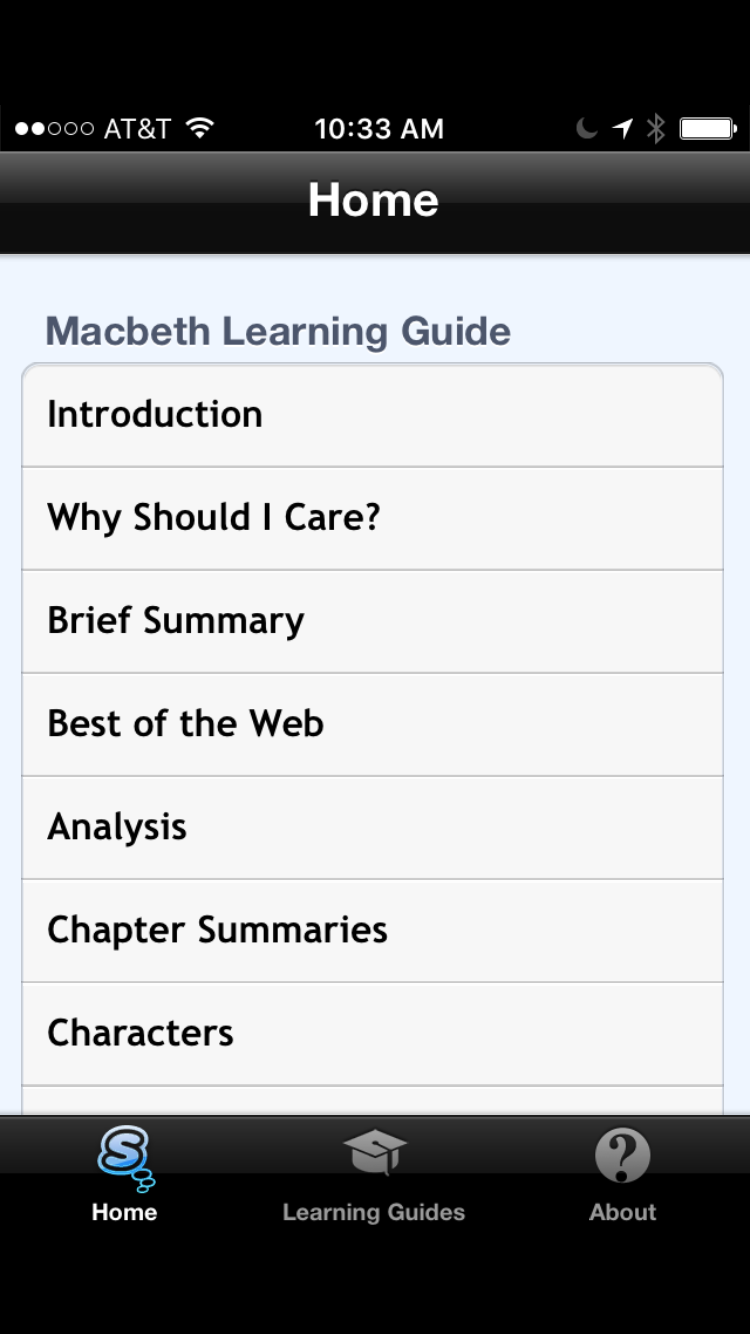
6. Shakespeare by Shmop: incredible! This is a study guide for your phone of tablet. There are separate apps Hamlet, Macbeth, and R&J. Each one features a glossary, analysis, quotes, study questions, you get the idea. You can cover a lot of the play with this app. My favorite feature is “Why Should I Care?” This is a short essay that compares the themes and ideas of the play to modern life. Excellent app, and the website is great too for students and teachers: http://www.shmoop.com

7. Shakespeare for kids


 I believe nobody is too old or too young to enjoy Shakespeare, so I tried to find a Shkespeare app for young children and came up with this. To be honest, I was disappointed in this one; it’s basically an app version of Irene Lamb’s book “Tales From Shakespeare”. It consists of short summaries of the plays intended for children. There are no study guides, no quotes, and the games have nothing to do with Shakespeare. My advice, get the book, or go to these sites: 

8. Poems By Heart Made by the Penguin Publishing Co, it’s designed to help you learn a poem by quizzing yourself, one line at a time, (or one word if necessary). Friendly and enjoyable.


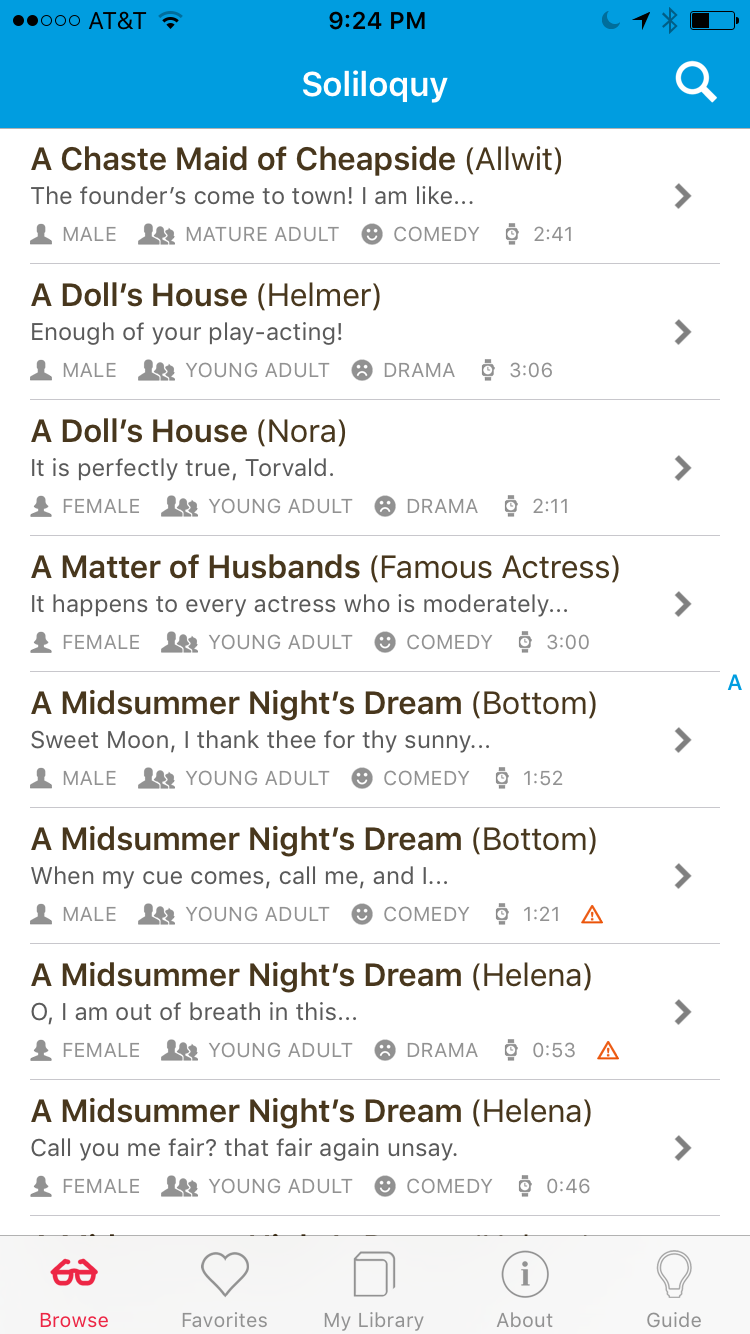
9. Soliloquy by playshakespeare.com. 

As you might expect, this app is a database of Shakespearean speeches. I normally don’t advocate actors learning speeches out of context without reading the whole play, but this app is useful for the professional actor on the go, who needs to pull out a speech in a hurry. It’s sort of a digital monologue portfolio. You can find a good speech, save it, then pull it out when you need to study it. There’s also a pro feature that allows you to edit the speech if it’s running long. What I really like is the fact that each speech is conveniently classified by gender/ genre/ length, and the helpful tips for young actors picking a good speech.

10. Shakespeare by Play Shakespeare.com


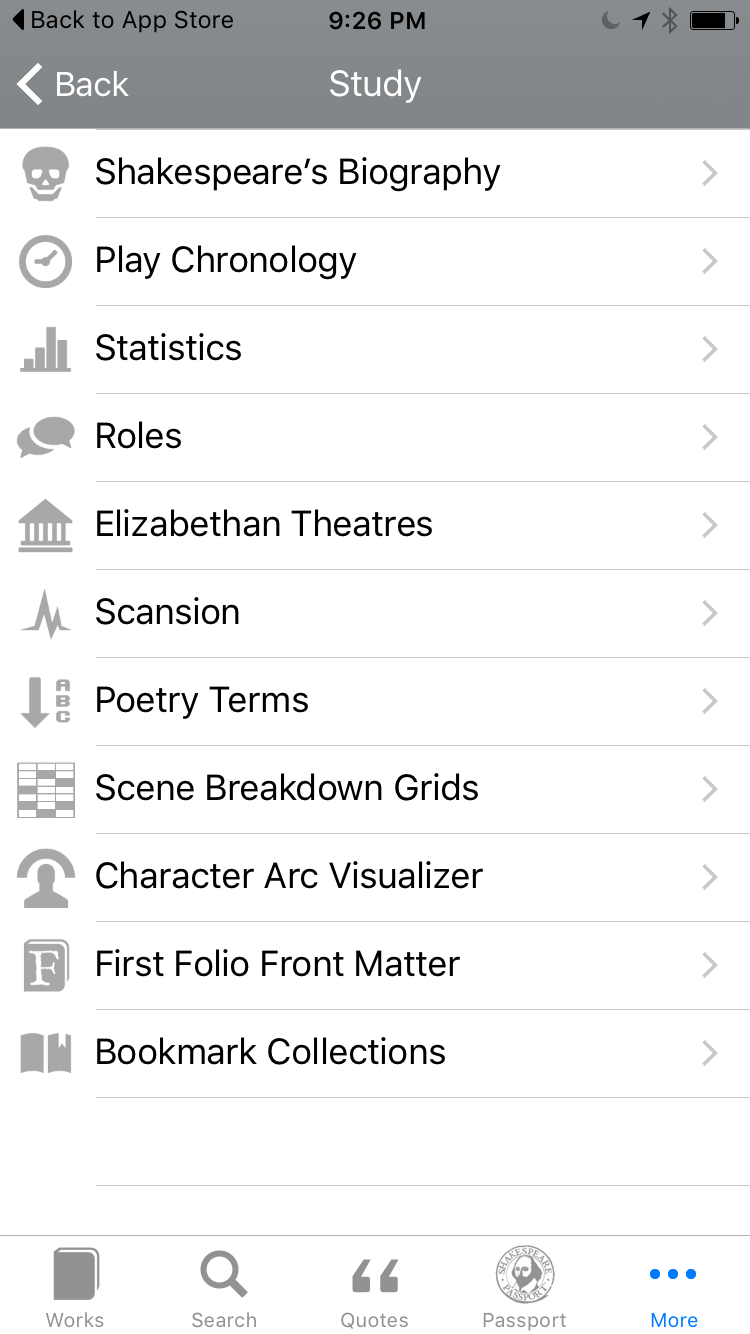
Well now we come to the end of the free Shakespeare app list I’ve compiled. Now what? I would recommend downloading Shakespeare by Playshakespeare.com, then BURN THE LIST! This is the most incredible Shakespeare app I’ve ever seen! It has tons of free and pay- only features and I’ve listed a few below:

  • Full text of the plays
  • A GPS feature where you can locate any Shakespearean theater near you.
  • A free passport to 57 theaters that offer discounts to members.
  • Study guides which include scene breakdown, poetry glossary, and notes on verse scansion
  • Shakeapeare quotes generator.
  • A glossary of over 40,000 Shakespearean words 

Much like this blog, I recommend this app to Shakespeare lovers of any age!


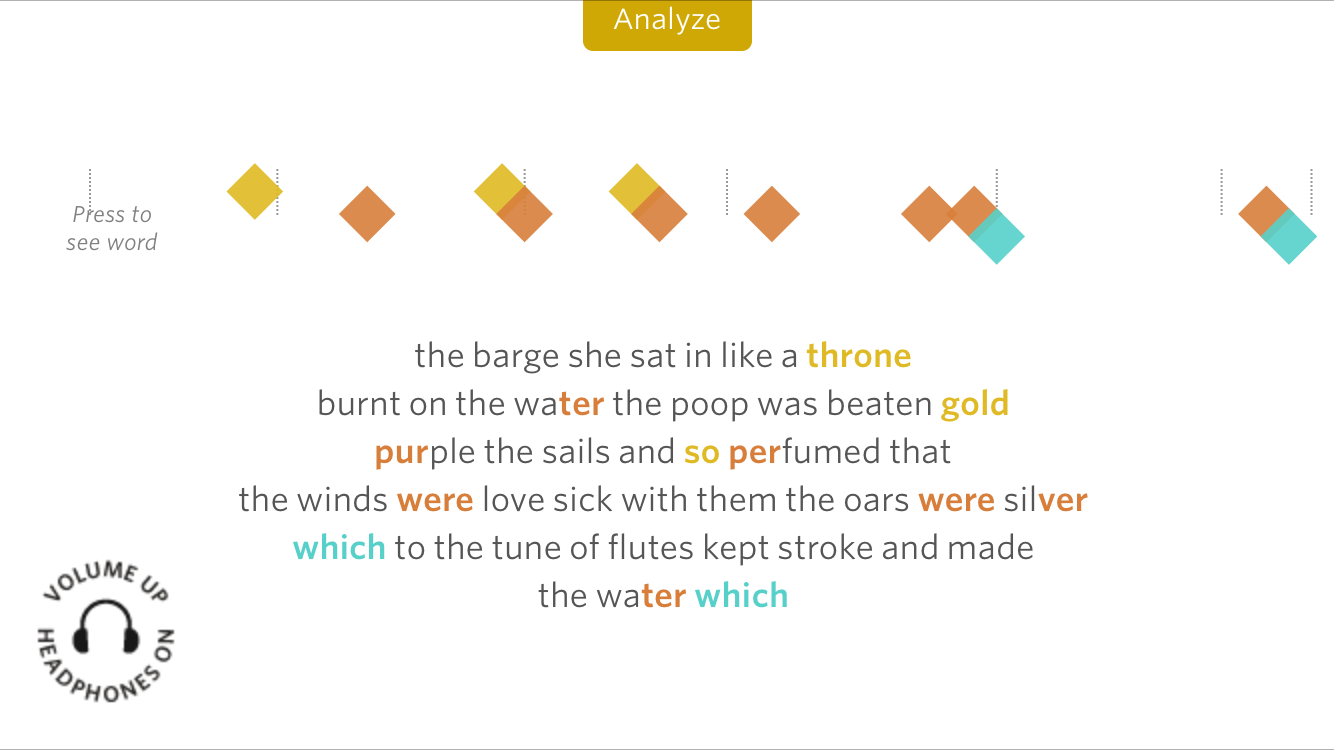
One more bonus review: this isn’t an app, but it’s a website created by Joel Eastman and Erik Hinton of the Wall Street Journal. Its purpose is to analyze the awesome lyric complexity of the Broadway musical “Hamilton.” http://graphics.wsj.com/hamilton/ 

The website uncovers the use of assonance, alliteration, near-rhymes, mid-line rhymes, and other strokes of Lin-Manuel Maranda’s lyrical brush. The best part is that you can feed any text you want into the website, and it will use the same algorithm to show you its lyrical elements, so I’d recommend using it as a tool to study Shakespeare. You’ll find that the Bard of Avon and Snoop Lion aren’t as different as they might seem.

So there you are, a few fun, friendly, and free tools for exploring the work and life of a timeless English playwright. As The Bard might say: “Sirs, betake you to your tools,” for such apps as these are only as good as the person who uses them.

Intro to Richard III

Hi everyone,

Introducing our new Play of the Month: Shakespeare’s dark history play about murder and corruption, Richard III. First, a short presentation I made that introduces the characters and themes of the play.


Second, a quick, funny summary of the play from the Reduced Shakespeare Company


And finally, this incredible animated version of the play, which looks like a stained-glass window come to life!

RIP Alan Rickman

Hung be the heavens with black, yield day to night! – William Shakespeare

One of the greatest classical actors of our time has gone to his great reward, which I hope includes a “good show” from Shakespeare himself. Most people know Alan Rickman as the slimy Professor Snape, or the evil Hans Gruber, or the cheating husband from “Love Actually,” but a generation ago he was a Shakespearean acting phenomenon at the Royal Shakespeare Company, playing such roles as Jaques, Hamlet, and Achilles. As much as I love Harry Potter, I think it’s wrong to remember such a versatile actor for only one role, so here’s a retrospective of his work that I found this morning. Guardian Tribute to Alan Rickman

“Good night sweet prince, and flights of angels sing thee to thy rest.”

How Shakespeare Celebrated Christmas Part 2: How the Nobles Celebrated Christmas

Once Shakespeare became a member of the Lord Chamberlain’s Men and later The King’s Men, the royals often requested that he and his company perform as the official royal entertainment at Christmas. Christmas for Shakespeare from 1592 to 1613 meant work. Nevertheless, it must’ve been a thrill for this country boy from Warwickshire England to see how the king and courtiers of his country would celebrate Christmas with elaborate feasts, parties, dances, and of course drama.

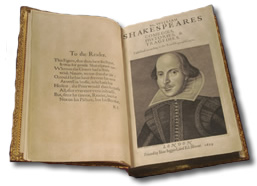
We know for a fact that Shakespeare was asked to perform at Christmas. As you can see on this title page for Shakespeare’s Loves Labors Lost, we have records of his plays being performed by name for the Christmas feast. In Tudor and Jacobean times, The Master of the Revels kept records of which plays he permitted to perform during the Christmas season and those records reveal what kind of entertainment each monarch enjoyed at Christmas.
Christmas at King Henry VIII’s palace

Although King Henry the Eighth died before Shakespeare was born, his Christmas feasts were so lavish I simply had to devote some space in this post to talk about him. Henry outlawed all sports and games at Christmastime during his reign, focusing instead on drama and feasts. Part of the reason that the king outlawed any kind of sports (except archery), was because of the huge caloric quantity ingested from his feasts. To be blunt, as Henry aged, his diet only got worse. Near the end of his life, he was so overweight, his attendants needed a crane to get him out of bed!

Henry’s Christmas feasts were the stuff of legend. One-third of his palace at Hampton Court was devoted to the kitchens! The feast would include as many exotic and expensive dishes as the king’s court could imagine!

Christmas turkey became popular in Henry the Eighth’s day, but it would certainly share a dish with peacock, hare, goose, and wild boar; the most vicious animal to kill in the wild forest. There’s even a Christmas carol called the Boar’s Head Carol, which celebrates how hard it was to procure and prepare such an animal. For Henry, exotic food was a symbol of his power and so he stocked his Christmas feast with the most elaborate food a king could buy to impress his nobles and visiting dignitaries.

After the feast, the court would sing together, often to unaccompanied music called madrigals. These were short, secular songs in multiple voice parts and they were the pop songs of Henry’s day; he even composed a few himself!

If you watch this video you can see an incredible documentary, where a group of historic food historians re-creating an elaborate Tudor feast: A Tudor Feast

If you liked this post, please consider signing up for my new online class, “What Was Christmas Like For William Shakespeare?” I’ll go further into the traditions of Elizabethan Christmas and add some insight into Shakespeare’s play “Twelfth Night.” Register now at Outschool.com!
– Shakespearean Student

What was Christmas Like For William Shakespeare?

Well, Christmas is almost here; soon many of us will be traveling home to celebrate the holidays with our families, enjoying parties, presents, carols, and decorations. However, our modern traditions weren’t always the norm for people who celebrate Christmas. In the interest of historical curiosity, we here at Shakespearean Student would like to talk a little bit about how William Shakespeare might’ve celebrated Christmas!

As with everything in Shakespeare’s life, many times scholars have nothing but “what if’s” to go on, because few records exist, there were no photos from the period, and very few documents survive related to Shakespeare. He also kept no journals or diaries to record what his life might’ve been like. However, based in the holiday traditions of England that have lingered on to this day, we can surmise what Christmas might’ve been like in the late 16th century.

Part 1: Stratford

Shakespeare was born in 1564, in the town of Stratford-Upon-Avon in the county of Warwickshire England. As I mentioned earlier, Shakespeare would not have known many of our modern Christmas traditions. The Christmas Tree as we know it didn’t come into being until Queen Victoria’s reign, (and she certainly didn’t light hers with electric lights). Victoria also invented the idea of putting presents under the tree. I’m not an expert on Christmas, but my research would indicate that probably Elizabethans like Shakespeare didn’t even give out presents on Christmas Day! Instead, in country towns like Stratford in Tudor times, Christmas was a time of feasting, singing, caroling, and theatre!

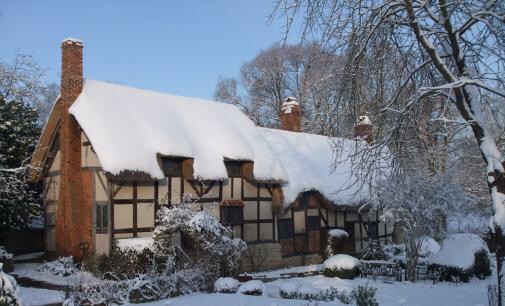
The Shakespeare family home at Christmas

Candleglow%20PR%20small[1]

The Christmas season in Shakespeare’s day usually extended from Christmas Eve to the twelfth night after Christmas also known as Twelfth Night or Epithany. Common people usually decorated their homes with holly and ivy, and celebrated Christmas Eve by lighting their homes with candles and by burning the Yule log, an ancient tradition dating back over 1,000 years when the Vikings controlled most of England. It was a symbol of light and warmth in the darkest time of the year.

Replica of Shakespeare’s kitchen.

Feasting-

Roast goose was a staple of the common man’s feast at Christmas. In 1588, Queen Elizabeth commanded the whole country to consume geese to commemorate England’s victory over the Spanish Armada. Other traditional fare included plum porridge, beer or ale, and the most celebrated Christmas beverage of all: Wassail!

Wasailing-

The old tradition of caroling comes from an ancient pagan holiday tradition of showing charity to the poor at the winter solstice. People would go door to door asking for alms and occasionally a warm beverage. This ancient practice evolved into caroling and Wasailing!

The word “wassail” is an old Celtic word that means “lambswool,” it refers to the fact that the drink is covered with a thin foam that looks kind of like the wool of a sheep. It is also derived from the Anglo-Saxon “wassail,” which means “be in health,” so it is simultaneously a drink, a toast, and an explanation of what the drink looks like.

Like our modern-day caroling, people would sing and dance going door to door asking for a traditional glass of wassail or a mince pie. A mince pie is a traditional meat pie that is often filled with 12 different ingredients to symbolize the 12 days of Christmas.
Mince pies were popular with both peasants and kings, and contains both fruit and different types of meat including rabbit chicken duck and hare.
Wasailing also has its roots in ancient pagan holidays and that’s why it’s often accompanied with a traditional Morris dance, where the dancers are waving handkerchiefs, knocking sticks together and dancing with brightly colored ribbons. This was a great tradition back in the small towns and shires of England and continues to this very day. Below you’ll find a video where you can make some wassail yourself! I Just a note that in this recipe, the cook has left out the alcohol and has also left out the egg which is necessary to create the foamy lambswool. Nonetheless I think it’s a very good recipe and I welcome you to try it for yourself.

Plays

As the mayor’s son, young William had a VIP pass to see all traveling actors who came to town. Shakespeare’s dad would’ve decided who got to perform at the guild halls and local inns, so he and his son would’ve watched private performances of all the shows first. After that, John Shakespeare decided who got to perform, and who would be sent away. In addition to professional troupes at Christmas, craftsmen in Will’s hometown people in Warwickshire would come together and put on a show! These amateur dramatic pieces were known as Mystery Plays.

Mystery Plays got their name from the old meaning of mystery: a trade or skill. Much like modern nativity plays or community theaters, every year all the craftsmen from the town would put on a series of short shows derived from Bible stories at Christmas time, and showcase their crafts as well as their acting talents. For example the goldsmiths were in charge of the Three Wise Men story.

We know that Shakespeare liked these plays because he refers to one in particular many, many times: The play of King Herod. in the Bible, Herod The Great is fearful of the baby Jesus and sends his soldiers to kill any young baby that they can find in the city of Jerusalem. Very often when Shakespeare refers to any of his villainous characters he describes them as Herod-like.

The Mysteries were printed during Shakespeare’s lifetime and people in York, Coventry, and Wakefield England still perform them today! Here’s a video of a little girl who performed in the York Mystery play last year:

I hope you enjoyed this little sojourn into the ancient traditions of the common folk back in Shakespeare’s England.

If you liked this post, please consider signing up for my new online class, “What Was Christmas Like For William Shakespeare?” I’ll go further into the traditions of Elizabethan Christmas and add some insight into Shakespeare’s play “Twelfth Night.” Register now at Outschool.com!

Till next time!

-The Shakespearean Student

Sources:

  1. Historic UK: A Tudor Christmas: http://www.historic-uk.com/HistoryUK/HistoryofEngland/A-Tudor-Christmas/
  2. Shakespeare Birthplace Trust: Christmas At Shakespeare’s Houses: http://www.shakespeare.org.uk/visit-the-houses/whats-on.html/christmas-holidays.html
  3. The Anne Bolyn Files: A Tudor Christmas: http://www.theanneboleynfiles.com/resources/tudor-life/tudor-christmas/
  4. Wassailing and Mumming: http://www.whychristmas.com/customs/wassailing.shtml